
Задание №6701.
Чтение. ЕГЭ по английскому
Прочитайте текст и заполните пропуски A — F частями предложений, обозначенными цифрами 1 — 7. Одна из частей в списке 1—7 лишняя.
Global financial crises
A global financial crisis affects people all over the world, but to very different degrees. Some people are lucky enough only to hear about it, while others are plunged into economic uncertainty, ___ (A).
A crisis occasionally arises from sudden bad decisions, but the cause is usually a collection of bad policies operated over an extended period. The financial crisis of 2008 was a result of a loosening of rules among banks. Changes in those regulations began during the 1980s, ___ (B) financial transactions with little supervision.
The system of regulation became one of trust; it was up to the banks to behave wisely, and the governments would stay out of it. The regulation of banks was, in a sense, left up to the free market, ___ (C). It allowed for transactions to flow more freely, which did in fact help economies grow during the 1980s and 1990s.
When the financial markets first ran into trouble, large banking institutions failed altogether, ___ (D). A small number of the worlds most wealthy people suffered greatly. But overall, the middle class and the poor suffered the worst of the crisis.
The 2010 Eurozone crisis is thought to be connected to the 2008 one. Governments that had borrowed enormous amounts to pay for problems caused two years earlier suddenly found themselves unable to support the debt. The Eurozone crisis was as severe as the one in 2008 ___ (E). More people would suffer as a result.
There is little that can be done to immediately fix a global financial crisis. Individuals can prepare for such an event by ___ (F). Naturally, everyone must fight to make sure governments put sensible banking policies in place before problems occur.
1. keeping money in savings and making sure they stay out of debt
2. and many policymakers felt this would be sufficient
3. and added yet another layer of uncertainty to world financial markets
4. resulting in the loss of their job, home or livelihood
5. which many people had saved for a number of years
6. which caused a domino effect that spread around the world
7. a decade when governments decided to let banks carry out
| A | B | C | D | E | F |
Решение:
Пропуску A соответствует часть текста под номером 4.
Пропуску B соответствует часть текста под номером 7.
Пропуску C соответствует часть текста под номером 2.
Пропуску D соответствует часть текста под номером 6.
Пропуску E соответствует часть текста под номером 3.
Пропуску F соответствует часть текста под номером 1.
Показать ответ
Источник: Тесты для подготовки к ЕГЭ по английскому языку, 2019. Вербицкая М., Манн М., Тейлор-Ноулз С.
Сообщить об ошибке
Тест с похожими заданиями
Упражнение 10 для подготовки к ЕГЭ по английскому языку.
Прочитайте текст и заполните пропуски A–F частями предложений, обозначенными цифрами 1–7. Одна из частей в списке 1–7 лишняя.
текстответ
A global financial crisis affects people all over the world, but to very different degrees. Some people are lucky enough only to hear about it, while others are plunged into economic uncertainty, A _______ .
A crisis occasionally arises from sudden bad decisions, but the cause is usually a collection of bad policies operated over an extended period. The financial crisis of 2008 was a result of a loosening of rules among banks. Changes in those regulations began during the 1980s, В ______ financial transactions with little supervision.
The system of regulation became one of trust; it was up to the banks to behave wisely, and the governments would stay out of it. The regulation of banks was, in a sense, left up to the free market C ______ . It allowed for transactions to flow more freely, which did in fact help economies grow during the 1980s and 1990s.
When the financial markets first ran into trouble, large banking institutions failed altogether, D _______ . A small number of the worlds most wealthy people suffered greatly. But overall, the middle class and the poor suffered the worst of the crisis.
The 2010 Eurozone crisis is thought to be connected to the 2008 one. Governments that had borrowed enormous amounts to pay for problems caused two years earlier suddenly found themselves unable to support the debt. The Eurozone crisis was as severe as the one in 2008 E _______. More people would suffer as a result.
There is little that can be done to immediately fix a global financial crisis. Individuals can prepare for such an event by F _______ . Naturally, everyone must fight to make sure governments put sensible banking policies in place before problems occur.
1. keeping money in savings and making sure they stay out of debt
2. and many policymakers felt this would be sufficient
3. and added yet another layer of uncertainty to world financial markets
4. resulting in the loss of their job, home or livelihood
5. which many people had saved for a number of years
6. which caused a domino effect that spread around the world
7. a decade when governments decided to let banks carry out
A-4; B-7; C-2; D-6; E-3; F-1
Global financial crises
A global financial crisis affects people all over the world, but to very different degrees. Some people are lucky enough only to hear about it, while others are plunged into economic uncertainty, resulting in the loss of their job, home or livelihood.
A crisis occasionally arises from sudden bad decisions, but the cause is usually a collection of bad policies operated over an extended period. The financial crisis of 2008 was a result of a loosening of rules among banks. Changes in those regulations began during the 1980s, a decade when governments decided to let banks carry out financial transactions with little supervision.
The system of regulation became one of trust; it was up to the banks to behave wisely, and the governments would stay out of it. The regulation of banks was, in a sense, left up to the free market and many policymakers felt this would be sufficient. It allowed for transactions to flow more freely, which did in fact help economies grow during the 1980s and 1990s.
When the financial markets first ran into trouble, large banking institutions failed altogether, which caused a domino effect that spread around the world. A small number of the worlds most wealthy people suffered greatly. But overall, the middle class and the poor suffered the worst of the crisis.
The 2010 Eurozone crisis is thought to be connected to the 2008 one. Governments that had borrowed enormous amounts to pay for problems caused two years earlier suddenly found themselves unable to support the debt. The Eurozone crisis was as severe as the one in 2008 and added yet another layer of uncertainty to world financial markets. More people would suffer as a result.
There is little that can be done to immediately fix a global financial crisis. Individuals can prepare for such an event by keeping money in savings and making sure they stay out of debt. Naturally, everyone must fight to make sure governments put sensible banking policies in place before problems occur.
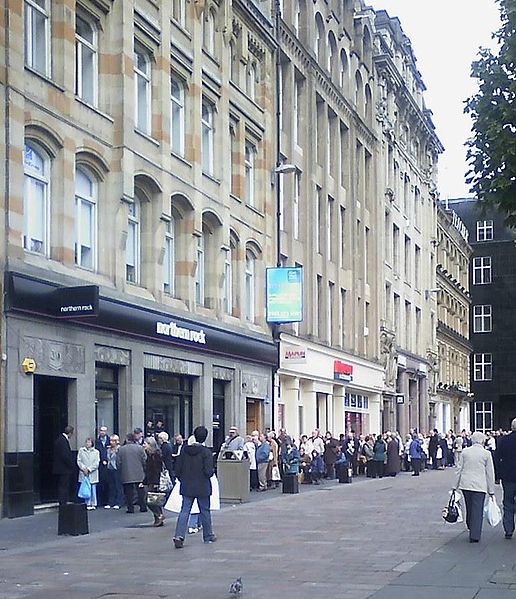
Run on the bank in Glasgow, UK, David MacKay, CC 2.0
Global Financial Crisis
This article will examine the global financial crisis that occurred beginning in 2008, and into 2009 and afterwards. In this article, we shall discuss the beginnings of the global financial crisis, the factors that led to the global financial crisis, the effects of the crisis, as well as the current state of the world given the 2008 financial crisis.
The Global Financial Crisis was one of the worst that the world has seen in decades. Economies across states were affected, and millions of jobs were lost. Moreover, it has taken years for the economy to rebound, and we are still not at levels prior to the global financial crisis. The question that many have posed is: what led to the 2008 financial crisis? As we shall see, there many factors that led to this global financial crisis. In this article, we shall discuss the role of banks, individuals, governments, and other key actors in the international system.
Deregulation of the International Markets
One of the primary causes of the recent 2008 financial crisis (and in turn the global financial crisis) was the deregulation of the financial markets in the United States and abroad. While the economic crisis occurred in 2008 and beyond, some argue that deregulation decades ago shaped the international market in a way that was less restricting on bank behavior. For example, in the mid 1970s until 1980, banks were a lot more freer to act, as regulations were taken off. Thus, “[f]or example, in 1980, commercial banks and savings and loans institutions were permitted to determine their own interest rates on deposits and loans, thereby spurring greater competition. Many smaller banks were acquired by larger, more distant banks” (Payne, 2013: 141). But along with deregulation of the domestic conditions facing banks in the United States, there were also pushes for international deregulations. Many banks were called for liberalization, arguing that they were lagging behind banks in other countries. Thus, some banks attempted to operate offshore in order to avoid restrictions (Payne, 2013). Moreover, increased technology, along with a belief in liberalization also helped move towards the idea of deregulation (Payne, 2013). And because of the deregulation, a number of companies were now more wiling to to take large risks, often away from the public idea. And a lot of this was because there were a lack of effective monitoring in place to hold such actors accountable (Payne, 2013). Moreover, it was at this time that we also saw the rise of hedge funds, which “[e]nabled wealthy investors to avoid some financial regulations in global financial markets” (Payne, 2013: 143).
Subprime Mortgage Crisis
Scholars argue that another key reason for the global financial crisis had to do with the subprime mortgage crisis and subprime loans. A subprime mortgage loan is where “credit is given to individuals who fail to meet rigorous standards usually expected by lending institutions” (Payne, 2013: 144). While “[t]he definition of what constitutes a “subprime” borrower is not precise, but it generally refers to a borrower with poor credit history (i.e. a FICO score below 620 or so) that pays a higher rate of interest on a loan” (Baily, Litan, & Johnson, 2008: 14) (there were also a category of borrowers under Alt-A, who were seen as “a bit less risky but not quite prime, [who] had better credit scores but little or no documentation of income” (Baily, Litan, & Johnson, 2008: 14)).
Many believe that the persons who were allowed to borrow money for homes did not have the necessary income, or sufficient credit scores to afford those homes. Moreover, banks were also very lenient on down payments; in many cases, 20 percent is often seen as safe, as it helps the banks ensure the owner is invested in the home, and in case they stop paying on the property, the bank will have some equity to take away from the transactions. However, in these cases, down payments were often not needed (Payne, 2013). And when this happens, particularly with loans that “had a very high loan to value ratio, perhaps as high as 100 percent…meaning that they started with no initial equity–and thus no true financial stake–in the house” (Baily, Liton, & Johnson, 2008: 17). And it has also been said that some bankers helped individuals by encouraging deceptive on loan applications, telling the person who is applying for the loan how to fill out parts of it (or what to purposely leave out). As Baily, Litan, & Johnson (2008) explain, “[s]ometimes the line will be fuzzy between a situation where broker helps a family navigate the application process so they can buy a house they really can afford, and a situation where the broker and the applicant are deliberately lying” (18).
Related to such issues of inability to actually afford the house that one was trying to purchase, there were various sorts of subprime mortgage loans such as adjustable rate mortgages (which had different interest rates over the years), balloon mortgages (where an individual would often pay a lower amount earlier, and then the payment would “balloon” after a certain number of years), as well as interest-only sorts of loans (Payne, 2013). With balloon payments, or example, there was a hope by those who entered into these agreements that they would have low rates for a set number of years, and then, when the payments increased at the agreed upon time, they would be able to pay them, and the house would be worth much more than it was worth when they made the initial purchase. Interestingly, the idea behind this was to eventually refinance as the house increased in value (Baily, Litan, & Johnson, 2008). However, when the time came for the increase in the payments, a number of individuals could not pay the new rate (Payne, 2013). And we also saw other non-traditional loans such as a piggyback loan, where a person who already purchased a home could get an additional loan on the existing home loan (Payne, 2013).
Baily, Litan & Johnson (2008) explain just how much of a rise we saw in subprime mortgages as it related to the factors of the 2008 financial crisis when they wrote:
Looking at the data, the deterioration in lending standards over the course of the boom is remarkable. The share of subprime loans originated as ARMs jumped from 51 to 81 percent from 1999 to 2006; for Alt-A loans, the share jumped from 6 to 70 percent during the same time period. A similar deterioration happened in combined loan to value ratios (the CLTV combines all liens against a property): the average CLTV ratio for originated subprime loans jumped from 79 to 86 percent. Furthermore, the share of full-doc subprime originations fell from 69 to 58 percent; for Alt-A loans it dropped from 38 to 16 percent” (18). (This data they used was from Ashcraft & Schuerman, 2008).
As the Economist (2013) explains the issue of these subprime mortgages with regards to the subprime mortgage crisis and the global financial crisis,
“The years before the crisis saw a flood of irresponsible mortgage lending in America. Loans were doled out to “subprime” borrowers with poor credit histories who struggled to repay them. These risky mortgages were passed on to financial engineers at the big banks, who turned them into supposedly low-risk securities by putting large numbers of them together in pools. Pooling works when the risks of each loan are uncorrelated. The big banks argued that the property markets in different American cities would rise and fall independently of one another. But this proved wrong. Starting in 2006, America suffered a nationwide house-price slump. The pooled mortgages were used to back securities known as collateralised debt obligations (CDOs), which were sliced into tranches by degree of exposure to default. Investors bought the safer tranches because they trusted the triple-A credit ratings assigned by agencies such as Moody’s and Standard & Poor’s. This was another mistake. The agencies were paid by, and so beholden to, the banks that created the CDOs. They were far too generous in their assessments of them.”
In fact, if one looks at the figures regarding lending in that time period (in the early 2000s), one saw that following 2003, the number of mortgages (and prime loan mortgages) actually fell in 2004-2006, but subprime loans rise drastically (Baily, Litan, & Johnson, 2008: 14).
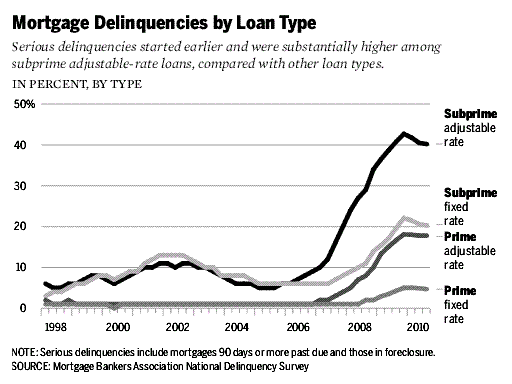
Mortgage_delinquencies_by_loan_type_1998-2010, National Commission on the Causes of the Financial and Economic Crisis in the United States, public opinion
Banks, Profits, and the 2008 Financial Crisis
All of these loans had an effect on the overall stability of the housing market, and thus lead to the 2008 financial crisis. However, it wasn’t that investors saw these as concerning. In fact, many were willing to back such subprime loans, as they saw them as a way to make money. And banks were willing to continue to offer these subprime loans because they believed they also could make much more money than other places, with far lower interest rates (Economist, 2013).
Before the deregulation push, banks were the primary actors with regards to offering loans, and collecting on these loan payments. However, we began to see securitization. Payne (2013) explains that “Securitization is a sophisticated process of financial engineering that allows global investment to be spread out and separated into multiple income streams to reduce risk” (143). However, this action affected housing prices; “securitization increased the amount of money available to individuals purchasing homes. This led to unprecedented growth in house prices. It also resulted in high default rates and the housing crisis” (Payne, 2013: 143). As Baily, Litan, & Johnson (2008) argue,
“The most perverse incentive in the mortgage origination market…is the ability of originators to immediately sell a completed loan off their books to another financial institution. Currently, most mortgage loans are originated by specialists and brokers who do not provide the funding directly. One institution provides the initial funding of the mortgage but then quickly sells it off to another financial institution, where either it is held on a balance sheet or packaged with other mortgages to be securitized. The key issue here is that the institution that initiates the loan has little or no financial incentive to make sure the loan is a good one. Most brokers and specialists are paid based on the volume of loans they process. They have an incentive to keep the pace of borrowing rolling along, even if that meant making riskier and riskier loans” (20).
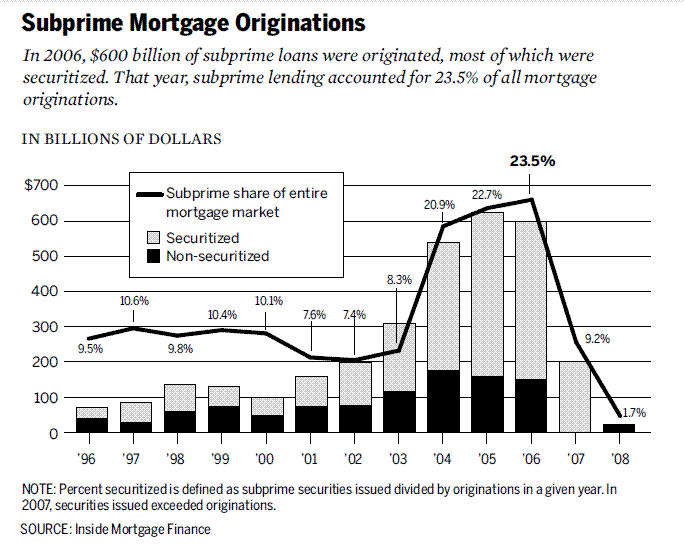
Subprime_mortgage_originations,_1996-2008, National Commission on the Causes of the Financial and Economic Crisis in the United States, public domain
Derivatives and the Global Financial Crisis
Another issue that further explains the 2008 financial crisis (and then global financial crisis) was the issue of derivatives. Derivatives are “…bets on the creditworthiness of a particular company, like insurance on a loan” (Payne, 2013: 143). Payne (2013) explains the role of derivatives with regards to the 2008 financial crisis when he explains that
There were two types of credit derivatives: credit default swaps and collateralized debt obligations. Credit default swaps were widely used, especially by insurance companies such as the American International Group (AIG). Life insurance companies invested in credit default swaps as assets. Parties involved in a credit default swap agreed that one would pay the other if a particular borrower, a third party, could not repay its loans. Credit default swaps were used to transfer credit risks away from banks. A major problem with credit default swaps was the lack of transparency. They were also unregulated. Ultimately, credit default swaps created confusion and encouraged excessive risk taking. It was difficult to determine where the risk ended up. Designed to pass on risks, loans were packaged as securities. Collateralized debt obligations are linked to mortgage companies, which passed on the risk, Mortgages, instead of being held by banks and mortgage companies, were sold to investors shortly after after the loans closed, and investors packaged them as securities” (143).
Speculation and the Global Financial Crisis
Throughout all of these issues with regards to the buildup to the 2008 financial crisis and the global financial crisis, there was a belief by many that housing prices would continue to rise. And because of this, what we saw was an increase in speculation, which “[i]nvolves excessive risk taking, excessive optimism, and the development of a herd mentality” (Payne, 2013: 146). In the case of the 2008 financial crisis, many continued to speculate on the prices of homes. They saw home sale prices rising, and in turn though out that this would continue. There were many factors that led to what many called a “speculative bubble.” Payne (2013) explains the four different steps to a speculative bubble:
- A new technology or invention changes people’s expectations and those who are well informed try to profit from it.
- Prices or profits continue to rise, which draws more people into the market.
- The boom passes into euphoria and rational decision making is suspended.
- The bust is almost inevitable. Prices and profits fall, companies and individuals go bankrupt, and the economy plunges into a recession” (146).
With regards to the economic crisis that occurred in 2008, one of the major issues was that people were doing just this; they were speculating on the housing market, thinking that prices would continue to increase. Some were looking at past trends, where, from the 1970s onward (until 2006), home prices rarely declined. Furthermore, increases were quite prevalent, with rises every single quarter from 1999 until just before the fourth quarter of 2007 (Baily, Litan, & Johnson: 2008). And looking toveall prices, “[r]ates of price increase moved above 6 percent in 1999, accelerating to 8 and then 9 percent before starting to slow at the end of 2005” (Baily, Litan, & Johnson, 2008: 11).
Seeing this data, many were onboard with speculating on the housing market. A number of individuals who were interviewed in 2003 supported the idea that real estate was the best possible investment for someone looking to invest in the long run (Case & Schiller, in Baily, Litan, & Johnson, 2008). This led to an increase in overall demand for homes (Baily, Litan, & Johnson, 2008). In fact, one of the reasons for the increase was this idea that since there was such a rise, that this would continue to take place, leading to higher prices (Baily, Litan, & Johnson, 2008).
Corporate Pay and Global Financial Crisis
One of the other reasons for the global financial crisis was said to be the pay levels of top individuals in various banks and related companies. There were incentives for those who could make money for the company, and the higher the stock went, the better the bonuses and pay was (Payne, 2013). Unfortunately, this lead to some individuals carrying out various fraud schemes in companies such as Enron, for example (Payne, 2013).
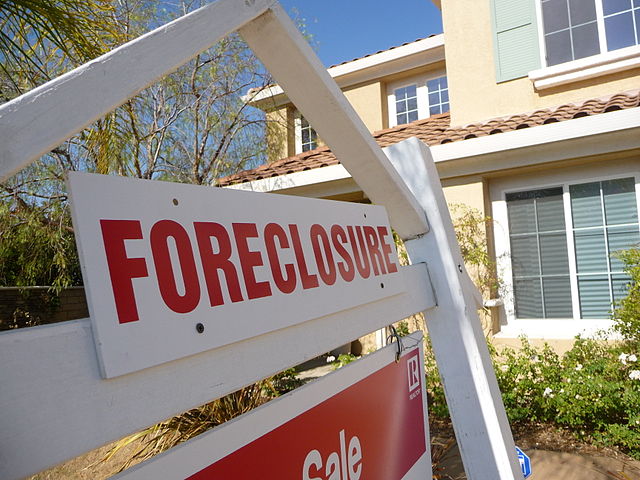
Sign of the Times-Foreclosure, 31 May 2008, respires, CC. 2.0
The Aftermath of the 2008 Financial Crisis
There were a number of effects to the 2008 Financial Crisis and in turn the global financial crisis. One of the biggest effects of the 2008 financial crisis within the United States was the housing crisis, with regards to foreclosures. With the collapse in housing prices, people owned much more on their mortgages than the home was worth. Looking at historical trends it seemed that “[o]ver the period 1995-2000, household income per capita rose substantially, contributing to the increased demand [of houses]. However, …the increase in house prices outpaced the growth of household income starting around 2000. One sign that house prices had moved too high is that they moved ahead much faster than real household income” (11).
In addition to the rise in prices compared to household income, many who got home mortgages were also unable to afford the mortgages, or the balloon payments (as discussed above). And others who were in the market to purchase a home had a tougher time doing so, whether because of credit, or the drops in value to their current homes. This affected construction of new homes, which in turn hurt industries reliant on the building of new homes. And thus, because of this, along with the overall decline in the economy, many individuals were losing jobs, which in turn further hurt their financial stability, and ability to pay the mortgages on their homes. When they were unable to do so, they foreclosed on their homes. It was said that “[o]ne in forty-five U.S. Households, or 3 million, received a foreclosure filing, and banks repossessed 1 million homes in 2010” (Payne, 2013: 147). Furthermore, the housing market did not improve in the years immediately after 2008 and 2009 (Payne, 2013).
The 2008 financial crisis had a detrimental effect on the U.S. economy. Along with the foreclosures, the subprime mortgage crisis and the overall economic crisis also hurt U.S. businesses. One of the hardest hit was the manufacturing industries, and in particular car companies. A number of companies such as General Motors, as well as Chrysler, went into bankruptcy. Overall industrial production was said to have an 11 percent decline in the United States (Payne, 2011: 148).
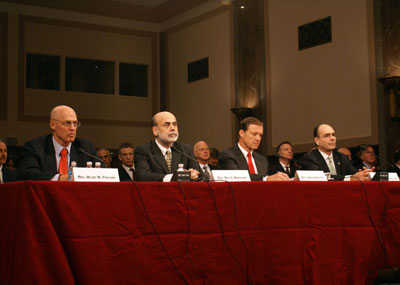
English: Treasury Secretary Henry Paulson, Federal Reserve Ben Bernanke, chairman of the SEC Christopher Cox, and James B. Lockhart III testifying on 2008-9-23 to Senate Banking Committee, 23 September 2008, public domain
The International Effects of the United States Financial Crisis
However, there was also a global financial crisis, where the U.S. economic crisis hurt companies trading abroad, as well as affected other countries and international businesses. For example, “[i]ndustrial production was down 12 percent in Europe…and 43 percent in Taiwan. Tightening credit and consumer fear ultimately created a downward spiral that significantly diminished global trade. Germany saw its exports drop by 20 percent [and] China’s exports fell by more than 25 percent” (Payne, 2013: 148). Furthermore, there has also been work discussing the 2008 Financial Crisis as it relates to states in the Global South (Naude, 2009).
References
Ashcraft, A.B. & Schuerman, T. (2008). Understanding the Securitization of Subprime Mortgage Credit. Staff Report no. 318, Federal Reserve Bank of New York. (March).
Baily, M.N., Litan, R.E. & M.S. Johnson (2008). The Origins of the Financial Crisis. Initiative on Business and Public Policy at Brookings. Fixing Finance Series, Paper 3, November 2008, pages 1-47.
Case, K.E. & Shiller, R.J. (2003). Is There a Bubble in the Housing Market? Brookings Papers on Economic Activity, 2, 2003, pages 299-342.
Economist (2013). The Origins of the Financial Crisis: Crash Course. September 7th, 2013. Available Online: http://www.economist.com/news/schoolsbrief/21584534-effects-financial-crisis-are-still-being-felt-five-years-article
Naude, W. (2009). The Financial Crisis of 2008 and the Developing Countries. United Nations University, Discussion Paper No. 2009/01, pages 1-20.
Payne, R. (2013). Global Issues. New York, New York. Pearson.


Cлайд 1

Rostov-on-Don Department of education Gymnasium 34 Vladislav Pismenskiy Form 10 “Б” Research project in English Science Topic : Global Financial Crisis (GFC) or the «Great Recession“ Project supervisor : Dolgopolskaya I.B. 2012
Cлайд 2
The notion of economic crisis General grounds Causes of the crisis Impact on financial markets Global effects Stabilization Economic forecasting and media coverage Conclusion Outline
Cлайд 3
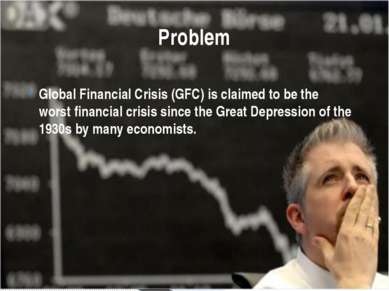
Global Financial Crisis (GFC) is claimed to be the worst financial crisis since the Great Depression of the 1930s by many economists. Problem
Cлайд 4
There is hardly ever any sphere of society that GFC didn’t touch. That’s why changes both in global economic relations and in the economy of a definite state and defining of the directions of further economic development have become urgent. Actuality
Cлайд 5
The term financial crisis is applied broadly to a variety of situations in which some financial institutions or assets suddenly lose a large part of their value. Financial crisis. What’s this? Financial crises recession or depression
Cлайд 6
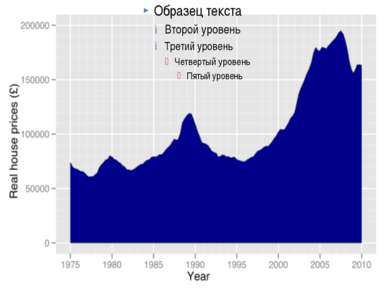
The source of financial crisis of 2008 lies in the banking system of the USA. It concerned valuation and liquidity problems but the roots go back to 2007 which is considered to be the peak of housing bubble.
Cлайд 7

Causes
Cлайд 8
Cлайд 9
Oil prices
Cлайд 10
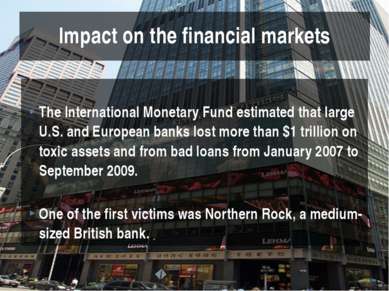
The International Monetary Fund estimated that large U.S. and European banks lost more than $1 trillion on toxic assets and from bad loans from January 2007 to September 2009. One of the first victims was Northern Rock, a medium-sized British bank. Impact on the financial markets
Cлайд 11
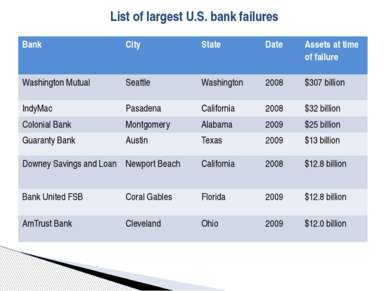
List of largest U.S. bank failures Bank City State Date Assets at time of failure WashingtonMutual Seattle Washington 2008 $307 billion IndyMac Pasadena California 2008 $32 billion Colonial Bank Montgomery Alabama 2009 $25 billion Guaranty Bank Austin Texas 2009 $13 billion Downey Savings and Loan Newport Beach California 2008 $12.8 billion Bank United FSB Coral Gables Florida 2009 $12.8 billion AmTrust Bank Cleveland Ohio 2009 $12.0 billion
Cлайд 12
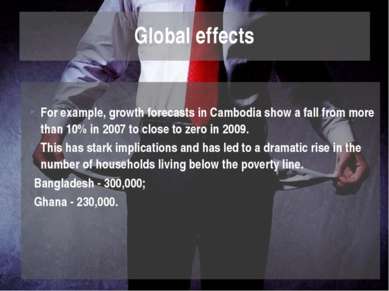
For example, growth forecasts in Cambodia show a fall from more than 10% in 2007 to close to zero in 2009. This has stark implications and has led to a dramatic rise in the number of households living below the poverty line. Bangladesh — 300,000; Ghana — 230,000. Global effects
Cлайд 13
The recession that began in December 2007 ended in June 2009, according to U.S. National Bureau of Economic Research (NBER) and the financial crisis appears to have ended about the same time. Nevertheless, the lack of fundamental changes in banking and financial markets, worries many market participants, including the International Monetary Fund. Stabilization
Cлайд 14
The financial crisis was not widely predicted by mainstream economists, who instead spoke of the Great Moderation. A number of economists predicted the crisis, with varying arguments. A cover story in BusinessWeek magazine claims that economists mostly failed to predict the worst international economic crisis since the Great Depression of 1930s. Within mainstream financial economics, most believe that financial crises are simply unpredictable. Lebanese-American trader and financial risk engineer Nassim Nicholas Taleb warned against the breakdown of the banking system in particular and the economy in general owing to their use of bad risk models and reliance on forecasting and framed the problem as part of «robustness and fragility». Role of economic forecasting
Cлайд 15
Mass media focused great attention to the world financial crises. It has generated many articles, books, films etc. Trying to find the reason, the ways out of the crisis and those who are to blame for it. For example, Time Magazine named «25 People to Blame for the Financial Crisis» Media coverage
Cлайд 16
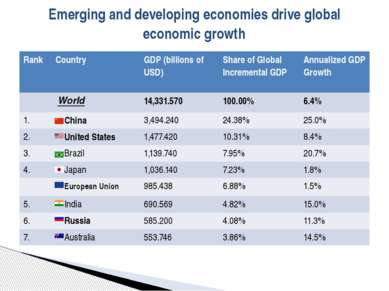
Emerging and developing economies drive global economic growth Rank Country GDP (billions of USD) Share of Global Incremental GDP Annualized GDP Growth World 14,331.570 100.00% 6.4% 1. China 3,494.240 24.38% 25.0% 2. United States 1,477.420 10.31% 8.4% 3. Brazil 1,139.740 7.95% 20.7% 4. Japan 1,036.140 7.23% 1.8% European Union 985.438 6.88% 1.5% 5. India 690.569 4.82% 15.0% 6. Russia 585.200 4.08% 11.3% 7. Australia 553.746 3.86% 14.5%
Cлайд 17
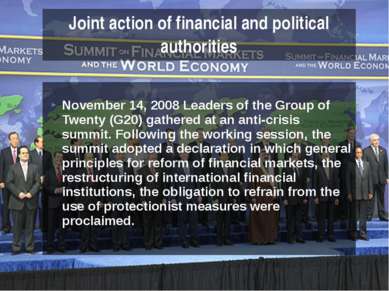
November 14, 2008 Leaders of the Group of Twenty (G20) gathered at an anti-crisis summit. Following the working session, the summit adopted a declaration in which general principles for reform of financial markets, the restructuring of international financial institutions, the obligation to refrain from the use of protectionist measures were proclaimed. Joint action of financial and political authorities
Cлайд 18
Summing up, the investigation outlined the reasons of the crisis and its consequences and mainly the fact that the stabilization and further development of financial market is possible only by joint efforts of all the leading economies. But the crisis turned out to be not so deep and the global financial system didn’t undergo crucial changes thanks to the interference of the state into the financial market. Though, not all the reasons were done away with economies of leading states still live under threat of the following crises. Conclusion
Cлайд 19

Thank you for your attention!
Causes of Global Financial Crisis
The current global financial crisis is in nature synchronised and once in lifetime. There are different views regarding causes of the current financial crisis which has gripped the whole world. Some attribute it to failure of regulators and policy makers others say it is financial institutions. Yet others put the onus on savings of emerging market countries especially China.
No doubt current crisis clearly reflect lack of vision on part of policy makers. The free market and deregulation mantra rigorously promoted by leading policy makers during the last decade shifted the attention of all stakeholders away from regulating even the riskiest and complex financial derivative instruments which are hardly comprehendible for anyone except few mathematical and statistical magicians. If there would have been even a reasonable level of oversight of these complex financial derivatives, things would not be that worse as they are today. The chart below gives a very high level overview of the increase in the notional amount of outstanding over the counter (OTC) derivatives that multiplied almost seven times from just USD 94 trillion in June 2000 to USD 683.7 trillion in June 2008 as reported by Bank for International Settlements.
Chart o/s otc derivatives june 2000 to june 2008
The ignorance of regulators even added fuel to the fire. Regulators are not just there to ensure compliance with existing laws but to identify and rectify any loopholes in the existing regulations. On one hand, US federal reserve kept the interest rates at very low levels for extended period of time in order to avoid natural downturn in the economy and thereby created abundant liquidity in the system and promoted a culture of extravagance and living beyond means. The world will not finance US consumer spending forever as the debt needs repayment which is not possible if you spend more than you earn. Savings as a percentage of household disposable income gradually decreased from 9% In 1980 to 1% in 2007 as published by Federal agencies which clearly reflect this culture. Even at one point in 2005 it went into negative zone which means US consumers were spending more than they were earning.
On the other hand, assumption that the financial market participants can look after their interests better than anyone else, promoted an illusion that there is no need to regulate the financial system. This assumption was flawed and completely ignored two factors, the element of competition in the financial services industry and greed. If I put myself into the shoes of those banking executives I might do the same as they did because if I adopt a conservative approach towards risk short term profitability will be hit and there would be huge pressure and criticism from various groups e.g. investors, media etc. regarding the performance of my organisation as compared to other market players. Though short sighted criticism by media or analysts does not prove legitimatecy for blind risk taking in order to boost short term profitability at the cost of long term survival of the organisation. Moreover, linkage between short term performance and remuneration packages of executives provoked them to take unusually high risk which produce huge profits in short term.
In addition to that, not only financial institutions but also credit rating agencies mispriced the risk. They failed to price risk attributable to externalities. The simplest example of pricing externalities is taking into account impact of failure of the organisation in question on the whole financial system e.g. in case failure of Citibank there will huge impact on the financial system as compared to failure of any small regional financial institution making it more expensive to bet on Citibank. Risks are generally mispriced not only in the financial services industry but also in other industries e.g. automobile industry, the price of a car only includes manufacturing cost plus margin, taxes etc. but the pricing mechanism does not take into account the cost of impact of that car on the environment and decline in the available energy resources.
Financial engineering has proved too expensive for the global economy so far. Complex derivative financial instruments like Credit Default Swaps (CDS) and Collateral Debt Obligations (CDO) no doubt increased the liquidity in the system but at the same time encouraged reckless lending practices e.g. sub prime lending and speculation.
CDO is a security whose principal and interest are repaid by the cash flows generated by a portfolio of assets (usually loans and bonds). The portfolio of assets is the collateral and it is usually in the balance sheet of a separate entity, called special purpose vehicle, which has the CDO as its only liability and the assets in the portfolio as its only assets. It is CDOs and similar financial instruments that enabled the originators of loans to sell loan portfolios and thereby increased the liquidity of the long term loans. It is interesting that a financial institution can now sell the loan it has originated to someone sitting at the other corner of the globe through instruments like CDOs thus transferring the inherent credit risk involved in the lending and promoted careless lending practices. This is simple logic which also applies at individual level e.g. if one knows he can sell the loan he lent to anyone and earn a profit then one will not hesitate to give the money even to a person to whom no one will lend a penny. This is what exactly happened in the case of sub prime lending.
CDS is an instrument in which the buyer makes periodic payments to the seller, and in return receives a compensation if an underlying financial instrument defaults. It is effectively insurance against default by the counterparty with the difference that in case of insurance insurer is regulated and adhere to insurance regulations e.g. capital requirements whilst in the case of CDS the writer or seller need not to be a regulated entity thus increasing the counterparty risk which in my view is a huge regulatory failure. Due to this flaw huge amount of CDS were sold by hedge funds without any consideration whether the entity will be capable to pay the compensation if it is required in the future. On top of that market participants bought and sold CDS for speculative purposes i.e. without having the underlying asset similar to short selling o f equities.The following table illustrate the outstanding notional amount of CDS and corresponding market values from June 2007 to June 2008. Though outstanding notional amount has just increased by 35% corresponding market values has soared to USD 3.1 trillion more than 4 times of market value at June 2007 that gives clear idea of increase in counterparty default risk since this crisis began. The recoverability of these USD 3.1 trillion is questionable if called.
Table CDS june 2007 to 2008
Savings of the emerging market countries especially China is said to be among one of the main causes of the current financial crisis. The main argument is that the savings of emerging markets have to find a home and instead of investment in the real economic assets they were made available to consumers in west notably Americans to mortgage a house or to buy a car etc. I can not understand the logic behind sky rocket hike in the price of a dwelling house which is not contributing to real economy. Almost all economists were agreed that the model of ‘Asians make it, Americans buy it’ is not sustainable in the long term and that Asians have to increase their domestic consumption in order to maintain economic growth in the long term. Whilst, Chinese savings were increasing sharply and reached to …. in …. US saving both on national and individual level was decreasing as noted above. One need not to be a rocket scientist to determine that one can not live on borrowing forever as one will loose his credibility sooner or later and Americans have to reduce consumption and increase savings. It is evident from the recent data that Americans saving rate at individual level has increased since the inception of the crisis from …. In jan 2008 To … in jan 2009.
No matter what are causes of the crisis there is no doubt about that we are in huge trouble. The vicious spiral of decrease in overall economic output, as demonstrated below, has begun and no one knows where it will end and how many will it take away with it. Interestingly, none of the five giant investment banks has sustained this crisis. Bear Stern and Merrill Lynch were acquired by JP Morgan and Bank of America respectively, Lehman Brothers gone bankrupt and the remaining two Goldman Sachs and Morgan Stanley changed their status from investment bank to deposit accepting institutions. We have witnessed events beyond imagination for instance freezing of commercial paper market, fall of stock markets by more than 40% in a year etc.
Одно из заданий на чтение ЕГЭ по английскому языку предполагает заполнение пропусков в тексте частями предложений. На этой странице приводятся решение заданий из открытой базы Федерального института педагогических измерений (фипи).
|
Задание 1 >> Задание 28 >> |
The Global Financial Crisis
Download the complete Explainer
117KB
The global financial crisis (GFC) refers to the period
of extreme stress in global financial markets
and banking systems between mid 2007 and
early 2009. During the GFC, a downturn in the
US housing market was a catalyst for a financial
crisis that spread from the United States to the
rest of the world through linkages in the global
financial system. Many banks around the world
incurred large losses and relied on government
support to avoid bankruptcy. Millions of people
lost their jobs as the major advanced economies
experienced their deepest recessions since the
Great Depression in the 1930s. Recovery from the
crisis was also much slower than past recessions
that were not associated with a financial crisis.
Main Causes of the GFC
As for all financial crises, a range of factors explain
the GFC and its severity, and people are still
debating the relative importance of each factor.
Some of the key aspects include:
1. Excessive risk-taking in a favourable macroeconomic environment
In the years leading up to the GFC, economic
conditions in the United States and other
countries were favourable. Economic growth
was strong and stable, and rates of inflation,
unemployment and interest were relatively
low. In this environment, house prices
grew strongly.
Expectations that house prices would continue
to rise led households, in the United States
especially, to borrow imprudently to purchase
and build houses. A similar expectation on
house prices also led property developers and
households in European countries (such as
Iceland, Ireland, Spain and some countries in
Eastern Europe) to borrow excessively. Many of
the mortgage loans, especially in the United
States, were for amounts close to (or even
above) the purchase price of a house. A large
share of such risky borrowing was done by
investors seeking to make short-term profits by
‘flipping’ houses and by ‘subprime’ borrowers
(who have higher default risks, mainly because
their income and wealth are relatively low
and/or they have missed loan repayments in
the past).
Banks and other lenders were willing to make
increasingly large volumes of risky loans for a
range of reasons:
- Competition increased between individual
lenders to extend ever-larger amounts of
housing loans that, because of the good
economic environment, seemed to be very
profitable at the time. - Many lenders providing housing loans did not
closely assess borrowers’ abilities to make loan
repayments. This also reflected the widespread
presumption that favourable conditions
would continue. Additionally, lenders had little
incentive to take care in their lending decisions
because they did not expect to bear any losses.
Instead, they sold large amounts of loans to
investors, usually in the form of loan packages
called ‘mortgage-backed securities’ (MBS),
which consisted of thousands of individual
mortgage loans of varying quality. Over time,
MBS products became increasingly complex and opaque,
but continued to be rated by external agencies as if they were very safe. - Investors who purchased MBS products mistakenly thought that they were buying a
very low risk asset: even if some mortgage loans in the package were not repaid,
it was assumed that most loans would continue to be repaid. These investors
included large US banks, as well as foreign banks from Europe and other
economies that sought higher returns than could be achieved in their local
markets.
2. Increased borrowing by banks and investors
In the lead up to the GFC, banks and other investors in the United States and abroad
borrowed increasing amounts to expand their lending and purchase MBS products.
Borrowing money to purchase an asset (known as an increase in leverage) magnifies
potential profits but also magnifies potential losses.[1]
As a result, when house
prices began to fall, banks and investors incurred large losses because they had
borrowed so much.
Additionally, banks and some investors increasingly borrowed money for very short
periods, including overnight, to purchase assets that could not be sold quickly.
Consequently, they became increasingly reliant on lenders – which included other
banks – extending new loans as existing short-term loans were repaid.
3. Regulation and policy errors
Regulation of subprime lending and MBS products was too lax. In particular, there was
insufficient regulation of the institutions that created and sold the complex and
opaque MBS to investors. Not only were many individual borrowers provided with loans
so large that they were unlikely to be able to repay them, but fraud was
increasingly common – such as overstating a borrower’s income and over-promising
investors on the safety of the MBS products they were being sold.
In addition, as the crisis unfolded, many central banks and governments did not
fully recognise the extent to which bad loans had been extended during the boom and
the many ways in which mortgage losses were spreading through the financial system.
How the GFC Unfolded
US house prices fell, borrowers missed repayments
The catalysts for the GFC were falling US house prices and a rising number of
borrowers unable to repay their loans. House prices in the United States peaked
around mid 2006, coinciding with a rapidly rising supply of newly built houses in
some areas. As house prices began to fall, the share of borrowers that failed to
make their loan repayments began to rise. Loan repayments were particularly
sensitive to house prices in the United States because the proportion of US
households (both owner-occupiers and investors) with large debts had risen a lot
during the boom and was higher than in other countries.
Stresses in the financial system
Stresses in the financial system first emerged clearly around mid 2007. Some lenders
and investors began to incur large losses because many of the houses they
repossessed after the borrowers missed repayments could only be
sold at prices below the loan balance. Relatedly,
investors became less willing to purchase MBS
products and were actively trying to sell their
holdings. As a result, MBS prices declined, which
reduced the value of MBS and thus the net worth
of MBS investors. In turn, investors who had
purchased MBS with short-term loans found it
much more difficult to roll over these loans, which
further exacerbated MBS selling and declines in
MBS prices.
Spillovers to other countries
As noted above, foreign banks were active
participants in the US housing market during
the boom, including purchasing MBS (with
short-term US dollar funding). US banks also had
substantial operations in other countries. These
interconnections provided a channel for the
problems in the US housing market to spill over to
financial systems and economies in other countries.
Failure of financial firms, panic in financial markets
Financial stresses peaked following the failure
of the US financial firm Lehman Brothers in
September 2008. Together with the failure or near
failure of a range of other financial firms around
that time, this triggered a panic in financial markets
globally. Investors began pulling their money out
of banks and investment funds around the world
as they did not know who might be next to fail
and how exposed each institution was to subprime
and other distressed loans. Consequently, financial
markets became dysfunctional as everyone tried
to sell at the same time and many institutions
wanting new financing could not obtain it.
Businesses also became much less willing to invest
and households less willing to spend as confidence
collapsed. As a result, the United States and some
other economies fell into their deepest recessions
since the Great Depression.
Policy Responses
Until September 2008, the main policy response
to the crisis came from central banks that lowered
interest rates to stimulate economic activity,
which began to slow in late 2007. However,
the policy response ramped up following the
collapse of Lehman Brothers and the downturn in
global growth.
Lower interest rates
Central banks lowered interest rates rapidly to very
low levels (often near zero); lent large amounts
of money to banks and other institutions with
good assets that could not borrow in financial
markets; and purchased a substantial amount
of financial securities to support dysfunctional
markets and to stimulate economic activity once
policy interest rates were near zero (known as
‘quantitative easing’).
Increased government spending
Governments increased their spending to
stimulate demand and support employment
throughout the economy; guaranteed deposits
and bank bonds to shore up confidence in
financial firms; and purchased ownership stakes in
some banks and other financial firms to prevent
bankruptcies that could have exacerbated the
panic in financial markets.
Although the global economy experienced its
sharpest slowdown since the Great Depression,
the policy response prevented a global depression.
Nevertheless, millions of people lost their jobs,
their homes and large amounts of their wealth.
Many economies also recovered much more
slowly from the GFC than previous recessions
that were not associated with financial crises.
For example, the US unemployment rate only
returned to pre-crisis levels in 2016, about nine
years after the onset of the crisis.
Stronger oversight of financial firms
In response to the crisis, regulators strengthened their oversight of banks and
other financial institutions. Among many new global regulations, banks must now
assess more closely the risk of the loans they are providing and use more resilient
funding sources. For example, banks must now operate with lower leverage and can’t
use as many short-term loans to fund the loans that they make to their customers.
Regulators are also more vigilant about the ways in which risks can spread
throughout the financial system, and require actions to prevent the spreading of
risks.
Australia and the GFC
Relatively strong economic performance
Australia did not experience a large economic downturn or a financial crisis during
the GFC. However, the pace of economic growth did slow significantly, the
unemployment rate rose sharply and there was a period of heightened uncertainty. The
relatively strong performance of the Australian economy and financial system during
the GFC, compared with other countries, reflected a range of factors, including:
- Australian banks had very small exposures to the US housing market and US banks,
partly because domestic lending was very profitable. - Subprime and other high-risk loans were only a small share of lending in
Australia, partly because of the historical focus on lending standards by the
Australian banking regulator (the Australian Prudential Regulation Authority
(APRA)). - Australia’s economy was buoyed by large resource exports to China, whose economy
rebounded quickly after the initial GFC shock (mainly due to expansionary fiscal
policy).
Also a large policy response
Despite the Australian financial system being in a much better position before the
GFC, given the magnitude of the shock to the global economy and to confidence more
broadly, there was also a large policy response in Australia to ensure that the
economy did not suffer a major downturn. In particular, the Reserve Bank lowered the
cash rate significantly, and the Australian Government undertook expansionary fiscal
policy and provided guarantees on deposits at and bonds issued by Australian banks.
Following the crisis, APRA implemented the stronger global banking regulations in
Australia. Together, APRA and the financial market and corporate regulator, the
Australian Securities and Investments Commission, have also strengthened lending
standards to make the financial and private sectors more resilient.