
The Big Bang
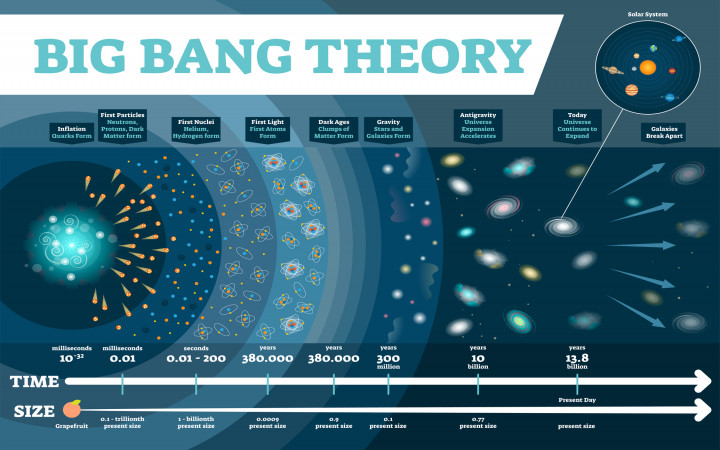
Most astronomers believe the Universe began in a Big Bang about 14 billion years ago. At that time, the entire Universe was inside a bubble that was thousands of times smaller than a pinhead. It was hotter and denser than anything we can imagine.
Then it suddenly exploded. The Universe that we know was born. Time, space and matter all began with the Big Bang. In a fraction of a second, the Universe grew from smaller than a single atom to bigger than a galaxy. And it kept on growing at a fantastic rate. It is still expanding today.
As the Universe expanded and cooled, energy changed into particles of matter and antimatter. These two opposite types of particles largely destroyed each other. But some matter survived. More stable particles called protons and neutrons started to form when the Universe was one second old.
Over the next three minutes, the temperature dropped below 1 billion degrees Celsius. It was now cool enough for the protons and neutrons to come together, forming hydrogen and helium nuclei.
After 300 000 years, the Universe had cooled to about 3000 degrees. Atomic nuclei could finally capture electrons to form atoms. The Universe filled with clouds of hydrogen and helium gas.
Last modified 20 June 2014
Story of the Universe
- Подробности
-
24622
 |
||
| Прочитайте текст. Заполните пропуски в предложениях под номерами В04-В12 соответствующими формами слов, напечатанных заглавными буквами справа от каждого предложения. TEST 08 (part 1) |
Computer revolution
|
B4 |
50 years ago people even did not hear/ didn’t hear of computers, and today we cannot imagine life without them. Computer technology is the fastest-growing industry in the world. |
NOT HEAR |
|
B5 |
The first computer was the size of a minibus and weighed a ton. |
BE |
|
B6 |
Today, its job can be done by a chip the size of a pin head. And the revolution is still going on. |
DO |
|
B7 |
The next generation of computers will be able to talk and even think for themselves. Of course, they’ll be a lot simpler than human brains, but it will be a great step forward. Such computers will help to diagnose illnesses, find minerals, identify criminals and control space travel. |
BE ABLE |
|
B8 |
Some people say that computers are dangerous, but I do not agree / don’t agree with them. They save a lot of time. They seldom make mistakes. |
NOT AGREE |
|
B9 |
It’s much easier to surf the Internet than to go to the library. |
EASY |
|
B10 |
On-line shopping makes it possible to find exactly what you want, saving both time and money. |
MAKE |
|
B11 |
E-mail is a great invention, too. It’s faster than sending a letter and cheaper than sending a telegram. |
BE |
|
B12 |
All in all, I strongly believe that computers are a useful tool. They have changed our life for the better. So why shouldn’t we make them work to our advantage? |
CHANGE |
Пройти тестирование по этим заданиям
Вернуться к каталогу заданий
Версия для печати и копирования в MS Word
1
Imagine that you are preparing a project with your friend. You have found some interesting material for the presentation and you want to read this text to your friend. You have 1.5 minutes to read the text silently, then be ready to read it out aloud. You will not have more than 1.5 minutes to read it.
… You don’t see many birds in winter. Most have left your area. Those that stay are not as active. Activity uses energy that is needed to keep warm. The worst problems for birds in winter are getting enough heat and holding on to the heat once it is made. These are problems for all birds. But it is especially true for very small ones. They cannot find enough food. The weather stays so cold for so long that they cannot eat enough to keep alive. But birds have many ways of fighting the cold.
You shiver to keep warm. The heat that you make is made mostly in your muscles. The muscles make more heat when they are active. So one way of keeping warm is to move about, use your muscles. Another way is to shiver. When your body needs heat, the muscles tighten and loosen quickly. They become active. Just as you shiver to keep warm, so do birds.
Источник: Демонстрационная версия ЕГЭ—2015 по английскому языку
2
Imagine that you are preparing a project with your friend. You have found some interesting material for the presentation and you want to read this text to your friend. You have 1.5 minutes to read the text silently, then be ready to read it out aloud. You will not have more than 1.5 minutes to read it.
How many nostrils do you have? Four. Two you can see, two you can’t. This discovery came from observing how fish breathe. Fish get their oxygen from water. Most of them have two pairs of nostrils, a forward-facing set for letting water in and a pair of «exhaust pipes» for letting it out again. The question is, if humans evolved from fishes, where did the other pair of nostrils go. The answer is that they migrated back inside the head to become internal. To do this they somehow had to work their way back through the teeth.
Similar gaps between the teeth can also be seen at an early stage of the human birth. When they fail to join up, the result is a cleft palate. So one ancient fish explains two ancient human mysteries. The most recent research on noses, incidentally, shows that we use each of our two external nostrils to detect different smells.
Источник: РЕШУ ЕГЭ
3
Imagine that you are preparing a project with your friend. You have found some interesting material for the presentation and you want to read this text to your friend. You have 1.5 minutes to read the text silently, then be ready to read it out aloud. You will not have more than 1.5 minutes to read it.
Antarctica is the driest place on Earth. Parts of the continent have seen no rain for two million years. A desert is technically defined as a place that receives less than 10 inches of rain a year. The Sahara gets just 1 inch of rain a year.
As well as the driest place on Earth, Antarctica can also claim to be the wettest and the windiest. Seventy percent of the world’s fresh water is found there in the form of ice, and its wind speeds are the fastest ever recorded. The unique conditions in the Dry Valleys of Antarctica are caused by so-called katabatic winds. These occur when cold, dense air is pulled downhill simply by the force of gravity. Though Antarctica is a desert, these completely dry parts of it are called, somewhat ironically, oases. They are so similar to conditions on Mars that NASA used them to test the Viking mission.
Источник: РЕШУ ЕГЭ
4
Imagine that you are preparing a project with your friend. You have found some interesting material for the presentation and you want to read this text to your friend. You have 1.5 minutes to read the text silently, then be ready to read it out aloud. You will not have more than 1.5 minutes to read it.
The highest mountain is located on Mars. The giant volcano Mount Olympus is the highest mountain in the solar system and in the known universe. At 14 miles and 388 miles across, it is almost three times the height of Mount Everest and so wide that its base would cover Arizona, or the whole of the area of the British Isles. The crater on the top is around 45 miles wide and over nearly 2 miles deep, easily big enough to swallow London.
We traditionally measure mountains by their height. If we measured them by their size, it would be meaningless to isolate one mountain in a range from the rest. That being so, Mount Everest would dwarf Olympus Mons. It is part of the gigantic range which is nearly 1,500 miles long.
Источник: РЕШУ ЕГЭ
5
Imagine that you are preparing a project with your friend. You have found some interesting material for the presentation and you want to read this text to your friend. You have 1.5 minutes to read the text silently, then be ready to read it out aloud. You will not have more than 1.5 minutes to read it.
The ostrich is the bird that lays the smallest egg for its size. Although it is the largest single cell in nature, an ostrich egg is less than 2 per cent of the weight of the mother. A wren’s egg, by comparison, is 13 per cent of its weight. The largest egg in comparison with the size of the bird is that of the Little Spotted kiwi. Its egg accounts for 26 per cent of its own weight.
An ostrich egg weighs as much as twenty-four hen’s eggs; to soft-boil one takes forty-five minutes. Queen Victoria tucked into one for breakfast and declared it among the best meals she had ever eaten. The largest egg laid by any animal – including the dinosaurs – belonged to the elephant bird of Madagascar, which became extinct in 1700. It was ten times the size of an ostrich egg, nine litres in volume and the equivalent of 180 chicken’s eggs.
Источник: РЕШУ ЕГЭ
Пройти тестирование по этим заданиям
SCIENCE — Earth and Space
Have You Ever Wondered…
- What is the Big Bang?
- What caused the Big Bang?
- Is there only one universe?
Today’s Wonder of the Day was inspired by Audrey. Audrey Wonders, “What is the Big Bang Theory?” Thanks for WONDERing with us, Audrey!
Our world is full of interesting questions. What happened to the dinosaurs? Are ghosts real? What about aliens? In Wonderopolis, we love making new discoveries. We want to learn something new about the world every day.
However, there are a lot of questions that don’t have answers yet. What is dark matter? Can anything live inside a black hole? What caused the Big Bang? Some people are frustrated by questions that don’t have answers. However, we think it’s fun to learn about all the possible answers to a question. We can look at the evidence ourselves to decide what we believe.
Have you ever heard of the Big Bang theory? It’s a scientific explanation of the history of our universe. Based on the name, you might expect that it starts with an explosion. However, that’s not the case. Instead, the Big Bang starts with an expansion.
According to the Big Bang theory, our universe was once smaller than an atom. All the matter in the universe was held in a tiny point with a huge mass. This point is called a singularity. Around 13.8 billion years ago, that tiny point began to expand quickly. It grew, and it grew, and it kept growing.
As the universe grows, it’s also cooling. Just after the Big Bang, the universe was so hot that light wasn’t possible. Can you imagine that? There was no light anywhere. Slowly, as matter cooled, the first stars formed, giving off light. Other matter formed into planets, comets, asteroids, and everything else in our universe.
Based on the evidence they’ve gathered, many experts think the Big Bang was the beginning of time. If that’s true, then what caused the Big Bang? The short answer is, we don’t know. And we likely won’t know for a long time. However, scientists have many ideas.
Some experts believe the Big Bang was more of a big bounce. This would mean that our universe is one in a series of universes. In the big bounce, our expanding universe keeps growing until it stops. At some point, it begins to shrink. Growing smaller and smaller, the universe returns to the point of singularity. There, it bounces. The Big Bang begins again, with a new universe expanding as ours once did.
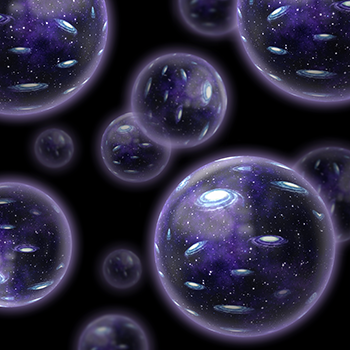
Other experts believe that the Big Bang wasn’t the beginning of time. Instead, they think there could be other universes growing all around us. Some scientists believe universes are constantly bumping into each other and setting off Big Bangs. This would cause a limitless number of other universes that exist in a multiverse.
Scientists David Sloan, Julian Barbour, Tim Koslowski, and Flavio Mercati think there could be a mirror universe to our own. They called it the flipped universe. In that universe, time flows in the opposite direction of our own. It would exist on the other side of the point of singularity.
Stephen Hawking also thought there could be more than one universe. In his final paper, he said that our universe could be a projection of a two-dimensional universe. If this is true, the other universe would have caused the Big Bang.
Some people don’t believe in the Big Bang at all. Many religions instead believe that an all-powerful god created the world. In fact, a 2014 AP poll found that 51% of Americans were either unsure about the Big Bang or didn’t believe it ever happened. Clearly, there are many questions about the beginning of our universe left to answer.
We may never know what caused the Big Bang. What do you think? Was the Big Bang caused by another universe? Was it a big bounce? Do you have your own idea? We’re sure it‘s out of this world!
Standards:
NGSS.ESSA1.1, NGSS.PS1.A, CCRA.L.3, CCRA.L.6, CCRA.R.1, CCRA.R.2, CCRA.R.10, CCRA.W.2, CCRA.W.4, CCRA.W.7, CCRA.W.8, CCRA.W.9, CCRA.L.1, CCRA.L.2, CCRA.SL.1, CCRA.SL.2
Wonder What’s Next?
And they’re off! Tomorrow’s Wonder of the Day will have you racing to the finish line.
Try It Out
Find an adult friend or family member to help you with these activities!
- Ready to read some of the evidence for yourself? Check out this explanation of the Big Bang theory. Then, write a paragraph explaining the Big Bang theory to a friend or family member.
- Imagine you have the chance to meet an expert on space and physics. What questions would you ask them about the Big Bang? How about anything else in our world? Write a list of questions. Then, ask a friend or family member to help you search for answers online or at the library.
- Our universe is huge and full of things we don’t understand. Take a look at these 10 strange objects. Which one is most interesting to you? Describe it to a friend or family member and explain what makes it interesting.
Wonder Sources
- https://www.nationalgeographic.com/science/space/universe/origins-of-the-universe/ (accessed 09 May 2019)
- https://science.nasa.gov/astrophysics/focus-areas/what-powered-the-big-bang (accessed 09 May 2019)
- https://www.nbcnews.com/mach/science/what-happened-big-bang-ncna995216(accessed 09 May 2019)
- http://www.hawking.org.uk/the-beginning-of-time.html (accessed 09 May 2019)
- https://www.mnn.com/earth-matters/space/stories/time-actually-existed-big-bang-according-new-theory (accessed 09 May 2019)
- https://www.universetoday.com/139167/heres-stephen-hawkings-final-theory-about-the-big-bang/ (13 May 2019)
- https://www.theatlantic.com/technology/archive/2014/04/a-majority-of-americans-question-the-science-of-the-big-bang/360976/ (13 May 2019)
Did you get it?
Test your knowledge
Wonder Contributors
We’d like to thank:
Austin, Ayaan, sean and Scarlett
for contributing questions about today’s Wonder topic!
Keep WONDERing with us!
What are you wondering?
Related Wonders for You to Explore

If you’re interested in the smallest things known to scientists, there’s something you should know. They are extraordinarily ill-behaved. But that’s to be expected. Their home is the quantum world.
Explainer: Quantum is the world of the super small
These subatomic bits of matter don’t follow the same rules as objects that we can see, feel or hold. These entities are ghostly and strange. Sometimes, they behave like clumps of matter. Think of them as subatomic baseballs. They also can spread out as waves, like ripples on a pond.
Although they might be found anywhere, the certainty of finding one of these particles in any particular place is zero. Scientists can predict where they might be — yet they never know where they are. (That’s different than, say, a baseball. If you leave it under your bed, you know it’s there and that it will stay there until you move it.)

“The bottom line is, the quantum world just doesn’t work in the way the world around us works,” says David Lindley. “We don’t really have the concepts to deal with it,” he says. Trained as a physicist, Lindley now writes books about science (including quantum science) from his home in Virginia.
Here’s a taste of that weirdness: If you hit a baseball over a pond, it sails through the air to land on the other shore. If you drop a baseball in a pond, waves ripple away in growing circles. Those waves eventually reach the other side. In both cases, something travels from one place to another. But the baseball and the waves move differently. A baseball doesn’t ripple or form peaks and valleys as it travels from one place to the next. Waves do.
But in experiments, particles in the subatomic world sometimes travel like waves. And they sometimes travel like particles. Why the tiniest laws of nature work that way isn’t clear — to anyone.
Consider photons. These are the particles that make up light and radiation. They’re tiny packets of energy. Centuries ago, scientists believed light traveled as a stream of particles, like a flow of tiny bright balls. Then, 200 years ago, experiments demonstrated that light could travel as waves. A hundred years after that, newer experiments showed light could sometimes act like waves, and sometimes act like particles, called photons. Those findings caused a lot of confusion. And arguments. And headaches.
Wave or particle? Neither or both? Some scientists even offered a compromise, using the word “wavicle.” How scientists answer the question will depend on how they try to measure photons. It’s possible to set up experiments where photons behave like particles, and others where they behave like waves. But it’s impossible to measure them as waves and particles at the same time.
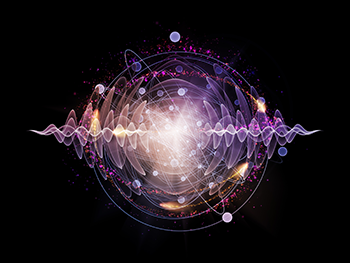
This is one of the bizarre ideas that pops out of quantum theory. Photons don’t change. So how scientists study them shouldn’t matter. They shouldn’t only see a particle when they look for particles, and only see waves when they look for waves.
“Do you really believe the moon exists only when you look at it?” Albert Einstein famously asked. (Einstein, born in Germany, played an important role in developing quantum theory.)
This problem, it turns out, is not limited to photons. It extends to electrons and protons and other particles as small or smaller than atoms. Every elementary particle has properties of both a wave and a particle. That idea is called wave-particle duality. It’s one of the biggest mysteries in the study of the smallest parts of the universe. That’s the field known as quantum physics.
Quantum physics will play an important role in future technologies — in computers, for example. Ordinary computers run calculations using trillions of switches built into microchips. Those switches are either “on” or “off.” A quantum computer, however, uses atoms or subatomic particles for its calculations. Because such a particle can be more than one thing at the same time — at least until it’s measured — it may be “on” or “off” or somewhere in-between. That means quantum computers can run many calculations at the same time. They have the potential to be thousands of times faster than today’s fastest machines.
IBM and Google, two major technology companies, are already developing superfast quantum computers. IBM even allows people outside the company to run experiments on its quantum computer.
Experiments based on quantum knowledge have produced astonishing results. For example, in 2001, physicists at Harvard University, in Cambridge, Mass., showed how to stop light in its tracks. And since the mid-1990s, physicists have found bizarre new states of matter that were predicted by quantum theory. One of those — called a Bose-Einstein condensate — forms only near absolute zero. (That’s equivalent to –273.15° Celsius, or –459.67° Fahrenheit.) In this state, atoms lose their individuality. Suddenly, the group acts as one big mega-atom.
Quantum physics isn’t just a cool and quirky discovery, though. It’s a body of knowledge that will change in unexpected ways how we see our universe — and interact with it.
A quantum recipe
Quantum theory describes the behavior of things — particles or energy — on the smallest scale. In addition to wavicles, it predicts that a particle may be found in many places at the same time. Or it may tunnel through walls. (Imagine if you could do that!) If you measure a photon’s location, you might find it in one place — and you might find it somewhere else. You can never know for certain where it is.
Also weird: Thanks to quantum theory, scientists have shown how pairs of particles can be linked — even if they’re on different sides of the room or opposite sides of the universe. Particles connected in this way are said to be entangled. So far, scientists have been able to entangle photons that were 1,200 kilometers (750 miles) apart. Now they want to stretch the proven entanglement limit even farther.
Quantum theory thrills scientists — even as it frustrates them.
It thrills them because it works. Experiments verify the accuracy of quantum predictions. It also has been important to technology for more than a century. Engineers used their discoveries about photon behavior to build lasers. And knowledge about the quantum behavior of electrons led to the invention of transistors. That made possible modern devices such as laptops and smartphones.
But when engineers build these devices, they do so following rules that they don’t fully understand. Quantum theory is like a recipe. If you have the ingredients and follow the steps, you end up with a meal. But using quantum theory to build technology is like following a recipe without knowing how food changes as it cooks. Sure, you can put together a good meal. But you couldn’t explain exactly what happened to all of the ingredients to make that food taste so great.
Scientists use these ideas “without any idea of why they should be there,” notes physicist Alessandro Fedrizzi. He designs experiments to test quantum theory at Heriot-Watt University in Edinburgh, Scotland. He hopes those experiments will help physicists understand why particles act so strangely on the smallest scales.
Is the cat okay?
If quantum theory sounds strange to you, don’t worry. You’re in good company. Even famous physicists scratch their heads over it.
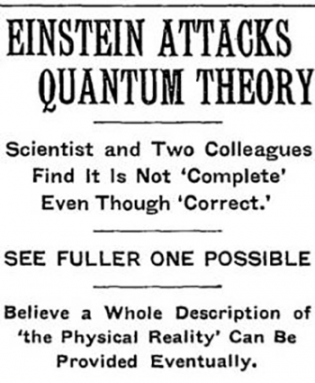
Remember Einstein, the German genius? He helped describe quantum theory. And he often said he didn’t like it. He argued about it with other scientists for decades.
“If you can think about quantum theory without getting dizzy, you don’t get it,” Danish physicist Niels Bohr once wrote. Bohr was another pioneer in the field. He had famous arguments with Einstein about how to understand quantum theory. Bohr was one of the first people to describe the weird things that pop out of quantum theory.
“I think I can safely say that nobody understands quantum [theory],” noted American physicist Richard Feynman once said. And yet his work in the 1960s helped show that quantum behaviors aren’t science fiction. They really happen. Experiments can demonstrate this.
Quantum theory is a theory, which in this case means it represents scientists’ best idea about how the subatomic world works. It’s not a hunch, or a guess. In fact, it’s based on good evidence. Scientists have been studying and using quantum theory for a century. To help describe it, they sometimes use thought experiments. (Such research is known as theoretical.)
In 1935, Austrian physicist Erwin Schrödinger described such a thought experiment about a cat. First, he imagined a sealed box with a cat inside. He imagined the box also contained a device that could release a poison gas. If released, that gas would kill the cat. And the probability the device released the gas was 50 percent. (That’s the same as the chance that a flipped coin would turn up heads.)
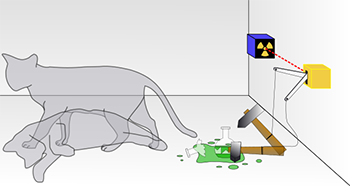
To check the status of the cat, you open the box.
The cat is either alive or dead. But if cats behaved like quantum particles, the story would be stranger. A photon, for instance, can be a particle and a wave. Likewise, Schrödinger’s cat can be alive and dead at the same time in this thought experiment. Physicists call this “superposition.” Here, the cat won’t be one or the other, dead or alive, until someone opens the box and takes a look. The fate of the cat, then, will depend on the act of doing the experiment.
Schrödinger used that thought experiment to illustrate a huge problem. Why should the way that the quantum world behaves depend on whether someone is watching?
Welcome to the multiverse
Anthony Leggett has been thinking about this problem for 50 years. He’s a physicist at the University of Illinois at Urbana-Champaign. In 2003, he won a Nobel Prize in physics, the most prestigious award in his field. Leggett has helped develop ways to test quantum theory. He wants to know why the smallest world doesn’t match with the ordinary one we see. He likes to call his work “building Schrödinger’s cat in the laboratory.”
Leggett sees two ways to explain the problem of the cat. One way is to assume that quantum theory will eventually fail in some experiments. “Something will happen that is not described in the standard textbooks,” he says. (He has no idea what that something might be.)
The other possibility, he says, is more interesting. As scientists conduct quantum experiments on larger groups of particles, the theory will hold. And those experiments will unveil new aspects of quantum theory. Scientists will learn how their equations describe reality and be able to fill in the missing pieces. Eventually, they will be able to see more of the whole picture.
Simply put, Leggett hopes: “Things that right now seem fantastic will be possible.”
Some physicists have proposed even wilder solutions to the “cat” problem. For example: Maybe our world is one of many. It’s possible that infinitely many worlds exist. If true, then in the thought experiment, Schrödinger’s cat would be alive in half the worlds — and dead in the rest.
Quantum theory describes particles like that cat. They may be one thing or another at the same time. And it gets weirder: Quantum theory also predicts that particles may be found in more than one place at a time. If the many-world idea is true, then a particle might be in one place in this world, and somewhere else in other worlds.
This morning, you probably chose which shirt to wear and what to eat for breakfast. But according to the many worlds idea, there is another world where you made different choices.
This weird idea is called the “many-world” interpretation of quantum mechanics. It is exciting to think about, but physicists have not found a way to test whether it’s true.
Tangled up in particles
Quantum theory includes other fantastic ideas. Like that entanglement. Particles may be entangled — or connected — even if they’re separated by the width of the universe.
Imagine, for instance, that you and a friend had two coins with a seemingly magical connection. If one showed up heads, the other would always be tails. You each take your coins home and then flip them at the same time. If yours comes up heads, then at the exact same moment you know your friend’s coin has just come up tails.
Entangled particles work like those coins. In the lab, a physicist can entangle two photons, then send one of the pair to a lab in a different city. If she measures something about the photon in her lab — such as how fast it moves — then she immediately knows the same information about the other photon. The two particles behave as though they send signals instantaneously. And this will hold even if those particles are now separated by hundreds of kilometers.
Story continues below video.
VIDEO BY B. BELLO; IMAGE BY NASA; MUSIC BY CHRIS ZABRISKIE (CC BY 4.0); PRODUCTION & NARRATION: H. THOMPSON
As in other parts of quantum theory, that idea causes a big problem. If entangled things send signals to each other instantly, then the message might seem to travel faster than the speed of light — which, of course, is the speed limit of the universe! So that cannot happen.
In June, scientists in China reported a new record for entanglement. They used a satellite to entangle six million pairs of photons. The satellite beamed the photons to the ground, sending one of each pair to one of two labs. The labs sat 1,200 kilometers (750 miles) apart. And each pair of particles remained entangled, the researchers showed. When they measured one of a pair, the other one was affected immediately. They published those findings in Science.
Scientists and engineers are now working on ways to use entanglement to link particles over ever-longer distances. But the rules of physics still prevent them from sending signals faster than the speed of light.
Why bother?
If you ask a physicist what a subatomic particle really, truly is, “I don’t know that anyone can give you an answer,” says Lindley.
Many physicists are content with not knowing. They work with quantum theory, even though they don’t understand it. They follow the recipe, never quite knowing why it works. They may decide that if it works, why bother going any further?
Others, like Fedrizzi and Leggett, want to know why particles are so weird. “It’s far more important to me to find out what’s behind all of this,” Fedrizzi says.
Forty years ago, scientists were skeptical that they could do such experiments, notes Leggett. Many thought that asking questions about the meaning of quantum theory was a waste of time. They even had a refrain: “Shut up and calculate!”
Leggett compares that past situation to exploring sewers. Going into sewer tunnels might be interesting but not worth visiting more than once.
“If you were to spend all your time rummaging around in the bowels of the Earth, people would think you were rather strange,” he says. “If you spend all your time on the foundations of quantum [theory], people will think you’re a little odd.”
Now, he says, “the pendulum has swung the other way.” Studying quantum theory has become respectable again. Indeed, for many it has become a lifelong quest to understand the secrets of the tiniest world.
“Once the subject hooks you, it won’t let you go,” says Lindley. He, by the way, is hooked.
Power Words
More About Power Words
atom The basic unit of a chemical element. Atoms are made up of a dense nucleus that contains positively charged protons and uncharged neutrons. The nucleus is orbited by a cloud of negatively charged electrons.
behavior The way something, often a person or other organism, acts towards others, or conducts itself.
electron A negatively charged particle, usually found orbiting the outer regions of an atom; also, the carrier of electricity within solids.
engineer A person who uses science to solve problems. As a verb, to engineer means to design a device, material or process that will solve some problem or unmet need.
entanglement (in quantum physics) A concept in quantum physics that holds that subatomic particles can be linked even if they are not physically near one another. Quantum entanglement can link the properties of things at great distances — perhaps at opposite ends of the universe.
equation In mathematics, the statement that two quantities are equal. In geometry, equations are often used to determine the shape of a curve or surface.
field An area of study, as in: Her field of research was biology. Also a term to describe a real-world environment in which some research is conducted, such as at sea, in a forest, on a mountaintop or on a city street. It is the opposite of an artificial setting, such as a research laboratory.
laser A device that generates an intense beam of coherent light of a single color. Lasers are used in drilling and cutting, alignment and guidance, in data storage and in surgery.
matter Something that occupies space and has mass. Anything on Earth with matter will have a property described as «weight.»
microchip A tiny wafer of semiconducting material (the chip), often silicon, which holds tiny electronic parts and the «wiring» needed to connect them to an electric circuit. Or a small computer chip that is implanted in goods or animals and acts like a tag. It holds information that can be retrieved as needed (such as an animal’s name or the inventory lot for commercial products.
multiverse A term to connote the idea that our universe may be one of many (perhaps an infinite number of alternative universes) and that different things may happen in each.
Nobel prize A prestigious award named after Alfred Nobel. Best known as the inventor of dynamite, Nobel was a wealthy man when he died on December 10, 1896. In his will, Nobel left much of his fortune to create prizes to those who have done their best for humanity in the fields of physics, chemistry, physiology or medicine, literature and peace. Winners receive a medal and large cash award.
particle A minute amount of something.
photon A particle representing the smallest possible amount of light or other electromagnetic radiation.
physics The scientific study of the nature and properties of matter and energy. A scientist who works in such areas is known as a physicist.
probability A mathematical calculation or assessment (essentially the chance) of how likely something is to occur.
proton A subatomic particle that is one of the basic building blocks of the atoms that make up matter. Protons belong to the family of particles known as hadrons.
quantum (pl. quanta) A term that refers to the smallest amount of anything, especially of energy or subatomic mass.
quantum mechanics A branch of physics dealing with the behavior of matter on the scale of atoms or subatomic particles.
quantum physics A branch of physics that uses quantum theory to explain or predict how a physical system will operate on the scale of atoms or sub-atomic particles.
quantum theory A way to describe the operation of matter and energy at the level of atoms. It is based on an interpretation that at this scale, energy and matter can be thought to behave as both particles and waves. The idea is that on this very tiny scale, matter and energy are made up of what scientists refer to as quanta — miniscule amounts of electromagnetic energy.
radiation (in physics) One of the three major ways that energy is transferred. (The other two are conduction and convection.) In radiation, electromagnetic waves carry energy from one place to another. Unlike conduction and convection, which need material to help transfer the energy, radiation can transfer energy across empty space.
satellite A moon orbiting a planet or a vehicle or other manufactured object that orbits some celestial body in space.
science fiction A field of literary or filmed stories that take place against a backdrop of fantasy, usually based on speculations about how science and engineering will direct developments in the distant future. The plots in many of these stories focus on space travel, exaggerated changes attributed to evolution or life in (or on) alien worlds.
sewer A system of water pipes, usually running underground, to move sewage (primarily urine and feces) and stormwater for collection — and often treatment — elsewhere.
skeptical Not easily convinced; having doubts or reservations.
smartphone A cell (or mobile) phone that can perform a host of functions, including search for information on the internet.
subatomic Anything smaller than an atom, which is the smallest bit of matter that has all the properties of whatever chemical element it is (like hydrogen, iron or calcium).
superposition (in quantum physics) The ability of some minute subatomic-scale particle to be more than one place at the same time. It has to do with particles in the quantum world having the weird capacity to exist in all possible states (or positions) at once. (in geology) An understanding that unless subsurface strata of soil and rock have been disturbed somehow, the age of the materials will get successively older with depth.
theory (in science) A description of some aspect of the natural world based on extensive observations, tests and reason. A theory can also be a way of organizing a broad body of knowledge that applies in a broad range of circumstances to explain what will happen. Unlike the common definition of theory, a theory in science is not just a hunch. Ideas or conclusions that are based on a theory — and not yet on firm data or observations — are referred to as theoretical. Scientists who use mathematics and/or existing data to project what might happen in new situations are known as theorists.
thought experiments Mathematical analyses of ideas, situations or events. They are not based on real-world tests in a lab or the environment. They instead use numbers and relationships between mathematical operations to test whether something can or will happen. This is also known as theoretical research.
transistor A device that can act like a switch for electrical signals.
universe The entire cosmos: All things that exist throughout space and time. It has been expanding since its formation during an event known as the Big Bang, some 13.8 billion years ago (give or take a few hundred million years).
verify (n. verification) To demonstrate or confirm in some way that a particular claim or suspicion is true.
wave A disturbance or variation that travels through space and matter in a regular, oscillating fashion.
wave-particle duality The concept that a subatomic particle can exhibit properties of a wave and a particle. But at any one time it will only show attributes of being either a wave or a particle.
wavicle A term invented in 1928 by the British physicist Arthur Stanley Eddington to convey the duality of light and radiation as being both waves and particles, although they never appear to be both at the same time.
Citations
Journal: J. Yin et al. Satellite-based entanglement distribution over 1200 kilometers. Science. Vol. 356, June 16, 2017, p. 1140. doi: 10.1126/science.aan3211.
Journal: M. Ringbauer et al. Measurements on the reality of the wavefunction. Nature Physics. Vol. 11, March 2015, p. 249. doi: 10.1038/NPHYS3233.
Book: D. Lindley. Uncertainty: Einstein, Heisenberg, Bohr, and the Struggle for the Soul of Science. Anchor Books, 2008, 272 pp.
Journal: C. Liu et al. Observation of coherent optical information storage in an atomic medium using halted light pulses. Nature. Vol. 409, January 25, 2001, p. 490. doi: 10.1038/35054017.
Book: D. Lindley. Where Does The Weirdness Go? Why Quantum Mechanics Is Strange, But Not As Strange As You Think. Basic Books, 1997, 268 pp.
Questions for ‘The quantum world is mind-bogglingly weird’
Wordfind (click here)
Stephen Ornes lives in Nashville, Tenn., and his family has two rabbits, six chickens and a cat. He has written for Science News Explores since 2008 on topics including lightning, feral pigs, big bubbles and space junk.
Вопрос
ЕГЭ 2018 Английский язык ПЧ Раздел 2 (чтение) Задание 10
Прочитайте тексты и установите соответствие между текстами и их заголовками: к каждому тексту, обозначенному буквами A-G в первом столбце, подберите соответствующий заголовок из второго столбца.
Тексты
Правильный ответ
A — Cordial Acknowledgements.
B — Confusing Hypotheses.
C — What It Is Like.
D — Alive and Kicking.
E — In line with Expectations.
F — Gains in Democracy.
G — Good Things and Bad Things Together.
Оставить комментарий
Комментарии (0)

Добавьте в закладки!
Нажмите Ctrl+D в своем браузере!
Нашли ошибку?
Выделите её и нажмите Ctrl+Enter. Помогите сайту!
Советы
Не ошибается тот, кто ничего не делает! Человек, заряженный на успех, добьётся большего, чем тот, кто боится ошибок и нерешителен в действиях.
- Вконтакте
- Telegram

Официальный канал нашего сайта в Telegram.
Новости в сфере образования
Объяснение различных тем
Помощь в подготовке
Подписаться
1) Установите соответствие между заголовками 1 — 8 и текстами A — G. Используйте каждую цифру только один раз. В задании один заголовок лишний.
1. See a snake crawling down
2. Natural wonder
3. Created to protect
4. Mysterious rocks
5. Lost city
6. The really cool place
7. Go there now
8. Ancient sculptures
A. Eight thousand feet above sea level, this five-century-old pre-Columbian site was once home to the Incas. Until American historian Hiram Bingham publicized his findings of the area in a book called “Across South America,” the mountain-top ruins were widely unknown to anyone living outside of the Urubamba Valley. Since Spanish colonialists had no idea of Machu Picchu’s existence, Incan architecture and design of the buildings were preserved.
B. Does the arrangement of the 25-ton sandstone blocks at Stonehenge suggest some sort of spiritual prediction? No one really knows. Theories about the nearly 5,000-year-old circular stone structure vary. The most intriguing time to visit Stonehenge is at sunset when a yellow-orange glow can be seen through the magnificent towers’ arches making some people believe that it was originally a place of healing, while others think it was used for ancestor worship.
C. The 1,500-year-old pyramids, located near the town of Merida, may be less popular than their equivalents in Egypt, but they are just as remarkable. Although there are many structures there like the Temple of the Warriors or the Wall of Skulls, the main attraction is El Castillo, the 78-foot, 91-step central pyramid. The absolute best time to travel to El Castillo is at sunset when shadows give the illusion that a large serpent is sliding down the pyramid.
D. The Earth’s southernmost point, Antarctica, is the driest and coldest of the seven continents. For a place that is 98 per cent covered in one-mile-deep ice, it is hard to imagine why anyone would want to visit it at all. But there is a strange beauty about Antarctica that is incomparable to anywhere else on the planet. Anyway, while Antarctica has no permanent residents, there are often up to 5,000 researchers working there at a time.
E. It is believed that hundreds of years ago the natives of Easter Island carved massive heads out of stone to honor their ancestors. Today, there are 887 “moai,” as the statues are called, which create a mysterious, yet intriguing landscape on this Polynesian island, which is a four-and-a-half hour flight from Lima, Peru. The tallest statue on the island, named Paro, is 33 feet high and weighs 82 tons.
F. North America’s Red Canyon is 277 river miles long, eighteen miles wide, and one mile deep, and if it doesn’t make your mouth drop with surprise, then you might not be human! Most tourists go there by car and there are plenty of spots along the way to pull the car over and have a look from the top. You can also go down into the canyon’s depths and experience the very heart of the canyon by going rafting on the Colorado River, and even spend the night at a hotel below the rim.
G. Thousands of miles long, the Great Wall of China is the largest cultural object humans have ever built. It majestically snakes through China, winds around rising and falling hills, twists through an enormous countryside, and stretches from Shanhaiguan in the east to Lop Lake in the west. However, the wall was constructed more than 2,000 years ago not to amaze people, but in an attempt to keep out invading tribes from the north.
| A | B | C | D | E | F | G |
2) Прочитайте текст и заполните пропуски A — F частями предложений, обозначенными цифрами 1 — 7. Одна из частей в списке 1—7 лишняя.
Finding your sportsman spirit
Doing sports, we can really test our physical fitness in contest, and it is one of the only ways that nations clash peacefully. Sportsmen and sportswomen are today’s warriors — the contests ___ (A) on the pitches and courts are the closest things we have to gladiatorial fighting.
If sportsmen are like warriors, then the ‘sportsman spirit’ could be considered the closest thing we have to a warrior’s code — to bushido or to chivalry. If you develop good sportsmanship then this means that you take joy in the contest and at the same time ___ (B), that you win graciously and that you don’t cheat.
If you have put time and effort into training then you are aware of the blood, sweat and tears that the opposition has put in as well. They will have had the same dedication to their game as you have and you will know precisely ___ (C) . In this way you are brothers (or sisters) and the only difference between you is ___ (D) different teams. For this reason they deserve your respect.
There are many traditions in many sports to help us retain good relationships with our opponents. This means things like shaking hands at the end of a tennis match, and this is ___ (E) and honourable rather than just being muddy skirmishes.
You might have performed brilliantly on the pitch, but you are kidding yourself if you believe ___ (F) of your own doing. If nothing else, the weather and luck will have played a role in the outcome, and if you’re playing a team sport then you are only one cog in a machine.
1. what keeps sports civil
2. who can’t keep their temper
3. that you chose
4. that you respect your opponent
5. that your victory was entirely
6. that are played out
7. what they have been through
| A | B | C | D | E | F |
3) Прочитайте текст и запишите в поле ответа цифру 1, 2, 3 или 4, соответствующую выбранному Вами варианту ответа.
Показать текст. ⇓
According to the text, the most distinctive characteristic of the brain is its
1) ability to control the body.
2) elaborateness.
3) size.
4) weight.
4) Прочитайте текст и запишите в поле ответа цифру 1, 2, 3 или 4, соответствующую выбранному Вами варианту ответа.
Показать текст. ⇓
The claims that the brain is better than any computer because it
1) processes more information.
2) works faster.
3) can download information from different sources.
4) reacts to information more adequately.
5) Прочитайте текст и запишите в поле ответа цифру 1, 2, 3 или 4, соответствующую выбранному Вами варианту ответа.
Показать текст. ⇓
According to the text, the work of brain neurons influences
1) electricity production.
2) our dreams.
3) everything we do.
4) character of messages we send.
6) Прочитайте текст и запишите в поле ответа цифру 1, 2, 3 или 4, соответствующую выбранному Вами варианту ответа.
Показать текст. ⇓
The narrator compares the work of neurons to a pinball machine to
1) show the character of brain work.
2) raise the awareness of the brain’s nature.
3) stress the amount of information that the brain processes.
4) illustrate the shape of the neuron highways.
7) Прочитайте текст и запишите в поле ответа цифру 1, 2, 3 или 4, соответствующую выбранному Вами варианту ответа.
Показать текст. ⇓
Comparing sensory and motor neurons, we can make a conclusion that
1) motor neurons transmit information faster.
2) there are more motor neurons.
3) sensory neurons transmit information faster.
4) there are more sensory neurons.
 Прочитайте текст и запишите в поле ответа цифру 1, 2, 3 или 4, соответствующую выбранному Вами варианту ответа.
Показать текст. ⇓
The structure of brain changes when
1) our memory fails.
2) new neurons appear.
3) we are riding a bike.
4) we acquire new knowledge.
9) Прочитайте текст и запишите в поле ответа цифру 1, 2, 3 или 4, соответствующую выбранному Вами варианту ответа.
Показать текст. ⇓
Physical exercises proved to be good for
1) the production of brain chemicals.
2) solving homework problems.
3) giving the brain a rest.
4) maintaining a good mood.