
Charles Darwin was an English naturalist. He found that all species of life
A and worded out the scientific theory. According to it,
evolution happens because of a process that is called natural selection.
Фрагменты для заполнения пропусков:
-
built in Moscow in 1907, under pressure
-
showing most of the endangered species found in
-
presents a complete scientific picture of the evolution of
-
consists of many exotic species, including hummingbirds and
-
had evolved from common ancestors
-
the largest museum of natural science that occupies
-
established as an educational museum at the Moscow
Многие участники ЕГЭ с результатами ниже 61 балла выбрали фрагменты 3 и 4 вместо фрагмента 5. Ответ 3 не подходит с позиции грамматики, так не согласуется с подлежащим ‘all species‘ и сказуемым ‘found‘ (нет согласования времен), наличие предлога ‘of’ свидетельствует также о нарушении структуры предложения. Да и в целом смысл предложения в данном случае непонятен. Ответ 4 также не подходит по аналогичным причинам. Успешно вписывается по смыслу и грамматической структуре лишь фрагмент 5.
Как и в предыдущие годы, основной причиной выбора неправильных вариантов ответов в данном задании является непонимание логико-смысловой структуры текста, связанное с дефицитом языковых знаний. Это незнание правил построения предложений, особенностей союзов, союзных слов, предлогов, т.е. неумение оперировать грамматическими и лексическими средствами. Участники экзамена не всегда принимают во внимание то, что выбранный фрагмент должен вписываться в текст как по структуре, так и по смыслу.
Поделитесь с Вашими друзьями:
It’s fitting that the largest natural history museum would be dedicated to one of history’s most prominent and celebrated naturalists.
Charles Darwin was an English naturalist. He established that all species of life have descended over time from common ancestors, and proposed the scientific theory that this branching pattern of evolution resulted from a process that he called natural selection, in which the struggle for existence has a similar effect to the artificial selection involved in selective breeding.
The State Darwin Museum (SDM) was built in Moscow in 1907, under pressure and persuasion from A.F. Kots, a young Russian scientist who was very fond of Darwin. It is said to have been the first museum of natural history in the world.
There are more than 5,000 items occupying the three floors of the museum. One of the more impressive sections has a plethora of dinosaur models, presented with a fabulous dinosaur soundtrack. SDM presents a complete scientific picture of the evolution of the living world, and a large display showing the variety of wildlife on earth, with animals from all climatic zones from the North Pole to the South.
One of the largest collections of the museum is the birds collection, which consists of many exotic species, including hummingbirds and birds of paradise.
Экзаменационная работа по английскому языку состоит из пяти разделов, включающих 46 заданий.
Раздел 1. (Аудирование) Включает 15 заданий, из которых первое — на установление соответствия и 14 заданий с выбором одного правильного ответа из трех предложенных. Рекомендуемое время на выполнение Раздела 1 —30 минут.
Раздел 2. (Чтение) Включает 9 заданий, из которых 2 задания на установление соответствия и 7 заданий с выбором одного правильного ответа из четырех предложенных. Рекомендуемое время на выполнение Раздела 2 —30 минут.
Раздел 3. (Грамматика и лексика) Включает 20 заданий, из которых 13 заданий с кратким ответом и 7 заданий с выбором одного правильного ответа из четырех предложенных. При выполнении заданий с кратким ответом вы должны самостоятельно записать ответ в соответствующем месте работы. Рекомендуемое время на выполнение Раздела 3 —40 минут.
По окончании выполнения заданий каждого из этих разделов не забы — вайте. переносить свои ответы в Бланк ответов №1.
Раздел 4. (Письмо) Состоит из 2-х заданий и представляет собой небольшую письменную работу (написание личного письма и письменного высказывания с элементами рассуждения). Рекомендуемое время на выполнение этого раздела работы —60 минут. Черновые пометки делаются прямо на листе с заданиями (они не оцениваются), и только полный вариант ответа заносится в Бланк ответов №2.
Чистое время проведения экзамена на одного человека (без учета времени ожидания и инструктажа) — 160 минут.
Рекомендуется выполнять задания в том порядке, в котором они даны. Постарайтесь выполнить как можно больше заданий и набрать наибольшее количество баллов.
Желаем успеха!
5. Зак. №237
VARIANT 1
Раздел!.Аудирование
В1~|_______________________________________________________________
Вы услышите6 Высказываний. Установите соответствие между высказываниями каждого говорящего 1 — би утверждениями, данными в списке А — G. Используйте каждое утверждение, обозначенное соответствующей буквой, только один раз. В задаНии есть одно лишнее утверждение. Вы услышите запись два — Жды. Занесите свои ответы в таблицу.
A. Не enjoys making English-speaking pen friends.
B. All people are created equal and have much in common.
C. Student exchanges are very exciting.
D. Partnership between schools begins with pen friend activities.
E. He is going to exchange pictures and recipes of national dishes.
E Making foreign pen friends broadens his outlook.
G. He knows how to participate in student exchanges.
Говорящий 1 2 3 4 5 6
Утверждение
Вы услышите разговор друзей, которые собираются на пикник. Определите, какие из приведенных утверждений Al — А7 соответствуют содержанию текста (1 — True), Какие не соответствуют (2 — False) И о чем в тексте не сказано, то есть на основании текста нельзя дать ни положительного, ни отрицательного ответа (3 — Not stated). Обведите номер выбранного вами варианта ответа. Вы услышите запись дважды.
I Al I The picnic is going to be held in the park.
L) True 2) False 3) Not stated
I A2 ∣They decided to buy seven packages of hot dogs. l)True 2) False 3) Not stated
I АЗ I Last picnic Jim ate too much hamburgers by himself.
L)True 2) False 3) Not stated
I A4 I Kathy has been so busy lately because she has been working a lot.
1) True 2) False 3) Not stated
I A5 I Dave wanted Scott to make a chocolate cake for the picnic dessert. l)True 2) False 3) Not stated
I A6 I They are planning to take a lot of plastic plates and forks.
1) True 2) False 3) Not stated
I A7 [ Dave hates mustard.
L)True 2) False 3) Not stated
Вы услышите рекомендации преподавателя. В заданиях А8 — А14 обведите цифру 1, 2 Или 3, Соответствующую выбранному вами варианту ответа. Вы Услышите Запись Дважды.
I A8 I The narrator says that it is very important to improve your language
2) in all fields of the language.
3) in Iisteningto internet radio stations.
4) in reading literature in the original.
I A9 I When you watch English TV the narrator insists on using
1) voice dubbing and subtitles.
2) only subtitles and not voice dubbing.
3) neither voice dubbing nor subtitles.
∣A10∣ According to the narrator the best way to broaden your vocabulary is
1) memorizing or repetition.
2) putting new words in their context as often as possible.
3) Iookingnewwords up in the dictionary.
∣A111 The narrator thinks that online translators
1) are of great help if you want to improve your language.
2) are very harmful for mastering foreign languages.
3) should be used under some special circumstances.
∣A12∣ The narrator believes that you should
1) Ieam a foreign language as intensively as possible.
2) Ieam a foreign language observing the particular schedule.
3)set up your own pace of learning depending on your personal preferences.
∣A13∣ The tutor recommends
1) to Ieam the basics of the standard English first.
2) to start with dialects.
3) not to pay much attention to the kind of English you leam.
∣A14∣ The tutor is sure that
1) learning English can be an interesting and pleasant pastime.
2) there must not be any fun nor jokes while learning English.
3) learning English is your personal business.
6.3aκ.Ns237
По окончании выполнения заданий Bl И Al — А14 НЕ ЗАБУДЬТЕ ПЕРЕНЕСТИ СВОИ ОТВЕТЫ В БЛАНК ОТВЕТОВ Ле 1! ОБРАТИТЕ ВНИМАНИЕ, что ответы на задания Bl, Al — А14 Располагаются в разных частях бланка. Bl Расположено в нижней части бланка. При переносе ответов в задании Bl Буквы записываются без пробелов и знаков препинания.
Раздел 2. Чтение
~В2~]______________________________________________________________
Установите соответствие между заголовками А — Ни Текстами! — 7. Занесите свои ответы в таблицу. Используйте каждую Букву только один раз. В задании есть один лишний заголовок.
A. An important profession
B. Lookingforajob
C. Learning business
D. Learning by doing
E. A new image of Mary Poppins
F. Useful advice
G. Kids are in trouble
H. A family agreement
I. A computer company has a special person who answers all questions that are sent to him. The person is a 63 year old man. He is known for always finding the right answers. He does not look like a computer expert. Other companies do not have a place for people to ask questions. If they do, it may take a long time to get an answer. Sometimes you may never get an answer at all. It is important for companies to have a person who will answer your questions.
J. Every morning, kids from a local high school are working hard. They are Sellingtheir special coffee to airplane passengers. The students earn $6.10 an hour plus tips. They also get school credit while they Ieam how to run a business. Many of the students enjoy the work although it took some time to Ieam how to do it. They have to Ieam how to steam milk, load the pots and add flavor. It takes some skill and sometimes mistakes are made. The most common mistake is forgetting to add the coffee.
K. Martin Smith at his 22 is one of the best male nannies. «I love being around kids, it is very rewarding. The money isn’t great, but then I don’t do it for the money. I like seeing kids happy and, if they are, it makes my job a whole lot easier,» laughs Martin. His female counterparts have welcomed Martin, although some chauvinistic men think his chosen career makes him a bit «strange». He admits that it will be some time before male nannies are totally accepted.
L. Tom had a good job for many years. He enjoyed his work and did his job well. But six months ago Tom was laid off from his job. Finding a new job turned out to be difficult. Tom has become discouraged. He cannot pay the bills. A job counselor at the Workforce Center gave him a person to contact. Now he feels better because he has two job interviews next week.
S. Bess is a clerk in an office. She doesn’t know how to use the paper shredder. Gail, Bess’ boss, shows her how to use it. Gail points to the on∕off switch. Bess turns the shredder on. «Keep your hands and clothes away from the shredder when it is on and in use. The blades are sharp,» says Gail. «I would like to practice it by myself,» says Bess.
T. Pam is busy. She works on two jobs six days a week. Plus, she is the mom of two young children. She drinks a lot of coffee. It helps her stay awake. But when she goes to bed she cannot get to sleep. She tosses and turns. She only gets about four hours of sleep each night. Pam looks to the Internet for help. She finds a good website with these sleep tips: do not use caffeine; take a walk; stretch; read a book; take deep breaths. Pam plans to try them this week.
U. School starts in one week. Beth is twelve years old. Beth’s mom feels that Beth is responsible enough to stay at home alone. Mom and Beth create some after — school rules. The rules are: Beth will call her mom at work as soon as she gets home; Beth will have no friends at their home until Mom is home; and Beth will have her homework done by 6: OO p. m. «Will this plan work for you, Beth?» Mom asks. «Yes,» says Beth. «I think it will work great!» ~1 ∣2∣3∣4∣5∣6∣7∣
~B3~]_____________________________________________________________
Прочитайте текст и заполните пропуски 1 — 6 Частями предложений, обозначенными буквами А — G. Одна из частей в списке А — G — лишняя. Занесите букву, обозначающую соответствующую часть предложения, в таблицу.
Charles Robert Darwin was an English naturalist. He is famous for his work on the theory of evolution. His book On the Origin of Species does two things. First, it provided a great deal of evidence 1 . Second, it proposed
A theory to explain How evolution works. That theory is natural selection. Evolution by natural selection is the key to understanding biology 2 .
Darwin spent five years on board of a Royal Navy exploring ship, the HMS Beagle. He was the guest naturalist, which meant that he was responsible for making collections and notes about the animals, plants and the geology of the countries they visited. The ship’s crew made charts of all the coastal areas, which could be used by the navy wherever it went in the world. At the time, Britain had by far the largest navy in the world, 3 .
Darwin collected everywhere the ship weighed anchor. He found huge fossils of recently extinct mammals, experienced an earthquake in Chile, and noticed the land had been raised. Then he saw raised beaches elsewhere, high in the Andes, with fossil seashells and trees 4____ . Obviously the earth was
Constantly changing, with land rising in some places, and sinking in others. He collected birds and insects, 5 .
Darwin was the first dedicated naturalist to visit the Galapagos Islands, off the west coast of Ecuador. He noticed that some of the birds were like mockingbirds on the mainland, but different enough 6 . He began to
Wonder how so many new species came to be on these islands.
When Charles got back to England, he edited a series of scientific reviews of the Voyage, and he wrote a personal journal which we know as the Voyage of the Beagle. It is one of the great natural history travel diaries.
A. that evolution has taken place.
B. being an empire which was global.
C. which had once grown on a sandy beach.
D. to be placed in separate species.
E. and the diversity of life on Earth.
E And sent shipments back to Cambridge for experts to identify.
G. Changingdownthegenerations.
1 2 3 4 5 6
Прочитайте текст и выполните задания А15 — А21. В каждом задании обведите цифру 1, 2, 3 Или 4, Соответствующую выбран — ному вами варианту ответа.
(By OscarWilde)
Standing on the steps to receive them was an old woman. This was Mrs. Umney1 the housekeeper, whom Mrs. Otis, at Lady Canterville’s earnest request, had agreed to keep on in her former position. She made them each a low curtsey as they alighted, and welcomed them in a quaint, old-fashioned manner. Following her, they passed through the fine Tudor hall into the library. Here they found tea laid out for them.
Suddenly Mrs. Otis caught sight of a dull red stain on the floor just by the fireplace and, quite unconscious of what it really signified, said to Mrs. Umney, «I am afraid something has been spilt there.»
«Yes, madam,» replied the old housekeeper in a low voice, «blood has been spilt on that spot.»
«How horrid,» cried Mrs. Otis. «I don’t care at all for blood-stains in a sitting-room. It must be removed at once.»
The old woman smiled, and answered in the same low, mysterious voice, «It is the blood of Lady Eleanore de Canterville, who was murdered on that very spot by her own husband, Sir Simon de Canterville, in 1575. Sir Simon survived her nine years, and disappeared suddenly under very mysterious circumstances. His body has never been discovered, but his guilty spirit still haunts the house. The blood-stain has been much admired by tourists and others, and cannot be removed.»
«That is all nonsense,» cried Washington Otis. «Pinkerton’s Champion Stain Remover will clean it up in no time,» and before the terrified housekeeper could interfere he had fallen upon his knees, and was rapidly scouring the floor with a small stick of what looked like a black cosmetic. In a few moments no trace of the blood-stain could be seen.
«I knew Pinkerton would do it,» he exclaimed triumphantly, as he looked round at his admiring family; but no sooner had he said these words than a terrible flash of lightning lit up the room, a fearful peal of thunder made them all start to their feet, and Mrs. Umney fainted.
«What a monstrous climate!» said Mr. Otis calmly, as he lit a long cheroot.
In a few moments Mrs. Umney came to. There was no doubt, however, that she was extremely upset, and she sternly warned Mr. Otis to beware of some trouble coming to the house.
«I have seen things with my own eyes, sir,» she said, «that would make any Christian’s hair stand on end, and many and many a night I have not closed my eyes in sleep for the awful things that are done here.» Mr. Otis, however, and his wife warmly assured the honest soul that they were not afraid of ghosts, and, after invoking the blessings of Providence on her new master and mistress, and making arrangements for an increase of salary, the old housekeeper tottered off to her own room.
∣A15∣ Mrs. Otis had agreed to keep on Mrs. Umney in her former position because
1) Mrs. Umney knew Canterville Chase very well.
2) Lady Canterville had asked her about it.
3) Mrs. Otis liked old-fashioned manners.
4) Mrs. Otis felt sorry for Mrs. Umπey.
∣A16∣ When Mrs. Otis caught sight of a dull red stain on the floor
1) she was very scared.
2) she didn’t pay much attention to it.
3) she ordered to clean it up.
4) she allowed it to be admired by tourists.
∣A17∣ According to Mrs. Umney the blood stain on the floor
1) was of Lady Eleanore de Canterville who was killed by her husband.
2) was of Sir Simon de Canterville who disappeared under very mysterious circumstances.
3) was of a tourist who suffered from an accident.
4) was of unknown origin.
∣A18∣ In order to get rid of the stain
1) Washington Otis cleaned the stained spot with a stain remover.
2) Washington Otis asked Mrs. Umney to buy a stain remover.
3) Washington Otis gave a stain remover to Mrs. Umney.
4) Washington Otis lit a long cheroot.
∣A19∣Mrs. Umney fainted because
1) Mrs. Otis was very angry with her.
2) Mr. Otis threatened to fire her.
3) she could not remove the stain.
4) she was terrified by the lightning and thunder.
∣A20∣ When Mrs. Umney came to she asked Mr. and Mrs. Otis l)to send for a doctor.
2) not to reduce her salary.
3) to defend her from the ghost.
4) to be careful because some terrible events were coming to the house. ∣A21 [The story of the blood stain
1) made Mr. and Mrs. Otis start to their feet trembling with fear.
2) didn’t impress them very much.
3) made them think of selling the house.
4) made them laugh.
По окончании выполнения заданий В2, ВЗ И Al5 — А21 НЕ ЗАБУДЬТЕ ПЕРЕНЕСТИ СВОИ ОТВЕТЫ В БЛАНК ОТВЕТОВ № 1! ОБРАТИТЕ ВНИМАНИЕ, что ответы на задания В2, ВЗ, А15 — А21 Располагаются в разных частях бланка.
__________________ Раздел 3. Грамматика и лексика__________________
Прочитайте приведённый ниже текст Преобразуйте, если необходимо, слова, напечатанные заглавными буквами в конце строк, обозначенных номерами В4 — BlO, Так, чтобы они грамматически соответствовали содержанию текста. Заполните пропуски полученными словами. Каждый пропуск соответствует отдель — ному заданию из группы В4 — BlO.
MendingaShelf
I B4 IMaggie: Jim, what are you________ in there? You’re making a DO
Terrible noise.
Jim: Γm mending the shelf. You asked me to do it yesterday.
I B5 IMaggie: Can’t you leave it till later? Γm trying to Ieam a WRITE
Poem by heart. It is very long. It________ by Robert Bums in
____ 1775.
I B6 IJim: Just a moment! I’ve almost finished. Maggie,__________ we BE
Having supper soon? I must leave about seven.
I B7 IMaggie: Surely! I________ scrambled eggs with toasts in a few MAKE
Minutes.
Jim: Sounds fine.
I B8 IMaggie: Where are the eggs, Jim? You_________ them yesterday, BUY
Didn’t you?
Jim: Yes, I did. I put them on the shelf.
Loud crash. Good heavens! What’s happening in there?
I B9 IMaggie: Just the shelf again, and all the eggs as well this BREAK time. What shall I do with all these eggs?
∣B10∣Jim: I say, Maggie, I don’t mind_________ just a big hamburger. HAVE
Прочитайте приведённый ниже текст Преобразуйте, если необходимо, слова, напечатанные заглавными буквами в конце строк, обозначенных номерами Bll — В16, так, чтобы они грамматически и лексически соответствовали содержанию текста. Заполните пропуски полученными словами. Каждый пропуск соответствует отдельному заданию из группы Bll — В16.
Language School in London
Practising English outside the classroom is a great way to improve your everyday language. There is always some happening in
London and each week a social programme is planned by our Social Programme Manager.
I Bl 11 The programme is run with a team of_________ teachers and QUALIFY
Helps you get to know other students.
∣B12∣ You will enjoy the culture and________ of London and ENTERTAIN
Britain.
∣B13∣ Each week the school provides an excellent________ of SELECT
Activities for you to choose from. There is at least one organised school activity every day and at least three activities per week are provided free of charge.
IB141 events provided by the school include visits to TYPE
Museums and galleries, sight seeing and walking tours around London. You will be given a full programme of social activities when you arrive on your first day at school.
B15 Ifyourequireany_________ ,Wewillbegladtoofferadviceand ASSIST
B16 help you to make you staying at our school___________ and ENJOY
Productive.
Прочитайте текст с пропусками, обозначенными номерами А22 — А28. Эти номера соответствуют заданиям А22 — А28, В которых представлены возможные варианты ответов. Обведи — те номер выбранного вами варианта ответа.
City Welcomes New Store and Its Owners
The city of Armada opened its arms to a new business on Huntington Drive At FirsT Street. The store, caLled TUrtle Dove, is a pet shop specializing in two ∣A22∣ Of animals. The ∣A23∣ Are two brothers, Bill and Bob
Pidgin. They moved here from the northern California town of Santa Rosa, Where they owned an ant farm store called Animal House. That store was ∣A24∣’ A success that after five years they sold it for a big profit.
They took it easy for a couple of years, travelling ∣A25∣____ The states.
«We visited almost every zoo in the couNtry, pArtly because we love animals and partly because we were looking for ∣A26∣ For our next business,»
Said Bill. They finally decided on turtles and doves. «They’re easy to feed and care for, and both animals live a long time,» said Bob.
The store will be open from 9 : OO a. m. to 9 : 00 p. m. Wednesdays through Saturdays. «We think those Are hoUrs that our customers will find very convenient. Plus, the three days ∣A27∣ gives us a chance to go
Into the woods and find more critters. We never buy our animals; we always try to collect them from the wild. That way we can pass on huge savings to our customers. And, of course, by removing these animals from their natural habitat, we ∣A28∣_____________ them from being devoured by their natural enemies.
So our customers are happy, our animals are happy, and we’re happy. It’s a win — Winforall of us.»
|
A22] 1) kinds |
2) variants |
3) options |
4) groups |
|
A23∣ 1) buyers |
2) customers |
3) purchasers |
4) owners |
|
A24∣ 1) such |
2) same |
3) some |
4) rather |
|
A25∣ 1) throughout |
2) between |
3) among |
4)near |
|
A26∣ 1) indignation |
2) inspiration |
3) attraction |
4) expression |
|
A27] l)on |
2) of |
3)off |
4) after |
|
A28∣ 1) prohibit |
2) prevent |
3) protect |
4) purchase |
По окончании выполнения заданий B4 — B16, A22 — А28 НЕ ЗАБУДЬТЕ ПЕРЕНЕСТИ СВОИ ОТВЕТЫ В БЛАНК ОТВЕТОВ №1! ОБРАТИТЕ ВНИМАНИЕ, что ответы на задания В4 — B16, А22 — А28 располагаются в разных частях бланка. При переносе ответов в заданиях В4 — В16 Буквы записываются без пробелов и зна — ковпрепинания.
Раздел 4. Письмо
Для ответов на задания Cl, С2 используйте Бланк ответов № 2. При выполнении заданий Cl И С2 особое внимание обратите на то, что ваши ответы будут оцениваться только по записям, сделанным в Бланке ответов № 2. Никакие записи черновика не будут учитываться экспертом. Обратите внимание также на необходимость соблюдения указанного объёма текста. Тексты недостаточного объёма, а также часть текста, превышающая требуемый объём — не оцениваются. При заполнении Бланка ответов №2 Вы указываете сначала номер задания Cl, С2, а потом пишете свой ответ. Если одной стороны Бланка недостаточно, вы мо — жете использовать другую сторону Бланка.
I Cl I You have 20 minutes to do this task.
You have received a letter from your English-speaking pen-friend Alex who writes:
I need some money to buy a new CD-player. I lost my old one last week. Do you think I should find a part time job to earn some money? Fm thinking of working as a postman’s assistant. Have you ever had any part time job? Maybe 1 should ask my parents for some cash and so I won’t be distracted from my school studies. Have you got any advice for me?
Yesterday 1 saw a new comedy about pets. I loved it very much!
Writealetterto Alex.
In your letter
— answer his questions
— ask 3 Questions About the film he saw yesterday.
Write 100- 140 words.
Remember the rules of letter writing.
I C2 I You have 40 minutes to do this task.
Comment on the following statement.
Some people think that a birthday present must be a surprise. Others prefer to hint or let their friends and relatives know what they would like to get as a present.
What is your opinion?
Write 200 — 250 words.
Use the followingplan:
— make an introduction (state the problem)
— express your personal opinion and give reasons for it
— give arguments for the other point of view and explain why you don’t agree with it
— draw a conclusion
VARIANT 2
Раздел !.Аудирование
^Bi~]______________________________________________________________
Вы услышите6 Высказываний. Установите соответствие между высказываниями каждого говорящего 1-6 И утверждениями, данными в списке A-G. Используйте каждое утверждение, обозначенное соответствующей буквой, только один раз. В задании Есть одно лишнее утверждение. Вы Услышите запись дважды. Занесите свои ответы в таблицу.
A. You can choose the most suitable meals pattern.
B. You can select the most appropriate type of accommodation.
C. You’ll be able to cook by yourself.
D. You’ll have no problem getting to the school from where you are staying.
E. You’ll get from our school to some popular places of interest in no time.
F. There is a wide range of facilities for leisure and entertainment.
G. All students are given emergency numbers to contact the school.
|
Говорящий |
1 |
2 |
3 |
4 |
5 |
6 |
|
Утверждение |
Вы услышите, как руководитель туристической группы рассказывает о предстоящем путешествии. Определите, какие из приведенных утверждений А1—А7соответствуют содержанию текста (I-True), Какие не соответствуют (2-False) И о чем в тексте не сказано, то есть на основании текста нельзя дать ни положительного, ни отрицательного ответа (3-Not stated). Обведите номер выбранного вами варианта ответа. Вы услышите запись дважды.
I Al ∣The plane departs at 9.00 a. m.
1) True 2) False 3) Not stated
I A2^~∣ The group will be going to the hotel by bus.
L)True 2) False 3) Not stated
I A3 I It will be possible to swim for about half an hour in the morning.
L)True 2) False 3) Not stated
I A4 I The hotel restaurant opens at about 7.00 a. m.
1) True 2) False 3) Not stated
I A5 I The group will go to Times Square where they can have a tour for about an hour.
L)True 2) False 3) Not stated
I A6 IAftervisitingthe Metropolitan Museum of Art they will visit the Empire State Building.
1) True 2) False 3) Not stated
I A7 I After watching the musical they will come back to the hotel around 10.30 p. m.
L)True 2) False 3) Not stated
Вы услышите рассуждения преподавателя. В заданиях А8-А14 обведите цифру 1, 2 Или 3, Соответствующую выбранному вами варианту ответа. Вы Услышите Запись Дважды.
I A8 ∣Accordingto the narrator language learning
1) is a complicated process demanding to invent something new.
2) is similar to leaning to swim.
3) requires doing the things exactly the way the native speakers do it.
I A9 I The naσator states that when you are just beginning to Ieam a foreign language
1) you will speak and write very slowly with a lot of mistakes.
2) it is quite possible to avoid a large majority of mistakes.
3) it is not necessary to write and speak slowly.
∣A10∣ The tutor says that in order to produce correct sentences
1) you should remember correct examples of word’s usage.
2) you should remember thousands of words and idioms.
3) you should think a lot before speaking or writing.
I Al 11 The narrator thinks that if you can remember and understand a sentence in a foreign language
1) you can repeat it without any mistakes.
2) you will never forget it.
3) you should revise it every day.
∣A12∣ How much time according to the narrator will it take a beginning learner to produce each sentence?
1)13 seconds.
2)3 minutes.
3)30 seconds.
IА131 The tutor is sure that pronunciation is a special aspect of a foreign language because
1) it is almost impossible to understand native speakers.
2) knowing the right way to pronounce is not enough.
3) you have no opportunity to listen to native speakers.
∣A14∣ According to the narrator the only area of any language that can be compared to learning to swim is
1) reading.
2) writing.
3) pronunciation.
По окончании выполнения заданий Bl И Al—А14 НЕ ЗАБУДЬТЕ ПЕРЕНЕСТИ СВОИ ОТВЕТЫ В БЛАНК ОТВЕТОВ № Il ОБРАТИТЕ ВНИМАНИЕ, что ответы на задания Bl, А1—А14 располагаются в разных частях бланка. Bl Расположено в нижней части бланка. При переносе ответов в задании Bl Буквы записываются без про — белов и знаков препинания.
Раздел 2. Чтение
~В2~]______________________________________________________________
Установите соответствие между заголовками A-H И текстами 1—7. Занесите свои ответы в таблицу. Используйте каждую букву Только один раз. В задании есть один лишний заголовок.
A. Internet users Аге growing older
B. Free food for kids
C. Unhealthyfood
D. Spoiledseavoyage
E. Guestsnotleavingtheirhomes
F. Bad weather didn’t spoil the plan
G. Anewrecord
H. Confined in prison
I. There was a nice playground with slides, sandboxes and tunnels. But someone burned it to the ground. Parents and children were very upset. The organizers got together and chose a day on a weekend to start rebuilding so that people could help. The weekend they chose was not very good for working. It was raining. The organizers were worried that nobody would show up to help build the new playground. Almost 400 people showed up to help!
J. Braxton is the youngest person to swim from Alcatraz to San Francisco’s Aquatic Park. Braxton’s swim was 1.4 miles long. He did it with
80Учебно—ТренировочныетестыдляподготовкикЕГЭ His coach and two other swimmers. A Coast Guard boat was next to them also. When they finished, the boy became the youngest swimmer to ever make the swim. Braxton’s mother was not always excited about the idea of her son doing the swim. Once he proved that he really wanted to do it she agreed.
K. Internet has opened the world to many people. Now students can go to any library on earth. They can get information. They can visit a child in another country. Laura Bacon likes to visit with other students. She’s going to Peggy’s page. Peggy is a school student in London, England. She put her own home page on the Internet. It includes pictures of Peggy, her school, her mom, dad and friends. You can send her mail, too.
L. It is very important for children to be well fed. Bodies and minds work better when they are well nourished. One school district has taken steps to make sure all of their kids are fed. Anyone under 18 years of age can get breakfast and lunch in this school district without paying for it. In the past the meals were only served during the school year. Now children can get breakfast and lunch during the summer too.
S. When children have too much fat and sugar in their diets, they can become overweight or even obese. Some studies say that teenagers drink soda every day and eat too much fast food. The governor of California held a special summit meeting to talk about the problem. He also signed a new law. It limits the sale of junk food and soda in school cafeterias. Lawmakers hope that this new law will stop children from eating so much junk food.
T. A family is sailing around the Pacific Ocean. The children send e-mail to their grandmother three or four times a week. The grandmother learned to use the Internet just before she retired. She says e-mail makes her feel like she has been travelling with them. Close to eight million senior citizens use the Internet. That is two times as many as a year ago. They use it mainly to keep in touch with their families.
U. When it is hot outside, many people like to go swimming. One place to swim is in a pool in someone’s backyard. Families like to have pools so everyone can cool off during the hot summer months. One person told people that he would build them a pool in their backyard. Then they had paid him money for the whole job. He started building the pool but never finished. The man is now in jail for taking their money and not finishing the job.
I 2 3 4 5 6 7
~ВЗ]_______________________________________________________________
Прочитайте текст и заполните пропуски 1—6 частями предложений, обозначенными буквами A—G. Одна из частей в списке А— G — лишняя. Занесите букву, обозначающую соответствующую часть предложения, в таблицу.
Galileo Galilei was an Italian astronomer and a famous thinker. Some people believe that Galileo was the first person 1 . This is not true, but
He was the first person to publish his observations of objects in the sky, like the Moon, stars and other planets. He discovered that the Milky Way is made of many tiny stars, that the Moon has hills, and he found four moons around Jupiter, now called the Galilean Moons. He also discovered sunspots and tried to determine the speed of light.
Galileo also studied natural forces, and other things 2__________ . A legend
Says that he climbed the Leaning Tower of Pisa, and dropped cannonballs of different weights, 3 . Even though their weights were not the same, they
Hit the ground at the same time. Galileo found that objects fall to the ground at the same rate, 4 . This went against the views of Aristotle, an ancient
Philosopher whose theory was different. Galileo’s findings were ignored by most people, and Aristotle’s view was still accepted as correct 5 . This
Also led to Newton creating his Law of Gravity.
Galileo came to accept the findings of Copemicus, that the Sun was the center of the then-known universe, and not the Earth. Because he promoted this and other ideas, the Catholic Church arrested him, and threatened to execute him, unless he promoted the Church’s view as well. The Church taught that the Earth stood still, 6 .
A. Until he died on January 8,1642.
B. To build a telescope.
C. That are now called principles of physics.
D. Unless things like wind resistance change the rate.
E. Until Isaac Newton proved Galileo was right.
F. While everything in the sky moved around it.
G. To see which would strike the ground first.
|
1 |
2 |
3 |
4 |
5 |
6 |
Прочитайте текст и выполните задания А15—А21. В каждом задании обведите цифру 1, 2, 3 Или 4, Соответствующую выбранному вами варианту ответа.
(By Oscar Wilde)
At eleven o’clock the family went to bed. Some time after, Mr. Otis was awakened by a curious noise in the corridor, outside his room. It sounded like the clank of metal, and seemed to becoming nearer every moment. He got up at once, struck a match, and looked at the time. It was exactly one o’clock. He was quite calm, and felt his pulse, which was not feverish at all. The strange noise still continued, and with it he heard distinctly the sound of footsteps. He put on his slippers, took a small bottle out of his dressing-case, and opened the door. Right in front of him he saw an old man of terrible aspect. His eyes were as red burning coals; long grey hair fell over his shoulders; his dress was soiled and ragged, and from his wrists and ankles hung heavy rusty chains.
«My dear sir,» said Mr. Otis, «I really must insist on your oiling those chains, and have brought you for that purpose a small bottle of the Tammany Lubricator. It is said to be completely efficient upon one application. I shall leave it here for you by the bedroom candles, and will be happy to supply you with more should you require it.» With these words Mr. Otis laid the bottle down on a marble table, and, closing his door, retired to rest.
For a moment the Canterville ghost stood quite motionless in natural indignation; then, dashing the bottle violently upon the polished floor, he ran down the corridor, uttering groans and emitting a ghastly green light. Just, however, as he reached the top of the staircase, a door was flung open, two little white-robed figures appeared, and a large pillow flew past his head! There was evidently no time to be lost, so he vanished through the wall, threatening to take revenge.
The second appearance of the ghost was on Sunday night. But no sooner had he turned the comer, than, with a piteous cry of terror, he fell back, and hid his pale face in his long, bony hands. Right in front of him was standing a horrible phantom, monstrous as a madman’s dream! Its head was bald and polished; its face round and white. Its eyes emitted red light, the mouth was widely opened.
After a time, however, the brave old Canterville ghost came to himself and determined to go and speak to the phantom. He thought that, after all, two ghosts were better than one, and that, by the aid of his new friend, he might safely take revenge. But on reaching the spot a terrible sight met his gaze. Something had evidently happened to the phantom, for the light had entirely faded from its hollow eyes. It was leaning up against the wall in a strained and uncomfortable posture. He rushed forward and seized it in his arms, when, to his horror, the head came off and rolled on the floor. The ghost found himself holding a white bed-curtain with a sweeping-brush, and a hollow pumpkin lying at his feet!
∣A15∣ When Mr. Otis was awakened by a strange noise of clanking metal he
1) was frightened very much.
2) took a small bottle out of sleeping mixture of his dressing-case.
3) wanted to get rid of the noise.
4) decided to awaken his wife.
I A16∣ When Mr. Otis saw the Canterville ghost in the corridor he
1) asked him not to make noise.
2) offered him a very effective lubricator to oil the chains.
3) threw a bottle of lubricator at him.
4) made several comments on his noisy behavior.
∣A17] After his meeting with Mr. Otis the ghost
1) was very thankful to Mr. Otis.
2) decided not to disturb Mr. Otis any more.
3) was confused but then flew into a rage.
4) was ashamed of himself.
∣A18∣When the ghost reached the top of the staircase he
1) was attacked by a pillow.
2) threw a pillow at the white-robed figures.
3) found a pillow lying on the floor.
4) fell over a pillow.
I A19∣ The Canterville ghost appeared for the second time because he
1) missed Mr. Otis very much.
2) wanted to get another bottle of lubricator.
3) wanted to take his revenge.
4) wanted to entertain Mr. Otis.
∣A20∣ When the Canterville ghost met a horrible phantom he
1) ran away in fear and never came back.
2) was very glad to see it.
3) decided to leave the house forever.
4) overcame his fear and decided to make friends with it.
∣A211 The Canterville ghost was not be able to speak to the phantom because
1) the phantom disappeared.
2) the phantom was not real.
3) the phantom did not understand English.
4) the phantom refused to speak to him.
84Учебно-тренировочные тесты для подготовки к ЕГЭ По окончании выполнения заданий В2, ВЗ И А15-А21 НЕ ЗАБУДЬТЕ ПЕРЕНЕСТИ СВОИ OTBETbIB БЛАНК ОТВЕТОВ № 1! ОБРАТИТЕ ВНИМАНИЕ, что ответы на задания В2, ВЗ, A15—A2I Располага- ются в разных частях бланка.
__________________ Раздел 3. Грамматика и лексика___________________
Прочитайте приведённый ниже текст. Преобразуйте, если необходимо, слова, напечатанные заглавными буквами в конце строк, обозначенных номерами В4-В10, так, чтобы они грамматически соответствовали содержанию текста. Заполните пропуски полученными словами. Каждый пропуск соответствует отдельному заданию из группы В4—В10.
GoingAway for the Week
I B4 IPaul: Sara, I_________ forward to our yearly campout for three LOOK
Weeks. It’s going to be a wonderful day for hiking tomorrow.
The great outdoors. Camping under the stars. This is the life.
Γ B5 ISara: Yeah, but Paul, Γm a little bit worried about the weather SAY though. The weatherman it was going to rain later
Tonight.
J B6 IPaul: Ah, nonsense. Nothing can spoil our adventure. Those BE weather reports never right.
Sara: Did you remember to buy a cough medicine, like I told you?
[ B7 ]Paul: Sorry, I forgot. We________ it at the station kiosk. BUY
Sara: Let’s make sure we haven’t forgotten anything.
F B8 IPaul:________ (you) for the taxi yet? TELEPHONE
Sara: Yes, it should be here any moment now. You’ve bolted all the windows, haven’t you, and locked the back door?
Paul: Good heavens, Sara, you’ve asked me that at least a dozen times. Hurry up now, for goodness sake!
Γ^B9~] Sara:_______ , Paul. I’m quite ready. NOT SHOUT
∣B10∣ The taxi______ to have arrived. SEEM
Прочитайте приведённый ниже текст. Преобразуйте, если необходимо, слова, напечатанные заглавными буквами в конце строк, обозначенных номерами Bll-BlG, Так, чтобы они грамматически и лексически соответствовали содержанию текста. Заполните пропуски полученными словами. Каждый пропусксоответствуетотдельномузаданиюизгруппыВ11—В16.
Special Dogs
There is a special group of dogs known as «Therapy Dogs.» These dogs are family pets with special training. The training allows them to go into public buildings and comfort people in need. The dogs are trained to be calm and quiet.
∣B111 Loud noises and_______ places don’t frighten them. They FAMILIAR
Enjoy spending time with people. Some therapy dogs go into places such as hospitals and nursing homes. The patients enjoy petting the dogs, and look forward to their visits.
B12 Thedogshelpto__________ their day. BRIGHT
B13 Studies show that when people pet animals, their blood PRESS and heart rates go down. They are calmer, and their mood improves. Other therapy dogs work in schools and libraries. In one town in California, therapy dogs have become children’s reading buddies. The dogs have been trained to be Iisteningcompanions for young readers. The dogs make a great audience.
∣B14∣ They don’t judge a child who cannot read well, they just listen CALM ___. The children can read at their own pace.
IB151 The kids find it________ intimidating than reading in front of LITTLE
Their class.
IB161 Sometimes, reading in front of their peers makes kids. The dogs are quiet and attentive. NERVE
Прочитайте текст с пропусками, обозначенными номерами А22— А28. Эти номера соответствуют заданиям А22—А28, в которых представлены возможные варианты ответов. Обведите но — мер выбранного вами варианта ответа.
Burning Wood Bad for the Air
The government officials are worried. The air quality in ∣A22∣___ Areas
Is not good. The air is polluted with soot. The officials worry that the air is harmful to the people who breathe the air. They are experts. They study the environment. They discusS wayS to stop the air pollution. They decided to make some changes to the ∣A23∣ .
The new plan places strict limits on how much soot can be released into the air. Now, a measurement of 65 parts of soot is considered safe. The new plan would ∣A24∣ That number to 30. The daily limit of pollution in the
Air would be cut in half.
These new standards would affect industry. The limits would also affect people who own wood stoves and fireplaces. The couNty wiLl keep track of the air quality every day. People would be required to stop ∣A25∣_________________________________________________________ Wood when
The levels are high. They can also install a kind of special fireplace not polluting the air as much. Some counties will punIsh faMilies who violate the ban. They will have to pay a fine for not complying ∣A26∣ the law.
Some states Do noT have much industry. Their pollution problem is not too bad. They would ∣A27∣ have to regulate how much pollution is released
Into tHe air. The experts hope that this ban will help keep the air cleaner. ∣A28∣ The plan becomes a law the public will have a chance to comment
On it. Citizens will have ninety days to ask questions and voice concerns about the plan. Then it will become a law.
|
A221 l)some |
2) same |
3)such |
4) this |
|
А23]L)low |
2) law |
3)air |
4) soot |
|
A24∣ 1) produce |
2) reduce |
3)increase |
4) release |
|
A25∣ 1) cutting |
2) lighting |
3) firing |
4) burning |
|
A26∣ l)with |
2) in |
3) within |
4) to |
|
A27]l) still |
2) rather |
3) quite |
4) better |
|
A28∣ 1) after |
2) before |
3) when |
4) if |
По окончании выполнения заданий B4-B16, А22-А28 НЕ ЗАБУДЬТЕ ПЕРЕНЕСТИ СВОИ ОТВЕТЫ В БЛАНК ОТВЕТОВ №1! ОБРАТИТЕ ВНИМАНИЕ, что ответы на задания В4—В16, А22—А28 Располагаются в разных частях бланка. При переносе ответов в заданиях В4—В16 буквы записываются без пробелов и знаков препинания.
Раздел 4. Письмо
Для ответов на задания Cl, С2 используйте Бланк ответов Ле 2. При выполнении заданий Cl И С2 особое внимание обратите на то, что ваши ответы будут оцениваться только по записям, сделанным в Бланке ответов № 2. Никакие записи черновика не будут учитываться экспертом. Обратите внимание также на необходимость соблюдения указанного объёма текста. Тексты недостаточного объёма, а также часть текста, превышающая требуемый объём — не оцениваются. При заполнении Бланка ответов №2 Вы указываете сначала номер задания Cl, С2, а потом пишете свой ответ. Если одной стороны Бланка недостаточно, вы мо — жете использовать другую сторону Бланка.
[ Cl ∣You have 20 minutes to do this task.
You have received a letter from your English-speaking pen-friend Helen who writes:
Do your parents criticize the way you dress? Mine always tell me what I should wear. Yesterday my mum bought me a dress that 1 don’t like at all. She wanted me to wear it at a disco party. I don’t like arguing with her. So / would rather stay at home. How can 1 explain to my parents that Tm old enough to choose the clothes to wear? Have you got any advice you can give me?
Write a letter to Helen.
In your letter
— answer her questions
— ask 3 questions About the dress her mother bought for her.
Write 100- 140 words.
Remember the rules of letter writing.
I C2 I You have 40 minutes to do this task.
Comment on the following statement.
Today many teachers want kindergarteners to be able to read and do simple math problems before they go into the first grade. But some doctors and psychologists say it can be harmful to the children.
What is your opinion?
Write 200 — 250 words.
— make an introduction (state the problem)
— express your personal opinion and give reasons for it
— give arguments for the other point of view and explain why you don’t
Agree with it
— draw a conclusion
1) Установите соответствие между заголовками 1 — 8 и текстами A — G. Используйте каждую цифру только один раз. В задании один заголовок лишний.
1. Inspired by noble goals
2. Protected by law
3. Small size – great opportunities
4. Little experience – big success
5. Hard to see and to believe
6. Hard to explain how they could
7. Breathtaking just to watch
8. From travelling to discovery
A. Charles Darwin’s five-year voyage on H.M.S. Beagle has become legendary and greatly influenced his masterwork, the book, On the Origin of Species. Darwin didn’t actually formulate his theory of evolution while sailing around the world aboard the Royal Navy ship. But the exotic plants and animals he encountered challenged his thinking and led him to consider scientific evidence in new ways.
B. The 19th century was a remarkable time for exploration. Vast portions of the globe, such as the interior of Africa, were mapped by explorers and adventurers. It was the time when David Livingstone became convinced of his mission to reach new peoples in Africa and introduce them to Christianity, as well as free them from slavery.
C. Louis Pasteur’s various investigations convinced him of the rightness of his germ theory of disease, which holds that germs attack the body from outside. Many felt that such tiny organisms as germs could not possibly kill larger ones such as humans. But Pasteur extended this theory to explain the causes of many diseases – including cholera, TB and smallpox – and their prevention by vaccination.
D. Frederick Law Olmsted, the architect who designed New York City’s Central Park, called the Yosemite Valley “the greatest glory of nature.” Californians convinced one of their representatives, Senator John Conness, to do something about its protection. In May 1864, Conness introduced legislation to bring the Yosemite Valley under the control of the state of California. President Abraham Lincoln signed the bill into law.
E. The Maya thrived for nearly 2,000 years. Without the use of the cartwheel or metal tools, they built massive stone structures. They were accomplished scientists. They tracked a solar year of 365 days and one of the few surviving ancient Maya books contains tables of eclipses. From observatories, like the one at Chichen Itza, they tracked the progress of the war star, Mars.
F. Bali has been a surfing hotspot since the early 20th century, and continues to attract surfers from all over the world. The island’s small size and unique geography provides wonderful surfing conditions, in all seasons, for surfers of any level of experience. Inexperienced surfers might like to try Kuta’s kind waves, while more able surfers will try Nusa Dua’s powerful waves.
G. Base jumping is an extreme sport, one which only very adventurous travelers enjoy. Some base jumpers leap off bridges, others off buildings and the most extreme off cliffs in Norway. Once a year, base jumpers in the US get to leap off the New RiverBridge in West Virginia. During the annual Bridge Day, hundreds of jumpers can go off the bridge legally. Thousands of spectators show up to watch.
| A | B | C | D | E | F | G |
2) Прочитайте текст и заполните пропуски A — F частями предложений, обозначенными цифрами 1 — 7. Одна из частей в списке 1—7 лишняя.
Arizona’s world class cruise
Spectacular Canyon Lake is situated in the heart of the Superstition Mountains in Arizona, giving home to the Dolly Steamboat. The Dolly Steamboat, ___ (A), now cruises the secluded inner waterways of this beautiful lake. It is worth exploring this favourite destination of President Theodore Roosevelt who declared, “The Apache Trail and surrounding area combines the grandeur of the Alps, the glory of the Rockies, the magnificence of the Grand Canyon and then adds something ___ (B).” You will marvel as you travel up to the national forest, which provides the most inspiring and beautiful panorama ___ (C). Every trip brings new discoveries of rock formations, geological history, and the flora and fauna distinct to the deserts of Arizona.
Once aboard the Dolly Steamboat, you may view the majestic desert big horn sheep, bald eagles and a host bird of other wildlife, water fowl, ___ (D). Experience the unique sound harmony that is created by the waters of CanyonLake. Stretch out and relax at one of the tables or stand next to the railings on the deck. There is plenty of leg room on the Dolly. You will get a unique chance to listen to the captain ___ (E).
All the passengers are treated with outstanding service and personal attention to every need. Feel free to ask questions, move about and mingle with the crew. So enjoy an unforgettable vacation cruise and see ___ (F) like a ride on Arizona’s Dolly Steamboat.
1. that none of the others have
2. who pays much attention to children’s safety
3. continuing a tradition of cruising since 1925
4. hovering over the magnificent lake
5. that nature has ever created in the wild
6. who retells the legends of the mysterious past
7. for yourself why there is nothing quite
| A | B | C | D | E | F |
3) Прочитайте текст и запишите в поле ответа цифру 1, 2, 3 или 4, соответствующую выбранному Вами варианту ответа.
Показать текст. ⇓
Which of the following is mentioned among the reasons for poorer sleep?
1) Work for telecom firms.
2) Consumption of drugs.
3) Work done at home.
4) Lack of communication.
4) Прочитайте текст и запишите в поле ответа цифру 1, 2, 3 или 4, соответствующую выбранному Вами варианту ответа.
Показать текст. ⇓
According to the research, just about percent of people have the recommended number of sleeping hours.
1) forty
2) twenty
3) thirty
4) ten
5) Прочитайте текст и запишите в поле ответа цифру 1, 2, 3 или 4, соответствующую выбранному Вами варианту ответа.
Показать текст. ⇓
Paragraph 4 stresses that
1) the “sleep score” in Britain is relatively low.
2) many people in Britain are unaware of sleeping disorders.
3) the number of Britons who don’t get enough sleep is alarming.
4) British workers get more sleep than American ones.
6) Прочитайте текст и запишите в поле ответа цифру 1, 2, 3 или 4, соответствующую выбранному Вами варианту ответа.
Показать текст. ⇓
The inadequate nighttime rest of employees might result in
1) brain damage.
2) inefficiency at work.
3) lack of job satisfaction.
4) problems with alcohol.
7) Прочитайте текст и запишите в поле ответа цифру 1, 2, 3 или 4, соответствующую выбранному Вами варианту ответа.
Показать текст. ⇓
What does “sleep hygiene” NOT involve?
1) Professional help.
2) A darkened room.
3) A relaxing book.
4) Regular bedtime.
 Прочитайте текст и запишите в поле ответа цифру 1, 2, 3 или 4, соответствующую выбранному Вами варианту ответа.
Показать текст. ⇓
The phrase “vicious cycle” in paragraph 7 means
1) a sudden wave of tiredness.
2) a course of everyday events.
3) a large amount of extra work.
4) a repetitive cycle of poor sleep consequences.
9) Прочитайте текст и запишите в поле ответа цифру 1, 2, 3 или 4, соответствующую выбранному Вами варианту ответа.
Показать текст. ⇓
What, according to the article, is important for good quality sleep?
1) Higher productivity at work.
2) A five-day working week.
3) Five to seven hours of nighttime sleep.
4) Absence of health problems.
, Research Paper
Like many modern students, Charles Darwin exceeded only in subjects that intrigued him. Although his father was a physician, Darwin was uninterested in medicine and he was unable to stand the sight of surgery. He did eventually obtain a degree in theology from Cambridge University, although theology too was of minor interest to him. What Darwin really liked to do was to tramp over hills, observing plants and animals, collecting new specimens, scrutinizing their structures, and categorizing his findings.
In 1831, when Darwin was only 22 years old, the British government sent Her Majesty’s Ship Beagle on a 5 year expedition that would take them first along the coastline of South America and then onward around the world. As was common on such expeditions, the Beagle would carry along a naturalist to observe and collect geological and biological specimens encountered along the route. Thanks to the recommendation of one of Darwin’s previous college professors, he was offered the position of naturalist aboard the Beagle.
The Beagle sailed to South America, making many stops along the coast. Here Darwin observed the plants and animals of the tropics and was stunned by the diversity of species compared with Europe.
Perhaps the most significant stopover of the voyage was the month spent in the Galapagos Islands off of the northwestern coast of South America. It was here that Darwin found huge populations of tortoises; and he found that different islands were home to distinctively different types of tortoises. He then found that on islands without tortoises, pricky pear cactus plants grew with their juicy pads and fruits spread out over the ground. And on islands that had hourdes of tortoises, the prickly pears grew substantially thick, tall trunks, bearing the fleshy pads and fruits high above the reach of the tough mouthed tortoises. He then wondered if the differences in these organisms could have arisen after they became isolated from one another on seperate islands.
In 1836, Darwin returned to England after the 5 years with the expedition. He became established as one of the foremost naturalist of his time. But constantly gnawing at his mind was the problem of the origin of the species.
Darwin sought to prove his ideal of evolution with simple examples. The various breeds of dogs provided a striking example of what Darwin sought to prove. Dogs descended from wolves, and even today the two will readily cross-breed. With rare exceptions, however, few modern dogs actually resemble wolves. Some breeds, such as the Chihuahua and the Great Dane, are so different from one another that they would be considered seperate species in the wild. If humans could cross-breed such radically different dogs in only a few hundred years, Darwin reasoned that nature could produce the same spectrum of living organisms given the hundreds of millions of years that she had been allowed.
Darwin also maintained that seperate species evolve as a result of the principles of natural selection, or survival of the fittest. He knew that many more members of a species are born than can possibly survive. He also postulated that strong positive genes would be bred and rebred into each new generation of animals.
Darwin, contrary to popular belief, never said that human beings evolved from apes. He said that all life began as a primordial soup, with molecules acting on each other. So from the first single celled organism all life came. One single organism, when acted on by several different molecules could give rise to many different species of animals. It is in this way that he stated that Ape and man were similar..each having a similar life’s beginning.
Darwin’s theories caused the people of the time to begin to question where it was that they actually came from. His response was the book On the Origin of Species. In it he addressed the concerns of the people. He said “It is interesting to contemplate an entangled bank, clothed with many plants of many kinds, with birds singing in the bushes, with various insects flitting about, and with worms crawling through the damp earth, and to reflect that these elaborately constructed forms….have all been produced by laws acting around us. These laws, taken in the highest sense, being Growth with Reproduction; Inheritance and Variability…; a Ratio of Increase so high as to lead to a struggle for life, and as a consequence to Natural Selection, entailing Divergence of Character and Extinction of less-improved forms….There is grandeur in this view of life, with its several powers, having been originally breathed into a few forms or into one, and that, whilst this planet has gone cycling on according to the fixded laws of gravity, from so simple a beginning endless forms most beautiful and most wonderful have been, and are being, evolved.”
Charles Robert Darwin was born on February 12, 1809 in Shrewsbury, England. He was the fifth child and second son of Robert Waring Darwin and Susannah Wedgwood. Darwin was the British naturalist who became famous for his theories of evolution and natural selection. Like several scientists before him, Darwin believed all the life on earth evolved (developed gradually) over millions of years from a few common ancestors.
From 1831 to 1836 Darwin served as naturalist aboard the H.M.S. Beagle on a British science expedition around the world. In South America Darwin found fossils of extinct animals that were similar to modern species. On the Galapagos Islands in the Pacific Ocean he noticed many variations among plants and animals of the same general type as those in South America. The expedition visited places around the world, and Darwin studied plants and animals everywhere he went, collecting specimens for further study.
Upon his return to London Darwin conducted thorough research of his notes and specimens. Out of this study grew several related theories: one, evolution did occur; two, evolutionary change was gradual, requiring thousands to millions of years; three, the primary mechanism for evolution was a process called natural selection; and four, the millions of species alive today arose from a single original life form through a branching process called «specialization.»
Darwin’s theory of evolutionary selection holds that variation within species occurs randomly and that the survival or extinction of each organism is determined by that organism’s ability to adapt to its environment. He set these theories forth in his book called, «On the Origin of Species by Means of Natural Selection, or the Preservation of Favoured Races in the Struggle for Life» (1859) or «The Origin of Species» for short. After publication of Origin of Species, Darwin continued to write on botany, geology, and zoology until his death in 1882. He is buried in Westminster Abbey.
Darwin’s work had a tremendous impact on religious thought. Many people strongly opposed the idea of evolution because it conflicted with their religious convictions. Darwin avoided talking about the theological and sociological aspects of his work, but other writers used his theories to support their own theories about society. Darwin was a reserved, thorough, hard working scholar who concerned himself with the feelings and emotions not only of his family, but friends and peers as well.
It has been supposed that Darwin renounced evolution on his deathbed. Shortly after his death, temperance campaigner and evangelist Lady Elizabeth Hope claimed she visited Darwin at his deathbed, and witnessed the renunciation. Her story was printed in a Boston newspaper and subsequently spread. Lady Hope’s story was refuted by Darwin’s daughter Henrietta who stated, «I was present at his deathbed … He never recanted any of his scientific views, either then or earlier.»
Топики по теме
- Charles Spencer Chaplin
- Charlotte Bronte
- Christopher Columbus
- Conan Doyle
| Charles Darwin | |
|---|---|
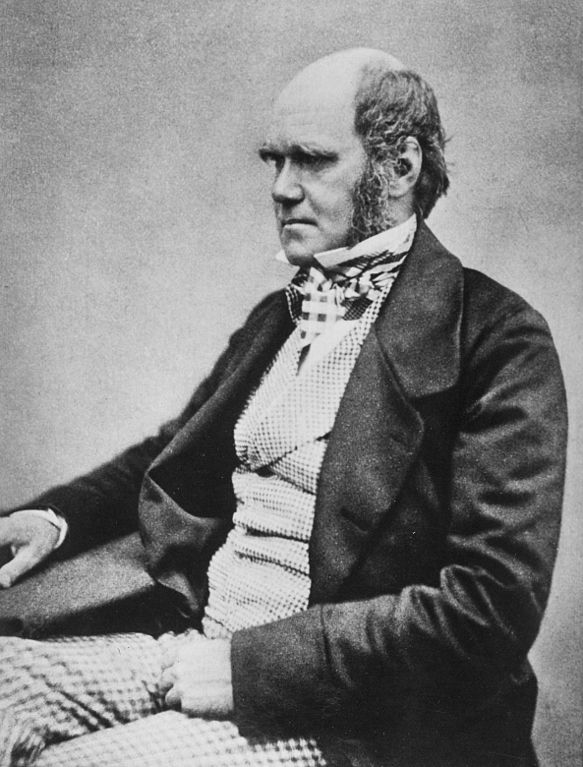 |
|
| Naturalist & Geologist | |
| Specialty | Life Sciences |
| Born | Feb. 12, 1809 The Mount, Shrewsbury, Shropshire, UK |
| Died | Apr. 19, 1882 (at age 73) Down House, Downe, Kent, UK |
| Nationality | British |
Among the most controversial figures in world history is Charles Darwin. Darwin’s theory of evolution forever changed the way scientists looked at how human beings evolved. The theory also challenged commonly held beliefs about religion that set off a firestorm of debate, a debate that still rages to this very day. Regardless of what one thinks of Darwin’s theory of evolution, no one can deny how impacting and influential Darwin has been on the scientific community.
Darwin’s Early Life
On February 12, 1809, Charles Darwin was born in Shrewsbury, Shropshire, England. He was born of privilege as his father was a doctor and a financier. Darwin also grew up in a home that was socially conscious as his family was involved with the abolitionist movement.
Darwin, contrary to the beliefs of some, was not brought up in a household that promoted atheism. Darwin was a religious man who struggled with his beliefs later in life. However, as a young man, he was a follower of the Anglican religion.
Young Charles was also good in his studies and, when he grew older, he enrolled in the University of Edinburgh Medical School. Darwin did not like medical school and gravitated to, of all things, taxidermy.
A Naturalist is Born
In his second year of medical school, Darwin joined the Plinian Society, which was a natural history organization. Darwin would invest a great deal of time studying marine invertebrates. He also invested a lot of time studying, of all things, oyster shell spores. It could be said this newfound hobby was setting the stage for his eventual journey into becoming a naturalist.
His father, however, found it distressing that Darwin was not working hard in medical school so he engineered the young one’s transfer to Christ’s College. While studying at his new college, Darwin was required to study material that presented a strange fusion of creationism and naturalism.
The Flight of the Beagle
When Charles Darwin opted to travel around the world on the ship, The Beagle, little did he know he would be starting on a journey that would forever change the world of science. On December 27, 1831, Darwin left on a five-year voyage on the HMS Beagle to study geology at the various South American locations the ship would stop at. Darwin was also to collect plants as part of a natural history collection.
Over the course of the trip, Darwin would examine various different fossils. He made many notes on the fossils. Slowly, over time, he began to conclude that one species did not automatically turn into another one and that process of evolution seemed to occur. Darwin would eventually compile his notes into his major work, On the Origin of the Species.
On the Origin of the Species
Published in 1858, On the Origin of the Species would become the foundation for the discipline known as evolutionary biology. At the core of the book was the notion that living creatures evolve over generations through the process of natural selection. Natural selection is commonly referred to as survival of the fittest as only the strongest of the species are able to thrive and survive from one generation to the next.
Obviously, the work presented in its pages was extremely controversial as it went against the common grains of thought held in the bulk of the scientific world. To say the work was extremely disliked by those in the religious community would be a massive understatement.
Other Works of Charles Darwin
Darwin’s life’s work would be quite diverse and impacting across many fields and disciplines. Other work by Darwin would cover such material as sexual selection and emotions as they are expressed by humans and animals. While these works were impressive, they did achieve the same widespread interest as On the Origin of the Species.
Darwin’s Final Years
Darwin did struggle in life over his eventual growth into atheism. It can be said this may have troubled him somewhat later in life. Overall, his final years seemed to be relatively peaceful. On April 19, 1882, Charles Darwin passed away due to complications related to heart disease. His legacy is an amazing one as it still influences science to this very day.
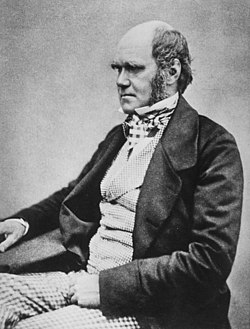
Charles Darwin, aged about 45
Charles Robert Darwin (12 February 1809 – 19 April 1882) was an English naturalist.[1] He was born in Shrewsbury, Shropshire. He is famous for his work on the theory of evolution.
His book On the Origin of Species was published in 1859. In this book, he put forward much evidence that evolution had occurred. He also proposed natural selection as the way evolution had taken place.
Darwin did not know about genetics: he never read the work of Gregor Mendel.[2] Nevertheless, Darwin’s explanation of evolution was fundamentally correct. In contrast to Lamarck, Darwin’s idea was that the giraffe’s neck became longer because those with longer necks survived better.[3]p177/9 These survivors passed their genes on, and in time the whole species got longer necks.
Voyage of the HMS Beagle[change | change source]
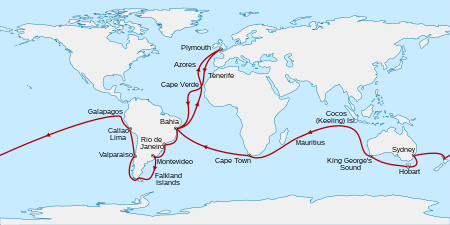
Darwin spent almost five years on board a Royal Navy exploring ship, the HMS Beagle.[4] He was the guest naturalist, which meant that he was responsible for making collections and notes about the animals, plants, and the geology of the countries they visited. The ship’s crew made charts of all the coastal areas, which could be used by the navy wherever it went in the world. At the time, Britain had by far the largest navy in the world, and an empire which was global.
Darwin collected everywhere the ship landed. He found huge fossils of recently extinct mammals, experienced an earthquake in Chile, and noticed the land had been raised. He knew of raised beaches elsewhere, high in the Andes, with fossil seashells and trees which had once grown on a sandy beach. Obviously the earth was constantly changing, with land rising in some places, and sinking in others. He collected birds and insects, and sent shipments back to Cambridge for experts to identify.
Darwin was the first dedicated naturalist to visit the Galapagos Islands, off the west coast of Ecuador. He noticed that some of the birds were like mockingbirds on the mainland, but different enough to be placed in separate species. He began to wonder how so many new species came to be on these islands.
When Darwin got back to England, he edited a series of scientific reviews of the voyage, and wrote a personal journal which we know as The Voyage of the Beagle. It is one of the great natural history travel diaries.[5]
In 1843 Darwin, who already had two children with his wife Emma, bought Down House in the village of Downe, Kent. He lived there for the rest of his life, and today the house and contents are open to the public.
Evolution[change | change source]
While on the H.M.S. Beagle, and later back home in London, Darwin had come across the ideas of the Rev. T.R. Malthus. Malthus had realised that, although humans could double their population every 25 years, it did not happen in practice. He thought the reason was that a struggle for existence (or resources) limited their numbers. If numbers increased, then famine, wars and diseases caused more deaths. Darwin, who knew that all living things could, in principle, increase their numbers, began to think about why some survived, while others did not.[6]p264-268 His answer took years to develop.
The theory of evolution says that all living things on Earth, including plants, animals and microbes, come from a common ancestor by slowly changing throughout the generations. Darwin suggested that the way living things changed over time is through natural selection. This is the better survival and reproduction of those that best fit their environment. Fitting into the place where you live is called adapting. Those who fit best into the place where they live, the best adapted, have the best chance to survive and breed. Those who are less well-adapted tend not to survive. If they do not survive well enough to raise young, this means they do not pass on their genes. In this way, the species gradually changes.
The first chapter of the Origin deals with domesticated animals, such as cattle and dogs. Darwin reminded readers of the huge changes mankind had made in its domestic animals, which were once wild species. The changes were brought about by selective breeding – choosing animals with desirable characters to breed from. This had been done generation after generation, until our modern breeds were produced. Perhaps what man had done deliberately, might happen in nature, where some would leave more offspring than others.
Darwin noticed that although young plants or animals are very similar to their parents, no two are exactly the same and there is always a range of shape, size, colour, and so on. Some of these differences the plant or animal may have got from their own ancestors, but some are new and caused by mutations. When such differences made an organism more able to live in the wild, it would have a better chance to survive, and would pass on its genes to its offspring, and they to their offspring. Any difference that would cause the plant or animal to have less of a chance to live would be less likely to be passed on, and would eventually die out altogether. In this way groups of similar plants or animals (called species) slowly change in shape and form so that they can live more successfully and have more offspring who will survive them. So, natural selection had similarities to selective breeding, except that it would happen by itself, over a much longer time.

1859 copy of Origins of Species
He first started thinking about this in 1838, but it took a full twenty years before his ideas became public. By 1844 he was able to write a draft of the main ideas in his notebook. Historians think that he did not talk about his theory because he was afraid of public criticism.[7] He knew his theory, which did not discuss religion, raised questions about the literal truth of the Book of Genesis. Whatever the reason, he did not publish his theory in a book until 1859.[8] In 1858 he heard that another biologist, Alfred Russel Wallace, had the same ideas about natural selection. Darwin and Wallace’s ideas were first published in the Journal of the Linnaean Society in London, 1858. Then, Darwin published his book the next year. The name of the book was On the Origin of Species by means of Natural Selection, or the preservation of favoured races in the struggle for life. This is usually called The Origin of Species.[9][10]
Other works[change | change source]
Darwin wrote a number of other books, most of which are also very important.
His books[change | change source]
- 1838-43: Zoology of the voyage of H.M.S. Beagle: published between 1839 and 1843 in five Parts (and nineteen numbers) by various authors, edited and superintended by Charles Darwin, who contributed sections to two of the Parts:
- 1838: Part 1 No. 1 Fossil Mammalia, by Richard Owen (Preface and Geological introduction by Darwin)
- 1838: Part 2 No. 1 Mammalia, by George Robert Waterhouse (Geographical introduction and A notice of their habits and ranges by Darwin)
- 1839: Journal and remarks (The Voyage of the Beagle)
- 1842: The structure and distribution of Coral Reefs
- 1844: Geological observations of volcanic islands
- 1846: Geological observations on South America
- 1849: Geology from A manual of scientific enquiry; prepared for the use of Her Majesty’s Navy: and adapted for travellers in general. ed. John Herschel.
- 1851: A Monograph of the Sub-class Cirripedia, with figures of all the species. The Lepadidae; or, Pedunculated Cirripedes. Living barnacles.
- 1854: A Monograph of the Sub-class Cirripedia, with figures of all the species. The Balanidae (or Sessile Cirripedes); the Verrucidae, etc.
- 1851: A Monograph on the Fossil Lepadidae, or, Pedunculated Cirripedes of Great Britain. Fossil barnacles.
- 1854: A Monograph on the Fossil Balanidæ and Verrucidæ of Great Britain
- 1859: On the Origin of Species by means of natural selection, or the preservation of favoured races in the struggle for life
- 1862: On the various contrivances by which British and foreign Orchids are fertilised by insects (Fertilisation of orchids)
- 1865: On the movements and habits of climbing plants (Linnean Society paper, published in book form in 1875)
- 1868: The variation of animals and plants under domestication
- 1871: The Descent of Man, and selection in relation to sex
- 1872: The expression of emotions in Man and animals
- 1875: Insectivorous plants
- 1876: The effects of cross and self fertilisation in the vegetable kingdom
- 1877: The different forms of flowers on plants of the same species
- 1880: The power of movement in plants
- 1881: The formation of vegetable mould through the action of worms.
The original manuscript books of the Origin of Species have been returned to Cambridge University library. They were stolen 22 years ago.[11]
[change | change source]
- Erasmus Darwin
- Alfred Russel Wallace
- Charles Lyell
- Charles Darwin’s books
- Darwin Day
- Darwinism
- Evolution
References[change | change source]
- ↑ «Charles Darwin (1809 — 1882)». BBC. Retrieved 2011-11-03.
- ↑ The work of Mendel was not rediscovered until the early 20th century
- ↑ Darwin, Charles 1884. The origin of species. 6th ed, Murray, London.
- ↑ Browne, Janet 1995. Charles Darwin: vol. 1 Voyaging, Part 2 The Traveller. Cape, London. ISBN 1-84413-314-1
- ↑ Browne, Janet 1995. Charles Darwin: vol. 1 Voyaging. Cape, London. ISBN 1-84413-314-1
- ↑ Desmond A. & Moore J. Darwin. 1991. Joseph, London.
- ↑ Bowler, Peter J. 2009. Evolution: the history of an idea. 4th ed, University of California Press.
- ↑ Palca, Joe (2009). «Darwin’s theory: too big to publish : NPR». npr.org.
- ↑ Browne, Janet 2002. Charles Darwin: vol. 2 The power of place. Cape, London. ISBN 0-7126-6837-3
- ↑ Desmond, Adrian and Moore, James 1991. Darwin. Joseph, London. ISBN 0-7181-3430-3
- ↑ ‘Stolen’ Charles Darwin notebooks left on library floor in pink gift bag
by Rebecca Jones. [1]
Born on: 12 February 1809
Born in: Mount House, Shrewsbury, Shropshire, England
Nationality: English
Career: English naturalist, collector and geologist
Death: 19 April, 1882
Charles Darwin was a famous English naturalist, an eminent collector and geologist, who scientifically proved that all species of life have evolved from common ancestors through the process called natural selection. This formed the basis of the modern evolutionary theory. Both the scientific community as well as the common public was convinced with the process of evolution. Moreover, his scientific discoveries remain the foundation of biology, explaining the diversity of life. He was also an established geologist and established the effect of earthworms on soil.
Childhood & Early Life
Charles Darwin was born as Charles Robert Darwin on 12 February 1809 in Shrewsbury, Shropshire, England. His father Robert Darwin was a rich society doctor while his mother’s name was Susannah Darwin. Charles had five siblings and he was the fifth amongst the six. In 1817, Charles attended the day school run by his preacher. When Charles was eight years old, his mother died. In 1818, he attended the Anglican Shrewsbury School as a boarder. In 1825, Darwin worked as an apprentice doctor with his father.
Later that year, he joined the University of Edinburgh, Scotland to study medicine. However, he did not continue it as he found the surgical treatment too brutal. On the contrary, he started learning taxidermy and in his second year, he joined the Plinian Society, which was a student group interested in natural history. With this he became a keen pupil of Robert Edmund Grant. He joined him in his investigation of the life cycle of marine animals. On the other hand, Darwin’s father was very upset with his son’s progress at studies.
In effect, he enrolled Darwin in a Bachelor of Arts course at Christ College, Cambridge so that he could earn well as an Anglican parson. In his final exams, Darwin performed quite well in theology and stood tenth in the pass list. After sometime, Charles received a letter from Henslow to work as a naturalist in the company of Robert FritzRoy. It was a two year expedition, which would explore the coastline of South America. Though his father was not against it, he later agreed.
His expedition took five years, during which he carefully noted a rich variety of geological features, fossils and living organisms, and methodically collected an enormous number of specimens. He even sent these specimens to Cambridge, which established his reputation as a naturalist. After the return from his voyage in 1836, Darwin became a celebrity in the field of science. In 1859, his book on the theory of natural selection was published. ‘The Origin of Species by Means of Natural Selection’ or ‘The Preservation of Favored Races in the Struggle for Life’ was extremely popular, as the entire stock of 1,250 copies was oversubscribed. In the book, Darwin described detailed observations, inferences and consideration of anticipated objections.
Works
Darwin was an exhaustive author. The publication of his works on evolution gave him a considerable reputation as the author of ‘The Voyage of the Beagle’. Moreover, as a geologist he published extensively on South America and even solved the mystery of the formation of coral atolls. As a biologist, he published the definitive work on barnacles. ‘The Origin of Species’ deals with perceptions of his work, while ‘The Descent of Man and Selection in Relation to Sex’ and ‘The Expression of Emotions in Man and Animals’ made considerable impact. His books on plants including ‘The Power of Movement in Plants’ were innovative studies of great importance, as well as his final work on ‘The Formation of Vegetable Mould through the Action of Worms’.
Personal Life
Charles Darwin married his cousin Emma Wedgewood on January 29, 1839 at Maer in an Anglican ceremony. Soon after this, both of them moved to London. The couple had ten children, out of which two died at infancy and another daughter named Annie died at the age of ten. This was a huge setback for both the parents. Out of his surviving children, George, Francis and Horace became Fellows of the Royal Society, known as astronomer, botanist and civil engineer, respectively. On the other hand, another son Leonard became a soldier, politician, economist, eugenicist and mentor of the statistician and evolutionary biologist Ronald Fisher. Owing to Darwin’s stature, he was buried in Westminster Abbey, close to John Herschel and Isaac Newton.
Posted by: Jaksyn Peacock
Learn about the scientist who formed the theory of evolution.
Pre-listening vocabulary
- naturalist: someone who studies natural history
- evolution: a theory that states that species change over time in order to survive
- origin: where something came from
- organism: a living being
- unpopular: disliked by the public
Listening activity
Podcast: Play in new window | Download (Duration: 1:22 — 1.3MB)
Subscribe: Apple Podcasts | Google Podcasts | RSS | More
Gapfill exercise
Charles Darwin was an English naturalist. He is known for forming the theory of evolution, a explanation for the origin of on Earth. Darwin was born in 1809 in Shrewsbury, England. In 1831, he got a on a ship called the HMS Beagle, which was taking a five-year trip around the world. Darwin got to visit many and study different plants and animals. He started to form his theory while studying birds on the Galápagos Islands. In 1859, he published a book called On the Origin of Species, which stated that all life on Earth may have from one organism. This theory was unpopular at the time, because society was very religious. However, over time, more people started to accept Darwin’s ideas. Darwin died in 1882, at age 73.
Comprehension questions
1. Darwin is known for forming the theory of
gravity
evolution
relativity
Correct!
Wrong!
Darwin is known for forming the theory of evolution.
2. In 1831, Darwin got a job
on a ship
in a lab
at a museum
Correct!
Wrong!
In 1831, Darwin got a job on a ship.
3. Darwin’s book stated that
all life on Earth was a part of the same species
all life on Earth originated from the Galapagos Islands
all life on Earth may have evolved from one organism
Correct!
Wrong!
Darwin’s book stated that all life on Earth may have evolved from one organism.
Discussion/essay questions
- Why do you think so many religious people rejected the theory of evolution? Is it possible to believe in both religion and evolution?
Transcript
Charles Darwin was an English naturalist. He is known for forming the theory of evolution, a scientific explanation for the origin of life on Earth. Darwin was born in 1809 in Shrewsbury, England. In 1831, he got a job on a ship called the HMS Beagle, which was taking a five-year trip around the world. Darwin got to visit many countries and study different plants and animals. He started to form his theory while studying birds on the Galápagos Islands. In 1859, he published a book called On the Origin of Species, which stated that all life on Earth may have evolved from one organism. This theory was unpopular at the time, because society was very religious. However, over time, more people started to accept Darwin’s ideas. Darwin died in 1882, at age 73.
Written and recorded by Jaksyn Peacock for EnglishClub
© EnglishClub.com
Search for more Listen&Learn stories:
Subscribe to EnglishClub Podcasts

Leave a comment
Last updated on March 16th, 2020
Charles Robert Darwin was an English naturalist and geologist. He is most famous for his book On the Origin of Species, which he published in 1859. He brought forward the idea that all species of life have evolved over time from common ancestors. He has been described as one of the most influential figures in human history. With these 33 interesting facts about Charles Darwin, let’s discover more about his life, education, interests, theories, and death.
Facts about Charles Darwin’s early life
1. Charles Darwin was the fifth of six children born to his parents.
2. Lost his mother: When Darwin was eight years old, his mother died. He was cared for and brought up by his three elder sisters.
3. Rich family: Darwin came from a family of scientists and wealthy people.
4. Incomplete medical education: Charles Darwin enrolled in the medical education program at the University of Edinburgh; however, he was fascinated by nature and paid minimal attention to his medical studies. He found surgery distressing and medical lectures boring.
5. Disappointed father: His father, citing his lack of interest in medical education removed him from the college and said to him, “You care for nothing but shooting, dogs and rat catching, and you will be a disgrace to yourself and all your family.”

6. Bored by his medical education, Darwin enrolled at Cambridge to study divinity. During this period, he was an avid collector of beetles. He also ate some of the animals that he collected.

7. Learning Taxidermy: Charles Darwin learned taxidermy from John Edmonstone, a freed black slave from Guyana, South America, during 40 hour-long lectures. Taxidermy is the art of preparing and preserving the skins of animals and of stuffing and mounting them in lifelike form.
8. Record-keeping habit: Darwin maintained a notebook to record his detailed observations of birds and their habits during his studies.
9. Beagle voyage: Darwin was invited to work as a naturalist during the survey of the South American coastline by Captain Robert FitzRoy.
10. Life-Changing Voyage: Darwin visited four continents on his five-year-long H.M.S. Beagle voyage between 1831 and 1836. This proved to be the most important time of his geological career, as he collected and investigated several specimens like fossils, birds and plants.

11. Break up with girlfriend: Did you know that Charles Darwin had a girlfriend during his college years with whom he broke up? She was his sister’s friend. The breakup happened due to the fact that Darwin was probably giving less attention to his girlfriend, who was also being pursued by many more attentive suitors. Darwin also received a letter from his girlfriend “Fanny” that she was going to get married.
12. Interest in hiking: During his twenties, Darwin was an avid hiker.
13. In his honor: Darwin has a mountain named after him. “Mount Darwin” is the highest peak in Tierra del Fuego. On February 12, 1834, Captain FitzRoy named a mountain after him on his birthday.
14. Regarding marriage: Darwin made a “pros” and “cons” list about marriage during the time he was thinking about whether or not he really wanted to be married.
15. Married his first cousin, Emma: Darwin had ten children from his marriage with his cousin. Three of these died from illness and the remaining were also unhealthy for most of their lives. Darwin had commented about the risks involved in marriages between cousins. Over a billion people live in regions where 20-50% of the marriages are “consanguineous” – defined as a union between two individuals who are related as second cousins or closer.
16. Darwin played backgammon with his wife Emma during the time he was ill after his visit to South America. In fact, he developed a schedule to play two games of Backgammon every night.
17. Animal eater: Darwin once ate an owl. According to him, the owl’s flavor was indescribable.

18. Book on earthworms: The book, entitled The Formation of Vegetable Mould Through the Action of Worms, With Observations on Their Habits, was published in 1881, and sold even better than On the Origin of Species. This book was also his last.
19. The voyage of The Beagle had a monumental effect on Darwin’s view of natural history. Darwin visited ecologically diverse regions such as Brazil, Chile, Australia, the Falkland Islands and the Galapagos Islands.

20. The Galapagos Islands are the home to plants and animals that can’t be found anywhere else in the world. The islands helped Darwin greatly in his research and collection of specimens.
21. Some 250 species and several higher groups bear Darwin’s name.
22. A day for his accomplishments: On February 12, in Darwin’s honor, Darwin Day is celebrated across the world.
23. Lifelong sickness: Darwin, apart from the gains that he made with his discoveries regarding geology and nature, also happened to become ill from sea sickness. The sickness triggered lifelong health issues that Darwin endured until the end of his life.
24. After his return from the voyage, he formulated his theory of ‘Origin of Species’ between 1837 and 1839. However, he did not publish it immediately.
25. His daughter dies: In 1851, Darwin’s 10-year-old daughter died of an illness. This incident had damaging consequences on Darwin’s health. During the 20 years between founding his theory of ‘Origin of Species’ and its publishing, he suffered from sickness much of the time.
“On the Origin of Species”
26. The publication trigger: Darwin might not have published his theory if he had not been triggered to publish it by his admirer Alfred Russel Wallace. Wallace also developed a theory of natural selection and wanted Darwin’s opinion regarding it and its publishing. At this time, Darwin realized the importance of publishing his theory, otherwise the credit may have gone to Alfred Wallace if he ended up publishing his theory first.
27. Publishing the theory: Darwin published his theory on November 24, 1859. He was once again struck by a tragedy when his 18-month-old son died of scarlet fever.
Continue reading on the next page…