
 В английском языке есть некоторые слова, использование которых часто вызывает затруднение у тех, кто стремится изучить его. И в самом деле, даже те, для кого английский язык является родным, часто путают их. А это означает, что эти слова могут использоваться неверно в английской письменной и устной речи. В данной статье мы хотели бы объяснить использование десяти подобных слов, чтобы наглядно показать вам как нужно правильно их использовать:
- 1. Affect – оказывать воздействие, влиять (глагол) / Effect — результат, воздействие (существительное)
— Did the bad weather affect your summer holiday? – повлияла ли плохая погода на ваши летние каникулы?
— What was the effect of your visit?- каким был результат вашего визита? - 2. Borrow/ Lend — брать взаймы/давать взаймы
— I need to borrow £2,000 from my bank. – мне нужно взять взаймы £2,000 в банке.
— My bank has agreed to lend me £2,000 – мой банк согласился ссудить мне (дать мне взаймы) £2,000 - 3. Controlled/Inspected — контролируются/ проверяются
— Our machines are controlled by a central computer system- наши машины контролируются центральной компьютерной системой
— The cash machines are inspected once a day by our staff. – кассовые аппараты проверяются один раз в день нашим персоналом - 4. Interested/Interesting – интересоваться чем-то/интересный
— I am interested in homeopathy – я интересуюсь гомеопатией
— I find homeopathy very interesting. – я нахожу гомеопатию очень интересной - 5. Journey, trip – путь, поездка (Noun)/Travel — (Verb) — ездить
— Some people have a long journey to work – некоторые люди совершают длительную поездку до работы
— Some people have to travel far to get to work. – некоторым людям приходится далеко ездить чтобы добраться до работы. - 6. Raise— повышать, подниматься/Rise — подниматься
— If you don’t understand something, raise your hand. (‘Raise’ takes an object) –Если вы чего-то не понимаете, поднимите руку (после ‘Raise’ ставится дополнение)
— At midday the sun rises high (‘Rise’ does not take an object) – в полдень солнце поднимается высоко. (после ‘Rise’ не ставится дополнение) - 7. Receipt — чек/Recipe — рецепт
— You can return the product if you have a receipt- Можете вернуть товар, если у вас есть чек Можно получить чек за багаж?
— I love this bread. How did you make it? Can you give me the recipe?- мне нравится этот хлеб. Как вы его печете? Могу я получить рецепт? - 8. Remember – помнить/Remind — напоминать
— I must remember to take my tennis racket tomorrow. (I remember) – я должен помнить о том, что завтра нужно взять теннисную ракетку. (я помню)
— Could you please remind me to take my tennis racket tomorrow. (You remind me) – не могли бы вы напомнить мне взять теннисную ракетку (вы напомните мне) - 9. Sensible – благоразумный/ Sensitive — чуткий, впечатлительный, ранимый
— Gill always saves a part of her salary every month. She is very sensible – Джил всегда откладывает часть своей зарплаты каждый месяц. Она очень благоразумна
— Gill is very sensitive, be careful not to offend her — Джил очень ранимая, будь осторожен, чтобы ее не обидеть. - 10. Advice – совет (существительное) / Advise — советовать (глагол)
— He’s a very wise man, I always follow his advice – Он очень мудрый человек, я всегда следую его советам.
— Could you advise me some good Italian restaurant in the city center? – Ты не мог бы посоветовать мне какой-нибудь хороший итальянский ресторан в центре?
7 Comments on Confusing words — английские слова, которые легко перепутать
1) He heard us and ….. his head a) rose b) raised c) arose d) lifted 2) I’m not …. with her poetry. a) familiar b) aware c) accustomed 3) I’m afraid some difficulties may …. a) arise b) rise c) raise 4) I’ve …. six children a) raised b) grew c) grew up 5) We wanted to buy a car before the prices … again a) raised b) rose c) arose 6) My friend …… in Paris last night by bus. a) arrived b) came c) got 7) Moreover, I ………… to lock the front door. a) recollected b) recalled c) remembered  At last they ………. the top of the mountain. a) arrived at b) reached c) achieved 9) I know how to ………… my own children. a) bring up b) raise c) grow up 10) I will do anything that I can to be …………….. to a higher position a) rose b) raised c) arose 11) I want you to ……….. to the party a) come b) get c) arrive 12) My colleague ………….. me of my classmate. a) recalls b) remembers c) reminds 13) How are you ………….. home tonight? a) getting b) reaching c) coming 14) My mom always …………… me to put my hat on. a) recalls b) remembers c) reminds 15) At last they the top of the mountain. a) reached b) achieved c) approached 16) I can hardly …………… the events of that evening. a) remember b) recollect c) memorise 17) I …………. that I ordered a cup of tea. a) remind b) recall c) remember 18) We ………… to London around 6 p.m a) got b) came c) approached 19) I was ………….. in a big family. a) grown up b) brought up c) raised up 20) You have to ……….. harder if you want to pass the test. a) study b) learn c) educate 21) We were slowly …………….. our destination. a) getting b) approaching c) reaching 22) The boy …………. how to read and write. a) educated b) studied c) learnt 23) My sister’s children …………… so quickly. a) grow b) grow up c) bring up 24) Sally …………….. all her coworkers’ names just in a week! a) recalled b) remembered c) memorised 25) The children are …………….. of the danger of taking drugs. a) aware b) familiar c) accustomed 26) This is not the kind of treatment I am ……………… to. a) familiar b) accustomed c) aware 27) I need to …………… myself more on financial planning. a) educate b) teach c) learn 28) Behaviour like this will ………….. you into trouble. a) direct b) guide c) lead 29) I wasn’t …………… on going there on my own. a) eager b) keen c) willing 30) Could you …………… your chair a little- I’ve got my coat caught under it. a) rise b) lift c) raise 31) How much are they …………….. to pay? a) keen b) eager c) willing 32) He has a positive ……………….. about the changes. a) attitude b) approach c) mood 33) She ……………. us through the busy streets to the cathedral. a) led b) directed c) guided 34) I was ………….. to get back to work as soon as possible. a) eager b) wiiling c) interested 35) I must have seen you somewhere, your face is very ……………. to me. a) accustomed b) familiar c) aware 36) Sheila’s ……………….. in starting her own business. a) interested b) familair c) accostomed 37) The glimmerings of an ……… began to come to him. a) aspect b) idea c) view d) point 38) Who has been placed in charge during the director’s …………? a) absence b) lack c) loss d) shortage 39) There was fierce competition for the ……….. resources. a) short b) rare c) scarce d) insufficient 40) By the end of the concert, the people in the theater were dancing in the …………. . a) rows b) aisles c) lines d) queues 41) His behavior shows a ………… of maturity. a) absence b) loss c) shortage d) lack 42) They won the championship three years in a ………. . a) aisle b) row c) line d) queue 43) The ………… of teachers poses a major problem. a) absence b) lack c) shortage d) loss 44) He had never …………time to think, all was employed in reading. a) free b) spare c) handy d) convenient 45) It is possible to jump the …………. a) aisle b) row c) line d) queue 46) There’s been an …………. number of volunteers for the job. a) inadequate b) insufficient c) scarce d) rare 47) He did not see the …………. of the joke. a) idea b) view c) point d) matter 48) Living in the city has taught me to ………………. the differences between people. a) estimate b) calculate c) value d) appreciate 49) We abuse land because we …………….. it as a commodity belonging to us. a) see b) regard c) consider d) recognise 50) He had lost many of the people who …………. to him. a) mattered b) valued c) regarded d) estimated 51) It would be a mistake to ……………… that we can rely on their help. a) suppose b) assume c) estimate d) guess 52) The tree is ……………… to be at least 700 years old. a) calculated b) valued c) estimated d) appreciated 53) It’s a long shot, but someone might …………… her from the photo and be able to tell us where she lives. a) realise b) familiarise c) regard d) recognise 54) We …………. the cost of new carpeting for the whole house. a) appreciated b) calculated c) assessed d) estimated

Leaderboard
This leaderboard is currently private. Click Share to make it public.
This leaderboard has been disabled by the resource owner.
This leaderboard is disabled as your options are different to the resource owner.
Quiz is an open-ended template. It does not generate scores for a leaderboard.
Log in required
Options

Switch template
Interactives
More formats will appear as you play the activity.
“Этот… галчонок… у меня рубль олимпийский украл! Его надо немедленно в поликлинику сдать, для опытов!”
А вопрос о том, как готовить к заданиям 30-36 из раздела “Грамматика и Лексика” на ЕГЭ по английскому языку, украл у меня немало нервных и мозговых клеток. И в этой статье я объясню, кто виноват почему и что с этим самым заданиям делать. А также дам советы по подготовке и порекомендую учебники, которые помогут эту подготовку осуществить.
Общая информация
Если задания 19 – 24 и задания 25 – 29 относятся к базовому уровню сложности, то задания 30 – 36 – к повышенному, поэтому на ОГЭ по английскому языку похожих заданий нет. Максимум за правильные ответы ученик может получить 7 баллов, по баллу за каждый вопрос.
В этой части экзамена составители предлагают экзаменуемым связный текст с пропусками, в которые нужно вставить правильный вариант из предложенных четырех. То есть, если правильный ответ неясен, его можно угадать, в отличие от двух других заданий этого раздела. Пропущенные слова должны подходить по смыслу, сочетаемости или грамматическому оформлению к своему окружению. Проще говоря, в этом задании проверяется знание:
- значений слов и их синонимов/омонимов
- предлогов, которые употребляются с этими словами
- как слова сочетаются друг с другом
- фразовых глаголов и идиом
Я бы рекомендовала на экзамене тратить на эту часть не более 10 минут.
Советую следующий алгоритм действий:
- Знакомимся с текстом, смотрим на пропуски и прикидываем, какие варианты могли бы подойти (можно пока не смотреть на предложенные варианты, а подумать, что бы вы сюда подставили).
- Внимательно читаем текст, отмечая подходящие ответы.
- Проверяем себя, заново все перечитываем.
- Переносим в бланк ответов и проверяем правильность перенесенного.
Поподробнее про пункт 2.
Как и во всем экзамене, тут есть задания полегче, есть посложнее. При ответе на каждый, даже самый легкий вопрос, рекомендую рассказывать себе или попугаю (когда делаем самостоятельно) и учителю или его попугаю (на занятии), почему остальные варианты ответа не подходят. Еще очень полезно прочитать предложение и подумать, какой у него смысл и соответствует ли ему выбранное слово.
Если вариант ответа неизвестен – вычеркнуть совсем неподходящие и выбирать из оставшегося. Не удастся обосновать выбор – пишем ответ, который лучше звучит – память поможет выбрать тот, который где-то когда-то слышали или читали. А может и не поможет.
Если в ответах даны 2-3 похожих варианта, то, скорее всего, правилен один из похожих и составители проверяют знание различий между синонимами или омонимами. Например:
Powerful new telescopes are _______ to infrared radiation.
1) sensible 2) sensitive 3) appropriate 4) suitable
Первые два слова звучат похоже и не все ученики знают разницу между ними. На этом их и рассчитывают “поймать” составители теста. Sensible переводится как разумный, sensitive – чувствительный, восприимчивый. Подходит ответ №2.
И не стоит забывать о грамматике! Редко, но бывает, что предложенные варианты различаются грамматической формой, например:
Sarah refused to give up …
1) smoke 2) to smoke 3) smoking 4) to smoking.
Правильный выбор будет зависеть от слова, которое стоит рядом с пропуском. Здесь это фразовый глагол give up, а мы знаем, что после фразовых глаголов нормальный глагол приобретет окончание -ing.
Пример из демоверсии 2023

Задание 30 проверяет знание различий между confusing verbs и если ученик не знает их значения, придется угадывать. Как правило, ребята справляются здесь со всем кроме ensure, так что учим их действовать методом исключения
В следующем нужно знать linking words and phrases, чтобы к according подставить нужную частицу to, она написана как раз после пропуска. Чтобы затренировать эти слова и другие, необходимые для правильного выполнения раздела, очень советую вот эту книгу по лексике.
Задание 32 про классику – разницу между speak/tell/talk/say, это различие тестируют почти каждый год, поэтому учим “намертво”.
Для правильного выполнения задания 33 нужно просто было пройти с учениками конструкцию used to, и тогда все вопросы здесь отпадут.
В номере 34 снова приветствуем confusing words, но здесь легкий правильный ответ, который, как правило, знают все школьники.
Следующее задание – про сочетаемость. Её, кстати, можно и загуглить (увы, не на экзамене). Вбиваем в поле для поиска make you feel, и гугл дает нам сразу несколько вариантов с фразой. Значит, это – существующая коллокация и пишем её в поле для ответов.

И в 36-м снова про linking words and conjunctions, разобраться с которыми поможет книга по лексике.
А вот правильно заполненный бланк с ответами на задания 30 – 36:

Советы по подготовке
После всего написанного, думаю, понятно, что задание на знание лексики не зря имеет повышенный уровень сложности. И при подготовке к нему нельзя, как в случае с грамматикой или словообразованием, выучить все правила и суффиксы и научиться их применять, потому что составители экзамена не ограничиваются определенным набором слов, который был бы написан в официально источнике.
Для успешного выполнения этой части ЕГЭ по английскому языку советую:
- После каждой пройденной лексической темы намертво учить слова, их синонимы-омонимы, предлоги иже с ними и сочетаемость, а также идиомы и фразовые глаголы. Как учить? Выписывать, забивать в Quizlet, составлять предложения, делать переводы, употреблять в сочинениях и рассказах по теме.
- Читать художественную литературу, выписывать незнакомые слова-словосочетания и опять составлять-пересказывать-писать-говорить предложения с ними. Смотреть любимые сериалы на английском, ролики на ютюбе, слушать песни. Даже если нет времени на работу со словами, все равно смотреть-слушать-читать, на экзамене память может “выстрелить” и подскажет, что вот это вариант “звучит лучше”. На самом деле, не звучит так лучше, просто вы это уже где-то видели, и в голове увиденное закрепилось.
- Пройти наиболее используемые confusing words, collocations, linking words, synonyms, verbs/adjectives/nouns + prepositions (у меня эти моменты вписаны в книгу по лексике)
И, понятно, тренировать. Для тренировки рекомендую упражнения с сайта ФИПИ
Если вы этого еще не сделали – покупайте план ЕГЭ, который помог более 1.000 преподавателей по английскому подготовить своих учеников на высокие баллы
P.S. Про разделы и стратегии выполнения заданий ЕГЭ можно почитать статьи:
Аудирование или задания 1 — 9
Чтение или задания 10 — 18
Грамматика или задания 19 — 25
Словообразование или задания 26 — 31
Лексика или задания 32-38
Личное письмо или задание 39
Проект или задание 40
Устная часть. Задание 1
Устная часть, Задание 2
Устная часть, Задание 3
Устная часть, Задание 4
ELTgram от Ирины Кузнецовой
Путаете ли вы похожие английские слова? Не пугайтесь — с этой проблемой сталкиваются многие, но она решаема. На современных примерах из фильмов и сериалов покажем, как различать такие слова.

Мы уже рассказывали вам о похожих словах, которые часто путают в английском языке. Но их так много, что все в одну статью никак не поместились бы. Сегодня представим вам 20 новых пар так называемых commonly confused words. Узнайте, как не перепутать босса с поваром, персонал с материалом, цену с призом, кухню с двоюродным братом и политику со стратегией.
Если вы хотите расширить свой лексический запас, записывайтесь на бесплатный вводный урок.
1. Chief or chef?
| Характеристика | Слово | |
|---|---|---|
| chief /tʃiːf/ |
chef /ʃef/ |
|
| Перевод | существительное — лидер, руководитель
прилагательное — главный, самый важный; руководящий |
существительное — повар, шеф-повар |
| Синонимы | существительное — a boss, an employer, a head
прилагательное — main, supreme |
существительное — a cook |
| Пример употребления | I’d like to appoint Jeff chief loan officer. — Хочу назначить Джеффа ведущим кредитным специалистом.
The chief of the staff is responsible for taking serious decisions. — Руководитель персонала ответственен за принятие серьезных решений. |
Remi has always dreamt of becoming a chef at a Michelin-starred restaurant. — Реми всегда мечтал стать поваром ресторана, отмеченного звездами «Мишлен». |
2. Suit or suite?
| Характеристика | Слово | |
|---|---|---|
| suit BrE — /sjuːt/, AmE — /suːt/ |
suite /swiːt/ |
|
| Перевод | существительное — костюм, комплект одежды
глагол — подходить, устраивать, удовлетворять требованиям |
существительное — номер люкс; набор, комплект |
| Синонимы | существительное — a tuxedo
глагол — to satisfy, to match up, to measure up |
существительное — a deluxe room; a set |
| Пример употребления | Try on this suit, I guess it should fit you perfectly. — Примерь этот костюм, я думаю, он будет сидеть на тебе идеально.
The variety of beverages and appetizers at the party suited all tastes. — Разнообразие напитков и закусок на вечеринке удовлетворяло всем вкусам. |
I need a suite in your hotel. — Мне нужен номер люкс в вашем отеле.
We ordered a new four-piece suite for the kitchen. — Мы заказали новый комплект мебели из четырех предметов для кухни. |
3. Cousin or cuisine?
| Характеристика | Слово | |
|---|---|---|
| cousin /ˈkʌzn/ |
cuisine /kwɪˈziːn/ |
|
| Перевод | кузен, кузина; дальний родственник; единомышленник | кухня, кулинарное искусство |
| Синонимы | a distant relative; like-minded person | cookery, national food |
| Пример употребления | Honey, my cousin is going to stay with us for a couple of weeks. — Дорогая, мой двоюродный брат поживет у нас пару недель.
I’ve got plenty of cousins who support me. — У меня много единомышленников, которые поддерживают меня. |
Take me to some cafe where locals eat. I want to try their national cuisine. — Отведи меня в кафе, в котором едят местные. Хочу попробовать их национальную кухню. |
First cousin означает «двоюродный брат/сестра», а second cousin — «троюродный брат/сестра».
4. Deny or refuse?
| Характеристика | Слово | |
|---|---|---|
| deny /dɪˈnaɪ/ |
refuse /rɪˈfjuːz/ |
|
| Перевод | отрицать; мешать, препятствовать | отвергать, отклонять, отказывать |
| Синонимы | to disclaim; to prevent | to decline, to reject |
| Пример употребления | после глагола to deny употребляем существительное, местоимение that либо глагол с окончанием -ing:
The thief denied the theft of the car. — Вор отрицал, что он украл машину. |
The judge refused to sustain a claim. — Судья отказался удовлетворить иск. |
5. Ashamed or embarrassed?
| Характеристика | Слово | |
|---|---|---|
| ashamed /əˈʃeɪmd/ |
embarrassed /ɪmˈbærəst/ |
|
| Перевод | испытывающий чувство стыда | смущенный, сбитый с толку |
| Синонимы | sheepish, contrite, shameful | confused, abashed |
| Пример употребления | после прилагательного ashamed употребляем либо предлог of, либо местоимение that:
The accountant was ashamed of his awkward dancing at the corporate party. — Бухгалтер испытывал стыд после своих неловких танцев на корпоративной вечеринке. |
после прилагательного embarrassed употребляем предлог by или about:
I was embarrassed by her behavior. — Меня смутило ее поведение. I was too embarrassed about her words that I couldn’t do anything. — Я была настолько сбита с толку ее словами, что не смогла ничего сделать. |
6. Accept or agree?
| Характеристика | Слово | |
|---|---|---|
| accept /əkˈsept/ |
agree /əˈɡriː/ |
|
| Перевод | принимать (подарок, предложение, правду, идею), допускать | соглашаться, сходиться во взглядах; договариваться; соответствовать |
| Синонимы | to receive, to answer affirmatively, to admit | to consent |
| Пример употребления | Have you already accepted the invitation to their wedding? — Вы уже приняли приглашение на их свадьбу?
Her husband has passed away, but she still can’t accept the fact that he’s gone. — Ее муж умер, но она никак не может принять факт того, что его больше нет. |
после глагола to agree употребляем предлоги with, on/about, частицу to с глаголом или местоимение that:
We agreed to put off the meeting till Monday. — Мы условились отложить собрание до понедельника. We agree on many social and political issues. — Мы сходимся во взглядах по многим социальным и политическим вопросам. |
7. Tall or high?
| Характеристика | Слово | |
|---|---|---|
| tall /tɔːl/ |
high /haɪ/ |
|
| Перевод | определенного роста (о людях), высотный (о многоэтажных зданиях) | высокий (об объектах); высокопоставленный; отличный, превосходный |
| Синонимы | elevated, huge, vast | large, big |
| Пример употребления | How tall is your boy? — Насколько ваш мальчик высокий?
Tall skyscrapers almost reach the clouds. — Высотные небоскребы почти достают до облаков. |
It’s dangerous to swim today. The waves are extremely high. — Сегодня опасно плавать. Волны очень высокие.
Their goods are known for the high quality. — Их товары известны своим отличным качеством. |
8. Opportunity or possibility?
| Характеристика | Слово | |
|---|---|---|
| opportunity BrE — /ˌɒpəˈtjuːnəti/, AmE — /ˌɑːpərˈtuːnəti/ |
possibility BrE — /ˌpɒsəˈbɪləti/, AmE — /ˌpɑːsəˈbɪləti/ |
|
| Перевод | шанс, благоприятная возможность, удобный случай | вероятность, возможность |
| Синонимы | a chance | probability, likelihood |
| Пример употребления | после существительного an opportunity употребляем предлог for или конструкцию to do smth:
This private school is a great opportunity for your kids. — Эта частная школа — отличный шанс для ваших детей. I appreciate the opportunity to make a toast and thank you all. — Я ценю возможность произнести тост и поблагодарить вас всех. |
после существительного a possibility употребляем предлог of или местоимение that:
There is a possibility that the weather will be bad at the weekend. — Есть вероятность, что погода на выходных испортится. Is there a possibility of any injuries during the rock-climbing classes? — А какова вероятность получить травму во время занятий скалолазанием? |
9. Thankful or grateful?
| Характеристика | Слово | |
|---|---|---|
| thankful /ˈθæŋkfl/ |
grateful /ˈɡreɪtfl/ |
|
| Перевод | радостный оттого, что избежал опасности, радостный оттого, что что-то неприятное позади | благодарный за что-то хорошее |
| Синонимы | pleased | appreciative |
| Пример употребления | после прилагательного thankful употребляем предлог for, местоимение that или конструкцию to do smth:
Alice was thankful that she didn’t get in jail. — Элис была рада тому, что она не попала в тюрьму. I’m thankful to stay in one piece after the car crash. — Я рад, что остался жив после автомобильной аварии. |
после прилагательного grateful употребляем конструкцию to smb for smth (кому-то за что-либо) или местоимение that:
I’m grateful to my parents for my happy childhood. — Я благодарен своим родителям за счастливое детство. Nick was grateful that he had a shelter. — Ник был благодарен за то, что у него был приют. |
10. Foreigner or stranger?
| Характеристика | Слово | |
|---|---|---|
| foreigner BrE — /ˈfɒrənə(r)/, AmE — /ˈfɔːrənər/, /ˈfɑːrənər/ |
stranger BrE — /ˈstreɪndʒə(r)/, AmE — /ˈstreɪndʒər/ |
|
| Перевод | иностранец | незнакомец, посторонний; чужой в какой-то обстановке |
| Синонимы | someone is from abroad/overseas | an unknown person |
| Пример употребления | It’s not that easy for a foreigner to get a proper job. — Иностранцу не так легко получить должную работу. | I feel like a complete stranger in New York. — Я чувствую себя чужим в Нью-Йорке. |
11. Alternately or alternatively?
| Характеристика | Слово | |
|---|---|---|
| alternate(ly) BrE — /ɔːlˈtɜːnət/, AmE — /ˈɔːltərnət/ |
alternative(ly) BrE — /ɔːlˈtɜːnətɪv/, AmE — /ɔːlˈtɜːrnətɪv/ |
|
| Перевод | поочередный, чередующийся | альтернативный, другой вариант |
| Синонимы | in turns, consecutively | another option, instead, on the other hand |
| Пример употребления | Seasons change alternately in this region. — В этом регионе времена года меняются поочередно. | We were walking home on foot. Alternatively, we could take a taxi, but we didn’t have money. — Мы шли домой пешком. Как вариант, мы могли взять такси, но у нас не было денег. |
12. Staff or stuff?
| Характеристика | Слово | |
|---|---|---|
| staff BrE — /stɑːf/, AmE — /stæf/ |
stuff /stʌf/ |
|
| Перевод | существительное — служебный персонал
глагол — набирать персонал прилагательное — штатный |
существительное — штука, штуковина; материал, вещество; что-то неопределенное (идея, дело)
глагол — набивать, начинять |
| Синонимы | существительное — employees, personnel
глагол — to hire прилагательное — in-house |
существительное — a thing, an object, an item; a substance, material
глагол — to fill |
| Пример употребления | слово staff может употребляться как с глаголом во множественном числе, так и в единственном — подробнее об этом читайте в статье «Употребление существительных только во множественном и только в единственном числе»:
The staff are supposed to be hardworking. — Сотрудники должны быть трудолюбивыми. The staff has shown its readiness to work hard. — Персонал показал готовность работать усердно. |
I can’t meet you at the airport. I’ve got some stuff to do. — Я не могу встретить тебя в аэропорту. Мне надо сделать кое-какие дела.
Jim quickly stuffed his clothes into the suitcase and hurried to catch the train. — Джим быстро запихал вещи в чемодан и поторопился на поезд. |
13. Ache or pain?
| Характеристика | Слово | |
|---|---|---|
| ache /eɪk/ |
pain /peɪn/ |
|
| Перевод | существительное — боль (продолжительная, ноющая, доставляющая дискомфорт)
глагол — испытывать боль |
существительное — острая боль при травме или болезни; горе, страдание
глагол — причинять боль, болеть; мучить, огорчать |
| Пример употребления | Runner’s calves ached after the marathon. — Икры бегуна болели после марафона.
The kid felt a dull ache in the stomach after eating some cookies. — Ребенок почувствовал тупую боль в животе после того, как съел немного печенья. |
Let’s help this poor guy. He seems to be in pain. — Давай поможем этому бедолаге. Похоже, ему больно.
Mike felt sharp pain in his chest and we called an ambulance. — Майк почувствовал острую боль в груди, и мы вызвали скорую. |
14. Loudly or aloud?
| Характеристика | Слово | |
|---|---|---|
| loudly /ˈlaʊdli/ |
aloud /əˈlaʊd/ |
|
| Перевод | громко (о любом громком звуке) | вслух, во весь голос |
| Синонимы | in a loud voice | out loud |
| Пример употребления | The books fell loudly on the table. — Книги громко упали на стол. | Mary, please read your verse aloud for the whole class. — Мэри, пожалуйста, прочитай свое стихотворение вслух для всего класса. |
15. Price or prize?
| Характеристика | Слово | |
|---|---|---|
| price /praɪs/ |
prize /praɪz/ |
|
| Перевод | существительное — цена; жертва
глагол — устанавливать цену |
существительное — премия, награда; приз, выигрыш
глагол — высоко ценить, оценивать по достоинству |
| Синонимы | существительное — cost, charge, a fee; a sacrifice | существительное — an award, a trophy
глагол — to appreciate, to value |
| Пример употребления | Our wedding dresses range in price from 150 $ to 500 $. — Наши свадебные платья стоят от 150 до 500 долларов.
If you want to become rich, you have to pay a certain price. — Если ты хочешь быть богатым, придется чем-то пожертвовать. |
The main prize in the competition is a month for two in Italy. — Главный приз в соревнованиях — это поездка на двоих в Италию на месяц. |
16. Arise or rise?
| Характеристика | Слово | |
|---|---|---|
| arise /əˈraɪz/ |
rise /raɪz/ |
|
| Перевод | глагол — появляться, возникать; происходить, проистекать | глагол — восходить, подниматься; увеличиваться в объеме, расти
существительное — восход, рост, подъем; прибавка к зарплате |
| Синонимы | глагол — to start, to begin, to arrive | глагол — to go upwards, to lift, to increase |
| Пример употребления | If a crisis arises, we should come up with plan B. — Если возникнет кризис, мы должны придумать план Б.
People think that all their problems arise from the decisions of the government. — Люди считают, что все их проблемы проистекают из решений правительства. |
Accommodation prices will continue to rise during this year. — Цены на жилье продолжат расти в этом году.
Am I going to get a rise for the overtime work? — Я получу прибавку за переработки? |
17. City or town?
| Характеристика | Слово | |
|---|---|---|
| city /ˈsɪti/ |
town /taʊn/ |
|
| Перевод | BrE — большой значимый город, город с местным самоуправлением; жители города (с глаголом в единственном числе)
AmE — город любого размера, у которого определены границы и который наделен официальными полномочиями от правительства штата |
BrE — небольшой город; административный центр района, деловой центр; жители городка (с глаголом в единственном числе)
AmE — деревня |
| Пример употребления | Major Russian cities are Saint Petersburg and Moscow. — Главные русские города — Санкт-Петербург и Москва.
The city is waiting for a new election race. — Жители города ждут новой предвыборной гонки. |
My native town is very small. Its population is only 2 000 people. — Мой родной городок очень маленький. Его население всего лишь 2 000 человек.
Today I’m going to town for a brief business meeting. — Сегодня я еду в центр на короткую деловую встречу. |
18. Close or shut?
| Характеристика | Слово | |
|---|---|---|
| close BrE — /kləʊz/, AmE — /kloʊz/ |
shut /ʃʌt/ |
|
| Перевод | закрыть | захлопнуть, запереть на ключ |
| Синонимы | to end, to stop, to finish | to lock |
| Пример употребления | Close the door please when leaving. — Когда будете уходить, закройте, пожалуйста, дверь.
Calm down. Close your eyes and count to ten. — Расслабьтесь. Закройте глаза и посчитайте до десяти. |
Shut the door from the outside right now! — Сейчас же захлопни дверь с той стороны!
Switch off the light and shut the warehouse. — Выключи свет и запри склад. |
19. Politics or policy?
| Характеристика | Слово | |
|---|---|---|
| politics BrE — /ˈpɒlətɪks/, AmE — /ˈpɑːlətɪks/ |
policy BrE — /ˈpɒləsi/, AmE — /ˈpɑːləsi/ |
|
| Перевод | политика, политическая деятельность; политические убеждения и взгляды | линия поведения, стратегия; принципы, стандарты, нормы |
| Пример употребления | Many people say that they are not interested in politics, they want to discuss something entertaining. — Многие люди говорят, что их не интересует политика, и они хотят обсуждать что-то развлекательное. | I develop foreign policy of our company. — Я развиваю международную стратегию нашей компании. |
20. Hear or listen?
| Характеристика | Слово | |
|---|---|---|
| hear BrE — /hɪə(r)/, AmE — /hɪr/ |
listen /ˈlɪsn/ |
|
| Перевод | слышать, обладать слухом | слушать, внимательно и осознанно воспринимать информацию; Послушай! |
| Синонимы | to notice sound | to receive sonic information attentively, to pay attention to sounds |
| Пример употребления | I can hear them talking behind the door. — Я слышу, как они говорят за дверью.
I heard the rumours about closing our company for good. — Я слышала слухи о том, что нашу компанию хотят закрыть навсегда. |
Listen to him carefully and answer every question sincerely. — Слушай его внимательно и отвечай искренне на каждый вопрос.
While commuting, I listen to the music or audiobooks. — Добираясь до работы на транспорте, я слушаю музыку или аудиокниги. Listen! I want to talk to you. — Послушай! Я хочу поговорить с тобой. |
Знаете ли вы еще какие-то похожие английские слова? Пишите в комментариях.
© 2023 englex.ru, копирование материалов возможно только при указании прямой активной ссылки на первоисточник.
Confusing Words
1. The bank manager has agreed to borrow/lend me another $5,000.
2. My brother is very tall/high.
3. The cost of life/living increased by 80% last year.
4. Can you tell/say the difference between these two products?
5. Last week there was an outburst/outbreak of the bird flue.
6. Some employees have a long travel/journey to work every day.
7. Which measurement/measure should I take first – the width or the length of the room?
8. He is a real ache/pain in the neck.
9. We expected/waited our guests to come at 6 p.m.
10. First study/learn the manual and then use the computer.
11. I’ve got her business card, but I don’t memorize/recall meeting her at all.
12. I wonder if you could do/make me a favour (AmE favor).
13. I wanted to ask Bob a question, but he was wide/fast asleep.
14. Your choice of friends is most regretful/regrettable.
15. I have been sitting by myself/on my own.
16. Mary is a very strong/intense person who cares deeply about everything.
17. She is very credible/credulous and believes everyone.
18. The speaker or writer infers/implies something, and the listener or reader infers/implies it.
19. We have had to postpone/cancel our vacation until September.
20. The plane was put off/delayed by an hour due to a blizzard.
21. His efforts to improve the school have been very effective/efficient.
22. A sensible/sensitive person has great sensibility/sensitivity and is quick to enjoy or suffer.
23. She is practical/practicable and buys only what she can afford.
24. He applied for a job/work as a personnel officer.
25. The food at my school is so bad it’s hardly eatable/edible.
26. Yesterday I received an officious/official letter concerning my income tax.
27. We expect prices to raise/rise by at least ten per cent next month.
28. We will only exchange your answering machine if you bring the receipt/recipe.
29. He is working on a science degree/title in chemistry.
30. By your masterful/masterly speech I can tell you are an expert on teaching students.
31. The next episode/serial of “Dallas” will be shown on BBC1 next Friday.
32. The temperature yesterday was about average/middle for the time of year.
33. Although someone had seen him take the watch, he still denied/refused it.
34. I asked two persons how to get to the post office, but none/neither of them knew.
35. When my teacher gave me my test paper back, she said I was on the right track/way.
36. Will the department’s policy be affected/effected by the appointment of a new chairwoman?
37. You would rather/had better be on time, or they will leave without you.
38. These machines are controlled/inspected at least once a day.
39. Amsterdam is a city of channels/canals.
40. Bach and Beethoven wrote classical/classic music.
41. Before coming here, I studied economics/economy at university.
42. A small car is more economical/economic than a large one because it uses less petrol (AmE gasoline).
43. Is it a historic/historical fact that Washington slept in this house?
44. He will become illegible/eligible to vote next year.
45. Recent events have made this movie very topical/actual.
46. The President’s arrival is eminent/imminent.
47. This dress has to be altered/changed. It’s too large.
48. Where were you trained/educated to be a lawyer?
49. He has lived and worked in convent/monastery for the past ten years.
50. The college has excellent library facilities/amenities.
51. His speech was full of contemptible/contemptuous remarks about his wife. It was contemptible/contemptuous of him to speak like that about her.
52. You will have to send your tax return/declaration in April.
53. That was his last will and testimony/testament.
54. I had an accident/incident in the kitchen and broke all the glasses.
55. This train is very convenient/comfortable. It has soft seats and air-conditioning.
56. There is no room/place for any more suitcases in the boot (AmE trunk).
57. Keep some place/space between your car and the car ahead at the parking place/space.
58. How do you expect me to get the work finished when I am continually/continuously being interrupted?
59. The teacher told me that it would be a magic/miracle if I passed the examination.
60. Unfortunately, the ring I had thought was valuable turned out to be invaluable/worthless/priceless.
Answers and Explanations:
1. lend to lend means to give someone the possession or use of something for a limited time (давать взаймы), but to borrow means to take something for a certain time (брать взаймы): Can I borrow $1,000 from the bank?
2. tall people and things are those that are narrow as well as high (a tall tree), but: a high building/ceiling/mountain.
3. living (here) is a standard one reaches in food, drink, etc., but life is nearly always an active force that enables a plant, an animal, a person, etc. to continue existing.
4. tell to tell (here) means to show or to recognize: tell the time, but to say means to pronounce sounds or words.
5. outbreak means a sudden appearance or beginning of something bad: an outbreak of decease/war, but outburst means a sudden powerful expression of feeling or activity («взрыв»): outburst of weeping/laughter.
6. journey is a trip of some distance, usually by land, but travel usually suggests traveling for long distances and long periods of time: He came home after years of foreign travel.
7. measurement means the act of measuring a length, height, etc., but measure is an amount in a system for calculating size, weight, etc.: An hour is a measure of time.
8. pain the expression means that he is the person who causes annoyance or displeasure («головная боль»), but ache usually means a continuous dull pain: headache.
9. expected to expect means to think that someone will come or that something will happen, but to wait means to stay until someone comes or something happens: Our guests were late and we had to wait.
10. study to study means to spend time in learning something, but to learn means to gain knowledge of something or memorize: She is learning how to play the piano.
11. recall to recall means to remember, but to memorize means to learn and remember on purpose: He memorized the list of names.
12. do you usually do an action and make something that was not there before: to make a noise/a fire; to do the shopping/one’s exercises; “What are you doing?” “Cooking.” “What are you making?” “A cake.” However, there are many fixed expressions like do a favour, do one’s best, do without something, make a war, make friends, make up one’s mind, and there is no rule about these.
13. fast asleep means sleeping deeply, but wide may mean completely/fully: I was wide awake until two o’clock at night.
14. regrettable means that one should feel sorry about it (досадно), but regretful means that someone should be unhappy at the loss of something, at a sad event, etc. (полный сожаления): He said he was not regretful about leaving the university.
15. by myself means completely alone, but on my own also means without help: I can’t carry it on my own; it’s too heavy.
16. intense means strong in quality or feeling (hatred, heat, pain), but strong would mean having power, esp. of the body: She was not very strong after her illness.
17. credulous means too willing to believe, esp. without real proof (легковерный), but credible means deserving or worthy of belief; trustworthy (заслуживающий доверия): a credible news report.
18. implies … infers to imply means to express indirectly, to suggest (намекать): His remarks implied that he had not enjoyed the trip. To infer means to reach an opinion after thinking about something (делать вывод): I infer from your letter that you do not wish to see us.
19. postpone to postpone means to move to some later time (откладывать), but to cancel means to give up or call off a planned activity (отменять): She cancelled (AmE canceled) her trip.
20. delayed to delay means to do something later than planned, but to put off means to move to some later time.
21. effective means producing the desired result (an effective medicine), but efficient means working well, quickly, and without waste: She is an efficient worker.
22. sensitive … sensibility sensitive suggests showing delicate feelings or judgment (sensitive to cold/pain), but sensible means reasonable and practical; having or showing good sense (a sensible child/plan; sensible shoes); sensibility concerns one’s ability to experience delicate feelings (способность чувствовать и понимать).
23. practical (here) means sensible, clever at doing things; practicable can sometimes mean the same thing (a practical/practicable plan or suggestion), but practicable is never used of people.
24. job is nearly always a regular paid employment, but work is nearly always an activity which uses effort with a special purpose, not for amusement.
25. eatable if food is in a fit condition to be eaten, fresh, and nicely prepared, but something is edible if it can be used as food: Are these berries/mushrooms edible, or are they poisonous?
26. official means that the letter was from a position of power and responsibility (an official position/occasion), but officious means too eager to give orders or to offer advice (назойливый, навязчивый):an officious letter complaining about the noise from my neighbour’s radio.
27. rise to rise means to increase or go up to a higher position, but to raise means to move someone or something to a higher position: They raised the curtain and the play began.
28. receipt is a written statement that one has received money, but recipe is a set of instructions for cooking a dish: a recipe for making bread, (fig) a recipe for a happy marriage.
29. degree is a title given by a university, but title is a name given to a book, etc., or a word before a person’s name: Mr., Doctor, Colonel.
30. masterly means showing great skill (мбстерская), but masterful means having an ability to control others (властный).
31. episode is an account in a play of one separate event, but serial is a written or broadcast story appearing in parts at fixed times.
32. average is a level or standard regarded as usual or ordinary: He is above/below average in his lessons. On the average we receive 3 letters each day. Middle is the central part, point or position: in the middle of the month; middle is also used in expressions: middle age/class/Ages/East.
33. denied to deny means to refuse accept as a fact (отрицать), but to refuse means not to accept (отказываться): The prisoner refused to give his name.
34. neither is used when they are only two, but: None of my friends come to see me.
35. track (here) to be on the right/wrong track means thinking correctly/incorrectly, but way usually means the (right) road, path, etc. in order to reach a place: I met him on the way home.
36. affected to affect means to change or influence, but to effect means to produce (совершать, осуществлять): The new President hopes to effect changes in the government’s policy.
37. had better expresses advisability and often implies warning of bad consequences, but would rather expresses preference: I would rather go to a movie tonight than study grammar.
38. inspected to inspect means to examine details or quality of something, but to control means to direct: The council controls the city.
39. canals are waterways dug in the ground, esp. to allow ships or boats to travel along it (the Panama Canal), but channels mean the deepest parts of a river, harbour or sea passages: The English Channel separates England and France.
40. classical (here) means that the music was written with serious artistic intentions; classical can also mean that something is in accordance with ancient Greek or Roman models in literature or art (classical literature), but classic means having the highest quality or belonging to an established set of standards: a classic style of dress/example/case.
41. economics is the science, but economy is an example of the careful use of money, time, goods, etc.
42. economical (here) means using petrol (AmE gasoline) without waste (экономный), but economic means connected with trade, industry; or concerning economics.
43. historical characters or events are those that have really existed or happened (the local historical society), but a place is historic if it has a long history, and an event is historic if it will be remembered in history: a historic meeting between two great leaders.
44. eligible means having the right to do something by law (имеющий право), but illegible (not legible) which cannot be read (неразборчивый): illegible handwriting.
45. topical means being a subject of present interest (актуальный), but actual means existing as a real fact (действительный, фактический): The actual cost of repairs was a lot less than we had expected.
46. imminent means going to happen very soon, but eminent means famous and admired of people (an eminent doctor).
47. altered to alter means to (cause to) become different (изменить, переделать): Can you alter your travel plans? To change means to make or become different: In autumn (AmE fall) the leaves change from green to yellow. She changed her dress.
48. trained to train means to give teaching and practice in a profession or skill (обучать): She is training to be a doctor. To educate means to teach, train the character or mind (давать/получить образование): He was educated at a very good school.
49. monastery is a religious establishment where monks (men) live, but convent is the place where nuns live (женский монастырь).
50. facilities are means to do things (средства, услуги), but amenities are things which make life pleasant (удобства): The house is close to local amenities (a park and a swimming pool).
51. contemptuous … contemptible contemptuous means feeling or expressing contempt, a lack of respect (презрительный): She gave a contemptuous laugh. Contemptible means deserving to be treated with contempt (не уважительный, презренный): That was a contemptible trick to play on a friend!
52. return a tax return is an official statement given in answer to a demand (декларация о налогах), but declaration means a statement, giving information in an official manner: Please make a written declaration of all the goods you bought abroad.
53. testament means the written wishes of a person in regard to sharing his property after his death (завещание), but testimony is a formal statement, as made by a witness in a court of law (показание).
54. accident means something unpleasant, undesirable, or damaging that happens unexpectedly or by chance (несчастный случай, авария), but incident is an event, esp. one in a story: In a recent incident two bombs exploded.
55. comfortable in this sentence means having and providing comfort (a comfortable chair), but a convenient train means one which runs at suitable times. A convenient seat is not hard to reach in a bus or theatre (AmE theater).
56. room (here) means a space that could be filled, or that is enough for any purpose: Is there any room for me to sit down in here? A place is a single particular piece of space: There is a place for you in the corner.
57. space … place/space space means something measurable in length, width, or depth: Is there enough space at the table for 10 people? If you park your car in a parking lot, a space for one car is a parking place/space.
58. continually means happening again and again (беспрестанно), but continuously means without interruption: six hours of continuous driving.
59. miracle means an act or happening, usually having a good result, that cannot be explained by the laws of nature (чудо), but magic usually means the system of trying to control events by calling on spirits, secret forces, etc. (волшебство), or the art of a magician (фокусник) who produces unexpected results by tricks.
60. worthless things are of little or no value (also valueless), but invaluable is used of qualities rather than things: Your help has been invaluable; we couldn’t have done this work without you. Very valuable things are priceless: a priceless 16th century Chinese plate.
By Vladimir Pavlov,
Moscow State Academy of Business Administration
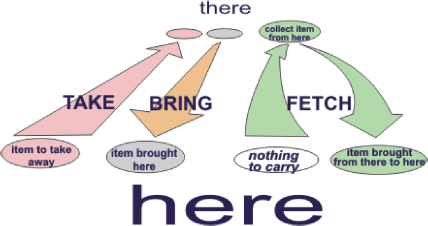
- take-bring-fetch;
- cry-weep-sob;
- long-wish-yearn
1. to bring — to take — to fetch
to bring — to come with, to carry or lead. If you bring someone or something with you when you come to a place, you have them with you. If you ask someone to bring you something, you are asking them to carry or move it to the place where you are.
приносить / приводить / привозить = у меня чего-то нет, и я жду, когда мне ПРИнесут
Please bring your calculator to every lesson.
He would have to bring Judy with him.
Bring me a glass of water, please.
to take — to move or carry sth from one place to another.
If you take someone or something with you when you go to a place you have them with you. If you take them to a place you carry or drive them there.
брать / взять / отводить (детей) / отнести = у меня уже что-то есть, и я сам/а несу куда-то
It’s Richard’s turn to take the children to school.
She gave me some books to take home.
to fetch — to go and get sth from another place and bring back.
If you fetch sth, you go to the place where it is and return with it to the place where you were before.
принести / захватить = я схожу, возьму и вернусь с этим предметом
Let me fetch a chair for you.
2. to cry — to weep — to sob
to cry — to produce tears from the eyes as a sign of sorrow.
плакать
The boy fell over and started crying.
to weep (formal) — to cry tears because of sadness or strong emo-tion, usually quietly and for a long time.
плакать / рыдать (навзрыд)
Weeping, the mourners followed the coffin to the churchyard.
to sob — to cry noisily while taking short breaths.
плакать тихонечко / всхлипывать
She couldn’t atop crying and sobbed herself to sleep.
3. to long (for) — to wish — to yearn (for)
to long — to want sth very much, especially when this used to happen or existed in the past.
очень хотеть, страстно желать (чего-л.) , испытывать потребность (в чём-л.) , стремиться (к чему-л.)
He longed for the good old days when teachers were shown respect.
I long for you – ты мне очень нужен.
to wish (formal) — to want strongly to do sth.
желать чего-то сильно
Everyone has the right to smoke if he or she wishes, but not the right to ruin the health of those around them.
to yearn (formal) — to want sth so much that you do not feel happy or complete without it, but you know you are NOT likely to get it.
томиться, тосковать по (кому-л. / чему-л.) ; очень сильно хотеть (чего-л.)
Above all the prisoner yearned for freedom.
УПРАЖНЕНИЯ
A. take — bring — fetch
1. Come to the party and ___ your friend, I’ll be very happy to see you both.
2. Could you please go and ___ a piece of chalk from the teacher’s room?
3. It was my grandmother who ___ me to the theatre for the first time.
4. We are meeting at 8 near the school, don’t forget to ___ your packed lunches with you.
5. It’s not so difficult to teach your dog to ___ sticks.
6. Father came home early and ___ a big beautifully decorated cake.
7. When I go travelling, I always ___ this bag, it’s very convenient.
8. My friend ___ me this magnet as a souvenir from England.
9. In the evening we used to go and ___ milk from the nearby farm.
B. cry — sob — weep
1. I held back tears because I didn’t want my friends to think that I was ___.
2. Brokenhearted she ___ silently at night not to disturb her family.
3. I always feel like ___ when I watch this scene at the end of the film.
4. From behind the door we heard a child ___ loudly in the house.
5. When Joan heard the happy news, she began to ___ tears of joy.
6. We were woken up in the middle of the night by a loud noise: it was little Andy ___ and calling his mother.
7. Please don’t ___, I’ll repair your doll, I promise.
8. She ___ hysterically her whole body shaking.
9. The girl __ quietly trying to hide her hitter tears from her friends.
C. long (for) — yearn (for) — wish
1. Duncan still ___ for his dead wife after all these years.
2. If you ___ really hard, maybe you’ll get what you want.
3, — Where is he now? — I only __ I knew.
4. Max waited for the taxi to come. He ___ desperately to be back at home.
5. They were the words she had secretly ___ to hear. Patricia was happy.
6. Though Beatrice knew she couldn’t have children of her own, she ___ for them.
7. ‘I ___ they could come,’ said Martin.
8. Boris ___ for the winter to be over.
9. Vera knew the family desperately needed her help, she understood she could hardly leave them, but she ___ to go to St. Petersburg to become a movie actress.
Ссылки на видео, объясняющие разницу в некоторых словах этого блока:
- Bring or Take – engvid.com
- Come, Go, Bring, Take, Fetch, Get: Learn English with Simple English Videos – simpleenglishvideo.com
Most confused words in English with Meaning are listed here. These confused words are used in our daily conversation. You must know these confused words that makes your listening and understanding difficult.
What are the Confusing Words?
Confusing words are the words that we mistakenly use in the wrong place. These are the words with the most confusion. Confusing words is a very useful vocabulary lesson and a lot of English learners are looking for a compatible lesson of confusing words.
Important: Adverbs of Manner
Most confused words in English with Meaning
Here is the list of 100 words that are often confused with their correct meaning in English:
| Temperance
Temperament |
moderation
disposition |
| regret
Sorrow |
to grieve at
pain of mind |
| Flagrant
Fragrant |
glaring
sweet |
| Witch
Which |
Sorceress
What one |
| Accident
Incident |
Bad event
Any event |
| Allowed
Aloud |
Permitted
Clearly heard |
| Statue
Statute |
an image
size |
| Last
Latest |
Final
Most recent |
| Confidant
Confident |
one who is entrusted with secrets
fully assured |
| Ascendant
Ascendancy |
rising
controlling influence |
| Simulate
Dissimulate |
to pretend to be what one is not
to hide what one is |
| Neglect
Negligence |
willful omission of duty
habitual omission of duty |
| Excite
Incite |
to stir up
to move the mind to action |
| Scenery
Sight |
a view of a landscape
a thing seen |
| Immunity
Impunity |
not liable to infection
freedom from punishment |
| Capable
Capacious |
having ability or skill to do
roomy |
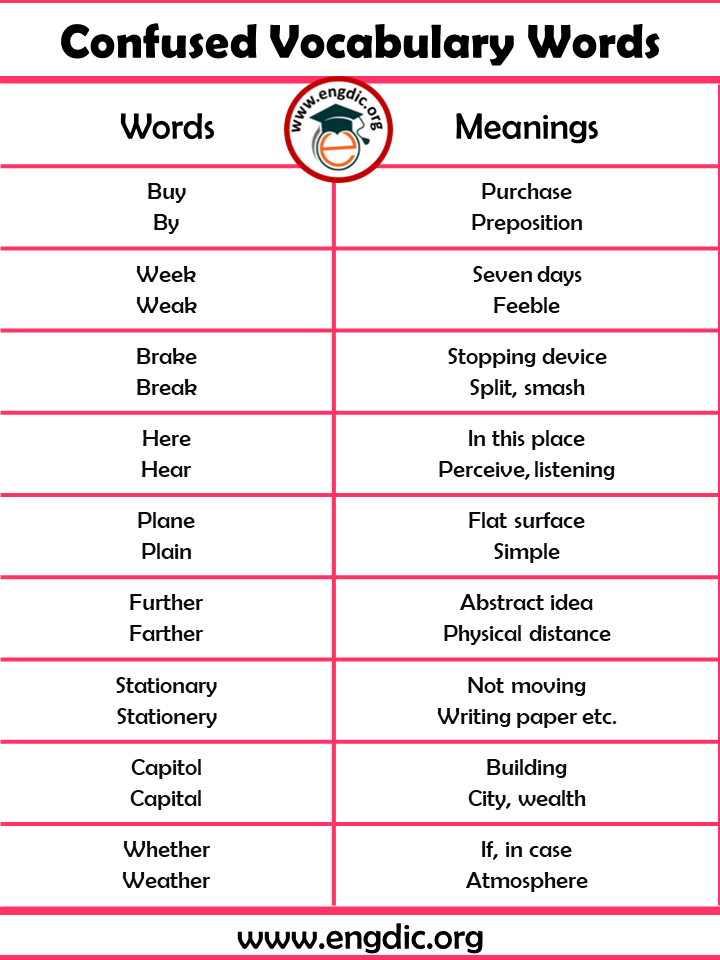
| Brake
Break |
Stopping device
Split, smash |
| Stimulant
Stimulus |
increasing or existing vital action
that which urge a man on |
| Ate
Eight |
The past tense of eat
The number |
| Honorary
Honorable |
intended merely to confer honor
worthy of Honor |
| Remember
Reminder |
Think of a memory
Notes, Cell alerts |
| Further
Farther |
Abstract idea
Physical distance |
| Stationary
Stationery |
Not moving
Writing paper etc. |
Confused Words List 2
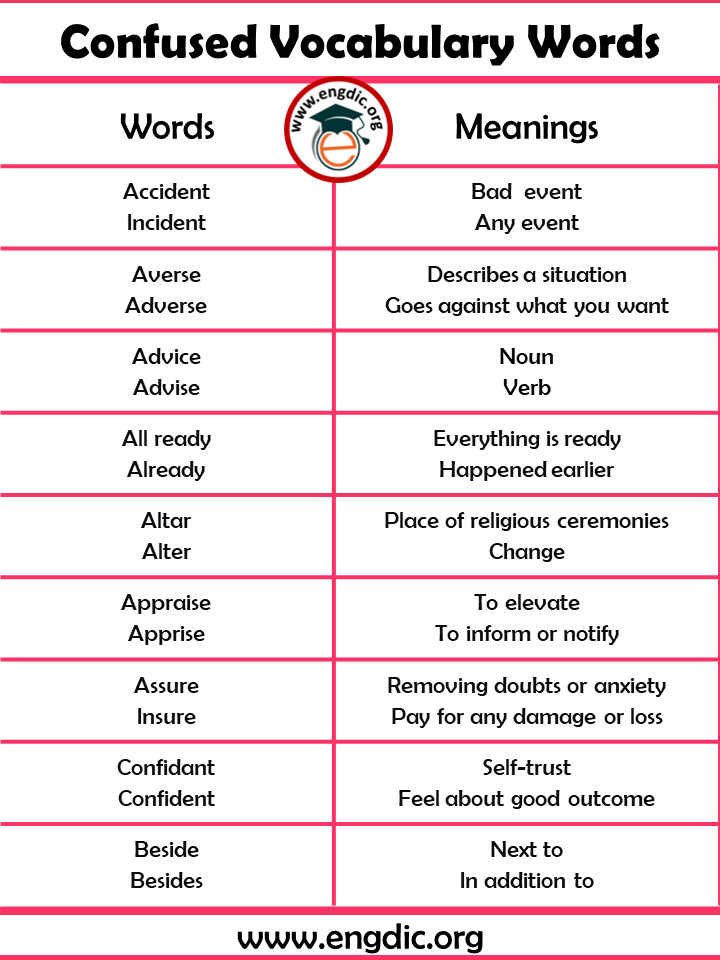
| Timid
Cowardly |
fearful, wanting courage
mean, base |
| Luxuriant
Luxurious |
rich in growth
given to luxury |
| Collision
Collusion |
clash
a secret agreement to deceive |
| Gentle
Genteel |
polite
well-bred |
| Capitol
Capital |
Building
City, wealth |
| Altar
Alter |
Place of religious ceremonies
Change |
| Exceptionable
Exceptional |
to which exception can be taken
extraordinary |
| Take
Receive |
to take hold of thing ourselves
to accept delivery of a thing |
| Sell
Sale |
Verb
Noun |
| Forth
Fourth |
Forward
The number comes after three |
| Confidant
Confident |
Self-trust
Feel about good outcome |
| Good
Well |
Adjective
Adverb |
| Trifling
Trivial |
of small importance
a thing which is small in itself |
| Temporary
Temporal |
lasting for a time only
worldly |
| Hope
Expect |
to cherish pleasurable wishes
to look forward to as something about to happen |
| Wages
Fee |
money way to workmen
some paid to a professional man |
| Persecute
Prosecute |
to harass
to bring before a court |
| Lonely
Solitary |
forsaken
alone |
| See
Witness |
see is used for persons or things
witness is used for events or incidents |
| Healthful
Healthy |
conducive to health
possessing or enjoying health |
| Compliment
Complement |
Positive comment
Two things that go together |
| Scatter
Spread |
to throw things in different directions
to cover a certain area with something |
| Attenuate
Extenuate |
to make thin or lean
mitigate; to lessen the gravity of an act |
| Respectful | indicating respect |
| Union
Unity |
the stoke of different things being combined into one
oneness |
| Pair
Couple |
a set of two persons or things
two persons of different sexes bound to each other |
| Wave
Waive |
move
relinquish or forego |
| Practical
Practicable |
applying knowledge to some useful end and opposed to theoretical
capable of being performed |
| Testimony
Evidence |
oral or written statement
information tending to establish fast |
Confused Words List 3

| Compliment
Complement |
an expression to regard or praise
that which completes |
| Sensual
Sensuous |
one who indulges in animal appetites
pertaining to senses |
| Emigrate
Immigrate |
Leave your own country
Come and live in a country |
| Hate
Dislike |
to dislike intensely
to be displeased with |
| Plane
Plain |
Flat surface
Simple |
| Coarse
Course |
Rough
Way or path |
| Tenor
Tenure |
general run or currency
term |
| Quiet
Quite |
Silent
Really, positively |
| Transpire
Happen |
become known
occur |
| Freedom
Liberty |
personal and private liberty
public freedom |
| Corporal
Corporeal |
bodily
having a body or substance |
| Official
Officious |
pertaining to an office
too forward in offering services |
| Event
Accident |
An occurrence of some importance not necessarily unexpected
unexpected happening |
| Verbal
Verbose |
oral
wordy |
| Factious
Facetious |
turbulent
joking |
| Whether
Weather |
If, in case
Atmosphere |
| Probable
Possible |
that which is expected to happen
that which can happen |
| Part
Portion |
a section or a division
share giving when something is distributed |
| Farther
Further |
more far or distant
additional |
| Depreciate
Deprecate |
to low in value
to express disapproval of some |
| Polite
Politic |
courteous
well devised |
| Buy
By |
Purchase
Preposition |
| Spacious
Specious |
having ample room.
seeming right or true, but not really so |
| Avocation
Vocation |
subordinate occupation generally pursued for pleasure
occupation, career |
| Imaginary
Imaginative |
unreal
given to imagining |
| To
Too |
In the direction of something
Also |
| Quantity
Number |
the amount that can be measured
the amount that can be counted |
| Pray
Prey |
Asking God
An animal that is hunted |
Related: 100 Confusing Word in English
Confusing Words List 3

| Bring up
Grow up |
Parents bring up children
Children grow up |
| Ensure
Insure |
Guarantee
Financial liability |
| Suspense
Suspension |
state of indecision b
withholding |
| Willing
Willful |
disposed
obstinate |
| Sequel
Sequence |
result
order of succession |
| Shade
Shadow |
a spot sheltered from the sun
patch of shade projection by a body |
| Beside
Besides |
Next to
In addition to |
| Gone to
Been to |
You’ve traveled and not returned yet
You’ve traveled and have already returned |
| Poison
Venom |
If we inhale
Is injected |
| Effectual
Effective |
successful in producing the desired effect
having power to effect |
| Conscious
Conscientious |
aware of
one who acts according to the dictates of one’s conscience |
| Observance
Observation |
performance
act of recognizing and nothing |
| Averse
Adverse |
Describes a situation
Goes against what you want |
| Genius
Talent |
rare natural gifts
high mental ability or extraordinary capacity that is acquired |
| Loose
Lose |
Free
Misplace |
| Week
Weak |
Seven days
Feeble |
| Momentary
Momentous |
lasting only for a moment
of great importance |
| Decry
Descry |
to condemn
to discover by the eye |
| Peak
Pique |
Top
Provoke, Arouse |
| Literally
Actually |
whatever I say is literally true
he actually told a lie |
| Resources
Recourse |
means of raising money
a going to for aid or protection |
| Fetch
Bring |
to go and get
taking something with one |
| Deduce
Deduct |
to infer a truth or opinion from what precedes
to subtract |
| Here
Hear |
In this place
Perceive, listening |
| Salary
Income |
the money paid at regular intervals to officials, clerk, soldier
total money earned or received |
| Beneficial
Beneficent |
advantageous, useful
kind |
| Ugly
Awkward |
offensive to the eye
ungraceful |
| Deliverance
Delivery |
act of delivering from evil or fear
the act of speaking |
| Whom
Who |
Object
Subject |
Common Confused Words List 5
| House
Home |
Is still a house even if no one living inside it
Is a place where you live or the location |
| Accede
Concede |
to agree
to admit |
| Greed
Avarice |
desire for more than one needs
love for money for its own sake |
| Guarantee
Warranty |
Refers to promise
Used for products |
| Hardly
Scarcely |
with difficulty
hardly |
| Clumsy
Veracity |
ungainly
greed |
| Flee
Fly |
to run away
to move through the air on wings or in an aircraft |
| Then
Than |
At that time
Comparison |
| Piece
Peace |
Part, portion
Absence of war |
| House
Home |
building intended for habitation
the residence of family |
| Complacent
Complaisant |
pleased, satisfied
obliging |
| Hasten
Hurry |
to move with speed
to act with haste |
| Poor
Pore |
Have no money
Putting |
| Morale
Moral |
State of spirit
Lesson |
| Mitigate
Alleviate |
to make the burden mild punishment
to light the burden |
| Goal
Gaol |
destination
jail |
| Assure
Insure |
Removing doubts or anxiety
Pay for any damage or loss |
| Complete
Finish |
accomplish
to end |
| Advice
Advise |
Noun
Verb |
| Insight
Incite |
In depth
Provoke to action |
| recollect
remember |
that which we have difficulty in recalling
keep in mind |
Common Confused Words List 6
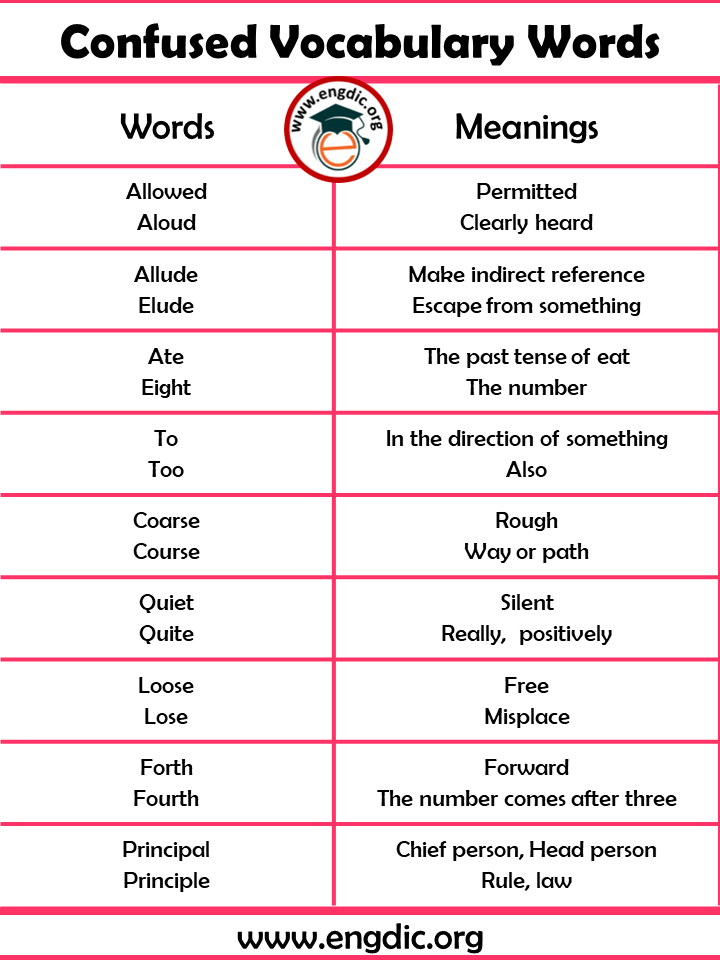
| Allude
Elude |
Make indirect reference
Escape from something |
| Appraise
Apprise |
To elevate
To inform or notify |
| Virtual
Virtuous |
for practical purposes
having model goodness |
| Wreck
Wreak |
ruin
take vengeance upon enemy |
| Principal
Principle |
Chief person, Head person
Rule, law |
| Popular
Populous |
pleasing to the people
full of people |
| All ready
Already |
Everything is ready
Happened earlier |
| Compensation
Remuneration |
reward for service
reward |
| Boldness
Courage |
courage of transient nature
the quality that enable men to meet danger without fear |
| Good
Goodly |
possessing desirable qualities
large; graceful |
| Cloth
Clothes |
Material cotton, wool
Items that we wear |
| Review
Revise |
To examine
Correction of errors |
Must Learn: Modal Verbs List
Infographics (Words often Confused with Meaning)

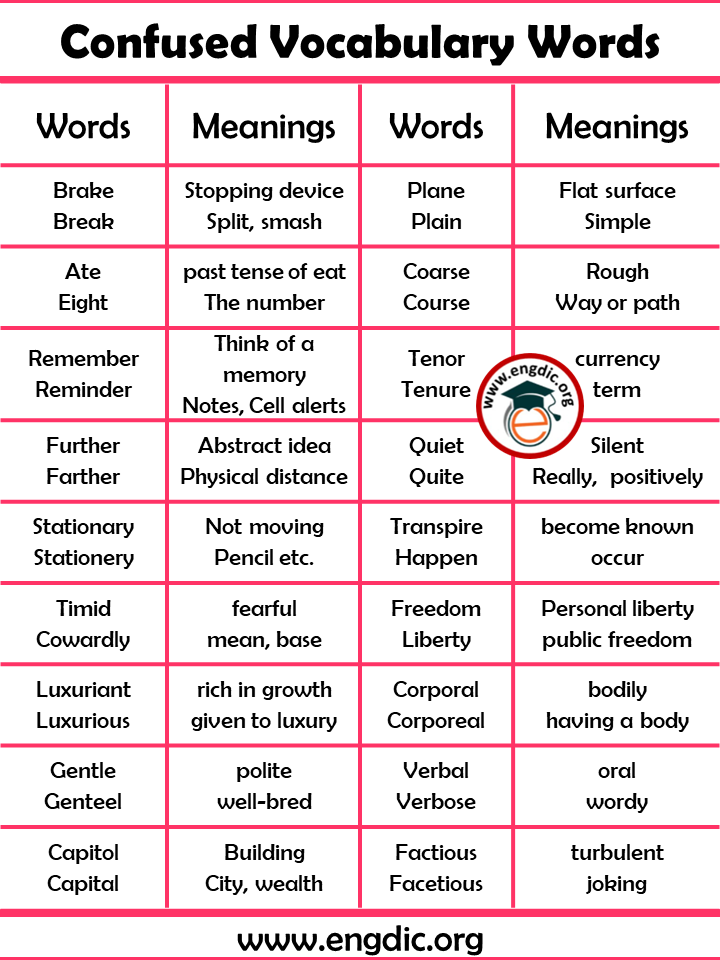
Download this lesson on Words often Confused with Meaning in PDF
Download PDF
What are the commonly confused words?
Here are Some Commonly Confused words with meaning:
| Confidant
Confident |
Self-trust
Feel about a good outcome |
| Beside
Besides |
Next to
In addition to |
| Averse
Adverse |
Describes a situation
Goes against what you want |
| Assure
Insure |
Removing doubts or anxiety
Pay for any damage or loss |
| Appraise
Apprise |
To elevate
To inform or notify |
| Altar
Alter |
Place of religious ceremonies
Change |
| All ready
Already |
Everything is ready
Happened earlier |
| Advice
Advise |
Noun
Verb |
| Accident
Incident |
Bad event
Any event |
What are the most confusing words in English?
Here is a list of 10 Most confusing Words in English:
| Whom
Who |
Object
Subject |
| Piece
Peace |
Part, portion
Absence of war |
| Morale
Moral |
State of spirit
Lesson |
| Last
Latest |
Final
Most recent |
| Insight
Incite |
In-depth
Provoke to action |
| House
Home |
Is still a house even if no one living inside it
Is a place where you live or the location |
| Guarantee
Warranty |
Refers to promise
Used for products |
| Good
Well |
Adjective
Adverb |
| Gone to
Been to |
You’ve traveled and not returned yet
You’ve traveled and have already returned |
| Ensure
Insure |
Guarantee
Financial liability |
| Emigrate
Immigrate |
Leave your own country
Come and live in a country |