
Образуйте от слова POSSIBLE однокоренное слово так, чтобы оно грамматически и лексически соответствовало содержанию текста.
It may seem __________________, but these frescoes have remained safe without restoration till the present day. Now the monastery is a museum. In 2000 the Ensemble of the Ferapontov Monastery was included in UNESCO’s World Heritage List.
Ferapontov Monastery in Vologda
Ferapontov monastery was founded in 1398. This was when Ferapont the Reverend established a new settlement on a lake not far from Vologda. There were many villages around this 26__________________ place and soon people started to come to him for advice. Then some people decided to stay with him as monks. That’s 27__________________ how the monastery was started. Later Ferapont built a wooden church and other 28__________________. He left the monastery to build another one but never returned. However, the monastery remained both a 29__________________ and popular place even without him. Now tourists can enjoy its 30__________________ frescoes, created in 1502. It may seem 31__________________, but these frescoes have remained safe without restoration till the present day. Now the monastery is a museum. In 2000 the Ensemble of the Ferapontov Monastery was included in UNESCO’s World Heritage List.
1
Образуйте от слова BEAUTY однокоренное слово так, чтобы оно грамматически и лексически соответствовало содержанию текста.
Ferapontov Monastery in Vologda
Ferapontov monastery was founded in 1398. This was when Ferapont the Reverend established a new settlement on a lake not far from Vologda. There were many villages around this __________________ place and soon people started to come to him for advice.
Источник: ЕГЭ по английскому языку 01.04.2019. Досрочная волна
2
Образуйте от слова ACTUAL однокоренное слово так, чтобы оно грамматически и лексически соответствовало содержанию текста.
Then some people decided to stay with him as monks. That’s __________________ how the monastery was started.
Источник: ЕГЭ по английскому языку 01.04.2019. Досрочная волна
3
Образуйте от слова CONSTRUCT однокоренное слово так, чтобы оно грамматически и лексически соответствовало содержанию текста.
Later Ferapont built a wooden church and other __________________. He left the monastery to build another one but never returned.
Источник: ЕГЭ по английскому языку 01.04.2019. Досрочная волна
4
Образуйте от слова FAME однокоренное слово так, чтобы оно грамматически и лексически соответствовало содержанию текста.
However, the monastery remained both a __________________ and popular place even without him.
Источник: ЕГЭ по английскому языку 01.04.2019. Досрочная волна
5
Образуйте от слова AMAZE однокоренное слово так, чтобы оно грамматически и лексически соответствовало содержанию текста.
Now tourists can enjoy its __________________ frescoes, created in 1502.
Источник: ЕГЭ по английскому языку 01.04.2019. Досрочная волна
Спрятать пояснение
Пояснение.
По смыслу предложения требуется отрицательная форма прилагательного possible, образуемая приставкой -im.
Ответ: impossible.
Источник: ЕГЭ по английскому языку 01.04.2019. Досрочная волна
ENTRY
TEST 11
LISTENING
Вы
услышите диалог. Определите, какие из приведённых утверждений А–G
соответствуют содержанию текста (1 — True), какие не соответствуют (2
— False) и о чём в тексте не сказано, то есть на основании текста нельзя
дать ни положительного, ни отрицательного ответа (3 — Not stated).
A. Ellen went camping with her family.
B. Ellen spent two weeks at a camp site in
Karelia.
C.
Ellen’s
family has a three-person tent.
D.
Nick
is afraid of rafting.
E.
Nick
has spent last two weeks getting ready for school.
F.
Nick
and Ellen like their last year History teacher.
G.
Ellen
doesn’t have good marks in history.
Запишите в ответ цифры, расположив их в
порядке, соответствующем буквам:
|
A |
B |
C |
D |
E |
F |
G |
READING
Прочитайте
текст и заполните пропуски A–F частями предложений, обозначенными
цифрами 1–7. Одна из частей в списке 1–7 — лишняя. Занесите
цифры, обозначающие соответствующие части предложений, в таблицу.
Santa Claus
The man we know as Santa Claus has
a history all to his own. Today, he is thought of mainly as the jolly man in
red, but his story A_______________________ the 3rd century to a monk named
St. Nicholas. It is believed that Nicholas was born sometime around 280 AD in
modern-day Turkey. Much admired for his kindness, St. Nicholas B_______________________.
It is said that he gave away all of his inherited wealth and
traveled the countryside
helping the poor and sick. Over the course of many years, Nicholas’s popularity
spread and he became known as the protector of children and sailors. His feast
day C_______________________ his
death, December 6. This was
traditionally considered a lucky day to make large purchases or to get married.
By the Renaissance, St. Nicholas was the most popular saint in Europe.
St. Nicholas first D_______________________
at the end of the 18th century. The name Santa Claus
evolved from a Dutch shortened form
of Sint Nikolaas. As his popularity grew, Sinter Klaas was described as
everything from a jocker with a blue three-cornered hat, red waistcoat, and
yellow stockings to a man wearing a broad-brimmed hat and a huge pair of
Flemish trousers.
In the 19th centuries
big stores E_______________________ using images of the newly-popular
Santa
Claus. In 1841,
thousands of children visited a Philadelphia shop to see a life-size Santa
Claus model. I F_______________________ before stores began to attract
children, and their parents, with the lure of a peek at the “real-life”
Santa Claus with his famous white beard and red gown.
1.
began to
advertise Christmas shopping
2. became the subject of many legends
3. began dressing up unemployed men in
4. is celebrated on the anniversary of
5. was only a matter of time
6. stretches all the way back to
7.
appeared in
American popular culture
|
Пропуск |
A |
B |
C |
D |
E |
F |
|
Часть |
GRAMMAR
& VOCABULARY
An
honest answer
1. Преобразуйте, если это необходимо, слово «INVITE»
так, чтобы оно грамматически соответствовало содержанию текста.
George
Bernard Shaw was an outstanding British literary figure and a man with a good
sense of humour.
When he
was still a young critic, he __________________ as a guest to a family party.
2.
Преобразуйте, если
это необходимо, слово PLAY так, чтобы оно грамматически соответствовало
со‐ держанию текста.
When
he entered the room, the daughter of the host __________________ the piano and
her performance
was no
good. She said, “People say you are fond of music. Are you?”
3.
Преобразуйте, если
это необходимо, слово BE так, чтобы оно грамматически
соответствовало содержанию текста.
“I
__________________ fond of music for a long time, but never mind, go on
playing,” was Shaw’s answer.
E-books
4.
Преобразуйте, если
это необходимо, слово UNDERSTAND так, чтобы оно грамматически
соответ‐ ствовало содержанию текста.
People
of the 21st century have to think about living green. A long time ago we
__________________ that
we should
protect our forests.
5.
Преобразуйте, если
это необходимо, слово THEY так, чтобы оно грамматически
соответствовало со‐ держанию текста.
That
is why today people try to avoid printing photos and keep __________________
all on computers. E-
books are
another example of people wishing not to waste paper.
6.
Преобразуйте, если
это необходимо, слово ONE так, чтобы оно грамматически
соответствовало со‐ держанию текста.
The
__________________ e-book appeared in 1998 and attracted everybody’s attention
immediately.
7.
Преобразуйте, если
это необходимо, слово SAFE так, чтобы оно грамматически
соответствовало со‐ держанию текста.
Modern
e-books are much __________________ for your eyes than they used to be in the
past and are very
affordable
now.
Ferapontov Monastery in Vologda
8.
Образуйте от слова BEAUTY однокоренное слово так, чтобы оно
грамматически и лексически соответствовало содержанию текста.
Ferapontov monastery
was founded in 1398. This was when Ferapont the Reverend established a new
settlement on a lake not far from Vologda. There were many villages around this
__________________ place and soon people started to come to him for advice.
9.
Образуйте от слова ACTUAL однокоренное слово так, чтобы оно
грамматически и лексически соответствовало содержанию текста.
Then
some people decided to stay with him as monks. That’s __________________ how
the monastery was
started.
10.
Образуйте от слова CONSTRUCT однокоренное слово так, чтобы оно
грамматически и лексически соответствовало содержанию текста.
Later
Ferapont built a wooden church and other __________________. He left the
monastery to build
another
one but never returned.
11.
Образуйте от слова FAME однокоренное слово так, чтобы оно
грамматически и лексически соответствовало содержанию текста.
However,
the monastery remained both a __________________ and popular place even without
him.
12.
Образуйте от слова AMAZE однокоренное слово так, чтобы оно
грамматически и лексически соответствовало содержанию текста.
Now
tourists can enjoy its __________________ frescoes, created in 1502.
13.
Образуйте от слова POSSIBLE однокоренное слово так, чтобы оно
грамматически и лексически соответствовало содержанию текста.
It
may seem __________________, but these frescoes have remained safe without
restoration till the present
day. Now the monastery is a museum.
In 2000 the Ensemble of the Ferapontov Monastery was included in UNESCO’s World
Heritage List.
In the summer of 1909, Russian chemist and photographer Sergey Prokudin-Gorsky traveled along the Mariinsky Waterway, which connects St. Petersburg via the Sheksna River with the Volga River Basin.
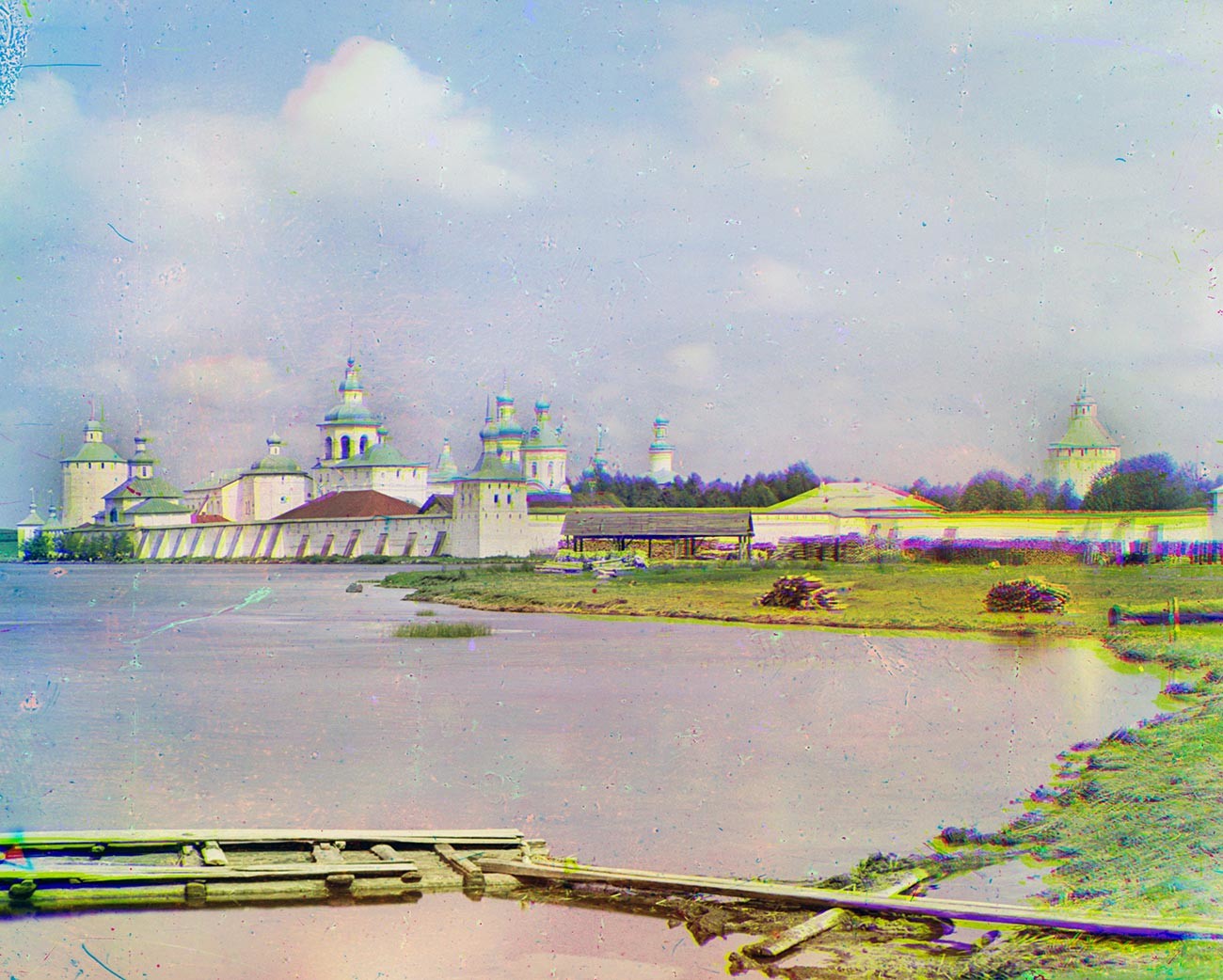
Kirillov. St. Kirill Belozersk Monastery. Southeast view with south shore of Siverskoe Lake. Summer 1909
Sergeн Prokudin-Gorsky
He visited historic settlements in northern Russia, including the small town of Kirillov, site of the St. Kirill Belozersky Monastery. With its massive walls, brick towers and array of churches, this monastery was one of the most impressive sights in the Russian North.
A test of faith
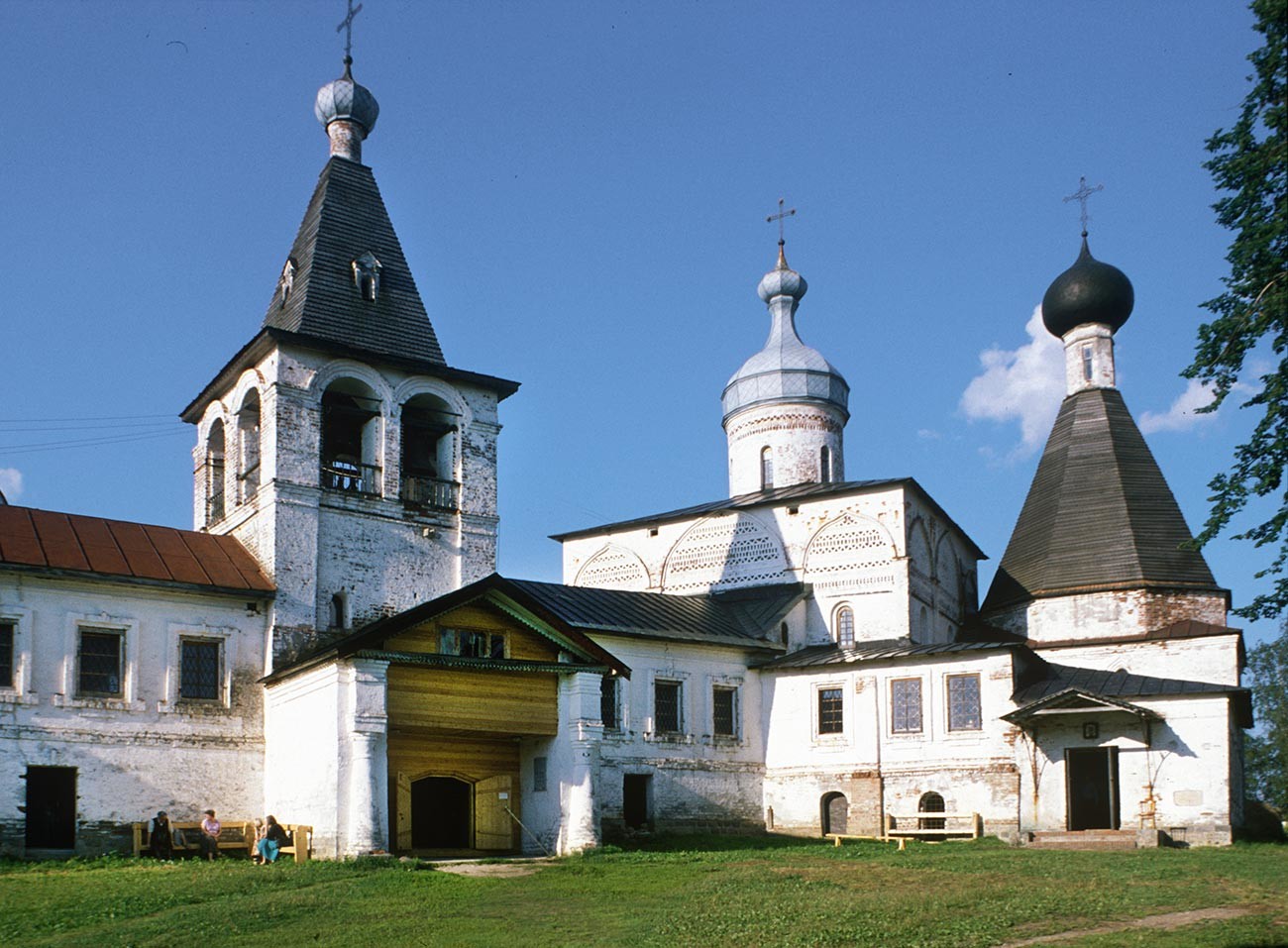
Ferapontov Monastery, west view. From left: bell tower, Nativity Cathedral, Church of St. Martinian. August 2, 1998
William Brumfield
During the 14th-century revival of monasticism in Moscow under the direction of St. Sergius of Radonezh, pioneering monks sought remote northern areas as a test of their faith and dedication. Muscovite princes supported them not only to spread the Orthodox faith but also to consolidate Moscow’s territorial expansion into the rich northern forests.
The founding of the Kirillov monastery can be dated to 1397, when the monk Kirill (Cyril) of Belozersk (1337-1427) arrived at Siverskoye Lake and made a cave dwelling for himself. He had taken monastic vows in Moscow’s powerful Simonov Monastery and became a disciple of St. Sergius, who supported his determination.
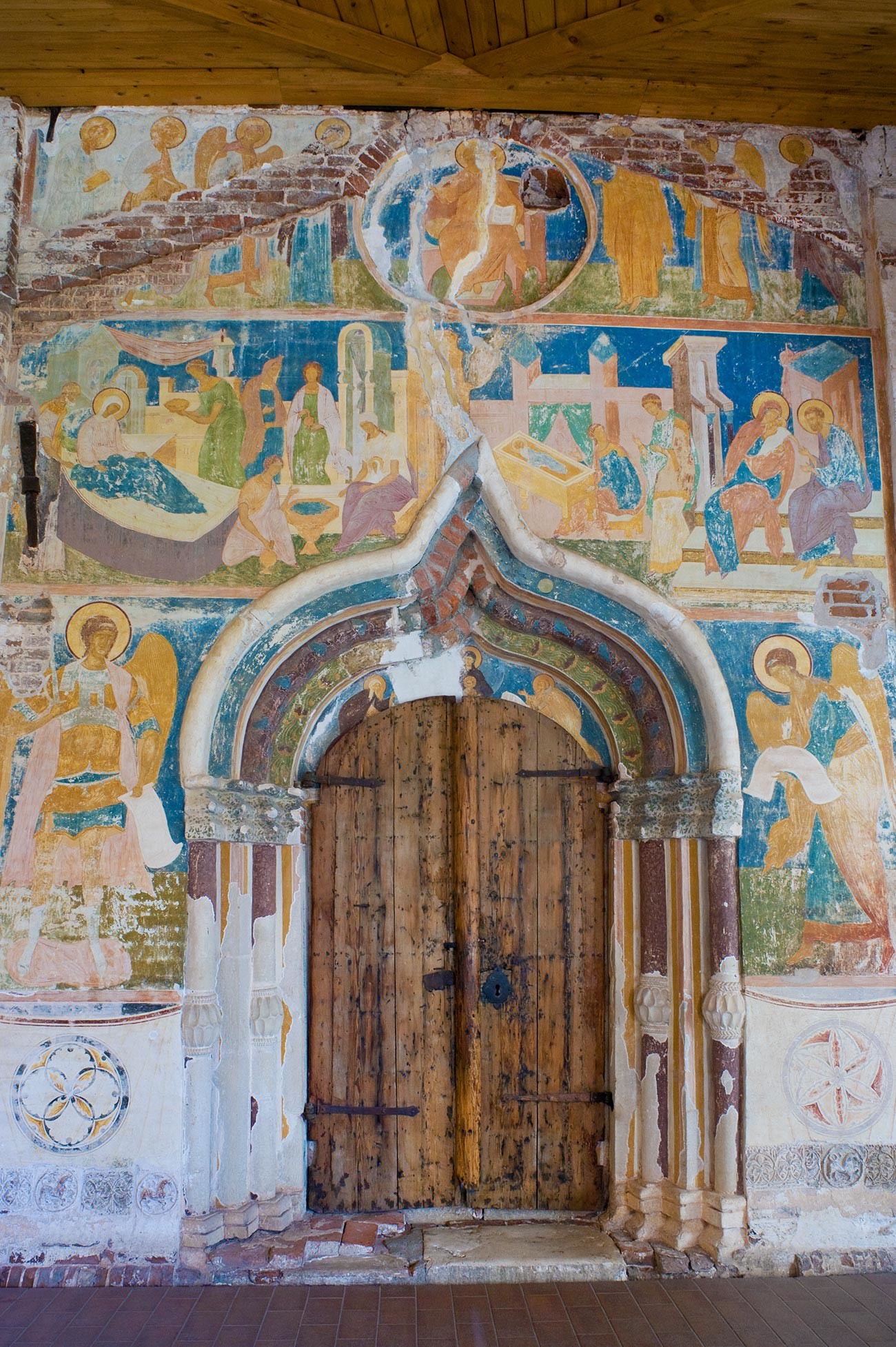
Cathedral of Nativity of the Virgin, west facade. Main portal with Archangels Michael (left) & Gabriel. Top: scenes from Nativity of Virgin Mary. June 1, 2014
William Brumfield
Kirill was joined by the monk Ferapont (1337-1426; also of noble birth and tonsured at Simonov Monastery). Ferapont left in 1398 to found a monastic retreat overlooking nearby Lake Borodavo. Formally dedicated to the Nativity of the Virgin, the monastery acquired the additional name Ferapontov after the monk’s canonization in 1549. Ferapont had the support of Prince of Andrey of Mozhaisk (son of Grand Prince Dmitry Donskoy), who later asked him to establish another monastery at Mozhaisk.
A spiritual treasure
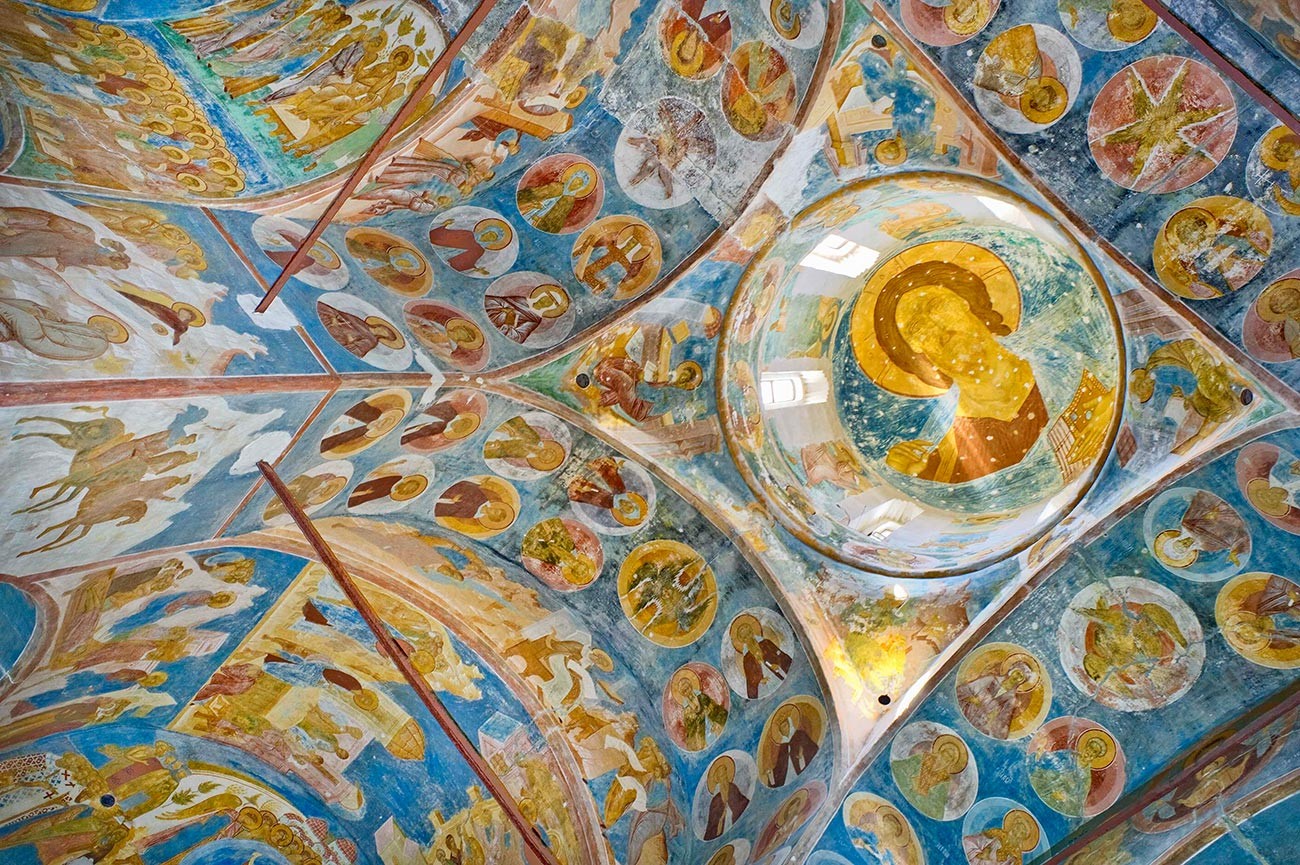
Cathedral of Nativity, general view of frescoes. Dome with image of Christ Pantokrator. Left: northwest pier. Medallions depict monastics, eremites, martyrs, saints. June 1, 2014
William Brumfield
Located not far from the Sheksna River (13 miles), Ferapontov Monastery is of one of Russia’s most revered cultural and spiritual treasures. Nonetheless, it is not included in popular summer cruise itineraries between Moscow and St. Petersburg. Indeed, the small site could easily be overwhelmed by large tour groups. There is no evidence that Prokudin-Gorsky visited it during his work at Kirillov. My own several visits occurred over some two decades, from 1995 to 2014.
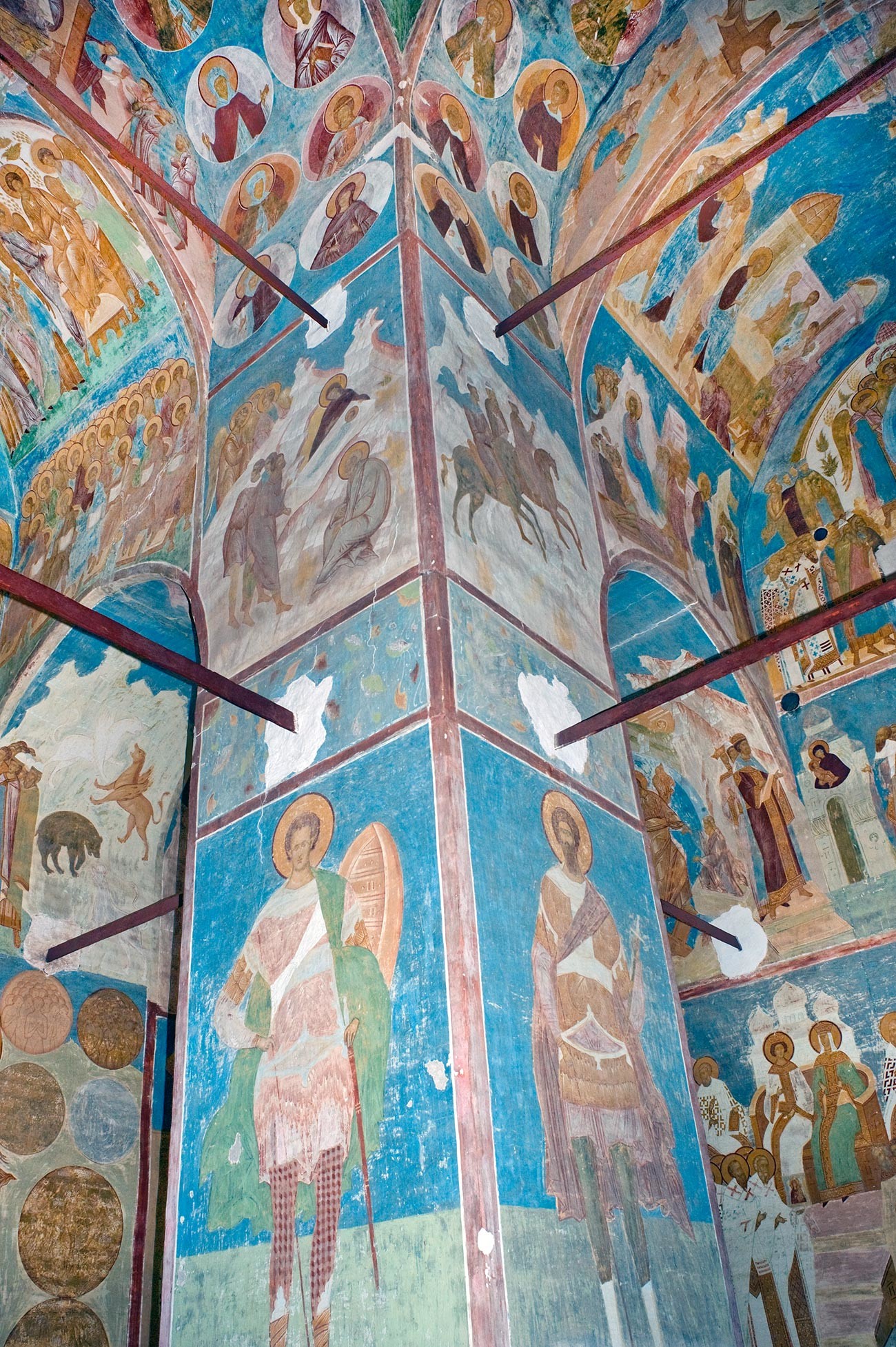
Cathedral of Nativity. Northwest pier with frescoes of St. Demetrius (left) & St. Theodore. Upper level: Three Wise Men following the Star. June 1, 2014
William Brumfield
For dedicated art lovers, Ferapontov Monastery and its luminous early 16th-century frescoes are now accessible via paved road from the regional capital of Vologda (75 miles). In recognition of its significance as one of the greatest examples of medieval Russian art, the monastery was chosen in 2000 for inclusion on the UNESCO World Heritage List.
The central monastic church, dedicated to the Nativity of the Virgin and originally a log structure, was rebuilt in brick in 1490 under the guidance of abbot (hegumen) Ioasaf. The upper walls and cupola of the structure were modified as early as the 16th century, with additional changes during the 18th century.
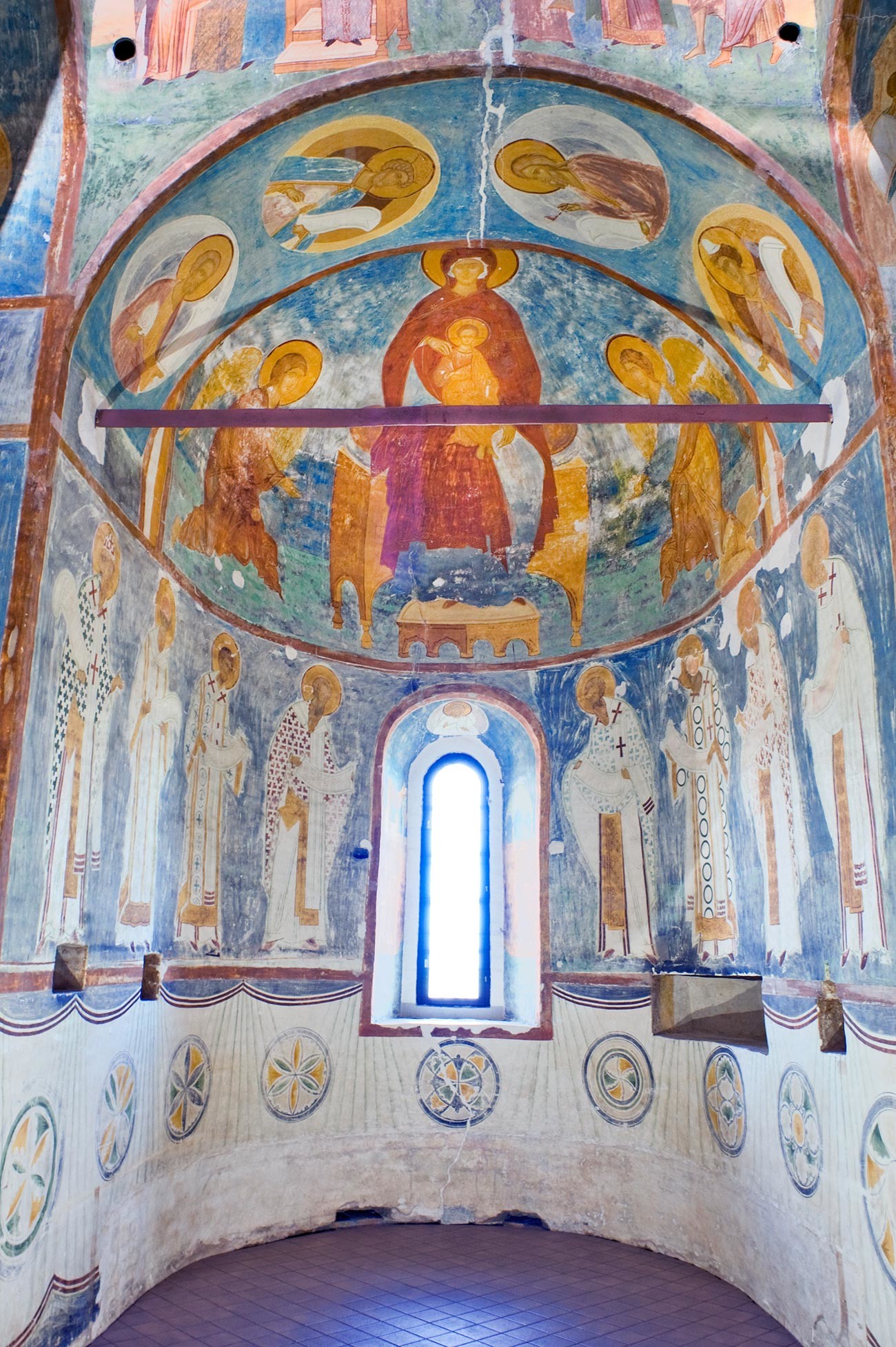
Cathedral of Nativity. Central apse (for main altar). Fresco of Mary enthroned with Archangels Gabriel & Michael. Lower row: Church Fathers at liturgy. Foreground: iron tie rod stabilizing the walls. June 1, 2014
William Brumfield
The impetus for the remarkable frescoes also came from Ioasaf, who was a spiritual adviser to Grand Prince Ivan III and a member of the princely Obolensky family. With such connections, he was able to draw upon the services of the renowned artist Dionisy, accustomed to commissions for frescoes and icons from the Muscovite court.
In 1502, Dionisy and his sons Feodosy and Vladimir journeyed to the monastery, where they were able to paint the entire interior in the summer of 1502. (Because of the damp climate, such work was possible only in the summer months.)
Suffused with color
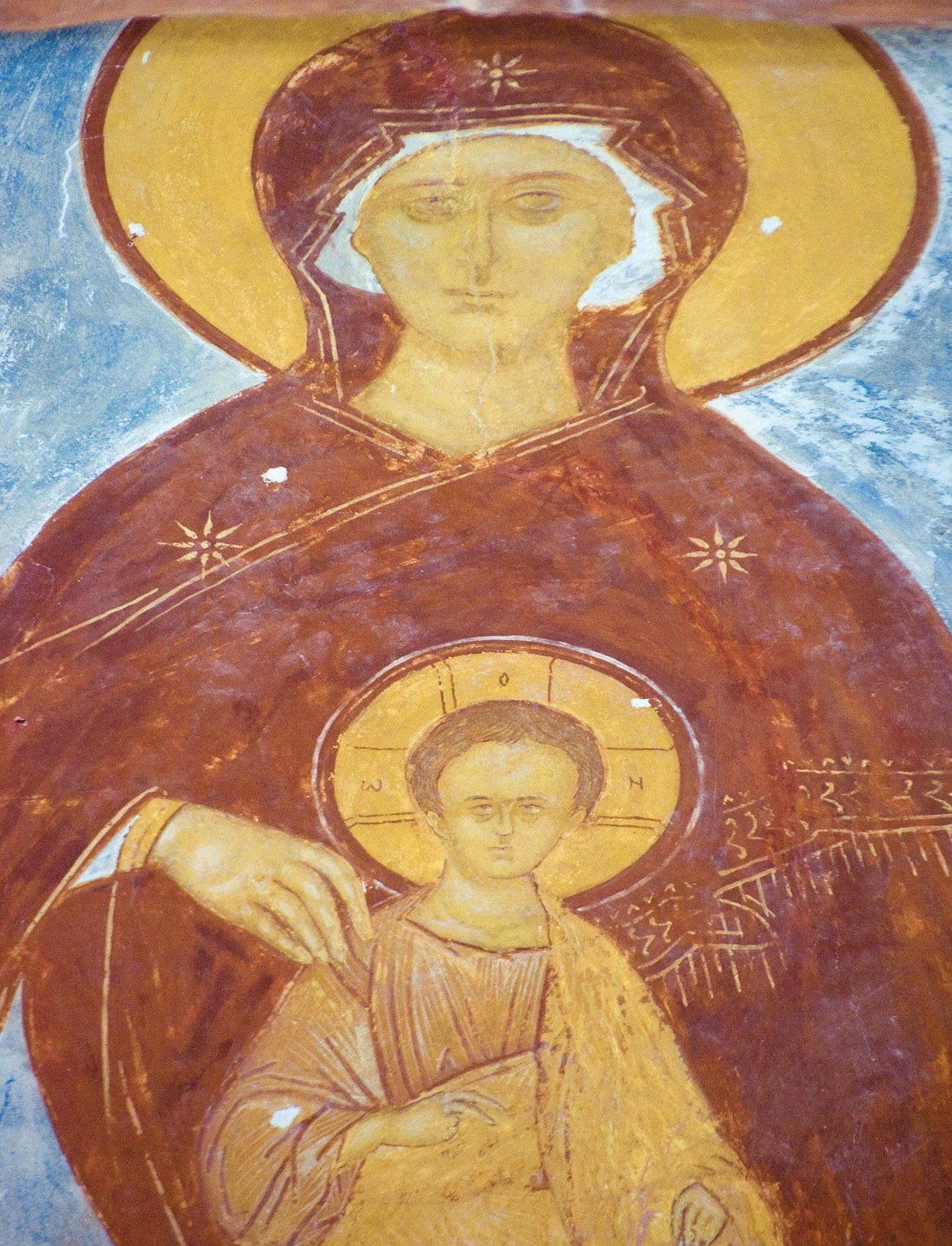
Cathedral of Nativity. Central apse. Fresco of Mary enthroned with Christ Child. June 1, 2014
William Brumfield
Fortunately, the remote location and small size of Ferapontov Monastery spared the cathedral walls from the repainting typical of more prominent medieval churches. Despite structural damage and periods of political turbulence, the frescoes have survived with only limited losses. The monastery thus provides unrivaled insight into the monumental creativity of Dionisy.
The west (main) entrance consists of a simple perspective portal flanked by frescoes devoted to the Nativity of the Virgin. Archangels Michael and Gabriel guard the portal. Although partially damaged by the construction of a porch and gallery in the 16th century, the entrance frescoes thereby gained protection from the severe climate. Their surfaces still retain a rich palette of colors.
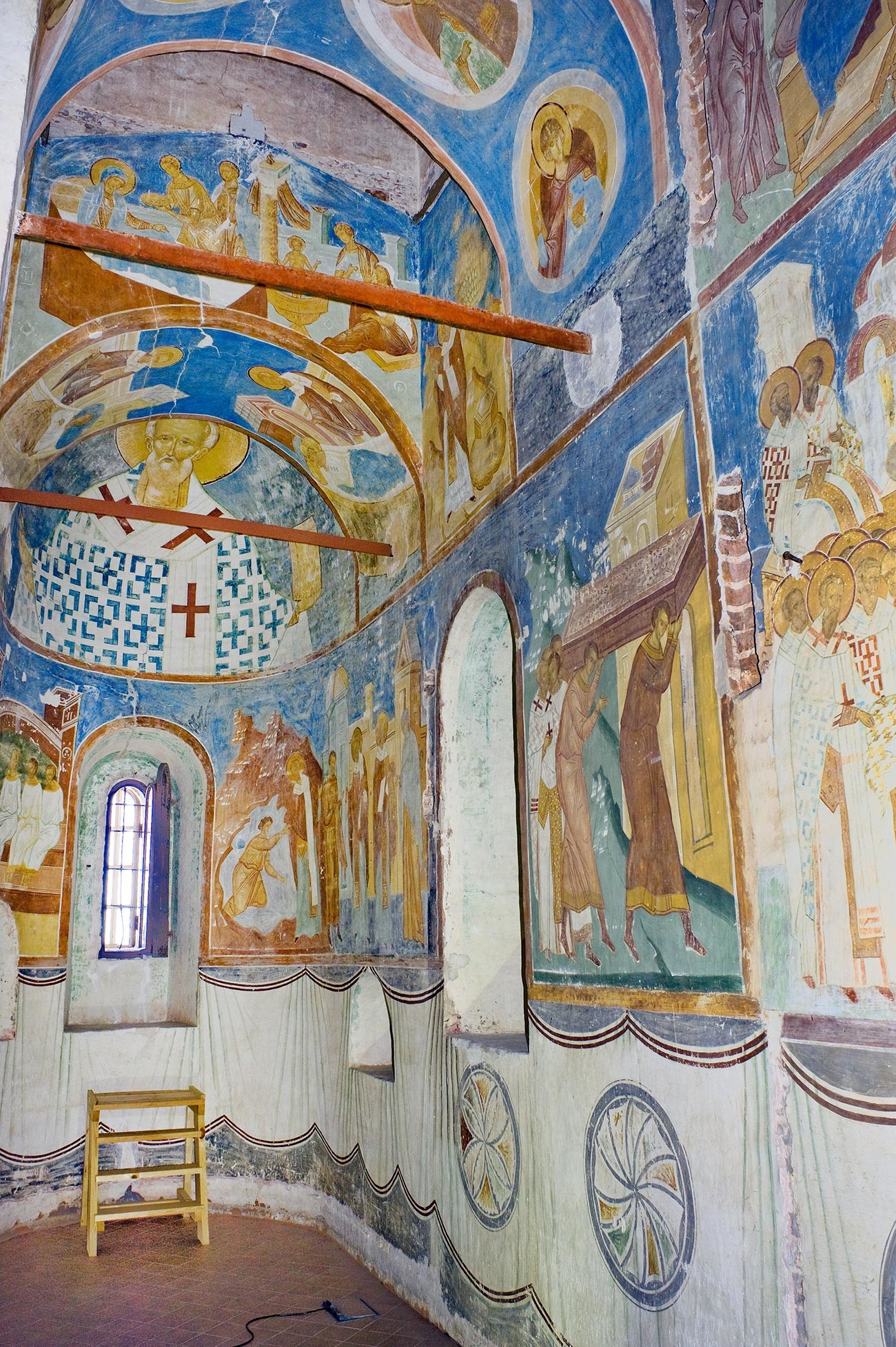
Cathedral of Nativity. South apse with frescoes of St. Nicholas. June 1, 2014
William Brumfield
On entering the Church of the Nativity of the Virgin we see a compact space whose walls are completely painted. The volume is defined by four piers, which support a single cylinder (or «drum») and cupola. Iron tie rods connect the upper parts of the main structural elements. On a bright afternoon, the interior is suffused with color.
The Ferapontov paintings are radiant in their warmth and the expressiveness of their figures. Legend has it that Dionisy derived the pigments for his water-based paints from stones found at Lake Borodava. It is more likely that he brought from Moscow materials of the highest quality, supported by the largesse of Ioasaf and perhaps the court itself.
A vision of heaven on earth
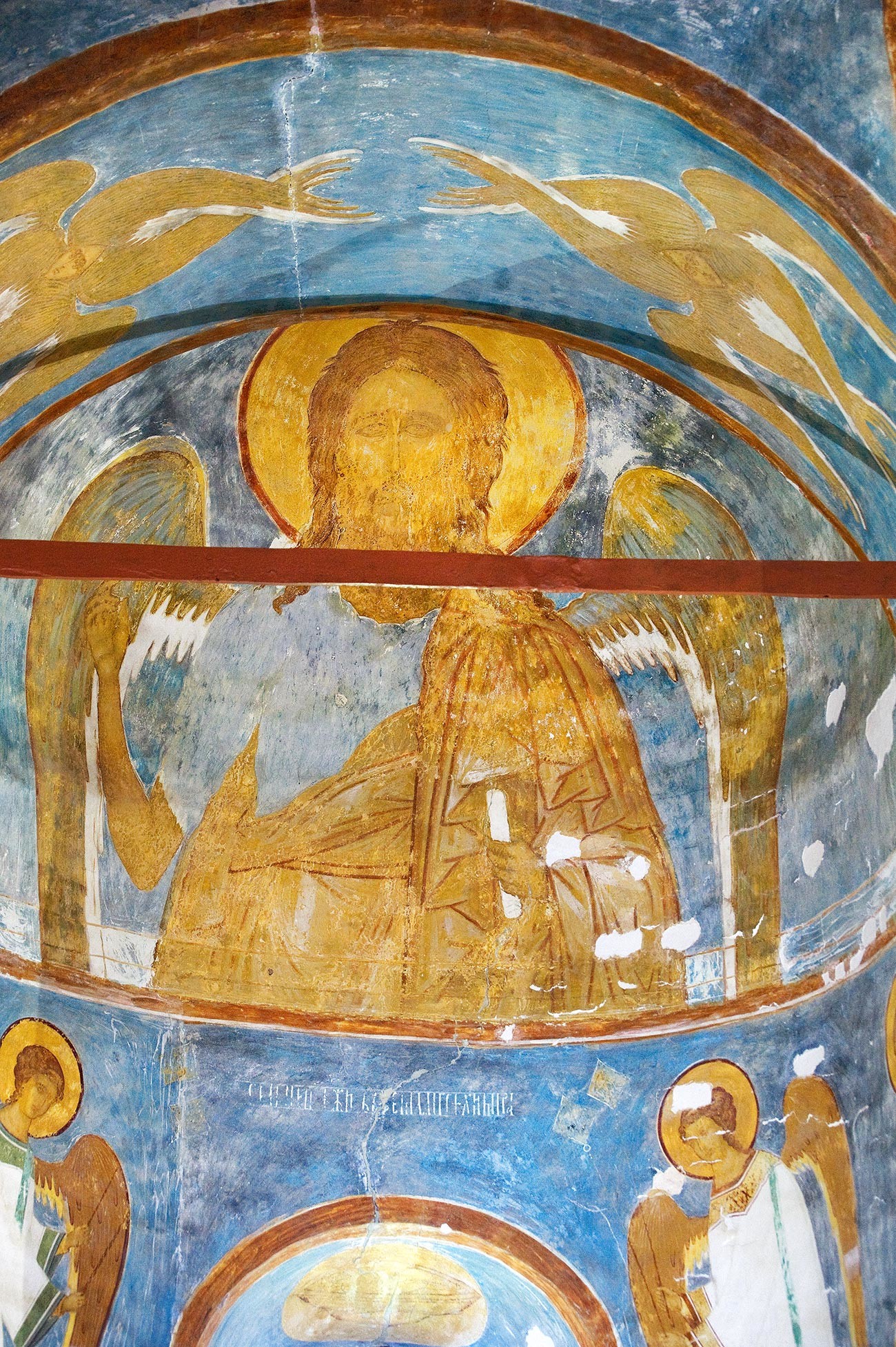
Cathedral of Nativity. North apse with fresco of John the Baptist, Angel of the Desert.
June 1, 2014
William Brumfield
As befits the dedication of this church, most of the frescoes are devoted to Mary. The great Akathistos cycle of liturgical hymns to the Virgin is comprehensively depicted and includes miracles and other events in her life. The entire fresco ensemble is a work in praise of Mary.
There are also images of archangels, saints, and church fathers on the piers and arches. The lower tier of the north and south walls includes a depiction of the Seven Ecumenical Councils, which affirmed the doctrine of the Trinity.
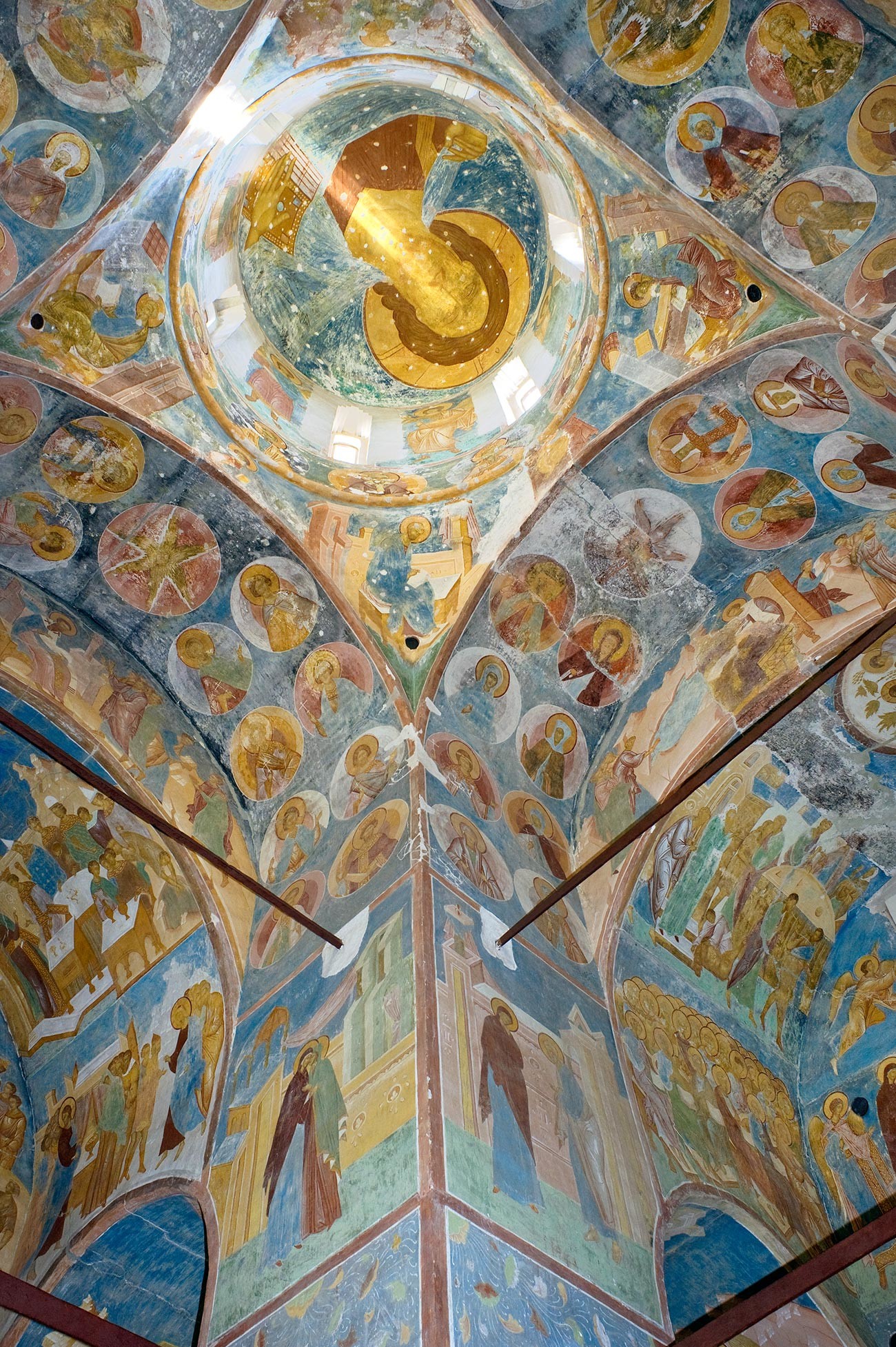
Cathedral of Nativity. Dome with image of Christ Pantokrator. Left: southwest pier with scenes from the Great Akathist (hymn to Virgin Mary). June 1, 2014
William Brumfield
Soaring above the interior, the dome contains the mysterious image of Christ Pantocrator («Ruler of all»), a feature typical of Russian Orthodox churches. Archangels appear in the cylinder beneath the dome, together with medallions depicting patriarchs from the Book of Genesis. Images of the four evangelists are portrayed on the triangular pendentives at the base of the cylinder. This central space is surrounded by a constellation of medallions with saints.
In the east is the most sacred part of the structure, the apse. The main bay, which contained the altar, is centered on a vibrant fresco of the enthroned Virgin Mary with the infant Jesus seated on her lap. The north (left) bay contained the prothesis, where the sacraments were blessed. At its top is John the Baptist, Angel in the Wilderness. The south bay contained the diakonikon, with the priests’ vestments. It culminates in the intent gaze of St. Nicholas.
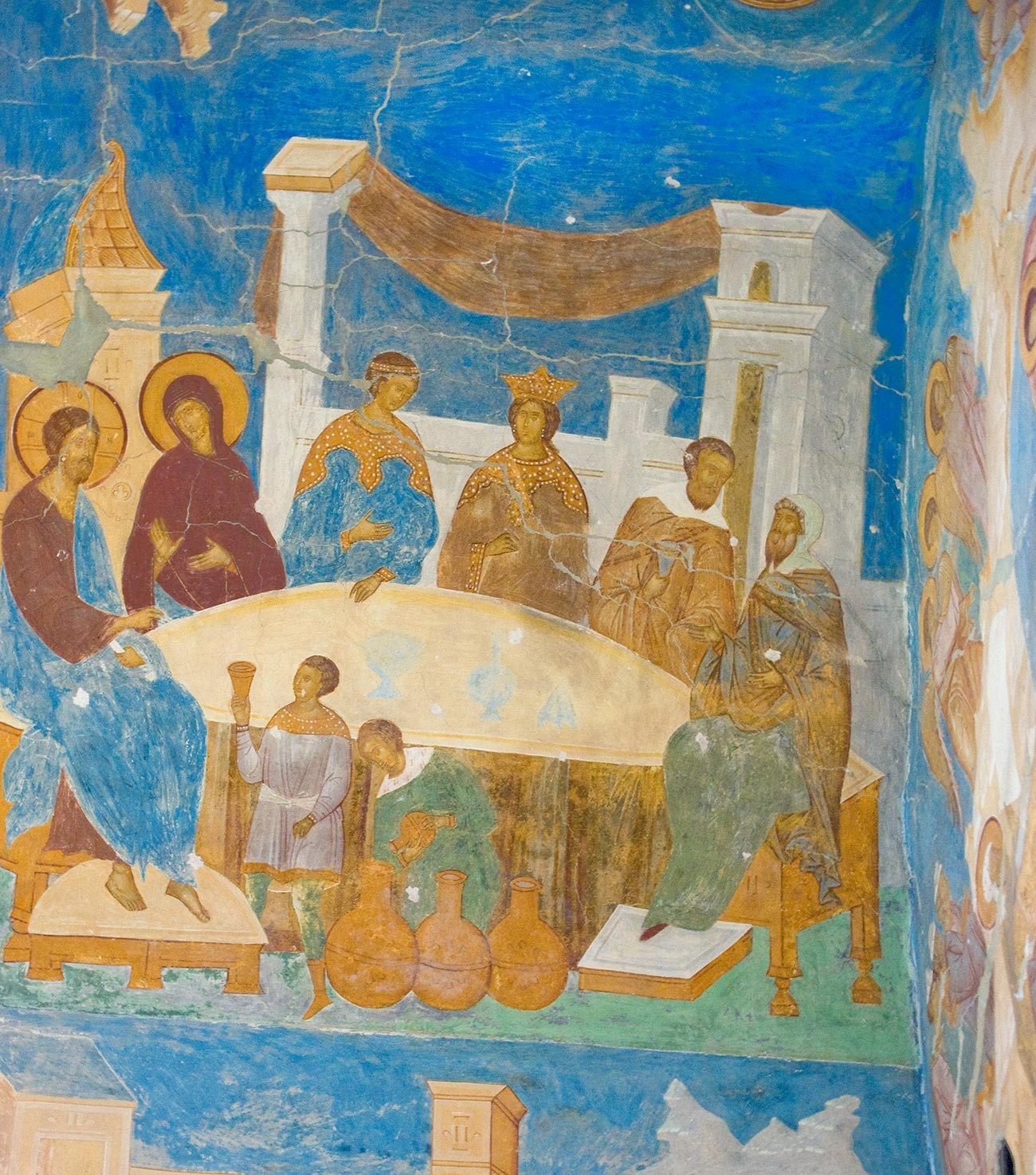
Cathedral of Nativity. South wall, vault arch, left side. Fresco of Christ at the Wedding in Cana. June 1, 2014
William Brumfield
The west wall contains a partially preserved «Last Judgment.» The central elements, including Christ Enthroned, were lost to ill-conceived structural changes in the 18th century. Despite this loss, the preservation of these sublime frescoes must be considered one of the miracles of Russian art.
Destruction and decline
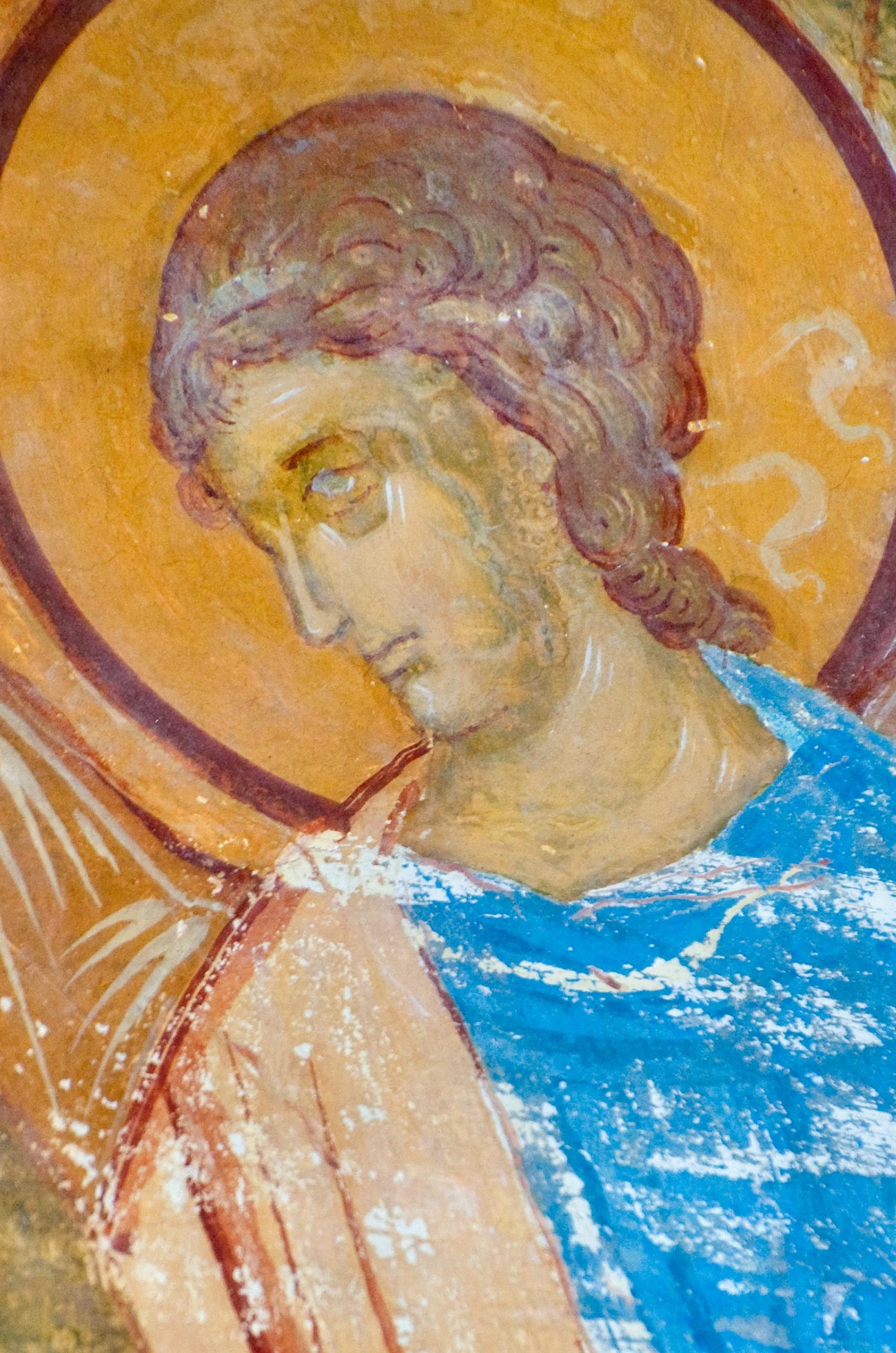
Cathedral of Nativity. North wall. Angel from fresco «Vision of the Monk Eulogios». June 1, 2014
William Brumfield
The Ferapontov Monastery continued to flourish in the 16th century with the addition in 1530-31 of a brick refectory and church dedicated to the Annunciation, as well as a large building for the monastery’s archives and collection of manuscripts. During his reign (1547-1584), Ivan the Terrible maintained the tradition of royal patronage of the monastery.
With the end of the Rurik dynasty in 1598 and the sudden death of Tsar Boris Godunov in 1605, Russia endured a catastrophic dynastic crisis known as the Time of Troubles during which invading forces and large bands of marauders devastated the heartland. Even the establishment of the Romanov dynasty in 1613 failed to quell disorder in much of the country.
Although the well-defended Kirillov Monastery withstood several attacks, the smaller Ferapontov Monastery was sacked by a Polish-Lithuanian force in 1614. Fortunately, much of the monastery treasure was hidden, and the cathedral frescoes survived, but economic recovery occurred slowly because of the widespread destruction of surrounding villages.
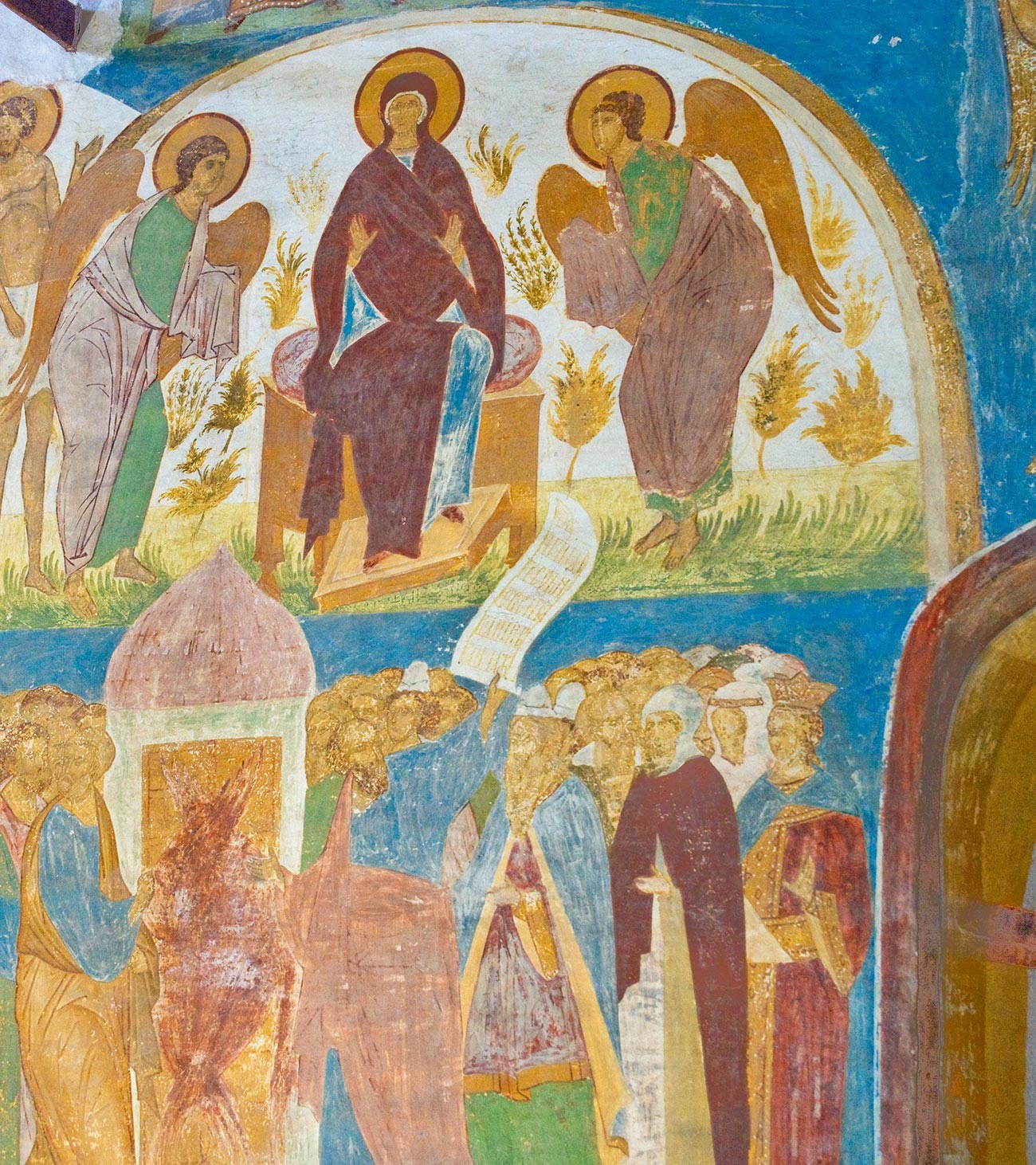
Cathedral of Nativity. West wall, Virgin Mary in Paradise. June 1, 2014
William Brumfield
In 1640 a brick church dedicated to St. Martinian (successor to St. Ferapont) was erected at the south wall of the Nativity Cathedral. Its distinctive «tent» tower provides a vertical point for the central ensemble, which was completed by construction of a brick bell tower and covered gallery leading to the refectory church. The culminating grace point occurred in 1649 with the rebuilding of the Holy Gate, crowned with twin churches dedicated to St. Ferapont and the Epiphany.
From 1667 to 1676, the monastery served as the place of exile for the former Patriarch Nikon, who was stripped of his authority by a church council in 1666. At the same time, the monastery underwent a prolonged economic decline culminating in 1764 with the loss of revenue-producing property following Catherine the Great’s secularization of monastic land holdings. The 1798, the impoverished monastery was closed, and its churches were converted to parish use.
A miraculous restoration
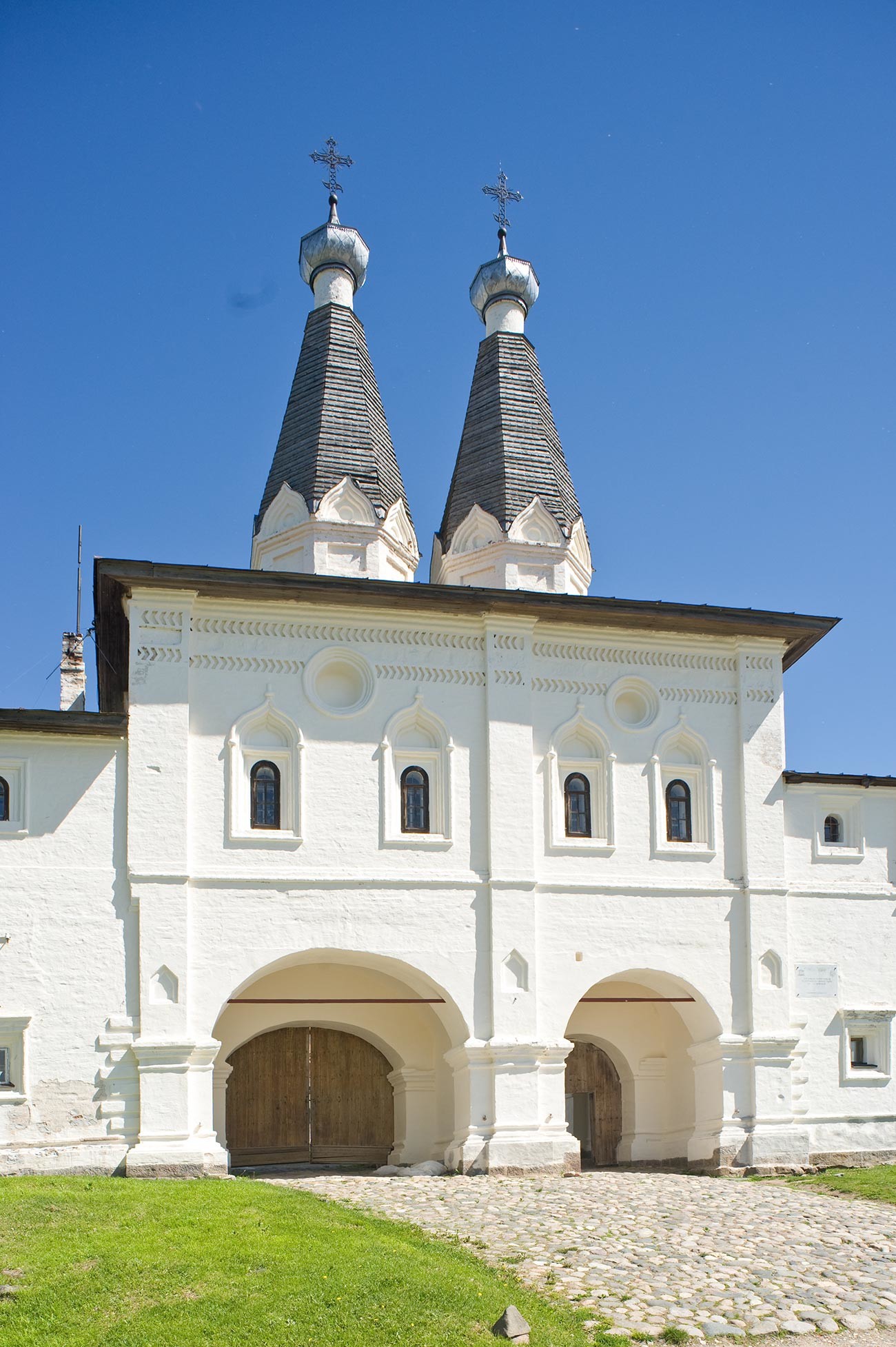
Ferapontov Monastery. Holy Gate with Churches of Epiphany & St. Ferapont. West view. June 1, 2014
William Brumfield
Without necessary maintenance, the architectural ensemble was threatened with irreversible damage. Its plight was brought to public attention by Ivan Brilliantov, son of a local priest from neighboring Tsypino. Because of his scrupulous work studying the architecture and frescoes, the monastery was reconsecrated as a convent in 1903 under the direction of Abbess Taisiya, one of Russia’s most venerated monastics at the turn of the 20th century.
In 1925 the convent was dissolved by Soviet decree, and the churches converted to parish use until their closure in 1936. Tragically, Ivan Brilliantov was arrested and shot in 1931 during an early purge against specialists in local history—something that seems incredible even by the standards of the time.
At least the monastery buildings were conserved as major work of art — in large measure based on Brilliantov’s pioneering efforts. In 1975 the site was designated a state museum, and in 1989 the gate churches were reopened for a local parish. Since that time the buildings have been repaired, and the frescoes have been the object of decades of careful study and restoration.
The sacred territory is now shared by the museum and the Russian Orthodox Church. All things considered, the preservation of the Dionisy frescoes at Ferapontov Monastery must be considered one the great miracles of Russian cultural history.
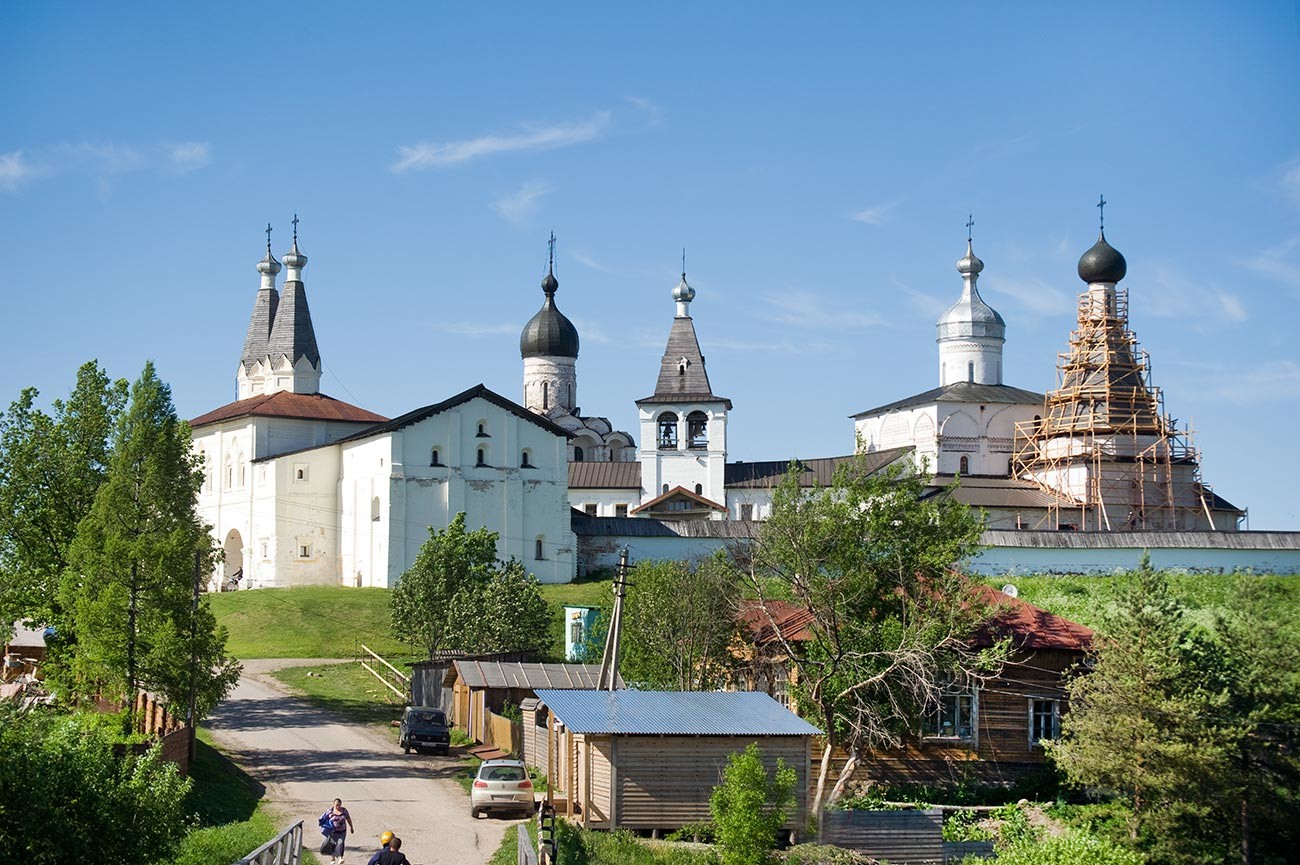
Ferapontov Monastery, southwest view. From left: Churches of Epiphany & St. Ferapont, bell tower, Nativity Cathedral, Church of St. Martinian. June 1, 2014
William Brumfield
In the early 20th century, the Russian photographer Sergey Prokudin-Gorsky developed a complex process for color photography. Between 1903 and 1916 he traveled through the Russian Empire and took over 2,000 photographs with the process, which involved three exposures on a glass plate. In August 1918, he left Russia and ultimately resettled in France where he was reunited with a large part of his collection of glass negatives, as well as 13 albums of contact prints. After his death in Paris in 1944, his heirs sold the collection to the Library of Congress. In the early 21st century the Library digitized the Prokudin-Gorsky Collection and made it freely available to the global public. A few Russian websites now have versions of the collection. In 1986 the architectural historian and photographer William Brumfield organized the first exhibit of Prokudin-Gorsky photographs at the Library of Congress. Over a period of work in Russia beginning in 1970, Brumfield has photographed most of the sites visited by Prokudin-Gorsky. This series of articles juxtaposes Prokudin-Gorsky’s views of architectural monuments with photographs taken by Brumfield decades later.
If using any of Russia Beyond’s content, partly or in full, always provide an active hyperlink to the original material.
Get the week’s best stories straight to your inbox
Founded in 1398, Ferapontov Monastery hosts a very valuable examples of ancient frescoes. The Monastery is enlisted in the World Heritage List of UNESCO.

Ferapontov Monastery

Ferapontov Monastery. Frescoes of Dionisy

Ferapontov Monastery. Frescoes of Dionisy

Ferapontov Monastery. Frescoes of Dionisy

Ferapontovo village

Ferapontovo village
The monastery was founded in 1398 when Ferapont the Reverend left Kirillov Monastery and settled on the shores of Lake Paskoye. There were many villages around this place and soon people started to come to him for advice. Then some people decided to stay with him as monks. That’s how the Monastery was started.
Later Ferapont built the Church of the Nativity of the Virgin, the first church was built out of wood. In 1408 Ferapont left the Monastery and went to Mozhaisk to found a new monastery at the request of the prince of Mozhaisk Andrew. He was laways dreaming to come back, but he never did. He died in 1426.
In 1427 Matinian the Reverend visited the Monastery and decided to stay there. Later he became the Father-Superior. This period is considered to be the Golden Age of the Monastery.
In 1924 Ferapontov Monastery was closed. In 1975 the museum was established in order to protect the valuable frescoes of Dionisy.
The frescoes
In the main cathedral of Ferapontov Men’s Monastery one can observe marvellous frescoes, created in 1502 by a famous artist Dionisy. These frescoes remained safe without restoration till present days.
Английский язык, 03.03.2019 04:00
Перевод в оригинальном стиле. it is cold. a chill wind blows from the bosphorus. we had come on our trip in late march, expecting sunshine and mild heat, and found hail-storms. when it rains in istanbul the narrow streets below the bazaar become torrents, impossible to walk through. from the grounds of the topkapi the skyline of the city, like an array of upturned shields andspears, is unreal. the tourists murmur, pass on. turbans, fountains. images out of the arabian nights. our hotel is in the new part of istanbul, near the hilton, overlooking the bosphorus, across which there is a newly built bridge. standing on the balcony you can look from europe to asia. there are few places in the world where, poised on one continent, you can gaze over a strip of water at another. we hadwanted something more exotic. no more alpine chalets and villas in spain. we need yet another holiday, but a different holiday. we thought of the east. we imagined a landscape of minarets and domes out of the arabian nights. however, i pointed out the political uncertainties of the middle east to my wife. she is sensitive to such things. in london bombs go off in the hilton and restaurants in mayfair.»well, turkey then — istanbul,» she said — we had the brochures open on the table, with their photographs of the blue mosque — «that’s not the middle east. istanbul is in europe.»
Ответов: 4
The Ferapontov convent (русский. Ферапонтов монастырь), in the Vologda region of Russia, is considered one of the purest examples of Russian medieval art, a reason given by UNESCO for its inscription on the World Heritage List.
from the Ferapontov Monastery.]] The monastery was founded by
Saint Ferapont in 1398 in the inhospitable Russian North, to the
east from the Kirillo-Belozersky
Monastery, named after his fellow monk, Saint Kirill of
Beloozero. The fame of the monastery started to spread under
Kirill’s disciple, Saint Martinian, who was to become a father
superior of the Troitse-Sergiyeva
Lavra in 1447.

Even after Martinian’s death, his monastery was protected and
favoured by members of Ivan III’s family. The most ancient
structure, the Cathedral of Nativity of the Virgin (1490), was
built in brick by the masters of Rostov. This edifice is
the best preserved of three sister cathedrals erected in the 1490s
in the Russian North. All the interior walls are covered with
invaluable frescoes by the great medieval painter Dionisius.

During the 1530s, they added a treasury, a refectory, and the
unique Annunciation church surmounted by a belfry. At that time the
monastery enjoyed special privileges conferred upon it by Ivan the
Terrible, and possessed some 60 villages in the vicinity. The tsar
himself frequently visited the monastery as a pilgrim.
In the Time of Troubles, the monastery was ravaged by the
Poles. During its
recovery the last buildings — the tent-like church of Saint
Martinian (1641), a two-tented barbican church (1650), and a
bell-tower (1680) — were added to the complex. The belfry clocks
(1638) are said to be the oldest in Russia.

As the monastery gradually lost its religious importance, it was
being turned into a place of exile for distinguished clerics, such
as the Patriarch Nikon. It was abolished by Emperor Paul in 1798,
reinstituted as a convent in 1904, closed by the Bolsheviks twenty
years later, and turned into a museum in 1975. The museum
constitutes a part of the Russian North National Park since
1991.

External
links
- All the
murals of the Ferapontov Monastery online - Official
web page of the monastery


The history of the Belosersk monastery of the Nativity of the Virgin in Ferapontovo is in some crucial points connected with the important historical events of the epoch when a centralized Russian state was formed. Founded in 1398 by St.Ferapont, a friend and associate of St.Kirill Belozersky, the Ferapontov Monastery had been one of the major religious and cultural centres of Belozersk region for about 400 years. Thanks to the activities of Kirill Belozersky’s pupil — St.Martinian Belozersky who was an abbot of the Troitse-Sergiev Monastery in 1447-1455, the Ferapontov Monastery won wide renown. Together with the Kirillo-Belozersky Monastery, it became a traditional place of worship and contribution of many representatives of Russian feudal nobility (Andrei and Mikhail Mozhayskiye, Vassily III, Ivan IV and others). Well-known hierarchs of the Russian church who took an active part in the life of the country left the monastery to spread God’s Word among people in the XV-XVI centuries (Archbishop Rostovsky and Yaroslavsky Ioasaf (Obolensky), Bishop Permsky and Vologodsky Filofei, Bishop Suzdalsky Ferapont). The monastery was also important as a political prison. Among the Muscovite politicians exiled to Kirillov were Vassian Patrikeyev, Tsar Simeon Bekbulatovich, Patriarch Nikon, and the prime minister Boris Morozov. Such scribes as Martinian, Spiridon, Filofei, Paisiy, Matfei, Efrosin and the icon painter Dionisy worked here.
The XVIth century is the period of prosperity for the monastery. This is confirmed by the contribution letters and the charters of the civil and church authorities, above all Ivan IV, Vassily III and Elena Glinskaya and Ivan IV attended divine services in the monastery. The monastery contribution book started in 1534 names among the contributors «the princes Staritsky, Kubensky, Lykovy, Belsky, Shuisky, Vorotinsky … Godunovy, Sheremetyevy» and others. The Siberian, Rostov, Vologda, Belozersk and Novgorod rulers are also mentioned here.

Obtaining the relics of Martinian and his subsequent cannonization brought more attention to the monastery, which helped to increase contributions and incomes.
The Ferapontov Monastery was the richest owner in Lake Beloe region. About 60 villages, more than 300 peasants and 100 waste plots of land belonged to it at the beginning of XVII century.
The forming of the brick ensemble of the Ferapontov Monastery of XV-XVII centuries started in 1490 with the construction of the first brick temple of Lake Beloe region, the Cathedral of the Nativity of the Virgin, by Rostov masters. This edifice is the best preserved of three sister cathedrals erected in the 1490s in the Russian North. All the interior walls are covered with invaluable frescoes by the great medieval painter Dionisy.
In XVI century the monumental church of the Annunciation with a refectory, the Treasury Chamber and the household buildings (the stone drying chamber, the guest chamber, the cooking chamber) were built in the monastery. Recovered after the Lithuanian ravage, in XVII century the monastery constructed the churches on the Holy gates, the Church of St.Martinian and a bell tower.
In 1798 the Ferapontov Monastery was abolished by the decree of the Sinod.
In XIX century the decreased monastery territory was surrounded by a brick wall.
In 1904 the monastery was re-opened as a convent, but it was closed again in 1924.
At the present moment, the Ferapontov Monastery houses the Museum of Dionisy’s Frescoes that has the status of a historical and architectural museum-reserve. The museum, established at the beginning of XX century, has been guarding the monuments over the decades with the help of only one employee, a watchman. The forming of the modern museum started in 1975, and the museum became a scientific, research and information centre disseminating knowledge about the unique monuments of the ensemble of the Ferapontov Monastery through various forms of the museum activity.

Transportation
Hotels, motels and where to sleep
Restaurant, taverns and where to eat
Cultural (and not so cultural) events
Interesting information and useful tips
Description of the Ferapontov Monastery
Ferapontov Monastery (in Cyrillic Russian: Ферапонтов
монастырь), in the Óblast (region) of Vologda, is considered as one
of the most beautiful examples of Russian medieval art and
architecture, which is why it is on the Heritage list of Humanity of
Unesco.
Ferapontov Monastery founded in 1398 east of
the
Kirillo-Belozersky
Monastery, named after St. Cyril of Belozero.
The monastery began to be known under the disciple of Cyril, St.
Marciniano, who will become abbot of the monastery of the Trinity
and of Saint Sergey in 1447.
This Orthodox monastery was protected and favored by the members
of the family of Ivan III. The oldest building, the Cathedral of the
Nativity of the Virgin (1490) was built by the masters of Rostov.
This is the best preserved building of the three cathedrals built in
the 1490s in northern Russia. All the interior walls are covered
with frescoes painted by Dionisios.
In the 1530s a treasury,
a refectory, and the church of the Annunciation were added, topped
by a bell tower. At that time the monastery enjoyed the special
attention of Iván IV the Terrible, including also 60 towns of the
environs. The Tsar himself often visited the monastery as a simple
pilgrim.
During the Tumultuous Period or Times of Trouble,
the Poles sacked the monastery in 1614. During its reconstruction
the churches of San Marcinian (1641), a barbican church in (1650)
and a bell tower in (1680) were also built. The bells of the bell
tower of the church, dating from 1638, are said to be the oldest in
Russia.
Ferapontov monastery lost its religious importance
little by little, and became a place of retreat or, as in the case
of Patriarch Nikon, exile for the distinguished clergy. It was
closed by the Emperor Paul I of Russia in 1798, restored as a
convent in 1904. It was again closed by the Bolsheviks twenty years
later, and transformed into a museum in 1975 .
The museum is
part of the national park of northern Russia since 1991 .
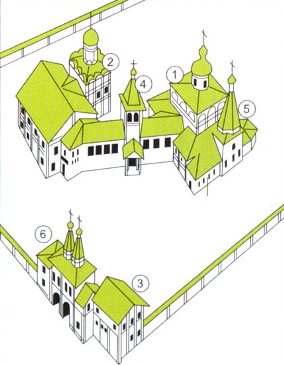 Monastery Map:
1. Church of Birth of
Mother of God (1490)
2. Church of
Annunciation (1534) and Dining Hall
3.
Treasury (17th century)
4. Bell Tower
5. Church of Saint Martinian (1640)
6.
Holy Gate with Church of Epiphany and Saint Ferapon
Transportation
Get in
Ferapontovo is situated on R-5 highway about 115km to
north-west from Vologda — it’s the easiest way to get there by car
or by hitchhike. You can also go there from Cherepovets via
Kirillov. Note, that buses from Vologda to Kirillov (several a day)
turn from R-5 to Kirillov about 4km before Ferapontovo, so you’ll
need to not miss the turn (better ask driver beforehand), and then
either hitchhike or walk, as buses further are very seldom. There’s
nothing at the turn to Kirillov except forest and a bus stop
(possibly not even mobile carrier), nearest shops and other
facilities are in Ferapontovo.
To reach Ferapontovo directly
you’ll need buses, going to Lipin Bor and further — to Vytegra and
even further to Petrozavodsk from Vologda or Cherepovets (buses from
Cherepovets can be catched on in Kirillov or aforementioned turn).
The only daily buses of those are Vologda-Vytegra in the morning and
Cherepovets-Lipin Bor in the evening, also there’s evening bus
Vologda-Lipin Bor with different schedule on Sunday, others are
going only on selected days of week (including 2 buses
Kirillov-Ferapontovo only on Tuesdays and Thursdays). Better check
timetable beforehand and note that further from their starting point
buses can be not only late, but ahead of schedule as well, as well
as get canceled, so it’s better to check that the bus is on via a
call to departing bus station.
For hitchhiking from Vologda
you may want to reach first Molochnoe via a suburb bus (goes rather
often from central postoffice).
Hotels, motels and where to sleep
Restaurant, taverns and where to eat
Cultural (and not so cultural) events
Interesting information and useful tips
Ferapontov monastery located in Kirillovsky district of Vologda oblast is Russian historical and cultural monument of state importance. The monastery is in the list of UNESCO World Heritage and is one of the main places of interest of the region. The following photos of Ferapontov monastery were captured by av_otus.
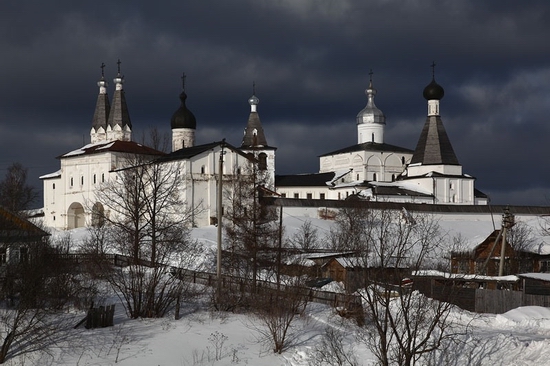
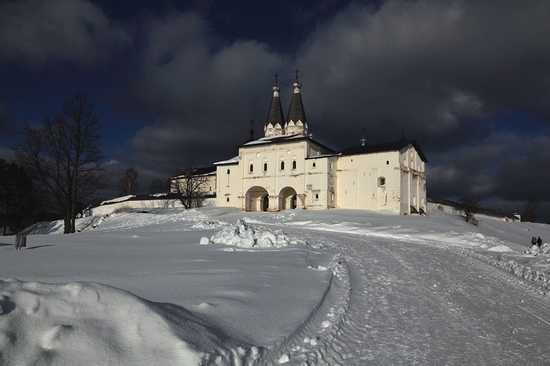
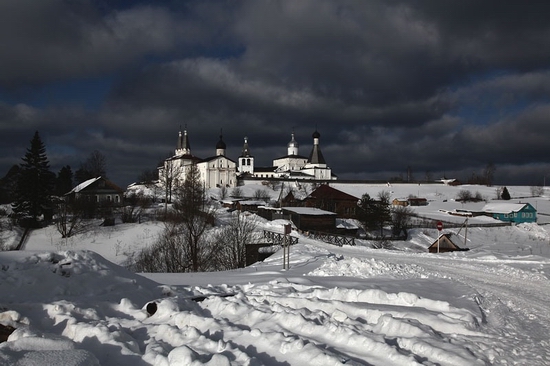
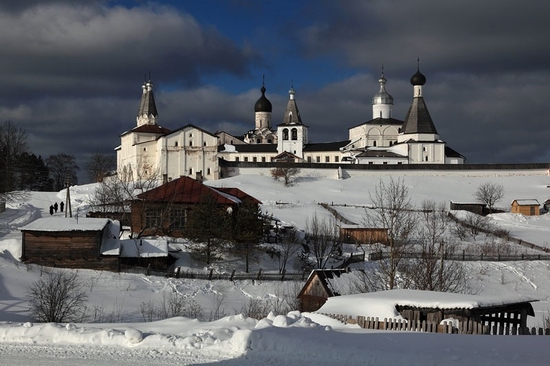
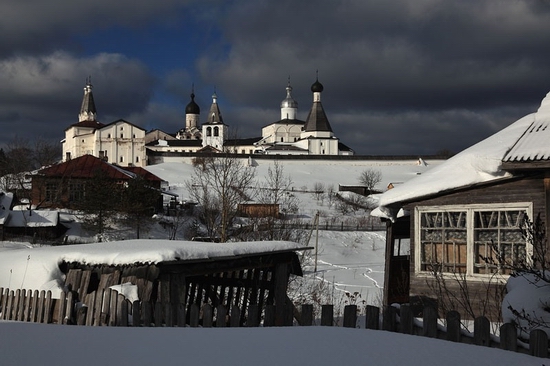
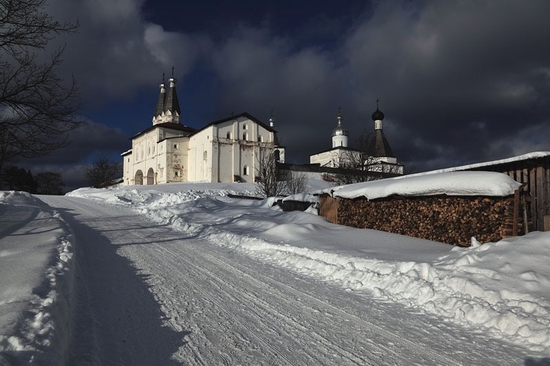
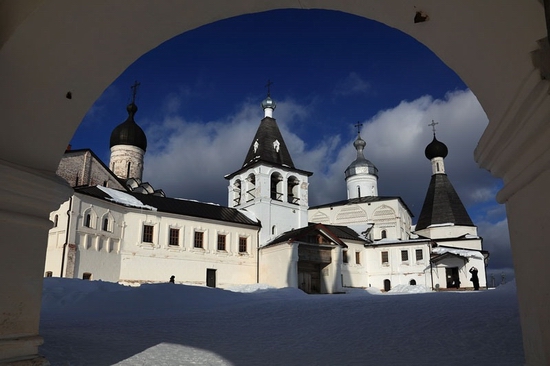
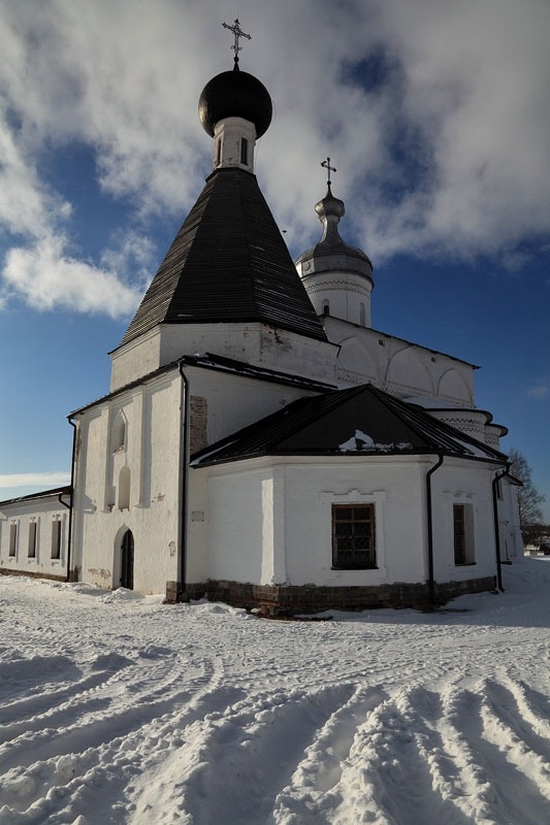
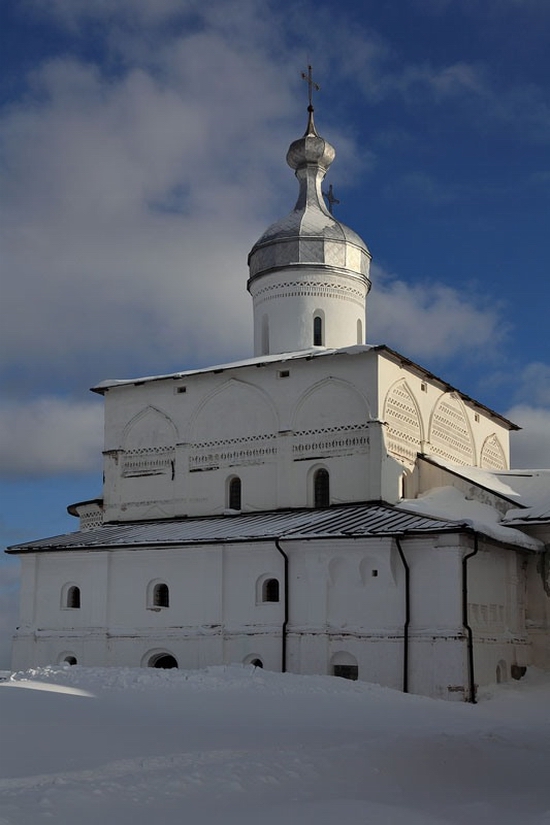
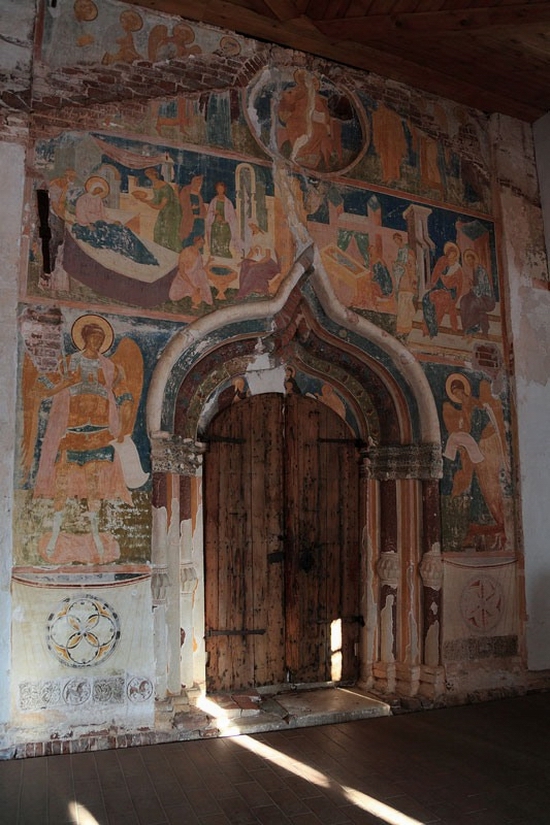
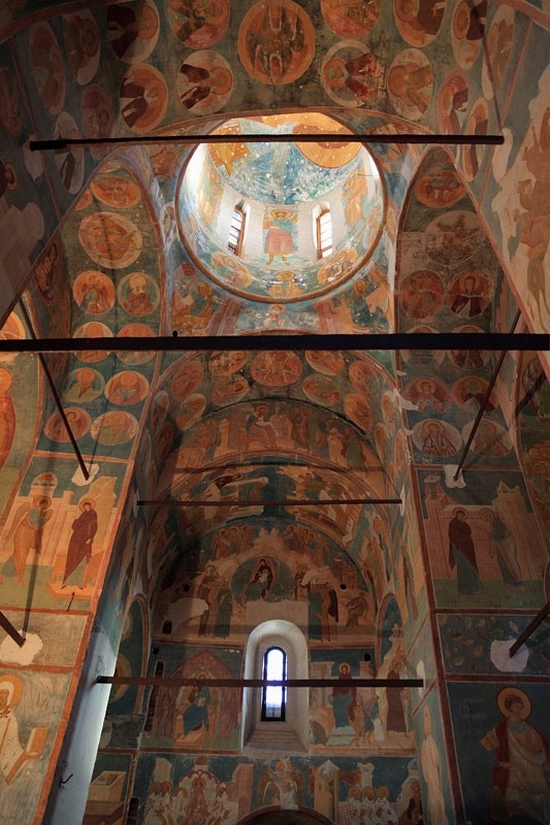
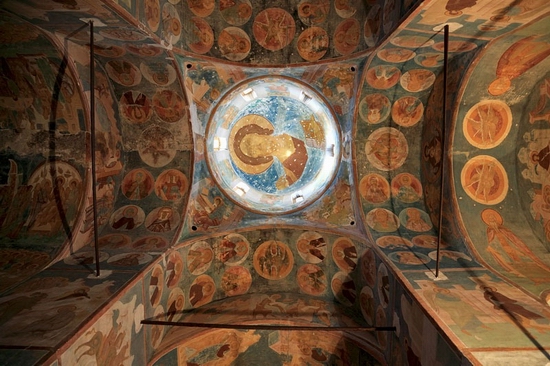
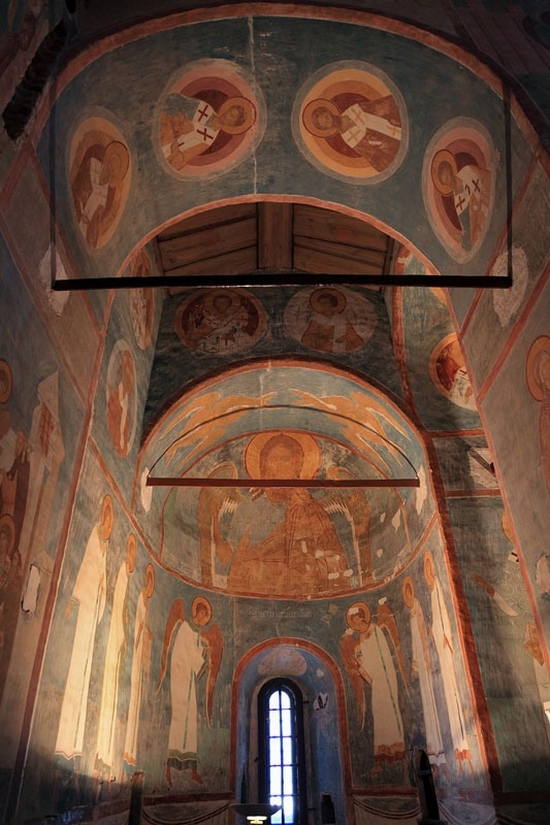
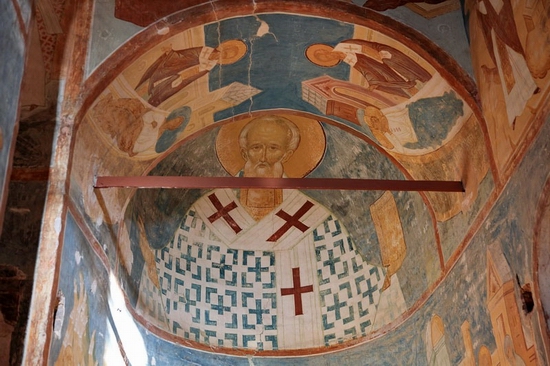
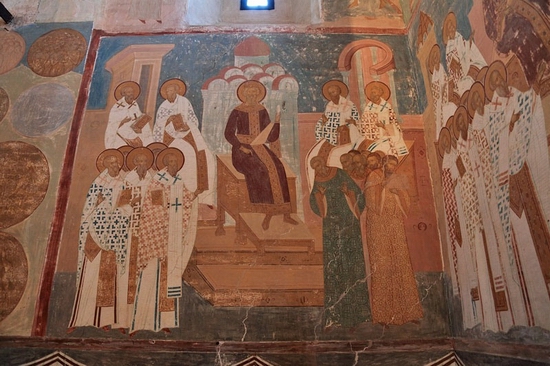
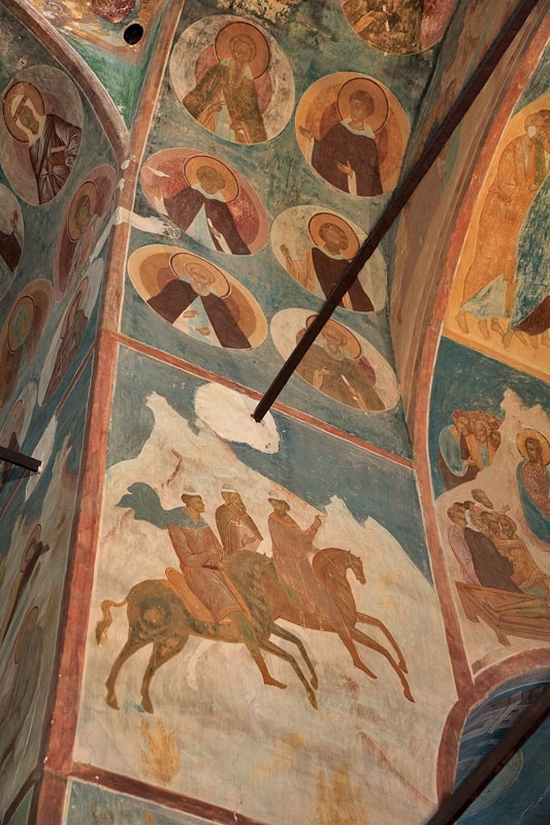
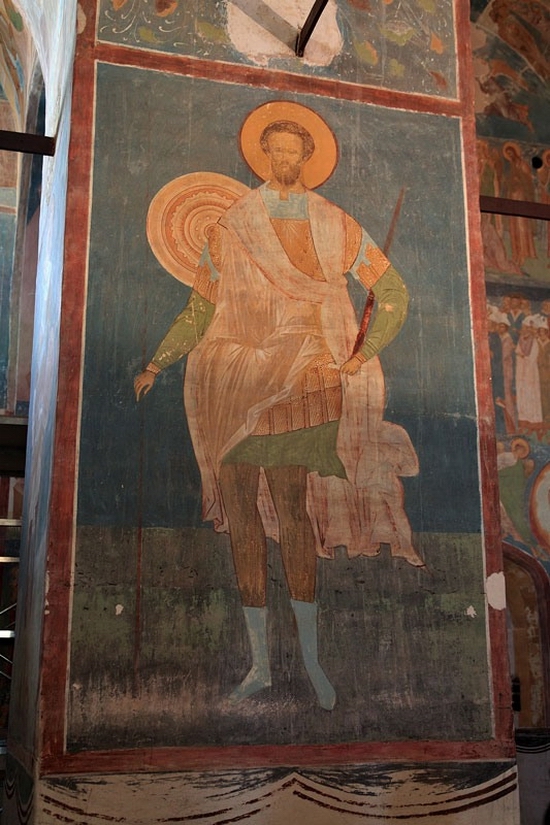
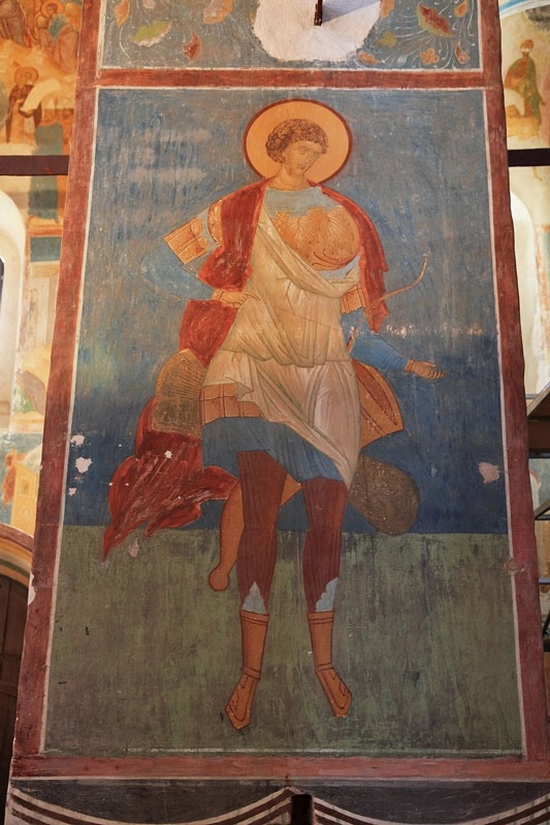
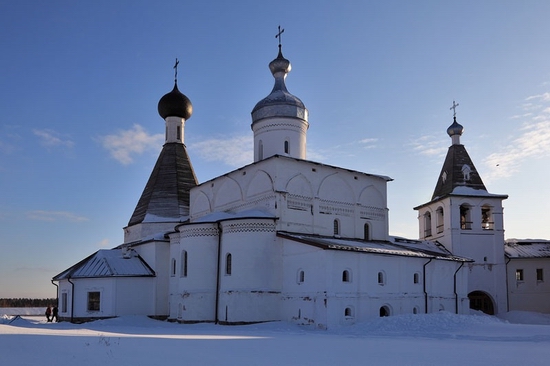
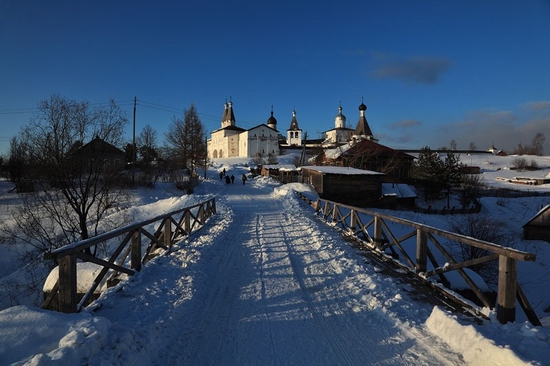
If you enjoyed this post, please consider leaving a comment or subscribing to the RSS feed to have future articles delivered to your feed reader.
Tags: No tags
You might also like:
Magnitogorsk city page was added
Komsomolsk-on-Amur city page was added >>
No comments yet.
Leave a Reply
Name
Mail (will not be published)
Website
Your Comment
Задания 26-31
Ferapontov Monastery in Vologda
Ferapontov monastery was founded in 1398. This was when Ferapont the Reverend established a new settlement on a lake not far from Vologda. There were many villages around this ___BEAUTIFUL___ place and soon people started to come to him for advice. Then some people decided to stay with him as monks. That’s ___ACTUALLY___ how the monastery was started.
Later Ferapont built a wooden church and other ___CONSTRUCTION___. He left the monastery to build another one but never returned. However, the monastery remained both a ___FAMOUS___ and popular place even without him.
Now tourists can enjoy its ___AMAZING___ frescoes, created in 1502. It may seem ___IMPOSSIBLE___, but these frescoes have remained safe without restoration till the present day. Now the monastery is a museum. In 2000 the Ensemble of the Ferapontov Monastery was included in UNESCO’s World Heritage List.
Аудирование Чтение Языковой материал Письмо Говорение