
Presentation on theme: «Fossil Fuels Overview Fascinating Fossil Fuels!. I. Fossil Fuels… A. Include coal, natural gas, tar sands, oil shale and petroleum. B.Formed over a period.»— Presentation transcript:
1
Fossil Fuels Overview Fascinating Fossil Fuels!
2
I. Fossil Fuels… A. Include coal, natural gas, tar sands, oil shale and petroleum. B.Formed over a period of time from compressed vegetation and other organisms. C. Are considered nonrenewable resources. Why?
3
II. Coal 1. Coal is the most abundant and least expensive of the fossil fuels. It is also the most popular, accounting for almost 40 % of the total worldwide power generation. 2. The use of coal can be traced back to around A.D. 50 from cinders in Roman ruins in Britain. There is also evidence to suggest that the Greeks used coal as a fuel in the 4th century. www.answers.com http://www.panda.org/news_facts/educati on/middle_school/homework_help/webfiel d_trips/coal/index.cfm Roman and Greek ruins users.ece.utexas.edu
4
3. Coal is a rock consisting almost entirely of organic material http://www.athro.com/geo/trp/gub/coal.html
5
B. The Coal Formation Process 1.Today’s coal formed from prehistoric vegetation that accumulated thousands of years ago when much of the Earth’s surface was covered in swamps. As the plants and trees in these swampy areas began to die, their remains sank into the swamp land, which eventually formed a dense material called peat. www.discover-tasmania.com Modern giant tree fern
6
Peat – an early step in coal formation Peat’s got its own journal
7
A good place to look for peat formation … Peat only forms where there are low oxygen conditions, such as in this damp low spot on a swamp or bog. Bodies don’t decay in bogs very well – as you can tell! http://www.athro.com/geo/trp/gub/coal.html en.wikipedia.org Bog Man
8
The Coal Formation Process … 2. The organic matter accumulates and forms a bed of peat. 3. The peat bed gets buried by other sediments and under heat and pressure begins to transform to a low grade coal known as lignite. 4. More heat and pressure further change the lignite into bituminous coal. 5. Even more heat and pressure change the bituminous coal into a nice hard shiny anthracite coal.
9
The Steps of Coal Formation… www.uky.edu
10
Is coal being made now? Coal formation is a continuing process, however large deposits of sediment are no longer covering swamp lands as in the past! Today, in areas such as the Great Dismal Swamp of North Carolina and Virginia, the Okefenokee Swamp of Georgia, and the Everglades in Florida, plant life decays and subsides, eventually to be covered by silts and sands, and other matter. Perhaps many years from now, those areas will contain large coal beds. The Florida Everglades rst.gsfc.nasa.gov
11
C. Coal in the U.S. 1. The U.S. has more coal deposits than any other single country. 2. Coal is mined in 26 of our 50 states. 3. More than half the electricity we used is produced by burning coal. 4. We have more coal in our country than the world has oil. http://www.princeton.edu/~jarigoni/CHEMGOOD/Introduction.htm http://fossil.energy.gov/education/energylessons/coal/gen_coal.html
12
D. Coal Mining 2 main methods of coal mining: Underground Surface Exhausted rescuers looking for a missing miner emerge from a tunnel at Xinfu Coal Mine, where an explosion killed 17 miners on Monday in Qitaihe, Heilongjiang Province. [newsphoto] www.chinadaily.com.cn
13
A coal seam exposed by mining http://rogerphilpot.homestead.com/mechanicalploughcolor.jpg
14
ii. Strip mining coal http://www.geokem.com/images/scans/Indonesian_coal_mine.jpg www.globaljusticegame.mrap.info
15
ii. Mountaintop Removal – a large scale type of coal mining What effect does this type of mining have on the environment? http://www.ohvec.org/galleries/mountaintop_removal/007/index.html
16
Coal mining has always been a dirty, dangerous job. http://hewit.unco.edu/dohist/mining/work/coal/photo1.htm
17
2. Health impacts of using coal as an energy source a. Coal mine workers face serious health problems, including black lung, a lung disease from prolonged exposure to coal dust in mines. b. On the job hazards include: the mines may cave in, accumulate poison gases, or suddenly flood – all of which can injure or kill the miners
18
Black Lung Black lung is a legal term describing a preventable, occupational lung disease that is contracted by prolonged breathing of coal mine dust. The U.S. Congress ordered black lung to be eradicated from the coal industry in 1969. Today, it is estimated that former coal miners each year die an agonizing death in often isolated rural communities. http://www.umwa.org/job/blacklung/
19
3. Environmental Impacts of Using Coal … a. Surface mining requires the removal of massive amounts of top soil, leading to erosion, loss of habitat and pollution. b. Underground mining causes acid mine drainage, which causes heavy metals to dissolve and seep into ground and surface water. c. Burning coal creates ground level ozone, smog and acid rain. d. Coal (and fuel oil) combustion emit fly ash particles into the atmosphere, which contribute to air pollution problems. e. Burning coal produces carbon dioxide, nitrogen oxide, sulfur dioxide and methane gas, all of which could contribute to global climate change. hvo.wr.usgs.gov
20
III. Natural gas i. Formed from the remains of tiny sea animals and plants (PLANKTON) that died thousands of years ago. (Same process that formed petroleum.) ii. The gas became trapped in the rock layers much like a wet household sponge traps water. http://lsa.colorado.edu/essence/texts/naturalgas.htm www.seed.slb.com
21
C. Composition of Natural Gas 1.Raw natural gas is a mixture of different gases. Its main ingredient is methane. By itself, methane is odorless, colorless, and tasteless. 2. As a safety measure, natural gas companies add a chemical odorant (it smells like rotten eggs) so escaping gas can be detected.
22
D. Processing natural gas After natural gas comes out of the ground, it goes to a processing plant where it is cleaned of impurities (water, sulfur, dust) and separated into its various components Then it’s compressed and forced through pipelines under high pressure. It’s often cooled to a liquid state before being transported. LNG – liquified natural gas A natural-gas processing plant off Thailand’s coast www.nytimes.com
23
Natural Gas Processing … www.answers.com
24
Benefits of using natural gas … Cleaner fuel than petroleum or coal Has the highest energy content of the hydrocarbons used for fuel Our country has large reserves, mostly in the Gulf of Mexico, Texas, Louisiana, Oklahoma, New Mexico, Wyoming, Kansas, and Alaska. Used for making plastics, detergents, drugs But, if we continue to use natural gas at the same rate as we use it today, the United States will run out in about 50 years (more can be recovered for higher $).
25
Other sources of natural gas Landfills — Landfill gas is considered a renewable source of natural gas since it comes from decaying garbage. –Landfill gas is 50 percent methane Biomass — a fuel source derived from plant and animal wastes which generates natural gas There are more than 350 commercial landfill gas recovery operations in the U.S. which generate electricity on-site, supply industrial gas-fired boilers, or produce substitute natural gas fuels such as CNG. www.gtp-merichem.com
26
Some landfills are currently capturing the gas produced by decaying garbage. A well is drilled into the waste mass in order to install a well. The landfill gas is then pumped to a gas treatment and processing facility to separate out the methane from carbon dioxide and other non-methane compounds.
27
Study Reveals Huge U.S. Oil Shale Field … WASHINGTON — The United States has an oil reserve at least three times that of Saudi Arabia locked in oil-shale deposits beneath federal land in Colorado, Utah and Wyoming, according to a study released yesterday. Headline from The Seattle Times, September 1, 2005 As the head of Shell’s Unconventional Resources unit, Steve Mutt, explained that as far back as the native Americans, people have been trying to exploit this resource, which is essentially immature petroleum. The Indians called it fire rock and inexperienced homesteaders tried to use it for their fireplaces with disastrous consequences. www.evworld.com
28
An oil-shale rock burns on its own once it has been lit by a blowtorch. Associated Press photo by Douglas C. Pizac http://sfgate.com
29
Oil shale doesn’t contain oil or (usually) shale The organic material is kerogen (not oil), and the «shale» is usually a relatively hard rock, called marl. Properly processed, kerogen can be converted into a substance somewhat similar to petroleum. The kerogen must be heated to a high temperature. This causes the organic material to be converted into a liquid. The liquid is then further processed to produce an medium grade oil which is said to be better than the lowest grade of oil.
30
Here’s the down side……. The report mentioned above also says oil- shale mining, above-ground processing and disposing of spent shale cause significant adverse environmental impacts. Shell Oil is working on a process that would heat the oil shale in place, which could have less effect on the environment.
31
A new oil shale method uses in-ground heaters to “preheat” the oil shale so it is easier to remove the oil. AP photo by Douglas C. Pizac http://sfgate.com Instead of strip- mining the rock and then processing it, this new method superheats huge underground areas for several years, This method gradually forces the oil out of the stone and then pumps it to the surface
32
Tar sands (also called oil sands or bituminous sands) These sands contain clay, water, sand, and bitumen Bitumen contains 83.2% carbon This can be processed to make synthetic crude oil or be refined into petroleum products. This may prove to be a viable alternative to oil imported from the Middle East. Wikipedia
33
Environmental impacts of using shale or tar sands Takes lots of energy to remove and process. Uses large amounts of water which is then polluted by the process. Generate huge amounts of waste that must be “put back” somewhere (unless the in-ground heating method is used). climateprogress.org www.borealbirds.org
34
Environmental Impact of Tar Sands Alberta Tar Sands The term “tar sands” refers to thick oil called bitumen that is mixed in with sand, clay, and water. Intensive energy is required to process the sands into crude oil. Tar Sands oil is the world’s most harmful type of oil for the atmosphere, emitting high volumes of greenhouse gases during development, which contribute to global warming, as well as other pollutants. Tar Sands projects are the largest contributor to greenhouse gas emissions growth in Canada. By 2015, the Tar Sands are expected to emit more greenhouse gases than the nation of Denmark (pop. 5.4 million). www.borealbirds.org
35
Summary of Fossil Fuels … Petroleum Coal Natural Gas Oil Shale Tar Sands How much longer will we have access to these fuels? How expensive will they get as demand exceeds supply? What are some alternative energy sources?
Rabbits, rabbits, rabbits — nohare to be seen.

The distribution of animals and plants can be absolutely fascinating. While fossils may not interest everybody, the mammals that occupy our earth currently give us a wealth of information. This concerns climate and geological change, as their ancestors, and those who didnt make it, show us the details of the climate changes that concern us very deeply at this moment in time.
Whale evolution resolved, but only slightly.

Were having a whale of a time, enjoying a paper that tries to work out how the pygmy right whale became neotenic. The history of whale fossils is one of big gaps and they cause the problems in resolving ancient relationships still.
Our ancient ancestors couldn’t digest milk

The modern Eurasian ancestors roamed across Siberia according to a new study, but another paper revealed DNA-enhancing technology using part of prehistoric skulls. We now know roughly when our genes adapted to farming, less sunlight and many other technological advances we made in the past.
Copulation was invented by ancient fish

The drive to produce offspring has always been as dominant as the enjoyment of food. Australian scientists have now used Scottish fossils to deduce that Estonian fish evolved a jolly dance that has resulted in much more fun in their ancestors!
Future Transport: roads, rail, air and sea problems

What happens as business adapts to climate change. Will transport manage to avoid the hazards associated with floods, droughts and the heat? Finally, reports are getting down to detail on what we are going to have to do in the very near future. That is apart from stopping using fossils for fuel!
What to do with CO2

The future is bleak, with vast fossil fuel emissions reducing very little. CCS seems always to be the excuse for energy companies to keep drilling, with government aid to help them store the global-warming emissions. As nuclear and renewable energies grow in importance, they still dont seem capable of replacing fossils. As Indias new government under Nahendra Modi sets its sights on solar, perhaps we can see more large emitters becoming used to the idea of leaving the coal, oil and gas where it is.
Skin cancer selected our ancestors?

We can’t find the fossils and the genome can give only some hints. How did the first human-like species survive and why did they have to be black. Mel Greaves has the answers.
Your ancestor was a little therian

We can visualise distant ancestral forms of many organisms by imagining similar species alive today, or complete fossils. Here the scarcity of evidence on early mammalian teeth makes it difficult, but not impossible, to show how incredible events shaped our past into the flower, insect and mammal-dominated Paleocene.
Fracking Nonsense

While renewable energy struggles to make its mark on politicians, the easy way is to use the good old technology of getting fossils out of the ground and setting them alight. Has anybody remembered the globe is warming quickly now?
Wild Horses from America

The horse, the human and many others are being revealed as stretching way back in time, through ancestries we only dreamed of. The fascination of the horse is because we can truly see what happened because of the great herds that existed and left many useful fossils.
Ancestor of hummingbird and swift

The North American fossils of humming birds are rare compared to other continents. This fossil is early and provides lots of information relevant to swifts and humming birds.
Those pesky apes keep coming and adapting — as do the theories

Human origins fascinate some people more than our currently-evolved selves. We have, in Africa, the mother of our species and civilisation. Unfortunately, we were fed a false theory in the beginning and now play catch up with the fossils that give us clues about our adaptive ancestors.
Health Check for Oetzi the Iceman

When we wrote on Oetzi the archer who became ‘The Iceman,’ we must have missed the point. Now geneticists have jumped into the glacier with him and extracted his DNA for a whole-genome sequence.
Footprints Bring Fossil Elephants to Life

Could it be that elephants are our superiors in matrilocal (mother-based), hierarchical and complex social structures? Research into fossil elephant trackways investigates their behavior.
Living fossil eel takes us back 200 million years

Eels are among the most successful of all fish groups, and that extends back through time to the evolution of the bony teleosts themselves. The new species was named Protanguilla palau, complete with a unique family and genus.
An Ichthyosaur and other Tales

Valentin Fischer of the University of Liege, with several others, including Darren Naisch of the School of Earth Sciences at Southampton University, have illuminated the dark recesses of ichthyosaur biology with the unveiling of a new species.
It is important to get a head

Lauren Sallan, post-doctoral student at the University of Chicago has equalled her prestigious colleagues with recent achievements in evolutionary understanding. The idea that the development of features in the head precedes that in other areas such as body shape is a hard one to prove.
A bronze buckle in old Alaska

The discovery of a bronze artifact in a prehistoric Eskimo site. No trace of bronze metallurgy had ever been found in Alaska, until now.
Release the ‘Kraken’, well the Artistic Triassic Cephalopod

A strange explanation is given for a puzzling arrangement of Triassic era fossils. It could seem strange to apply the word ‘artistic’ to a Triassic creature but an in-depth examination of Ichthyosaur fossils has renewed the general confusion about what happened to the animals on display at Nevada’s Berlin-Ichthyosaur State Park.
Looking for the climate’s future in the distant past

Scientists have turned to fossils from a previous time of high CO2 concentrations and found that previous temperature predictions have probably been too high. The team studied growth rings in the shells of molluscs and tested other material found in the fossils.
Soft-bodied giants roamed oceans longer than thought

A paper in Nature today shows that anomalocaridids, giant predatory sea-creatures, survived 30 million years longer than was previously believed. The conclusion comes from the study of beautifully preserved soft-bodied fossils, found in Moroccan rocks, from the Ordovician period.
‘Greenhouse’ Effect Endangers Ocean Life

Scientists discover that the ‘greenhouse’ effect isn’t constrained to the atmosphere. A team of geologists from Newcastle University in the UK have discovered evidence that ‘greenhouse oceans’ occurred in prehistoric times, resulting in areas of ocean with little or no life due to low levels of oxygen in the water.
Research casts light on planet’s future

The study of fossilised mollusks could give scientists an invaluable insight into the way the world will respond to climate change. Researchers at Californian university UCLA say that examining the fossils from 3.5 million years ago has allowed them to build a picture of how the world is reacting to current levels of atmospheric carbon dioxide, a key contributor to global climate change.
New evidence of the first Americans

A new archaeological find in Texas pushes further back the date when humans arrived in American, spelling the end of the Clovis First theory. The evidence has been found in Texas, where thousands of artefacts were discovered beneath a previous find of Clovis relics. Archaeologists believe the new evidence is between 13,200 and 15,500 years old and shows signs that the Clovis people adapted and improved on previous technologies.
‘Pompeii’ like fossils of Trilobites found in real-life situations

Sudden death and burial by hurricane-displaced sediments has frozen ancient creatures in real-life situations which allow scientists to try and decipher how they behaved. University of Cincinnati palaeontologist Carlton E Brett says colonies of ancient sea creatures have been caught in mid-orgy by sudden downpours of fossilising sediment catching snapshots of life in the way that the eruption of Mount Vesuvius did at Pompeii.
Fossil-quake clues in ancient sediments help map out earthquake prediction

The record of earthquakes past may be preserved in water-lain sediments, according to research from Tel Aviv University. These fossil-quakes leave tell-tale wave marks and help push back the record of seismic activity thousands of years. And the more information on an area’s seismic past, the more confidently we can project future risks.
Coming together to save Babylon

The New York based world monuments fund has undertaken a massive project to restore the damage done to the ruins of ancient Babylon. After years of neglect and violence, archaeologists and preservationists have once again begun working to protect and even restore parts of Babylon.
Сегодня 17.04.2022 13:13 свежие новости час назад
Прогноз на сегодня : Ege across . Развитие событий.
Актуально сегодня (17.04.2022 13:13): Ege across
..
1. Ege across
2. Ege across fiyat
3. Ege across sahibinden
4. Check ege через госуслуги
5. Across the pacific егэ ответы
6. Across the pacific a french swimmer will try to become the егэ
7. Across the pacific егэ ответы a french swimmer
8. Fossils are fascinating for thousands of years people have come across егэ
9. Across the pacific егэ
10. Afrench swimmer will try to become the first person to swim across the pacific ocean егэ
Ege across
Ege across
Ege across
Ege across
Ege across
Ege across
Ege across
Ege across
Ege across
Ege across
Ege across
Ege across
9041462618282665b80f0416d63c2cfc f93470f924860e354c0a256c6d91fba5
Ege across
Ege across
Ege across
юрий москаленко нечестный штрафной читать онлайн полностью | кутоксираган узбек кизларини селкасини олиш | сбермобайл тариф для пенсионеров | кайфуем ноты скачать | firmware acer liquid z220 | game of thrones wikia | инструкция пароварка тефаль s03 | tv box allwinner h3 how to disassemble the firmware | игра престолов 2 сезон amedia торрент | Sergei-kuznetsov-otsifrovannyi-mir-kniga-skachat |
Invision Community © 2022 IPS, Inc.
Карта сайт Rss
s
p
People have been fascinated by fossils for thousands of years. Fossils are evidence of ancient life forms or ancient habitats; they are actual remains of once living things, such as bones or seeds, or even traces of past events such as animal footprints, or ripple marks on a prehistoric shore.
Whether a fossil is the skeleton of a dinosaur or the stony remains of a tree that lived long ago, it can transport us back through the eons, giving us a glimpse of life the way it was ages before we came into existence.
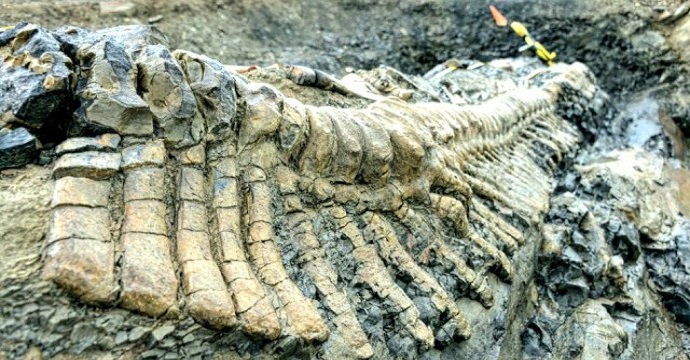
Photo Source
There are several paleontolological sites across India where one can see fossils of the the country’s earliest residents. However, as fossil sites are often exposed to the risk of plunder or destruction, they are protected by the Geological Survey of India.
Here are some of the best places in India to take a trip back in geological time. From the country’s first dinosaur to the oldest human ancestor, these sites show an impressive range of fossils that are crucial in understanding Earth’s history.
1. The world’s most diverse marine animals – Zanskar Valley, Kashmir
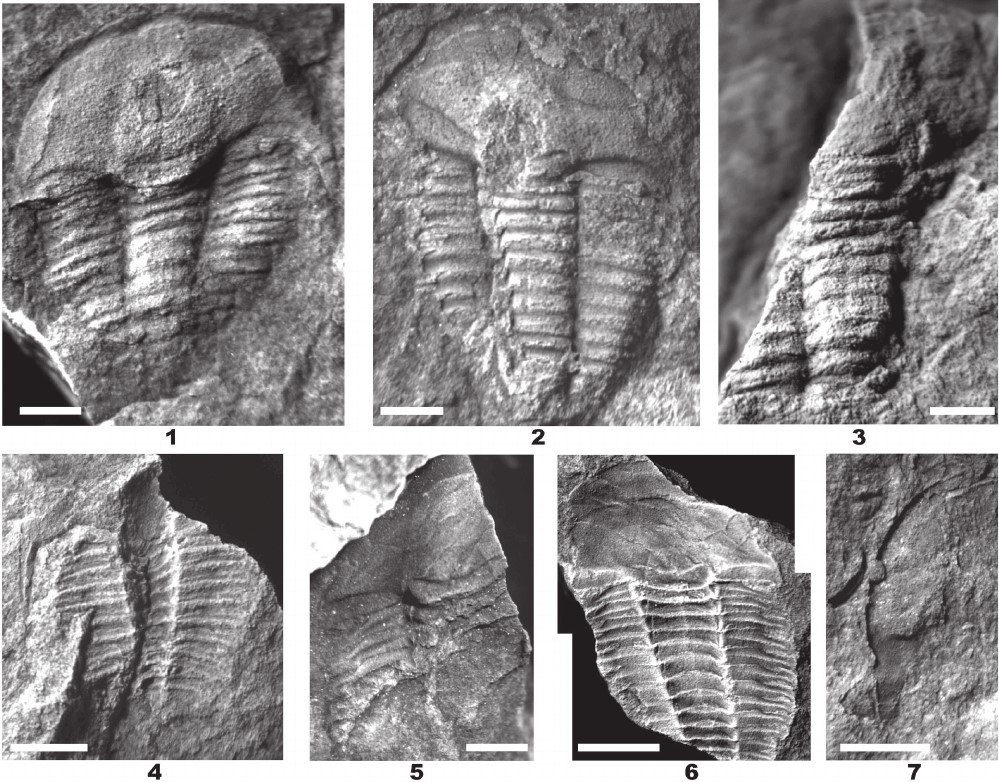
Photo Source
Around 550 million years ago, trilobites, a species of arthropods, lived in great numbers in virtually all the oceans. They were possibly the most diverse animals on Earth, with more than 15,000 known species of trilobites. Then, around 250 million years ago, most trilobites went extinct. Less than 10% of all species survived, making this one of the largest mass extinctions on Earth. The trilobites at the Kurgiakh region of the Zanskar Valley are from the early Cambrian age and are similar to those found in south China and parts of Pakistan. They are also proof that millions of years ago the Himalayan mountains were certainly submerged under the Tethys sea.
2. First dinosaur fossil site in India with flora, fauna intact – Waddham, Maharashtra
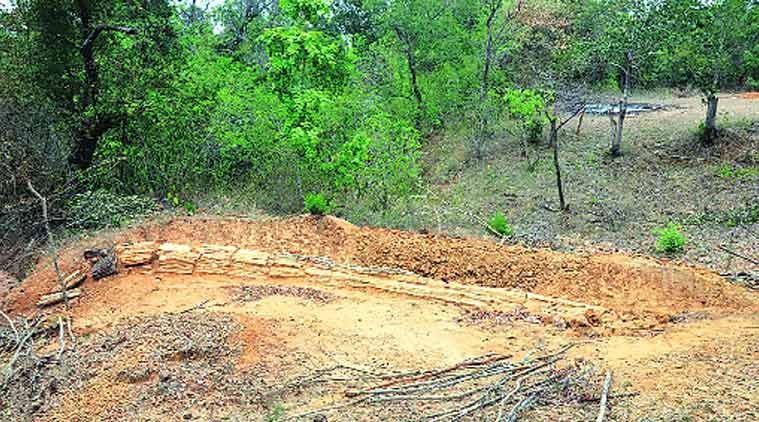
Photo Source
Waddham, a reserve forest, is a well-known fossils site where a full-fledged skeleton of a dinosaur was found near the Godavari basin in Maharashtra, bordering Telangana in 1959. The well preserved Barapasaurus skeleton is at present kept in the museum of Indian Statistical Institute (ISI) in Kolkata. Named the Waddham Fossil Park, this Jurassic period site houses the fossils of flora that existed when sauropods, the giant ‘vegetarian’ dinosaurs, walked this stretch of the Indian subcontinent. This has given the park the unique distinction of being the only dinosaur site in the Indian subcontinent to have fossils of both flora and fauna from that time.
3. A sanctuary of marine fossils – Manendragarh, Chhattisgarh

Photo Source
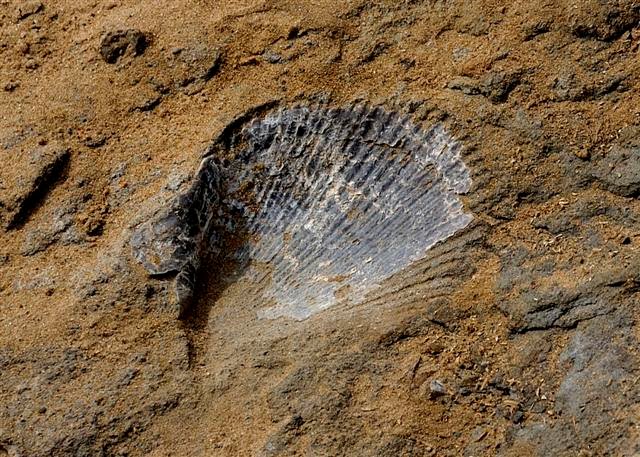
The Marine Gondwana Fossil Park is a unique exposure of fossiliferous marine Permian rocks of the Talchir formation dating back to around 280-240 million years ago. Located in the Manendragarh area of Chattisgarh’s Koriya district, the fossil faunal assemblage is indicative of the transgression of sea in this part of India about 20 crores of years ago. The park has plenty of fossils of marine bivalve molluscs and other marine fauna.
4. India’s first unique dinosaur species – Balasinor, Gujarat
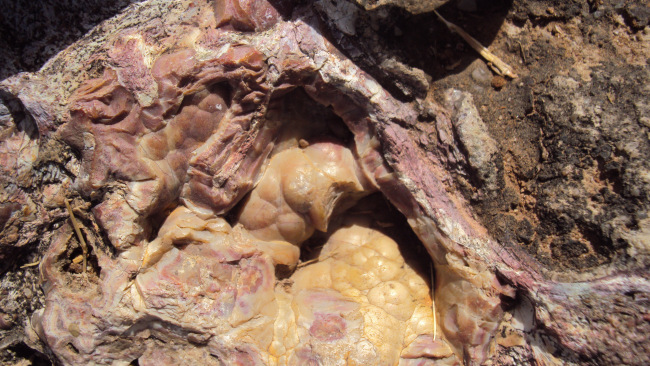
Photo Source
In 1981, scientists from the Geological Survey of India (GSI) accidentally discovered fossils in the sedimentary rocks of Raiyoli village in Balasinor. Since then, researchers have uncovered fossils of about 1000 dinosaur eggs, belonging to at least 13 species of dinosaurs, making Raiyoli in Balasinor the third largest dinosaur hatchery in the world. The site is also where Rajasaurus narmadensis, the first species of dinosaur (the gigantic, horned, 30-foot-long carnivore) unique to India, was identified in 2003. A very rare example of non-dinosaurian predation on dinosaurs was also found in the form of a fossilized dinosaur-eating snake named Sanajeh indicus.
You May Like: From Royalty to Relics: The Fascinating Story of India’s Dinosaur Princess, Aaliya Sultana Babi
5. One of a kind fossil park at the actual site of fossil discovery – Suketi, Himachal Pradesh
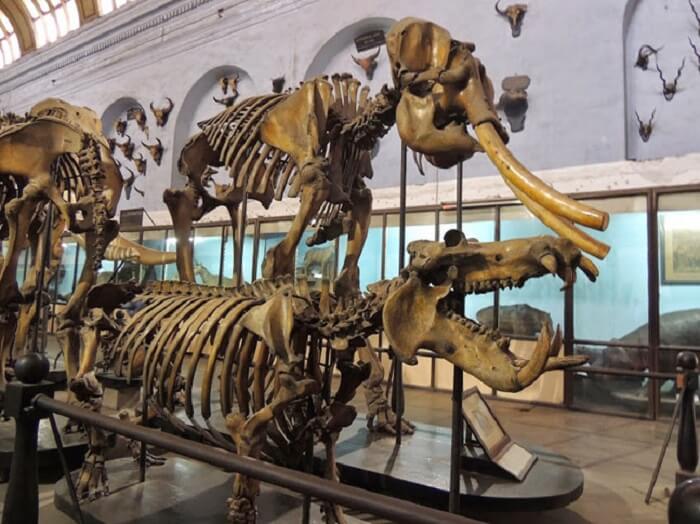
Photo Source
Lying on the bank of River Markanda in Nahan, Suketi Fossil Park is a one of its kind park fossil park with a collection of prehistoric vertebrate fossils and skeletons recovered from the upper and middle Siwaliks’ geological formations. This place is best known for its six life-size fibre glass models of extinct Mesozoic mammals that once roamed the area. There is also a museum, within the precincts of the Park, where the unearthed fossils are curated and exhibited.
6. Perfectly preserved ancient trees – Thiruvakkarai, Tamil Nadu

Photo Source
Around 35 km from Puducherry, the National Fossil Wood Park at Santhanur in Perambalur district has a rare collection of 200 fossilised trees. The petrified tree trunks are believed to be over 120 million years old and are evidence of the presence of a sea during the Cretaceous period in this area. Some of the fossilised tree trunks are up to 28 m in length and 5 m in girth. The majority of the fossil wood belong to conifer, gymnosperm and angiosperm species. Fine woody texture, the annular rings, the pit structures and the knots are intricately preserved.
7. India’s earliest human fossils- Hathnora, Madhya Pradesh

Photo Source
On December 5, 1982, a team of scientists of the Geological Survey of India stumbled upon a fossilized piece of a skull bone at Hathnora on the banks of the Narmada in Madhya Pradesh. It turned out the bone was of a female hominin, the first early hominin fossil, an ancestor of modern humans, found in the Indian subcontinent. In 2012, another set of hominin fossils – a long bone of the arm and a thigh bone – were found at Netankheri, 3 km from Hathnora. While researchers are not sure as to which species of Homo the fossils belongs to, stone tools unearthed from the region date back from 800,000 to 10,000 years ago, indicating a long history of human presence at the site.
Also Read: How One Indian Organization is Trying to Preserve Ancient Indian Rock Art Found in Caves
Like this story? Have something to share? Email: contact@thebetterindia.com, or join us on Facebook and Twitter (@thebetterindia). To get positive news on WhatsApp, just send ‘Start’ to 090 2900 3600 via WhatsApp.
1) Установите соответствие между заголовками 1 — 8 и текстами A — G. Используйте каждую цифру только один раз. В задании один заголовок лишний.
1. A taste of everything
2. Shop till you drop
3. City’s tourist attractions
4. Ancient traditions live on
5. Activities for the adventurous and hardy
6. On the crossroads of religions
7. For the body, mind and soul
8. From the high peaks to the deep seas
A. Today Jakarta has much to offer, ranging from museums, art and antique markets, first class shopping to accommodations and a wide variety of cultural activities. Jakarta’s most famous landmark, the National Monument or Monas is a 137m obelisk topped with a flame sculpture coated with 35 kg of gold. Among other places one can mention the National museum that holds an extensive collection of ethnographic artifacts and relics, the Maritime Museum that exhibits Indonesia’s seafaring traditions, including models of sea going vessels.
B. Sumatra is a paradise for nature lovers, its national parks are the largest in the world, home to a variety of monkeys, tigers and elephants. Facing the open sea, the western coastline of Sumatra and the waters surrounding Nias Island have big waves that make them one of the best surfer’s beaches in Indonesia. There are beautiful coral reefs that are ideal for diving. For those who prefer night dives, the waters of Riau Archipelago offer a rewarding experience with marine scavengers of the dark waters.
C. Various establishments offer professional pampering service with floral baths, body scrubs, aromatic oils, massages and meditation; rituals and treatments that use spices and aromatic herbs to promote physical and mental wellness. Various spa hotels are extremely popular. Indonesians believe that when treating the body you cure the mind.
D. Jakarta has a distinctly cosmopolitan flavor. Tantalize your taste buds with a gastronomic spree around the city’s many eateries. Like French gourmet dining, exotic Asian cuisine, American fast food, stylish cafes, restaurants all compete to find a way into your heart through your stomach. The taste of Indonesia’s many cultures can be found in almost any corner of the city: hot and spicy food from West Sumatra, sweet tastes of Dental Java, the tangy fish dishes of North Sulawesi.
E. In the face of constant exposure to modernization and foreign influences, the native people still faithfully cling to their culture and rituals. The pre-Hindu Bali Aga tribe still maintains their own traditions of architecture, pagan religion, dance and music, such as unique rituals of dances and gladiator-like battles between youths. On the island of Siberut native tribes have retained their Neolithic hunter-gathering culture.
F. Whether you are a serious spender or half hearted shopper, there is sure to be something for everybody in Jakarta. Catering to diverse tastes and pockets, the wide variety of things you can buy in Jakarta is mind boggling from the best of local handicrafts to haute couture labels. Modern super and hyper markets, multi-level shopping centers, retail and specialty shops, sell quality goods at a competitive price. Sidewalk bargains range from tropical blooms of vivid colors and scents in attractive bouquets to luscious fruits of the seasons.
G. The land’s long and rich history can’t be separated from the influence of Hinduism, Buddhism, Islam and Christianity. There is one of the oldest Hindu temples in Java, the majestic Buddhist ‘monastery on the hill’, Borobudur, the largest Buddhist monument in the world. About 17 km away from this monastery is a 9th century temple complex built by the Sanjaya dynasty. Prambanan complex is dedicated to the Hindu trinity: Ciwa, Vishnu and Brahma. The spread of Islam also left interesting monuments such as the 15th century Minaret Mosque in Kudus.
| A | B | C | D | E | F | G |
2) Прочитайте текст и заполните пропуски A — F частями предложений, обозначенными цифрами 1 — 7. Одна из частей в списке 1—7 лишняя.
Nenets Culture affected by Global Warming
For 1,000 years the indigenous Nenets people have migrated along the 450-mile-long Yamal peninsula in northern Russia. In summer they wander northwards, taking their reindeer with them. In winter they return southwards.
But this remote region of north-west Siberia is now being affected by global warming. Traditionally the Nenets travel across the frozen River Ob in November ___ (A) around Nadym. These days, though, this annual winter migration is delayed. Last year the Nenets, together with many thousands of reindeer, had to wait until late December ___ (B).
“Our reindeer were hungry. There wasn’t enough food,” Jakov Japtik, a Nenets reindeer herder, said. “The snow is melting sooner, quicker and faster than before. In spring it’s difficult for the reindeer to pull the sledges. They get tired,” Japtik said.
Herders say that the peninsula’s weather is increasingly unpredictable – with unseasonal snowstorms ___ (C), and milder longer autumns. In winter, temperatures used to go down to -50°3. Now they are normally around -30°C, according to Japtik. “Obviously we prefer -30°3. But the changes aren’t good for the reindeer ___ (D),” he said, setting off on his sledge to round up his reindeer herd.
Here, in one of the most remote parts of the planet, there are clear signs ___ (E). Last year the Nenets arrived at a regular summer camping spot and discovered that half of their lake had disappeared. The water had drained away after a landslide. The Nenets report other curious changes – there are fewer mosquitoes and a strange increase in flies. Scientists say there is unmistakable evidence ___ (F).
1. when the reindeer give birth in May
2. that Yamal’s ancient permafrost is melting
3. that the impact on Russia would be disastrous
4. when the ice was finally thick enough to cross
5. the environment is under pressure
6. and set up their camps in the southern forests
7. and in the end what is good for the reindeer is good for us
| A | B | C | D | E | F |
3) Прочитайте текст и запишите в поле ответа цифру 1, 2, 3 или 4, соответствующую выбранному Вами варианту ответа.
Показать текст. ⇓
Harry’s father was permitted to come to Canada if he
1) didn’t work in agriculture.
2) became a farmer.
3) remained a merchant.
4) returned to Poland after some years.
4) Прочитайте текст и запишите в поле ответа цифру 1, 2, 3 или 4, соответствующую выбранному Вами варианту ответа.
Показать текст. ⇓
Harry stopped working for his cousin Albert because
1) he returned to his father’s farm.
2) he went to Poland to start his own business.
3) his cousin refused to pay him more money.
4) his cousin wanted to increase working hours.
5) Прочитайте текст и запишите в поле ответа цифру 1, 2, 3 или 4, соответствующую выбранному Вами варианту ответа.
Показать текст. ⇓
A local city planner wanted Harry to
1) tear down the old buildings.
2) own the buildings.
3) exchange the buildings for fur.
4) restore the buildings.
6) Прочитайте текст и запишите в поле ответа цифру 1, 2, 3 или 4, соответствующую выбранному Вами варианту ответа.
Показать текст. ⇓
Harry had some problems with his stomach because in his childhood he
1) had eaten too much.
2) had not been able to eat proper food.
3) used to starve.
4) had liked rich food.
7) Прочитайте текст и запишите в поле ответа цифру 1, 2, 3 или 4, соответствующую выбранному Вами варианту ответа.
Показать текст. ⇓
One of Harry’s parents’ neighbours told the police about them because they
1) used to work like dogs.
2) rented a place downtown.
3) ran their business at home.
4) had expanded their business.
 Прочитайте текст и запишите в поле ответа цифру 1, 2, 3 или 4, соответствующую выбранному Вами варианту ответа.
Показать текст. ⇓
“People said we’d be broke very soon” means that people expected them to
1) go bankrupt soon.
2) destroy their house.
3) have a breakthrough in business.
4) break their back due to hard work.
9) Прочитайте текст и запишите в поле ответа цифру 1, 2, 3 или 4, соответствующую выбранному Вами варианту ответа.
Показать текст. ⇓
“Last” in “Harry was one of the last” refers to
1) the political figures who gave Manitoba its special character.
2) those who had moved into more expensive neighbourhood.
3) successful immigrants who still lived in North Winnipeg.
4) those who had chosen the profession of the arts.
Одно из заданий на чтение ЕГЭ по английскому языку предполагает заполнение пропусков в тексте частями предложений. На этой странице приводятся решение заданий из открытой базы Федерального института педагогических измерений (фипи).
|
Задание 1 >> Задание 28 >> |
Для написания ответов необходимо зарегестрироваться