
Установите соответствие между текстами A–G и заголовками 1–8. Запишите свои ответы в таблицу. Используйте каждую цифру только один раз. В задании один заголовок лишний.
1. Never too late!
2. True symbols
3. The real thing
4. Back to beauty
5. The best for the best
6. No borders or boundaries
7. No place is too small for it!
8. A successful beginning
A. Gothic Revival is an architectural style that became popular in Britain in the early 19th century, right after the period of neo-classicism with its straight lines and noble columns. When English architects turned to the elegant tall towers and pointed narrow windows of medieval gothic castles, it was, in a way, a reaction to the machine production of the Industrial Revolution, as well as a desire to portray pre-industrial society as a golden age.
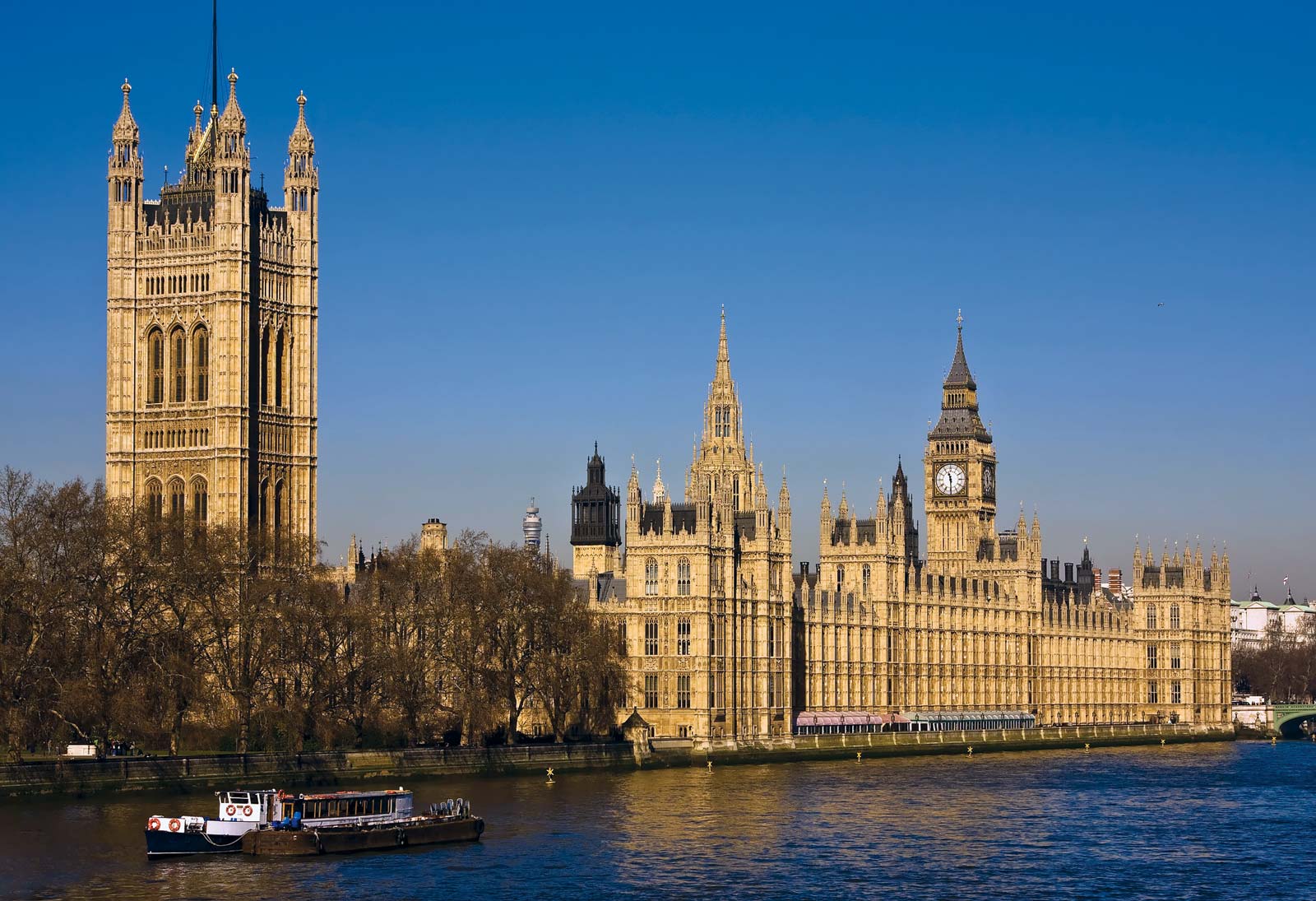
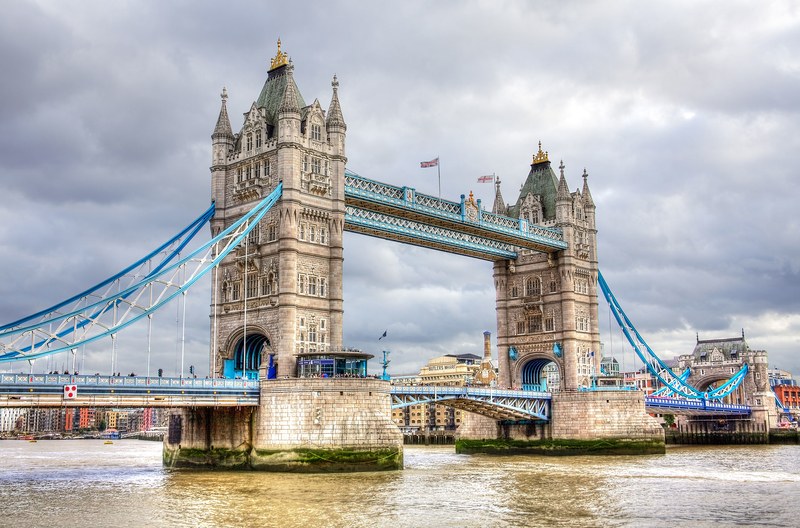
B. Present-day Britain is full of churches, universities, and other public buildings and private houses built in this style. However, the two most iconic and recognisable Gothic Revival constructions are the Houses of Parliament and the Tower Bridge in London. The Palace of Westminster that houses the British Parliament was built in the 1860s after the old building had burnt down, whereas the Tower Bridge was erected in 1894.
C. During the 19th century, Gothic Revival quickly spread to other European countries and the USA. Several of the most prestigious American universities like Princeton or Yale adopted Gothic Revival style for their campuses and called it Collegiate Gothic. Gothic Revival style may not be as wellrepresented in Russia, but can be found there as well, if you know where to look — sometimes in quite unexpected places!
D. The well-known Russian industrialist Alexei Khludov often went to London and Liverpool in the 1840s-1860s to learn about textile manufacturing and to buy equipment for his own cotton factories. Charmed by the brand new clock tower of the Houses of Parliament, he decided to build his own ‘Big Bens’ for his facilities in Egorievsk and Yartsevo, bringing Gothic Revival to these little places in Moscow and Smolensk regions.
E. Another Russian textile magnate Savva Morozov built a Gothic Revival mansion in central Moscow — in Spiridonovka Street. It is not only from the outside that the mansion looks like a castle. Dark wooden Gothic interior, stained-glass windows and even thrones make you feel that you have been transported into the middle ages. Morozov’s mansion was the first big project of architect Fyodor Schechtel that brought him fame.
F. Perhaps the most unexpected place to find Gothic Revival interiors in Russia is Sandunov’s public baths — the most luxurious public baths in Moscow. Sila Sandunov built his baths for aristocracy in the early 19th century. But it was in the 1890s that the baths were rebuilt so that each room had its own architectural style. A heavy wooden ceiling, carved chairs and windows, as well as a beautiful mosaic make it look like an English castle.
G. There are many more buildings in Moscow that have been erected in Gothic Revival style by the most talented Russian architects in the 19th century. But there is also one authentic English building — designed by Richard Kneel Freeman, an architect from the town of Bolton near Manchester. It is the Anglican church of St Andrews in Voznesensky Lane, which makes the whole area around it look like a little part of Britain in central Moscow.
| Текст | A | B | C | D | E | F | G |
| Заголовок |
Установите соответствие между текстами A–G и заголовками 1–8.
Занесите свои ответы в таблицу. Используйте каждую цифру только один
раз. В задании один заголовок лишний.
1. Never too late! 5. The best for the best
2. True symbols 6. No borders or boundaries
3. The real thing 7. No place is too small for it!
4. Back to beauty 8. A successful beginning
A. Gothic Revival is an architectural style that became popular in Britain in the
early 19th century, right after the period of neo-classicism with its straight lines
and noble columns. When English architects turned to the elegant tall towers
and pointed narrow windows of medieval gothic castles, it was, in a way, a
reaction to the machine production of the Industrial Revolution, as well as a
desire to portray pre-industrial society as a golden age.
B. Present-day Britain is full of churches, universities, and other public buildings
and private houses built in this style. However, the two most iconic and
recognisable Gothic Revival constructions are the Houses of Parliament and
the Tower Bridge in London. The Palace of Westminster that houses the British
Parliament was built in the 1860s after the old building had burnt down,
whereas the Tower Bridge was erected in 1894.
C. During the 19th century, Gothic Revival quickly spread to other European
countries and the USA. Several of the most prestigious American universities
like Princeton or Yale adopted Gothic Revival style for their campuses and
called it Collegiate Gothic. Gothic Revival style may not be as wellrepresented in Russia, but can be found there as well, if you know where to
look – sometimes in quite unexpected places!
D. The well-known Russian industrialist Alexei Khludov often went to London
and Liverpool in the 1840s-1860s to learn about textile manufacturing and to
buy equipment for his own cotton factories. Charmed by the brand new clock
tower of the Houses of Parliament, he decided to build his own ‘Big Bens’ for
his facilities in Egorievsk and Yartsevo, bringing Gothic Revival to these little
places in Moscow and Smolensk regions.
10Английский язык. 11 класс. Вариант АЯ2110101 6
© СтатГрад 2021−2022 уч. г. Публикация в интернете или печатных изданиях без письменного
согласия СтатГрад запрещена
E. Another Russian textile magnate Savva Morozov built a Gothic Revival
mansion in central Moscow – in Spiridonovka Street. It is not only from the
outside that the mansion looks like a castle. Dark wooden Gothic interior,
stained-glass windows and even thrones make you feel that you have been
transported into the middle ages. Morozov’s mansion was the first big project
of architect Fyodor Schechtel that brought him fame.
F. Perhaps the most unexpected place to find Gothic Revival interiors in Russia is
Sandunov’s public baths – the most luxurious public baths in Moscow. Sila
Sandunov built his baths for aristocracy in the early 19th century. But it was in
the 1890s that the baths were rebuilt so that each room had its own
architectural style. A heavy wooden ceiling, carved chairs and windows, as
well as a beautiful mosaic make it look like an English castle.
G. There are many more buildings in Moscow that have been erected in Gothic
Revival style by the most talented Russian architects in the 19th century. But
there is also one authentic English building – designed by Richard Kneel
Freeman, an architect from the town of Bolton near Manchester. It is the
Anglican church of St Andrews in Voznesensky Lane, which makes the whole
area around it look like a little part of Britain in central Moscow.
GOTHIC CATHEDRALS
The architecture of the central Middle Ages was termed Gothic during the Renaissance because of its association with the barbarian north. Now this term is used to describe the important international style in most countries of Europe from the early 12th century to the advent of the Renaissance in the 15th century.
At the technical level Gothic architecture is characterized by the ribbed vault, the pointed arch, and the flying buttress.
One of the earliest buildings in which these techniques were introduced in a highly sophisticated architectural plan was the abbey of Saint-Denis, Paris.
The proportions are not large, but the skills and precision with which the vaulting is managed and the subjective effect of the undulating chain windows around the perimeter have given the abbey its traditional claim to the title «first Gothic building».
It should be said that in France and Germany this style is subdivided into the Early, High, and Late Gothic.
The French middle phase is called Rayonnant, the late — Flamboyant.
In English architecture the usual divisions are Early English, Decorative, and Perpendicular.
Early English Gothic developed from c. 1180 to c.1280. The most influential building in the new fashion was the choir of Canterbury cathedral (1175—1184), which has many of the features of Laon cathedral.
The building retains a passage at clerestory level — an Anglo-Norman feature that remained standard in English architecture well into the 13th century. Both in the shape of the piers and in the multiplicity of attached colonettes, Canterbury resembles Laon. Colonettes became extremely popular with English architects, particularly because of the large supplies of purbeck marble, which gave any elevation a special coloristic character. This is obvious at Salisbury cathedral (begun 1220), but one of the richest examples of the effect is in the nave of Lincoln cathedral (begun c. 1225).
English architects for a long time retained a liking for heavy surface decoration: thus, when Rayonnant tracery designs were imported, they were combined with the existing repertoire of colonettes, attached shafts, and vault ribs. The result which could be extraordinarily dense — for instance, in the east (or Angel) choir (begun 1256) at Lincoln cathedral and at Exeter cathedral (begun before 1280) — has been called the English Decorated style (1280-1350).
The architectural affects achieved (notably the retrochair of Wells cathedral or the choir of St. Augustine, Bristol) were more inventive generally than those of contemporary continental buildings.
English Gothic came to an end with the final flowering of the Perpendicular style (c. 1350—1550). It was characterized by vertical emphasis in structure and by elaborate fan vaults.
The first major surviving statement of Perpendicular style is probably the choir of Gloucester cathedral (begun soon after 1330). Other major monuments were St. Stephen’s Chapel, Westminster (begun 1292 but now mostly destroyed) and York Minster nave (begun 1291), St. George’s Chapel, Windsor, King’s College Chapel, Cambridge (1444), the naves of Winchester (c. 1480), and Canterbury (c. 1400), the Chapel of Henry VII at Westminster Abbey.
Gothic was essentially the style of the Catholic countries of Europe. It was also carried to Cyprus, Malta, Syria, and Palestine by the Crusaders and their successors in the Mediterranean. The forms that were developed within the style on a regional basis were often of great beauty and complexity. They were used for all secular buildings, as well as for cathedrals, churches, and monasteries.
By the Gothic Survival is meant the survival of Gothic forms, particularly in provincial traditional building.
It developed after the advent of the Renaissance and into the 17th century. It should be differed from the Gothic Revival (Neo-Gothic) in the 18th — the 19th centuries.
Vocabulary
advent — приход, прибытие
rib — ребро
arch — арка
pointed arch — стрельчатая (остроконечная) арка
buttress — контрфорс
flying buttress — аркбутан, арочный контрфорс
sophisticated — изощренный
abbey — аббатство
skill — мастерство
precision — точность’
undulating — волнистый
claim — требование; претензия; притязание; утверждение; заявление
Rayonnant — лучистый (стиль)
Flamboyant — «пламенеющий» (стиль)
choir — место хора в соборе
to retain — удерживать; поддерживать; сохранять
clerestory — верхний ряд окон, освещающий центр высокого
помещения
to attach — прикреплять; присоединять
tracery — ажурная каменная работа; рисунок, узор; переплетение
shaft — ствол
dense — густой, плотный
chapel — часовня
secular — светский, мирской
I. Complete the sentences.
1. At the technical level the Gothic style is characterized by the ribbed vault, the flying buttress, and …
a) the round arch
b) the bulbous dome
c) the pointed arch
2. The title the «first Gothic building» is given to …
a) the abbey of Saint-Denis
b) Westminster abbey
c) King’s College Chapel
3. In English architecture the usual subdivisians are Early English, Decorated and … styles.
a) Carolingian
b) Flamboyant
c) Perpendicular
4. English architects for a long time retained a liking for …
a) plain surfaces
b) heavy surface decoration
c) curved surfaces
5. Gothic was essentially the style of… countries.
a) the Buddhist
b) the Orthodox
c) the Catholic
II. Choose the right sentence.
1. The Gothic style developed in most countries of Europe.
a) The Gothic style was associated with the barbarian north.
b) Gothic is represented in many European countries.
c) Paris — for much of this period the home of a powerful and artistically enlightened court — played an especially important role in the history of Gothic art.
2. Canterbury Cathedral was the most influential building in the new fashion.
a) Canterbury Cathedral was the most important structure of the Early English Gothic.
b) Canterbury resembles St. Paul’s Cathedral.
c) Canterbury Cathedral was built in the 12th century.
3. English architects retained a liking for heavy surface decoration.
a) English architects preferred restrained decoration.
b) The stained glass of the period was heavily coloured.
c) English architects kept on using ponderous exterior decorations.
4. Gothic was used for cathedrals, churches and monasteries.
a) Gothic was used for industrial buildings.
b) Gothic was used for ecclesiastic structures.
c) In most European countries artists imitated architectural styles from northern France.
Read the text and speak on the reason of imitation of Gothic architecture
NEO-GOTHIC
The architectural movement most commonly associated with Romanticism is the Gothic Revival, a term first used in England in the mid-19th century to describe buildings being erected in the style of the Middle Ages and later expanded to embrace the entire Neo-Gothic movement.
The first clearly self-conscious imitation of Gothic architecture for reasons of nostalgia appeared in England in the early 18th century. Buildings erected at that time in the Gothic manner were for the most part frivolous and decorative garden ornaments, actually more Rococo than Gothic in spirit. But, with the rebuilding beginning in 1747 of the country house Strawberry Hill by the English writer Horace Walpole, a new and significant aspect of the revived style was given convincing form; and, by the beginning of the 19th century, picturesque planning and grouping provided the basis for experimentation in architecture. Gothic was especially suited to this aim. Scores of houses with battlements and turrets in the style of a castle were built in England during the last years of the 18th century.

French architects, in particular, Viollet-le-Duc, who restored a range of buildings from the Sainte-Chapelle and Notre-Dame in Paris to the whole town of Carcassonne, were the first to appreciate the applicability of the Gothic skeleton structure, with its light infilling, to a modern age, and the analogy was not lost on subsequent architects at a time when the steel frame was emerging as an important element of structural engineering. Functionalism and structural honesty as ideals in the Modern movement were a legacy of the Gothic Revival.
Not surprisingly, the Gothic Revival was felt with most force in those countries in which Gothic architecture itself was most in evidence — England, France, and Germany. Each conceived it as a national style, and each gave to it a strong and characteristic twist of its own.
Читайте также:
Meaning of GOTHIC REVIVAL in English
Architectural movement ( 0441; 1730 0441; 1930) most commonly associated with Romanticism.
The first nostalgic imitation of Gothic architecture appeared in the 18th century, when scores of houses with castle-style battlements were built in England, but only toward the mid-19th century did a true Gothic Revival develop. The mere imitation of Gothic forms and details then became its least important aspect, as architects focused on creating original works based on underlying Gothic principles. French architects, particularly E.-E. Viollet-le-Duc , were the first to think about applying the Gothic skeleton structure to a modern age. Though the movement began losing force toward the end of the century, Gothic-style churches and collegiate buildings continued to be constructed in Britain and the U.S. well into the 20th century.
Britannica Concise Encyclopedia.
Краткая энциклопедия Британика.
2012

Gothic Revival (also referred to as Victorian Gothic, neo-Gothic, or Gothick) is an architectural movement popular in the Western world that began in the late 1740s in England. Its momentum grew in the early 19th century when increasingly serious and learned admirers of neo-Gothic styles sought to revive medieval Gothic architecture, in contrast to the neoclassical styles prevalent at the time. Gothic Revival draws features from the original Gothic style, including decorative patterns, finials, lancet windows, hood moulds, and label stops. Listed below are 15 buildings to define the architectural style:
1. Strawberry Hill
Strawberry Hill, Gothic Revival home of Horace Walpole, located on the River Thames in Twickenham, Eng. Walpole bought the house as a cottage in 1747 and gradually transformed it into a medieval-style mansion that suggested in its atmosphere the setting of his famous Gothic novel The Castle of Otranto (1765).

2. Palace of Westminster
Houses of Parliament, also called the Palace of Westminster, in the United Kingdom of Great Britain and Northern Ireland, the seat of the bicameral Parliament, including the House of Commons and the House of Lords. Sir Charles Barry, assisted by A.W.N. Pugin, designed the present buildings in the Gothic Revival style. The Houses of Parliament were designated a UNESCO World Heritage site in 1987.

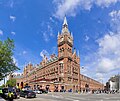
3. St. Pancras Railway Station
St. Pancras railway station was designed by Sir William henry Barlow in 1868. The red brick structure is far from a pure representation of gothic architecture but rather a monumental Victorian structure that borrowed liberally from the gothic aesthetic. The single-span overall roof was the largest such structure in the world at the time of its completion. The materials used were wrought iron framework of lattice design, with glass covering the middle half and timber (inside)/slate (outside) covering the outer quarters.


4. Tower Bridge
Tower Bridge is a combined bascule and suspension bridge in London, built between 1886 and 1894. The bridge crosses the River Thames close to the Tower of London and has become an iconic symbol of London. It is one of the later examples of gothic revival architecture, designed by Sir Horace Jones and built by Sir John Wolfe Barry. The bridge was a feat of mechanical engineering that would have been impossible at the start of Victoria’s reign, yet the modern machinery was clad in Gothic Revival architecture in order to harmonize with the Tower of London and the Houses of Parliament upriver.
5. St. Patrick’s Basilica
The gothic revival building, designed by P. L. Morin and Father Felix Martin, is 71 meters (233 ft) long and 32 meters (105 ft) wide; the steeple reaches a height of 69 meters (226 ft). It is considered one of the most magnificent examples of its style in Canada. The interior is heavily ornamented with motifs that combine a French fleur de Lys and Irish shamrocks; more striking are the 25-meter (82 ft) columns, all carved from the same white oak and encased in marble.

6. Hungarian Parliament Building
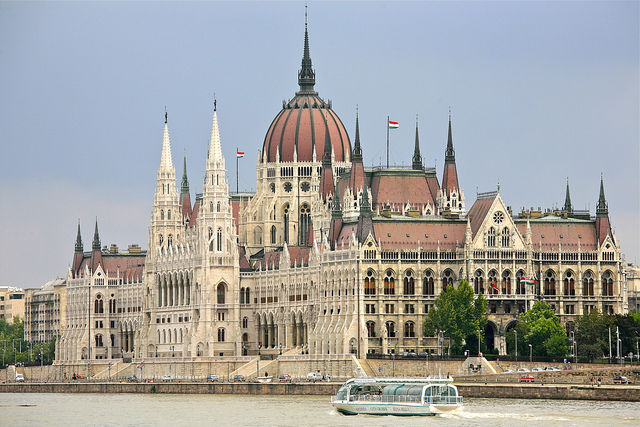
The Hungarian Parliament Building, which translates to House of the Country or House of the Nation), also known as the Parliament of Budapest after its location, is the seat of the National Assembly of Hungary, a notable landmark of Hungary and a popular tourist destination in Budapest. The Parliament Building built in the Gothic Revival style has a symmetrical façade and a central dome. Inaugurated in 1904, the Parliament of Budapest is the creation of architect ImreSteindl who ironically went blind before its completion, leaving him unable to appreciate his finished masterpiece.
7. Chhatrapati Shivaji Terminus
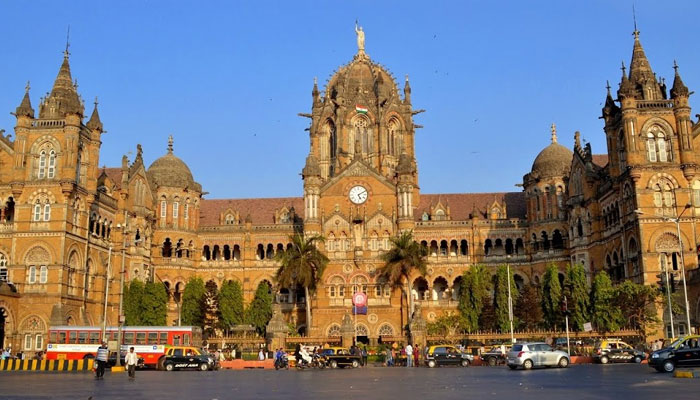
Chhatrapati Shivaji Terminus knew by its former name Victoria Terminus, is a historic terminal train station and UNESCO World Heritage Site in Mumbai, Maharashtra, India. The terminus was designed by British architectural engineer Frederick William Stevens in the style of Victorian Italianate Gothic Revival architecture. The station building is designed in the High Victorian Gothic style of architecture. The building exhibits a fusion of influences from Victorian Italianate Gothic Revival architecture and classical Indian architecture. It is one of the first and finest products of the use of industrial technology, merged with the Gothic Revival style in India.
8. Notre-Dame Basilica (Montreal)
Notre-Dame Basilica is a basilica in the historic district of Old Montreal, in Montreal, Quebec, Canada. The interior of the church is amongst the most dramatic in the world and regarded as a masterpiece of Gothic Revival architecture. The vaults are coloured deep blue and decorated with golden stars, and the rest of the sanctuary is decorated in blues, azures, reds, purples, silver, and gold. It is filled with hundreds of intricate wooden carvings and several religious statues.
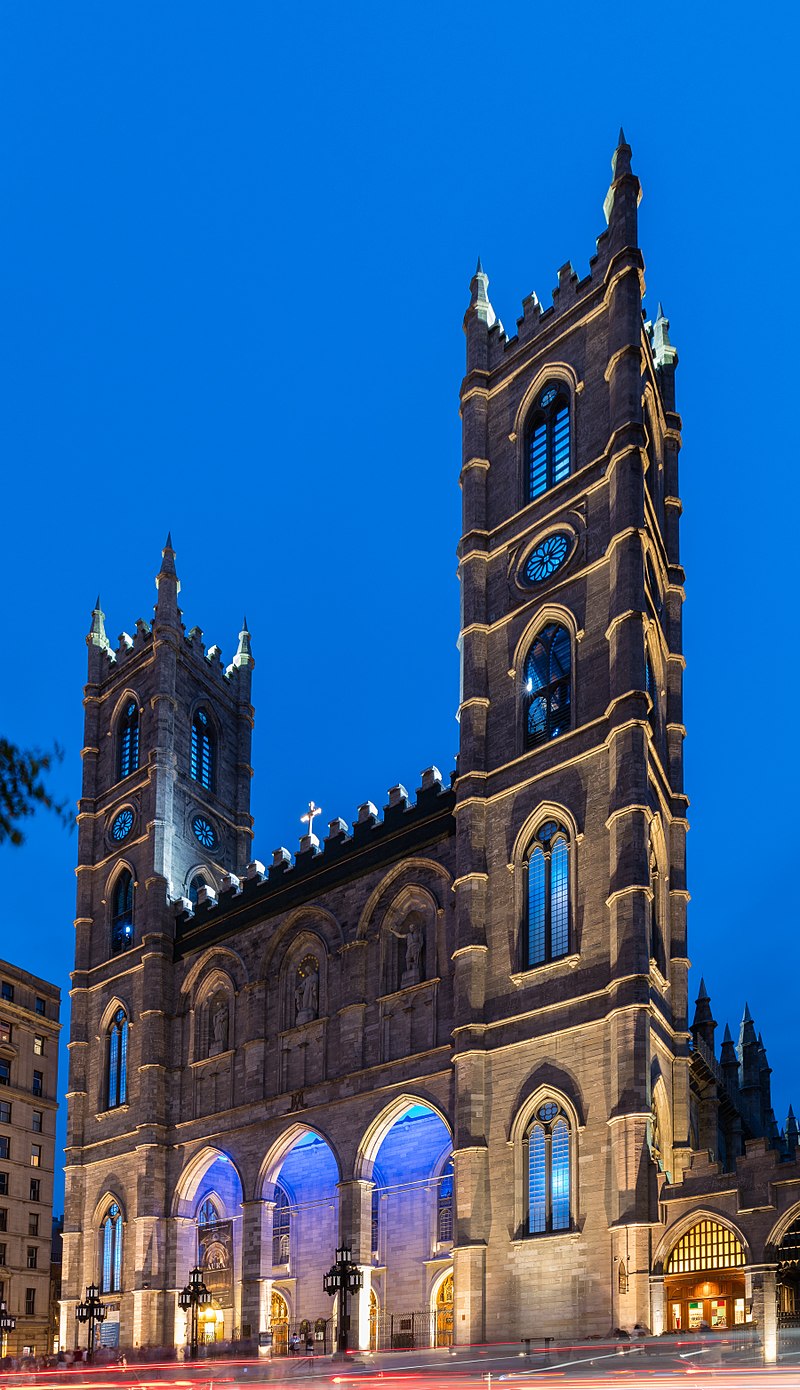
9. Trinity Church, New York
It was designed by American Institute of Architects co-founder Richard Upjohn. Upjohn was known as a leader of the American Gothic Revival movement. His magnificent design made Trinity one of the first and finest examples of Neo-Gothic architecture in the United States.
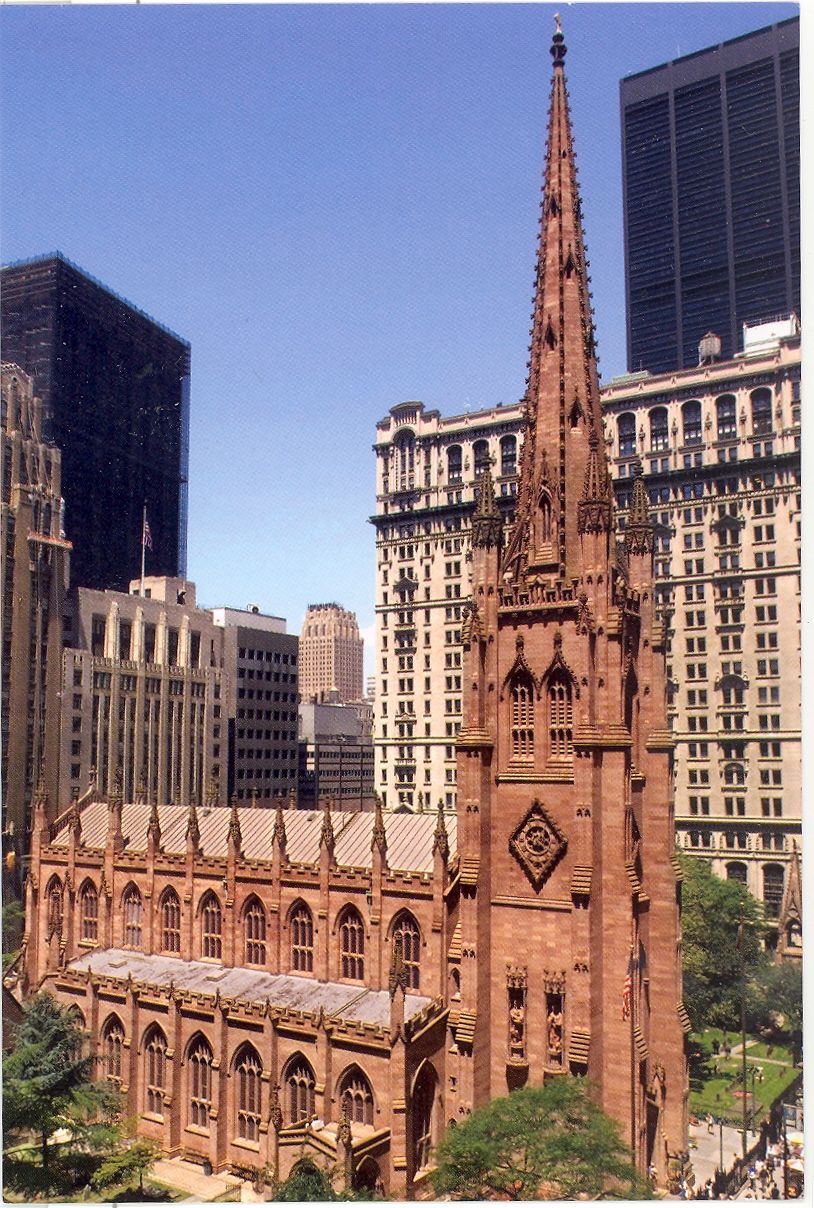
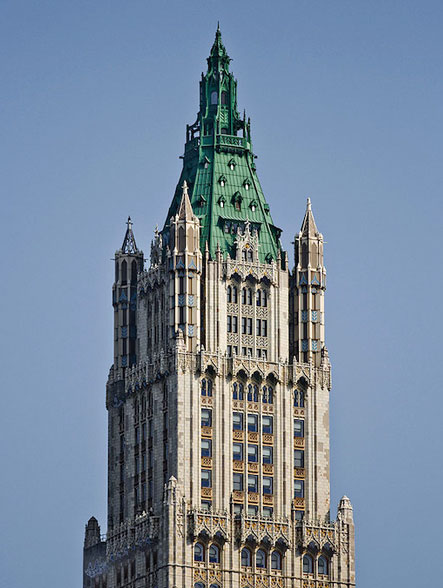
10. Woolworth Building
The Woolworth Building is an early American skyscraper located at 233 Broadway in Manhattan, New York City. Designed by architect Cass Gilbert, it was the tallest building in the world from 1913 to 1930, with a height of 792 feet (241 m). More than a century after its construction, it remains one of the 100 tallest buildings in the United States as well as one of the 30 tallest buildings in New York City. The Woolworth Building, an innovative and elegant early skyscraper completed in 1913, endures today as an iconic form on the New York City skyline.
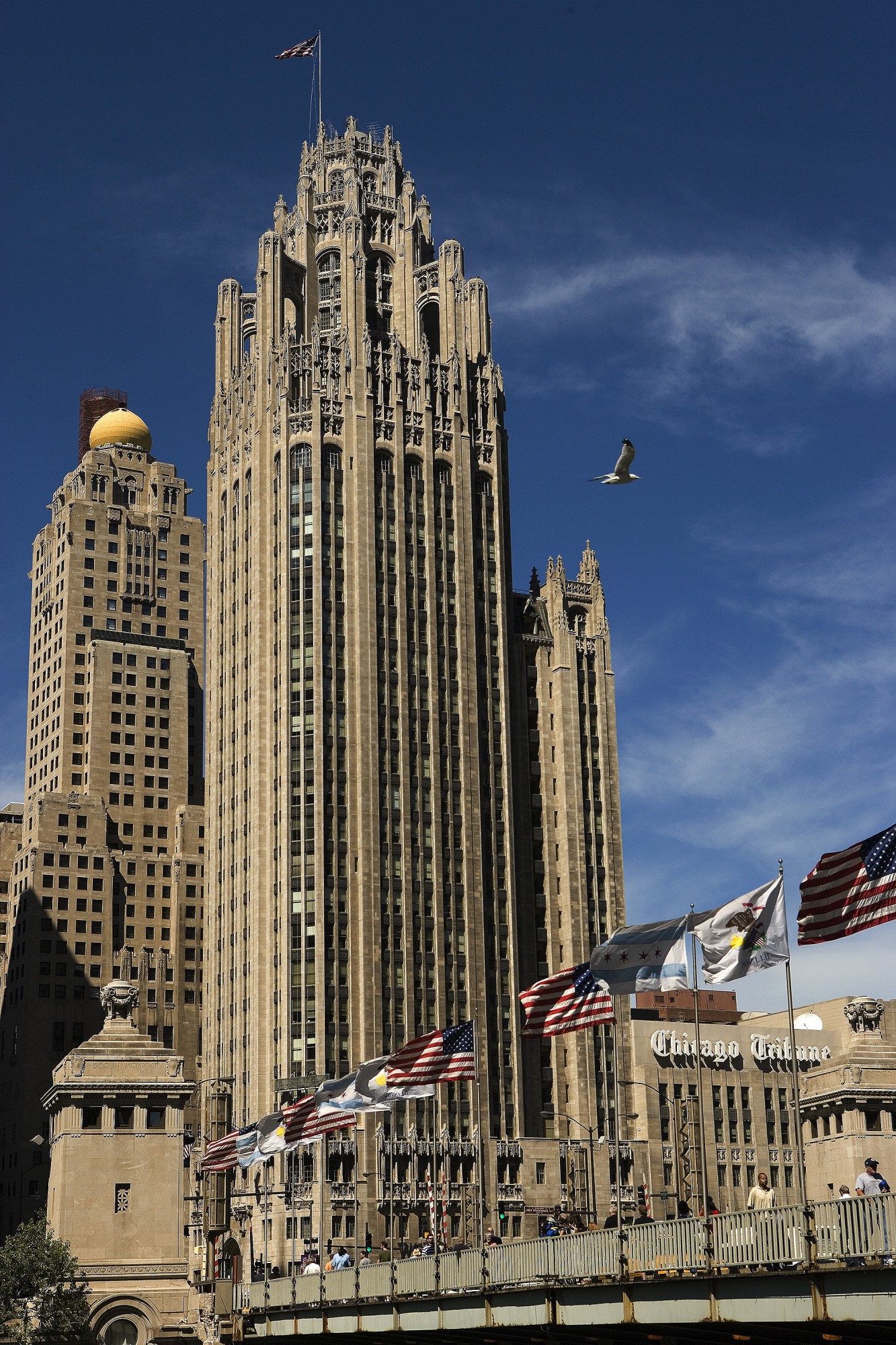
11. Tribune Tower
The Tribune Tower is a neo-Gothic skyscraper located in Chicago, Illinois, United States. Built between 1923 and 1925, the international design competition for the tower became a historic event in 20th-century architecture. The winner was a neo-Gothic design by New York architects John Mead Howells and Raymond Hood, with buttresses near the top. Construction on the Tribune Tower was completed in 1925 and reached a height of 462 feet (141 m) above ground. The ornate buttresses surrounding the peak of the tower are especially visible when the tower is lit at night.
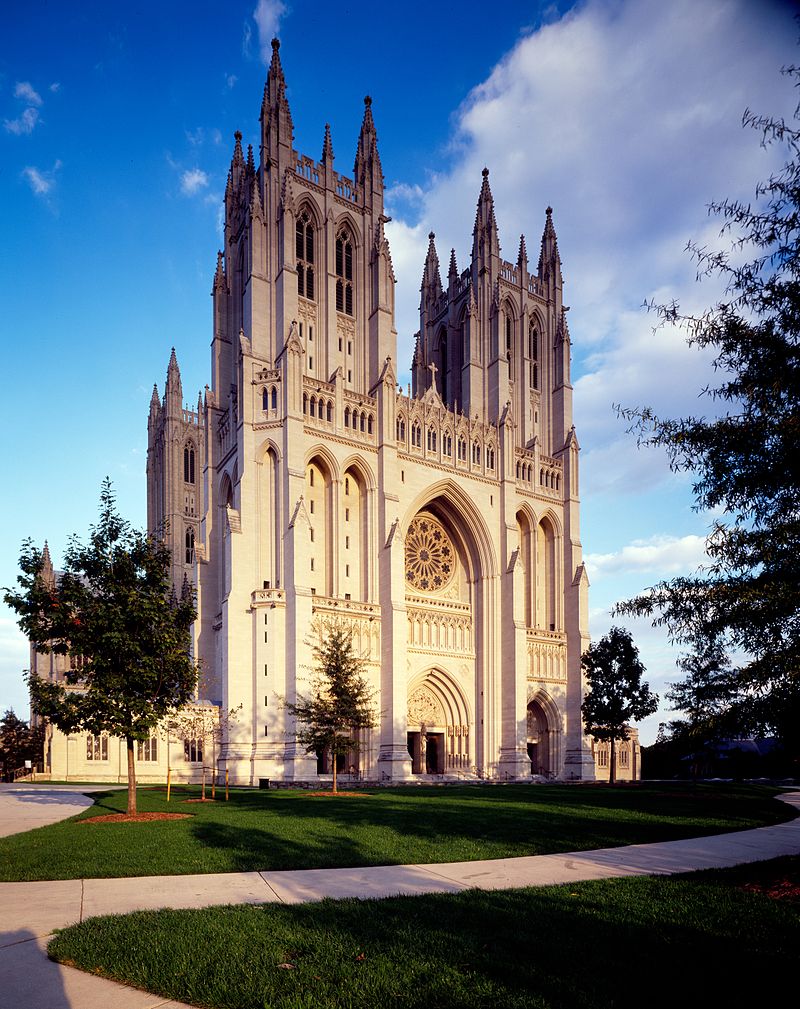
12. Washington National Cathedral
The Cathedral Church of Saint Peter and Saint Paul in the City and Diocese of Washington, commonly known as Washington National Cathedral, is an American cathedral of the Episcopal Church. The structure is of Neo-Gothic design closely modeled on the English Gothic style of the late fourteenth century. It is both the second-largest church building in the United States and the fourth-tallest structure in Washington, D.C.
13. University Of Otago Registry Building
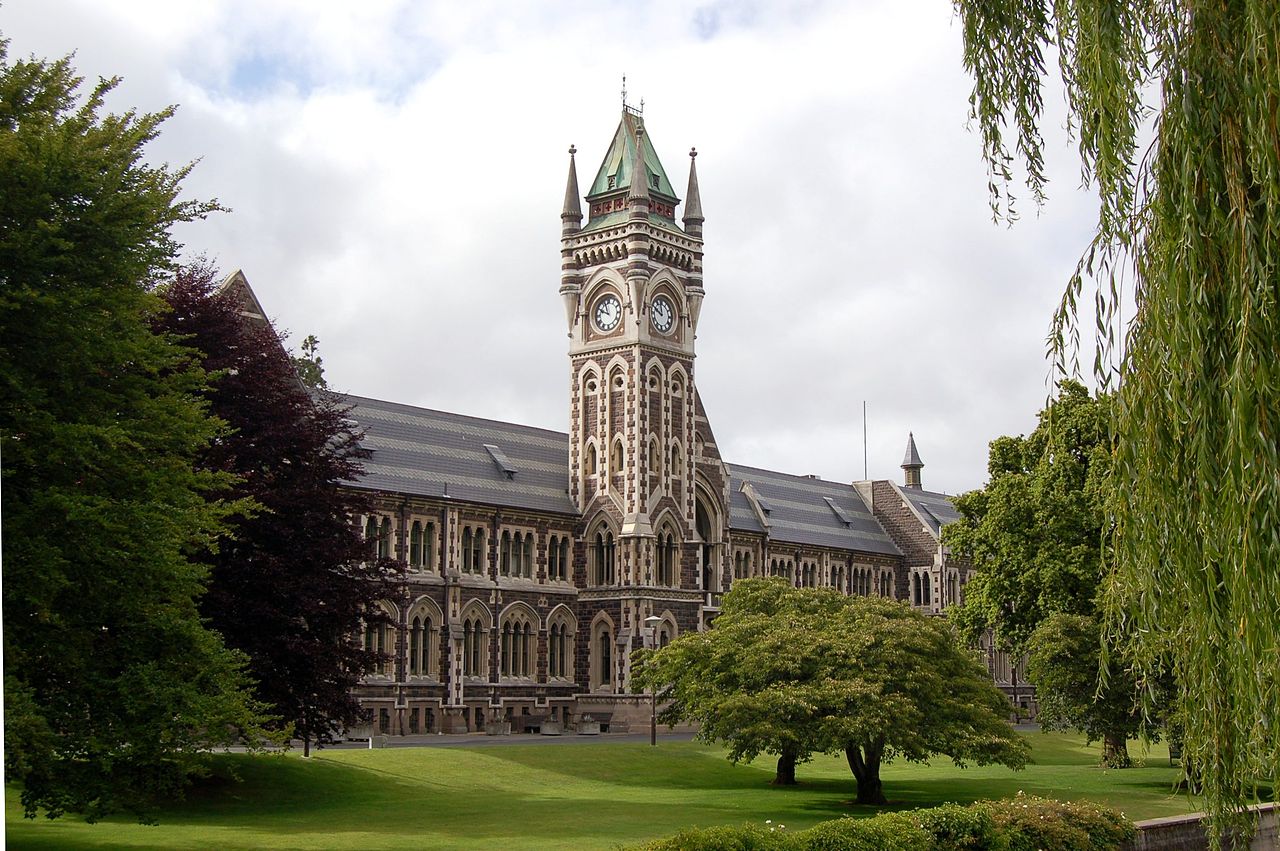
The University of Otago Registry Building, also known as the Clocktower Building, is a Victorian and later structure in the city of Dunedin, New Zealand, and is constructed from contrasting dark Leith Valley basalt and Oamaru stone, with a foundation of Port Chalmers breccia. The building houses the administrative center of the university and the office of the Vice-Chancellor. It has a Category I listing with Heritage New Zealand. It is the principal element of the Clocktower complex, the group of Gothic revival buildings at the heart of the University of Otago’s campus. The most prominent of the group, it was designed and re-designed by Maxwell Bury and Edmund Anscombe between the 1870s and the 1920s. This resulted in a revised geometry and a change to the original conception.
14. Oxford University Museum Of Natural History
The Oxford University Museum of Natural History, sometimes known simply as the Oxford University Museum or OUMNH, is a museum displaying many of the University of Oxford’s natural history specimens, located on Parks Road in Oxford, England. The neo-Gothic building was designed by the Irish architects Thomas Newenham Deane and Benjamin Woodward, mostly Woodward. The museum‘s design was directly influenced by the writings of critic John Ruskin, who involved himself by making various suggestions to Woodward during construction.

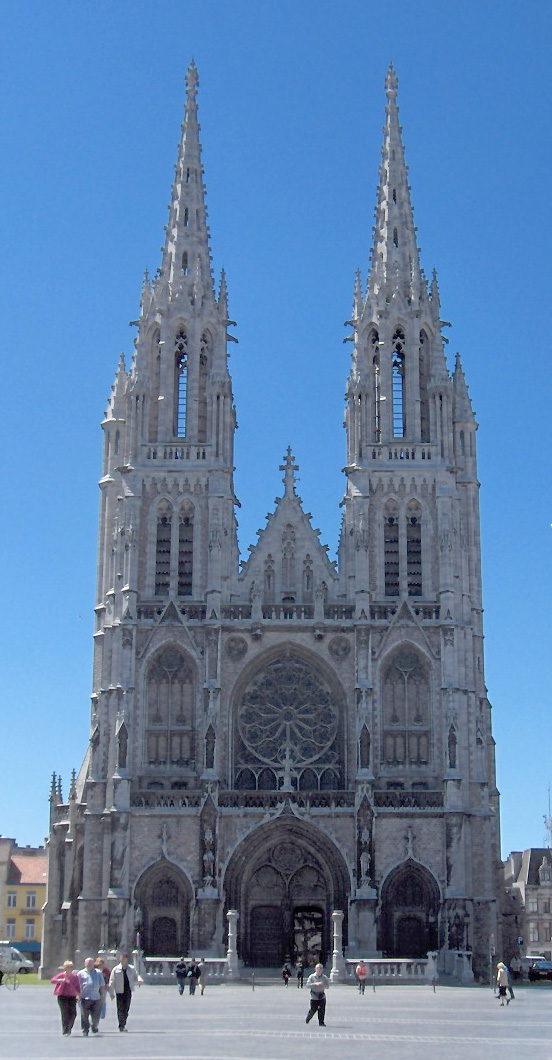
15. Sint-Petrus-en-Pauluskerk
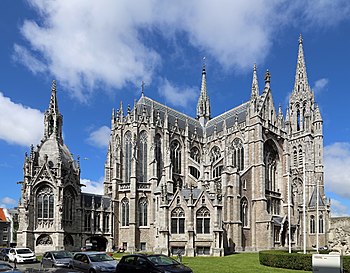
Sint-Petrus-en-Pauluskerk (Church of Saint Peter and Saint Paul), the main church of Ostend, Belgium, is a Roman Catholic Neo-Gothic church. It is built on the ashes of a previous church that occupied the site. The church was built in the Neo-Gothic style according to plans by architect Louis Delacenserie, who based his design on the Gothic Cologne Cathedral and the Neo-Gothic Votivkirche in Vienna.




- Entertainment & Pop Culture
- Geography & Travel
- Health & Medicine
- Lifestyles & Social Issues
- Literature
- Philosophy & Religion
- Politics, Law & Government
- Science
- Sports & Recreation
- Technology
- Visual Arts
- World History
- On This Day in History
- Quizzes
- Podcasts
- Dictionary
- Biographies
- Summaries
- Top Questions
- Week In Review
- Infographics
- Demystified
- Lists
- #WTFact
- Companions
- Image Galleries
- Spotlight
- The Forum
- One Good Fact
- Entertainment & Pop Culture
- Geography & Travel
- Health & Medicine
- Lifestyles & Social Issues
- Literature
- Philosophy & Religion
- Politics, Law & Government
- Science
- Sports & Recreation
- Technology
- Visual Arts
- World History
- Britannica Explains
In these videos, Britannica explains a variety of topics and answers frequently asked questions. - Britannica Classics
Check out these retro videos from Encyclopedia Britannica’s archives. - #WTFact Videos
In #WTFact Britannica shares some of the most bizarre facts we can find. - This Time in History
In these videos, find out what happened this month (or any month!) in history. - Demystified Videos
In Demystified, Britannica has all the answers to your burning questions.
- Student Portal
Britannica is the ultimate student resource for key school subjects like history, government, literature, and more. - COVID-19 Portal
While this global health crisis continues to evolve, it can be useful to look to past pandemics to better understand how to respond today. - 100 Women
Britannica celebrates the centennial of the Nineteenth Amendment, highlighting suffragists and history-making politicians. - Britannica Beyond
We’ve created a new place where questions are at the center of learning. Go ahead. Ask. We won’t mind. - Saving Earth
Britannica Presents Earth’s To-Do List for the 21st Century. Learn about the major environmental problems facing our planet and what can be done about them! - SpaceNext50
Britannica presents SpaceNext50, From the race to the Moon to space stewardship, we explore a wide range of subjects that feed our curiosity about space!
«Neo-Gothic» redirects here. Not to be confused with the New Gothic contemporary art movement.
Gothic Revival (also referred to as Victorian Gothic, neo-Gothic, or Gothick) is an architectural movement that began in the late 1740s in England. The movement gained momentum and expanded in the first half of the 19th century, as increasingly serious and learned admirers of the neo-Gothic styles sought to revive medieval Gothic architecture, intending to complement or even supersede the neoclassical styles prevalent at the time. Gothic Revival draws upon features of medieval examples, including decorative patterns, finials, lancet windows, and hood moulds. By the middle of the 19th century, Gothic Revival had become the preeminent architectural style in the Western world, only to fall out of fashion in the 1880s and early 1890s.
The Gothic Revival movement’s roots are intertwined with philosophical movements associated with Catholicism and a re-awakening of high church or Anglo-Catholic belief concerned by the growth of religious nonconformism. Ultimately, the «Anglo-Catholicism» tradition of religious belief and style became known for its intrinsic appeal in the third quarter of the 19th century. Gothic Revival architecture varied considerably in its faithfulness to both the ornamental style and principles of construction of its medieval original, sometimes amounting to little more than pointed window frames and touches of neo-Gothic decoration on a building otherwise on a wholly 19th-century plan and using contemporary materials and construction methods, most notably in the use of iron and, after the 1880s, steel in ways never seen in medieval exemplars.

In parallel with the ascendancy of neo-Gothic styles in 19th-century England, interest spread to the rest of Europe, Australia, Africa and the Americas; the 19th and early 20th centuries saw the construction of very large numbers of Gothic Revival structures worldwide. The influence of Revivalism had nevertheless peaked by the 1870s. New architectural movements, sometimes related as in the Arts and Crafts movement, and sometimes in outright opposition, such as Modernism, gained ground, and by the 1930s the architecture of the Victorian era was generally condemned or ignored. The later 20th century saw a revival of interest, manifested in the United Kingdom by the establishment of the Victorian Society in 1958.
Roots[edit]
The rise of evangelicalism in the eighteenth and early nineteenth centuries saw in England a reaction in the high church movement which sought to emphasise the continuity between the established church and the pre-Reformation Catholic church.[1] Architecture, in the form of the Gothic Revival, became one of the main weapons in the high church’s armoury. The Gothic Revival was also paralleled and supported by «medievalism», which had its roots in antiquarian concerns with survivals and curiosities. As «industrialisation» progressed, a reaction against machine production and the appearance of factories also grew. Proponents of the picturesque such as Thomas Carlyle and Augustus Pugin took a critical view of industrial society and portrayed pre-industrial medieval society as a golden age. To Pugin, Gothic architecture was infused with the Christian values that had been supplanted by classicism and were being destroyed by industrialisation.[2]
Gothic Revival also took on political connotations; with the «rational» and «radical» Neoclassical style being seen as associated with republicanism and liberalism (as evidenced by its use in the United States and to a lesser extent in Republican France), the more spiritual and traditional Gothic Revival became associated with monarchism and conservatism, which was reflected by the choice of styles for the rebuilt government centres of the British parliament’s Palace of Westminster in London, the Canadian Parliament Buildings in Ottawa and the Hungarian Parliament Building in Budapest.[3]
In English literature, the architectural Gothic Revival and classical Romanticism gave rise to the Gothic novel genre, beginning with The Castle of Otranto (1764) by Horace Walpole,[4] and inspired a 19th-century genre of medieval poetry that stems from the pseudo-bardic poetry of «Ossian». Poems such as «Idylls of the King» by Alfred, Lord Tennyson recast specifically modern themes in medieval settings of Arthurian romance. In German literature, the Gothic Revival also had a grounding in literary fashions.[5]
Survival and revival[edit]
Gothic architecture began at the Basilica of Saint Denis near Paris, and the Cathedral of Sens in 1140[6] and ended with a last flourish in the early 16th century with buildings like Henry VII’s Chapel at Westminster.[7] However, Gothic architecture did not die out completely in the 16th century but instead lingered in on-going cathedral-building projects; at Oxford and Cambridge Universities, and in the construction of churches in increasingly isolated rural districts of England, France, Germany, the Polish–Lithuanian Commonwealth and in Spain.[8] Londonderry Cathedral (completed 1633) was a major new structure in the Perpendicular Gothic style.[9]

In Bologna, in 1646, the Baroque architect Carlo Rainaldi constructed Gothic vaults (completed 1658) for the Basilica of San Petronio in Bologna, which had been under construction since 1390; there, the Gothic context of the structure overrode considerations of the current architectural mode. Guarino Guarini, a 17th-century Theatine monk active primarily in Turin, recognized the «Gothic order» as one of the primary systems of architecture and made use of it in his practice.[10]
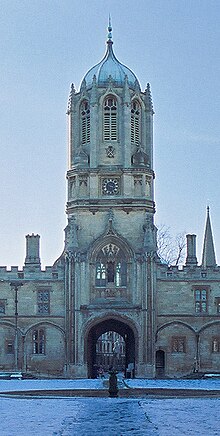
Likewise, Gothic architecture survived in an urban setting during the later 17th century, as shown in Oxford and Cambridge, where some additions and repairs to Gothic buildings were considered to be more in keeping with the style of the original structures than contemporary Baroque. Sir Christopher Wren’s Tom Tower for Christ Church, University of Oxford,[a] and, later, Nicholas Hawksmoor’s west towers of Westminster Abbey, blur the boundaries between what is called Gothic survival and the Gothic Revival.[12] Throughout France in the 16th and 17th centuries, churches such as St-Eustache continued to be built following Gothic forms cloaked in classical details, until the arrival of Baroque architecture.[13]
Even in Central Europe of the late 17th and 18th centuries, where Baroque dominated, some architects used elements of the Gothic style. The most important example is Jan Santini Aichel, whose Pilgrimage Church of Saint John of Nepomuk in Žďár nad Sázavou, Czech Republic, represents a peculiar and creative synthesis of Baroque and Gothic.[14] An example of another and less striking use of the Gothic style in the time is the Basilica of Our Lady of Hungary in Márianosztra, Hungary, whose sanctuary was long considered authentically Gothic, because the 18th-century architect used medieval shapes to emphasize the continuity of the monastic community with its 14th-century founders.[15]
During the mid-18th century rise of Romanticism, an increased interest and awareness of the Middle Ages among influential connoisseurs created a more appreciative approach to selected medieval arts, beginning with church architecture, the tomb monuments of royal and noble personages, stained glass, and late Gothic illuminated manuscripts. Other Gothic arts, such as tapestries and metalwork, continued to be disregarded as barbaric and crude, however sentimental and nationalist associations with historical figures were as strong in this early revival as purely aesthetic concerns.[16]
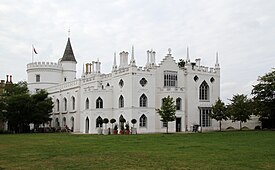
German Romanticists (including philosopher and writer Goethe and architect Karl Friedrich Schinkel), began to appreciate the picturesque character of ruins—»picturesque» becoming a new aesthetic quality—and those mellowing effects of time that the Japanese call wabi-sabi and that Horace Walpole independently admired, mildly tongue-in-cheek, as «the true rust of the Barons’ wars».[b][18] The «Gothick» details of Walpole’s Twickenham villa, Strawberry Hill House begun in 1749, appealed to the rococo tastes of the time,[c][20] and were fairly quickly followed by James Talbot at Lacock Abbey, Wiltshire.[21] By the 1770s, thoroughly neoclassical architects such as Robert Adam and James Wyatt were prepared to provide Gothic details in drawing-rooms, libraries and chapels and, for William Beckford at Fonthill in Wiltshire, a complete romantic vision of a Gothic abbey.[d][24]
Some of the earliest architectural examples of the revived are found in Scotland. Inveraray Castle, constructed from 1746 for the Duke of Argyll, with design input from William Adam, displays the incorporation of turrets.[e] The architectural historian John Gifford writes that the castellations were the «symbolic assertion of the still quasi-feudal power [the duke] exercised over the inhabitants within his heritable jurisdictions».[26] Most buildings were still largely in the established Palladian style, but some houses incorporated external features of the Scots baronial style. Robert Adam’s houses in this style include Mellerstain[27] and Wedderburn[28] in Berwickshire and Seton Castle in East Lothian,[29] but it is most clearly seen at Culzean Castle, Ayrshire, remodelled by Adam from 1777.[30] The eccentric landscape designer Batty Langley even attempted to «improve» Gothic forms by giving them classical proportions.[31]
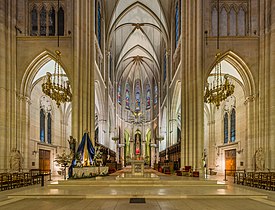
Basilica of Sainte Clotilde Sanctuary, Paris, France
A younger generation, taking Gothic architecture more seriously, provided the readership for John Britton’s series Architectural Antiquities of Great Britain, which began appearing in 1807.[32] In 1817, Thomas Rickman wrote an Attempt… to name and define the sequence of Gothic styles in English ecclesiastical architecture, «a text-book for the architectural student». Its long antique title is descriptive: Attempt to discriminate the styles of English architecture from the Conquest to the Reformation; preceded by a sketch of the Grecian and Roman orders, with notices of nearly five hundred English buildings. The categories he used were Norman, Early English, Decorated, and Perpendicular. It went through numerous editions, was still being republished by 1881, and has been reissued in the 21st century.[f][34]
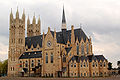
The most common use for Gothic Revival architecture was in the building of churches. Major examples of Gothic cathedrals in the U.S. include the cathedrals of St. John the Divine and St. Patrick in New York City and the Washington National Cathedral on Mount St. Alban in northwest Washington, D.C. One of the biggest churches in Gothic Revival style in Canada is Basilica of Our Lady Immaculate in Ontario.[35]
Gothic Revival architecture remained one of the most popular and long-lived of the many revival styles of architecture. Although it began to lose force and popularity after the third quarter of the 19th century in commercial, residential and industrial fields, some buildings such as churches, schools, colleges and universities were still constructed in the Gothic style, often known as «Collegiate Gothic», which remained popular in England, Canada and in the United States until well into the early to mid-20th century. Only when new materials, like steel and glass along with concern for function in everyday working life and saving space in the cities, meaning the need to build up instead of out, began to take hold did the Gothic Revival start to disappear from popular building requests.[36]
Gothic Revival in the other decorative arts[edit]

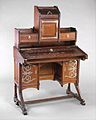
The revived Gothic style was not limited to architecture. Classical Gothic buildings of the 12th to 16th Centuries were a source of inspiration to 19th-century designers in numerous fields of work. Architectural elements such as pointed arches, steep-sloping roofs and fancy carvings like lace and lattice work were applied to a wide range of Gothic Revival objects. Some examples of Gothic Revivals influence can be found in heraldic motifs in coats of arms, painted furniture with elaborate painted scenes like the whimsical Gothic detailing in English furniture is traceable as far back as Lady Pomfret’s house in Arlington Street, London (1740s),[37] and Gothic fretwork in chairbacks and glazing patterns of bookcases is a familiar feature of Chippendale’s Director (1754, 1762), where, for example, the three-part bookcase employs Gothic details with Rococo profusion, on a symmetrical form.[38][39] Abbotsford in the Scottish Borders, rebuilt from 1816 by Sir Walter Scott and paid for by the profits from his, hugely successful, historical novels, exemplifies the «Regency Gothic» style.[g][41] Gothic Revival also includes the reintroduction of medieval clothes and dances in historical re-enactments staged especially in the second part of the 19th century, although one of the first, the Eglinton Tournament of 1839, remains the most famous.[42]
During the Bourbon Restoration in France (1814–1830) and the Louis-Philippe period (1830-1848), Gothic Revival motifs start to appear, together with revivals of the Renaissance and of Rococo. During these two periods, the vogue for medieval things led craftsmen to adopt Gothic decorative motifs in their work, such as bell turrets, lancet arches, trefoils, Gothic tracery and rose windows. This style was also as «Cathedral style» («À la catédrale»).[43][44]
By the mid-19th century, Gothic traceries and niches could be inexpensively re-created in wallpaper, and Gothic blind arcading could decorate a ceramic pitcher. Writing in 1857, J. G. Crace, an influential decorator from a family of influential interior designers, expressed his preference for the Gothic style: «In my opinion there is no quality of lightness, elegance, richness or beauty possessed by any other style… [or] in which the principles of sound construction can be so well carried out».[45] The illustrated catalogue for the Great Exhibition of 1851 is replete with Gothic detail, from lacemaking and carpet designs to heavy machinery. Nikolaus Pevsner’s volume on the exhibits at the Great Exhibition, High Victorian Design published in 1951, was an important contribution to the academic study of Victorian taste and an early indicator of the later 20th century rehabilitation of Victorian architecture and the objects with which they decorated their buildings.[46]
In 1847, eight thousand British crown coins were minted in proof condition with the design using an ornate reverse in keeping with the revived style. Considered by collectors to be particularly beautiful, they are known as ‘Gothic crowns’. The design was repeated in 1853, again in proof. A similar two shilling coin, the ‘Gothic florin’ was minted for circulation from 1851 to 1887.[47][48]
Romanticism and nationalism[edit]

Gothic façade of the Parlement de Rouen in France, built between 1499 and 1508, which later inspired neo-Gothic revival in the 19th century
French neo-Gothic had its roots in the French medieval Gothic architecture, where it was created in the 12th century. Gothic architecture was sometimes known during the medieval period as the «Opus Francigenum», (the «French Art»). French scholar Alexandre de Laborde wrote in 1816 that «Gothic architecture has beauties of its own»,[49] which marked the beginning of the Gothic Revival in France. Starting in 1828, Alexandre Brogniart, the director of the Sèvres porcelain manufactory, produced fired enamel paintings on large panes of plate glass, for King Louis-Philippe’s Chapelle royale de Dreux, an important early French commission in Gothic taste,[50] preceded mainly by some Gothic features in a few jardins paysagers.[51]

The French Gothic Revival was set on sounder intellectual footings by a pioneer, Arcisse de Caumont, who founded the Societé des Antiquaires de Normandie at a time when antiquaire still meant a connoisseur of antiquities, and who published his great work on architecture in French Normandy in 1830.[52] The following year Victor Hugo’s historical romance novel The Hunchback of Notre-Dame appeared, in which the great Gothic cathedral of Paris was at once a setting and a protagonist in a hugely popular work of fiction. Hugo intended his book to awaken a concern for the surviving Gothic architecture left in Europe, however, rather than to initiate a craze for neo-Gothic in contemporary life.[53] In the same year that Notre-Dame de Paris appeared, the new French restored Bourbon monarchy established an office in the Royal French Government of Inspector-General of Ancient Monuments, a post which was filled in 1833 by Prosper Mérimée, who became the secretary of a new Commission des Monuments Historiques in 1837.[54] This was the Commission that instructed Eugène Viollet-le-Duc to report on the condition of the Abbey of Vézelay in 1840.[55] Following this, Viollet le Duc set out to restore most of the symbolic buildings in France including Notre Dame de Paris,[56] Vézelay,[57] Carcassonne,[58] Roquetaillade castle,[59] the famous Mont-Saint-Michel Abbey on its peaked coastal island,[60] Pierrefonds,[61] and Palais des Papes in Avignon.[58] When France’s first prominent neo-Gothic church[h] was built, the Basilica of Saint-Clotilde,[i] Paris, begun in 1846 and consecrated in 1857, the architect chosen was of German extraction, Franz Christian Gau, (1790–1853); the design was significantly modified by Gau’s assistant, Théodore Ballu, in the later stages, to produce the pair of flèches that crown the west end.[64]
In Germany, there was a renewal of interest in the completion of Cologne Cathedral. Begun in 1248, it was still unfinished at the time of the revival. The 1820s «Romantic» movement brought a new appreciation of the building, and construction work began once more in 1842, marking a German return for Gothic architecture. St. Vitus Cathedral in Prague, begun in 1344, was also completed in the mid-19th and early 20th centuries.[65] The importance of the Cologne completion project in German-speaking lands has been explored by Michael J. Lewis, «The Politics of the German Gothic Revival: August Reichensperger». Reichensperger was himself in no doubt as to the cathedral’s central position in Germanic culture; «Cologne Cathedral is German to the core, it is a national monument in the fullest sense of the word, and probably the most splendid monument to be handed down to us from the past».[66]
Because of Romantic nationalism in the early 19th century, the Germans, French and English all claimed the original Gothic architecture of the 12th century era as originating in their own country. The English boldly coined the term «Early English» for «Gothic», a term that implied Gothic architecture was an English creation. In his 1832 edition of Notre Dame de Paris, author Victor Hugo said «Let us inspire in the nation, if it is possible, love for the national architecture», implying that «Gothic» is France’s national heritage. In Germany, with the completion of Cologne Cathedral in the 1880s, at the time its summit was the world’s tallest building, the cathedral was seen as the height of Gothic architecture.[67] Other major completions of Gothic cathedrals were of Regensburger Dom (with twin spires completed from 1869 to 1872),[68] Ulm Münster (with a 161-meter tower from 1890)[69] and St. Vitus Cathedral in Prague (1844–1929).[70]

In Belgium, a 15th-century church in Ostend burned down in 1896. King Leopold II funded its replacement, the Saint Peter’s and Saint Paul’s Church, a cathedral-scale design which drew inspiration from the neo-Gothic Votive Church in Vienna and Cologne Cathedral.[71] In Mechelen, the largely unfinished building drawn in 1526 as the seat of the Great Council of The Netherlands, was not actually built until the early 20th century, although it closely followed Rombout II Keldermans’s Brabantine Gothic design, and became the ‘new’ north wing of the City Hall.[72][73] In Florence, the Duomo’s temporary façade erected for the Medici-House of Lorraine nuptials in 1588–1589, was dismantled, and the west end of the cathedral stood bare again until 1864, when a competition was held to design a new façade suitable to Arnolfo di Cambio’s original structure and the fine campanile next to it. This competition was won by Emilio De Fabris, and so work on his polychrome design and panels of mosaic was begun in 1876 and completed by 1887, creating the Neo-Gothic western façade.[74]
Eastern Europe also saw much Revival construction; in addition to the Hungarian Parliament Building in Budapest,[3] the Bulgarian National Revival saw the introduction of Gothic Revival elements into its vernacular ecclesiastical and residential architecture. The largest project of the Slavine School is the Lopushna Monastery cathedral (1850–1853), though later churches such as Saint George’s Church, Gavril Genovo display more prominent vernacular Gothic Revival features.[75]

In Scotland, while a similar Gothic style to that used further south in England was adopted by figures including Frederick Thomas Pilkington (1832–98)[76] in secular architecture it was marked by the re-adoption of the Scots baronial style.[77] Important for the adoption of the style in the early 19th century was Abbotsford, which became a model for the modern revival of the baronial style.[78] Common features borrowed from 16th- and 17th-century houses included battlemented gateways, crow-stepped gables, pointed turrets and machicolations. The style was popular across Scotland and was applied to many relatively modest dwellings by architects such as William Burn (1789–1870), David Bryce (1803–76),[79] Edward Blore (1787–1879), Edward Calvert (c. 1847–1914) and Robert Stodart Lorimer (1864–1929) and in urban contexts, including the building of Cockburn Street in Edinburgh (from the 1850s) as well as the National Wallace Monument at Stirling (1859–1869).[80] The reconstruction of Balmoral Castle as a baronial palace and its adoption as a royal retreat from 1855 to 1858 confirmed the popularity of the style.[78]
In the United States, the first «Gothic stile»[81] church (as opposed to churches with Gothic elements) was Trinity Church on the Green, New Haven, Connecticut. It was designed by Ithiel Town between 1812 and 1814, while he was building his Federalist-style Center Church, New Haven next to this radical new «Gothic-style» church. Its cornerstone was laid in 1814,[82] and it was consecrated in 1816.[83] It predates St Luke’s Church, Chelsea, often said to be the first Gothic-revival church in London. Though built of trap rock stone with arched windows and doors, parts of its tower and its battlements were wood. Gothic buildings were subsequently erected by Episcopal congregations in Connecticut at St John’s in Salisbury (1823), St John’s in Kent (1823–26) and St Andrew’s in Marble Dale (1821–1823).[81] These were followed by Town’s design for Christ Church Cathedral (Hartford, Connecticut) (1827), which incorporated Gothic elements such as buttresses into fabric of the church. St. Paul’s Episcopal Church in Troy, New York, was constructed in 1827–1828 as an exact copy of Town’s design for Trinity Church, New Haven, but using local stone; due to changes in the original, St. Paul’s is closer to Town’s original design than Trinity itself. In the 1830s, architects began to copy specific English Gothic and Gothic Revival Churches, and these «‘mature Gothic Revival’ buildings made the domestic Gothic style architecture which preceded it seem primitive and old-fashioned».[84]
There are many examples of Gothic Revival architecture in Canada. The first major structure was Notre-Dame Basilica in Montreal, Quebec, which was designed in 1824.[85] The capital, Ottawa, Ontario, was predominantly a 19th-century creation in the Gothic Revival style. The Parliament Hill buildings were the preeminent example, of which the original library survives today (after the rest was destroyed by fire in 1916).[86] Their example was followed elsewhere in the city and outlying areas, showing how popular the Gothic Revival movement had become.[35] Other examples of Canadian Gothic Revival architecture in Ottawa are the Victoria Memorial Museum, (1905–08),[87] the Royal Canadian Mint, (1905–08),[88] and the Connaught Building, (1913–16),[89] all by David Ewart.[90]
Gothic as a moral force[edit]
Pugin and «truth» in architecture[edit]

In the late 1820s, A. W. N. Pugin, still a teenager, was working for two highly visible employers, providing Gothic detailing for luxury goods.[91] For the Royal furniture makers Morel and Seddon he provided designs for redecorations for the elderly George IV at Windsor Castle in a Gothic taste suited to the setting.[j][93] For the royal silversmiths Rundell Bridge and Co., Pugin provided designs for silver from 1828, using the 14th-century Anglo-French Gothic vocabulary that he would continue to favour later in designs for the new Palace of Westminster.[94] Between 1821 and 1838 Pugin and his father published a series of volumes of architectural drawings, the first two entitled, Specimens of Gothic Architecture, and the following three, Examples of Gothic Architecture, that were to remain both in print and the standard references for Gothic Revivalists for at least the next century.[95]
In Contrasts: or, a Parallel between the Noble Edifices of the Middle Ages, and similar Buildings of the Present Day (1836), Pugin expressed his admiration not only for medieval art but for the whole medieval ethos, suggesting that Gothic architecture was the product of a purer society. In The True Principles of Pointed or Christian Architecture (1841), he set out his «two great rules of design: 1st, that there should be no features about a building which are not necessary for convenience, construction or propriety; 2nd, that all ornament should consist of enrichment of the essential construction of the building». Urging modern craftsmen to seek to emulate the style of medieval workmanship as well as reproduce its methods, Pugin sought to reinstate Gothic as the true Christian architectural style.[96]
Pugin’s most notable project was the Houses of Parliament in London, after its predecessor was largely destroyed in a fire in 1834.[k][98] His part in the design consisted of two campaigns, 1836–1837 and again in 1844 and 1852, with the classicist Charles Barry as his nominal superior. Pugin provided the external decoration and the interiors, while Barry designed the symmetrical layout of the building, causing Pugin to remark, «All Grecian, Sir; Tudor details on a classic body».[99]
Ruskin and Venetian Gothic[edit]

John Ruskin supplemented Pugin’s ideas in his two influential theoretical works, The Seven Lamps of Architecture (1849) and The Stones of Venice (1853). Finding his architectural ideal in Venice, Ruskin proposed that Gothic buildings excelled above all other architecture because of the «sacrifice» of the stone-carvers in intricately decorating every stone. In this, he drew a contrast between the physical and spiritual satisfaction which a medieval craftsman derived from his work, and the lack of these satisfactions afforded to modern, industrialised labour.[l][101]
By declaring the Doge’s Palace to be «the central building of the world», Ruskin argued the case for Gothic government buildings as Pugin had done for churches, though mostly only in theory. When his ideas were put into practice, Ruskin often disliked the result, although he supported many architects, such as Thomas Newenham Deane and Benjamin Woodward, and was reputed to have designed some of the corbel decorations for that pair’s Oxford University Museum of Natural History.[102] A major clash between the Gothic and Classical styles in relation to governmental offices occurred less than a decade after the publication of The Stones of Venice. A public competition for the construction of a new Foreign Office in Whitehall saw the decision to award first place to a Gothic design by George Gilbert Scott overturned by the Prime Minister, Lord Palmerston, who successfully demanded a building in the Italianate style.[m][104]
Ecclesiology and funerary style[edit]
In England, the Church of England was undergoing a revival of Anglo-Catholic and ritualist ideology in the form of the Oxford Movement, and it became desirable to build large numbers of new churches to cater for the growing population, and cemeteries for their hygienic burials. This found ready exponents in the universities, where the ecclesiological movement was forming. Its proponents believed that Gothic was the only style appropriate for a parish church, and favoured a particular era of Gothic architecture – the «decorated». The Cambridge Camden Society, through its journal The Ecclesiologist, was so savagely critical of new church buildings that were below its exacting standards and its pronouncements were followed so avidly that it became the epicentre of the flood of Victorian restoration that affected most of the Anglican cathedrals and parish churches in England and Wales.[105]

St Luke’s Church, Chelsea, was a new-built Commissioner’s Church of 1820–24, partly built using a grant of £8,333 towards its construction with money voted by Parliament as a result of the Church Building Act of 1818.[106] It is often said to be the first Gothic Revival church in London,[107] and, as Charles Locke Eastlake put it: «probably the only church of its time in which the main roof was groined throughout in stone».[108] Nonetheless, the parish was firmly low church, and the original arrangement, modified in the 1860s, was as a «preaching church» dominated by the pulpit, with a small altar and wooden galleries over the nave aisle.[109]
The development of the private major metropolitan cemeteries was occurring at the same time as the movement; Sir William Tite pioneered the first cemetery in the Gothic style at West Norwood in 1837, with chapels, gates, and decorative features in the Gothic manner, attracting the interest of contemporary architects such as George Edmund Street, Barry, and William Burges. The style was immediately hailed a success and universally replaced the previous preference for classical design.[110]
Not every architect or client was swept away by this tide. Although Gothic Revival succeeded in becoming an increasingly familiar style of architecture, the attempt to associate it with the notion of high church superiority, as advocated by Pugin and the ecclesiological movement, was anathema to those with ecumenical or nonconformist principles. Alexander «Greek» Thomson launched a famous attack; «We are told we should adopt [Gothic] because it is the Christian style, and this most impudent assertion has been accepted as sound doctrine even by earnest and intelligent Protestants; whereas it ought only to have force with those who believe that Christian truth attained its purest and most spiritual development at the period when this style of architecture constituted its corporeal form».[111] Those rejecting the link between Gothic and Catholicism looked to adopt it solely for its aesthetic romantic qualities, to combine it with other styles, or look to northern European Brick Gothic for a more plain appearance; or in some instances all three of these, as at the non-denominational Abney Park Cemetery in east London, designed by William Hosking FSA in 1840.[112]
Viollet-le-Duc and Iron Gothic[edit]

Carcassonne – Viollet-le-Duc restored the citadel from 1853.
France had lagged slightly in entering the neo-Gothic scene, but produced a major figure in the revival in Eugène Viollet-le-Duc. As well as a powerful and influential theorist, Viollet-le-Duc was a leading architect whose genius lay in restoration.[n] He believed in restoring buildings to a state of completion that they would not have known even when they were first built, theories he applied to his restorations of the walled city of Carcassonne,[58] and to Notre-Dame and Sainte Chapelle in Paris.[56] In this respect he differed from his English counterpart Ruskin, as he often replaced the work of mediaeval stonemasons. His rational approach to Gothic stood in stark contrast to the revival’s romanticist origins.[114][115] Throughout his career he remained in a quandary as to whether iron and masonry should be combined in a building. Iron had in fact been used in Gothic buildings since the earliest days of the revival. It was only with Ruskin and the archaeological Gothic’s demand for historical truth that iron, whether it was visible or not, was deemed improper for a Gothic building. Ultimately, the utility of iron won out: «substituting a cast iron shaft for a granite, marble or stone column is not bad, but one must agree that it cannot be considered as an innovation, as the introduction of a new principle. Replacing a stone or wooden lintel by an iron breastsummer is very good».[116] He strongly opposed illusion, however: reacting against the casing of a cast iron pillar in stone, he wrote; «il faut que la pierre paraisse bien être de la pierre; le fer, du fer; le bois, du bois» (stone must appear to be stone; iron, iron; wood, wood).[117]

The arguments against modern construction materials began to collapse in the mid-19th century as great prefabricated structures such as the glass and iron Crystal Palace and the glazed courtyard of the Oxford University Museum of Natural History were erected, which appeared to embody Gothic principles.[o][119][120] Between 1863 and 1872 Viollet-le-Duc published his Entretiens sur l’architecture, a set of daring designs for buildings that combined iron and masonry.[121] Though these projects were never realised, they influenced several generations of designers and architects, notably Antoni Gaudí in Spain and, in England, Benjamin Bucknall, Viollet’s foremost English follower and translator, whose masterpiece was Woodchester Mansion.[122] The flexibility and strength of cast-iron freed neo-Gothic designers to create new structural Gothic forms impossible in stone, as in Calvert Vaux’s cast-iron Gothic bridge in Central Park, New York dating from the 1860. Vaux enlisted openwork forms derived from Gothic blind-arcading and window tracery to express the spring and support of the arching bridge, in flexing forms that presage Art Nouveau.[123]
Collegiate Gothic[edit]

In the United States, Collegiate Gothic was a late and literal resurgence of the English Gothic Revival, adapted for American university campuses. The term «Collegiate Gothic» originated from American architect Alexander Jackson Davis’s handwritten description of his own «English Collegiate Gothic Mansion» of 1853 for the Harrals of Bridgeport.[124][125] By the 1890s, the movement was known as «Collegiate Gothic».[126]
The firm of Cope & Stewardson was an early and important exponent, transforming the campuses of Bryn Mawr College,[127] Princeton University[128] and the University of Pennsylvania in the 1890s.[129] In 1872, Abner Jackson, the President of Trinity College, Connecticut, visited Britain, seeking models and an architect for a planned new campus for the college. William Burges was chosen and he drew up a four-quadrangled masterplan, in his Early French style. Lavish illustrations were produced by Axel Haig.[130] However, the estimated cost, at just under one million dollars, together with the sheer scale of the plans, thoroughly alarmed the College Trustees[131] and only one-sixth of the plan was executed, the present Long Walk, with Francis H. Kimball acting as local, supervising, architect, and Frederick Law Olmsted laying out the grounds.[130] Hitchcock considers the result, «perhaps the most satisfactory of all of [Burges’s] works and the best example anywhere of Victorian Gothic collegiate architecture».[132]
The movement continued into the 20th century, with Cope & Stewardson’s campus for Washington University in St. Louis (1900–09),[133] Charles Donagh Maginnis’s buildings at Boston College (1910s) (including Gasson Hall),[134] Ralph Adams Cram’s design for the Princeton University Graduate College (1913),[135] and James Gamble Rogers’ reconstruction of the campus of Yale University (1920s).[136] Charles Klauder’s Gothic Revival skyscraper on the University of Pittsburgh’s campus, the Cathedral of Learning (1926) exhibited very Gothic stylings both inside and out, while utilizing modern technologies to make the building taller.[137]
Vernacular adaptations and the revival in the Antipodes[edit]
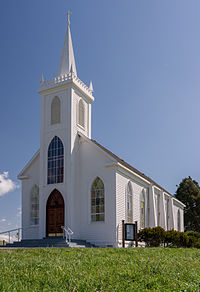
Church of St Avila, Bodega, California
Carpenter Gothic houses and small churches became common in North America and other places in the late 19th century. These structures adapted Gothic elements such as pointed arches, steep gables, and towers to traditional American light-frame construction. The invention of the scroll saw and mass-produced wood moldings allowed a few of these structures to mimic the florid fenestration of the High Gothic. But, in most cases, Carpenter Gothic buildings were relatively unadorned, retaining only the basic elements of pointed-arch windows and steep gables. A well-known example of Carpenter Gothic is a house in Eldon, Iowa, that Grant Wood used for the background of his painting American Gothic.[139]
New Zealand and Australia[edit]
Benjamin Mountfort, born in Britain, trained in Birmingham, and subsequently resident in Canterbury, New Zealand imported the Gothic Revival style to his adopted country and designed Gothic Revival churches in both wood and stone, notably in Christchurch.[140] Frederick Thatcher designed wooden churches in the Gothic Revival style, for example Old St. Paul’s, Wellington, contributing to what has been described as New Zealand’s «one memorable contribution to world architecture».[141] St Mary of the Angels, Wellington by Frederick de Jersey Clere is in the French Gothic style, and was the first Gothic design church built in ferro-concrete.[142] The style also found favour in the southern New Zealand city of Dunedin, where the wealth brought in by the Otago Gold Rush of the 1860s allowed for substantial stone edifices to be constructed, using hard, dark breccia stone and a local white limestone, Oamaru stone, among them Maxwell Bury’s University of Otago Registry Building[143] and the Dunedin Law Courts by John Campbell.[144]
Australia, in particular in Melbourne and Sydney, saw the construction of large numbers of Gothic Revival buildings. William Wardell (1823–1899) was among the country’s most prolific architects; born and trained in England, after emigrating his most notable Australian designs include St Patrick’s Cathedral, Melbourne and St John’s College and St Mary’s Cathedral in Sydney. In common with many other 19th century architects, Wardell could deploy different styles at the command of his clients; Government House, Melbourne is Italianate.[145] His banking house for the English, Scottish and Australian Bank in Melbourne has been described as «the Australian masterpiece of neo-Gothic».[146] This claim has also been made for Edmund Blacket’s MacLaurin Hall at the University of Sydney,[147] which sits in the quadrangle complex described as «arguably the most important group of Gothic and Tudor Revival style architecture in Australia».[148]
Global Gothic[edit]

Henry-Russell Hitchcock, the architectural historian, noted the spread of the Gothic Revival in the 19th and early 20th centuries, «wherever English culture extended – as far as the West Coast of the United States and to the remotest Antipodes».[149] The British Empire, almost at its geographic peak at the height of the Gothic Revival, assisted or compelled this spread. The English-speaking dominions, Canada, Australia particularly the state of Victoria and New Zealand generally adopted British styles in toto (see above); other parts of the empire saw regional adaptations. India saw the construction of many such buildings, in styles termed Indo-Saracenic or Hindu-Gothic.[150] Notable examples include Chhatrapati Shivaji Terminus (formerly Victoria Terminus)[151] and the Taj Mahal Palace Hotel, both in Mumbai.[152] At the hill station of Shimla, the summer capital of British India, an attempt was made to recreate the Home counties in the foothills of the Himalayas. Although Gothic Revival was the predominant architectural style, alternatives were also deployed; Rashtrapati Niwas, the former Viceregal Lodge, has been variously described as Scottish Baronial Revival,[153] Tudor Revival[154] and Jacobethan.[p][156]
Other examples in the east include the late 19th century Church of the Saviour, Beijing, constructed on the orders of the Guangxu Emperor and designed by the Catholic missionary and architect Alphonse Favier;[157] and the Wat Niwet Thammaprawat in the Bang Pa-In Royal Palace in Bangkok, by the Italian Joachim Grassi.[158] In Indonesia, (the former colony of the Dutch East Indies), the Jakarta Cathedral was begun in 1891 and completed in 1901 by Dutch architect Antonius Dijkmans;[159] while further north in the islands of the Philippines, the San Sebastian Church, designed by architects Genaro Palacios and Gustave Eiffel, was consecrated in 1891 in the still Spanish colony.[160] Church building in South Africa was extensive, with little or no effort to adopt vernacular forms. Robert Gray, the first bishop of Cape Town, wrote; «I am sure we do not overestimate the importance of real Churches built after the fashion of our English churches». He oversaw the construction of some fifty such buildings between 1848 and his death in 1872.[q][162] South America saw a later flourishing of the Revival, particularly in church architecture,[163] for example the Metropolitan Cathedral of São Paulo in Brazil by the German Maximilian Emil Hehl,[164] and the Cathedral of La Plata in Argentina.[165]
20th and 21st centuries[edit]

The Gothic style dictated the use of structural members in compression, leading to tall, buttressed buildings with interior columns of load-bearing masonry and tall, narrow windows. But, by the start of the 20th century, technological developments such as the steel frame, the incandescent light bulb and the elevator made this approach obsolete. Steel framing supplanted the non-ornamental functions of rib vaults and flying buttresses, providing wider open interiors with fewer columns interrupting the view.
Some architects persisted in using Neo-Gothic tracery as applied ornamentation to an iron skeleton underneath, for example in Cass Gilbert’s 1913 Woolworth Building[166] skyscraper in New York and Raymond Hood’s 1922 Tribune Tower in Chicago.[167] The Tower Life Building in San Antonio, completed in 1929, is noted for the arrays of decorative gargoyles on its upper floors.[168] But, over the first half of the century, Neo-Gothic was supplanted by Modernism, although some modernist architects saw the Gothic tradition of architectural form entirely in terms of the «honest expression» of the technology of the day, and saw themselves as heirs to that tradition, with their use of rectangular frames and exposed iron girders.

In spite of this, the Gothic Revival continued to exert its influence, simply because many of its more massive projects were still being built well into the second half of the 20th century, such as Giles Gilbert Scott’s Liverpool Cathedral[169] and the Washington National Cathedral (1907–1990).[170] Ralph Adams Cram became a leading force in American Gothic, with his most ambitious project the Cathedral of St. John the Divine in New York (claimed to be the largest cathedral in the world), as well as Collegiate Gothic buildings at Princeton University.[171] Cram said «the style hewn out and perfected by our ancestors [has] become ours by uncontested inheritance».[172]
Though the number of new Gothic Revival buildings declined sharply after the 1930s, they continue to be built. St Edmundsbury Cathedral, the cathedral of Bury St Edmunds in Suffolk, was expanded and reconstructed in a neo-Gothic style between the late 1950s and 2005, and a commanding stone central tower was added.[173] A new church in the Gothic style is planned for St. John Vianney Parish in Fishers, Indiana.[174][175] The Whittle Building at Peterhouse, University of Cambridge, opened in 2016, matches the neo-Gothic style of the rest of the courtyard in which it is situated.[176]
Appreciation[edit]
By 1872, the Gothic Revival was mature enough in the United Kingdom that Charles Locke Eastlake, an influential professor of design, could produce A History of the Gothic Revival.[177] Kenneth Clark’s, The Gothic Revival. An Essay, followed in 1928, in which he described the Revival as «the most widespread and influential artistic movement which England has ever produced.»[178] The architect and writer Harry Stuart Goodhart-Rendel covered the subject of the Revival in an appreciative way in his Slade Lectures in 1934.[r][180] But the conventional early 20th century view of the architecture of the Gothic Revival was strongly dismissive, critics writing of «the nineteenth century architectural tragedy»,[181] ridiculing «the uncompromising ugliness»[182] of the era’s buildings and attacking the «sadistic hatred of beauty» of its architects.[183][s] The 1950s saw further signs of a recovery in the reputation of Revival architecture. John Steegman’s study, Consort of Taste (re-issued in 1970 as Victorian Taste, with a foreword by Nikolaus Pevsner), was published in 1950 and began a slow turn in the tide of opinion «towards a more serious and sympathetic assessment.»[185] In 1958, Henry-Russell Hitchcock published his Architecture: Nineteenth and Twentieth Centuries, as part of the Pelican History of Art series edited by Nikolaus Pevsner. Hitchcock devoted substantial chapters to the Gothic Revival, noting that, while «there is no more typical nineteenth-century product than a Victorian Gothic church»,[186] the success of the Victorian Gothic saw its practitioners design mansions,[78] castles,[187] colleges,[188] and parliaments.[186] The same year saw the foundation of the Victorian Society in England and, in 1963, the publication of Victorian Architecture, an influential collection of essays edited by Peter Ferriday.[189] By 2008, the fiftieth anniversary of the founding of the Victorian Society, the architecture of the Gothic Revival was more fully appreciated with some of its leading architects receiving scholarly attention and some of its best buildings, such as George Gilbert Scott’s St Pancras Station Hotel, being magnificently restored.[190] The Society’s 50th anniversary publication, Saving A Century, surveyed a half-century of losses and successes, reflected on the changing perceptions toward Victorian architecture and concluded with a chapter entitled “The Victorians Victorious”.[191]
Gallery[edit]
Europe[edit]







North America[edit]





South America[edit]
-

-

-

-

-

-
Capilla Cristo Pobre, Jauja, Peru




Australia and New Zealand[edit]




Asia[edit]





Decorative arts[edit]
-

-

Desk; c.1877; Metropolitan Museum of Art

Footnotes[edit]
- ^ Christopher Wren consciously set out to imitate Cardinal Wolsey’s architectural style. Writing to Dean Fell in 1681, he noted; «I resolved it ought to be Gothic to agree with the Founder’s work», adding that to do otherwise would lead to «an unhandsome medley». Pevsner suggests that he succeeded «to the extent that innocent visitors never notice the difference».[11]
- ^ This was Walpole’s appraisal of the sham castle at Hagley Park, Worcestershire designed by his friend, Sanderson Miller.[18]
- ^ Tours of the house, conducted by Walpole’s housekeeper, Margaret Young, proved hugely popular. Walpole wrote to a friend; «I am so tormented by droves of people coming to see my house, and Margaret gets such sums of money by showing it, that I have a mind to marry her».[19]
- ^ Alfred’s Hall, built by Lord Bathurst on his Cirencester Park estate between 1721 and 1732 in homage to Alfred the Great,[22] is perhaps the earliest Gothic Revival structure in England.[23]
- ^ The little-researched Clearwell Castle in Gloucestershire, by Roger Morris who also undertook work at Inveraray, has been described as «the earliest Gothick Revival castle in England».[25]
- ^ Thomas Rickman trained as an accountant and his posthumous famed rested on his antiquarian researches, rather than his considerable corpus of buildings, which were disparaged as the creations of a «self-taught» architect. It was only towards the end of his life, and after, that the position of architect was recognised as a profession, with the establishment of the Institute of British Architects in 1834 and the Architectural Association in 1847.[33]
- ^ Sir Walter Scott’s novels popularised the Medieval period and their influence went well beyond architecture. The historian Robert Bartlett notes that, at one point in the mid-19th century, four different stage adaptations of Ivanhoe were running simultaneously in London theatres, and nine separate operas were based on the work.[40]
- ^ In Montreal, Quebec, Canada, the earlier neo-Gothic Basilica of Notre Dame (1842) belongs to the Gothic Revival exported from Great Britain. Its architect, James O’Donnell, was an Irish immigrant with no known connections to France.[62]
- ^ The choice of the canonized wife of King Clovis, the first Christian king of a unified France, held significance for the Bourbons.[63]
- ^ Pugin subsequently recanted, writing in the second of his two lectures, The True Principles of Pointed or Christian Architecture; «A man who remains any length of time in a modern Gothic room, and escapes without being wounded by some of its minutiae, may consider himself extremely fortunate. There are often as many pinnacles and gables about a pier glass frame as are to be found in a church. I have perpetrated many of these enormities in the furniture I designed some years ago for Windsor Castle… Collectively they appeared a complete burlesque of pointed design».[92]
- ^ Pugin recorded his delight at the destruction of what he considered the wholly inadequate earlier restorations of James Wyatt and John Soane. «You have doubtless seen the accounts of the late great conflagration at Westminster. There is nothing much to regret…a vast amount of Soane’s mixtures and Wyatt’s heresies have been consigned to oblivion. Oh it was a glorious sight to see his composition mullions and cement pinnacles flying and cracking.»[97]
- ^ Ruskin also had an abhorrence of the contemporary «restorer» of Gothic buildings. Writing in the Preface to the first edition of his The Seven Lamps of Architecture, he remarked; «[My] whole time has been lately occupied in taking drawings from the one side of buildings, of which masons were knocking down the other».[100]
- ^ The rumour that Scott repurposed his Foreign Office design for the Midland Grand Hotel is unfounded.[103]
- ^ In the Preface to his Dictionary of French Architecture from 11th to 16th Century (1854–1868) (Dictionnaire raisonné de l’architecture française du XIe au XVIe siècle), le-Duc wrote of the ignorance of Gothic architecture prevalent at the start of the 19th century: «as for [buildings] which had been constructed between the end of the Roman empire and the fifteenth century, they were scarcely spoken of except to be cited as the products of ignorance or barbarousness».[113]
- ^ Ruskin was unimpressed by Joseph Paxton’s Crystal Palace, describing it as nothing but «a greenhouse larger than ever greenhouse was built before».[118]
- ^ Thomas R. Metcalf, in his study An Imperial Vision: Indian Architecture and the British Raj, records a debate at the Royal Society of Arts in London in 1873 between proponents of the European and indigenous approaches. While T. Roger Smith contended that, «as our administration exhibits European justice, order, law and honour, so our buildings ought to hold up a high standard of European art», William Emerson argued that «it is impossible for the architecture of the west to be suitable for the natives of the east».[155]
- ^ An unusual feature of the church building programme overseen by Bishop Gray was that the majority of the churches were designed by his wife, Sophy, a considerable rarity at a time when women were almost entirely excluded from the professions.[161]
- ^ In his speech in 1976, on receiving the RIBA Gold Medal, Sir John Summerson recalled Rendel’s contribution; «It was well known that Victorian architecture was bad or screamingly funny, or both. Rendel begged to differ, but what really stunned his audience was that he knew, and knew in great detail, what he was talking about».[179]
- ^ Kenneth Clark, despite his sympathetic approach, recalled that during his Oxford years it was generally believed not only that Keble College was «the ugliest building in the world» but that its architect was John Ruskin, author of The Stones of Venice. The college was built to the designs of the architect William Butterfield.[184]
References[edit]
- ^ Curl 1990, pp. 14–15.
- ^ «Pugin and the Gothic Revival». Archived from the original on 6 October 2007. Retrieved 12 July 2010.
- ^ a b Cooke 1987, p. 383.
- ^ Charlesworth 2002, p. 5.
- ^ Robson Scott 1965, p. unknown.
- ^ Furneaux Jordan 1979, p. 127.
- ^ Furneaux Jordan 1979, p. 163.
- ^ Furneaux Jordan 1979, p. 165.
- ^ Hunter, Bob (18 September 2014). «Londonderry Cathedtral». Wars & Conflict: The Plantation of Ulster. BBC.
- ^ «Guarino Guarini : Italian architect, priest, mathematician, and theologian». Encyclopedia Britannica. n.d. Retrieved 7 September 2018.
- ^ Sherwood & Pevsner 2002, pp. 110–111.
- ^ Macaulay 1975, p. 31.
- ^ «Église Saint-Eustache». Paris tourist office. Retrieved 6 May 2020.
- ^ «Pilgrimage Church of St. John of Nepomuk at Zelená Hora». UNESCO World Heritage Centre. United Nations Educational, Scientific, and Cultural Organization. Retrieved 24 February 2023.
- ^ Nagy, Gergely Domonkos (2013). «Gothicized buildings and the role of symbols in Baroque architecture». Periodica Polytechnica Architecture. 44 (2): 69–76. doi:10.3311/PPar.7396. ISSN 1789-3437.
- ^ Aldrich 2005, p. 140.
- ^ Chalcraft & Viscardi 2007, p. 7.
- ^ a b Brooks & Pevsner 2007, p. 339.
- ^ Chalcraft & Viscardi 2007, p. 20.
- ^ Historic England. «Strawberry Hill (St Mary’s Training College) (Grade I) (1261987)». National Heritage List for England. Retrieved 6 May 2020.
- ^ Historic England. «Lacock Abbey with Stable Yard (Grade I) (1283853)». National Heritage List for England. Retrieved 6 May 2020.
- ^ Historic England. «Alfreds Hall, Cirencester Park (Grade II*) (1298719)». National Heritage List for England. Retrieved 2 May 2020.
- ^ Charlesworth 2002a, p. 14.
- ^ Aldrich 2005, pp. 82–83.
- ^ Verey & Brooks 2002, pp. 310–311.
- ^ Gifford 1989, p. 161.
- ^ Cruft, Dunbar & Fawcett 2006, p. 529.
- ^ Cruft, Dunbar & Fawcett 2006, p. 744.
- ^ McWilliam 1978, pp. 428–431.
- ^ Whyte & Whyte 1991, p. 100.
- ^ «Batty Langley, gardener and prolific writer». www.twickenham-museum.org.uk. Twickenham Museum. Retrieved 6 May 2020.
- ^ Macauley 1975, p. 174.
- ^ Aldrich 2019, p. 25.
- ^ Rickman 1848, p. 47.
- ^ a b Shannon Kyles. «Gothic Revival (1750–1900)». Ontario Architecture. Retrieved 6 May 2020.
- ^ «Gothic Revival». Encyclopædia Britannica Online. Retrieved 8 October 2013.
- ^ Lindfield 2016, p. 78.
- ^ «Style Guide: Gothic Revival». London, United Kingdom: Victoria and Albert Museum. Retrieved 6 May 2020.
- ^ «Thomas Chippendale». www.vam.ac.uk. Victoria and Albert Museum. 26 November 2012.
- ^ Bartlett 2001, p. 14.
- ^ Lindfield 2016, p. 224.
- ^ Anstruther 1963, preface.
- ^ Graur 1970, p. 233.
- ^ Sylvie 2001, pp. 116–117, 138.
- ^ Beard 1985, p. 72.
- ^ Pevsner 1951, foreword.
- ^ «Victoria: Gothic Crown». Baldwins. 19 March 2019.
- ^ «Queen Victoria: The Gothic Crown 1847». www.royalmint.com. The Royal Mint. Archived from the original on 24 June 2020. Retrieved 6 May 2020.
- ^ Bartlett 2001, p. 15.
- ^ «History of the Chapel Royal at Dreux». Chapelle Royale a Dreux Official Site. Retrieved 29 May 2020.
- ^ Gothein, Marie-Luise. «History of Garden Art — Jardin Anglo-Chinois». www.gardenvisit.com. The Landscape Guide. Retrieved 29 May 2020.
- ^ «Collections of the Musée de Normandie». mondes-normands.caen.fr. Normandy Museum. Retrieved 6 May 2020.
- ^ Lowenthal 2015, p. 416.
- ^ Barnes, Julian (7 July 2007). «An inspector calls». The Guardian.
- ^ Murphy, Kevin. «Memory and Modernity: Viollet-le-Duc at Vézelay». www.psupress.org. Penn State University Press. Retrieved 6 May 2020.
- ^ a b Midant 2002, p. 54.
- ^ Midant 2002, p. 19.
- ^ a b c Midant 2002, p. 96.
- ^ «Historique du Château -Anglais-«.
- ^ «Mont-Saint-Michel and its Bay». UNESCO World Heritage Centre. UNESCO World Heritage Centre. Retrieved 6 May 2020.
- ^ Midant 2002, p. 108.
- ^ Toker 1991, pp. xviii–xix.
- ^ Menin 1775, p. 5.
- ^ «Western architecture – From the 19th to the early 20th century». Encyclopedia Britannica. n.d. Retrieved 6 May 2020.
- ^ Brichta 2014, p. ?.
- ^ Germann 1972, p. 152.
- ^ «Cologne Cathedral: History, Artworks, & Facts». Encyclopedia Britannica. Retrieved 6 May 2020.
- ^ «About St. Peter’s Cathedral». domplatz-5.de. Infozentrum Domplatz. Archived from the original on 15 July 2020. Retrieved 6 May 2020.
- ^ «Ulm Minster (Ulm, 1890)». Structurae. Retrieved 6 May 2020.
- ^ Forrest, F.G. «St. Vitus Cathedral». www.fg.cz. Prague Castle. Retrieved 6 May 2020.
- ^ «Sint-Petrus-en-Pauluskerk» (in Dutch). City of Ostend. Retrieved 24 July 2011.
- ^ «Stadhuis» (in Dutch). City of Mechelen. Archived from the original on 18 July 2011. Retrieved 18 July 2011.
- ^ «Stadhuis met voormalige Lakenhal (ID: 3717)». De Inventaris van het Bouwkundig Erfgoed (in Dutch). Vlaams Instituut voor het Onroerend Erfgoed (VIOE). Retrieved 24 July 2011.
- ^ «Florence». Il Grande Museo del Duomo. Retrieved 6 May 2020.
- ^ Tuleshkov 2007, p. ?.
- ^ Stamp 1995, pp. 108–110.
- ^ Jackson 2011, p. 152.
- ^ a b c Hitchcock 1968, p. 94.
- ^ Hull 2006, p. 154.
- ^ Glendenning, MacInnes & MacKechnie 2002, pp. 276–285.
- ^ a b Buggeln 2003, p. 115.
- ^ Jarvis 1814.
- ^ Hobart 1816, p. 5.
- ^ Stanton 1997, p. 3.
- ^ «The creation of the Basilica – La Basilique Notre-Dame». www.basiliquenotredame.ca. Notre-Dame. Retrieved 6 May 2020.
- ^ «Parliament Buildings, Ottawa, Ontario, Canada». Encyclopedia Britannica. Retrieved 6 May 2020.
- ^ «Victoria Memorial Museum». www.historicplaces.ca. Register of Canada’s Historic Places. Retrieved 6 May 2020.
- ^ «Royal Canadian Mint Historical Plaque». www.ontarioplaques.com. Ontario’s Historic Plaques. Retrieved 6 May 2020.
- ^ «Connaught Building National Historic Site of Canada». www.pc.gc.ca. Parks Canada. Retrieved 6 May 2020.
- ^ Fulton 2005.
- ^ Aldrich & Atterbury 1995, p. 372.
- ^ Charlesworth 2002c, p. 199.
- ^ Hill 2007, pp. 74–75.
- ^ «Augustus Welby Northmore Pugin (1812–52)». The Victorian Web. Retrieved 3 October 2008.
- ^ Hill 2007, pp. 52–53.
- ^ Charlesworth 2002c, pp. 168–171.
- ^ Atterbury & Wainwright 1994, p. 219.
- ^ Hill 2007, p. 317.
- ^ Atterbury & Wainwright 1994, p. 221.
- ^ Ruskin 1989, p. ix.
- ^ Charlesworth 2002c, p. 343.
- ^ Dixon & Muthesius 1993, p. 160.
- ^ Cherry & Pevsner 2002, p. 362.
- ^ Stamp 2015, p. 152.
- ^ Clark 1983, pp. 155–174.
- ^ Port 2006, p. 327.
- ^ Germann 1972, p. 9.
- ^ Eastlake 2012, p. 141.
- ^ «St Luke’s Church – A Brief History». St Luke’s Parochial Church Council. Retrieved 2 November 2012.
- ^ «West Norwood Cemetery». The Courtauld Institute of Art. Retrieved 6 May 2020.
- ^ Stamp 1997, p. 1.
- ^ Historic England (1 October 1987). «Abney Park Cemetery, Hackney (1000789)». National Heritage List for England. Retrieved 11 May 2018.
- ^ Charlesworth 2002c, p. 611.
- ^ Pevsner 1969, p. 18.
- ^ Midant 2002, p. 35.
- ^ Midant 2002, p. 154.
- ^ Pevsner 1969, p. 17.
- ^ Pevsner 1969, p. 37.
- ^ «The Crystal Palace of Hyde Park». University of Oregon. Archived from the original on 12 March 2012. Retrieved 4 April 2008.
- ^ «The Museum’s architecture». www.oumnh.ox.ac.uk. Oxford University Museum of Natural History. Retrieved 6 May 2020.
- ^ Pevsner 1969, p. 34.
- ^ Historic England. «The Mansion, Woodchester (1340703)». National Heritage List for England. Retrieved 11 May 2018.
- ^ «Gothic Bridge (94th street)». www.centralpark.com. Central Park. Retrieved 6 May 2020.
- ^ Truettner, Julia M. (31 December 2002). Aspirations for Excellence: Alexander Jackson Davis and the First Campus Plan for the University of Michigan, 1838. University of Michigan Press. p. 49. ISBN 0472112775. Retrieved 16 March 2018.
- ^ Golovin, Anne Castrodale. «Bridgeport’s Gothic Ornament The Harral-Wheeler House» (PDF). Smithsonian Institution. Smithsonian Institution Press. Retrieved 16 March 2018.
- ^ Marter, Joan M.; Regain, Melissa (2011). The Grove Encyclopedia of American Art, Volume 1. Oxford University Press. p. 362. ISBN 9780195335798. Retrieved 16 March 2018.
- ^ «Collegiate Gothic – Cope and Stewardson». www.brynmawr.edu. Bryn Mawr. Retrieved 6 May 2020.
- ^ «Princeton University’s Gothic Love Affair». Princeton Magazine. Retrieved 6 May 2020.
- ^ «Architectural Archives: Weitzman School of Design». www.design.upenn.edu. University of Pennsylvania. Retrieved 6 May 2020.
- ^ a b Crook 2013, pp. 221–223.
- ^ Armstrong, Christopher Drew (June 2000). «Qui Transtulit Sustinet» – William Burges, Francis Kimball, and the Architecture of Hartford’s Trinity College». Journal of the Society of Architectural Historians. University of California Press. 59 (2): 194–215. doi:10.2307/991590. JSTOR 991590.
- ^ Hitchcock 1968, p. 187.
- ^ «History and Traditions». Washington University in St. Louis. Retrieved 6 May 2020.
- ^ «Maginnis, Charles Donagh (1867–1955)». Boston College University Libraries. Retrieved 6 May 2020.
- ^ «Graduate College History». gradschool.princeton.edu. Princeton University Graduate School. Retrieved 6 May 2020.
- ^ «Collection: Index of architectural drawings of Yale University buildings by James Gamble Rogers | Archives at Yale». archives.yale.edu.
- ^ «Charles Z. Klauder Architecture Archives». Carnegie Mellon University. Archived from the original on 16 July 2020. Retrieved 6 May 2020.
- ^ «American Gothic House Center». Wapellocounty.org. Wapello County Conservation Board. 18 December 2009. Archived from the original on 18 June 2009. Retrieved 11 June 2011.
- ^ Dictionary of New Zealand Biography. «Mountfort, Benjamin Woolfield». teara.govt.nz. New Zealand Ministry for Culture and Heritage. Retrieved 6 May 2020.
- ^ «Old St Paul’s». nzhistory.govt.nz. New Zealand history online. Retrieved 6 May 2020.
- ^ «Frederick de Jersey Clere – Wellington Heritage». wellingtoncityheritage.org.nz. Wellington City Council. Retrieved 6 May 2020.
- ^ Bury, Maxwell. «University of Otago building, Dunedin». teara.govt.nz. New Zealand Ministry for Culture and Heritage. Retrieved 6 May 2020.
- ^ «Government Architect – John Campbell – Wellington Heritage». wellingtoncityheritage.org.nz. Wellington City Council. Retrieved 6 May 2020.
- ^ Ruwolt, Jon. «Gothic-Revival». Federation House. Retrieved 6 May 2020.
- ^ Brown, Jenny. «Golden era of neo-Gothic». Domain. Retrieved 6 May 2020.
- ^ Finnerty 2001, p. 38.
- ^ «University of Sydney receives state heritage listing». ArchitectureAU.com. ARCHITECTUREAU. Retrieved 6 May 2020.
- ^ Hitchcock 1968, p. 97.
- ^ Morris 1986, p. 31.
- ^ Morris 1986, p. 133.
- ^ Morris 1986, pp. 149–150.
- ^ Morris 1986, p. 75.
- ^ «The Viceregal Lodge (now the Institute of Advanced Studies), Shimla, India, by Henry Irwin». www.victorianweb.org. The Victorian Web. Retrieved 6 May 2020.
- ^ Metcalf 1989, p. 1.
- ^ «Henry Irwin and the Indo Saracenic Movement Reconsidered: The Lodge on Observatory Hill». www.victorianweb.org. The Victorian Web. Retrieved 6 May 2020.
- ^ Clark 2019, p. XXIII.
- ^ Meksophawannakul, Sarot (8 March 2020). «Gothic but Buddhist». Bangkok Post. Retrieved 5 May 2020.
- ^ Setiawati, Indah (6 May 2013). «Parishioners split on Cathedral AC installation». The Jakarta Post. Retrieved 6 May 2020.
- ^ «San Sebastian Church». UNESCO. Archived from the original on 23 March 2015. Retrieved 11 May 2018.
- ^ Martin 2012, p. 117.
- ^ Martin 2012, p. 121.
- ^ Sundt 2017, p. 119.
- ^ «Cidade de São Paulo». City of São Paulo Tourism Office. Archived from the original on 17 July 2020. Retrieved 6 May 2020.
- ^ Sundt 2017, pp. 124–125.
- ^ «The Woolworth Building». Cass Gilbert Society. Retrieved 7 May 2020.
- ^ «Tribune Tower». Chicago Architecture Center. Retrieved 7 May 2020.
- ^ «The Guarding Gargoyles of Downtown San Antonio». USA News. 5 April 2020.
- ^ Historic England. «Anglican Cathedral Church of Christ, Liverpool (Grade I) (1361681)». National Heritage List for England. Retrieved 5 May 2020.
- ^ «Timeline». Washington National Cathedral. Retrieved 6 May 2020.
- ^ «Ralph Adams Cram: American architect and writer». Encyclopedia Britannica. Retrieved 6 May 2020.
- ^ Bartlett 2001, p. 21.
- ^ Pearman, Hugh (13 March 2005). «Return of the Goths: the last Anglican cathedral is nearly finished. And built to last 1,000 years». Gabion: Retained Writing on Architecture. Hugh Pearman. Archived from the original on 18 March 2005.
- ^ Mooney, Caroline (27 April 2008). «Architectural plans unveiled for church and campus complex over the next two decades». The Catholic Moment. Lafayette, Indiana. Archived from the original on 15 May 2008.
- ^ «St. John Vianney Fishers, Indiana». HDB/Cram and Ferguson. Archived from the original on 8 October 2008. Retrieved 3 October 2008.
- ^ «Prince of Wales opens the new Whittle Building». John Simpson Architects. Retrieved 6 May 2020.
- ^ Eastlake 2012, preface.
- ^ Clarke 1983, p. 7.
- ^ Goodhart-Rendel 1989, p. 11.
- ^ Steegman 1970, p. v.
- ^ Turnor 1950, p. 111.
- ^ Turnor 1950, p. 91.
- ^ Clark 1983, p. 191.
- ^ Clark 1983, p. 2.
- ^ Steegman 1970, p. 2.
- ^ a b Hitchcock 1968, p. 100.
- ^ Hitchcock 1968, p. 95.
- ^ Hitchcock 1968, p. 96.
- ^ Ferriday 1963, Introduction.
- ^ Bradley 2007, p. 163.
- ^ Stamp 2011, pp. 43–44.
Sources[edit]
- Aldrich, Megan Brewster; Atterbury, Paul (1995). A.W.N. Pugin: Master of Gothic Revival. New Haven and London: Yale University Press. ISBN 978-0-300-06656-2.
- Aldrich, Megan (2005). Gothic Revival. London: Phaidon Press. ISBN 978-0-714-83631-7.
- Aldrich, Megan (2019). Megan Aldrich; Alexandrina Buchanan (eds.). Thomas Rickman and the Victorians. Studies in Victorian Architecture and Design. Vol. 7. London: The Victorian Society. ISBN 978-0-901-65756-5. OCLC 1088560920.
- Anstruther, Ian (1963). The Knight and the Umbrella: An Account of the Eglinton Tournament – 1839. London: Geoffrey Bles. OCLC 249701828.
- Atterbury, Paul; Wainwright, Clive (1994). Pugin: A Gothic Passion. New Haven and London: Yale University Press. ISBN 978-0-300-06656-2. OCLC 750811794.
- Bartlett, Robert (2001). Medieval Panorama. Los Angeles: Getty Publications. ISBN 978-0-892-36642-2.
- Beard, Geoffrey (1985). The National Trust Book of English Furniture. London: Viking. ISBN 978-0-670-80141-1. OCLC 924269530.
- Bradley, Simon (2007). St Pancras Station. London: Profile Books. ISBN 978-1-861-97951-3.
- Brichta, Tomas (2014). Late Completion of Cologne and St-Vitus Cathedral (M.Arch). University of Edinburgh. hdl:1842/9814.
- Brooks, Alan; Pevsner, Nikolaus (2007). Worcestershire. The Buildings of England. Yale University Press. ISBN 978-0-300-11298-6.
- Buggeln, Gretchen Townsend (2003). Temples of Grace: The Material Transformation of Connecticut’s Churches. Hanover, US: New England University Publications. ISBN 978-1-584-65322-6.
- Chadenet, Sylvie (2001). French Furniture: From Louis XIII to Art Deco. Boston, US: Little, Brown and Company. ISBN 978-0-821-22683-4.
- Chalcraft, Anna; Viscardi, Judith (2007). Strawberry Hill: Horace Walpole’s Gothic Castle. London: Frances Lincoln Ltd. ISBN 978-0-711-22687-6. OCLC 255611525.
- Charlesworth, Michael (2002). The Gothic Revival 1720–1870 — Literary Sources and Documents: Blood and Ghosts. Vol. 1. Robertsbridge, East Sussex: Helm Information. ISBN 978-1-873-40367-9. OCLC 491489502.
- Charlesworth, Michael (2002). The Gothic Revival 1720–1870 – Literary Sources and Documents: Gothic and National Architecture. Vol. 3. Robertsbridge, East Sussex: Helm Information. ISBN 978-1-873-40367-9. OCLC 491489502.
- Cherry, Bridget; Pevsner, Nikolaus (2002). London 4: North. The Buildings of England. New Haven, US and London: Yale University Press. ISBN 9780300096538.
- Clark, Anthony E. (2019). China Gothic: The Bishop of Beijing and His Cathedral. Washington, US: University of Washington Press. ISBN 978-0-295-74668-5.
- Clark, Kenneth (1983). The Gothic Revival: An Essay in the History of Taste. London: John Murray. ISBN 978-0-719-53102-6.
- Cooke, Robert (1987). The Palace of Westminster. London: Burton Skira. ISBN 978-2-882-49014-8.
- Crook, J. Mordaunt (2013). William Burges and the High Victorian Dream. London: Frances Lincoln. ISBN 978-0-7112-3349-2.
- Cruft, Kitty; Dunbar, John; Fawcett, Richard (2006). Borders. The Buildings of Scotland. New Haven, US and London: Yale University Press. ISBN 978-0-300-10702-9. OCLC 1062076262.
- Curl, James Stevens (1990). Victorian Architecture. Newton Abbot, Devon and London: David & Charles. ISBN 978-0-715-39144-0.
- Dixon, Roger; Muthesius, Stefan (1993). Victorian Architecture. London: Thames and Hudson. ISBN 978-0-195-20048-5.
- Eastlake, Charles Locke (2012). A History Of The Gothic Revival. Cambridge: Cambridge University Press. ISBN 978-1-108-05191-0.
- Ferriday, Peter (1963). Victorian Architecture. London: Jonathan Cape. OCLC 270335.
- Finnerty, Anne (2001). The Architecture of East Australia: An Architectural History in 432 Individual Presentations. Felbach, Germany: Edition Axel Menges. ISBN 978-3-930-69890-5.
- Fulton, Gordon W. (2005). «Ewart, David». Dictionary of Canadian Biography (online ed.). University of Toronto Press.
- Furneaux Jordan, Robert (1979). A Concise History of Western Architecture. London: Thames & Hudson. OCLC 757298161.
- Germann, Georg (1972). Gothic Revival in Europe and Britain: Sources, Influences and Ideas. London: Lund Humphries. ISBN 978-0-853-31343-4.
- Gifford, John (1989). William Adam 1689–1748: A Life and Times of Scotland’s Universal Architect. Edinburgh: Mainstream Publishing. ISBN 978-1-851-58296-9. OCLC 600401309.
- Glendenning, Miles; MacInnes, Ranald; MacKechnie, Aonghus (2002). A History of Scottish Architecture: from the Renaissance to the Present Day. Edinburgh: Edinburgh University Press. ISBN 978-0-748-60741-9.
- Goodhart-Rendel, Harry Stuart (1989) [1953]. English Architecture Since The Regency: An Interpretation. London: Century. ISBN 978-0-712-61869-4. OCLC 243386485.
- Graur, Neaga (1970). Stiluri în arta decorativă (in Romanian). Bucharest: Cerces. OCLC 560131438.
- Hill, Rosemary (2007). God’s Architect: Pugin and the Building of Romantic Britain. London: Allen Lane. ISBN 978-0-713-99499-5.
- Hitchcock, Henry-Russell (1968) [1958]. Architecture: Nineteenth and Twentieth Centuries. Pelican History of Art. London: Penguin Books. OCLC 851173836.
- Hobart, John Henry (1816). The Moral Efficacy and the Positive Benefits of the Ordinances of the Gospel: A Sermon Preached at the Consecration of Trinity Church, in the City of New Haven, on Wednesday, the 21st Day of February, A.D. 1816. Oliver Steele.
- Hull, Lise (2006). Britain’s Medieval Castles. London: Praeger. ISBN 978-0-275-98414-4.
- Jackson, Alvin (2011). The Two Unions: Ireland, Scotland, and the Survival of the United Kingdom, 1707–2007. Oxford: Oxford University Press. ISBN 978-0-199-59399-6.
- Jarvis, Samuel Farmar (1814). An Address, Delivered in the City of New-Haven: At the Laying of the Corner-stone of Trinity Church, May 17th, 1814. Oliver Steele.
- Lindfield, Peter (2016). Georgian Gothic: Medievalist Architecture, Furniture and Interiors, 1730–1840. London: Boydell & Brewer. ISBN 978-1-783-27127-6.
- Lowenthal, David (2015). The Past is a Foreign Country — Revisited. Cambridge, UK: Cambridge University Press. ISBN 978-0-521-85142-8.
- Macaulay, James (1975). The Gothic Revival 1745–1845. Glasgow and London: Blackie. ISBN 978-0-216-89892-9.
- Martin, Desmond (2012). «Bishop Robert Gray and Mrs Sophia Gray: Building Anglican Churches in South Africa, 1848–72». In G. A. Bremner (ed.). Ecclesiology Abroad: The British Empire and Beyond. Studies in Victorian Architecture and Design. Vol. 4. London: The Victorian Society. ISBN 978-0-901-65753-4. OCLC 825141174.
- Menin, Nicolas (1775). A description of the Coronation of the Kings and Queens of France. London: unknown. OCLC 1064350166.
- Metcalf, Thomas R. (1989). An Imperial Vision: Indian Architecture and Britain’s Raj. London: Faber & Faber. ISBN 978-0-571-15419-7. OCLC 835581414.
- Midant, Jean-Paul (2002). Viollet-le-Duc: The French Gothic Revival. Paris: L’Aventurine. ISBN 978-2-914-19922-3.
- Morris, Jan (1986). Stones of Empire: The Buildings of the Raj. Oxford, UK: Oxford University Press. ISBN 978-0-192-82036-5. OCLC 473765817.
- McWilliam, Colin (1978). Lothian. The Buildings of Scotland. Harmondsworth, Middlesex: Penguin Books. ISBN 978-0-140-71066-3. OCLC 185487752.
- Pevsner, Nikolaus (1951). High Victorian Design: A Study of the Exhibits of 1851. London: Architectural Press. OCLC 875412662.
- Pevsner, Nikolaus (1969). Ruskin and Viollet-Le-Duc: Englishness and Frenchness in the Appreciation of Gothic Architecture. London: Thames and Hudson. OCLC 264998275.
- Port, M. H. (2006). 600 New Churches: The Church Building Commission 1818–1856. Reading, UK: Spire Books. ISBN 978-1-904-96508-4.
- Rickman, Thomas (1848). An Attempt to Discriminate the Styles of Architecture in England: From the Conquest to the Reformation. London: J. H. Parker. p. 47. doi:10.1017/CBO9781107338241. ISBN 978-1-107-33824-1.
- Robson Scott, William Douglas (1965). The Literary Background of the Gothic Revival in Germany — A chapter in the history of taste. Oxford: Clarendon Press. OCLC 504490694.
- Ruskin, John (1989) [1849]. The Seven Lamps Of Architecture. New York: Dover Publications. ISBN 978-0-486-26145-4. OCLC 19886931.
- Sherwood, Jennifer; Pevsner, Nikolaus (1996). Oxfordshire. The Buildings of England. New Haven, US and London: Yale University Press. ISBN 978-0-30009-6392.
- Stamp, Gavin (1995). C. Brooks (ed.). The Victorian kirk: Presbyterian architecture in nineteenth century Scotland. The Victorian Church: Architecture and Society. Manchester: Manchester University Press. ISBN 0-7190-4020-5.
- — (1997). Caledonia Gothica: Pugin and the Gothic Revival in Scotland. Architectural Heritage. Edinburgh: Journal of the Architectural Heritage Society of Scotland. OCLC 632385481.
- — (2011). Saving a Century: the Victorian Society, 1958–2008. London: Victorian Society. ISBN 978-0-901-65740-4. OCLC 1141858753.
- — (2015). Gothic For The Steam Age: An Illustrated Biography of George Gilbert Scott. London: Aurum Press. ISBN 978-1-781-31124-0. OCLC 1123924291.
- Stanton, Phoebe B. (1997). The Gothic Revival and American Church Architecture: An Episode in Taste, 1840–1856. Baltimore, US and London: Johns Hopkins University Press. ISBN 978-0-801-85622-8. OCLC 38338245.
- Steegman, John (1970). Victorian Taste – A study of the Arts and Architecture from 1830 to 1870. Cambridge: Nelson’s University Paperbacks. ISBN 978-0-262-69028-7.
- Sundt, Richard A. (2017). Timothy Brittain-Catlin; Jan De Maeyer; Martin Bressani (eds.). Gothic Revival Worldwide: A.W.N. Pugin’s Global Influence. Leuven, Belgium: Leuven University Press. ISBN 978-9-462-70091-8.
- Toker, Franklin (1991). The Church of Notre Dame in Montreal: An Architectural History. Montreal: McGill–Queen’s University Press. ISBN 978-0-773-50848-4.
- Turnor, Reginald (1950). Nineteenth Century Architecture in Britain. London: Batsford. OCLC 520344.
- Tuleshkov, Nikolaĭ (2007). Славинските първомайстори (Master Builders from Slavine) (in Bulgarian). София: Арх & Арт. ISBN 978-9-548-93140-3. OCLC 264741060.
- Verey, David; Brooks, Alan (2002) [1970]. Gloucestershire 2: The Vale and the Forest of Dean. The Buildings of England. New Haven, US and London: Yale University Press. ISBN 9780300097337.
- Whyte, Ian; Whyte, Kathleen A (1991). The Changing Scottish Landscape, 1500–1800. London: Routledge. ISBN 9780415029926.
Further reading[edit]
- Christian Amalvi, Le Goût du moyen âge, (Paris: Plon), 1996. The first French monograph on French Gothic Revival.
- «Le Gothique retrouvé» avant Viollet-le-Duc. Exhibition, 1979. The first French exhibition concerned with French Neo-Gothic.
- Hunter-Stiebel, Penelope, Of knights and spires: Gothic revival in France and Germany, 1989. ISBN 0-614-14120-6
- Phoebe B Stanton, Pugin (New York, Viking Press 1972, ©1971). ISBN 0-670-58216-6
- Summerson, Sir John, 1948. «Viollet-le-Duc and the rational point of view» collected in Heavenly Mansions and other essays on Architecture
- Sir Thomas G. Jackson, Modern Gothic Architecture (1873), Byzantine and Romanesque Architecture (1913), and three-volume Gothic Architecture in France, England and Italy (1901)
See also[edit]
Sub-varieties of the Gothic Revival style[edit]
- Carpenter Gothic
- Collegiate Gothic
- Dissenting Gothic
- National Romantic Style
- Neo-Manueline
- Ruskinian Gothic
- Scottish Baronial
- Tudor Revival
- Black-and-White Revival
Locale[edit]
- Canada
- Poland
- List of Gothic Revival architecture
External links[edit]
- Basilique Sainte-Clotilde, Paris
- Canada by Design: Parliament Hill, Ottawa at Library and Archives Canada
- Books, Research and Information
- Proyecto Documenta’s entries for neo-Gothic elements at the Valparaíso’s churches
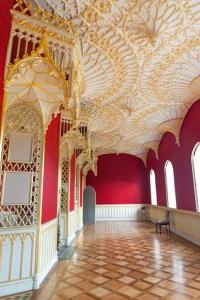
Strawberry Hill, Twickenham
The term «Gothic Revival» (sometimes called Victorian Gothic) usually refers to the period of mock-Gothic architecture practised in the second half of the 19th century. That time frame can be a little deceiving, however, for the Gothic style never really died in England after the end of the medieval period.
Throughout the 17th and 18th centuries, when classical themes ruled the fashion-conscious world of architecture, Gothic style can be seen, if intermittently. This is because many architects were asked to remodel medieval buildings in a way that blended in with the older styles.
Christopher Wren, the master of classical style, for example, added Gothic elements to several of his London churches (St. Michael, Cornhill, and St. Dunstan-in-the-East). William Kent’s gatehouse at Hampton Court Palace (1723) fit in flawlessly with Cardinal Wolsey’s original Tudor Gothic. When Nicholas Hawksmoor remodelled the west towers at Westminster Abbey (from 1723) he did so in a sympathetic Gothic style.
In the late 18th century, running in parallel, as it were, with raging classicism, was a school of romanticized Gothic architecture, popularized by Batty Langley’s pattern books of medieval details. This medieval style was most common in domestic building, where the classical style overwhelmingly prevailed in public buildings.
One of the prime movers of a new interest in Gothic style was Horace Walpole. Walpole’s country house at Strawberry Hill, Twickenham (1750), was a fancifully romantic Gothic cottage. The style adopted by Walpole (termed, not surprisingly, «Strawberry Hill Gothic»), took many of the decorative elements of exterior medieval Gothic and moved them to the interior of the house. Thus, Walpole’s rooms are adorned — some might say over-adorned — with touches like cusped ceilings and crocketed arches.
Little of Walpole’s style is what you could call «authentic»; he merely took decorative touches and strewed them about with abandon. The controversial result is very much open to criticism; you either love it or hate it, but few people are ambivalent about it.
Other architects tried their hand at Gothic style. Even Robert Adam, the master of neo-classical country house architecture, used Gothic elements, for example at Culzean Castle, where the exterior crenellation recalls a medieval fortress.
James Wyatt was the most prominent 18th-century architect employing Gothic style in many of his buildings. His Ashridge Park (Hertfordshire), begun in 1806, is the best surviving example of his work. At Ashridge, Wyatt employed a huge central hall, open to the roof, in conscious imitation of a medieval great hall.
Into the early years of the 19th century many architects dabbled in Gothic style, but as with Walpole, it was more the decorative touches that appealed to them; little bits of carving here, a dab of pointed arch there.
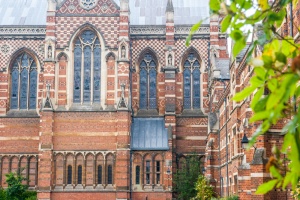
Keble College, Oxford
Most paid scant heed to authentic proportion, which is one of the most powerful moving forces of «real» Gothic style. Even when the shapes used by builders were Gothic, the structure was not. Columns and piers were made with iron cores covered over with plaster.
In the early 19th century Gothic was considered more suitable for church and university buildings, where classical style was thought more appropriate for public and commercial buildings. Good examples of university Gothic can be seen at Cambridge, for example, the Bridge of Sighs at St. John’s College (1826) and the gateway at King’s College (1822-24).
It is really only after 1840 the Gothic Revival began to gather steam, and when it did the prime movers were not architects at all, but philosophers and social critics. This is the really curious aspect of the Victorian Gothic revival; it intertwined with deep moral and philosophical ideals in a way that may seem hard to comprehend in today’s world.
Men like A.W. Pugin and writer John Ruskin (The Seven Lamps of Architecture, 1849) sincerely believed that the Middle Ages was a watershed in human achievement and that Gothic architecture represented the perfect marriage of spiritual and artistic values.
Ruskin allied himself with the Pre-Raphaelites and vocally advocated a return to the values of craftsmanship, artistic, and spiritual beauty in architecture and the arts in general. Ruskin and his brethren declared that only those materials which had been available for use in the Middle Ages should be employed in Gothic Revival buildings.
Even more narrow-minded than Ruskin were followers of the «ecclesiological movement», which began in the universities of Oxford and Cambridge. Adherents of the ecclesiological movement believed that only the Gothic style was suitable for church architecture, but not just any Gothic style!
To them, the «Middle Pointed» or Decorated style prevalent in the late 13th to mid 14th century was the only true Gothic. The bible of the movement was the monthly publication, The Ecclesiologist, which was published from 1841-1868. The publication was in essence a style-guide to proper Gothic architecture and design.
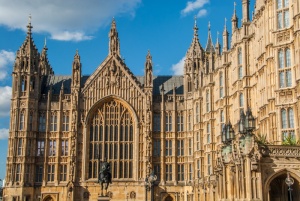
Westminster Palace
But all this theory needed some practical buildings to illustrate the ideals. The greatest example of authentic Gothic Revival is the Palace of Westminster (The Houses of Parliament). The Palace of Westminster was rebuilt by Sir Charles Barry and A.W. Pugin after a disastrous fire destroyed the old buildings in 1834. While Barry oversaw the construction, much of the design is Pugin’s, a design he carried out in exacting Perpendicular Gothic style inside and out.
The period from 1855-1885 is known as High Victorian Gothic. In this period architects like William Butterfield (Keble College Chapel, Oxford) and Sir George Gilbert Scott (The Albert Memorial, London) created a profusion of buildings in varying degrees of adherence to strict Gothic style. High Victorian Gothic was applied to a dizzying variety of architectural projects, from hotels to railroad stations, schools to civic centres. Despite the strident voice of the Ecclesiological Society, buildings were not limited to the Decorated period style but embraced Early English, Perpendicular, and even Romanesque styles.
Were the Gothic Revivalists successful? Certainly the Victorian Gothic style is easy to pick out from the original medieval. One of the reasons for this was a lack of trained craftsmen to carry out the necessary work. Original medieval building was time-consuming and labour-intensive. Yet there was a large pool of labourer’s skilled in the necessary techniques; techniques which were handed down through the generations that it might take to finish a large architectural project.
Victorian Gothic builders lacked that pool of skilled labourers to draw upon, so they were eventually forced to evolve methods of mass-producing decorative elements. These mass-produced touches, no matter how well made, were too polished, too perfect, and lacked the organic roughness of original medieval work.
Major Gothic Revival buildings to see in England:
Strawberry Hill, Twickenham
Exeter College Chapel, Oxford
Scarisbrick Hall, Lancashire
Keble College, Oxford
Palace of Westminster, London
Albert Memorial, London
Related:
AW Pugin
Most American Gothic Revival homes in the 1800s were romantic adaptations of medieval architecture. Delicate wooden ornaments and other decorative details suggested the architecture of medieval England. These homes did not try to replicate authentic Gothic styles — no flying buttresses were needed to hold up the Gothic Revival homes found throughout America. Instead, they became the elegant farm nomes of a growing America. What are the roots of this American Gothic?
Romantic Gothic Revival
:max_bytes(150000):strip_icc()/Gothic-Revival-140491165-5943f2f35f9b58d58ad99c5a.jpg)
The Victorian Era Wolf-Schlesinger House (c. 1880), now the St. Francisville Inn, north of Baton Rouge, Louisiana.
Franz Marc Frei/LOOK-foto/Getty Images
Between 1840 and 1880, Gothic Revival became a prominent architectural style for both modest residences and churches throughout the United States. The much-beloved Gothic Revival stylings, eye-catching 19th-century architecture have many of these characteristics:
- Pointed windows with decorative tracery
- Grouped chimneys
- Pinnacles
- Battlements and shaped parapets
- Leaded glass
- Quatrefoil and clover-shaped windows
- Oriel windows
- Asymmetrical floor plan
- Steeply pitched gables
The First Gothic Revival Homes
:max_bytes(150000):strip_icc()/architecture-strawberry-hill-500453147-crop-5afcbf0fae9ab800363b385a.jpg)
Eighteenth Century Strawberry Hill, Gothic Revival Home of Sir Horace Walpole.
Jonathan McManus/Getty Images (cropped)
American Gothic architecture was imported from the United Kingdom. In the mid-1700s, the English politician and writer Sir Horace Walpole (1717-1797) decided to redo his country home with details inspired by medieval churches and cathedrals — a 12th-century architecture known as «Gothic» was «revived» by Walpole. The well-known house, located near London at Strawberry Hill near Twickenham, became a model for Gothic Revival architecture.
Walpole worked on Strawberry Hill House for nearly thirty years beginning in 1749. It is in this house that Walpole also invented a new genre of fiction, the Gothic novel, in 1764. With Gothic Revival, Sir Horace became an early proponent of turning back the clock as Britain led the Industrial Revolution, full steam ahead.
The great English philosopher and art critic John Ruskin (1819-1900) was more influential in Victorian Gothic Revival. Ruskin believed that man’s highest spiritual values and artistic achievements were expressed not only in the elaborate, heavy masonry architecture of medieval Europe, but also that era’s working system of guilds when craftsmen formed associations and coordinated their non-mechanized methods in order to build things. Ruskin’s books outlined principles of design that used European Gothic architecture as the standard. A belief in Gothic guilds was a rejection of mechanization — the Industrial Revolution — and an appreciation for the hand-crafted.
The ideas of John Ruskin and other thinkers lead to a more complex Gothic Revival style often called High Victorian Gothic or Neo-Gothic.
High Victorian Gothic Revival
:max_bytes(150000):strip_icc()/gothicrevival-victoriatower-73634625-crop-59417a643df78c537b88da98.jpg)
Looking up the High Victorian Gothic Victoria Tower (1860) in London, The Houses of Parliament.
Mark R. Thomas/Getty Images (cropped)
Between 1855 and 1885, John Ruskin and other critics and philosophers stirred interest in recreating a more authentic Gothic architecture, like buildings from centuries before. The 19th-century buildings, called High Gothic Revival, High Victorian Gothic, or Neo-Gothic, were closely modeled after the great architecture of medieval Europe.
One of the most famous examples of High Victorian Gothic architecture is Victoria Tower (1860) at the Royal Palace of Westminster in London, England. A fire destroyed most of the original palace in 1834. After lengthy debate, it was decided that architects Sir Charles Barry and A.W. Pugin would rebuild Westminster Palace in a High Gothic Revival style that imitated 15th-century Perpendicular Gothic styling. Victoria Tower is named after the reigning Queen Victoria, who took delight in this new Gothic vision.
High Victorian Gothic Revival architecture features masonry construction, patterned brick and multi-colored stone, stone carvings of leaves, birds, and gargoyles, strong vertical lines and a sense of great height. Because this style is generally a realistic recreation of authentic medieval styles, telling the difference between Gothic and Gothic Revival can be difficult. If it was built between 1100 and 1500 AD, the architecture is Gothic; if it’s built in the 1800s, it’s Gothic Revival.
Not surprisingly, Victorian High Gothic Revival architecture was usually reserved for churches, museums, rail stations, and grand public buildings. Private homes were considerably more restrained. Meanwhile, in the United States, builders put a new spin on the Gothic Revival style.
Gothic Revival in the United States
:max_bytes(150000):strip_icc()/Gothic-revival-lyndhurst-583647140-crop-59430fc93df78c537b7c0323.jpg)
Gothic Revival Details on Lyndhurst Mansion in Tarrytown, New York.
Erik Freeland/Corbis via Getty Images (cropped)
Across the Atlantic from London, American builders began to borrow elements of British Gothic Revival architecture. New York architect Alexander Jackson Davis (1803-1892) was evangelical about the Gothic Revival style. He published floor plans and three-dimensional views in his 1837 book, Rural Residences. His design for Lyndhurst (1838), an imposing country estate overlooking the Hudson River in Tarrytown, New York, became a showplace for Victorian Gothic architecture in the United States. Lyndhurst is one of the grand mansions built in the US.
Of course, most people could not afford a massive stone estate like Lyndhurst. In the U.S. more humble versions of Gothic Revival architecture evolved.
Brick Gothic Revival
:max_bytes(150000):strip_icc()/Gothic-revival-Lake-Peterson-564118313-crop-594353fa5f9b58d58a187187.jpg)
The Lake-Peterson House, 1873, a Yellow Brick Gothic Revival home in Rockford, Illinois.
Carol M. Highsmith/Buyenlarge/Getty Images (cropped)
The earliest Victorian Gothic Revival homes were built of stone. Suggesting the cathedrals of medieval Europe, these homes had pinnacles and parapets.
Later, more modest Victorian Revival homes were sometimes constructed of brick with wooden trimwork. The timely invention of the steam-powered scroll saw meant that builders could add lacy wooden bargeboards and other factory-made ornaments.
Vernacular Gothic Revival
:max_bytes(150000):strip_icc()/Gothic-Revival-668269263-5944247b5f9b58d58a23815d.jpg)
Gothic Revival Rectory c. 1873 in Old Saybrook, Connecticut.
Barry Winiker/Getty Images
A series of pattern books by popular designer Andrew Jackson Downing (1815-1852) and Lyndhurst architect Alexander Jackson Davis captured the imagination of a country already swept up in the Romantic movement. Timber-framed houses across North America, especially in rural areas, began to sport Gothic details.
On America’s modest wooden vernacular farmhouses and rectories, local variations of Gothic Revival ideas were suggested in the shape of the roof and window moldings. Vernacular is not a style, but regional variations of Gothic elements made the Gothic Revival style of interest throughout America. On the house shown here, slightly pointed window moldings and a steep center gable reflect the Gothic Revival influence — along with the quatrefoil and clover-shaped designs of the porch banister.
Plantation Gothic
:max_bytes(150000):strip_icc()/Gothic-Revival-Rose-Hill-165603857-crop-594436385f9b58d58a272f0a.jpg)
Rose Hill Mansion Plantation in Bluffton, South Carolina.
akaplummer/Getty Images (cropped)
In the United States, the Gothic Revival styles were seen as most suitable for rural areas. Architects of the day believed that the stately homes and austere 19th century farmhouses should be set in a natural landscape of rolling green lawns and profuse foliage.
Gothic Revival was a wonderful style to bring elegance to the main house without the expensive grandeur found in some of the Neo-classical antebellum architecture. Rose Hill Mansion Plantation shown here was begun in the 1850s but may not have been completed until the 20th century. Today it is one of the finest examples of Gothic Revival architecture in Bluffton, South Carolina.
For property owners of a certain wealth, whether in towns or American farms, homes were often more highly decorated, such as the brightly colored Roseland Cottage in Woodstock, Connecticut. Industrialization and the availability of machine-made architectural trim allowed builders to create a frivolous version of Gothic Revival known as Carpenter Gothic.
Carpenter Gothic
:max_bytes(150000):strip_icc()/gothic-revival-498458033-crop-59434f653df78c537bc852d9.jpg)
Victorian Era Carpenter Gothic Style Home in Hudson, New York.
Barry Winiker/Getty Images (cropped)
The fanciful Gothic Revival style spread across North America via pattern books such as Andrew Jackson Downing’s popular Victorian Cottage Residences (1842) and The Architecture of Country Houses (1850). Some builders lavished the fashionable Gothic details on otherwise modest wooden cottages.
Characterized by scrolled ornaments and lacy «gingerbread» trim, these small cottages are often called Carpenter Gothic. Homes in this style usually have steeply pitched roofs, lacy bargeboards, windows with pointed arches, a 0ne story porch, and an asymmetrical floor plan. Some Carpenter Gothic homes have steep cross gables, bay and oriel windows, and vertical board and batten siding.
Carpenter Gothic Cottages
:max_bytes(150000):strip_icc()/Gothic-Revival-CarpenterGothic-564119595-crop-59443aa05f9b58d58a2741fa.jpg)
Carpenter Gothic Cottage in Oak Bluffs, Martha Vineyard, Massachusetts.
Carol M. Highsmith/Buyenlarge/Getty Images (Cropped)
Cottages, smaller than plantation homes, were often built in populated areas. What these homes lacked in square footage was made up in a more ornate decoration, A few religious revival groups in the American Northeast built densely clustered groupings — small cottages with lavish gingerbread trim. Methodist camps in Round Lake, New York and Oak Bluffs on Martha’s Vineyard in Massachusetts became miniature villages in the Carpenter Gothic style.
Meanwhile, builders in towns and urban areas began to apply the fashionable Gothic details to traditional homes that were not, strictly speaking, Gothic at all. Possibly the most lavish example of a Gothic pretender is the Wedding Cake House in Kennebunk, Maine.
A Gothic Pretender: The Wedding Cake House
:max_bytes(150000):strip_icc()/wedding-cake-maine-140875237-crop-59442e363df78c537be183cc.jpg)
The Wedding Cake House, 105 Summer Street, Kennebunk, Maine.
Education Images/UIG/Getty Images (cropped)
The «Wedding Cake House» in Kennebunk, Maine is one of the most photographed Gothic Revival buildings in the United States. And yet, it is not technically Gothic at all.
At first glance, the house may look Gothic. It is lavished with carved buttresses, spires, and lacy spandrels. However, these details are merely frosting, applied to the facade of a refined brick home in the Federal style. Paired chimneys flank a low, hipped roof. Five windows form an orderly row along the second story. At the center (behind the buttress) is a traditional Palladian window.
The austere brick house was originally built in 1826 by a local shipbuilder. In 1852, after a fire, he got creative and fancied up the house with Gothic frills. He added a carriage house and barn to match. So it happened that in a single home two very different philosophies merged:
- Orderly, classical ideals — Appealing to the intellect
- Fanciful, romantic ideals — Appealing to the emotions
By the late 1800s, the fanciful details of Gothic Revival architecture had waned in popularity. Gothic Revival ideas did not die out, but they were most frequently reserved for churches and large public buildings.
Graceful Queen Anne architecture became the popular new style, and houses built after 1880 often had rounded porches, bay windows, and other delicate details. Still, hints of Gothic Revival styling can often be found on Queen Anne houses, like a pointed molding that suggests the shape of a classic Gothic arch.
 Джалолова Светлана Анатольевна, учитель английского языка Высшей квалификационной категории. Победитель конкурсного отбора на соискание Гранта Москвы в сфере образования 2010г. Старший эксперт ГИА ЕГЭ по английскому языку. Победитель Всероссийской Олимпиады учителей английского языка «Профи-край» 2015 год. Почетная грамота Министерства образования РФ 2014 г., Грамота победителя конкурса лучших учителей РФ 2007г., Диплом победителя конкурса на соискание Гранта Москвы 2010 г.. Стаж работы — 23 года.
 Недашковская Наталья Михайловна, Учитель английского языка Высшей квалификационной категории. Победитель ПНПО 2007 г. Победитель конкурсного отбора на соискание Гранта Москвы в сфере образования 2010г. Эксперт ГИА ОГЭ по английскому языку. Проводила педагогическую экспертизу учебных изданий при РАО 2015-2016. Почетная грамота Министерства образования РФ 2013 г., Грамота победителя конкурса лучших учителей РФ 2007г., Диплом победителя конкурса на соискание Гранта Москвы 2010 г. Стаж работы — 35 лет.
 Подвигина Марина Михайловна, Учитель английского языка Высшей квалификационной категории. Победитель ПНПО 2008 г. Победитель конкурсного отбора на соискание Гранта Москвы в сфере образования 2010г. Старший эксперт ГИА ЕГЭ по английскому языку. Проводила педагогическую экспертизу учебных изданий при РАО 2015-2016. Почетная грамота Министерства образования РФ 2015 г., Грамота победителя конкурса лучших учителей РФ 2008г., Диплом победителя конкурса на соискание Гранта Москвы 2010 г. Стаж работы — 23 года.
 Трофимова Елена Анатольевна, Учитель английского языка Высшей квалификационной категории. Старший эксперт ГИА ЕГЭ по английскому языку. Почетная грамота Министерства образования РФ 2013 г. Стаж работы — 15 лет.
Раздел 2 «Чтение» включает в себя 3 задания
Задания данного раздела проверяют понимание основного содержания текста, понимание структурно-смысловых связей в тексте, полное и точное понимание информации в тексте. Рекомендуемое время выполнения данного раздела — 30 минут. Максимальный результат — 20 баллов.
1. Задание под номером 10, за которое дается максимальное количество баллов — 7, сформулировано следующим образом:
Установите соответствие между текстами A–G и заголовками 1–8. Занесите свои ответы в таблицу. Используйте каждую цифру только один раз. В задании один заголовок лишний.
Даются 8 заголовков и 7 текстов. Под установлением соответствий подразумевается подбор подходящих заголовков к каждому тексту. Это задание проверяет умение понимать основную идею (содержание) каждого текста, отделять главное от второстепенного, игнорировать избыточную информацию и незнакомые слова, не мешающие пониманию основного содержания.
Для успешного выполнения задания предлагаем вам следующим алгоритм действия:
- Прочитайте заголовки (темы или краткие утверждения) и определите: что в них общего и чем они отличаются друг от друга: проблемой, отношением к проблеме и т.д.
- В процессе ознакомления с заголовками целесообразно подчеркнуть в них ключевые слова или сделать другие пометки.
- Глядя на заголовки, попытайтесь предугадать основное содержание текста, подобрать слова/словосочетания, которые необходимы для раскрытия данной темы/ проблемы/ ситуации.
- Просмотрите каждый текст, игнорируя незнакомые слова и выражения, с тем, чтобы понять его основную идею.
- По мере прочтения каждого текста отмечайте все возможные варианты ответа рядом с текстом, помечая заголовок в списке как использованный. (Не забывайте, что на бланках КИМ разрешается делать любые пометки.)
- При возникших затруднениях с определением соответствия текста заголовку (теме, краткому утверждению), прочтите текст еще раз и попытайтесь сформулировать его основную идею самостоятельно, затем выберите наиболее близкий вариант по содержанию из оставшихся и отметьте его.
- Если текст кажется совсем непонятным, отложите его. Подобрав заголовки к другим текстам и действуя методом исключения, у вас останется два заголовка и один текст — шансов даже просто угадать уже гораздо больше.
- Вернитесь к тем текстам, где изначально были выбраны несколько возможных соответствий.
- Продумайте и обоснуйте самому себе выбор того или иного соответствия с опорой на текст.
- Проверьте правильность других выбранных соответствий. Убедитесь, что вы не использовали одну и ту же букву дважды.
- Удостоверьтесь, что оставшийся заголовок не подходит ни к одному тексту.
- Запишите окончательный вариант ответа в таблицу после задания.
Давайте проверим, насколько наша тактика работает на примере. Даны следующие заголовки для соотнесения с текстами:
|
1. A shop that inspired writers |
5. Birth of a popular sport |
|
2. Country’s brave defenders |
6. Textile business links |
|
3. A truly international place |
7. A nice-sounding building |
|
4. Governesses of rich children |
8. The initial steps of commerce |
Выделяем ключевые слова в каждом из них:
|
1. A shop that inspired writers |
5. Birth of a popular sport |
|
2. Country’s brave defenders |
6. Textile business links |
|
3. A truly international place |
7. A nice-sounding building |
|
4. Governesses of rich children |
8. The initial steps of commerce |
Читаем тексты и определяем основную мысль каждого из них. Выделяем ключевые слова и выражения в заголовках. Соотносим заголовки с текстами, находя синонимичные слова и фразы в тексте и заголовках:
A. Moscow has always been a multicultural city. If we look back at its history, we will see that there were several foreign communities living in Moscow on a permanent basis. We all know about German people inhabiting the banks of the Yauza river, where little Peter, the future tsar of all Russia, ran around, made friends and got his first ideas of learning about ships and fleets. But what do we know about the British community of Moscow? Did it even exist?
(Ответ 3: — multicultural city — 3. A truly international place)
B. The first ties between Russia and Britain were formed in the middle of the 16th century in the time of Ivan the Terrible. It was then that some wealthy British merchants founded the Muscovy Company which held a monopoly on trade between Britain and Russia until 1698. The building of its Moscow headquarters was granted to the company by the tsar in 1556 and can be still visited at 4, Varvarka Street, known to us now as The Old English Court.
(Ответ 8: — first ties — 8. The initial steps of commerce. Возможен также вариант 4 — 4.Textile business links. Оставляем оба до конца работы с текстом.)
С. Beginning from the time of Peter the Great, several talented British military men moved to Russia. Many of them served as army generals and navy admirals, defending Russian borders in different wars and battles. Among the most famous ones were Field Marshall James Bruce, Field Marshall Barclay de Tolly and Admiral Thomas Mackenzie, all of them of Scottish origin.
(Ответ 2 — defending Russian borders in different wars and battles — 2.Country’s brave defenders)
D. In the 18th century, British industrialists made themselves known in Russia. One of the most outstanding figures was Robert McGill, who lived in Moscow and served as an intermediary between Lancashire mill engineers and the Russian cotton industry, and built over 150 mills (cotton factories) in Russia. Robert McGill had a house in Spiridonovka Street and together with his wife Jane was a prominent member of the British community in Moscow.
(Ответ 6 — intermediary between Lancashire mill engineers and the Russian cotton industry — Textile business links, т.е. вариант уходит из текста В, поскольку в том тексте нет информации о текстиле, а в этом говорится о хлопке)
E. If you talk to Moscow concert musicians who were active between the 1960s and the 1990s, they will tell you of the fantastic acoustics of the “Melodiya” recording studio at 8, Voznesensky Lane, which they lovingly called ‘kirche’, mistakenly thinking it was a German church. This building, designed in the English neo-gothic architectural style, was in fact built in 1885 by Robert McGill and is St. Andrew’s Anglican Church, which was used as a recording studio in Soviet times.
(Ответ 7 — fantastic acoustics — 7. A nice-sounding building)
F. Another spectacular example of British architecture in Moscow is the old building of TsUM next to the Bolshoy and Maly theatres. Built in the early 1900s, it was back then the biggest department store in Moscow. It was owned by Scottish merchants Andrew Muir and Archie Mirrielees. Mayakovsky mentions Muir&Mirrielees in several of his poems, while Chekhov named his dogs after its two owners.
(Ответ 1 — department store — 1. A shop that inspired writers)
G. In 1887, two other cotton industrialists from Lancashire, Clement and Harry Charnock, moved to work at a cotton factory in Orekhovo-Zuevo, near Moscow. They were both great football fans and decided to introduce this game to the workers of the factory. This resulted in the first professional football team in Russia which after the Revolution became the core of Moscow Dynamo team.
(Ответ 5 — the first professional football team — 5. Birth of a popular sport)
Лишний заголовок — 7. Governesses of rich children. Действительно, нет ни одного текста с информацией о гувернантках и богатых детях.
Заносим варианты в таблицу:
|
Текст |
A |
B |
C |
D |
E |
F |
G |
|
Заголовок |
3 |
8 |
2 |
6 |
7 |
1 |
5 |

Перейти в каталог продукции по английскому языку
2. Задание под номером 11 повышенного уровня, за которое дается максимальное количество баллов — 6, сформулировано следующим образом:
Прочитайте текст и заполните пропуски A–F частями предложений, обозначенными цифрами 1–7. Занесите цифры, обозначающие соответствующие части предложений, в таблицу.
Предлагается текст (газетная или журнальная статья) с шестью пропусками, обозначенными буквами (A-F), и семь фрагментов предложений для заполнения пропусков, обозначенных цифрами (1-7). Один фрагмент предложения — лишний. Надо установить соответствие между частью текста и пропущенным фрагментом предложения. Это задание проверяет понимание структурно-смысловых связей текста.
Для правильного выполнения задания следует:
1. Просмотреть весь текст (без выделенных фрагментов), определить его тему и основное содержание, не обращая внимания на незнакомые слова и выражения.
Surviving in a Desert
A desert is defined as a place that gets less than 250 mm of rain each year. It differs sharply from the climate of a rain forest, A _________________. Arid desert lands cover about one third of the earth’s surface. Most deserts are covered with sand, B __________________. There are also usually a lot of rocky areas. This combination of sand and rock means that the soil is not very fertile. C ___________________, some living things are able to do well in this setting. Many plants have changed and developed in ways D ________________. These changes have become apparent in a number of ways. Some plants are able to grow very quickly E ______________. They turn green and produce flowers within just a few days. Other desert plants simply stop growing in very dry weather. They appear to be dead, but when the rain returns, they come back to life and begin growing again. Desert animals have also developed many characteristics that help them to survive in arid environment. Camels can go for a very long time without drinking. Other animals, such as snakes and rats, find cool places to sleep during the day and come out only at night. The extremely long ears of desert rabbits help them F ________________. Changes like these have allowed some animals and plants to grow and develop successfully in a very challenging ecological system: the desert. There are countless books in the world, and whoever you are, whatever you’re feeling, there is definitely a book out there, just waiting for you to discover it.
2. Обратить внимание на пропуски в тексте и попытаться предугадать пропущенную информацию. Например, в приведенном выше тексте, пропусках А и В вероятно изъяты придаточные определительные предложения, начинающиеся со слова which.
3. Прочитать выделенные фрагменты и определить структурные особенности начала фрагмента (с точки зрения использования грамматических и лексических норм сочетаемости), если таковые имеются.
1) which is often in the form of hills called sand dunes
2) whenever it rains
3) to find water as far as 25 metres away
4) which can receive up to 10,000 mm of rain annually
5) to better distribute their body heat and stay cool
6) even though the desert environment is very dry and hot
7) that help them to live in the desert
Например, информация пункта 6 обычно занимает место в начале предложения и выделяется запятой, в тексте этому требованию соответствует пропуск С. Фрагменты пунктов 1 и 4 грамматически подходят к буквам А и В.
4. Читать текст последовательно, обращая особое внимание не только на пунктуацию, но и на последнее слово или выражение перед каждым пропуском. Если это слово или выражение требует определенного согласования или управления (использование герундия, инфинитива, предлога, союза и т.д.), надо искать соответствующее начало в выделенном фрагменте. Например, глагол help, предшествующий пропуску F, используется с инфинитивом, с которого начинаются фрагменты 3 и 5.
5. Если одна и та же грамматическая структура используется в начале нескольких выделенных фрагментов, необходимо учитывать смысловое содержание предложения с пропуском, а также предыдущих и последующих предложений. В случае с пропуском F речь идет о пустынных зайцах, следовательно, пункт 5 больше подходит, так как в нем присутствует информация о теле, что больше подходит к животным.
6. По ходу чтения отмечать все возможные варианты соответствий, указывая нужные буквы рядом с цифрой пропуска или нужные цифры рядом с буквами, обозначающими выделенные фрагменты,
7. Делать нужные исправления по ходу чтения, исключая уже использованные варианты.
8. Если остаются пропуски с двумя вариантами соответствий, следует обратить внимание на грамматические и лексические нормы сочетаемости и содержание текста.
9. Проверить правильность других выбранных соответствий.
10. Прочитать полученный текст с точки зрения смысла, логики и грамматики.
11. Записать окончательный вариант ответа в таблицу после задания.
12. Определить, насколько лишний фрагмент не подходит ко всем пропускам.
Проверим правильность нашей тактики на тексте. Внимательно читаем все предложение в тексте, где содержится первый пропуск. Определяем, что не хватает придаточного предложения, начинающегося со слова which. Из вариантов 1 и 4 выбираем 4 пропуск, так как предыдущая информация посвящена количеству дождя.
It differs sharply from the climate of a rain forest, A _4 ( which can receive up to 10,000 mm of rain annually).
Пропуск В также сочетается с придаточным определительным предложением, но здесь речь идет о песке, т.е. подходит вариант 1
Most deserts are covered with sand, B _1 (which is often in the form of hills called sand dunes).
Как мы уже отмечали ранее, пропуску С соответствует пункт 6 по месту в предложении и наличию запятой. Проверяем по смыслу, подходит.
This combination of sand and rock means that the soil is not very fertile. C _6 (even though the desert environment is very dry and hot, some living things are able to do well in this setting).
В пропуске D также должно быть определительное придаточное предложение, отсутствие запятой дает нам возможность выбрать пункт 7, так как по правилу ограничительных и распространительных определительных предложений that используется только в ограничительных предложений, не выделяемых запятой.
Many plants have changed and developed in ways D _7 (that help them to live in the desert).
В предложении с пропуском Е отсутствует информация либо об образе действия, либо о цели, либо о причине, т.е. подходит пункт 2.
Some plants are able to grow very quickly E _2 (whenever it rains).
Для пропуска F, как говорилось выше, соответствует пункт 5 по смыслу и с точки зрения грамматических связей.
The extremely long ears of desert rabbits help them F_5 (to better distribute their body heat and stay cool).
Прочитываем восполненный текст, проверяем смысловые, логические и грамматические связи и заносим ответы в таблицу.
Ответ:
|
A |
B |
C |
D |
E |
F |
|
4 |
1 |
6 |
7 |
2 |
5 |
Перейти в каталог продукции по английскому языку
3. Задание под номерами 12-18, за которое дается максимальное количество баллов — 7 (по 1 баллу за каждый правильный ответ), сформулировано следующим образом:
Прочитайте текст и выполните задания 12–18. В каждом задании запишите в поле ответа цифру 1, 2, 3 или 4, соответствующую выбранному Вами варианту ответа.
В третьем задании (А12-А18) части раздела чтения предлагаются семь тестовых заданий с четырьмя вариантами ответов (1-4), из которых только один является правильным. Как правило, это либо начало предложения, к которому предлагается четыре возможных варианта окончания, либо вопрос, к которому дается четыре варианта ответа. Это задание проверяет умение полностью понять содержание прочитанного, умение определять логические связи в предложении и между частями текста; умение делать выводы из прочитанного («читать между строк»), а также умение догадаться о значение слова (выражения) по контексту.
Чтобы правильно выполнить задание, рекомендуется:
- Быстро прочитать весь текст, не углубляясь в подробности для понимания общего содержания и основных событий рассказа.
- При выполнении каждого задания внимательно перечитывайте только ту часть, где должен быть ответ. Выполняйте задание последовательно. Помните, что последовательность тестовых вопросов связана с последовательностью развития сюжета текста.
- Прочитайте первый вопрос, подчеркните ключевые слова и найдите тот фрагмент текста, где должен быть ответ. Этим фрагментом может быть одно слово, выражение, целое предложение или абзац.
- Выберите правильный ответ, обязательно найдя и подчеркнув то место в тексте, которое подтверждает ответ.
- Не пытайтесь найти точно такие же слова и выражения, которые содержатся в вопросе, в самом тексте. Вам нужно найти синонимичные способы выражения одной и той же мысли.
- Если не получается определить правильный ответ, действуйте методом исключения.
- Если не можете осознанно выбрать ни один из предложенных вариантов, не понимаете сути вопроса, выбирайте ответ интуитивно, не оставляйте задание без ответа.
- Таким же образом работайте со всеми остальными вопросами.
Например, дан текст:
Doctor Who
Doctor Who is a British science-fiction TV series that follows the adventures of a time-traveling alien, called the Doctor, and his human companion, as they travel through time and space in a spaceship, called the TARDIS (Time and Relative Dimension in Space), and courageously save the world time and time again. Doctor Who first aired on BBC on 23 November, 1963 and was one of the first science-fiction stories to appear on screen: 3 years before Star Trek and 14 years before the Star Wars franchise. In 1989, due to falling popularity, the show was suspended. But 16 years later, in 2005, it was brought back to the screen with a whole new cast of actors and has been ongoing ever since. It is considered to be the longest running sci-fi show in the world, having celebrated its 50th anniversary in 2013. But how has Doctor Who managed to survive for this long? What sets it apart from other amazing shows that are now over? What makes Doctor Who really unique, is that it does not have to rely on any particular actor to continue. When the Doctor is close to death, he is able to start a biological process within himself, called regeneration, that changes every single cell in his body, while still leaving his mind intact. Essentially, he becomes a different person: new looks, new personality, new everything. But one thing that never changes is his genius, and his sense of humor. This means, that every four years or so, when the actors playing the Doctor decide to move on to different projects and leave the show, the producers can find a new actor to take on the iconic role. So far twelve actors have played the Doctor. Another reason the show has been running for so long is that there is no main storyline, it is very much episodic, each episode telling a story of a separate adventure. So as long as the writers of the show keep coming up with new planets for the Doctor and his companion to visit, and new alien villains for them to defeat, the show can continue forever. Doctor Who has an unbelievably huge fan base all over the world, so big in fact, that the 50th anniversary episode aired in 94 countries simultaneously, earning it a Guinness World Record. There is also a large amount of music, inspired by Doctor Who, and since the series’s renewal, a music genre called Trock (Time Lord Rock) has appeared. The most famous Trock band is Chameleon Circuit. They produce music exclusively about Doctor Who, and so far have released two albums. Soon after Doctor Who’s appearance in 1963, novels surrounding the series started to appear. The first ever novelization came out on 12 November, 1964, almost exactly a year after the first episode came out. Since then over 150 novelizations and 200 spin-off books have been published, including some written by Neil Gaiman. Doctor Who has been an important part of popular culture for over half a century now. The show is limitless, filled with possibility: you can go to Victorian London, or to Pompeii, or to the 51st century. It can be any genre: comedy, horror, fantasy, drama, sometimes all of them at the same time. It’s clever, and funny, and sad, and makes you think. The plots are well written, and sometimes you feel like you’re twisting your brain into a knot, trying to figure out the paradoxes. But most importantly it’s kind-hearted and beautiful. No doubt Doctor Who will remain a fan-favorite for many years to come.
12. The first Star Wars movie came out in
1) 1963
2) 1966
3) 1977
4) 1989.
Обращаем внимание, что вопрос не о сериале “Doctor Who”, а о фильме “Star Wars”, находим во 2 абзаце информацию, производим необходимые расчеты и получаем год — 1977, т.е. правильный ответ — 3.
13. Which of the following is NOT the reason why Doctor Who has been around for so long?
1) It is easy to change the actors playing the main character
2) The TV series is extremely popular all over the world
3) Separate episodes and seasons are not connected by plot
4) The writers of Doctor Who keep writing new stories.
Первые три пункта представлены в тексте как причины долгой жизни сериала, последний, четвертый, вариант является не причиной, а следствием, результатом. Т.е. выбираем правильный ответ — 4.
14. Which of the following words does NOT apply to the Doctor as a character?
1) clever
2) human
3) funny
4) brave
При описании персонажа находим в тексте характеристики: genius, sense of humor, которые синонимичны словам 1) clever, 3) funny. А то, что главный герой борется со злодеями, свидетельствует о том, что он смелый — 4) brave. Остается правильный ответ — 2) human.
15. Which word is closest in meaning to the word ‘iconic’ at the end of the third paragraph?
1) difficult
2) famous
3) religious
4) desirable
Слово ‘iconic’ имеет смысл культовый, иконный. В соответствии с общим смыслом абзаца, речь не идет о религиозном смысле слова, остается культовый, или знаменитый, поэтому ответ — 2) famous.
16. Which of the following statements is true?
1) Trock is a music genre that first appeared in the middle of the 1960s
2) Chameleon Circuit rock group writes music for the Doctor Who TV series
3) Both albums of Chameleon Circuit are centered around Doctor Who
4) The music genre that is used in the Doctor Who TV series is called Trock.
В тексте дана информация о группе “Chameleon Circuit”.
They produce music exclusively about Doctor Who, and so far have released two albums.
Правильный ответ — 3.
Проверяем, почему не подходят остальные варианты. В первом — неправильная дата. Во втором сказано, что музыка пишется ДЛЯ сериала, а в тексте говорится о том, что она пишется О главном герое. В четвертом пункте говорится, что в сериале используется жанр музыки Trock, а, согласно тексту, этот жанр возник под влиянием самого сериала, то есть нарушена причинно-следственная связь.
17. In the 6th paragraph the author implies that
1) the Doctor Who TV series inspired writers to create novels about the Doctor
2) every Doctor Who episode later gets published in the format of a book
3) Neil Gaiman has written some episodes for the Doctor Who TV series
4) Doctor Who is based on more than 150 books by different authors.
Слова surrounding, spin-off имеющие значение сопутствующий, дополнительный, побочный, а также даты говорят о книгах, появившихся после сериала, поэтому правильный ответ – 1.
Ответ 2 не подходит, поскольку в тексте нет информации о том, что каждая серия потом описывается в книге. Ответ 3 не подходит, так как из текста следует, что он не писал сценарий для сериала, а его книги были написаны по мотивам сериала. Ответ 4 неверен, так как цифра 150 относится к количеству книг, написанных по мотивам сериала. Это, так называемые, distractors (отвлекающие факторы).
18. Which choice is closest in meaning to the phrase ‘you feel like you are twisting your brain into a knot’ in the last paragraph?
1) You are trying very hard to solve a problem
2) You come to a dead-end while solving a problem
3) You give your brain some good training
4) You are using intuition rather than your brain.
Правильный ответ — 1, так как во втором пункте “come to a dead-end” имеет отрицательную коннотацию — зайти в тупик, третий говорит о тренировке ума, а не о решении проблемы, четвертый пункт ставит во главу угла интуицию, а не мыслительную деятельность.