

Information
Text 1: Read the following text carefully and then do Task A and Task B.
The real experience of an online-only university student
Adapted from: https://www.timeshighereducation.com/student/blogs/real-experience-online-
only-university-studentRainesford Stauffer
0. Online-only learning is on the rise among students – and blogger Rainesford Stauffer
explains how studying online gave her the flexibility to work and study.
1. I graduated with academic honours without ever meeting my professors, embarking on an
all-nighter with classmates and, technically, never having gone to a class at all. I was an
online-only student, and as online degree programmes grow in popularity, my past three years
of study were a crash-course in the unique challenges of learning online, as well as a glimpse
into what the future of higher education might look like.
2. My school day looked very different than most: rather than loading up my backpack and
heading to class, I would wake up, eat breakfast while doing my first round of schoolwork for
the day, and spend a few hours finishing assignments. Then, I’d head off to work, maybe
tucking in a study session during lunch before wrapping up homework or preparing for exams
in the evening. Saturday and Sunday became two of my busiest school days and I became an
expert at working everywhere from my desk to the car.
3. Some of my most vivid undergraduate memories were of completing a term paper on the
floor backstage at the ballet performance I was managing, and stumbling home after a full day
of work to begin school that evening. Just like traditional universities, I had papers, exams,
and grades – only, there were no office hours and no such thing as sick days. Enrolment in
online learning programmes has grown over the past few years, with more than a quarter of
students enrolled in at least one online course. But too many misconceptions still persist
around the experience of being an online-only student – for example, that an online degree
doesn’t carry the same level of prestige as a traditional one. By contrast, online learning
enabled me to hone skills such as self-motivation and time management that ultimately made
me a better student, and later, a more prepared young adult.
4. Autumn Steed, a professional dancer who just began an online degree programme in
kinesiology at California Baptist University, agrees that there are differences between
traditional university time management, and the commitment required to study online: “you
attend an in-person class for a select period of time in which you are entirely focused on that
subject,” she says. “In an online programme, you must be able to self-motivate and manage
multiple courses in the limited time that you are able to provide for yourself.”
5. Oliver Till, who is studying for a BA in business and environment at The Open University,
observes that “it is very easy, when studying at home, for little things to chip away at the time
you have set aside.” He points out the necessity of “making sure those closest to you
understand the commitment and choice you have made”.
6. With no set class hours, an online student defines their own schedule, a significant reason
why so many working students are drawn to online degree programmes. Steed believes that
this actually helps her education. “For someone who enjoys working at their own pace,
independent higher education seems like the ideal fit. Although online study may eliminate the
social aspect of in-person education, it can counter that loss through the ability to increase
personal productivity,” she says.
Task A: (2.5 points) Choose the correct option according to the text.
Example: (Paragraph 1) Rainesford Stauffer says she
a) graduated without meeting her teachers in person.
b) studied late into the night.
c) found online courses to be risky. Answer: a
Per què aquesta pàgina està desenfocada?
Es tracta d’un document Premium. Fes-te Premium i podràs llegir tot el document.
Per què aquesta pàgina està desenfocada?
Es tracta d’un document Premium. Fes-te Premium i podràs llegir tot el document.
Per què aquesta pàgina està desenfocada?
Es tracta d’un document Premium. Fes-te Premium i podràs llegir tot el document.
Per què aquesta pàgina està desenfocada?
Es tracta d’un document Premium. Fes-te Premium i podràs llegir tot el document.
Selected data derived from the income statement and balance sheet of Jones Soda Co. for a recent year are as follows:
Income statement data (in thousands):Net earnings (loss)$(6,106)Losses on inventory write-down and fixed assets379Depreciation expense799Stock-based compensation expense (noncash)830Balance sheet data (in thousands):Increase in accounts receivable$278Decrease in inventory1,252Decrease in prepaid expenses131Decrease in accounts payable472begin{array}{lrr}
text{Income statement data (in thousands):}\
hspace{15pt}text{Net earnings (loss)}&$hspace{5pt}(6,106)\
hspace{15pt}text{Losses on inventory write-down and fixed assets}&{379}\
hspace{15pt}text{Depreciation expense}&{799}\
hspace{15pt}text{Stock-based compensation expense (noncash)}&{830}\
text{Balance sheet data (in thousands):}\
hspace{15pt}text{Increase in accounts receivable}&{$hspace{20pt}278}\
hspace{15pt}text{Decrease in inventory}&{1,252}\
hspace{15pt}text{Decrease in prepaid expenses}&{131}\
hspace{15pt}text{Decrease in accounts payable}&{472}\
end{array}
a. Prepare the Cash Flows from Operating Activities section of the statement of cash flows, using the indirect method for Jones Soda Co.
Раздел 1. АУДИРОВАНИЕ
Вы услышите 6 высказываний. Установите соответствие между высказываниями каждого говорящего A—F и утверждениями, данными в списке 1—7. Используйте каждое утверждение, обозначенное соответствующей цифрой, только один раз. В задании есть одно лишнее утверждение. Вы услышите запись дважды. Занесите свои ответы в таблицу.
Далее вы можете набрать еще 40 баллов. Автоматически это проверить нельзя, поэтому сделайте реалистичный прогноз о том, сколько бы вы смогли набрать баллов, и получите ваш итоговый результат ЕГЭ.
Если возник вопрос по ответу, в котором вы ошиблись, можете задать его в комментариях.
Раздел 4. ПИСЬМО
Для ответов на задания 39 и 40 используйте бланк ответов № 2. Черновые пометки можно делать прямо на листе с заданиями, или можно использовать отдельный черновик. При выполнении заданий 39 и 40 особое внимание обратите на то, что Ваши ответы будут оцениваться только по записям, сделанным в БЛАНКЕ ОТВЕТОВ № 2. Никакие записи черновика не будут учитываться экспертом. Обратите внимание также на необходимость соблюдения указанного объёма текста. Тексты недостаточного объёма, а также часть текста, превышающая требуемый объём, не оцениваются. Запишите сначала номер задания (39, 40), а затем ответ на него. Если одной стороны бланка недостаточно, Вы можете использовать другую его сторону.
You have received a letter from your English-speaking pen friend Jessica who writes:
… By the way, we are doing a project at college on the fashion industry in different countries. It would be nice if you could tell me what clothes are popular with teenagers in Russia. Do you have any special fashion for teens? What kind of clothes do you prefer? Why?
Write a letter to Jessica.
In your letter
— answer her questions
— ask 3 questions about her tastes in clothes
Write 100 — 140 words.
Remember the rules of letter writing.
За это задание вы можете получить 6 баллов максимум.
Comment on the following statement.
Lots of people enjoy celebrating holidays. However, for some people a holiday is just a day off.
What is your attitude to celebrations? Which way of celebrating holidays do you find more enjoyable?
Write 200 — 250 words.
— make an introduction (state the problem)
— express your personal opinion and give 2—3 reasons for your opinion
— express an opposing opinion and give 1—2 reasons for this opposing opinion
— explain why you don’t agree with the opposing opinion
— make a conclusion restating your position
За это задание вы можете получить 14 баллов максимум.
Раздел 5. ГОВОРЕНИЕ
— За 1,5 минуты нужно подготовиться и в следующие 1,5 минуты выразительно прочитать текст вслух — 1 балл.
— Составление 5 вопросов на основе ключевых слов. На подготовку отводится 1,5 минуты, затем каждый вопрос надо сформулировать в течение 20 секунд — 5 баллов.
— 3 фотографии. Нужно выбрать 1 и описать ее по предложенному тут же в задании плану за 3,5 минуты — 7 баллов.
— 2 картинки. Нужно сравнить их, описать сходства и различия, объяснить, почему выбранная тематика близка выпускнику, за 3,5 минуты — 7 баллов.
UNIT 1
MY STUDIES AT THE UNIVERSITY
CHOOSING A CAREER
Discuss the following questions in pairs:
Have you already made up your mind what you want to be?
Do you know what skills you need for the job?
Vocabulary Drill
Ex. 1. Arrange the following words in the appropriate groups.
|
Lawyer Architect Librarian Refuse collector Carpenter Engineer Tailor/dres smaker Plumber Hairdresser/barber |
Firefighter Builder Cleaner Mechanic Vet Police officer Chef Designer Electrician |
Dentist Priest Physiotherapist Accountant Civil servant Farmer Child-minder Scientist |
| Jobs that require considerable training and / or qualification | Trades (skilled manual jobs) requiring on-the-job and other training | Unskilled jobs |
Model. Jobs that require considerable training and / or qualification are: a lawyer, etc.
Ex. 2. Who would you contact or call on in the situations below? Try to find the appropriate person for each situation.
1. A filling has come out of one of your back teeth.
2. You think your eyes need testing.
3. Your fringe is getting a bit too long.
4. You want a portrait photograph of yourself.
5. You fancy a holiday in the sun.
6. Your grand piano isn’t sounding quite right.
7. You want to find a 400-year-old grandfather clock.
8. Your car won’t start.
9. You want to learn to drive.
10. You have decided to sell your house.
11. You want plans drawn up for a new house.
a) a dentist (dental surgeon)
b) a hairdresser (hair stylist)
c) an architect
d) a driving instructor
e) a (garage) mechanic
g) a photographer
h) an optician
i) an antique dealer
j) a travel agent
k) an estate agent
m) a piano tuner
n) a social worker
Model. If a filling has come out of one of my back teeth, I would contact / call on a dental surgeon.
Ex 3. What jobs can be characterized in the following way?
Very boring ↔ very interesting
Very badly-paid ↔ very well-paid
Give opportunity to meet people ↔ give no opportunity to meet people
Involve travelling ↔ don’t involve travelling
Require special qualification ↔ manual
Caring ↔ influencing people
Require using a computer ↔ don’t require using a computer
Involve the use of languages ↔ don’t require knowledge of languages
Monotonous ↔ varied
Involve living abroad ↔ don’t involve living abroad
Low-status ↔ high-status
Require working indoors ↔ require working outdoors
Require wearing special uniform ↔ suggest wearing beautiful clothes
Model. — I think the jobs of a lawyer, a physiotherapist and a designer are very interesting.
— I don’t think so. In my opinion … .
— I agree. I also think that … .
Ex. 4. What are the most important factors for you in choosing or keeping a job? Put the following factors in order of importance and then compare your list with that of your partner’s.
— good salary or wages
— interesting and varied work, not boring and monotonous
— work which is useful to society
— good working conditions
— flexible hours
— opportunities to meet people
— friendly considerate management and colleagues
— opportunities to travel
— long holidays
— job security
— good career prospects
— bossing people
— dealing with children
— responsibility of your own
— working with nice people
— getting on with your boss
— the chance of promotion
— another factor
Model. The most important factor for me in choosing or keeping a job is … . Secondly, it’s … . Thirdly, it’s … . Then come …, …, …, etc.
Ex. 5. Work in groups of three or four and make up a list of
a) jobs which can be described as:
|
full-time part-time 9 to 5 temporary seasonal backbreaking demanding frustrating |
challenging boring tough interesting well-paid badly-paid prestigious rewarding |
b) jobs suitable for men and those for women.
Model. We are of opinion that the following jobs can be described as full-time. They are the jobs of a … , a … , etc.
We think that jobs suitable for men are … . And those for women are … .
Speech Activities
Ex. 1. Which Job Is the Best?
Split into two teams. One team names a job and gives its attractions. The other team thinks of its drawbacks. Then the second team names a job and its attractions and the first team finds its drawbacks.
Model. — The job of a … is (very) … .
— But at the same time it is also (very) … .
Ex 2. Play a guess game.
One student thinks of a job, the others try to guess what the job is by using various job descriptions from the previous exercises.
|
Example: |
— Do you have to wear a uniform? — Do you have flexible hours? — Is this job challenging/well-paid etc? |
Ex 3. Say what the ideal job for you is and why.
Model. To my mind the ideal job for me is that of a … because … .
Ex. 4 A. Do you think your having influence over them?
B. Individually, circle ‘True’ or ‘False’ to the statements below. Then calculate your score.
|
True |
False |
|
|
I always consider other people’s opinions before making decisions. |
A |
C |
|
I like working with statistics. |
C |
A |
|
I never hesitate to help a colleague with his / her family problems. |
A |
C |
|
I frequently forget where I leave things. |
B |
C |
|
I rarely succeed in persuading others when I talk to them. |
C |
B |
|
Most people think I can survive being insulted. |
C |
A |
|
In a new group of people, I often feel anxious. |
C |
B |
|
I rarely boast about my achievements. |
A |
C |
|
Mundane tasks bore me. |
B |
C |
|
The main aim in taking part in an activity is to win. |
C |
A |
|
I am easily persuaded by the majority. |
C |
B |
|
If I have a choice in the matter, I do things my way first. |
C |
A |
|
Success in my job is very important to me. |
B |
C |
|
I like tasks which demand a lot of physical and mental energy. |
B |
C |
|
I frequently ask myself how I really feel. |
A |
C |
|
I make sure people that upset me know they have. |
C |
B |
|
Calculate your score: Total A answers_______ Total B answers________ Ignore all C answers. |
A = Caring B = Influencing 0-4 very slight interest 5-12 average interest 13+ strong interest |
If you have more A than B answers, you are more interested in caring for people than influencing them. If you have more B answers, you are interested in influencing people.
|
Caring jobs Medical doctor dentist psychiatrist health visitor radiographer other Welfare social worker Education speech therapist teacher lecturer |
Influencing jobs Control armed forces police prison officer security guard Commercial sales representative retailer Managerial marketing manager / director property developer advertising executive market researcher |
C. Do the results of the test coincide with what you at first thought?
Text 1
A Round Table Talk About Professions
Text A
Ex 1. Match the English and Russian equivalents for the following words and word combinations:
Choosing a career is not an easy thing; to depend on; you would like to do; you will have to take special courses; a person has to make a decision; moreover; etc; to find out; a fire-fighter; to train specialists; unless; growth of society; a notary; a judge.
Нотариус; человек вынужден принять решение; вы бы хотели заниматься; зависеть от; развитие общества; готовить специалистов; выбрать профессию — довольно не легко; выяснить, узнать; вам придется прослушать специальные курсы; судья; кроме того, более того; если не; и так далее; пожарный.
Ex 2. Read the first part of the text and choose the best title for it:
1. What a person can do after leaving school.
2. The most important decision a person has to make.
3. Future prospects.
Choosing a career is not an easy thing. It is one of the most difficult problems a young person faces after finishing school. Moreover, it is one of the most important decisions a person has to take in his or her life. Your future will depend on your choice. There are individuals, of course, who from the time they are six years old ‘know’ that they want to be doctors, or pilots, or fire fighters, but the majority of us can’t make a decision about an occupation or career when they leave school.
Choosing an occupation is really a very difficult problem. There are a lot of things you have to think about as you try to decide what you would like to do. You must consider all pros and cons1. You may find that you will have to take special courses to qualify for a particular kind of work, or may find out that you will need to get some work experi-ence2. Fortunately, there are a lot of people you can turn to for advice and help in making your decision. At most schools, there are teachers who can advise you and give detailed information about job qualifica-tions3. And you can talk over your ideas with family members and friends who are always ready to listen to you and offer suggestions.
The so-called aptitude-tests4 as well as interviews with specialists, good advice on the part of your teachers, an example of your parents or relatives, documentaries about careers of great men, and what’s more important, your personal desire, self-evaluation is an important part of the decision-making process. There is another possibility to find the way in life: after finishing school any young person can start working and test himself if he is fit for the trade. Then you can go to a vocational college and to get the trade5 of a medical nurse, a technologist, a cook, a computer operator, a hair-dresser, a fashion designer, a shop assistant, an accountant, a forester, a fire fighter, etc. But if you want to be a teacher, a psychologist, a doctor, an engineer, an economist, a journalist, a lawyer, an agronomist, a pilot or a scientist you have to enter this or that University (or Institute) that trains specialists in this field.
Text-based Activities
Ex 1. Find in the text the nouns used in plural and read them out.
Ex. 2. Find in the text and read aloud the sentences where the verb(s) is (are) used in the Present Simple Tense.
Ex. 3. Answer the questions:
1. What is the most difficult problem for a young person when he leaves school?
2. What things do you have to think about when choosing an occupation?
3. What should you do to qualify for a particular job?
4. Whom can you turn to for advice when making your decision?
5. Are there many young people who choose their profession in childhood?
6. What other way can a person choose a profession?
7. What professions can you get in a vocational college (University)?
8. Why is it so important to be skilled in different professions?
9. Do you know what you want to be?
10. Have you got any career plans?
Text B
Read the second part of the text and say why work is so important in our society.
In our society work is almost a must for a person. So — unless you are very rich — you have to work if you want to be accepted by your friends, acquaintances and neighbours. That is the reason why some unemployed persons pretend that they still have a job, they cannot admit even to their family that they are out of work.
An unemployed person often feels unwanted and useless.
If I could choose my job freely this job would have to meet some of the following qualifications:
1) The most important condition would be that I liked my work, that it gave satisfaction.
2) This job should pay well enough. I don’t really want to become a millionaire but I would not reject a certain luxury.
3) In this job I would like to work with other people and not just things.
So I want a job that satisfies, that pays fairly well and lets me work together with people.
Answer the questions:
1. Why does a person have to work?
2. What problems does an unemployed person have?
3. What are the most important job qualifications for this person?
4. What is the most important job qualification for you?
Text C
Read the third part of the text and name the professions that were mentioned.
Now let’s have a round table and talk about different professions and jobs. A person taking part in our talk will give reasons why he (she) wants to choose this or that profession.
Marina: I want to become a teacher and work at primary classes. I know that it is a very difficult profession. But there is nothing better than to teach young children and help them to find their way in life, to educate them. I love children, and I want to spend all my life with them. Moreover, I want to leave good memories in their souls.
Rita: As for me, my dream is to be a sociologist. You know that sociology is a science that studies the nature and growth of society and social behaviour of people in it. I always read a lot of reviews done by sociologists on the eve of the elections or referendums. I’m absolutely sure that the results of this work are necessary for political parties, for non-governmental groups and politicians.
Sasha: I think that I’ll become an economist. My mother is an economist and I understand how important her work is for her enterprise. She is responsible for the effectiveness of the plant. She is aware of the production, distribution and using up of the goods. No decision is taken without her approval. It is very responsible work.
Kate: I want to become a journalist. It’s impossible to imagine our life without journalists’ work. Every day we see reporters and journalists on TV and hear them on the radio. These people are always very busy, they are in danger, but their life is interesting. As for me, I try to write articles for our school newspaper and my friends like them.
Ivan: I want to be a lawyer and work in a juridical field. A lawyer can solve many problems. This work gives stability to any society. People must be protected by the power of laws and the society has to be protected against crime. But I haven’t decided yet what I really want to be a notary or a judge.
We know that today jobs spring out looking after other people’s lives, children, dogs, gardens, food, health. We understand that all the professions are very important for the society. It needs any skills, the more skills — the better. If you don’t have them — get them. Don’t forget, by 2030 there’ll be jobs we haven’t ever thought about yet. Everybody has to work hard for his dream to come true.
Text-based Activities
Ex 1. Find in the text the nouns used in the possessive case and read out the sentences.
Ex. 2. Choose the correct phrase (a, b or c) to complete the following sentences.
1. One of the most difficult problems a young person faces after finishing school is …
a) to enter an educational establishment.
b) choosing a career.
c) earning money to support life.
2. Sociology is a science that …
a) studies people’s characters.
b) helps people in their relationship.
c) studies the nature and growth of society and social behaviour of people living in it.
3. To become an economist it is necessary to know about …
a) the production, distribution and using up of goods.
b) growth of society.
c) social behaviour of people.
4. To work in a juridical field you have to be …
a) a journalist.
b) a lawyer.
c) a sociologist.
Ex. 3. Find in the text the English equivalents for the given Russian sentences.
1. … что социология — это наука, которая изучает природу и развитие общества, а также социальное поведение людей в нем.
2. … сегодня возникает множество специальностей по присмотру за другими людьми, их детьми, собаками, садами, питанием, здоровьем.
3. … любые умения, чем больше умений — тем лучше.
4. Если вы ничего не умеете — учитесь.
5. И не забывайте, что к 2030 году появятся неизвестные прежде профессии.
Speech Activities
Ex 1. Learn the patterns. Pay attention to their structure and use them in your own sentences.
I wish I were a sociologist.
Я хочу стать социологом.
The more skills — the better.
Чем больше умений, тем лучше.
Ex. 2. They say that to choose a profession is not an easy thing. Prove that it is so. Who helped you to make the right decision.
Ex 3. Now let’s have a round table and talk about different professions and jobs. A person taking part in our talk will give reasons why he (she) wants to choose this or that profession.
Ex 4. Reread the text and speak about the profession you like best. Give your arguments why it is so. The following phrases may be useful:
In my opinion …
To my mind …
I agree that …
I can’t agree that …
It’s a well-known fact that …
I fully (absolutely) agree that …
Ex 5. Comment on the following saying: «All things are difficult before they are easy». How do you understand it?
Text 2
The Way I Study Sociology
Ex 1. Before reading the text look up the following words in the dictionary:
A freshman = a first-year student, to major in = to specialize in, to admit, to make up one’s mind, a research worker, eventually, to enter, faculty, science, behaviour, syllabus.
Ex. 2. Match the English and Russian equivalents for the following words and word combinations:
Let me introduce myself; as they say it in America; I am doing sociology; let alone some other things; I take a special liking to history; it was shortly before leaving school; to take up sociology seriously; whether I will make a very good teacher.
Получится ли из меня очень хороший учитель; как говорят в Америке; не говоря уже о других предметах; разрешите представиться; я изучаю социологию; незадолго до окончания школы; мне особенно нравится история; заняться изучением социологии серьезно.
Read the text and say what perspectives the profession of a sociologist provides you with.
Let me introduce myself: I am Sasha Ivanov, a student at Yan-ka Kupala Grodno State University. Now I am a freshman, as they say it in America, and I am doing sociology in the Faculty of history and sociology. I take a full course of the History of Sociology and the Introduction into Sociology, let alone some other things. I must say I take a special liking to the subjects in which I am going to major (specialize). I must admit Social Studies was my favourite subject at school. I was also fond of reading historical novels describing life, culture and political events in different countries of the world. And it was shortly before leaving school that I made up my mind to enter this faculty and take up sociology seriously as my future profession.
You know sociology is a science that studies the nature and growth of society and social behaviour of people in it. There are many subjects in our syllabus connected with social studies: the introduction into sociology, the history of sociology, etc.
The profession of a sociologist is quite varied. The graduates of our Faculty can work as teachers and research workers at secondary and higher schools, educational establishments, companies, firms, etc. Many of them have become well-known scientists or have chosen public activity as their career.
Whether I will make a very good teacher or a research worker, or become successful in some other field of social life remains to be seen6. But I’m sure that eventually I will become quite knowledgeable in the field of sociology and social sciences.
Vocabulary Focus
Ex 1. Find in the text the English equivalents for the following words:
Факультет истории и социологии, слушать полный курс, увлекаться, связанный с, выпускники, средние школы, высшие школы, образовательные учреждения, вполне подготовленный.
Ex 2. Fill in the right word:
syllabus (syllabi), curriculum (curricula)
1. A … is a plan that states exactly what students at a school or college should learn in a particular subject.
2. A … is the subjects that are taught by a school, college, etc, or the things that are studied in a particular subject.
3. Has computer studies been introduced into the school …?
4. Dickens and Hardy are on this year’s English… .
graduate from, finish (leave) school
1. At what age did you … school?
2. When did your friend … from the University?
3. Every year many young people … from our college.
4. What did you do after you … the medical school?
study, learn, teach
1. I want to … to play tennis.
2. Who … you English last year?
3. What subjects do you … in your 1st year?
4. «Your homework for tomorrow is: to … the grammar material and to … the new words», said the teacher.
5. He … this historical document very well.
6. In learning a foreign language it is necessary to … systematically.
7. We often … the texts by heart.
8. I usually … in the morning.
9. Did you … French or German at school?
10. Which is more difficult: to … or to …?
11. She … her friends the new game.
12. Will you teach me how to swim?
13. He … his lessons quickly.
14. My teacher … me English.
15. Susan wanted to learn … to drive.
Ex 3. Find another way of expressing the parts in italics. Consult the text.
1. Let me tell you how I study sociology.
2. I am a student of the Moscow University. Now I am in myfirst year.
3. Besides other subjects I take a course of world history.
4. I like my special subject very much.
5. After finishing school I decided to become a college student.
6. English was the subject he liked best at school.
7. I am sure my sister will finally become a good teacher.
Ex 4. Fill in the correct prepositions:
1. We are going to major … the humanities.
2. Eventually my brother made … his mind to enter … the university.
3. At school he took a special liking … world culture.
4. We made … our minds to take … sport seriously.
5. When did your sister graduate .college?
Oral Speech Practice
Ex 1. Supply answers to the following questions:
1. What is your name?
2. Are you a first-year or a second-year student?
3. What faculty are you in?
4. You take a full course of sociology at the University, don’t you?
5. What courses of history do you take?
6. Do you study other subjects?
7. What was your favourite subject at school?
8. Why did you make up your mind to enter this faculty?
9. Which do you want to become: a teacher of social sciences or a research worker after graduating from university?
10. Are you sure you will make a good specialist?
11. Why have you chosen sociology as your future speciality?
Ex 2. Find in the text and read out the information about your future profession (career perspectives etc) that was unknown to you before reading the text.
Ex. 3. Say something about your entrance examinations.
The words you may need: to take three examinations (centralized tests), the history of Belarus, Russian (the Russian language), Belarus-sian (the Belarussian language), Social Studies (Human, society and state), to do well in, to pass the exams successfully (успешно), to fail, many applicants (абитуриенты), to be admitted to (быть принятым в).
Ex 4. Make up an oral presentation about your future profession. Make use of the following plan.
1. Introduce yourself.
2. Speak about the importance of making the right choice about your future career (what you have to think about, who helped you to make the choice, etc).
3. There are different professions to choose from (…).
4. Speak about the most important factors for you in making or keeping a job.
5. Describe the profession of a sociologist (what kind of science sociology is, speak about your entrance exams, what kind of profession/job it is, what opportunities it gives you).
UNIVERSITY STUDIES
Discuss the following quotation in pairs:
Light is better than darkness, knowledge is better than ignorance. So what’s your choice?
Find the following words in the dictionary:
An academic session (year), a college, studies, Dean, the Dean’s office, a lecture (on), to lecture (in), a lecturer, a lecture room, a term (semester), a term (course)-paper, a credit-test, a theme, archaeology, sources and literature, a department, a foreign language, a gym, a hostel (dormitory), a canteen, to take (pass) an examination (in), to be admitted to, to fail (in) the examination, to attend classes (lectures, seminars, tutorials), a seminar (on/in), to miss classes, to have a history class (a Latin class), to present a course (term)-paper, to make a report (on), to read (prepare) for an exam, to get an excellent (good, satisfactory bad) mark in (for), after (before) classes, classes finish (are over), to work at (one’s English, history, a problem), to make notes (of), to do one’s homework (lessons), in class.
Vocabulary Drill
Ex. 1. Match the definitions:
|
1) a lecture |
a) one of the groups of people working together to form part of a large organisation such as a hospital, university, or company; |
|
2) a credit |
b) somewhere where people, especially people living away from home, can stay and eat cheaply; |
|
3) a term |
c) a place in a factory, school, etc. where meals are provided, usually quite cheaply; |
|
4) a hostel |
d) a successfully completed part of a course at a university or college; |
|
5) a tutorial |
e) a period of teaching and discussion with a tutor, especially in a British university; |
|
6) a seminar |
f) a long talk given to a group of people on a particular subject, especially as a method of teaching in universities; |
|
7) a report |
g) one of the periods that the university year is divided into; |
|
|
h) a class in which a small group of students meet to study or talk about a particular subject; |
|
9) a canteen |
i) a written or spoken description of a situation or event, giving people the information they need. |
Ex. 2. Render the expressions in brackets in English:
1. I began this (учебный год) as a student of Grodno State University. 2. It was only ago that I (сдал свой последний экзамен). 3. I (сдал экзамены) successfully and (был принят) to the university. 4. Then the (декан) of the Faculty took the floor. 5. He spoke about the subjects we were to study and various (кафедрах) of the faculty. 6. He expressed hope that we should attend all the (лекции, семинары, практические). 7. Each year we must (представлять курсовую работу) to our scientific adviser and (делать доклады) in class on different themes. 8. In June, for instance, I will (готовиться к экзамену) in archaeology, ancient history. 9. Our English teacher says we must (работать над языком) very hard.
Ex 3. Answer the questions:
1. What can students do in the canteen?
2. Do you attend your lectures? What do you do at them?
3. What are students supposed to do at the seminar?
4. You often work at the library, don’t you? Describe how you work there.
5. Why can students fail in an examination?
Use the prompts:
At the Lecture
to listen to the lecturer, to take notes, to ask questions, to write, to put down
At the Seminar
to speak on the subject, to make a report, to take part in the discussion, to ask questions, to add to what was said by the previous speaker, to ask the teacher to explain, to clear up
At the Library
to read books recommended by the teachers of History, to look through newspapers and magazines, to make notes, to prepare for
In the Canteen
to have one’s meals (breakfast, lunch, dinner, supper), to eat, to drink, to have a bite, to take coffee (tea, milk, juice, sandwiches, bread and butter, fish, meat, vegetables, fruit)
Ex 4. Read aloud the following sentences paying attention to the pronunciation of the different homonyms of ‘present’:
1. Open the brackets putting the verbs in Present Simple or Continuous.
2. We usually present our course-papers at the end of the term.
3. As for me, New Year’s Day is associated with getting a lot of presents.
4. Is anyone absent in your group today? — No, all are present.
Ex 5. Match the expressions in the left column with the collocated expressions in the right column:
|
to be admitted to to read for to attend to make to present to pass to take to fail |
classes lectures seminars tutorials a report on the university an examination notes of a course-paper |
Make up your own sentences with the expressions.
Ex 6. Make the right choice:
to take (exams), to pass (exams)
1. They say the History of Sociology is very difficult. Do you think you’ll … ?
2. I … my driving test first time.
3. I had to … my driving test three times before I finally ….
4. I … the entrance exams successfully and was admitted to the university.
5. How many times did you have to … this credit?
6. You can … a credit only five times, then you’re going to be expelled.
7. My folk say if I … my exams successfully, they’ll buy me a car.
to take (notes), to make (notes)
1. … a note of how much money you spend.
2. She … good notes of everything that’s said in class.
3. Did you … notes of the lecture? — Certainly. I missed the lecture, but I copied up the notes.
4. Are you prepared for the seminar? — I read the book and … some notes.
Ex. 7. Insert the correct preposition:
1. Tomorrow there’ll be a lecture … the Sociology of Culture.
2. Who is going to lecture … Applied Statistics in Sociology?
3. When are we going to have a seminar … Methods of Teaching Sociology — Next week.
4. I passed the exams well and was admitted … this faculty.
5. How many students failed … the test?
6. Each year we must present a course paper to our scientific adviser and make reports … historical themes.
7. It’s a very tough job to read … exams. It’s much easier to prepare … exams.
8. The majority of students got satisfactory marks … the test.
9. What do you usually do … the lectures ? — We take notes . them.
Text 3
At the College
Read the text and say what subject the author made up his mind to study as his future speciality.
I began this academic session as a student of the Teachers’ Training College. I am in the History Faculty in my first year. It was only a week ago that I took my last examination. It was an English one in which I did very well.
So I passed all the exams successfully and was admitted to the college. Many applicants failed and some were admitted to the evening department.
When at school, I thought to enter the sciences, but then I changed my mind (изменить решение) and decided to take up history. I must say the first day at the college was unforgettable. We gathered in the Assembly Hall where the Rector congratulated us on the beginning of the session and wished us success (пожелать успеха) in our academic life. Then the Dean of the Faculty, Doctor of History took the floor (взять слово). Не spoke about the subjects we were to study and various departments of the faculty. He expressed hope that we should attend all the lectures, tutorials and seminars. Each year we must present a course paper to our scientific adviser (guide) and make reports in class on historical themes. At the end of each term we will take several examinations and credit-tests. In June, for instance, I will read for my exams in archaeology, ancient history, Latin, Russian history (the period of feudalism) and English.
As regards (что касается) English they will teach us not only to read and translate historical documents and literature but to speak English as well. Our English teacher says we must work at the language very hard.
After the inside tour of the college (осмотрев помещения колледжа) which we made, following the meeting, my friends and I went to the hostel. I am sure I’ll enjoy my studies (получу удовольствие, занимаясь) at the college.
Answer the questions on the text:
1. What was the author’s last exam? How did he pass it?
2. What college was he admitted to?
3. Did the author want to study sciences or history at school?
4. Did he like his first day at the college? Why?
5. What must every student do to pass the exams and credits?
6. What did the author do after the inside tour of the college?
DIALOGUES
Ex. 1. Match the expressions in the left column with their Russian equivalents in the right column:
|
Hallo! It’s nice to see you. (I am) glad to meet you. How are you? причина Молодец! Не стыдно? Так тебе и надо! to be well by the way I wonder why. a roommate a classmate No wonder. Good for him! to get through one’s exam I was most fortunate For shame! It serves you right. reason to be frank with you in general You don’t say so! |
вообще откровенно говоря Не может быть! (Что вы говорите!) Мне очень повезло. выдержать экзамен Неудивительно. товарищ по группе товарищ по комнате Интересно (знать), почему. между прочим быть здоровым, хорошо себя чувствовать Как поживаете? Рад тебя (вас) видеть. Привет! |
Dialogue 1
Ex 2. Read the following dialogue and say between whom the conversation is taking place:
— Hallo, Bob! Glad to meet you?
— Hallo, Pete. It’s nice to see you. How are you?
— Thank you. Fine. Hope you are well too. By the way, I saw Victor, your roommate, this morning. He looks very happy. I wonder why.
— No wonder. He did well in his exams.
— Good for him! And what about you? Did you get through?
— No, I was most unfortunate. I failed in history.
— Failed? You don’t say so. What’s the reason?
— To be frank with you, I missed lectures rather often and sometimes didn’t attend seminars. In general I didn’t work hard enough.
— For shame! It serves you right. It’ll be a good lesson for you.
Ex 3. Fill in the gaps and translate the expressions in brackets:
— Hallo, Mike! … to meet you
— It’s nice to … you, too. How … you?
— Thank you. Fine. Hope you are … too. By……. , I saw your (товарища по комнате) the other day. He looks very happy. I wonder why.
— … wonder. He did well … his exams.
— Good … him! And what about you? Did you get … ?
— No, I … in maths.
— You don’t say so! What’s the …?
— To be … with you, I … lectures rather often and didn’t … seminars. … general I didn’t work hard enough.
— … shame! It … you right. It’ll be a good lesson for you.
Ex. 4. Match the expressions in the left column with their Russian equivalents in the right column:
|
normally (generally) a hot dish juice to be hungry to be thirsty to have a bite to take something for (breakfast) |
перекусить хотеть пить, испытывать жажду брать что-л. на (завтрак) обычно горячее блюдо хотеть есть, испытывать голод сок |
Dialogue 2
Ex 5. Read the dialogue and say where the conversation is taking place:
— Where do you usually go for lunch?
— Normally I have it here in the cafe.
— What does your lunch generally consist of?
— As a rule I take a hot dish and some juice or coffee, sometimes a cup of tea and sandwiches. But why are you asking me these eating questions? Are you hungry already?
— To be frank with you, I am.
— Well, let’s go and have a bite then.
Ex 6. Make up sentences according to the patterns, using the words listed below and ask questions to your partner:
1. Do you have breakfast at home or in the cafeteria?
2. 2. Where do you usually have breakfast?
3. At what time (when) do you generally have breakfast?
4. What do you have for breakfast?
Lunch, dinner, supper, tea, your meals, coffee, milk, juice, bread and butter, fish, meat, fruit.
Report what you’ve learned about your partner to your group-mates. Don’t forget about adding-s(es) in the third person singular Present Simple.
Ex 7. Put the phrases of the dialogue in the right order:
— As a rule, I drop in a cafe to have a bite. I usually take a sandwich and a cup of tea. And what do you prefer to have for lunch?
— O.K. Sounds great.
— By the way, it’s pretty hot in here. I’m getting thirsty.
— Where do you normally have lunch?
— Well, let’s go to the canteen and have something to drink, then, shall we?
— My lunch generally consists of a hot dish (fish or meat and fried potatoes, for example), or if I’m thirsty I just take some juice, that’s all.
— In general if I’m hungry I go to the university canteen. And what about you?
Ex 8. Using the prompts make up dialogues of your own and act them out in class:
1) former schoolmates meet after their first day at the university;
2) two groupmates talk to each other on the eve of the examination period;
3) two groupmates are discussing their English classes;
4) some students are having a talk in the canteen;
5) some groupmates are admiring their college life;
6) some students are complaining about their university life.
The words you may need:
1) exciting, to gather, Assembly Hall, the Rector, the Dean, to address the freshmen, to congratulate us on the beginning of the academic year, to wish success, to make an inside tour, to have a look at, in the evening, a grand party;
2) at the end of each term, to take credit-tests and examinations, the history of Belarus, the Introduction into Sociology, to read (prepare, sit) for the exams, to pass, successfully, to get good and excellent marks;
3) as regards English, to work at the language very hard, to want to know the language, the reading-room, to do English lessons, to read and translate the text, to learn the new words, to study grammar, to learn dialogues by heart, to do various exercises, every evening;
4) to have meals (breakfast, lunch, dinner, supper) at home or in the canteen, what time, to take something for (lunch);
5) Dean, to lecture in, a credit-test, exams, to celebrate Students’ Day, a grand party, a lecture room;
6) too much homework, to make notes of, sources and literature.
Text 4
College Life
Ex 1. Before reading the text look up the following words in the dictionary:
|
A full-time student A part-time student Entrance exams A professor |
a monitor a student membership card a student record book a student library card |
an applicant a high academic degree a rector, a vice-rector a dean, a subdean |
Ex 2. Guess the meanings of the following words:
Junior — having a low rank in an organisation or profession: a junior student.
Senior — having a higher position or rank: a senior lecturer, a senior student.
Associate professor — a professor at an American university whose job is above the level of assistant professor and below the level of full professor.
Assistant professor — the lowest rank of professor at an American university.
Timetable — a list of the times of classes in a school, college, etc.
Curriculum — the subjects that are taught by a school, college etc, or the things that are studied in a particular subject
To play truant — to stay away from classes without permission.
To cheat — to behave in an dishonest way, especially in an examination.
A crib — a book giving a translation or answers to questions, often used dishonestly by students.
To cram — to prepare yourself for an examination by learning a lot of information very quickly.
A postgraduate — someone who is studying after graduating from the university.
An undergraduate — a student.
To graduate with honours — to finish the university at a level that is higher than the most basic level.
Graduation dissertation — a long research work that you do to graduate from the higher educational establishment.
Finals — the exams that students are supposed to take at the end of their studies.
Note that postgraduates often study for: an MA (Master of Arts), (I’m doing a Masters in English) or an MSc (Master of Science) (She did a Masters in biology) or a PhD (Doctor of Philosophy) (He’s got a PhD in computer science).
Ex 3. Choose the right word:
1. (Full-time, part-time) students have their classes two months a year. 2. (An applicant, an undergraduate) is a person who is taking his or her entrance exams. 3. (A postgraduate, an undergraduate) is someone who is studying for their high academic degree. 4. (A monitor, a tutor) usually hands out student membership cards. 5. To be admitted to the library you need a (a student record book, a library card). 6. Freshmen are (junior, senior) students. 7. If you missed the lecture, it means that you (attended it, played truant). 8. If a person has only excellent marks in his or her record book, it means that he or she is going to (be expelled, graduate with honours). 9. If you cram while reading up for an exam, it means that you (learn everything thoroughly, make cribs).
Ex 4. Study the following example of the appropriate translation of sentences with the pronoun one in the function of the subject:
One never knows what his answer may be. — Никогда не знаешь, что он ответит.
One should be careful when crossing the street. — Следует быть осторожным при переходе через улицу.
Suggest your own variant of translation of the following sentences:
One must always keep one’s word.
One must never cross the street when the traffic lights are red.
Read the text and say what subject the author has chosen to major in.
The merry-go-round of college life is something that one never forgets. It’s a fascinating, fantastic, fabulous experience, irrespective of the fact whether one is a full-time or a part-time student.
Who can forget the first day at the university when one turns from an applicant who has passed entrance exams into a first-year student? I did it! I entered, I got in to the university! A solemn ceremony in front of the university building and serious people making speeches. Hey, lad, do you happen to know who they are? Who? The rector, vice-rectors, deans, subdeans… and what about those ladies? Heads of departments and senior lecturers? Okay. Some of them must be professors, some — associate or assistant professors, but, of course, all of them have high academic degrees. And where are our lecturers and tutors? Oh, how nice…
The monitors hand out student membership cards, student record books and library cards — one feels like a real person. First celebrations and then days of hard work. So many classes, so many new subjects to put on the timetable! The curriculum seems to be developed especially for geniuses. Lectures, seminars and tutorials. Home preparations; a real avalanche of homework!
If one can not cope with the work load of college he or she immediately starts lagging behind. It is easier to keep pace with the programme than to catch up with it later. Everyone tries hard to be, or at least to look, diligent. First tests and examination sessions. The first successes and first failures. «I have passed!» or «He has not given me a pass!» Tears and smiles. And a long-awaited vacation.
The merry-go-round runs faster. Assignments, written reproductions, compositions, synopses, papers. Translations checked up and marked. «Professor, 1 have never played truant, I had a good excuse for missing classes.» Works handed in and handed out. Reading up for exams. «No, professor, I have never cheated — no cribs. I just crammed.»
Junior students become senior. Still all of them are one family -undergraduates. Students’ parties in the students’ club. Meeting people and parting with people. You know, Nora is going to be expelled and Dora is going to graduate with honours. Yearly essays, graduation dissertations, finals…
What? A teacher’s certificate? You mean, I’ve got a degree in English? I am happy! It is over! It is over…Is it over? Oh, no…
A postgraduate course, a thesis, an oral, and a degree in Philology. The first of September. Where are the students of the faculty of foreign languages? Is it the English department? Oh, how nice…
Text-based Activities
Ex. 1. Would you compare college life with a merry-go-round or with something else?
Ex 2. What do you think of the first months at the university?
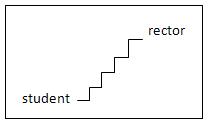
Ex 3. They say that it is a poor soldier who does not want to become a general. Name the steps of the social ladder which a student must pass to climb up to the position of the rector. Use the words from the list below, placing one word on one step.
Dean, assistant lecturer, head of department, vice-rector, associate professor, assistant professor, subdean, professor, undergraduate, junior student, senior student
Follow-up Activities
Ex 1. Identify the tense:
1. If you are ready, we will start at once. 2. If it snows tomorrow, we will stay at home. 3. Before she gets to the theatre, she’ll go past the shopping centre. 4. What will we do if it rains tonight? 5. What will she do if she sees her best friend again? 6. Will I see you before you start? 7. What will he do when he comes home? 8. He will ring me up when he returns home. 9. I’m sure he will come to say goodbye to us before he leaves St. Petersburg. 10. I won’t speak to him until he apologises. 11. Peter will introduce us to his friends as soon as we meet them.
Ex 2. Put the verbs in brackets in Present or Future Simple:
1. Before you (to cross) the park, you (to come) to a supermarket. 2. When you (to cross) the park, you (to see) the hospital. 3. If you (to translate) this article into Russian, I (to use) it in my report. 4. If she (to be) in St. Petersburg now, she (to meet) you at the railway station. 5. If you (not to hurry), you (to miss) the train. 6. If it (to rain), we (not to go) to the country. 7. When my friend (to come) to St. Petersburg, we (to go) to the Russian Museum. 8. I (to be able) to translate this article if you (to give) me a dictionary. 9. You (to have) to work hard at home if you (to miss) the lesson. 10. Where you (to go) when you (to come) to London? 11. The child (not to be) healthy if you (not to give) him much fruit. 12. I (not to have) dinner before mother (to come) home. 13. What you (to do) if you (not to finish) your homework tonight? 14. What he (to do) if his TV set (to break)? 15. If I (to stay) some more days in your town, I (to call) on you and we (to have) a good talk. 16. He (to go) to the Public Library very often when he (to be) a student. 17. As soon as I (to return) from school, I (to ring) you up. 18. You (to pass) many towns and villages on your way before you (to arrive) in Moscow. 19. I (to stay) at home till she (to come). Then we (to go) to the theatre if she (to bring) tickets. 20. After I (to finish) school, I (to enter) the University. 21. When he (to return) to St. Petersburg, he (to call) on us. 22. If I (to see) him, I (to tell) him about their letter. 23. We (to gather) at our place when my brother (to come) back from Africa. 24. I (to sing) this song with you if you (to tell) me the words. 25. I hope you (to join) us when we (to gather) in our country house next time. 26. What you (to do) when you (to come) home? 27. When they (to cross) the road? they (to see) the hotel.
Ex. 3. Match the name of the subject with its Russian equivalent:
|
the History of Sociology the Introduction into Sociology Applied Statistics in Sociology the Sociology of Marriage and Family Methods of Sociological Research the Sociology of Governing the Sociology of Labour the Sociology of Education Sociological National Schools the Sociology of Mass Media and communication Methods of Teaching Sociology the Sociology of the Personality the Sociology of Science the Sociology of Politics the Sociology of Economics the Sociology of Conflict the Sociology of Youngsters Theoretical Sociology the Sociology of Advertising the Sociology of Culture Gender Sociology the Sociology of Public Relations the Sociology of the City the Sociology of the Cinema |
Социология образования Социология культуры Гендерная социология Социология Public Relations Социология города Социология кино Социология образования Методология и методы социол. исслед. Социология личности Методика преподавания социологии Социология науки Социология политики Социология экономики Введение в социологию Социология молодежи Социология рекламы Социология культуры Социология управления Социология труда Социологические национальные школы Социология СМИ и коммуникаций История социологии Прикладная статистика в социологии Социология конфликта |
Ex. 4. Divide the titles of the subjects mentioned above into two columns (those with the definite article and those with no article) and explain the usage of articles before the names of subjects.
Ex. 5. Get acquainted with the university syllabus and say what subjects you are going to study in the course of your studies:
1st year — the History of Sociology, the Introduction into Sociology.
2nd year — the History of Sociology, Applied Statistics in Sociology, the Sociology of Marriage and Family, Theoretical Sociology.
3rd year — Methods of Sociological Research, the Sociology of Governing, the Sociology of Labour, the Sociology of Education, Sociological national schools, the Sociology of Mass Media and communication.
4th year — Methods of Sociological Research, Methods of Teaching Sociology, the Sociology of the Personality, the Sociology of Science, the Sociology of Politics, the Sociology of Economics, the Sociology of Conflict, the Sociology of Youngsters, the Sociology of Advertising.
5th year — the Sociology of Education, the Sociology of Culture, Gender Sociology, the Sociology of Public Relations, the Sociology of the City, the Sociology of the Cinema.
Model. When I’m in my 1st year, I’ll study the History of Sociology and the Introduction into Sociology.
Ex 6. Make up an oral presentation university. Make use of the following plan.
1. Introduce yourself.
2. Say a few words about your university: say what it is called, speak about its faculties and their specializations.
3. Speak about your entrance exams. Say how well you passed them.
4. Describe your first day at the university.
5. Speak about your studies at the university (how they are organized, what subjects you study etc.).
6. Say what future perspectives the profession of a sociologist provides you with (what kind of science sociology is, what kind of profession/job it is, what opportunities it gives you).
Here is the list of words you have learnt so far:
|
an academic session (year) |
to make a report (on) |
|
a college |
to read (prepare) for an exam |
|
studies |
to get an excellent (good, satisfactory |
|
Dean |
bad) mark in (for) |
|
the Dean’s office |
after (before) classes |
|
a lecture (on) |
classes finish (are over) |
|
to lecture (in) |
to work at (one’s English, history, |
|
a lecturer |
a problem) |
|
a lecture room |
to make/take notes (of) |
|
a term (semester) |
to do one’s homework (lessons) |
|
a term (course)-paper |
in class |
|
a credit-test |
Hallo! |
|
a theme |
It’s nice to see you. |
|
archaeology |
(I am) glad to meet you. |
|
sources and literature |
How are you? |
|
a department |
to be well |
|
a foreign language |
by the way |
|
a gym |
I wonder why. |
|
a hostel (dormitory) |
a roommate |
|
a canteen |
a classmate |
|
to take (pass) an examination (in) |
No wonder. |
|
to be admitted to |
Good for him! |
|
to fail (in) the examination |
to get through one’s exam |
|
to attend classes (lectures, seminars, tutorials) |
I was most fortunate |
|
a seminar (on/in) |
You don’t say so! |
|
to miss classes |
For shame! |
|
to have a history class (a Latin class) |
It serves you right. |
|
to present a course (term)-paper |
reason |
|
to be frank with you |
A crib |
|
in general |
To cram |
|
normally (generally) |
A postgraduate |
|
a hot dish |
To graduate with honours |
|
juice |
Graduation dissertation |
|
to be hungry |
To play truant |
|
to be thirsty |
the History of Sociology |
|
to have a bite |
Applied Statistics in Sociology |
|
to take something for (breakfast) |
the Introduction into Sociology |
|
A full-time student |
the Sociology of Marriage and Family |
|
a monitor |
the Sociology of Education |
|
an applicant |
Methods of Sociological Research |
|
A part-time student |
the Sociology of Governing |
|
a student membership card |
the Sociology of Labour |
|
a high academic degree |
Theoretical Sociology |
|
Entrance exams |
Sociological National Schools |
|
a student record book |
the Sociology of the Cinema |
|
a rector |
Methods of Teaching Sociology |
|
a vice-rector |
the Sociology of the Personality |
|
A professor |
the Sociology of Science |
|
a student library card |
the Sociology of Politics |
|
a dean |
the Sociology of Economics |
|
a subdean |
the Sociology of Conflict |
|
Junior |
the Sociology of Youngsters |
|
Senior |
the Sociology of Advertising |
|
Associate professor |
the Sociology of Culture |
|
Assistant professor |
Gender Sociology |
|
Timetable |
the Sociology of Public Relations |
|
Curriculum |
the Sociology of the City |
|
To cheat |
the Sociology of Mass Media and |
|
Finals |
communication |
GRAMMAR EXERCISES
Present Forms
A.
I. The verb «to be» in the Present Simple Tense
Ex. 1. Put in am, is or are.
1. The sky is very blue today. 2. I______not tired. 3. This shelf________very heavy. 4. These shelves______ very heavy. 5. The child______ sleep. 6. Look! This______ Mabel. 7. I______ cold. Can you shut the window, please? 8. The castle_______ one thousand years old. 9. My brother and I________good tennis players. 10. Amy_____ at home but her parents_____ in church. 11. I______ a student. 12. My sister_______ an archeologist.
Ex 2. Write full sentences. Use am / is / are each time.
1. (my grandparents / very old) My grandparents are very old.
2. (my desk / very comfortable) ____________________________
3. (your spectacles/ in your bag)____________________________
4. (I / not very clever today) ____________________________
5. (this house/ very expensive) ____________________________
6. (the shops / not open today) ____________________________
7. (Mr. Wren’s grandson / six years old)_______________________
8. (the houses in this street/ very big) _______________________
9. (the examination / not difficult)__________________________
10. (those flowers / very beautiful)__________________________
Ex 3. Write positive or negative sentences. Use am /am not / is / isn’t / are / aren’t.
1. (Brussels…the capital of Belgium) Brussels is the capital of Belgium.
2. (I…interested in hockey) I’m not interested in hockey.
3. (I.. .angry)____________________________
4. (It…cold today)________________________
5. (The Hague…in Switzerland)______________
6. (I…afraid of dogs)______________________
7. (My hands…dirty)_______________________
8. (Russia…a very big country)_______________
9. (The Amur…in Europe)___________________
10. (Diamonds…cheap)____________________
11. (Motor-racing… a dangerous sport)__________
12. (Squirrels…big animals)__________________
Ex 4. Write questions with What/ Who / How / Where / Why…? Use am / is /are.
1. (What colour your house?) What colour is your house?
2. (Where my key?)________________________________ ?
3. (Where my trousers?)_____________________________ ?
4. (How old your grandmother?)_______________________ ?
5. (What colour his hair?)____________________________ ?
6. (How much these shoes?)__________________________ ?
7. (Who your favourite actor?)________________________ ?
8. (Why you always late?)____________________________ ?
Ex 5. Ask questions. (Read the answers to the questions first)
1. (his name?) What’s his name?
Robert.
2. (single or married?) Are you single or married?
I’m single.
3. (British?) ________________________________
No, I’m not.
4. (where / from?) ___________________________
From Australia.
5. (how old?)________________________________
I’m 18.
6. (a student?)_______________________________
No, I’m a secretary.
7. (your mother a teacher?)____________________
No, she’s a lawyer.
8. (where/from?)_____________________________
She’s Italian.
9. (her name?)______________________________
Rachel.
10. (how old?)______________________________
She’s 40.
II. The verb «to have» in the Present Simple Tense.
Ex 1. Put in have got (‘ve got), has got (‘s got), haven’t got or hasn’t got.
1. They like flowers. They_____ a lot of roses in their garden.
2. Jane_______ a car. She goes everywhere by bicycle.
3. Everybody likes Tom. He_____ a lot of friends.
4. Mr. and Mrs. Eastwood_____ two children, a boy and a girl.
5. An insect______ six legs.
6. I can’t open the door. I________ a key.
7. Quick! Hurry! We________ much time.
8. «What’s wrong?» — «I_________ something in my eye».
9. Ben doesn’t read much. He________ many books.
10. It’s a nice town. It_______ a very nice shopping centre.
11. Mother is going to the dentist. She________ toothache.
12. «Where’s my newspaper?» — «I don’t know. I__________ it».
13. Julia wants to go on holiday but she_________ any money.
14. I’m not going to work today. I_________ a bad cold.
Ex. 2. Write questions.
1. (you/ a bicycle?) Have you got a bicycle?
2. (you/ a VCR?)_______________________
3. (your father/a car?)___________________
4. (Carol/many friends?)_________________
5. (Mr. and Mrs. Lewis/any children?)________
6. (how much money/you?)_______________
7. (what kind of car/John?)________________
III. The Simple Present Tense. Ex 1. Write the he/she/it forms.
Ex.1. Write the he/she/it forms.
|
catch |
run |
stand |
drink |
write |
push |
|
come |
cook |
fetch |
fix |
watch |
miss |
|
read |
touch |
live |
smoke |
wish |
start |
+ -s comes___________________________________
+ -es catches___________________________________
Ex. 2. Write the following sentences in the 3rd person singular.
1. I think I am ill. 2. They often visit their granny. 3. We live in Leeds. 4. You usually speak too quickly. 5. Do you like boiled potatoes? 6. Good animals always obey their masters. 7. The boys box in the gymnasium on Fridays. 8. His dogs always attack the neighbours. 9. Heavy trucks make a lot of noise.
Ex. 3. Choose the correct answers.
Pattern: We/My friend always wear old clothes.
You /John always wears nice clothes.
1. We all / The boss thinks you’re wonderful.
2. I /Catherine want a new job.
3. Bread / Books costs a lot.
4. Andy / Andy and Pete sings very well.
5. Mary / Mary and Ian like parties.
6. You / She drive too fast.
7. Our cat / Our cats never catches mice.
8. That child / Children makes a lot of noise.
9. That bus / All those buses go to the station.
10. My father / My mother and father teaches
Ex 4. Change the following sentences into general questions:
Pattern: He makes testing at the laboratory.
Does he make testing at the laboratory?
1. He applies the new method for his investigation.
2. The subject compares the cards.
3. The psychologist rejects this idea.
4. She often works at the psychological laboratory.
5. The scientist applies new devices.
6. The investigator uses testing in his research.
7. He considers them to be right.
8. She gives instructions to the students.
9. He gradually achieves good progress in his studies.
10. She denies such hasty conclusions.
Ex 5. Make the following sentences negative:
Pattern: I consider him to be right.
I don’t consider him to be right.
1. I reject his position.
2. I make proper conclusions.
3. I apply his method for my experiments.
4. I specialize in engineering psychology.
5. I study the problem of group dynamics.
6. I compare the experimental data.
7. I use the latest data in my research..
8. I deny their approach.
9. I give instructions to the subjects.
10. I achieve good results on the basis of his method.
Do you know all these question words?
what when where who why how how much how many what time
What do you think? (not What think you?) Where does Lucy live? (not Where lives Lucy?)
How much does this cost? (not How much this costs?)
What time does the train leave? (not What time the train leaves?)
Ex. 6. Choose the correct subject.
Pattern: How much does the ticket cost? (the ticket /the tickets
1. Where do____________ live? (your daughter /your children)
2. What time does__________ start? (the lesson / the lessons)
3. What do________ want? (you / the girl)
4. When does_________ finish? (the holidays / the holiday)
5. Why do________ talk so fast? (that woman / those women)
6. What do__________ think of the new boss? (you / she)
Ex 7. Make questions.
Pattern: Where / she live? Where does she live?
1. What / you want?_________________________
2. What / this word mean?_____________________
3. What time / the film start?____________________
4. How much / those shoes cost?_________________
5. Why / she need money?_____________________
6. How / this camera work?____________________
7. Where / you buy your meat?__________________
8. Who / you want to see?______________________
Be careful when questions have long subjects — the word order does not change.
Where does Ann live?
Where does your other sister live?
Where does your sister’s old English teacher live?
(not Where lives your sister’s old English teacher? or Where docs live your...)
Ex 8. Make questions.
Pattern: The President and his wife live in Madrid, Where do the President and his wife live?
1. Peter and Ann’s children play football on Saturdays.
When________________
2. The film about skiing in New Zealand starts at 8.00.
What time__________________
3. The second word in the first sentence means ‘kind’.
What_________________
4. The man in the flat downstairs wants to change his job.
Why_________________
5. A ticket for Saturday’s concert costs €15.
How much_______________
B.
Ex 1. Put the verb in brackets into the Present Indefinite.
1. Oscar Wilde and Bernard Shaw (be) the most witty British writers.
2. Fishermen often (tell) tales about their catches.
3. Their children (go) to a private school.
4. Little Amanda (collect) all sorts of toy-pigs.
5. My father (like) a lot of milk in his tea and a few lumps of sugar.
6. Anything that he (say) (be) worth listening to.
7. We usually (spend) our holidays in Spain.
8. My English friends (live) in a nice house that (stand) on a hill that (overlook) lake Winder-mere which (be) in the Lake District.
9. What this sentence (mean)?
10. I (live) in Tver, which (be) my native town.
11. My brother (sing) in Italian opera.
12. My sister (have) a good appetite and she always (eat) heartily.
13. Let’s go outside. It (be) terribly hot in the house.
14. What you (see) over there?
15. In England the traffic (keep) to the left but on the Continent it (keep) to the right.
16. This map (be) the largest that we (have).
17. They often (come) to see me in my town house.
18. The twittering of birds in the trees in spring (be) a pleasant sound.
Ex. 2. Put the verb in brackets into the correct form.
Pattern: The lecture begins at 10 o’clock.
How many languages do you speak (you/speak)?
1. What time___________ (the museums/open) in St. — Petersburg?
2. I have a bike but I____________________ (not/use) it very often.
3. How many cups of tea________________ (you/drink) a day?
4. «What______________ (you/do)?» — «I am a chemical engineer».
5. «Where (your father/come) from?» — «He (come) from Minsk».
6. If you need help, why___________________ (you/not/ask) for it?
7. I________________ (play) the guitar, but I (not/play) very well.
8. I don’t understand the word «maintain». What «main-tain»____________ (mean)?
Ex 3. Expand the following into sentences in order to make true statements with doesn’t or don’t where necessary.
Pattern: Water boils at 100 °C.
Rice doesn’t grow on trees.
1) water / boil / at 100 °C.
2) nice / grow / on trees.
3) chicks / hatch / from eggs
4) kangaroos / live / in Spain
5) plants / need / water to grow
6) rain / fall / from clouds
7) astronauts / travel / in submarines
cows / lay / eggs
9) pandas / live / in Italy
10) elephants / eat / meat
11) fish / walk / on land
12) the sun / set / in the east
13) bees / give milk
14) caterpillars / turn / into butterflies
15) wool / come / from sheep
Ex. 4. This time you have to read some sentences and correct them. The English is correct but the information is wrong. Write two correct sentences each time.
Pattern: The sun goes round the earth. The sun doesn’t go round the earth. The earth goes round the sun.
1. The sun rises in the west.______________________________
2. Mice catch cats._____________________________________
3. Carpenters make things from metal.______________________
4. The River Amazon flows into the Pacific Ocean._____________
Ex 5. Now you have to use these sentences to make questions. Begin your question with the word(s) in brackets.
Pattern: Tom plays tennis. (How often?) How often does Tom play tennis?
I get up in the morning. (What time/usually?) What time do you usually get up?
1. Ann watches television. (How often?)_____________________
2. I write to my parents. (How often?)_______________________
3. I have dinner in the evening? (What time/usually?)____________
4. Tom works. (Where?)__________________________________
5. I go to the cinema. (How often?)__________________________
6. People do stupid things. (Why?)__________________________
7. The car breaks down. (How often?)_______________________
Present Continuous
A.
Ex. 1. Make present progressive sentences.
Pattern: Ann / read / the newspaper? Ann is reading the newspaper.
1. The baby / cry / again.____________________
2. It / snow / again._________________________
3. You / look / very beautiful today.____________
4. Your coffee / get / cold.____________________
5. I / play / a lot of football this year.____________
6. We / wait / for a phone call.______________________________
7. Chris and Helen / spend / a week in France._________________
8. The students / make an experiment.______________________
9. John / interview the subjects._____________________________
10. They / watch the testing process._________________________
11. Mary /solve a problem._______________________________
12. She / register the students’ answers._______________________
13. The student / copy the experimental data.__________________
14. The subject / perform a task.___________________________
15. The scientist / compare the data._________________________
16. He / investigate sense-data._____________________________
Ex 2. Make present continuous negative sentences.
Pattern: Mother is talking on the phone. (sleep) She isn’t sleeping.
1. John is standing. (lie down) __________________________
2. Father is shaving. (wash) __________________________
3. The boys are playing. (fight) __________________________
4. We are dancing. (jump) __________________________
5. They are speaking. (shout) __________________________
6. Mary is running. (walk) __________________________
7. I am eating. (drink) __________________________
8. The teacher is speaking. (read)_____________________________
Ex 3. Answer the questions using the words in brackets.
Pattern: Are you drawing? (write a story) — No. I’m not. I’m writing a story.
1. Is he writing a letter? (watch television)_______________________
2. Are you reading Byron’s poems? (learn them by heart)___________
3. Is Dad smoking in his study? (read a newspaper)________________
4. Are they listening to the radio? (talk with a friend)_______________
5. Are you hurrying to work? (go home)________________________
6. Is Joan playing the piano? (listen to a concert)_________________
7. Are you working at your essay? (write a film script)______________
8. Is she washing up? (cook)_________________________________
Ex. 4. Answer the questions using the words in brackets.
1. Is Jerry very busy just now? (finish his work)___________________
2. Are the students very busy just now? (perform a task)____________
3. Is Susan very busy just now? (have breakfast)_________________
4. Are the Greens very busy just now? (shop)____________________
5. Is Miss Black very busy just now? (sew)______________________
6. Is Jane very busy just now? (wash up)________________________
7. Is Henry very busy just now? (skate)_________________________
8. Are the girls very busy just now? (rehearse)____________________
Ex. 5. Complete the text with verbs from the boxes.

And Mrs. Alexander ►is coming down the steps of the plane now. It is very cold and it 1)____________ heavily, but she 2)___________ very happy. She 3)___________ a dark blue dress with a black coat and boots, but she 4)_________ a hat. She really is a very beautiful woman. Her husband 5)__________ down the steps with her.

Now Mrs. Alexander and her husband 6)___________at the crowd and smiling. The photographers 7)________ to get nearer, but the police are 8)____________ them. What a day! At last, after twenty years, this wonderful woman 9) to her own country. Now the President 10)________ her hand. What 11)________ he________ to her, do you think?
Present Continuous vs. Present Simple
A-B.
Ex 1. Say whether the underlined verbs are right. Correct those which are wrong.
Pattern: I don’t go there often. RIGHT.
Please don’t interrupt. He talks sense. WRONG — is talking
1. Look! Someone is coming up to the back door.____________
2. Do you talk about my book? I hope you like it.____________
3. Are you believing in ghosts?___________________________
4. Listen! Somebody tries to start the car.__________________
5. He always goes there in the springtime.___________________
6. I’m thinking he is a good chap.__________________________
7. The people are worried that the traffic is increasing._________
8. We’re usually going to Hampton by train.__________________
Ex 2. Put the verbs in brackets into Present Indefinite and Present Continuous.
I.
1. Mr. Smith (teach) us at present. He (substitute) for Mr. Reese, who (be) our regular teacher.
2. «I (go) to visit Peter tonight. He (leave) tomorrow morning». -«He (come) back the same day?» — «I (not/know)».
3. John often (stay) in a hotel when he (come) to town, but tonight he (stay) with us.
4. The fourth class always (meet) on the 18th floor, but our class (meet) on the 17th floor. However, since they (paint) our regular classroom now, we (go) to meet in the club-room today.
5. «Nick (leave) today». — «What train he (take) for his journey?» -«He (catch) the 5.50 train».
6. The mechanic (repair) my car today. So I must go to work by the underground.
7. «You/write) him tonight?» — «Yes, I always (write) him on his birthday. You (want) to send any message?» — «Certainly».
8. John (say) he (leave) for Chicago on the fifteenth.
9. I (go) to the seaside on my holiday.
10. My brother (come) to see me next week.
11. Whenever I (call) at the Smiths’ home, they (play) cards. I really (think) they (play) every night.
12. Jack (make) at least ten spelling errors in every lesson.
II.
1. A. Where (be) Andrew?
B. He (smoke) on the terrace.
A. I (think) he (smoke) too much.
B. Yes, he (be) a chain-smoker.
2. A. What (be) this music?
B. It (be) Ann. She (play) the piano.
3. A. You (come) with us?
B. I’d love to come. Where you (go)?
A. We (drive) to the Lake District.
B. You (take) the children along?
A. No, we (leave) them with our parents.
B. You (mind) if I (bring) my dog?
A. No.
4. A. Mike (come) tonight?
B. No, he (work) hard at present.
A. What he (do)?
B. He (read up) for his examinations.
A. But it (be) Saturday. I (be) sure he (not/go) to take his examination on Sunday.
B. No, but he (say) he (meet) his girl-friend on Sunday, and the examination (be) on Monday, so he (have) only tonight for his studies.
Ex 3. Put the verbs in brackets into the correct form of the present continuous or the present simple.
1. A: Where’s James?
B: He is/’s playing (play) football in the garden right now.
2. A: Bill (dance) very well.
B: Yes, he’s a good singer, too.
3. A: Lucy is very busy.
B: Yes. She (work) very hard these days.
4. A: What (you/do) on Saturdays?
В: I clean the house and go shopping.
5. A: Why (you/pack) your suitcase?
B: Because I (fly) to Paris tomorrow morning.
6. A: Fred (not/know) how to swim.
B: That’s because he’s only three.
7. A: Max looks very fit.
B: Yes. He (take) a lot of exercise these days.
Ex 4. Put the verbs in brackets into the correct form of the present continuous or the present simple.
Charlie Foster 1) works (work) at a bakery. He 2)_____________ (always/get up) very early because he 3)____________ (start) work at four o’clock every morning. Charlie 4)_________ (not/be) at work this morning. At the moment he 5)_____ (pack) a suitcase because he 6)_______ (go) on holiday today. Charlie 7)__________ (sing) to himself. He’s very happy. Right now he 8)_________________ (look for) his aeroplane tickets. Where are they? He can’t find them. There they are; under his bed! Charlie 9) _______ (call) a taxi now. His plane 10)____________ (leave) in an hour. Where 11)_______ (leave) (Charlie/go)? To Hawaii!
Ex 5. Put the verbs in brackets into the correct form of the present continuous or the present simple.
Dear Martin,
How are you and Sally? I 1) hope (hope) you’re well. I 2)___________ (write) to give you some good news. I have got a summer job for the holidays! 3)________ (repair) telephone lines for a telephone company. I 4)_______ (usually/ride) my bicycle to work because it’s only a ten minute ride from home. We 5)___________ (start) work at 8:30. We 6) ______ (finish) at 4:30 on Mondays to Thursdays, but at 2:30 on Fridays, so I 7)________ (have) long weekends. I 8)__________ (work) very hard at the moment. To tell you the truth, I 9)_________ (be) a bit nervous because my boss 10)__________ (leave) for Scotland on business next week, so I’ll be on my own. Lizzie says I 11)____________ (worry) about it too much. She’s probably right!
Ex 6. Correct the mistakes.
1. Steve goes fishing tomorrow.
2. Rebecca wash her hair every day.
3. I am visiting my grandparents every week.
4. Tim doesn’t wants to do his homework.
5. He sits on the floor at the moment.
6. Do you watch TV in the evenings always?
7. Sarah is drinking coffee every morning.
8. They don’t go usually on holiday in May.
9. Does she work late? No, she does never.
10. Peter looks for a new house at the moment.
C.
Ex 1. Put the verbs in brackets into the correct form of the present continuous or the present simple.
1. A: Do you know (you/know) that man over there?
B: Actually, I do. He’s Muriel’s husband.
2. A: Are you doing anything tomorrow evening?
B: Yes. I_____(see) Jack at nine o’clock.
3. A: I_____ (see) you’re feeling better.
B: Yes, I am, thank you.
4. A: What’s that noise?
B: The people next door_____ (have) a party.
5. A: Graham______ (have) a new computer.
В: I know. I’ve already seen it.
6. A: This dress______ (not/fit) me any more.
B: Why don’t you buy a new one?
7. A: Your perfume_______ (smell) nice. What is it?
B: It’s a new perfume called Sunshine.
8. A: What is Jane doing?
B: She____ (smell) the flowers in the garden.
9. A: What______ (you/look) at?
B: Some photos I took during my holidays. They aren’t very good, though.
10. A: You_______ (look) very pretty today.
B: Thank you. I’ve just had my hair cut.
11. A: I_______ (think) we’re being followed.
B: Don’t be silly! It’s just your imagination.
12. A: Is anything wrong?
B: No. I_______ (just/think) about the party tonight.
13. A: This fabric________ (feel) like silk.
B: It is silk, and it was very expensive.
14. A: What are you doing?
В: I_______ (feel) the radiator to see if it’s getting warm.
15. A: She________ (be) generous, isn’t she?
B: Yes, she has never been a mean person.
16. A: He________ (be) very quiet today isn’t he?
B: Yes, I think he has some problems,
17. A: Would you like some cherries?
B: Yes, please. I_____ (love) cherries. They’re my favourite fruit.
18. A: I’m sorry, but I_________ (not understand) what you mean.
B: Shall I explain it again?
19. A: The children are making lots of noise today.
В: I know, but they (have) fun.
20. A: This cake________ (taste) awful.
В: I think I forgot to put the sugar in it!
Ex. 2. In this exercise you have to decide whether the verbs in these sentences are right or wrong. Correct those which are wrong. The verb is underlined.
Pattern: I don’t know your telephone number. RIGHT.
Please don’t make so much noise. I study. WRONG — am studying.
1. Look! Somebody is climbing up that tree over there._____________
2. Can you hear those people? What do they talk about?___________
3. Are you believing in God?_____________
4. Look! That man tries to open the door of your car.
5. The moon goes round the earth._____________
6. I’m thinking it would be a good idea to leave early. _
7. The government is worried because the number of people without jobs is increasing.
8. I’m usually going to work by car.______________
Ex 3. Now you have to put the verb into the correct form, present continuous (I am doing) or present simple (I do).
Pattern: Please don’t make so much noise. I am studying (study).
How many languages does Tom speak (Tom/speak)?
This machine doesn’t work (not/work). It hasn’t worked for years.
1. I________ (not/belong) to a political party.
2. Hurry! The bus________ (come). I________ (not/want) to miss it.
3. The River Nile_________ (flow) into the Mediterranean.
4. The river__________ (flow) very fast today — much faster than usual.
5. ___________ (it/ever/snow) in India?
6. We usually_________ (grow) vegetables in our garden but this year we_________ (not/grow) any.
7. A. Can you drive?
B. No, but I_________ (learn). My father____________ (teach) me.
8. You can borrow my umbrella. I____________ (not/need) it at the moment.
9. (at a party) I usually___________ (enjoy) parties but I__________ (not/ enjoy) this one very much.
10. George says he’s 80 years old but I_________________ (not/believe) him.
11. Ron is in London at the moment. He_________________(stay) at the Hilton Hotel. He usually______ (stay) at the Hilton Hotel when he’s in London.
In these sentences think about whether the situation is temporary or permanent.
12. My parents_________ (live) in Bristol. They were born there and have never lived anywhere else. Where_________ (your parents/live)?
13. She___________ (stay) with her sister at the moment until she finds somewhere to live.
14. A. What___________ (your father/do)?
B. He’s a teacher, but he_____________ (not/work) at the moment.
Present Perfect Tense
A.
Ex 1. Put the verb in brackets into the Present Perfect.
1. I don’t know this girl. I never (meet) her before. 2. «Where is Mother?» — «She just (go) out». 3. «Don’t you know what the film is about?» — «No, I (not/see) it». 4. Don’t worry about the letter. I already (post) it. 5. «Is he a good teacher?» — «Oh yes, he (help) me a lot». 6. I know London perfectly well. I (be) there several times. 7. I can’t find my umbrella. I think, somebody (take) it by mistake. 8. «Do you speak Spanish?» — «No, I never (study) it». 9. «Do you know where they have gone?» — «No, they (sell) their house and (not/leave) their new address».
Ex 2. Answer the questions. Put the verb in brackets into the Present Perfect.
Pattern: Is his article ready? (write)
Yes, he has written it.
1. Are her rooms clean? (do)
2. Is our dinner ready, Mother? (cook)
3. Does she know the poem? (learn)
4. Do you know this sort of pencil? (use)
5. Does he know how nice the cake is? (eat)
6. Do you know that your gloves are on the table? (find)
7. Is Bobby‘s face clean? (wash)
8. Do you know how beautiful these songs are? (hear)
Ex. 3. Make present perfect sentences.
|
Pattern: |
I / never/ read / Shakespeare I / break / my arm / three times Peter / pay / for his lessons? |
I’ve never read Shakespeare I’ve broken my arm three times Has Peter paid for his Lessons? |
1. Joe / change / his job / twice this year.________________________
2. you / ever / write / a poem?________________________________
3. I / never / climb / a mountain.______________________________
4. how often I she / ask / you for money?_______________________
5. I / often / try / to stop smoking._____________________________
6. Alex / phone / me / six times this week._______________________
7. Charles / speak / to you / today?____________________________
8. Mary / not / tell / me / her new address._______________________
9. you / ever / break / your leg?_______________________________
10. We / not / play / football / this year.________________________
Ex 4. You are writing a letter to a friend and giving news about people you both know. Use the words given to make sentences and put the verb into the correct form.
Pattern: Phil/find a new job Phil has found a new job.
Dear Chris,
Lots of things have happened since I last wrote to you.
1. Charles/go/Brazil Charles.____________________________
2. Jack and Jill/decide/to get married._____________________
3. Suzanne/have/a baby.______________________________
4. Monica/give up/smoking.____________________________
5. George/pass/his driving-test.___________________________
Ex 5. In this exercise you have to read the situation and then write a suitable sentence. Use the verb given.
Pattern: Tom is looking for his key. He can’t find it. (lose) He has lost his key.
1. Ann’s hair was dirty. Now it is clean. (wash) She________________
2. Tom was 80 kilograms. Now he weighs 70. (lose weight)__________
3. The car has just stopped because there isn’t any more petrol in the tank. (run out of petrol)
4. Yesterday Bill was playing football. Now he can’t walk and his leg is in plaster. (break)
Ex 6. You are asking someone about things be has done in his life. Use the words in brackets to make your questions.
Pattern: (you ever/be/to Italy?) Have you ever been to Italy?
1. (you ever/be/to South America?)___________________________
2. (you/read/any English books?)_____________________________
3. (you/live/in this town all your life?)__________________________
4. (how many times/you/be/in love?)__________________________
5. (what’s the most beautiful country you/ever/visit?)______________
6. (you ever/speak/to a famous person?)_______________________
Ex 7. Answer these questions using the words in brackets.
Pattern: When did you last smoke? (for two years) I haven’t smoked for two years.
1. When did it last rain? (for ages) It________________ for ages.
2. When did they last visit you? (since June) They_________________
3. When did you last play tennis? (for a long time)________________
4. When did you last eat caviar? (never)________________________
5. When did you last drive? (for six months)_____________________
6. When did you last go to Spain? (never)_______________________
7. When did she last write to you? (since last summer)______________
Ex 8. In this exercise you have to make questions with the words given.
Pattern: (you hear from George recently?) Have you heard from George, recently?
1. (you/read/a newspaper recently?)___________________________
2. (you/see/Tom in the past few days?)_________________________
3. (you/play/tennis recently?)________________________________
4. (you/eat/anything today?)________________________________
5. (you/see/any good films recently?)__________________________
6. (you/have/a holiday this year yet?)_________________________
B.
Ex 1. Circle the words for a finished time.
a few days ago always this week last week never now then today yesterday in 1990
Ex 2. Correct (R) or not (WR)?
Pattern: My father has changed his job. R
Andy has gone to Scotland last week. WR
1. Look what Peter has given me yesterday!_______________
2. I’ve seen a great programme last night._________________
3. I think everybody has arrived now.___________________
4. Mary has written to me three weeks ago.________________
5. Sorry — I’ve forgotten your name.______________________
6. I’ve forgotten Mike’s birthday last Tuesday._____________
7. Everybody has gone home at 10 o’clock.________________
8. There’s nobody here! What has happened ?______________
Ex 2. Make present perfect progressive sentences. Usefor or since.
|
Pattern: |
John started learning Chinese in February. Now it’s July. (for) John has been learning Chinese for five months. It started raining on Sunday. It’s still raining. (since) It’s been raining since Sunday. |
1. Mary started painting the house on Monday. Now it’s Friday. (for)
2. We started driving at six o’clock. Now it’s ten o’clock. (for)
3. Ann started working at Smiths in January. (since)
4. Joe started building boats when he was 20. Now he’s 40. (for)
5. We started waiting for the bus at 8.30. (since)
6. Prices started going up last year. (since)
Ex 3. Make questions beginning with How long…?
Pattern: you / study / maths How long have you been standing maths?
1. Jane / talk / on the phone_______________________________
2. your brother / work / in Glasgow_________________________
3. Eric / drive / buses____________________________________
4. that man / stand / outside_______________________________
5. you / play / the piano__________________________________
Ex. 4. Choose the correct form.
Pattern: How long have you learnt / been learning the piano?
Look! I have bought/been buying a coat.
1. It has rained / been raining since Tuesday.
2. John has broken / been breaking his leg.
3. He hasn’t told / been telling me his address.
4. How long have we driven/been driving now?
5. Have you ever read / been reading this book?
6. Hello! I’ve waited / been waiting for you for hours!
7. How long have you played/ been playing tennis?
8. How many games have you played / been playing?
Ex. 5. Put in the present perfect or present perfect progressive.
Pattern: I have had these shoes for a year. (have)
How long have you been waiting? (wait)
1. It________________________ all day. (snow)
2. We_____________ this dog for years. (have)
3. Ann_________________ all day. (work)
4. John_________________ ill this week. (be)
5. How long_______ you_______ Andrew (know)?
Ex 6. Put in the present perfect or continuous, using short forms where appropriate.
1. A. How long have you known (you/know) Alison?
B. We (be) friends since we were children.
2. A. Who (use) the car?
B. I have. Is there a problem?
3. A. What are Andrew and David doing?
B. They (work) in the garden for three hours
4. A. Why is Sally upset?
B. She (lose) her bag
5. A. I (always/believe) that exercise is good for you.
B. Of course, it’s good to keep fit.
6. A. Emily (teach) maths since she left university.
B. Yes, and she’s a very good teacher, too.
7. A. Fred (open) a new shop.
B. Really? Where is it?
8. A. This pie is delicious.
B. Is it? I (not/taste) it yet.
9. A. Have you found your umbrella yet?
B. No, I (look) for it for an hour now.
10. A. You look exhausted.
B. Well, I (clean) the windows since 8 o’clock this morning.
11. A. Can I have some more lemonade, please?
B. Sorry, your brother (just/drink) it all.
12. A. Have you got new neighbours?
B. Yes, they (just/move) to the area.
Ex. 7. Choose the correct answer.
1. «What time does the train leave?»
«I think it Aat 2 o’clock».
A. leaves В. has been leaving С. has left
2. «Where are Tom and Pauline?»
«They_____ to the supermarket».
A. have just gone В. have been going С. go
3. «What is Jill doing these days?»
«She_______ for a job for six months».
A. is looking В. has been looking С. looks
4. «Is Mandy watching TV?»
«No. She________ her homework right now».
A. is always doing В. is doing С. does
5. «Have you been for a walk?»
«Yes. I often_______ for walks in the evenings».
A. have gone В. am going С. go
6. «Have you seen any films lately?»
«Yes. Actually, I___________ two this week».
A. have seen В. am seeing С. see
7. «What_______ ?» «It’s a piece of cherry pie. Mum made it yesterday?»
A. are you eating В. do you eat С. have you eaten
8. «Are you going on holiday this summer?»
«Yes. I_______ enough money».
A. am saving В. have already saved С. save
9. «Is Todd reading the newspaper?»
«No. He________ dinner at the moment».
A. has been making В. makes С. is making
10. «Have you bought any new CDs recently?»
«Yes. Actually, I___________ two this week».
A. have bought В. have been buying С. am buying
11. «What time does the play start?»
«I think it_________ at 8 o’clock».
A. has been starting В. starts С. has started
12. «Where is Mark?»
«He_______ to the library to return some books».
A. has gone В. has been С. is going
Ex. 8. Underline the correct tense.
1. Liz and I are good friends. We know/have known each other for four years.
2. Sarah is very tired. She has been working/is working hard all day.
3. «Where is John?» «He’s upstairs. He does/is doing his homework».
4. I can’t go to the party on Saturday. I am leaving/ have been leaving for Spain on Friday night.
5. Jane has finished/is finishing cleaning her room, and now she is going out with her friends.
6. I didn’t recognize Tom. He looks/is looking so different in a suit.
7. I don’t need to wash my car. Jim washes/has washed it for me already.
8. Ian has been talking/is talking to his boss for an hour now.
9. Claire’s train arrives/has arrived at 3 o’clock. I must go and meet her at the station.
10. «Would you like to borrow this book?» «No, thanks. I have read/have been reading it before».
11. «Where are you going/do you go?» «To the cinema. Would you like to come with me?»
12. Have you seen my bag? I am searching/have been searching for it all morning.
13. «Is Colin here?» «I don’t know. I haven’t seen/ haven’t been seeing him all day».
14. Sophie is very clever. She is speaking/speaks seven different languages.
15. We are moving/have moved house tomorrow. Everything is packed.
Ex 9. Put the verbs in brackets into the correct tense.
1. A. What are you doing (you/do)?
B. Nothing. I (just/finish) my lunch.
2. A. Where (you/be) all morning?
В. I (clean) my house since 8 o’clock.
3. A. (you/do) anything next weekend?
B. No, I (not/make) any plans yet.
4. A. Jane looks great (she/lose) weight?
B. Yes, she (exercise) a lot recently.
5. A. (be/you) busy fight now?
B. Yes, I (just/start) typing this report.
6. A. Where is Peter?
B. He (wash) the car at the moment.
7. A. Who (be) your favourite actor?
B. I (like) Sean Connery since I was a child.
8. A. (you/do) your homework yet?
B. Almost, I (do) it now.
Ex 10. Put the verbs in brackets into the correct tense.
1. Who has been using (use) my toothbrush?
2. «What (you/do)?» «I (write) a letter».
3. Samantha (play) tennis with friends every weekend.
4. Tim and Matilda (be) married since 1991.
5. Uncle Bill (just/decorate) the bathroom.
6. Pauline and Tom (sing) in the school choir twice a week.
7. Who (you/speak) to?
8. Sarah is very happy. She (win) a poetry competition.
9. He (drink) two cups of coffee this morning.
10. My friend (live) in America at the moment.
11. They (usually/change) jobs every five years.
12. I (normally/cut) my hair myself.
13. Linda (study) in the library for three hours.
14. We (play) in a concert next weekend.
15. Who (read) my diary?
16. Tim (leave) the house at 7 o’clock every morning.
17. (your mother/work) in a bank?
18. (you/drink) coffee with your breakfast every day?
19. We (make) plans for our summer holidays right now.
20. They (move) house in September.
Ex. 11. Choose the correct answer.
1. «Have you seen your sister recently?
«Yes, she came to visit last weekend».
A. Have you been seeing B. You have seen C. Have you seen
2. «I didn’t know Sarah could drive».
«Oh, yes, she________ since last April».
A. has been driving B. has driven C. is driving
3. «Where is Jason?»
«He_________ at the swimming pool».
A. is being B. is C. has been
4. «This is a great book.».
«I know. I_____________ it twice already».
A. have read B. am reading C. have been reading
5. «Hello, Jane. I’m home».
«Where have you been? I___________ for you all day».
A. have been looking B. look C. am looking
6. «Are you having a holiday this year?»
«Yes, I_________ to Hawaii».
A. am going B. have been C. have gone
7. «Who does your hair for you?»
«My mother usually_______________ it».
A. is cutting B. cuts C. has cut
8. «Your socks are all wet!»
«Don’t worry I_______________ another pair with me».
A. am bringing B. bring C. have brought
Ex. 12. Correct the mistakes.
1. They have been to the shops. They’ll be home soon.
2. Joe plays in the garden at the moment.
3. I am going to work by car every day.
4. The builders finish the block of flats already.
5. He has been breaking his arm.
6. Sam have just finished reading a very interesting book.
7. Water is boiling at 100 oC.
8. John is living here since 1986.
9. I study this subject for five years.
10. Who has use me scissors?
C.
Present Perfect vs. Present Perfect Continuous
Ex 1. Translate into English.
1. В этой части света солнце садится рано. 2. Джойс едет в Лондон завтра, потому что ее дядя хочет ее видеть. 3. Некоторым людям больше всего нравится лето, некоторые любят весну или осень, а другие предпочитают зиму. 4. «Где Лиззи?» — «Она катается верхом на лошади». 5. «Что делают дети?» — «Они слушают сказку и рисуют». 6. Джейн прекрасно рисует. 7. Отец обычно ездит на работу поездом, но сегодня он на машине. 8. Каждый год он проводит каникулы в горах. 9. Я пишу, чтобы пригласить вас к нам на лето. 10. Я сижу у окна и смотрю на море. Какое-то судно уплывает (sail away) в вечернее золото горизонта.
Ex 2. Translate into English.
1. «Когда он обычно приходит домой?» — «Он обычно приходит домой в 7 часов вечера». 2. Каким поездом вы уезжаете в Петербург на следующей неделе? 3. В следующее воскресенье ко мне приезжают друзья из Шеффилда. 4. Алекс делает новую полку для книг. Он всю мебель для своей комнаты всегда делает сам. 5. На ней сегодня шляпа и голубое платье. 6. Я не могу сейчас дать вам эту книгу, потому что я ее читаю. «Вы много читаете?» — «Да, много». -«Вы покупаете книги или берете их в библиотеке?» — «Я обычно беру по пять книг в центральной библиотеке и меняю их через месяц». «Что вы делаете под столом?» — «Я ищу иголку». 9. «Что у вас обычно на завтрак?» — «Я обычно ем бутерброд и выпиваю чашку кофе». «Куда ты так бежишь?» — «Я бегу на десятичасовую электричку. Я встречаюсь сегодня с Ником. Он не любит, когда я опаздываю». В следующее воскресенье я уезжаю в Данию.
Ex 3. Translate into English.
1. Почему у тебя черные губы? — Я ела чернику. 2. Ты съел весь кекс? 3. Что вы делаете? — Мы собираем яблоки. — Сколько вы уже собрали? — Мы собрали 5 корзин. 4. Я сегодня делала покупки и наконец нашла тебе летние туфли. 5. Какой чудный запах! Бабушка варит варенье. 6. Я полирую этот стол с самого завтрака. Я очень устала. 7. Что ты делаешь в гараже так долго? — Я накачиваю шины (pump the tires). Я уже накачал три. Ты поможешь мне с четвертой? 8. Ты знакома с Томом? — Я знаю его целую вечность. 9. Почему вы так шумите (make a horrible noise)? — Я потерял ключ и пытаюсь разбудить жену, поэтому я бросаю камни в окно спальни. — Вы бросаете камни не в то окно. Вы живете в следующем доме. 10. Он только что продал две свои картины. — Ему повезло. Мой муж рисует уже пять лет и еще не продал ни одной картины. 11. Я все утро занимаюсь домашней работой и еще ничего не сделал. 12. Почему вы не принесли мне письма? Вы их еще не напечатали? 13. Куда ты дела мои ботинки? Я нигде не могу их найти. — Майк только что ушел в них. 14. Тот человек стоит на автобусной остановке последние полчаса. Сказать ему, что последний автобус уже ушел? 15. Мой муж собирает картины современных художников с тех пор, как мы поженились. Он уже собрал так много, что не знает, куда их повесить.
Pronouns
A.
Ex. 1. Fill in the gaps in the following grammar table:
|
I |
me |
my |
mine |
myself |
|
you |
||||
|
he |
his |
itc |
||
|
hers |
||||
|
it |
||||
|
our |
||||
|
yourselves |
||||
|
they |
Ex. 2. Insert the appropriate pronouns:
1. I made up … mind to enter the university.
2. You made up … mind to enter the university.
3. He made up … mind to enter the university.
4. She made up … mind to enter the university.
5. We made up … mind to enter the university.
6. They made up … mind to enter the university.
Ex. 3. Circle the correct answer.
Pattern: I/Me don’t understand.
1. «Who said that?» «It was she / her«.
2. Tell we / us your address.
3. This isn’t for you, it’s for he /him.
4. I don’t think they / them are here today.
5. «Where’s your brother?» «That’s he / him over there».
6. Where are the children? Can you see they / them?
7. Ask she / her why she / her is crying.
Ex. 4. Put in he, him, she, her, they or them.
1. «Does your father speak English?»… understands a little».
2. «I’m seeing Lucy and Pete on Tuesday.» «Oh, give … my love».
3. «Mr. Carter’s here.» «Ask … to wait downstairs».
4. Where are your friends?… ‘re very late.
5. «Have you spoken to Mrs. Lewis?» «Not yet. I’m going to phone … this evening».
6. «Where’s Ann?» «… ‘s in Germany all this week».
Ex. 5. Put in it, they or them.
1. «Where are my keys?» «… ‘re on that chair».
2. ‘Where did that cat come from?» «.came in through the window».
3. «What did you think of the film?» «…’s not very good».
4. «What shall I do with these letters?» «Just put … on the table».
5. «Can I have John’s address?» «I’ll give …to you this afternoon».
6. «Did you enjoy your holiday in Ireland?» «Yes, …’s a wonderful place».
7. «Where are your glasses?» «I’ve lost
8. «Would you like tickets for the concert?» «How much do … cost?»
Ex. 6. Put in the correct possessives.
Pattern: Ann’s lost her keys.
Would you like to wash your hands?
1. Peter says … wife is ill.
2. We’re taking … holiday in June.
3. … car is that outside?
4. My bank has changed … name.
5. I’m going to sell … motorbike.
6. My students have got … exam next week.
7. John writes to … girlfriend every day.
8. Ann lives with … father in Portugal.
9. Please put … coats upstairs.
10. Robert broke … leg skiing last winter.
11. «What film did you see?» «Sorry, I’ve forgotten … name».
Ex. 7. Circle the correct answer.
1. She doesn’t love him / himself.
2. She likes looking at her / herself in the mirror.
3. Old people often talk to them / themselves.
4. I’m going out tonight, so you will all have to cook for yourself / yourselves.
5. I like Bill, but I don’t understand him / himself.
Ex. 8. Put in myself, yourself etc.
1. I’m teaching … to play the guitar.
2. «Who’s John talking to?» «…».
3. Get a drink for… .
4. We really enjoyed … last night.
5. Mary talks about … all the time.
6. Find chairs for … and sit down.
7. They just want to make money for… .
Ex. 9. Rewrite the sentences in brackets so that the noun is not repeated. Use one or ones.
Model. These cups are nice. Each one is hand-painted. (Each cup is hand-painted.)
1. I need to fill in a form about my driving test, but … (I haven’t got a form.)
2. I’ve watched all these videos. … (I must get some new videos.)
3. These photos are good. …(Have you seen this photo?)
4. I need a dinner-jacket for the party, so … (I’ve hired a dinnerjacket.)
5. Those socks are horrible. …(Can you find any nice socks?)
6. This map isn’t very good. … (The map in the car is better.)
Ex 10. Rewrite the repeated noun by one (the one) or ones in the following sentences:
1. This picture is more beautiful than that picture.
2. As to the students’ reports made at the conference I liked the report on the economic struggle in capitalist countries.
3. These are yesterday’s papers. Take fresh papers.
4. This article is not so difficult to translate as the article you gave us last week.
5. Put all the books except that book on the shelf.
6. You have got several maps of the Roman Empire. Will you give me a map for a short time?
B.
Ex. 1. Choose the correct form of the pronouns in brackets.
I. 1. It may be (our, ours) dictionaries. 2. He has not read a line of (your, yours). How can he criticize (your, yours) poems? 3. His composition is much more interesting than (your, yours) or (my, mine). 4. (Their, theirs) knowledge of the subject is not much superior to (our, ours). 5. I’m afraid they will take (her, hers) advice not (your, yours). 6. All (our, ours) clothes were extremely dirty, and (my, mine) especially so. 7. Will you help me to sort out the things? I cannot tell which are (your, yours) and which are (my, mine). 8. This is (your, yours) notebook, but where is (my, mine)?
II. 1. She got to (her, hers) feet and took (his, him) hand. 2. «Let me see your passports», I gave him and Catherine got out of handbag (my, mine; her, hers; her, hers). 3. Mind (your, yours; my, mine) own business and I’ll mind (your, yours; my, mine). 4. Mr. Black gave (his, him) wife a leather bag for (her, hers) birthday. 5. The next voice to speak up was not the Lieutenant’s but (my, mine). 6. I looked at (her, hers) and at none other from that moment. 7.________ was not a marriage that could last (their, theirs). 8._______ nerves are as bad as_______ (your, yours, my, mine). 9. His eyes were as bright as_____________ (her, hers). 10. After all, this is_______ home just as much as______ (your, yours, my, mine). 11. My sister likes much sugar in______ tea, but I like little in______(her, hers, my, mine). «Who can drink tea as sweet as (your, yours)», I wonder. 12. His own hand shook as he accepted a rose or two from_______and thanked her (her, hers).
Ex 2. Use the appropriate form ofpersonal pronouns in the following sentences.
1. He patted Jack heartily on (he) shoulder. 2. He put (he) hand in (she). 3. «This foolish wife of (I) thinks I’m a great artist», said he. 4. (They) say there’s been a great earthquake in the Pacific. 5. Then he stopped and pointed and said: «Those are peas». I said, «We’ve got some peas, too». «I expect (you) are bigger than (our)», he said politely. 6. Don’t show this letter to (you) brother. 7. There’s, a ghastly article of (he) in the evening’s paper. 8. She folded the letter and replaced it in (it) envelope. 9. The children had had (they) tea. Kate was late for (she) as usual, Mary and Paul were having (they). 10. This demand of (they) is quite ridiculous. 11. She makes all (she) clothes herself. 12. There was a cold wind blowing so I put on (I) heavy coat.
Ex 3. Complete these sentences using myself/yourself, etc.
Pattern: Here is the money, go and buy yourself an ice-cream.
1. Be careful! That pan is very hot. Don’t burn__________ .
2. I want to know you better. Tell me about____________ .
3. It isn’t her fault. She really shouldn’t blame___________ .
4. Did you make the dress_________________________ ?
5. The boy was lucky when he fell down the stairs. He didn’t hurt_____ .
6. Tom cut________ while he was shaving this morning.
7. He spends most of his time alone, so it’s not surprising that he .
8. Don’t worry about us. We can look after____________ .
Ex 4. Complete these sentences, using myself, etc. only where necessary.
Pattern: I really don’t feel well today, I’ll stay in bed.
1. Tom is growing a beard because he doesn’t like shaving_________ .
2. The telephone rang while I was taking a shower. I dried_______ and ran into the room.
3. I tried to study but I just couldn’t make_____________ .
4. Jack and I first met______ at a party five years ago.
5. You’re working too much. Why don’t you relax___________ more?
6. It was a lovely holiday. We really enjoyed________ very much.
7. The routine is the same every morning I wash______________ and have breakfast.
Ex. 5. In these sentences you have to write -selves or each other.
Pattern: Look at yourself. Your face is dirty.
How long have Tom and Ann known each others.
1. At Christmas friends often give______________ presents.
2. I enjoyed____ very much at the party.
3. Jack and Jill are very happy together. They love_______ very much.
4. She has no reason to blame____________ .
5. I think this poor dog has hurt___________ .
6. Nora and I don’t see__________ very often these days.
Ex 6. Complete these sentences using on my own/by myself, etc.
Pattern: Learner-drivers are not allowed to drive on their own.
1. She hated being in the house on______ . She was afraid to be alone.
2. The box was too heavy for me to lift by________ .
3. You can’t expect them to do everything by____________ .
4. Very young children should not be allowed to go swimming by________.
5. Mothers shouldn’t leave children in the house on__________ .
6. We’ve often made that mistake________ .
7. Do you like working with other people or do you prefer working .
8. If the rest of you can’t, help we’ll have to do it on_____________ .
Ex. 7. Use one of the demonstrative pronouns in the following sentences.
1. __________is cooking oil, I always buy________one. 2. She gave me the______ present as a year before. 3. What do you want me to do with______ 4. He was one of________ men whom women all like. 5. Do you see_____ bushes on the other side of the river? 6. Let us leave _____ subject. 7. He continued to frequent the________ cafe as when he had stayed at the hotel. 8. I believe you but there are______________ who wouldn’t. 9.______ is what I thought last year. 10._______ life. 11.______ is what I want you to do. 12. I have divided the books into two piles._____ are to be kept.________ are to be sold. 13. Our house was next to__________ of June’s.
Ex. 8. Fill in many, much or a lot of.
1. A. Let’s go for a walk.
B. I can’t. I’ve got a lot of work to do.
2. A. Do you want to come in for a while?
B. No, thank you. I haven’t got … time.
3. A. Mr. Brown looks very happy.
B. Yes. He won… money last week.
4. A. You’ve got … pets!
B. Yes, three dogs and four cats!
5. A. I must go to the bank today.
B. I’ll come with you. I haven’t got … money either.
6. A. Have you got … lessons today?
B. No. I’ll be home at three o’clock.
7. A. Have you seen … horror films?
B. No. I don’t like horror films.
8. A. There isn’t … coffee left.
B. I know. I’ll buy some today.
9. A. Are there … children in your class?
B. Yes, about twenty-five.
C.
Ex. 1. Fill in the correct possessive adjective or pronoun.
1. A. Have you met your new neighbours yet?
B. No. I’ve seen … children in the garden, though.
2. A. You took … coat home last night.
В. I know, I’m sorry. I thought it was … because they’re both black.
3. A. What’s wrong with Rosie?
B. Oh, she’s been having problems with … back recently.
4. A. James is doing well at school.
В. I know … teacher says he’s very advanced for his age.
5. A. Is this bag … ?
B. Oh, yes, thank you. I nearly forgot it.
6. A. Julie and Frank are so lucky … house is beautiful.
B. Yes, and it’s so much bigger than I envy them.
7. A: I like … shirt. It’s like Sandra’s.
B: Actually, it is … I borrowed it from her yesterday.
8. A: Why did you lend Tom … car?
B: Because … is being repaired at the moment.
Ex. 2. Fill in a possessive adjective or the.
1. A dog bit him on the leg.
2. I banged … head on the cupboard door.
3. Karen put … arm around Jane’s shoulder.
4. Don’t put … feet on the table!
5. You shouldn’t have punched Tom in … stomach.
6. Paul patted Lisa on … shoulder.
Ex 3. Frank and Kim are having a picnic by a lake. Read the dialogue and underline the correct item.
A. There’s 1) nothing/something I like more than having a picnic here by Lake Tahoe.
B. Yes, it’s 2) anything/something I really enjoy, too. It’s great to go 3) anywhere/somewhere where there is no noisy traffic and 4) anything/nothing to disturb us from our lunch. I can’t think of 5) somewhere/anywhere I’d rather be than here.
A. I know. There’s 6) no one/somebody else here, so we can enjoy the peace and quiet.
B. Well, I’d like 7) any/some more of that chicken. Is there no/any left?
A. Yes, there’s plenty in this basket. But there’s 9) some/ no mayonnaise, I’m afraid.
B. That’s okay. Wait a minute. Did you hear 10) something/nothing?
A. Don’t be silly. It was 11) anything/nothing.
B. No, look! A group of school children are coming for a picnic, too!
A. Oh no! I can’t think of 12) something/anything worse! Let’s go home!
Ex. 4. Fill in the gaps with some, any, no or one of their compounds.
1. A. Is anything the matter with Dawn? She looks upset.
B. She had an argument with her friend today.
2. A. I think … is trying to break into that house.
B. You’re right. We should call the police.
3. A. We’ve got … time to make a cake before the party!
B. I’ll go out and buy one then.
4. A. I’m thinking of moving … to London.
B. Really? My boss has a house near London.
5. A. It was very busy in town today.
B. I know. There was hardly … to park.
6. A. I suppose I should make … for dinner.
B. I’ll help you if you like.
7. A. What’s on TV tonight?
B. I looked in the TV guide. There’s hardly … good on tonight.
8. A. Do you like living in Brighton?
B. Yes, but … will ever mean as much to me as my home town.
9. A. Did you have a good holiday in England?
B. Yes. There was hardly … rain all week.
10. A. Did you call Sarah this evening?
B. Yes, but … was at home, so I left a message on the answering machine.
Ex. 5. Choose the correct answer.
1. «Did you buy a new skirt?» — «No. I looked in C shop in town».
A. everything В. everywhere C. every
2. «Who is coming to your party?» — «I’ve invited … I know».
A. everything В. everyone С. everywhere
3. «Have you found your keys yet?» — «No. I’ve looked but I can’t find them».
A. everything В. everywhere С. every
4. «The children must have been hungry». — «I know. They ate … on their plates».
A. every В. everywhere С. everything
5. «Where shall I put the shopping?» — «Put … in the kitchen, please».
A. everything В. everywhere С. everybody
6. «How often do you go to the gym?» — «I usually go … day».
A. everything В. everywhere С. every
7. «Do I have to tidy my room?» — «Yes. There are clothes and toys …!»
A. everyone В. everywhere С. every
8. «Is there a problem?» — «No, don’t worry … is fine».
A. Everywhere В. Every С. Everything
9. «Has Jim gone out again?» — «Yes. He’s been out … night this week».
A. every В. everything С. everywhere
Ex. 6. Fill in the gaps using each or every.
1. In a basketball match each team has five players.
2. She has a piano lesson … Wednesday.
3. The Jones’ house has ten rooms and they … have a television in … room.
4. The teacher told us to spend five minutes on … question.
5. He visits us … weekend.
6. My aunt gave … one of us a present.
7. I love this group. I’ve got … record they’ve ever made.
8. There are three glasses, but … one is a different shape.
9. I think about him … moment of the day.
10. … of these two bottles holds one litre.
Ex 7. Fill in the gaps with a few, very few, a little or very little.
1. A. How was your exam today?
B. Actually, I would have liked a little more time to finish it.
2. A. How do you like your tea?
B. With no sugar and just … milk, please.
3. A. Are you ready to take your driving test?
B. No. I think I need … more lessons.
4. A. Do you want me to bring anything for the party?
B. Well, I’ve got … wine glasses. Could I borrow some of yours?
5. A. Did you get that job?
B. No. I didn’t get it because I’ve got … experience.
6. A. Why didn’t Alan’s business succeed?
B. Unfortunately, he had … clients.
7. A. Shall we go shopping this evening?
B. I’m sorry, I’ve got… time today.
8. A. Have you finished your garden yet?
B. Not yet, but I’ve planted … trees.
9. A. Are you hungry?
B. Not really. I’ll just have … soup for lunch.
10. A. How was your first day at work?
B. Not very good, really. I made … mistakes.
Ex. 8. Fill in the gaps with both, all, neither, either or none.
Dear Beth,
Thank you for your letter. I was good to hear 1) all your news. I get lots of letters, but 2) … of them cheer me up as much as yours. Bill and I are 3) … very tired at the moment. He’s very busy because he’s been promoted to manger of his firm. I’ve started a new job, so don’t have much spare time, 4) … I love my job and 5) … of the people I work with are friendly, but the long hours seem to take up 6) … of my energy. My parents are coming to visit us tomorrow. 7) … of them have seen the new house yet, so I’ll have to show them … around. Bill has decorated 9) … of the rooms, so 10) … of them looks the way they did when we moved in. I hope 11) … you and Toby will be able to visit us again soon, then you can see 12) … the changes. Write soon. I’m looking forward to 13) … hearing from you or seeing you soon.
With love. Chloe
Ex 9. Translate into English using reflexive pronouns.
1. Вы сделали это совершенно самостоятельно?
2. Возьмите себя в руки.
3. Когда мы приехали, сам губернатор встретил нас в аэропорту.
4. Через несколько минут он снова был самим собой.
5. Девушка шла, тихо напевая про себя.
6. Ведите себя как следует.
7. Они слишком много о себе думают.
8. Вы можете разделить это между собой.
9. Я очень горжусь собой, что нашел выход из этой трудной ситуации.
10. Ты можешь сделать это самостоятельно?
11. Вам не надо приходить самому, можете прислать секретаря.
Ex 10. Translate into English paying attention to the use of personal and demonstrative pronouns as the subject.
1. Чьи это брюки? — Это мои брюки.
2. Я принес вам важные новости. Это самые последние новости.
3. Кто-то постучал в дверь. Это мой сосед.
4. Куда вы положили деньги? — Они в кошельке, на полке.
5. Вы помните его? Какой это был мужественный человек!
Ex. 11. Translate into English.
1. Кто знает этого человека?
2. Кто из вас разбил эту вазу?
3. Кого из них вы спрашивали об этом?
4. Кого вы ждете здесь?
5. Кому вы дали свой словарь?
Ex 12. Translate into English.
1. Они ехали по широкой дороге, по обе стороны которой росли деревья.
2. Оба, я и мой брат, были молоды и сильны.
3. Передай это сообщение папе или маме, боюсь, я не увижу ни того, ни другого.
4. Ты не можешь взять с собой оба моих фотоаппарата.
5. Они оба служат в армии.
____________________________________
1 pros and cons — «за» и «против»
2 experience — опыт
3 job qualifications — сумма качеств, необходимых для приема на работу
4 aptitude-tests — тесты на профпригодность
5 trade — занятие; ремесло; профессия
6 remains to be seen — покажет будущее
I graduated with academic honours without ever meeting my professors, embarking on an all-nighter with classmates and, technically, never having gone to a class at all. I was an online-only student, and as online degree programmes grow in popularity, my past three years of study were a crash-course in the unique challenges of learning online, as well as a glimpse into what the future of higher education might look like.
My school day looked very different than most: rather than loading up my backpack and heading to class, I would wake up, eat breakfast while doing my first round of schoolwork for the day, and spend a few hours finishing assignments. Then, I’d head off to work, maybe tucking in a study session during lunch before wrapping up homework or preparing for exams in the evening. Saturday and Sunday became two of my busiest school days and I became an expert at working everywhere from my desk to the car.
Some of my most vivid undergraduate memories were of completing a term paper on the floor backstage at the ballet performance I was managing, and stumbling home after a full day of work to begin school that evening. Just like traditional universities, I had papers, exams, and grades – only, there were no office hours and no such thing as sick days.
Enrolment in online learning programmes has grown over the past few years, with more than a quarter of students enrolled in at least one online course. But too many misconceptions still persist around the experience of being an online-only student – for example, that an online degree doesn’t carry the same level of prestige as a traditional one. By contrast, online learning enabled me to hone skills such as self-motivation and time management that ultimately made me a better student, and later, a more prepared young adult.
Studying for an MA in a new and unusual subject
Five benefits of a part-time postgraduate degree
A day in the life of a university student in the UK
Going to university at the age of 37
Autumn Steed, a professional dancer who just began an online degree programme in kinesiology at California Baptist University, agrees that there are differences between traditional university time management, and the commitment required to study online: “you attend an in-person class for a select period of time in which you are entirely focused on that subject,” she says. “In an online programme, you must be able to self-motivate and manage multiple courses in the limited time that you are able to provide for yourself.”
Oliver Till, who is studying for a BA in business and environment at The Open University, observes that “it is very easy, when studying at home, for little things to chip away at the time you have set aside.” He points out the necessity of “making sure those closest to you understand the commitment and choice you have made”.
With no set class hours, an online student defines their own schedule, a significant reason why so many working students are drawn to online degree programmes. Steed believes that this actually helps her education. “For someone who enjoys working at their own pace, independent higher education seems like the ideal fit. Although online study may eliminate the social aspect of in-person education, it can counter that loss through the ability to increase personal productivity,” she says.
Line Dalile, who completed her degree in visual culture online at Curtin University, noted that “the biggest challenge has to be connecting with fellow classmates. While discussion forums encourage participation and allow for feedback or exchange of ideas, they lack the ‘real-time’ aspect. Online study offers the student a considerable amount of freedom, which sometimes blurs the boundaries between school and life,” she explained.
Laura Ross, who took a sports law class online at Asbury University while studying for her accounting degree echoed the sentiment. “The biggest difference I noticed was the lack of interaction,” she says. “I felt like the learning was very much on my own.”
That is the simultaneous blessing and curse of the online experience. Learning on my own enabled me to craft an education that was unique to me. Given that about 70 per cent of students work while attending school and that students in the US and UK want more flexibility than ever from their education, gone are the days of a “typical” university experience.
In terms of academic tradition, it is important to point out that distance learning is hardly new, although developments in technology are recent. The concept of higher learning through “correspondence courses” is more than 170 years old, and with the addition of modern technology and desire for increased flexibility, is an inarguable part of the future of universities.
We have a world and economy that is adaptive and flexible. The rise of online learning points to a future of higher education that is equally accessible and innovative. In fact, 90 per cent of academic leaders believe that the majority of all university students will be taking at least one online course in the next five years.
I may not have spent afternoons sprawled out on the campus quad, but my online experience added more things to my education than it subtracted. As the world changes rapidly and the workforce evolves with it, options like online learning create opportunity for students to take charge of what their learning and life will look like. What more can we ask from education, really?
Read more: Five tips to make the most of your university experience
в условии
в решении
в тексте к заданию
в атрибутах
Категория:
Атрибут:
Всего: 536 … 281–300 | 301–320 | 321–340 | 341–360 | 361–380 | 381–400 | 401–420 | 421–440 …
Добавить в вариант
Преобразуйте, если это необходимо, слово BE так, чтобы оно грамматически соответствовало содержанию текста.
“The cold landscape that we are accustomed to in northern Canada __________________ a thing of the past soon,” specialists predict.
1
Преобразуйте, если это необходимо, слово RISE так, чтобы оно грамматически соответствовало содержанию текста.
Global warming
In northern Québec and Labrador, temperatures __________________ two degrees Celsius since the mid-1990s. That rise has helped more trees grow in the area which was previously too cold for trees.
Источник: ЕГЭ по английскому языку 24.04.2014. Досрочный экзамен. Вариант 2
2
Преобразуйте, если это необходимо, слово WARM так, чтобы оно грамматически соответствовало содержанию текста.
And the more trees that grow, the __________________ the region becomes.
Источник: ЕГЭ по английскому языку 24.04.2014. Досрочный экзамен. Вариант 2
3
Преобразуйте, если это необходимо, слово INVITE так, чтобы оно грамматически соответствовало содержанию текста.
Sense of humour
There are many funny stories about Will Rogers, a famous American actor and humorist. Once he __________________ to the White House to meet President Calvin Coolidge.
Источник: ЕГЭ по английскому языку 24.04.2014. Досрочный экзамен. Вариант 2
4
Преобразуйте, если это необходимо, слово MAKE так, чтобы оно грамматически соответствовало содержанию текста.
Rogers was cautioned not to try to be funny because the President had no sense of humour. Rogers bet that he __________________ Coolidge laugh within 20 seconds.
Источник: ЕГЭ по английскому языку 24.04.2014. Досрочный экзамен. Вариант 2
5
Преобразуйте, если это необходимо, слово QUESTION так, чтобы оно грамматически соответствовало содержанию текста.
When the formal introduction was made and the words “Mr. President, may I introduce my friend, Mr. Will Rogers,” were pronounced, Rogers held out his hand with a __________________ look and said, “Pardon me, I didn’t quite get the name.”
Источник: ЕГЭ по английскому языку 24.04.2014. Досрочный экзамен. Вариант 2
6
Преобразуйте, если это необходимо, слово WIN так, чтобы оно грамматически соответствовало содержанию текста.
Coolidge roared with laughter, and Rogers __________________ the bet.
Источник: ЕГЭ по английскому языку 24.04.2014. Досрочный экзамен. Вариант 2
7
Образуйте от слова TROPIC однокоренное слово так, чтобы оно грамматически и лексически соответствовало содержанию текста.
Bangkok
Bangkok is the capital and the most populous city of Thailand. This __________________ metropolis is also one of the most traveller-friendly cities in Asia. Bangkok was not the first capital of Thailand, in fact it has taken that role comparatively not long ago.
Источник: ЕГЭ по английскому языку 24.04.2014. Досрочный экзамен. Вариант 2
8
Образуйте от слова ACHIEVE однокоренное слово так, чтобы оно грамматически и лексически соответствовало содержанию текста.
To the north lie the ancient capitals Ayuthaya and Sukothai.The __________________ of Sukothai in the arts, literature and law were considerable.
Источник: ЕГЭ по английскому языку 24.04.2014. Досрочный экзамен. Вариант 2
9
Образуйте от слова IMPRESS однокоренное слово так, чтобы оно грамматически и лексически соответствовало содержанию текста.
The ruins are __________________.
Источник: ЕГЭ по английскому языку 24.04.2014. Досрочный экзамен. Вариант 2
10
Образуйте от слова FAME однокоренное слово так, чтобы оно грамматически и лексически соответствовало содержанию текста.
I visited Sukothai recently, during the __________________ Thailand festival of lights, when tiny vessels are set to float in rivers and lakes as offerings to the river goddess.
Источник: ЕГЭ по английскому языку 24.04.2014. Досрочный экзамен. Вариант 2
11
Образуйте от слова TOUR однокоренное слово так, чтобы оно грамматически и лексически соответствовало содержанию текста.
It is during Thailand’s festivals that it becomes most obvious to any __________________ that despite the country’s recent modernization, its culture, its spiritual heritage, is as real to Thai people as it has ever been.
Источник: ЕГЭ по английскому языку 24.04.2014. Досрочный экзамен. Вариант 2
Источник: ЕГЭ по английскому языку 24.04.2014. Досрочный экзамен. Вариант 2
Преобразуйте, если это необходимо, слово INVITE так, чтобы оно грамматически соответствовало содержанию текста.
Sense of humour
There are many funny stories about Will Rogers, a famous American actor and humorist. Once he __________________ to the White House to meet President Calvin Coolidge.
1
Преобразуйте, если это необходимо, слово RISE так, чтобы оно грамматически соответствовало содержанию текста.
Global warming
In northern Québec and Labrador, temperatures __________________ two degrees Celsius since the mid-1990s. That rise has helped more trees grow in the area which was previously too cold for trees.
Источник: ЕГЭ по английскому языку 24.04.2014. Досрочный экзамен. Вариант 2
2
Преобразуйте, если это необходимо, слово WARM так, чтобы оно грамматически соответствовало содержанию текста.
And the more trees that grow, the __________________ the region becomes.
Источник: ЕГЭ по английскому языку 24.04.2014. Досрочный экзамен. Вариант 2
3
Преобразуйте, если это необходимо, слово BE так, чтобы оно грамматически соответствовало содержанию текста.
“The cold landscape that we are accustomed to in northern Canada __________________ a thing of the past soon,” specialists predict.
Источник: ЕГЭ по английскому языку 24.04.2014. Досрочный экзамен. Вариант 2
4
Преобразуйте, если это необходимо, слово MAKE так, чтобы оно грамматически соответствовало содержанию текста.
Rogers was cautioned not to try to be funny because the President had no sense of humour. Rogers bet that he __________________ Coolidge laugh within 20 seconds.
Источник: ЕГЭ по английскому языку 24.04.2014. Досрочный экзамен. Вариант 2
5
Преобразуйте, если это необходимо, слово QUESTION так, чтобы оно грамматически соответствовало содержанию текста.
When the formal introduction was made and the words “Mr. President, may I introduce my friend, Mr. Will Rogers,” were pronounced, Rogers held out his hand with a __________________ look and said, “Pardon me, I didn’t quite get the name.”
Источник: ЕГЭ по английскому языку 24.04.2014. Досрочный экзамен. Вариант 2
6
Преобразуйте, если это необходимо, слово WIN так, чтобы оно грамматически соответствовало содержанию текста.
Coolidge roared with laughter, and Rogers __________________ the bet.
Источник: ЕГЭ по английскому языку 24.04.2014. Досрочный экзамен. Вариант 2
7
Образуйте от слова TROPIC однокоренное слово так, чтобы оно грамматически и лексически соответствовало содержанию текста.
Bangkok
Bangkok is the capital and the most populous city of Thailand. This __________________ metropolis is also one of the most traveller-friendly cities in Asia. Bangkok was not the first capital of Thailand, in fact it has taken that role comparatively not long ago.
Источник: ЕГЭ по английскому языку 24.04.2014. Досрочный экзамен. Вариант 2
8
Образуйте от слова ACHIEVE однокоренное слово так, чтобы оно грамматически и лексически соответствовало содержанию текста.
To the north lie the ancient capitals Ayuthaya and Sukothai.The __________________ of Sukothai in the arts, literature and law were considerable.
Источник: ЕГЭ по английскому языку 24.04.2014. Досрочный экзамен. Вариант 2
9
Образуйте от слова IMPRESS однокоренное слово так, чтобы оно грамматически и лексически соответствовало содержанию текста.
The ruins are __________________.
Источник: ЕГЭ по английскому языку 24.04.2014. Досрочный экзамен. Вариант 2
10
Образуйте от слова FAME однокоренное слово так, чтобы оно грамматически и лексически соответствовало содержанию текста.
I visited Sukothai recently, during the __________________ Thailand festival of lights, when tiny vessels are set to float in rivers and lakes as offerings to the river goddess.
Источник: ЕГЭ по английскому языку 24.04.2014. Досрочный экзамен. Вариант 2
11
Образуйте от слова TOUR однокоренное слово так, чтобы оно грамматически и лексически соответствовало содержанию текста.
It is during Thailand’s festivals that it becomes most obvious to any __________________ that despite the country’s recent modernization, its culture, its spiritual heritage, is as real to Thai people as it has ever been.
Источник: ЕГЭ по английскому языку 24.04.2014. Досрочный экзамен. Вариант 2
Источник: ЕГЭ по английскому языку 24.04.2014. Досрочный экзамен. Вариант 2
Преобразуйте, если это необходимо, слово MAKE так, чтобы оно грамматически соответствовало содержанию текста.
Rogers was cautioned not to try to be funny because the President had no sense of humour. Rogers bet that he __________________ Coolidge laugh within 20 seconds.
1
Преобразуйте, если это необходимо, слово RISE так, чтобы оно грамматически соответствовало содержанию текста.
Global warming
In northern Québec and Labrador, temperatures __________________ two degrees Celsius since the mid-1990s. That rise has helped more trees grow in the area which was previously too cold for trees.
Источник: ЕГЭ по английскому языку 24.04.2014. Досрочный экзамен. Вариант 2
2
Преобразуйте, если это необходимо, слово WARM так, чтобы оно грамматически соответствовало содержанию текста.
And the more trees that grow, the __________________ the region becomes.
Источник: ЕГЭ по английскому языку 24.04.2014. Досрочный экзамен. Вариант 2
3
Преобразуйте, если это необходимо, слово BE так, чтобы оно грамматически соответствовало содержанию текста.
“The cold landscape that we are accustomed to in northern Canada __________________ a thing of the past soon,” specialists predict.
Источник: ЕГЭ по английскому языку 24.04.2014. Досрочный экзамен. Вариант 2
4
Преобразуйте, если это необходимо, слово INVITE так, чтобы оно грамматически соответствовало содержанию текста.
Sense of humour
There are many funny stories about Will Rogers, a famous American actor and humorist. Once he __________________ to the White House to meet President Calvin Coolidge.
Источник: ЕГЭ по английскому языку 24.04.2014. Досрочный экзамен. Вариант 2
5
Преобразуйте, если это необходимо, слово QUESTION так, чтобы оно грамматически соответствовало содержанию текста.
When the formal introduction was made and the words “Mr. President, may I introduce my friend, Mr. Will Rogers,” were pronounced, Rogers held out his hand with a __________________ look and said, “Pardon me, I didn’t quite get the name.”
Источник: ЕГЭ по английскому языку 24.04.2014. Досрочный экзамен. Вариант 2
6
Преобразуйте, если это необходимо, слово WIN так, чтобы оно грамматически соответствовало содержанию текста.
Coolidge roared with laughter, and Rogers __________________ the bet.
Источник: ЕГЭ по английскому языку 24.04.2014. Досрочный экзамен. Вариант 2
7
Образуйте от слова TROPIC однокоренное слово так, чтобы оно грамматически и лексически соответствовало содержанию текста.
Bangkok
Bangkok is the capital and the most populous city of Thailand. This __________________ metropolis is also one of the most traveller-friendly cities in Asia. Bangkok was not the first capital of Thailand, in fact it has taken that role comparatively not long ago.
Источник: ЕГЭ по английскому языку 24.04.2014. Досрочный экзамен. Вариант 2
8
Образуйте от слова ACHIEVE однокоренное слово так, чтобы оно грамматически и лексически соответствовало содержанию текста.
To the north lie the ancient capitals Ayuthaya and Sukothai.The __________________ of Sukothai in the arts, literature and law were considerable.
Источник: ЕГЭ по английскому языку 24.04.2014. Досрочный экзамен. Вариант 2
9
Образуйте от слова IMPRESS однокоренное слово так, чтобы оно грамматически и лексически соответствовало содержанию текста.
The ruins are __________________.
Источник: ЕГЭ по английскому языку 24.04.2014. Досрочный экзамен. Вариант 2
10
Образуйте от слова FAME однокоренное слово так, чтобы оно грамматически и лексически соответствовало содержанию текста.
I visited Sukothai recently, during the __________________ Thailand festival of lights, when tiny vessels are set to float in rivers and lakes as offerings to the river goddess.
Источник: ЕГЭ по английскому языку 24.04.2014. Досрочный экзамен. Вариант 2
11
Образуйте от слова TOUR однокоренное слово так, чтобы оно грамматически и лексически соответствовало содержанию текста.
It is during Thailand’s festivals that it becomes most obvious to any __________________ that despite the country’s recent modernization, its culture, its spiritual heritage, is as real to Thai people as it has ever been.
Источник: ЕГЭ по английскому языку 24.04.2014. Досрочный экзамен. Вариант 2
Источник: ЕГЭ по английскому языку 24.04.2014. Досрочный экзамен. Вариант 2
Преобразуйте, если это необходимо, слово QUESTION так, чтобы оно грамматически соответствовало содержанию текста.
When the formal introduction was made and the words “Mr. President, may I introduce my friend, Mr. Will Rogers,” were pronounced, Rogers held out his hand with a __________________ look and said, “Pardon me, I didn’t quite get the name.”
1
Преобразуйте, если это необходимо, слово RISE так, чтобы оно грамматически соответствовало содержанию текста.
Global warming
In northern Québec and Labrador, temperatures __________________ two degrees Celsius since the mid-1990s. That rise has helped more trees grow in the area which was previously too cold for trees.
Источник: ЕГЭ по английскому языку 24.04.2014. Досрочный экзамен. Вариант 2
2
Преобразуйте, если это необходимо, слово WARM так, чтобы оно грамматически соответствовало содержанию текста.
And the more trees that grow, the __________________ the region becomes.
Источник: ЕГЭ по английскому языку 24.04.2014. Досрочный экзамен. Вариант 2
3
Преобразуйте, если это необходимо, слово BE так, чтобы оно грамматически соответствовало содержанию текста.
“The cold landscape that we are accustomed to in northern Canada __________________ a thing of the past soon,” specialists predict.
Источник: ЕГЭ по английскому языку 24.04.2014. Досрочный экзамен. Вариант 2
4
Преобразуйте, если это необходимо, слово INVITE так, чтобы оно грамматически соответствовало содержанию текста.
Sense of humour
There are many funny stories about Will Rogers, a famous American actor and humorist. Once he __________________ to the White House to meet President Calvin Coolidge.
Источник: ЕГЭ по английскому языку 24.04.2014. Досрочный экзамен. Вариант 2
5
Преобразуйте, если это необходимо, слово MAKE так, чтобы оно грамматически соответствовало содержанию текста.
Rogers was cautioned not to try to be funny because the President had no sense of humour. Rogers bet that he __________________ Coolidge laugh within 20 seconds.
Источник: ЕГЭ по английскому языку 24.04.2014. Досрочный экзамен. Вариант 2
6
Преобразуйте, если это необходимо, слово WIN так, чтобы оно грамматически соответствовало содержанию текста.
Coolidge roared with laughter, and Rogers __________________ the bet.
Источник: ЕГЭ по английскому языку 24.04.2014. Досрочный экзамен. Вариант 2
7
Образуйте от слова TROPIC однокоренное слово так, чтобы оно грамматически и лексически соответствовало содержанию текста.
Bangkok
Bangkok is the capital and the most populous city of Thailand. This __________________ metropolis is also one of the most traveller-friendly cities in Asia. Bangkok was not the first capital of Thailand, in fact it has taken that role comparatively not long ago.
Источник: ЕГЭ по английскому языку 24.04.2014. Досрочный экзамен. Вариант 2
8
Образуйте от слова ACHIEVE однокоренное слово так, чтобы оно грамматически и лексически соответствовало содержанию текста.
To the north lie the ancient capitals Ayuthaya and Sukothai.The __________________ of Sukothai in the arts, literature and law were considerable.
Источник: ЕГЭ по английскому языку 24.04.2014. Досрочный экзамен. Вариант 2
9
Образуйте от слова IMPRESS однокоренное слово так, чтобы оно грамматически и лексически соответствовало содержанию текста.
The ruins are __________________.
Источник: ЕГЭ по английскому языку 24.04.2014. Досрочный экзамен. Вариант 2
10
Образуйте от слова FAME однокоренное слово так, чтобы оно грамматически и лексически соответствовало содержанию текста.
I visited Sukothai recently, during the __________________ Thailand festival of lights, when tiny vessels are set to float in rivers and lakes as offerings to the river goddess.
Источник: ЕГЭ по английскому языку 24.04.2014. Досрочный экзамен. Вариант 2
11
Образуйте от слова TOUR однокоренное слово так, чтобы оно грамматически и лексически соответствовало содержанию текста.
It is during Thailand’s festivals that it becomes most obvious to any __________________ that despite the country’s recent modernization, its culture, its spiritual heritage, is as real to Thai people as it has ever been.
Источник: ЕГЭ по английскому языку 24.04.2014. Досрочный экзамен. Вариант 2
Источник: ЕГЭ по английскому языку 24.04.2014. Досрочный экзамен. Вариант 2
Преобразуйте, если это необходимо, слово WIN так, чтобы оно грамматически соответствовало содержанию текста.
Coolidge roared with laughter, and Rogers __________________ the bet.
1
Преобразуйте, если это необходимо, слово RISE так, чтобы оно грамматически соответствовало содержанию текста.
Global warming
In northern Québec and Labrador, temperatures __________________ two degrees Celsius since the mid-1990s. That rise has helped more trees grow in the area which was previously too cold for trees.
Источник: ЕГЭ по английскому языку 24.04.2014. Досрочный экзамен. Вариант 2
2
Преобразуйте, если это необходимо, слово WARM так, чтобы оно грамматически соответствовало содержанию текста.
And the more trees that grow, the __________________ the region becomes.
Источник: ЕГЭ по английскому языку 24.04.2014. Досрочный экзамен. Вариант 2
3
Преобразуйте, если это необходимо, слово BE так, чтобы оно грамматически соответствовало содержанию текста.
“The cold landscape that we are accustomed to in northern Canada __________________ a thing of the past soon,” specialists predict.
Источник: ЕГЭ по английскому языку 24.04.2014. Досрочный экзамен. Вариант 2
4
Преобразуйте, если это необходимо, слово INVITE так, чтобы оно грамматически соответствовало содержанию текста.
Sense of humour
There are many funny stories about Will Rogers, a famous American actor and humorist. Once he __________________ to the White House to meet President Calvin Coolidge.
Источник: ЕГЭ по английскому языку 24.04.2014. Досрочный экзамен. Вариант 2
5
Преобразуйте, если это необходимо, слово MAKE так, чтобы оно грамматически соответствовало содержанию текста.
Rogers was cautioned not to try to be funny because the President had no sense of humour. Rogers bet that he __________________ Coolidge laugh within 20 seconds.
Источник: ЕГЭ по английскому языку 24.04.2014. Досрочный экзамен. Вариант 2
6
Преобразуйте, если это необходимо, слово QUESTION так, чтобы оно грамматически соответствовало содержанию текста.
When the formal introduction was made and the words “Mr. President, may I introduce my friend, Mr. Will Rogers,” were pronounced, Rogers held out his hand with a __________________ look and said, “Pardon me, I didn’t quite get the name.”
Источник: ЕГЭ по английскому языку 24.04.2014. Досрочный экзамен. Вариант 2
7
Образуйте от слова TROPIC однокоренное слово так, чтобы оно грамматически и лексически соответствовало содержанию текста.
Bangkok
Bangkok is the capital and the most populous city of Thailand. This __________________ metropolis is also one of the most traveller-friendly cities in Asia. Bangkok was not the first capital of Thailand, in fact it has taken that role comparatively not long ago.
Источник: ЕГЭ по английскому языку 24.04.2014. Досрочный экзамен. Вариант 2
8
Образуйте от слова ACHIEVE однокоренное слово так, чтобы оно грамматически и лексически соответствовало содержанию текста.
To the north lie the ancient capitals Ayuthaya and Sukothai.The __________________ of Sukothai in the arts, literature and law were considerable.
Источник: ЕГЭ по английскому языку 24.04.2014. Досрочный экзамен. Вариант 2
9
Образуйте от слова IMPRESS однокоренное слово так, чтобы оно грамматически и лексически соответствовало содержанию текста.
The ruins are __________________.
Источник: ЕГЭ по английскому языку 24.04.2014. Досрочный экзамен. Вариант 2
10
Образуйте от слова FAME однокоренное слово так, чтобы оно грамматически и лексически соответствовало содержанию текста.
I visited Sukothai recently, during the __________________ Thailand festival of lights, when tiny vessels are set to float in rivers and lakes as offerings to the river goddess.
Источник: ЕГЭ по английскому языку 24.04.2014. Досрочный экзамен. Вариант 2
11
Образуйте от слова TOUR однокоренное слово так, чтобы оно грамматически и лексически соответствовало содержанию текста.
It is during Thailand’s festivals that it becomes most obvious to any __________________ that despite the country’s recent modernization, its culture, its spiritual heritage, is as real to Thai people as it has ever been.
Источник: ЕГЭ по английскому языку 24.04.2014. Досрочный экзамен. Вариант 2
12
Образуйте от слова LARGE однокоренное слово так, чтобы оно грамматически и лексически соответствовало содержанию текста.
Thailand may have become assimilated into the modern world but its soul is __________________ untouched.
Источник: ЕГЭ по английскому языку 24.04.2014. Досрочный экзамен. Вариант 2
Источник: ЕГЭ по английскому языку 24.04.2014. Досрочный экзамен. Вариант 2
Преобразуйте, если это необходимо, слово «FLY» так, чтобы оно грамматически соответствовало содержанию текста.
Difficult landing
One airline had a policy that required the first officer to stand at the door while the passengers exited. He smiled and thanked them for __________________ the airline.
1
Преобразуйте, если это необходимо, слово HAVE так, чтобы оно грамматически соответствовало содержанию текста.
A pilot on this airline landed his plane into the runway really hard. He thought that passengers __________________ angry comments.
Источник: Демонстрационная версия ЕГЭ—2015 по английскому языку
2
Преобразуйте, если это необходимо, слово THEY так, чтобы оно грамматически соответствовало содержанию текста.
However, it seemed that all of __________________ were too shocked to say anything. Finally, everyone got off except for a little old lady. She said, ‘Can I ask you a question?’ ‘Yes, Madam,’ said the pilot. ‘What was it?’ the lady asked, ‘Did we land or were we shot down?’
Источник: Демонстрационная версия ЕГЭ—2015 по английскому языку
3
Преобразуйте, если это необходимо, слово BUILD так, чтобы оно грамматически соответствовало содержанию текста.
Alhambra
The Alhambra is a palace and fortress in Granada. It __________________ between 1238 and 1358 at the end of Muslim rule in Spain. Despite the development that followed the Christian conquest, it still looks like a medieval Moorish settlement.
Источник: Демонстрационная версия ЕГЭ—2015 по английскому языку
4
Преобразуйте, если это необходимо, слово SURVIVE так, чтобы оно грамматически соответствовало содержанию текста.
Since the Middle Ages, the Alhambra __________________ as a remarkable example of a Spanish-Moorish town. As most fortresses of that time, it has a surrounding wall, but it looks fairly weak.
Источник: Демонстрационная версия ЕГЭ—2015 по английскому языку
5
Преобразуйте, если это необходимо, слово NOT DEFEND так, чтобы оно грамматически соответствовало содержанию текста.
Later it __________________ the kings of Granada and was just supposed to offer nice views.
Источник: Демонстрационная версия ЕГЭ—2015 по английскому языку
6
Преобразуйте, если это необходимо, слово CONSIDER так, чтобы оно грамматически соответствовало содержанию текста.
Today, the Alhambra __________________ to be one of the greatest examples of Islamic architecture.
Источник: Демонстрационная версия ЕГЭ—2015 по английскому языку
7
Образуйте от слова SUDDEN однокоренное слово так, чтобы оно грамматически и лексически соответствовало содержанию текста.
Victoria Falls
Before you even see the falls, you hear and feel them. As you walk along the trail to the entrance, the sound of rumbling water sounds in the background and __________________ your face is hit with a breeze of humidity and mist.
Источник: Демонстрационная версия ЕГЭ—2015 по английскому языку
8
Образуйте от слова VOLCANO однокоренное слово так, чтобы оно грамматически и лексически соответствовало содержанию текста.
At 2 km wide and 100 m tall, Victoria Falls is the world’s largest curtain of falling water, and is twice the width and height of Niagara Falls. Victoria Falls was formed from intense __________________ activity almost 200 million years ago.
Источник: Демонстрационная версия ЕГЭ—2015 по английскому языку
9
Образуйте от слова FAME однокоренное слово так, чтобы оно грамматически и лексически соответствовало содержанию текста.
As you approach Victoria Falls from the nearby town of Livingstone, you first have to pass a larger-than-life statue of Livingstone, one of the most __________________ explorers.
Источник: Демонстрационная версия ЕГЭ—2015 по английскому языку
10
Образуйте от слова EUROPE однокоренное слово так, чтобы оно грамматически и лексически соответствовало содержанию текста.
“Livingstone was the first __________________ to see Victoria Falls and then spread the word about them,” said Dr. Lawrence.
Источник: Демонстрационная версия ЕГЭ—2015 по английскому языку
11
Образуйте от слова EXCITE однокоренное слово так, чтобы оно грамматически и лексически соответствовало содержанию текста.
“Part of the reason the news of great waterfalls in central Africa was so __________________ in the middle of the 19th century was that many people thought that the centre of the continent was a desert,” he added.
Источник: Демонстрационная версия ЕГЭ—2015 по английскому языку
Источник: Демонстрационная версия ЕГЭ—2015 по английскому языку
Преобразуйте, если это необходимо, слово HAVE так, чтобы оно грамматически соответствовало содержанию текста.
A pilot on this airline landed his plane into the runway really hard. He thought that passengers __________________ angry comments.
1
Преобразуйте, если это необходимо, слово «FLY» так, чтобы оно грамматически соответствовало содержанию текста.
Difficult landing
One airline had a policy that required the first officer to stand at the door while the passengers exited. He smiled and thanked them for __________________ the airline.
Источник: Демонстрационная версия ЕГЭ—2015 по английскому языку
2
Преобразуйте, если это необходимо, слово THEY так, чтобы оно грамматически соответствовало содержанию текста.
However, it seemed that all of __________________ were too shocked to say anything. Finally, everyone got off except for a little old lady. She said, ‘Can I ask you a question?’ ‘Yes, Madam,’ said the pilot. ‘What was it?’ the lady asked, ‘Did we land or were we shot down?’
Источник: Демонстрационная версия ЕГЭ—2015 по английскому языку
3
Преобразуйте, если это необходимо, слово BUILD так, чтобы оно грамматически соответствовало содержанию текста.
Alhambra
The Alhambra is a palace and fortress in Granada. It __________________ between 1238 and 1358 at the end of Muslim rule in Spain. Despite the development that followed the Christian conquest, it still looks like a medieval Moorish settlement.
Источник: Демонстрационная версия ЕГЭ—2015 по английскому языку
4
Преобразуйте, если это необходимо, слово SURVIVE так, чтобы оно грамматически соответствовало содержанию текста.
Since the Middle Ages, the Alhambra __________________ as a remarkable example of a Spanish-Moorish town. As most fortresses of that time, it has a surrounding wall, but it looks fairly weak.
Источник: Демонстрационная версия ЕГЭ—2015 по английскому языку
5
Преобразуйте, если это необходимо, слово NOT DEFEND так, чтобы оно грамматически соответствовало содержанию текста.
Later it __________________ the kings of Granada and was just supposed to offer nice views.
Источник: Демонстрационная версия ЕГЭ—2015 по английскому языку
6
Преобразуйте, если это необходимо, слово CONSIDER так, чтобы оно грамматически соответствовало содержанию текста.
Today, the Alhambra __________________ to be one of the greatest examples of Islamic architecture.
Источник: Демонстрационная версия ЕГЭ—2015 по английскому языку
7
Образуйте от слова SUDDEN однокоренное слово так, чтобы оно грамматически и лексически соответствовало содержанию текста.
Victoria Falls
Before you even see the falls, you hear and feel them. As you walk along the trail to the entrance, the sound of rumbling water sounds in the background and __________________ your face is hit with a breeze of humidity and mist.
Источник: Демонстрационная версия ЕГЭ—2015 по английскому языку
8
Образуйте от слова VOLCANO однокоренное слово так, чтобы оно грамматически и лексически соответствовало содержанию текста.
At 2 km wide and 100 m tall, Victoria Falls is the world’s largest curtain of falling water, and is twice the width and height of Niagara Falls. Victoria Falls was formed from intense __________________ activity almost 200 million years ago.
Источник: Демонстрационная версия ЕГЭ—2015 по английскому языку
9
Образуйте от слова FAME однокоренное слово так, чтобы оно грамматически и лексически соответствовало содержанию текста.
As you approach Victoria Falls from the nearby town of Livingstone, you first have to pass a larger-than-life statue of Livingstone, one of the most __________________ explorers.
Источник: Демонстрационная версия ЕГЭ—2015 по английскому языку
10
Образуйте от слова EUROPE однокоренное слово так, чтобы оно грамматически и лексически соответствовало содержанию текста.
“Livingstone was the first __________________ to see Victoria Falls and then spread the word about them,” said Dr. Lawrence.
Источник: Демонстрационная версия ЕГЭ—2015 по английскому языку
11
Образуйте от слова EXCITE однокоренное слово так, чтобы оно грамматически и лексически соответствовало содержанию текста.
“Part of the reason the news of great waterfalls in central Africa was so __________________ in the middle of the 19th century was that many people thought that the centre of the continent was a desert,” he added.
Источник: Демонстрационная версия ЕГЭ—2015 по английскому языку
Источник: Демонстрационная версия ЕГЭ—2015 по английскому языку
Преобразуйте, если это необходимо, слово THEY так, чтобы оно грамматически соответствовало содержанию текста.
However, it seemed that all of __________________ were too shocked to say anything. Finally, everyone got off except for a little old lady. She said, ‘Can I ask you a question?’ ‘Yes, Madam,’ said the pilot. ‘What was it?’ the lady asked, ‘Did we land or were we shot down?’
1
Преобразуйте, если это необходимо, слово «FLY» так, чтобы оно грамматически соответствовало содержанию текста.
Difficult landing
One airline had a policy that required the first officer to stand at the door while the passengers exited. He smiled and thanked them for __________________ the airline.
Источник: Демонстрационная версия ЕГЭ—2015 по английскому языку
2
Преобразуйте, если это необходимо, слово HAVE так, чтобы оно грамматически соответствовало содержанию текста.
A pilot on this airline landed his plane into the runway really hard. He thought that passengers __________________ angry comments.
Источник: Демонстрационная версия ЕГЭ—2015 по английскому языку
3
Преобразуйте, если это необходимо, слово BUILD так, чтобы оно грамматически соответствовало содержанию текста.
Alhambra
The Alhambra is a palace and fortress in Granada. It __________________ between 1238 and 1358 at the end of Muslim rule in Spain. Despite the development that followed the Christian conquest, it still looks like a medieval Moorish settlement.
Источник: Демонстрационная версия ЕГЭ—2015 по английскому языку
4
Преобразуйте, если это необходимо, слово SURVIVE так, чтобы оно грамматически соответствовало содержанию текста.
Since the Middle Ages, the Alhambra __________________ as a remarkable example of a Spanish-Moorish town. As most fortresses of that time, it has a surrounding wall, but it looks fairly weak.
Источник: Демонстрационная версия ЕГЭ—2015 по английскому языку
5
Преобразуйте, если это необходимо, слово NOT DEFEND так, чтобы оно грамматически соответствовало содержанию текста.
Later it __________________ the kings of Granada and was just supposed to offer nice views.
Источник: Демонстрационная версия ЕГЭ—2015 по английскому языку
6
Преобразуйте, если это необходимо, слово CONSIDER так, чтобы оно грамматически соответствовало содержанию текста.
Today, the Alhambra __________________ to be one of the greatest examples of Islamic architecture.
Источник: Демонстрационная версия ЕГЭ—2015 по английскому языку
7
Образуйте от слова SUDDEN однокоренное слово так, чтобы оно грамматически и лексически соответствовало содержанию текста.
Victoria Falls
Before you even see the falls, you hear and feel them. As you walk along the trail to the entrance, the sound of rumbling water sounds in the background and __________________ your face is hit with a breeze of humidity and mist.
Источник: Демонстрационная версия ЕГЭ—2015 по английскому языку
8
Образуйте от слова VOLCANO однокоренное слово так, чтобы оно грамматически и лексически соответствовало содержанию текста.
At 2 km wide and 100 m tall, Victoria Falls is the world’s largest curtain of falling water, and is twice the width and height of Niagara Falls. Victoria Falls was formed from intense __________________ activity almost 200 million years ago.
Источник: Демонстрационная версия ЕГЭ—2015 по английскому языку
9
Образуйте от слова FAME однокоренное слово так, чтобы оно грамматически и лексически соответствовало содержанию текста.
As you approach Victoria Falls from the nearby town of Livingstone, you first have to pass a larger-than-life statue of Livingstone, one of the most __________________ explorers.
Источник: Демонстрационная версия ЕГЭ—2015 по английскому языку
10
Образуйте от слова EUROPE однокоренное слово так, чтобы оно грамматически и лексически соответствовало содержанию текста.
“Livingstone was the first __________________ to see Victoria Falls and then spread the word about them,” said Dr. Lawrence.
Источник: Демонстрационная версия ЕГЭ—2015 по английскому языку
11
Образуйте от слова EXCITE однокоренное слово так, чтобы оно грамматически и лексически соответствовало содержанию текста.
“Part of the reason the news of great waterfalls in central Africa was so __________________ in the middle of the 19th century was that many people thought that the centre of the continent was a desert,” he added.
Источник: Демонстрационная версия ЕГЭ—2015 по английскому языку
Источник: Демонстрационная версия ЕГЭ—2015 по английскому языку
Преобразуйте, если это необходимо, слово BUILD так, чтобы оно грамматически соответствовало содержанию текста.
Alhambra
The Alhambra is a palace and fortress in Granada. It __________________ between 1238 and 1358 at the end of Muslim rule in Spain. Despite the development that followed the Christian conquest, it still looks like a medieval Moorish settlement.
1
Преобразуйте, если это необходимо, слово «FLY» так, чтобы оно грамматически соответствовало содержанию текста.
Difficult landing
One airline had a policy that required the first officer to stand at the door while the passengers exited. He smiled and thanked them for __________________ the airline.
Источник: Демонстрационная версия ЕГЭ—2015 по английскому языку
2
Преобразуйте, если это необходимо, слово HAVE так, чтобы оно грамматически соответствовало содержанию текста.
A pilot on this airline landed his plane into the runway really hard. He thought that passengers __________________ angry comments.
Источник: Демонстрационная версия ЕГЭ—2015 по английскому языку
3
Преобразуйте, если это необходимо, слово THEY так, чтобы оно грамматически соответствовало содержанию текста.
However, it seemed that all of __________________ were too shocked to say anything. Finally, everyone got off except for a little old lady. She said, ‘Can I ask you a question?’ ‘Yes, Madam,’ said the pilot. ‘What was it?’ the lady asked, ‘Did we land or were we shot down?’
Источник: Демонстрационная версия ЕГЭ—2015 по английскому языку
4
Преобразуйте, если это необходимо, слово SURVIVE так, чтобы оно грамматически соответствовало содержанию текста.
Since the Middle Ages, the Alhambra __________________ as a remarkable example of a Spanish-Moorish town. As most fortresses of that time, it has a surrounding wall, but it looks fairly weak.
Источник: Демонстрационная версия ЕГЭ—2015 по английскому языку
5
Преобразуйте, если это необходимо, слово NOT DEFEND так, чтобы оно грамматически соответствовало содержанию текста.
Later it __________________ the kings of Granada and was just supposed to offer nice views.
Источник: Демонстрационная версия ЕГЭ—2015 по английскому языку
6
Преобразуйте, если это необходимо, слово CONSIDER так, чтобы оно грамматически соответствовало содержанию текста.
Today, the Alhambra __________________ to be one of the greatest examples of Islamic architecture.
Источник: Демонстрационная версия ЕГЭ—2015 по английскому языку
7
Образуйте от слова SUDDEN однокоренное слово так, чтобы оно грамматически и лексически соответствовало содержанию текста.
Victoria Falls
Before you even see the falls, you hear and feel them. As you walk along the trail to the entrance, the sound of rumbling water sounds in the background and __________________ your face is hit with a breeze of humidity and mist.
Источник: Демонстрационная версия ЕГЭ—2015 по английскому языку
8
Образуйте от слова VOLCANO однокоренное слово так, чтобы оно грамматически и лексически соответствовало содержанию текста.
At 2 km wide and 100 m tall, Victoria Falls is the world’s largest curtain of falling water, and is twice the width and height of Niagara Falls. Victoria Falls was formed from intense __________________ activity almost 200 million years ago.
Источник: Демонстрационная версия ЕГЭ—2015 по английскому языку
9
Образуйте от слова FAME однокоренное слово так, чтобы оно грамматически и лексически соответствовало содержанию текста.
As you approach Victoria Falls from the nearby town of Livingstone, you first have to pass a larger-than-life statue of Livingstone, one of the most __________________ explorers.
Источник: Демонстрационная версия ЕГЭ—2015 по английскому языку
10
Образуйте от слова EUROPE однокоренное слово так, чтобы оно грамматически и лексически соответствовало содержанию текста.
“Livingstone was the first __________________ to see Victoria Falls and then spread the word about them,” said Dr. Lawrence.
Источник: Демонстрационная версия ЕГЭ—2015 по английскому языку
11
Образуйте от слова EXCITE однокоренное слово так, чтобы оно грамматически и лексически соответствовало содержанию текста.
“Part of the reason the news of great waterfalls in central Africa was so __________________ in the middle of the 19th century was that many people thought that the centre of the continent was a desert,” he added.
Источник: Демонстрационная версия ЕГЭ—2015 по английскому языку
Источник: Демонстрационная версия ЕГЭ—2015 по английскому языку
Преобразуйте, если это необходимо, слово SURVIVE так, чтобы оно грамматически соответствовало содержанию текста.
Since the Middle Ages, the Alhambra __________________ as a remarkable example of a Spanish-Moorish town. As most fortresses of that time, it has a surrounding wall, but it looks fairly weak.
1
Преобразуйте, если это необходимо, слово «FLY» так, чтобы оно грамматически соответствовало содержанию текста.
Difficult landing
One airline had a policy that required the first officer to stand at the door while the passengers exited. He smiled and thanked them for __________________ the airline.
Источник: Демонстрационная версия ЕГЭ—2015 по английскому языку
2
Преобразуйте, если это необходимо, слово HAVE так, чтобы оно грамматически соответствовало содержанию текста.
A pilot on this airline landed his plane into the runway really hard. He thought that passengers __________________ angry comments.
Источник: Демонстрационная версия ЕГЭ—2015 по английскому языку
3
Преобразуйте, если это необходимо, слово THEY так, чтобы оно грамматически соответствовало содержанию текста.
However, it seemed that all of __________________ were too shocked to say anything. Finally, everyone got off except for a little old lady. She said, ‘Can I ask you a question?’ ‘Yes, Madam,’ said the pilot. ‘What was it?’ the lady asked, ‘Did we land or were we shot down?’
Источник: Демонстрационная версия ЕГЭ—2015 по английскому языку
4
Преобразуйте, если это необходимо, слово BUILD так, чтобы оно грамматически соответствовало содержанию текста.
Alhambra
The Alhambra is a palace and fortress in Granada. It __________________ between 1238 and 1358 at the end of Muslim rule in Spain. Despite the development that followed the Christian conquest, it still looks like a medieval Moorish settlement.
Источник: Демонстрационная версия ЕГЭ—2015 по английскому языку
5
Преобразуйте, если это необходимо, слово NOT DEFEND так, чтобы оно грамматически соответствовало содержанию текста.
Later it __________________ the kings of Granada and was just supposed to offer nice views.
Источник: Демонстрационная версия ЕГЭ—2015 по английскому языку
6
Преобразуйте, если это необходимо, слово CONSIDER так, чтобы оно грамматически соответствовало содержанию текста.
Today, the Alhambra __________________ to be one of the greatest examples of Islamic architecture.
Источник: Демонстрационная версия ЕГЭ—2015 по английскому языку
7
Образуйте от слова SUDDEN однокоренное слово так, чтобы оно грамматически и лексически соответствовало содержанию текста.
Victoria Falls
Before you even see the falls, you hear and feel them. As you walk along the trail to the entrance, the sound of rumbling water sounds in the background and __________________ your face is hit with a breeze of humidity and mist.
Источник: Демонстрационная версия ЕГЭ—2015 по английскому языку
8
Образуйте от слова VOLCANO однокоренное слово так, чтобы оно грамматически и лексически соответствовало содержанию текста.
At 2 km wide and 100 m tall, Victoria Falls is the world’s largest curtain of falling water, and is twice the width and height of Niagara Falls. Victoria Falls was formed from intense __________________ activity almost 200 million years ago.
Источник: Демонстрационная версия ЕГЭ—2015 по английскому языку
9
Образуйте от слова FAME однокоренное слово так, чтобы оно грамматически и лексически соответствовало содержанию текста.
As you approach Victoria Falls from the nearby town of Livingstone, you first have to pass a larger-than-life statue of Livingstone, one of the most __________________ explorers.
Источник: Демонстрационная версия ЕГЭ—2015 по английскому языку
10
Образуйте от слова EUROPE однокоренное слово так, чтобы оно грамматически и лексически соответствовало содержанию текста.
“Livingstone was the first __________________ to see Victoria Falls and then spread the word about them,” said Dr. Lawrence.
Источник: Демонстрационная версия ЕГЭ—2015 по английскому языку
11
Образуйте от слова EXCITE однокоренное слово так, чтобы оно грамматически и лексически соответствовало содержанию текста.
“Part of the reason the news of great waterfalls in central Africa was so __________________ in the middle of the 19th century was that many people thought that the centre of the continent was a desert,” he added.
Источник: Демонстрационная версия ЕГЭ—2015 по английскому языку
Источник: Демонстрационная версия ЕГЭ—2015 по английскому языку
Преобразуйте, если это необходимо, слово NOT DEFEND так, чтобы оно грамматически соответствовало содержанию текста.
Later it __________________ the kings of Granada and was just supposed to offer nice views.
1
Преобразуйте, если это необходимо, слово «FLY» так, чтобы оно грамматически соответствовало содержанию текста.
Difficult landing
One airline had a policy that required the first officer to stand at the door while the passengers exited. He smiled and thanked them for __________________ the airline.
Источник: Демонстрационная версия ЕГЭ—2015 по английскому языку
2
Преобразуйте, если это необходимо, слово HAVE так, чтобы оно грамматически соответствовало содержанию текста.
A pilot on this airline landed his plane into the runway really hard. He thought that passengers __________________ angry comments.
Источник: Демонстрационная версия ЕГЭ—2015 по английскому языку
3
Преобразуйте, если это необходимо, слово THEY так, чтобы оно грамматически соответствовало содержанию текста.
However, it seemed that all of __________________ were too shocked to say anything. Finally, everyone got off except for a little old lady. She said, ‘Can I ask you a question?’ ‘Yes, Madam,’ said the pilot. ‘What was it?’ the lady asked, ‘Did we land or were we shot down?’
Источник: Демонстрационная версия ЕГЭ—2015 по английскому языку
4
Преобразуйте, если это необходимо, слово BUILD так, чтобы оно грамматически соответствовало содержанию текста.
Alhambra
The Alhambra is a palace and fortress in Granada. It __________________ between 1238 and 1358 at the end of Muslim rule in Spain. Despite the development that followed the Christian conquest, it still looks like a medieval Moorish settlement.
Источник: Демонстрационная версия ЕГЭ—2015 по английскому языку
5
Преобразуйте, если это необходимо, слово SURVIVE так, чтобы оно грамматически соответствовало содержанию текста.
Since the Middle Ages, the Alhambra __________________ as a remarkable example of a Spanish-Moorish town. As most fortresses of that time, it has a surrounding wall, but it looks fairly weak.
Источник: Демонстрационная версия ЕГЭ—2015 по английскому языку
6
Преобразуйте, если это необходимо, слово CONSIDER так, чтобы оно грамматически соответствовало содержанию текста.
Today, the Alhambra __________________ to be one of the greatest examples of Islamic architecture.
Источник: Демонстрационная версия ЕГЭ—2015 по английскому языку
7
Образуйте от слова SUDDEN однокоренное слово так, чтобы оно грамматически и лексически соответствовало содержанию текста.
Victoria Falls
Before you even see the falls, you hear and feel them. As you walk along the trail to the entrance, the sound of rumbling water sounds in the background and __________________ your face is hit with a breeze of humidity and mist.
Источник: Демонстрационная версия ЕГЭ—2015 по английскому языку
8
Образуйте от слова VOLCANO однокоренное слово так, чтобы оно грамматически и лексически соответствовало содержанию текста.
At 2 km wide and 100 m tall, Victoria Falls is the world’s largest curtain of falling water, and is twice the width and height of Niagara Falls. Victoria Falls was formed from intense __________________ activity almost 200 million years ago.
Источник: Демонстрационная версия ЕГЭ—2015 по английскому языку
9
Образуйте от слова FAME однокоренное слово так, чтобы оно грамматически и лексически соответствовало содержанию текста.
As you approach Victoria Falls from the nearby town of Livingstone, you first have to pass a larger-than-life statue of Livingstone, one of the most __________________ explorers.
Источник: Демонстрационная версия ЕГЭ—2015 по английскому языку
10
Образуйте от слова EUROPE однокоренное слово так, чтобы оно грамматически и лексически соответствовало содержанию текста.
“Livingstone was the first __________________ to see Victoria Falls and then spread the word about them,” said Dr. Lawrence.
Источник: Демонстрационная версия ЕГЭ—2015 по английскому языку
11
Образуйте от слова EXCITE однокоренное слово так, чтобы оно грамматически и лексически соответствовало содержанию текста.
“Part of the reason the news of great waterfalls in central Africa was so __________________ in the middle of the 19th century was that many people thought that the centre of the continent was a desert,” he added.
Источник: Демонстрационная версия ЕГЭ—2015 по английскому языку
Источник: Демонстрационная версия ЕГЭ—2015 по английскому языку
Преобразуйте, если это необходимо, слово CONSIDER так, чтобы оно грамматически соответствовало содержанию текста.
Today, the Alhambra __________________ to be one of the greatest examples of Islamic architecture.
1
Преобразуйте, если это необходимо, слово «FLY» так, чтобы оно грамматически соответствовало содержанию текста.
Difficult landing
One airline had a policy that required the first officer to stand at the door while the passengers exited. He smiled and thanked them for __________________ the airline.
Источник: Демонстрационная версия ЕГЭ—2015 по английскому языку
2
Преобразуйте, если это необходимо, слово HAVE так, чтобы оно грамматически соответствовало содержанию текста.
A pilot on this airline landed his plane into the runway really hard. He thought that passengers __________________ angry comments.
Источник: Демонстрационная версия ЕГЭ—2015 по английскому языку
3
Преобразуйте, если это необходимо, слово THEY так, чтобы оно грамматически соответствовало содержанию текста.
However, it seemed that all of __________________ were too shocked to say anything. Finally, everyone got off except for a little old lady. She said, ‘Can I ask you a question?’ ‘Yes, Madam,’ said the pilot. ‘What was it?’ the lady asked, ‘Did we land or were we shot down?’
Источник: Демонстрационная версия ЕГЭ—2015 по английскому языку
4
Преобразуйте, если это необходимо, слово BUILD так, чтобы оно грамматически соответствовало содержанию текста.
Alhambra
The Alhambra is a palace and fortress in Granada. It __________________ between 1238 and 1358 at the end of Muslim rule in Spain. Despite the development that followed the Christian conquest, it still looks like a medieval Moorish settlement.
Источник: Демонстрационная версия ЕГЭ—2015 по английскому языку
5
Преобразуйте, если это необходимо, слово SURVIVE так, чтобы оно грамматически соответствовало содержанию текста.
Since the Middle Ages, the Alhambra __________________ as a remarkable example of a Spanish-Moorish town. As most fortresses of that time, it has a surrounding wall, but it looks fairly weak.
Источник: Демонстрационная версия ЕГЭ—2015 по английскому языку
6
Преобразуйте, если это необходимо, слово NOT DEFEND так, чтобы оно грамматически соответствовало содержанию текста.
Later it __________________ the kings of Granada and was just supposed to offer nice views.
Источник: Демонстрационная версия ЕГЭ—2015 по английскому языку
7
Образуйте от слова SUDDEN однокоренное слово так, чтобы оно грамматически и лексически соответствовало содержанию текста.
Victoria Falls
Before you even see the falls, you hear and feel them. As you walk along the trail to the entrance, the sound of rumbling water sounds in the background and __________________ your face is hit with a breeze of humidity and mist.
Источник: Демонстрационная версия ЕГЭ—2015 по английскому языку
8
Образуйте от слова VOLCANO однокоренное слово так, чтобы оно грамматически и лексически соответствовало содержанию текста.
At 2 km wide and 100 m tall, Victoria Falls is the world’s largest curtain of falling water, and is twice the width and height of Niagara Falls. Victoria Falls was formed from intense __________________ activity almost 200 million years ago.
Источник: Демонстрационная версия ЕГЭ—2015 по английскому языку
9
Образуйте от слова FAME однокоренное слово так, чтобы оно грамматически и лексически соответствовало содержанию текста.
As you approach Victoria Falls from the nearby town of Livingstone, you first have to pass a larger-than-life statue of Livingstone, one of the most __________________ explorers.
Источник: Демонстрационная версия ЕГЭ—2015 по английскому языку
10
Образуйте от слова EUROPE однокоренное слово так, чтобы оно грамматически и лексически соответствовало содержанию текста.
“Livingstone was the first __________________ to see Victoria Falls and then spread the word about them,” said Dr. Lawrence.
Источник: Демонстрационная версия ЕГЭ—2015 по английскому языку
11
Образуйте от слова EXCITE однокоренное слово так, чтобы оно грамматически и лексически соответствовало содержанию текста.
“Part of the reason the news of great waterfalls in central Africa was so __________________ in the middle of the 19th century was that many people thought that the centre of the continent was a desert,” he added.
Источник: Демонстрационная версия ЕГЭ—2015 по английскому языку
12
Образуйте от слова EXPLORE однокоренное слово так, чтобы оно грамматически и лексически соответствовало содержанию текста.
Dr. Lawrence is a lecturer at Scotland’s University of Edinburgh who specialises in the history of science and __________________ in Africa.
Источник: Демонстрационная версия ЕГЭ—2015 по английскому языку
Источник: Демонстрационная версия ЕГЭ—2015 по английскому языку
Преобразуйте, если это необходимо, слово «NEAR» так, чтобы оно грамматически соответствовало содержанию текста.
Bouvet Island
Bouvet Island is a dependent area of Norway. It is an uninhabited volcanic island in the South Atlantic Ocean where the_____human life resides thousands of miles away.
1
Преобразуйте, если это необходимо, слово COVER так, чтобы оно грамматически соответствовало содержанию текста.
The island has an area of 49 square kilometres, the biggest part of which _____by a glacier.
2
Преобразуйте, если это необходимо, слово SPOT так, чтобы оно грамматически соответствовало содержанию текста.
The island _____ on 1 January 1739. It is home to different sea creatures.
3
Преобразуйте, если это необходимо, слово BE так, чтобы оно грамматически соответствовало содержанию текста.
The island _____ a nature reserve since 1971.
4
Преобразуйте, если это необходимо, слово TWELVE так, чтобы оно грамматически соответствовало содержанию текста.
My dream house
I live in a block of flats in one of the residential areas of my town. My flat is on the _____floor. When the lift is faulty, it is very hard to get to the flat on foot.
5
Преобразуйте, если это необходимо, слово LIVE так, чтобы оно грамматически соответствовало содержанию текста.
I often think about a big ideal house in the suburbs I ______ in without noisy neighbours to disturb me.
6
Преобразуйте, если это необходимо, слово I так, чтобы оно грамматически соответствовало содержанию текста.
I would like to have a green house with rare plants from all over the world. I could take care of them _____.
In the future when I grow up, graduate from university and get a well-paid job, I’ll definitely buy the house I’m
dreaming about now.
7
Образуйте от слова NATURAL однокоренное слово так, чтобы оно грамматически и лексически соответствовало содержанию текста.
Robots of the future
Robotic engineers are designing the next generation of robots to look, feel and act more human, to make it easier for us to warm up to a cold machine.
Realistic looking hair and skin with embedded sensors will allow robots to react __________ in their environment.
8
Образуйте от слова NOTICED однокоренное слово так, чтобы оно грамматически и лексически соответствовало содержанию текста.
For example, a robot that senses your touch on the shoulder turns to greet you.
Subtle actions by robots that go _______ between people, help bring them to life and can also relay non verbal communication.
9
Образуйте от слова MOVE однокоренное слово так, чтобы оно грамматически и лексически соответствовало содержанию текста.
Artificial eyes can move and blink. Slight chest ________ simulate breathing.
10
Образуйте от слова FACE однокоренное слово так, чтобы оно грамматически и лексически соответствовало содержанию текста.
Man-made muscles are able to change _______ expressions.
11
Образуйте от слова ACCEPT однокоренное слово так, чтобы оно грамматически и лексически соответствовало содержанию текста.
These are all must have attributes for the socially _________ robots of the future.
Преобразуйте, если это необходимо, слово COVER так, чтобы оно грамматически соответствовало содержанию текста.
The island has an area of 49 square kilometres, the biggest part of which _____by a glacier.
1
Преобразуйте, если это необходимо, слово «NEAR» так, чтобы оно грамматически соответствовало содержанию текста.
Bouvet Island
Bouvet Island is a dependent area of Norway. It is an uninhabited volcanic island in the South Atlantic Ocean where the_____human life resides thousands of miles away.
2
Преобразуйте, если это необходимо, слово SPOT так, чтобы оно грамматически соответствовало содержанию текста.
The island _____ on 1 January 1739. It is home to different sea creatures.
3
Преобразуйте, если это необходимо, слово BE так, чтобы оно грамматически соответствовало содержанию текста.
The island _____ a nature reserve since 1971.
4
Преобразуйте, если это необходимо, слово TWELVE так, чтобы оно грамматически соответствовало содержанию текста.
My dream house
I live in a block of flats in one of the residential areas of my town. My flat is on the _____floor. When the lift is faulty, it is very hard to get to the flat on foot.
5
Преобразуйте, если это необходимо, слово LIVE так, чтобы оно грамматически соответствовало содержанию текста.
I often think about a big ideal house in the suburbs I ______ in without noisy neighbours to disturb me.
6
Преобразуйте, если это необходимо, слово I так, чтобы оно грамматически соответствовало содержанию текста.
I would like to have a green house with rare plants from all over the world. I could take care of them _____.
In the future when I grow up, graduate from university and get a well-paid job, I’ll definitely buy the house I’m
dreaming about now.
7
Образуйте от слова NATURAL однокоренное слово так, чтобы оно грамматически и лексически соответствовало содержанию текста.
Robots of the future
Robotic engineers are designing the next generation of robots to look, feel and act more human, to make it easier for us to warm up to a cold machine.
Realistic looking hair and skin with embedded sensors will allow robots to react __________ in their environment.
8
Образуйте от слова NOTICED однокоренное слово так, чтобы оно грамматически и лексически соответствовало содержанию текста.
For example, a robot that senses your touch on the shoulder turns to greet you.
Subtle actions by robots that go _______ between people, help bring them to life and can also relay non verbal communication.
9
Образуйте от слова MOVE однокоренное слово так, чтобы оно грамматически и лексически соответствовало содержанию текста.
Artificial eyes can move and blink. Slight chest ________ simulate breathing.
10
Образуйте от слова FACE однокоренное слово так, чтобы оно грамматически и лексически соответствовало содержанию текста.
Man-made muscles are able to change _______ expressions.
11
Образуйте от слова ACCEPT однокоренное слово так, чтобы оно грамматически и лексически соответствовало содержанию текста.
These are all must have attributes for the socially _________ robots of the future.
Преобразуйте, если это необходимо, слово SPOT так, чтобы оно грамматически соответствовало содержанию текста.
The island _____ on 1 January 1739. It is home to different sea creatures.
1
Преобразуйте, если это необходимо, слово «NEAR» так, чтобы оно грамматически соответствовало содержанию текста.
Bouvet Island
Bouvet Island is a dependent area of Norway. It is an uninhabited volcanic island in the South Atlantic Ocean where the_____human life resides thousands of miles away.
2
Преобразуйте, если это необходимо, слово COVER так, чтобы оно грамматически соответствовало содержанию текста.
The island has an area of 49 square kilometres, the biggest part of which _____by a glacier.
3
Преобразуйте, если это необходимо, слово BE так, чтобы оно грамматически соответствовало содержанию текста.
The island _____ a nature reserve since 1971.
4
Преобразуйте, если это необходимо, слово TWELVE так, чтобы оно грамматически соответствовало содержанию текста.
My dream house
I live in a block of flats in one of the residential areas of my town. My flat is on the _____floor. When the lift is faulty, it is very hard to get to the flat on foot.
5
Преобразуйте, если это необходимо, слово LIVE так, чтобы оно грамматически соответствовало содержанию текста.
I often think about a big ideal house in the suburbs I ______ in without noisy neighbours to disturb me.
6
Преобразуйте, если это необходимо, слово I так, чтобы оно грамматически соответствовало содержанию текста.
I would like to have a green house with rare plants from all over the world. I could take care of them _____.
In the future when I grow up, graduate from university and get a well-paid job, I’ll definitely buy the house I’m
dreaming about now.
7
Образуйте от слова NATURAL однокоренное слово так, чтобы оно грамматически и лексически соответствовало содержанию текста.
Robots of the future
Robotic engineers are designing the next generation of robots to look, feel and act more human, to make it easier for us to warm up to a cold machine.
Realistic looking hair and skin with embedded sensors will allow robots to react __________ in their environment.
8
Образуйте от слова NOTICED однокоренное слово так, чтобы оно грамматически и лексически соответствовало содержанию текста.
For example, a robot that senses your touch on the shoulder turns to greet you.
Subtle actions by robots that go _______ between people, help bring them to life and can also relay non verbal communication.
9
Образуйте от слова MOVE однокоренное слово так, чтобы оно грамматически и лексически соответствовало содержанию текста.
Artificial eyes can move and blink. Slight chest ________ simulate breathing.
10
Образуйте от слова FACE однокоренное слово так, чтобы оно грамматически и лексически соответствовало содержанию текста.
Man-made muscles are able to change _______ expressions.
11
Образуйте от слова ACCEPT однокоренное слово так, чтобы оно грамматически и лексически соответствовало содержанию текста.
These are all must have attributes for the socially _________ robots of the future.
Преобразуйте, если это необходимо, слово BE так, чтобы оно грамматически соответствовало содержанию текста.
The island _____ a nature reserve since 1971.
1
Преобразуйте, если это необходимо, слово «NEAR» так, чтобы оно грамматически соответствовало содержанию текста.
Bouvet Island
Bouvet Island is a dependent area of Norway. It is an uninhabited volcanic island in the South Atlantic Ocean where the_____human life resides thousands of miles away.
2
Преобразуйте, если это необходимо, слово COVER так, чтобы оно грамматически соответствовало содержанию текста.
The island has an area of 49 square kilometres, the biggest part of which _____by a glacier.
3
Преобразуйте, если это необходимо, слово SPOT так, чтобы оно грамматически соответствовало содержанию текста.
The island _____ on 1 January 1739. It is home to different sea creatures.
4
Преобразуйте, если это необходимо, слово TWELVE так, чтобы оно грамматически соответствовало содержанию текста.
My dream house
I live in a block of flats in one of the residential areas of my town. My flat is on the _____floor. When the lift is faulty, it is very hard to get to the flat on foot.
5
Преобразуйте, если это необходимо, слово LIVE так, чтобы оно грамматически соответствовало содержанию текста.
I often think about a big ideal house in the suburbs I ______ in without noisy neighbours to disturb me.
6
Преобразуйте, если это необходимо, слово I так, чтобы оно грамматически соответствовало содержанию текста.
I would like to have a green house with rare plants from all over the world. I could take care of them _____.
In the future when I grow up, graduate from university and get a well-paid job, I’ll definitely buy the house I’m
dreaming about now.
7
Образуйте от слова NATURAL однокоренное слово так, чтобы оно грамматически и лексически соответствовало содержанию текста.
Robots of the future
Robotic engineers are designing the next generation of robots to look, feel and act more human, to make it easier for us to warm up to a cold machine.
Realistic looking hair and skin with embedded sensors will allow robots to react __________ in their environment.
8
Образуйте от слова NOTICED однокоренное слово так, чтобы оно грамматически и лексически соответствовало содержанию текста.
For example, a robot that senses your touch on the shoulder turns to greet you.
Subtle actions by robots that go _______ between people, help bring them to life and can also relay non verbal communication.
9
Образуйте от слова MOVE однокоренное слово так, чтобы оно грамматически и лексически соответствовало содержанию текста.
Artificial eyes can move and blink. Slight chest ________ simulate breathing.
10
Образуйте от слова FACE однокоренное слово так, чтобы оно грамматически и лексически соответствовало содержанию текста.
Man-made muscles are able to change _______ expressions.
11
Образуйте от слова ACCEPT однокоренное слово так, чтобы оно грамматически и лексически соответствовало содержанию текста.
These are all must have attributes for the socially _________ robots of the future.
Преобразуйте, если это необходимо, слово TWELVE так, чтобы оно грамматически соответствовало содержанию текста.
My dream house
I live in a block of flats in one of the residential areas of my town. My flat is on the _____floor. When the lift is faulty, it is very hard to get to the flat on foot.
1
Преобразуйте, если это необходимо, слово «NEAR» так, чтобы оно грамматически соответствовало содержанию текста.
Bouvet Island
Bouvet Island is a dependent area of Norway. It is an uninhabited volcanic island in the South Atlantic Ocean where the_____human life resides thousands of miles away.
2
Преобразуйте, если это необходимо, слово COVER так, чтобы оно грамматически соответствовало содержанию текста.
The island has an area of 49 square kilometres, the biggest part of which _____by a glacier.
3
Преобразуйте, если это необходимо, слово SPOT так, чтобы оно грамматически соответствовало содержанию текста.
The island _____ on 1 January 1739. It is home to different sea creatures.
4
Преобразуйте, если это необходимо, слово BE так, чтобы оно грамматически соответствовало содержанию текста.
The island _____ a nature reserve since 1971.
5
Преобразуйте, если это необходимо, слово LIVE так, чтобы оно грамматически соответствовало содержанию текста.
I often think about a big ideal house in the suburbs I ______ in without noisy neighbours to disturb me.
6
Преобразуйте, если это необходимо, слово I так, чтобы оно грамматически соответствовало содержанию текста.
I would like to have a green house with rare plants from all over the world. I could take care of them _____.
In the future when I grow up, graduate from university and get a well-paid job, I’ll definitely buy the house I’m
dreaming about now.
7
Образуйте от слова NATURAL однокоренное слово так, чтобы оно грамматически и лексически соответствовало содержанию текста.
Robots of the future
Robotic engineers are designing the next generation of robots to look, feel and act more human, to make it easier for us to warm up to a cold machine.
Realistic looking hair and skin with embedded sensors will allow robots to react __________ in their environment.
8
Образуйте от слова NOTICED однокоренное слово так, чтобы оно грамматически и лексически соответствовало содержанию текста.
For example, a robot that senses your touch on the shoulder turns to greet you.
Subtle actions by robots that go _______ between people, help bring them to life and can also relay non verbal communication.
9
Образуйте от слова MOVE однокоренное слово так, чтобы оно грамматически и лексически соответствовало содержанию текста.
Artificial eyes can move and blink. Slight chest ________ simulate breathing.
10
Образуйте от слова FACE однокоренное слово так, чтобы оно грамматически и лексически соответствовало содержанию текста.
Man-made muscles are able to change _______ expressions.
11
Образуйте от слова ACCEPT однокоренное слово так, чтобы оно грамматически и лексически соответствовало содержанию текста.
These are all must have attributes for the socially _________ robots of the future.
Преобразуйте, если это необходимо, слово LIVE так, чтобы оно грамматически соответствовало содержанию текста.
I often think about a big ideal house in the suburbs I ______ in without noisy neighbours to disturb me.
1
Преобразуйте, если это необходимо, слово «NEAR» так, чтобы оно грамматически соответствовало содержанию текста.
Bouvet Island
Bouvet Island is a dependent area of Norway. It is an uninhabited volcanic island in the South Atlantic Ocean where the_____human life resides thousands of miles away.
2
Преобразуйте, если это необходимо, слово COVER так, чтобы оно грамматически соответствовало содержанию текста.
The island has an area of 49 square kilometres, the biggest part of which _____by a glacier.
3
Преобразуйте, если это необходимо, слово SPOT так, чтобы оно грамматически соответствовало содержанию текста.
The island _____ on 1 January 1739. It is home to different sea creatures.
4
Преобразуйте, если это необходимо, слово BE так, чтобы оно грамматически соответствовало содержанию текста.
The island _____ a nature reserve since 1971.
5
Преобразуйте, если это необходимо, слово TWELVE так, чтобы оно грамматически соответствовало содержанию текста.
My dream house
I live in a block of flats in one of the residential areas of my town. My flat is on the _____floor. When the lift is faulty, it is very hard to get to the flat on foot.
6
Преобразуйте, если это необходимо, слово I так, чтобы оно грамматически соответствовало содержанию текста.
I would like to have a green house with rare plants from all over the world. I could take care of them _____.
In the future when I grow up, graduate from university and get a well-paid job, I’ll definitely buy the house I’m
dreaming about now.
7
Образуйте от слова NATURAL однокоренное слово так, чтобы оно грамматически и лексически соответствовало содержанию текста.
Robots of the future
Robotic engineers are designing the next generation of robots to look, feel and act more human, to make it easier for us to warm up to a cold machine.
Realistic looking hair and skin with embedded sensors will allow robots to react __________ in their environment.
8
Образуйте от слова NOTICED однокоренное слово так, чтобы оно грамматически и лексически соответствовало содержанию текста.
For example, a robot that senses your touch on the shoulder turns to greet you.
Subtle actions by robots that go _______ between people, help bring them to life and can also relay non verbal communication.
9
Образуйте от слова MOVE однокоренное слово так, чтобы оно грамматически и лексически соответствовало содержанию текста.
Artificial eyes can move and blink. Slight chest ________ simulate breathing.
10
Образуйте от слова FACE однокоренное слово так, чтобы оно грамматически и лексически соответствовало содержанию текста.
Man-made muscles are able to change _______ expressions.
11
Образуйте от слова ACCEPT однокоренное слово так, чтобы оно грамматически и лексически соответствовало содержанию текста.
These are all must have attributes for the socially _________ robots of the future.
Преобразуйте, если это необходимо, слово I так, чтобы оно грамматически соответствовало содержанию текста.
I would like to have a green house with rare plants from all over the world. I could take care of them _____.
In the future when I grow up, graduate from university and get a well-paid job, I’ll definitely buy the house I’m
dreaming about now.
1
Преобразуйте, если это необходимо, слово «NEAR» так, чтобы оно грамматически соответствовало содержанию текста.
Bouvet Island
Bouvet Island is a dependent area of Norway. It is an uninhabited volcanic island in the South Atlantic Ocean where the_____human life resides thousands of miles away.
2
Преобразуйте, если это необходимо, слово COVER так, чтобы оно грамматически соответствовало содержанию текста.
The island has an area of 49 square kilometres, the biggest part of which _____by a glacier.
3
Преобразуйте, если это необходимо, слово SPOT так, чтобы оно грамматически соответствовало содержанию текста.
The island _____ on 1 January 1739. It is home to different sea creatures.
4
Преобразуйте, если это необходимо, слово BE так, чтобы оно грамматически соответствовало содержанию текста.
The island _____ a nature reserve since 1971.
5
Преобразуйте, если это необходимо, слово TWELVE так, чтобы оно грамматически соответствовало содержанию текста.
My dream house
I live in a block of flats in one of the residential areas of my town. My flat is on the _____floor. When the lift is faulty, it is very hard to get to the flat on foot.
6
Преобразуйте, если это необходимо, слово LIVE так, чтобы оно грамматически соответствовало содержанию текста.
I often think about a big ideal house in the suburbs I ______ in without noisy neighbours to disturb me.
7
Образуйте от слова NATURAL однокоренное слово так, чтобы оно грамматически и лексически соответствовало содержанию текста.
Robots of the future
Robotic engineers are designing the next generation of robots to look, feel and act more human, to make it easier for us to warm up to a cold machine.
Realistic looking hair and skin with embedded sensors will allow robots to react __________ in their environment.
8
Образуйте от слова NOTICED однокоренное слово так, чтобы оно грамматически и лексически соответствовало содержанию текста.
For example, a robot that senses your touch on the shoulder turns to greet you.
Subtle actions by robots that go _______ between people, help bring them to life and can also relay non verbal communication.
9
Образуйте от слова MOVE однокоренное слово так, чтобы оно грамматически и лексически соответствовало содержанию текста.
Artificial eyes can move and blink. Slight chest ________ simulate breathing.
10
Образуйте от слова FACE однокоренное слово так, чтобы оно грамматически и лексически соответствовало содержанию текста.
Man-made muscles are able to change _______ expressions.
11
Образуйте от слова ACCEPT однокоренное слово так, чтобы оно грамматически и лексически соответствовало содержанию текста.
These are all must have attributes for the socially _________ robots of the future.
12
Образуйте от слова USE однокоренное слово так, чтобы оно грамматически и лексически соответствовало содержанию текста.
It may be less pleasant to work in the company of robots but definitely one of the main reasons is the high efficiency of the process of work as not much time will be spent on _______ talks.
Преобразуйте, если это необходимо, слово «WIN» так, чтобы оно грамматически соответствовало содержанию текста.
The Sydney Opera House
For many years there was no good opera house in Australia. In 1954, Jorn Utzon from Denmark __________________ a competition organized by the Australian government to build an opera house. The construction lasted for fourteen years until 1973.
1
Преобразуйте, если это необходимо, слово BECOME так, чтобы оно грамматически соответствовало содержанию текста.
Since then, the building __________________ the symbol of Australia.
Источник: ЕГЭ по английскому языку 05.05.2015. Досрочная волна
2
Преобразуйте, если это необходимо, слово WALK так, чтобы оно грамматически соответствовало содержанию текста.
The best way to visit the Sydney Opera House is to see a show. In sunny weather visitors can take a picnic basket and enjoy __________________ around the Botanic Gardens near the Opera House.
Источник: ЕГЭ по английскому языку 05.05.2015. Досрочная волна
3
Преобразуйте, если это необходимо, слово GIVE так, чтобы оно грамматически соответствовало содержанию текста.
My job in a restaurant
I was seventeen, when I __________________ a job in a local fast food restaurant.
Источник: ЕГЭ по английскому языку 05.05.2015. Досрочная волна
4
Преобразуйте, если это необходимо, слово ONE так, чтобы оно грамматически соответствовало содержанию текста.
Training was for three days. During the __________________ two days I watched videos about my job. During the last day of orientation, I had to be at the restaurant to see how things got done.
Источник: ЕГЭ по английскому языку 05.05.2015. Досрочная волна
5
Преобразуйте, если это необходимо, слово BUSY так, чтобы оно грамматически соответствовало содержанию текста.
I began work on Saturday, which was the __________________ day of the week.
Источник: ЕГЭ по английскому языку 05.05.2015. Досрочная волна
6
Преобразуйте, если это необходимо, слово NOT CONNECT так, чтобы оно грамматически соответствовало содержанию текста.
My present job __________________ with cooking. I work for a computer company. I like it, but I miss communicating with people.
Источник: ЕГЭ по английскому языку 05.05.2015. Досрочная волна
7
Образуйте от слова BUILD однокоренное слово так, чтобы оно грамматически и лексически соответствовало содержанию текста.
St. Basil’s Cathedral
St. Basil’s Cathedral in Moscow was built between 1555 and 1561. According to legends, Ivan the Terrible blinded its
__________________ so that they could never build such a magnificent structure again.
Источник: ЕГЭ по английскому языку 05.05.2015. Досрочная волна
8
Образуйте от слова TRUE однокоренное слово так, чтобы оно грамматически и лексически соответствовало содержанию текста.
However, these legends seem __________________. Old documents say that the same Russian architect built another
cathedral in Vladimir later.
Источник: ЕГЭ по английскому языку 05.05.2015. Досрочная волна
9
Образуйте от слова COLOUR однокоренное слово так, чтобы оно грамматически и лексически соответствовало содержанию текста.
There is a deep contrast between the __________________ exterior of the church and its modest interior.
Источник: ЕГЭ по английскому языку 05.05.2015. Досрочная волна
10
Образуйте от слова DECORATE однокоренное слово так, чтобы оно грамматически и лексически соответствовало содержанию текста.
People can see very few __________________ and very narrow corridors inside.
Источник: ЕГЭ по английскому языку 05.05.2015. Досрочная волна
11
Образуйте от слова TERRIBLE однокоренное слово так, чтобы оно грамматически и лексически соответствовало содержанию текста.
Several times throughout its history, the cathedral suffered __________________ from fires and enemy attacks.
Источник: ЕГЭ по английскому языку 05.05.2015. Досрочная волна
Источник: ЕГЭ по английскому языку 05.05.2015. Досрочная волна
Всего: 536 … 281–300 | 301–320 | 321–340 | 341–360 | 361–380 | 381–400 | 401–420 | 421–440 …
After graduating from medical school, Eugene Alford built a lucrative career as an ear, nose, and throat specialist and a facial plastic surgeon at Methodist Hospital. In the summers, he and his wife Mary, a dentist and former paediatric nurse, would join a church-sponsored medical mission to Honduras, where he operated on the needy in a rural clinic.
At home, Alford treated many prominent Houston residents, but he also waived his fee for less fortunate patients. Carolyn Thomas, for instance, went to see him with a large gauze bandage over a cavity in her face. She had been shot by her boyfriend, who had also killed her mother. The bullet had blown away Thomas’s nose, upper jaw, and right eye. Reconstruction would have cost a million dollars, but Alford, his medical team, and his hospital did it for free.
Whenever Alford needed to relax after a particularly gruelling period of work, he’d drive to his ranch in Bellville and lose himself in farm chores. He didn’t make it out there as often as he would have liked. As a plastic surgeon at Methodist Hospital, he had performed 800 operations over the previous year and was booked solid for months ahead.
So on a chilly Sunday a few days after Christmas, Alford headed out through the pine bush, intending to clear a trail for deer hunting. As he cut through underbrush in the south pasture, Alford brought the tractor to a halt in front of a dead white oak standing in his path. He nudged the trunk with the tractor’s front-end loader, expecting the tree to topple neatly to the ground. Instead the top half of the oak swayed towards him. In seconds, more than a ton of hardwood slammed down on him, crushing his spine.
Pinned to the steering wheel, Alford could barely breathe. He tried to hit the brakes, but his legs failed to respond. When he found he could move his hands, he turned off the ignition, then with great effort pulled his cell phone from his shirt pocket and called his wife on speed dial. ‘Mary,’ he gasped, ‘a tree fell on me. I’m going to die.’ ‘Don’t quit!’ she shouted. ‘We’re coming to get you!’ Alford was still conscious when his neighbours Kevin and Snuffy, alerted by Mary, hauled the tree off him. A rescue helicopter touched down minutes later, and Alford advised the paramedics on which drugs to administer to him. Then he blacked out.
He was flown to the trauma unit at Medical Centre in Houston, then quickly transferred to Methodist. The operation was successful, but the patient was still in danger. After almost two weeks in the TCU, Alford awoke, and his condition improved enough for him to be taken to a rehabilitation unit, where he began physical therapy and learned to use a wheelchair. In February 2008, six weeks after the accident, Alford returned to his 100-year-old home in Houston. At first, he was so weak that he could sit up only when strapped into a wheelchair.
Before the accident, Alford had been a solidly built six-footer and was used to being in charge. Now, entirely dependent on others, he fell into despair. ‘If it weren’t for my wife and kids, I would have killed myself,’ he says. But then the love started pouring in. Alford’s brother maintained a blog to provide updates about Alford’s recovery. Over the next three months, he received 40,000 messages from colleagues, former patients, acquaintances, even strangers. The outpouring raised his spirits. It also gave Mary a new perspective on him. For years, Alford’s schedule of 15-hour days hadn’t left him much time for her and the kids. ‘I’d just about decided you liked work more than us,’ Mary told him one day over lunch. ‘But now I realize you didn’t want to leave the hospital because there were so many folks that needed you. You couldn’t just abandon them.’
The couple refurbished their house with ramps, a wheelchair-accessible bathroom, and an elevator. They bought an extended-cab pickup truck and fitted it with a wheelchair hoist, a swivelling driver’s seat, and hand controls so Alford could drive himself.
But Alford’s goal was to make such adjustments temporary. After a month of physical therapy, he graduated from an electric to a manual wheelchair. The daily workouts built strength in his back and abdominal muscles, improving his ability to hold himself upright. Soon he was able to stand with the aid of a tubular steel frame; seated in his chair, he could now draw his legs toward his chest.
In May, Alford began the next phase of treatment. By putting a paralyzed patient through his paces, therapists hoped to grow new neuromuscular connections. After three months of this routine, Alford’s coordination had improved markedly. He felt ready to pick up a scalpel again, with the hospital’s approval. Alford still goes for four hours of rehab every morning and spends his evenings stretching and riding a motorized stationary bike to keep muscle spasms at bay. But in the hours between, he sees patients or performs surgeries—as many as five a week.
He’s eager to do more complex surgeries and plans to increase his workload. Walking remains uncertain. ‘I always tell him if I had a crystal ball, I’d be a millionaire,’ says Mar-cie Kern, one of his physical therapists. Still, the doctor considers himself a lucky man.
ВОПРОС 1 Eugene Alford
1) treated only prominent Houston residents.
2) did some charity work.
3) had fixed fees.
4) often visited his ranch in Bellville.
ВОПРОС 2 In paragraph 3 ‘gruelling’ means
1) extremely boring.
2) quite exciting.
3) very tiring.
4) highly uncomfortable.
ВОПРОС 3 As a result of the accident, the oak broke Alford’s
l)neck.
2) legs.
3)back.
4) chest.
ВОПРОС 4 Before the accident, Alford
1) was in charge of the hospital.
2) liked his work more than his family.
3) worked 15 hours a week.
4) could not spend much time with his wife and children.
ВОПРОС 5 To make Alford feel more comfortable
1) the family equipped their house with necessary facilities.
2) his 100-year-old house was redecorated.
3) the family bought a new house.
4) his old pickup truck was fitted with a wheelchair hoist.
ВОПРОС 6 After physical therapy and daily workouts
1) Alford didn’t need a wheelchair.
2) Alford’s stamina came back.
3) Alford started to perform simple operations.
4) Alford’s coordination improved markedly.
ВОПРОС 7 At present Alford
1) feels sorry for himself.
2) is planning to practise medicine as well as he used to.
3) is going to start walking.
4) wants to become a millionaire.
ВОПРОС 1: – 2
ВОПРОС 2: – 3
ВОПРОС 3: – 3
ВОПРОС 4: – 4
ВОПРОС 5: – 1
ВОПРОС 6: – 2
ВОПРОС 7: – 2
Раздел 1. Аудирование
1
1
Вы услышите 6 высказываний. Установите соответствие между высказываниями каждого говорящего 1—6 и утверждениями, данными в списке A—G. Используйте каждую букву, обозначающую утверждение, только один раз. В задании есть одно лишнее утверждение. Вы услышите запись дважды. Занесите свои ответы в поле справа.
Нажмите , чтобы прослушать запись
A. TV may have a negative effect on learning.
B. TV should change in the future.
C. TV can teach a lot.
D. TV has many functions.
E. TV can ruin family life.
F. TV should be switched on and off in time.
G. TV can be a good friend.
2
2
Вы услышите радиопередачу о звездах современной рок-музыки. Определите, какие из приведенных утверждений A— G соответствуют содержанию текста (1 — True), какие не соответствуют (2 — False) и о чем в тексте не сказано, то есть на основании текста нельзя дать ни положительного, ни отрицательного ответа (3 — Not stated). Занесите номер выбранного Вами варианта ответа в поле справа. Вы услышите запись дважды.
Нажмите , чтобы прослушать запись
1. Rock stars’ income cannot be compared with income in any other professional category.
2. Some rock stars admit that they earn more than they deserve.
3. Being a good singer is more important than being lucky in show business.
4. Star fans are not happy when a rock star appears too often on TV and in movies.
5. Rock stars support charity programs in many different ways.
6. Most rock stars end their life in poverty.
7. The stage life of many rock stars is not long.
Вы услышите интервью, которое школьница берет у своей бабушки для школьной радиогазеты. В заданиях 3—9 обведите цифру 1, 2 или 3, соответствующую выбранному вами варианту ответа. Вы услышите запись дважды.
Нажмите , чтобы прослушать запись
3
3
The girl’s grandmother goes by the name of Elaine because
1. it is only natural to go by one’s first name for a girl.
2. she didn’t like her real first name and changed it when she grew up.
3. she wanted to avoid confusion with other female members in the family.
4
4
Elaine liked primary school because
1. she could be alone at least on the way to school.
2. her teacher always made her feel special.
3. she could learn more, listening to older kids.
5
5
Among Elaine’s chores was
1. waxing the floors.
2. tidying the closets.
3. washing the dishes.
6
6
When in high school Elaine
1. proved to be a natural dancer.
2. couldn’t learn to play basketball.
3. could take athletics with boys.
7
7
She got a chance to go to college because
1. her employer helped her to continue her education.
2. she earned enough money working at the creamery and at the cafeteria.
3. she got an academic scholarship.
8
8
She majored in
1. economics.
2. home economics education.
3. education.
9
9
Elaine had a big family, and remembering her kids growing up
1. she feels sorry she had so many children.
2. she wishes she had more.
3. she believes it was a reward for all her previous problems.
Раздел 2. Чтение
10
10
Установите соответствие тем 1 — 8 текстам A — G. Занесите свои ответы в соответствующее поле справа. Используйте каждую цифру только один раз. В задании одна тема лишняя.
1. A taste of everything
2. Shop till you drop
3. City’s tourist attractions
4. Ancient traditions live on
5. Activities for the adventurous and hardy
6. On the crossroads of religions
7. For the body, mind and soul
8. From the high peaks to the deep seas
A. Today Jakarta has much to offer, ranging from museums, art and antique markets, first class shopping to accommodations and a wide variety of cultural activities. Jakarta’s most famous landmark, the National Monument or Monas is a 137m obelisk topped with a flame sculpture coated with 35 kg of gold. Among other places one can mention the National museum that holds an extensive collection of ethnographic artifacts and relics, the Maritime Museum that exhibits Indonesia’s seafaring traditions, including models of sea going vessels.
B. Sumatra is a paradise for nature lovers, its national parks are the largest in the world, home to a variety of monkeys, tigers and elephants. Facing the open sea, the western coastline of Sumatra and the waters surrounding Nias Island have big waves that make them one of the best surfer’s beaches in Indonesia. There are beautiful coral reefs that are ideal for diving. For those who prefer night dives, the waters of Riau Archipelago offer a rewarding experience with marine scavengers of the dark waters.
C. Various establishments offer professional pampering service with floral baths, body scrubs, aromatic oils, massages and meditation; rituals and treatments that use spices and aromatic herbs to promote physical and mental wellness. Various spa hotels are extremely popular. Indonesians believe that when treating the body you cure the mind.
D. Jakarta has a distinctly cosmopolitan flavor. Tantalize your taste buds with a gastronomic spree around the city’s many eateries. Like French gourmet dining, exotic Asian cuisine, American fast food, stylish cafes, restaurants all compete to find a way into your heart through your stomach. The taste of Indonesia’s many cultures can be found in almost any corner of the city: hot and spicy food from West Sumatra, sweet tastes of Dental Java, the tangy fish dishes of North Sulawesi.
E. In the face of constant exposure to modernization and foreign influences, the native people still faithfully cling to their culture and rituals. The pre-Hindu Bali Aga tribe still maintains their own traditions of architecture, pagan religion, dance and music, such as unique rituals of dances and gladiator-like battles between youths. On the island of Siberut native tribes have retained their Neolithic hunter-gathering culture.
F. Whether you are a serious spender or half hearted shopper, there is sure to be something for everybody in Jakarta. Catering to diverse tastes and pockets, the wide variety of things you can buy in Jakarta is mind boggling from the best of local handicrafts to haute couture labels. Modern super and hyper markets, multi-level shopping centers, retail and specialty shops, sell quality goods at a competitive price. Sidewalk bargains range from tropical blooms of vivid colors and scents in attractive bouquets to luscious fruits of the seasons.
G. The land’s long and rich history can’t be separated from the influence of Hinduism, Buddhism, Islam and Christianity. There is one of the oldest Hindu temples in Java, the majestic Buddhist ‘monastery on the hill’, Borobudur, the largest Buddhist monument in the world. About 17 km away from this monastery is a 9th century temple complex built by the San jay a dynasty. Prambanan complex is dedicated to the Hindu trinity: Ciwa, Vishnu and Brahma. The spread of Islam also left interesting monuments such as the 15th century Minaret Mosque in Kudus.
11
11
Установите соответствие тем 1 — 7 текстам A — F. Занесите свои ответы в соответствующее поле справа. Используйте каждую цифру только один раз. В задании одна тема лишняя.
1. whatever it costs
2. most excellent impression
3. you have never heard of before, and nobody else either
4. in the first three years you do not need to learn or use any other adjectives
5. would never know it really well
6. far from being the whole vocabulary of the language
7. and all this
When I arrived in England I thought I knew English. After I’d been here an hour I realized that I did not understand one word. In the first week I picked up a tolerable working knowledge of the language and the next seven years convinced me gradually but thoroughly that I A _________________ , let alone perfectly. This is sad. My only consolation being that nobody speaks English perfectly.
Remember that those five hundred words an average Englishman uses are В _________________. You may learn another five hundred and another five thousand and yet another fifty thousand and still you may come across a further fifty thousand С _________________.
If you live here long enough you will find out to your greatest amazement that the adjective nice is not the only adjective the language possesses, in spite of the fact that D _________________.
You can say that the weather is nice, a restaurant is nice, Mr. Soandso is nice, Mrs. Soandso’s clothes are nice, you had a nice time, E _________________.
Then you have to decide on your accent. The easiest way to give the impression of having a good accent or no foreign accent at all is to hold an unlit pipe in your mouth, to mutter between your teeth and finish all your sentences with the question: «isn’t it?» People will not understand much, but they are accustomed to that and they will get a F _________________.
Прочитайте текст и выполните задания 12—18, обводя цифру 1, 2, 3 или 4, соответствующую номеру выбранного вами варианта ответа.
A good night’s sleep — an impossible dream?
Tonight, do yourself a favor. Shut off the TV, log off the Internet and unplug the phone. Relax, take a bath, maybe sip some herbal tea. Then move into the bedroom. Set your alarm clock for a time no less than eight hours in the future, fluff up your pillows and lay your head down for a peaceful night of restorative shut-eye. That’s what American doctors advise.
American sleep experts are sounding an alarm over America’s sleep deficit. They say Americans are a somnambulant nation, stumbling groggily through their waking hours for lack of sufficient sleep. They are working longer days — and, increasingly, nights — and they are playing longer, too, as TV and the Internet expand the range of round-the-clock entertainment options. By some estimates, Americans are sleeping as much as an hour and a half less per night than they did at the turn of the century — and the problem is likely to get worse.
The health repercussions of sleep deprivation are not well understood, but sleep researchers point to ills ranging from heart problems to depression. In a famous experiment conducted at the University of Chicago in 1988, rats kept from sleeping died after two and a half weeks. People are not likely to drop dead in the same way, but sleep deprivation may cost them their lives indirectly, when an exhausted doctor prescribes the wrong dosage or a sleepy driver weaves into someone’s lane.
What irritates sleep experts most is the fact that much sleep deprivation is voluntary. «People have regarded sleep as a commodity that they could shortchange,» says one of them. «It’s been considered a mark of very hard work and upward mobility to get very little sleep. It’s a macho attitude». Slumber scientists hope that attitude will change. They say people have learned to modify their behavior in terms of lowering their cholesterol and increasing exercise. Doctors also think people need to be educated that allowing enough time for sleep and taking strategic naps are the most reliable ways to promote alertness behind the wheel and on the job.
Well, naps would be nice, but at the moment, employers tend to frown on them. And what about the increasing numbers of people who work at night? Not only must they work while their bodies’ light-activated circadian rhythms tell them to sleep, they also find it tough to get to sleep after work. Biologists say night workers have a hard time not paying attention to the 9-to-5 day because of noises or family obligations or that’s the only time they can go to the dentist. There are not too many dentists open at midnight.
As one might imagine, companies are springing up to take advantage of sleeplessness. One of the companies makes specially designed shift-work lighting systems intended to keep workers alert around the clock. Shiftwork’s theory is that bright light, delivered in a controlled fashion, can help adjust people’s biological clocks. The company president says they are using light like a medicine. So far, such special lighting has been the province of NASA astronauts and nuclear power plant workers. He thinks that in the future, such systems may pop up in places like hospitals and 24-hour credit-card processing centers. Other researchers are experimenting with everything from welder’s goggles (which night workers wear during the day) to human growth hormones. And, of course, there is always what doctors refer to as «therapeutic caffeine use», but everyone is already familiar with that.
So, is a good night’s sleep an impossible dream for Americans? Maybe so.
12
12
The advice of American doctors is all about
1. ways to reduce negative effect of modern technologies.
2. complex measures that ensure healthy sleep.
3. positive effect of herbal therapy.
4. the process of restoring from unexpected psychological stress.
13
13
Americans are referred to as a «somnambulant nation» because
1. they need special help to fall asleep.
2. are sleepwalkers.
3. regularly wake up at night.
4. don’t get enough sleep to function effectively.
14
14
Experiments with sleep deprivation proved that
1. it inevitably leads to death.
2. its repercussions have finally become predictable.
3. it is likely to result in cardio or nervous problems.
4. animal and human reactions are almost alike.
15
15
There is a tendency to sleep less because
1. people want to look tough at any cost.
2. people think they can reduce sleeping hours without any harm.
3. people have learned to cope with less sleep just as they have learned to lower cholesterol.
4. otherwise they lose career and social opportunities.
16
16
Having naps during the day would be nice, but
1. doctors do not find them effective.
2. people won’t take them voluntarily.
3. bosses are against this.
4. it is difficult to arrange.
17
17
People who work at night can hardly
1. fulfill traditional family obligations.
2. consult doctors when needed.
3. socialize to their liking.
4. ever sleep without ear-plugs.
18
18
The main aim of specially designed shift-work lighting system is
1. to help people feel alert at night.
2. to provide better lightning.
3. to prevent heart diseases.
4. to stimulate human growth hormones.
Раздел 3. Грамматика и лексика
Прочитайте приведенные ниже тексты. Преобразуйте, если необходимо, слова, напечатанные жирными буквами в конце строк, обозначенных номерами 19—25, так, чтобы они грамматически соответствовали содержанию текстов. Перенесите полученный ответ в соответствующее поле справа. Каждый пропуск соответствует отдельному заданию из группы 19 — 25. Ответ пишите без пробелов и иных знаков.
19
19
Who really discovered America?
Name Everybody knows that Christopher Columbus discovered America. However, America ___________ after Amerigo Vespucci who explored the eastern coast of South America.
20
20
Be Was he really the first to reach the continent? The great Norwegian explorer Thor Heyerdal believed that ancient people ___________ able to build boats that could cross oceans.
21
21
LeaveTo test his ideas, Heyerdal decided to build a copy of an ancient Egyptian boat. On May 25, 1969 the boat called Ra ___________ a port in Morocco.
22
22
SeamanOn May 17, 1970 Ra with two ___________ on board successfully crossed the Atlantic, proving that ancient civilizations had enough skill to reach America long before Columbus.
23
23
Labor Day
OneLabor Day is a holiday in honor of workers. On September 5, 1882 the ___________ Labor Day parade was held in New York.
24
24
Carry20,000 workers marched up Broadway, ___________ banners «Labor creates all wealth». After the parade, there were picnics all around the city.
25
25
ManyThe next year even ___________ people took part in the celebration. In 1894, Congress made it a national holiday. Today most Americans consider Labor Day the end of the summer. They enjoy the last three-day weekend on the beaches and in the parks.
Прочитайте приведенный ниже текст. Преобразуйте слова, напечатанные жирными буквам в конце строк 26—31, так, чтобы они грамматически и лексически соответствовали содержанию текста. Заполните соответствующее поле справа полученными словами. Каждое поле соответствует отдельному заданию из группы 26—31.
26
26
Castle Clinton
DefenseCastle Clinton was built in the times of Napoleonic wars and great tension between Britain and the US. New York was almost ___________ and in a short time five new forts, Castle Clinton among them, were built.
27
27
EntertainHowever, it was never used as a fortress. In 1824, it became a place of public ___________ .
28
28
ScienceA newspaper described it as a «fanciful garden, tastefully ornamented with shrubs and flowers». The garden was the setting for band concerts, fireworks and demonstrations of the latest ___________ achievements.
29
29
RemarkMany ___________ people were honored at the Garden, President Andrew Jackson among them.
30
30
VisitIn 1896 Castle Clinton became the city Aquarium and thousands of ___________ rushed to see fish that came from the waters around New York.
31
31
VaryLater exotic fish from around the world were brought to the Aquarium and the collection grew in number and ___________ .
Прочитайте текст с пропусками, обозначенными номерами 32 — 38. Эти номера соответствуют заданиям 32 — 38, в которых представлены возможные варианты ответов. Обведите номер выбранного вами варианта ответа.
Sharing music with friends
Sharing music with friends Brenda is a nineteen-year old full-time college student, and she earns money working part time as a waitress. Brenda loves to listen to music like most young people, but she can’t [32] ___ the high CD prices that record companies [33] ___ for popular CDs. Brenda says that the prices of CDs are ridiculously high at $17 to $20 each and there are only two or three good songs on each CD.
She [34] ___ an apartment with three other roommates. She pays her own [35] ___ and she also pays most of her [36] ___. Her solution to expensive CDs is to download or copy music from the Internet. Brenda and millions of other people are called «downloaders» because they download free file-sharing software and music. When Brenda later gives, shares, or trades her music files free over the Internet, she is also an uploader. She considers herself an active music uploader, but the music industry considers her a [37] ___. From 2001 on, the Recording Industry Association of America has sued and fined dozens of file-sharing services, for uploading music files, and hundreds of people, for [38] ___ the law by downloading music.
32
32
1. provide
2. supply
3. afford
4. allow
33
33
1. offer
2. charge
3. suggest
4. propose
34
34
1. leases
2. lends
3. hires
4. rents
35
35
1. lessons
2. classes
3. tuition
4. education
36
36
1. costs
2. fees
3. expenses
4. payments
37
37
1. thief
2. cheater
3. burglar
4. bandit
38
38
1. undermining
2. disobeying
3. breaking
4. ruining
Раздел 4. Письмо
При выполнении заданий 39 и 40 особое внимание обратите на то, что Ваши ответы будут оцениваться только по записям, сделанным в БЛАНКЕ ОТВЕТОВ. Никакие записи черновика не будут учитываться экспертом. Обратите внимание также на необходимость соблюдения указанного объёма текста. Тексты недостаточного объёма, а также часть текста, превышающая требуемый объём, не оцениваются.
39
You have received an email message from your English-speaking pen-friend Alice:
From: [email protected]
To: [email protected]
Subject: Sorting out your bedroom
…Last Monday my new friend Sarah came round. Well, my bedroom is always a bit messy, but that day I managed to tidy it in ten minutes. Hope my mum will never know that I put the clothes that were all over the floor into the bin bags and pretended it was for charity. What about you? Does your room look like a bomb has exploded? How often do you sort out your room? Do you have any speed-cleaning tips?
By the way, a new supermarket has opened nearby…
— answer her questions;
— ask 3 questions about the new supermarket.
Write 100 — 140 words.
Remember the rules of email writing.
40
40. 1 Imagine that you are doing a project on the most desired domestic appliances among teenagers in Zetland. You have found some data on the subject — the results of opinion polls (see the table below).
Comment on the data in the table and give your personal opinion on the subject of the project.
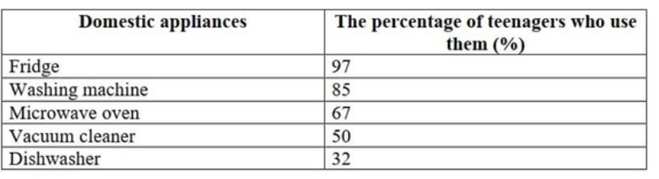
Write 200–250 words.
Use the following plan:
— make an opening statement on the subject of the project work;
— select and describe 2–3 main features;
— make 1–2 comparisons where relevant;
— outline a problem that can arise with domestic appliances and suggest a way of solving it;
— conclude by giving your personal opinion on the role of modern home appliances in our life.
40.2 Imagine that you are doing a project on what is important when choosing an online grocery store in Zetland. You have found some data on the subject (see the diagram below). Comment on the data in the diagram and give your personal opinion on the subject of the project.
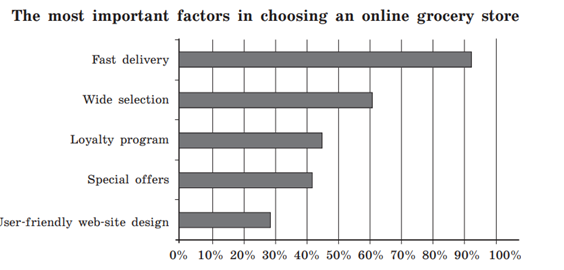
Write 200–250 words.
Use the following plan:
— make an opening statement on the subject of the project work;
— select and describe 2–3 main features;
— make 1–2 comparisons where relevant;
— outline a problem that can arise when doing grocery shopping online and suggest a way of solving it;
— conclude by giving your personal opinion on the role of online shopping in our life.
Раздел 5. Говорение
Imagine that you are preparing a project with your friend. You have found some interesting material for the presentation and you want to read this text to your friend. You have 1.5 minutes to read the text silently, then be ready to read it out aloud. You will not have more than 1.5 minutes to read it.
41
Physical activity is an essential part of people’s development. Exercising as little as 30 minutes a day can greatly improve your health. Exercise makes us strong, fast, patient and disciplined. Regular physical activity is important for our overall health and well-being. Physical exercise strengthens the immune system, improves mental health and helps prevent such diseases as heart and cardiovascular disease, diabetes and obesity.
Regular exercise can help improve your mood, reduce the risk of chronic disease, increase energy levels and even improve sleep. Exercise causes endorphins to be released in the brain. Endorphins are chemicals produced by your body that reduce pain and can make you feel happier.
That is why exercise is the best remedy for depression and stress. Exercise also increases the flow of oxygen to the brain and improves mental clarity and memory.
If your goal is to increase your life span and to have good health, you should lead a healthy lifestyle.
42
Study the advertisement.

You are considering buying this Tesla phone and now you’d like tp get more information. In 1.5 minutes you are to ask four direct questions to find out the following:
- solar charging
- the number of cameras
- monthly charge for using Starlink
- battery capacity
You have 20 seconds to ask each questions.
Показать ответ
1. Does the phone have solar charging?
2. How many cameras does the phone have?
3. What is monthly charge for using Starlink?
4. What is the battery capacity which I can use?
43
You are going to give an interview. You have to answer five questions. Give full answers to the questions (2-3 sentences).
Remember that you have 40 seconds to answer each question.
Interviewer: Hello everybody! It’s IT Channel. Our guest today is a teenager from Russia and we are going to discuss the Internet. We’d like to know our guest’s point of view on this issue. Please answer five questions. So, let’s get started.
Interviewer: How often do you use the Internet?
Student: ________________________________________________________________
Interviewer: What do you usually use the Internet for?
Student: _________________________________________________________________
Interviewer: Can the Internet be dangerous? Why?
Student: _________________________________________________________________
Interviewer: Did you use the Internet for studying last year?
Student: _________________________________________________________________
Interviewer: Would you like to study online instead of attending classes at school?
Student: _________________________________________________________________
Interviewer: Thank you very much for the interview!
Показать ответ
1. I use the Internet every day. I can use it for 10 hours in a day, because the Internet helps me to do the work.
2. I usually use the Internet for finding the necessary information for my study and my work. The Internet is very useful system and it gives a lot of opportunity for developing.
3. Yes, I think that the Internet can be dangerous, because sometimes there is a lot of unsafe and false information, which can lead to confusion. Also surfing the Internet can take all the day.
4. Yes, of course, I used the Internet for studying last year. I had lessons online and all my books and resourses were at the computer and in the Internet.
5. No, I wouldn’t like to study online, because I prefer meeting people face to face. I like the real communication and I have a lot of friends. I want to see them from time to time.
44
Imagine that you are doing a project “Ways of Spending Leisure Time” together with your friend. You have found some illustrations and want to share the news. Leave a voice message to your friend. In 2.5 minutes be ready to tell the friend about the photos:
- give a brief description of the photos, justifying the choice of the photos for the project;
- say in what way the pictures are different, justifying the choice of the photos for the project;
- mention the advantages and disadvantages (1-2) of the two ways of spending leisure time;
- express your opinion on the subject of the project – which way of spending your leisure time you would prefer and why.
You will speak for not more than 3 minutes (2-3 sentences for each item of the plan, 12–15 sentences total). You have to talk continuously.

Благодарим авторов сайта langart.ru за помощь в подготовке материалов.