1) Вставьте слово, которое грамматически будет соответствовать содержанию текста.
Imperial Porcelain Factory
The Imperial Porcelain Factory has been making fine porcelain in Russia for centuries. The factory, founded in 1744, was Empress Elizabeths idea with the aim of a ___ (CREATE) centre of excellence in Russian ceramic art.
2) Вставьте слово, которое грамматически будет соответствовать содержанию текста.
After Empress Elizabeth, consecutive monarchs kept the factory busy with orders and allowed it to produce the ___ (FINE) quality porcelain and ceramic plates, vases, tea sets and the like.
3) Вставьте слово, которое грамматически будет соответствовать содержанию текста.
In the 1940s, the factory began to produce its famous cobalt net pattern, which consisted of intersecting lines of deep blue forming a geometric pattern on a white background. The edges of the dishes ___ (HIGHLIGHT) in exquisite 22-karat gold.
4) Вставьте слово, которое грамматически будет соответствовать содержанию текста.
Burger Hut
Peter called into his favourite burger shop on his way home from college one day. He didn’t realise he was out of cash until after he ___ (ORDER) his meal.
5) Вставьте слово, которое грамматически будет соответствовать содержанию текста.
The bill came to £4,99, and luckily, the burger shop accepted bank cards, so he paid with his card and went home. He ___ (EAT) his burger while he was watching TV, and then he went about the rest of his day.
6) Вставьте слово, которое грамматически будет соответствовать содержанию текста.
A couple of weeks later, Peter noticed a £499 charge on his bank statement. ‘This charge can’t be ___ (I). I haven’t used my card for anything that expensive,’ Peter said aloud.
7) Вставьте слово, которое грамматически будет соответствовать содержанию текста.
He saw the words ‘Burger Hut’ alongside the amount, so he called his bank and explained the situation. ‘It does seem strange that someone ___ (SPEND) that much money in a burger shop,’ the bank employee said, and he agreed to correct the charge.
 Вставьте слово, которое грамматически и лексически будет соответствовать содержанию текста.
Apps
Apps are those little computer programs we use on our mobile phones and other small devices. The word ‘app’ is an abbreviation for software ___ (APPLY).
9) Вставьте слово, которое грамматически и лексически будет соответствовать содержанию текста.
Apps have been very popular since the rise of smartphones. There are apps for banking transactions, weather forecasts, video games, maps, calendars and other forms of data ___ (MANAGE).
10) Вставьте слово, которое грамматически и лексически будет соответствовать содержанию текста.
Many apps are available free of charge, or are at least ___ (EXPENSIVE). Some apps with more sophisticated features can cost quite a bit of money, however.
11) Вставьте слово, которое грамматически и лексически будет соответствовать содержанию текста.
An estimated 102 billion apps were downloaded in 2013, proving that the general public’s ___ (REACT) to apps has been positive.
12) Вставьте слово, которое грамматически и лексически будет соответствовать содержанию текста.
Some apps are quite amazing, such as one that can tell you what song is playing in a restaurant or cafe. Others are ___ (POSITIVE) strange — there’s an app that makes a whistling sound that only a dog can hear!
13) Вставьте слово, которое грамматически и лексически будет соответствовать содержанию текста.
When a software company releases a new app, it’s often a ___ (MASS) event. Celebrities make appearances and loads of fans queue up to get a glimpse of them, and perhaps check out the app, too.
14) Запишите в поле ответа цифру 1, 2, 3 или 4, соответствующую выбранному Вами варианту ответа.
Leon and friends
Leon has known his friends for years. He can talk with them about anything, and they rarely disagree ___ one another.
1) to
2) about
3) over
4) with
15) Запишите в поле ответа цифру 1, 2, 3 или 4, соответствующую выбранному Вами варианту ответа.
One day, however, he and his friend Jarrod got into a terrible argument over sport. Leon was quite surprised, actually, because the argument got so bad that Jarrod ___ out of his house. Leon had never been so upset in his life.
1) blew
2) stormed
3) flooded
4) rained
16) Запишите в поле ответа цифру 1, 2, 3 или 4, соответствующую выбранному Вами варианту ответа.
A week went by and they hadn’t spoken to one another. Leon told his other friends what had happened, but they hadn’t seen Jarrod in a while. Leon guessed he had to be the one to ___ out to him.
1) touch
2) catch
3) pull
4) reach
17) Запишите в поле ответа цифру 1, 2, 3 или 4, соответствующую выбранному Вами варианту ответа.
He decided to visit Jar rod’s house and meet him face-to-face. He knew they had to speak eventually and he didn’t want to ___ the agony. But no one answered the door when he rang. Confused, Leon thought he would just leave a note. I’m sorry we got into an argument the other day. Please, let’s talk soon,’ he wrote.
1) prolong
2) extend
3) lengthen
4) stretch
18) Запишите в поле ответа цифру 1, 2, 3 или 4, соответствующую выбранному Вами варианту ответа.
Later that night, Leon received a call from Jarrod. Strangely, Jarrod tried to ___ that it wasn’t a big deal.
1) play
2) imagine
3) fake
4) pretend
19) Запишите в поле ответа цифру 1, 2, 3 или 4, соответствующую выбранному Вами варианту ответа.
‘But you got up and left my house. You nearly ran out!’ replied Leon. ‘Sorry, I guess I just let my emotions get the ___ of me.
1) bad
2) good
3) better
4) worse
20) Запишите в поле ответа цифру 1, 2, 3 или 4, соответствующую выбранному Вами варианту ответа.
It was really stupid. Forgive me,’ said Jarrod. That was all Leon needed to hear, and the two of them laid the incident to ___.
1) rest
2) sleep
3) break
4) nap
Упражнение на грамматическое преобразование слов. Рекомендуем всем, кто готовится к сдачи ЕГЭ по английскому языку.
Прочитайте приведённый ниже текст. Образуйте от слов, напечатанных заглавными буквами, однокоренные слова, так, чтобы они грамматически соответствовали содержанию текста.
ЗаданиеОтвет
Imperial Porcelain Factory
The Imperial Porcelain Factory has been making fine porcelain in Russia for centuries. The factory, founded in 1744, was Empress Elizabeth’s idea with the aim of ( CREATE ) ceramic art.
After Empress Elizabeth, consecutive monarchs kept the factory busy with orders and allowed it to produce the ( FINE ) quality porcelain and ceramic plates, vases, tea sets and the like.
In the 1940s, the factory began to produce its famous cobalt net pattern, which consisted of intersecting lines of deep blue forming a geometric pattern on a white background. The edges of the dishes ( HIGHLIGHT ) in exquisite 22-karat gold.
Imperial Porcelain Factory
The Imperial Porcelain Factory has been making fine porcelain in Russia for centuries. The factory, founded in 1744, was Empress Elizabeth’s idea with the aim of CREATING ceramic art.
After Empress Elizabeth, consecutive monarchs kept the factory busy with orders and allowed it to produce the FINEST quality porcelain and ceramic plates, vases, tea sets and the like.
In the 1940s, the factory began to produce its famous cobalt net pattern, which consisted of intersecting lines of deep blue forming a geometric pattern on a white background. The edges of the dishes WERE HIGHLIGHTED in exquisite 22-karat gold.
1) Вставьте слово, которое грамматически будет соответствовать содержанию текста.
Imperial Porcelain Factory
The Imperial Porcelain Factory has been making fine porcelain in Russia for centuries. The factory, founded in 1744, was Empress Elizabeths idea with the aim of a ___ (CREATE) centre of excellence in Russian ceramic art.
2) Вставьте слово, которое грамматически будет соответствовать содержанию текста.
After Empress Elizabeth, consecutive monarchs kept the factory busy with orders and allowed it to produce the ___ (FINE) quality porcelain and ceramic plates, vases, tea sets and the like.
3) Вставьте слово, которое грамматически будет соответствовать содержанию текста.
In the 1940s, the factory began to produce its famous cobalt net pattern, which consisted of intersecting lines of deep blue forming a geometric pattern on a white background. The edges of the dishes ___ (HIGHLIGHT) in exquisite 22-karat gold.
4) Вставьте слово, которое грамматически будет соответствовать содержанию текста.
Burger Hut
Peter called into his favourite burger shop on his way home from college one day. He didn’t realise he was out of cash until after he ___ (ORDER) his meal.
5) Вставьте слово, которое грамматически будет соответствовать содержанию текста.
The bill came to £4,99, and luckily, the burger shop accepted bank cards, so he paid with his card and went home. He ___ (EAT) his burger while he was watching TV, and then he went about the rest of his day.
6) Вставьте слово, которое грамматически будет соответствовать содержанию текста.
A couple of weeks later, Peter noticed a £499 charge on his bank statement. ‘This charge can’t be ___ (I). I haven’t used my card for anything that expensive,’ Peter said aloud.
7) Вставьте слово, которое грамматически будет соответствовать содержанию текста.
He saw the words ‘Burger Hut’ alongside the amount, so he called his bank and explained the situation. ‘It does seem strange that someone ___ (SPEND) that much money in a burger shop,’ the bank employee said, and he agreed to correct the charge.
Вставьте слово, которое грамматически и лексически будет соответствовать содержанию текста.
Apps
Apps are those little computer programs we use on our mobile phones and other small devices. The word ‘app’ is an abbreviation for software ___ (APPLY).
9) Вставьте слово, которое грамматически и лексически будет соответствовать содержанию текста.
Apps have been very popular since the rise of smartphones. There are apps for banking transactions, weather forecasts, video games, maps, calendars and other forms of data ___ (MANAGE).
10) Вставьте слово, которое грамматически и лексически будет соответствовать содержанию текста.
Many apps are available free of charge, or are at least ___ (EXPENSIVE). Some apps with more sophisticated features can cost quite a bit of money, however.
11) Вставьте слово, которое грамматически и лексически будет соответствовать содержанию текста.
An estimated 102 billion apps were downloaded in 2013, proving that the general public’s ___ (REACT) to apps has been positive.
12) Вставьте слово, которое грамматически и лексически будет соответствовать содержанию текста.
Some apps are quite amazing, such as one that can tell you what song is playing in a restaurant or cafe. Others are ___ (POSITIVE) strange — there’s an app that makes a whistling sound that only a dog can hear!
13) Вставьте слово, которое грамматически и лексически будет соответствовать содержанию текста.
When a software company releases a new app, it’s often a ___ (MASS) event. Celebrities make appearances and loads of fans queue up to get a glimpse of them, and perhaps check out the app, too.
14) Запишите в поле ответа цифру 1, 2, 3 или 4, соответствующую выбранному Вами варианту ответа.
Leon and friends
Leon has known his friends for years. He can talk with them about anything, and they rarely disagree ___ one another.
1) to
2) about
3) over
4) with
15) Запишите в поле ответа цифру 1, 2, 3 или 4, соответствующую выбранному Вами варианту ответа.
One day, however, he and his friend Jarrod got into a terrible argument over sport. Leon was quite surprised, actually, because the argument got so bad that Jarrod ___ out of his house. Leon had never been so upset in his life.
1) blew
2) stormed
3) flooded
4) rained
16) Запишите в поле ответа цифру 1, 2, 3 или 4, соответствующую выбранному Вами варианту ответа.
A week went by and they hadn’t spoken to one another. Leon told his other friends what had happened, but they hadn’t seen Jarrod in a while. Leon guessed he had to be the one to ___ out to him.
1) touch
2) catch
3) pull
4) reach
17) Запишите в поле ответа цифру 1, 2, 3 или 4, соответствующую выбранному Вами варианту ответа.
He decided to visit Jar rod’s house and meet him face-to-face. He knew they had to speak eventually and he didn’t want to ___ the agony. But no one answered the door when he rang. Confused, Leon thought he would just leave a note. I’m sorry we got into an argument the other day. Please, let’s talk soon,’ he wrote.
1) prolong
2) extend
3) lengthen
4) stretch
18) Запишите в поле ответа цифру 1, 2, 3 или 4, соответствующую выбранному Вами варианту ответа.
Later that night, Leon received a call from Jarrod. Strangely, Jarrod tried to ___ that it wasn’t a big deal.
1) play
2) imagine
3) fake
4) pretend
19) Запишите в поле ответа цифру 1, 2, 3 или 4, соответствующую выбранному Вами варианту ответа.
‘But you got up and left my house. You nearly ran out!’ replied Leon. ‘Sorry, I guess I just let my emotions get the ___ of me.
1) bad
2) good
3) better
4) worse
20) Запишите в поле ответа цифру 1, 2, 3 или 4, соответствующую выбранному Вами варианту ответа.
It was really stupid. Forgive me,’ said Jarrod. That was all Leon needed to hear, and the two of them laid the incident to ___.
1) rest
2) sleep
3) break
4) nap

Автор росписи: Шуляк, Галина Дмитриевна. Род. 1944; Автор формы: Филиппенко, Даниил Дальевич (форма «Лилия»). Род. 1962 Ваза «Античный фриз» из композиции «Античный фасон» 2012 г.
From Wikipedia, the free encyclopedia
Jump to navigation
Jump to search
Imperial Porcelain Factory may refer to:
- Jingdezhen porcelain, Chinese imperial porcelain factories were located there from the 14th century
- Vienna porcelain (Kaiserlich privilegierte Porcellain Fabrique), 1718 to 1864
- Imperial Porcelain Factory, Saint Petersburg, 1744 to date (under different names 1917 to 2005)
- Yıldız Palace, Istanbul, home of the Turkish Imperial Porcelain Factory or «Yıldız Porcelain Factory», 1890s to present

This disambiguation page lists articles associated with the title Imperial Porcelain Factory.
If an internal link led you here, you may wish to change the link to point directly to the intended article.
Retrieved from «https://en.wikipedia.org/w/index.php?title=Imperial_Porcelain_Factory&oldid=897695914»
Categories:
- Disambiguation pages
National Treasure IMPERIAL PORCELAIN FACTORY
Students: Basil Kornishov
Ivan Grigoryev
School: 667
Form: 8v
Teacher: Trubitsina T.M.
Saint Petersburg
Nevsky district
Project: Looking at the world out of my window
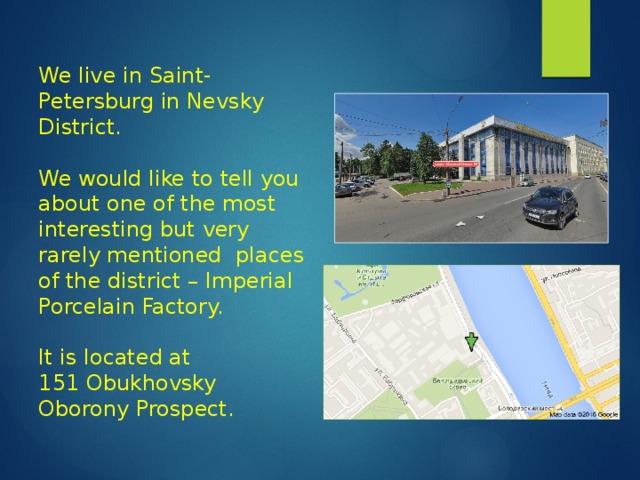
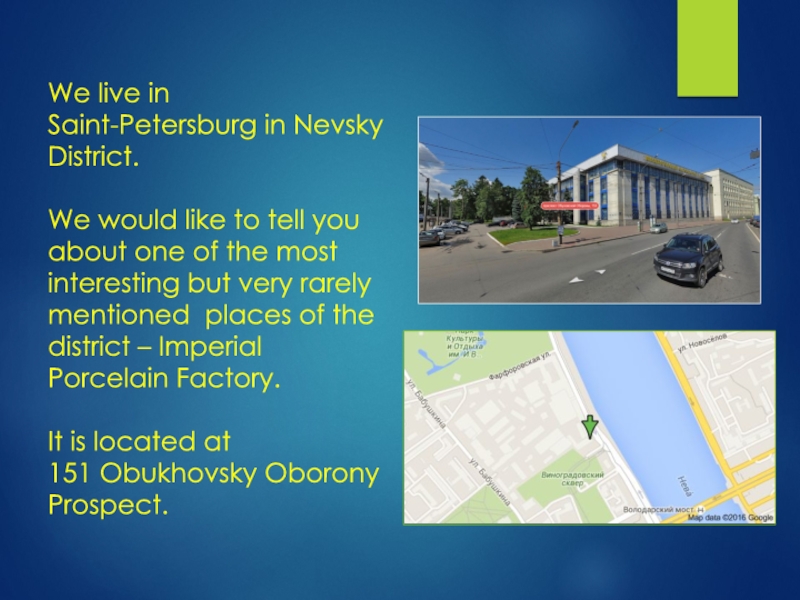
We live in Saint-Petersburg in Nevsky District.
We would like to tell you about one of the most interesting but very rarely mentioned places of the district – Imperial Porcelain Factory.
It is located at
151 Obukhovsky Oborony Prospect.
18 th CENTURY
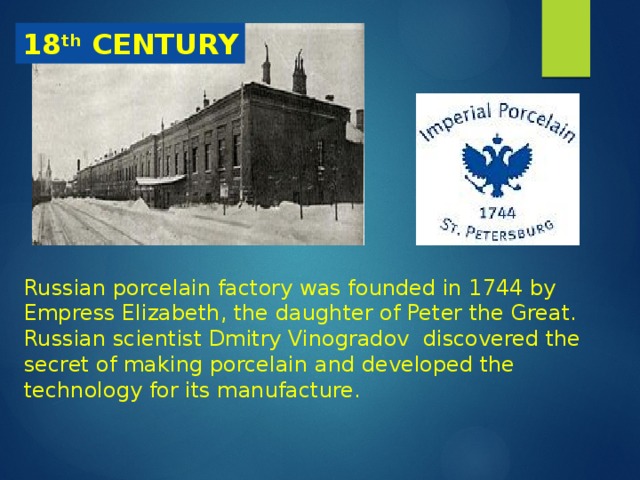
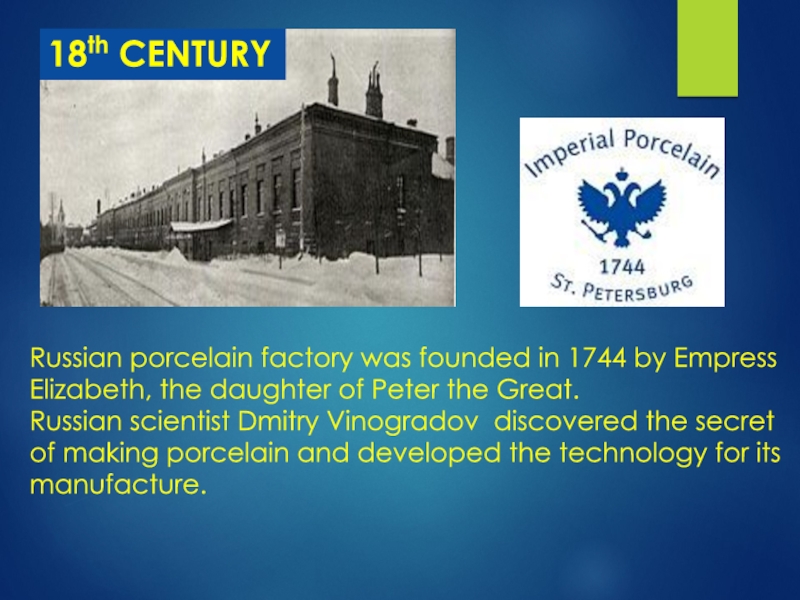
Russian porcelain factory was founded in 1744 by Empress Elizabeth, the daughter of Peter the Great.
Russian scientist Dmitry Vinogradov discovered the secret of making porcelain and developed the technology for its manufacture.
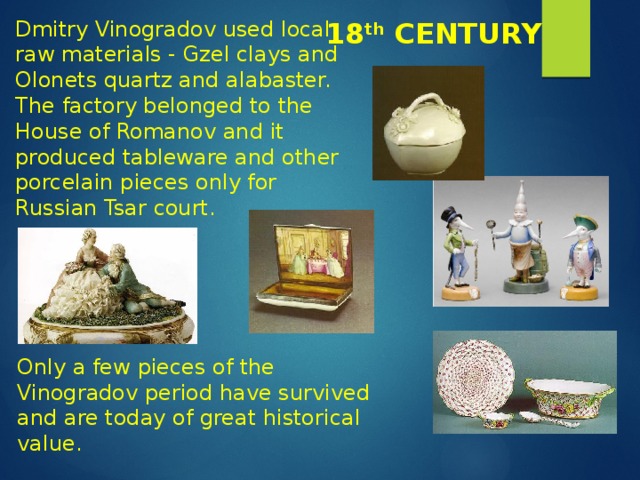
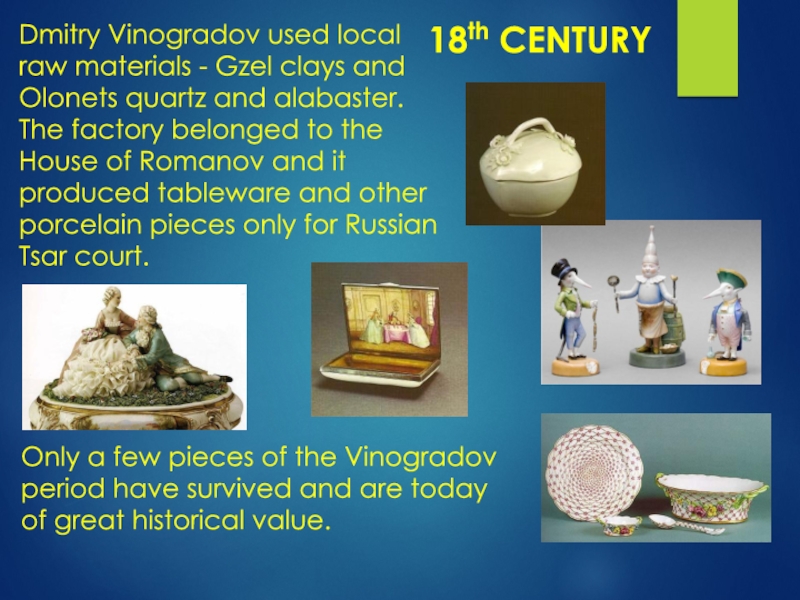
Dmitry Vinogradov used local raw materials — Gzel clays and Olonets quartz and alabaster.
The factory belonged to the House of Romanov and it produced tableware and other porcelain pieces only for Russian Tsar court.
18 th CENTURY
Only a few pieces of the Vinogradov period have survived and are today of great historical value.
19 th CENTURY
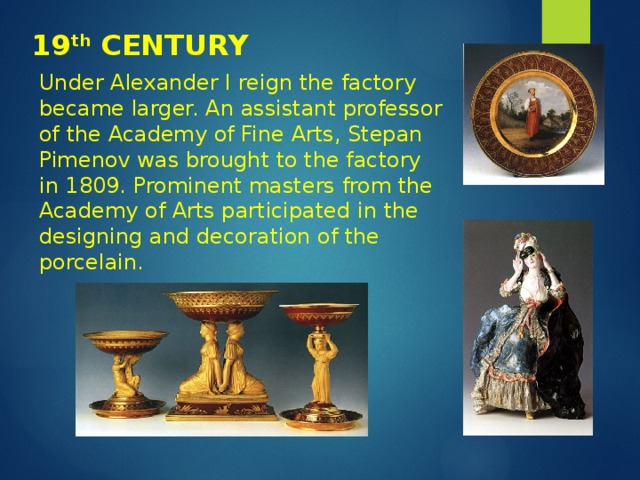
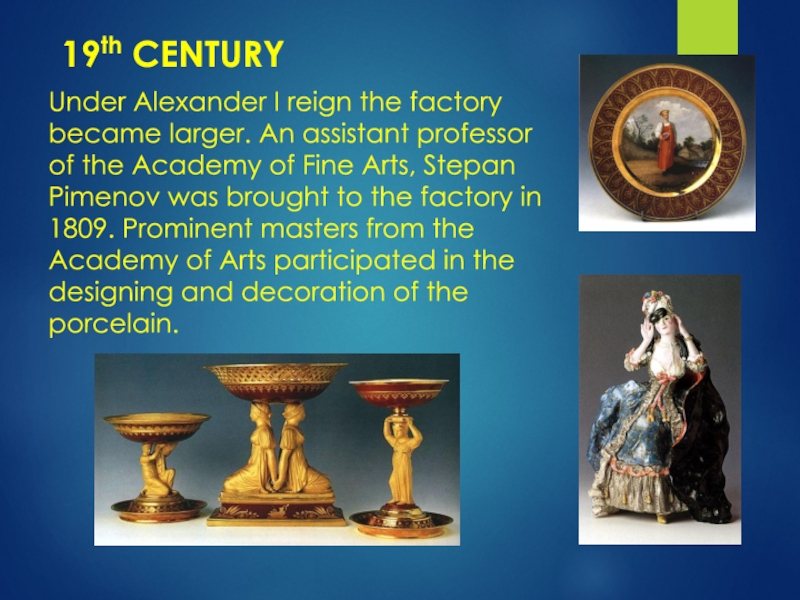
Under Alexander I reign the factory became larger. An assistant professor of the Academy of Fine Arts, Stepan Pimenov was brought to the factory in 1809. Prominent masters from the Academy of Arts participated in the designing and decoration of the porcelain.
19 th CENTURY
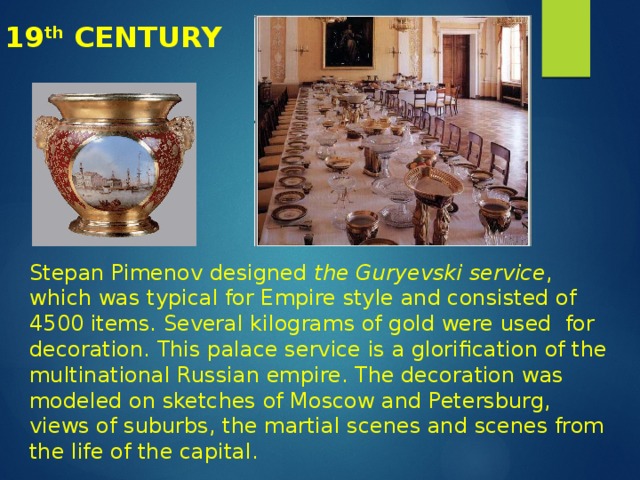
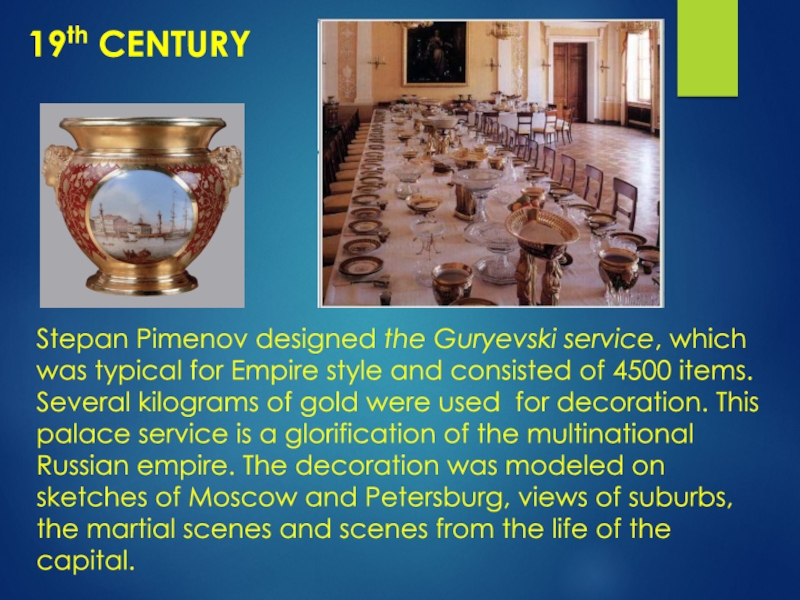
Stepan Pimenov designed the Guryevski service , which was typical for Empire style and consisted of 4500 items. Several kilograms of gold were used for decoration. This palace service is a glorification of the multinational Russian empire. The decoration was modeled on sketches of Moscow and Petersburg, views of suburbs, the martial scenes and scenes from the life of the capital.
20 th CENTURY
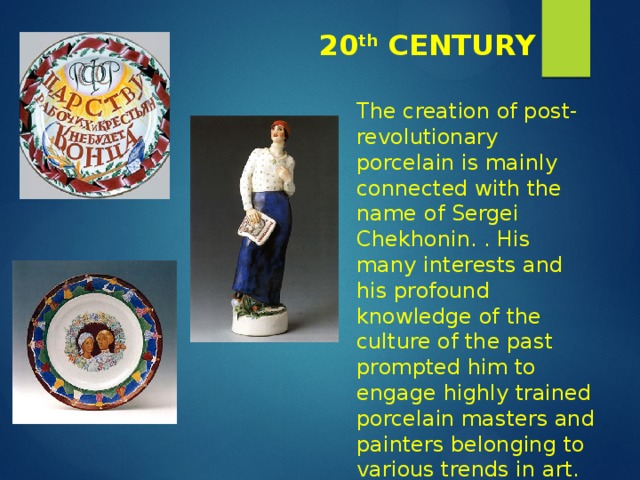
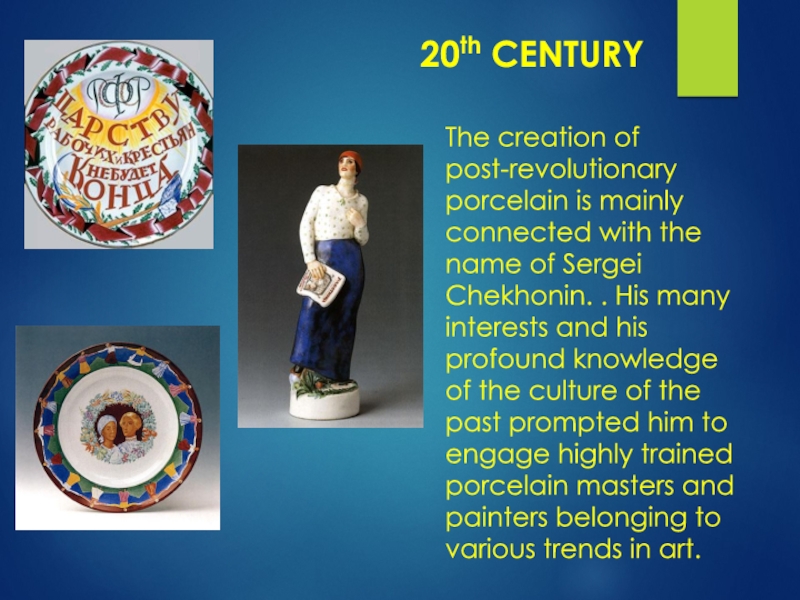
The creation of post-revolutionary porcelain is mainly connected with the name of Sergei Chekhonin. . His many interests and his profound knowledge of the culture of the past prompted him to engage highly trained porcelain masters and painters belonging to various trends in art.
20 th CENTURY
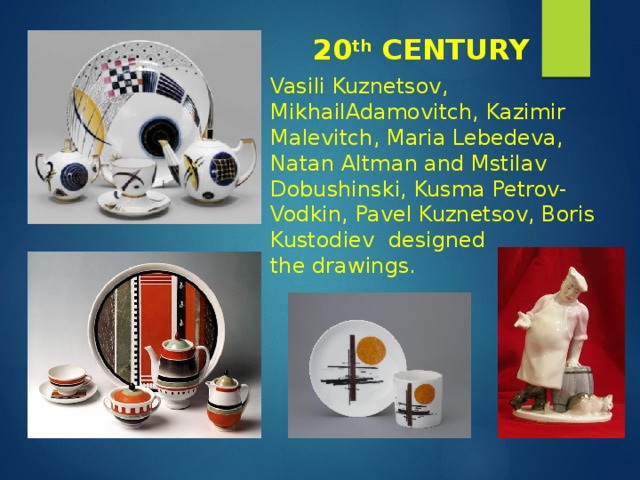
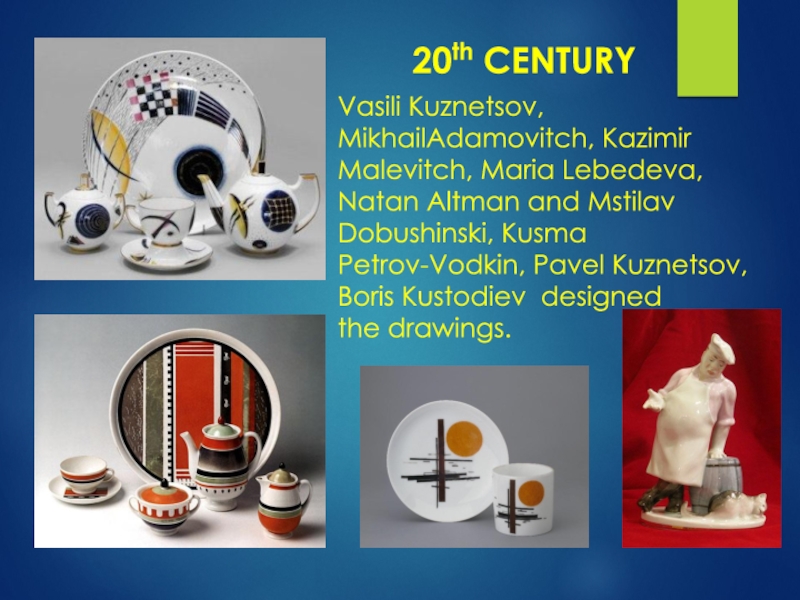
Vasili Kuznetsov, MikhailAdamovitch, Kazimir Malevitch, Maria Lebedeva, Natan Altman and Mstilav Dobushinski, Kusma Petrov-Vodkin, Pavel Kuznetsov, Boris Kustodiev designed
the drawings.
20 th CENTURY
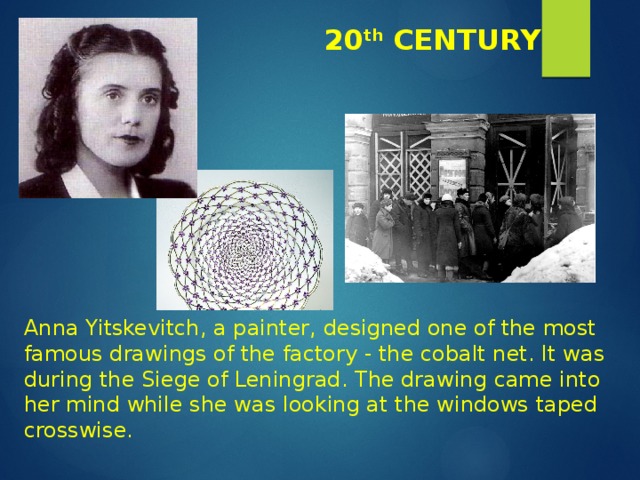
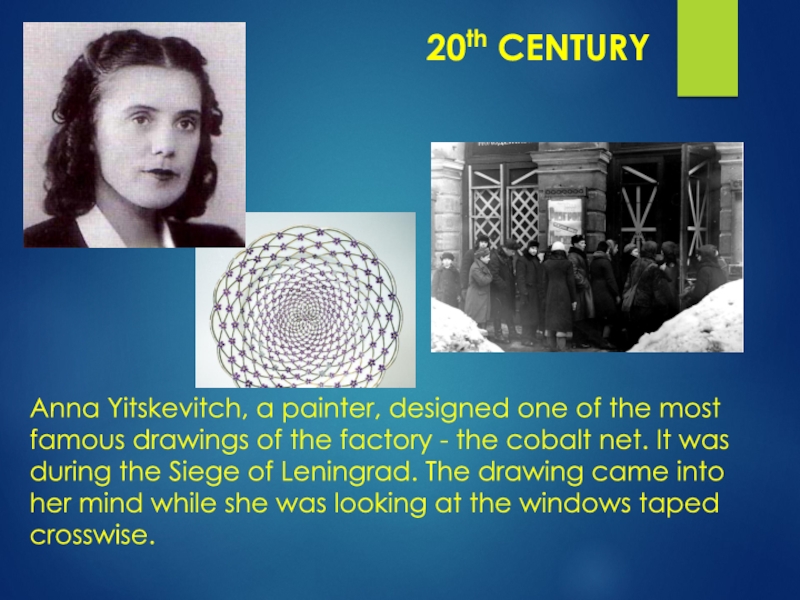
Anna Yitskevitch, a painter, designed one of the most famous drawings of the factory — the cobalt net. It was during the Siege of Leningrad. The drawing came into her mind while she was looking at the windows taped crosswise.
20 th CENTURY
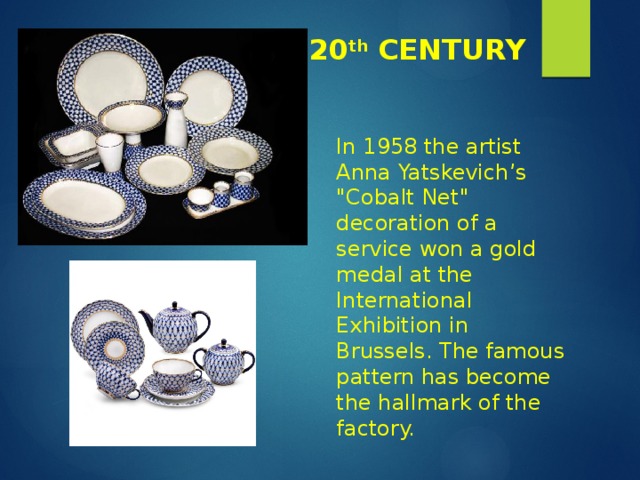
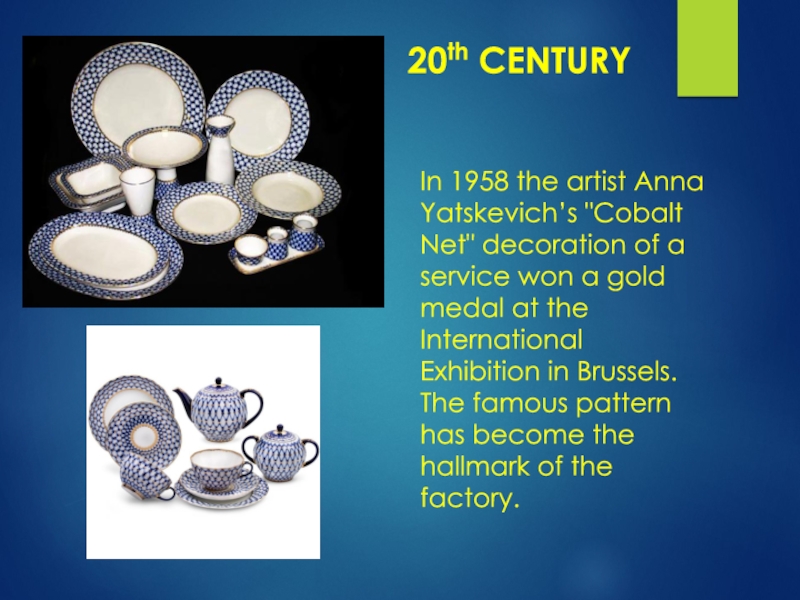
In 1958 the artist Anna Yatskevich’s «Cobalt Net» decoration of a service won a gold medal at the International Exhibition in Brussels. The famous pattern has become the hallmark of the factory.
21st CENTURY
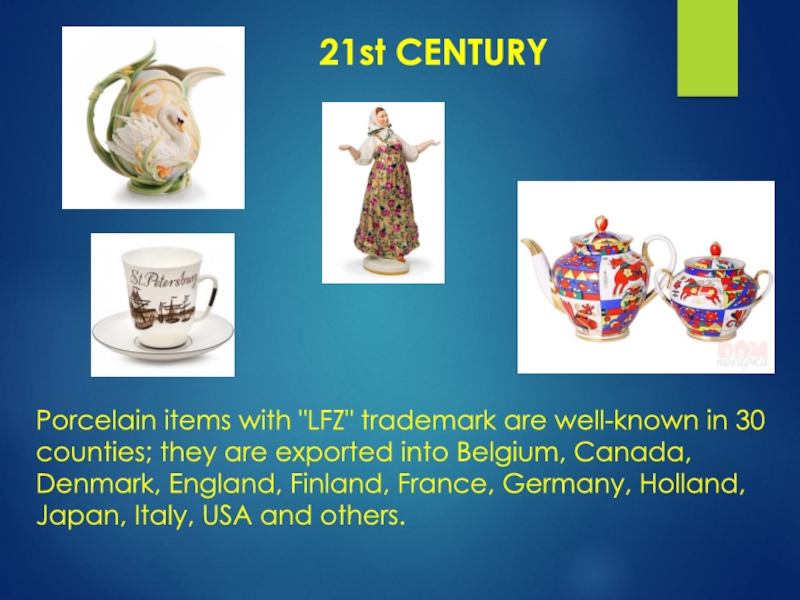
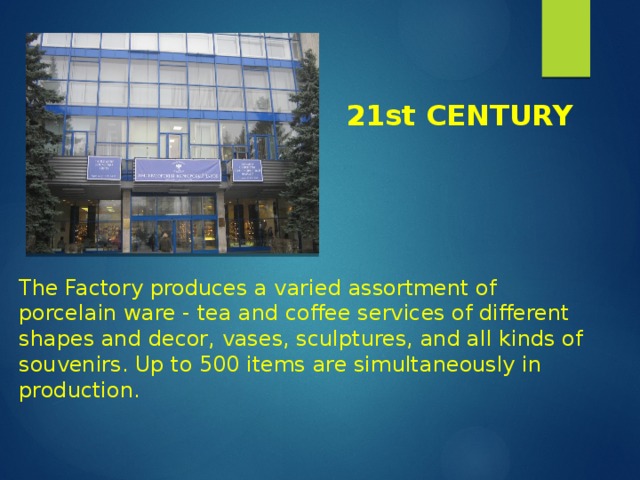
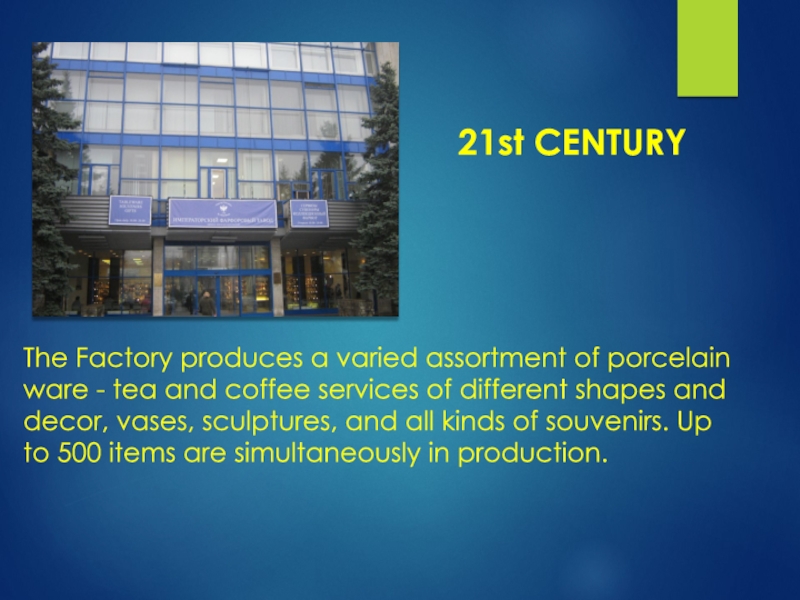
The Factory produces a varied assortment of porcelain ware — tea and coffee services of different shapes and decor, vases, sculptures, and all kinds of souvenirs. Up to 500 items are simultaneously in production.
21st CENTURY
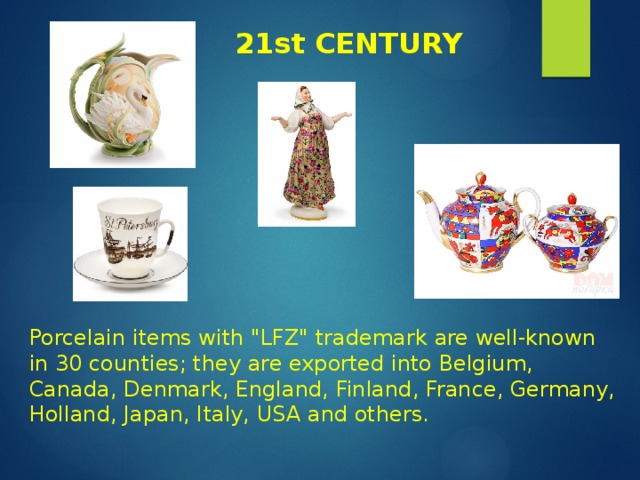
Porcelain items with «LFZ» trademark are well-known in 30 counties; they are exported into Belgium, Canada, Denmark, England, Finland, France, Germany, Holland, Japan, Italy, USA and others.
THANK YOU FOR YOUR ATTENTION
Instance of manufactory,
porcelain manufacture,
trademark,
online shop
- Reasonator
- PetScan
- Scholia
- Statistics
- OpenStreetMap
- Locator tool
- WikiShootMe
- Search depicted
Задание № 23842
Прочитайте текст и заполните пропуски A-F частями предложений, обозначенными цифрами 1-7. Одна из частей в списке лишняя.
1. as China was the birthplace of porcelain
2. within the fired body at these high
3. the term porcelain lacks a universal definition
4. generally including clay in the form of kaolin
5. it can be difficult to distinguish between stoneware and porcelain
6. because of its resemblance to the translucent surface
7. to chemical attack and thermal shock
Porcelain
Porcelain is a ceramic material made by heating materials, A_________, in a kiln to temperatures between 1,200 and 1,400 °C (2,200 and 2,600°F). The toughness, strength, and translucence of porcelain arises mainly from the formation of glass and the mineral mullet В__________________temperatures.
Porcelain derives its present name from the old Italian porcellana (cowrie shell) C______________of the shell. Porcelain can informally be referred to as “china” or “fine china” in some English-speaking countries, D____________making. Properties associated with porcelain include low permeability and elasticity; considerable strength, hardness, toughness, whiteness, translucency and resonance; and a high resistance E______________.
For the purposes of trade, the Combined Nomenclature of the European Communities defines porcelain as being “completely vitrified, hard, impermeable (even before glazing), white or artificially coloured, translucent (except when of considerable thickness), and resonant.” However, F_____________and has “been applied in a very unsystematic fashion to substances of diverse kinds which have only certain surface- qualities in common” (Burton 1906).
Показать ответ
Комментарий:
A — 4 По переводу: Фарфор представляет собой керамический материал, изготовленный из нагретых материалов, в общем, включая глину в виде каолина, в печи с температурой от 1200 до 1400 ° C (2200 и 2600 ° F).
B — 2 Перед «temperatures» необходимо уточнение каких именно температур: «high temperatures».
C — 6 Требуется объяснение причины (Фарфор получает свое нынешнее название от старой итальянской porcellana (раковины каури)) . Придаточное причины вводится зачастую словом «because».
D — 1 После фразы » in some English-speaking countries,» логичны примеры: «as China was the birthplace of porcelain».
E — 7″ a high resistance » требует после себя только предлога TO.
F — 3 По логике предложения: Однако термин «фарфор» не имеет универсального определения и «очень несистематичен» применительно к веществам различного вида, которые имеют только определенные поверхностные качества »(Burton 1906).
Ответ: 426173
Нашли ошибку в задании? Выделите фрагмент и нажмите Ctrl + Enter.
1. Imperial Porcelain Factory
While in Europe they carefully preserve Meissen, Limoges and Bohemian porcelain, in Russia they still greatly value the exquisite sets of the Imperial Porcelain Factory.
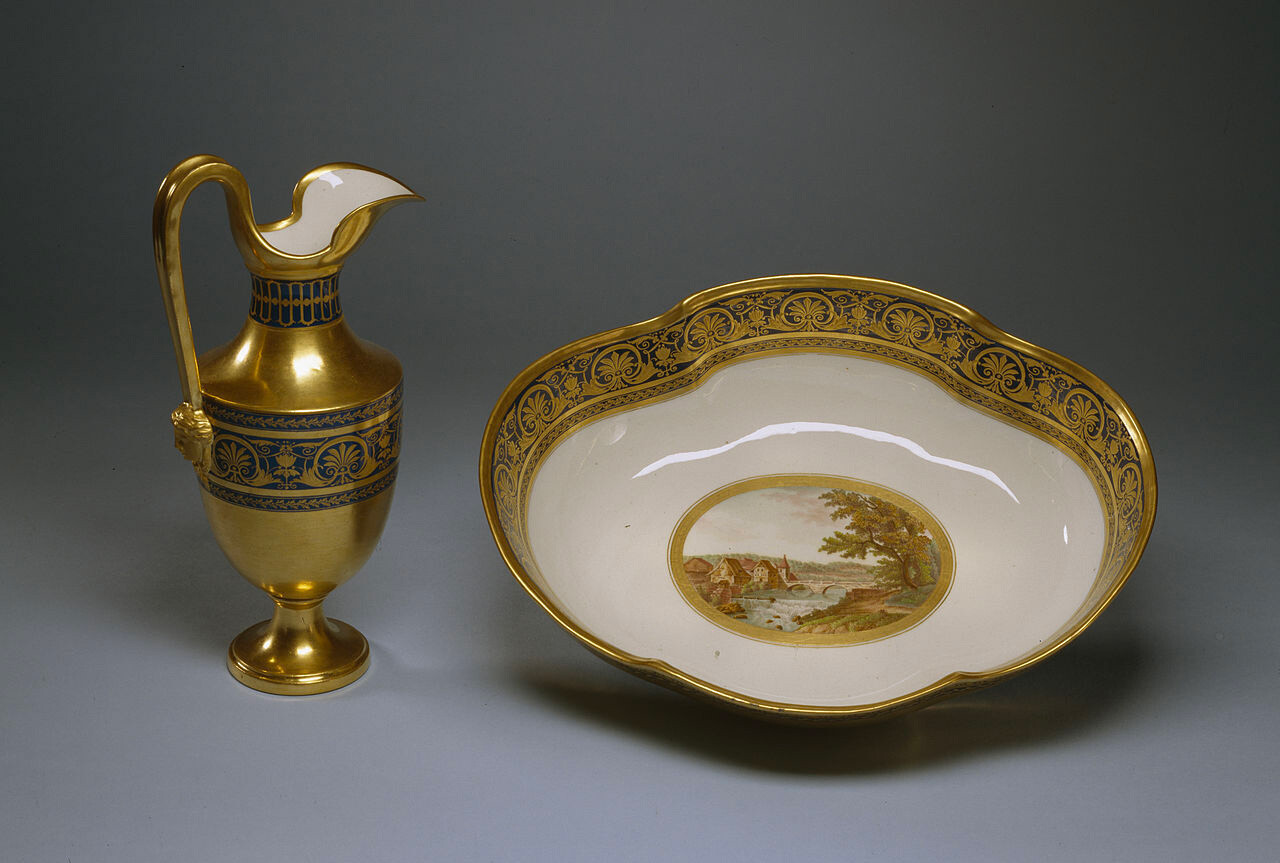
Gilded porcelain produced by Imperial Porcelain Factory.
Walters Art Museum
The factory was founded in 1744 as Nevskaya Porcelain Manufactory. In just several years, Russian chemist Dmitry Vinogradov managed to fully establish production – develop the composition of the porcelain mixture, the glazing, the paints for finishing and gold dust for decoration.
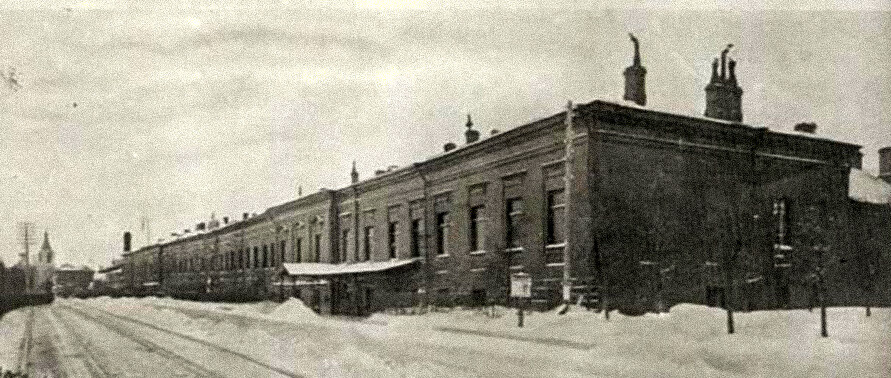
Imperial Porcelain Factory in 1904.
Public domain
He produced the first successful samples in 1747, and in 1756 he designed a porcelain set for Empress Elizaveta Petrovna’s parade dinners. In 1756, the manufacturer received the name “Imperial Porcelain Factory.”
For many years one could see the monogram of the ruling monarch on the bottom of its goods, but today it features the two-headed eagle.
READ MORE: WHY IS RUSSIAN IMPERIAL PORCELAIN SO POPULAR IN THE U.S.?
2. Pavlovsky Posad Kerchief Manufacture

Girl in a Pavlovo Posad scarf in Pavlovsky Posad.
Ekaterina Rerberg/Sputnik
A woolen shawl with a bright flower design is not just pretty but also a practical accessory that can keep you warm during times of severe cold.
The most famous Russian shawls are made by Pavlovsky Posad Kerchief Manufacture that was founded in 1795 on the basis of local silk shawl cottage industries. The production of woolen or semi-woolen printed fabric shawls began in the 1850s. Every shawl was unique.
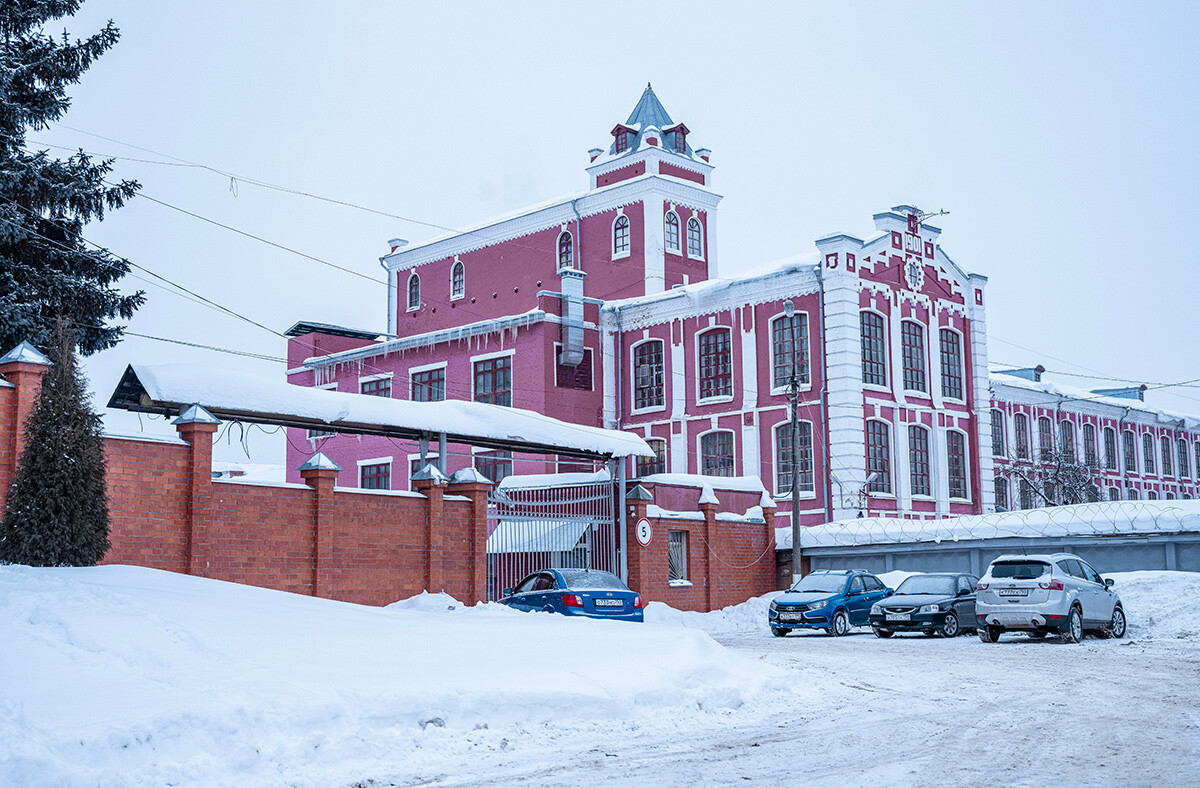
Pavlovsky Posad Kerchief Manufacture.
Ekaterina Rerberg/Sputnik
Classic colors for Pavlovsky Posad shawls include black, burgundy and unbleached linen. Later, their palette was expanded. Most often flowers are depicted on the shawls (roses and dahlias), arranged in bouquets or garlands with the addition of ornaments or floral patterns. Every distinct type of shawl has a specific name – “Gathering”, “Crane”, “Scarlet flower”, “White roses” and etc.
READ MORE: 7 TYPES OF SCARVES MADE IN DIFFERENT RUSSIAN REGIONS
3. Babayevsky Confectioners
Every Russian child’s heart skips a beat when they unwrap “Mishka kosolapy” (“Clumsy bear”) or “Belochka” (“Squirrel”) chocolates. Just like “Vdokhnovenie” (“Inspiration”) or “Babaevsky” chocolate, they’re produced by the imperial-era company, Babayevsky Confectioners (a part of the United Confectioners holding).
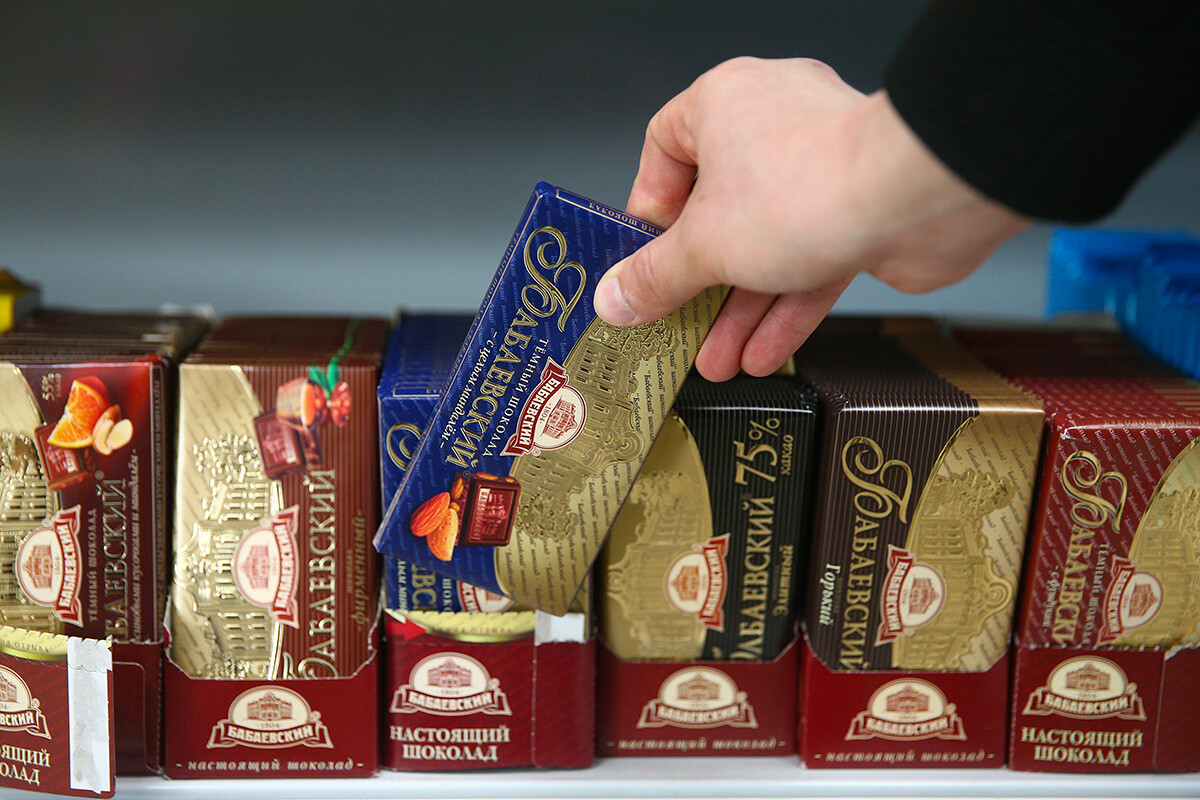
Babaevsky chocolate bars on sale at a grocery store.
Yegor Aleyev/TASS
The factory’s history began in 1804 when the Abrikosov family of confectioners opened a workshop. Their chocolates, packaged in pretty boxes with cards and puzzles, were much to children’s liking and became an important attribute of important holidays.
After the 1917 Revolution, the company was nationalized, then renamed after party worker Peter Babayev and continued to manufacture chocolate candies.
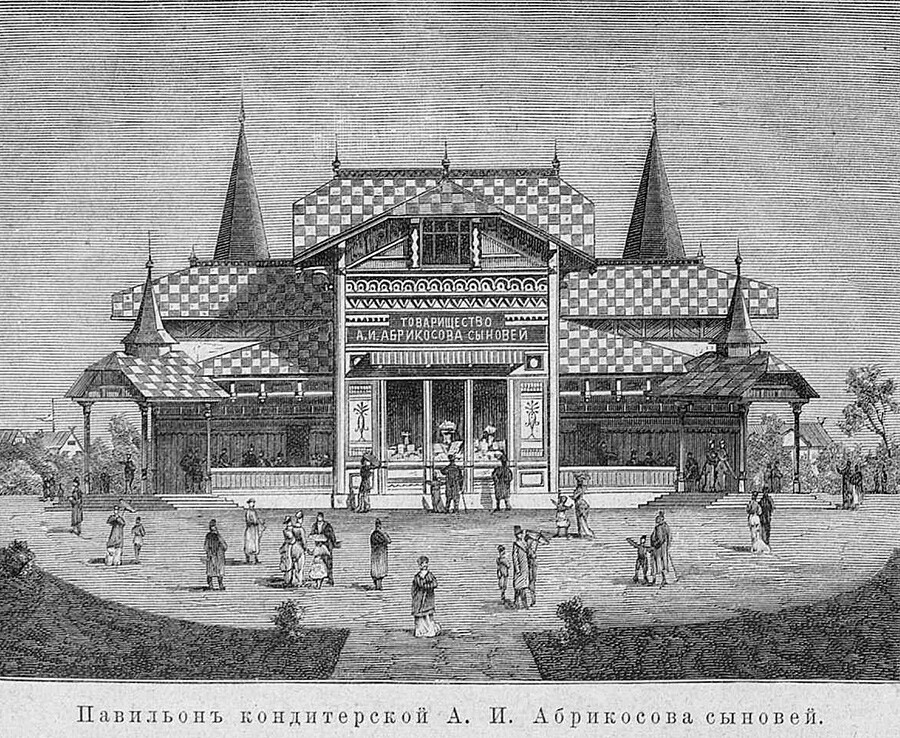
The pavilion of the Abrikosov Sons Company at the Exhibition. Moscow, 1882.
Public domain
READ MORE: TOP 10 RUSSIAN CANDIES
4. Red October
The history of the most famous Russian chocolate factory began thanks to confectioner Ferdinand Theodor von Einem, a citizen of the Kingdom of Württemberg (a historical region of Germany). His candy and chocolate workshop opened in Moscow in 1851, and it supplied chocolates for the imperial family’s table. After the October Revolution, the factory was nationalized and soon after renamed “Red October.”
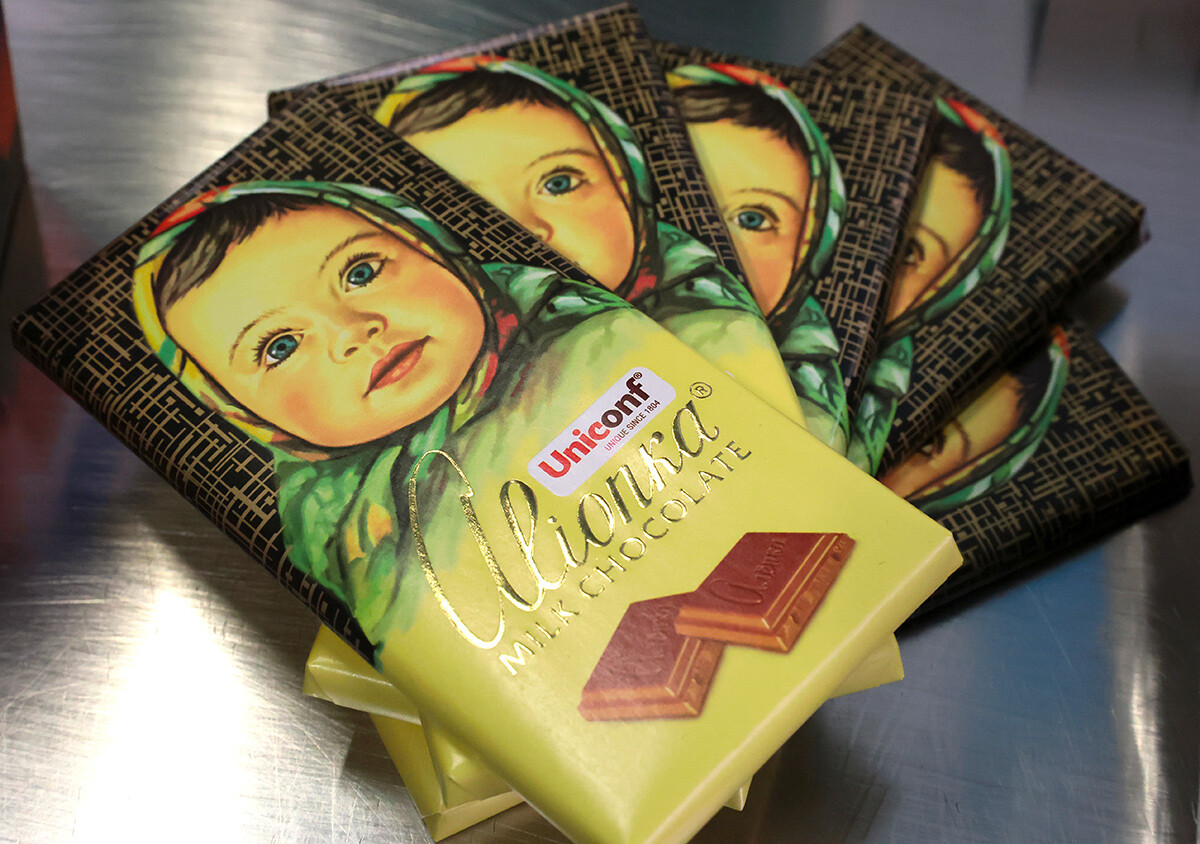
Alenka chocolate at the Krasny Oktyabr Chocolate Factory in Moscow.
Vitaly Belousov/Sputnik
Among the factory’s most famous trademarks are the chocolate candies “Alyonka”, “Krasnaya shapochka” (“Red Riding Hood”), “Rakovye sheyki” (“Crayfish tails”), and “Kara-kum.”
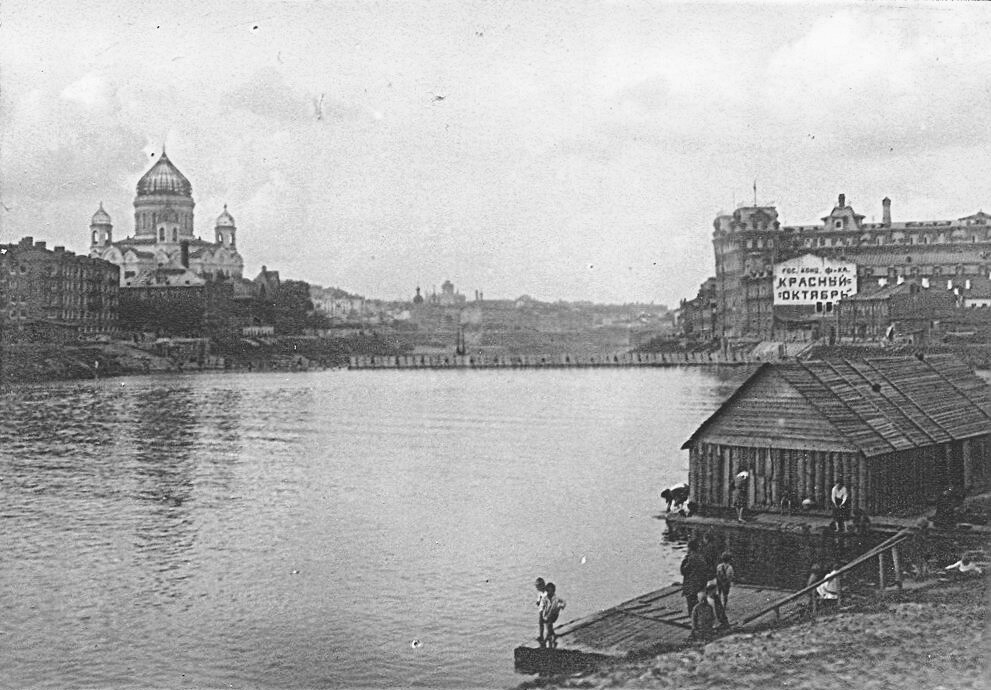
The «Red October» («Krasny Oktyabr») factory in the 1920s.
Public domain
The factory also produced chocolates for important events. For the first human space flight they produced “Kosmicheskiye” (“Space”) chocolates, and for the 1980 Olympics – “Finish”, “Volleyball” and “Ogni Moskvy” (“Moscow Lights”) chocolates. Since 2002 the company has been a part of the United Confectioners holding.
READ MORE: HOW CHOCOLATE APPEARED IN RUSSIA
5. Imperial Tula Arms Factory
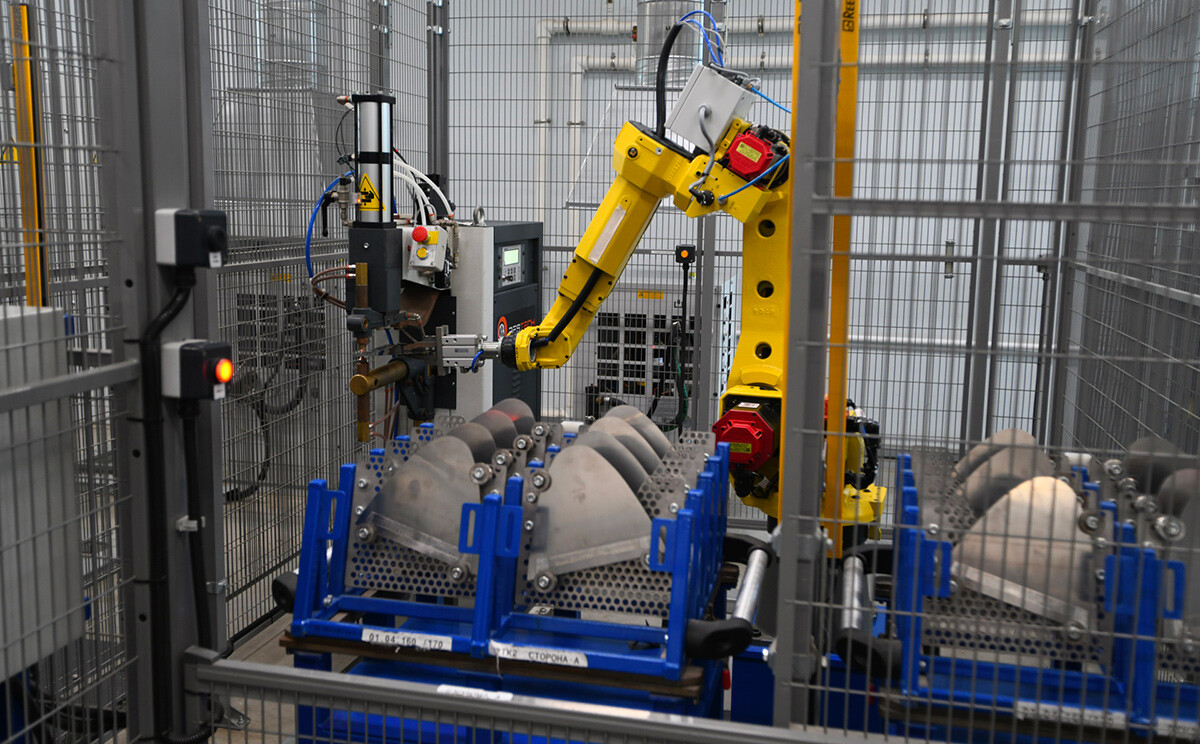
The country’s oldest arms factory was founded in 1712 by the decree of Peter the Great. Back in 1720, the factory produced 22,000 rifles and handguns with the flintlock mechanism to equip the army. In 1749, the mass production of cold weapons began here – blades, sabers and rapiers.
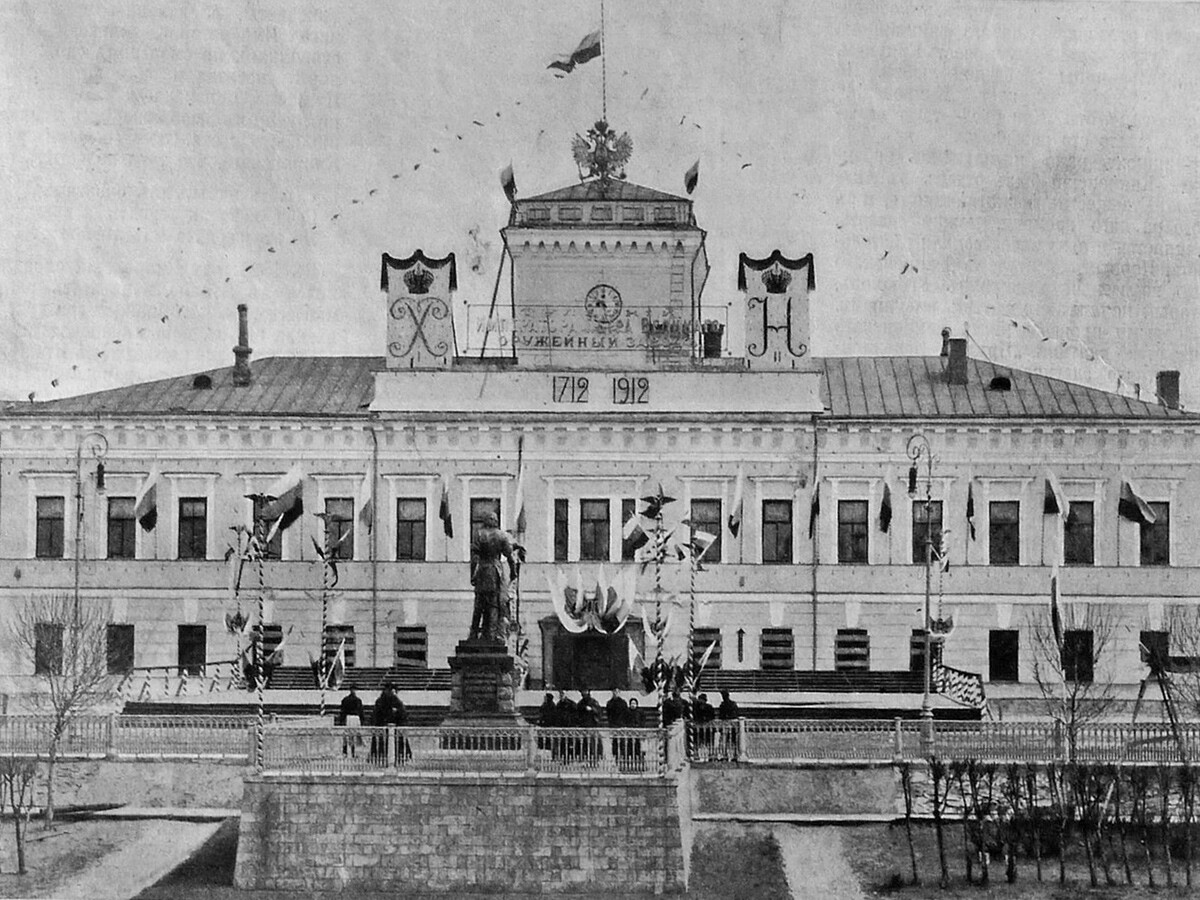
Celebrations on the 200th anniversary of the Imperial Tula Arms Factory. 28 February 1912.
Magazin «Neva», № 23, 1912
Later, the workshops began producing the Maxim gun, TT pistols, the Mosin-Nagant rifles, anti-tank guided missiles and grenade launchers.
Aside from weapons, it also produces unique pieces of art with facets cut on metal.
READ MORE: TULA, FORGE OF THE RUSSIAN ARMY FOR OVER 400 YEARS
6. Kalashnikov
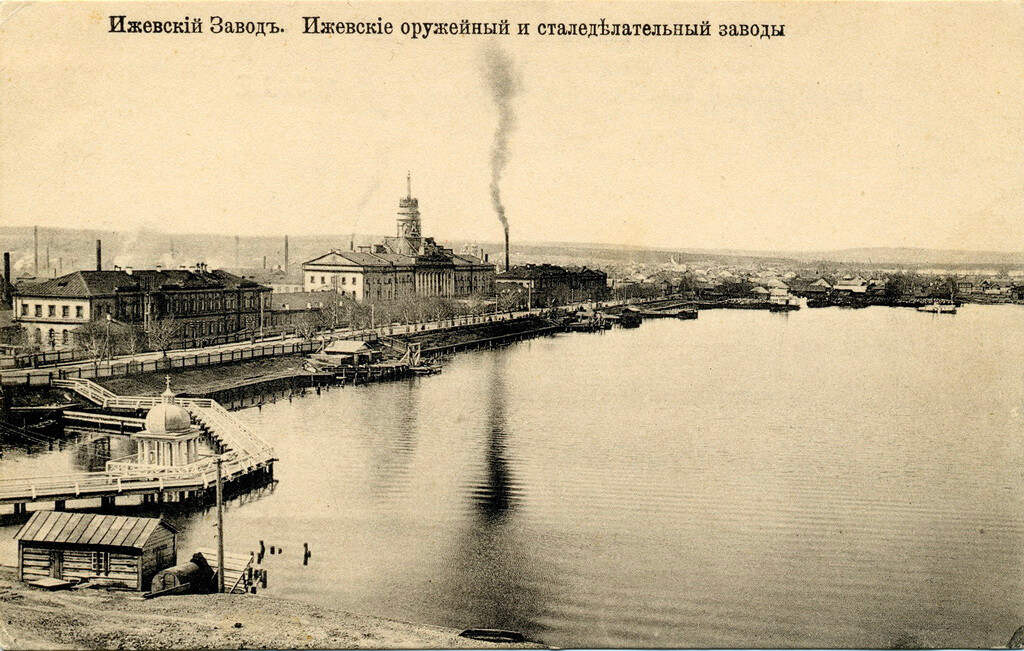
Izhevsk Arms Factory.
Public domain
This enterprise in the city of Izhevsk produces about 95% of firearms in Russia. Its history began in 1807 when the Izhevsk Arms Factory was opened on the basis of a destroyed iron mill on the Izh river. More than 200 foreign specialists were invited to teach Russian workers their craft. As such, Izhevsk began the production of firearms and cold weapons for the Russian army.
In 1948, designer Mikhail Kalashnikov joined the specialist team. Soon after it launched the mass production of AK assault rifles. In 2013, the factory was renamed as the Kalashnikov Group.
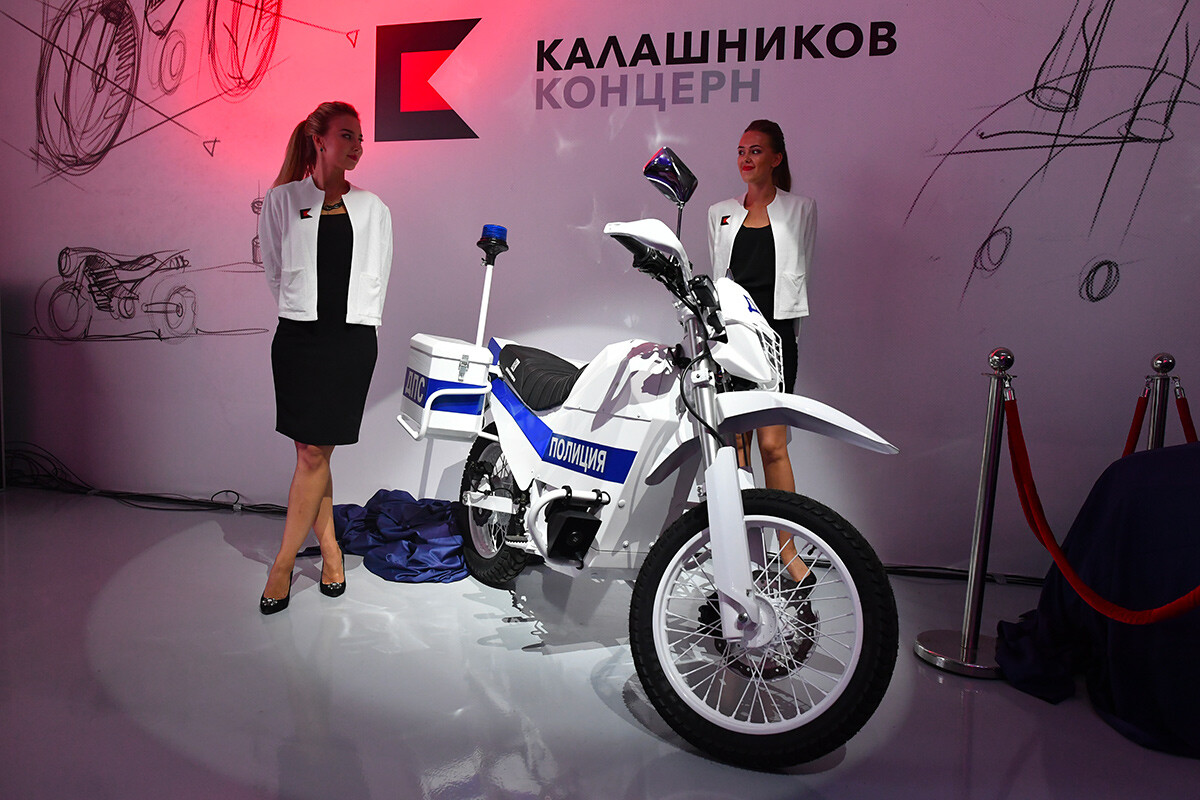
An electric motorcycle for police units, developed by the Kalashnikov Group.
Mikhail Voskresensky/Sputnik
7. Abrau-Dyurso
Russia’s most famous producer of sparkling wines originated on a whim of Emperor Alexander II, who in 1870 ordered a winery to be founded near Lake Abrau on the River Dyurso.
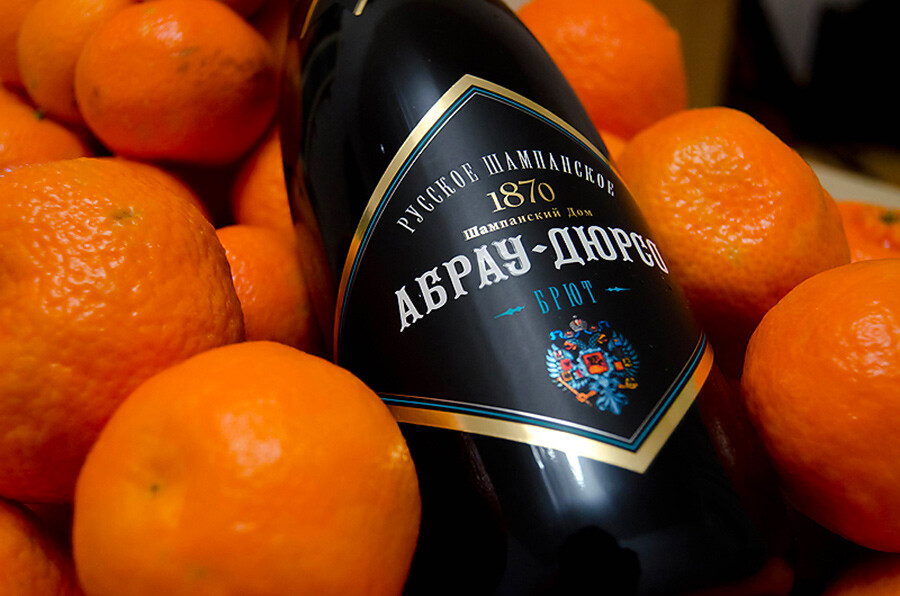
«Abrau-Durso» brut.
Karachun (CC BY-SA 3.0)
Agronomist Fyodor Geyduk purchased grape vines in Europe. In 1877, the specialists of the winery gathered its first harvest, from which they produced the first local wine. In 1898, this local champagne first went on sale to the general public. Henceforth, Abrau-Dyurso sparkling wines were served at imperial receptions.
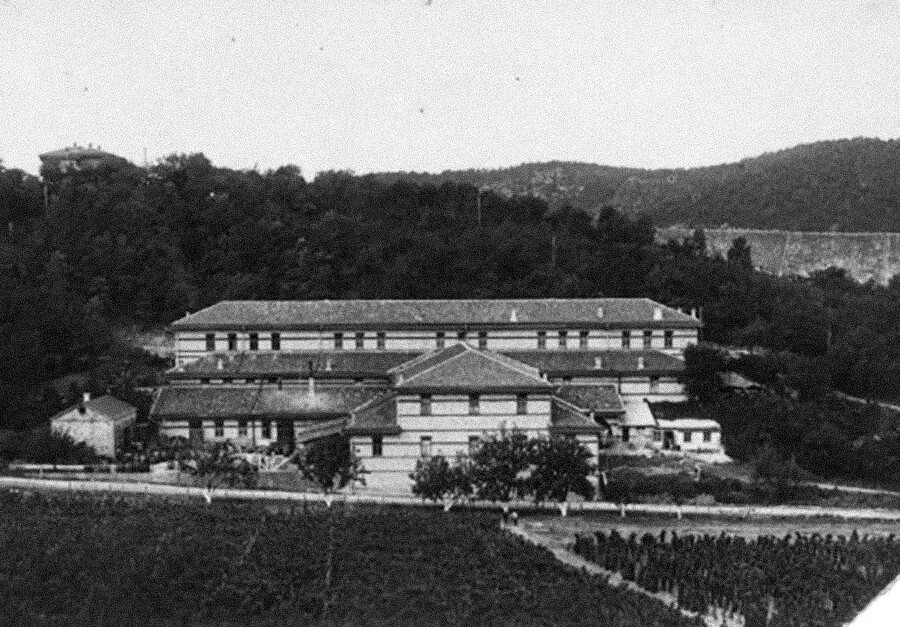
Abrau-Dyurso.
Public domain
After the Revolution and nationalization, the factory was the only winery in the USSR producing wines according to classical technology. During World War II, the wineries were seriously damaged and the factory was evacuated, but after liberation it was restored quite quickly.
In 1975, an export brand of “Soviet champagne”, Nazdorovya, was developed here. This sparkling wine was supplied to Europe, the U.S., Mexico and other countries.
In the post-Soviet era the factory fell into decay, but was revived after its purchase by the company SVL. Now, its vineyards occupy more than 3,000 hectares. The Abrau-Dyurso village has turned into the country’s largest enogastronomic center.
READ MORE: 6 vineyards that prove Russia is not only about vodka
Dear readers,
Our website and social media accounts are under threat of being restricted or banned, due to the current circumstances. So, to keep up with our latest content, simply do the following:
Subscribe to our Telegram channels: Russia Beyond and The Russian Kitchen
Subscribe to our weekly email newsletter
Enable push notifications on our website
Install a VPN service on your computer and/or phone to have access to our website, even if it is blocked in your country
If using any of Russia Beyond’s content, partly or in full, always provide an active hyperlink to the original material.
Get the week’s best stories straight to your inbox
National Treasure IMPERIAL PORCELAIN FACTORY
Students: Basil Kornishov
Ivan Grigoryev
School: 667
Form: 8v
Teacher: Trubitsina T.M.
Saint Petersburg
Nevsky district
Project: Looking at the world out of my window
We live in Saint-Petersburg in Nevsky District.
We would like to tell you about one of the most interesting but very rarely mentioned places of the district – Imperial Porcelain Factory.
It is located at
151 Obukhovsky Oborony Prospect.
18 th CENTURY
Russian porcelain factory was founded in 1744 by Empress Elizabeth, the daughter of Peter the Great.
Russian scientist Dmitry Vinogradov discovered the secret of making porcelain and developed the technology for its manufacture.
Dmitry Vinogradov used local raw materials — Gzel clays and Olonets quartz and alabaster.
The factory belonged to the House of Romanov and it produced tableware and other porcelain pieces only for Russian Tsar court.
18 th CENTURY
Only a few pieces of the Vinogradov period have survived and are today of great historical value.
19 th CENTURY
Under Alexander I reign the factory became larger. An assistant professor of the Academy of Fine Arts, Stepan Pimenov was brought to the factory in 1809. Prominent masters from the Academy of Arts participated in the designing and decoration of the porcelain.
19 th CENTURY
Stepan Pimenov designed the Guryevski service , which was typical for Empire style and consisted of 4500 items. Several kilograms of gold were used for decoration. This palace service is a glorification of the multinational Russian empire. The decoration was modeled on sketches of Moscow and Petersburg, views of suburbs, the martial scenes and scenes from the life of the capital.
20 th CENTURY
The creation of post-revolutionary porcelain is mainly connected with the name of Sergei Chekhonin. . His many interests and his profound knowledge of the culture of the past prompted him to engage highly trained porcelain masters and painters belonging to various trends in art.
20 th CENTURY
Vasili Kuznetsov, MikhailAdamovitch, Kazimir Malevitch, Maria Lebedeva, Natan Altman and Mstilav Dobushinski, Kusma Petrov-Vodkin, Pavel Kuznetsov, Boris Kustodiev designed
the drawings.
20 th CENTURY
Anna Yitskevitch, a painter, designed one of the most famous drawings of the factory — the cobalt net. It was during the Siege of Leningrad. The drawing came into her mind while she was looking at the windows taped crosswise.
20 th CENTURY
In 1958 the artist Anna Yatskevich’s «Cobalt Net» decoration of a service won a gold medal at the International Exhibition in Brussels. The famous pattern has become the hallmark of the factory.
21st CENTURY
The Factory produces a varied assortment of porcelain ware — tea and coffee services of different shapes and decor, vases, sculptures, and all kinds of souvenirs. Up to 500 items are simultaneously in production.
21st CENTURY
Porcelain items with «LFZ» trademark are well-known in 30 counties; they are exported into Belgium, Canada, Denmark, England, Finland, France, Germany, Holland, Japan, Italy, USA and others.
THANK YOU FOR YOUR ATTENTION
Слайд 1National Treasure
IMPERIAL PORCELAIN FACTORY
Saint Petersburg
Nevsky district
Project: Looking at the
world out of my window
Students: Basil Kornishov
Ivan Grigoryev
School: 667
Form: 8v
Teacher: Trubitsina T.M.
Слайд 2We live in Saint-Petersburg in Nevsky District.
We would like
to tell you about one of the most interesting but
very rarely mentioned places of the district – Imperial Porcelain Factory.
It is located at
151 Obukhovsky Oborony Prospect.
Слайд 3Russian porcelain factory was founded in 1744 by Empress
Elizabeth, the daughter of Peter the Great.
Russian scientist Dmitry
Vinogradov discovered the secret of making porcelain and developed the technology for its manufacture.
18th CENTURY
Слайд 4Dmitry Vinogradov used local raw materials — Gzel clays
and Olonets quartz and alabaster.
The factory belonged to the
House of Romanov and it produced tableware and other porcelain pieces only for Russian Tsar court.
18th CENTURY
Only a few pieces of the Vinogradov period have survived and are today of great historical value.
Слайд 519th CENTURY
Under Alexander I reign the factory became larger.
An assistant professor of the Academy of Fine Arts, Stepan
Pimenov was brought to the factory in 1809. Prominent masters from the Academy of Arts participated in the designing and decoration of the porcelain.
Слайд 619th CENTURY
Stepan Pimenov designed the Guryevski service, which was
typical for Empire style and consisted of 4500 items. Several
kilograms of gold were used for decoration. This palace service is a glorification of the multinational Russian empire. The decoration was modeled on sketches of Moscow and Petersburg, views of suburbs, the martial scenes and scenes from the life of the capital.
Слайд 720th CENTURY
The creation of post-revolutionary porcelain is mainly connected
with the name of Sergei Chekhonin. . His many interests
and his profound knowledge of the culture of the past prompted him to engage highly trained porcelain masters and painters belonging to various trends in art.
Слайд 820th CENTURY
Vasili Kuznetsov, MikhailAdamovitch, Kazimir Malevitch, Maria Lebedeva, Natan
Altman and Mstilav Dobushinski, Kusma Petrov-Vodkin, Pavel Kuznetsov, Boris Kustodiev
designed
the drawings.
Слайд 920th CENTURY
Anna Yitskevitch, a painter, designed one of the
most famous drawings of the factory — the cobalt net.
It was during the Siege of Leningrad. The drawing came into her mind while she was looking at the windows taped crosswise.
Слайд 1020th CENTURY
In 1958 the artist Anna Yatskevich’s «Cobalt Net»
decoration of a service won a gold medal at the
International Exhibition in Brussels. The famous pattern has become the hallmark of the factory.
Слайд 11The Factory produces a varied assortment of porcelain ware
— tea and coffee services of different shapes and decor,
vases, sculptures, and all kinds of souvenirs. Up to 500 items are simultaneously in production.
21st CENTURY
Слайд 1221st CENTURY
Porcelain items with «LFZ» trademark are well-known in
30 counties; they are exported into Belgium, Canada, Denmark, England,
Finland, France, Germany, Holland, Japan, Italy, USA and others.