
It was the second of September 1859. The clipper ship Southern Cross was off Chile when, at 1.30 a.m., it sailed into a living hell. Hailstones from above and waves from all around whipped the deck. When the wind-lashed ocean spray fell away to leeward, the men noticed they were sailing in an ocean of blood. The colour was reflected from the sky, which — they could see even through the clouds — was wreathed in an all-encompassing red glow.
The sailors recognised the lights as the southern aurora that usually graced the skies near the Antarctic Circle, just as their northern counterparts cling to the Arctic. To see them from this far north was highly unusual. As the gale subsided, they witnessed an even more astonishing display. Fiery lights loomed against the horizon as if some terrible conflagration had engulfed the Earth. Vivid bolts flew across the now clear sky in spiral streaks and exploded in silent brilliance, as if the very souls of all humanity were fleeing whatever cataclysm had befallen the planet.
Upon their arrival at San Francisco, the ship’s company discovered that theirs was not an isolated experience. Two thirds of the Earth’s skies had been similarly smothered. Also, there was a sinister side to the aurora.
The beguiling lights had disabled the telegraph system, wiping out communications across the world. For days, nature refused to allow these arteries of information to flow freely. It was as if today’s Internet had suddenly, inexplicably shut down. In Philadelphia, a telegrapher was stunned by a severe shock. In some offices the equipment burst into flames. In Bergen, Norway, the operators had to scramble to disconnect the apparatus, risking electrocution. On top of this, compasses spun uselessly under the grip of the aurora, disrupting global navigation.
In the scramble to understand just what had engulfed Earth, the Victorians had only one clue. On the previous morning amateur astronomer Richard Carrington was working in his private observatory at Redhill, Surrey, and found himself witness to an unprecedented celestial event.
He was studying sunspots, the unexplained dark blemishes that occasionally speckle the Sun. The sunspot that Carrington gazed upon that day was really huge. It was almost ten times the diameter of the Earth. Yet on the Sun, it barely stretched a tenth of the way across the fiery disc. Without warning, two beads of searing white light appeared over it.
No one had ever described the Sun behaving like this before and Carrington instantly began timing the lights as they drifted across the sunspot, faded and vanished. That night, the apocalyptic aurora burst over the Earth. Could it be that Carrington’s titanic explosion had somehow hurled the electrical and magnetic energy at the Earth?
Carrington himself never pursued the research. Yet his discovery of the solar flare began half a century of intrigue, rivalry and speculation as other astronomers raced to understand the mysterious way in which the Sun could reach out across 93 million miles of void and strike the Earth. With the benefit of hindsight, we can see that the Carrington flare was a tipping point for astronomy. Suddenly aware that the Earth and its technology could be affected by celestial events, astronomers turned their attention away from charting the positions of stars to aid navigation, and began studying the nature of celestial objects.
Today, the study continues. Astronomers routinely watch solar flares with their spacecraft and know that these explosions usually eject huge clouds of electrically-charged particles into space. When these strike the Earth, they produce the aurora in the atmosphere and cause technology to malfunction. Astronomers call it space weather and the ferocity of it still occasionally catches them unawares. In October 2003, a Japanese weather satellite died during a solar storm. In 1989, millions of North Americans were blacked out when a solar storm damaged the Hydro-Quebec power station in Canada.
In all these studies, however, there is one sobering thought. The scale of the solar storm of 1859 has never been equalled since. Even the fiercest recent storms are between three and five times smaller. With our current reliance on technology higher than at any time in history, another ‘Carrington-event’ could cost us billions.
ВОПРОС 1 When the clipper ship Southern Cross was off Chile,
1) the weather improved.
2) huge stones started falling from above.
3) the ocean water changed its colour.
4) there was a lot of blood around.
ВОПРОС 2 It is rare for the southern aurora
1) to be seen against the horizon.
2) to have red colour.
3) to appear so far north.
4) to grace the skies near the Antarctic Circle.
ВОПРОС 3 What was NOT the effect of the aurora?
1) The telegraph system was disabled.
2) The Internet suddenly shut down.
3) The equipment in some offices burst into flames.
4) Compasses spun uselessly, disrupting global navigation.
ВОПРОС 4 The probable reason for the aurora was
1) a huge sunspot.
2) the light from the sun.
3) the electrical and magnetic energy of the Earth.
4) powerful solar flares.
ВОПРОС 5 Carrington’s discovery was a tipping point for astronomy because
1) it began half a century of intrigue, rivalry and speculation.
2) it proved celestial events were unable to affect our planet.
3) astronomers began studying the nature of the celestial objects.
4) astronomers turned their attention to charting the positions of stars.
ВОПРОС 6 Today astronomers are still surprised by
1) the extreme force of solar storms.
2) the amount of electrically-charged particles ejected by solar flares.
3) the fact that the aurora causes technology to malfunction.
4) the fact that a Japanese weather satellite died during a solar storm.
ВОПРОС 7 The solar storm of 1859 was
1) the first solar storm on our planet.
2) twice as big as the fiercest recent storms.
3) less fierce than most recent solar storms.
4) the fiercest in recent history.
ВОПРОС 1: – 3
ВОПРОС 2: – 3
ВОПРОС 3: – 2
ВОПРОС 4: – 4
ВОПРОС 5: – 3
ВОПРОС 6: – 1
ВОПРОС 7: – 4
Вариант 1.
Раздел 1. Аудирование.
1.
Вы услышите 6 высказываний. Установите
соответствие между высказываниями каждого говорящего A–F
и утверждениями, данными в списке 1–7. Используйте каждое
утверждение, обозначенное соответствующей цифрой, только один
раз. В задании есть одно лишнее утверждение. Вы услышите запись
дважды.
1. I believe many people misunderstand
fashion.
2. I must have enough clothes to choose
from.
3. Clothes make you look your best.
4. Thinking about fashion is a waste of
time.
5. I’sure clothes should be practical.
6. You and people around you should feel
good about what you wear.
7. Parents often criticize fashion choices
of their children.
|
Говорящий |
A |
B |
C |
D |
E |
F |
|
Утверждение |
2.
Вы услышите диалог. Определите, какие из приведённых
утверждений А–G соответствуют содержанию текста (1 – True),
какие не соответствуют (2 – False) и о чём в тексте не сказано,
то есть на основании текста нельзя дать ни положительного, ни отрицательного
ответа (3 – Not stated). Занесите номер выбранного Вами варианта
ответа в таблицу. Вы услышите запись дважды.
A) Michael isn’t
enjoying his studies.
1) Тrue 2) False 3)
Not stated
B) Jane is free on Saturday evening.
1) Тrue 2) False 3)
Not stated
C) Michael’s favourite actor is Michael
Douglas.
1) Тrue 2) False 3)
Not stated
D) Jane agrees to go to the cinema.
1) Тrue 2) False 3)
Not stated
E) Shops in Bath are less expensive than
shops in Clifton.
1) Тrue 2) False 3)
Not stated
F) There’re several good restaurants in
the new shopping mall in Bath.
1) Тrue 2) False 3)
Not stated
G) Michael and jane will go to Bath by car.
1) Тrue 2) False 3) Not stated
|
||||||||||||||||||||||||
3. Вы услышите репортаж дважды. В заданиях 3-9
обведите цифру 1,2 или 3, соответствующую выбранному вами варианта ответа. Вы
услышите запись дважды.
3. Why does Matilda think that the first question is
easy?
1) The answer depends on her mood.
2) The choice of films is limited.
3) She has her personal favourite.
4. Why does Mariela name ‘American Beauty’ the best film?
1) Because of acting.
2) Because it’s mainstream.
3) Because of its plain plot.
5. Why is ‘Gladiator’ not Mariela’s favourite film?
1) It’s too mysterious.
2) For her it’s a usual film.
3) it’s not exciting.
6.Mariela thinks that ‘The Sixth Sense’ was
1) made by the best director.
2) the most unanticipated success.
3) made to frighten people.
7. According to Mariela, what is good about ‘All about
my Mother’?
1) It has a lovely beginning.
2) There are more positive people in it.
3) It can touch feelings of anybody.
8. What does Mariela say about John Travolta in ‘Pulp
Fiction’?
1) His role was not typical for him.
2) He could play any part in it.
3) He’s the best as a bad guy.
9. What does Mariela think about ‘Chicago’?
1) It’s the best musical ever.
2) The choice of the actors determined the success.
3) The musical is not for the cinema.
Раздел 2. Чтение
10.Установите соответствие между текстами A–G
и заголовками 1–8. Занесите свои ответы в таблицу.
Используйте каждую цифру только один раз. В задании один заголовок лишний.
|
1. |
5. Online Learning |
|
2. Key Factor in Learning |
6. Language Extinction |
|
3. Linguistic Interference |
7. Learning by Imitation |
|
4. Universal Language |
8. Sign Language |
A. Young
children have a genetic ability to learn language. They come into the world as
eager learning machines, and language acquisition is a major aspect of this
learning. How children actually learn language is not entirely clear, however.
Most linguists believe that they do it primarily by listening to and trying to
communicate with adult speakers. Initially, this means that they copy the way
adults use words and grammar.
B.
Learning a second or third language is
easier in early childhood than later. It is particularly important to learn
correct pronunciation as young as possible. At any age, learning by constant
contact with native speakers in their own society is the quickest and the most
effective method. It is superior to taking foreign language classes because it
forces you to concentrate on it all of the time.
C.
Learning a second language can be affected
by the patterns of the first language. There can be some blending of phonemes.
For instance, most Americans who learn French in high school or college
pronounce French words with a distinctive American accent. Grammar can also be
affected. English speakers who learn both French and Spanish sometimes combine
grammatical rules of both when speaking either of them.
D .Until just a few years ago,
language study was limited to the classroom or personal tutor, or home study by
book. In the last few decades technology has given us a much needed audio
option — first vinyl records, then cassettes and CDs. Now technology has given
us a new format — the Internet. Options to learn a language by Internet are
still limited but the potential is not.
E.
What is important when learning a
language? If you have the desire and persis -tence, time is the only factor
that you may have to work with. How much time you can devote to learning will
play a role in how quickly you can learn the language. Just re member how
exciting it will be and how rewarding you will feel at the accomplishment.
F.
Rather than have businessmen, diplomats,
scientists and tourists from every country learning all the major languages
that they want to learn or need to learn, Esperantists would have everyone just
learn one second language — Esperanto. Then everyone could communicate with
everyone, everywhere. The major ‘national’ languages could keep their special
characteristics for anyone who wanted to learn them. This is the essence of the
‘Esperanto Movement’.
G.
More than half of the world’s 7,000
languages are expected to die out by the end of the century, often taking with
them irreplaceable knowledge about the natural world. When a species dies out,
sometimes fossils can be found, remains uncovered. But when a human language
disappears, there’s rarely any key left behind. Each loss becomes a linguistic
black hole, where an entire way of knowing the world disappears.
|
Текст |
А |
B |
C |
D |
E |
F |
G |
|
Заголовок |
11. Прочитайте текст и заполните пропуски
A–F частями предложений, обозначенными цифрами 1–7.
Одна из частей в списке 1–7 — лишняя. Занесите цифры, обозначающие
соответствующие части предложений, в таблицу.
Mikhail
Lomonosov and Moscow State University
Mikhail Lomonosov was one of the
intellectual titans of XVIII century. His interests ranged from history,
rhetoric, art and poetry A ______ . Alexander Pushkin described him
as В ______ , whose
lifelong passion was learning.
Lomonosov’s activity is a manifestation of
the enormous potential of the Russian scientific community. Peter I reformed
Russia, which allowed the country to reach the standard of С ______ many
spheres. Great importance was placed on education. St. Petersburg Academy of
Sciences, founded by Peter I, established a university and a grammar school to
educate intellectuals and researchers the country needed; however, these
educational establishments could not fulfill the task they took on. It was
Michail Lomonosov D ______ of establishing a university in Moscow.
An influential courtier and the E ______ Count Shuvalov supported
Lomonosov’s plans for a new university and presented them to the Empress.
In 1755, on 25 January-St. Tatiana’s Day
according to the Russian Orthodox Church calendar — Elizaveta signed the decree
that a university should be founded in Moscow. The opening ceremony took place
on 26 April, when Elizaveta’s coronation day was celebrated. Since 1755 25
January and 26 April F ______ Moscow University; the annual conference
where students present the results of their research work is traditionally held
in April.
1. who suggested in his letter to Count
Shuvalov the idea
2. to mechanics, chemistry and mineralogy
3. a person of formidable willpower and
keen scientific mind
4. favourite of Empress Elizaveta
Petrovna, the patron of arts and science
5. the contemporary European powers in
6. are marked by special events and
festivities at
7. famous among all educated people
|
Пропуск |
A |
B |
C |
D |
E |
F |
|
Часть предложения |
Прочитайте
текст и выполните задания 12-18. В каждом задании запишите в поле ответа
цифру 1,2,3 или 4, соответствующую выбранному вами варианту ответа.
It was the second of September 1859. The clipper ship Southern
Cross was off Chile when, at 1.30 a.m, it sailed into a living hell.
Hailstones from above and waves from all around whipped the deck. When the wind
lashed ocean spray fell away to leeward, the men noticed they were sailing in
an ocean of blood. The colour was reflected from the sky, which — they could
see even through the clouds — was wreathed in an all encompassing red glow.
The sailors recognised the lights as the southern aurora that
usually graced the skies near the Antarctic Circle, just as their northern counterparts
cling to the Arctic. To see them from this far north was highly unusual. As the
gale subsided, they witnessed an even more astonishing display. Fiery lights
loomed against the horizon as if some terrible conflagration had engulfed the
Earth. Vivid bolts flew across the now clear sky in spiral streaks and exploded
in silent brilliance, as if the very souls of all humanity were fleeing
whatever cataclysm had befallen the planet.
Upon their arrival at San Francisco, the ship’s company discovered
that theirs was not an isolated experience. Two thirds of the Earth’s skies had
been similarly smothered. Also, there was a sinister side to the aurora.
The beguiling lights had disabled the telegraph system, wiping out
communications across the world. For days, nature refused to allow these
arteries of information to flow freely. It was as if today’s Internet had
suddenly, inexplicably shut down. In Philadelphia, a telegrapher was stunned by
a severe shock. In some offices the equipment burst into flames. In Bergen,
Norway, the operators had to scramble to disconnect the apparatus, risking electrocution. On top
of this, compasses spun uselessly under the grip of the aurora, disrupting
global navigation.
In the scramble to understand just what had engulfed Earth, the
Victorians had only one clue. On the previous morning amateur astronomer
Richard Carrington was working in his private observatory at Redhill, Surrey,
and found himself witness to an unprecedented celestial event.
He was studying sunspots, the unexplained dark blemishes that
occasionally speckle the Sun. The sunspot that Carrington gazed upon that day
was really huge. It was almost ten times the diameter of the Earth. Yet on the
Sun, it barely stretched a tenth of the way across the fiery disc. Without
warning, two beads of searing white light appeared over it.
No one had ever described the Sun behaving like this before and
Carrington instantly began timing the lights as they drifted across the
sunspot, faded and vanished. That night, the apocalyptic aurora burst over the
Earth. Could it be that Carrington’s titanic explosion had somehow hurled the
electrical and magnetic energy at the Earth?
Carrington himself never pursued the research. Yet his discovery
of the solar flare began half a century of intrigue, rivalry and speculation as
other astronomers raced to understand the mysterious way in which the Sun could
reach out across 93 million miles of void and strike the Earth. With the
benefit of hindsight, we can see that the Carrington flare was a tipping point
for astronomy. Suddenly aware that the Earth and its technology could be
affected by celestial events, astronomers turned their attention away from
charting the positions of stars to aid navigation, and began studying the
nature of celestial objects.
Today, the study continues. Astronomers routinely watch solar
flares with their spacecraft and know that these explosions usually eject huge
clouds of electrically charged particles into space. When these strike the
Earth, they produce the aurora in the atmosphere and cause technology to
malfunction. Astronomers call it space weather and the ferocity of it still
occasionally catches them unawares. In October 2003, a Japanese weather
satellite died during a solar storm. In 1989, millions of North Americans were
blacked out when a solar storm damaged the Hydro Quebec power station in
Canada.
In all these studies, however, there is one sobering thought. The
scale of the solar storm of 1859 has never been equalled since. Even the
fiercest recent storms are between three and five times smaller. With our
current reliance on technology higher than at any time in history, another
‘Carrington event’ could cost us billions.
A12. When the clipper ship Southern Cross
was off Chile,
1)
the weather improved.
2)
huge stones started falling from above.
3)
the ocean water changed its colour.
4)
there was a lot of blood around.
A13. It is rare for the
southern aurora
1)
to be seen against the horizon.
2)
to have red colour.
3)
to appear so far north.
4)
to grace the skies near the Antarctic Circle.
A14. What was NOT the effect of the aurora?
1)
The telegraph system was disabled.
2)
The Internet suddenly shut down.
3)
The equipment in some offices burst into flames.
4)
Compasses spun uselessly, disrupting global navigation.
A15.
The probable reason for the aurora was
1)
a huge sunspot.
2)
the light from the sun.
3)
the electrical and magnetic energy of the Earth
4)
powerful solar flares.
.
A16. Carrington’s discovery was a tipping point
for astronomy because
1)
it began half a century of intrigue, rivalry and speculation.
2)
it proved celestial events were unable to affect our planet.
3)
astronomers began studying the nature of the celestial objects.
4)
astronomers turned their attention to charting the positions of
stars.
A17.
Today astronomers are still surprised by
1)
the extreme force of solar storms.
2)
the amount of electrically charged particles ejected by solar
flares.
3)
the fact that the aurora causes technology to malfunction.
4)
the fact that a Japanese weather satellite died during a solar
storm.
A18 The solar storm of 1859 was
1)
the first solar storm on our planet.
2)
twice as big as the fiercest recent storms.
3)
less fierce than most recent solar storms.
4)
the fiercest in recent history.
Раздел 3. Грамматика и лексика.
Прочитайте
приведенные ниже тексты . Преобразуйте, если необходимо, слова,
напечатанные
заглавными буквами и обозначенные номерами 19-25, так, чтобы они
грамматически соответствовали содержанию текстов. Заполните пропуски
полученными словами. Каждый пропуск соответствует отдельному заданию из группы
19-25.
Gap year destination
Many young adults who turn 18 take a year off to travel the
world. A gap year, as it’s known, can be the 19______________MEMORABLE
time in a young person’s life. Where do most young adults spend this time? It
seems that the top spot is usually Thailand, where students can stay cheaply,
have a wide variety of activities to take part in and spend loads of time 20____________RELAX
on the beach. Because Thailand is so popular, it’s likely that young adults 21__________MEET
other young adults while they’re there. It’s also an opportunity to experience
another culture and learn a few words of a foreign language.
Bad day
Eugene wasn’t having a good day. First, while he was pouring
coffee into his mug at home in the morning, his hand slipped and he
accidentally 22_____________SPILL coffee all over the kitchen
workshop. He went to wipe up the spill with a sponge and knocked the mug onto
the floor, where it broke into several pieces. Upset and 23___________FRUSTRATE,
he left home without having any coffee at all. At work, he ran into a
colleague, literally, and nearly knocked her over. ‘I’m so sorry Michelle. Are you
OK?’ he said quickly. She wasn’t amused and told him to watch where he 24______________GO.
He 25_______________CAN NOT wait for the day to end, and just as
it did, he realized he had a report to finish. ‘What a terrible day. I should
have stayed in bed this morning! he said, as he prepared to stay late at work.
Прочитайте приведенный
ниже текст. Образуйте от слов, напечатанных заглавными буквами и обозначенных
номерами 26-31, однокоренные слова так, чтобы они грамматически и
лексически соответствовали содержанию текста. Заполните пропуски полученными
словами. Каждый пропуск соответствует отдельному заданию из группы 26-31.
Shopping
and Traffic
When a customer
buys something in supermarket, the bar code on the product is read 26_________ELECTRONIC
at the hill. The information is transmitted to head office, where it is
collected and analyzed, and then a schedule for the 27_____________DELIVER
of the product to the supplier is produced. A miracle of scale, speed and 28____________EFFICIENT,
it’s the new system of food distribution that has imposed a huge strain on
Britain’s transport infrastructure. Between 35 and 40 per cent of lorries on UK
roads today are 29______________INVOLVE in producing and
distributing food. Shopping for food has also made a 30_____________CONSIDER
contribution to the increase in traffic. In the last ten years, the average 31______________DISTANT
travelled to go shopping went up 30 per cent, as small local shops came under
pressure from out-of-town retail stores and closed.
Прочитайте
текст с пропусками, обозначенными номерами 32–38. Эти номера
соответствуют заданиям 32–38, в которых представлены возможные варианты
ответов. Запишите в поле ответа цифру 1, 2, 3 или 4,
соответствующую выбранному Вами варианту ответа.
Machu Picchu
In a way, it’s wonderful that Machu Picchu can nowadays be visited
on a day 32_______ from Cuzco. Everyone probably should have a chance to
see this remarkable place.
Like many travellers, I hoped to get a taste of Machu Picchu’s
‘lost in the clouds’ atmosphere by approaching the ruins on foot 33______
the Inca trail. I joined the obligatory tour group in Cuzco, then spent the
next four days surrounded by others making the classic pilgrimage. Along the
way, we crossed several breathtaking Andean passes, treading on original Inca
paving stones, and passing several other fine ruins.
Our last 34_______ stop was at an exquisitely beautiful
site called Huinay Huayna, where dozens of impossibly steep terraces cascade
into a deep green gorge backed by a high waterfall. My new found travelling
companions included five Argentines who 35_______ my interest in
exploring Huinay Huayna by moonlight.
The only problem was a slight difference in styles. Mine was more
along the lines of silent and meditative contemplation; theirs involved a
ritualistic circle chant, led by the charismatic lone male in the group whom I
thereafter nicknamed the Warlock. Absenting myself from the circle that night,
I made a mental note to 36_______ my distance from them the next day at
Machu Picchu.
Before dawn the following morning we climbed to the mountaintop
Gateway of the Sun, hoping for the classic panoramic view of Machu Picchu
before the tour buses arrived. Unfortunately, the weather did not cooperate.
With dozens of other disappointed trekkers, I shivered on the hilltop in chilly
fog for two hours, waiting for a sunrise that never came, then trudged down the
hill to Machu Picchu itself. As I 37_______, the clouds started lifting,
revealing the place to be every bit as spectacular as I could have hoped. By
day’s end, my tour group had dispersed, apparently preferring a hot bath. I, however, felt I was just 38_______ the surface.
|
32.1) travel 33.1) with 34.1) overall 35.1) captured 36.1)keep 37.1) descended 38.1) reaching |
2) voyage 2) 2) 2) shared 2) 2) 2) |
3) journey 3) 3) overnight 3) kept 3) 3) 3) |
4) 4) 4) 4) held 4) 4) pretended 4) patching |
||||||||
Раздел 4.
Письмо
39. You have received
a letter from your English-speaking pen-friend David who writes:
… I have finally chosen the college I will
try to enter next summer. Which university would you like to go to after
school? What would you like to study? What backup plans have you made, if you
don’t get accepted?
Oh, by the way, do you remember Lucy, my dog?
She’s just had six puppies!!!…
Write a letter to David.
In your letter
— answer his questions
— ask 3 questions about his dog
and/or its puppies.
Write 100–140 words.
Remember the rules of letter writing.
40. Comment on
the following statement
Some teenagers would like to have a highly paid job; others
believe that their future job should be interesting and bring satisfaction.
What is your
opinion? Do you agree with this statement? Write 200–250 words. Use the
following plan:
− make an introduction (state the problem)
− express your personal opinion and give
2–3 reasons for your opinion
− express an opposing opinion and give 1–2
reasons for this opposing opinion
− explain why you don’t agree with the
opposing opinion
− make a conclusion restating your
position
Ответы
1)
523614
2) 1232132
3)
– 3
4) –
1
5)
-2
6) -2
7)
-3
 -1
-1
9) -2
10)
A B C D E F G
7 1 3 5 2 4 6
11)
A B C D E F
2 3 5 1 4 6
12)
3
13)
3
14)
2
15)
4
16)
3
17)
1
18)
4
19) mostmemorable
20)
relaxing
21) willmeet
22)
spilt/spilled
23)
frustrated
24) wasgoing
25) couldnot
26) electronically
27)
delivery
28) efficiency
29) involved
30) considerable
31) distance
32)
4
33)
2
34)
3
35)
2
36)
1
37)
1
38)
3
Для выполнения заданий 12-18 экзаменуемым предлагается прочитать художественный или публицистический текст и выбрать правильный ответ из четырёх предложенных вариантов. Задания 12-18 могут представлять собой вопросы, на которые надо найти ответы, или незавершённые утверждения, к которым надо подобрать правильное окончание.
Это задания высокого уровня, требующие от учащихся полного и точного понимания текста, а следовательно, — обширного словарного запаса и прочных лексико-грамматических навыков. В процессе чтения учащиеся могут отмечать правильные ответы на листе с заданиями.
По окончании выполнения всех заданий следует перенести свои ответы в бланк ответов № 1. За каждый правильный ответ учащийся получает 1 балл. Максимально возможное количество первичных баллов за это задание — 7.
РЕКОМЕНДАЦИИ К ВЫПОЛНЕНИЮ ЗАДАНИЙ 12-18
• Прочитайте внимательно весь текст, а затем начните отвечать на вопросы.
• Не волнуйтесь, если вы не знаете значения каких-либо слов. Возможно, они не понадобятся вам при выборе правильного ответа. Если всё же эти слова существенны для ответа на вопрос, попробуйте догадаться об их значении по контексту или словообразовательным элементам.
• Прочитайте вопрос и попытайтесь найти в тексте ответ на него до того, как вы посмотрите на варианты ответов. Затем прочитайте варианты ответа и выберите тот, который наилучшим образом удовлетворяет содержанию текста.
• При выборе ответа помните, что слова в правильном варианте не всегда совпадают со словами текста. Очень часто правильный ответ выражает идею текста другими словами.
• Рекомендуется отмечать ответы в тексте, чтобы в случае необходимости можно было быстро найти нужное место и ещё раз проверить свой ответ.
• Вопросы обычно следуют в том порядке, в котором они встречаются в тексте.
• Не следует отвечать на вопрос, основываясь на собственном опыте или уже имеющихся знаниях. Вы должны найти запрашиваемую информацию в тексте и сделать вывод только на основании прочитанного.
• Если вы затрудняетесь с выбором правильного ответа, попробуйте исключить неверные ответы. Обращайте внимание на детали, так как неверные ответы могут содержать иную грамматическую форму или слегка изменённую информацию из текста.
• Рекомендуемое время на выполнение этого задания — 15 мин.
ОБРАЗЦЫ ЗАДАНИЙ 12-18 В ФОРМАТЕ ЕГЭ
9. Прочитайте текст и выполните задания 12-18. В каждом задании запишите в поле ответа цифру 1, 2, 3 или 4, соответствующую выбранному вами варианту ответа.
It was the second of September, 1859. The clipper ship Southern Cross was off Chile when it sailed into a living hell. Hailstones from above and waves from all around whipped the deck. When the ocean spray fell away to leeward, the men noticed they were sailing in an ocean of blood. The colour was reflected from the sky, which was wreathed in a red glow.
The sailors recognised the lights as the southern aurora that usually clung to the Antarctic Circle. To see them from this far north was highly unusual. As the gale subsided, they witnessed an even more astonishing display. Fiery lights loomed against the horizon as if some terrible fire had engulfed the Earth. Upon their arrival in San Francisco, they discovered that two thirds of the Earth’s skies had been similarly smothered. Also, there was a sinister side to the aurora.
The beguiling lights had disabled the telegraph system, wiping out communications across the world. It was as if today’s Internet had suddenly shut down. In some offices the equipment burst into flames. In Norway, the operators had to disconnect the apparatus, risking electrocution. On top of this, compasses spun uselessly under the grip of the aurora, disrupting global navigation.
In the scramble to understand just what had engulfed Earth, the Victorians had only one clue. On the previous morning amateur astronomer Richard Carrington was working in his private observatory and found himself witness to an unprecedented celestial event.
He was studying sunspots, the unexplained dark blemishes that occasionally speckle the Sun. The sunspot that Carrington gazed upon that day was really huge. It was almost ten times the diameter of the Earth. Without warning, two beads of white light appeared over it.
No one had ever described the Sun behaving like this before and Carrington instantly began timing the lights as they drifted across the sunspot, faded and vanished. That night, the apocalyptic aurora burst over the Earth. Could it be that Carrington’s titanic explosion had somehow hurled the electrical and magnetic energy at the Earth?
Carrington himself never pursued the research. Yet his discovery of the solar flare began half a century of intrigue, rivalry and speculation as other astronomers raced to understand the mysterious way in which the Sun could reach out the Earth. With the benefit of hindsight, we can see that the Carrington flare was a tipping point for astronomy. Suddenly aware that the Earth and its technology could be affected by celestial events, astronomers turned their attention away from charting the positions of stars to aid navigation, and began studying the nature of celestial objects.
Today, the study continues. Astronomers routinely watch solar flares and know that these explosions usually eject huge clouds of electrically-charged particles into space. When these strike the Earth, they produce the aurora in the atmosphere and cause technology to malfunction. Astronomers call it space weather, and the ferocity of it still occasionally comes as a surprise. In October 2003, a Japanese weather satellite died during a solar storm. In 1989, millions of North Americans were blacked out when a solar storm damaged the power station in Canada.
The scale of the solar storm of 1859 has never been equalled since. With our current reliance on technology higher than at any time in history, another ‘Carrington- event’ could cost us billions.
(Adapted from ‘The Biggest Solar Storm in History’ by Stuart Clark)
12. When the clipper ship Southern Cross was off Chile,
1) the weather improved.
2) huge stones started falling from above.
3) the ocean water changed its colour.
4) there was a lot of blood around.
Ответ:_______ .
13. It is rare for the southern aurora to
1) be seen against the horizon.
2) have red colour.
3) appear so far north.
4) occur near the Antarctic Circle.
Ответ:_______ .
14. What was NOT the effect of the aurora?
1) The telegraph system was disabled.
2) The Internet suddenly shut down.
3) The equipment in some offices burst into flames.
4) Compasses spun uselessly, disrupting global navigation.
Ответ:_______ .
15. The probable reason for the aurora was
1) a huge sunspot.
2) the light from the sun.
3) the electrical and magnetic energy of the Earth.
4) powerful solar flares.
Ответ:_______ .
16. Carrington’s discovery was a tipping point for astronomy because
1) it began half a century of intrigue, rivalry and speculation.
2) it proved celestial events were unable to affect our planet.
3) astronomers began studying the nature of the celestial objects.
4) astronomers turned their attention to charting the positions of stars.
Ответ:_______ .
17. Today astronomers are still amazed by the
1) extreme force of solar storms.
2) amount of electrically-charged particles ejected by solar flares.
3) fact that the aurora causes technology to malfunction.
4) fact that a Japanese weather satellite died during a solar storm.
Ответ:_______ .
18. The solar storm of 1859 was
1) the first solar storm on our planet.
2) twice as big as the fiercest recent storms.
3) less fierce than most recent solar storms.
4) the fiercest in recent history.
Ответ: .
10. Прочитайте текст и выполните задания 12-18. В каждом задании запишите в поле ответа цифру 1, 2, 3 или 4, соответствующую выбранному вами варианту ответа.
When David steps out of the front door he is blinded for a moment by the fizzing sunlight and reaches instinctively for his dad’s hand. Father and son are on their way to the barbershop, something they have always done together.
The routine is always the same. ‘It’s about time we got that mop of yours cut,’ David’s dad says. ‘Perhaps, I should do it. Where are those garden shears, Jane?’ Sometimes his dad chases him round the living room, pretending to cut off his ears. When he was young David used to get too excited and start crying, scared that maybe he really would lose his ears, but he has long since grown out of that.
Mr. Samuels’ barbershop is in a long room above the shop, reached by a steep flight of stairs. There is a groove worn in each step by the men who climb and descend in a regular stream. David follows his father, annoyed that he cannot make each step creak like his old man can.
David loves the barbershop — it’s like nowhere else he goes. Black and white photographs of men with various out-offashion hairstyles hang above a picture rail at the end of the room, where two barber’s chairs are bolted to the floor. They are heavy, old-fashioned chairs with foot pumps that hiss and chatter as Mr. Samuels, the rolls of his plump neck squashing slightly, adjusts the height of the seat. In front of the chairs are deep sinks with a showerhead and long metal hose attached to the taps. Behind the sinks are mirrors and on either side of these, shelves overflowing with a mixture of plastic combs, shaving mugs, scissors, cut throat razors and hair.
The room is usually packed with customers, silent for most of the time. When it is David’s turn for a cut, Mr. Samuels places a wooden board covered with a piece of red leather across the arms of the chair, so that the barber doesn’t have to stoop to cut the boy’s hair. David scrambles up onto the bench and looked at himself in the mirror.
‘The rate you’re shooting up, you won’t need this soon,’ the barber says. ‘Wow,’ says David, squirming round to look at his dad, forgetting that he can see him through the mirror. ‘Dad, Mr. Samuels said I could be sitting in the chair soon, not just on the board!’ ‘I hear,’ his father replies without looking up from the paper. ‘I expect Mr. Samuels will start charging me more for your hair then.’ ‘At least double the price,’ said Mr. Samuels, winking at David. Finally David’s dad looks up from his newspaper and glances into the mirror, seeing his son looking back at him. He smiles.
Occasionally David steals glances at the barber as he works. He smells a mixture of stale sweat and aftershave as the barber’s moves around him, combing and snipping, combing and snipping. David feels like he is in another world, noiseless except for the snap of the barber’s scissors. In the reflection from the window he could see a few small clouds moving slowly to the sound of the scissors’ click.
When Mr. Samuels has finished, David hops down from the seat, rubbing the itchy hair from his face. Looking down he sees his own thick, blonde hair scattered among the browns, greys and blacks of the men who have sat in the chair before him. For a moment he wants to reach down and gather up the broken blonde locks, to separate them from the others, but he does not have time.
The sun is still strong when they reach the pavement outside the shop. ‘Let’s get some fish and chips to take home, save your mum from cooking tea,’ says David’s dad. The youngster is excited and grabs his dad’s hand.
(Adapted from ‘David’s Haircut’ by Ken Elkes)
12. Sometimes David’s dad chases him round the living room because he
1) intends to take him to the barbershop.
2) feels like frightening David.
3) wants to cut off David’s ears.
4) plans to cut David’s hair with the shears.
Ответ:______ .
13. In paragraph 3 ‘a groove’ means
1) a kind of clothes worn by the men who come to the barbershop.
2) a special perfume.
3) a thin cut into a wooden surface.
4) a creak that each step makes.
Ответ:______ .
14. Mr. Samuels
1) has got a modern barbershop.
2) is a rich barber.
3) has got very few customers.
4) is slightly fat.
Ответ:______ .
15. Mr. Samuels places a wooden board across the arms of the chair because he
1) wants David to sit comfortably while cutting.
2) would like David to see himself in the mirror.
3) doesn’t want to bend while cutting the boy’s hair.
4) doesn’t want David to turn in order to see his father.
Ответ:______ .
16. Mr. Samuels says he will charge a double price for David’s hair because
1) he intends to raise the price of the haircut.
2) David has already grown up.
3) he is kidding.
4) he needs to buy a new chair.
Ответ:______ .
17. David feels like he is in another world because he
1) has never been to the barbershop.
2) can hear almost no sounds.
3) smells a mixture of stale sweat and aftershave.
4) can see some clouds in the sky.
Ответ:______ .
18. David’s hair is
1) fair.
2) grey.
3) brown.
4) black.
Ответ:______ .
11. Прочитайте текст и выполните задания 12-18. В каждом задании запишите в поле ответа цифру 1, 2, 3 или 4, соответствующую выбранному вами варианту ответа.
The risk of catastrophic climate change is getting worse, according to a new study from scientists involved with the United Nations Intergovernmental Panel on Climate Change (IPCC). Threats, ranging from the destruction of coral reefs to more extreme weather events like hurricanes, droughts and floods, are becoming more likely at the temperature change that is already underway.
‘Most people thought that the risks were going to be only for certain species and poor people. But all of a sudden the European heat wave of 2003 came along and killed lots of people. Hurricane Katrina caused the increased intensity of droughts and floods. Plus, there’s a dramatic melting of Greenland that nobody can explain,’ says climatologist Stephen Schneider of Stanford University. ‘There is evidence everywhere that what was believed to be likely has happened. Unfortunately, nature has been cooperating with the climate change theory, and this fact certainly has to increase our concern.’
Schneider and his colleagues updated a graph, dubbed the ‘burning embers’, that was designed to map the risks of damage from global warming. The initial version of the graph drawn in 2001 had the risks of climate change beginning to appear after 3.6 °F (2 °C) of warming, but the years since have shown that climate risks kick in with less warming.
According to the new graph, risks to ‘unique and threatened systems’ such as coral reefs as well as risks of extreme weather events become likely when temperatures rise by as little as 1.8 °F from 1990 levels, which is likely to occur by mid-century given the current concentrations of atmospheric greenhouse gases. Risks of negative consequences such as increased droughts and the complete melting of ice caps in Greenland and Antarctica definitively outweigh any potential positives such as longer growing seasons in countries like Canada and Russia.
‘We’re definitely going to overshoot some of these temperatures where we see these very large vulnerabilities manifest,’ says economist Gary Yohe of Wesleyan University in Middletown. ‘That means we’ll have to learn how to adapt.’ Adaptation notwithstanding, Yohe and Schneider say that scientists must also figure out a way to reduce greenhouse gas emissions to reverse the heating trend and to prevent further damage.
Several bills pending in Congress would set a so-called cap-and-trade policy under which an overall limit on pollution would be set. Companies with low output could sell their allowances to those that fail to cut emissions as long as the total stays within the total pollution cap. ‘Any federal policy would put a price on carbon dioxide pollution, which is currently free to vent into the atmosphere,’ Yohe notes. He, however, favours a so-called carbon tax that would set a fixed price for climate-changing pollution.
But even with such policies in place climate change is a foregone conclusion. Global average temperatures have already risen by at least 0.6 °C and further warming of at least 0.4 °C is virtually certain, according to the IPCC. A host of studies, including a recent one from the Massachusetts Institute of Technology, have shown that global warming is already worse than predicted even a few years ago. The question is: ‘Will it be catastrophic or not?’ ‘Nobody knows,’ Schneider says. ‘But it’s time to move.’
(Adapted from ‘Risks of Global Warming Rising‘ by David Biello)
12. The current temperature change
1) is less than it was predicted.
2) is too little to cause any concern.
3) makes natural disasters more probable.
4) has caused the catastrophic climate change.
Ответ:_______ .
13. According to Stephen Schneider, people should be more worried because
1) the heat wave is going to kill more people.
2) the intensity of floods and drought will increase in the near future.
3) nobody can explain the dramatic melting of Greenland.
4) nature has proved the climate change theory.
Ответ:_______ .
14. In paragraph 3 ‘dubbed’ means
1) added.
2) named.
3) doubled.
4) showed.
Ответ:_______ .
15. According to the updated graph, risks of negative consequences begin to appear
1) when the temperature change reaches 1° C.
2) when temperatures rise by as little as 1.8° C from 1990 levels.
3) after 3.6° F of warming.
4) after 2° C of warming.
Ответ:_______ .
16. Global warming has
1) only negative consequences.
2) only positive consequences.
3) more negative than positive consequences.
4) more positive than negative consequences.
Ответ:_______ .
17. Cap-and-trade policy implies that
1) companies will have to cut their emissions.
2) companies could sell their emissions.
3) the overall amount of emissions must stay within a certain limit.
4) companies will have to pay a fixed carbon tax.
Ответ: .
18. According to the IPCC, global warming
1) is no worse than predicted a few years ago.
2) will have catastrophic effect.
3) is still uncertain.
4) is inevitable.
Ответ: .
12. Прочитайте текст и выполните задания 12-18. В каждом задании запишите в поле ответа цифру 1, 2, 3 или 4, соответствующую выбранному вами варианта ответа.
Any architect, builder or scientist can speculate about what the house of the future might be like. But Grace can tell you because Grace is a talking house. Her high-tech gadgets and innovative uses of everyday objects will certainly change the way we think about our homes. Grace isn’t the only one exploring how technology can make our homes more efficient and comfortable. Here is a survey of home innovators’ best ideas.
Grace is not a real house. More formally known as the Microsoft Home, she exists inside an office building on the company’s campus in Redmond. But once inside, it’s easy to imagine you’re in a trendy, futuristic home. When you enter the house, Grace’s voice, coming from hidden speakers, relays your messages. In the kitchen, you set a bag of flour on the stone counter. Grace sees what you’re doing, and projects a list of flour-based recipes on the counter. Once you choose one, Grace recites a list of necessary ingredients. She even knows what’s in your pantry or refrigerator, thanks to a special technology.
The notion of seamless computing, in which technology is everywhere and yet nowhere (except when we want it), underlies most future-home thinking. Technology manager Jay Libby envisions windows made of smart glass that can be transformed into a TV. ‘Nobody wants a television set,’ says Libby. ‘People want the service it provides.’ If he gets his way, the TV will soon disappear, and the term picture window will be redefined.
Home entertainment is just one consideration for the future. The day when your house will be like a family member is not that far off. In Atlanta, scientists are designing systems that will allow older people to continue living independently. For example, Grandma’s home can be intelligently wired to recognize her patterns of sleep and movement so that her family members can be notified of any changes via computer. Does spying on Grandma sound creepy? Today scientists are working on how to convey information without sacrificing privacy and autonomy. They also don’t want to create inappropriate anxiety. Maybe your granny just took a quiet day to read, and the system would have to recognize that.
If we’re going to live in our homes longer, they’ll need to be more flexible. Future homes will be manufactured in factories and then assembled on-site. Already, some homes are made out of prefab walls called structural insulated panels. These boards wrapped around a foam core eliminate the need for conventional framing. Besides offering speed, strength and accuracy, panellised construction is extremely airtight because the foam core completely seals the home. Insulspan president Frank Baker calls it ‘a total energy envelope.’ He ought to know because his own 5,000-square-foot panellised home costs less than $500 a year to heat.
At some point, homes will have to use alternative energy sources such as solar panels, which look like regular roof shingles. Today, these systems are rare and expensive, but they’ll start to look more attractive as electricity costs climb.
It’s easy to get carried away with visions of homes that heat themselves, keep us company and remind us to call the folks. ‘But technology never drives the aesthetic,’ says architect Sarah Susanka. ‘That’s why those weird-looking ‘houses of the future’ never come into being. People will always want their house to look and feel like a home.’
(Adapted from ‘Home, Smart Home’ by Max Alexander)
12. Grace is a
1) futuristic fashion house.
2) sample of innovations.
3) Microsoft office.
4) real house.
Ответ: .
13. The aim of Grace is to
1) free people from cooking.
2) introduce new entertainment facilities.
3) change people’s attitude to homes.
4) have someone to talk to.
Ответ:______ .
14. In paragraph 4 ‘seamless computing’ means that
1) you cannot feel the presence of computers.
2) computers are connected seamlessly.
3) there are no computers in the house.
4) computing is meaningless.
Ответ:______ .
15. Grandma’s home will allow family members to
1) live together with their grandparents.
2) feel free from spying.
3) convey information without sacrificing privacy.
4) get information about their older relatives.
Ответ:______ .
16. Structural insulated panels will make our houses
1) cheaper.
2) lighter.
3) more beautiful.
4) warmer.
Ответ:______ .
17. People will have to use alternative energy sources in the future because
1) solar panels are cheaper than regular roof shingles.
2) solar panels are very popular today.
3) people need more and more electricity.
4) electricity is getting more and more expensive.
Ответ:______ .
18. According to architect Sarah Susanka, houses of the future never come into being because they are
1) rather expensive.
2) strange and unattractive.
3) difficult to construct.
4) too complicated.
Ответ:______ .
It was the 2 September 1859. The clipper ship Southern Cross was off Chile when, at 1:30am, it 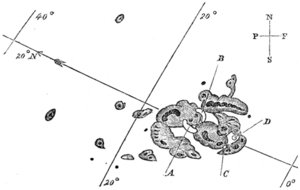 sailed into a living hell. Hailstones from above and waves from all around whipped the deck. When the wind-lashed ocean spray fell away to leeward, the men noticed they were sailing in an ocean of blood. The colour was reflected from the sky, which, they could see — even through the clouds — was wreathed in an all-encompassing red glow.
The sailors recognised the lights as the southern aurora that usually graced the skies near the Antarctic Circle, just as their northern counterparts cling to the Arctic. To see them from this far north was highly unusual. As the gale subsided, they witnessed an even more astonishing display. Fiery lights loomed against the horizon as if some terrible conflagration had engulfed the Earth. Vivid bolts flew across the now clear sky in spiral streaks and exploded in silent brilliance, as if the very souls of all humanity were fleeing whatever cataclysm had befallen the planet.
Upon their arrival at San Francisco, the ship’s company discovered that theirs was not an isolated experience. Two thirds of the Earth’s skies had been similarly smothered. Also, there was a sinister side to the aurorae.
The beguiling lights had disabled the telegraph system, wiping out communications across the world. For days, nature refused to allow these arteries of information to flow freely. It was as if today’s Internet had suddenly, inexplicably shut down. Worse still, the aurora also threatened life and limb.
In Philadelphia, a telegrapher was stunned by a severe shock. In some offices the equipment burst into flames. In Bergen, Norway, the operators had to scramble to disconnect the apparatus, risking electrocution. On top of this, compasses spun uselessly under the grip of the aurora, disrupting global navigation.
In the scramble to understand just what had engulfed Earth, the Victorians had only one clue.  On the previous morning amateur astronomer Richard Carrington was working in his private observatory at Redhill, Surrey, (left) and found himself witness to an unprecedented celestial event.
He was studying sunspots, the unexplained dark blemishes that occasionally speckle the Sun. The sunspot that Carrington gazed upon that day was huge, almost ten times the diameter of the Earth. Yet on the Sun, it barely stretched a tenth of the way across the fiery disc. Without warning, two beads of searing white light appeared over it.
No one had ever described the Sun behaving like this before and Carrington instantly began timing the lights as they drifted across the sunspot, faded and vanished. That night, the apocalyptic aurora burst over the Earth. Could it be that Carrington’s titanic explosion had somehow hurled the electrical and magnetic energy at the Earth? If so, how?
Carrington himself never pursued the research. He became embroiled in a sex and drugs scandal that destroyed his reputation and then ended his life. Yet his discovery of the solar flare began half a century of intrigue, rivalry and speculation as other astronomers raced to understand the mysterious way in which the Sun could reach out across 93 million miles of void and strike the Earth. With the benefit of hindsight, we can see that the Carrington flare was a tipping point for astronomy. Suddenly aware that the Earth and its technology could be affected by celestial events, astronomers turned their attention away from charting the positions of stars to aid navigation, and began studying the nature of the celestial objects.
Today, the study continues. Astronomers routinely watch solar flares with their spacecraft and know that these explosions usually eject huge clouds of electrically-charged particles into space. When these strike the Earth, they produce the aurora in the atmosphere and cause technology to malfunction. Astronomers call it space weather and the ferocity of it still occasionally catches them unawares. In October 2003, a Japanese weather satellite died during a solar storm. In 1989, millions of North Americans were blacked out when a solar storm damaged the Hydro-Quebec power station in Canada.
In all these studies, however, there is one sobering thought. The scale of the solar storm of 1859 has never been equalled since. Even the fiercest recent storms are between three and five times smaller. With our current reliance on technology higher than at any time in history, another «Carrington-event» could cost us billions.
This article is about the 19th century sailing ships. For other uses, see Clipper (disambiguation).

Taeping, a tea clipper built in 1863
A clipper was a type of mid-19th-century merchant sailing vessel, designed for speed. Clippers were generally narrow for their length, small by later 19th century standards, could carry limited bulk freight, and had a large total sail area. «Clipper» does not refer to a specific sailplan; clippers may be schooners, brigs, brigantines, etc., as well as full-rigged ships. Clippers were mostly constructed in British and American shipyards, though France, Brazil, the Netherlands and other nations also produced some. Clippers sailed all over the world, primarily on the trade routes between the United Kingdom and China, in transatlantic trade, and on the New York-to-San Francisco route around Cape Horn during the California Gold Rush. Dutch clippers were built beginning in the 1850s for the tea trade and passenger service to Java.[1]
The boom years of the clipper era began in 1843 in response to a growing demand for faster delivery of tea from China. This continued under the stimulating influence of the discovery of gold in California and Australia in 1848 and 1851, and ended with the opening of the Suez Canal in 1869.[2]
Origin and usage of «clipper»[edit]
The term «clipper» most likely derives from the verb «clip», which in former times meant, among other things, to run or fly swiftly. Dryden, the English poet, used the word «clip» to describe the swift flight of a falcon in the 17th century when he said «And, with her eagerness the quarry missed, Straight flies at check, and clips it down the wind.» The ships appeared to clip along the ocean water. The term «clip» became synonymous with «speed» and was also applied to fast horses and sailing ships. «To clip it», and «going at a good clip», are remaining expressions.

«Opium clipper» Water Witch, a British barque built in 1831
The first application of the term «clipper», in a nautical sense, is uncertain. The Baltimore Clipper was in use over the last quarter of the 18th century through to the first half of the 19th century, but under a different name for much of that time. At first, these vessels were referred to as «Virginia-built» or «pilot-boat model»—with the name «Baltimore-built» appearing during the War of 1812. It was not until the final days of the slave trade (c. 1835 -1850)—just as the type was dying out—that the name «Baltimore Clipper» became common. The retrospective application of the word «clipper» to this type has been a source of confusion.[3]
The Oxford English Dictionary’s earliest quote (referring to the Baltimore Clipper) is from 1824.[4] The Dictionary cites Royal Navy officer and novelist Frederick Marryat as using the term in 1830. British newspaper usage of the term can be found as early as 1832 and in shipping adverts from 1835.[5][6] A US court case of 1834 has evidence which discusses a clipper being faster than a brig.[7]
Definitions[edit]
A clipper is a sailing vessel designed for speed, a priority which takes precedence over cargo carrying capacity, or building or operating costs. It is not restricted to any one rig, and while many were fully rigged ships, others were barques, brigs or schooners. Nor was the term restricted to any one hull type. Howard Chapelle lists three basic hull types for clippers. The first was characterised by the sharp deadrise and ends found in the Baltimore Clipper. The second was a hull with a full mid-section and modest deadrise, but sharp ends – this was a development of the hull-form of transatlantic packets. The third was more experimental, with deadrise and sharpness being balanced against the need to carry a profitable quantity of cargo. As well as a fast hull, a clipper carried a large sail area – by the standards of any other type of sailing ship, a clipper was greatly over-canvassed. The last defining feature of a clipper, in the view of maritime historian David MacGregor, was a captain who had the courage, skill and determination to get the fastest speed possible out of her.[8]: 16-21 [9]: 321–322
In assessing the hull of a clipper, different maritime historians use different criteria to measure «sharpness». «Sharpness» or «fineness» is explained by comparing a rectangular cuboid with the underwater shape of a vessel’s hull. The more material you have to carve off the cuboid to achieve the hull shape, the sharper the hull. Ideally a maritime historian would be able to look at either the block coefficient of fineness or the prismatic coefficient[a] of various clippers, but measured drawings or accurate half-models may not exist to calculate either of these figures.[9]: 43–45 An alternative measure of sharpness for hulls of a broadly similar shape is the coefficient of under-deck-tonnage, as used by David MacGregor in comparing tea clippers. This could be calculated from the measurements taken to determine the registered tonnage, and so can be applied to more vessels.[10]: 87–88
An «extreme clipper» has a hull of great fineness, as judged either by the prismatic coefficient, the coefficient of under-deck-tonnage or some other technical assessment of hull shape. It is a term that has been misapplied in the past, without reference to hull shape. As commercial vessels, these are totally reliant on speed to generate a profit for their owners, as their sharpness limits their cargo carrying capacity.
A «medium clipper» has a cargo-carrying hull that has some sharpness. In the right conditions and with a capable captain, some of these achieved notable quick passages. They were also able to pay their way when the high freight rates often paid to a fast sailer were not available (in a fluctuating market).
The term «clipper» applied to vessels between these two categories. They often made passages as fast as extreme clippers, but had less difficulty in making a living when freight rates were lower.[8]: 16
History[edit]


Hornet – an American clipper ship of the 1850s
The first ships to which the term «clipper» seems to have been applied were the Baltimore clippers, developed in Chesapeake Bay before the American Revolution, and reaching their zenith between 1795 and 1815. They were small, rarely exceeding 200 tons OM.[2] Their hulls were sharp ended and displayed a lot of deadrise. They were rigged as schooners, brigs or brigantines.[8]
In the War of 1812 some were lightly armed, sailing under Letters of Marque and Reprisal, when the type—exemplified by Chasseur, launched at Fells Point, Baltimore in 1814—became known for her incredible speed; the deep draft enabled the Baltimore clipper to sail close to the wind.[11] Clippers, running the British blockade of Baltimore, came to be recognized for speed rather than cargo space.
The type existed as early as 1780. A 1789 drawing of HMS Berbice (1780)—purchased by the Royal Navy in 1780 in the West Indies—represents the earliest draught of what became known as the Baltimore Clipper
Speed was also required for the opium trade from India to China. The fast-sailing vessels used were called Opium Clippers. Some of these were built specifically for the purpose – mostly in India and Britain. Some fruit schooners were bought for this trade, as were some Baltimore clippers.[12]: 90–97
Vessels of the Baltimore clipper type continued to be built for the slave trade, being useful for escaping enforcement of the British and American legislation prohibiting the trans-atlantic slave trade.[13]: 308 Some of these Baltimore clippers were captured when working as slavers, condemned by the appropriate court, and sold to owners who then used them as opium clippers – moving from one illegal international trade to another.[12]: 91
Ann McKim, built in Baltimore in 1833 by the Kennard & Williamson shipyard,[14][15] is considered by some to be the original clipper ship.[16] (Maritime historians Howard I. Chapelle and David MacGregor decry the concept of the «first» clipper, preferring a more evolutionary, multi-stepped development of the type.[12]: 72 ) She measured 494 tons OM, and was built on the enlarged lines of a Baltimore clipper, with sharply raked stem, counter stern and square rig. Although Ann McKim was the first large clipper ship ever constructed, it cannot be said that she founded the clipper ship era, or even that she directly influenced shipbuilders, since no other ship was built like her; but she may have suggested the clipper design in vessels of ship rig. She did, however, influence the building of Rainbow in 1845, the first extreme clipper ship.[2]
In Aberdeen, Scotland, the shipbuilders Alexander Hall and Sons developed the «Aberdeen» clipper bow in the late 1830s: the first was Scottish Maid launched in 1839.[17] Scottish Maid, 150 tons OM, was the first British clipper ship.[2] «Scottish Maid was intended for the Aberdeen-London trade, where speed was crucial to compete with steamships. The Hall brothers tested various hulls in a water tank and found the clipper design most effective. The design was influenced by tonnage regulations. Tonnage measured a ship’s cargo capacity and was used to calculate tax and harbour dues. The new 1836 regulations measured depth and breadth with length measured at half midship depth. Extra length above this level was tax-free and became a feature of clippers. Scottish Maid proved swift and reliable and the design was widely copied.»[18] The earliest British clipper ships were built for trade within the British Isles (Scottish Maid was built for the Aberdeen to London trade[19]). Then followed the vast clipper trade of tea, opium, spices and other goods from the Far East to Europe, and the ships became known as «tea clippers».
From 1839, larger American clipper ships started to be built beginning with Akbar, 650 tons OM, in 1839, and including the 1844-built Houqua, 581 tons OM. These larger vessels were built predominantly for use in the China tea trade and known as «tea clippers». Smaller clipper vessels also continued to be built predominantly for the China opium trade and known as «opium clippers» such as the 1842-built Ariel, 100 tons OM.[2]
Then in 1845 Rainbow, 757 tons OM, the first extreme clipper was launched in New York. These American clippers were larger vessels designed to sacrifice cargo capacity for speed. They had a bow lengthened above the water, a drawing out and sharpening of the forward body, and the greatest breadth further aft. Extreme clippers were built in the period 1845 to 1855.
In 1851, shipbuilders in Medford, Massachusetts built the Antelope, often called the Antelope of Boston to distinguish her from other ships of the same name. This vessel is sometimes called one of the first medium clipper ships. A ship-design journalist noted that «the design of her model was to combine large stowage capacity with good sailing qualities.»[20] The Antelope was relatively flat-floored and had only an 8-inch dead rise at half-floor.
The medium clipper, though still very fast, could carry more cargo. After 1854 extreme clippers were replaced in American shipbuilding yards by medium clippers.[2]
The Flying Cloud was a clipper ship that claimed the fastest passage between New York and San Francisco, 89 days 8 hours. (The other contender for this «blue ribbon» title was the medium clipper Andrew Jackson—there is an unresolvable argument over timing these voyages «from pilot to pilot»).[8]: 60–61 Flying Cloud was the most famous of the clippers built by Donald McKay. She was known for her extremely close race with the Hornet in 1853; for having a woman navigator, Eleanor Creesy, wife of Josiah Perkins Creesy, who skippered the Flying Cloud on two record-setting voyages from New York to San Francisco; and for sailing in the Australia and timber trades.
Clipper ships largely ceased being built in American shipyards in 1859 when, unlike the earlier boom years, only four clipper ships were built; a few were built in the 1860s. The last American clipper ship was «the Pilgrim» launched in 1873 from the shipyards of Medford, Massachusetts, built by Joshua T. Foster. Among shipowners of the day, «Medford-built» came to mean the best.[21]
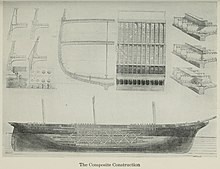
British clipper ships continued to be built after 1859. From 1859 a new design was developed for British clipper ships that was nothing like the American clippers; these ships continued to be called extreme clippers. The new design had a sleek graceful appearance, less sheer, less freeboard, lower bulwarks, and smaller breadth. They were built for the China tea trade, starting with Falcon in 1859, and continuing until 1870. The earlier ships were made from wood, though some were made from iron, just as some British clippers had been made from iron prior to 1859. In 1863 the first tea clippers of composite construction were brought out, combining the best of both worlds. Composite clippers had the strength of iron spars with wooden hulls, and copper sheathing could be added to prevent the fouling that occurred on iron hulls.[2]
After 1869, with the opening of the Suez Canal that greatly advantaged steam vessels (see Decline below), the tea trade collapsed for clippers. From the late 1860s until the early 1870s the clipper trade increasingly focused on the Britain to Australia and New Zealand route, carrying goods and immigrants, services that had begun earlier with the Australian Gold Rush of the 1850s. British-built clipper ships and many American-built British-owned ships were used. Even in the 1880s, sailing ships were still the main carriers of cargoes between Britain, and Australia and New Zealand. This trade eventually became unprofitable, and the ageing clipper fleet became unseaworthy.[2]
China clippers and the apogee of sail[edit]
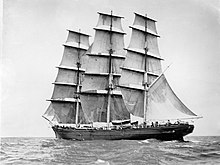
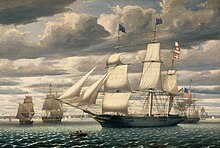
Clipper ship Southern Cross leaving Boston Harbor, 1851, by Fitz Hugh Lane
Among the most notable clippers were the China clippers, also called tea clippers or opium clippers, designed to ply the trade routes between Europe and the East Indies.[22] The last example of these still in reasonable condition is Cutty Sark, preserved in dry dock at Greenwich, United Kingdom. Damaged by fire on 21 May 2007 while undergoing conservation, the ship was permanently elevated three metres above the dry dock floor in 2010 as part of a plan for long-term preservation.
Before the early 18th century, the East India Company paid for its tea mainly in silver. When the Chinese Emperor chose to embargo European manufactured commodities and demand payment for all Chinese goods in silver, the price rose, restricting trade. The East India Company began to produce something desired by the Chinese as much as tea was by the British: opium. This had a significant influence on both India and China. Opium was also imported into Britain and was not prohibited because it was thought to be medically beneficial. Laudanum, made from opium, was used as a pain killer, to induce sleep and to suppress anxiety. The famous literary opium addicts Thomas De Quincey, Samuel Taylor Coleridge and Wilkie Collins also took it for its pleasurable effects. The Limehouse area in London was notorious for its opium dens, many of which catered for Chinese sailors as well as English addicts.[23]
Clippers were built for seasonal trades such as tea, where an early cargo was more valuable, or for passenger routes. One passenger ship survives, the City of Adelaide designed by William Pile of Sunderland. The fast ships were ideally suited to low-volume, high-profit goods, such as tea, opium, spices, people, and mail. The return could be spectacular. The Challenger returned from Shanghai with «the most valuable cargo of tea and silk ever to be laden in one bottom».[24] Competition among the clippers was public and fierce, with their times recorded in the newspapers.
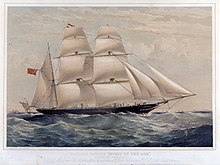
The last China clippers had peak average speeds of over 16 knots (30 km/h).[citation needed] The Great Tea Race of 1866 showcased their speed.
Donald McKay’s Sovereign of the Seas reported the highest speed ever achieved by a sailing ship – 22 knots (41 km/h), made while running her easting down to Australia in 1854. (John Griffiths’ first clipper, the Rainbow, had a top speed of 14 knots.) There are eleven other instances of a ship’s logging 18 knots (33 km/h) or over. Ten of these were recorded by American clippers.
Besides the breath-taking 465-nautical-mile (861 km) day’s run of the Champion of the Seas, there are thirteen other cases of a ship’s sailing over 400 nautical miles (740 km) in 24 hours.
And with few exceptions all the port-to-port sailing records are held by the American clippers.[25]
The 24h record of the Champion of the Seas set in 1854, wasn’t broken until 1984 (by a multihull), or 2001 (by another monohull).[26]
Decline[edit]

A graph of the number of clippers built in the USA each year in the 1850s. This closely follows the economic situation.[8]: 14
The American clippers sailing from the East Coast to the California goldfields were working in a booming market. Freight rates were high everywhere in the first years of the 1850s. This started to fade in late 1853. The ports of California and Australia reported that they were overstocked with goods that had been shipped earlier in the year. This gave an accelerating fall in freight rates that was halted, however, by the start of the Crimean War in March 1854, as many ships were now being chartered by the French and British governments. The end of the Crimean War in April 1856 released all this capacity back on the world shipping markets — the result being a severe slump. The next year saw the Panic of 1857, which had effects on both sides of the Atlantic. The United States was just starting to recover from this in 1861 when the American Civil War started, causing significant disruption to trade in both Union and Confederate states.[8]: 14–15
As the economic situation deteriorated in 1853, American shipowners either did not order new vessels, or specified an ordinary clipper or a medium clipper instead of an extreme clipper. No extreme clipper was launched in an American shipyard after the end of 1854 and only a few medium clippers after 1860.
By contrast, British trade recovered well at the end of the 1850s. Tea clippers had continued to be launched during the depressed years, apparently little affected by the economic downturn.[8]: 15 The long-distance route to China was not realistically challenged by steamships in the early part of the 1860s. No true steamer (as opposed to an auxiliary steamship) had the fuel efficiency to carry sufficient cargo to make a profitable voyage. The auxiliary steamships struggled to make any profit.

SS Agamemnon, the first steamer with the fuel efficiency to challenge sailing vessels on the long-distance route from Britain (or the East Coast USA) to the China tea ports
The situation changed in 1866 when the Alfred Holt-designed and owned SS Agamemnon made her first voyage to China. Holt had persuaded the Board of Trade to allow higher steam pressures in British merchant vessels. Running at 60 psi instead of the previously permitted 25 psi, and using an efficient compound engine, Agamemnon had the fuel efficiency to steam at 10 knots to China and back, with coaling stops at Mauritius on the outward and return legs — crucially carrying sufficient cargo to make a profit.[27]
In 1869 the Suez Canal opened, giving steamships a route about 3,000 nautical miles (5,600 km; 3,500 mi) shorter than that taken by sailing ships round the Cape of Good Hope. Despite initial conservatism by tea merchants, by 1871 tea clippers found strong competition from steamers in the tea ports of China. A typical passage time back to London for a steamer was 58 days, while the very fastest clippers could occasionally make the trip in less than 100 days; the average was 123 days in the 1867–68 tea season.[28][29][10]: 225–243 The freight rate for a steamer in 1871 was roughly double that paid to a sailing vessel. Some clipper owners were severely caught out by this: several extreme clippers had been launched in 1869, including Cutty Sark, Norman Court and the Caliph.[b]
Surviving ships[edit]
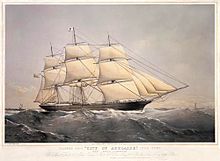
«City of Adelaide» (1864)
Of the many clipper ships built during the mid-19th century, only two are known to survive. The only intact survivor is Cutty Sark, which was preserved as a museum ship in 1954 at Greenwich for public display. The other known survivor is City of Adelaide; unlike Cutty Sark she was reduced to a hulk over the years. She eventually sank at her moorings in 1991, but was raised the following year and remained on dry land for years. Adelaide (a.k.a. S.V. Carrick) is the older of the two survivors, and was transported to Australia for conservation.[31][32]
Clipper ship sailing cards[edit]

Clipper ship sailing card for the «Free Trade», printed by Nesbitt & Co., NY, early 1860s
Departures of clipper ships, mostly from New York and Boston to San Francisco, were advertised by clipper ship sailing cards. These cards, slightly larger than today’s postcards, were produced by letterpress and wood engraving on coated card stock. Most clipper cards were printed in the 1850s and 1860s, and represented the first pronounced use of color in American advertising art.
Relatively few (perhaps 3,500) cards survive today. With their rarity and importance as artifacts of nautical, Western, and printing history, clipper cards are highly prized by both private collectors and institutions.[33]
See also[edit]
- List of clipper ships
- Clipper route
- Packet boat
- Sail-plan
- Windjammer
People associated with clipper ships[edit]
- List of people who sailed on clipper ships
- Joseph Warren Holmes
- Samuel Hartt Pook
- William Jardine
- Donald McKay
- John (or «Jock») «White Hat» Willis
Notes[edit]
- ^ The block coefficient of fineness is a mathematical measure of sharpness used by naval architects which compares the hull with a hypothetical block equal in length, breadth and height to the immersed part of the hull. The prismatic coefficient makes a similar comparison to a prism with the immersed hull’s dimensions, and is considered to the best indicator of potential speed. The lower the coefficient, the more material has to be removed from the hypothetical cuboid. It is unlikely that many commercial sailing vessels had a prismatic coefficient that was less than 0.57.
- ^ Caution is needed in interpreting Basil Lubbock’s count of the number of extreme clippers launched in 1869. He states there were 25, but apparently without evidence such as having sight of reliable plans or half-models. MacGregor stated that at least 5 of those in Lubbock’s list were medium clippers, thereby calling into question the categorisation of the others.[30]: 253
[edit]
- ^ Barnwell, R.G. (1857). Commercial Relations of the United States with Foreign Countries. United States Department of State. pp. 260–4.
- ^ a b c d e f g h Clark, Arthur Hamilton (1912). The Clipper Ship Era: An Epitome of Famous American and British Clipper Ships, Their Owners, Builders, Commanders, and Crews, 1843-1869. G.P. Putnam’s Sons.
The Clipper Ship Era.
- ^ Chapelle, Howard Irving (1930). The Baltimore Clipper, its Origin and Development. New York: Bonanza Books.
- ^ «clipper». Oxford English Dictionary (Online ed.). Oxford University Press. (Subscription or participating institution membership required.)
- ^ «Westmeath Journal». 14 June 1832. p. 1.
and may be called an American Clipper
- ^ «Liverpool Standard and General Commercial Advertiser». 22 December 1835. p. 1. Retrieved 13 May 2020.
The well-known Clipper SAGUENAY,
- ^ Gibert, Pedro; United States. Circuit Court (1st Circuit) (1834), A report of the trial of Pedro Gibert, Bernardo de Soto, Francisco Ruiz, Nicola Costa, Antonio Ferrer, Manuel Boyga, Domingo de Guzman, Juan Antonio Portana, Manuel Castillo, Angel Garcia, Jose Velazquez, and Juan Montenegro alias Jose Basilio de Castro, before the United States Circuit Court : on an indictment charging them with the commission of an act of piracy, on board the brig Mexican, of Salem : containing a full statement of the testimony, and the arguments of the counsel on both sides, the charge of the court, pronounced by the Hon. Judge Story : and the verdict of the jury : with an appendix containing several documents never before published, Russell, Odiorne & Metcalf ; Providence : M. Brown & Co. ; Portland : Colman & Chisholm ; Salem : John M. Ives, retrieved 15 September 2019
- ^ a b c d e f g MacGregor, David R (1993). British & American Clippers: A Comparison of their Design, Construction and Performance in the 1850s. London: Conway Maritime Press Ltd. ISBN 0-85177-588-8.
- ^ a b Chapelle, Howard I. (1967). The Search for Speed Under Sail, 1700-1855. Bonanza Books.
- ^ a b MacGregor, David R. (1983). The Tea Clippers, Their History and Development 1833–1875 (Second ed.). Conway Maritime Press. ISBN 0-85177-256-0.
- ^ Villiers 1973.
- ^ a b c MacGregor, David R (1988). Fast Sailing Ships, their design and construction, 1775-1875 (Second ed.). London: Conway Maritime Press. ISBN 0-87021895-6.
- ^ Grindal, Peter (2016). Opposing the Slavers. The Royal Navy’s Campaign against the Atlantic Slave Trade (Kindle ed.). London: I.B.Tauris & Co. Ltd. ISBN 978-0-85773-938-4.
- ^ Dear, I.C.B., & Kemp, Peter, eds. Oxford Companion to Ships and the Sea (Oxford University Press, 2005).
- ^ Website «Ann McKim» -details, at bruzelius.info Accessed 30 March 2009.
- ^ Ukers, William Harrison (1935). All about Tea. Tea and Coffee Trade Journal Company. pp. 87.
Ann McKim clipper ship.
- ^ «Alexander Hall & Sons Ltd». Aberdeen Ships. 4 November 2006. Retrieved 8 April 2013.
- ^ «Aberdeen Built Ships». Aberdeenships.com. 22 February 2013. Retrieved 8 April 2013.
- ^ «Alexander Hall & Son Shipyard». The Doric Columns — Aberdeen. 1 September 2013. Retrieved 6 June 2020.
- ^ Boston Daily Atlas, 29 November 1851
- ^ Medford Historical Society & Museum:Medford-Built Sailing Ships, at medfordhistorical.org Accessed 19 October 2017
- ^ Jefferson, Sam (4 November 2014). Clipper Ships and the Golden Age of Sail: Races and Rivalries on the Nineteenth Century High Seas. A&C Black. ISBN 9781472900289.
- ^ «The Opium Clippers». Portcities.org.uk. 15 November 2012. Retrieved 8 April 2013.
- ^ Forbes, Allan; Ralph Mason Eastman (1952). Yankee ship sailing cards... State Street Trust Co.
- ^ Lyon, Jane D (1962). Clipper Ships and Captains. New York: American Heritage Publishing.
- ^ «24 Hour Distance». Sailspeedrecords.com. Retrieved 8 April 2013.
- ^ Jarvis, Adrian (1993). «Chapter 9: Alfred Holt and the Compound Engine». In Gardiner, Robert; Greenhill, Dr. Basil (eds.). The Advent of Steam — The Merchant Steamship before 1900. Conway Maritime Press Ltd. pp. 158–159. ISBN 0-85177-563-2.
- ^ Clark, Arthur H (1911). The Clipper Ship Era 1843–1869. New York: G. P. Putnam’s Sons. p. 332.
- ^ «Agamemnon (1865); Passenger/cargo vessel». Ship models. National Maritime Museum.
- ^ MacGregor, David R. (1988). Fast Sailing Ships, their Design and Construction, 1775-1875 (Second ed.). London: Conway Maritime Press Ltd. ISBN 0-87021-895-6.
- ^ «City of Adelaide website – Condensed History». Cityofadelaide.org.au. Retrieved 8 April 2013.
- ^ Jim Carrick. «The Future of the S.V. Carrick». History Scotland magazine. Archived from the original on 8 February 2006.
- ^ Neale, Jane. «Clipper Ship Cards». American Antiquarian Society. Archived from the original on 8 October 2013. Retrieved 11 July 2014.
References[edit]
- Carl C. Cutler, Greyhounds of the Sea (1930, 3rd ed. Naval Institute Press 1984)
- Alexander Laing, Clipper Ship Men (1944)
- David R. MacGregor, Fast Sailing Ships: Their Design and Construction, 1775–1875 Naval Institute Press, 1988 ISBN 0-87021-895-6
- Oxford English Dictionary (1987) ISBN 0-19-861212-5.
- Bruce D. Roberts, Clipper Ship Sailing Cards, 2007, Lulu.com. ISBN 978-0-9794697-0-1.
- Bruce D. Roberts, Clipper Ship Cards: The High-Water Mark in Early Trade Cards, The Advertising Trade Card Quarterly 1, no. 1 (Spring 1994): 20–22.
- Bruce D. Roberts, Clipper Ship Cards: Graphic Themes and Images, The Advertising Trade Card Quarterly 1, no. 2 (Summer 1994): 22–24.
- Bruce D. Roberts, Museum Collections of Clipper Ship Cards, The Advertising Trade Card Quarterly 2, no. 1 (Spring 1995): 22–24.
- Bruce D. Roberts, Selling Sail with Clipper Ship Cards, Ephemera News 19, no. 2 (Winter 2001): 1, 11–14.
- Chris and Lesley Holden (2009). Life and Death on the Royal Charter. Calgo Publications. ISBN 978-0-9545066-2-9.
Further reading[edit]
Overview and introduction[edit]
- Knoblock, Glenn A. (2014). The American Clipper Ship, 1845–1920: A Comprehensive History, with a Listing of Builders and Their Ships. Jefferson: McFarland. ISBN 978-0-7864-7112-6.
- Ross, Donald Gunn III. «Era of the Clipper Ships Web Site». Archived from the original on 30 March 2010. Retrieved 3 September 2011. – Beautifully illustrated introduction, by a member of Donald McKay’s family
- Clark, Arthur H. (1910). The Clipper Ship Era, An Epitome of Famous American and British Clipper Ships, Their Owners, Builders, Commanders, and Crews, 1843–1869. Camden, ME: G.P. Putnam’s Sons. – Basic reading, a favorite of Franklin Delano Roosevelt
- Westward by Sea: A Maritime Perspective on American Expansion, 1820–1890, digitized source materials from Mystic Seaport, via Library of Congress American Memory
- Currier & Ives (1959). American clipper ship prints by the Curriers. American Neptune. Salem, MA: The American Neptune.
American clipper ships[edit]
- Cutler, Carl C (1984). Greyhounds of the sea: The story of the American clipper ship (3rd ed.). Annapolis, MD: Naval Institute Press. ISBN 978-0-87021-232-1. – The definitive narrative history, useful for checking discrepancies between sources
- Crothers, William L (1997). The American-built clipper ship, 1850–1856 : characteristics, construction, and details. Camden, ME: International Marine. ISBN 0-07-014501-6. – The comprehensive reference for design and construction of American-built clipper ships, with numerous drawings, diagrams, and charts. Gives examples of how each design feature varies in different ships.
- Howe, Octavius T; Matthews, Frederick C. (1986) [First published 1926-1927]. American Clipper Ships 1833–1858. Volume 1 and 2. Salem, MA; New York: Marine Research Society; Dover Publications. ISBN 978-0-486-25115-8. Articles on individual ships, broader coverage than Crothers
Clipper ships by type[edit]
- Lubbock, Basil (1984). The China clippers. The Century seafarers. London: Century. ISBN 978-0-7126-0341-6.
- Lubbock, Basil (1968) [1921]. The Colonial Clippers (2nd ed.). Glasgow: James Brown & Son. pp. 86–87. OCLC 7831041. – British and Australian clippers
- Lubbock, Basil (1932). The Nitrate Clippers (1st ed.). Glasgow: Brown, Son & Ferguson. pp. 86–87. ISBN 978-0-85174-116-1.
- Lubbock, Basil (1967) [1933]. The Opium Clippers. Boston, MA: Charles E. Lauriat Co. ISBN 978-0-85174-241-0. – One of the few comprehensive books on these ships
External links[edit]
 |
Look up clip in Wiktionary, the free dictionary. |
- City of Adelaide Clipper Ship, one of the few surviving clippers
- Westward by Sea Library of Congress collection of sailing cards.
- The Shipslist: Baltimore Clipper
- The Clipper Ship Card Collection at the New-York Historical Society
CHAPTER XVI
AMERICAN CLIPPERS OF 1854 AND 1855
DURING the year 1854 no less than twenty passages were made from Atlantic ports to San Francisco in 110 days or less. The Flying Cloud repeated her famous record passage of 89 days, and was followed by the Romance of the Seas, 96 days; Witchcraft, 97 days; David Brown, 98 days, and Hurricane, 99 days. The abstract log of the Flying Cloud is as follows:
| Sandy Hook to the equator | 17 | days. |
| Equator to 50° South | 25 | » |
| From 50° South in the Atlantic to 50° South in the Pacific | 12 | » |
| To the equator | 20 | » |
| To San Francisco | 15 | » |
| Total | 89 | » |
On this passage the Flying Cloud gave a fine example of her sailing qualities. She sailed eight days after the Archer, also an exceedingly fast ship, and led her into San Francisco by nine days. Captain Creesy received a grand ovation on this, his second record passage, and the merchants of San Francisco, always generous and hospitable, vied with each other to do him honor. Upon his return to New York, a banquet was given him at the Astor House, then the finest hotel in the city, and a splendid service of silver plate was presented to him by the New York and Boston Marine Underwriters.
The Romance of the Seas sailed from Boston two days after the David Brown, commanded by Captain George Brewster, of Stonington, had passed out by Sandy Hook, but came up with her off the coast of Brazil. From this point they were frequently in company for days together, finally passing through the Golden Gate side by side, March 23, 1854. After discharging their cargoes, they again passed out of the Golden Gate together, this time bound for Hong-kong, and while they were not in company during this passage of 45 days, they anchored in Hong-kong harbor on the same day and almost at the same hour. The log of the Romance of the Seas records that skysails and royal studdingsails were set just outside the Golden Gate and were not taken in during the passage until entering the harbor of Hong-kong.
It is difficult to realize the intense interest with which these clipper ship races were regarded in those days; and it is doubtful whether at the present day any branch of sport inspires so much wholesome, intelligent enthusiasm as did these splendid ocean matches of the old clippers.
In this year a change came over the California trade. The wild rush to the mines had subsided, and the markets of San Francisco, while not overstocked, were so sufficiently and regularly supplied as to render great speed in the transportation of merchandise unnecessary; the rates of freight had therefore declined, but were still good. Twenty ships, the last of the extreme clippers, were built in 1854 for the California trade, including some which became celebrated, such as the Canvasback, Fleetwing, Grace Darling, Harvey Birch, Nabob, Nonpareil, Ocean Telegraph, Rattler, Robin Hood, and Sierra Nevada; but we miss from among the ship-builders of this year the names of Donald McKay, William H. Webb, Samuel Hall, Jacob A. Westervelt, and George Raynes, none of whom brought out California clippers.
Although no more extreme clippers were built for the California trade after 1854, a fine class of ships, known as medium clippers, was constructed, some of which proved exceedingly fast, and remarkable passages continued to be made. Many of these medium clippers would be considered very sharp and heavily sparred vessels at the present time.
The Sunny South, of 703 tons register, was one of the prettiest clippers ever launched at New York, and was the only sailing ship built by George Steers, the designer of the yacht America, steam frigate Niagara, and Collins Line steamship Adriatic. She was built for the China trade, was launched at Williamsburg, September 7, 1854; was owned by Napier, Johnson & Co., and was commanded by Captain Michael Gregory. It is a singular fact that while this ship was well known to possess great speed when in company with other clippers, yet she never made a passage worthy of being recorded, and was not a very successful ship financially; although the product of the skill of a designer, who, dying in early manhood, left a name so interwoven with his country’s triumphs upon the sea that it can never be forgotten.
In 1859, the Sunny South was sold at Havana, her name being changed to Emanuela. At that time her royal studdingsail booms and skysail masts and yards were removed. On August 10, 1860, she was seized in the Mozambique Channel flying the Chilian flag, with a cargo of slaves on board, by the British man-of-war Brisk, and the following particulars of her capture are given by one of the officers of that vessel:
«At 11:30 a.m. on the 10th of August last, as Her Majesty’s ship Brisk, Captain De Horsey, bearing the flag of Rear-Admiral the Hon. Sir Henry Keppel, K. C. B., was running to the northward in the Mozambique Channel, a sail was reported as seen from the masthead. Steam was got up without delay, and sail made in chase. It being hazy, the stranger was shortly lost sight of. When the weather had partially cleared the stranger was reported four points on our starboard bow, and the ship’s course was altered in that direction. We were now going eleven knots and a half, and the Captain, feeling that it must be something out of the common that would alter bearings at that distance in so short a time, proceeded himself with his glass to the foretopmast head, officers mounting the rigging.
«That a general excitement prevailed was evident from the manner in which our sails were trimmed, taken in, and set again. Hottentots and landsmen, who on other occasions only looked at ropes, now laid hold of them with a will. The Captain’s order from the masthead to keep away two points showed that he had observed something suspicious—in fact, he had noticed a sudden alteration in the course of the chase, and pronounced her to be a long, rakish-looking ship, too large to be a slaver, but thought there was something very suspicious in the sudden alteration of her course, her crowd of sail, and the unusual number of staysails.
«At about 3 P.M. we could see her hull from the deck, and, carrying with us a fresh breeze, while she was in the doldrums, we closed on her rapidly. When within half a mile we hoisted our colors, when every glass was pointed toward her peak, and all sorts of conjectures were made as to what colors she would show. No one could imagine that so large a vessel could be a slaver.
«On closing under her lee, and when within a cable’s length, a white package was thrown from her side into the sea; and the experienced then exclaimed, ‘A slaver, and there go her papers!’ A few minutes more, and we sheered up alongside to leeward of as beautiful model of a ship as ever was seen. Some forty dejected looking individuals, apparently a mixture of all nations, stood on her deck; still no colors, nor did she appear inclined to shorten sail or heave-to. The Captain then determined to run ahead and lower the quarter-boats to drop down and board; and as this manœuvre was being carried out a blank gun caused her to square the mainyard, which she did with studding-sails hanging to the yard, and luffed up into the wind.

The «Brisk» and The «Emanuela»
«It was an anxious five minutes to those on board while the boats were away. A small white British ensign run up at her peak showed that she was a prize, and a voice hailed us, ‘Eight hundred and fifty slaves on board!’»
In 1855 the California fleet was increased by the building of thirteen medium clipper ships, among which were the Andrew Jackson, Carrier Dove, Charmer, Daring, Herald of the Morning, Mary Whitridge, and Ocean Express. Only three passages were made from Atlantic ports to San Francisco during this year in 100 days or less; the Herald of the Morning, from New York, 99 days; Neptune’s Car, from New York, and Westward Ho, from Boston, each 100 days. Thirteen ships made the passage in over 100 days and less than 110 days; among them being the Boston Light, from Boston, 102 days; the Cleopatra and Red Rover, from New York, each 107 days; the Flying Cloud, from New York, and Meteor and Don Quixote, from Boston, each 108 days; the Flying Fish, two passages from Boston in 109 and 105 days, and the Governor Morton, from New York in 104 days.
This was Captain Creesy’s last voyage in the Flying Cloud, and he now retired to his home in Salem until 1861, when he was appointed a Commander in the United States Navy and assigned to the clipper ship Ino. She carried a crew of eighty men from Marblehead, and on her second cruise in 1862 made the record run of twelve days from New York to Cadiz. Captain Creesy subsequently commanded the clipper ship Archer, and made two voyages to China. He died at Salem in 1871, in his fifty-seventh year. So long as the American clipper ships and their brilliant exploits hold a place in the memory of man, the names of Josiah Creesy and the Flying Cloud will be remembered with pride.
The Mary Whitridge became one of the most famous of the clippers launched in 1855. She was built in Baltimore, where she was owned by Thomas Whitridge & Co., and was commanded by Captain Robert B. Cheesborough, also of that port. She was 877 tons register; length 168 feet, breadth 34 feet, depth 21 feet. On her first voyage she made the remarkable run of 13 days 7 hours from Cape Charles to the Rock Light, Liverpool. She was engaged for many years in the China trade under the command of Captain Benjamin F. Cutler and bore the reputation of being the finest and fastest ship sailing out of Baltimore.
At this time an important development took place in the California trade. It had been found that the fertile soil of the Pacific slope could be made to yield other treasures than gold, and in May, 1855, the barque Greenfield, Captain Follansbee, loaded the first consignment of wheat exported from California, consisting of 4752 bags. She was soon followed by the Charmer, commanded by Captain Lucas, which loaded a full cargo of 1400 tons of wheat for New York at $28 per ton freight. The export of wheat in sailing vessels rapidly increased, enabling ships to earn freights out and home, and this continued for many years.
In 1855 Donald McKay built three fine medium clipper ships, the Defender, Amos Lawrence, and Abbott Lawrence, which remind us that a number of Boston ships bore the names of her distinguished citizens. There were the Thomas H. Perkins, Rufus Choate, Starr King, Edward Everett, R. B. Forbes, Enoch Train, John E. Thayer, George Peabody, Samuel Appleton, Robert G. Winthrop, Russell Sturgis, and perhaps others now forgotten. There were already a ship, a barque, two brigs, and two schooners named the Daniel Webster, besides several steamboats and tugs and a pilot-boat; hence, the owners of ships who were desirous of honoring the great statesman were obliged to adopt some other means of expressing their admiration, and since Webster was known as the Defender of the Constitution and also as the Expounder of that document, there were two ships named the Defender and the Expounder. Some one suggested that the latter ship might, perhaps, have been named in honor of Yankee Sullivan, a noted prize-fighter then retired from the ring.
The Defender was 1413 tons register, and carried a splendid full-length figurehead of Daniel Webster. She was owned by D. S. Kendall and H. P. Plympton, of Boston, and was commanded by Captain Isaac Beauchamp.
My object in drawing attention to this vessel is to mention a notable gathering at Mr. McKay’s house on the day of her launch, July 27, 1855. The leading merchants of Boston and their families were his guests on that occasion, and speeches were made by the Hon. Edward Everett, ex-Mayor, the Hon. Benjamin Seaver, and Enoch Train. In the course of his address, Mr. Everett remarked: «I was at a loss, I confess, to comprehend the secret of the great success which has attended our friend and host. Forty-two ships, I understand, he has built—all vessels such as we have seen to-day. I do not mean that they were all as large, but they were as well constructed and looked as splendidly, as they rode on the waves. Forty-two vessels![1] No one else, certainly, has done more than our friend to improve the commercial marine of this country, and it has long seemed to me that there was a mystery about it. But since I have been under this roof to-day, I have learned the secret of it—excellent family government, and a good helpmeet to take counsel with and encouragement from. A fair proportion of the credit and praise for this success is, I am sure, due to our amiable and accomplished hostess [Cheers]. I congratulate also the father of our host, the father of such a family. He has, I am told, fourteen sons and daughters, and fifty grandchildren. Nine of the latter were born during the last year. I wish to know, my friends, if you do not call that being a good citizen!»
When the Abbott Lawrence was launched, in October of the same year. Mr. McKay was called upon to respond to the toast, «In memory of Abbott Lawrence,» and his brief speech has fortunately been preserved:
«Ladies and gentlemen: I regret my inability

Donald McKay
to do justice to the name that is honored and respected in every part of the civilized world. My speech is rude and uncultivated, but my feelings, I trust, are warm and true, and could I express those feelings, I would tell you how much I honor the memory of Abbott Lawrence. I know you all honor it, for you all knew him, and to know him was to love him. Love begets love. He loved our common country as a statesman of enlarged and liberal views, and our state and city as the scene of his personal labors. In Massachusetts he commenced his career; here he toiled and triumphed, here he has bequeathed the richest tokens of his love, and here all of him that can die mingles with the soil. He was not only a great man, but a good man. In every relation of life, he was a model for imitation. Ever be his memory green in the hearts of his countrymen. When the ship which bears his name shall have been worn out by the storms and the vicissitudes of the sea, may another, and another, and so on, till the end of time, perpetuate it upon the ocean, for he was the patron and friend of commerce as well as of the other great interests of the state. In conclusion, ladies and gentlemen, I again give you the memory of Abbott Lawrence. May his name and noble example never be forgotten.»
This speech seems to me to be most interesting, as showing the natural refinement of a mind destitute of the culture of even a common-school education, or perhaps it would be nearer the truth to say, a mind that had escaped the restraining influence of the pedagogue.
«Yet is remembrance sweet,
Though well I know
The days of childhood
Are but days of woe;
Some rude restraint,
Some petty tyrant sours
What else should be
Our sweetest blithest hours.»
These lugubrious lines found no echo in the early life of Donald McKay, for his boyhood was passed in earnest, healthy toil, and filled with a keen desire for knowledge, while his manhood had known the joy of well-earned success.
After the Abbott Lawrence, Mr. McKay built the medium clippers Minnehaha, Baltic, Adriatic, Mastiff, and barque Henry Hill, all in 1856; the Alhambra, 1857; the Helen Morris, and second Sovereign of the Seas, 1868, and the Glory of the Seas, 1869. During the Civil War, he built for the United States Government, the iron gunboat Ashuelot, the ironclad monitor Nausett, the wooden gunboats Trefoil, and Yucca, and the sloop of war Adams. In 1877 he retired to his farm at Hamilton, Massachusetts, and there he died, September 20, 1880, in the seventy-first year of his age.
Donald McKay was a man of untiring energy and industry. He was a rapid and skilful draughtsman and designed and superintended the construction of every vessel that he built. This may also be said of almost every ship-builder of that period, but Mr. McKay’s skill, the result of an intuitive perception ripened by experience, gave him a peculiar insight not only into how to create, but into what to create, and it was this genius that made him pre-eminent as a builder of clipper ships. He was a born artist and his ships were the finest expression of mechanical art. They are entitled to a place in the realm of fine arts far more than much of the merchandise that claims that distinction.
Mr. McKay was of a generous nature, and liberally rewarded the men who assisted him, and he was ever ready to lend a helping hand to those less fortunate than himself. So soon as he began to prosper he sent for his parents and made a new home for them at East Boston, and their comfort and happiness were always his care and greatest pleasure. In his later years he endured misfortune and ingratitude with the same sturdy sweetness and equanimity that he had shown in the days when fortune smiled.

–
Solar flares produce geomagnetic storms (CMEs) that can affect ANY country in the world, and knock out power for months or years.
What is the current threat?
–
This is a compilation of different well written sources. References are given.
Definition:
CME
http://en.wikipedia.org/wiki/Coronal_mass_ejection
= Coronal Mass Ejection – is a massive burst of solar wind, other light isotope plasma, and magnetic fields rising above the solar corona or being released into space.
Coronal mass ejections are often associated with other forms of solar activity, most notably solar flares, but a causal relationship has not been established. Most ejections originate from active regions on Sun’s surface, such as groupings of sunspots associated with frequent flares. CMEs occur during both the solar maxima and the solar minima of sun activity, albeit with decreased frequency during the minima.
X-class is the largest flare.
M-class is a medium sized solar flare.
C-class is the smallest of the flares.
–
The Carrington Effect (CME)
http://chasblogspot.blogspot.com/2009/08/carrington-event.html
A Super Solar Flare
At 11:18 AM on the cloudless morning of Thursday, September 1, 1859, 33-year-old Richard Carrington—widely acknowledged to be one of England’s foremost solar astronomers—was in his well-appointed private observatory. Just as usual on every sunny day, his telescope was projecting an 11-inch-wide image of the sun on a screen, and Carrington skillfully drew the sunspots he saw.
On that morning, he was capturing the likeness of an enormous group of sunspots. Suddenly, before his eyes, two brilliant beads of blinding white light appeared over the sunspots, intensified rapidly, and became kidney-shaped. Realizing that he was witnessing something unprecedented and «being somewhat flurried by the surprise,» Carrington later wrote, «I hastily ran to call someone to witness the exhibition with me. On returning within 60 seconds, I was mortified to find that it was already much changed and enfeebled.» He and his witness watched the white spots contract to mere pinpoints and disappear.
It was 11:23 AM. Only five minutes had passed.
Just before dawn the next day, skies all over planet Earth erupted in red, green, and purple auroras so brilliant that newspapers could be read as easily as in daylight. Indeed, stunning auroras pulsated even at near tropical latitudes over Cuba, the Bahamas, Jamaica, El Salvador, and Hawaii.
Even more disconcerting, telegraph systems worldwide went haywire. Spark discharges shocked telegraph operators and set the telegraph paper on fire. Even when telegraphers disconnected the batteries powering the lines, aurora-induced electric currents in the wires still allowed messages to be transmitted.
«What Carrington saw was a white-light solar flare—a magnetic explosion on the sun,» explains David Hathaway, solar physics team lead at NASA’s Marshall Space Flight Center in Huntsville, Alabama.
The explosion produced not only a surge of visible light but also a mammoth cloud of charged particles and detached magnetic loops—a «CME»—and hurled that cloud directly toward Earth.
The next morning when the CME arrived, it crashed into Earth’s magnetic field, causing the global bubble of magnetism that surrounds our planet to shake and quiver. Researchers call this a «geomagnetic storm.» Rapidly moving fields induced enormous electric currents that surged through telegraph lines and disrupted communications.
–
–
The Biggest Solar Storm in History
It was the 2 September 1859 -the day after Carrington had notice the solar flare. The clipper ship Southern Cross was off Chile when, at 1:30am, it sailed into a living hell.
Hailstones from above and waves from all around whipped the deck.
When the wind-lashed ocean spray fell away to leeward, the men noticed they were sailing in an ocean of blood.
*** This reminds me of the sea turning to blood in Revelation.
Could a huge fiery flare from the sun coming to earth cause the sea to appear red?
Rev 8:
[8] And the second angel sounded, and as it were a great mountain burning with fire was cast into the sea: and the third part of the sea became blood;
[9] And the third part of the creatures which were in the sea, and had life, died; and the third part of the ships were destroyed.REV. 16:
[3] And the second angel poured out his vial upon the sea; and it became as the blood of a dead man: and every living soul died in the sea.
–
The colour was reflected from the sky, which, they could see – even through the clouds – was wreathed in an all-encompassing red glow.
The sailors recognized the lights as the southern aurora that usually graced the skies near the Antarctic Circle, just as their northern counterparts cling to the Arctic. To see them from this far north was highly unusual.
As the gale subsided, they witnessed an even more astonishing display.
Fiery lights loomed against the horizon as if some terrible conflagration had engulfed the Earth.
Vivid bolts flew across the now clear sky in spiral streaks and exploded in silent brilliance, as if the very souls of all humanity were fleeing whatever cataclysm had befallen the planet.
Upon their arrival at San Francisco, the ship’s company discovered that theirs was not an isolated experience.
Two thirds of the Earth’s skies had been similarly smothered. Also, there was a sinister side to the aurora.
The beguiling lights had disabled the telegraph system, wiping out communications across the world.
For days, nature refused to allow these arteries of information to flow freely. It was as if today’s Internet had suddenly, inexplicably shut down. Worse still, the aurora also threatened life and limb.
In Philadelphia, a telegrapher was stunned by a severe shock. In some offices the equipment burst into flames.
In Bergen, Norway, the operators had to scramble to disconnect the apparatus, risking electrocution. On top of this, compasses spun uselessly under the grip of the aurora, disrupting global navigation.
–
Solar flares now
It’s obvious the flare caused considerable trouble back in 1859.
What impact would such a solar storm have on our modern world, if it occurred today?
According to the NAS report, a severe space weather event in the US could induce ground currents that would knock out 300 key transformers within about 90 seconds, cutting off the power for more than 130 million people.
How the solar storm would effect each country in the world depends on their level of dependency on electronic and technical systems.
–

–
Solar flares and global famine
http://www.examiner.com/exopolitics-in-seattle/solar-cycle-24-solar-flares-social-collapse-or-crushing-cold-temperatures-and-global-famine
Canadian journalist Lorne Gunter writes in February 2009: “According to Robert Toggweiler of the Geophysical Fluid Dynamics Laboratory at Princeton University and Joellen Russell, assistant professor of biogeochemical dynamics at the University of Arizona — two prominent climate modellers — the computer models that show polar ice-melt cooling the oceans, stopping the circulation of warm equatorial water to northern latitudes and triggering another Ice Age.
Gunter observes, “The last time the sun was this inactive, Earth suffered the Little Ice Age that lasted about five centuries and ended in 1850.
Crops failed through killer frosts and drought.
Famine, plague and war were widespread.
Harbours froze, so did rivers, and trade ceased.”
“The old solar cycles produced very intense solar storms.
The greatest solar storm in modern time known as the Carrington flare of 1-2 September 1859 occurred in Solar Cycle 10.
In addition to the Carrington flare, several other massive solar storms occurred during the old solar cycles.
These massive solar storms occurred on
12 October 1859,
4 February 1872,
17-18 November 1882,
30 March 1894,
31 October 1903,
25 September 1909 and
13-16 May 1921.
“If a solar storm of the magnitude of the Carrington flare were to occur today, the effect on our modern technologically dependent society would be grave.
Of these, the greatest threat would lie in the loss of stable electrical power. A massive solar storm could destroy many of the large custom Extra High Voltage (EHV) power transformer in the United States.
Imagine the effect of a total power blackout for months/years on 100 million people in the U.S. along with many millions across the globe.
Imagine the effect on the entire earth, if it was big enough.
–

–
An increase in Earth’s cloud cover (due to CME) produces a global drop in temperature.
This is despite the fact that during that same time period, atmospheric carbon dioxide (at Mauna Loa) has risen 5% from 367 ppm to 386 ppm.
The main threat from a ‘Dalton Minimum’ or ‘Maunder Minimum’ event is famine and starvation (affecting millions or hundreds of millions worldwide) due to shortened growing seasons and harsher weather.
In the past, in addition to great famines, this cold harsh weather has also lead to major epidemics.
–
Examples:
–
During the Dalton Minimum-1
“The Hudson River at the New York Harbor froze, enabling people to walk across the ice from Manhattan to Staten Island.
The Hudson froze over completely during particularly brutal winter of 1779/1780, when the surface was solid for five weeks straight and the British rolled cannons over the ice.
In 1821, taverns were constructed in the middle of the river to offer warmth and refreshment to pedestrians. [Sources: When New York Harbor Froze Over, 1779-1780 and F.Y.I.]
–
During the Dalton Minimum-2
“From 1803 to 1806, Captains Lewis and Clark lead a transcontinental expedition to explore the greater Northwest. During the winter of 1804/1805, the explorers set up a winter base camp near the Big Knife River near what is today the town of Bismarck, North Dakota. The winter was bitterly cold.
There were 6 days with temperatures of -30oF or lower. These occurred in 1804 on December 12 (-38oF), December 17 (-45oF), December 18 (-32oF), in 1805 on January 10 (-40oF), January 11 (-38oF), and January 13 (-34oF).
Compare this to the current low temperatures of Bismarck, North Dakota in which only one day in the past decade fell below -30oF. On January 15, 2009 the temperature fell to -44oF. [Sources: (1) The Journals of the Expedition under the Command of Captains Lewis and Clark, (2) Weather Underground for Bismarck, ND ]
–
During the Maunder Minimum
“During the Great Frost of (1683–1684) in England, the River Thames was completely frozen for two months, the ice was 11 inches thick at London. Sea ice was reported along the coasts of southeast England, and ice prevented the use of many harbors.
The sea froze, so that ice formed for a time between Dover and Calais, joining England and France. (It is more likely that the shorelines froze and a great mass of densely packed icebergs, some 11 feet thick, built up along the coastlines fusing into a semi-rigid structure that may have connected the two shorelines together.)
The Thames was recorded to have frozen over at London during the years: 1649, 1655, 1663, 1666, 1667, 1684, 1695, 1709, and 1716. [Sources: River Thames Frost Fairs and Historical Weather Events 1650-1699] [See also: The Great Frost of 1683-4 and Where Thames Smooth Waters Glide]
–
During the Little Ice Age
Growing seasons in England and Continental Europe generally became short and unreliable, which led to shortages and famine. These hardships were nothing compared to the more northerly countries: Glaciers advanced rapidly in Greenland, Iceland, Scandinavia and North America, making vast tracts of land uninhabitable.
The Arctic pack ice extended so far south that several reports describe Eskimos landing their kayaks in Scotland.
Finland’s population fell by one-third, Iceland’s by half, the Viking colonies in Greenland were abandoned altogether, as were many Inuit communities. [Sources: The Deniers: Our Spotless Sun]
–
Previous recent CME storms – effects
A similar flare on March 13, 1989, provoked geomagnetic storms that disrupted electric power transmission from the Hydro Québec generating station in Canada, blacking out most of the province and plunging 6 million people into darkness for 9 hours; aurora-induced power surges even melted power transformers in New Jersey.
In December 2005, X-rays from another solar storm disrupted satellite-to-ground communications and Global Positioning System (GPS) navigation signals for about 10 minutes. This would be dangerous for aviation which uses GPS.
Canada and many of the Scandinavian countries have experienced the most electrical damage from solar storms, because of their proximity to the North pole.
–

–
Current status of sun – Enormous Ring is Developing on the Sun
http://www.lambslain.com/2010/10/solar-storms-and-emp-threats-enormous.html
Solar Storms and CME/EMP Threats
«What do you think would happen to society without power, water, food, and fuel? It’s not a pretty picture. People will begin dying off by the end of the first week — those without a minimal storage of water or those who live in regions where water is not immediately available to them. Desperation will result in a rampage of crime with hoards searching for food and water. Within several weeks, a complete civil breakdown will be underway as mass migration out of the major cities creates extremely dangerous conditions while people search for food, water and supplies. You get the idea.» – Global Power Grid Vulnerability into 2012, Modern Survival Blog, May 6, 2010
What is this strange ring that has been developing on the Sun?
Sunspot 1112, located in the southeast quadrant, has been the source of a giant filament that is currently stretching 400,000 km across the surface of the Sun.
However, today, there appears to be development of a enormous circular ring which looks to be linking with the huge magnetic filament of sunspot 1112.
Most of today’s various wavelength images of the Sun all show this feature over at the SDO (Solar Dynamics Observatory) — NASA website.
SpaceWeather.com today reports:
A vast filament of magnetism is cutting across the Sun’s southern hemisphere today. A bright ‘hot spot’ just north of the filament’s midpoint is UV radiation from sunspot 1112. The proximity is no coincidence; the filament appears to be rooted in the sunspot below.
If sunspot flares, it could cause the entire structure to erupt.
This active region merits watching…
What concerns me is that if indeed this is a huge magnetic filament nearly encircling the entire Sun, it is now currently directly facing the Earth.
If sunspot 1112 does erupt, could the entire filament explode into a massive CME?
This particular phenomenon will be all over in a few days as it rotates around the Sun, but it serves to remind us that there are more and more events happening on the Sun as we transit into the next solar cycle maximum (peaking ~ 2012 into 2013).
–
![clip_image002[5]](https://heavenawaits.files.wordpress.com/2011/01/clip_image0025_thumb2.jpg?w=178&h=194 "clip_image002[5]")
–
What would happen without Power and Electricity?
First to go – immediately for some people – is drinkable water.
Anyone living in a high-rise apartment, where water has to be pumped to reach them, would be cut off straight away.
For the rest, drinking water will still come through the taps for maybe half a day. With no electricity to pump water from reservoirs, there is no more after that.
There is simply no electrically powered transport: no trains, underground or overground.
Our just-in-time culture for delivery networks may represent the pinnacle of efficiency, but it means that supermarket shelves would empty very quickly – delivery trucks could only keep running until their tanks ran out of fuel, and there is no electricity to pump any more from the underground tanks at filling stations.
Back-up generators would run at pivotal sites – but only until their fuel ran out. For hospitals, that would mean about 72 hours of running a bare-bones, essential care only, service. After that, no more modern healthcare.
The truly shocking finding is that this whole situation would not improve for months, maybe years: melted transformer hubs cannot be repaired, only replaced.
Even when some systems are capable of receiving power again, there is no guarantee there will be any to deliver.
Almost all natural gas and fuel pipelines require electricity to operate.
Coal-fired power stations usually keep reserves to last 30 days, but with no transport systems running to bring more fuel, there will be no electricity in the second month.
…With no power for heating, cooling or refrigeration systems, people could begin to die within days.
There is immediate danger for those who rely on medication.
Lose power to New Jersey, for instance, and you have lost a major centre of production of pharmaceuticals for the entire US.
Perishable medications such as insulin will soon be in short supply.
«In the US alone there are a million people with diabetes,» Kappenman says. «Shut down production, distribution and storage and you put all those lives at risk in very short order.»
–
–
![clip_image002[7]](https://heavenawaits.files.wordpress.com/2011/01/clip_image0027_thumb.jpg?w=244&h=185 "clip_image002[7]")
–
Conclusion:
Be prepared physically and spiritually. Get to know God. Trust in Jesus.
Get down on your knees in prayer and humble yourself before the Creator.
Only he can save you in a case like this.
–
–
–
–
See also:
Sunspot activity, economic stress, and terrorism? Click here for more
Earthquakes increase in end times. Click here for more
To read about solar eclipses connected to end time events, Click here for more.
To read about solar cycle 24 and the end times, Click here for more.
To read about star signs in the end times. Click here for more.
To read about famine in the end times Click here for more.
To read about earthquakes increasing in Jerusalem in the end times Click here for more.
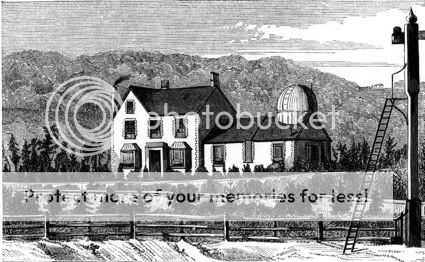
 . He is a Fellow of the Royal Astronomical Society, UK, and a Visiting Fellow of the University of Hertfordshire, UK. Visit him at www.stuartclark.com.