
Здесь можно найти карточки для третьей части устного экзамена PET + вводная речь экзаменатора:
#1
Now I’d like both of you to talk on your own about something. I’m going to give both of you a photograph of children meeting with their friends.
Candidate A, here is your photograph. Please show it to Candidate B, but I’d like you to talk about it. (Approximatly 1 minute)
Candidate B, you just listen. I’ll give you your photograph in a moment.
Thank you.

Listen to a student talking about photo A
Now, Candidate B, here is your photograph. It also shows teenagers meeting with their friends. Please show it to candidate A, and tell us what you can see in the photograph. (Approximatly 1 minute)
Thank you.

Listen to a student talking about photo B
#2
Now I’d like both of you to talk on your own about something. I’m going to give both of you a photograph of teenagers doing sports.
Candidate A, here is your photograph. Please show it to Candidate B, but I’d like you to talk about it. (Approximatly 1 minute)
Candidate B, you just listen. I’ll give you your photograph in a moment.
Thank you.

Listen to a student talking about photo A
Now, Candidate B, here is your photograph. It also shows people playing sports. Please show it to candidate A, and tell us what you can see in the photograph. (Approximatly 1 minute)
Thank you.

Listen to a student talking about photo B
#3
Now I’d like both of you to talk on your own about something. I’m going to give both of you a photograph of people spending money.
Candidate A, here is your photograph. Please show it to Candidate B, but I’d like you to talk about it. (Approximatly 1 minute)
Candidate B, you just listen. I’ll give you your photograph in a moment.
Thank you.

Now, Candidate B, here is your photograph. It also shows people spending money. Please show it to candidate A, and tell us what you can see in the photograph. (Approximatly 1 minute)
Thank you.

#4
Now I’d like both of you to talk on your own about something. I’m going to give both of you a photograph of people enjoying time outdoors.
Candidate A, here is your photograph. Please show it to Candidate B, but I’d like you to talk about it. (Approximatly 1 minute)
Candidate B, you just listen. I’ll give you your photograph in a moment.
Thank you.

Now, Candidate B, here is your photograph. It also shows people enjoying time outdoors. Please show it to candidate A, and tell us what you can see in the photograph. (Approximatly 1 minute)
Thank you.

#5
Now I’d like both of you to talk on your own about something. I’m going to give both of you a photograph of people making things.
Candidate A, here is your photograph. Please show it to Candidate B, but I’d like you to talk about it. (Approximatly 1 minute)
Candidate B, you just listen. I’ll give you your photograph in a moment.
Thank you.

Now, Candidate B, here is your photograph. It also shows people making things. Please show it to candidate A, and tell us what you can see in the photograph. (Approximatly 1 minute)
Thank you.

#6
Now I’d like both of you to talk on your own about something. I’m going to give both of you a photograph of people reading.
Candidate A, here is your photograph. Please show it to Candidate B, but I’d like you to talk about it. (Approximatly 1 minute)
Candidate B, you just listen. I’ll give you your photograph in a moment.
Thank you.

Now, Candidate B, here is your photograph. It also shows people reading. Please show it to candidate A, and tell us what you can see in the photograph. (Approximatly 1 minute)
Thank you.

Practice for your speaking exam
PET SPEAKING PART 3 SAMPLE CARDS/КАРТОЧКИ #2
PET SPEAKING PART 3 SAMPLE CARDS/КАРТОЧКИ #3
Вам также может быть интересно:
PET SPEAKING PART 2 SAMPLE CARDS/КАРТОЧКИ #1
PET SPEAKING PART 2 SAMPLE CARDS/КАРТОЧКИ #2
PET SPEAKING PART 2 SAMPLE CARDS/КАРТОЧКИ #3
You can get more information from the official website
Describing a picture is a common element of almost all Cambridge main suite English exams, but in order to practise, you’ll need pictures to describe. The other essential element is knowing how to describe a picture. For that you can use our perfect PET speaking part 2 plan. It’s important to choose the right type of pictures to describe because not all of them have the right qualities. For example, you’ll never see a picture of a single object or anything that is strange or controversial.
Check here for 5 complete Preliminary (PET) Speaking exams as part of Breakout English’s premium materials collection.

Possible topics for PET Speaking Part 2
As specified in the official Cambridge Preliminary (PET) handbook, there are certain topics that are expected at B1 level. Here are the ones which are most likely to come up in this part of the exam.
- daily life
- education
- entertainment and media
- food and drink
- free time
- health, medicine and exercise
- hobbies and leisure
- house and home
- people
- relations with other people
- shopping
- social interaction
- sport
- the natural world
- transport
- travel and holidays
- work and jobs
When you practise speaking with your classes. Try to find PET Speaking Part 2 pictures on a variety of these topics so that your students are fully prepared for whatever they might get in their exam. We’ve got a selection for you to download or display below, but if you are looking for more pictures to describe, remember to find something with enough content for the full minute.
In part 2 of the Preliminary (PET) Speaking Exam you will be asked to describe a picture to the examiner for approximately one minute.
Here is an example of a Preliminary (PET) Speaking Exam Part 2.
(Candidate A), here is your photograph. It shows friends spending time together.
(Candidate B), you just listen.
(Candidate A), please tell us what you can see in the photograph.
Approximately one minute
Thank you.
(Candidate B), here is your photograph. It shows someone reading.
(Candidate A), you just listen.
(Candidate B), please tell us what you can see in the photograph.
Approximately one minute
Thank you.
The examiner has a few back-up prompts available if the candidate is having trouble completing the task. These back-up prompts are always the same:
- Talk about the people/person
- Talk about the place
- Talk about the other things in the photograph
The Materials
Practise with these PET Speaking Part 2 pictures. Either use them from the website or download the pdf to practise, print or display.
If doing it with a class, write down things that they do well and errors. After describing each picture, do a correction/praise feedback stage before trying again.
Check here if you need to know how to describe a picture are looking for the perfect PET speaking part 2 plan.
EXAM PART: Speaking
EXAM SKILLS: Describing people, giving information about everyday activities, talking about what people are doing
TIME: 2-5 minutes per picture + feedback
Download the pictures
Preliminary (PET) Speaking Part 2 – Pictures
Pictures to describe
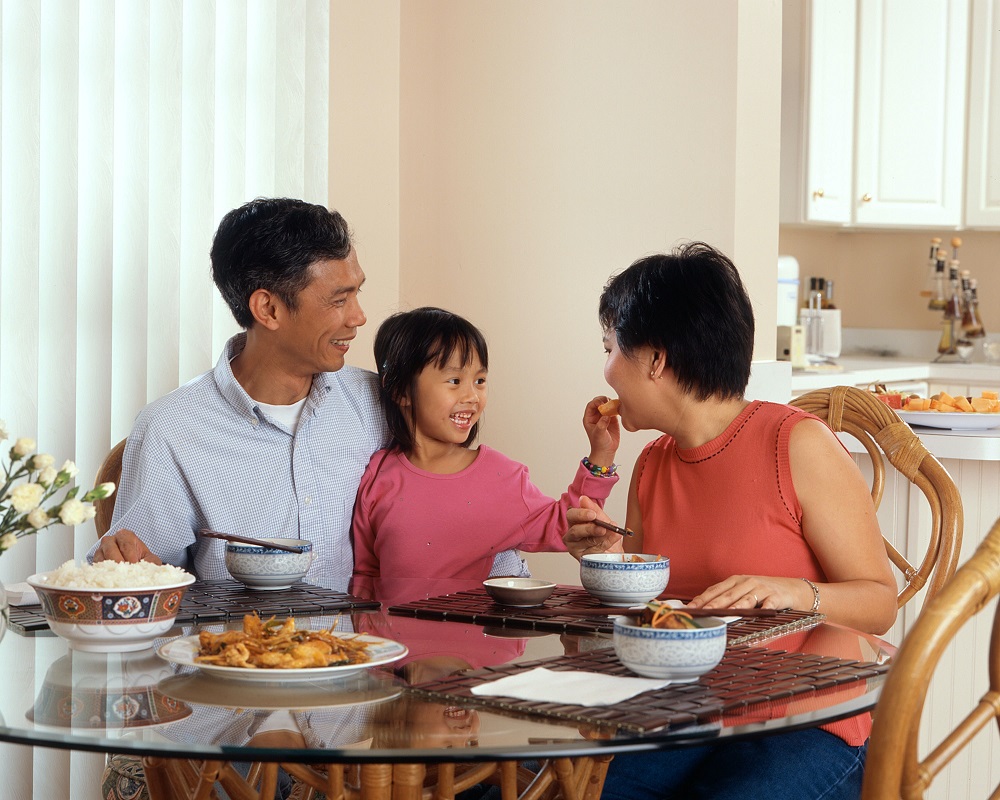
Eating together
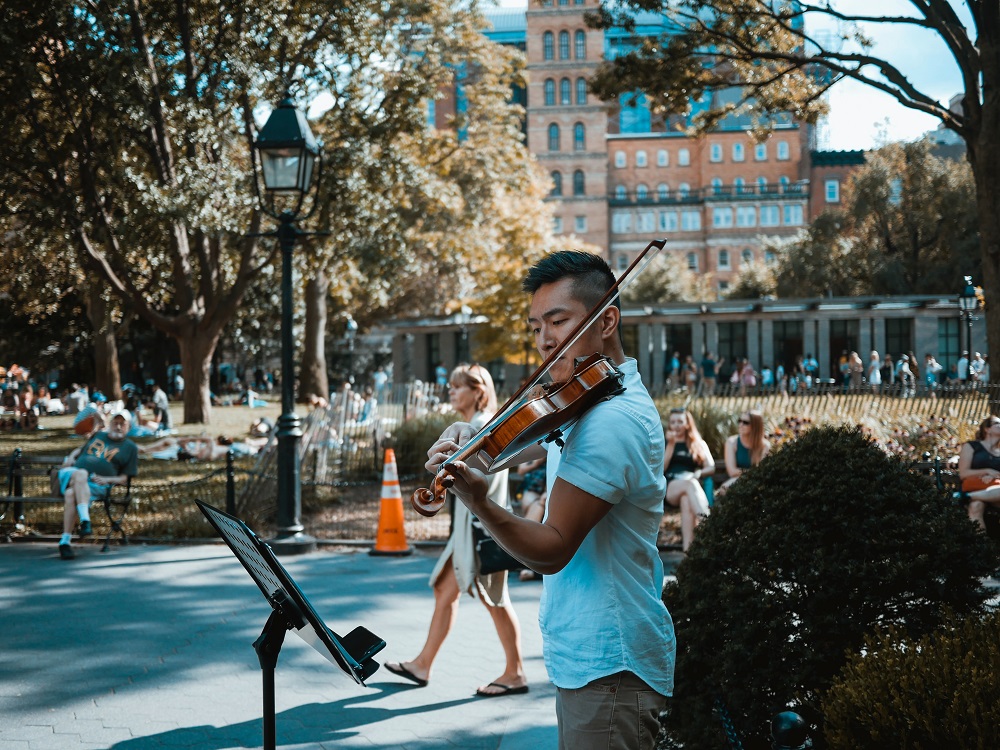
Playing music
Celebrating

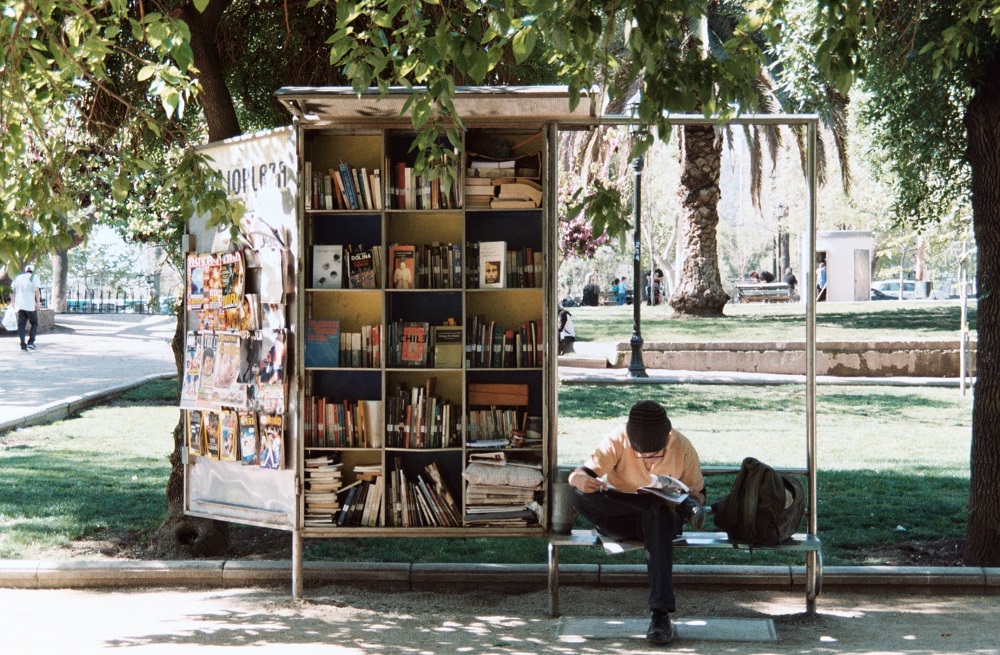
Reading
Spending time at home

Cooking

Using technology

Playing games
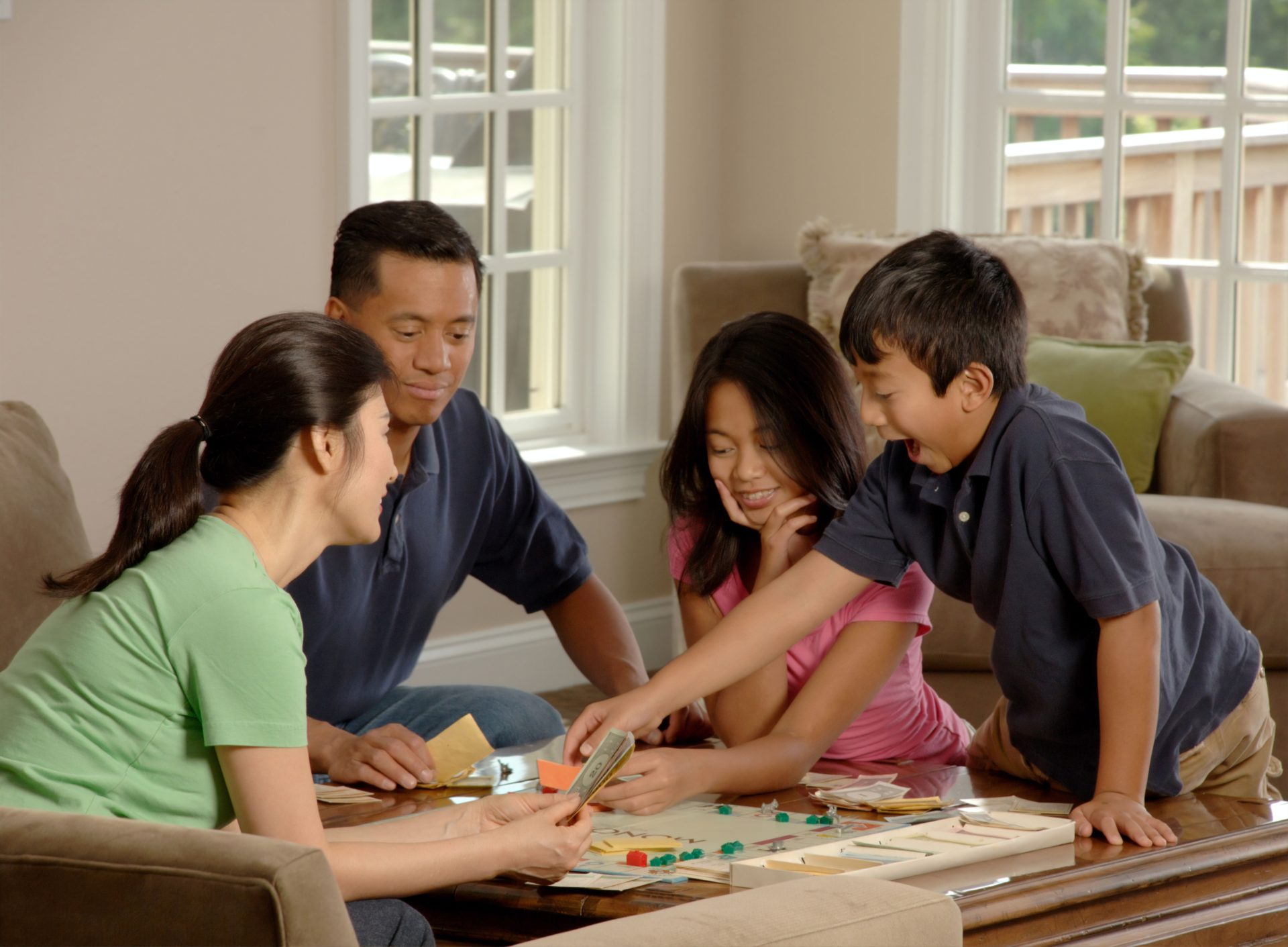
At school
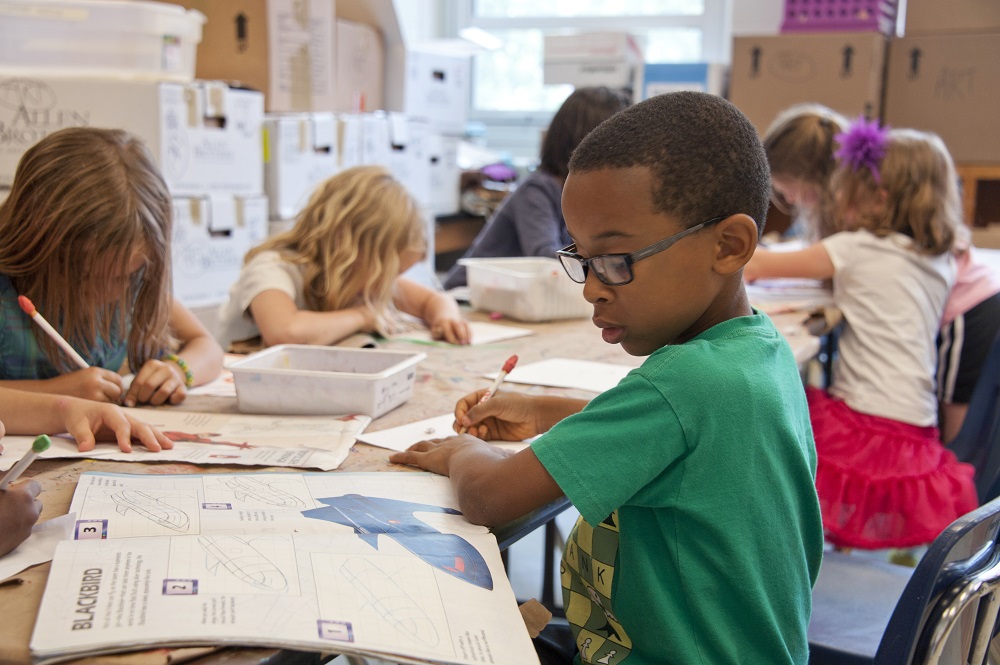
Spending time outside

Skip to main content
English Language Assessment
We use cookies. By continuing to use this website you are giving your consent for us to set cookies Dismiss
B1 Preliminary (PET)
Как описывать картинки
Speaking Part 2 занимает 3-4 минуты.
Экзаменатор показывает фото. Нужно описать то, что на фото. Каждый кандидат описывает свою картинку в порядке очереди. В это время другой кандидат молчит, желательно, чтобы он слушал речь своего партнера, привыкал к ней.
Экзаменатор говорит:
Now I’d like each of you to talk on your own about something. I’m going to give each of you a photograph and I’d like you to talk about it.
Экзаменатор дает идею того, что происходит на фотографии.
Here’s your photograph. It shows people in a café.
Не времени на подготовку ответа, нужно сразу начать описывать картинку.
Как описывать фотографию
1. Нужно начать с общего описания того, что на фото. Самая распространенная ошибка – это сразу фокусироваться на какой-то детали на фото.
Плохое начало:
On this photo there is a kiosk on the right.
Хорошее начало:
In this photo, I can see a young man who seems to be at the airport.
2. Затем, нужно описать фото в деталях.
2.1. Для этого нужно использовать предлоги места:
In the top left
On the left
In the bottom left
At the top
In the center/middle
At the bottom
In the top right
On the right
In the bottom right
At the front
At the front, there is a vet.
At the back
At the back, there is a shelf with some books.
Behind
Behind them, there are two boys running after them.
Next to
Parents are sitting next to her

2.2. Указать место, действие где происходит.
At the restaurant
At the cinema
At the theatre
in the museum
in the art gallery
at the exhibition
At the café
Inside a café
At school
At work
At the office
At the beach
At a playground
At the fairground
At the coast
In the mountains
On farm
In hospital (at hospital)
On the sports field
On the golf course
On the tennis court
On the football pitch
On holiday
On the iPod
On the tablet
On the laptop
On the computer
In the kitchen
In the dining room
In the living room
2.3. Какие могу быть события:
It’s a birthday party.
It’s a business meeting.
It’s a Christmas party.
2.4. Сказать, что человек находится один или что-то делает сам:
Be on her (his) own
I can’t see anybody else around
Be alone
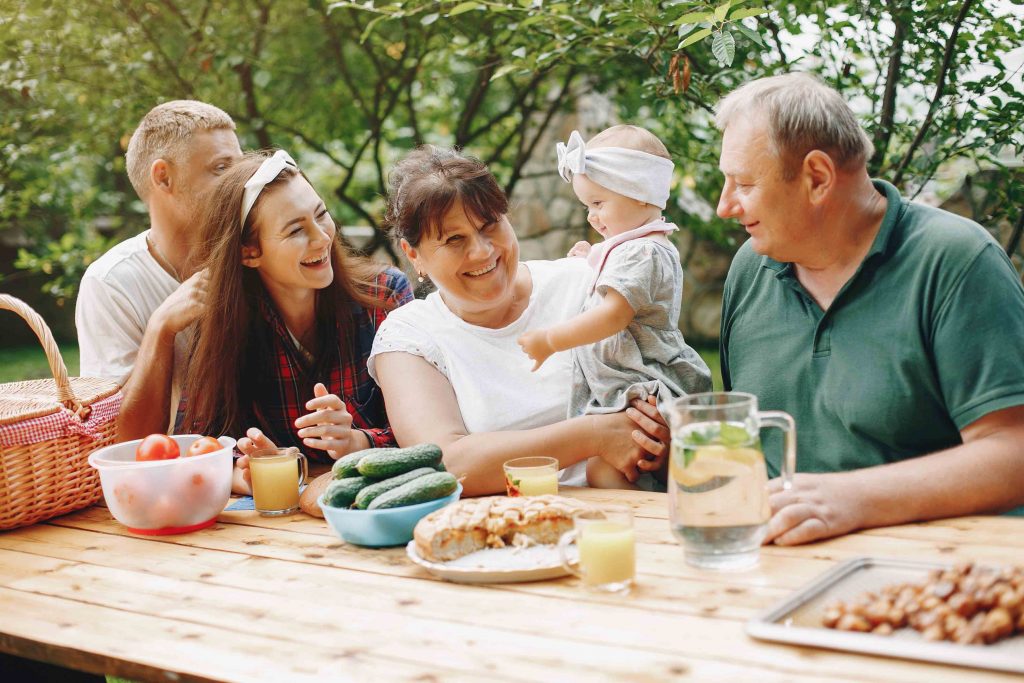
3. На фото всегда люди. Поэтому идеи, о чем говорить, дают ответы на вопросы:
3.1. Кто на фото
Mother
Father
Teenagers
a boy
a girl
a couple
husband
wife
children
3.2. Внешность
She looks like she is about 14 years old.
She has thick straight hair.
3.3. Одежда
She is wearing a purple long-sleeved top.
3.4. Погода
Описание одежды можно скомбинировать с описание погоды.
It looks like a sunny day outside.
I don’t think it’s very warm though. They both are wearing thick sweaters.
It’s sunny though I can see their shadows on the ground.
I think it must be warm weather.
The sun’s shining.
The gold court looks very green.
I can see trees in the background and a bit of blue sky.
It looks very peaceful.
4. Затем нужно порассуждать на тему того, что люди делают на фото.
She is smiling and playing a game with her brother.
4.1. Так как описываются люди, то пригодятся глаголы. Очень часто используется окончание –ing.
Глаголы:
holding, playing, smiling, laughing, talking, working, sitting, share, looking at, want, miss, trying, enjoying, reading, eating, drinking, sipping
4.2. Можно использовать фразовые глаголы, это повысит бал.
Shopping around – делать покупки
Wandering around — бродить
Looking around – осматривать местность
Kicking around – играть с мячом ногами
Touring around – бродить, осматривать
Tuck in/wolf down – кушать с аппетитом

4.3. Нужно четко знать сочетаемость данных глаголов с различными существительными (collocations):
Sitting at the table
Sitting between them
Nearly sitting on the ground
Holding a present
Giving a present
Getting a present
Playing sport
Playing at school
Holding a hockey stick
Running after him
Share a pizza
Looking very carefully at
Doing sports
Doing shopping
Choosing things to buy
Picking up the rubbish
Holding bags
Following the recipe
Making a mess
Having fun
Working together
Making a cake
Watching a football match
Burring in the sand
Making a sand castle
Throwing a ball
Catching a ball
Riding a horse
Riding a bike
Diving in the sea
Baking a cake
Baking a pie
Making salad
Making lunch
5. Необходимо не просто описывать, что происходит на фото, но выразить свою точку зрения. Для этого следует ответить на вопрос «Why… ?».
Не следует бояться ошибиться. Можно делать свои предположения по поводу ситуации, эмоций, которые люди на фото испытывают, что люди предположительно думают.
Пример:
In my opinion, she must work at the hospital because she has a white uniform. There is supposed to be some medical equipment in the background.
She is talking on the phone. Maybe she is talking to a customer. She looks quite happy. Maybe she is making a good deal.
Чтобы описать чувства пригодятся выражения
Look happy
Look relaxed
Look angry
Look grumpy
Look nervous
Look scared
Look upset
Look disappointed
Enjoying time outdoors
Enjoin time with their family
Enjoying time with their friends
Signing in a microphone
Playing the guitar
Enjoying their meal
Be hungry
Be thirsty
Be starving
Be full
Be hot
Be cold
Be embarrassed
Be scared
Be frightened
Be bored
Be interested in
He wonders.
Уроки английского языка проводятся онлайн.
Все учебники и материалы предоставляются преподавателем.
Ответы на возможные вопросы по процессу обучения онлайн можно прочитать по ССЫЛКE
- Exam: PET-O
- Course: SPEAKING
- Parts 3, Exam 1
Instructions
Complete the document given by dragging and dropping, or typing, the correct answers into the spaces provided, from the list given alongside.
The finished document will be a model answer for this part of the exam.

NEW Drag and drop now works on all mobile devices.
FIRST IMAGE FOR STUDENT A
SPEAKING RESPONSE TO VISUAL STIMULUS
Examiner
I would like you to look at the photograph and talk about it.
Student A
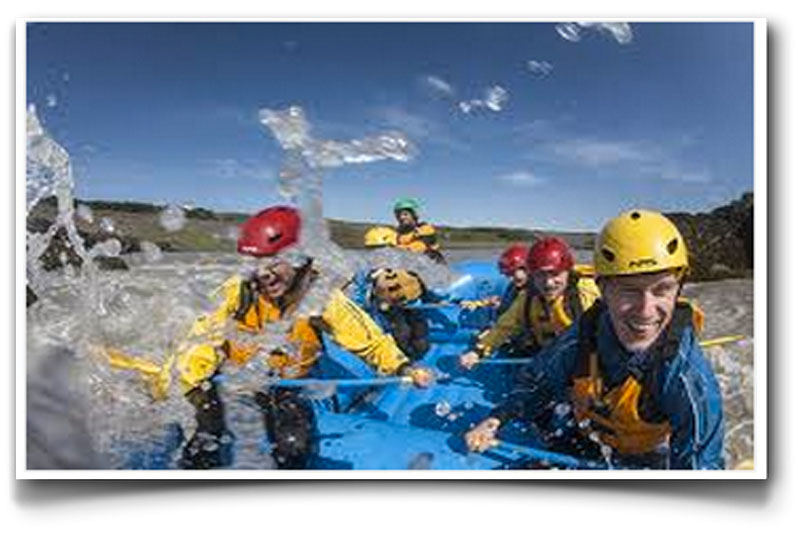
This image shows a group (1) young people enjoying the sport of rafting. It is clear that they are enjoying (2) because they are all smiling.
- A) it
- B) of
It looks (3) fun but is actually very difficult because the river is very powerful and the raft is difficult (4) control. Everybody (5) wearing a helmet and a life jacket (6) suggests that this activity can be dangerous if precautions are not taken.
- C) is
- D) which
- E) like
- F) to
The weather looks very nice, with a clear blue (7) and I imagine it is quite warm (8) this activity would be unpleasant in cold weather and the people would not look so happy. It can be seen that the river is in the mountains because the sport of rafting needs rivers (9) are very active and these are only found (10) the mountains.
- G) that
- H) as
- I) in
- J) sky
If I (11) the opportunity, I would love (12) go rafting as I have never tried it, and it looks very exciting.
- K) to
- L) had
SECOND IMAGE FOR STUDENT B
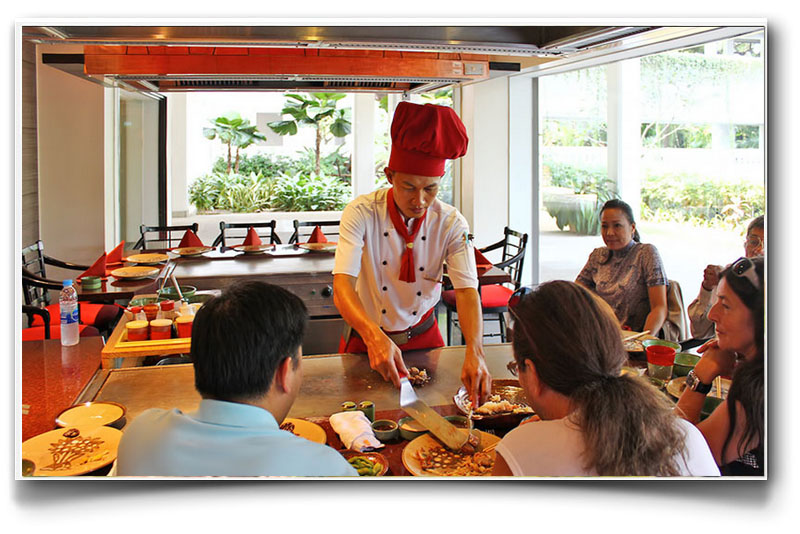
Examiner
I would like you to look at the photograph and talk about it.
Student B
This image shows a group of people (1) served by a chef. They are sitting in a restaurant which (2) expensive because the decor is of good quality and the chef is wearing an exclusive uniform.
- A) looks
- B) being
The weather is very sunny and warm because the people (3) wearing light clothes and have taken (4) their jackets. Even the chef is (5) short sleeves. It is quite normal for people in hot weather to prefer (6) eat inside, out of the direct sunlight, because it is cooler.
- C) to
- D) off
- E) in
- F) are
It seems (7) be lunch time because it (8) sunny outside, and judging by the number of people eating, the restaurant seems very popular. The chef appears to (9) oriental, so it could be (10) the far east although the clients all seem to be westerners.
- G) in
- H) be
- I) to
- J) is
If I (11) the chance, I would love (12) sit at this table and have my lunch because I love going to nice restaurants.
- K) to
- L) had
FIRST IMAGE FOR STUDENT A
Examiner:
I would like you to look at the photograph and talk about it.
Student A:
This image shows a group of young people enjoying the sport of rafting. It is clear that they are enjoying it because they are all smiling.
It looks like fun but is actually very difficult because the river is very powerful and the raft is difficult to control. Everybody is wearing a helmet and a life jacket which suggests that this activity can be dangerous if precautions are not taken.
The weather looks very nice, with a clear blue sky and I imagine it is quite warm as this activity would be unpleasant in cold weather and the people would not look so happy. It can be seen that the river is in the mountains because the sport of rafting needs rivers that are very active and these are only found in the mountains.
If I had the opportunity, I would love to go rafting as I have never tried it and it looks very exciting.
SECOND IMAGE FOR STUDENT B

Examiner:
I would like you to look at the photograph and talk about it.
Student B:
This image shows a group of people being served by a chef. They are sitting in a restaurant which looks expensive because the decor is of good quality and the chef is wearing an exclusive uniform.
The weather is very sunny and warm because the people are wearing light clothes and have taken off their jackets. Even the chef is in short sleeves. It is quite normal for people in hot weather to prefer to eat inside, out of the direct sunlight, because it is cooler.
It seems to be lunch time because it is sunny outside, and judging by the number of people eating, the restaurant seems very popular. The chef appears to be oriental, so it could be in the far east although the clients all seem to be westerners.
If I had the chance, I would love to sit at this table and have my lunch because I love going to nice restaurants.
Explanation
1) In part 3 of the PET speaking exam you and your partner will be required to speak individually about an image.
2) You need to mention what the image shows, but it is much more important to talk about the effect of the image, by using phrases like I THINK….or IT SEEMS LIKE….
3) A good way to organise your answer is to imagine four paragraphs.
Say what you see in the first.
Say what you feel in the second and third.
Finally, in the fourth which is the conclusion, say how you would react if you had the opportunity to participate in the activity shown . Use a sentence like IF I HAD THE CHANCE TO … I WOULD …
4) You need to be aware of the time, so that you say just what you need to in the time allowed. If you say too much in the beginning, your time will finish and you will not be able to give a complete answer.
5) In every speaking exam, it is not only what you say that is being judged. The way you organise your ideas is also very important.
Introduction
In 2020 Cambridge English updated the B1 Preliminary exam and there were a few changes to the Speaking paper so it is important for students and teachers to know what the ‘new’ Speaking exam looks like and what you can do to get ready and practise the right way.
The structure of the Speaking test still looks very similar to the old version, but, as I said before, there are a few changes.
- Introductory phase – The examiner asks each candidate a few personal questions. It’s like a warm-up.
- Individual long turn – Candidates need to describe a photo. This used to be Part 3, but now it is in line with higher-level exams like B2 First and C1 Advanced.
- Collaborative task – In this part the candidates work together and discuss a topic based on pictures which they get from the examiner. Until 2020 this was Part 2.
- Discussion – The examiner asks the candidates to discuss different questions which are linked to the topic in Part 3.
The different parts of the Speaking paper
Now that you know that there are four parts to the Speaking exam in PET it is time to look at them one by one. I’m going to show you how each section works based on an example video. We will look at the things the candidates do well and see what they could do better to get higher marks. Hopefully, you will understand the exam better and feel more confident once you get to the end of this article. 🙂
Part 1
In Part 1 of the B1 Preliminary Speaking test, the examiner asks the candidates some questions about their lives. There is a wide range of topics such as work/studies, family/friends, past/future activities, hobbies, your home, etc.
This section of the exam is like a warm-up or an introduction for you. The examiner tries to make you feel comfortable so you are not too nervous when you get to the following stages.
In the example video above you can see the two candidates doing Part 1. It only takes two minutes and the examiner asks them simple questions in turn. Both students do a good job because they give full answers adding some extra information like reasons or examples where they can. This is a very important point for you to remember as many candidates forget about this so their answers become very short and it doesn’t sound natural.
Another thing that many people often ignore is their body language. Try to smile when you are talking to the examiner or your partner, look at them when you or they are speaking and give them the impression that you are friendly, open and easy to talk to.
Part 2
We could say that Part 2 is where the exam really starts. Here you work on your own, which means you don’t interact with your partner, but you talk about a photo that the examiner gives you for about one minute. You have to describe the picture and tell the examiner what you can see.
I have seen many students preparing for the exam and there is a strategy that has worked best for most of them.
- Describe the person/people in the picture first (appearance, What are they doing?, possible feelings)
- Describe their surroundings (Where are they? What objects are around them? Are the people doing anything with the things around them?)
It is like going from the centre of the picture to the outside. You start with the people, who are usually in the middle of the image, and you move to the outside from there. This way you don’t forget any important details and if you get confused, you have something that can help you remember what to do next.
Example 1
In the video example, there are a few very interesting points to look at. Kenza goes first and I immediately notice that she doesn’t talk much about the woman’s appearance. She doesn’t speak about her clothes, her hair or body position. She could definitely improve that.
On the other hand, she speculates very nicely about what the woman might be doing in the photo. She uses words and expressions like “I don’t think…” or “Maybe…”. Also, her grammar is great using present continuous (am/are/is + -ing) to describe what is happening in the picture.
Unfortunately, she stops after just around 30 seconds when she could talk about a lot of other things and the examiner needs to help her a little bit. Don’t worry too much, this is OK and you won’t fail the exam just because of that, but it is better if you can talk for a full minute or until the examiner asks you to stop.
Once Kenza continues, she makes more good observations and keeps using nice grammar and vocabulary (“As I said before…”, revising, preparing, etc.)
Example 2
Mohammed does a very good job speaking for the full minute and he makes a lot of really good observations talking about the man, his phone, the guitar, his clothes and some other things as well. He mostly uses present continuous, just like Kenza, which is a very good thing to do too. Apart from that, Mohammed also speculates about the man possibly living alone because there is no one with him in the photo and there are no toys or any other signs of children.
The one thing, however, that Mohammed could improve is that there is no real structure in his turn. He jumps from one thing to the other instead of following a clear structure as I described above. To be clear, this doesn’t ruin his turn, but we can always work on little things in order to get even higher marks. Remember, describe the person first and then focus on the other things in the photo.
Part 3
Part 3 is the first task in which you communicate directly with your partner. The examiner gives you a situation and some pictures. Use these pictures to discuss the situation with your partner and make a decision based on the examiner’s instructions. You have 2-3 minutes of talking time and the examiner will stop you when the time is up.
Kenza and Mohammed generally work well together. They take turns talking and both of them give their opinion clearly as well as react to what their partner says instead of simply trying to throw their own ideas out there. Also, they discuss the topic until the examiner stops them, which is another important point for you to keep in mind. Teamwork is really the most crucial point in Part 3 and you should practise how to interact well with your partner before you take the official exam.
Kenza could support her ideas a little bit more and her answers are sometimes slightly too short while Mohammed does a great job giving reasons and examples to express his opinions. The same is true for how they interact with each other with Mohammed being more inviting than Kenza asking her to give her thoughts on the different gift options the football club could give to its supporters.
Overall, both students do a solid job, but Mohammed shows better skills when it comes to interacting with Kenza so I would give him higher marks here.
Part 4
Last but not least, Part 4 marks the end of the Speaking paper in B1 Preliminary. Here, the examiner asks you and your partner to discuss different questions together for about three minutes. The topic is always connected to Part 3 so in our example it is all about sports.
In the video, you can see that from the beginning Kenza and Mohammed work well together again. They react to what their partner says and give their opinions based on that information.
Similarly to Part 3 Mohammed shows better overall language awareness, a wider range of vocabulary and grammar and better interactive communication even though Kenza shows that her speaking skills are quite good for this level as well using good grammar and vocabulary to answer the questions and to interact with Mohammed.
Useful language for the Speaking exam
In each part of the Speaking test in B1 Preliminary, there are some useful phrases that you should try to use in order to get higher marks. The examiners look for this type of language because it signals that you are talking in the correct way and that you know what the examiners expect from you.
In general, we can break up the Speaking exam in three groups when it comes to useful language: Part 1, Part 2, Parts 3+4.
Part 1
Part 1 is the warm-up to your examination so it is important that you get accustomed to saying full sentences and to linking your ideas with reasons, examples, results and contrasts. A great way to achieve this is to use different linking expressions that you already know so there is nothing new for you to learn. Just make sure that you put one or two of them in each answer in Part 1 and you will see that what you say immediately makes more sense.
Below you can find some examples and O believe that these are probably the most common examples to give reasons or examples and to express result or contrast.
| Useful language for Speaking Part 1 |
| Giving reason |
| because because of + -ing/noun since as |
| Giving examples |
| for example such as for instance like |
| Expressing a result/consequence |
| so to in order to for + -ing |
| Expressing contrast |
| but although even though however on the other hand |
Again, these are the most common expressions, but there are many more that you can find online or in a good grammar book.
Part 2
Part 2 is all about describing what you can see in a photo, which means that you need the right language to do exactly that. Apart from that, you should also speculate a little bit about the people’s feeling or what they might be doing.
| Useful language for Speaking Part 2 |
| Talking about different parts of the picture (prepositions) |
| on the right/left at the top/bottom in the top/bottom left/right corner in the centre in the foreground/background next to / near in front of / behind |
| Describing the people in the picture |
| He’s/She’s got long/short/dark/fair/brown/red/grey hair. He’s/She’s got blue/brown/green/grey eyes. He’s/She’s tall/short/slim/big. He’s/She’s wearing + clothes |
| Describing the actions in the picture |
| We always use the present continuous to describe what is happening in a photo. Example: He is watching TV. She is writing an email on her laptop. |
| Speculating about the things in the picture |
| maybe/perhaps He/She might be + -ing/adjective I think/believe that… It looks/seems like he/she is + -ing/adjective |
Parts 3 & 4
Lastly, we are going to look at the last two parts of the B1 Preliminary Speaking test. As described earlier in this article, it is important to interact well with your partner and you should give your opinion with reasons and examples. This last part about reasons and examples is very similar to Part 1 so I’m not going to repeat that, but let’s check how you can communicate effectively with your partner during Parts 3 and 4.
| Useful language for Speaking Parts 3 and 4 |
| Giving your opinion |
| In my opinion, … I think/believe/feel … For me, … I would say … |
| Agreeing/Disagreeing |
| I agree/disagree. I (don’t) think so. I see your point. Definitely/Absolutely! Yes, but … |
| Inviting your partner to speak |
| What do you think? What about you? And you? Do you agree? What is your opinion? |
Time to practise
I hope you were able to take away some useful tips for the B1 Preliminary Speaking exam from this article. There are many great resources online like the videos Cambridge English puts on YouTube so you can see what the test looks like and very often they add comments by the examiners in the description for you to understand even better what the candidates do well and what they could improve.
You now need to start practising. As soon as you know who your partner for the official exam is going to be, go through different exams with your teacher or, again, find them online. Try to put some of the useful language in your answers and see how easy it can be to improve quickly.
Lots of love,
Teacher Phill 🙂
В прошлой статье мы подробно разобрали изменения в формате экзамена KET. Сегодня поговорим о том, что нас ждёт при подготовке к изменённому PET или, как он теперь называется, B1 Preliminary.
В двух словах: изменятся не только задания, но и количество частей, а также формат оценивания. Теперь B1 Preliminary и B1 Preliminary for Schools будут состоять из 4 частей: Speaking, Listening, Reading и Writing. До 2020 года задания части Reading & Writing выполнялись вместе. Pass поменяется на Grade C, Pass with Merit на Grade B, а Pass with Distinction — на Grade A. Часть Reading станет чуть больше, появятся новые задания и в других разделах экзамена.
Reading
Так как Reading теперь стала отдельной частью, у кандидатов появились более жёсткие временные рамки. Если раньше можно было гибко планировать время и тратить больше усилий на чтение либо письмо на выбор, то теперь придётся концентрироваться на каждой части по очереди. Исчезло задание-”угадайка” в части 3, где сдающие частенько не особо вчитывались в текст и выбирали между True и False интуитивно. Добавились 2 новых задания, подробнее о которых чуть ниже.
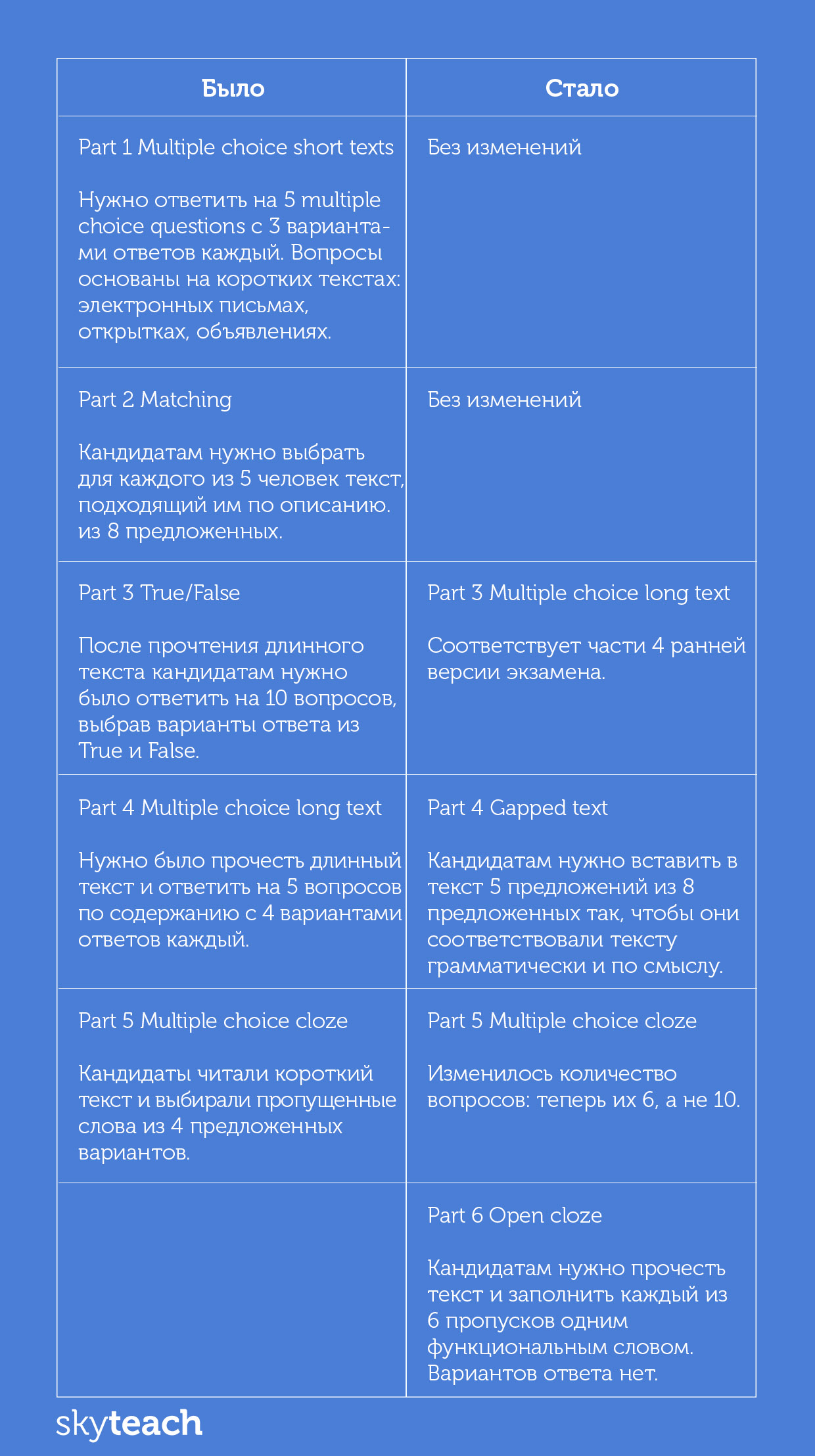
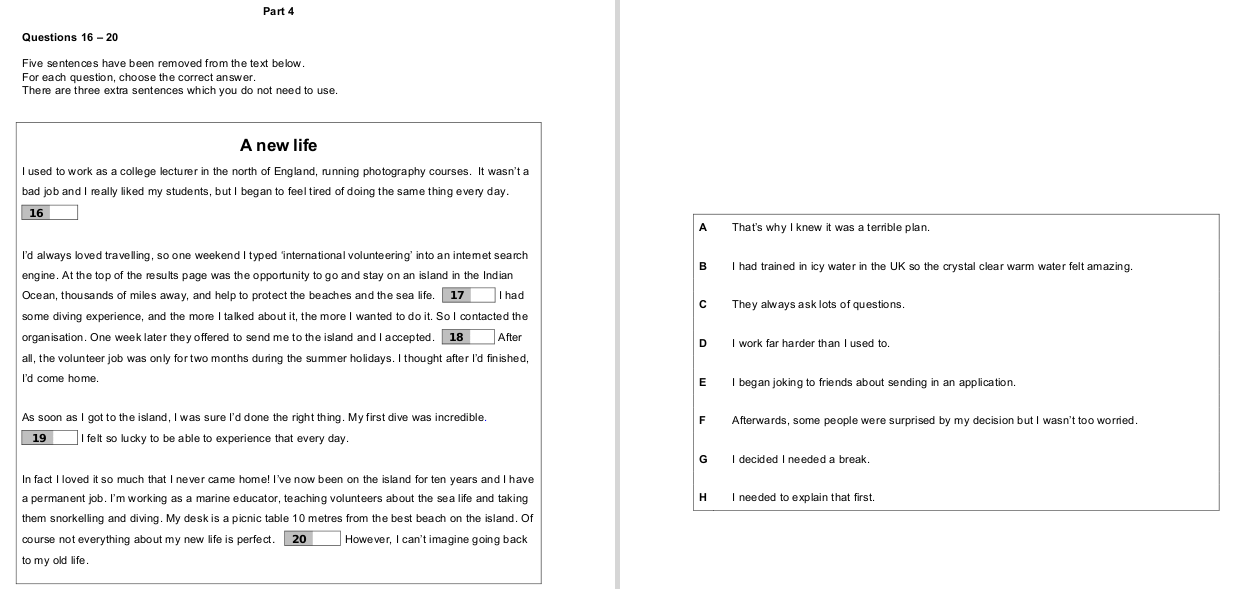
Новые задания в Reading представлены частью 4 и 6. Оба задания напоминают аналогичные им в FCE.

Writing
Writing теперь также вынесен в отдельную часть. Исчезло нелюбимое многими ‘transformation task’, где кандидатам нужно было преобразовать второе предложение, основываясь на прочитанном первом и предложенном слове. Также, больше не придётся пытаться уложить ответы на все вопросы письма во втором задании в лимит из 35-45 слов.
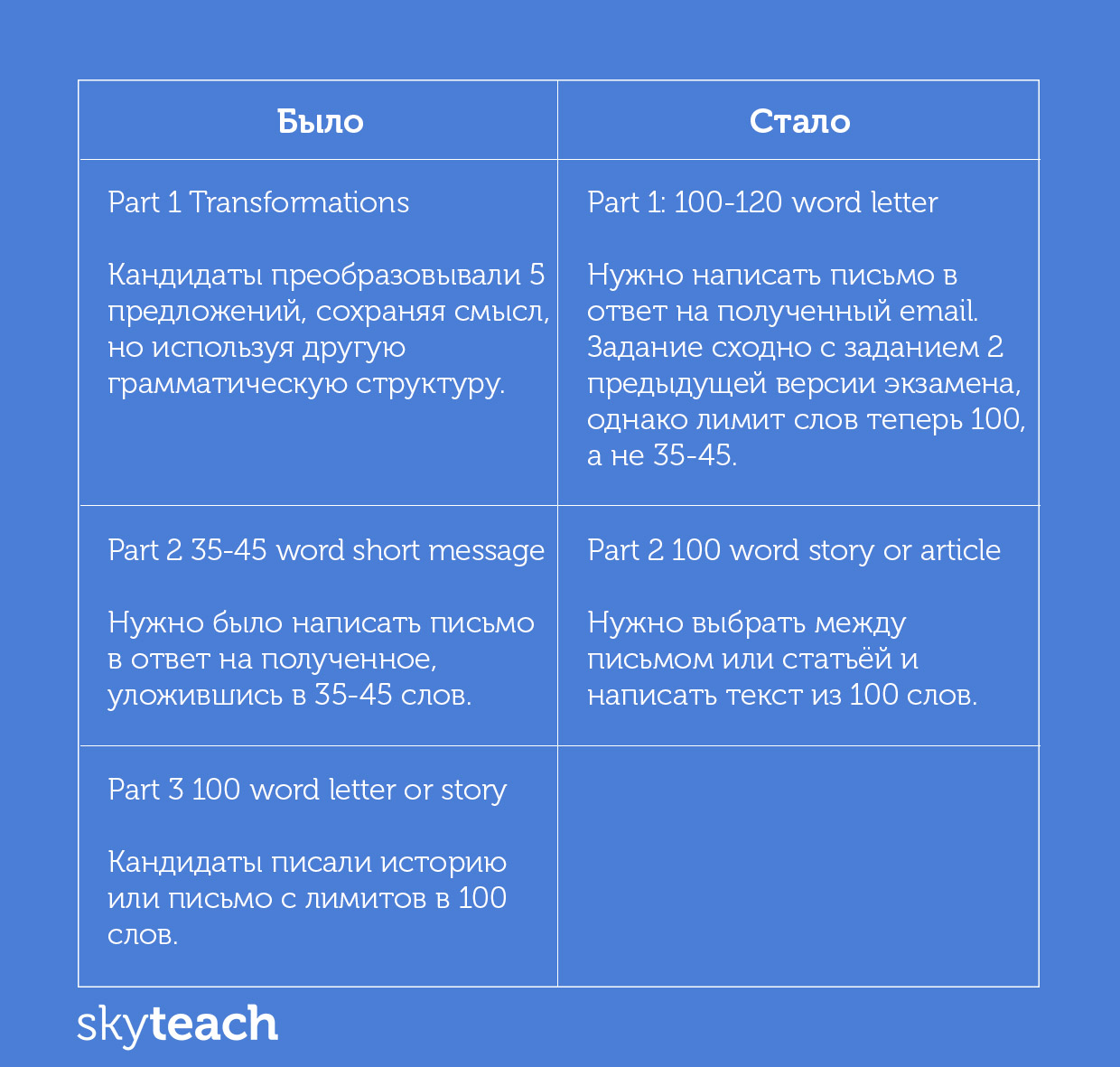
Новое задание представлено частью 1.
Listening
Изменения в этой части можно считать минимальными: стресс кандидатам не грозит.
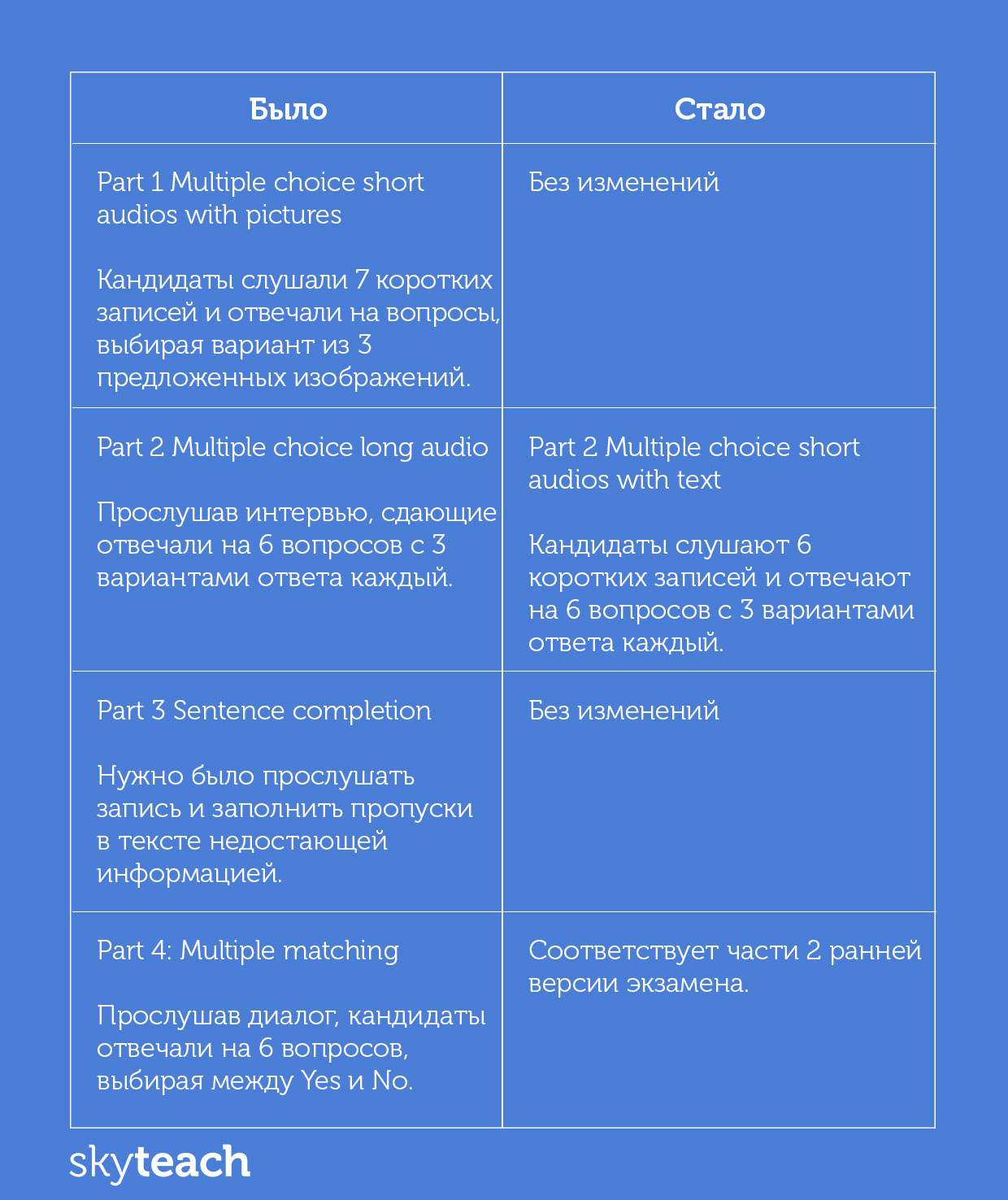
В этой части самым большим изменениям подверглось задание 2.

Speaking
В части Speaking новых заданий не добавилось и всего одно из 4 изменилось. Есть, однако, нюансы. Так, например, кандидатам больше не придётся произносить по буквам свою фамилию. Картинки для описания теперь будут на разные темы, поэтому кандидат, отвечающий вторым, больше не будет иметь минимального преимущества и возможности вспомнить несколько слов на уже озвученную тему. А в 4 части экзаменаторы будут задавать кандидатам целый ряд вопросов, обеспечив намного больше поддержки, чем в аналогичном задании предыдущей версии экзамена.
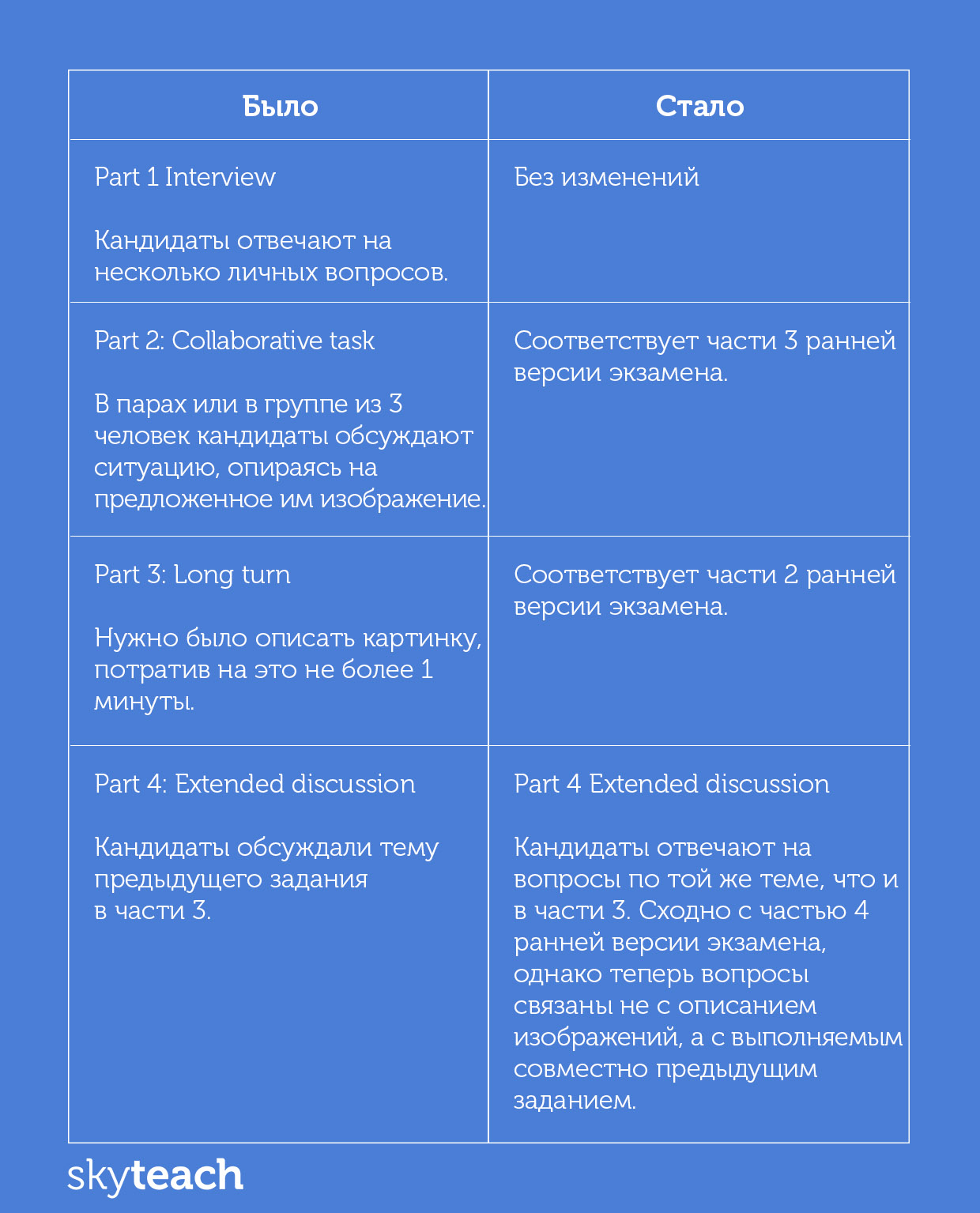
Для более детальной информации посетите сайт, специально созданный Кембриджем для анонса всех изменений в KET и PET. Там вы сможете скачать sample papers-2020, ознакомиться со списком рекомендуемых пособий и ресурсов для подготовки и посмотреть новые видео с записью устной части. А здесь найдете много советов о том, что кандидатам в принципе нужно знать для успешной сдачи экзамена.
Уже готовите к A2 Key и B1 Preliminary в новом формате?