
Задание №6978.
Чтение. ЕГЭ по английскому
Прочитайте текст и заполните пропуски A — F частями предложений, обозначенными цифрами 1 — 7. Одна из частей в списке 1—7 лишняя.
Language and mobility
European Union citizens have the right to live and work in other member states besides their home country. The European Union (EU) makes it possible for people to go where the jobs are. Knowing other languages is the key to real mobility in the EU, ___ (A) across the continent.
Learning the local language is not only the key to getting a job in another country, ___ (B). This often provides a whole new perspective on what it is to be European and on what the EU is creating jointly. The national histories and cultural heritage of the different countries may differ, ___ (C). Being able to speak to one another raises awareness of what people have in common and at the same time increases mutual respect for cultural differences.
A study undertaken for the European Commission shows ___ (D) through a lack of language skills. This is particularly the case for small and mediumsized enterprises ___ (E). According to the study, nearly 1 million firms have lost contracts with potential clients in other EU countries because of language barriers. The study also emphasizes the necessity of multilingualism for winning business in world markets. Multilingualism itself is an economic growth sector. In this context, English is the key language, ___ (F).
1. it also creates a bridge to the culture of the local people
2. that EU firms can lose business opportunities
3. but the EU’s collective objectives for the future are closely in tune
4. that are failing to use export opportunities in other EU countries
5. employing native speakers to work in export markets worldwide
6. but the study also stresses the importance of Chinese, Arabic and Russian
7. enabling all EU citizens to take advantage of job and travel opportunities
| A | B | C | D | E | F |
Решение:
Пропуску A соответствует часть текста под номером 7.
Пропуску B соответствует часть текста под номером 1.
Пропуску C соответствует часть текста под номером 3.
Пропуску D соответствует часть текста под номером 2.
Пропуску E соответствует часть текста под номером 4.
Пропуску F соответствует часть текста под номером 6.
Показать ответ
Источник: ЕГЭ. Английский язык: типовые экзаменационные варианты. Под ред. М.В. Вербицкой
Сообщить об ошибке
Тест с похожими заданиями
- Подробности
-
23565
 |
||
|
Прочитайте текст. Заполните пропуски в предложениях под номерами В11-В16 соответствующими формами слов, напечатанных заглавными буквами справа от каждого предложения. TEST 01 (part 2) |
A Challenge for Europe
|
B11 |
Recently there has been a small …………………… in the number of people out of work in Europe. |
REDUCE |
|
B12 |
However, ……………………… is still the number one social problem facing the 15 member states of the European Union. |
EMPLOY |
|
B13 |
Moreover, ……………………… of opportunity between men and women is still an issue that politicians in many countries have not come to grips with. |
EQUAL |
|
B14 |
In ……………………… such as law and engineering women are still noticeable by their absence. |
PROFESSIONAL |
|
B15 |
……………………… still discriminate against women in a number of ways even if their qualifications are the same as those of men. |
EMPLOY |
|
B16 |
It would be a pity if the ……………………… of the EU on an economic level were marred by failure in the vital area of social policy. |
ACHIEVE |
Задание 1
Прослушайте шесть высказываний. Установите соответствие между высказываниями каждого говорящего A–F и утверждениями, данными в списке 1–7. Используйте каждое утверждение, обозначенное соответствующей цифрой, только один раз. В задании есть одно лишнее утверждение. Занесите свои ответы в таблицу.
| 1. | A diary in your mobile may be a good idea. |
| 2. | This way to remember things doesn’t go well with hygiene. |
| 3. | One should keep used diaries and daily planners. |
| 4. | This technique is not good for remembering things. |
| 5. | Good memory may be a question of genetics. |
| 6. | Writing things on pieces of paper is convenient. |
| 7. | Keeping a diary can help not to forget things. |
Задание 2
Вы услышите диалог. Определите, какие из приведённых утверждений А–G соответствуют содержанию текста (1 – True), какие не соответствуют (2 – False) и о чём в тексте не сказано, то есть на основании текста нельзя дать ни положительного, ни отрицательного ответа (3 – Not stated). Занесите номер выбранного Вами варианта ответа в таблицу. Вы услышите запись дважды.
Задания 3-9
Прослушайте интервью. В заданиях А8–А14 укажите номер выбранного Вами варианта ответа.
Задание 10
Установите соответствие между текстами A–G и заголовками 1–8. Занесите свои ответы в таблицу. Используйте каждую цифру только один раз. В задании один заголовок лишний.
| 1 | When we don’t sleep |
| 2 | Not only for humans |
| 3 | How dreaming helps |
| 4 | When we dream |
| 5 | Why dreams can be scary |
| 6 | What we feel dreaming |
| 7 | How we forget dreams |
| 8 | How we remember dreams |
| A | Even though our dreams may feel like they last for hours and hours, we hardly spend more than two hours dreaming each night, which means a person spends a total of nearly six years dreaming throughout a lifetime. In general there are four phases of the sleep cycle and all dreaming occurs practically at the final phase. Each of these sleep cycles lasts approximately 60 to 90 minutes and may repeat several times throughout the night. |
| B | Anxiety is the most popular emotion experienced in dreams. Many people dream of falling, which is often connected to something in our lives that is going in the wrong direction. In addition, dreams of being chased are very common and are linked to avoidance. Also people report dreams about their teeth falling out, which is related to the words and communication we might have in real life. |
| C | Dreaming helps people make sense of the information and events that occur in their lives. Dreams play an important role in processing and remembering information that we absorb daily. Also, they help reduce stress and even solve problems. It’s very possible to work through real-life problems while dreaming at night. In addition, dreams provide a lot of important content and meaning that can be used to inspire and direct our lives during the day. |
| D | Nearly 5 to 10% of adults have nightmares. There are several reasons for it, for example when people start taking certain medications or when they withdraw from drugs. Some physical conditions, such as stress or illness, can also be a trigger. However, in some cases adults may have frequent nightmares that are unrelated to their everyday lives, which may signify that they are more creative, sensitive, and emotional than the average person. |
| E | There is no person who does not have dreams, but not everybody recalls them. The most vivid dreams happen during the Rapid Eye Movement sleep stage when the brain is extremely active and the eyes move back and forth quickly underneath the eyelids. Although dream recall varies from person to person, some people have little or no recollection of the content, and around 90% of dreams are gone following the first 10 minutes of waking up. |
| F | Scientists have found that animals also dream and their subconscious thoughts are connected to real experiences. Animals’ dreams are complex, containing long sequences of events. Animals’ brains share the same series of sleeping states as the brain of human beings. Analyzing animals’ dreams and the content of their dreams may help scientists treat memory disorders and develop new ways for people to learn and retain information more effectively. |
| G | Only five minutes after the end of a dream and half of the content is likely to vanish from our memories. It’s not that dreams aren’t important enough to keep in mind, but other things tend to get in the way. Dream researcher L. Strumpell believes that dreams disappear from our memories for a number of factors. For example, we may not recall dream images that lack intensity, association or repetition, which are usually needed for dream recall. |
Задание 11
Прочитайте текст и заполните пропуски A–F частями предложений, обозначенными цифрами 1–7. Одна из частей в списке 1–7 лишняя. Занесите цифры, обозначающие соответствующие части предложений, в таблицу.
Promoting language learning
The European Union (EU) is committed to supporting the rights of its
citizens to personal and professional mobility, and their ability to communicate
with each other. It does so by A_____________________ to promote the teaching
and learning of European languages. These programmes have at least one thing in
common: they cover cross-border projects involving partners from two, and often
three or more, EU countries.
The EU programmes are designed to complement the national education
policies of member countries. Each government is responsible for its own national
education policy, B_____________________. What the EU programmes do is to
create links between countries and regions via joint projects,
C_____________________.
Since 2007 the main programmes have been put under the overall umbrella
of the EU’s lifelong learning programme. All languages are eligible for support
under this programme: official languages, regional, minority and migrant
languages, D_____________________. There are national information centres in
each country, E_____________________.
The cultural programmes of the EU also promote linguistic and cultural
diversity in a number of ways. The “Media” programme funds the dubbing and
subtitling of European films for F _________. The “Culture”
programme builds cross-cultural bridges by supporting the translation of modern
authors into other EU languages.
- and the languages of the EU’s major trading partners
- which includes language teaching and learning
- cinemas and television in other EU countries
- which enhance the impact of language teaching and learning
- funding a number of educational programmes
- and encouraging people to learn new languages
- where details about the application procedures are given
Задания 12-18
Прочитайте текст и выполните задания 12–18. В каждом задании запишите в поле ответа цифру 1, 2, 3 или 4, соответствующую выбранному
варианту ответа.
Space could solve water problems
Have you ever tasted saltwater? I guess you have and if so, you will agree
with me that it’s not very refreshing. In fact, drinking more than a few cups worth
can kill you.
According to the United States Geological Survey, whose mission is to
collect and disseminate reliable, impartial, and timely information that is needed to
understand the nation’s water resources, about ninety-seven percent of the water on
our planet is saltwater; the rest is stored in lakes, rivers, glaciers and aquifers
underground. Moreover, only about one-third of the world’s potential fresh water
can be used for human needs. As pollution increases, the amount of usable water
decreases.
Water is the most precious and taken-for-granted resource we have on Earth.
It is also one of the most threatened resources. Increased population and possible
climate change will put more and more strain on supplies of this vital resource as
time goes on. What could we do in this situation? Though it may seem like science
fiction, the solution could lie in outer space.
I’m not saying we’re going to be teleporting to a spring on the other side of
the galaxy or colonizing another planet just to have longer showers – it’s much
more mundane than that. What we could achieve realistically in this century is the
successful use of the solar system’s rare metals and water, barring the invention of
the matrix.
You may be surprised to learn that the metal in your keys, coins, cell phone,
computer, car and everywhere else, originally came to this planet from space.
When Earth formed, the heavy metals sank to the center and formed a solid core.
The lighter elements formed the mantle and the crust we live on. Asteroids and
comets that struck the Earth brought water and metals to the surface.
There are thousands of asteroids orbiting near Earth. Most asteroids are
made of rock, but some are composed of metal, mostly nickel and iron. Probes
could be sent out to these to identify useful ones. Then larger probes could push
them towards the Earth where they can be handled in orbit.
In order to fuel ships and probes, we simply need to find a source of water,
such as a comet or the surface of the moon. We collect the water and pass an
electric current through it from a solar panel. The water separates into oxygen and
hydrogen, which in liquid form is a powerful rocket fuel.
Is this really possible? We may soon find out. Private company SpaceX has
already started delivering equipment to the International Space Station (ISS).
The ISS is proof that countries once at each other’s throats, like America and
Russia, can work together and pull off multi-billion dollar projects.
Recently, a company called Planetary Resources Inc. made the news for
getting big names like Google and Microsoft to invest in exploring asteroids for material gain. Although it will take many decades, it is wise to put the gears in
motion now.
We’ve already landed probes on the surface of asteroids and taken samples
from them. We can put something as large as the ISS, which weighs just short of
500 tons, according to National Aeronautics and Space Administration (NASA), in
orbit.
We can make a half-million-mile round-trip to get rocks from the moon. We
can do all of these things already. They just need to be applied and developed in
a smart way.
Задания 19-25
Прочитайте приведённые ниже тексты. Преобразуйте, если необходимо, слова, напечатанные заглавными буквами в конце строк, обозначенных
номерами 19–25, так, чтобы они грамматически соответствовали содержанию текстов. Заполните пропуски полученными словами. Каждый пропуск соответствует отдельному заданию из группы 19–25.
One airline had a policy that required the first officer to stand at the door while the passengers exited. He smiled and thanked them for the airline. [FLY]
A pilot on this airline landed his plane into the runway really hard. He thought that passengers angry comments. [HAVE]
However, it seemed that all of were too shocked to say anything. Finally, everyone got off except for a little old lady. She said, ‘Can I ask you a question?’ ‘Yes, Madam,’ said the pilot. ‘What was it?’ the lady asked, ‘Did we land or were we shot down?’ [THEY]
The Alhambra is a palace and fortress in Granada. It between 1238 and 1358 at the end of
Muslim rule in Spain. Despite the development that followed the Christian conquest, it still looks like a medieval Moorish settlement. [BUILD]
Since the Middle Ages, the Alhambra as a remarkable example of a Spanish-Moorish town. As most fortresses of that time, it has a surrounding wall, but it looks fairly weak. [SURVIVE]
Later it the kings of Granada and was just supposed to offer nice views. [NOT/DEFEND]
Today, the Alhambra to be one of the greatest examples of Islamic architecture. [CONSIDER]
Задания 26-31
Прочитайте приведённый ниже текст. Образуйте от слов, напечатанных заглавными буквами в конце строк, обозначенных номерами 26–31,
однокоренные слова так, чтобы они грамматически и лексически соответствовали содержанию текста. Заполните пропуски полученными
словами. Каждый пропуск соответствует отдельному заданию из группы 26–31.
Задания 32-38
Прочитайте текст с пропусками, обозначенными номерами 32–38. Эти номера соответствуют заданиям 32–38, в которых представлены
возможные варианты ответов. Запишите в поле ответа цифру 1, 2, 3 или 4, соответствующую выбранному Вами варианту ответа.
When the war ended I returned to Trinity College and was granted an extra year to complete my degree. 32 ____________________ my father and mother considered my grant at Trinity the highlight of the year, I thought Dad’s receiving an award from the Queen was more important. The ceremony turned 33 ______________________ to be a double delight, because I was able to witness my old tutor, Professor Bradford, receive his award for the role he had played in the field of breaking German military codes 34 ______________________ the war. I was proud of our little team working under Professor Bradford – as Churchill stated in the House of Commons, we had probably cut the length of the war by a year. We all met up afterwards for tea at the Ritz, and not unnaturally at some 35 _____________________ during the afternoon the conversation switched to what career I proposed to follow now the war was over. To my father’s credit he had never once 36 _____________________ that I should join him at the family company, especially as I knew how much he had longed for another son who might eventually 37 ___________________ his place. In fact, during the summer vacation I became even more conscious of my good fortune, as Father seemed to be preoccupied with the business and Mother was unable to hide her own anxiety about the future of the company. But whenever I asked if I could help all she would 38 __________________ was, “Don’t worry, it will all work out in the end.”
При выполнении заданий 32-38 вам поможет:
Методичка “Фразовые глаголы”
Задание 39
You have received a letter from your English-speaking pen-friend Joan who writes:
… When I forget to take an umbrella in summer, it always rains. What’s the weather like in summer where you live? What do you usually do when it rains? How do you protect yourself from bad weather?
I bought new shoes two days ago, but now I think I should take them back to the store …
Write a letter to Joan.
In your letter
– answer her questions
– ask 3 questions about her new shoes
Write 100–140 words.
Remember the rules of letter writing.
Как написать личное письмо на ЕГЭ по английскому языку
Задание 40
Выберите только ОДНО из двух предложенных высказываний (40.1 или 40.2), укажите его номер в БЛАНКЕ ОТВЕТОВ № 2 и выразите своё мнение
по предложенной проблеме согласно данному плану.
Comment on one of the following statements.
40.1 Exams motivate students to study harder.
40.2 It is better for children to grow up in the city.
What is your opinion? Do you agree with this statement?
Write 200–250 words.
Use the following plan:
– make an introduction (state the problem paraphrasing the given
statement);
– express your personal opinion and give 2–3 reasons for your opinion;
– express an opposing opinion and give 1–2 reasons for this opposing
opinion;
– explain why you do not agree with the opposing opinion;
– make a conclusion restating your position.
Вам помогут:
Методичка: “Примерные темы и аргументы для эссе (с лексикой)”
Курс эссе
Удачи на экзамене!
Описание задания 11
В задании 11 вам надо заполнить пропуски в тексте соответствующими фрагментами из предложенного списка. Даётся связный текст, в котором шесть предложений содержат пропуски, и семь фрагментов для вставок, из которых один фрагмент лишний. Так проверяется понимание структурно-смысловых связей текста, потому что вставляемые фрагменты должны соответствовать пропуску и по структуре, и по смыслу. За каждое правильно установленное соответствие вы получаете 1 балл, максимум за успешное выполнение этого задания — 6 баллов.
Стратегии выполнения задания 11
1. Просмотрите сначала текст, чтобы понять его общее содержание.
2. Затем внимательно прочитайте предложенные фрагменты предложений. Помните, что один из них лишний, он вам не понадобится.
3. Проанализируйте, какой частью предложения или каким членом предложения является каждый фрагмент (придаточное определительное, группа сказуемого и т. п.). Подумайте, что может ему предшествовать в тексте или идти после него.
4. Прочитайте текст до первого предложения, где нужно восстановить пропущенный фрагмент. Определите, какая СТРУКТУРА (какая часть предложения или какой член предложения: придаточное определительное, группа сказуемого и т. п.) вырезана. Обращайте особое внимание на слова, которые стоят непосредственно перед пропуском и после него.
5. Найдите нужную СТРУКТУРУ в списке фрагментов. Проверьте, подходит ли этот фрагмент в данное предложение ПО СМЫСЛУ.
6. Проработайте таким образом весь текст. Возможно, у вас будут варианты для каких- то предложений. Выбирая окончательный ответ, помните, что восстановленный фрагмент должен соответствовать предложению и по СТРУКТУРЕ, и по СМЫСЛУ.
7. Проверяя свои ответы, проследите также, не нарушается ли связь соответствующего существительного и заменяющего его местоимения или не нарушается ли согласование подлежащего и сказуемого.
8. Обращайте также внимание на союзы, союзные слова и другие элементы, служащие для связи слов в предложении и организации текста, придающие ему логическую завершенность.
Учимся выполнять задание 11
11. Прочитайте текст и заполните пропуски A—F частями предложений, обозначенными цифрами 1—7. Одна из частей в списке 1—7 лишняя. Занесите цифры, обозначающие соответствующие части предложений, в таблицу.
Promoting language learning
The European Union (EU) is committed to supporting the rights of its citizens to personal and professional mobility, and their ability to communicate with each other. It does so by A _________________ to promote the teaching and learning of European languages. These programmes have at least one thing in common: they cover cross- border projects involving partners from two, and often three or more, EU countries.
The EU programmes are designed to complement the national education policies of member countries. Each government is responsible for its own national education policy, В _________________. What the EU programmes do is to create links between countries and regions via joint projects, C _________________.
Since 2007 the main programmes have been put under the overall umbrella of the EU’s lifelong learning programme. All languages are eligible for support under this programme: official languages, regional, minority and migrant languages, D _________________. There are national information centres in each country, E _________________.
The cultural programmes of the EU also promote linguistic and cultural diversity in a number of ways. The “Media” programme funds the dubbing and subtitling of European films for F _________________. The “Culture” programme builds cross-cultural bridges by supporting the translation of modern authors into other EU languages.
1. and the languages of the EU’s major trading partners
2. which includes language teaching and learning
3. cinemas and television in other EU countries
4. which enhance the impact of language teaching and learning
5. funding a number of educational programmes
6. and encouraging people to learn new languages
7. where details about the application procedures are given
Ответ:
|
А |
В |
С |
О |
Е |
F |
G |
Разбор задания 11
ШАГ 1. Знакомимся со вторым заданием в разделе “Чтение”. Внимательно изучаем инструкцию к заданию 11. Стараемся понять, что необходимо сделать в этом задании.
Прочитайте текст и заполните пропуски A—F частями предложений, обозначенными цифрами 1—7. Одна из частей в списке 1—7 лишняя. Занесите цифры, обозначающие соответствующие части предложений, в таблицу.
Предлагается связный текст, в котором вы видите шесть пропусков под буквами А—F, и даются семь фрагментов (частей предложения) под номерами 1—7, один из которых лишний. Ваша задача — вернуть шесть фрагментов в соответствующие пропуски в тексте таким образом, чтобы они подходили данному пропуску и по структуре, и по смыслу. Каждый фрагмент из списка 1—7 может использоваться только один раз. За каждое правильно подобранное соответствие дается 1 балл. За все задание можно максимально получить 6 баллов.
Инструкция позволяет определить, что данное задание направлено на понимание структурно-смысловых связей в тексте и в нём проверяются следующие ключевые умения:
• определение, какой частью предложения или каким членом предложения является каждый фрагмент (придаточное определительное, группа сказуемого и т. п.);
• определение, какая СТРУКТУРА (какая часть предложения или какой член предложения: придаточное определительное, группа сказуемого и т. п.) вырезана.
• определение, подходит ли этот фрагмент в данное предложение ПО СМЫСЛУ;
• выбор союзов, союзных слова и других элементов, служащих для связи слов в предложении и организации текста, придающие ему логическую завершенность.
ШАГ 2. Быстро читаем текст, игнорируя пропуски, стараемся понять его общее содержание.
ШАГ 3. Просматриваем первый абзац текста, обращая внимание на структуру, которую должен иметь пропущенный фрагмент. Ищем подходящий по структуре фрагмент среди фрагментов 1—7.
The European Union (EU) is committed to supporting the rights of its citizens to personal and professional mobility, and their ability to communicate with each other. It does so by A _________________ to promote the teaching and learning of European languages. These programmes have at least one thing in common: they cover cross-border projects involving partners from two, and often three or more, EU countries.
1. and the languages of the EU’s major trading partners
2. which includes language teaching and learning
3. cinemas and television in other EU countries
4. which enhance the impact of language teaching and learning
5. funding a number of educational programmes
6. and encouraging people to learn new languages
7. where details about the application procedures are given
Изучаем часть предложения, которая идёт до и после пропуска в тексте. Пытаемся определить, с какой части речи должен начинаться пропущенный фрагмент. Хорошей подсказкой здесь нам служит предлог by, который указывает на то, что за ним должно следовать существительное или герундий, форма на —ing. Просматриваем фрагменты 1—7 и обнаруживаем фрагмент 3, который начинается с существительного. Однако этот фрагмент не подходит по смыслу. Видим фрагмент 5, который начинается с герундия. Проверим, подходит ли данный фрагмент по смыслу. Да, подходит. Следовательно, правильный ответ — 5.
ШАГ 4. Просматриваем следующий отрывок текста В, обращая внимание на структуру, которую должен иметь пропущенный фрагмент. Ищем подходящий по структуре фрагмент средифрагментов 1—7.
The EU programmes are designed to complement the national education policies of member countries. Each government is responsible for its own national education policy, В _________________.
Структура предложения и слова, которые идут до пропуска, свидетельствуют о том, что после слова policy должно идти придаточное определительное с союзом или союзным словом. Просматриваем список фрагментов 1—7. Такую структуру имеют второй и четвертый фрагменты. Подставим второй фрагмент и проверим, подходит ли он по смыслу и по структуре. Да, подходит. Перепроверим себя и попробуем подставить фрагмент 4. Он не подходит по структуре, так как глагол не стоит в 3-м лице единственного числа (Present Simple), а значит, грамматически не согласуется со словом policy.
ШАГ 5. Просматриваем следующее предложение второго абзаца текста, обращая внимание на структуру, которую должен иметь пропущенный фрагмент.
What the EU programmes do is to create links between countries and regions via joint projects, C _________________.
Ищем подходящий по структуре фрагмент среди фрагментов 1—7. Оказывается, нам здесь тоже нужно использовать придаточное определительное с союзом или союзным словом. Их было всего два. Одно мы уже использовали. Осталось придаточное определительное предложение 4. Мы уже также выяснили, что глагол в части определительного предложения должен согласовываться со словом, которое стоит перед пропуском, в данном случае со словом projects (существительное во множественном числе). Проверим, подходит ли фрагмент 4. Глагол enhance хорошо согласуется со словом projects по управлению. Данный фрагмент подходит как по структуре, так и по смыслу. Ответ — фрагмент 4.
ШАГ 6. Просматриваем следующий отрывок текста, обращая внимание на структуру, которую должен иметь пропущенный фрагмент.
Since 2007 the main programmes have been put under the overall umbrella of the EU’s lifelong learning programme. All languages are eligible for support under this programme: official languages, regional, minority and migrant languages, D _________________.
У нас осталось четыре фрагмента: 1 — and the languages of the EU’s major trading partners, 3 — cinema and television in other EU countries, 6 — and encouraging people to learn new languages, 7 — where details about the application procedures are given. Двоеточие после слова programme указывает на то, что дальше идёт перечисление, перечисляются официальные языки, региональные, меньшинств и мигрантов. Ряд перечислений не завершён, так как отсутствует последний однородный член предложения — ещё какие-то языки. Последний однородный член предложения обычно прикрепляется сочинительным союзом and, перед которым часто стоит запятая. Проверим, есть ли у нас среди оставшихся фрагментов те, которые начинаются с союза and. Такие фрагменты есть, а именно 1 и 6. Подставим фрагмент 1 и прочитаем предложение. Данный фрагмент подходит и по структуре, и по смыслу. Однако всё же перепроверим себя. Попробуем подставить фрагмент 6. Он не подходит по смыслу и по структуре, так как после союза and в нём идёт герундий, а не существительное, значит, он не может выступать как однородный член предложения для существительных и не подхватывает цепочку перечислений. Следовательно, правильный ответ — 1.
ШАГ 7. Просматриваем следующее предложение третьего абзаца текста, обращая внимание на структуру, которую должен иметь пропущенный фрагмент. Ищем подходящий фрагмент поструктуре среди фрагментов 3, 6, 7.
There are national information centres in each country, E _________________.
Фрагмент 3 не подходит по структуре, а фрагмент 6 — по смыслу. Остаётся фрагмент 7. Проверим, подойдёт ли он по структуре. Да, подходит. А по смыслу? Предложение приобретает завершённость и смысл, когда мы подставляем фрагмент 7.
ШАГ 8. Просматриваем следующий, последний абзац текста, обращая внимание на структуру, которую должен иметь пропущенный фрагмент. Ищем подходящий фрагмент.
The cultural programmes of the EU also promote linguistic and cultural diversity in a number of ways. The “Media” programme funds the dubbing and subtitling of European films for F _________________. The “Culture” programme builds cross-cultural bridges by supporting the translation of modern authors into other EU languages.
У нас осталось два фрагмента: 3 — cinema and television in other EU countries и 6 — and encouraging people to learn new languages. Нам нужно дополнение, судя по структуре текста. Поскольку это предлог for, дополнение может быть выражено существительным или герундием. Фрагмент 6 не подходит, так как начинается с союза and, который не может сочетаться с предлогом for. Фрагмент 3 полностью подходит как по структуре, так и по смыслу. Подсказкой также служит слово film, которое хорошо сочетается со словами cinema and television. Таким образом, правильный ответ — 3. Фрагмент 6 оказался лишним.
Типичные ошибки при выполнении задания 11
Экзаменуемые:
• при восстановлении фрагмента полагаются только на его содержание либо только на его структуру, в то время как необходимо принимать во внимание и то, и другое;
• не понимают смысла предложений с пропусками;
• не понимают грамматической структуры предложений;
• не соотносят реферируемые слова (местоимения, союзы, существительные, глаголы) в главном и придаточном предложении;
• не используют языковую догадку для понимания незнакомых слов в контексте.
Подготовительные упражнения к заданию 11
1. Ответьте на вопросы.
1. Какова цель задания 11 в разделе “Чтение”?
2. Какие ключевые умения проверяет задание 11?
3. Какой вид теста используется для задания 11?
4. Какой тип текста используется для задания 11?
5. Сколько баллов можно получить за задание 11?
2. Определите, с какой части речи должны начинаться пропущенные фрагменты.
A. Researchers found improvements (1) _________________ were significantly higher in the second group.
B. However, you have got to find (2) _________________.
C. In total, 128 people took (3) _________________.
D. The teachers very clearly see the link between diet and concentration. Children’s concentration and behaviour (4) _________________._____________________
E. Pupils are encouraged to find out more about where their food comes from by (5) _________________.
3. Вставьте who, what, whose, that в пропуски.
1. This is the hat _____ Mary bought in London last week.
2. Peter did _____ he could.
3. Jane told me _____ she wanted to invite Harry for dinner.
4. Olga has already read the book _____ I bought yesterday.
5. He was a man _____ meant _____ he said.
6. I don’t know _____ delayed the flight.
7. I don’t know _____ project to choose, Mary’s or Peter’s.
8. I don’t know _____ handwriting it was.
9. He invited us to dinner _____ was very kind of him.
10. The teacher wasn’t surprised at _____ he saw in the room.
11. My father, _____ is 46, is a doctor.
12. They say _____ they received the letter last Friday.
13. It was Captain Jones _____ told me of Mr Crown’s misfortunes.
14. Felix decided _____ he’d better stop smoking.
15. I had to find out _____ he was after.
4. Выберите правильный вариант.
1. During the nineteenth century, Britain built up an empire of colonies which/what stretched into every continent.
2. It was said that the sun never set on the British Empire, so/because at any time of the day the sun was always shining on a British colony somewhere in the world.
3. In the nineteenth century Britain received large numbers of new immigrants which/who came over to escape from starvation.
4. Unfortunately, immigrants found a very different reality when/while they arrived in Britain.
5. In 1971 the Commonwealth Immigration Act restricted the number of new immigrants, however/although one exception was made in 1972.
6. The House of Commons has 651 seats which/that were occupied by Members of Parliament (MPs) who/when elected by the British Parliament.
7. The Queen, who/that is the Head of the State, opens and closes the Parliament.
8. There 651 Members of Parliament in Britain, and/but the Chamber of the House of Commons is quite small.
9. The House of Commons has a chairman called the Speaker who/whose job is to keep the House in order.
10. The most important MPs sit on the front benches and are though/therefore called frontbenchers.
11. The ministers of Government sit on the front bench to the right, when/while the opposition frontbenchers sit on the left.
12. As/Because leaders of their political parties and leaders of the country, Prime Ministers are powerful and important people.
*5. Составьте предложения, используя следующие фрагменты:
1. … who had many interesting and exciting adventures.
2. … hiking through mountain passes …
3. … when I received their answer.
4. … when I was opening the envelope.
5. … who has taken many excellent pictures of my raccoons.
6. … which came today?
7. … though he has never been to France.
6. Восстановите текст, вставив пропущенные слова (союзы и союзные слова).
How much do you know about the early history of England? About three thousand years B.C. many parts of Europe, including the British Isles, were inhabited by a people, (1) _____ came to be known as the Iberians. We do not know much about these people (2) _____ they lived in Britain long before a word of their history was written, (3) _____ we can learn something from their weapons, tools and the remains of their dwellings (4) _____ have been found.
We know more about the Celts (5) _____ about the earlier inhabitants of the island, (6) _____ of the written accounts (7) _____ exist. The Celts did not write down the events themselves. Other people (8) _____ knew them described them in their books. The Greeks were the first to mention the British Isles. It is from the Greek books (9) _____ we know about the Phoenicians, (10) _____ were great sailors and traders even before the Greeks. They travelled as far as the shores of Britain.
The earliest writer from (11) _____ we have learned much about the country and its inhabitants was Julius Caesar, the famous Roman general, statesman and writer. In his Commentaries on the Gallic War, a book (12) _____ was written in Latin, he describes the island and the Celts against (13) _____ he fought. He tells us (14) _____ the Celts were tall and blue-eyed. They wore long flowing moustaches (15) _____ no beards. They lived in tribes (16) _____ were ruled by chiefs (17) _____ all the tribesmen obeyed.
7. Определите в следующем тексте слова, влияющие на выбор вырезанного фрагмента. Какая часть речи, какая грамматическая конструкция может следовать за ними?
Covering more than 850 km, the Portuguese coast boasts such a large number of fine, white sandy beaches that it is almost impossible to keep count. All bathed by the Atlantic Ocean and all different, their beauty is hard to describe, so there is nothing better A _____________________.
The most famous are in the Algarve. With three thousand hours of sun per year and warm waters, there are beaches to suit every taste and many dreamlike resorts. The choices are many, from sandy stretches extending as far as the eye can see В _____________________, the trade image of the region. They are always accompanied C _____________________.
8. Соотнесите мини-тексты и вырезанные фрагменты. Один фрагмент лишний.
Covering more than 850 km, the Portuguese coast boasts such a large number of fine, white sandy beaches that it is almost impossible to keep count. All bathed by the Atlantic Ocean and all different, their beauty is hard to describe, so there is nothing better A _____________________.
The most famous are in the Algarve. With three thousand hours of sun per year and warm waters, there are beaches to suit every taste and many dreamlike resorts. The choices are many, from sandy stretches extending as far as the eye can see В _____________________, the trade image of the region. They are always accompanied by a calm clear sea, C _____________________.
1. which is ideal for various water sports
2. who has never been to this wonderful city
3. than to discover them once for oneself
4. to the smaller coves, sheltered by huge cliffs
Ответ:
9. Прочитайте текст и заполните пропуски А—С частями предложений, обозначенными цифрами 1—5. Две из частей в списке 1—5 лишние. Занесите цифры, обозначающие соответствующие части предложений, в таблицу.
11.
Beautiful cities of Italy
The political and cultural centre of Italy is the ‘Eternal City’, Rome. Ever since the Roman Empire, as its capital, Rome has become famous as a centre of European culture. The most striking sights of Rome are, of course, the Colosseum and the Forum. Once the Colosseum was able to receive about 50 thousand spectators, A _____________________ and concert halls. The Pantheon, the old temple of all gods, В _____________________, is also located in Rome.
The second most important town in Italy is Milan. Milan is the capital of fashion and C _____________________, exhibitions and conferences. The main attraction of Milan is its Cathedral Square, where the monument to the King Victor Emmanuel II is installed. Theatre fans will not be left disappointed by visiting the Theatre of La Scala.
1. which is comparable with modern stadiums
2. that everyone is dreaming about this trip
3. which was built in the early I century
4. the venue for major international festivals
5. which are connected by more than 150 canals
Ответ:
Полезные советы
• Прочитайте текст, чтобы понять его общий смысл.
• В этом задании очень важно хорошее понимание структуры предложения и текста в целом.
• Прочитайте абзац, который содержит пропущенный фрагмент текста, и попытайтесь понять, каково должно быть содержание пропущенного фрагмента.
• Прочитайте абзац, который содержит пропущенный фрагмент текста, и попытайтесь понять, какой член предложения или какое придаточное структурно подойдёт к данному пропуску.
• Пропущенный фрагмент часто является частью придаточного предложения. Подумайте, какой союз или союзное слово может начинать фрагмент.
• Прочитайте предложения до и после пропущенного фрагмента, ищите слова, которые могут вам помочь, например упоминание о времени then, after, местоимения it, that, she/her, союзы и союзные слова, например which, what, so, unless и т. п.
• Обратите внимание на пунктуацию: после некоторых слов ставится запятая (However), другие слова никогда не встречаются после запятой (that).
• Решите, какой фрагмент подходит, и проверьте, как он вписывается в пропуск.
• Убедитесь, что все предложения грамматически и логически связаны.
• Убедитесь, что лишний фрагмент не подходит ни к одному из пропусков в тексте.
Тренируемся в выполнении задания 11
Вариант 1
Прочитайте текст и заполните пропуски A—F частями предложений, обозначенными цифрами 1—7. Одна из частей в списке 1—7 лишняя. Занесите цифры, обозначающие соответствующие части предложений, в таблицу.
UNESCO
Everybody knows what the abbreviation of UNESCO stands for. This global organization strives to build networks among nations that enable strong and true solidarity. In 1945, it created in order to respond to the belief of nations, A _____________________, that political and economic agreements are not enough to build a lasting peace.
So, what does UNESCO do to achieve this goal? One of primary aims of UNESCO is mobilizing for education В _____________________ as a fundamental human right and as a prerequisite for human development. UNESCO also fosters intercultural understanding C _____________________ and support for cultural diversity. UNESCO created the idea of World Heritage to protect sites of outstanding universal value. Finally, UNESCO does its best to protect freedom of expression D _____________________.
Today, UNESCO’s message has never been more important. We must create policies capable of addressing the social, environmental and economic dimensions of our life. This new thinking reaffirms the founding principles of the Organization and enhances its role. In a globalized world with interconnected societies, intercultural dialogue is vital E _____________________. In an uncertain world, the future of nations depends not only on their economic capital or natural resources, F _____________________. UNESCO does it through education, scientific research and the sharing of knowledge.
1. so that every child has access to quality education
2. which is essential for democracy and human dignity
3. if we are to live together accepting our diversity
4. which suffered two world wars in less than a generation
5. but also on their ability to understand coming changes
6. which demands full participation of all nations
7. which is done through protection of heritage
Ответ:
|
A |
В |
C |
D |
E |
F |
Вариант 2
Прочитайте текст и заполните пропуски A—F частями предложений, обозначенными цифрами 1—7. Одна из частей в списке 1—7 лишняя. Занесите цифры, обозначающие соответствующие части предложений, в таблицу.
Some tips on stress management
Modern people are much more under stress than our ancestors. Everybody knows that stress brings all kinds of ailments related to heart, neurology and blood pressure. A _____________________, a lot of it can slow down your actual performance. Try to de-stress yourself. It’s easy said than done В _____________________, not even health. You have to put time and effort to win back your health! So, learn to relax and engage yourself in activities that give you joy. If you are not able to relax and your mind wanders around, you might take help of relaxation techniques like meditation.
C _____________________, don’t think negative. Think about the best and the worst situation that the problem can get you in. Now, first focus on the worst situation to decide D _____________________. If not, half of your problem is solved. Now, focus on the best situation and the ways that can be employed to reach it E _____________________. Now, keep on reviewing and omitting the items F _____________________ at every repetition. Ultimately, you will be left with one or two options to try for solving your problem. This will definitely help in relieving your stress. You can adopt any other method for solving problems — just don’t take stress. Stress, anyhow, doesn’t solve any problem!
1. that now don’t look so good a solution
2. when confronted with a problem
3. while a little anxiety gives you extra motivation
4. that you must eat well, sleep tight and stay active
5. and make a list of solutions, mentally or on paper
6. but at the same time nothing comes free
7. if it is so bad that you need to get depressed
Ответ:
|
А |
В |
С |
D |
Е |
F |
Рефлексия
1. Помог ли вам представленный в данной теме материал лучше понять содержание и структуру задания 11 раздела “Чтение”?
2. Что было легко/трудно в усвоении темы?
3. Что было полезным?
4. Что вы усвоили, чему вы научились, что сумеете выполнить самостоятельно?
5. Что осталось неясным?
Научились, умеем, усвоили
1. Усвоили алгоритм выполнения задания 11 раздела “Чтение”.
2. Научились выполнять это задание.
3. Умеем применять следующие стратегии:
• понять в прочитанном тексте структурно-смысловые связи текста;
• извлекать из текста необходимую информацию;
• игнорировать ненужную информацию;
• выявлять соотносимые слова в главном и придаточном предложениях.
Тренировочное задание 23 на подбор заголовков к текстам.
текстыответ
| 1. ‘Dialogues’ on the road | 5. Too heavy traffic |
| 2. The role of two-wheeled vehicles | 6. Whole life in motion |
| 3. Liberty is better than safety | 7. My car is my castle |
| 4. Savages of the road | 8. Slow but steady |
A) The British are enthusiastic about mobility. They are sure that the opportunity to travel far and often is their right. Some people spend more than three hours every day to get to work in London or some other big city and back home late in the evening. Of course most people do not spend so much time every day on travelling, but it is a fact that very few people live near enough to their work or school to get there on foot.
B) As in almost all the countries in modern Europe, most people in Britain use the motor car as the most frequent means of transport. And as in many countries nowadays there are a lot of problems with traffic congestion and air pollution. In fact these problems are more serious than in many other European countries because of two facts. Firstly, Britain is densely populated and, secondly, a very high proportion of goods are transported by road.
C) Almost every family in Britain has a car that they use regularly and quite many families have more than one car. There are several reasons for the widespread enthusiasm for cars. Some people use them just to project an image of themselves. Another possible reason that might explain the British love for their own cars is the nation passion for privacy. Driving your car is like taking your ‘home’ with you wherever you go.
D) The privacy factor might as well explain why British drivers ‘communicate’ less than drivers from many other countries. They use their horns very seldom, are do not usually not ‘signal’ their displeasure at the behavior of other road users with their hands. Many tourists also notice that British drivers are a little bit more tolerant of both other drivers and pedestrians than drivers from their home countries. Some tourists first take this peculiarity for the British ‘being gentleman’.
E) British drivers are also more safety conscious than drivers from any other countries in Europe. Britain has the best road safety record among all the European countries. The speed limit on motorways in Britain is a little lower than in most other countries. It is 70 miles per hour (112 kilometers per hour). The British go over this limit very seldom. What’s more, it’s profitable to be a good driver in Britain as there are many costly government campaigns to encourage road safety.
F) Another interesting indication showing that the car is supposed to be a private space is that, in spite of British concern for safety, Britain was one of the last countries in Western Europe that introduced the compulsory wearing of seat belt. This measure was, and still is, considered by many British drivers to be a kind of an infringement of personal liberty.
G) The British are not really fond of on mopeds or motorcycles like the Italians, for example. They exist, of course, but they are considered to be not that private for British tastes. Every year there are twenty times as many cars as mopeds or motorcycles that are registered in Britain. Millions of bicycles are used especially by younger people in certain university towns such as Oxford and Cambridge. Still this means of transport is not as common as it is in other parts of north-western Europe like the Netherlands.
A) – 6
B) – 5
C) – 7
D) – 1
E) – 8
F) – 3
G) – 2
Чтение
Задание 2.
Дан текст с 6-ю пропусками и 7 фрагментов для заполнения пропусков. Задача — заполнить пропуски, один фрагмент – лишний.
Promoting language learning.
The European Union (EU) is committee supporting the rights of its citizens to personal and professional mobility, and their ability to communicate with each other. It does so by A______ to promote the teaching and learning of European languages. These programmes have at least one thing in common: they cover cross-border projects involving partners from two, and often three or more, EU countries.
The EU programmes are designed to complement the national education policies of member countries. Each government is responsible for its own national education policy, B ____. What the EU programmes do is create links between countries and regions via joint projects, C _______.
Since 2007 the main programmes have been put under overall umbrella of the EU’s lifelong learning programme. All languages are eligible for support under this programme: official languages, regional, minority and migrant languages, D___. There are national information centres in each country, which E____.
The cultural programmes of the EU also promote linguistic and cultural diversity in a number of ways. The “Media” programme funds the dubbing and subtitling of European films for F _____. The “Culture” programme builds cross-cultural bridges by supporting the translation of modern authors into other EU languages.
- and the languages of the EU’s major trading partnerts
- which includes language teaching and learning
- cinemas and television in other EU countries
- which enhance the impact of language teaching and learning
- funding a number of educational programmes
- and encouraging people to learn new languages
- where details about the application procedures are given
| Пропуск | A | B | C | D | E | F |
| Фрагмент |
Данное задание проверяет понимание причинно-следственных связей. В пропуски нужно вставлять пропущенные части предложений, соединенные союзами или герундием (Gerund), ифинитивом (Infinitive) сложным дополнением (Complex object) или сложным подлежащим (complex subject) . Даже не глядя на предложенные варианты ответа, мы можем определить, какие конструкции могут подойти.
Например, после предлога by можно поставить либо существительное, либо герундий. В пропуске A можно поставить только герундий, значит, верный ответ 5.
Союз and, как правило, соединяет две равнозначные части предложения и не выделяется запятой. Единственный пропуск без запятой – пропуск F, но перед пропуском стоит предлог for, после которого никак нельзя поставить союз and. Другой вариант использования and – перечисление. Такой вариант мы видим в пропуске D, где перечисляется, какие языки участвуют в программе. В ответах у нас два союза and, но подходит только ответ 1, так как там тоже идет речь о языках. Второй вариант and, таким образом, является лишним.
Самым сложным является расставить по местам предложения, начинающиеся с which и that. В таких предложениях недостаточно просто понимать грамматическую конструкцию, необходимо внимательно прочитать предложение с пропуском и следующее за ним. Рассмотрим пропуск B. Перед пропуском речь идет о education policy, после пропуска речь идет о ней же, значит, пропущенный фрагмент предложения должен давать дополнительную информацию об образовательной политике государства. Поищем среди предложенных вариантов ответа подходящие. Ближе всего по смыслу варианты 2 и 4. Чтобы выбрать один из двух вариантов, мы можем либо поискать другие пропуски, к которым могут подойти данные фрагменты, то есть, работать методом исключения, либо постараться сделать выбор логически. Вариант 2 говорит о том, что входит в программу, вариант 4 говорит о влиянии программы. Учитывая, что мы находимся в начале текста, и это первое упоминание о программе, ответ 2 более логичен.

ЕГЭ Задания по чтению
Задание 10
Установите соответствия между текстами A — G и заголовками 1 — 8. Занесите свои ответы в таблицу. Используйте каждую цифру только один раз. В задании один заголовок лишний.
- An attractive land
- Climate variations
- Geography of the country
- The jewel of India
- Flora and fauna
- From the country’s history
- More than sightseeing
- Driven to extinction
 A. India is bound on the north by Afghanistan, China, Nepal and Bhutan; on the east by Bangladesh, Myanmar and the Bay of Bengal; on the south by the Indian Ocean; and on the west by the Arabian Sea and Pakistan. India’s coastline is more than 7,000 km. With the second largest population in the world the country spans 3.28 million sq metres in space, and is made up of 28 states, of which New Delhi is the capital.
B. India can boast of one of the oldest cultures in the world. Rich in gold, jewels, spices and other valuable things, India was an attractive land for British colonists. Other Europeans staked their claim on the country too and they often left behind themselves ancient ruins of sacred sites and abandoned cities. India became independent from Britain in 1947 after a long struggle led by the peaceful protester, Mahatma Gandhi.
C. The diverse religion, cultures, customs, languages and religions portray a colourful and inviting picture of India. As a result, many tourists are attracted to visit India and experience its natural beauty and rich cultural heritage. Today, India is the one of the most famous tourist destinations of the world thanks to its immense natural beauty and cities with historical monuments, rich architecture and craftsmanship.
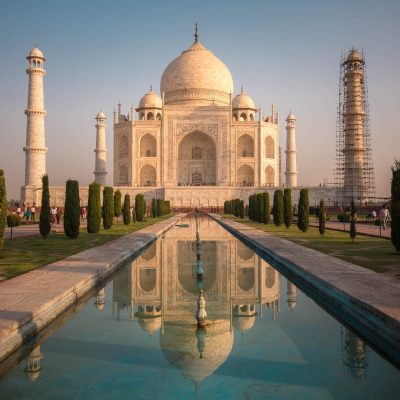
D. The Taj Mahal, located in the city of Agra in Utter Pradesh, in northern India, is the country’s most celebrated attraction and a fine example of the country’s architecture. Built between 1631 and 1648 by the emperor to house his beloved wife’s tomb, it is a work of art of incomparable beauty as its white marble stone changes colour in different light. Crowds of tourists visit this place annually, including celebrities.
E. India is generally seen as a warm country. Most of the parts in India have a tropical or subtropical climate, with little variation in temperature between seasons. The northern plains, however, have a greater temperature range, with cooler winters and hotter summers. The mountain areas have cold winters and cool summers. In the mountains, though, climate type can change from subtropical to polar within a few miles.
F. India has long been associated with a stunning combination of spirituality, philosophy and health. The ancient healing system of Ayurveda is known as the science of life originated here, as did yoga and meditation. Now people come to India not only to see its sights, but also to spend time in local monasteries and retreats to leave behind the fast-paced lifestyle and discover the inner God in themselves.
G. The fauna of India is made up of almost 5,000 species of larger animals. Tiger, panther, lion, cheetah, snow leopard, and jungle cat can be found is some parts of the country. Besides this, India is home to elephants, rhinoceros, black bear, antelope, and deer. There are 15,000 flowering plant species, accounting to 6 percent of the world’s total flora. Out of these, about 3,000 to 4,000 are believed to be in danger of extinction.
Задание 11
Прочитайте текст и заполните пропуски A — F частями предложений, обозначенными цифрами 1 — 7. Одна из частей в списке 1 — 7 лишняя. Занесите цифры, обозначающие соответствующие части предложений, в таблицу.
- and the languages of the EU’s major trading partners
- which includes language teaching and learning
- cinemas and television in other EU countries
- which enhance the impact of language teaching and learning
- funding a number of educational programmes
- and encouraging people to learn new languages
- where details about the application procedures are given
 The European Union (EU) is committed to supporting the rights of its citizens to personal and professional mobility, and their ability to communicate with each other. It does so by A.____________ to promote the teaching and learning of European languages. These programmes have at least one thing in common: they cover crossborder projects involving partners from two, and often three or more, EU countries.
The EU programmes are designed to complement the national education policies of member countries. Each government is responsible for its own national education policy, B.____________. What the EU programmes do is to create links between countries and regions via joint projects, C.____________.
Since 2007 the main programmes have been put under the overall umbrella of the EU’s lifelong learning programme. All languages are eligible for support under this programme: official languages, regional, minority and migrant languages, D.____________. There are national information centres in each country, E.____________.
The cultural programmes of the EU also promote linguistic and cultural diversity in a number of ways. The “Media” programme funds the dubbing and subtitling of European films for F.____________. The “Culture” programme builds cross-cultural bridges by supporting the translation of modern authors into other EU languages.
Задание 12
Прочитайте текст и выполните задания 12 — 18. В каждом задании запишите в поле ответа цифру 1, 2, 3 или 4, соответствующую выбранному вами варианту ответа.
Space could solve water problems
 Have you ever tasted saltwater? I guess you have and if so, you will agree with me that it’s not very refreshing. In fact, drinking more than a few cups worth can kill you.
According to the United States Geological Survey, whose mission is to collect and disseminate reliable, impartial, and timely information that is needed to understand the nation’s water resources, about ninety-seven percent of the water on our planet is saltwater; the rest is stored in lakes, rivers, glaciers and aquifers underground. Moreover, only about one-third of the world’s potential fresh water can be used for human needs. As pollution increases, the amount of usable water decreases.
Water is the most precious and taken-for-granted resource we have on Earth. It is also one of the most threatened resources. Increased population and possible climate change will put more and more strain on supplies of this vital resource as time goes on. What could we do in this situation? Though it may seem like science fiction, the solution could lie in outer space.
I’m not saying we’re going to be teleporting to a spring on the other side of the galaxy or colonizing another planet just to have longer showers — it’s much more mundane than that. What we could achieve realistically in this century is the successful use of the solar system’s rare metals and water, barring the invention of the matrix.
You may be surprised to learn that the metal in your keys, coins, cell phone, computer, car and everywhere else, originally came to this planet from space. When Earth formed, the heavy metals sank to the center and formed a solid core. The lighter elements formed the mantle and the crust we live on. Asteroids and comets that struck the Earth brought water and metals to the surface.
There are thousands of asteroids orbiting near Earth. Most asteroids are made of rock, but some are composed of metal, mostly nickel and iron. Probes could be sent out to these to identify useful ones. Then larger probes could push them towards the Earth where they can be handled in orbit.
In order to fuel ships and probes, we simply need to find a source of water, such as a comet or the surface of the moon. We collect the water and pass an electric current through it from a solar panel. The water separates into oxygen and hydrogen, which in liquid form is a powerful rocket fuel.
Is this really possible? We may soon find out. Private company SpaceX has already started delivering equipment to the International Space Station (ISS).
The ISS is proof that countries once at each other’s throats, like America and Russia, can work together and pull off multi-billion dollar projects.
Recently, a company called Planetary Resources Inc. made the news for getting big names like Google and Microsoft to invest in exploring asteroids for material gain. Although it will take many decades, it is wise to put the gears in motion now.
We’ve already landed probes on the surface of asteroids and taken samples from them. We can put something as large as the ISS, which weighs just short of 500 tons, according to National Aeronautics and Space Administration (NASA), in orbit.
We can make a half-million-mile round-trip to get rocks from the moon. We can do all of these things already. They just need to be applied and developed in a smart way.
Начните свою подготовку к ЕГЭ по английскому с лучшими преподавателями
Первое занятие бесплатно!