
Mary, queen of Scots was one of the most fascinating and controversial monarchs of 16th century Europe. At one time, she claimed the crowns of four nations – Scotland, France, England and Ireland. Her physical beauty and kind heart were acknowledged even by her enemies. Yet she lacked the political skills to rule successfully in Scotland.
Her second marriage was unpopular and ended in murder and scandal; her third was even less popular and ended in forced abdication in favor of her infant son. She fled to England in 1568, hoping for the help of her cousin, Elizabeth I. Her presence was dangerous for the English queen, who feared Catholic plotting on Mary’s behalf.
The two queens never met and Mary remained imprisoned for the next nineteen years. She was executed in 1587, only forty-four years old. By orders of the English government, all of her possessions were burned. In 1603, upon Elizabeth’s death, Mary’s son became king of England as James I.
‘As a sinner I am truly conscious of having often offended my Creator and I beg him to forgive me, but as a Queen and Sovereign, I am aware of no fault or offence for which I have to render account to anyone here below.’ Mary, queen of Scots to her jailer, Sir Amyas Paulet; October 1586
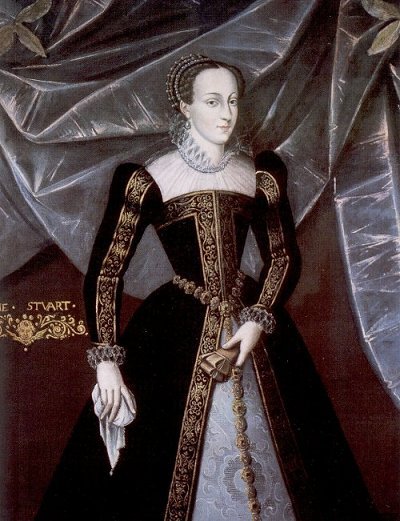
In November 1542, King James V of Scotland, lay dying at his beloved Falkland Palace, built just five years earlier. He was devastated by his army’s defeat by the English at Solway Moss and saw little hope for the future.
At Falkland, he was told that Mary of Guise, his French-born wife once wooed by Henry VIII, had given birth to a daughter at Linlithgow Palace on December 8.
This was a feast-day in honor of the Virgin Mary and many took it as a good omen for the princess; for her father, however, it was otherwise. Upon receiving news of Mary’s birth, he reportedly said, ‘Woe is me.
My dynasty came with a lass. It will go with a lass.’ James’s ancestor, Robert II, had become King of Scots in 1371. The son of Robert the Bruce’s daughter Marjorie and Walter, the High Steward of Scotland, Robert was nearest in succession to the throne. He called his new dynasty ‘Stewart,’ a variation on his father’s title; in France, it was spelled Stuart.
Mary’s father, James V, believed this lineage had ended with his daughter’s birth. He certainly never contemplated that his grandson would one day rule both Scotland and its old enemy, England. James died within a week of Mary’s birth and, before she was even a year old, the child was crowned queen of Scots.
The regents of Scotland made a treaty with Henry VIII in which Edward, Henry’s long-awaited and precious son, would wed Mary. But Henry VIII became increasingly erratic and despotic in his later years and continued to send his army north. In 1546, Henry also encouraged the murder of Cardinal Beaton, a great Scots patriot; the proof – shortly before the murder, he had offered one thousand pounds for expenses associated with a plot to murder Beaton.
After this, the Scots were determined to avoid the proposed English marriage. In July 1548, they sent the five-year-old Mary to France, her mother’s homeland. The Scots Parliament had agreed to her marriage with Francis, the heir of Henry II, king of France from 1547 to 1559.
Mary sailed from Dumbarton Castle to France, using this route to avoid English ships patrolling the English Channel. According to most contemporary reports, Mary was exceptionally lovely (even in an age when most noble women were accorded the title of ‘fair’ or ‘beautiful’), intelligent and full of vitality.
One French observer wrote admiringly: ‘It is not possible to hope for more from a Princess on this earth.’ From this vantage point, Mary’s life seemed to be set on a glorious course; but like a later foreign queen of France, Marie Antoinette, Mary’s life was not destined to be peaceful and happy.

When Mary left for Scotland, she travelled with the children of Scotland’s nobility, including the ‘Four Maries,’ the women who would stay with her throughout her later imprisonment and execution.
They were Mary Fleming, Mary Seton, Mary Beaton and Mary Livingstone. Mary Seton was the only one to die unmarried and lived on until 1615, praying for Mary’s soul and giving alms in her memory. The group arrived in France in August 1548.
France, 1548-61
Mary was given a royal welcome in France by King Henry II. He ordered that she would have precedence over his own daughters as she was sovereign of an independent country and also because she was to wed his heir, the Dauphin.
The king also became very fond of the child, saying, ‘The little Queen of Scots is the most perfect child I have ever seen.’ While in France, Mary’s maternal grandmother, Antoinette de Guise, wrote to her daughter in Scotland that Mary was ‘very pretty, graceful and self-assured.’
Mary was 5 when she first met the four-year-old Dauphin, her betrothed husband. According to most contemporaries, they were close and affectionate with one another even as children. They traveled from one royal palace to another – Fountaineblea to Meudon, or to Chambord or Saint-Germain.
They were always attended to by a retinue of servants and, even then, Mary had developed a fondness for animals, especially dogs, which was to continue throughout her life. Mary was also educated in the traditional manner of French princesses; she spoke French and learned Latin, Italian, Spanish and a little Greek.
She learned to dance, sing, play the lute as well as converse on religious matters. Her religious tutor was the prior of Inchmahome, a Scottish priest. When she was seven, her mother came to France to visit her; when Mary of Guise returned to Scotland, neither realized that they would never see each other again.
By the age of eleven, Mary was deemed to be as intelligent and well-spoken as a woman of twenty-five by her doting father-in-law. It is worth noting that the Guise family regarded Mary as one of their own; not only was betrothed to the heir to the throne but her mother was a Guise as well. Her uncle, Cardinal Guise, taught her about statecraft, perhaps encouraging her natural feelings of clemency and mercy. In fact, Mary was to be remarkably free from bigotry during her short reign in Scotland, even towards her subjects of a different religion.
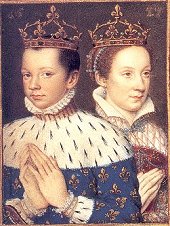
In 1555, Mary sent back letters to her mother in Scotland to be used for administrative purposes and it is from these that we first see her royal signature ‘MARIE R’. In 1558, she married the Dauphin in an incredible celebration in Notre-Dame Cathedral in Paris. Exceptionally tall for a woman in the 16th century, Mary was every inch the regal Queen; she had an oval face, shapely chin, and small mouth which were set off by her golden-red hair, her large forehead, and hazel eyes.
Many considered Mary to be the most beautiful princess in Europe, much as they had thought of her relative, Henry VIII’s sister, Mary, who had also come to France as queen for a short while. Mary was not always in the best of health but, unlike her husband, there were no immediate concerns for her life.
In 1558, Queen Mary I of England passed away and Henry II of France encouraged his daughter-in- law to assume the royal arms of England. In his opinion – and that of most of Catholic Europe – Mary of Scotland was the next heir to the English throne.
This belief, of course, would have serious repercussions throughout Mary’s life. Elizabeth I never forgot this first offense and never rested easily while her Catholic relative was alive. But the matter was smoothed over when Elizabeth was persuadd the assumption was due more to Guise ambitions than Mary’s actual wish.
In 1559, Henry II of France, died at the age of 40. Mary and her husband were crowned Queen and King of France. But in June of 1560, Mary’s mother died in Scotland at the age of 45. And just six months later, her young husband also died of an ear infection.
Mary was understandably devastated by this chain of tragic events. Thockmorton, the English ambassador, commented that Francis had left ‘as dolorous a wife as she had good cause to be. By long watching with him during his sickness and painful diligence about him’ she had become exhausted and made herself ill. She wrote a poem, in French, about her grief at his death; this is a translation of one verse:
By day, by night, I think of him/ In wood or mead, or where I be/ My heart keeps watch for one who’s gone./ And yet I feel he’s aye with me.
What was Mary to do next? She left for Scotland, a land rife with religious and civil discord. Without waiting for a safe-conduct pass from Elizabeth, whose ships were patrolling her route, Mary set out for Scotland on 14 August 1561 and, five days later, reached Leith, the port of Edinburgh.
Learn more about the husbands of Mary Queen of Scots
Scotland, 1561-68
Mary knew very well that she was succeeding to a most troubled heritage. But after her recent years of loss and grief, she was determined to make a bright future. Also, in an age of religious persecution which earned her cousin Mary Tudor the nickname ‘Bloody Mary,’ Mary was determined that every one of her Scottish subjects should worship God as their conscience bade; there would be no religious persecution under her rule. In this, she resembled her cousin Elizabeth I.

The Scots received their new queen with great joy and celebration. At once, she began to try and help them; within a year of her arrival, one-sixth of all Church benefices was given to the Protestant ministers to relieve their poverty.
She also attempted to strengthen the power of the Crown against Scotland’s notoriously difficult-to-control nobles. Of course, such a strategy would lead to more peace and stability within the realm.
As a result, she was popular with the common people but not the nobility; she played croquet, golfed, went for hunts and archery practice, sung, danced, and, in general, showed an admirable zest for life. In 1562 the English ambassador reported to Elizabeth, ‘When the soldiers came back from the night’s sentry-duty, she said she was sorry she was not a man to be all night on the fields and to walk the causeway with buff-coat, steel-helmet, buckler, and broadsword.’
In 1563, Mary began the traditional ‘royal progress’ throughout Scotland. In 1564, the fourth Earl of Atholl organized a great hunt in honor of the queen and, yet again, Mary charmed all who met her. Yet she also treaded dangerous ground with her policy of non-discrimination and desire to unify the nation, taking power away from the independent nobles.
Though a Catholic, Mary became friends with one of the most learned Protestants of the time, George Buchanan. In the political realm, Mary kept up peaceful relations with France, Spain, and England, though she never met Elizabeth face-to-face. But, in 1566, her patience was tried by the English ambassador’s persistent and obvious spying; she ordered him out of the kingdom and declared him persona non grata.
And her peace with France and Spain was kept without a treaty, though a treaty would have given Scotland some measure of protection against England in the possibility of conflict. However, Mary was aware that any treaty could compromise her subjects, involving them in yet another war and causing strife. Above all, she wanted peace and prosperity, and she kept Scotland safely distanced from political machinations. When the threat to Mary’s reign finally came, it was not from one of these outside powers; indeed, it came from within her own nation.
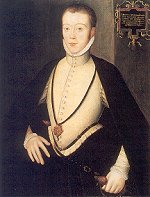
As queen, Mary was more than aware that she should marry and provide heirs to the throne. In July of 1565, she wed a cousin named Henry Stewart, Lord Darnley, a weak, vain, and unstable young man; like Mary, he was also a grandchild of Henry VIII’s sister Margaret.
Why Mary wed Darnley remains a mystery. He was superficially charming and, unlike most men, taller than the queen. He was also fond of courtly amusements and thus a nice change from the dour Scottish lords who surrounded her. But he never seemed to care for Mary and sought far more power than she was willing to give him.
When she was six months pregnant in March of 1566, Darnley joined a group of Scottish nobles who broke into her supper-room at Holyrood Palace and dragged her Piedmontese secretary, David Riccio, into another room and stabbed him to death.
They claimed Riccio had undue influence over her foreign policy but, in reality, they probably meant to cause Mary, from watching this horrific crime, to suffer a miscarriage, thus losing her child and her own life as well since one usually meant the other in the 16th century.
Mary certainly believed that Darnley, angry because she had denied him the crown matrimonial, wanted to kill her and the child, thus becoming King of Scots. But it is unlikely that, had he been successful, Darnley would have long survived his wife.
After Riccio’s death, the nobles kept Mary prisoner at Holyrood Palace. Entering the later stages of her pregnancy, she was desperate to escape and – somehow – won over Darnley and they escaped together. Three months later the future James VI of Scotland was born and congratulations came from all over Europe. Still young and healthy after the birth, Mary now had an heir.
This was the apex of her reign, her greatest and happiest moment. In December 1566 James was baptized in the Chapel Royal of Stirling Castle. Mary, once the fragile last hope of the Stewart dynasty, was just 23 years old and had fulfilled one of a monarch’s greatest duties – providing a healthy son and heir.
Elizabeth of England, ten years older, watched these events with interest for, even then, she knew her own future would be – by choice – unmarried and childless. She could well imagine that Mary’s son would be her heir as well.
But this future soon seemed perilous for James’s birth provided only a temporary calm. The nobles who had plotted with Darnley now felt betrayed by him; after all, they had captured the queen and her potential heir, murdered her dear friend, and were in a position to demand anything. But Darnley’s decision to help Mary escape infuriated them.
In February of 1567 they had Darnley’s house, Kirk o’ Field, blown up; Darnley’s strangled body was found in the garden. Many nobles were implicated, most particularly James Hepburn, the Earl of Bothwell. Certainly Bothwell’s later life (imprisoned in Denmark, he died in 1578, virtually insane) was a degree of punishment for this crime.
However, in the immediate aftermath of Darnley’s murder, he met with Mary about six miles outside of Edinburgh. He had 600 men with him and asked to escort Mary to his castle at Dunbar; he told her she was in danger if she went to Edinburgh. Mary, unwilling to cause further bloodshed and understandably terrified, followed his suggestions.
Bothwell’s noble friends had previously pressed her to marry him and he, too, had told her she needed a strong husband who could help unify the nobles behind her. Mary had refused the proposal then, preferring to marry Darnley, but now she knew herself to be powerless.
She also had an infant son to consider. So she consented to wed Bothwell, hoping that this would finally stabilize the country. Also, Bothwell showed Mary an agreement the nobles had signed which indicated they were prepared to accept him as their overlord. In May 1567 they wed at Holyrood and Mary wrote to the foreign courts that it was the right decision for her country.
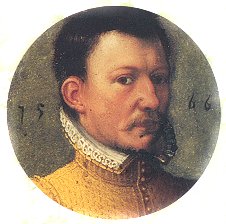
But the nobles were still not to be trusted. Now, they were angry that Bothwell would be all-powerful and they decided to wage war against him. Barely a month after the marriage, rebel nobles and their forces met Mary’s troops at Carberry Hill, 8 miles south-east of Edinburgh.
The nobles demanded that Mary abandon Bothwell, whom they had earlier ordered her to wed. She refused and reminded them of their earlier order. To avoid the bloodshed of battle, she turned herself over and the rebels took her to Edinburgh while Bothwell struggled to rally troops of his own. Mary was taken to Lochleven Castle and held prisoner in that island fortress; fearing for her own life, she became desperately ill.
She was forced to sign a document abdicating the crown in favor of her year-old son. At the end of that month, July 1567, James was crowned king and James Stewart, the Earl of Moray, Mary’s bastard half-brother, became Regent. Moray wasted no time in repaying Mary’s earlier kindness to him by stealing her son and jewels.
Of course, Scottish history reveals that all these nefarious nobles came to a bad end – Moray was murdered just 3 years later and the next regents were also killed; in fact, her son James had one of the traitors executed in 1580, when he was just a teenager.
Mary’s cause was aided in 1568 when John Hay, before his execution, made a statement from the scaffold that told how the nobles had murdered Darnley. Before this, the nobles had attempted to make the people believe Mary was responsible.
Now, she was able to win sympathy and friends. George Douglas, one of the brothers of her keeper at Lochleven, helped her escape. After 10 months of captivity, she was free to fight for the throne. Her supporters gathered an army and, on their way to Dumbarton Castle, a battle was fought at Langside, Glasgow.
Mary’s forces lost and she was forced to flee with her supporters. Against all advice, she was determined to go south and ask Elizabeth I for support. As James’s godmother and Mary’s cousin as well as a fellow independent Queen, Mary felt certain Elizabeth would help her. As most know, this was the beginning of yet another chapter of suffering and misery for Mary.
The Final Years, 1568-87
Mary set sail for England on 16 May 1568. She soon arrived in Workington, Cumbria; Elizabeth did not know what to do and kept Mary guarded in the north. After all, without Mary’s knowledge, she had been helping her enemies, promising money and sanctuary in return for their treacherous behavior against their queen.
Elizabeth’s motives for this were obvious – Mary was the closest Catholic claimant to the English throne and Elizabeth knew some of her subjects were not above hoping she could be deposed and Mary made queen of both Scotland and England.
So she had determined to keep her cousin’s kingdom in continual strife; if Mary was busy at home, she would have less chance to plot against Elizabeth. But Elizabeth’s conscience was determined to be clear so she appointed commissioners to look into the matter; they met throughout 1568 and 1569. In December of 1569, the so-called Casket Letters were first presented at Westminster.
They were supposedly letters and other papers belonging to Bothwell and found in his casket (letter box). They disappeared soon afterwards and only translations and copies remain. However, few believed they were either real or important at the time for Elizabeth, in January 1569, released a statement that ‘Nothing had been sufficiently proved, whereby the Queen of England should conceive an evil opinion of her good sister.’ Everyone took this to mean that Mary was not guilty of any conspiracy alleged in the letters.
But in this same year, conservative nobles in England supported an idea that Mary should wed the Duke of Norfolk. This also indicated that Elizabeth, and most English nobles, believed Mary innocent of Darnley’s murder and any charges in the Casket Letters.
But Elizabeth did not consent to the marriage and kept Mary under lock and key. Soon, this arrangement had settled into stone; Mary was moved from prison to prison, eventually ending up at Fotheringhay Castle, about 70 miles north-west of London and as close to Elizabeth as she ever came.
Of course, Mary plotted from the very beginning to escape. She felt justified in doing so since she was being held against her will. However, as the years passed, the plots grew more outlandish and murderous. Mary’s imprisonment was only to end with her execution.
Read a more detailed account of Mary’s arrival in England and the plots which led to her trial and execution at the Queen Elizabeth I website.
In October of 1586, Mary was put on trial at Fotheringhay for plotting to kill Elizabeth and claim the English throne. Elizabeth’s last letter to Mary was delivered at the start of the trial:
You have in various ways and manners attempted to take my life and to bring my kingdom to destruction by bloodshed. I have never proceeded so harshly against you, but have, on the contrary, protected and maintained you like myself.
These treasons will be proved to you and all made manifest. Yet it is my will, that you answer the nobles and peers of the kingdom as if I were myself present. I therefore require, charge, and command that you make answer for I have been well informed of your arrogance.
Act plainly without reserve, and you will sooner be able to obtain favour of me.
Elizabeth.
Mary defended herself admirably though she had no friends or supporters at the trial and, essentially, the verdict had been decided before the proceedings had begun. Mary admitted her desire to escape but stated, ‘I have not procured or encouraged any hurt against Her Majesty, Queen Elizabeth.’ And she appealed for mercy, mentioning her own reputation for tolerance and kindness: ‘My subjects now complain they were never so well off as under my government.’
But she also accepted the inevitable, telling the assembled nobles, ‘May God keep me from having to do with you all again.’ When the verdict was read to her, she said, ‘I do not fear to die in a good cause.’
The trial lasted just two days and was over on 16 October 1586 but it was not until 7 February 1587 that she was told she would be executed the next morning. She asked for her chaplain but was refused this last comfort.
The Earl of Kent said: ‘Your life would be the death of our religion, your death would be its life.’ In fact, Mary had been a tolerant ruler in Scottish religious matters. But such was the extreme religious upheaval of the time, tolerance itself was a sign of weakness.
The death-sentence was signed by Elizabeth who later argued that her secretary Davison had deceived her as to its contents; she said she would not have signed it otherwise. Her letter to Mary’s son James about the execution, written on 14 February, is a remarkable document:
My dear Brother, I would you knew (though not felt) the extreme dolor that overwhelms my mind, for that miserable accident which (far contrary to my meaning) hath befallen. I have now sent this kinsman of mine, whom ere now it hath pleased you to favour, to instruct you truly of that which is too irksome for my pen to tell you.
I beseech you that as God and many more know, how innocent I am in this case : so you will believe me, that if I had bid aught I would have bid by it. I am not so base minded that fear of any living creature or Prince should make me so afraid to do that were just; or done, to deny the same. I am not of so base a lineage, nor carry so vile a mind.
But, as not to disguise, fits not a King, so will I never dissemble my actions, but cause them show even as I meant them. Thus assuring yourself of me, that as I know this was deserved, yet if I had meant it I would never lay it on others’ shoulders; no more will I not damnify myself that thought it not.
The circumstance it may please you to have of this bearer. And for your part, think you have not in the world a more loving kinswoman, nor a more dear friend than myself; nor any that will watch more carefully to preserve you and your estate.
And who shall otherwise persuade you, judge them more partial to others than you. And thus in haste I leave to trouble you: beseeching God to send you a long reign.
Your most assured loving sister and cousin,
Elizabeth R.
A year later, the Catholic Philip V of Spain invaded England with his Armada, perhaps – to some degree – urged on by Mary’s execution.

Mary did not retire until two in the morning on the last day of her life. She spent her final hours making a will and generously providing to those who had served her faithfully.
Early on the morning of 8 February 1587, dressed in black satin and velvet, she entered the Great Hall of Fotheringhay Castle.
She commanded her servant, Melville, to go to her son and tell him that she had never done anything to compromise their kingdom of Scotland.
Mary was calm and composed before the several hundred spectators present; she listened while the execution warrant was read and then prayed aloud in English for the Church and her son. She also mentioned Queen Elizabeth and prayed for her to continue to serve God in the years to come.
Mary comforted her weeping servants, her friends and supporters to the last. They helped her undress; beneath her all-black gown, she wore a red petticoat and bodice. Her women helped her attach the long red sleeves. Mary thus died wearing the liturgical color of Catholic martyrdom.
She gave them her golden rosary and Agnus Dei, asking them to remember her in their prayers. Her eyes were covered with a white cloth. While her servants wept and called out prayers in a medley of languages, she laid her neck upon the block, commended herself to God and received the death-stroke. But the executioner was unsteady and the first blow cut the back of her head; Mary whispered, ‘Sweet Jesus’, and the second blow descended.
When the executioner lifted her head and cried out, ‘God save the Queen,’ a macabre surprise occurred. Mary, queen of Scots had worn an auburn wig to her execution. It was left in the executioner’s hand as her head, with its short, grey hair, fell to the floor.
Mary had always loved animals and her little Skye terrier had brought her great comfort during the years in prison. It had curled itself around her feet while she knelt at the block and died just days after the queen. As queen of Scots, Mary’s motto had been ‘In my end is my beginning’. And certainly the end of her life marked the beginning of her legend.
The Catholic nations which had condemned her behavior during Darnley’s murder and the marriage to Bothwell now celebrated her as a martyr. Her former brother-in-law, Henri III of France, held a funeral mass at Notre-Dame, where Mary had wed Francis almost thirty years before.
Accounts of her execution, illustrated by crude woodcuts, were sold throughout Europe. She was now the sympathetic heroine; the past could be forgotten.
Sixteen years later, Mary’s son became King of England and Scotland. In 1612, he moved her body to Westminster Abbey, London, constructing a magnificent tomb which rivaled Elizabeth I’s.
In her Essay on Adversity, written in 1580 while she was imprisoned, Mary had written of rulers: ‘Tribulation has been to them as a furnace to fine gold – a means of proving their virtue.’ It was a fitting epitaph for her own infamous life.
Link/cite this page
If you use any of the content on this page in your own work, please use the code below to cite this page as the source of the content.
Link will appear as Hanson, Marilee. «Mary, Queen of Scots: Biography, Facts, Portraits & Information» https://englishhistory.net/tudor/relative/mary-queen-of-scots/, January 31, 2015

In this post, we will be looking at identifying information and the writer’s views or claims, including true, false and not given and yes, no not given questions.
In the IELTS Reading Test, common questions include true, false, not given. You will be asked to identify information in a text, then reading statements and deciding if they are true, false or not given.
When reading the text, you must concentrate and look for the following;
- TRUE – this means that the statement agrees with the information in the text.
- FALSE – This means that the information disagrees with the information in the text.
- NOT GIVEN – this means that the information is not present in the text – so you cannot say if it is either true or false.
For the answer to be true, it must agree and be true to the information given in the text. Any information that is not shown in the text would be not given.
TEST QUESTION
In the IELTS test, the true, false, not given questions will look similar to the those below >>

Exercise 1
Read the text below (from the English History website) and decide if the statements are true, false or not given.
Mary, Queen of Scots was one of the most fascinating and controversial monarchs of 16th century Europe. At one time, she claimed the crowns of four nations – Scotland, France, England and Ireland. Her physical beauty and kind heart were acknowledged even by her enemies. Yet she lacked the political skills to rule successfully in Scotland. Her second marriage was unpopular and ended in murder and scandal; her third was even less popular and ended in forced abdication in favour of her infant son. She fled to England in 1568, hoping for the help of her cousin, Elizabeth I. Her presence was dangerous for the English queen, who feared Catholic plotting on Mary’s behalf. The two queens never met and Mary remained imprisoned for the next nineteen years. She was executed in 1587, only forty-four years old. By orders of the English government, all of her possessions were burned. In 1603, upon Elizabeth’s death, Mary’s son became king of England as James I.
- True – if the statement agrees with the information
- False – if the statement contradicts the information
- Not Given – if there is no information present
10. Mary Queen of Scots was once the monarch of four different places.
11. Mary married her first husband Francis ii of France in 1558.
12. Mary and Queen Elizabeth 1st were good friends and met often.
13. After her death, Mary’s son James 1st became the King of Scotland.
Answers at the bottom of the page.
TIP >> NOT GIVEN > The IELTS Reading Test is measuring your ability to be able to read a text and find information within it. Not about your general knowledge on the subject. If the information is not in the text – your answer would, therefore, be not given.
Exercise 2
Read the text below (from the English History website) and decide if the statements are true, false or not given.
Henry’s first wife, Katharine of Aragon, was the youngest child of the ‘Catholic Kings’ of Spain, Ferdinand and Isabella; she and Henry were married for over twenty years. His second wife, Anne Boleyn, was the daughter of an ambitious knight; she was executed after three years of marriage. His third wife, Jane Seymour, died after less than two years of marriage, having finally produced a son and heir for Henry. His fourth wife, Anne of Cleves, was divorced mere months after the wedding, for Henry found her unattractive and was already courting his fifth wife, Catherine Howard. Catherine was executed after less than two years of marriage and the king settled upon the twice-widowed Katharine Parr as his sixth wife. She outlived the mercurial king.
- True – if the statement agrees with the information
- False – if the statement contradicts the information
- Not Given – if there is no information present
14. Henry’s first wife Katharine of Aragon was the longest relationship he had with any of the wives.
15. Henry Viii favoured his second wife Anne Boleyn above all the others.
16.Henry Viii divorced Anne of Cleaves after a short time.
17. atherine Parr had two sons with Henry Viii before he died.
Answers at the bottom of the page.
Exercise 3
Read the text below (from the English History website) and decide if the statements are true, false or not given.
Elizabeth Tudor is considered by many to be the greatest monarch in English history. When she became queen in 1558, she was twenty-five years old, a survivor of scandal and danger, and considered illegitimate by most Europeans. She inherited a bankrupt nation, torn by religious discord, a weakened pawn between the great powers of France and Spain. She was only the third queen to rule England in her own right; the other two examples, her cousin Lady Jane Grey and half-sister Mary I, were disastrous. Even her supporters believed her position dangerous and uncertain. Her only hope, they counselled, was to marry quickly and lean upon her husband for support. But Elizabeth had other ideas.
She ruled alone for nearly half a century, lending her name to a glorious epoch in world history. She dazzled even her greatest enemies. Her sense of duty was admirable, though it came at a great personal cost. She was committed above all else to preserving English peace and stability; her genuine love for her subjects was legendary. Only a few years after her death in 1603, they lamented her passing. In her greatest speech to Parliament, she told them, ‘I count the glory of my crown that I have reigned with your love.’ And five centuries later, the worldwide love affair with Elizabeth Tudor continues.
‘Proud and haughty, as although she knows she was born of such a mother, she nevertheless does not consider herself to inferior degree to the Queen, whom she equals in self-esteem; nor does she believe herself less legitimate than her Majesty, alleging in her own favour that her mother would never cohabit with the King unless by way of marriage, with the authority of the Church….
She prides herself on her father and glories in him; everybody saying that she also resembles him more than the Queen does and he therefore always liked her and had her brought up in the same way as the Queen.’ the Venetian ambassador Giovanni Michiel describes Elizabeth; spring 1557.
Elizabeth Tudor was born on 7 September 1533 at Greenwich Palace. She was the daughter of King Henry VIII and his second wife, Anne Boleyn. Henry had defied the papacy and the Holy Roman Emperor to marry Anne, spurred on by love and the need for a legitimate male heir. And so Elizabeth’s birth was one of the most exciting political events in 16th-century European history; rarely had so much turmoil occurred on behalf of a mere infant. But the confident predictions of astrologers and physicians were wrong and the longed-for prince turned out to be a princess.
- True – if the statement agrees with the information
- False – if the statement contradicts the information
- Not Given – if there is no information present
18. Queen Elizabeth 1st wanted to find a husband to share her royal responsibilities.
19. Queen Elizabeth 1st was loved by many.
20. Queen Elizabeth 1st was the only female heir to the throne.
21. Henry was determined to marry Anne Boleyn, driven by his affection and his longing for a son.
Answers at the bottom of the page.
What is the difference between true, false, not given and yes, no, not given questions?
There is a difference between the true, false, not given questions and the yes, no, not given questions.
The true, false, not given questions are asking you to look for information based on facts in the text.
The yes, no, not given questions are asking you to look for the writer’s views or claims in the text.
Identifying The Writer’s View or Claims
When the writer is giving their opinion, this is them expressing their view on a topic. If the writer presents something as a fact, then this is a claim. Therefore to find a claim or view in the text, you are required to read the text and use your own interpretation of it.
Not given still means that you cannot find any information in the text in relation to the statement.
Yes, No, Not Given
For these questions you will look at the following;
- YES – if the statement agrees with the views or claims
- NO – if the statement contradicts the views or claims
- NOT GIVEN – it is impossible to say what the writer’s views/claims are
TEST QUESTION
In the IELTS test, the yes, no, not given questions will look similar to the those below >>

Exercise 4
Read the text below (from the BBC English History website) and decide if the statements are yes, no or not given.
Viking Raids
Raids by seaborne Scandinavian pirates on sites in Britain, especially largely undefended monastic sites, began at the end of the eighth century AD.
By the end of the ninth century, there were large-scale settlements of Scandinavians in various parts of Britain, and they had achieved political domination over a significant territory.
Early in the 11th century, the king of Denmark became King of England as well. And in 1066 there were separate invasions by the king of Norway, Harald Hardrada, and Duke of Normandy, William, the latter the descendant of Scandinavian settlers in northern France.
Many monasteries in the north were destroyed, and with them any records of the raids.
Yet the most significant development of the period was an indirect result of Scandinavian involvement in the affairs of Britain – the emergence of two kingdoms of newly unified territories, England and Scotland.
In 793 AD, an anguished Alcuin of York wrote to the Higbald, the bishop of Lindisfarne and to Ethelred, King of Northumbria, bemoaning the unexpected attack on the monastery of Lindisfarne by Viking raiders, probably Norwegians sailing directly across the North Sea to Northumbria.
It is clear from the letter that Lindisfarne was not destroyed. Alcuin suggested that further attack might be averted by moral reform in the monastery.
Over the next few decades, many monasteries in the north were destroyed, and with them any records they might have kept of the raids. We know no historical details of the raids in Scotland, although they must have been extensive.
Iona was burnt in 802 AD, and 68 monks were killed in another raid in 806 AD. The remaining monks fled to Kells (County Meath, Ireland) with a gospel-book probably produced in Iona, but now known as the ‘Book of Kells’.
Other monasteries in Scotland and northern England simply disappear from the record. Lindisfarne was abandoned, and the monks trailed around northern England with their greatest possession, the relics of St Cuthbert, until they found a home in Durham in 995 AD.
Skim the text and see if the statements below agree with the claims of the writer >>
- YES – if the statement agrees with the views or claims
- NO – if the statement contradicts the views or claims
- NOT GIVEN – it is impossible to say what the writer’s views/claims are
7. The most important part of that time was the evolution of two empires.
8. The fear that the Norwegians would cross the ocean and settle into the North of England.
9. The Vikings left with treasures including ‘The Book of Kells’.
10. The Vikings ruined many places along the north coast in the UK including Bamburgh Castle.
Answers at the bottom of the page.
Exercise 5
Read the text below (from the BBC English History website) and decide if the statements are yes, no or not given.
The Home Front
The concept of a ‘Home Front’ – when civilians are mobilised en masse to support the war effort during a conflict – dates from World War One, as far as the British are concerned. It was re-activated in 1938 during the Munich crisis when civilians were encouraged to enrol in Air Raid Precautions (ARP) or the Auxiliary Fire Service (AFS).
Anticipating terror from the air
ARP was a reaction to the fear, shared throughout Europe in the 1930s, of the mass bombing of civilians from the air. In the 1930s, the government estimates calculated that 600,000 people would be killed and 1.2 million injured in air raids during a future war.
The evacuation had already been running for two days by the time war with Germany was announced on 3 September 1939. Throughout the war, three million people were moved beyond the reach of German bombers, in what became a fundamentally life-changing event for many. The internment of German and Austrian ‘aliens’ also commenced at the outbreak of war, and those considered high risks were interned immediately. Later, Italian aliens were ’rounded up’ under Churchill’s orders after Italy joined the war in June 1940.
‘Doing your bit’
The nation’s labour was once again mobilised, and to an even greater extent than World War One. Half a million women joined the uniformed services, and millions more worked in the factories and on the land. Both men (from 1939) and women (from 1941) were conscripted. Men were even conscripted into the coal mines – one in ten of those enlisted domestically.
Skim the text and see if the statements below agree with the claims of the writer >>
- YES – if the statement agrees with the views or claims
- NO – if the statement contradicts the views or claims
- NOT GIVEN – it is impossible to say what the writer’s views/claims are
11. Although many people were in the military services during World Wars 1 and 2 much more volunteered to help.
12. During the war, many people were displaced.
13. People from Italy were offered protection from the English government.
14. Women completed more roles during the war effort than men.
Answers at the bottom of the page.
REVIEW AND STRATEGY
The true, false, not given / yes, no, not given questions are common in the IELTS Reading Test, therefore you should practice and develop a strategy for answering.
TIP >> Read the instructions before you start reading the questions or the text. Take note if the questions are true, false, not given or yes, no, not given.
TIP >> Read the questions and the given text. For the yes, no, not given questions look out for keywords that suggest the writer is sharing their view or opinion, like; always, occasionally, some or claimed.
TIP >> Skim read the text and match the statement to the correct part of the text.
TIP >> Check that the statement exactly matches the meaning of the text if you are going to say it is true (or yes). If it does not it is false (or no). If there is no information – it is not given.
TIP >> Answers are in the same order as the text, work your way through them. If you are going over and over looking for something, then it is most likely ‘not given’. Don’t waste lots of time looking for something that is not there.
TIP >> Be aware of synonyms and paraphrasing.
Answers >>
Exercise 1 Answers >>
10. True
11. Not Given
12. False
13. False
Exercise 2 Answers >>
14. True
15. Not Given
16. True
17. False
Exercise 3 Answers >>
18. False
19. True
20. Not Given
21. True
Exercise 4 Answers >>
7. Yes
8. Yes
9. No
10. Not Given
Exercise 5 Answers >>
11. Yes
12. Yes
13. No
14. Not Given
We hope you found this post useful in helping you to study for the IELTS Test. If you have any questions please let us know in the comments below or on the Facebook page.
The best way to keep up to date with posts like this is to like us on Facebook, then follow us on Instagram and Pinterest.
If you need help preparing for the IELTS Test, join the IELTS Achieve Academy and see how we can assist you to achieve your desired band score. We offer an essay correction service, mock exams and online courses.
В этом задании проверяется, насколько успешно вы овладели грамматическими навыками. Предполагается, что вы уже должны знать, как образовать нужную грамматическую форму от предложенного вам слова в начальной форме.
Стратегия выполнения задания
• Внимательно прочитайте предложение, определите по обстоятельствам времени или по имеющимся глагольным формам, в каком времени написано предложение.
• Определите, какую часть речи вы должны изменить из предложенной вам начальной формы, чаще всего это глаголы.
• Если это глагол:
— подумайте, какую форму имел в виду автор (личную, инфинитив, герундий или причастие);
— посмотрите, нужна ли форма активного или пассивного залога;
— и только после этого поставьте глагол в нужную грамматическую форму, необходимую для этого предложения.
• Если это прилагательное или наречие, посмотрите, нет ли сравнительной или превосходной степени, подсчитайте количество слогов, подумайте, не является ли это слово исключением, только после этого поставьте его в нужную форму.
• Если вы изменяете существительное, по соседнему глаголу или другим местоимениям определите, в каком числе (единственном или множественном) употреблено слово в предложении.
Прежде чем приступить к выполнению заданий на проверку знаний по грамматике английского языка, лучше повторить базовые структуры английского языка по таблице времен и по краткому теоретическому справочнику.
Краткий теоретический справочник
В данной главе предложено обобщённое изложение основного грамматического материала, уже освоенного учащимися. Главной задачей справочника является сведение воедино наиболее важных грамматических правил английского языка, использование которых поможет успешно справиться с практическими заданиями из второй части пособия.
При изучении английского языка следует чётко понимать, что его основным отличием является строгий порядок слов в предложении. Приведённые в справочнике таблицы помогут освежить в памяти базовые структуры построения предложений в английском языке.
Глагол.
Любое из предложений может быть сформулировано как в действительном (активном) залоге, так и в страдательном (пассивном). В первом случае действие выполняет подлежащее, а во втором — дополнение, которое может быть указано в предложении или нет. Действительный залог в речи используется гораздо чаще, поэтому именно он взят за основу в системе времён. Под основные правила не подпадают глагол To beИ модальные глаголы.
В таблице использованы следующие сокращения:
— Пед. ч. — Подлежащее в единственном числе (существительное или местоимения He, she, it);
— Пмн. ч. — Подлежащее во множественном числе (существительное или местоимения You, we, they);
— Vr2 — правильный глагол с окончанием — ed, неправильный во второй форме в таблице неправильных глаголов;
— V3 — правильный глагол с окончанием — ed, неправильный в третьей форме в таблице неправильных глаголов;
— ^in9— глагол с окончанием — ing.
|
Present |
Past |
Future |
|
|
Simple (когда?) |
Действие регулярное, обычное, повторяющееся Always∕never, often/seldom, today, usually∕sometimes, every day. + I/ Пмн. ч V Пед. ч V+s — I/ Пмн. ч don’t V Пед. ч doesn’t V ? Do I/ Пмн. ч V Does Пед. ч V |
Действие, которое произошло в прошлом Yesterday, last, ago + ∏ V2 — ∏ didn’t V ? Did ∏ V |
Действие, которое Произойдёт в будущем Tomorrow, soon, in 2 days + ∏ will V — ∏ won’t V? Shalll/weV Will ∏ V |
|
Progressive (Continuous) Длительность действия = несовершенный вид |
— действие, происходящее в момент речи; — запланированное в будущем действие Now, at the moment + I am Пед. ч is Vin5 Пмн. ч are — I am not Пед. ч isn’t V7715 Пмн. ч aren’t ? Am I Пед. ч Is Пед. ч Vjns Are Пмн. ч Искл.: Не употребляется с глаголами со значением умственной деятельности и чувственного восприятия |
— действие, происходящее в определённый момент времени в прошлом At 5 o’clock yesterday, the whole day, from 3 to 5, while, when ÷ Пед. ч was V777 5 Пмн. ч were Ning ~ Пед. ч wasn’t Ning Пмн. ч weren’t Ning ? Was Пед. ч V7775 Were Пмн. ч V7n5 |
— действие, которое будет длиться в определённый момент времени в будущем At 5 o’clock tomorrow + ∏ will be V7775 — ∏ won’t be V777 5 ? Will ∏ be Ning |
Activevoice (действительный залог)
|
Present |
Past |
Future |
|
|
Perfect (результат действия) |
— действие выполнено или не выполнено к настоящему моменту, результат важен сейчас; — действие началось в прошлом и (не)закончено к моменту речи Ever/never, just, already, yet, recently, lately, for, since + l/ Пмн. ч have V3 Пед. ч has V3 — I/ Пмн. ч haven’t V3 Пед. ч hasn’t V3 ? Have I/ Пмн. ч V3 Has Пед. ч V3 |
— действие завершено к определённому моменту Времени; — действие в прошлом, которое предшествует другому прошедшему действию + ∏ had V3 — ∏ hadn’t V3 ? Had ∏ V3 |
— действие завершится к определённому моменту времени в будущем By 5 o’clock tomorrow + ∏ will have V3 — ∏ won’t have V3 ? Will ∏ have V3 |
|
Perfect Progressive (как долго длится действие) |
— действие длилось до момента речи; — действие длилось в прошлом и (не)завершилось к моменту речи + I/ Пмн. ч have been Ving Пед. ч has been Ning -1/ Пмн. ч haven’t been Ning Пед. ч hasn’t been Vfn9 ? Have I/ Пмн. ч been Ning Has Пед. ч been Ning |
— длительное прошедшее действие, которое завершилось раньше определённого момента в прошлом + ∏ had been Vfn9 — ∏ hadn’t been Vfn9 ? Had ∏ been Vfn9 |
Употребление времён в действительном и страдательном залогах полностью совпадает. Форма страдательного залога образуется при помощи вспомогательного глагола To beВ нужной форме и Participle П (третья форма) смыслового глагола.
Английский язык. ЕГЭ—2016. Тренинг
|
Present |
Past |
Future |
|
|
Simple |
+ I am Пед. ч is V3 Пмн. ч are — I am not Пед. ч isn’t V3 Пмн. ч aren’t ? Is Пед. ч V3 Are Пмн. ч V3 |
+ Пед. ч was V3 Пмн. ч were V3 — Пед. ч wasn’t V3 Пмн. ч weren’t V3 ? Was Пед. ч V3 Were Пмн. ч V3 |
+ ∏ will be V3 — ∏ won’t be V3 ? Will ∏ be V3 Shall I/We be V3 |
|
Progressive (Continuous) |
+ I am Пед. ч is being V3 Пмн. ч are — I am not Пед. ч isn’t being V3 Пмн. ч aren’t ? Is Пед. ч being V3 Are Пмн. ч being V3 |
+ Пед. ч was being V3 Пмн. ч were being V3 — Пед. ч wasn’t being V3 Пмн. ч weren’t being V3 ? Was Пед. ч being V3 Were Пмн. ч being V3 |
|
|
Perfect |
+ I/ Пмн. ч have been V3 Пед. ч has been V3 — I/ ∏ haven’t been V3 ∏ hasn’t been V3 ? Have I/ Пмн. ч been V3 Has Пед. ч been V3 |
+ ∏ had been V3 — ∏ hadn’t been V3 ? Had ∏ been V3 |
Passive voice (страдательный залог)
Модальные глаголы и их эквиваленты
Модальные глаголы отличаются от остальных глаголов тем, что сами не обозначают действие. Они выражают отношение к нему говорящего. Они не могут употребляться самостоятельно, после них обязательно должен стоять смысловой глагол в начальной форме. Они могут сами образовывать отрицательные и вопросительные предложения, им не требуются вспомогательные глаголы, но это правило не распространяется на их эквиваленты.
|
Модальные глаголы в настоящем времени и их значения |
Форма в прошедшем времени |
Форма в будущем времени |
|
Сап Возможность, способность, умение выполнить действие |
Could |
Will be able to |
|
May — разрешение — предположение с оттенком сомнения |
Might |
Will be allowed to |
|
Must Обязанность, приказание, необходимость |
Эквивалент Had to |
Will have to |
|
Should/ ought to Следует выполнить действие (совет, рекомендация) |
— |
— |
|
Need/ needn’t Нужно/не нужно выполнять действие |
— |
— |
Неличные формы глагола
В английском языке есть три неличные формы глагола: инфинитив, герундий и причастие. Рассмотрим особенности их употребления. Инфинитив Может выполнять функции подлежащего, части сказуемого, прямого дополнения, обстоятельства цели и сложного дополнения (Complex Object, Complex Subject). Инфинитив в английском языке имеет формы действительного и страдательного залогов, также может быть перфектным и неперфектным, это единственная неличная форма глагола, имеющая форму Progressive.
|
Non-Perfect |
Perfect |
|||
|
Simple |
Progressive |
Perfect |
Perfect Progr. |
|
|
Active |
To V |
Tθ be VI∏g |
To have V3 |
To have been Ving (употребляется редко) |
|
Passive |
To be V3 |
— |
To have been V3 (употребляется редко) |
— |
Герундий Имеет, кроме глагольных свойств, свойства имени существительного. Соответствующей формы в русском языке не существует; по значению к герундию близки отглагольные существительные, также его значение может передаваться инфинитивом, деепричастием, глаголом в личной форме.
|
Active |
Passive |
|
|
Simple |
V — vГпд |
Being V3 |
|
Perfect |
Having V3 |
Having been V3 |
Перед герундием может стоять притяжательное местоимение или существительное в притяжательном падеже, предлог. Случаи употребления герундия следует запомнить:
— как прямое дополнение после глаголов Like, need, prefer, remember, enjoy, mind, excuse, be busy, be worth;
— как предложное дополнение может употребляться после любого глагола или прилагательного, требующего предлога: To depend on, to rely on, to object to, to blame for, to thank for, to praise for, to be responsible for, to be fond of, to be tired of, to be afraid of, to look forward to, to feel like.
Причастие В английском языке может быть в предложении определением или входить в состав причастного оборота (в русском языке соответствует причастному и деепричастному обороту). В качестве определения выступают Participle I Simple (несовершенного вида) и Participle II (совершенного вида).
Причастие, употреблённое в качестве обстоятельства времени и причины, может выражать относительное время. Так, причастие I простое показывает, что выражаемое им действие происходит одновременно с действием глагола-сказуемого, а причастие I перфектное показывает, что действие произошло ранее действия сказуемого. Необходимо помнить, что перед причастием предлог не употребляется.
|
Active |
Passive |
|
|
Participle I Simple (Present) |
VingОпределение/ обстоятельство |
Being V3 обстоятельство |
|
Participle I Perfect |
Having ⅛ обстоятельство |
Having been V3 обстоятельство |
|
Participle Il |
— |
V⅛ определение |
Закон согласования времён Используется в английском языке при переводе предложения из прямой речи в косвенную. Основное его положение: если главная часть стоит в прошедшем времени, то и в зависимой части необходимо употреблять только одно из прошедших времён.
|
Время предложения |
Время в придаточном |
|
В прямой речи |
Предложении в косвенной |
|
Речи |
|
|
Present Simple |
Past Simple |
|
Present Progressive |
Past Progressive |
|
Present Perfect |
Past Perfect |
|
Past Simple |
→ Past Perfect |
|
Past Progressive |
Past Perfect Progressive |
|
Present Perfect Progressive |
Past Perfect Progressive |
|
Future |
Future in the Past |
Также нужно обращать внимание на то, какой тип предложения был в прямой речи.
Повествовательное Предложение имеет следующую структуру: Подл. + said / told + That + Подл. + сказуемое в нужном прошедшем времени.
Вопросительное Предложение:
Подл. + asked + if (whether) / вопросительное слово + подл. + сказуемое в нужном прошедшем времени.
Повелительное Предложение:
Подл. + asked / ordered + to + инфинитив.
Необходимо согласовать и обстоятельства времени.
|
This |
That |
|
(these) |
(those) |
|
Today |
That day |
|
Now |
Then |
|
Here |
→ there |
|
Tomorrow |
The next (the following) day |
|
Ago |
Before |
|
Yesterday |
The day before∕the previous day |
|
Last week |
The week before |
В английском языке, как и в русском, существуют Три наклонения: А) Повелительное наклонение, которое выражает побуждение к действию, просьбу или приказание: Go at once! Don’t be late!
6) Изъявительное наклонение, которое выражает реальное действие в настоящем, прошедшем или будущем времени;
В) Сослагательное наклонение, которое выражает возможность, предположение или нереальность действия.
Рассмотрим более подробно сослагательное наклонение.
The Subjunctive Mood. Выделяют две формы сослагательного наклонения: Subjunctive I (совпадает с формой Future in the Past), которое употребляется в простом предложении и в главной части сложноподчинённого предложения, и Subjunctive II (совпадает с формой Past Simple / Past Perfect), которое употребляется в придаточном предложении. Сослагательное наклонение часто используется в сложных предложениях с придаточным условия.
Условные предложения:
1-й тип — Реальное действие, которое может произойти в будущем при каком-то условии.
2-й тип — Нереальное на данный момент действие, которое невозможно в настоящем или будущем.
3-й тип — нереальное действие, которое не произошло в прошлом. Второй и третий типы переводятся с частицей Бы.
|
Главная часть |
Условная часть |
|
|
1-й тип |
Future Simple Подл, will V |
Lf(When…) Present Simple Подл. V∕Vs |
|
2-й тип |
Future in the Past Подл, would V |
If Past Simple Подл. V2 |
|
3-й тип |
Future in the Past Подл, would have V3 |
If Past Perfect Подл* had V3 |
Существительное
Множественное число имён существительных
1. Традиционным способом Образования множественного числа является прибавление окончания -S/-ES.
2. К существительным, оканчивающимся в единственном числе на — s, —SS, — sh, — ch, -х Прибавляется окончание -es (Xerox-xeroxes).
3. Некоторые имена существительные, оканчивающиеся на — f∕-fe, меняют окончания на -ve+s (wife-wives).
4. Существительные, оканчивающиеся на — у с предшествующей согласной, меняют её на -i+es (victory-victories).
5. Существительные на -о Образуют множественное число с -S Или -es (нужно запоминать каждый конкретный случай).
6. Нетрадиционные способы Образования множественного числа:
Man — men
Woman — women foot — feet tooth — teeth goose — geese mouse — mice child — children ox — oxen
7. Единственное число = множественному числу
Sheep fish deer
8. Неисчисляемые существительные, употребляющиеся только в единственном числе: Sand (Песок), food, meat, water, air, politics, economics, physics, mathematics, spaghetti, advice, information, knowledge, progress, news, money, hair.
9. Существительные, употребляющиеся только во множественном числе: Jeans, tongs (Щипцы), glasses, trousers, tights, scissors, goods, clothes, contents, wages (Зарплата).
Артикль
The definite article
А) перед нарицательными существительными.
1. Перед существительным, обозначающим конкретный предмет, о котором даются или выясняются дополнительные сведения.
The flat is quite large and comfortable.
2. Перед существительным, являющимся единственным в своём роде или в данной обстановке.
When we went out, the moon was shining.
3. Перед существительным в функции обстоятельства места, если не подчёркивается значение Один из.
They went into the restaurant and sat down at the table by the window.
4. Перед существительным, обозначающим вещество в определённом количестве или определённом месте в данной обстановке.
Pass me the salt, please.
5. Перед приложением, характеризующим известное историческое лицо.
Dreiser, the famous American writer, joined the Communist Party at the age of 74.
6. После слов One of, some of, many of, each of, most of;Обычно после слов All, both.
Give me one of the books.
7. Перед существительным, имеющим определение, выраженное прилагательным в превосходной степени, перед словами Same, followingИ порядковыми числительными, а также словами NextВ значении Следующий по порядку и LastВ значении Последний.
This is the most responsible task of all.
8. Перед прилагательными и причастиями в значении существительного и перед словом PeopleВ значении Народ.
The old don’t always understand the young.
9. Перед существительными, обозначающими социальные классы людей.
The workers
The bourgeoisie
10. Перед существительными в единственном числе, обозначающими целый класс предметов.
The dog is a friend of man.
Б) перед именами собственными
1. Перед именем собственным, обозначающим целиком всю семью.
/ haven’t met the Browns since they returned from London.
2. Перед именами собственными, имеющими ограничивающие определение.
Не was again the Charles she used to know years ago.
3. Перед названиями некоторых стран и местностей.
Не travelled widely throughout the United States.
4. Перед названиями океанов, морей, рек и горных цепей.
Не travelled twice across the Pacific Ocean.
5. Перед названиями четырёх сторон света.
Have you ever been to the South?
6. Перед названиями судов, гостиниц и английских газет. Не reads the Morning Star regularly.
The indefinite article
1. Для обозначения принадлежности предмета к какому-либо классу предметов (с глаголами To have, to seeИ др., с оборотом There is,В именной части составного сказуемого) при наличии описательного определения и без него.
A man’s waiting for you.
2. Перед абстрактным существительным при наличии описательного определения.
They lived a quiet life.
3. Перед существительным в приложении, если не подчеркивается известность лица, к которому оно относится.
Mr Petrov, an engineer at our factory, spoke at the meeting yesterday.
4. В значении Один перед исчисляемыми существительными, обозначающими время.
Will you be back in an hour?
5. В восклицательных предложениях после WhatИ перед исчисляемыми существительными в единственном числе.
What a lonely day!
6. Перед исчисляемыми существительными в единственном числе, определяемыми словами Such, quite, rather, most(в значении Очень).
It is such a difficult sentence that 1 can’t translate it.
7. Перед существительным, определяемым порядковым числительным в значении Другой, ещё один.
Suddenly we heard a shot, then a second and a third.
8. В сочетаниях A littleИ A few.
If I have a little free time today, I’ll drop in.
No article
1. Перед абстрактными существительными; перед названием вещества, если речь не идёт о каком-либо конкретном количестве; перед существительными во множественном числе в случаях, перечисленных выше (пункт 1, 5, 6 — The indefinite article).
The work gives him satisfaction.
2. Перед именами собственными.
London is the capital of England.
3. Перед существительным, определяемым словами NextВ значении Будущий и LastВ значении Прошлый.
/ went to the Ukraine for my holiday last year, and I am going there next year, too.
4. Перед названиями наук.
I like Literature and History, but / don’t like Mathematics.
5. Перед существительными Mother, Father, Uncle, AuntИ др. в речи членов одной и той же семьи.
Has Mother come back yet?
6. В некоторых сочетаниях существительного с предлогом, когда все сочетание носит наречный характер: In time, at home, at night, by train, by heart, by day, from year to year, from head to footИ др.
You can get there in time if you goby train.
Степени сравнения прилагательных
Существуют три степени сравнения прилагательных: положительная, сравнительная и превосходная. В зависимости от способов образования степеней сравнения выделяют три группы прилагательных.
1-я группа:
1) односложные прилагательные (low, nice, hot);
2) двусложные прилагательные на — у, -ow, -le, — er (pretty, clever);
3) двусложные с ударением на втором слоге (severe);
4) трёхсложные прилагательные с приставкой Un— (unhappy).
Все эти прилагательные образуют степени сравнения с помощью суффиксов.
Iow — lower — the lowest
clever — cleverer — the cleverest
2-я группа: Все остальные двусложные и многосложные прилагательные
образуют степени сравнения с помощью слов MoreИ The most.
Modern — More Modem — The most Modem terrible — More Terrible — The most Terrible 3-я группа: Особые случаи, когда прилагательные образуют степени сравнения от разных основ.
Good — better — the best
bad— worse — the worst
far — farther — the farthest
Far — further — the furthest
many∕much — more — the most
little — less — the least
Степени сравнения наречий
1. Односложные — так же, как и прилагательные 1 — й группы (без артикля):
Iate — later — latest
2. Многосложные — так же, как и прилагательные 2-й группы (без артикля):
Seldom — More Seldom — Most Seldom
3. Особые случаи:
Badly — worse — worst
little — less — least
much — more — most
well — better— best
Местоимения
1. Личные — I, you, he, she, it, we, they.
2. Притяжательные — My, your, his, her, its, our, your, their. Абсолютная форма — Mine, yours, his, hers, its, ours, theirs.
3. Объектные (косв. падежи) — Me, you, him, her, it, us, them.
4. Вопросительные/ Относительные/ Союзные в зависимости от типа предложения — Who(whom), whose, which, what.
5. Возвратные — Myself, yourself, herself, himself, itself, yourselves, ourselves, themselves.
6. Взаимные — Each other, one another.
7. Отрицательные — No, nobody, no one, none, nothing, nowhere.
8. Неопределённые — Some(+), any(-, ?), every И их производные, All, both, each, other, another, one.
Числительные
1. Количественные числительные Обозначают количество предметов, номера комнат, домов, автобусов и т. д., хронологические даты.
1,201 books (one thousand two hundred and one books) on page 305 (three hundred and five)
In 1900 ( nineteen hundred)
In 1905 (nineteen ou five)
In 1956 (nineteen fifty six)
In 2008 (two thousand and eight)
Дробные числительные (простые и десятичные):
1/5 ton (one fifth of a ton)
1/2 kilometre (half a kilometre)
1/4 mile (quarter of a mile)
0.5 (zero point five)
3.215 (three point two one five)
2. Порядковые числительные Служат для обозначения дат, порядка предмета по счёту (употребляются с артиклем the).
35th day (the thirty-fifth day)
16th January (the sixteenth of January)
Прочитайте приведённый ниже текст. Преобразуйте слова, напечатанные заглавными буквами в конце строк, обозначенных номерами 1 — 9, так, чтобы они грамматически соответствовали содержанию текста. Заполните пропуски полученными словами. Каждый пропуск соответствует отдельному заданию.
Задание 1
|
1 |
People in the UK are used to___________ excellent Customer service in the shops and |
HAVE |
|
2 |
Are not used to doing things___________ . We saw A TV programme about IKEA. The main idea of it was a bad customer service, inconvenience customers suffer putting furniture together. |
SELF |
|
3 |
All_______ complaints looked ridiculous to us. Manuals from IKEA on assembling furniture are so clear that a child can do it. |
THIS |
|
4 |
They contain no words at all — just________ steps |
DETAIL |
On how to assemble it.
I remember hall furniture in our apartment in Russia. 30% of holes were not matching and I had to drill holes with a bigger diameter or at different angles to put pieces together.
The mirror was much than the place for
It and I had to drill new holes and cut metal shelf holders to make everything fit. It took me a week. I am sure that many Russian people have the same ’nice’ memories about assembling fumiture.
We bought a bookcase with several shelves in British IKEA once. ’Cheap and cheerful’ as people say. I assembled the thing in 15 minutes.
Every hole was exactly in its place, it easy to assemble it even without instruction manuals just using common sense. So we are very pleased with shop services here and don’t understand why people complain.
Задание 2
|
Looking at the runners as they prepare to set off on a 48 hour endurance race, you can’t |
||
|
1 |
Help_______ their stubborn toughness as they Face the less than promising weather conditions. |
NOTICE |
|
2 |
The first few drops of rain________ already_______ To fall. But the runners seem quite unperturbed. |
BEGIN |
|
3 |
They set off in pairs in a staggered start,__________ With a tent, sleeping bag and essential food supplies, plus a map and compass. |
EQUIP |
|
4 |
In the next 48 hours they________ as they run over |
TIME |
The steep hills and mountains around the valley. They must navigate the course, and report at a series of pre-arranged check points
|
5 |
Before______ it back to the starting point. It’s a Tough sport for tough people. In some events the fell runner has to run up and down a specified number of peaks in a given time. This kind of race first began in 1932 when Bob Graham ran up and down 42 peaks in the Lake District in a single day. |
MAKE |
|
6 |
That record_______ many times since then. |
BEAT |
|
7 |
The current record of 77 peaks________ in 1997 by Mark Harfell. The women’s record of 62 peaks belongs to Anne Stentiford. |
SET |
Задание 3
_1 Iup for my girlfriend’s birthday for a few
Months and wanted to treat her to something really special. Then a friend recommended a balloon flight.
2 He one just a month before which was
A real success. It sounded ideal so I went for the ’celebration package’ with a flexible booking date, an hour in the balloon, champagne and a DVD ofthe flight.
3 I thought that it perfect. Milly was delighted and she wanted to do the flight on her actual birthday. This is where the problems started.
4 It turned out that the birthday date. When I insisted, they just said, ’There’s nothing we can do. We appreciate your booking.’ No explanation, no apology, nothing. We finally got a flight three days later but things didn’t improve. We were up in the air for only 35 minutes, the champagne glasses were cracked and the DVD arrived scratched. I promised Milly I would get a refund and we would go away for the weekend.
5 Three months later I still I can’t get through to customer services and
6 the company to my emails for all this
Time. Without wanting to sound over the top, it’s the most stressful thing
7 I ever to organize.
Задание 4
Mary, queen of Scots, was one of the most fascinating and controversial monarchs of the 16th century Europe. Her physical beauty and kind heart were acknowledged even by her enemies. Yet she lacked the political skills to rule in Scotland. Her second marriage was unpopular and ended in murder and scandal;
Her third was even and ended in forced
Abdication in favour of her infant son.
She fled to England in 1568 for the help
Of her cousin, Elizabeth I. Her presence was dangerous
For the English queen, who Catholic plotting on Mary’s behalf. The two queens never met and Mary remained imprisoned for the next nineteen years.
She in 1587, only forty-four years old.
By orders of the English government, all of her possessions were burnt. In 1603, upon Elizabeth’s death Mary’s son became the king of England as James I. Certainly the end of her life marked the beginning of her legend.
The Catholic nations which her behavior
During Darnley’s murder and the marriage to Bothwell now celebrated her as a martyr.
6 Her former brother-in-law a funeral mass at Notre-Dame. Accounts of her execution, illustrated by crude woodcuts, were sold throughout Europe. She was now the sympathetic heroine;
7 the past could.
Задание 5
A colony on Mars
It is one thing to land scientific instruments on Mars; however, it is quite another to establish a base for humans to explore the planet.
Even if we, we would probably freeze to death. Living on Mars would be a bit like living in a giant fridge, just.
Daytime temperatures can rise above freezing, but because of the thin atmosphere, the sun’s heat radiates back into space. Even at the equator, the temperature drops to -50oC at night. In fact, there is no ozone layer to keep out ultraviolet radiation and
Hardly any oxygen for. It is not possible to bum conventional fuels either, which is yet another problem. But despite all these issues, at the present time scientists on transport and clothing for Mars and an artificial environment in which colonists will be able to live. Teams from around the world are sharing their experience and expertise.
So far scientists substantial success in
Their research.
However, the potential cost the idea of human life on Mars nothing more than a fantastic dream. It won’t happen in our lifetime or that of our but maybe one day…
Задание 6
Anyone can do it
David Thomas failed all his exams and left school with no qualifications,
|
1 |
Yet this 30-year-old fire-fighter__________ into the Guinness Book of Records by reciting from memory 22,500 digits of the mathematical constant, pi. |
GO |
|
2 |
After______ for five months, in which he spent ten hours a Day memorizing a quarter of million digits, David Thomas took part in a 16-hour mental battle. Witnesses watched in awe as Thomas set a new European Record, earning the title ’most Powerful Memory in the Western Hemisphere’. |
TRAIN |
|
3 |
David says, ’My education __________ very. My father left Home when I was six years old, and my mother and stepfather didn’t open my eyes much. When I was at school I was hopeless. I couldn’t remember anything, but now I can remember more facts than anyone in Europe. |
LIMIT |
|
4 |
If there was a memory Olympics, I_________ a good chance Of a gold medal’. So how Thomas do it? |
HAVE |
|
5 |
One night he________ a TV programme and there was an Interview with a man called Dominic O’Brien, |
WATCH |
|
6 |
Who _______ the world memory champion five times. Thomas was fascinated by O’ Brien’s theory that anyone can improve their memory by using specialized techniques. These techniques involve linking everything to familiar peopleorobjects. If David is trying to remember facts he also links them to an image. |
BE |
|
7 |
You might wonder what the point is of__________ remember 22,500 numbers. But David is soon going to appear on TV’s Record Breakers, and this week he is teaching memory training. |
CAN |
Задание 7
Late last night Rebecca Richards, an 18-year-old student, had an argument with her boyfriend, so she left his house at 3.30 in the morning and
drove off. She in thick fog along a road in
Cornwall when she misjudged a comer and went off the road. Her car fell over a 150 m cliff.
Rebecca out and landed 20 m from the sea.
When she regained consciousness, she realized that she still had her mobile phone. She dialed 999 (the emergency number) but she was
So confused that she make several calls before
They could finally understand her. While she was waiting for help to come she could see that the sea was coming closer every moment.
She lay there terrified. Suddenly she heard the
Noise of a helicopter in the sky above. The helicopter took half an hour to see exactly where Rebecca was but in the end it managed to reach her. By the time the helicopter took off,
The waves just one metre away. Eventually she
Got to the nearest hospital where
She now. ’It was so lucky that I had my mobile
Phone with me,’ she said to journalists, ’because if I hadn’t been able to phone for help
I definitely.’
Задание 8
My Favourite Pastime
As a child, my mother had bought me a book about dinosaurs. Thinkingback, I Supposethat is what sparked my interest in palaeontology.
_1_ I by their size and the fact that some of them were
As big as a house.
2 I spent a lot of my free time dinosaurs and copying
Illustrations from books. Later, in fourth class we were taken on an excursion to a museum.
That is when I saw a real dinosaur for the first time. In actual fact, it was a life-size replica of one. It made such a big impression on me!
|
3 |
During that time I _________ every book on dinosaurs I Could get my hands on. Of course, my favourite film is Jurassic Park, |
READ |
|
4 |
Which I_______ twelve times! Today I work part-time at a Museum. There, during my break I get to look at the displays and study them. I also do some volunteer work with a palaeontologist who I met at the museum. |
SEE |
|
5 |
I help clean dinosaur bones which_________ together with a Metal frame and put on display in museums as complete skeletons. I find what I do fascinating. Did you know that there are more than a thousand species of dinosaurs which have been discovered? |
FIX |
|
6 |
And who_______ how many are still to be discovered. As I learn more about our past and what the earth was like millions of years ago, I realise that I want to learn more. |
KNOW |
|
7 |
I hope once by the time I finish university, I ______________ A palaeontologist myself. I may even make my own discovery one day. |
BECOME |
Задание 9
Cracking the code
In the 1845, in Virginia, USA, a hotel owner named Robert Morris
J__ decided to break open a locked box that to
Him for safekeeping by a guest named Thomas Beale. Twenty years before, Beale had stayed at the hotel for two months and then vanished, never to be seen again. His box contained
2 three sheets of paper in different codes, all numbers. There was a note in English Sayingthat Beale had found a large amount of gold, which he had hidden in a secret location. Unfortunately, there was no key to the code. Morris worked on the codes without success,
Beforethem over to someone else in 1860. This
Person, whose identity remains unknown, managed to crack the second code, which on a sentence from the American Declaration of Independence. The decoded message revealed further clues to the location of the treasure and made possible an estimation of real value ($20 million in today’s prices). However, the first and the third codes, which to contain more details, remain unsolved.
Everybody who is interested in the Beale papers can read them because they were published as long ago as 1885.
Since then, some of the world’s finest analysts on the codes of hidden treasures, but no one has managed to crack them.
Whoever this will become fabulously wealthy.
Задание 10
|
1 |
Fork-Iike implements for spearing food___________ for Over 2000 years. For example, the Ancient Romans used to use special spoons with one prong or two at the end of the handle for Winklingout shellfish. |
USE |
|
2 |
The first ’modem’ fork________ to have been used in The 1 Ith century by the wife of the Venetian Doge. |
THINK |
|
3 |
However, the first real evidence that forks_________ as Eating tools already came in a 1570 engraving of a knife, fork and spoon. |
SPREAD |
|
4 |
In 1605, King Henry III of France and his companions for their fork-wielding Effeminacy. |
SATIRIZE |
|
5 |
’They______ rather_______ their mouths with their Little forked instruments than with their fingers’, wrote Thomas Artus, who claimed that they looked especially silly as they strove to capture the peas and broad beans on their plates. |
TOUCH |
On returning home from Italy in 1611, the Englishman Thomas Coryat bore the news that he had seen forks in Italy and had decided to adopt them. Ultra-modern people considered
6 that any fingering of the meat that . at table was a transgression against the law of good manners while eating.
7 However, even Coryat did not regard forks as for eating with, but for holding the meat in place while carving.
Задание 11
A farmer had some puppies he needed to sell.
He painted a sign the pups and set about
Nailing it to a post on the edge of his yard.
While he the last nail into the post, he felt a
Tug on his overalls and saw a little boy.
’Mister,’ he said, ’(you) to sell your puppies? I would like to choose one.’ As the dogs made their way to the fence,
The little boy a small puppy hobbling behind
The others. ’Son,’ said the farmer, ’if you buy that PUPP¾
He able to run and play with you like these
Other dogs.’ The little boy rolled up one leg of his trousers and showed the farmer a steel brace running down both sides of his leg, which to a specially made shoe.
He said, ’You see, sir, I run well myself, and
He will need someone who understands.’
Задание 12
Saving Jesse’s Arm
At about 8 p. m. on July 6*∖ eight-year-old Jesse
Arbogast
|
1 |
______ in the sea in a National Park near Pensacola, |
PLAY |
|
Florida. It was the end of a perfect day at the beach with his uncle and aunt. Then disaster struck. |
||
|
2 |
Jesse_______ by a two-metre-long male shark, which Bit off his right arm from the shoulder and also took a bite out of his leg. By the time his uncle and aunt pulled Jesse out of the water, |
ATTACK |
|
3 |
He was unconscious and________ a lot of blood. While Jesse’s aunt was giving the boy the kiss of life, his uncle, Vance Florenzier, ran into the sea and disappeared under the water. Amazingly he managed to catch the 90-kilo shark and pull it out of the water onto the beach. At that moment two park rangers arrived to help the family and |
LOSE |
|
4 |
One of them________ the shark four times. Then he Held open the shark’s mouth, reached down its throat and pulled out Jesse’s arm. A few minutes later, a helicopter took the boy and his arm to the nearest Baptist Hospital, where doctors managed to reattach Jesse’s arm in an eleven-hour operation. |
SHOOT |
|
5 |
After such a terrible accident nobody___________ to be Over-optimistic, |
WANT |
|
6 |
But the medical team are hopeful that Jesse____________ Full use of his arm in the future. |
HAVE |
|
7 |
Although Jesse’s story_________ , it would be incorrect To think that sharks are always so dangerous. |
TERRIFY |
Задание 13
It was his stories that frightened people most of all.
Dreadful stories they were.
|
1 |
He must_______ amongst some of the wickedest men Upon the sea and the language in which he told them shocked our people almost as much as the crimes that he described. |
LIVE |
|
2 |
My father always said that the inn__________ but I really Do believe that his presence did us good. People were frightened, but they quite liked it. It added some excitement to our quiet country life. |
RUIN |
|
3 |
There were even some young men who____________ him, Calling him ‘a true sea dog’ and saying that he was the sort of man that made the English terrifying at sea. In one way, actually, it was true that he could ruin |
ADMIRE |
|
4 |
Us as he kept on_______ week after week, month |
STAY |
|
5 |
After month, long after all the money he__________ us had Been used up. |
GIVE |
|
6 |
He______ us any more, but my father never had the Courage to ask for it. Captain never wrote and never received any letters, |
NOT PAY |
|
7 |
He never spoke to_______ but the neighbours, and then, For the most part, only when he was drunk. |
ONE |
Задание 14
Bernie woke up suddenly and looked at the bedside clock. It was 3.00 in the morning. ’Much too early’, he said to
|
Himself and went straight back to sleep. He was Sleeperwhen he knew |
A light |
|
|
1 |
He_______ get up early, and that day he was Feelingespecially responsible as he had the plane |
MUST |
|
2 |
Tickets for the football team, and they_________ to Meet at the airport at 7.00 a. m. Suddenly Bernie woke up again and looked at the bedside clock. It still said 3.00. Hejust fell asleep when he noticed |
AGREE |
|
3 |
That sunlight________ in through the curtains. |
COME |
|
4 |
’Oh, no! Bemie thought in a panic_________ for his watch |
LOOK |
|
On the table. It said 7.05. At that time the phone started to ring. ’What’s happened to you?’ a voice asked. ’It’s 7.05. The plane leaves |
||
|
5 |
At 7.45.’ ’I ________ there as soon as I can,’ Bernie Promised. Desperately he put on the first clothes he could find, picked up his bag fortunately |
BE |
|
6 |
_____ the night before, quickly took his car keys and ran out of the door… Bemie woke up suddenly and looked at the bedside clock. It was 3.00 in the morning. A nurse came over. ’Where I am?’ Bernie said. |
PACK |
|
7 |
’You are in a hospital — you __________ a car accident While driving fast, I’m afraid. Were you trying to catch a plane?’ Задание 15 The unwanted Painting This picture has been in Mr Tanner’s family for many years. |
HAVE |
|
1 |
His grandfather________ it in a junk shop forty-five years Ago, Iongbefore this extraordinary story happened. |
BUY |
|
2 |
However, he wasn’t sure he liked it so he___________ it in his Attic for many years. Then he absolutely forgot about it until 1990. That year his grand-daughter was goingto be married and he was looking for a wedding present. As he was very |
KEEP |
|
3 |
Greedy he decided that this old painting _______________ an Excellent one. The new bride hated the painting, so she gave it to her brother, |
BE |
|
4 |
Mick Tanner, who________ the owner of the painting ever Since. ’I can’t say I know anything about art’, said Mr Tanner ’but I have always liked this painting; that’s why I put it up in the cafe I own in Hillview Road. To be honest, I have never thought it was worth anything much’. Imagine Mr Tanner’s surprise when, a few weeks ago, |
BE |
|
)8 |
Английский язык. ЕГЭ—2016. Тренинг |
|
5 |
He_______ by a new customer that the painting INFORM Might be worth around £500,000. |
|
6 |
The customer, a well-known art dealer,__________ the RECOGNIZE Signature on the painting the minute he saw it while |
|
7 |
He______ a dinner in the cafe. It was by Renoir, one HAVE |
Of the most famous artists of the 19^ century!
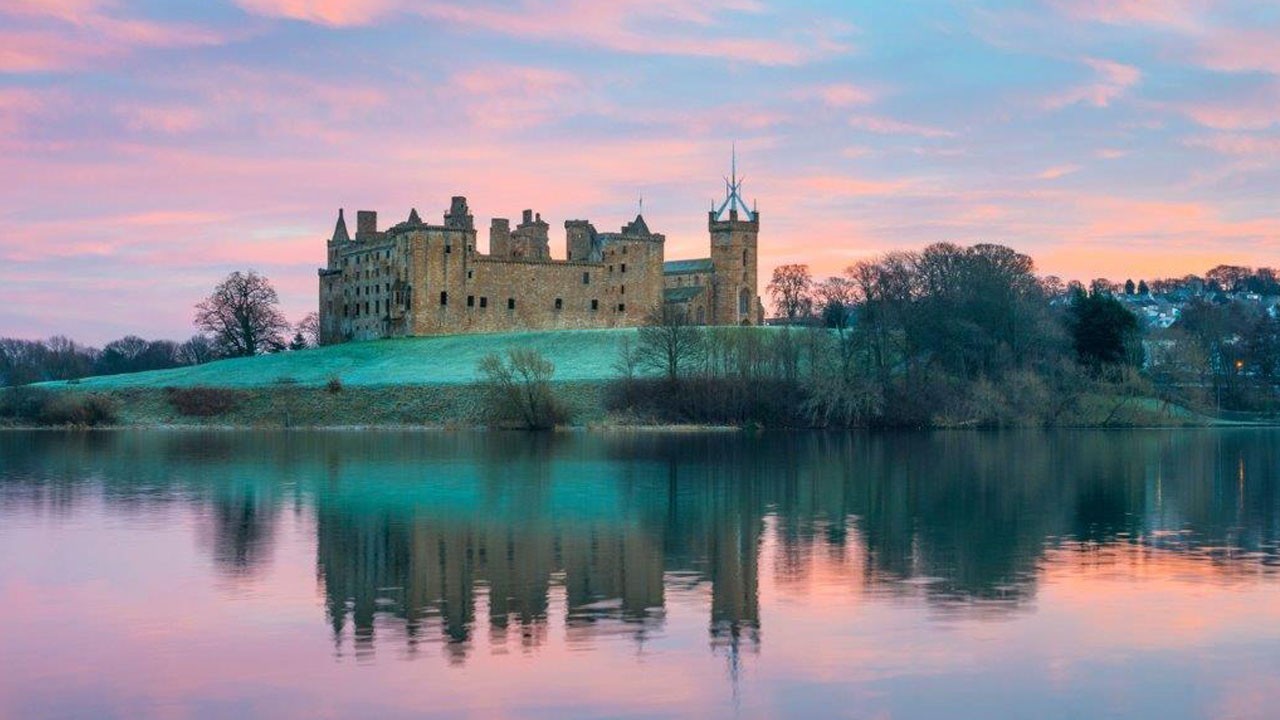
Linlithgow Palace
© Kenny Lam
Linlithgow, West Lothian
Mary, Queen of Scots was one of the most fascinating and controversial monarchs of 16th century Europe. At one time, she claimed the crowns of four nations – Scotland, France, England and Ireland.
Private Tours available all year round
Mary’s physical beauty and kind heart were acknowledged even by her enemies. Yet her life ended tragically. Join us to explore Mary’s life, beginning at her birthplace in Linlithgow, our hometown, and within easy reach of Edinburgh and Glasgow. We promise you’ll not lose your head.
Included in the tour:
- 1 day self guided tour with itinerary provided
- Full Day Escorted Tour
- By knowledgeable and entertaining guides
- Ready to share our local knowledge
- Beginning in Linlithgow (30 mins outside Glasgow and Edinburgh – how to get to Linlithgow.)
Highlights
- Holyrood Palace*
- Edinburgh Castle*
- Royal Mile*
- Linlithgow Palace
- St’s Michael’s Parish Church
- Stirling Castle
- Loch Leven Castle
- Falkland Palace
*self-guided with free information pack
This is a private tour for up to 4 adults and costs £420. If you would like to arrange a Mary, Queen of Scots tour for five more people, please get in touch.
From £105 per adult
Departure days
-
Monday
-
Tuesday
-
Wednesday
-
Thursday
-
Friday
-
Saturday
-
Sunday
January — December
-
Level Access
Tour information
Tour prices
From
£105 Per Adult
Book now
Prices are subject to change depending on season
Tour gallery

Mary’s Meanders is an award winning independent tour guide company specialising in fully customised escorted day tours around central Scotland and Ireland.
If you are passionate about history, fantastic castles, scenery and amazing stories, tour with us. We promise you’ll arrive a visitor and leave a friend. We specialise in Ancestry, Bespoke, Outlander, Mary Queen of Scots tours.
2020 Virtual Tours — Outlander & MQS
Walking Tours of Linlithgow
Private Tours
Scottish Road Trip in a gift Box
Mary the Coo App
We are GOOD TO GO!
Shared Tours available 5th April — 29th September
Private Tours available all year around
Virtual Tours available all year around
Other tours from this company
VisitFull Day Classic Outlander Tour
Full Day Classic Outlander Tour
Departs: Linlithgow
Spend a full day exploring classic Outlander filming locations including Castle…
Key facilities
-
Level Access
VisitFull Day Dragonfly Outlander Tour
Full Day Dragonfly Outlander Tour
Departs: Linlithgow
Companion tour to our Classic Outlander Tour. Now you have seen Lallybroch and C…
Key facilities
-
Level Access
VisitAncestry Tour
Ancestry Tour
Discover the land of your ancestors with Mary’s Meanders.
Each ancestry tour…
The content of many of our web listings is provided by third party operators and not VisitScotland. VisitScotland accepts no responsibility for (1) any error or misrepresentation contained in third party listings, and (2) the contents of any external links within web listings ((1) and (2) together hereinafter referred to as the «Content»). VisitScotland excludes all liability for loss or damage caused by any reliance placed on the Content. The Content is provided for your information only and is not endorsed by VisitScotland.
«Portrait Of Mary Queen Of Scots, British 18th Century, After Federico Zuccaro (c.1540–1609)»
Mary, Queen of Scots was one of the most fascinating and controversial monarchs of 16th century Europe. At one time, she claimed the crowns of four nations – Scotland, France, England and Ireland. Her physical beauty and kind heart were acknowledged even by her enemies. Yet she lacked the political skill and intuition to rule successfully in Scotland and was embroiled in marriages that ended in murder and scandal. She fled to England in 1568, hoping for the help of her cousin, Elizabeth I. Her presence was dangerous for the English queen, who feared Catholic plotting on Mary’s behalf. The two queens never met and Mary remained imprisoned for the next nineteen years. She was executed in 1587, only forty-four years old, by orders of the English government and all of her possessions were burned. In 1603, upon Elizabeth’s death, Mary’s son became king of England as James I and in 1612 he moved her body to a magnificent tomb in Westminster Abbey, London.
The handling of the paint in this 18th century work is very good throughout and the fabric has been meticulously portrayed. The artist of this portrait was familiar with and took inspiration from another portrait of the sitter that was traditionally believed to be the hand of Federico Zuccaro (former collection of the Earl of Burlington). They both depict the same elaborate costume and the high ruff, embroidered gown with high collar, and jewelled bodice. Zuccaro’s portrait shows the subject standing in an interior holding a flower in her left hand and with her right placed on the arm of a chair and a landscape and town visible through a window. The image of this infamous character was widely replicated and distributed as a means to further her cause, and later, for romantic purposes.
Held in a superb 18th 19th century carved frame.
Provenance: Sibton Park, Suffolk, England which is a large stately manor dating to 1827 and is set in the grounds of a 5,000 acre estate. See photos.
Measurements: Height 78cm, Width 64cm framed (Height 30.5”, Width 25” framed)