
6 pages, 2959 words
Mount Vesuvius is a volcano located in southern Italy, near the bay of Naples and the city of Naples. It is the only active volcano on the European mainland. Vesuvius rises to a height of 1277 m (4190 ft).
Vesuvio (Vesuvius) is probably the most famous volcano on earth, and is one of the most dangerous. Mount Vesuvius is a strato-volcano consisting of a volcanic cone (Gran Cone) that was built within a summit caldera (Mount Somma).
The Somma-Vesuvius complex has formed over the last 25, 000 years by means of a sequence of eruptions of variable explosiveness, ranging from the quiet lava outpourings that characterized much of the latest activity (for example from 1881 to 1899 and from 1926 to 1930) to the explosive Plinian eruptions, including the one that destroyed Pompeii and killed thousands of people in 79 A. D. At least seven Plinian eruptions have been identified in the eruptive history of Somma-Vesuvius (1).
Each was preceded by a long period of stillness, which in the case of the 79 A. D.
eruption lasted about 700 years. These eruptions were fed by viscous water-rich phonotitic to tephritic phonolitic magmas that appear to have differentiated in shallow crustal conditions. They are believed to have slowly filled a reservoir where differentiation was driven by compositional convection. A minimum depth of about 3 km was inferred for the top of the magmatic reservoir from mineral equilibria of metamorphic carbonate ejecta (2).
Fluid inclusions ([CO. sub.
2 pages, 666 words
The Essay on The Eruption of Mount Saint Helens
“The Eruption of Mount St. Helens” On May 18th, 1980, in Washington State, the volcano, Mount St. Helens erupted. This eruption caused widespread terror throughout the towns surrounding the mountain. The magma from the volcano burned up the forest and killed most of the animals in the area. It affected the wildlife greatly because, after the eruption, the ecosystem was burned and smoldered thus …
2] and [H. sub. 2]O-[CO. sub. 2]) in clinopyroxenes from cumulate and nodules indicate a trapping pressure of 1. 0 to 2.
5 kba r at about 1200 [degrees]C, suggesting that these minerals crystallized at depths of 4 to 10 km (3).
The differentiated magma fraction was about 30% of the total magma in the reservoir, and a volume of about 2 to 3 [km. sup. 3] was inferred for the reservoir (4).
The magma ascent to the surface occurred through a conduit o possibly 70 to 100 m in diameter (5).
A thermal model predicts that such a reservoir should contain a core of partially molten magma (6) that can be detected by high-resolution seismic tomography. The earliest outcropping volcanic deposits date back to about 25, 000 years ago. The lavas observed at a -1125 m bore-hole are about 0, 3-0, 5 million years old. It is known for the first eruption of which an eyewitness account is preserved, in 79 AD.
Geologically, Vesuvio is unique for its unusual versatility. Its activity ranging from Hawaiian-style release of liquid lava, fountain ing and lava lakes, over Strombolian and Vulcanian activity to violently explosive, plinian events that produce pyroclastic flows and surges. Vesuvius is a complex volcano. A complex volcano is “an extensive assemblage of spatially, temporally, and genetically related major and minor [volcanic] centers with there associated lava flows and pyroclastic flows.” Vesuvius has a long history. The oldest dated rock from the volcano is about 300, 000 years old. It was collected from a well drilled near the volcano and was probably part of the Somma volcano.
After Somma collapsed about 17, 000 years ago, Vesuvius began to form. Four types of eruption have been documented: a) Plinian (AD 79, Pompeii type) events with widespread air fall and major pyroclastic surges and flows; b) sub-Plinian to Plinian, more moderately sized eruptions (AD 472, 1631) with heavy tephra falls around the volcano and pyroclastic flows and surges; c) small to medium-sized, Strombolian to Vulcanian eruptions (numerous events during the 1631-1944 cycle, such as 1906 and 1944) with local heavy tephra falls and major lava flows and small pyroclastic avalanches restricted to the active cone itself. The fourth type it is the smallest of all eruption types observed at Vesuvio. It is the persistent Strombolian to Hawaiian style eruption that characterizes almost all of an eruptive sub-cycle, such as was the case during the period 1913-1944. Activity of this kind is mainly restricted to the central crater where one or more intracrateral cones form, and to the sides of the cone. Lava flows from the summit crater or from the sub terminal vents extend beyond the cone’s base.
5 pages, 2203 words
The Term Paper on Explosive Eruption Lava Magma Volcano
I. Introduction Volcano: defined is a mountain or hill formed by the accumulation of materials erupted through one or more openings (called volcanic vents) in the earth’s surface. The term volcano can also refer to the vents themselves. Most volcanoes have steep sides, but some can be gently sloping mountains or even flat tablelands, plateaus, or plains. The volcanoes above sea level are the best …
A somewhat particular kind of persistent activity is the slow release of large amounts of lava from sub terminal fractures to form thick piles of lava with little lateral extension, such as the lava cupola of Colle Umberto, formed in 1895-1899. (7) Vesuvius lies over a subduction zone. The two plates are the African plate and the Eurasian plate. The African plate is moving northward at about one inch (2-3 cm) per year and is slowly closing the Mediterranean basin. As it moves to the north, the African plate is pushed beneath the Eurasian plate. The rocks at Vesuvius are called tephrite.
A tephrite is basaltic in character and contains the following minerals: calcic plagioclase, augite, and nepheline or leucite. (8) Eruptive activity of Vesuvio noticeably occurs in cycles that last several centuries and alternate with repose periods lasting several centuries. Each repose period ends with a major (Plinian) eruption, initiating an active cycle. One of the problems researchers of Vesuvio have to deal with is that the cycles do not always repeat the same patterns and phenomena. The cycle or cycles following the 79 A. D.
eruption seem to have been different from the most recent one, lasting from 1631 until 1944. The most recent Plinian eruption of major magnitude was that of August 79 A. D. The 79 A. D. eruption of Vesuvius was the first volcanic eruption ever to be described in detail.
From 18 miles (30 km) west of the volcano, Pliny witnessed the eruption and later recorded his observations in two letters. He described the earthquakes before the eruption, the eruption column, air fall, the effects of the eruption on people, pyroclastic flows, and even tsunami. (9) Volcanologists now use the term “plinian” to refer to continued explosive eruptions, which generate high-altitude eruption columns and blanket large areas with ash. It is estimated that at times during the eruption the column of ash was 20 miles (32 km) tall.
1 page, 462 words
The Essay on Positive Impacts Of Volcanic Activity
In this answer I will discuss the positive impacts of volcanic activity. These positive impacts are geothermal energy, tourism and fertile soils. The first positive impact I will discuss is geothermal energy. Geothermal energy is heat that is generated by the plumes of magma that rise from the earth’s core to the crust. This magma heats the rocks of the earth’s crust. Geothermal energy is used as …
About 1 cubic mile (4 cubic kilometers) of ash was erupted in about 19 hours. It is world-famous for the destruction of the Roman towns of Pompeii and Herculaneum that has inspired of generations of poets, philosophers and scientists. (10) Two more very strong eruptions have occurred since 79 AD, a very poorly known one in 472 AD and another one in December 1631. It’s argued whether this eruption has been purely explosive or mixed explosive-effusive. It is clear that it was the second most devastating eruption of Vesuvio next to the eruption of 79 AD. Numerous villages and towns were devastated by pyroclastic flows, tephra falls and lahars, and at least 3000 people died.
Compared with the AD 79 eruption, the event of 1631 was of minor size regarding eruptive magnitude and erupted volumes but not in terms of destruction and fatalities. Beginning on December 16, 1631 and culminating the day after, it destroyed all towns and villages around the volcano and killed between 3000 to 6000 people. (9) It was the worst volcanic disaster in the Mediterranean during the past 1800 years. Like the AD 79 eruption, the 1631 event had been purely explosive but was characterized by the emplacement of devastating pyroclastic surges and flows. The eruption occurred after a calm period lasting between 130 to 500 years. Only recently (starting in the late 1980’s) has there been modern volcanological research on this important event that has significant implications for volcanic hazard assessments.
When Vesuvius became active again, Vesuvio had no significant eruptions since 1139; an eruption recorded for the year 1500 was a minor phreatic event, increased fumarolic activity, or a major rock fall. (11).
Before the eruption of 1631, Vesuvio was densely vegetated except at the summit of the active cone which by then had an elevation of about 1187 m about 100 m less than its present elevation, and 55 m higher than Monte Somma. The crater had a diameter of about 480 meters; it was funnel-shaped, had a few fumaroles on the rim and in its deepest part. Small ponds were present in the crater, but they probably existed on the caldera floor rather than within the active crater. (7) Increased fumarolic activity and nocturnal glow that was visible on the north side of the Vesuvian cone as early as August 1631.
2 pages, 842 words
The Essay on Hydrologic Cycle
There are four stages that are needed to have a successful hydrologic cycle; they are precipitation, evaporation, run off, and infiltration. Now Mother Nature has very delicately monitored these four stages ever since the earth was created. The delicate balance of water being put into and taken out of the earth maintained a natural hydrological cycle world wide, but since man has inhabited the …
Strongly increased local seismicity began to be perceived after December 10, 1631. The strongest tremors were felt as far away as Napoli. (12) The other warning signs were repeated subterranean rumblings in the night that preceded the outbreak and the drying up of wells around the volcano; some other wells reportedly became muddy. Among the somewhat stranger happenings is the reported filling to the rim of the crater with a steaming “bituminous mass” the nature of which was not further detailed, during the first days of December.
During the 24 hours before the eruption, earthquakes were felt more and more frequently. (9) The population must have become extremely nervous, but there was no major evacuation from the area. Chronology of the eruption Following several strong earthquakes, a series of vents became active between 6: 00 and 7: 00 on December 16, 1631. They were situated along an eruptive fracture on the west-southwest side of the active cone, splitting it open from the summit to the base. This initial activity ejected fresh magma along with material torn from the walls of the fissure, i.
e. older volcanic rocks. Blocky, non vesicular fragments of juvenile fragments point to some magma-water interactions at this stage (13).
The eruption rapidly gained energy as more vents opened on the flanks of the cone ejecting pyroclastic at a growing mass eruption rate.
Soon after the beginning of the eruption, a large eruption column rose up, attaining the famous shape of a pine tree. The height of the eruption column at this stage exceeded 20 km and may have reached up to 28 km, thus the eruption was Plinian. Ash began to fall around the volcano about one hour after the start of the activity, but heavy block and scoria fall began at about 1000 in the direction of Ottaviano (north east side of Monte Somma), a village that later was to suffer from many other eruptions of Vesuvio. (12) During the morning of December 16, a continuous tremor began to be felt in Napoli, it did not cease until 8-10 hours later. Darkness fell over the area around the volcano and reached Napoli at 4: 00 on that fatal day.
(13) The main portion of the eruptive plume was blown towards the east, causing darkness and tephra falls over southern Italy and over the Balkan. Slight as falls are reported to have occurred as far as Constantinople, W Turkey, about 1250 km from the volcano. (12) The proximal maximum thickness of the initial pumice deposit is 1. 5 m at Can ale dell ” Arena. (8) After the initial plinian phase, between 7: 00 and 10: 00 on December 16 the eruption took on a pulsating character, accompanied by strongly increased seismicity. During the night of 16-17 December, strong earth shocks occurred at intervals lasting 1-15 minutes.
3 pages, 1353 words
The Essay on Business Cycle Theory
In this model, economists pursue the sluggish adjustment of nominal wages path to explain why it is that the short-run aggregate supply curve is upward sloping. For sticky nominal wages, an increase in the price level lowers the real wage therefore making labor cheaper for firms. Cheaper labor means that firms will hire more labor, and the increased labor will in turn produce more output. The time …
At about 2: 00 on December 17 the first glowing avalanche that was observed to descend into the A trio del Cavallo. At around the same time, strong rainfalls saturated large amounts of already fallen ash to form lahars that caused damage and disruption on the north and northeast sides of Mount Somma. (14) On December 17 the activity changed with occasional surges of sub-Plinian to Plinian activity that caused tephra falls around the volcano. On the 17 th, the summit of the volcano was partially destroyed by the activity. (13) Within an active cycle, smaller sub cycles can be observed, starting with minor intracrateral (effusive and Strombolian) activity with some fluctuations until a strong eruption produces tall eruption columns, more voluminous, rapidly moving lava flows, and heavy tephra falls. This culminating, sub cycle-ending eruption is followed by a brief (max.
7 years during the most recent, and well-documented, cycle, 1631-1944) repose, then intracrateral activity starts again. (15).
Typical eruptions closing Vesuvian sub cycles were those of 1767, 1779, 1794, 1822, 1872, 1906, and 1944. Each of them caused damage in the towns around the volcano and the people suffered partial or total destruction at least once during the 1631-1944 cycle.
Torre del Greco, on the coast west of Vesuvio, was destroyed three times in that period. Lava flows entered populated areas also during some more intense activity in the course of a sub cycle, most recently in 1929. Eruptions of this type have been seriously disruptive for life near Vesuvio in the past and would be extremely disturbing, were they to occur today. To cite one example: the 1906 eruption caused heavy tephra falls in the northeastern sector of Vesuvio, causing the collapse of almost all roofs in the towns of that area. Up to 500 people were killed in that event. 26 People died much the same way during the most recent eruption in 1944.
6 pages, 2854 words
The Business plan on AO2/A03 How Steve Brankin manages people, finances and resources with in Asidua
AO2/A03 How Steve Brankin manages people, finances and resources with in Asidua In Asidua the management of people, finances and resources under Steve are central to business success. He undertakes this huge managerial task in a number of ways. Interviewing Steve gave me a great insight into these methods. Managing People Recruitment, Retention and Training of Employees. Employees in Asidua have …
(13) After that event, the volcano has most obviously entered one of the longer periods of repose that is maybe to last much longer – up to several centuries – until a new eruptive cycle will begin with a major explosive eruption. Such spastic eruptions produce heavy tephra falls, pyroclastic flows, surges, and lahars. Lava flows are uncommon during these events. As the next eruption will probably be a paroxysmal one, primary volcanic hazards are tephra falls and pyroclastic flows and surges.
They form a significant threat for a zone including parts of Napoli and the entire belt of towns around the volcano. It is certain phenomena, such as increasing seismicity, deformation, and others, will warn of an impending eruption, as has been the case before the AD 79 and 1631 eruptions. There are, however, serious logistical problems regarding the evacuation of maybe up to a million people in the areas endangered by tephra fall and pyroclastic flows and surges. Vesuvio has a long and complex record of eruptions.
Eruptions before AD 79 have neither been recorded in historical documents nor are there any folklore of previous activity. For the first millennium after Christ the record is incomplete and only with the late 17 th century it becomes reasonably adequate. We can say that the most recent eruptive cycle, lasting from 1631 until 1944, has been very well documented and gives an idea of the behavior of the volcano during such a cycle. Understanding of the volcano in longer terms of cycles is now beginning to form. It is known that eruptive cycles begin after non-active periods that may last centuries to millennia, and their opening eruptions are devastatingly violent, Plinian events. The most famous one is the AD 79 eruption that has been so well described in the letters by the Pliny the Younger.
His description inspired volcanologists in the late 19 th century to call eruptions like that of AD 79 “Plinian” eruptions. Certainly the most notable aspect of Vesuvio’s eminence among Earth’s volcanoes is the dense population surrounding it and climbing higher and higher up its slopes. In an enchanting landscape with beautiful islands, magnificent mountain ranges, marvellous coasts and historically famed cities, Vesuvio is the focus, lying in the center of a plain on the east north eastern side of the Gulf of Napoli. It is the steepness, the sudden way it rises from its peaceful surroundings, which make it so impressive. (16) Vesuvius is a very dangerous and deadly volcano. Mudflows and lava flows from the eruption in 1631 killed 3, 500 people.
(13) About 3, 360 people died in the 79 A. D. eruption from ash flows and falls. (9) Studies of past eruptions and their deposits continue. These studies help volcanologists understand the hazards associated with future eruptions. The population density in some areas of high risk is 20, 000 to 30, 000 per square km.
About 3 million people could be seriously affected by future Eruptions. In the first 15 minutes of a medium- to large-scale eruption an area with a 4 mile (7 km) radius of the volcano could be destroyed (Dobran and others, 1994).
About 1 million people live and work in this area immediately threatened by future eruptions. There are no signs of volcanic unrest at Vesuvius at the present time.
(11) References (1. ) V. Arno et al. , in Somma-Vesuvius, R. Santacroce, Ed. (Quaderni de La Ricerca Scientific a, Rome, 1987), pp.
53-103. (2. ) F. Barberi et al.
, Bull. Volcanol. 44, 295 (1981); L. Civet ta, R. Galati, R. Santacroce, ibid.
53, 517 (1991).
(3. ) H. E. Belkin and B. De Vivo, J.
Volcanol. Geotherm. Res. 58, 89 (1993).
(4. ) H.
Sigurdsson, S. Carey, W. Cornell, T. Pescatore, Natl. Geog r. Res.
1, 332 (1985).
(5. ) P. Papal e and F.
Dobran, J. Volcanol. Geotherm. Res.
58, 101 (1993).
(6. ) P. Gasparini, M.
S. M. Mantovani, R. Scandone, Bull.
Volcanol. 44, 317 (1981).
(7. ) Hoffer W (1982) Volcano: the search for Vesuvius. New York: Summit Books, p 189 (8) Liver L, Munno R, Postoglione I, Vinci A and Vitellin L (1997) The A. D.
79 eruption a future explosive scenario in the Vesuvian area: evaluation of associated risk. Bulletin of Volcanology 59: 112-124. (9) Barberi F, Rosi M, Santacroce R and Sheridan MF (1983) Volcanic hazard zonation at Vesuvius. In: Tazieffn H and Sab roux JC (eds) Forecasting volcanic events. Developments in Volcanology I.
Elsevier Amsterdam: 149-161 (10) Sigurdsson H, Carey S, Cornell W and Pescatore T (1985) The eruption of Vesuvius in 79 AD. National Geographic Research 1: 332-387 (11) Scandone R, Arganese G and G aldi F (1993 b) The evaluation of volcanic risk in the Vesuvian area. Journal of Volcanology and Geothermal Research 58: 263-271 (12) Rosi M and Santacroce R (1983) The A. D. 472 “Pollen a” eruption: Volcanological and petrological for this poorly-known, Plinian-type event at Vesuvius. Journal of Volcanology and Geothermal Research 17: 237-248 (13) Rolandi G, Barrell a AM and Borrelli A (1993 a) The 1631 eruption of Vesuvius.
Journal of Volcanology and Geothermal Research 58: 183-201 (14) Scandone R, Giacomelli L and Gasparini (1993 a) Mount Vesuvius: 2000 years of volcanological observations. Journal of Volcanology and Geothermal Research 58: 5-25 (15) Mastrolorenzo G, Munno R and Rolandi G (1993) Vesuvius 1906: a case study of a paroxysmal eruption and its relation to eruptive cycles. Journal of Volcanology and Geothermal Research 58: 217-237 (16) Santacroce R (1983) A general model for the behaviour of the Somma-Vesuvius volcanic complex. Journal of Volcanology and Geothermal Research 237-248 (17) Albi tino Elio, Vesuvio; a volcano and its history. Naples Us mate Press. 3-24 Barberi F, Macedonia G, Pares chi MT, Santacroce R (1990) Mapping the tephra fallout risk: an example from Vesuvius, Italy.
Nature 344: 142-144 (18) Sigurdsson H, Cash dollar S and Sparks RSJ (1982) The eruption of Vesuvius in A. D. 79: Reconstruction from historical and volcanological evidence. American Journal of Archaeology 86: 39-51 Mount Vesuvius Tami Gaudet te Febuary 29, 2000 Dr.
Rode -Tice.
All Papers Are For Research And Reference Purposes Only. You must cite our web site as your source.
Essay by • September 3, 2010 • 2,918 Words (12 Pages) • 2,045 Views
Page 1 of 12
Mount Vesuvius is a volcano located in southern Italy, near the bay of Naples and the city of
Naples. It is the only active volcano on the European mainland. Vesuvius rises to a height of 1277
m (4190 ft). Vesuvio (Vesuvius) is probably the most famous volcano on earth, and is one of the
most dangerous. Mount Vesuvius is a strato-volcano consisting of a volcanic cone (Gran Cono)
that was built within a summit caldera (Mount Somma). The Somma-Vesuvius complex has
formed over the last 25,000 years by means of a sequence of eruptions of variable explosiveness,
ranging from the quiet lava outpourings that characterized much of the latest activity (for example
from 1881 to 1899 and from 1926 to 1930) to the explosive Plinian eruptions, including the one
that destroyed Pompeii and killed thousands of people in 79 A.D. At least seven Plinian eruptions
have been identified in the eruptive history of Somma-Vesuvius (1). Each was preceded by a long
period of stillness, which in the case of the 79 A.D. eruption lasted about 700 years. These
eruptions were fed by viscous water-rich phonotitic to tephritic phonolitic magmas that appear to
have differentiated in shallow crustal conditions. They are believed to have slowly filled a reservoir
where differentiation was driven by compositional convection. A minimum depth of about 3 km
was inferred for the top of the magmatic reservoir from mineral equilibria of metamorphic
carbonate ejecta (2). Fluid inclusions ([CO.sub.2] and [H.sub.2]O-[CO.sub.2]) in
clinopyroxenes from cumulate and nodules indicate a trapping pressure of 1.0 to 2.5 kbar at
about 1200 [degrees]C, suggesting that these minerals crystallized at depths of 4 to 10 km (3).
The differentiated magma fraction was about 30% of the total magma in the reservoir, and a
volume of about 2 to 3 [km.sup.3] was inferred for the reservoir (4). The magma ascent to the
surface occurred through a conduit of possibly 70 to 100 m in diameter (5). A thermal model
predicts that such a reservoir should contain a core of partially molten magma (6) that can be
detected by high-resolution seismic tomography. The earliest outcropping volcanic deposits date
back to about 25,000 years ago. The lavas observed at a -1125 m bore-hole are about 0,3-0,5
million years old. It is known for the first eruption of which an eyewitness account is preserved, in
79 AD. Geologically, Vesuvio is unique for its unusual versatility. Its activity ranging from
Hawaiian-style release of liquid lava, fountaining and lava lakes, over Strombolian and Vulcanian
activity to violently explosive, plinian events that produce pyroclastic flows and surges. Vesuvius is
a complex volcano. A complex volcano is «an extensive assemblage of spatially, temporally, and
genetically related major and minor [volcanic] centers with there associated lava flows and
pyroclastic flows.» Vesuvius has a long history. The oldest dated rock from the volcano is about
300,000 years old. It was collected from a well drilled near the volcano and was probably part of
the Somma volcano. After Somma collapsed about 17,000 years ago, Vesuvius began to form.
Four types of eruption have been documented: a) Plinian (AD 79, Pompeii type) events with
widespread air fall and major pyroclastic surges and flows; b) sub-Plinian to Plinian, more
moderately sized eruptions (AD 472, 1631) with heavy tephra falls around the volcano and
pyroclastic flows and surges; c) small to medium-sized, Strombolian to Vulcanian eruptions
(numerous events during the 1631-1944 cycle, such as 1906 and 1944) with local heavy tephra
falls and major lava flows and small pyroclastic avalanches restricted to the active cone itself. The
fourth type it is the smallest of all eruption types observed at Vesuvio. It is the persistent
Strombolian to Hawaiian style eruption that characterizes almost all of an eruptive sub-cycle, such
as was the case during the period 1913-1944. Activity of this kind is mainly restricted to the
central crater where one or more intracrateral cones form, and to the sides of the cone. Lava
flows from the summit crater or from the sub terminal vents extend beyond the cone’s base. A
somewhat particular kind of persistent activity is the slow release of large amounts of lava from
sub terminal fractures to form thick piles of lava with little lateral extension, such as the lava cupola
of Colle Umberto, formed in 1895-1899. (7) Vesuvius lies over a subduction zone. The two
plates are the African plate and the Eurasian plate. The African plate is moving northward at about
one inch (2-3 cm) per year and is slowly closing the Mediterranean basin. As it moves to the
north, the African plate is pushed beneath the Eurasian plate. The rocks at Vesuvius are called
tephrite. A tephrite is basaltic in character and contains the following minerals: calcic plagioclase,
augite, and nepheline or leucite. (8) Eruptive activity of Vesuvio noticeably occurs in cycles that
last several centuries and alternate with repose periods lasting several centuries. Each
…
…
Only available on Essays24.com
(2010, 09). Volcanos. Essays24.com. Retrieved 09, 2010, from https://www.essays24.com/essay/Volcanos/1374.html
«Volcanos» Essays24.com. 09 2010. 2010. 09 2010 <https://www.essays24.com/essay/Volcanos/1374.html>.
«Volcanos.» Essays24.com. Essays24.com, 09 2010. Web. 09 2010. <https://www.essays24.com/essay/Volcanos/1374.html>.
«Volcanos.» Essays24.com. 09, 2010. Accessed 09, 2010. https://www.essays24.com/essay/Volcanos/1374.html.
Mount Vesuvius ( viss-OO-vee-əs; Italian: Vesuvio[1] [veˈzuːvjo, -ˈsuː-]; Neapolitan: ‘O Vesuvio[2] [o vəˈsuːvjə], also ‘A muntagna or ‘A montagna;[3] Latin: Vesuvius[4] [wɛˈsʊwɪ.ʊs], also Vesevius, Vesvius or Vesbius[5]) is a somma-stratovolcano located on the Gulf of Naples in Campania, Italy, about 9 km (5.6 mi) east of Naples and a short distance from the shore. It is one of several volcanoes which form the Campanian volcanic arc. Vesuvius consists of a large cone partially encircled by the steep rim of a summit caldera, caused by the collapse of an earlier and originally much higher structure.
The eruption of Mount Vesuvius in AD 79 destroyed the Roman cities of Pompeii, Herculaneum, Oplontis and Stabiae, as well as several other settlements. The eruption ejected a cloud of stones, ashes and volcanic gases to a height of 33 km (21 mi), erupting molten rock and pulverized pumice at the rate of 6×10⁵ cubic metres (7.8×10⁵ cu yd) per second.[6] More than 1,000 people are thought to have died in the eruption, though the exact toll is unknown. The only surviving eyewitness account of the event consists of two letters by Pliny the Younger to the historian Tacitus.[7]
Vesuvius has erupted many times since and is the only volcano on the European mainland to have erupted within the last hundred years. Today, it is regarded as one of the most dangerous volcanoes in the world because of the population of 3,000,000 people living near enough to be affected by an eruption, with 600,000 in the danger zone, making it the most densely populated volcanic region in the world. It has a tendency towards violently explosive eruptions, which are now known as Plinian eruptions.[8]
Mythology
Vesuvius has a long historic and literary tradition. It was considered a divinity of the Genius type at the time of the eruption of AD 79: it appears under the inscribed name Vesuvius as a serpent in the decorative frescos of many lararia, or household shrines, surviving from Pompeii. An inscription from Capua[9] to IOVI VESVVIO indicates that he was worshipped as a power of Jupiter; that is, Jupiter Vesuvius.[10]
The Romans regarded Mount Vesuvius to be devoted to Hercules.[11] The historian Diodorus Siculus relates a tradition that Hercules, in the performance of his labors, passed through the country of nearby Cumae on his way to Sicily and found there a place called «the Phlegraean Plain» (Φλεγραῖον πεδίον, «plain of fire»), «from a hill which anciently vomited out fire … now called Vesuvius.»[12] It was inhabited by bandits, «the sons of the Earth,» who were giants. With the assistance of the gods, he pacified the region and went on. The facts behind the tradition, if any, remain unknown, as does whether Herculaneum was named after it. An epigram by the poet Martial in 88 AD suggests that both Venus, patroness of Pompeii, and Hercules were worshipped in the region devastated by the eruption of 79.[13]

City of Naples with Mount Vesuvius at sunset
Etymology
Vesuvius was a name of the volcano in frequent use by the authors of the late Roman Republic and the early Roman Empire. Its collateral forms were Vesaevus, Vesevus, Vesbius and Vesvius.[14] Writers in ancient Greek used Οὐεσούιον or Οὐεσούιος. Many scholars since then have offered an etymology. As peoples of varying ethnicity and language occupied Campania in the Roman Iron Age, the etymology depends to a large degree on the presumption of what language was spoken there at the time. Naples was settled by Greeks, as the name Nea-polis, «New City», testifies. The Oscans, an Italic people, lived in the countryside. The Latins also competed for the occupation of Campania. Etruscan settlements were in the vicinity. Other peoples of unknown provenance are said to have been there at some time by various ancient authors.
Some theories about its origin are:
- From Greek οὔ = «not» prefixed to a root from or related to the Greek word σβέννυμι = «I quench», in the sense of «unquenchable».[14][15]
- From Greek ἕω = «I hurl» and βίη «violence», «hurling violence», *vesbia, taking advantage of the collateral form.[16]
- From an Indo-European root, *eus- < *ewes- < *(a)wes-, «shine» sense «the one who lightens», through Latin or Oscan.[17]
- From an Indo-European root *wes = «hearth» (compare e.g. Vesta)
Appearance

Vesuvius is a «humpbacked» peak, consisting of a large cone (Gran Cono) partially encircled by the steep rim of a summit caldera caused by the collapse of an earlier (and originally much higher) structure called Mount Somma.[18] The Gran Cono was produced during the A.D. 79 eruption. For this reason, the volcano is also called Somma-Vesuvius or Somma-Vesuvio.[19]
The caldera started forming during an eruption around 17,000–18,000 years ago[20][21][22] and was enlarged by later paroxysmal eruptions,[23] ending in the one of AD 79. This structure has given its name to the term «somma volcano», which describes any volcano with a summit caldera surrounding a newer cone.[24]
The height of the main cone has been constantly changed by eruptions but was 1,281 m (4,203 ft) in 2010.[21] Monte Somma is 1,132 m (3,714 ft) high, separated from the main cone by the valley of Atrio di Cavallo, which is 5 km (3.1 mi) long. The slopes of the volcano are scarred by lava flows, while the rest are heavily vegetated, with scrub and forests at higher altitudes and vineyards lower down. Vesuvius is still regarded as an active volcano, although its current activity produces little more than sulfur-rich steam from vents at the bottom and walls of the crater. Vesuvius is a stratovolcano at a convergent boundary, where the African Plate is being subducted beneath the Eurasian Plate. Layers of lava, ash, scoria and pumice make up the volcanic peak. Their mineralogy is variable, but generally silica-undersaturated and rich in potassium, with phonolite produced in the more explosive eruptions[25] (e.g. the eruption in 1631 displaying a complete stratigraphic and petrographic description: phonolite was firstly erupted, followed by a tephritic phonolite and finally a phonolitic tephrite).[26]
Formation

Vesuvius was formed as a result of the collision of two tectonic plates, the African and the Eurasian. The former was subducted beneath the latter, deeper into the earth. As the water-saturated sediments of the oceanic African plate were pushed to hotter depths inside the planet, the water boiled off and lowered the melting point of the upper mantle enough to partially melt the rocks. Because magma is less dense than the solid rock around it, it was pushed upward. Finding a weak spot at the Earth’s surface, it broke through, thus forming the volcano.[citation needed]
The volcano is one of several which form the Campanian volcanic arc. Others include Campi Flegrei, a large caldera a few kilometers to the north west, Mount Epomeo, 20 kilometres (12 mi) to the west on the island of Ischia, and several undersea volcanoes to the south. The arc forms the southern end of a larger chain of volcanoes produced by the subduction process described above, which extends northwest along the length of Italy as far as Monte Amiata in Southern Tuscany. Vesuvius is the only one to have erupted within recent history, although some of the others have erupted within the last few hundred years. Many are either extinct or have not erupted for tens of thousands of years.
Eruptions

Mount Vesuvius has erupted many times. The eruption in AD 79 was preceded by numerous others in prehistory, including at least three significantly larger ones, including the Avellino eruption around 1800 BC which engulfed several Bronze Age settlements. Since AD 79, the volcano has also erupted repeatedly, in 172, 203, 222, possibly in 303, 379, 472, 512, 536, 685, 787, around 860, around 900, 968, 991, 999, 1006, 1037, 1049, around 1073, 1139, 1150, and there may have been eruptions in 1270, 1347, and 1500.[23]
The volcano erupted again in 1631, six times in the 18th century (including 1779 and 1794), eight times in the 19th century (notably in 1872), and in 1906, 1929 and 1944. There have been no eruptions since 1944, and none of the eruptions after AD 79 were as large or destructive as the Pompeian one.
The eruptions vary greatly in severity but are characterized by explosive outbursts of the kind dubbed Plinian after Pliny the Younger, a Roman writer who published a detailed description of the AD 79 eruption, including his uncle’s death.[27] On occasion, eruptions from Vesuvius have been so large that the whole of southern Europe has been blanketed by ash; in 472 and 1631, Vesuvian ash fell on Constantinople (Istanbul), over 1,200 kilometres (750 mi) away. A few times since 1944, landslides in the crater have raised clouds of ash dust, raising false alarms of an eruption.
Since 1750, seven of the eruptions of Vesuvius have had durations of more than 5 years, more than any other volcano except Etna. The two most recent eruptions of Vesuvius (1875–1906 and 1913–1944) lasted more than 30 years each.[28]
Before AD 79
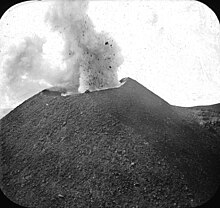
Vesuvius erupting. Brooklyn Museum Archives, Goodyear Archival Collection.
Scientific knowledge of the geologic history of Vesuvius comes from core samples taken from a 2,000 m (6,600 ft) plus bore hole on the flanks of the volcano, extending into Mesozoic rock. Cores were dated by potassium–argon and argon–argon dating.[29] The area has been subject to volcanic activity for at least 400,000 years; the lowest layer of eruption material from the Somma caldera lies on top of the 40,000-year‑old Campanian ignimbrite produced by the Campi Flegrei complex.
- 25,000 years ago: Vesuvius started forming in the Codola Plinian eruption.[18]
- Vesuvius was then built up by a series of lava flows, with some smaller explosive eruptions interspersed between them.
- About 19,000 years ago: the style of eruption changed to a sequence of large explosive Plinian eruptions, of which the AD 79 one was the most recent. The eruptions are named after the tephra deposits produced by them, which in turn are named after the place where the deposits were first identified:[30]
- 18,300 years ago: the Basal Pumice (Pomici di Base) eruption, VEI 6, the original formation of the Somma caldera. The eruption was followed by a period of much less violent, lava-producing eruptions.[22]
- 16,000 years ago: the Green Pumice (Pomici Verdoline) eruption, VEI 5.[18]
- Around 11,000 years ago: the Lagno Amendolare eruption, smaller than the Mercato eruption.
- 8,000 years ago: the Mercato eruption (Pomici di Mercato) – also known as Pomici Gemelle or Pomici Ottaviano, VEI 6.[18]
- Around 5,000 years ago: two explosive eruptions smaller than the Avellino eruption.
- 3,800 years ago: the Avellino eruption (Pomici di Avellino), VEI 6; its vent was apparently 2 km (1.2 mi) west of the current crater and the eruption destroyed several Bronze Age settlements of the Apennine culture. Several carbon dates on wood and bones offer a range of possible dates of about 500 years in the mid-2nd millennium BC. In May 2001, near Nola, Italian archaeologists using the technique of filling every cavity with plaster or substitute compound recovered some remarkably well-preserved forms of perishable objects, such as fence rails, a bucket and especially in the vicinity thousands of human footprints pointing into the Apennines to the north. The settlement had huts, pots and goats. The residents had hastily abandoned the village, leaving it to be buried under pumice and ash in much the same way that Pompeii and Herculaneum were later preserved.[31][32] Pyroclastic surge deposits were distributed to the northwest of the vent, travelling as far as 15 km (9.3 mi) from it, and lie up to 3 m (9.8 ft) deep in the area now occupied by Naples.[33]
- The volcano then entered a stage of more frequent, but less violent eruptions, until the most recent Plinian eruption, which destroyed Pompeii and Herculaneum.
- The last of these may have been in 217 BC.[23] There were earthquakes in Italy during that year and the sun was reported as being dimmed by gray haze or dry fog. Plutarch wrote of the sky being on fire near Naples, and Silius Italicus mentioned in his epic poem Punica[34][35] that Vesuvius had thundered and produced flames worthy of Mount Etna in that year, although both authors were writing around 250 years later. Greenland ice core samples of around that period show relatively high acidity, which is assumed to have been caused by atmospheric hydrogen sulfide.[36]

- The volcano was then quiet (for 295 years, if the 217 BC date for the last previous eruption is true) and was described by Roman writers as having been covered with gardens and vineyards, except at the top, which was craggy. The volcano may have had only one summit at that time, judging by a wall painting, «Bacchus and Vesuvius», found in a Pompeian house, the House of the Centenary (Casa del Centenario).
Several surviving works written over the 200 years preceding the AD 79 eruption describe the mountain as having had a volcanic nature, although Pliny the Elder did not depict the mountain in this way in his Naturalis Historia:[37]
- The Greek historian Strabo (c. 63 BC – AD 24) described the mountain in Book V, Chapter 4 of his Geographica[38] as having a predominantly flat, barren summit covered with sooty, ash-coloured rocks and suggested that it might once have had «craters of fire». He also perceptively suggested that the fertility of the surrounding slopes may be due to volcanic activity, as at Mount Etna.
- In Book II of De architectura,[39] the architect Vitruvius (c. 80–70 BC –?) reported that fires had once existed abundantly below the peak and that it had spouted fire onto the surrounding fields. He went on to describe Pompeiian pumice as having been burnt from another species of stone.
- Diodorus Siculus (c. 90 BC – c. 30 BC), another Greek writer, wrote in Book IV of his Bibliotheca Historica that the Campanian plain was called fiery (Phlegrean) because of the peak, Vesuvius, which had spouted flames like Etna and showed signs of the fire that had burnt in ancient history.[40]
Eruption of AD 79
In AD 79, Vesuvius erupted in one of the most catastrophic eruptions of all time. Historians have learned about the eruption from the eyewitness account of Pliny the Younger, a Roman administrator and poet.[41] In the surviving copies of the letters, several dates are given.[42] The latest evidence supports earlier findings and indicates that the eruption occurred after 17 October.[43]
The volcano ejected a cloud of stones, ashes and volcanic gases to a height of 33 km (21 mi), spewing molten rock and pulverized pumice at the rate of 6×10⁵ cubic metres (7.8×10⁵ cu yd) per second, ultimately releasing 100,000 times the thermal energy released by the Hiroshima-Nagasaki bombings.[44] The cities of Pompeii and Herculaneum were destroyed by pyroclastic surges and the ruins buried under tens of metres of tephra.[44][41]
Precursors and foreshocks
The AD 79 eruption was preceded by a powerful earthquake in 62, which caused widespread destruction around the Bay of Naples, and particularly to Pompeii.[45] Some of the damage had still not been repaired when the volcano erupted.[46] The deaths of 600 sheep from «tainted air» in the vicinity of Pompeii indicates that the earthquake of AD 62 may have been related to new activity by Vesuvius.
The Romans grew accustomed to minor earth tremors in the region; the writer Pliny the Younger even wrote that they «were not particularly alarming because they are frequent in Campania». Small earthquakes started taking place four days before the eruption[46] becoming more frequent over the next four days, but the warnings were not recognized.[a]
Scientific analysis

Pompeii and Herculaneum, as well as other cities affected by the eruption of Mount Vesuvius. The black cloud represents the general distribution of ash, pumice and cinders. Modern coast lines are shown.
Reconstructions of the eruption and its effects vary considerably in the details but have the same overall features. The eruption lasted two days. The morning of the first day was perceived as normal by the only eyewitness to leave a surviving document, Pliny the Younger. In the middle of the day, an explosion threw up a high-altitude column from which ash and pumice began to fall, blanketing the area. Rescues and escapes occurred during this time. At some time in the night or early the next day, pyroclastic surges in the close vicinity of the volcano began. Lights were seen on the peak interpreted as fires. People as far away as Misenum fled for their lives. The flows were rapid-moving, dense and very hot, knocking down wholly or partly all structures in their path, incinerating or suffocating all population remaining there and altering the landscape, including the coastline. These were accompanied by additional light tremors and a mild tsunami in the Bay of Naples. By late afternoon of the second day, the eruption was over, leaving only haze in the atmosphere through which the sun shone weakly.
The latest scientific studies of the ash produced by Vesuvius reveal a multi-phase eruption.[48] The initial major explosion produced a column of ash and pumice ranging between 15 and 30 kilometres (49,000 and 98,000 ft) high, which rained on Pompeii to the southeast but not on Herculaneum upwind. The chief energy supporting the column came from the escape of steam superheated by the magma, created from seawater seeping over time into the deep faults of the region, that came into interaction with magma and heat.
Subsequently, the cloud collapsed as the gases expanded and lost their capability to support their solid contents, releasing it as a pyroclastic surge, which first reached Herculaneum but not Pompeii. Additional blasts reinstituted the column. The eruption alternated between Plinian and Peléan six times. Surges 3 and 4 are believed by the authors to have buried Pompeii.[49] Surges are identified in the deposits by dune and cross-bedding formations, which are not produced by fallout.
Another study used the magnetic characteristics of over 200 samples of roof-tile and plaster fragments collected around Pompeii to estimate equilibrium temperature of the pyroclastic flow.[50] The magnetic study revealed that on the first day of the eruption a fall of white pumice containing clastic fragments of up to 3 centimetres (1.2 in) fell for several hours.[51] It heated the roof tiles up to 140 °C (284 °F).[52] This period would have been the last opportunity to escape.
The collapse of the Plinian columns on the second day caused pyroclastic density currents (PDCs) that devastated Herculaneum and Pompeii. The depositional temperature of these pyroclastic surges ranged up to 300 °C (572 °F).[53] Any population remaining in structural refuges could not have escaped, as the city was surrounded by gases of incinerating temperatures. The lowest temperatures were in rooms under collapsed roofs. These were as low as 100 °C (212 °F).[54]
The two Plinys
The only surviving eyewitness account of the event consists of two letters by Pliny the Younger to the historian Tacitus.[7] Pliny the Younger describes, amongst other things, the last days in the life of his uncle, Pliny the Elder. Observing the first volcanic activity from Misenum across the Bay of Naples from the volcano, approximately 35 kilometres (22 mi), the elder Pliny launched a rescue fleet and went himself to the rescue of a personal friend. His nephew declined to join the party. One of the nephew’s letters relates what he could discover from witnesses of his uncle’s experiences.[55][56] In a second letter, the younger Pliny details his own observations after the departure of his uncle.[57][58]
The two men saw an extraordinarily dense cloud rising rapidly above the peak. This cloud and a request by a messenger for an evacuation by sea prompted the elder Pliny to order rescue operations in which he sailed away to participate. His nephew attempted to resume a normal life, but that night a tremor awoke him and his mother, prompting them to abandon the house for the courtyard. Further tremors near dawn caused the population to abandon the village and caused disastrous wave action in the Bay of Naples.
The early light was obscured by a black cloud through which shone flashes, which Pliny likens to sheet lightning, but more extensive. The cloud obscured Point Misenum near at hand and the island of Capraia (Capri) across the bay. Fearing for their lives, the population began to call to each other and move back from the coast along the road. A rain of ash fell, causing Pliny to shake it off periodically to avoid being buried. Later that same day the pumice and ash stopped falling and the sun shone weakly through the cloud, encouraging Pliny and his mother to return to their home and wait for news of Pliny the Elder.
Pliny’s uncle, Pliny the Elder, was in command of the Roman fleet at Misenum and had meanwhile decided to investigate the phenomenon at close hand in a light vessel. As the ship was preparing to leave the area, a messenger came from his friend Rectina (wife of Tascius[59]) living on the coast near the foot of the volcano, explaining that her party could only get away by sea and asking for rescue. Pliny ordered the immediate launching of the fleet galleys to the evacuation of the coast. He continued in his light ship to the rescue of Rectina’s party.
He set off across the bay but in the shallows on the other side encountered thick showers of hot cinders, lumps of pumice and pieces of rock. Advised by the helmsman to turn back, he stated «Fortune favors the brave» and ordered him to continue on to Stabiae (about 4.5 kilometers from Pompeii).
Pliny the Elder and his party saw flames coming from several parts of the crater. After staying overnight, the party was driven from the building by an accumulation of material, presumably tephra, which threatened to block all egress. They woke Pliny, who had been napping and emitting loud snoring. They elected to take to the fields with pillows tied to their heads to protect them from the raining debris. They approached the beach again but the wind prevented the ships from leaving. Pliny sat down on a sail that had been spread for him and could not rise even with assistance when his friends departed. Though Pliny the Elder died, his friends ultimately escaped by land.[60]
In the first letter to Tacitus, Pliny the Younger suggested that his uncle’s death was due to the reaction of his weak lungs to a cloud of poisonous, sulphurous gas that wafted over the group. However, Stabiae was 16 km from the vent (roughly where the modern town of Castellammare di Stabia is situated) and his companions were apparently unaffected by the volcanic gases, and so it is more likely that the corpulent Pliny died from some other cause, such as a stroke or heart attack.[61] His body was found with no apparent injuries on the next day, after dispersal of the plume.
Casualties

Pompeii, with Vesuvius towering above
Along with Pliny the Elder, the only other noble casualties of the eruption to be known by name were Agrippa (a son of the Herodian Jewish princess Drusilla and the procurator Antonius Felix) and his wife.[62]
By 2003, around 1,044 casts made from impressions of bodies in the ash deposits had been recovered in and around Pompeii, with the scattered bones of another 100.[63] The remains of about 332 bodies have been found at Herculaneum (300 in arched vaults discovered in 1980).[64] What percentage these numbers are of the total dead or the percentage of the dead to the total number at risk remain unknown.
Thirty-eight percent of the 1,044 were found in the ash fall deposits, the majority inside buildings. These are thought to have been killed mainly by roof collapses, with the smaller number of victims found outside of buildings probably being killed by falling roof slates or by larger rocks thrown out by the volcano. The remaining 62% of remains found at Pompeii were in the pyroclastic surge deposits,[63] and thus were probably killed by them – probably from a combination of suffocation through ash inhalation and blast and debris thrown around. Examination of cloth, frescoes and skeletons shows that, in contrast to the victims found at Herculaneum, it is unlikely that high temperatures were a significant cause of the destruction at Pompeii. Herculaneum, which was much closer to the crater, was saved from tephra falls by the wind direction, but was buried under 23 metres (75 ft) of material deposited by pyroclastic surges. It is likely that most, or all, of the known victims in this town were killed by the surges.
People caught on the former seashore by the first surge died of thermal shock. The rest were concentrated in arched chambers at a density of as high as 3 persons per square metre. As only 85 metres (279 ft) of the coast have been excavated, further casualties may be discovered.
Later eruptions from the 3rd to the 19th centuries
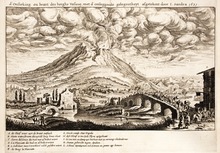
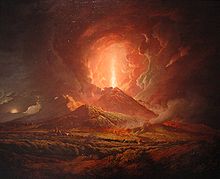
Since the eruption of AD 79, Vesuvius has erupted around three dozen times.
- It erupted again in 203, during the lifetime of the historian Cassius Dio.
- In 472, it ejected such a volume of ash that ashfalls were reported as far away as Constantinople (760 mi.; 1,220 km).
- The eruptions of 512 were so severe that those inhabiting the slopes of Vesuvius were granted exemption from taxes by Theodoric the Great, the Gothic king of Italy.
- Further eruptions were recorded in 787, 968, 991, 999, 1007 and 1036 with the first recorded lava flows.
The volcano became quiescent at the end of the 13th century, and in the following years it again became covered with gardens and vineyards as of old. Even the inside of the crater was moderately filled with shrubbery.
- Vesuvius entered a new phase in December 1631, when a major eruption buried many villages under lava flows, killing around 3,000 people. Torrents of lahar were also created, adding to the devastation. Activity thereafter became almost continuous, with relatively severe eruptions occurring in 1660, 1682, 1694, 1698, 1707, 1737, 1760, 1767, 1779, 1794, 1822, 1834, 1839, 1850, 1855, 1861, 1868, 1872, 1906, 1926, 1929, and 1944.
Eruptions in the 20th century

- The eruption of 5 April 1906[65][66] killed more than 100 people and ejected the most lava ever recorded from a Vesuvian eruption. Italian authorities were preparing to hold the 1908 Summer Olympics when Mount Vesuvius violently erupted, devastating the city of Naples and surrounding comunes. Funds were diverted to reconstructing Naples, and a new site for the Olympics had to be found.
- Vesuvius was active from 1913 through 1944, with lava filling the crater and occasional outflows of small amounts of lava.[67]
- That eruptive period ended in the major eruption of March 1944, which destroyed the villages of San Sebastiano al Vesuvio, Massa di Somma, and Ottaviano, and part of San Giorgio a Cremano.[68] From 13 to 18 March 1944, activity was confined within the rim. Finally, on 18 March 1944, lava overflowed the rim. Lava flows destroyed nearby villages from 19 March through 22 March.[69] On 24 March, an explosive eruption created an ash plume and a small pyroclastic flow.
In March 1944, the United States Army Air Forces (USAAF) 340th Bombardment Group was based at Pompeii Airfield near Terzigno, Italy, just a few kilometres from the eastern base of the volcano. The tephra and hot ash from multiple days of the eruption damaged the fabric control surfaces, the engines, the Plexiglas windscreens and the gun turrets of the 340th’s B-25 Mitchell medium bombers. Estimates ranged from 78 to 88 aircraft destroyed.[70]

Ash is swept off the wings of an American B-25 Mitchell medium bomber of the 340th Bombardment Group on 23 March 1944 after the eruption of Mount Vesuvius.
The eruption could be seen from Naples. Different perspectives and the damage caused to the local villages were recorded by USAAF photographers and other personnel based nearer to the volcano.[71]
Future
Large Vesuvian eruptions which emit volcanic material in quantities of about 1 cubic kilometre (0.24 cu mi), the most recent of which overwhelmed Pompeii and Herculaneum, have happened after periods of inactivity of a few thousand years. Sub-Plinian eruptions producing about 0.1 cubic kilometres (0.024 cu mi), such as those of 472 and 1631, have been more frequent with a few hundred years between them. From the 1631 eruption until 1944, there was a comparatively small eruption every few years, emitting 0.001–0.01 km³ of magma. It seems that for Vesuvius, the amount of magma expelled in an eruption increases very roughly linearly with the interval since the previous one, and at a rate of around 0.001 cubic kilometres (0.00024 cu mi) for each year.[72] This gives an approximate figure of 0.075 cubic kilometres (0.018 cu mi) for an eruption after 75 years of inactivity.
Magma sitting in an underground chamber for many years will start to see higher melting point constituents such as olivine crystallizing out. The effect is to increase the concentration of dissolved gases (mostly sulfur dioxide and carbon dioxide) in the remaining liquid magma, making the subsequent eruption more violent. As gas-rich magma approaches the surface during an eruption, the huge drop in internal pressure caused by the reduction in weight of the overlying rock (which drops to zero at the surface) causes the gases to come out of solution, the volume of gas increasing explosively from nothing to perhaps many times that of the accompanying magma. Additionally, the removal of the higher melting point material will raise the concentration of felsic components such as silicates potentially making the magma more viscous, adding to the explosive nature of the eruption.

The area around the volcano is now densely populated.
The government emergency plan for an eruption therefore assumes that the worst case will be an eruption of similar size and type to the 1631 VEI 4[73] eruption. In this scenario, the slopes of the volcano, extending out to about 7 kilometres (4.3 mi) from the vent, may be exposed to pyroclastic surges sweeping down them, whilst much of the surrounding area could suffer from tephra falls. Because of prevailing winds, towns and cities to the south and east of the volcano are most at risk from this, and it is assumed that tephra accumulation exceeding 100 kilograms per square metre (20 lb/sq ft)—at which point people are at risk from collapsing roofs—may extend out as far as Avellino to the east or Salerno to the south-east. Towards Naples, to the north west, this tephra fall hazard is assumed to extend barely past the slopes of the volcano.[72] The specific areas actually affected by the ash cloud depend upon the particular circumstances surrounding the eruption.
The plan assumes between two weeks’ and 20 days’ notice of an eruption and foresees the emergency evacuation of 600,000 people, almost entirely comprising all those living in the zona rossa («red zone»), i.e. at greatest risk from pyroclastic flows.[8][74] The evacuation, by train, ferry, car, and bus, is planned to take about seven days, and the evacuees would mostly be sent to other parts of the country, rather than to safe areas in the local Campania region, and may have to stay away for several months. However, the dilemma that would face those implementing the plan is when to start this massive evacuation: If it starts too late, thousands could be killed, whereas if it is started too early, the indicators of an eruption may turn out to be a false alarm. In 1984, 40,000 people were evacuated from the Campi Flegrei area, another volcanic complex near Naples, but no eruption occurred.[74]
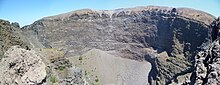
The crater of Vesuvius in 2012
Ongoing efforts are being made by the government at various levels (especially of Campania) to reduce the population living in the red zone, by demolishing illegally constructed buildings, establishing a national park around the whole volcano to prevent the future construction of buildings[74] and by offering sufficient financial incentives to people for moving away.[75] One of the underlying goals is to reduce the time needed to evacuate the area, over the next twenty to thirty years, to two or three days.[76]
The volcano is closely monitored by the Osservatorio Vesuvio in Naples with extensive networks of seismic and gravimetric stations, a combination of a GPS-based geodetic array and satellite-based synthetic aperture radar to measure ground movement and by local surveys and chemical analyses of gases emitted from fumaroles. All of this is intended to track magma rising underneath the volcano. No magma has been detected within 10 km of the surface, and so the volcano is classified by the Observatory as at a Basic or Green Level.[77]
National park
The area around Vesuvius was officially declared a national park on 5 June 1995.[78] The summit of Vesuvius is open to visitors, and there is a small network of paths around the volcano that are maintained by the park authorities on weekends. There is access by road to within 200 metres (660 ft) of the summit (measured vertically), but thereafter access is on foot only. There is a spiral walkway around the volcano from the road to the crater.
«Funiculì, Funiculà»
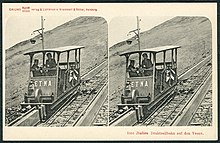
The first funicular cable car on Mount Vesuvius opened in 1880. It was later destroyed by the March 1944 eruption. «Funiculì, Funiculà», a Neapolitan language song with lyrics by journalist Peppino Turco set to music by composer Luigi Denza, commemorates its opening.[79]
See also
- Battle of Mount Vesuvius
- List of volcanic eruptions by death toll
- List of volcanoes in Italy
- List of stratovolcanoes
- Volcanic explosivity index
Notes
- ^ The dates of the earthquakes and of the eruption are contingent on a final determination of the time of year, but there is no reason to change the relative sequence.
References
- ^ «Vesuvio nell’Enciclopedia Treccani». www.treccani.it (in Italian). Retrieved 7 February 2021.
- ^ «Neapolitan/articles – Wikibooks, open books for an open world». en.wikibooks.org. Retrieved 7 February 2021.
- ^ Alfonso Grasso, ed. (2007). «Il Vesuvio» [Vesuvius]. ilportaledelsud.org (in Italian). Retrieved 8 February 2021.
- ^ Castiglioni, Luigi; Mariotti, Scevola (2007). Vocabolario della lingua latina : IL : latino-italiano, italiano-latino / Luigi Castiglioni, Scevola Mariotti ; redatto con la collaborazione di Arturo Brambilla e Gaspare Campagna (in Italian) (4th ed.). Loescher. p. 1505. ISBN 978-8820166601.
- ^ «Vesuvio o Vesevius nell’Enciclopedia Treccani». www.treccani.it (in Italian). Retrieved 8 February 2021.
- ^ Woods, Andrew W. (2013). «Sustained explosive activity: volcanic eruption columns and hawaiian fountains». In Fagents, Sarah A.; Gregg, Tracy K. P.; Lopes, Rosaly M. C. (eds.). Modeling Volcanic Processes: The Physics and Mathematics of Volcanism. Cambridge: Cambridge University Press. p. 158. ISBN 978-0521895439.
- ^ a b C. Plinii Caecilii Secundi. «Liber Sextus; 16 & 20». Epistularum. The Latin Library.
- ^ a b McGuire, Bill (16 October 2003). «In the shadow of the volcano». The Guardian. Retrieved 8 May 2010.
- ^ CIL x.1, 3806.[full citation needed]
- ^ Waldstein & Shoobridge 1908, p. 97
- ^ Kozák, Jan; Cermák, Vladimir (2010). «Vesuvius-Somma Volcano, Bay of Naples, Italy». The Illustrated History of Natural Disasters. Springer. pp. 45–54. doi:10.1007/978-90-481-3325-3_3. ISBN 978-90-481-3325-3.
- ^ Book IV, Chapter 21.[full citation needed]
- ^ Waldstein & Shoobridge 1908, p. 108 re Epigram IV line 44.
- ^ a b Lewis, Charlton T.; Short, Charles (2010) [1879]. «Vesuvius». A Latin Dictionary. Medford, MA: The Perseus Project, Tufts University.
- ^ Phillips, John (1869). Vesuvius. Oxford: Clarendon Press. pp. 7–9.
- ^ Charnock, Richard Stephen (1859). Local etymology, a derivative dictionary of geographical names. London: Houlston and Wright. p. 289.
- ^ Pokorny, Julius (1998–2003) [1959]. «eus, awes». In Lubotsky, A.; Starostin, G. (eds.). Indogermanisches etymologisches Woerterbuch (in German). Leiden: Leiden University.
- ^ a b c d «Summary of the eruptive history of Mt. Vesuvius». Osservatorio Vesuviano, Italian National Institute of Geophysics and Volcanology. Archived from the original on 3 December 2006. Retrieved 8 December 2006.
- ^ «Geology and Vulcanology | Vesuvius National Park». Parco Nazionale del Vesuvio. Retrieved 27 April 2021.
- ^ «Vesuvius, Italy». Volcano World. Archived from the original on 5 July 2008.
- ^ a b «The world’s top volcanoes». Scenta. Archived from the original on 26 August 2010.
- ^ a b «The Pomici Di Base Eruption». Osservatorio Vesuviano, Italian National Institute of Geophysics and Volcanology. Archived from the original on 22 October 2006. Retrieved 8 December 2006.
- ^ a b c «Vesuvius». Global Volcanism Program. Smithsonian Institution. Retrieved 8 December 2006.
- ^ «Definition of somma volcano». Volcano Live. Retrieved 11 December 2006.
- ^ «Vesuvius». volcanotrek.com. Retrieved 29 October 2010.
- ^ Stoppa, Francesco; Principe, Claudia; Schiazza, Mariangela; Liu, Yu; Giosa, Paola; Crocetti, Sergio (15 March 2017). «Magma evolution inside the 1631 Vesuvius magma chamber and eruption triggering». Open Geosciences. 9 (1): 24–52. Bibcode:2017OGeo….9….3S. doi:10.1515/geo-2017-0003. ISSN 2391-5447.
- ^ Pliny the Younger (1909). «6.16». In Eliot, Charles W. (ed.). Vol. IX, Part 4: Letters. The Harvard Classics. New York: Bartleby.[verification needed]
- ^ Venzke, E., ed. (10 December 2020). «What volcanoes have had the longest eruptions?». Global Volcanism Program — Volcanoes of the World (Version 4.9.2). Smithsonian Institution. doi:10.5479/si.GVP.VOTW4-2013. Retrieved 15 December 2020.
- ^ Guest et al. 2003, p. 45
- ^ Guest et al. 2003, p. 47
- ^ Livadie, Claude Albore. «An ancient Bronze Age village (3500 bp) destroyed by the pumice eruption in Avellino (Nola-Campania)». Meridie. Archived from the original on 18 June 2012. Retrieved 8 December 2006.
- ^ Ellen Goldbaum (6 March 2006). «Vesuvius’ Next Eruption May Put Metro Naples at Risk». University at Buffalo News Center. State University of New York. Retrieved 8 December 2006.
- ^ «Pomici di Avellino eruption». Osservatorio Vesuviano, Italian National Institute of Geophysics and Volcanology. Archived from the original on 18 September 2010. Retrieved 8 December 2006.
- ^ Stothers, R.B.; Klenk, Hans-Peter (2002). «The case for an eruption of Vesuvius in 217 BC (abstract)». Ancient Hist. Bull. 16: 182–185.
- ^ Punica VIII 653–655 «Aetnaeos quoque contorquens e cautibus ignes / Vesvius intonuit, scopulisque in nubila iactis / Phlegraeus tetigit trepidantia sidera vertex.» [«Also Vesuvius thundered, throwing Etna-like fires from its crags, and its flaming summit, throwing rocks into the clouds, touched the trembling stars»]
- ^ de Boer; Jelle Zeilinga & Sanders; Donald Theodore (2002). Volcanoes in Human History. Princeton University Press. ISBN 978-0-691-05081-2.
- ^ Pliny the Elder. The Natural History. Translated by John Bostock & Henry Thomas Riley.
- ^ Strabo. «Book V Chapter 4». Geography.
- ^ Marcus Vitruvius Pollio. «Book II». de Architectura.
- ^ «Somma-Vesuvius». Department of Physics, University of Rome. Archived from the original on 12 April 2011. Retrieved 8 December 2006.
- ^ a b Wallace-Hadrill, Andrew (15 October 2010). «Pompeii: Portents of Disaster». BBC History. Retrieved 4 February 2011.
- ^ Lapatin, Kenneth; Kozlovski, Alina (23 August 2019). «When Did Vesuvius Erupt? The Evidence for and against August 24». The Iris. Getty Museum.
- ^ «Pompeii: Vesuvius eruption may have been later than thought». BBC. 16 October 2018.
- ^ a b «Science: Man of Pompeii». Time. 15 October 1956. Archived from the original on 14 December 2008. Retrieved 4 February 2011.
- ^ Martini, Kirk (September 1998). «2: Identifying Potential Damage Events». Patterns of Reconstruction at Pompeii. Pompeii Forum Project, Institute for Advanced Technology in the Humanities (IATH), University of Virginia.
- ^ a b Jones, Rick (2004–2010). «Visiting Pompeii – AD 79 – Vesuvius explodes». Current Archeology. London: Current Publishing. Archived from the original on 8 March 2012. Retrieved 27 May 2010.
- ^ Sigurdsson 2002
- ^ Sigurdsson & Carey 2002, pp. 42–43
- ^ Zanella et al. 2007, p. 5
- ^ Zanella et al. 2007, p. 3
- ^ Zanella et al. 2007, p. 12
- ^ Zanella et al. 2007, p. 13
- ^ Zanella et al. 2007, p. 14
- ^ Pliny the Younger (2001) [1909–14]. «LXV. To Tacitus». In Charles W. Eliot (ed.). Vol. IX, Part 4: Letters. The Harvard Classics. New York: Bartelby.
- ^ Gaius Plinius Caecilius Secundus (Pliny the Younger) (September 2001). LETTERS OF PLINY. Letters of Pliny. Project Gutenberg. p. LXV. Retrieved 3 October 2016.
- ^ Pliny the Younger (2001) [1909–14]. «LXVI. To Cornelius Tacitus». In Charles W. Eliot (ed.). Vol. IX, Part 4: Letters. The Harvard Classics. New York: Bartelby.
- ^ Gaius Plinius Caecilius Secundus (Pliny the Younger) (September 2001). LETTERS OF PLINY. Letters of Pliny. Project Gutenberg. p. LXVI. Retrieved 3 October 2016.
- ^ «Pliny Letter 6.16». Archived from the original on 11 May 2015. Retrieved 11 May 2015.
- ^ Fisher, Richard V.; et al. (and volunteers). «Derivation of the name «Plinian»«. The Volcano Information Center. University of California at Santa Barbara, Department of Geological Sciences. Retrieved 15 May 2010.
- ^ Janick, Jules (2002). «Lecture 19: Greek, Carthaginian and Roman Agricultural Writers». History of Horticulture. Purdue University. Archived from the original on 18 July 2012. Retrieved 15 May 2010.
- ^ Josephus, Flavius. «xx.7.2». Jewish Antiquities. Also known to have been mentioned in a section now lost.
- ^ a b Giacomelli, Lisetta; Perrotta, Annamaria; Scandone, Roberto; Scarpati, Claudio (September 2003). «The eruption of Vesuvius of 79 AD and its impact on human environment in Pompei». Episodes. 26 (3): 235–238. doi:10.18814/epiiugs/2003/v26i3/014.
- ^ «Pompeii, Stories from an eruption: Herculaneum». Soprintendenza archeologica di Pompei. Chicago: The Field Museum of Natural History. 2007. Archived from the original on 18 March 2009. Retrieved 12 May 2010.
- ^ Vesuvius Causes Terror; Loud Detonations and Frequent Earthquakes, The New York Times, 6 April 1906
- ^ Vesuvius Threatens Destruction Of Towns; Bosco Trecase Abandoned, The New York Times, 7 April 1906
- ^ Scandone, Roberto; Giacomelli, Lisetta; Gasparini, Paolo (1993). «Mount Vesuvius: 2000 years of volcanological observations» (PDF). Journal of Volcanology and Geothermal Research. 58 (1): 5–25. Bibcode:1993JVGR…58….5S. doi:10.1016/0377-0273(93)90099-D.
- ^ Stevens, Robert (1944). Mt Vesuvius erupts near Naples, Italy in 1944 (The Travel Film Archive). Naples: Castle Films, YouTube. Archived from the original on 30 October 2021.
- ^ Giacomelli, L.; Scandone, R. (1996–2009). «The eruption of vesuvius of March 1944». Esplora i Vulcani Italiani. Dipartimento di Fisica E. Amaldi, Università Roma Tre. Archived from the original on 30 December 2009. Retrieved 9 May 2010.
- ^ Kaiser, Don. «The Mount Vesuvius Eruption of March 1944». Archived from the original on 3 November 2011. Retrieved 13 June 2009.
- ^ «Melvin C. Shaffer World War II Photographs». Central University Library (CUL), Southern Methodist University (SMU).
- ^ a b Kilburn, Chris & McGuire, Bill (2001). Italian Volcanoes. Terra Publishing. ISBN 978-1-903544-04-4.
- ^ Giacomelli, L.; Scandone, R. (1996–2009). «Activity of Vesuvio between 1631 and 1799». Esplora i Vulcani Italiani. Dipartimento di Fisica E. Amaldi, Università Roma Tre. Archived from the original on 19 January 2011. Retrieved 9 May 2010.
- ^ a b c Hale, Ellen (21 October 2003). «Italians trying to prevent a modern Pompeii». USA Today. Gannett Co. Inc. Retrieved 8 May 2010.
- ^ Arie, Sophie (5 June 2003). «Italy ready to pay to clear slopes of volcano». The Guardian. London. Retrieved 12 May 2010.
- ^ Gasparini, Paolo; Barberi, Franco; Belli, Attilio (16–18 October 2003). Early Warning of Volcanic eruptions and Earthquakes in the Neapolitan area, Campania Region, South Italy (Submitted Abstract) (PDF). Second International Conference on Early Warning (EWCII). Bonn, Germany. Archived from the original (PDF) on 27 September 2009. Retrieved 8 May 2010.
- ^ «Vesuvius». Naples: Osservatorio Vesuviano, Italian National Institute of Geophysics and Volcanology. Archived from the original on 2 May 2010. Retrieved 8 May 2010.
- ^ «The National Park». Vesuvioinrete.it. 2001–2010. Retrieved 7 May 2010.
- ^ Smith, Paul (March 1998). «Thomas Cook & Son’s Vesuvius Railway» (PDF). Japan Railway & Transport Review.
Bibliography
- Guest, John; Cole, Paul; Duncan, Angus; Chester, David (2003). «Chapter 2: Vesuvius». Volcanoes of Southern Italy. London: The Geological Society. pp. 25–62.
- Sigurdsson, Haraldur (2002). «Mount Vesuvius before the Disaster». In Jashemski, Wilhelmina Mary Feemster; Meyer, Frederick Gustav (eds.). The natural history of Pompeii. Cambridge UK: The Press Syndicate of the University of Cambridge. pp. 29–36.
- Sigurdsson, Haraldur; Carey, Steven (2002). «The Eruption of Vesuvius in AD 79». In Jashemski, Wilhelmina Mary Feemster; Meyer, Frederick Gustav (eds.). The natural history of Pompeii. Cambridge UK: The Press Syndicate of the University of Cambridge. pp. 37–64.
- Waldstein, Charles; Shoobridge, Leonard Knollys Haywood (1908). Herculaneum, past, present & future. London: Macmillan and Co.
- Zanella, E.; Gurioli, L.; Pareschi, M.T.; Lanza, R. (2007). «Influences of urban fabric on pyroclastic density currents at Pompeii (Italy): Part II: temperature of the deposits and hazard implications» (PDF). Journal of Geophysical Research. 112 (B5): B05214. Bibcode:2007JGRB..112.5214Z. doi:10.1029/2006jb004775.
External links
- Purcell, N.; Talbert; Elliott; Gillies (20 March 2015). «Places: 433189 (Vesuvius M.)». Pleiades. Retrieved 8 March 2012.
- Fraser, Christian (10 January 2007). «Vesuvius escape plan ‘insufficient’«. BBC News. Naples: BBC. Retrieved 11 May 2010.
- Garrett, Roger A.; Klenk, Hans-Peter (April 2005). «Vesuvius’ next eruption». Geotimes. Archived from the original on 12 May 2007. Retrieved 8 December 2006.
- «Vesuvius: The making of a catastrophe: Il problema ignorato». Global Volcanic and Environmental Systems Simulation (GVES). 1996–2003.
- Smithsonian Institution’s Global Volcanism Program (GVP) (entry for Aira / Sakurajima)
Upgrade to Answers+ and your first week is free!
Get unlimited, ad-free homework help with access to exclusive features and priority answers.
Mt Vesuvius Volcano | John Seach

Campania, Italy
40.82 N, 14.43 E,
summit elevation 1281 m,
Complex volcano
Mount Vesuvius is one of the world’s most dangerous volcanoes.
The volcano has an eruption cycle of about 20 years, but the last eruption was in 1944.
The volcano is rated as one of the most dangerous in the world with millions of people living close to the crater.
Mt Vesuvius volcano photos by John Seach

Mt Vesuvius volcano from Pompeii

Mt Vesuvius 2013

Mt Vesuvius and Napoli

Mt Vesuvius volcano

Flank of Mt Vesuvius and Napoli.

Mt Vesuvius caldera

Mt Vesuvius crater

Mt Vesuvius

Pompeii

Victims of 79AD eruption of Vesuvius at Pompeii

Mt Vesuvius eruption 1944 — original image from John Seach collection
In 79 AD an eruption of the volcano destroyed Pompeii and its remains are a popular tourist attraction south of Napoli.
In recent years there has been an attempt to relocate some resident from the slopes of the volcano
to reduce the risk from the next eruption.
A Tour of Pompeii.
The Eruption
of 79 AD.
1999 Earthquake Swarm
Since 1944, seismicity at Mt Vesuvius has been marked by moderate-energy events with a frequency of a few hundred per year. At 7:41 am local time on 9th October 1999 a magnitude 3.6 earthquake hit Mt Vesuvius, as part of the largest earthquake swarm since 1944. The earthquake was felt in a 25 km radius of the volcano. This earthquake was the same size as the precursor of the great 1631 eruption.
1944 Eruption
A two week long eruption of Mt Vesuvius volcano began on 18th March 1944 with a lava flow from the summit crater. Eruptions changed to explosive activity on 21st March with eight lava fountains. The lava fountains increased with time, and the last one on 22nd March was the most intense, reaching heights of 1000 m. A transition to mixed magmatic–phreatomagmatic activity was marked by emissions of ash columns. The final phase of activity at Vesuvius began on 23rd March with vulcanian activity and nuées ardentes. The eruption finished on 29th march 1944. This ended nearly 300 years of semi persistent activity of Vesuvius.
A shallow and deep magma reservoir was involved in the 1944 eruption of Mt Vesuvius volcano; depths of less than 3 km deep and 11-22 km. The shallow reservoir feeding the 1944 eruption was completely emptied and collapsed during the final phases of the eruption. The eruptions in 1944 and 1906 were similar in terms of rock compositions, eruptive style, and erupted volumes.
1906 Eruption
An eruption began at Mt Vesuvius on 4th April 1906 when an effusive vent opened on the southern slope at an altitude of 1200 m, near Casotto delle Guide. At midnight on 4th April the lava flow ceased when a new fracture opened up near the cistern of Casa Fiorenza at an elevation of about 800 m elevation. At about 8:00 a.m. on 6th April a third vent opened near Bosco Cognoli at 600 m altitude on the same fracture zone. Lava flow of Bosco Cognoli was much more fluid than those of the preceding days and continued until the evening of 7th April.
From the morning of 4th April explosions of progressively increasing intensity and frequency occurred at the central crater of Vesuvius. Ash plumes reached a height of 2000-3000 m. After 6th April there was a relative lowering of sea level, of about 50 cm, on the shoreline between Torre del Greco and Torre Annunziata, together with the opening of new fractures, which indicated inflation of the volcano.
On the afternoon of 7th April the activity at the central crater of Vesuvius became stronger, with increasingly violent and frequent explosions. Intense lava fountains were visible during the evening of 7th April. At 10:00 pm a break in the crater rim resulted in the lava fountains beginning «… shoot more and more obliquely
to the northeast till it formed a giant arch over spanning the crest of Monte Somma in the direction of Ottajano …»
At 3:30 am in the morning on 8th April the eruption at Vesuvius changed from lava fountains to extremely violent explosions. The upper part of the cone opened «like the falling of the petals of a flower and were expelled in all directions. Over a 30 hour period the eruption looked like a huge persistent geyser. Lapilli fell in a radius of 6 km from the crater.
The final phase of the 1906 eruption of Vesuvius consisted of emission of large
from the central crater with low pressure, and low eruptive clouds over the volcano. The eruption finished on 21st April 1906.
1872 Eruption
On 26th April 1872 an eruption began at Vesuvius with lava flowing from a fissure on the northwestern side of the mountain. The lava blocked the escape route for 20 spectators who were killed. The lava flow forked at Observatory Hill. One flow passed through Fossa della Vetrana and Fossa Faraone and destroyed the inhabited centres of Masa and S Sebastiano al Vesuvio. The second fork of the lava flow surrounded the Volcano Observatory and stranded staff for days. On the 28th April when the lava flow stopped there were spectacular eruptions at the summit. There was a crater collapse on 1st May forming a caldera.
1861 Eruption
A series of earthquakes preceded an eruption of Vesuvius on 6th December 1861. A fracture opened 2 km NE of Torre del Greco, and could be seen from the sea. Eruptive vents opened on the upper part of the fracture killing one woman. Lava flowed towards Torre del Greco and Herculanem until the end of December and destroyed several houses. The coastline rose up to one metre. Carbon dioxide emissions occurred in wells and cellars.
1858-61 Eruption
On 28th May 1858 lava flowed from six fissured on the northwest side of Mt Vesuvius volcano. Lava continued to flow until 1861 and reached Fosso Grande, Piano delle Ginestre and Fosso della Vetrana.
1834 Eruption
An eruption of Vesuvius began on 23rd August 1834 and discharged a large amount of lava. On 24th August a new vent opened on the eastern side of the volcano at Grotta del Mauro, in the location of the 1817 lava flow. On 27th August a lava flow moved towards Mauro, widening as it descended, and reached a width of half a mile, and a depth of 18 feet. The lava flow destroyed 180 houses, leaving 800 people homeless, and covered 500 acres of land. Towards the end of the eruption of Vesuvius fish died in a private pond at Puzzuoli. The main victims belonged to bottom dwelling species.
1794 Eruption
An explosion occurred at the summit of Mt Vesuvius on 15th July 1794. A lava flow reached Torre del Greco at 6:00 am the following morning destroying a large part of the town.
1760 Eruption
On 27th December 1760 a fracture opened up 3 km northwest of Boscotrecase on the southern side of Vesuvius. Fifteen vents opened and effused a large amount of lava. The cone of the central crater collapsed on 29th December diminishing the eruption.
1631 Eruption
On 10th December 1631 residents of Torre del Greco stated
they heard the mountain roaring from
the inside, with such a stirring of subterranean
spirits, that they could hardly sleep at all during
the night. This was the first activity at Mt Vesuvius in 500 years. A large eruption of Mt Vesuvius began at dawn on 16th December 1631. A Plinian column erupted up to 28 km high accompanied by tephra fallout for a few hours. Tephra fallout occurred on the eastern side of the volcano, sparing Naples. This was followed by pyroclastic flows, phreatomagmatic ash emission and secondary lahars. Spectacular lava flows began on 18th December 1631. Eruptions ceased by the end of December. Moderate plinian eruptions at Vesuvius like those of 1631 and 472 require periods of repose of the order of centuries and have always been explosive.
Further reading
Gurioli, L., Houghton, B.F., Cashman, K.V. and Cioni, R., 2005. Complex changes in eruption dynamics during the 79 AD eruption of Vesuvius. Bulletin of Volcanology, 67(2), pp.144-159.
Principe, C., Tanguy, J.C., Arrighi, S., Paiotti, A., Le Goff, M. and Zoppi, U., 2004. Chronology of Vesuvius’ activity from AD 79 to 1631 based on archeomagnetism of lavas and historical sources. Bulletin of Volcanology, 66(8), pp.703-724.
Sigurdsson, H., Cashdollar, S. and Sparks, S.R., 1982. The eruption of Vesuvius in AD 79: reconstruction from historical and volcanological evidence. American journal of archaeology, pp.39-51.
Sheridan, M.F., Barberi, F., Rosi, M. and Santacroce, R., 1981. A model for Plinian eruptions of Vesuvius. Nature, 289(5795), pp.282-285.
The Eruption
of 79 AD.
Mt Vesuvius Volcano Eruptions
1913-44, 1875-1906, 1874, 1870-72, 1864-68, 1855-61, 1854-55, 1841-50, 1835-39, 1824-34, 1796-1822, 1783-94, 1770-79, 1764-67, 1744-61, 1732-37, 1724-30, 1712-23, 1708, 1706-07, 1701-04, 1697-98, 1696, 1685-94, 1682, 1654-80, 1637-52, 1631-32, 1139, 1073, 1049?, 1037, 1007, 999?, 991?, 968, 787, 685, 536, 512, 505, 472, 379-95, ?222-35, 203, 172, 79 AD, 1500BC.
- Volcanoes of Italy.
Picture of Mount Vesuvius and Naples Bay
A panorama of the Gulf of Naples, Italy, showing the high population density and commerce. Mt. Vesuvius rests quietly in the background. Image copyright iStockphoto / Danilo Ascione.
Mount Vesuvius Introduction
Vesuvius is the only active volcano in mainland Europe, and has produced some of the continent’s largest volcanic eruptions. Located on Italy’s west coast, it overlooks the Bay and City of Naples and sits in the crater of the ancient Somma volcano. Vesuvius is most famous for the 79 AD eruption which destroyed the Roman cities of Pompeii and Herculaneum. Though the volcano’s last eruption was in 1944, it still represents a great danger to the cities that surround it, especially the busy metropolis of Naples.
Simplified plate tectonics cross-section
Simplified plate tectonics cross-section showing how Mount Vesuvius is located above a subduction zone formed where the African plate descends beneath Italy. Magma produced from the melting African plate creates the large, violently explosive volcanoes of the Italian Peninsula.
Map showing the location of Mount Vesuvius on the west coast of Italy. Map by Geology.com and MapResources.
Nearby Volcanoes: Etna, Stromboli
Mount Vesuvius: Plate Tectonic Setting
Vesuvius is part of the Campanian volcanic arc, a line of volcanoes that formed over a subduction zone created by the convergence of the African and Eurasian plates. This subduction zone stretches the length of the Italian peninsula, and is also the source of other volcanoes like Mount Etna, the Phlegraean Fields (Campi Flegrei), Vulcano, and Stromboli. Under Vesuvius, the lower part of the subducting slab has torn and detached from the upper part to form what is called a «slab window.» This makes Vesuvius’ rocks slightly different chemically from the rocks erupted from the other Campanian volcanoes.
Plaster casts: Victims of the 79 A.D. eruption
Plaster casts of people who died in the city of Pompeii during the 79 AD eruption of Mount Vesuvius. They were buried by the ashfall. Image: Garden of the Fugitives. This photo was taken by Lancevortex and is distributed under a GNU Free Documentation License.
Mount Vesuvius Geology and Hazards
The cone known as Mount Vesuvius began growing in the caldera of the Mount Somma volcano, which last erupted about 17,000 years ago. Most rocks erupted from Vesuvius are andesite, an intermediate volcanic rock (about 53-63% silica). Andesite lava creates explosive eruptions on a variety of scales, which makes Vesuvius an especially dangerous and unpredictable volcano. Strombolian eruptions (explosions of magma from a pool in the volcano’s conduit) and lava flows from the summit and flank fissures are relatively small. Plinian eruptions (huge explosions that create columns of gas, ash and rock which can rise dozens of kilometers into the atmosphere) have a much greater reach, and have destroyed entire ancient cities near Vesuvius with huge ashfalls and pyroclastic flows. Vesuvius is currently quiet, with only minor seismic (earthquake) activity and outgassing from fumaroles in its summit crater, but more violent activity could resume in the future.
Ruins at the ancient city of Pompeii
Brick columns stand among ruins of the ancient city of Pompeii. Image copyright iStockphoto / Evgeny Bortnikov.
The 79 AD eruption of Vesuvius is why volcanologists use «Plinian» to describe large volcanic eruption clouds. Pliny the Younger, a Roman historian who witnessed the 79 AD eruption, wrote the oldest surviving description of the tall, tree-shaped cloud that rose above the volcano. Modern volcanologists use the term to describe large-volume, violent eruptions that produce quickly-expanding clouds of rock, ash and gases which rise many miles into the atmosphere. Some more recent examples of Plinian eruptions include Mount St. Helens in 1980 and Pinatubo in 1990. Here is Pliny’s description…
«On 24 August, in the early afternoon, my mother drew [my uncle’s] attention to a cloud of unusual size and appearance. Its general appearance can be best expressed as being like an umbrella pine, for it rose to a great height on a sort of trunk and then split off into branches, I imagine because it was thrust upwards by the first blast and then left unsupported as the pressure subsided, or else it was borne down by its own weight so that it spread out and gradually dispersed. Sometimes it looked white, sometimes blotched and dirty, according to the amount of soil and ashes it carried with it.»
Mount Vesuvius: Eruption History
Mount Vesuvius has experienced eight major eruptions in the last 17,000 years. The 79 AD eruption is one of the most well-known ancient eruptions in the world, and may have killed more than 16,000 people. Ash, mud and rocks from this eruption buried the cities of Pompeii and Herculaneum. Pompeii is famous for the casts the hot ash formed around victims of the eruptions. The unfortunate people suffocated on ash in the air, which then covered them and preserved amazing details of their clothing and faces.
Facts About Mount Vesuvius |
|
| Location: | West coast of Italy |
| Coordinates: | 40°49′ N 14°26′ E |
| Elevation: | 1,281 m (4,000 feet) |
| Volcano Type: | Complex |
| Last Eruption: | 1944 |
| Nearby Volcanoes: | Etna Stromboli |
Starting in 1631, Vesuvius entered a period of steady volcanic activity, including lava flows and eruptions of ash and mud. Violent eruptions in the late 1700s, 1800s and early 1900s created more fissures, lava flows, and ash-and-gas explosions. These damaged or destroyed many towns around the volcano, and sometimes killed people; the eruption of 1906 had more than 100 casualties. The most recent eruption was in 1944 during World War II. It caused major problems for the newly-arrived Allied forces in Italy when ash and rocks from the eruption destroyed planes and forced evacuations at a nearby airbase.
| More Vesuvius Information |
| Smithsonian Institution Global Volcanism Program Website: Vesuvius page.
Gates, A.E. and Ritchie, D., 2007, Encyclopedia of Earthquakes and Volcanoes, Third Edition: New York, NY, Checkmark Books, 346 p. Osservatorio Vesuviano (Vesuvius Observatory), Istituto Nazionale di Geofisica e Vulcanologia. Wortel, M.J.R. and Spakman, W., 2000, Subduction and Slab Detachment in the Mediterranean-Carpathian Region: Science, v. 290, n. 5498, p. 1910-1917. Review (full text upon subscription). The Letters of Pliny the Younger, Penguin Classics (translated by Betty Radice). |
About the Author
Jessica Ball is a graduate student in the Department of Geology at the State University of New York at Buffalo. Her concentration is in volcanology, and she is currently researching lava dome collapses and pyroclastic flows. Jessica earned her Bachelor of Science degree from the College of William and Mary, and worked for a year at the American Geological Institute in the Education/Outreach Program. She also writes the Magma Cum Laude blog, and in what spare time she has left, she enjoys rock climbing and playing various stringed instruments.

Find Other Topics on Geology.com:
|
Rocks: Galleries of igneous, sedimentary and metamorphic rock photos with descriptions. |
Minerals: Information about ore minerals, gem materials and rock-forming minerals. |
|
Volcanoes: Articles about volcanoes, volcanic hazards and eruptions past and present. |
Gemstones: Colorful images and articles about diamonds and colored stones. |
|
General Geology: Articles about geysers, maars, deltas, rifts, salt domes, water, and much more! |
Geology Store: Hammers, field bags, hand lenses, maps, books, hardness picks, gold pans. |
|
|
Diamonds: Learn about the properties of diamond, its many uses, and diamond discoveries. |
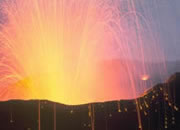
Volcano Mount Vesuvius Essay, Research Paper
Mount Vesuvius is a volcano located in southern Italy, near the bay of Naples and the city of Naples. It is the only active volcano on the European mainland. Vesuvius rises to a height of 1277 m (4190 ft). Vesuvio (Vesuvius) is probably the most famous volcano on earth, and is one of the most dangerous.
Mount Vesuvius is a strato-volcano consisting of a volcanic cone (Gran Cono) that was built within a summit caldera (Mount Somma). The Somma-Vesuvius complex has formed over the last 25,000 years by means of a sequence of eruptions of variable explosiveness, ranging from the quiet lava outpourings that characterized much of the latest activity (for example from 1881 to 1899 and from 1926 to 1930) to the explosive Plinian eruptions, including the one that destroyed Pompeii and killed thousands of people in 79 A.D. At least seven Plinian eruptions have been identified in
the eruptive history of Somma-Vesuvius (1). Each was preceded by a long period of stillness, which in the case of the 79 A.D. eruption lasted about 700 years. These eruptions were fed by viscous water-rich phonotitic to tephritic phonolitic magmas that appear to have differentiated in shallow crustal conditions. They are believed to have slowly filled a reservoir where differentiation was driven by compositional convection. A minimum depth of about 3 km was inferred for the top of the magmatic reservoir from
mineral equilibria of metamorphic carbonate ejecta (2). Fluid inclusions ([CO.sub.2] and [H.sub.2]O-[CO.sub.2]) in clinopyroxenes from cumulate and nodules indicate a trapping pressure of 1.0 to 2.5 kbar at about 1200 [degrees]C, suggesting that these minerals crystallized at depths of 4 to 10 km (3). The differentiated magma fraction was about 30% of the total magma in the reservoir, and a volume of about 2 to 3 [km.sup.3] was
inferred for the reservoir (4). The magma ascent to the surface occurred through a conduit of possibly 70 to 100 m in diameter (5). A thermal model predicts that such a reservoir should contain a core of partially molten magma (6) that can be detected by high-resolution seismic tomography.
The earliest outcropping volcanic deposits date back to about 25,000 years ago. The lavas observed at a -1125 m bore-hole are about 0,3-0,5 million years old. It is known for the first eruption of which an eyewitness account is preserved, in 79 AD. Geologically, Vesuvio is unique for its unusual versatility. Its activity ranging from Hawaiian-style release of liquid lava, fountaining and lava lakes, over Strombolian and Vulcanian activity to violently explosive, plinian events that produce pyroclastic flows and surges.
Vesuvius is a complex volcano. A complex volcano is «an extensive assemblage of spatially, temporally, and genetically related major and minor [volcanic] centers with there associated lava flows and pyroclastic flows.» Vesuvius has a long history. The oldest dated rock from the volcano is about 300,000 years old. It was collected from a well drilled near the volcano and was probably part of the Somma volcano. After Somma collapsed about 17,000 years ago, Vesuvius began to form. Four types of eruption have been documented: a) Plinian (AD 79, Pompeii type) events with widespread air fall and major pyroclastic surges and flows; b) sub-Plinian to Plinian, more moderately sized eruptions (AD 472, 1631) with heavy tephra falls around the volcano and pyroclastic flows and surges; c) small to medium-sized, Strombolian to Vulcanian eruptions (numerous events during the 1631-1944 cycle, such as 1906 and 1944) with local heavy tephra falls and major lava flows and small pyroclastic avalanches restricted to the active cone itself. The fourth type it is the smallest of all eruption types observed at Vesuvio. It is the persistent Strombolian to Hawaiian style eruption that characterizes almost all of an eruptive sub-cycle, such as was the case during the period 1913-1944. Activity of this kind is mainly restricted to the central crater where one or more intracrateral cones form, and to the sides of the cone. Lava flows from the summit crater or from the sub terminal vents extend beyond the cone’s base. A somewhat particular kind of persistent activity is the slow release of large amounts of lava from sub terminal fractures to form thick piles of lava with little lateral extension, such as the lava cupola of Colle Umberto, formed in 1895-1899. (7)
Vesuvius lies over a subduction zone. The two plates are the African plate and the Eurasian plate. The African plate is moving northward at about one inch (2-3 cm) per year and is slowly closing the Mediterranean basin. As it moves to the north, the African plate is pushed beneath the Eurasian plate. The rocks at Vesuvius are called tephrite. A tephrite is basaltic in character and contains the following minerals: calcic plagioclase, augite, and nepheline or leucite. (8)
Eruptive activity of Vesuvio noticeably occurs in cycles that last several centuries and alternate with repose periods lasting several centuries. Each repose period ends with a major (Plinian) eruption, initiating an active cycle. One of the problems researchers of Vesuvio have to deal with is that the cycles do not always repeat the same patterns and phenomena. The cycle or cycles following the 79 A.D. eruption seem to have been different from the most recent one, lasting from 1631 until 1944. The most recent Plinian eruption of major magnitude was that of August 79 A.D. The 79 A.D. eruption of Vesuvius was the first volcanic eruption ever to be described in detail. From 18 miles (30 km) west of the volcano, Pliny witnessed the eruption and later recorded his observations in two letters. He described the earthquakes before the eruption, the eruption column, air fall, the effects of the eruption on people, pyroclastic flows, and even tsunami. (9)
Volcanologists now use the term «plinian» to refer to continued explosive eruptions, which generate high-altitude eruption columns and blanket large areas with ash. It is estimated that at times during the eruption the column of ash was 20 miles (32 km) tall. About 1 cubic mile (4 cubic kilometers) of ash was erupted in about 19 hours. It is world-famous for the destruction of the Roman towns of Pompeii and Herculaneum that has inspired of generations of poets, philosophers and scientists. (10)
Two more very strong eruptions have occurred since 79 AD, a very poorly known one in 472 AD and another one in December 1631. It’s argued whether this eruption has been purely explosive or mixed explosive-effusive. It is clear that it was the second most devastating eruption of Vesuvio next to the eruption of 79 AD. Numerous villages and towns were devastated by pyroclastic flows, tephra falls and lahars, and at least 3000 people died. Compared with the AD 79 eruption, the event of 1631 was of minor size regarding eruptive magnitude and erupted volumes but not in terms of destruction and fatalities. Beginning on December 16, 1631 and culminating the day after, it destroyed all towns and villages around the volcano and killed between 3000 to 6000 people. (9) It was the worst volcanic disaster in the Mediterranean during the past 1800 years.
Like the AD 79 eruption, the 1631 event had been purely explosive but was characterized by the emplacement of devastating pyroclastic surges and flows. The eruption occurred after a calm period lasting between 130 to 500 years. Only recently (starting in the late 1980’s) has there been modern volcanological research on this important event that has significant implications for volcanic hazard assessments.
When Vesuvius became active again, Vesuvio had no significant eruptions since 1139; an eruption recorded for the year 1500 was a minor phreatic event, increased fumarolic activity, or a major rock fall. (11).
Before the eruption of 1631, Vesuvio was densely vegetated except at the summit of the active cone which by then had an elevation of about 1187 m about 100 m less than its present elevation, and 55 m higher than Monte Somma. The crater had a diameter of about 480 meters; it was funnel-shaped, had a few fumaroles on the rim and in its deepest part. Small ponds were present in the crater, but they probably existed on the caldera floor rather than within the active crater. (7)
Increased fumarolic activity and nocturnal glow that was visible on the north side of the Vesuvian cone as early as August 1631. Strongly increased local seismicity began to be perceived after December 10, 1631. The strongest tremors were felt as far away as Napoli. (12) The other warning signs were repeated subterranean rumblings in the night that preceded the outbreak and the drying up of wells around the volcano; some other wells reportedly became muddy. Among the somewhat stranger happenings is the reported filling to the rim of the crater with a steaming «bituminous mass» the nature of which was not further detailed, during the first days of December. During the 24 hours before the eruption, earthquakes were felt more and more frequently. (9) The population must have become extremely nervous, but there was no major evacuation from the area.
Chronology of the eruption
Following several strong earthquakes, a series of vents became active between 6:00 and 7:00 on December 16, 1631. They were situated along an eruptive fracture on the west-southwest side of the active cone, splitting it open from the summit to the base. This initial activity ejected fresh magma along with material torn from the walls of the fissure, i.e. older volcanic rocks. Blocky, nonvesicular fragments of juvenile fragments point to some magma-water interactions at this stage (13). The eruption rapidly gained energy as more vents opened on the flanks of the cone ejecting pyroclastics at a growing mass eruption rate. Soon after the beginning of the eruption, a large eruption column rose up, attaining the famous shape of a pine tree. The height of the eruption column at this stage exceeded 20 km and may have reached up to 28 km, thus the eruption was Plinian. Ash began to fall around the volcano about one hour after the start of the activity, but heavy block and scoria fall began at about 1000 in the direction of Ottaviano (north east side of Monte Somma), a village that later was to suffer from many other eruptions of Vesuvio. (12) During the morning of December 16, a continuous tremor began to be felt in Napoli, it did not cease until 8-10 hours later. Darkness fell over the area around the volcano and reached Napoli at 4:00 on that fatal day. (13)
The main portion of the eruptive plume was blown towards the east, causing darkness and tephra falls over southern Italy and over the Balkan. Slight asfalls are reported to have occurred as far as Constantinople, W Turkey, about 1250 km from the volcano. (12) The proximal maximum thickness of the initial pumice deposit is 1.5 m at Canale dell’Arena. (8)
After the initial plinian phase, between 7:00and 10:00 on December 16 the eruption took on a pulsating character, accompanied by strongly increased seismicity. During the night of 16-17 December, strong earth shocks occurred at intervals lasting 1-15 minutes. At about 2:00 on December 17 the first glowing avalanche that was observed to descend into the Atrio del Cavallo. At around the same time, strong rainfalls saturated large amounts of already fallen ash to form lahars that caused damage and disruption on the north and northeast sides of Mount Somma.(14)
On December 17 the activity changed with occasional surges of sub-Plinian to Plinian activity that caused tephra falls around the volcano. On the 17th, the summit of the volcano was partially destroyed by the activity. (13)
Within an active cycle, smaller sub cycles can be observed, starting with minor intracrateral (effusive and Strombolian) activity with some fluctuations until a strong eruption produces tall eruption columns, more voluminous, rapidly moving lava flows, and heavy tephra falls. This culminating, sub cycle-ending eruption is followed by a brief (max. 7 years during the most recent, and well-documented, cycle, 1631-1944) repose, then intracrateral activity starts again. (15).
Typical eruptions closing Vesuvian sub cycles were those of 1767, 1779, 1794, 1822, 1872, 1906, and 1944. Each of them caused damage in the towns around the volcano and the people suffered partial or total destruction at least once during the 1631-1944 cycle. Torre del Greco, on the coast west of Vesuvio, was destroyed three times in that period. Lava flows entered populated areas also during some more intense activity in the course of a sub cycle, most recently in 1929. Eruptions of this type have been seriously disruptive for life near Vesuvio in the past and would be extremely disturbing, were they to occur today. To cite one example: the 1906 eruption caused heavy tephra falls in the northeastern sector of Vesuvio, causing the collapse of almost all roofs in the towns of that area. Up to 500 people were killed in that event. 26 People died much the same way during the most recent eruption in 1944. (13)
After that event, the volcano has most obviously entered one of the longer periods of repose that is maybe to last much longer – up to several centuries – until a new eruptive cycle will begin with a major explosive eruption. Such spastic eruptions produce heavy tephra falls, pyroclastic flows, surges, and lahars. Lava flows are uncommon during these events. As the next eruption will probably be a paroxysmal one, primary volcanic hazards are tephra falls and pyroclastic flows and surges. They form a significant threat for a zone including parts of Napoli and the entire belt of towns around the volcano. It is certain phenomena, such as increasing seismicity, deformation, and others, will warn of an impending eruption, as has been the case before the AD 79 and 1631 eruptions. There are, however, serious logistical problems regarding the evacuation of maybe up to a million people in the areas endangered by tephra fall and pyroclastic flows and surges.
Vesuvio has a long and complex record of eruptions. Eruptions before AD 79 have neither been recorded in historical documents nor are there any folklore of previous activity. For the first millennium after Christ the record is incomplete and only with the late 17th century it becomes reasonably adequate. We can say that the most recent eruptive cycle, lasting from 1631 until 1944, has been very well documented and gives an idea of the behavior of the volcano during such a cycle.
Understanding of the volcano in longer terms of cycles is now beginning to form. It is known that eruptive cycles begin after non-active periods that may last centuries to millennia, and their opening eruptions are devastatingly violent, Plinian events. The most famous one is the AD 79 eruption that has been so well described in the letters by the Pliny the Younger. His description inspired volcanologists in the late 19th century to call eruptions like that of AD 79 «Plinian» eruptions. Certainly the most notable aspect of Vesuvio’s eminence among Earth’s volcanoes is the dense population surrounding it and climbing higher and higher up its slopes. In an enchanting landscape with beautiful islands, magnificent mountain ranges, marvellous coasts and historically famed cities, Vesuvio is the focus, lying in the center of a plain on the east north eastern side of the Gulf of Napoli. It is the steepness, the sudden way it rises from its peaceful surroundings, which make it so impressive. (16)
Vesuvius is a very dangerous and deadly volcano. Mudflows and lava flows from the eruption in 1631 killed 3,500 people.(13) About 3,360 people died in the 79 A.D. eruption from ash flows and falls.(9) Studies of past eruptions and their deposits continue. These studies help volcanologists understand the hazards associated with future eruptions. The population density in some areas of high risk is 20,000 to 30,000 per square km. About 3 million people could be seriously affected by future Eruptions. In the first 15 minutes of a medium- to large-scale eruption an area with a 4 mile (7 km) radius of the volcano could be destroyed (Dobran and others, 1994). About 1 million people live and work in this area immediately threatened by future eruptions. There are no signs of volcanic unrest at Vesuvius at the present time. (11)
References
(1.) V. Arno et al., in Somma-Vesuvius, R. Santacroce, Ed. (Quaderni de
La Ricerca Scientifica, Rome, 1987), pp. 53-103.
(2.) F. Barberi et al., Bull. Volcanol. 44, 295 (1981); L. Civetta, R. Galati,
R. Santacroce, ibid. 53, 517 (1991).
(3.) H. E. Belkin and B. De Vivo, J. Volcanol. Geotherm. Res. 58, 89
(1993).
(4.) H. Sigurdsson, S. Carey, W. Cornell, T. Pescatore, Natl. Geogr. Res.
1, 332 (1985).
(5.) P. Papale and F. Dobran, J. Volcanol. Geotherm. Res. 58,101 (1993).
(6.) P. Gasparini, M. S. M. Mantovani, R. Scandone, Bull. Volcanol. 44,
317 (1981).
(7.) Hoffer W (1982) Volcano: the search for Vesuvius. New York: Summit Books, p189
(8) Lirer L, Munno R, Postoglione I, Vinci A and Vitelli L (1997) The A.D. 79 eruption a future explosive scenario in the Vesuvian area: eveluation of associated risk. Bulletin of Volcanology 59: 112-124.
(9) Barberi F, Rosi M, Santacroce R and Sheridan MF (1983) Volcanic hazard
zonation at Vesuvius. In: Tazieffn H and Sabroux JC (eds) Forecasting volcanic events. Developments in Volcanology I. Elsevier Amsterdam: 149-161
(10) Sigurdsson H, Carey S, Cornell W and Pescatore T (1985) The eruption of
Vesuvius in 79 AD. National Geographic Research 1: 332-387
(11)Scandone R, Arganese G and Galdi F (1993b) The evaluation of volcanic risk in
the Vesuvian area. Journal of Volcanology and Geothermal Research 58: 263-271
(12 )Rosi M and Santacroce R (1983) The A.D. 472 «Pollena» eruption: Volcanological
and petrological for this poorly-known, Plinian-type event at Vesuvius. Journal of Volcanology and Geothermal Research 17: 237-248
(13)Rolandi G, Barrella AM and Borrelli A (1993a) The 1631 eruption of Vesuvius.
Journal of Volcanology and Geothermal Research 58: 183-201
(14)Scandone R, Giacomelli L and Gasparini (1993a) Mount Vesuvius: 2000 years of
volcanological observations. Journal of Volcanology and Geothermal Research 58: 5-25
(15)Mastrolorenzo G, Munno R and Rolandi G (1993) Vesuvius 1906: a case study of a
paroxysmal eruption and its relation to eruptive cycles. Journal of Volcanology and Geothermal Research 58: 217-237
(16) Santacroce R (1983) A general model for the behaviour of the Somma-Vesuvius
volcanic complex. Journal of Volcanology and Geothermal Research 237-248
(17) Albitino Elio, Vesuvio; a volcano and its history. Naples Usmate Press.3-24
Barberi F, Macedonio G, Pareschi MT, Santacroce R (1990) Mapping the tephra
fallout risk: an example from Vesuvius, Italy. Nature 344: 142-144
(18) Sigurdsson H, Cashdollar S and Sparks RSJ (1982) The eruption of Vesuvius in
A.D. 79: Reconstruction from historical and volcanological evidence. American Journal of Archaeology 86: 39-51
Mount Vesuvius
This Paper Recieved an A+ for my peterology class @ Plattsburgh State University NY
Tami Gaudette
Febuary 29,2000
Dr. Rode -Tice
-

-
September 4 2010, 06:42
Начинаю потихоньку расшифровывать и выкладывать материалы ЕГЭ-2010 (те, что были сняты мобильными телефонами во время реального экзамена и выложены в сеть). Сами фотографии выкладывать бессмысленно, они жуткого качества.
Текст для чтения. Кому интересно — он под катом. Ответов нет, поэтому буду благодарна всем, кто захочет потренироваться и дать свой вариант ответов. Комменты скринятся.
Vesuvius, near Naples in Italy, is the most famous of all volcanoes. Smoke and gases can often be seen above it, but sometimes it explodes violently. In the year 79 A.D. there was a particularly bad eruption. A large town not far off, Pompeii, was buried under the ash, and many people were killed. A Roman 1. ____________________ described it in detail, 2 __________________________ . Falling ashes darkened the sky, and he felt as if he were in a closed room without light. When Pompeii was dug out, or excavated, many centuries later, it was found to be buried under 30 feet of ash. This ash had kept the air away from the ruins, and the whole town had been preserved, 3_________________________ . Remains of food were found on tables, in the streets advertisements were still to be seen on the walls, and paintings inside the rooms have shown 4__________________________________. The luckless people of Pompeii had been taken by surprise; yet though the disaster was so great, the fact 5____________________________ has given us a great deal of knowledge about life of a Roman town. Since then Vesuvius has erupted many times, but nowadays people are too wise 6__________________________________; we can never tell just when another great outbreak will take place. The last big eruption of Vesuvius took place in 1944.
A. so that it can still be visited
B. who watched the eruption from a distance of 18 miles
C. that we have been able to excavate Pompeii and study it
D. to build large towns too close to the volcano
E. that was thought to be no longer active
F. so that we know just what took place
G. how the people themselves lived and behaved

|
Practice Test 13 |
ЧАСТЬ 2 – ЧТЕНИЕ |
2 Прочитайте текст и заполните пропуски 1–6 частями предложений, обозначенными буквами A–G. Одна из частей в списке А–G лишняя. Занесите букву, обозначающую соответствующую часть предложения, в таблицу B3.
On 24th August, 79AD, Mount Vesuvius, a volcano near Naples in Southern Italy, erupted.
The eruption was so powerful that it completely buried the towns of Pompeii and Herculaneum with ash. Centuries passed 1) ….. .
The towns lay buried for more than 1,500 years. Then, in 1599, an architect called Domenico Fontana rediscovered the towns
2) ….. .
However, a couple more centuries passed before any serious effort was made to unearth the towns, 3) ….. . Archaeologists discovered that Pompeii and Herculaneum had been wealthy, sophisticated and lively towns.
Both towns had had restaurants, food markets, shops, theatres and swimming pools. People had lived in large houses 4) ….. . In Pompeii, an aqueduct had even provided water for more than
twenty five street fountains, four public baths and many private houses and businesses.
While excavating Pompeii, one archaeologist
— Guiseppe Fiorelli — noticed something fascinating. Spaces could sometimes be seen in the hardened ash. Fiorelli quickly realised that these spaces were places 5) ….. . He decided to fill them with plaster in order to create casts.
Fiorelli’s technique created casts that were so detailed that it was even possible to see the terrified expressions on the faces of some of the people who had been killed when Mount Vesuvius erupted 2,000 years ago. Today, each year over 2.5 million visitors go to see the casts 6) ….. .
About three million people still live close to Mount Vesuvius. This is worrying as it is still an active volcano that scientists expect to erupt again.
Awhere human bodies had once been
Band the rest of the treasures at Pompeii and Herculaneum
C while digging in the area
Dand eventually people forgot that they had ever existed
Ewhich was also a popular holiday resort for wealthy Romans
Fwhich had beautiful frescoes painted on the walls
Gbut when it was, astonishing and wonderful findings were made
|
1 |
2 |
3 |
4 |
5 |
6 |
|
B3 D |
C |
G |
F |
A |
B |
103

|
ЧАСТЬ 2 – ЧТЕНИЕ |
Practice Test 13 |
3Прочитайте рассказ и выполните задания А15–А21. В каждом задании обведите цифру 1, 2, 3 или 4, соответствующую выбранному вами варианту ответа.
Caribbean Dream
The snow was piling up around the door and there was no sign yet of a change in the weather. As he cleared the pathway, Carl thought of blue skies and warm sunshine. It was how he got through the winters. He had decided that it must be his Caribbean background that made him suffer so miserably every winter. Everyone had warned him about the British weather but he had
used to it. Twenty
A15
precious savings. He still dreamt of returning to the Caribbean one day and although Carl was rarely able to add to his savings, so far he hadn’t had to use them.
Over the next few months, he worked as many hours overtime as he could. One afternoon, his line manager sent for him. He nervously entered the office and when he saw the expression on his manager’s face, he knew what was coming. “I’m
A19
He hadn’t meant to stay for so long. His intention had been to work as hard as he could for ten years, save every penny he could and then return home to start up his own business. Somehow, along the way, he had ended up getting married and having three children. Carl loved his family dearly, although this didn’t stop him from
A16
occasionally wondering where he would be now if he’d stuck to his plans.
Carl worked at a local factory where they manufactured appliances such as washing machines and fridges. He’d been there for eighteen years and had been promoted several times. He was now a foreman on the day shift. Lately, there had been talk of redundancies around the factory. He knew that the company
sorry,” he said. At least he had a few months left at work, which would give him time to make plans.
Because Carl had been with the company for so long, he was entitled to a considerable redundancy package. By law, the company had to calculate his compensation based on his current salary. He would leave with enough money to pay off the loan for his house completely. This was a good thing, of course, even though he had lost his job. Carl began to think more and more eagerly about his Caribbean dream. He decided that he
would talk to his family. Perhaps it was true that A20 every cloud has a silver lining, he thought.
Within the space of six months, Carl’s life changed completely. He sold his house and the
survive.
Alarm bells started to ring in Carl’s mind when his wife came home in tears one day and announced that the shop she had been working in was about to close for good. Carl realised that soon he would need to start dipping into his
into the Caribbean way of life and he has found some premises where he is planning to open up A21 an electrical appliances repair business. His Caribbean dream is becoming a reality. He chuckles quietly and shakes his head when people
ask him if he will miss the snow!
104

|
Practice Test 13 |
ЧАСТЬ 2 – ЧТЕНИЕ |
A1514 Regarding the British weather, Carl
1 thought that he would always find it difficult. 2 believed that he would get used to it one day. 3 hadn’t expected the winters to be so bad.
4 didn’t understand why people talked about it so much.
A1615 When he thought about his life, Carl would sometimes
1 worry about the future.
2 regret coming to Britain.
3 wish he had never married.
4 imagine how his life might have been different.
A1716 In the third paragraph, we learn that Carl 1 was happy about his promotion.
2 felt confident that his job was safe.
3 worried about being made redundant.
4 realised he needed to look for another job.
A1817 When Carl’s wife lost her job, Carl felt concerned that 1 he would lose his job, too.
2 they wouldn’t be able to visit their relatives any more. 3 their plans for the future would be affected.
4 he wouldn’t be able to save any more.
A1918 When Carl’s line manager called him into his office, the manager seemed very
|
1 |
angry. |
|
2 |
nervous. |
|
3 |
apologetic. |
|
4 |
afraid. |
A2019 In the sixth paragraph, the phrase ‘every cloud has a silver lining’ means 1 it is impossible to predict the future.
2 bad situations can bring about good.
3 there is often an opportunity to make money through a bad situation. 4 dreams can help you get through bad times.
A2120 In the final paragraph, the narrator gives the impression that Carl 1 is slowly getting used to a very different way of life.
2 is unexpectedly missing the British weather.
3 has less money now but feels happier.
4 is more satisfied with his new life than his old.
105

ЧАСТЬ 3 – ГРАММАТИКА И ЛЕКСИКА Practice Test 13
1Прочитайте приведённый ниже текст. Преобразуйте, если необходимо, сло’ ва, напечатанные заглавными буквами в конце строк, обозначенных номера’ ми B4–B10, так, чтобы они грамматически соответствовали содержанию текста. Заполните пропуски полученными словами. Каждый пропуск соответствует отдельному заданию из группы B4–B10.
|
B6 |
affects |
||
|
B7 |
will be found |
||
|
B8 |
having |
||
|
B9 |
am going |
||
|
B10 |
will get |
2 Прочитайте приведённый ниже текст. Преобразуйте, если необходимо, слова, напечатанные заглавными буквами в конце строк, обозначенных номерами В11–B16, так, чтобы они грамматически и лексически соответ’ ствовали содержанию текста. Заполните пропуски полученными словами. Каждый пропуск соответствует отдельному заданию из группы В11–В16.
Fyodor Dostoevsky
Fyodor Dostoevsky was born in Moscow in 1821. He was the son of a doctor who worked in a hospital for the poor.
|
The young Dostoevsky went to military school and held B11 |
government |
posts |

until he resigned to become an author. He became one of the most important and influential writers that has ever lived. Dostoevsky admired the works of the English writer Charles Dickens
|
who wrote about difficult times during the 9)B12 |
Industrial |
Revolution in the late |
18th and early 19th centuries. Dostoevsky also wrote novels about social issues.
One of Dostoevsky’s most significant works is Crime and Punishment. The main character in the
|
novel is Raskolnikov, a poor, |
10)B13 |
unemployed |
university drop out. The novel |
|
|
tells the story of how Raskolnikov |
plans to murder a(n) |
1B14) |
greedy |
|
moneylender to solve his financial problems. Another major work is The Brothers Karamazov,
|
which |
was Dostoevsky’s final novel and |
12)B15 |
possibly |
even his best. The |
|
|
novel |
focuses on a murder again but this time Dostoevsky examines other characters’ |
||||
|
reaction(s) |
|||||
|
13)B16 |
to the crime. |
||||
Fyodor Dostoevsky died in 1881 and is buried in the Alexander Nevsky Monastery in St. Petersburg.
GOVERN
INDUSTRY
EMPLOY GREED
POSSIBLE
REACT
106

|
Practice Test 13 |
ЧАСТЬ 3 – ГРАММАТИКА И ЛЕКСИКА |
3Прочитайте текст с пропусками, обозначенными номерами А22–А28. Эти номера соответствуют заданиям A22–A28, в которых представлены возмож’ ные варианты ответов. Обведите номер выбранного вами варианта ответа.
Harrods
Harrods is a world famous department store in Knightsbridge, London. Known for its quality merchandise and excellent customer
service, Harrods is one of London’s biggest tourist 14)A22…….. .
Harrods, which was 15)A23…….. by Charles Henry Harrod in 1835, started out as a tiny grocery and tea shop in London’s East End. The shop was moved in 1849 to its current 16)A24…….. on the Brompton Road, where it gradually grew into what it is today. Currently, Harrods comprises over 330 departments on seven floors and has a staff of about 5,000 people.
Harrods’ motto is ‘All things for all people, everywhere’. And it is true that you can buy almost anything you need at Harrods.
|
……..17) |
you want to get a haircut, buy a pet dog, find a wedding dress, buy some property in London, or simply choose a |
||||
|
A25 |
a break from your shopping, don’t worry because the shop |
||||
|
new coat, Harrods can help. What’s more, if you want to |
……..18) |
||||
|
has twenty nine restaurants! |
A26 |
||||
|
at this famous department store. You can’t |
|||||
|
19)A27 |
|||||
|
So when in London, don’t forget to take a |
20)A28…….. |
it — at night, |
Harrods is illuminated by about 11,500 lightbulbs, 300 of which are changed every day by the shop’s electrical engineers.
|
A22 |
1 |
features |
2 |
attractions |
3 |
stops |
4 |
places |
|
A23 |
1 |
composed |
2 |
produced |
3 |
established |
4 |
manufactured |
|
A24 |
1 |
situation |
2 |
post |
3 |
area |
4 |
location |
|
A25 |
1 |
Whether |
2 |
Including |
3 |
Depending |
4 |
While |
|
A26 |
1 |
give |
2 |
take |
3 |
do |
4 |
make |
|
A27 |
1 |
view |
2 |
sight |
3 |
look |
4 |
glance |
|
A28 |
1 |
lose |
2 |
miss |
3 |
leave |
4 |
pass |
ЧАСТЬ 4 – ПИСЬМО
C11 You have received a letter from your English speaking pen friend David who writes:
… I only get a little pocket money from my parents because they can’t afford to give me a lot. Do you get pocket money? Do you think parents should give their children pocket money? I don’t have a part time job, but my best friend does. Is it common for teenagers in Russia to have a part time job?
So, I have a new hobby – I’m learning to play a musical instrument …
|
Write a letter to David. In your letter |
● answer his questions |
|
● ask 3 questions about his new hobby |
Write 100 140 words. Remember the rules of letter writing.
C22 Comment on the following statement.
“Travelling by air is usually considered to be much quicker and more comfortable than travelling by other means. However, sometimes this may not be the case.”
What are the advantages and disadvantages of travelling by air? Write 200 250 words.
Use the following plan:
●write an introduction (state the problem/topic)
●list the advantages and give reasons/examples
●list the disadvantages and give reasons/examples
●draw a conclusion (give your opinion or a balanced consideration of the topic)
107

|
ЧАСТЬ 1 – АУДИРОВАНИЕ |
Practice Test 14 |
1 Вы услышите высказывания шести людей о карьерных планах на будущее. Уста новите соответствие между высказываниями каждого говорящего 1–6 и утверж дениями, данными в списке A–G. Используйте каждое утверждение, обозначенное буквой, только один раз. В задании есть одно лишнее утверждение. Вы услышите запись дважды. Занесите свои ответы в таблицу B1.
A I’m really determined to achieve my ambition.
B I would like to have my own successful business.
C I haven’t made my mind up about what I want to do yet.
D I believe there’s more to life than work.
E Being successful is all I care about.
F I would like to make a difference to people’s lives.
G I want to make my own decisions about my future.
|
1 |
2 |
3 |
4 |
5 |
6 |
|
B1 B |
D |
C |
F |
A |
G |
2Вы услышите беседу двух друзей о работе в летнем лагере. Определите, какие из приведённых утверждений А1–А7 соответствуют содержанию текста (1– True), какие не соответствуют (2 – False) и о чём в тексте не сказано, то есть на основании текста нельзя дать ни положительного, ни отрицательного ответа (3 – Not stated). Вы услышите запись дважды. Обведите правильный ответ.
|
A17 |
Mary wants a summer job for more than one reason. |
||||||
|
1 |
True |
2 |
False |
3 |
Not stated |
||
|
Pete worked with children of different ages last summer. |
|||||||
|
A28 |
|||||||
|
1 |
True |
2 |
False |
3 |
Not stated |
||
|
A39 |
Pete had problems |
with the children he worked with. |
|||||
|
1 |
True |
2 |
False |
3 |
Not stated |
||
|
Pete found it difficult to get up so early in the morning. |
|||||||
|
A410 |
|||||||
|
1 |
True |
2 |
False |
3 |
Not stated |
||
|
At first, Mary wonders whether she |
would be suitable for the job. |
||||||
|
A511 |
|||||||
|
1 |
True |
2 |
False |
3 |
Not stated |
||
|
All |
of the activities organised took |
place at the camp. |
|||||
|
A612 |
|||||||
|
1 |
True |
2 |
False |
3 |
Not stated |
||
|
Pete is considering |
working as a camp counsellor again this year. |
||||||
|
A713 |
|||||||
|
1 |
True |
2 |
False |
3 |
Not stated |
||
108

|
Practice Test 14 |
ЧАСТЬ 1 – АУДИРОВАНИЕ |
3Вы услышите женщину, рассказывающую о своей поездке в Бангкок. В заданиях А8–А14 обведите цифру 1, 2 или 3, соответствующую номеру выбранного вами варианта ответа. Вы услышите запись дважды.
14A8 Regarding the weather in Bangkok, the narrator says
1 it was a nice change for her.
2 she couldn’t get used to it.
3 it made her feel ill at first.
15A9 The narrator visited Bangkok because
1 she had heard it was a great place.
2 she found a cheap flight there.
3 she was considering moving there.
16A10 The narrator says the Grand Palace
1 is where the royal family lives.
2 has had different uses.
3 isn’t open to the public.
17A11 According to the narrator, Bangkok Zoo is
1 mainly popular with tourists.
2 inexpensive to visit.
3 best visited at a certain time.
18A12 When talking about Chatuchak Market, the narrator gives advice about 1 how to get there.
2 when to visit.
3 how to get the best bargains.
19A13 The narrator suggests that street food
|
1 |
isn’t any cheaper than restaurant food. |
|
2 |
should be avoided in non-tourist areas. |
|
3 |
is much better than many people think. |
20A14 When taking a ‘tuk-tuk’ taxi, the narrator says it’s important to 1 agree on the price before you get in.
2 make sure you are not the only passenger.
3 remember to tip the driver.
109

|
ЧАСТЬ 2 – ЧТЕНИЕ |
Practice Test 14 |
1Установите соответствие между заголовками A–Н и текстами 1–7. Занесите свои ответы в таблицу B2. Используйте каждую букву только один раз. В задании один заголовок лишний.
|
A |
Relationship advice |
E |
Designer shops |
|
B |
For a good cause |
F |
Solving a travel problem |
|
C |
Important visitors |
G |
Back in fashion |
|
D |
Problems with a new trend |
H |
So realistic |
1In America, shopping malls are much more than just places to shop. For teenage girls, who make up a large proportion of the shoppers, they’re places to look around, relax and socialise with friends. But that is not to say that they don’t make any purchases. If teen girls aren’t impressed by one of the many articles of clothing they’ve tried on, they’re sure to spend some money on food or drink.
2IMAX has made the movie experience more exciting by bringing films to life! How does IMAX work? Simple. Large film moves through a special high-tech projector and is shone onto a gigantic screen the size of an eight-storey building lying sideways. But viewers beware! The effects seem so real, you might get motion sickness.
3There is a simple way to stop your ears from popping when on a plane. Just chew gum! It’s not necessary, however, to chew throughout the entire journey; just when the plane is taking off and landing. This is the time when the plane’s cabin pressure changes the most. Trying to yawn or swallow air is also quite helpful.
4Keeping friendships alive can be challenging. Not only does it require honesty, understanding and loyalty but breathing space, too. ‘Clingy’ friends who never leave you alone can become tiresome. So, avoid putting strain on a friendship by being too needy. Give
friends time to hang out with others or just to be on their own. They’ll certainly appreciate it and it will actually help strengthen the friendship.
5Another trend in casual clothing has arrived! It’s not comprised of tight jeans, layered T- shirts or scarves but of glasses, ties, hats and suits. Yes, the ‘geek look’ is in again. Fortunately, this wardrobe doesn’t cost much and isn’t difficult to put together. All teen boys have to do is to look to old movies for inspiration and borrow some articles of clothing from their dad’s wardrobe.
6The student committee of Sussex College is planning a two-day movie marathon. The students have chosen films from all genres including comedy, drama and science fiction. The event will be held this May Day weekend at the college. Proceeds will go towards purchasing laptops for the college computer room. Everyone is welcome and tickets are available at the door.
7The latest cyber craze is blogging. A blog is basically a personal online journal. Blogging is different from posting in chat rooms because once you log out of a blog, your text remains. One disadvantage of this is that anyone could read your blog. University admissions departments or employers could access it, for example. Blogging can also be very addictive!
|
1 |
2 |
3 |
4 |
5 |
6 |
7 |
|
B2 C |
H |
F |
A |
G |
B |
D |
110

|
Practice Test 14 |
ЧАСТЬ 2 – ЧТЕНИЕ |
2 Прочитайте текст и заполните пропуски 1–6 частями предложений, обозначенными буквами A–G. Одна из частей в списке А–G лишняя. Занесите букву, обозначающую соответствующую часть предложения, в таблицу B3.
We’ve all heard the term ‘ice age’ used in everyday language.
Usually, when ordinary people use this term, they mean a period of the Earth’s history 1) ….. . In this sense, the Earth’s last ice age was about 10,000 years ago.
When scientists use the term ‘ice age’, however, they mean that the Earth’s polar regions only are covered in ice, 2) ….. .
Scientists believe that ice ages are quite rare events, which means that the Earth is almost always ice free at the North and South Poles. In fact, there have only been about five ice ages in the Earth’s 4.5 billion year history.
When an ice age does happen, however, it usually lasts for a very long time anywhere from 30 to 300 million years. The ice age we
are in at the moment began about 40 million years ago 3) ….. .
In every ice age, the amount of ice on Earth is different. When the temperature is cold (‘glacial’ periods), the amount of ice increases and the continents become covered in ice. When the temperature is warm (‘interglacial’ periods), the ice melts
4) ….. .
At present, the Earth is in an ‘interglacial’ period of an ice age, 5) ….. .
Scientists think that the Earth won’t go into a glacial period for another 50,000 years, 6) ….. .
Some scientists even think that global warming will keep temperatures so high that the next glacial period won’t happen for much longer.
Aand scientists think it will continue for a few million years more
Bwhich makes it impossible to grow crops
Cwhich is good news for mankind because agriculture depends on the continents being ice-free
Dwhich is why there is ice only at the poles
E until there is ice only at the poles
Fwhen temperatures are low and large parts of the earth’s continents are covered in ice
Gso according to them we are in the middle of an ice age today
|
1 |
2 |
3 |
4 |
5 |
6 |
|
B3 F |
G |
A |
E |
D |
C |
111

|
ЧАСТЬ 2 – ЧТЕНИЕ |
Practice Test 14 |
3Прочитайте рассказ и выполните задания А15–А21. В каждом задании обведите цифру 1, 2, 3 или 4, соответствующую выбранному вами варианту ответа.
The Slate Quarry
Bethesda used to be at the heart of the Welsh slate industry. The famous dark blue-green stone, used for roof and floor tiles, had been exported all
world’s biggest at nearly a mile long and 1,200 feet deep. It was a spectacular sight, a man-made
provided a source
A15
of Bethesda, as
numerous outdoor activity centres had been set up around the town.
David’s speciality was rock-climbing. Climbing had become more popular recently, along with other so-called ‘extreme sports’. David believed this was because of television. The advanced cameras used by the television companies could show spectacular images of hang-gliders taking off from the tops of mountains or climbers
A16
years of dedicated practice, were shown as being deceptively easy. Annoyingly, because of this, he had to spend the first morning of each course lecturing the participants on the dangers involved.
North Wales is one of the most beautiful regions of Britain. However, it rains regularly, even throughout the summer. Slate becomes dangerously slippery in the rain, and David made sure that his climbers used safety ropes and harnesses at all times. That day he was leading a group of seven teenagers from a town near London. As he tried to demonstrate the equipment, they continually mocked his accent
A17
and whispered to one another. At times, David muttered angrily to himself in his native Welsh language, knowing that they wouldn’t understand a word.
The three girls in the group had soon understood the technical procedures and David was pleasantly surprised at how well they worked
then over who had done the best. By the time David and the boys returned to the quarry floor, they were running almost an hour late. David announced that they were going back to the hostel immediately, despite loud complaints from the girls. The original plan had been to stop off in the town for a bit of shopping on the way back.
David was too irritated to argue, and stormed off towards the hostel. He phoned a couple of friends, in an attempt to drown out the teenagers’ complaining. Suddenly, one of the boys was pulling at his arm. “Sir, Sir! The girls, Sir, they’ve run off!” The girls, it seemed, had decided to
easy to get lost in these hills, and now it was beginning to get dark.
As the group marched on, the weather steadily worsened. Within minutes a light drizzle had turned into driving rain, which didn’t surprise David at all. He knew that one minute the sun  could be shining in these hills and the next the sky could be covered with big, black clouds. He had
no choice but to alert the Mountain Rescue Team.
David tried to prepare himself for the inevitable  questioning, and of course the deserved criticism.
He spoke to the operator in Welsh as the boys looked on. Suddenly, David sighed with relief. The operator had informed him that the girls were safe and well. They had already reached the town centre safely and had stopped a policeman to ask where to catch the bus back to the hostel.
112
Соседние файлы в предмете Английский язык
- #
- #
- #
- #
- #
- #
- #
- #
20.06.20148.88 Mб95Примеры резюме на английском языке.pdf
- #
- #