
ЕГЭ онлайн. Английский язык 2021
Чтение 12-18
Выполните третье задание демоверсии по чтению, самое объемное. На все три текста отводится примерно 30 минут. Проверьте себя и на время. Если еще не выполняли первый и второй тест, перейдите по ссылкам. Правда, все эти задания остались прошлогодними.
Прочитайте текст и выполните задания 12–18. В каждом задании запишите в поле ответа цифру 1, 2, 3 или 4, соответствующую выбранному Вами варианту ответа.
iGeneration: teenagers affected by phones
One day last summer, around noon, I called Athena, a 13-year-old who lives in Houston, Texas. She answered her phone – she has had an iPhone since she was 11 – sounding as if she’d just woken up. We chatted about her favorite songs and TV shows, and I asked her what she likes to do with her friends. “We go to the mall,” she said. “Do your parents drop you off?” I asked, recalling my own middleschool days, in the 1980s, when I’d enjoy a few parent-free hours shopping with my friends. “No – I go with my family,” she replied. “We’ll go with my mom and brothers and walk a little behind them. I just have to tell my mom where we are going. I have to check in every hour or every 30 minutes.”
Those mall trips are infrequent – about once a month. More often, Athena and her friends spend time together on their phones, unchaperoned. Unlike the teens of my generation, who might have spent an evening tying up the family landline with gossip, they talk on Snapchat, a smartphone app that allows users to send pictures and videos that quickly disappear. They make sure to keep up their Snapstreaks, which show how many days in a row they have Snapchatted with each other. She told me she had spent most of the summer hanging out alone in her room with her phone. That is just the way her generation is, she said. “We didn’t know any life other than with iPads or iPhones. I think we like our phones more than we like actual people.”
Some generational changes are positive, some are negative, and many are both. More comfortable in their bedrooms than in a car or at a party, today’s teens are physically safer than teens have ever been. They are markedly less likely to get into a car accident and, having less of a taste for alcohol than their predecessors, are less susceptible to drinking’s attendant ills.
Psychologically, however, they are more vulnerable than Millennials were: rates of teen depression and suicide have skyrocketed since 2011. It is not an exaggeration to describe iGen as being on the brink of the worst mental-health crisis in decades. Much of this deterioration can be traced to their phones.
However, in my conversations with teens, I saw hopeful signs that kids themselves are beginning to link some of their troubles to their ever-present phone. Athena told me that when she does spend time with her friends in person, they are often looking at their device instead of at her. “I’m trying to talk to them about something, and they don’t actually look at my face,” she said. “They’re looking at their phone, or they’re looking at their Apple Watch.” “What does that feel like, when you’re trying to talk to somebody face-to-face and they’re not looking at
you?” I asked. “It kind of hurts,” she said. “It hurts. I know my parents’ generation didn’t do that. I could be talking about something super important to me, and they wouldn’t even be listening.”
Once, she told me, she was hanging out with a friend who was texting her boyfriend. “I was trying to talk to her about my family, and what was going on, and she was like, ‘Uh-huh, yeah, whatever.’ So I took her phone out of her hands and I threw it at the wall.”
Though it is aggressive behavior that I don’t support, on the other hand – it is a step towards a life with limited phone use. So, if I were going to give advice for a happy adolescence, it would be straightforward: put down the phone, turn off the laptop, and do something – anything – that does not involve a screen.
12-18
Инструкция
В каком формате проходит ЕГЭ по английскому?
ЕГЭ по английскому языку состоит из двух частей: письменной и устной.
На выполнение письменной части экзамена отводится 3 часа 10 минут (190 минут). За это время нужно выполнить задания четырех разделов:
- Аудирование
- Чтение
- Грамматика и лексика
- Письмо
Устная часть состоит из четырех заданий на говорение, на ответ дается 17 минут.
Формат ЕГЭ подразумевает набор стандартизированных заданий: то есть все варианты ЕГЭ похожи друг на друга. Экзамен 2022 года построен по тому же принципу, что и в 2021. Это облегчает подготовку 😉 Чтобы справиться с ЕГЭ, достаточно разобраться в структуре экзамена и отработать стратегию выполнения каждого задания. В этом помогают демоверсии и типовые задания ЕГЭ, которые регулярно публикует ФИПИ.
Чтение
Залог успешного выполнения заданий по чтению — регулярная практика. Читать, читать, читать как можно больше 📚
Как устроен раздел «Чтение» на ЕГЭ по английскому?
Второй раздел ЕГЭ (Чтение) содержит 9 заданий. На выполнение дается 30 минут.
В Задании 10 вам нужно установить соответствие между текстами A–G и заголовками 1–8. Один заголовок лишний.

Задание 11 представляет собой текст с пропусками. Вам нужно прочитать текст и заполнить пропуски частями предложений, обозначенными цифрами 1–7. Одна из частей в списке лишняя.

Задания 12−18 состоят из 7 вопросов по содержанию прочитанного текста. К каждому из вопросов даны четыре варианта ответа. Вам нужно выбрать тот, который соответствует информации в тексте.

Разберем официальный тренировочный вариант ЕГЭ от ФИПИ за 2021 / 2022 ⬇️
Задание # 10
Установите соответствие между текстами A–G и заголовками 1–8. Один из заголовков останется лишним.
Сначала прочитайте заголовки 👇
|
|
|
|
Теперь можно приступать к чтению текстов ⬇️
Текст A
A. Most of Africa’s rural peoples use natural resources that are locally available for their homes. In grasslands, people typically use grass to cover the walls and roofs. In forested areas, they use hardwoods as well as bamboo and raffia palm. Earth and clay are also major resources used in construction. In areas with few natural resources, people often live as nomads, moving from place to place. Instead of making permanent homes, they usually use simple shelters or tents made of animal skins and woven hair.
Запишите номер заголовка 1−8 в поле ответа 👇
Ответ:
В тексте рассказывается о том, из каких материалов люди в Африке строят свои дома. Значит, подходит заголовок 1 — Building materials ✅
Во время чтения на ЕГЭ важно понять именно общий смысл. Совсем не страшно, если какое-то отдельное слово окажется незнакомым 😉
Тексты В, С
B. An architect must consider how a structure will be used and by whom. An apartment building, a palace, a hospital, a museum, an airport, and a sports arena all have different construction requirements. Another factor is the ideas the structure should communicate. For example, some buildings are made to impress people with a display of power and wealth; others — to make everyone feel welcome. Other things to consider are the location and surrounding environment, including weather, and the cost of materials.
Ответ:
В тексте говорится о том, что надо учитывать при строительстве здания. Подходит заголовок 4 — Designing a building ✅
C. Did you know that an eleven-year-old child first created the Popsicle? The boy’s name was Frank Epperson. In 1905, Frank left a mixture of water and powdered soda out on his porch by mistake. It also contained a stir stick. That night, fortunately for Frank, the temperatures fell to a record low. As a result, he discovered the substance had frozen to the stick, and a frozen fruit flavoured ice treat was created. He decided to call it the epsicle, which was later patented by him and named as Popsicle.
Ответ:
Из этого отрывка мы узнали, при каких обстоятельствах было изобретено мороженое Фруктовый лед. Выбираем заголовок 5 — Invented by accident ✅
Тексты D, E
D. As Earth goes around the sun, the North Pole points to the same direction in space. For about six months every year, the North Pole is tilted towards the sun. During this time, the Northern Hemisphere gets more direct sunlight than the Southern Hemisphere and more hours of daylight. During the other six months, the North Pole is tilted away from the sun. When the Northern Hemisphere gets the most sunlight, it experiences spring and summer. At the same time, the Southern Hemisphere gets autumn and winter.
Ответ:
Из всех вариантов подходит заголовок 8 — Why seasons change, так как здесь идет речь об условиях смены времен года ✅
E. In southern Peru, there is an isolated plateau where the wind almost never blows. Here, around the year 400 to 650 AD, the people of the Nazca culture created the famous Nazca lines, by removing the red stones covering the ground so that the white earth beneath was visible. These Nazca lines are actually portraits of animals such as monkeys, birds or fish. It is a mystery how such a primitive civilization could create such artwork with precision when they had no means of viewing their work from the air.
Ответ:
В тексте говорится о людях Наска, создавших удивительные рисунки на земле. Следовательно, подходит заголовок 7 — How did they do it? ✅
Тексты F, G
F. Antarctica, which is the southernmost and fifth largest continent, does not have twenty-four-hour periods divided into days and nights. In the South Pole, the sun rises on about September 21 and moves in a circular path until it sets on about March 22. This “day”, or summer, is six months long. During this period, if the weather conditions are good, the sun can be seen twenty-four hours a day. From March 22 until September 21, the South Pole is dark, and Antarctica has its “night”, or winter.
Ответ:
Мы узнаем, что в Антарктиде день и ночь длятся по 6 месяцев каждый. Подходит заголовок 2 — The longest on Earth ✅
G. Any ship that hits an iceberg can be damaged. The most famous iceberg in history sank the “Titanic”, a ship travelling in the northern Atlantic Ocean, on April 15, 1912. The ship’s side scraped the iceberg, which tore holes in the hull. Within three hours, the ship was at the bottom of the ocean. After the loss of the “Titanic”, several nations worked together to establish the International Ice Patrol. Today the U.S. Coast Guard runs the patrol, which warns ships about icebergs floating in Atlantic shipping routes.
Ответ:
В тексте говорится о том, что катастрофа «Титаника» была причиной создания Международного ледового патруля. Следовательно, подходит заголовок 3 — Safe travel ✅
Задание # 11
Прочитайте текст и заполните пропуски частями предложений, обозначенными цифрами 1–7. Одна из частей в списке лишняя.
Сначала ознакомьтесь с частями предложений 👇
| 1. that one may buy in Moscow as a souvenir | |
| 2. which are situated in the centre of Moscow | |
| 3. that pleases the people with a sweet tooth | |
| 4. although it has a slightly sour taste | |
| 5. which is a town not very far from Moscow | |
| 6. riding a bike around the villages in Russia | |
| 7. reading a book, or drinking coffee or tea |
На экзамене пробегите весь текст, чтобы понять его общий смысл. Вероятно, у вас получится подобрать несколько подходящих фрагментов уже при первом прочтении 😉
Для удобства мы разбили текст на 2 части. Выберите номер, соответствующий подходящему фрагменту ⬇️
Russia is famous for its diversity, as well as its hospitality. The best way to show Russia to someone is to bring home something special. Matryoshka and balalaika are quite stereotypical presents. There are many other goods 1
Woolen shawls have always been popular in Russia because of the cold winters. The shawls made in Pavlovsky Posad, 5 , are considered to be a traditional Russian gift. Woolen shawls and scarves have been made there since 1795. A wide shawl with a beautiful original pattern on it may be used like a blanket. It is nice to cover oneself up with it sitting in the armchair, watching a movie, 7 .
| 1. that one may buy in Moscow as a souvenir | |
| 2. which are situated in the centre of Moscow | |
| 3. that pleases the people with a sweet tooth | |
| 4. although it has a slightly sour taste | |
| 5. which is a town not very far from Moscow | |
| 6. riding a bike around the villages in Russia | |
| 7. reading a book, or drinking coffee or tea |
Great job! Вторая часть ⬇️
The Pavlovsky Posad manufacture produces scarves for men as well. They can be bought through the Internet, or in brand stores, 2.
Belyovskaya pastila is a souvenir 3. It has been made since the 19th century in the town of Belyov near Tula. This is a very special kind of Russian confection. Though it is called “pastilla”, it is not a marshmallow-style delicacy. Belyovskaya pastilla is made of dried apples. After they have been dried, they are mixed with egg whites and sugar and whipped. Belyovskaya pastilla is similar to a cake, 4 of apples. It is considered to be a natural product, and it is not of average price. Tourists can buy this kind of sweet at some confectioner’s shops throughout Moscow.
| 1. that one may buy in Moscow as a souvenir | |
| 2. which are situated in the centre of Moscow | |
| 3. that pleases the people with a sweet tooth | |
| 4. although it has a slightly sour taste | |
| 5. which is a town not very far from Moscow | |
| 6. riding a bike around the villages in Russia | |
| 7. reading a book, or drinking coffee or tea |
Вы отлично справились! 🎉🎉
Задание 11 в ЕГЭ требует хороших знаний грамматики английского языка. В частности, стоит повторить типы придаточных — это те части предложений, которые нужно вставить в пропуски.
Мы подготовили для вас лайфхаки и советы для выполнения Задания 11 👇
Задание 11. Чтение. ЕГЭ Английский язык
Как делать Задание 11 из блока Чтение ЕГЭ по английскому языку. Лайфхаки и решения.
Задания # 12−18
Прочитайте текст. Для каждого задания 12–18 выберите ответ, соответствующий информации в тексте.
Чтобы было комфортнее, разобьем текст на части ⬇️
One day last summer, around noon, I called Athena, a 13-year-old who lives in Houston, Texas. She answered her phone — she has had an iPhone since she was 11 — sounding as if she’d just woken up. We chatted about her favorite songs and TV shows, and I asked her what she likes to do with her friends. “We go to the mall,” she said. “Do your parents drop you off?” I asked, recalling my own middle-school days, in the 1980s, when I’d enjoy a few parent-free hours shopping with my friends. “No, I go with my family,” she replied. “We’ll go with my mom and brothers and walk a little behind them. I just have to tell my mom where we are going. I have to check in every hour or every 30 minutes.”
12. According to the author, in her childhood she used to…
call her mother every half an hour
watch TV a lot
go to the mall with her family
do the shopping with her friends
Вспоминая о своем детстве в 1980-х автор говорит: when I’d enjoy a few parent-free hours shopping with my friends.
Ответ: do the shopping with her friends ✅
Все утверждения о содержании текста даны по порядку — это удобно ️😉
Those mall trips are infrequent — about once a month. More often, Athena and her friends spend time together on their phones, unchaperoned. Unlike the teens of my generation, who might have spent an evening tying up the family landline with gossip, they talk on Snapchat, a smartphone app that allows users to send pictures and videos that quickly disappear. They make sure to keep up their Snapstreaks, which show how many days in a row they have Snapchatted with each other. She told me she had spent most of the summer hanging out alone in her room with her phone. That is just the way her generation is, she said. “We didn’t know any life other than with iPads or iPhones. I think we like our phones more than we like actual people.”
Задания к этой части текста 👇
#1
13. Which of the following does Athena do monthly?
Changes her iPhone
Uses the Snapchat
Goes to the mall with her family
Invites friends to her place
Первое предложение параграфа помогает в выборе: Those mall trips are infrequent — about once a month.
Ответ: goes to the mall with her family ✅
#2
14. For Athena’s peers spending time alone in their rooms seems…
difficult
soothing
awkward
natural
Говоря о своем поколении, Афина отмечает: That is just the way her generation is.
Ответ: natural ✅
Ничего страшного, если какие-то слова вы видите впервые. Попробуйте догадаться по контексту, о чем идет речь 😎
Some generational changes are positive, some are negative, and many are both. More comfortable in their bedrooms than in a car or at a party, today’s teens are physically safer than teens have ever been. They are markedly less likely to get into a car accident and, having less of a taste for alcohol than their predecessors, are less susceptible to drinking’s attendant ills.
Psychologically, however, they are more vulnerable than Millennials were: rates of teen depression and suicide have skyrocketed since 2011. It is not an exaggeration to describe iGen as being on the brink of the worst mental-health crisis in decades. Much of this deterioration can be traced to their phones.
15. Which of the following is NOT true about iGen teenagers, according to the author?
They have more physical health problems
They prefer loneliness to company
It is easy to hurt them psychologically
Most of them feel extremely unhappy
Важно обратить внимание на отрицательную частицу NOT в вопросе. По мнению рассказчицы today’s teens are physically safer. Этой точке зрения противоречит только один вариант.
Ответ: They have more physical health problems ✅
However, in my conversations with teens, I saw hopeful signs that kids themselves are beginning to link some of their troubles to their ever-present phones. Athena told me that when she does spend time with her friends in person, they are often looking at their devices instead of at her. “I’m trying to talk to them about something, and they don’t actually look at my face,” she said. “They’re looking at their phone, or they’re looking at their Apple Watch.” “What does that feel like, when you’re trying to talk to somebody face-to-face and they’re not looking at you?” I asked. “It kind of hurts,” she said. “It hurts. I know my parents’ generation didn’t do that. I could be talking about something super important to me, and they wouldn’t even be listening.”
16. «That» in “I know my parents’ generation didn’t do that” refers to…
discussing their problems
being glued to their phones
behaving in a mean way
listening attentively to friends
У поколения, к которому относятся родители Афины, не было телефонов в детстве.
Ответ: being glued to their phones ✅
Отличная работа! Осталось совсем немного ✌️
Once, she told me, she was hanging out with a friend who was texting her boyfriend. “I was trying to talk to her about my family, and what was going on, and she was like, ”Uh-huh, yeah, whatever.” So I took her phone out of her hands and I threw it at the wall.”
Though it is aggressive behavior that I don’t support, on the other hand — it is a step towards a life with limited phone use. So, if I were going to give advice for happy adolescence, it would be straightforward: put down the phone, turn off the laptop, and do something — anything — that does not involve a screen.
Еще два задания 👇
#1
17. The fact that Athena threw away her friend’s phone proves that…
smartphones can cause mental health problems
her friend thought she was doing the right thing
teenagers know the problems caused by phones
smartphones make teenagers more aggressive
«Телефон об стену» — это, конечно, агрессивное поведение 😁 Однако, этот пример показывает, что подростки постепенно осознают вред телефонов.
Ответ: teenagers know the problems caused by phones ✅
#2
18. What does the author suggest in her article?
There are good and bad sides in using smartphones
Smartphones are not safe
Smartphones cause violent behavior
Phone use by young people should be limited
Как правило, основная мысль текста выражена ближе к концу. В последнем предложении говорится, что надо отложить телефон, чтобы стать счастливее.
Ответ: Phone use by young people should be limited ✅
🎉🎉 Поздравляем, вы успешно выполнили задания из Раздела 2 ЕГЭ!
Не забудьте сохранить эту страницу в социальных сетях и поделиться с друзьями, чтобы готовиться к ЕГЭ вместе
Test 2 10 class
Variant 1
Task 1 Listening Match speakers 1-6 with statements A-G. Use the statements only once; there is one
you do not need to use.
A The speaker had difficulty finding accommodation.
B The speaker was lucky with the weather.
C The speaker lost something valuable.
D The speaker had to change travel plans.
E The speaker was unhappy with the food in the hotel.
F The speaker got ill.
G The speaker did a lot of sightseeing.
Task 2 Reading Read the text, then choose the correct answer (a, b, c, d) for questions 1-7.
Generation: teenagers affected by phones
One day last summer, around noon, I called Athena, a 13-year-old who lives in Houston, Texas.
She answered her phone – she has had an iPhone since she was 11 – sounding as if she’d just woken up.
We chatted about her favorite songs and TV shows, and I asked her what she likes to do with her friends.
“We go to the mall,” she said. “Do your parents drop you off?” I asked, recalling my own middleschool
days, in the 1980s, when I’d enjoy a few parent-free hours shopping with my friends. “No – I go with my
family,” she replied. “We’ll go with my mom and brothers and walk a little behind them. I just have to
tell my mom where we are going. I have to check in every hour or every 30 minutes.”
Those mall trips are infrequent – about once a month. More often, Athena and her friends spend
time together on their phones, unchaperoned. Unlike the teens of my generation, who might have spent an
evening tying up the family landline with gossip, they talk on Snapchat, a smartphone app that allows
users to send pictures and videos that quickly disappear. They make sure to keep up their Snapstreaks,
which show how many days in a row they have Snapchatted with each other. She told me she had spent
most of the summer hanging out alone in her room with her phone. That is just the way her generation is,
she said. “We didn’t know any life other than with iPads or iPhones. I think we like our phones more than
we like actual people.”
Some generational changes are positive, some are negative, and many are both. More comfortable
in their bedrooms than in a car or at a party, today’s teens are physically safer than teens have ever been.
They are markedly less likely to get into a car accident and, having less of a taste for alcohol than their
predecessors, are less susceptible to drinking’s attendant ills.
Psychologically, however, they are more vulnerable than Millennials were: rates of teen
depression and suicide have skyrocketed since 2011. It is not an exaggeration to describe iGen as being
on the brink of the worst mental-health crisis in decades. Much of this deterioration can be traced to their
phones. However, in my conversations with teens, I saw hopeful signs that kids themselves are beginning
to link some of their troubles to their ever-present phone. Athena told me that when she does spend time
with her friends in person, they are often looking at their device instead of at her. “I’m trying to talk to
them about something, and they don’t actually look at my face,” she said. “They’re looking at their
phone, or they’re looking at their Apple Watch.” “What does that feel like, when you’re trying to talk to
somebody face-to—face and they’re not looking at you?” I asked. “It kind of hurts,” she said. “It hurts. I
know my parents’ generation didn’t do that. I could be talking about something super important to me,
and they wouldn’t even be listening.”
Once, she told me, she was hanging out with a friend who was texting her boyfriend. “I was trying
to talk to her about my family, and what was going on, and she was like, ‘Uh—huh, yeah, whatever.’ So I
took her phone out of her hands and I threw it at the wall.”
Though it is aggressive behavior that I don’t support, on the other hand – it is a step towards a life
with limited phone use. So, if I were going to give advice for a happy adolescence, it would be
straightforward: put down the phone, turn off the laptop, and do something – anything – that does not
involve a screen.
1) According to the author, in her childhood she used to …
a) watch TV a lot.
b) call her mother every half an hour.
Демонстрационный вариант контрольных измерительных материалов единого государственного экзамена 2020 года по АНГЛИЙСКОМУ ЯЗЫКУ, Письменная часть.
Назначение демонстрационного варианта заключается в том, чтобы дать возможность любому участнику ЕГЭ и широкой общественности составить представление о структуре будущих КИМ, количестве заданий, об их форме и уровне сложности. Приведённые критерии оценки выполнения заданий с развёрнутым ответом, включённые в этот вариант, дают представление о требованиях к полноте и правильности записи развёрнутого ответа. Эти сведения позволят выпускникам выработать стратегию подготовки к ЕГЭ в 2020 г.

iGeneration: teenagers affected by phones.
One day last summer, around noon, I called Athena, a 13-year-old who lives in Houston, Texas. She answered her phone – she has had an iPhone since she was 11 – sounding as if she’d just woken up. We chatted about her favorite songs and TV shows, and I asked her what she likes to do with her friends. “We go to the mall,” she said. “Do your parents drop you off?” I asked, recalling my own middleschool days, in the 1980s, when I’d enjoy a few parent-free hours shopping with my friends. “No – I go with my family,” she replied. “We’ll go with my mom and brothers and walk a little behind them. I just have to tell my mom where we are going. I have to check in every hour or every 30 minutes.”
Бесплатно скачать электронную книгу в удобном формате, смотреть и читать:
Скачать книгу Демонстрационный вариант контрольных измерительных материалов единого государственного экзамена 2020 года по АНГЛИЙСКОМУ ЯЗЫКУ, Письменная часть — fileskachat.com, быстрое и бесплатное скачивание.
Скачать pdf
Ниже можно купить эту книгу по лучшей цене со скидкой с доставкой по всей России.Купить эту книгу
Скачать
— pdf — Яндекс.Диск.
Дата публикации: 12.12.2019 06:20 UTC
Теги:
тренировочный вариант ЕГЭ :: ЕГЭ по английскому языку :: 11 класс :: английский язык :: ответы :: КИМ :: 2020 :: письменная часть :: подготовка к ЕГЭ
Следующие учебники и книги:
- Английский язык, Подготовка к ЕГЭ в 2020 году, Диагностические работы, Ватсон Е.Р., 2020
- Exam Success, Подготовка к ЕГЭ по английскому языку, Rimmer W., Vinogradova O., 2013
- ЕГЭ, Английский язык, Готовимся к итоговой аттестации, Веселова Ю.С., 2020
- ЕГЭ 2020, Английский язык, 11 класс, Демонстрационный вариант, Спецификация, Кодификатор, Проект
Предыдущие статьи:
- ЕГЭ 2020, Английский язык, 11 класс, Кодификатор
- ЕГЭ-2019, английский язык, 10 тренировочных вариантов экзаменационных работ для подготовки к единому государственному экзамену, Музланова Е.С., 2018
- Английский язык, Экспресс-репетитор для подготовки к ЕГЭ, Чтение, Музланова Е.С., 2010
- ЕГЭ-2019, Английский язык, 10 тренировочных вариантов экзаменационных работ для подготовки к единому государственному экзамену, Музланова Е.С., 2018
Чтобы ученик получил максимум баллов на экзамене, нужно охватить два направления подготовки: повысить уровень языка и проработать экзаменационные стратегии. Опыт показывает, что ошибки при выполнении заданий, связанных с чтением, зачастую вызваны не проблемами с английским, а как раз наоборот: студент с очень высоким уровнем и прекрасным говорением ошибается из-за невнимательности к деталям и формату.
В статье вы найдете пять приемов работы над стратегиями экзаменационного чтения и примеры заданий для подготовки к ОГЭ и ЕГЭ 2023 года.
Содержание:
- Обучаем стратегиям работы над заданиями
- Помогаем самостоятельно выводить стратегии
- Учим совмещать заголовки и мини-тексты (Задание 12 ОГЭ и Задание 10 ЕГЭ)
- Отрабатываем задание на заполнение пропусков (Задание 11 ЕГЭ)
- Отрабатываем задание 12-18 ЕГЭ и задание 13-19 ОГЭ
1. Обучаем стратегиям работы над заданиями
Студенту необходимо понимать важность и суть стратегий работы над заданиями. Хорошо, если он сформулирует их сам.
Работа над стратегиями идет на каждом занятии в течение всей подготовки. Рекомендуем воспользоваться таким алгоритмом:
- Наблюдайте за собственными стратегиями студента. В начале работы над заданиями экзамена попросите ученика объяснить вам, как он собирается выполнить его — для проверки дайте практическое упражнение.
- Вводите новые стратегии вместе с аналитическими заданиями. Студент должен понимать, что и зачем он делает (конкретные задания мы опишем дальше).
- Чередуйте несколько стратегий выполнения одного задания, чтобы учащийся в течение нескольких уроков выбрал самую удобную и понятную. Именно ее он будет использовать на экзамене.
- Проводите каждый месяц симуляцию экзамена. Перед выполнением каждого задания студенту необходимо вслух описать стратегию, которой он собирается пользоваться.
2. Помогаем самостоятельно выводить стратегии
Чтобы помочь студенту самостоятельно вывести стратегии, советуем использовать подготовительное упражнение.
Ход работы:
- составьте список из 5-8 стратегий (зависит от типа задания). Среди них обязательно укажите ошибочные или неподходящие к конкретному заданию. Примерное соотношение верных и неверных вариантов 50 на 50. Задача ученика — выбрать только подходящие.
Следующий этап:
- объедините стратегии выполнения нескольких заданий, перемешайте их и добавьте неверные стратегии. Задача — распределить стратегии по заданиям, а также найти лишние.
Такой формат задания подходит для промежуточных уроков на повторение изученного, для работы над целым разделом.
Также предлагаем заглянуть в статьи:


3. Учим совмещать заголовки и мини-тексты (Задание 12 ОГЭ и Задание 10 ЕГЭ)
Предлагаем три стратегии работы над заданиями (советуем их чередовать) и упражнения для эффективной подготовки. Постепенно студент определится, чем будет пользоваться на экзамене.
Стратегия 1
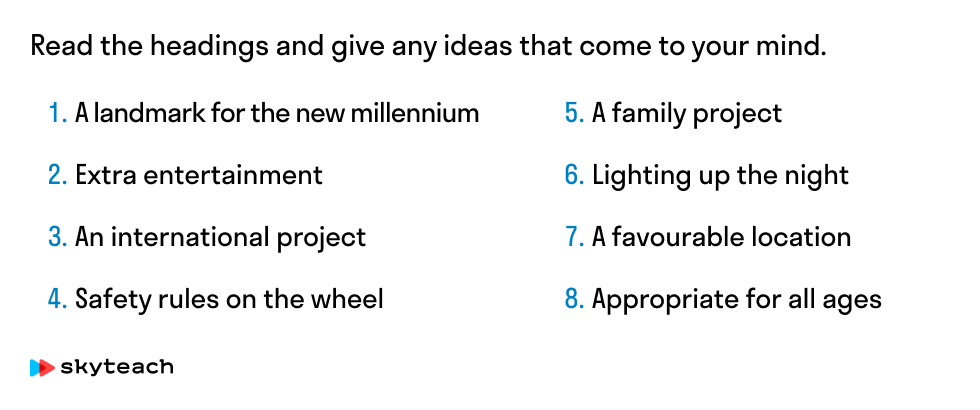
Ученик читает предложенные заголовки, не смотря на сами тексты. Его задача — придумать к каждому заголовку несколько ключевых слов или идеи для будущего текста.
Рассмотрим один из вариантов заданий прошлых лет. Мы взяли его из «Открытого банка заданий» ФИПИ.
Ход работы:
Задание 1. Студент читает каждый заголовок и пишет ассоциации или идеи, о которых может пойти речь.
Задание 2. Студент читает те же заголовки и совмещает их с возможными идеями. Вы можете добавить одну лишнюю.
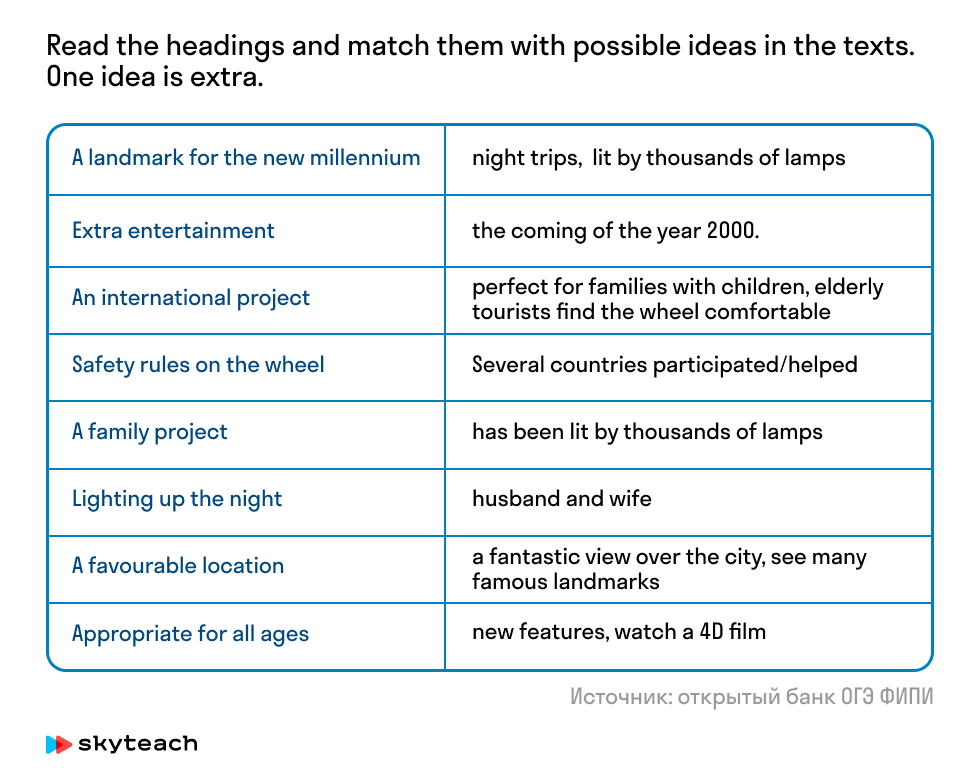
Совет. Рекомендуем брать идеи из предлагаемых в задании текстов.
Стратегия 2
Студент сначала читает текст и пробует самостоятельно озаглавить его. Затем ученик сравнивает собственные идеи со списком и выбирает наиболее близкий заголовок.
Совет. При подготовке упражнения берите тексты и заголовки из открытого банка ФИПИ, при этом важно выбрать наиболее близкие по идеям три заголовка для одного текста.
а) Read the text and give it a title:
b) Choose the most convenient title:
Old word — new meaning
For travellers’ needs
New word — old service
Стратегия 3
Студент читает заголовки и выделяет ключевые слова. Его задача — подобрать к каждому из них синоним, который может встретиться в будущем тексте.
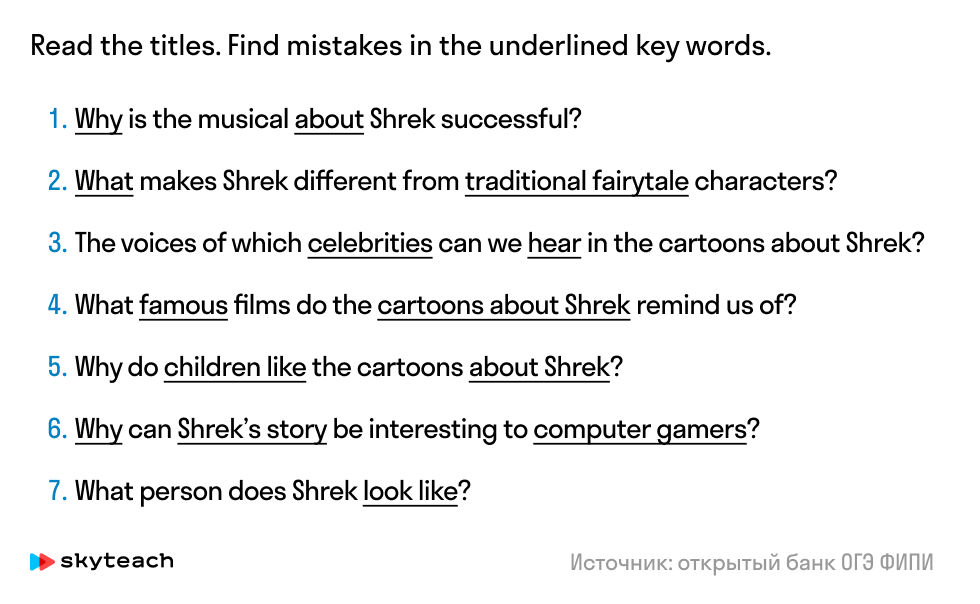
Подготовительное упражнение 1. Ученик читает заголовки, в которых уже подчеркнуты слова. Необходимо найти ошибки в выборе ключевых слов.
Подготовительное упражнение 2. Студент читает заголовок, выделяет в нем ключевые слова и подбирает к каждому синонимы.
Итоговым заданием серии уроков по этой стратегии будет полная версия экзаменационного задания. Ученик должен продемонстрировать, как выделяет ключевые слова в заголовках и находит синонимы в текстах.
4. Отрабатываем задание на заполнение пропусков (Задание 11 ЕГЭ)
По отзывам студентов, это задание доставляет больше всего проблем.
Ход работы при подготовке к экзамену может быть таким:
- подбор возможных вариантов на месте подчеркнутого слова;
- восстановление пропущенного слова в тексте;
- выбор из двух фраз на месте пропуска;
- заполнение пропусков фразами;
- работа над стратегией опорных слов.
Как видите, работа идет от простого к сложному. При этом важно научить студента не бояться восстанавливать контекст.
Отрабатывать заполнение пропусков можно косвенно, когда вы тренируете другие задания письменной части. Например, после подбора заголовков и текстов подчеркните некоторые слова в одном из абзацев. Задача студента — подобрать, какие еще варианты могут быть в этих местах.
Возьмем пример, который уже рассматривали в статье. В скобках даем возможные варианты замен:
Когда ваш студент будет готов к более сложной версии задания, скройте некоторые слова в тексте. Выпускнику нужно угадать по контексту, что пропущено. Обратите внимание, определяет он ли или нет, к каким частям речи относятся искомые слова.
Так может выглядеть вариант задания. Текст вновь взяли из первого задания ЕГЭ для косвенной проработки:
Как главную стратегию предложите студенту анализ слов до и после пропуска, а также самих фраз в задании.
Задание 1. Анализ слов до и после пропуска
Ход работы:
- студент читает только текст, не видя предложенных фраз;
- подчеркивает слова до и после пропуска;
- конструирует возможную фразу;
- смотрит на предложенные фразы и выбирает наиболее близкую.
Задание 2. Анализ предложенных фраз
Ход работы:
- студент читает заголовок текста;
- читает фразы, не смотря на текст;
- подбирает несколько вариантов возможных слов до и после;
- читает текст и заполняет пропуски.
Так может выглядеть итог подготовительной работы с фразами до чтения текста:
Попросите выпускника объяснить, что в каждой фразе натолкнуло его на предложенные варианты.
5. Отрабатываем задание 12-18 ЕГЭ и задание 13-19 ОГЭ
Объединили эти два задания, так как они предполагают, с одной стороны, полное понимание прочитанного, а с другой — анализ вопросов к тексту. Рассмотрим общие стратегии и ход работы над ними.
Период подготовки к выполнению задания можно разделить на этапы по формированию четырех микроумений. Разберем каждое.
1. Микроумение задавать вопросы и находить важную информацию в тексте
Можно предложить следующие варианты заданий:
Второе задание может выглядеть так:
Совет. Содержание вопросов рекомендуем брать из предлагаемых утверждений в экзаменационном задании. Кроме того, необходимо включать на первый взгляд похожие вопросы в задание. Это позволит формировать микроумение выделять детали в прочитанном тексте.
2. Микроумение выделять ключевые слова в вопросах, вариантах ответа и утверждениях
Навык можно сформировать косвенно в заданиях, которые уже были рассмотрены. Рекомендуем уделить внимание подбору синонимов к каждому ключевому слову.
3. Микроумение подтверждать или опровергать утверждения
Важный для экзамена навык, который поможет проверить выбранные ответы.
Чтобы сформировать это микроумение, всегда просите студента находить подтверждения своего ответа прямо в тексте. Эффективно использовать инструменты хайлайтер и маркер, которые есть на разных онлайн-досках и в текстовых редакторах.
4. Работа над стратегиями выполнения задания
Каждое из микроумений становится основой стратегий. Это можно представить в виде списка:
- прочитать текст и попробовать задать несколько вопросов к нему;
- прочитать утверждения, подчеркнуть ключевые слова, подобрать к ним синонимы и выбрать правильный вариант ответа, прочитав нужный фрагмент текста;
- прочитать утверждения, не глядя на предложенные варианты ответов, подчеркнуть ключевые слова, подобрать к ним синонимы и найти ответ в тексте самостоятельно. Затем сравнить собственный ответ с предложенными.
Вторая и третья стратегия — на выбор.
Для проверки микроумений используйте полный текст с заданиями. Перед выполнением студенту необходимо объяснить, какую стратегию он будет использовать.
Примеры заданий для работы над микроумениями:
- Read the text and ask questions to the underlined words. Прочитайте текст и задайте вопросы к подчеркнутым словам.
- Read the text and make up 3 true statements, 3 false statements and 2 not stated. Прочитайте текст и придумайте 3 правдивых, 3 ложных утверждения и 2 утверждения, о которых в тексте ничего не сказано.
- Read the questions and make up 3 options, one of which is the correct one. Прочитайте предложенные вопросы и придумайте к ним 3 варианта ответа, один из которых правильный.
Важно сделать отработку стратегий разнообразной и интересной. Для этого меняйте формат работы, последовательность действий, а также побуждайте студентов придумывать задания и вопросы к текстам. Тогда подготовка к экзаменам будет эффективной, и ваши ученики получат на ОГЭ и ЕГЭ по английскому языку высокие баллы.

More comfortable online than out partying, post-Millennials are safer, physically, than adolescents have ever been. But they’re on the brink of a mental-health crisis.
One day last summer, around noon, I called Athena, a 13-year-old who lives in Houston, Texas. She answered her phone—she’s had an iPhone since she was 11—sounding as if she’d just woken up. We chatted about her favorite songs and TV shows, and I asked her what she likes to do with her friends. “We go to the mall,” she said. “Do your parents drop you off?,” I asked, recalling my own middle-school days, in the 1980s, when I’d enjoy a few parent-free hours shopping with my friends. “No—I go with my family,” she replied. “We’ll go with my mom and brothers and walk a little behind them. I just have to tell my mom where we’re going. I have to check in every hour or every 30 minutes.”
Those mall trips are infrequent—about once a month. More often, Athena and her friends spend time together on their phones, unchaperoned. Unlike the teens of my generation, who might have spent an evening tying up the family landline with gossip, they talk on Snapchat, the smartphone app that allows users to send pictures and videos that quickly disappear. They make sure to keep up their Snapstreaks, which show how many days in a row they have Snapchatted with each other. Sometimes they save screenshots of particularly ridiculous pictures of friends. “It’s good blackmail,” Athena said. (Because she’s a minor, I’m not using her real name.) She told me she’d spent most of the summer hanging out alone in her room with her phone. That’s just the way her generation is, she said. “We didn’t have a choice to know any life without iPads or iPhones. I think we like our phones more than we like actual people.”
Recommended Reading
I’ve been researching generational differences for 25 years, starting when I was a 22-year-old doctoral student in psychology. Typically, the characteristics that come to define a generation appear gradually, and along a continuum. Beliefs and behaviors that were already rising simply continue to do so. Millennials, for instance, are a highly individualistic generation, but individualism had been increasing since the Baby Boomers turned on, tuned in, and dropped out. I had grown accustomed to line graphs of trends that looked like modest hills and valleys. Then I began studying Athena’s generation.
Around 2012, I noticed abrupt shifts in teen behaviors and emotional states. The gentle slopes of the line graphs became steep mountains and sheer cliffs, and many of the distinctive characteristics of the Millennial generation began to disappear. In all my analyses of generational data—some reaching back to the 1930s—I had never seen anything like it.
At first I presumed these might be blips, but the trends persisted, across several years and a series of national surveys. The changes weren’t just in degree, but in kind. The biggest difference between the Millennials and their predecessors was in how they viewed the world; teens today differ from the Millennials not just in their views but in how they spend their time. The experiences they have every day are radically different from those of the generation that came of age just a few years before them.
What happened in 2012 to cause such dramatic shifts in behavior? It was after the Great Recession, which officially lasted from 2007 to 2009 and had a starker effect on Millennials trying to find a place in a sputtering economy. But it was exactly the moment when the proportion of Americans who owned a smartphone surpassed 50 percent.
The more I pored over yearly surveys of teen attitudes and behaviors, and the more I talked with young people like Athena, the clearer it became that theirs is a generation shaped by the smartphone and by the concomitant rise of social media. I call them iGen. Born between 1995 and 2012, members of this generation are growing up with smartphones, have an Instagram account before they start high school, and do not remember a time before the internet. The Millennials grew up with the web as well, but it wasn’t ever-present in their lives, at hand at all times, day and night. iGen’s oldest members were early adolescents when the iPhone was introduced, in 2007, and high-school students when the iPad entered the scene, in 2010. A 2017 survey of more than 5,000 American teens found that three out of four owned an iPhone.
The advent of the smartphone and its cousin the tablet was followed quickly by hand-wringing about the deleterious effects of “screen time.” But the impact of these devices has not been fully appreciated, and goes far beyond the usual concerns about curtailed attention spans. The arrival of the smartphone has radically changed every aspect of teenagers’ lives, from the nature of their social interactions to their mental health. These changes have affected young people in every corner of the nation and in every type of household. The trends appear among teens poor and rich; of every ethnic background; in cities, suburbs, and small towns. Where there are cell towers, there are teens living their lives on their smartphone.
To those of us who fondly recall a more analog adolescence, this may seem foreign and troubling. The aim of generational study, however, is not to succumb to nostalgia for the way things used to be; it’s to understand how they are now. Some generational changes are positive, some are negative, and many are both. More comfortable in their bedrooms than in a car or at a party, today’s teens are physically safer than teens have ever been. They’re markedly less likely to get into a car accident and, having less of a taste for alcohol than their predecessors, are less susceptible to drinking’s attendant ills.
Psychologically, however, they are more vulnerable than Millennials were: Rates of teen depression and suicide have skyrocketed since 2011. It’s not an exaggeration to describe iGen as being on the brink of the worst mental-health crisis in decades. Much of this deterioration can be traced to their phones.
Even when a seismic event—a war, a technological leap, a free concert in the mud—plays an outsize role in shaping a group of young people, no single factor ever defines a generation. Parenting styles continue to change, as do school curricula and culture, and these things matter. But the twin rise of the smartphone and social media has caused an earthquake of a magnitude we’ve not seen in a very long time, if ever. There is compelling evidence that the devices we’ve placed in young people’s hands are having profound effects on their lives—and making them seriously unhappy.
In the early 1970s, the photographer Bill Yates shot a series of portraits at the Sweetheart Roller Skating Rink in Tampa, Florida. In one, a shirtless teen stands with a large bottle of peppermint schnapps stuck in the waistband of his jeans. In another, a boy who looks no older than 12 poses with a cigarette in his mouth. The rink was a place where kids could get away from their parents and inhabit a world of their own, a world where they could drink, smoke, and make out in the backs of their cars. In stark black-and-white, the adolescent Boomers gaze at Yates’s camera with the self-confidence born of making your own choices—even if, perhaps especially if, your parents wouldn’t think they were the right ones.
Fifteen years later, during my own teenage years as a member of Generation X, smoking had lost some of its romance, but independence was definitely still in. My friends and I plotted to get our driver’s license as soon as we could, making DMV appointments for the day we turned 16 and using our newfound freedom to escape the confines of our suburban neighborhood. Asked by our parents, “When will you be home?,” we replied, “When do I have to be?”
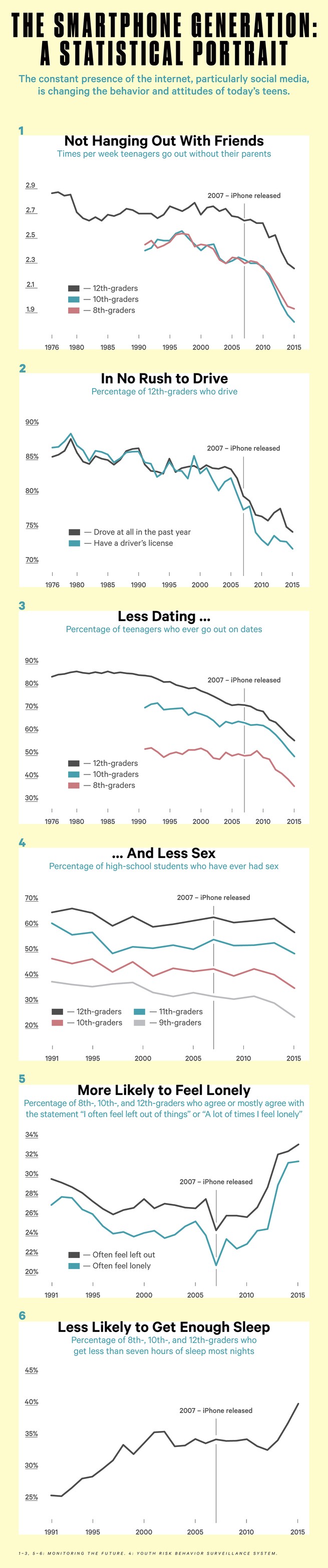
But the allure of independence, so powerful to previous generations, holds less sway over today’s teens, who are less likely to leave the house without their parents. The shift is stunning: 12th-graders in 2015 were going out less often than eighth-graders did as recently as 2009.
Today’s teens are also less likely to date. The initial stage of courtship, which Gen Xers called “liking” (as in “Ooh, he likes you!”), kids now call “talking”—an ironic choice for a generation that prefers texting to actual conversation. After two teens have “talked” for a while, they might start dating. But only about 56 percent of high-school seniors in 2015 went out on dates; for Boomers and Gen Xers, the number was about 85 percent.
The decline in dating tracks with a decline in sexual activity. The drop is the sharpest for ninth-graders, among whom the number of sexually active teens has been cut by almost 40 percent since 1991. The average teen now has had sex for the first time by the spring of 11th grade, a full year later than the average Gen Xer. Fewer teens having sex has contributed to what many see as one of the most positive youth trends in recent years: The teen birth rate hit an all-time low in 2016, down 67 percent since its modern peak, in 1991.
Even driving, a symbol of adolescent freedom inscribed in American popular culture, from Rebel Without a Cause to Ferris Bueller’s Day Off, has lost its appeal for today’s teens. Nearly all Boomer high-school students had their driver’s license by the spring of their senior year; more than one in four teens today still lack one at the end of high school. For some, Mom and Dad are such good chauffeurs that there’s no urgent need to drive. “My parents drove me everywhere and never complained, so I always had rides,” a 21-year-old student in San Diego told me. “I didn’t get my license until my mom told me I had to because she could not keep driving me to school.” She finally got her license six months after her 18th birthday. In conversation after conversation, teens described getting their license as something to be nagged into by their parents—a notion that would have been unthinkable to previous generations.
Independence isn’t free—you need some money in your pocket to pay for gas, or for that bottle of schnapps. In earlier eras, kids worked in great numbers, eager to finance their freedom or prodded by their parents to learn the value of a dollar. But iGen teens aren’t working (or managing their own money) as much. In the late 1970s, 77 percent of high-school seniors worked for pay during the school year; by the mid-2010s, only 55 percent did. The number of eighth-graders who work for pay has been cut in half. These declines accelerated during the Great Recession, but teen employment has not bounced back, even though job availability has.
Of course, putting off the responsibilities of adulthood is not an iGen innovation. Gen Xers, in the 1990s, were the first to postpone the traditional markers of adulthood. Young Gen Xers were just about as likely to drive, drink alcohol, and date as young Boomers had been, and more likely to have sex and get pregnant as teens. But as they left their teenage years behind, Gen Xers married and started careers later than their Boomer predecessors had.
Gen X managed to stretch adolescence beyond all previous limits: Its members started becoming adults earlier and finished becoming adults later. Beginning with Millennials and continuing with iGen, adolescence is contracting again—but only because its onset is being delayed. Across a range of behaviors—drinking, dating, spending time unsupervised— 18-year-olds now act more like 15-year-olds used to, and 15-year-olds more like 13-year-olds. Childhood now stretches well into high school.
Why are today’s teens waiting longer to take on both the responsibilities and the pleasures of adulthood? Shifts in the economy, and parenting, certainly play a role. In an information economy that rewards higher education more than early work history, parents may be inclined to encourage their kids to stay home and study rather than to get a part-time job. Teens, in turn, seem to be content with this homebody arrangement—not because they’re so studious, but because their social life is lived on their phone. They don’t need to leave home to spend time with their friends.
If today’s teens were a generation of grinds, we’d see that in the data. But eighth-, 10th-, and 12th-graders in the 2010s actually spend less time on homework than Gen X teens did in the early 1990s. (High-school seniors headed for four-year colleges spend about the same amount of time on homework as their predecessors did.) The time that seniors spend on activities such as student clubs and sports and exercise has changed little in recent years. Combined with the decline in working for pay, this means iGen teens have more leisure time than Gen X teens did, not less.
So what are they doing with all that time? They are on their phone, in their room, alone and often distressed.
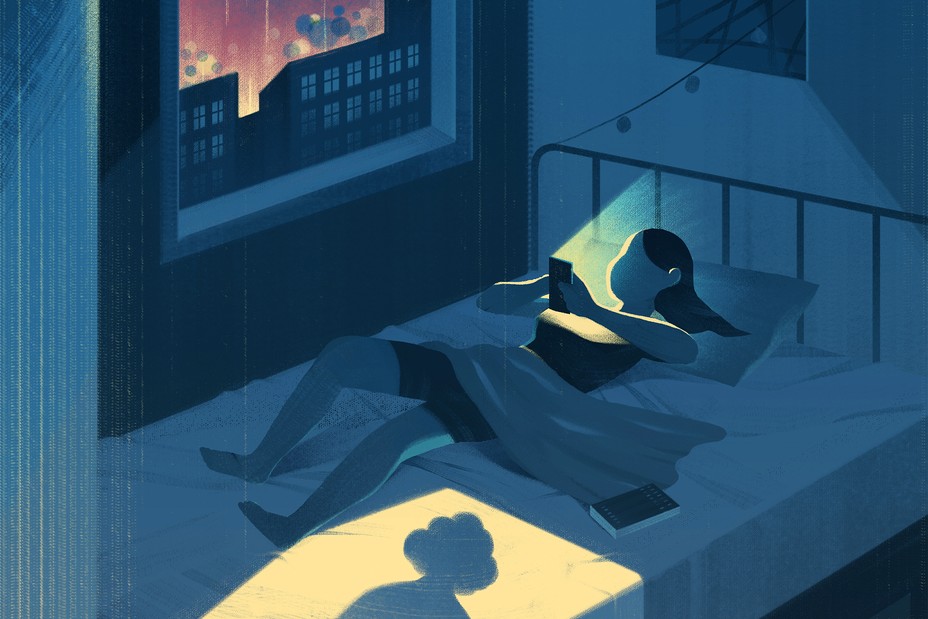
One of the ironies of iGen life is that despite spending far more time under the same roof as their parents, today’s teens can hardly be said to be closer to their mothers and fathers than their predecessors were. “I’ve seen my friends with their families—they don’t talk to them,” Athena told me. “They just say ‘Okay, okay, whatever’ while they’re on their phones. They don’t pay attention to their family.” Like her peers, Athena is an expert at tuning out her parents so she can focus on her phone. She spent much of her summer keeping up with friends, but nearly all of it was over text or Snapchat. “I’ve been on my phone more than I’ve been with actual people,” she said. “My bed has, like, an imprint of my body.”
In this, too, she is typical. The number of teens who get together with their friends nearly every day dropped by more than 40 percent from 2000 to 2015; the decline has been especially steep recently. It’s not only a matter of fewer kids partying; fewer kids are spending time simply hanging out. That’s something most teens used to do: nerds and jocks, poor kids and rich kids, C students and A students. The roller rink, the basketball court, the town pool, the local necking spot—they’ve all been replaced by virtual spaces accessed through apps and the web.
You might expect that teens spend so much time in these new spaces because it makes them happy, but most data suggest that it does not. The Monitoring the Future survey, funded by the National Institute on Drug Abuse and designed to be nationally representative, has asked 12th-graders more than 1,000 questions every year since 1975 and queried eighth- and 10th-graders since 1991. The survey asks teens how happy they are and also how much of their leisure time they spend on various activities, including nonscreen activities such as in-person social interaction and exercise, and, in recent years, screen activities such as using social media, texting, and browsing the web. The results could not be clearer: Teens who spend more time than average on screen activities are more likely to be unhappy, and those who spend more time than average on nonscreen activities are more likely to be happy.
There’s not a single exception. All screen activities are linked to less happiness, and all nonscreen activities are linked to more happiness. Eighth-graders who spend 10 or more hours a week on social media are 56 percent more likely to say they’re unhappy than those who devote less time to social media. Admittedly, 10 hours a week is a lot. But those who spend six to nine hours a week on social media are still 47 percent more likely to say they are unhappy than those who use social media even less. The opposite is true of in-person interactions. Those who spend an above-average amount of time with their friends in person are 20 percent less likely to say they’re unhappy than those who hang out for a below-average amount of time.
If you were going to give advice for a happy adolescence based on this survey, it would be straightforward: Put down the phone, turn off the laptop, and do something—anything—that does not involve a screen. Of course, these analyses don’t unequivocally prove that screen time causes unhappiness; it’s possible that unhappy teens spend more time online. But recent research suggests that screen time, in particular social-media use, does indeed cause unhappiness. One study asked college students with a Facebook page to complete short surveys on their phone over the course of two weeks. They’d get a text message with a link five times a day, and report on their mood and how much they’d used Facebook. The more they’d used Facebook, the unhappier they felt, but feeling unhappy did not subsequently lead to more Facebook use.
Social-networking sites like Facebook promise to connect us to friends. But the portrait of iGen teens emerging from the data is one of a lonely, dislocated generation. Teens who visit social-networking sites every day but see their friends in person less frequently are the most likely to agree with the statements “A lot of times I feel lonely,” “I often feel left out of things,” and “I often wish I had more good friends.” Teens’ feelings of loneliness spiked in 2013 and have remained high since.
This doesn’t always mean that, on an individual level, kids who spend more time online are lonelier than kids who spend less time online. Teens who spend more time on social media also spend more time with their friends in person, on average—highly social teens are more social in both venues, and less social teens are less so. But at the generational level, when teens spend more time on smartphones and less time on in-person social interactions, loneliness is more common.
So is depression. Once again, the effect of screen activities is unmistakable: The more time teens spend looking at screens, the more likely they are to report symptoms of depression. Eighth-graders who are heavy users of social media increase their risk of depression by 27 percent, while those who play sports, go to religious services, or even do homework more than the average teen cut their risk significantly.
Teens who spend three hours a day or more on electronic devices are 35 percent more likely to have a risk factor for suicide, such as making a suicide plan. (That’s much more than the risk related to, say, watching TV.) One piece of data that indirectly but stunningly captures kids’ growing isolation, for good and for bad: Since 2007, the homicide rate among teens has declined, but the suicide rate has increased. As teens have started spending less time together, they have become less likely to kill one another, and more likely to kill themselves. In 2011, for the first time in 24 years, the teen suicide rate was higher than the teen homicide rate.
Depression and suicide have many causes; too much technology is clearly not the only one. And the teen suicide rate was even higher in the 1990s, long before smartphones existed. Then again, about four times as many Americans now take antidepressants, which are often effective in treating severe depression, the type most strongly linked to suicide.
What’s the connection between smartphones and the apparent psychological distress this generation is experiencing? For all their power to link kids day and night, social media also exacerbate the age-old teen concern about being left out. Today’s teens may go to fewer parties and spend less time together in person, but when they do congregate, they document their hangouts relentlessly—on Snapchat, Instagram, Facebook. Those not invited to come along are keenly aware of it. Accordingly, the number of teens who feel left out has reached all-time highs across age groups. Like the increase in loneliness, the upswing in feeling left out has been swift and significant.
This trend has been especially steep among girls. Forty-eight percent more girls said they often felt left out in 2015 than in 2010, compared with 27 percent more boys. Girls use social media more often, giving them additional opportunities to feel excluded and lonely when they see their friends or classmates getting together without them. Social media levy a psychic tax on the teen doing the posting as well, as she anxiously awaits the affirmation of comments and likes. When Athena posts pictures to Instagram, she told me, “I’m nervous about what people think and are going to say. It sometimes bugs me when I don’t get a certain amount of likes on a picture.”
Girls have also borne the brunt of the rise in depressive symptoms among today’s teens. Boys’ depressive symptoms increased by 21 percent from 2012 to 2015, while girls’ increased by 50 percent—more than twice as much. The rise in suicide, too, is more pronounced among girls. Although the rate increased for both sexes, three times as many 12-to-14-year-old girls killed themselves in 2015 as in 2007, compared with twice as many boys. The suicide rate is still higher for boys, in part because they use more-lethal methods, but girls are beginning to close the gap.
These more dire consequences for teenage girls could also be rooted in the fact that they’re more likely to experience cyberbullying. Boys tend to bully one another physically, while girls are more likely to do so by undermining a victim’s social status or relationships. Social media give middle- and high-school girls a platform on which to carry out the style of aggression they favor, ostracizing and excluding other girls around the clock.
Social-media companies are of course aware of these problems, and to one degree or another have endeavored to prevent cyberbullying. But their various motivations are, to say the least, complex. A recently leaked Facebook document indicated that the company had been touting to advertisers its ability to determine teens’ emotional state based on their on-site behavior, and even to pinpoint “moments when young people need a confidence boost.” Facebook acknowledged that the document was real, but denied that it offers “tools to target people based on their emotional state.”
In July 2014, a 13-year-old girl in North Texas woke to the smell of something burning. Her phone had overheated and melted into the sheets. National news outlets picked up the story, stoking readers’ fears that their cellphone might spontaneously combust. To me, however, the flaming cellphone wasn’t the only surprising aspect of the story. Why, I wondered, would anyone sleep with her phone beside her in bed? It’s not as though you can surf the web while you’re sleeping. And who could slumber deeply inches from a buzzing phone?
Curious, I asked my undergraduate students at San Diego State University what they do with their phone while they sleep. Their answers were a profile in obsession. Nearly all slept with their phone, putting it under their pillow, on the mattress, or at the very least within arm’s reach of the bed. They checked social media right before they went to sleep, and reached for their phone as soon as they woke up in the morning (they had to—all of them used it as their alarm clock). Their phone was the last thing they saw before they went to sleep and the first thing they saw when they woke up. If they woke in the middle of the night, they often ended up looking at their phone. Some used the language of addiction. “I know I shouldn’t, but I just can’t help it,” one said about looking at her phone while in bed. Others saw their phone as an extension of their body—or even like a lover: “Having my phone closer to me while I’m sleeping is a comfort.”
It may be a comfort, but the smartphone is cutting into teens’ sleep: Many now sleep less than seven hours most nights. Sleep experts say that teens should get about nine hours of sleep a night; a teen who is getting less than seven hours a night is significantly sleep deprived. Fifty-seven percent more teens were sleep deprived in 2015 than in 1991. In just the four years from 2012 to 2015, 22 percent more teens failed to get seven hours of sleep.
The increase is suspiciously timed, once again starting around when most teens got a smartphone. Two national surveys show that teens who spend three or more hours a day on electronic devices are 28 percent more likely to get less than seven hours of sleep than those who spend fewer than three hours, and teens who visit social-media sites every day are 19 percent more likely to be sleep deprived. A meta-analysis of studies on electronic-device use among children found similar results: Children who use a media device right before bed are more likely to sleep less than they should, more likely to sleep poorly, and more than twice as likely to be sleepy during the day.
Electronic devices and social media seem to have an especially strong ability to disrupt sleep. Teens who read books and magazines more often than the average are actually slightly less likely to be sleep deprived—either reading lulls them to sleep, or they can put the book down at bedtime. Watching TV for several hours a day is only weakly linked to sleeping less. But the allure of the smartphone is often too much to resist.
Sleep deprivation is linked to myriad issues, including compromised thinking and reasoning, susceptibility to illness, weight gain, and high blood pressure. It also affects mood: People who don’t sleep enough are prone to depression and anxiety. Again, it’s difficult to trace the precise paths of causation. Smartphones could be causing lack of sleep, which leads to depression, or the phones could be causing depression, which leads to lack of sleep. Or some other factor could be causing both depression and sleep deprivation to rise. But the smartphone, its blue light glowing in the dark, is likely playing a nefarious role.
The correlations between depression and smartphone use are strong enough to suggest that more parents should be telling their kids to put down their phone. As the technology writer Nick Bilton has reported, it’s a policy some Silicon Valley executives follow. Even Steve Jobs limited his kids’ use of the devices he brought into the world.
What’s at stake isn’t just how kids experience adolescence. The constant presence of smartphones is likely to affect them well into adulthood. Among people who suffer an episode of depression, at least half become depressed again later in life. Adolescence is a key time for developing social skills; as teens spend less time with their friends face-to-face, they have fewer opportunities to practice them. In the next decade, we may see more adults who know just the right emoji for a situation, but not the right facial expression.
I realize that restricting technology might be an unrealistic demand to impose on a generation of kids so accustomed to being wired at all times. My three daughters were born in 2006, 2009, and 2012. They’re not yet old enough to display the traits of iGen teens, but I have already witnessed firsthand just how ingrained new media are in their young lives. I’ve observed my toddler, barely old enough to walk, confidently swiping her way through an iPad. I’ve experienced my 6-year-old asking for her own cellphone. I’ve overheard my 9-year-old discussing the latest app to sweep the fourth grade. Prying the phone out of our kids’ hands will be difficult, even more so than the quixotic efforts of my parents’ generation to get their kids to turn off MTV and get some fresh air. But more seems to be at stake in urging teens to use their phone responsibly, and there are benefits to be gained even if all we instill in our children is the importance of moderation. Significant effects on both mental health and sleep time appear after two or more hours a day on electronic devices. The average teen spends about two and a half hours a day on electronic devices. Some mild boundary-setting could keep kids from falling into harmful habits.
In my conversations with teens, I saw hopeful signs that kids themselves are beginning to link some of their troubles to their ever-present phone. Athena told me that when she does spend time with her friends in person, they are often looking at their device instead of at her. “I’m trying to talk to them about something, and they don’t actually look at my face,” she said. “They’re looking at their phone, or they’re looking at their Apple Watch.” “What does that feel like, when you’re trying to talk to somebody face-to-face and they’re not looking at you?,” I asked. “It kind of hurts,” she said. “It hurts. I know my parents’ generation didn’t do that. I could be talking about something super important to me, and they wouldn’t even be listening.”
Once, she told me, she was hanging out with a friend who was texting her boyfriend. “I was trying to talk to her about my family, and what was going on, and she was like, ‘Uh-huh, yeah, whatever.’ So I took her phone out of her hands and I threw it at my wall.”
I couldn’t help laughing. “You play volleyball,” I said. “Do you have a pretty good arm?” “Yep,” she replied.
This article has been adapted from Jean M. Twenge’s forthcoming book, iGen: Why Today’s Super-Connected Kids Are Growing Up Less Rebellious, More Tolerant, Less Happy—and Completely Unprepared for Adulthood—and What That Means for the Rest of Us.