
Установите соответствие между текстами и рубриками, выбрав рубрику из выпадающего списка. Используйте каждую рубрику только один раз. В задании одна рубрика лишняя.
Выпадающий список:
1. Weather
2. People
3. Health
4. Sports
5. Sightseeing
6. Nature
A. The Kuskovo Palace was built on the site of an old manor-house under the direction of the Moscow architect Karl Blank (1728–1793). The Palace was built in 1769-1775 inthe style of early classicism. The Palace is built in wood, the traditional building material used by Russian architects. The lower floor is built in brick.
B. For many days now, there have been historic and devastating floods in the state of Colorado, in and around the city of Boulder. And it’s all because of a huge amount of rain in a shortperiod of time! One area near Denver received as much rain in one day … as it usually does almost all year. That’s an all-time record for that area, according to NBC News.
C. What would you say the top predator in the world is? Lions? Elephants? Whales? People? According to Dr. Martin Nyffeler from the University of Basel in Switzerland, it’s … the spider. If you took every spider in the world and measured howmuch they all ate, it turns out to be an astronomical 400-800 million tons of prey each year.
D. First Lady Michelle Obama unveiled a new design today showing us what healthy eatinglooks like. And it’s simple. Half your meal should be fruits and vegetables. Some other important parts of her meal plan: —drink water instead of sugary drinks; —avoid oversized portions; —switch to low-fat milk; —compare salt on food packages and go with the onesthat have less.
E. The Chicago Cubs won the World Series for the first time since 1908, ending the longeststretch of time for a team between World Series’ wins — over a century. The Cubs had been down three games to one in this best of seven series, the Cleveland Indians being just onewin away from winning it all … three games in a row.
| Текст | A | B | C | D | E |
| Рубрика |
Задание №8941.
Чтение. ЕГЭ по английскому
Прочитайте текст и заполните пропуски A — F частями предложений, обозначенными цифрами 1 — 7. Одна из частей в списке 1—7 лишняя.
Nevsky Prospect
Nevsky Prospect is the main and most famous street of St. Petersburg. The unique architectural ensemble of Nevsky Prospect was formed during the 18th – early 20th centuries. It starts from the bank of the Neva River, runs through the centre of the city and ends at the Neva River. The whole history of St. Petersburg can be seen in the history of the avenue. The length of Nevsky Prospect is 4.5 km, the width is 25-60 m. The narrowest section is located from the Admiralty to the Moika River, ___ (A).
After the construction of the Admiralty in 1704 and the Alexander Nevsky Monastery in 1710, it was decided to build a road ___ (B) each other and with the Novgorod Path, which was used by Russian merchants. The construction began on both sides at the same time, the roads were laid through the wood, and in 1760s they were connected into one road, ___ (C), but with a turn at the Vosstaniya Square. Nevsky Prospect got its name only in 1783. The road was paved with cobble stones, ___ (D). It was the first street in St. Petersburg with gas lighting. By the early 20th century Nevsky Prospect had become the financial centre of Russia ___ (E) had their offices there.
Nowadays, Nevsky Prospect is the centre of cultural and social life of St. Petersburg. There are museums, theatres, exhibition halls, cinemas, restaurants, cafés, shops ___ (F).
1. and hotels there or nearby the avenue
2. showing the original width of the avenue
3. which was not as straight as it was planned
4. which were built by famous architects and
5. connecting these two important structures with
6. and a few rows of trees were planted along the street
7. as the 40 largest banks of Russia, Europe and America
| A | B | C | D | E | F |
Решение:
Пропуску A соответствует часть текста под номером 2.
Пропуску B соответствует часть текста под номером 5.
Пропуску C соответствует часть текста под номером 3.
Пропуску D соответствует часть текста под номером 6.
Пропуску E соответствует часть текста под номером 7.
Пропуску F соответствует часть текста под номером 1.
Показать ответ
Источник: ФИПИ. Открытый банк тестовых заданий
Сообщить об ошибке
Тест с похожими заданиями
E. The Oldest Town
B. The Emblem with an Animal
F. The Religious Centre
C. The City of Brides
G. The Market Town
D. The Cradle of the Tsar Dynasty
H. The Home Town of an Artist
Q1. Sergiev Posad was built around the Trinity Monastery of St. Sergius. Dating back to 1340, the
monastery is one of Russia’s most important historical landmarks. The town possesses a variety of
12th17th century buildings and visitors today still get a real feeling of Medieval Russia. The dominating
structure of the monastery is the massive, blue-domed and gold-starred Assumption cathedral, built in the
16th century. Adjacent is the tomb of Boris Godunov and his family. The monastery is still a place of
spiritual pilgrimage.
Q2. Rostov Velikiy (Rostov the Great) is an ancient Russian town located on the ‘Nero’ lake. The history
of this place started four thousand years ago, when the first tribes stayed next to the lake. Until the 11th
century the territory of Rostov was inhabited by the FinnUgors ‘Meryans’ people, and the town was
founded by them. Rostov was first mentioned in Russian chronicles in 862. It is a sleepy town with some
magnificent buildings. The focal point of the town is the Kremlin. Its churches are good examples of an
cient Russian architecture.
Q3. The name of Suzdal appeared in the annals for the first time in 1024. The first stone church was built
here in the 12th century. In Suzdal there are 33 churches, 5 monasteries, 7 chapels and no modern
construction in the centre of the town. Suzdal is officially protected from industry, and the old architecture
and buildings are kept intact. Suzdal is the town that was awarded The Golden Apple Prize for preservation
of its architectural ensemble and tourist development in the area.
Do’stlaringiz bilan baham:
How to get there from Moscow:
by train from Yaroslavl Station (travel time — 1:15-1:40 hrs)
When NOT to go:
During major Orthodox holidays: Christmas (January 7) and Easter, as it’s getting overcrowded
This small town has such a rich history and so much to tell about Russian culture and traditions that anyone interested in the country should definitely pay a visit. What’s more, the city is part of the Golden Ring tourist route, the only one inside Moscow Region, making it relatively reachable for a day trip from the capital.
To-do list:
- Visit the Trinity Cathedral
- Find the icon of the Trinity of Andrei Rublev
- Visit the Assumption Cathedral
- Find the wooden coffin of Sergius of Radonezh
- Count the towers on the monastery wall
- If the entrance to the walls is open, go along them and get a (low-flying) bird’s-eye-view of the monastery
- Find the tomb of Tsar Boris Godunov and his family
- Buy an icon or item of monastic handicraft as a keepsake
- Try the monastic buns and pastries
- Find the monument to Peter and Fevronia, the patron saints of marriage and family
A posad in Ancient Rus was the territory that surrounded a monastery or princely domain. They tended to be inhabited by artisans and traders, so were basically markets. Such a settlement took shape around the Trinity-Sergius Monastery by decree of Catherine the Great in 1782, and was named Sergiev in honor of St Sergius of Radonezh.
What is the Trinity-Sergius Lavra famous for?
According to legend, Sergius of Radonezh arrived here in the 1340s (some historians even pinpoint the year as 1342). He and a group of monks built a small dwelling for themselves, next to which they constructed a church in honor of the Holy Trinity.
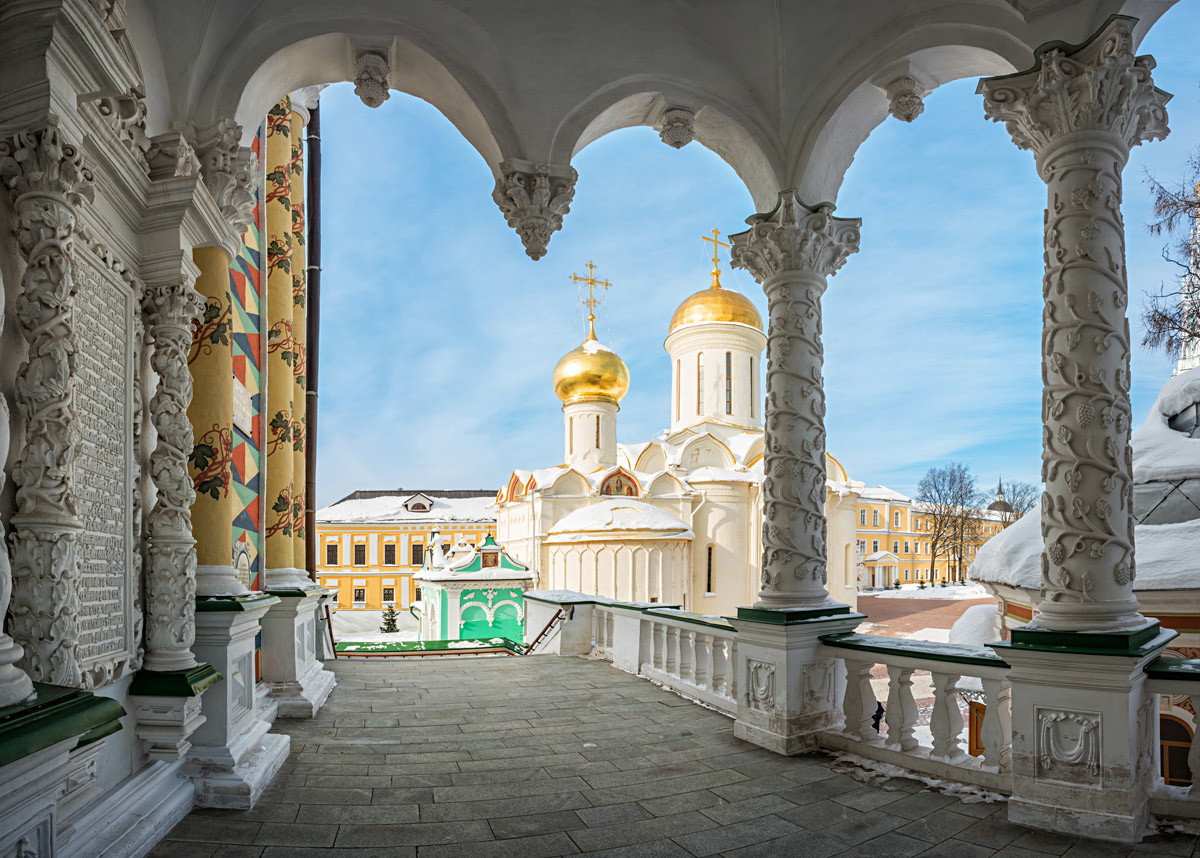
The Trinity Cathedral
Legion Media
Be sure to visit Trinity Cathedral. The modern version was built in 1422 (although it has been modified and renovated several times since). The finest master craftsmen of the 15th century worked on the interior decoration. It was for the iconostasis here that Andrei Rublev painted his famous Trinity icon, one of the most revered in the Russian Orthodox Church. It takes a trained eye to spot it. Look in the bottom row of the iconostasis – the first icon to the right of the gate leading to the altar.
Here’s a handy church-going hack. If you don’t know the name of a church, look at the lower icon to the right of the gate – a church is always devoted to this icon.
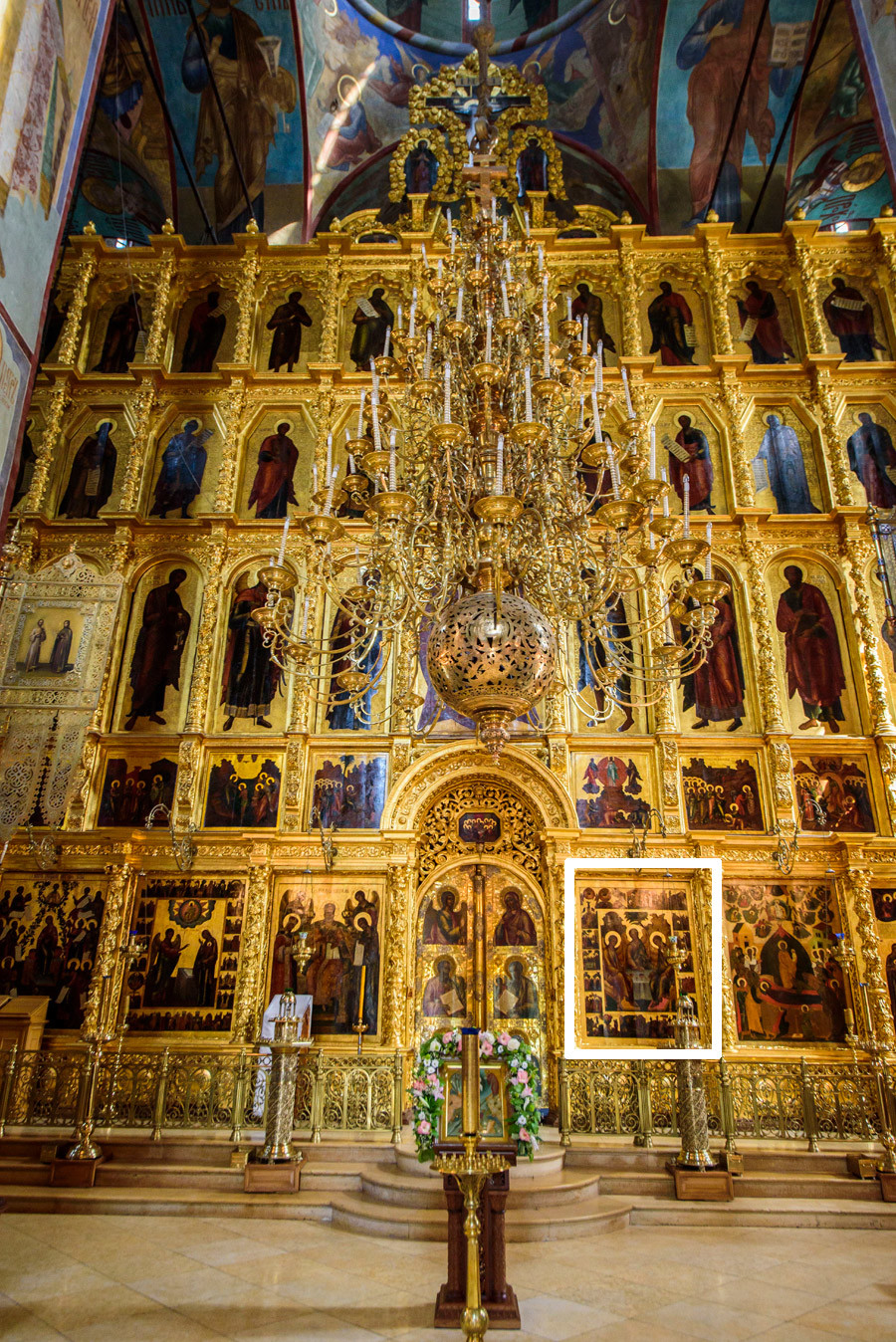
Iconostasis of the Trinity Cathedral
Getty Images
Trinity Cathedral was a particular favorite of Ivan the Terrible. It was here that he was baptized, got married, and held prayers after successful military campaigns.
The monastery withstood a siege by Polish invaders during the Time of Troubles, and supported Peter the Great when he was plotting a coup d’état against the regency of his half-sister Sophia Alekseyevna.
There are about ten churches inside the monastery, built at different times from the 15th to the 18th century. They offer a fascinating glimpse into the evolution of Russian church architecture.
There’s no need to see inside all of them, otherwise you’ll suffer church overload. But Assumption Cathedral, commissioned by Ivan the Terrible himself, is a must. It is recognizable by its blue domes with golden stars (by the way, whatever Golden Ring city you happen to be in, such domes signify that the shrine is dedicated to the Assumption of the Blessed Virgin Mary).
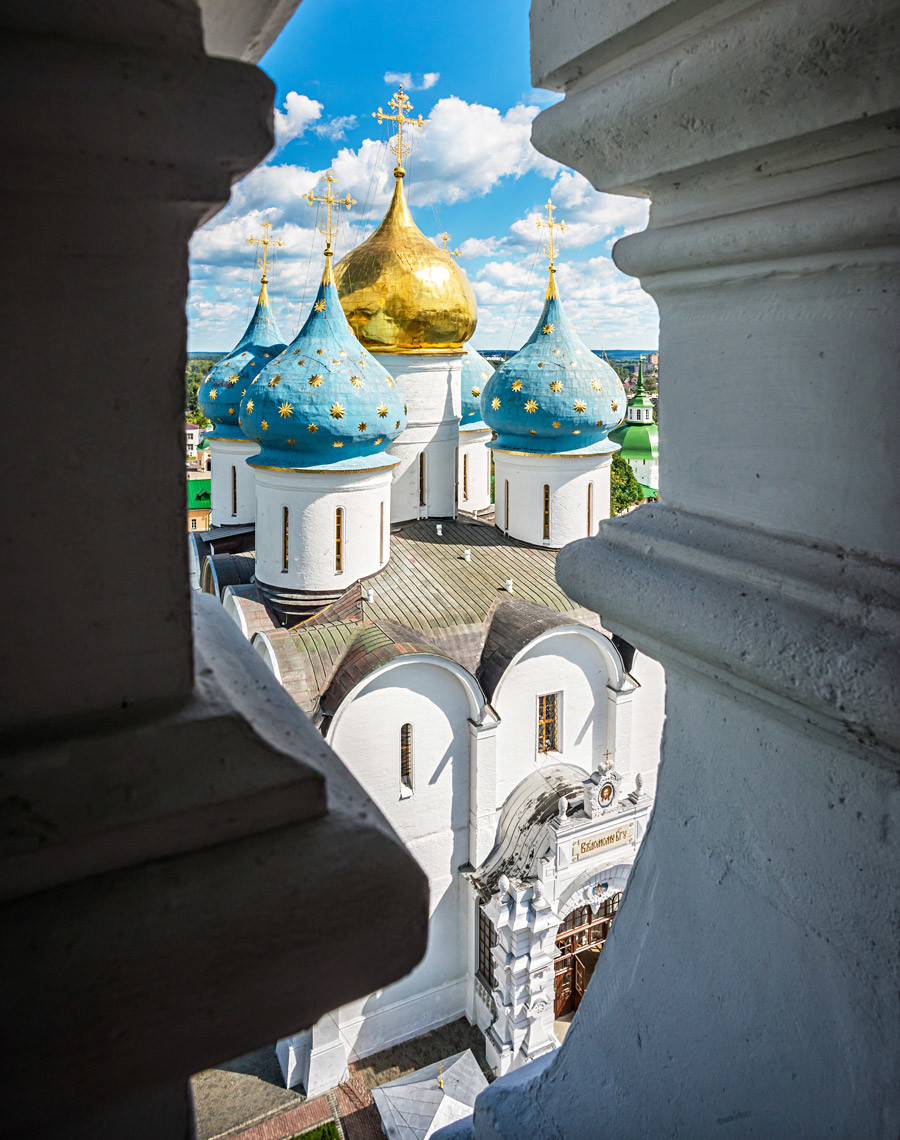
The Assumption Cathedral
Legion Media
Inside, you should definitely look up to admire the murals. Also, be sure to find the old wooden coffin of St. Sergius of Radonezh (although his actual relics are in Trinity Cathedral).
What is Sergius of Radonezh famous for?
For Russians, the name of Sergius of Radonezh is associated with the country’s revival after the centuries of Tatar-Mongol rule, and the so-called Russian Renaissance. He and his students founded not only the Trinity-Sergius Lavra, but a dozen other monasteries in central Russia, making him perhaps the most revered Russian saint in the Orthodox world. In the 20th century, he was also officially recognized by the Catholic Church.
His secular name was Bartholomew. According to legend, it was his childhood dream to become a monk, and after taking the vows he became Sergius. He was born near the city of Rostov in Yaroslavl Region (another Golden Ring city), but later his family moved to Radonezh.
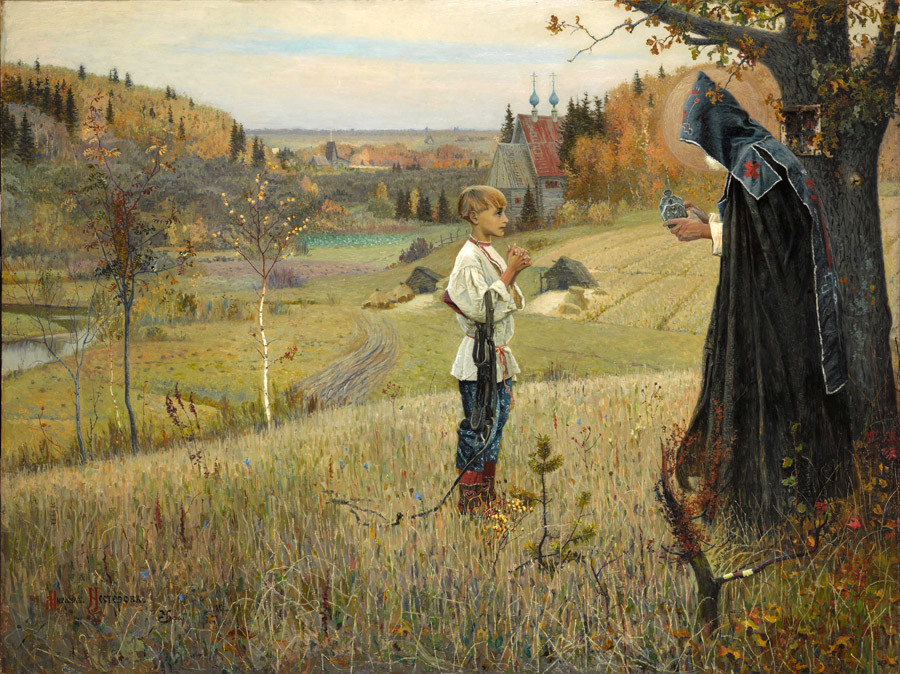
Mikhail Nesterov. The Vision to the Youth Batholomew
Tretyakov Gallery
His unworldly spiritual path, asceticism, and moral sermons profoundly affected his descendants, who elevated him to the sainthood, and to a special rank at that –Prepodobny, meaning “venerable.”
Sergius of Radonezh essentially reformed the whole of monastic life. He forbade monks from leaving the monastery grounds to beg for alms, whereupon they began to farm and provide for themselves. In addition, he introduced the principles of communal living, which meant no private property at all, common bread, etc., which enabled Russian monasteries to become hospices, i.e. they were able to receive wanderers and pilgrims, which figuratively and literally helped to “bind the lands and the people” – a vitally important concept at that time.
The spiritual authority of Sergius was so immense that he is considered nothing less than the “unifier of Rus” – it was he who rallied the fragmented feudal principalities to unite around just one, Muscovy, in order to cast off the Tatar-Mongol yoke. For many decades, the Golden Horde had been ravaging the Russian lands (the reason Sergius and his parents moved to Radonezh was because Rostov had been sacked).
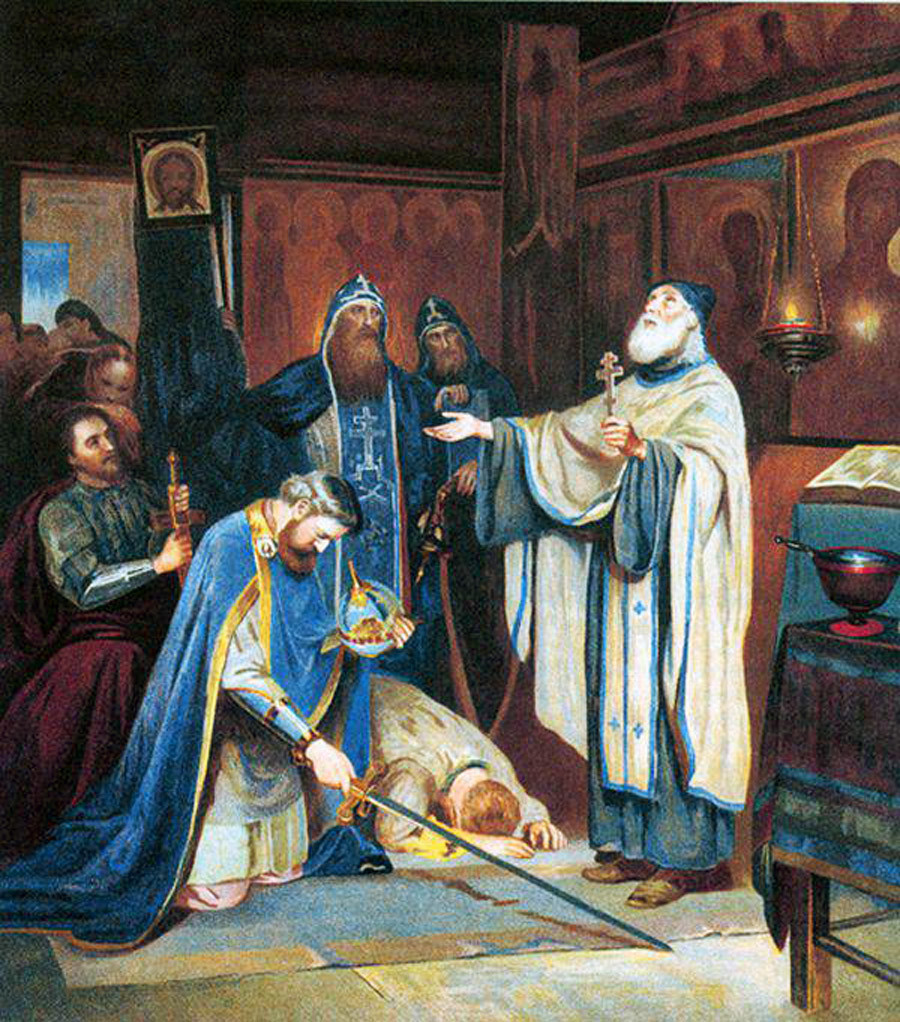
Alexander Novoskoltsev: Sergius of Radonezh blessing Dmitry Donskoy
Public domain
Before one of the most famous battles in medieval Russia – the Battle of Kulikovo Field – Prince Dmitry Donskoy requested the blessing of Sergius, who duly complied and even sent two of his bogatyr (warrior) monks to fight against the Tatars.
What else to see in Sergiev Posad?
The monastery is not the be-all and see-all of the city. There are a dozen cozy museums to visit. The main one, the Sergiev Posad State Historical and Art Museum Reserve, houses a large collection of ancient icons and church handicraft items, as well as other exhibits telling about Russian life from ancient to Soviet times.
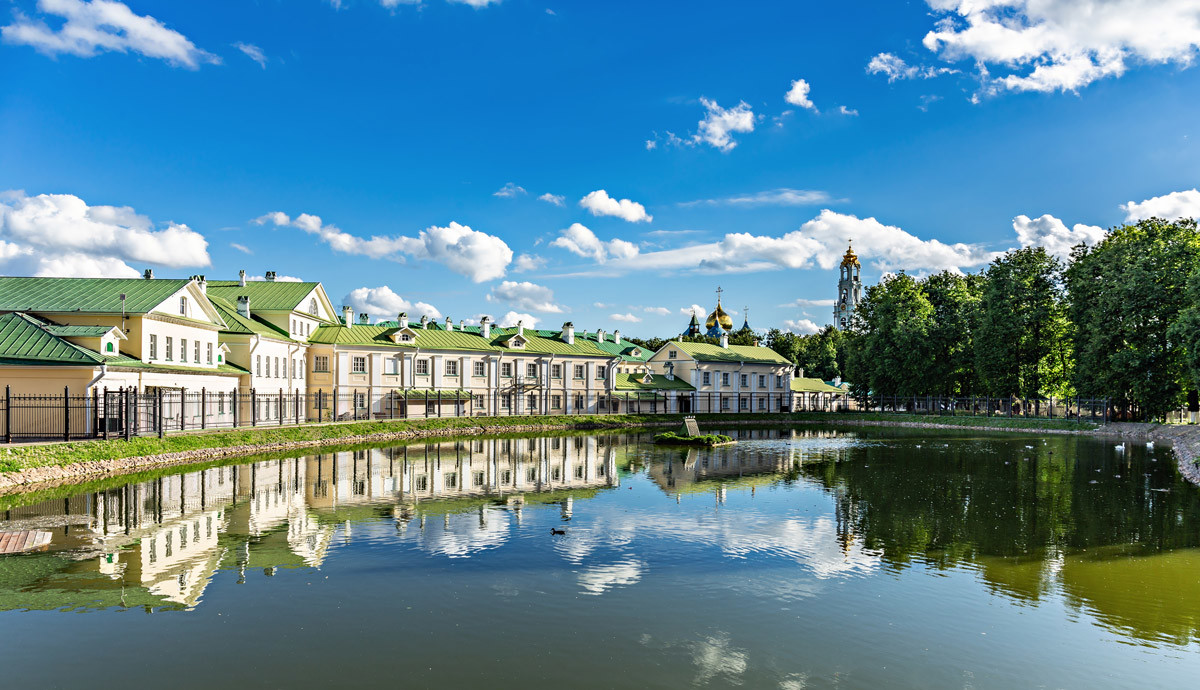
Bely (White) Pond not far from the Lavra
Legion Media
There is also the Toy Museum, founded in 1918, where you can see old Russian and Soviet toys, including ones that belonged to the children of the last Russian tsar, Nicholas II.
And to see how a typical Russian hut looked, you can visit the Once-Upon-a-Time Museum, in which kitchen utensils, spinning wheels, and all kinds of tools are displayed – everything that Russian hut dwellers would have owned.
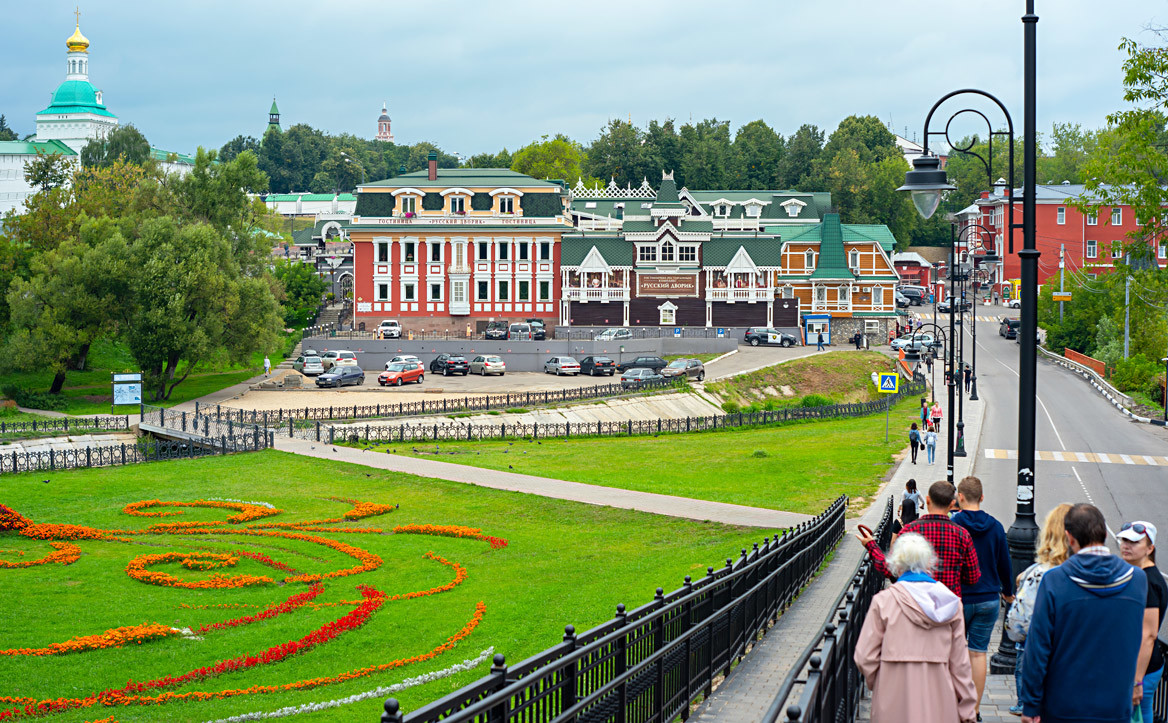
Sergiev Posad
Legion Media
What to see nearby Sergiev Posad:
Not far from the Lavra are three other places worth a trip.
1. Abramtsevo Estate (see our in-depth article here).
Built by millionaire merchant Savva Mamontov, it hosted gatherings of the finest Russian writers and artists of the late 19th–early 20th century. It could be said to be a prototype of modern art residences.
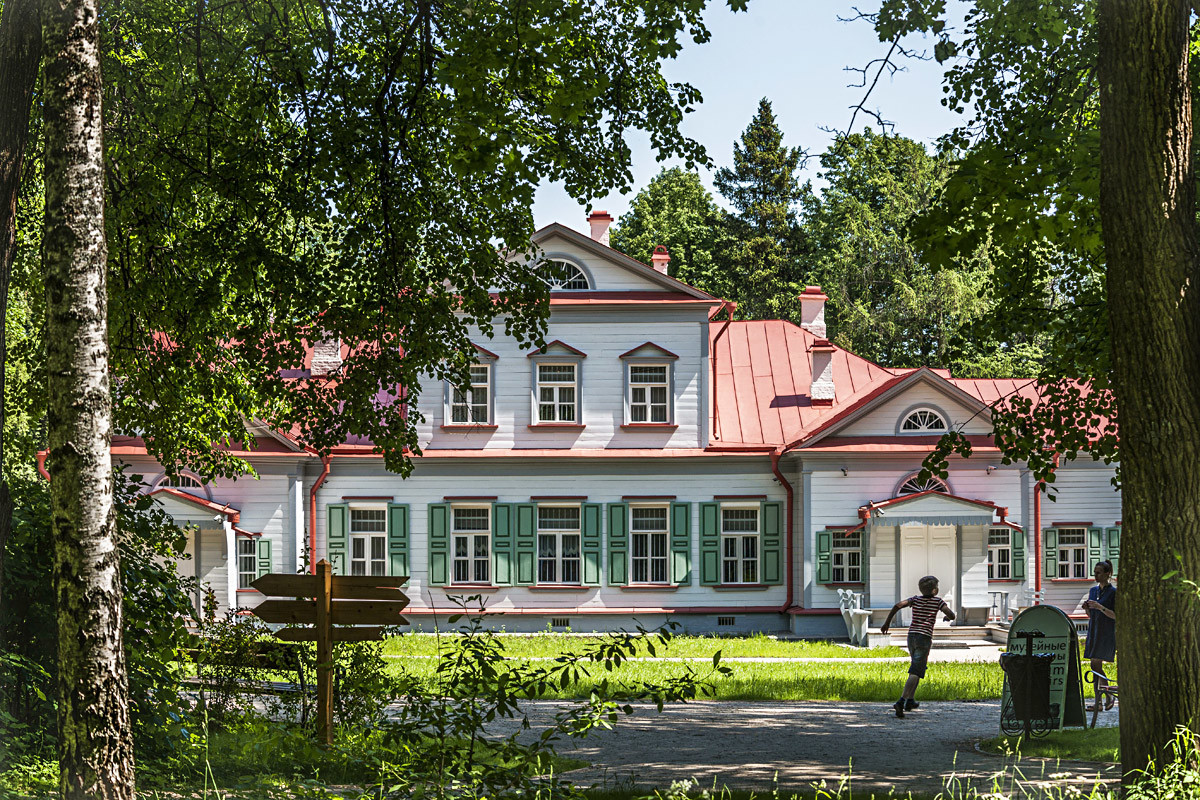
Abramtsevo Estate
Konstantin Kokoshkin/Global Look Press
2. The Pokrovsky Khotkov Monastery
The Pokrovsky Khotkov Monastery was the first refuge of the young monk Sergius of Radonezh. It was from here that he set off to found his dwelling place. The main Intercession Cathedral stores the relics of his parents. There is also the red-brick Nikolsky Cathedral, built much later in 1904, but in the style of a Byzantine temple.
3. Muranovo Estate
If you’re interested in how the estate of a second-tier nobleman looked in the 19th century, then head for Muranovo. Here, you will see a manor house and park – some of the trees are more than 150 years old! In addition, you’ll learn about the Russian poet Fedor Tyutchev, whose family lived here. (Watch more photos of the estate here)
If using any of Russia Beyond’s content, partly or in full, always provide an active hyperlink to the original material.
Get the week’s best stories straight to your inbox


The Trinity St Sergius Lavra Monastery is the largest monastery of the Russian Orthodox Church, with a history that dates back for hundreds of years. The monastery is located in the town of Sergiev Posad, which is around 70 kilometres to the north-east of Moscow. The monastery comprises over fifty different buildings, located within ancient defensive walls. Today, the monastery is listed as Unesco Site of World Heritage.
Fascinating Facts
- Only two monasteries in modern Russia hold the honorific status of ‘lavra’ — this monastery at Sergiev Posad,
and the Alexander Nevsky Lavra Monastery in St. Petersburg. The Trinity St Sergius Monastery had the honour of its
title as ‘lavra’ bestowed upon it by Russian Empress Elizaveta, in 1744. - Empress Elizaveta made the pilgrimage journey to the monastery from Moscow on foot. However, she did this in a
most original way – by walking 2-3 kilometres of the journey each day, and then being taken back to her palace in
Moscow by carriage every day. The carriage would return her to where she had left off the previous day. The entire
trip took several months when tackled in this way. - The largest church bell in Russia is the Tsar Bell, weighing 72 tonnes. It hangs in the Bell Tower of the
Trinity St Sergius Lavra Monastery. - The best view of the monastery can be seen from the Blinnary Gora, or Pancake Hill Observation Platform, in the
town centre of Sergiev Posad. Pancake Hill is so-called from the tradition of cooking pancakes there for the
hungry pilgrims who arrived there after their long journey.
History
The Holy Monk, St Sergius of Radonezh established a small religious community at Makovets Hill,
70 kilometres from Moscow. In 1377 the monks built Church of the Holy Trinity to serve their worship needs. The
depth of Christian study and devotion at the community became famed throughout Russia, becoming a spiritual centre
serving the whole country. Grand-Princes came to the monastery for blessings before military conflicts.
By 1422 the original wooden Trinity Church had been replaced with a stone church – the Trinity
Cathedral. Great ikon-painters such as Andrei Rublev and Daniil Chorny were involved in the murals and frescoes of the
new cathedral. Rublev’s famous ikon ‘The Trinity’ was created especially for the cathedral.
During the political upheavals of the early 17th century known as the Time of Troubles – during which Russia was
invaded by a Polish-Lithuanian occupation force – the monastery withstood a sixteen-month siege by the would-be
occupiers. Despite terrible suffering and damage, the monastery defended itself against the attacks.
During the eighteenth and nineteenth centuries, the Trinity St Sergius Lavra became one of Russia’s
richest monasteries. As well as becoming involved in trade, the Monastery opened a Divinity Academy.
During the soviet years, the monastery was entirely closed. Most of the ikon-screens and religious
items were melted down for scrap metal. However, in the mid-20th century, it was decided to award the former monastery
the status of a museum-reserve – a decision which saved all of the architectural heritage at the monastery. In 1993
the architectural ensemble of the monastery was listed by UNESCO as a site of world cultural heritage.
Today there are around 200 monks serving and working at the monastery.
What to see
- The Assumption Cathedral is the largest and most visible of the monastery’s buildings, located directly at the
centre of the monastery grounds. It was built over 1559 to 1585. - The Trinity Cathedral is the main church of the monastery, and its oldest building. It was built between 1422
and 1423, on the site of a former wooden cathedral of the same name. The original murals and frescoes in the
church were painted by the famous ikon-painters Andrei Rublev and Daniil Chorny – but their work has not survived.
Instead, it has been recreated from original sketches and drawings. The church’s crypt contains the relics of the
monastery’s founder, St Sergey of Radonezh, which are venerated by many visitors. - St Nikon’s Church is situated by the southern walls of the Trinity Cathedral. The church as built over
1623-1624, and contains the grave of St Nikon of Radonezh – one of the early acolytes of St Sergey of Radonezh. - The Church of the Holy Spirit. This small church is situated between the Assumption and Trinity cathedrals, and
is the second-oldest preserved church within the lavra, being built over 1476 and 1477, by master masons from
Pskov. The church contains the graves of a number of saints, including Maxim the Greek – a renowned theologian and
philosopher of the 16th century. - The smallest church within the monastery is the Mikheevsky Church – built in the 18th century on the spot where
the Blessed Virgin Mary appeared to St Sergey of Radonezh. - The Church of Zosima & Savvaty Solovetsky was built in 1635-1637 in the period when the monastery was
re-established after the Time of Troubles. - The Nativity Church of St John the Baptist was built with finance provided by Grigory Stroganoff, the Russian
industrialist, financier and philanthropist. Just like other projects he financed, the interior decorations are
truly sumptuous. - The Refectory Church. This church and refectory is one of the largest within the monastery, and is well-known
for its unusual colour-scheme, richly-decorated staircases and elaborate ornamentation. - The Smolensk Church – the Church of the Most-Holy Smolensk Ikon of the Odigetria Mother of God. This tiny
church dates to 1746-1753. It was specially built to keep the carved stone ikon of the Smolensk Mother of God. The
ikon is presently in a museum, and a facsimile is kept in the church. - The Monastery Bell-Tower was built between 1741 and 1776. It towers to 88 metres in height — even higher than
those in the Moscow Kremlin. - The Royal Chambers. These two-storey royal chambers are elegantly decorated with white walls, and occupy the
entire northern section of the monastery. They stand on the site of a former wooden residence of Ivan the
Terrible. The site is currently occupied by the monastery’s archaeological service, and presents displays of ikons
and church utensils. - The monastery walls and towers. The monastery is completely enclosed in defensive walls, which compromise the
Holy Gates and ten other towers, built between 16th and 18th centuries. The height of the walls can reach six
metres, and their full perimeter distance is 1.5 kilometres. The walls are averagely 3.5 metres thick.
Guided Tour to The Trinity St Sergius Lavra Monastery
You can book a tour in English on our website.
Send us a request to find out all the information you are interested in. This request is free and without obligation.
Thank you for contacting us! Our manager will be in touch as soon as possible to finalize the details.
Close
From Wikipedia, the free encyclopedia

General view |
|
| Monastery information | |
|---|---|
| Order | Russian Orthodox Church |
| Established | 1345 |
| People | |
| Founder(s) | Sergius of Radonezh |
| Site | |
| Location | Sergiyev Posad, Russia |
|
UNESCO World Heritage Site |
|
| Official name | Architectural Ensemble of the Trinity Sergius Lavra in Sergiev Posad |
| Criteria | Cultural: (ii), (iv) |
| Reference | 657 |
| Inscription | 1993 (17th Session) |
| Area | 22.75 ha (0.0878 sq mi) |
| Buffer zone | 15.57 ha (0.0601 sq mi) |
| Website | www.stsl.ru/languages/en/ |
| Coordinates | 56°18′37.26″N 38°7′52.32″E / 56.3103500°N 38.1312000°ECoordinates: 56°18′37.26″N 38°7′52.32″E / 56.3103500°N 38.1312000°E |
|
Location of Trinity Lavra of St. Sergius in European Russia
Trinity Lavra of St. Sergius (Europe) |


The Trinity Lavra of St. Sergius (Russian: Тро́ице-Се́ргиева ла́вра) is the most important Russian monastery and the spiritual centre of the Russian Orthodox Church. The monastery is situated in the town of Sergiyev Posad, about 70 km to the north-east from Moscow by the road leading to Yaroslavl, and currently is home to over 300 monks.
History[edit]
14th century[edit]
The monastery was founded in 1337 by one of the most venerated Russian saints, Sergius of Radonezh, who built a wooden church in honour of the Holy Trinity on Makovets Hill. Early development of the monastic community is well documented in contemporary lives of Sergius and his disciples.

In 1355, Sergius introduced a charter which required the construction of auxiliary buildings, such as refectory, kitchen, and bakery. This charter was a model for Sergius’ numerous followers who founded more than 400 cloisters all over Russia, including the celebrated Solovetsky, Kirillov, and Simonov monasteries.
St. Sergius supported Dmitri Donskoi in his struggle against the Tatars and sent two of his monks, Peresvet and Oslyabya, to participate in the Battle of Kulikovo (1380). At the outbreak of the battle, Peresvet died in a single combat against a Tatar bogatyr. The monastery was devastated by fire, when a Tatar unit raided the area in 1408.
15th century[edit]
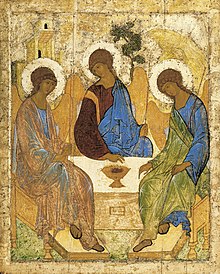
St. Sergius was declared patron saint of the Russian state in 1422. The same year the first stone cathedral was built by a team of Serbian monks who had found refuge in the monastery after the Battle of Kosovo. The relics of St. Sergius still may be seen in this cathedral, dedicated to the Holy Trinity. The greatest icon painters of medieval Russia, Andrei Rublev and Daniil Chyorny, were summoned to decorate the cathedral with frescoes. Traditionally, Muscovite royals were baptized in this cathedral and held thanksgiving services here.
In 1476, Ivan III invited several Pskovian masters to build the church of the Holy Spirit.[1] This structure is one of the few remaining examples of a Russian church topped with a belltower. The interior contains the earliest specimens of the use of glazed tiles for decoration. In the early 16th century, Vasily III added the Nikon annex and the Serapion tent, where several of Sergius’ disciples were interred.
16th century[edit]
It took 26 years to construct the six-pillared Assumption Cathedral,[2] which was commissioned by Ivan the Terrible in 1559. The cathedral is much larger than its model and namesake in the Moscow Kremlin. The magnificent iconostasis of the 16th–18th centuries features Simon Ushakov’s masterpiece, the icon of Last Supper. The interior walls were painted with violet and blue frescoes by a team of Yaroslavl masters in 1684. The vault contains burials of Boris Godunov, his family and several 20th-century patriarchs.
As the monastery grew into one of the wealthiest landowners in Russia, the woods where it had stood were cleared and a village (or posad) sprang up near the monastery walls. It gradually developed into the modern town of Sergiyev Posad. The cloister itself was a notable centre of chronicle-writing and icon painting. Just opposite the monastery walls St. Paraskeva’s Convent was established, among whose buildings St. Paraskeva’s Church (1547), Introduction Church (1547), and a 17th-century chapel over St. Paraskeva’s well are still visible.
17th century[edit]
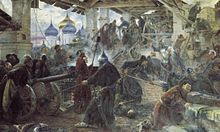
In 1550s, a wooden palisade surrounding the cloister was replaced with 1.5 km (0.93 mi) long stone walls, featuring twelve towers, which helped the monastery to withstand a celebrated 16-month Polish-Lithuanian siege in 1608–1610. A shell-hole in the cathedral gates is preserved as a reminder of Wladyslaw IV’s abortive siege in 1618.
By the end of the 17th century, when young Peter I twice found refuge within the monastery from his enemies, numerous buildings had been added. These include a small baroque palace of the patriarchs, noted for its luxurious interiors, and a royal palace,[3] with its facades painted in checkerboard design. The refectory of St. Sergius,[4] covering 510 square metres (5,500 sq ft) and also painted in dazzling checkerboard design, used to be the largest hall in Russia. The five-domed Church of John the Baptist’s Nativity[5] (1693–1699) was commissioned by the Stroganovs and built over one of the gates. Other 17th-century structures include the monks’ cells, a hospital topped with a tented church, and a chapel built over a holy well discovered in 1644.
18th and 19th centuries[edit]

View of the lavra in the 1890s.
In 1744, Empress Elizabeth conferred on the cloister the dignity of a Lavra. The metropolitan of Moscow was henceforth also the Archimandrite of the Lavra. Elizabeth particularly favoured the Trinity and annually proceeded afoot from Moscow to the cloister. Her secret spouse Alexey Razumovsky accompanied her on such journeys and commissioned a baroque church to the Virgin of Smolensk, the last major shrine to be erected in the Lavra. Another pledge of Elizabeth’s affection for the monastery is a white-and-blue baroque belltower,[6] which, at 88 meters, was one of the tallest structures built in Russia up to that date. Its architects were Ivan Michurin and Dmitry Ukhtomsky.
Throughout the 19th century, the Lavra maintained its status as the richest Russian monastery. A seminary founded in 1742 was replaced by an ecclesiastical academy in 1814. The monastery boasted a supreme collection of manuscripts and books.
Medieval collections of the Lavra sacristy attracted thousands of visitors. In Sergiyev Posad, the monastery maintained several sketes, one of which is a place of burial for the conservative philosophers Konstantin Leontiev and Vasily Rozanov.
20th century[edit]

1993 5 ruble coin depicting Trinity Lavra
After the Russian Revolution of 1917, the Soviet government closed the lavra in 1920. Its buildings were assigned to different civic institutions or declared museums. Part was used for training electrical engineers specialising in radio. In May 1923 Charles Ashleigh reported how the hall was used to demonstrate the new radio technology before a mixed audience primarily composed of peasants and soldiers, but with some townspeople. The broadcast started with am announcement followed by music with a band from the Moscow cavalry playing Stenka Razin. Then the audience were treated to a short lecture on the benefits of chemical manure and machine ploughs. After a gypsy song the performance was brought to a conclusion with a talk about the wonders of radio.[7] In 1930, monastery bells, including the Tsar-Bell of 65 tons, were destroyed. Pavel Florensky and his followers prevented the authorities from stealing and selling the sacristy collection but overall many valuables were lost or transferred to other collections.

In 1945, following Joseph Stalin’s temporary tolerance of the church during World War II, the Lavra was returned to the Russian Orthodox Church. On April 16, 1946 divine service was renewed at the Assumption Cathedral. The lavra continued as the seat of the Moscow Patriarchate until 1983, when the patriarch was allowed to settle at the Danilov Monastery in Moscow.
After that, the monastery continued as a prime centre of religious education. Important restoration works were conducted in the 1960s and 1970s. In 1993, the Trinity Lavra was inscribed on the UN World Heritage List.
The Lavra has a number of representative churches (podvorie or metochia) in its vicinity and throughout Russia.[8] The Lavra’s hieromonks have manned a number of sketes at remote locations (such as the Anzer Island in the Solovki Archipelago in the White Sea), as well as Trinity Church on King George Island in the Antarctic.
Notable burials[edit]
- Innocent of Alaska
- Patriarch Alexy I of Russia
- Tsar Boris Godunov and family
- Yuriy Trubetskoy
- Dmitry Troubetskoy
- Sergius of Radonezh
- Feodor II of Russia
References[edit]
- ^ «The Church of the Descent of the Holy Spirit : Sergiev Posad Museum». 2014-02-10. Archived from the original on 2014-02-10. Retrieved 2014-02-10.
- ^ Assumption Cathedral
- ^ «Sergiev Posad Museum: Tsar Palace». www.musobl.divo.ru. Archived from the original on 3 September 2005. Retrieved 28 February 2022.
- ^ [https://web.archive.org/web/20070928105325/http://www.musobl.divo.ru/refector.jpg Refectory of St. Sergius>
- ^ Church of John the Baptist’s Nativity
- ^ «Sergiev Posad Museum: Bell Tower». www.musobl.divo.ru. Archived from the original on 9 September 2005. Retrieved 28 February 2022.
- ^ Ashleigh, Charles (1924). «Radio in Russia». Radio Times (15, 6 January 1924 — 12 January 1924). Retrieved 19 December 2020.
- ^ Подворья Лавры (Lavra’s podvories)
Further reading[edit]
- William Craft Brumfield (1993), A History of Russian Architecture, Cambridge University Press, ISBN 978-0-521-40333-7
- Scott M. Kenworthy, The Heart of Russia: Trinity-Sergius, Monasticism, and Society after 1825. New York: Oxford University Press, 2010.
- David B. Miller, Saint Sergius of Radonezh, His Trinity Monastery, and the Formation of Russian Identity. DeKalb: Northern Illinois University Press, 2010.
External links[edit]
- (in English) Official site of the Holy Trinity-St. Sergius Lavra
- (in English) UN World Heritage Site
- The Holy Trinity-St. Sergius Lavra at Google Cultural Institute