
Подборка лексических единиц для ЕГЭ:
- lay the table – накрывать на стол
- clear the table, to clear away (the dishes) – убирать со стола
- do the washing – стирать
- iron – гладить
- tidy up the room – прибираться в своей комнате
- do a room – убирать комнату
- do cleaning up – проводить уборку
- dust the furniture – вытирать пыль с мебели
- air the room – проветривать комнату
- sweep the floor – подметать пол
- wash the floor – мыть пол
- clean with a vacuum cleaner – чистить пылесосом
- wipe the table – вытирать со стола
- wash the windows – мыть окна
- water the plants – поливать растения
- wash the dishes (= to wash up) – мыть посуду
- empty the dustbin – выносить мусорное ведро
- peel the potatoes – чистить картошку
- do household chores – выполнять домашние обязанности
- arrange the things – приводить в порядок вещи (scatter things – разбрасывать вещи)
- family duties = household chores – домашние обязанности
- typical duties for a teenager such as …– типичные обязанности для подростка, такие как…
- be responsible for … – отвечать за….
- take part in … – принимать участие в …
- I don’t mind … – Я не возражаю, против того чтобы…
- prefer to … rather than … – Я отдаю предпочтение …, а не …
- I consider myself an independent person that’s why … – Я считаю себя самостоятельным человеком, поэтому я …
- help about the house – помогать по дому
- get used to it – привыкнуть к чему-либо
- share daily duties (equally) – разделить обязанности поровну
- advertising campaign – рекламная кампания
- to be careful with money – внимательно относиться к деньгам (не тратить впустую)
- customer service – обслуживание клиентов
- to get into debt – «залезать» в долги
- must-have product – популярный товар
- to be on a tight budget – иметь скромный бюджет
- a pay in cash – оплата наличными
- to pay the full price – заплатить полную стоимость за что-то
- summer sales – летние распродажи
- to try something on – примерять что-либо
- to be value for money – стоить своих денег
- window shopping – поход в магазин с целью посмотреть, но не купить
Для тех, кто хочет максимально эффективно подготовиться к ЕГЭ по английскому языку:
Методичка: “Примерные темы и аргументы для эссе (с лексикой)”
Курс эссе
Репетитор
Удачи на экзамене!
Recommended textbook solutions
The Language of Composition: Reading, Writing, Rhetoric
2nd Edition•ISBN: 9780312676506Lawrence Scanlon, Renee H. Shea, Robin Dissin Aufses
661 solutions
Literature and Composition: Reading, Writing,Thinking
1st Edition•ISBN: 9780312388065Carol Jago, Lawrence Scanlon, Renee H. Shea, Robin Dissin Aufses
1,697 solutions

Edge Reading, Writing and Language: Level C
ISBN: 9781285439594David W. Moore, Deborah Short, Michael W. Smith
304 solutions
Technical Writing for Success
3rd Edition•ISBN: 9781111260804Darlene Smith-Worthington, Sue Jefferson
468 solutions
Идем дальше и продолжаем изучать тему «Shopping». В этом уроке вы изучаете список английских слов №2 (intermediate). Но не торопитесь! Сначала посмотрите на картинку и расскажите, что на ней происходит.

Shopping. Список английских слов №2 (intermediate)
I. Places for Shopping:
- market — рынок
- supermarket — супермаркет
- shopping centre — торговый центр
- department store — универмаг
- kiosk/ stall — киоск, ларек, палатка
- newsagent’s — газетный киоск
- fair — ярмарка
- rag fair — барахолка
- boutique — маленький магазин модной одежды
- a food shop — продоольственный магазин
Запомните: at the stall — в ларьке
II. General Words:
- shop-window — витрина
- counter — прилавок
- cash-desk — касса
- cashier — кассир
- salesman/ saleswoman/ shop assistant — продавец
- customer — покупатель
- consumer — потребитель
- consumer goods — потребительские товары
- queue — очередь
- to queue — стоять в очереди
- bargain — торговаться (a bargain — выгодное предложение)
- buy/ purchase/ shop for — покупать
- display — показывать
- offer — предлагать
- sale — распродажа
- be on sale — быть в продаже
- be out of stock — отсутствовать в наличии
- at a discount — со скидкой
- change (small change) — сдача
- pay in cash — платить наличными
- pay by credit card — платить кредиткой
- receipt — чек
- guarantee — гарантия
- label — ярлык
- serve — обслуживать
- wrap — заворачивать
- run out of — закончиться
- sell out — распродать
- shop around — посещать несколько магазинов, сравнивая цены
- compare prices — сравнивать цены
- take back — отнести назад
- be dissatisfied with — быть недовольным покупкой
- complain — жаловаться
- value / quality — качество
- not to work properly — не работает как надо
- not to work at all — совсем не работает
- two buttons are missing — не хватает двух пуговиц
- the wrong size (too small/ big) — не тот размер
- it’s too tight — жмет
- it’s too loose — слишком свободный
- make a funny noise — издает странный звук
- fade in the wash — линять
- shrink in the wash — садиться при стирке
- machine washable (можно……) — можно стирать в стиральной машине
- durable — износостойкий
- waterproof — водонепроницаемый
- top quality — отличного качества
- reliable — надежный
- perishable — скоропортящийся
- refund your money — вернуть деньги
- style (fashion) — фасон; cut — покрой
Запомните фразы:
1. What exactly is wrong with it? — Что с ней не так?
2. I’d like the refund. — Я бы хотела вернуть деньги.
3. Have you got another one in the same colour? — У вас есть другой такого же цвета?
4. I’ve got a problem with this . — У меня проблема с этим …
5. I’d like to pay in cash. — Я бы хотела заплатить наличными.
6. That will do. — Этого достаточно.
7. Will this/ these do? — Этот (эти) устраивает (ют)?
Shopping. Упражнения
Упражнение 1. Вспомните названия магазинов.

* * *
2. TEXT «Mrs. Richards’ Shopping» (from Spoken English by Golitsynsky)
Задание. Read the text and answer the questions.
Проверьте себя, знаете ли вы слова: empty, self-service counters, entrance, a good choice, half a kilo of mince, a good head of cabbage, a chocolate roll
Last Sunday Mrs. Richards looked into her refrigerator and saw that it was nearly empty. Mrs. Richards does not like it when there is nothing in her refrigerator. She took a big bag and went shopping.
The best place to do her shopping in is a supermarket. There is a good supermarket not far from Mrs. Richards’ house, and she went there. The supermarket has many self-service counters. Mrs. Richards likes it because at a self-service counter you can choose what you like and take it off the counter with your own hands.
When Mrs. Richards came to the shop, she took a basket at the entrance and went inside. First she went to the butcher’s counter. They did not have beef that day, but there was a good choice of pork. Mrs. Richards took a good piece of pork and two chickens. She also took half a kilo of mince.
Then she went to the greengrocer’s counter, because she wanted some potatoes and cabbage. She did not like the potatoes and decided to go to the market later. But she took a good head of cabbage. After that Mrs. Richards stopped at the grocer’s counter to take a package of macaroni, and then went to the delicatessen counter to see what she could buy for supper. She took a piece of cheese and a piece of sausage. They were selling ham, too, but she decided not to take ham: there was too much fat on it.
On the way to the cash-desk Mrs.Richards stopped at the confectioner’s counter to buу some candy and biscuits for tea. She also took a chocolate roll.
There were two or three people in front of Mrs. Richards at the cash-desk, and she had to wait a little. When her turn came, she paid for the foodstuffs she had bought and went home.
On the way home she called at a dairy-shop to buy a bottle of milk. She did not buy eggs, because her bag was full and she was afraid to break the eggs. She decided to go later for eggs and also to the baker’s to buy a loaf of bread.
Answer the following questions.
l. What did Mrs. Richards see when she looked into her refrigerator last Sunday?
2. What doesn’t Mrs. Richards like?
3. What is the best place for Mrs. Richards to do her shopping? Why?
4. Why does Mrs. Richards like to buy foodstuffs at self-service counters?
5. What did Mrs. Richards do when she came to the shop?
6. Where did she take the basket?
7. Why did Mrs. Richards go to the butcher’s counter? What did she buy at the butcher’s department?
8. What did Mrs. Richards want to buy at the greengrocer’s department? What did she buy? What didn’t she buy? Why?
9. What did Mrs. Richards buy at the grocer’s department?
10. Why did Mrs. Richards go to the delicatessen department? What did she buy there? What didn’t she buy? Why?
11. What did Mrs. Richards buy at the confectioner’s department?
12. Why did Mrs. Richards have to wait at the cash-desk? Did she have to wait long?
13. What did she do when her turn came?
14. What shop did Mrs. Richards call at (зашла) on the way home?
15. What did Mrs. Richards buy at the dairy? Why didn’t she buy eggs?
16. Train your memory and name the foodstuffs that Mrs. Richards have bought.
* * *
Упражнение 3. Используя текст в качестве основы расскажите, как вы делали покупки в выходные.
* * *
Упражнение 4. Вставьте слова в предложения согласно количеству букв.

* * *
Упражнение 5. Переведите на английский язык.
галстук, который подходит к моей новой рубашке; оригинальный фасон; на размер больше; выглядеть модно; скоропортящиеся товары, не хватает двух пуговиц, не работает как надо, слишком свободный,
* * *
Упражнение 6. Опишите картинку более подробно, используя слова из списка №2.
What is probably the girl buying?
- books on art — книги по искусству
- drugs/ medicines — лекарства
- pot plant — комнатное растение
- bouquet — букет
- sports equipment — спортивное снаряжение
- china — фарфор
- magazines — журналы
- greeting cards — поздравительные открытки
- posters — плакаты
- perfume — духи
* * *
Диалоги по теме»Shopping»
Упражнение 7. Выучите диалоги наизусть.
Диалог 1.
- too — слишком
- cabin — примерочная
A. Eh… I say…
B. Yes, madam? What can I do for you?
A. I’d like a summer dress, please.
B. Oh, I can offer you a wide choice of dresses to all tastes. Do you like this dress, madam?
A. I think it’s a little too short.
B. Yes, you are right. But you see, short dresses are in fashion now. Would you like to try it on?
A. All right.
B. Just step into this cabin.
* * *
Диалог 2.
- pre-shrunk stuff — несадящаяся ткань
A. Hello, sir. What can I do for you?
A. I’d like a warm pullover, please.
B. Oh, I can offer you a wide choice of pullovers to all tastes. What colour pullover would you like?
A. I’d like something in blue or light brown.
B. Do you like this one, sir?
B. I think this will do and I like the colour. Will it shrink, do you think?
A. Oh, no. It is made of pre-shrunk stuff.
B. It’s fine. I’ll take it.
Диалог 3.
- too loud — слишком кричащий
- either — тоже
A. How do you like this new shirt? I ‘ve bought it for my brother.
B. Oh, the colour is fashionable but it looks too broad in the shoulders. What size does he take in shirts?
A. His size is …A. I think it’s too big. And it is too long in the sleeves. To tell the truth, I don’t like the colour either. I advise you to take it back and exchange for a size smaller and not too loud.
B. I think, you are right. This colour may not suit him.
* * *
Упражнение 8. Переведите диалоги на английский язык (from Spoken English by Golitsynsky)
Диалог 4.
A. Здравствуйте, мадам. Что вам угодно?
B. Я бы хотела купить сумочку, которая подходила бы к моей шляпе.
A. Очень хорошо, мадам. Я могу предложить вам большой выбор сумочек на все вкусы. Вот симпатичная сумочка.
B. Да… Но вы знаете, эта сумочка немного мала. Мне нужна сумочка побольше.
A. Как насчет этой сумочки?
B. Это очень красивая сумочка. Но она слишком темная. Я бы хотела что-нибудь посветлее.
A. Я думаю, мадам, вам понравится эта сумочка Вот посмотрите. Она довольно большая.
B. Спасибо. Я думаю, вы правы, это как раз то что мне нужно. Я возьму эту сумочку.
A. Завернуть ее вам, мадам?
B. Да, пожалуйста… Но теперь я должна покупать туфли. Эта сумочка очень хорошая, но, боюсь, что она не подходит к моим туфлям.
A. О да, мадам, конечно. Вам нужны красивы модельные туфли. Могу предложить вам эту пару.
B. Они на вид неудобные.
А. Они и в самом деле неудобные. Но они самые модные в этом сезоне.
В. Ну что ж, я из возьму.
А. Что-нибудь еще, мадам?
В. Нет, благодарю вас, это все. !
Диалог 5.
А.Что вам угодно, сэр?
В. Мне нужна пара джинсов.
А. О сэр, я могу предложить вам широкий выбор джинсов на все вкусы. Какого размера джинсы вы носите?
В. Мой размер …
А. Вот прекрасные модные джинсы. Я надеюсь, они вам понравятся. Это ваш размер.
В. Как вы думаете, они сядут?
А. О нет, сэр, они сделаны из несадящейся ткани.
В. Можно мне их примерить?
А. Конечно, сэр. Пройдите в эту кабину.
В. Вы знаете, мне нравится фасон этих джинсов, и они хорошо на мне сидят, но боюсь, они не подходят к моей куртке. У вас нет чего-нибудь посветлее?
А. Да, сэр. Вот, примерьте эту пару.
В. Спасибо. Это как раз то, что мне нужно. Я их куплю.
А. Очень хорошо, сэр.
В. Сколько они стоят?
А. Всего тридцать долларов.
В. Платить вам или в кассу?
А. В кассу, сэр. Касса у выхода.
В. Спасибо.
ОТВЕТЫ
Здравствуйте! Для получения доступа к ответам необходимо оформить подписку. Ссылка в боковом меню — ОТВЕТЫ.
Покупки на английском языке. Shopping vocabulary
- 13.11.2018
Слова по теме шоппинг. Покупки на английском языке. Слова и выражения, обозначающие названия товаров и магазинов, а также связанные с покупкой и продажей товаров.
General – Общие слова
| retail organization | организация (предприятие) розничной торговли |
| shop | магазин |
| shopping area | торговый центр |
| shopping mall | крытый торговый центр |
| department store | универсальный магазин |
| chain store | один из филиалов, принадлежащих одной торгующей организации |
| mail-order firm | фирма «товары почтой», торгующая по заказам, сделанным по каталогу |
| booth | ларек |
| stall | киоск |
| rag fair | «толкучка» |
| shop-window (window display) | витрина |
| to dress the shop-window | оформлять витрину |
| show-case, case | витрина-прилавок |
| counter | прилавок |
| check-out point | контрольный пункт |
| cash-desk | касса |
| salesman (shop assistant) | продавец |
| saleswoman | продавщица |
| customer (shopper) | покупатель |
| consumer | потребитель |
| consumer goods | потребительские товары |
| shopping queue, line | очередь |
| to do one’s shopping | делать покупки |
| to go shopping | идти по магазинам |
| shopping spree | «прогулка» по магазинам с совершением многочисленных покупок и затратой больших сумм денег |
| impulse buying | незапланированная покупка |
| bargain | выгодная покупка (с точки зрения цены для покупателя) |
| to buy (to purchase, to shop for) | покупать (что-либо) |
| to sell | продавать |
| to supply | снабжать, поставлять |
| to deliver (goods) | доставлять (товары) |
| to display (goods) | выставлять (товары) |
| to be in (full) stock | быть в продаже |
| to be out of stock | не иметься в продаже |
| cheap | дешевый |
| expensive | дорогой |
| to cost | стоить |
| price, at a price | цена, по цене |
| discount, at a discount | скидка, со скидкой |
| sale | распродажа |
| sales tax | налог на продажу |
| mark-down | уценка |
| boutique | маленький магазин модной одежды и аксессуаров |
Some shops and the goods they sell – Некоторые магазины и их товары
| Antique shop | Антикварный магазин |
| valuable old articles | ценные старинные вещи |
| bric-a-brac | антикварные безделушки |
| Art shop | Магазин «Искусство» |
| painting | картины (масло) |
| water-colour | акварель |
| engraving | гравюра, эстамп |
| etching | гравюра |
| sculpture | скульптура |
| books on art | книги по искусству |
| Chemist’s (drugstore) | Аптека |
| drugs (medicines) and related articles | лекарства и сопутствующие товары |
| Florist’s (flower shop) | Цветочный магазин |
| plant | растение |
| pot plant | комнатное растение |
| wreath | венок |
| bouquet | букет |
| seed | семена |
| Furniture shop | Мебельный магазин |
| bedroom suite | мебельный гарнитур для спальни |
| sitting-room suite | мебельный гарнитур для гостиной |
| Haberdasher’s | Галантерейный магазин |
| thread reel | катушка ниток |
| tape | тесьма |
| ribbon | лента |
| needle | игла (швейная) |
| knitting-needle | спица (вязальная) |
| pin | булавка |
| safety-pin | английская булавка |
| button | пуговица |
| gloves | перчатки |
| mittens | варежки, рукавицы |
| muffler | теплый шарф |
| scarf | шарф |
| toiletries | туалетные принадлежности |
| Ironmonger’s (hardware shop) | Магазин металлических (скобяных) изделий |
| spade | лопата |
| nail | гвоздь |
| hammer | молоток |
| screw | винт |
| screwdriver | отвертка |
| gardening tools | садово-огородный инвентарь |
| watering-can | лейка |
| bucket (pail) | ведро |
| Jeweller’s | Ювелирный магазин |
| ring | кольцо |
| engagement ring | кольцо в знак помолвки (с драгоценным камнем) |
| wedding ring | обручальное кольцо |
| earrings | серьги |
| necklace | ожерелье |
| brooch | брошь |
| pendant | кулон |
| bracelet | браслет |
| silverware | посуда и столовые приборы из серебра |
| Sports shop (sorts outfitter’s) | Магазин спортивных товаров |
| sportswear | спортивная одежда |
| sport equipment | спортивное оборудование |
| Stationer’s | Магазин канцелярских товаров |
| note paper | писчая бумага |
| writing paper | писчая бумага |
| writing pad | блокнот |
| wrapping paper | оберточная бумага |
| carbon paper | копировальная бумага |
| notebook | записная книжка |
| file | папка для бумаг (документов) |
| pocket diary | карманный (настольный) деловой календарь |
| paper clip | скрепка |
| drawing pin | кнопка |
| ruler | линейка |
| rubber | резинка |
| fountain pen | авторучка |
| ink | чернила |
| ball-point pen | шариковая ручка |
| refill | стержень для шариковой ручки |
| fibre / felt-tip pen | фломастер |
| China shop | Магазин «Фарфор, фаянс, стекло» |
| china (porcelain) | фарфор |
| glassware | изделия из стекла |
| pottery (ceramics) | изделия из керамики |
| crockery (ware) | глиняные, фаянсовые изделия |
| Newsagent’s | Магазин периодических изданий (печати) |
| newspapers | газеты |
| magazines | журналы |
| posters | плакаты |
| paperbacks | книги в мягких бумажных переплетах |
| greeting cards | поздравительные открытки |
| plain / picture postcard | простые / видовые почтовые открытки |
| envelopes | конверты |
| stamps | марки |
| Bookseller’s (bookshop) | Книжный магазин |
| Dress shop (Women’s outfitters | Магазин женской одежды |
| Draper’s | Магазин тканей |
| Men’s outfitters | Магазин мужской одежды |
| Record shop | Магазин продукции звукозаписи |
| Shoe shop | Обувной магазин |
| Milliner’s | Магазин дамских головных уборов |
| Toy shop | Магазин игрушек |
Departments – Отделы
| Textiles | Ткани |
| satin | атлас |
| baize | байка |
| cambric | батист |
| velvet | бархат |
| cotton velvet | вельвет |
| cotton | хлопчатобумажная ткань |
| nylon | нейлон |
| corduroy | рубчатая ткань |
| ситец | |
| calico | набивной ситец |
| linen | полотно |
| pure-wool cloth | чисто шерстяная ткань |
| worsted | тонкая шерсть |
| tweed | твид (шерстяная материя) |
| silk (natural, artificial) | шелк (натуральный, искусственный) |
| plain | однотонный |
| flowered | в цветочек |
| background | фон |
| striped | в полоску |
| pin-striped | в тонкую полоску |
| chequered | в клетку |
| polka dot | в горошек |
| Footwear | Обувь |
| shoes | туфли |
| pattern | модельные |
| pattern-leather | лакированные |
| pumps | «лодочки» |
| suede (chamois) | замшевые |
| canvas | парусиновые |
| leather-soled | на кожаной подошве |
| rubber soled | на резиновой подошве |
| crepe soled | на каучуковой подошве |
| flat-heeled | без каблука |
| high-heeled | на высоком каблуке |
| boots | ботинки |
| high furlined boots | сапоги на меху |
| laced | на шнурках |
| sandals | босоножки |
| slippers | комнатные туфли |
| trotters | тапочки |
| overshoes | галоши |
| wellingtons | резиновые сапоги (обычно до колена) |
| shoe horn | рожок для обуви |
| shoe polish | крем для обуви |
| Knitted goods (wear) | Трикотажные изделия |
| cardigan | вязаный жакет, кофта |
| sweater | свитер |
| jumper | джемпер |
| pull-over (jersey) | пуловер |
| Hosiery | Чулочно-носочные изделия |
| socks | носки |
| stockings | чулки |
| tights (panty-hose) | колготки |
| knee-high stockings | гольфы (женские) |
| knee-length socks | гольфы (мужские) |
| Linen | Постельное и столовое белье |
| sheet | простыня |
| pillow-case | наволочка |
| bed-cover | покрывало |
| table cloth | скатерть |
| napkin | салфетка |
| Underwear | Нижнее белье |
| lingerie | дамское белье |
| slip | комбинация |
| waist-slip | юбка-комбинация |
| bra (brassiere) | бюстгальтер |
| panties | панталоны |
| panty briefs | трусы |
| vest | майка |
| Men’s underclothes | Мужское белье |
| sleeveless vest | майка |
| short-sleeved vest / T-shirt | футболка с коротким рукавом |
| briefs, trunks | трусы |
| long johns | кальсоны |
| Perfumery (Cosmetics) | Парфюмерия |
| perfume (scent) | духи |
| cream | крем |
| lipstick | губная помада |
| varnish | лак для ногтей |
| powder | пудра |
| eye-shade | тени |
| mascara | тушь |
| make-up | крем-грим |
| Household goods | Хозяйственные товары |
| tableware | столовые приборы и посуда |
| dinnerware | столовая посуда |
| kitchen utensils | кухонная утварь |
| iron | утюг |
| broom | метла |
| mop | швабра |
| electric appliances | электроприборы |
| bulb | электрическая лампочка |
| Ready-made clothes | Готовая одежда |
| garments | предметы одежды |
| dress (frock) | платье |
| gown | длинное платье |
| pinafore-dress | платье-сарафан |
| house-coat | халат |
| dressing-gown | ночной халат (утепленный) |
| blouse | блузка |
| skirt | юбка |
| shirt | рубашка |
| trousers (slacks, pants) | брюки |
| jeans | джинсы |
| suit | костюм |
| lounge suit | (повседневный) пиджачный костюм |
| jacket | пиджак, куртка |
| dinner jacket | смокинг |
| coat | пальто, пиджак |
| tail-coat | фрак |
| fur-coat | шуба |
| raincoat (mackintosh) | плащ, дождевик |
| parka | куртка с капюшоном |
| wind jacket, wind cheater | ветровка |
Supermarket – Супермаркет
| wire basket | проволочная корзина |
| shopping trolley | корзина на колесиках |
| shopping bag | хозяйственная сумка |
| entrance to the sales area | вход в торговый зал |
| patisserie / confectionary / bakery | хлебобулочные и кондитерские изделия |
| gondola (sales shelves) | стойка с полками товаров |
| scales for weighing fruit | весы для взвешивания фруктов |
| dairy products | молочные продукты |
| fresh-meat counter | отдел взвешивания мяса |
| freezer for frozen foods | холодильник для замороженных продуктов |
| drink gondola | стойка с напитками |
| soft drinks | безалкогольные напитки |
| canned beer | баночное пиво |
| bottled fruit juice | фруктовый сок в бутылках |
Food shops – Продуктовые магазины
| baker’s / bakery | булочная |
| butcher’s | мясной |
| confectioner’s / confectionary | кондитерский |
| dairy | молочный |
| greengrocer’s | овощной |
| fishmonger’s | рыбный |
| fruiterer’s | фруктовый |
| sweet-shop | сласти |
| off-license shop (wine and spirit merchant’s) | винный |
| tobacconist’s | табачный |
Quantities and package – Количество и упаковка
| bunch of flowers | букет цветов |
| bunch of grapes | гроздь винограда |
| bunch of keys | связка ключей |
| bar of (chocolate) | плитка (шоколада) |
| cake / tablet of (soap) | кусок (мыла) |
| joint of (beef) | кусок (говядины) |
| loaf of (bread) | батон (хлеба) |
| lump of (sugar) | кусочек (сахара) |
| slice of (bread) | кусок |
| dozen of (eggs) | дюжина |
| half a dozen | полдюжины |
| ball of (wool) | клубок |
| reel of (thread) | катушка |
| bottle of (milk) | бутылка |
| box of (clips) | коробка |
| carton / packet of (milk, cigarettes) | пачка / пакет |
| roll of (paper) | рулон |
| tube of (toothpaste) | тюбик |
| jar of (cream) | банка |
| can / tin of (peaches) | консервная банка |
Some useful words and expressions – Некоторые полезные слова и выражения
| to change | разменять |
| (small) change | мелочь, сдача |
| to pay | платить |
| how much is it / what’s the price of | сколько стоит? |
| open from…to… | открыто с…до… |
| closing (opening) time | время закрытия (открытия) |
| to attend (to), to serve | обслуживать |
| to be attended to, to be served | обслуживаться |
| to wrap | заворачивать (покупку) |
| fitting room | примерочная |
| to try on | примерять |
| to be stock size | иметь стандартную фигуру |
| to fit | сидеть (о платье и т.д.) |
| to be a misfit | плохо сидеть |
| to suit, to become | быть к лицу, идти, подходить |
| to match, to go with | сочетаться, гармонировать |
| to look (well) | выглядеть, смотреться (хорошо) |
| style, design | фасон |
| cut | покрой |
| fashion, vogue | мода |
| to come into fashion | войти в моду |
| all the vogue | крик моды |
| up-to-date | современный |
| stylish | модный |
| dowdy | непривлекательный |
| drab | неинтересный, скучный |
| to be long-wearing | быть носким |
| to wear well | хорошо, долго носиться |
| to be shrinkproof (colour-fast, waterproof, crease-resistant) | быть из несадящейся (нелиняющей, непромокающей, немнущейся) ткани |
| to afford | иметь возможность, быть в состоянии, позволить себе |
| can’t afford smth | не по средствам что-либо купить |
Shopping
Types of shopping
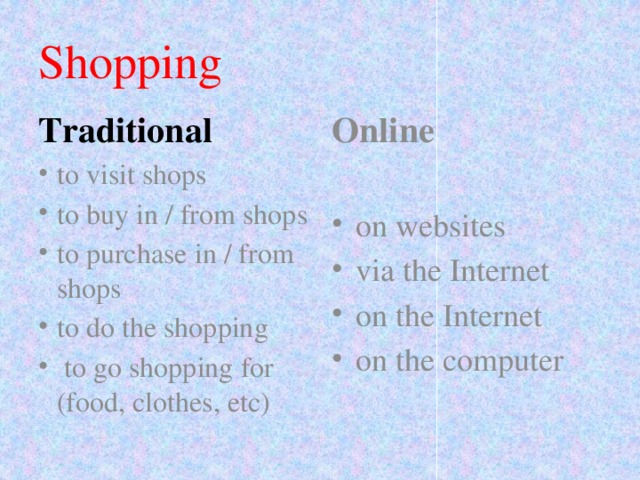
Shopping
Traditional
Online
- to visit shops
- to buy in / from shops
- to purchase in / from shops
- to do the shopping
- to go shopping for (food, clothes, etc)
- on websites
- via the Internet
- on the Internet
- on the computer


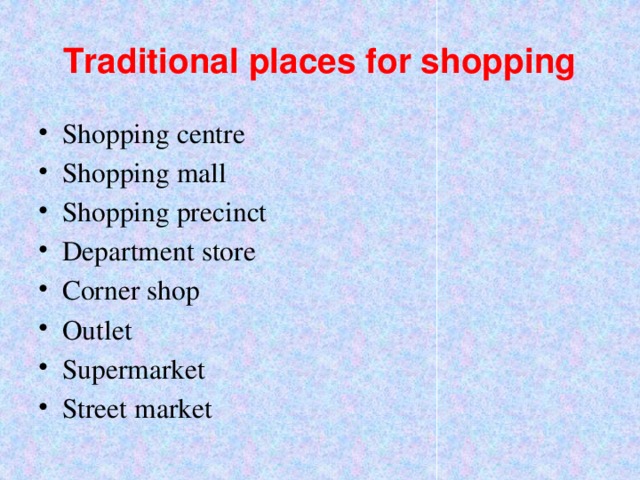
Traditional places for shopping
- Shopping centre
- Shopping mall
- Shopping precinct
- Department store
- Corner shop
- Outlet
- Supermarket
- Street market
Types of shops

‘ Shop’ Vocabulary
People selling and buying
Nouns
- shopkeeper
- owner
- manager
- shopper
- buyer
- customer
- purchaser
- seller
- shop assistant
- sales assistant
- trolley
- variety
- choice, selection
- help, assistance
- (social) event
- likelihood
- transaction
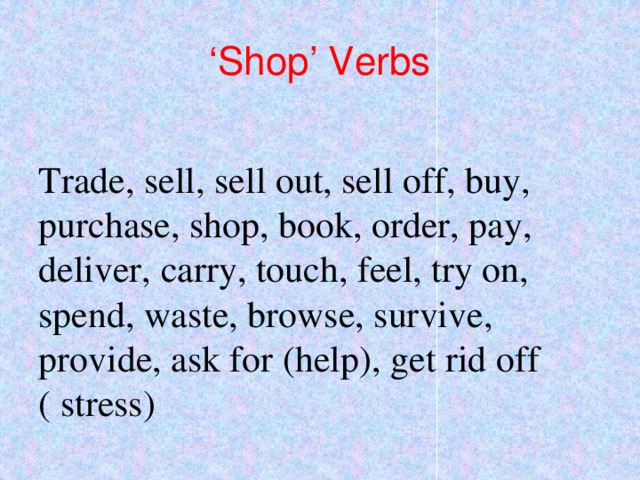
‘ Shop’ Verbs
Trade, sell, sell out, sell off, buy, purchase, shop, book, order, pay, deliver, carry, touch, feel, try on, spend, waste, browse, survive, provide, ask for (help), get rid off ( stress)
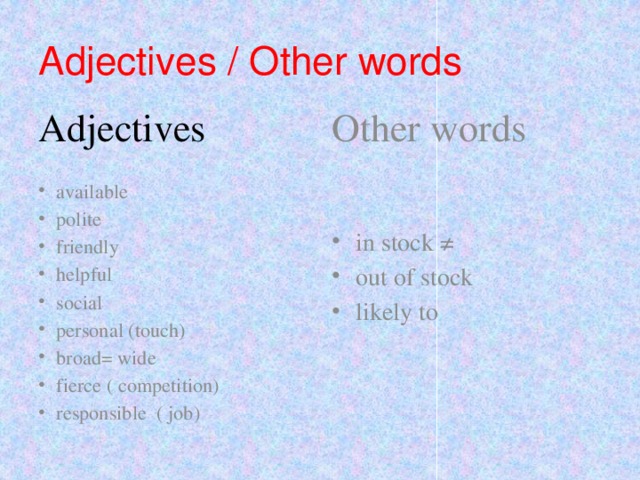
Adjectives / Other words
Adjectives
Other words
- in stock ≠
- out of stock
- likely to
- available
- polite
- friendly
- helpful
- social
- personal (touch)
- broad= wide
- fierce ( competition)
- responsible ( job)

Positive things
Traditional shopping
Online shopping
- a social event
- a friendlier environment
- sales assistant’s help
- broader varieties
- deliveries to the door
- cheaper prices
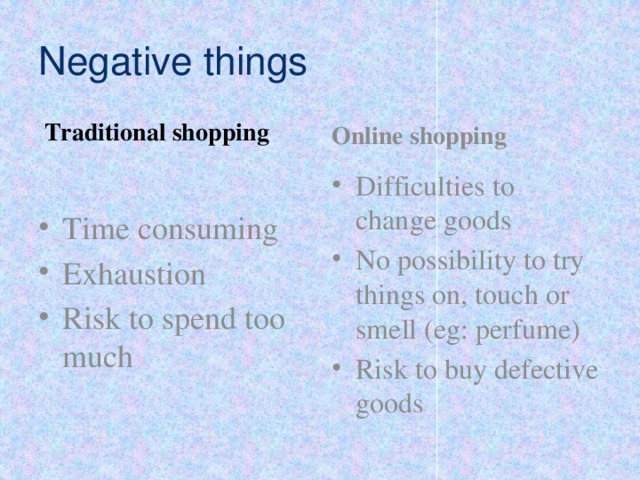
Negative things
Traditional shopping
Online shopping
- Time consuming
- Exhaustion
- Risk to spend too much
- Difficulties to change goods
- No possibility to try things on, touch or smell (eg: perfume)
- Risk to buy defective goods
Quiz
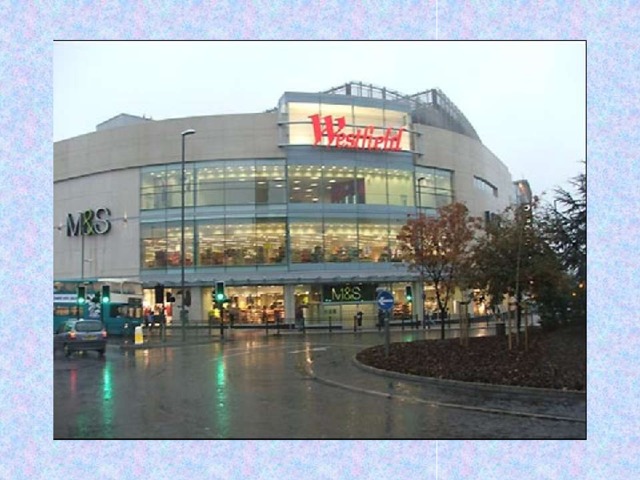
Special services in the Westfield Shopping Centre
- Personal shopper – a person whose job is to give advice and make suggestions to customers. They are often employed by department stores and boutiques (although some are freelance or work exclusively online)
- Valet parking – vehicles are parked for customers by a person called a valet .
- Concierge services – concierge consultants can fulfill every request and requirement of a shopper in the shopping centre

Good points of the Westfield Shopping Centre
- convenient location
- easiness of getting there by public transport
- is really for everyone ( combines high street shops and exclusive brand shops)
- an amazing glass roof giving the feeling of being outside, still under shelter in case of rain;
- availability of a hands—free shopping service, a valet parking, a concierge service
- over 50 places to eat
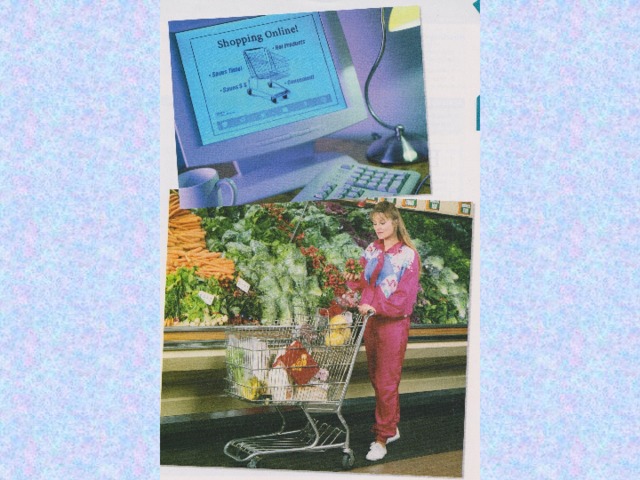

Picture comparison
- give a brief description of the photos (action, location)
- say what the pictures have in common
- say in what way the pictures are different
- say which of the ways of shopping presented in the pictures you’d prefer
- explain why
Action / Location
The photos show the ways of shopping. In the photographs there is buying things online and in a traditional supermarket.
We can see somebody ordering or have ordered things on a website being at home or in the office in one picture and the woman choosing vegetables in the supermarket in the other one.
Similarities
- One thing the photographs have in common is a trolley for putting purchases.
- Another similar thing is the way of payment . It doesn’t matter which shop you use, a real or a virtual one, you can pay with a card.
- Both of them introduce the possibilities of choosing what to buy.
Differences
- You carry your shopping in a carrier bag when you visit the supermarket. By online shopping you have the goods brought to your home.
- There aren’t any people in one picture whereas we can see a customer shopping in the supermarket in the other one.
- Unlike the website, you can see, touch and smell the products in the supermarket.
- Internet shopping is usually cheaper.
- Most shops aren’t open 24 hours a day.
I’d prefer
- traditional shopping to shopping online… ( I see it as a means of taking down stress and raising my spirits).
- shopping on websites to visiting real shops. I like doing it in comfort without being distracted.
- I like trying things on and choosing what suits me best.
- I would like to rely on shop assistant’s help.
- I can’t bear standing a queue at the cash desk.
- Neither would I like to carry heavy carrier bags to my home.

Feedback
- What do you find most difficult in the task of comparison and contrasting?
- What did you find useful in this lesson?
- What was useless or at least not very helpful?
- What new things did you learn in class?
Shopping vocabulary can be useful when talking
about a range of subjects and the topic of shopping itself is easy to talk about
as it’s something we all do regularly.
Here are a few things you could be asked about:
- How you feel about shopping
- Your local shopping facilities
- Changes in shopping habits
- Online shopping
- Consumer protection
This page includes over 100 common words and phrases related to shopping.
I’ve added an explanation for each one and a sample sentence to show it in
context. This will help you to learn how to use it correctly.
Don’t try to learn them all. Look at my suggestions below as to
the best way to use this comprehensive list of shopping vocabulary.
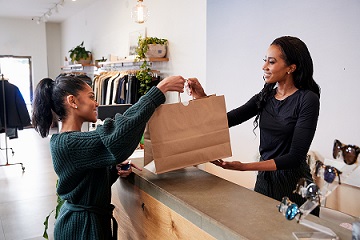 Do you enjoy shopping?
To ensure that you’re well prepared to answer any shopping-related question, I’ve included four things here:
- IELTS-style questions on the topic of shopping
- Sample answers
- A list of common shopping vocabulary with definitions & sample
sentences
- Links to online reading and listening resources
You’ll find PDF downloads of both the
questions and sample answers and the shopping vocabulary list at the bottom of
the respective sections.
The questions relate to the Speaking test
because this part of the exam offers the broadest range of possible questions
on the topic of shopping. They give the best opportunity for me to demonstrate the
vocabulary and for you to practise using it.
I’ve included IELTS-style questions and
answers for all three parts of the Speaking test. I’ve highlighted keywords and
phrases in bold.
You’ll find these words and phrases, and
many others, in the vocabulary list beneath. The list also includes
explanations and sample sentences and there’s an audio to listen to the
pronunciation.
The shopping vocabulary list contains words
and phrases relevant to all parts of the IELTS exam.
Finally, at the bottom of the page, I’ve
added links to topical articles, short videos and podcasts that will help you
to improve both your shopping vocabulary and your reading and listening skills.
IELTS-Style
Speaking Test Questions and Answers
Common shopping vocabulary
is highlighted in bold.
Part 1
1) How do
you feel about shopping?
I love going
shopping, especially bargain
hunting in the sales.
Every few months I go into the city on a shopping
spree with my friends.
2) What types
of shops do you use regularly?
I go to
the supermarket once a week for my groceries,
although I buy all my meat from the local butcher. When I go into
town, I always have a browse around the department stores.
3) What changes
have you seen in those shops in the past few years?
I’ve
noticed that the supermarket seems to sell a wider range of goods
and services every year. They now even have their own pharmacy. I
think that the main difference in the department store in an
improvement in their customer service.
4) Do you
like shopping on the internet?
Yes, I do enjoy shopping online. You have so much choice on the
internet and it’s easy to shop around.
Also, you can purchase things
immediately and they are often delivered the next day. It’s much quicker than waiting
until you have time to go into town.
5)
What kinds of things do you buy online?
I
purchase books, electrical
goods, gifts, stationery and, in fact, most everyday products on the internet. It’s
really only clothes and shoes that I always buy on the high street as I like to try them on first.
 It’s easy to shop online.
Part 2
Describe your favourite shop.
You should say:
- where it is
- what it sells
- how often you go there
and explain why you think it is a good
shop.
I particularly like browsing shops that sell outdoor wear,
things like waterproof jackets, walking boots, hiking trousers and rucksacks. There
are several in my home town but my favourite is called No Sweat. It’s an independent
store and they stock all the big
brand names in outdoor gear. Their goods
are expensive but top
quality
One reason I enjoy shopping there is their excellent
customer service. The sales assistants are very
helpful and do their best to advise you on the best products for your needs.
They never try and give you the hard
sell and will recommend a different brand that they don’t sell if they think it would suit you
better.
They are extremely knowledgeable about
outdoor gear, which is more than can be said of the shop assistants in similar stores in town. The other retail outlets are chain
stores and they don’t give you the same personal service or feeling of
confidence that they really know what they’re talking about.
I can’t say that I go to No Sweat very often but I always pop in for
a spot of bargain hunting if
they have a sale on or if I
need something in particular. I try to avoid the shop otherwise as it’s just too tempting to spend money I
can’t really afford. If I want something like an expensive new jacket, I generally save up for it.
The last time I went there was to buy a new pair of walking boots.
By chance, they had an offer on
a fabulous lightweight waterproof jacket in my favourite colour. It was at a
real knock-down price so I just
had to buy that as well. I
also bought a couple of
t-shirts that were reduced.
It all added up to quite a lot of money but they gave me a free pair of walking
socks and some stuff to clean my new boots. They usually give you free products
if you make a large purchase.
It makes you feel valued as a customer.
I think that’s why the shop has been
so successful when most independent stores
are struggling to compete with the big high
street names. It’s because of the way they value their customers and give good value for money.
 My favourite shop sells walking gear.
Part 3
1) Do you agree or disagree that women spend more time shopping
than men?
I would definitely say that women go
shopping more often than men and also spend longer looking for what
they want. For a start, it is usually women who buy the groceries
each week and also clothes for the children if they have a family. Many women I
know purchase most of their husband’s clothes as well because
their men hate shopping.
I think this is less the case with
younger men as they are more fashion conscious and happy to hit the shops
themselves. Brand named clothes are a status symbol
with the younger generation as they like to dress to impress. Men more readily
pay for expensive items, especially the latest electronic
gadgets, and aren’t too bothered about discounts.
For women, shopping
is often a social activity done with friends. It’s common to go window
shopping and my sister’s idea of a fun morning is browsing
the second-hand shops in town. You never see men doing either of
these things.
2) Do people generally prefer to buy
products from their own or from other countries?
I think it varies very much from person to person. On the
one hand, there’s an increasing number of people who choose to buy their meat and vegetables from
farm shops rather than supermarkets. This is partly to
support the local economy but also because they are concerned that transporting
produce around the world is contributing to global warming.
Unfortunately, supermarket
products are often cheaper despite having travelled many miles to the shops. For example, I live in
the countryside and can see sheep out of my window and yet it’s cheaper to buy
lamb from New Zealand, 11,000 miles away, than it is to purchase local lamb.
So, on the other hand, you have people on a low budget who are
forced to buy cheaper supermarket imports even if they
don’t want to.
With most goods
other than food, there’s often little choice but to buy foreign imports as most
things in the shops come from abroad.
3) Why do you think some people purchase things that they do
not need?
In my opinion, unnecessary purchases
are made for several reasons. Firstly, many people, especially the younger
generation, like to have the latest gadgets and fashions so they quickly
discard old stuff. We have become a real throwaway society. Also,
they want to have the same products as their friends whether they need them or
not.
Secondly, these days we tend to
have more spare cash to buy luxuries that our
parents would not have been able to afford at our age.
Finally, I think that aggressive
advertising convinces people that they need things that they don’t and, of
course, the internet encourages impulse buying as shopping
online is so quick and easy.
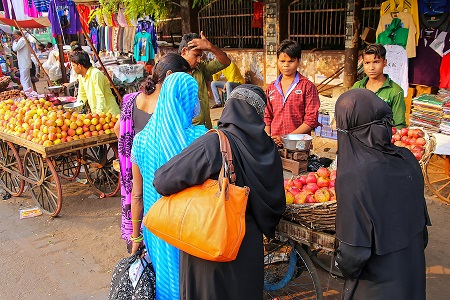 Women shopping at a market stall.
Click this link to get a PDF download of these practise questions & sample answers.
Download PDF Now
Shopping Vocabulary
* Important
- Do not try
and learn this list of shopping vocabulary.
- Identify
the vocabulary you find useful for answering practise questions about shopping.
- Record
these in your vocabulary notebook and practise using them regularly.
I recommend that you create
your own answers to the Speaking questions on this page. You will find many
other IELTS-style practise questions by searching online.
For help on how to learn
vocabulary, what to learn and how to record it, visit these pages:
How to Learn Vocabulary for
IELTS
Top 6 Types of IELTS
Vocabulary & Topic Word Lists
Shopping Vocabulary – Common Words & Phrases
Shopping Vocabulary Set 1: Going Shopping
to go shopping
– to go to the shops to buy things
— I won’t be home until 6pm tonight because I’m going shopping after work.
to do the shopping
– the activity of buying items from shops
— I hate doing the
shopping as it’s always so crowded in the supermarket.
goods
– things that are sold
— Department stores have a wide range of goods on sale.
window shopping
– the activity of looking at goods for sale, especially in shop window
displays, without the intention of buying anything
— One of my favourite activities on a Saturday is to go window shopping with my friends to see
the latest fashions.
bargain hunting
– looking for products that are good value for money, usually because
they are on sale at a lower price than normal
— I love bargain hunting and feel great when I
find something I need at a knock-down price.
shop around
– compare prices before buying something
— I always shop
around before buying high value items as prices can vary considerably.
browse – looking at things in one or more shops without a firm intention to buy
anything
— When I go into town, I often browse around the clothes shops to see if I can pick up any
bargains.
retail therapy
– the practise of buying things in order to make yourself feel better when you
are unhappy
— I need some retail
therapy to help me get over the disappointment of not getting a promotion
at work.
to go on a shopping spree
– a short period of time in which someone buys a lot of things
— I’ll have to go on a shopping spree before my holiday next month as I’ve lost so
much weight that my beachwear doesn’t fit me anymore.
hit
the shops / stores
– to go on a shopping spree
— I’m taking a bus into the city
with some friends on Saturday and we’re going to hit the shops.
an impulse buy –
an unplanned purchase when something is bought suddenly without careful thought
— My
waterproof jacket was an impulse buy
as I was actually looking for some new walking boots, but it was such a bargain
that I just had to get it.
a shopaholic
– someone who loves shopping and does it often, sometimes to the point of it
being an addiction
— My friend Sally is a true shopaholic but I do worry about her as she can’t really afford all
the designer clothes she buys.
Shopping Vocabulary Pronunciation
to try on – to put on an item of clothing to see if it fits or looks good
— Can I try on these two dresses please as I’m not sure which size will fit me best?
take something back – return an unwanted item to a shop
— I’m going to have to take this jacket back to the shop as the colour doesn’t match my skirt.
to return an item — to take or send something back to the retail outlet it was purchased from
— I’ll have to return the jumper I bought online as they sent the wrong size.
exchange – change an item that has been purchased for a different one
— The shirt I bought my dad for his birthday is too large so I’m going to exchange it for a smaller one.
for sale – available to buy
— I was really impressed by the quality of goods for sale in the new furniture shop in town.
shopping list – a list of the things you want to buy when you go shopping
— I always take a shopping list when I go to the supermarket so that I don’t forget anything.
customer service – any activity designed to increase the level of customer satisfaction, such as help them find finding the right product and guidance about its use
— I was really impressed with the customer service at the computer shop as a sales assistant helped me to choose the best laptop for my needs rather than trying to sell me a more expensive one.
to give someone the hard sell – try to sell someone something in a forceful way
— When I said I needed to go away and think about it before buying the car, the salesman tried the hard sell on me.
shoplifting — take goods from a shop without paying for them
— My cousin was caught shoplifting again and might be sent to prison this time.
shop online / internet shopping – to buy things over the internet
— It’s really popular to do your grocery shopping online these days and have it delivered to your house.
— The increase in internet shopping is leading to many local shops closing down
to order – to request a product over the internet or from a shop when the required item is not in stock
— I must remember to go online and order the computer game my brother wants for his birthday or it won’t arrive in time.
Shopping Vocabulary Pronunciation
Shopping Vocabulary Set 2: People
shopper – a
person who is shopping
— It
was the start of the summer sales and the high street was packed with shoppers.
customer – a person who
buys goods or services from a shop or business
— I like to do my shopping early in the morning before the
shops get busy with customers.
retailer
– a
business or person that sells goods to individual customers, as opposed to a
wholesaler or supplier, who normally sell their goods to another business
— Although
supermarkets are primarily food retailers,
they also sell many other things such as electrical goods and clothing.
bargain
hunter – someone who is looking for goods that are very good value for
money, usually because they are on sale at a lower price than normal
— My sister is a keen dedicated bargain hunter and rarely pays full price for anything.
shop assistant / sales assistant – a person who serves customers in a shop
— These days, shop assistants are often too busy chatting to one another to help
their customers.
cashier
— the person who takes the money in a shop
— The cashiers
were all busy and I had to join a queue to pay for my groceries.
market trader / market
vendor – a person who runs a stall at a market
— I
was late getting into town and many of the market
traders were already packing away their stalls.
store detective
– a person employed by a store to detect and prevent theft from the store by
shoplifters.
— The store detective
stopped the man as he was leaving the store and discovered a stolen bottle of
wine in his coat pocket.
Shopping Vocabulary Pronunciation
Shopping Vocabulary Set 3: Types of shop
shop
/ store / retail outlet – a place where customers can buy
goods
— My favourite shop / store / retail outlet to visit when I’m in London is Harrods.
chain store
– a group of shops that belong to one company
— These days, most towns in the UK are full of chain stores and there are very few
independent retailers left.
independent stores – shops not owned by large companies
— When I want to buy a special
outfit for a wedding, I shop in an independent
store so that I can be sure that no one else will be wearing the same
thing.
department store – a
large shop that sells different types of items in different areas or departments
of the store
—
The department store in our town
sells everything from clothes and shoes to bedding, kitchenware and cosmetics.
convenience store – a small local shop that is open for long hours and
sells a limited range of everyday food and other goods
— If we run out of bread or milk, I send one of the kids down
to the convenience store at the end
of the road to buy some.
supermarket – a
large shop that sells mainly food and household items
— I
buy most of our food at the supermarket,
although I do like to go to the local butcher for meat.
discount store
– a shop that sells goods at less than the normal retail price
— Having a motor parts discount
store near my home means that I can keep my car on the road quite cheaply.
grocery
– shop that sells groceries (the collective term for items of food sold in a
grocery or supermarket)
— I hope that our local grocery
store doesn’t close down now that a big supermarket has been build near town.
greengrocer – person
or shop that sells fresh fruit and vegetables
—
When I was young I was always given a free apple when I went to the greengrocer with my mum.
butcher – person
or shop that sells fresh meat
— My
butcher makes the best sausages in
the area.
bakery –
shop that sells fresh bread and cakes
—
Fresh bread from a bakery always
tastes much better than bread bought from a supermarket.
fishmonger – person
or shop that sells fresh fish
—
Our fishmonger buys his fish
straight off the local fishing boats so it’s very fresh.
farm shop – a
shop which sells produce from a farm directly to the public
— Buying
from a farm shop helps to support
the local economy and guarantees the produce is fresh.
Shopping Vocabulary Pronunciation
pharmacy – shop that sells medicines
— They were very helpful at the pharmacy and recommended some cough mixture that has calmed my chesty cough.
chemist (UK) / drugstore (US) – sells medicines and toiletries
— I was glad that mum asked me to pick her tablets from the chemist as they had an offer on razor blades and I needed some new ones.
newsagents – shop that sells newspapers and magazines
— Harry stopped off at the newsagents on his way to the train station each weekday morning to buy his daily paper.
pet shop – shop that sells food and other items for dogs, cats and other pets and sometimes small pets as well
— My dog loves visiting the pet shop with me as he knows that I’ll buy him a dog chew.
bookshop – shop that sells books
I buy lots of Christmas and birthday present from bookshops as all my family are keen readers.
DIY store – shop that sells things for home improvement
— Dad has promised me some shelves in my room so we’re off to the DIY store at the weekend to buy some planks of wood and screws.
hardware shop / ironmonger – shop that sells goods such as nails, screws and hand tools.
— I love browsing in hardware stores as they sell so many interesting bits and pieces.
delicatessen (deli) – shop that specialises in cooked meats, cheeses, and unusual or foreign prepared foods
— My special treat is a venison and mushroom pie from our local deli.
market – a place where people sell produce and good on small stalls
— I buy all my fruit and vegetables at the market because they are fresher than in the supermarket.
flea market – a group of stalls selling old furniture or clothes
— The flea market in Portobello Road, London, started in the 1800s and is still popular with both locals and tourists.
shopping mall – a large enclosed shopping area from which traffic is excluded
— The first time I visited a shopping mall I was so excited to see so many big brand name shops all in one place.
shopping centre – a large building or a group of buildings containing lots of different stores, often build away from town centres
— One of the reasons why people like out-of-town shopping centres is that you get free parking.
Shopping Vocabulary Pronunciation
Shopping Vocabulary Set 4: Buying things
to buy / to purchase – to acquire
something by paying for it
— Juan bought himself a new suit for his job interview.
— Kari couldn’t decide whether to
buy the red or the blue pair of shoes so she purchased both of them.
gift voucher – a
card that you buy at a shop to give as a gift, which entitles the person to
exchange it for goods worth the same amount
— I
often give my nieces and nephews gift
vouchers for their birthdays so that they can buy what they want.
discount voucher – a
ticket or piece of paper, often with a code on it, that gives money off the
purchase price
—
When I bought my new TV, I got a discount
voucher for 20% off my next purchase from the shop.
coupon – a voucher, often printed in a newspaper or magazine, that
can be used to get something without paying for it, or at a reduced price
— There’s a coupon
in our local newspaper this week for a free cupcake from the new bakery in
town.
store card – a plastic card that can be used to buy goods
in a particular store that you pay for at a later
time
— My Macy’s store card
saves me lots of money as I get 10% off everything I buy with it.
loyalty card
– a card issued by a shop that enables
customers to save money on the basis of how much they spend
— I have 9 points on my bookshop loyalty card and next time I buy a book I’ll get a second one for
free.
debit card
– a plastic card used to pay for items that takes the money directly from your bank
account
— My debit card
is now contactless so I don’t even need to enter my PIN number for small
purchases.
credit card
– a plastic card that you use to buy goods or services and pay for them later
— I’m careful as to how I use my credit card as it is very easy to overspend with one.
cash
– money in the form of notes and coins
— I hardly ever use cash
these days as I do most of my shopping online.
receipt
— a piece of paper showing the amount of money you have paid for something used
as proof of purchase
— I always keep the receipt
when I buy something in case I have to return it.
refund
– money given back to a customer when they return a product they are not happy
with
—
I took the faulty clock back to the shop and asked for a refund.
Shopping Vocabulary Pronunciation
Shopping Vocabulary Set 5: Prices and cost
price
— the amount of money you have to pay for something
— I was delighted when I looked at the price of the pretty blue dress and found that it was less than I
had expected.
price tag
– a label that states the price of an item
— When I see an item of clothing I like, I check the price tag first to see if I can afford
it.
discount
– a reduction in the price of something
— If I’m buying lots of items from a shop, I always ask for
a discount.
a sale
– a
period during which a shop sells goods at reduced prices
— I need a
new vacuum cleaner but I’m waiting until the January sales to save money.
on sale / on offer
— for sale at a reduced price
— Umbrellas are on
sale at the moment so I’m going to buy one ready for the rainy season.
to pick up a bargain / to snap up a
bargain – to buy something cheaply
— She picked up some great bargains in the
sale.
knock-down price – extremely cheap or costing much less than the usual
amount
— Now that spring is here, they’re selling off winter coats
at a knock-down price.
to slash prices
— to reduce prices a great deal
— Mr Patel is closing down his clothes shop and has slashed prices to sell off his stock.
expensive – costing a lot of money
— Stefan bought his girlfriend an expensive necklace for her birthday.
inexpensive / cheap – something that does not cost a lot of money
— Hyun-Gi looked in the sales for an inexpensive watch to wear for work.
— Wan-Soo said he’d seen some nice watches going cheap in the market.
to be value for money
– to be worth the cost
— My new laptop was quite expensive but has all the latest features so I think it was good value for money.
over-priced –
to cost more than you think it is worth
—
The sunglasses made me look really cool but they were over-priced so I didn’t buy them.
to save up
– to put money aside for something until the required amount is reached
— Khalil was saving
up to buy a new bicycle.
haggle –
to negotiate the cost of an item
— I
had to really haggle with the car
salesman to get the price I wanted.
Shopping Vocabulary Pronunciation
Shopping Vocabulary Set 6: In a shop
checkout
– the place where payment is made for goods, especially in a supermarket
— The girl on the checkout
was very friendly and chatted as she took the payment for my groceries.
queue
– a line of people waiting
— The supermarket was really busy and I had to queue for ages at the checkout.
shelves
– the place where they put the products in a shop, especially in a supermarket
— With Christmas only a few weeks away, the shelves were stacked with festive food.
trolley
– a large container with wheels that you
use to put products in, especially in a supermarket
— It’s important to pack your trolley carefully so that your fruit and eggs don’t get squashed under
heavy items.
changing room / fitting room
– place in a shop where you can try clothes on before buying them
— Belita wasn’t sure which size blouse would fit her best so
she took a small and a medium into the changing
room to try on.
opening hours
– the times when a shop is open for business
— In recent years, many shops have extended their opening hours to stay open later and
catch customers leaving work.
Shopping Vocabulary Pronunciation
Shopping Vocabulary Set 7: Other shopping vocabulary
brand
– a unique design, symbol or words, or a combination of these, used to create
an image that identifies a product and differentiates it from its competitors
— When I buy new fitness trainers, I always choose a
well-known brand like Nike so that I can be sure of the
quality.
big brand names
– large, well-known companies or product names
— Shoppers generally look for big brand names as their products usually have a good reputation.
brand-name goods – products made by a well-known
company
— Teenagers are a huge market for brand-name goods as having the same
brand as the cool kids makes them feel cool too.
high street names
– well-known shops
— If you visit any town in the UK, you will see all the
familiar high street names such as Boots, Marks & Spence and W.H.
Smith.
a luxury
– something expensive that you do not need but you buy for pleasure or comfort
— One day I’m going to treat myself to a luxury car but while the kids are
young, a station wagon is far more suited to our family needs.
status symbol – a product that people want to have because they think othe people will admire them for owning it.
— Designed clothes are an important status symbol among young people.
second-hand
– something that is for sale but has
been used before
— I often browse the second-hand
clothes shops to see if they’ve got anything worth having in my size.
fake – imitation
or counterfeit
— The
sale of fake designer clothes and
perfumes is illegal but can make dealers a lot of money.
genuine – what
it is meant to be, not fake
—
The leather jackets were so cheap that Marlon doubted that they were genuine.
throwaway society – the idea that we have become a society that consumes a
lot of stuff and readily throws it away, replacing it with new goods
— Whilst the transition to throwaway socieities is good for economic growth, it’s leading to a huge waste problem.
Shopping Vocabulary Pronunciation
Shopping Vocabulary Set 8: Idioms
the real McCoy –
genuine, not fake
— I
was worried that the gold bracelet I bought in the market wasn’t made of real
gold but I showed it my uncle who’s a jeweller and he said it’s the real McCoy.
going for a song –
on sale for a very low price
— I
was glad I went to the end of season sale at the garden centre as many of the
plants were going for a song.
to shop until you drop
– to continue shopping until you are exhausted; to shop intensively over a
short period of time
— I’m meeting my best friend in town on Friday afternoon and
we’re going to shop until we drop.
Shopping Vocabulary Pronunciation
Click this link to get a PDF download of this list of shopping vocabulary.
Download PDF Now
Ways to Improve Your Shopping Vocabulary
One of the best
ways to improve your shopping vocabulary is through reading. Watching topic related YouTube
videos and listening to podcasts is also hugely beneficial.
Here are some
online resources I recommend.
Shopping Articles
The Conversation
CNBC — Retail
BBC News — Retailing
The Guardian — Retail
TED Talks
I love TED Talks. They are short videos
with a powerful message and are generally very interesting. They’re ideal for
improving your vocabulary and give valuable listening skills practise.
Search TED Talks — Shopping to help you improve your shopping vocabulary.
All Topic Vocabulary
Like this page?
-
Home
-
IELTS Vocabulary
-
Shopping Vocabulary
›
›
-
Back To Top
Всего: 68 1–20 | 21–40 | 41–60 | 61–68
Добавить в вариант
According to the author, in her childhood she used to …
1) watch TV a lot.
2) call her mother every half an hour.
3) go to the mall with her family.
4) do the shopping with her friends.
Показать
1
Which of the following does Athena do monthly?
1) Goes to the mall with her family.
2) Uses the Snapchat.
3) Invites friends to her place.
4) Changes her iPhone.
Источник: Демонстрационная версия ЕГЭ—2020 по английскому языку, Демонстрационная версия ЕГЭ—2021 по английскому языку, Демонстрационная версия ЕГЭ—2022 по английскому языку, Демонстрационная версия ЕГЭ—2023 по английскому языку
2
For Athena’s peers spending time alone in their rooms seems …
1) natural.
2) soothing.
3) awkward.
4) difficult.
Источник: Демонстрационная версия ЕГЭ—2020 по английскому языку, Демонстрационная версия ЕГЭ—2021 по английскому языку, Демонстрационная версия ЕГЭ—2022 по английскому языку, Демонстрационная версия ЕГЭ—2023 по английскому языку
3
Which of the following is NOT true about iGen teenagers, according to the author?
1) Most of them feel extremely unhappy.
2) It is easy to hurt them psychologically.
3) They prefer loneliness to company.
4) They have more physical health problems.
Источник: Демонстрационная версия ЕГЭ—2020 по английскому языку, Демонстрационная версия ЕГЭ—2021 по английскому языку, Демонстрационная версия ЕГЭ—2022 по английскому языку, Демонстрационная версия ЕГЭ—2023 по английскому языку
4
That in “I know my parents’ generation didn’t do that” (paragraph 5) refers to …
1) being glued to their phones.
2) behaving in a mean way.
3) listening attentively to friends.
4) discussing their problems.
Источник: Демонстрационная версия ЕГЭ—2020 по английскому языку, Демонстрационная версия ЕГЭ—2021 по английскому языку, Демонстрационная версия ЕГЭ—2022 по английскому языку, Демонстрационная версия ЕГЭ—2023 по английскому языку
5
The fact that Athena threw away her friend’s phone proves that …
1) smartphones can cause mental health problems.
2) teenagers know the problems caused by phones.
3) smartphones make teenagers more aggressive.
4) her friend thought she was doing the right thing.
Источник: Демонстрационная версия ЕГЭ—2020 по английскому языку, Демонстрационная версия ЕГЭ—2021 по английскому языку, Демонстрационная версия ЕГЭ—2022 по английскому языку, Демонстрационная версия ЕГЭ—2023 по английскому языку
6
What does the author suggest in her article?
1) Phone use by young people should be limited.
2) Smartphones cause violent behavior.
3) Smartphones are not safe.
4) There are good and bad sides in using smartphones.
Источник: Демонстрационная версия ЕГЭ—2020 по английскому языку, Демонстрационная версия ЕГЭ—2021 по английскому языку, Демонстрационная версия ЕГЭ—2022 по английскому языку, Демонстрационная версия ЕГЭ—2023 по английскому языку
Источник: Демонстрационная версия ЕГЭ—2020 по английскому языку, Демонстрационная версия ЕГЭ—2021 по английскому языку, Демонстрационная версия ЕГЭ—2022 по английскому языку, Демонстрационная версия ЕГЭ—2023 по английскому языку
Imagine that you and your friend are doing a school project “Shopping”. You have found some illustrations and want to share the news. Leave a voice message to your friend. In 2.5 minutes be ready to:
— explain the choice of the illustrations for the project by briefly describing them and noting the differences;
— mention the advantages (1–2) of the two types of shopping;
— mention the disadvantages (1–2) of the two types of shopping;
— express your opinion on the subject of the project — which way of shopping you prefer and why.
You will speak for not more than 3 minutes (12–15 sentences). You have to talk continuously.

Photo 1
Photo 2
Imagine that you and your friend are doing a school project “Shopping”. You have found some illustrations and want to share the news. Leave a voice message to your friend. In 2.5 minutes be ready to:
— explain the choice of the illustrations for the project by briefly describing them and noting the differences;
— mention the advantages (1–2) of the two types of shopping;
— mention the disadvantages (1–2) of the two types of shopping;
— express your opinion on the subject of the project — which way of shopping you prefer and why.
You will speak for not more than 3 minutes (12–15 sentences). You have to talk continuously.
Photo 1
Photo 2
Источник: Демонстрационная версия ЕГЭ—2023 по английскому языку
Task 4. Imagine that you are doing a project “Shopping” together with your friend. You have found some illustrations and want to share the news. Leave a voice message to your friend. In 2,5 minutes be ready to:
— give a brief description of the photos, justifying the choice of the photos for the project;
— say in what way the pictures are different, justifying the choice of the photos for the project;
— mention the advantages and disadvantages (1−2) of the two ways of shopping;
— express your opinion on the subject of the project — what way of shopping you prefer and why.
You will speak for not more than 3 minutes (2−3 sentences for every item of the plan, 12−15 sentences total). You have to talk continuously.
Выберите только ОДНО из двух предложенных заданий (38.1 или 38.2). Укажите его номер и выполните согласно данному плану. В ответе на задание 38 числительные пишите цифрами.
38.1 Imagine that you are doing a project on what teenagers in Zetland think about school uniform. You have found some data on the subject — the results of the opinion polls (see the table below).
Comment on the data in the table and give your opinion on the subject of the project.
| Opinions about school uniform | Number of teenagers (%) |
|---|---|
| Enjoying to wear it | 40 |
| Having to wear it | 24 |
| Feeling no concern in wearing it | 14 |
| Feeling discomfort wearing it | 13 |
| Regarding it as outdated | 9 |
Write 200−250 words.
Use the following plan:
— make an opening statement on the subject of the project;
— select and report 2−3 facts;
— make 1−2 comparisons where relevant and give your comments;
— outline a problem one can face with wearing school uniform and suggest a way of solving it;
— conclude by giving and explaining your opinion on the role of school uniform for students.
38.2 Imagine that you are doing a project on why online shopping is popular in Zetland. You have found some data on the subject — the results оf the opinion polls (see the pie chart below).
Comment on the data in the diagram and give your opinion on the subject of the project.
Why online shopping is popular in Zetland
Write 200−250 words.
Use the following plan:
— make an opening statement on the subject of the project;
— select and report 2−3 facts;
— make 1−2 comparisons where relevant and give your comments;
— outline a problem that can arise with online shopping and suggest a way of solving it;
— conclude by giving and explaining your opinion on the role of online shopping in our life.
Прочитайте текст и заполните пропуски A–F частями предложений, обозначенными цифрами 1–7. Одна из частей в списке 1–7 — лишняя. Занесите цифры, обозначающие соответствующие части предложений, в таблицу.
Window Shopping
The day would be spent with my best friends Kath and Kate. We are actually three Catherines (by birth spelt with a C), A ______ we are all K’s: Kat (that’s me), Kath and Kate — the 3K Window Shopping gang!
Window shopping is simply wonderful. You can look at any outfit. You can try on В ______ not a single item on sale for which the price is a problem. You will try something on, ponder, pout, twirl, think hard, check yourself in the mirror one last time and finally reflect С ______ right for you! The highlight of this regular adventure however, is generally the 3K chocolate and ice cream break in the Shopping Centre’s top floor café. Of course we do not believe that we are wasting anyone’s time. We do D ______ as well, but a reliable equation for us is — 3Ks + shopping mall = a good time.
But E ______ out to be especially memorable. One of the stores had a questionnaire lottery with the first prize being a voucher worth £200. We filled in the question forms while in the café and returned to the store by their 2.00 pm deadline. Kate won the first prize but we had decided in advance that if any of us won something, we would share equally: All for one К and one for all! At this point our morning of window shopping paid off. We completed F ______ slightly less than 10 minutes: three skirts, three hats and three belts and three very OK, K’s.
1. not like to spend our time
2. that it’s probably not quite
3. that particular day turned
4. our real shopping in
5. sometimes go shopping for real
6. anything you want and there is
7. but when we are together
| Пропуск | A | B | C | D | E | F |
| Часть предложения |
Задания Д40 C2 № 1711 
Выберите только ОДНО из двух предложенных высказываний и выразите своё мнение по предложенной проблеме согласно данному плану.
Comment on one of the following statements.
1. Some people think that in the future traditional shops will disappear and all shopping will be on line with home delivery.
2. Central parts of big cities should be closed to private transport.
What is your opinion? Do you agree with this statement? Write 200–250 words. Use the following plan:
− make an introduction (state the problem)
− express your personal opinion and give 2–3 reasons for your opinion
− express an opposing opinion and give 1–2 reasons for this opposing opinion
− explain why you don’t agree with the opposing opinion
− make a conclusion restating your position
Задания Д44 C5 № 4677
Study the two photographs. In 1.5 minutes be ready to compare and contrast the photographs:
— give a brief description of the photos (action, location)
— say what the pictures have in common
— say in what way the pictures are different
— say which way of shopping presented in the pictures you’d prefer
— explain why
You will speak for not more than 2 minutes (12–15 sentences). You have to talk continuously.
Установите соответствие между заголовками 1–8 и текстами A–G. Запишите свои ответы в таблицу. Используйте каждую цифру только один раз. В задании есть один лишний заголовок.
1. CHRISTMAS SHOPPING
2. CRIME AT CHRISTMAS
3. CHRISTMAS TRADITIONS
4. CHRISTMAS – A FAMILY CELEBRATION
5. CHRISTMAS IN RUSSIA
6. CHRISTMAS DINNER
7. CHRISTMAS WEATHER
8. NEW YEAR’S CELEBRATIONS
A. There are a lot of traditions connected with Christmas but perhaps the most important one is the giving of presents. Family members wrap up their gifts and leave them at the bottom of the Christmas tree to be found on Christmas morning. Children leave a long sock or stocking at the end of their beds on Christmas Eve, 24th December, hoping that Father Christmas will come down the chimney during the night and bring them small presents, fruit and nuts.
B. At some time on Christmas day the family will sit down to a big turkey dinner followed by Christmas pudding or Christmas cake. As for Christmas cake, heavy and overfilling it is not to everybody’s taste. To make things worse, it takes weeks to make and when it is ready it can last until Easter, so if you don’t like it, you have to try and eat some at Christmas to avoid being haunted by it months after.
C. Officially Christmas and New Year celebrations run from the 24th of December to the 2nd of January. However, for many Brits the Christmas marathon starts as early as the beginning of October with the first festive adverts on TV. The idea of Christmas shopping is that you spend as much money as you can on anything you cast your eyes on, preferably something neither you nor your family or friends will ever use. An average British family spends 670 pounds or more around the Christmas period.
D. Long live Christmas! -say pickpockets, car thieves and burglars getting their share of Christmas shopping. Every year thousands of people get their wallets stolen in overcrowded shops and streets. Lots of lovely presents, which somebody spent so much time and money on, disappear without a trace when cars and homes are broken into. As much as 9% of people experience a burglary in December.
E. Who doesn’t want to have a white Christmas? Playing snowballs and making a snowman with the whole family on Christmas Day is most people’s dream (apart from the countries like Australia that celebrate Christmas in summer, on the beach). This dream is more likely to come true in northern countries like Russia, but for the British people it’s different. Although it’s not uncommon to get some snow in Scotland and northern England, the rest of Britain is normally only lucky enough to get some frost. In most cases the weather is wet and gloomy.
F. New year is a time for celebrating and making a new start in life. In Britain many people make New Year’s resolutions. This involves people promising themselves that they will improve their behaviour in some way, by giving up bad habits. People might decide to give up smoking, for example, or to go on a diet. These promises are often broken in the first few days of the New Year, however!
G. Christmas is celebrated on the 25th of December. For most families, this is the most important festival of the year. On this day many people are travelling home to be with their families. Most houses are decorated with brightly-coloured paper or holly, and there is usually a Christmas tree in the corner of the front room. Unfortunately, not all families get on well together. As it is a well-known fact, some magazines publish tips on how to cope with Christmas, such as yoga, meditation or holidays abroad.
| Текст | A | B | C | D | E | F | G |
| Заголовок |
Источник: Яндекс: Тренировочная работа ЕГЭ по английскому языку. Вариант 3.
Task 3. You are going to give an interview. You have to answer five questions. Give full answers to the questions (2−3 sentences). Remember that you have 40 seconds to answer each question.
Tapescript for Task 3
Interviewer: Hello everybody! It’s Teenagers Round the World Channel. Our guest today is a teenager from Russia and we are going to discuss shopping. We’d like to know our guest’s point of view on this issue. Please answer five questions. So, let’s get started.
Interviewer: Do you like shopping? Why?
Student: _________________________
Interviewer: Who do you usually go shopping with?
Student: _________________________
Interviewer: What do you buy online?
Student: _________________________
Interviewer: Are there any old shops in your hometown?
Student: _________________________
Interviewer: Would you like to set up your own shop? What would it be?
Student: _________________________
Interviewer: Thank you very much for your interview.
Выберите только ОДНО из двух предложенных заданий (38.1 или 38.2). Укажите его номер и выполните согласно данному плану. В ответе на задание 38 числительные пишите цифрами.
38.1 Imagine that you are doing a project on how teenagers in Zetland spend their free time. You have found some data on the subject — the results of the opinion polls (see the table below).
Comment on the data in the table and give your opinion on the subject of the project.
| Activities | Number of teenagers (%) |
|---|---|
| Hanging out with friends | 47 |
| Watching movies | 20 |
| Doing online shopping | 16 |
| Cooking | 12 |
| Reading the same book and discussing it | 5 |
Write 200−250 words.
Use the following plan:
— make an opening statement on the subject of the project;
— select and report 2−3 facts;
— make 1−2 comparisons where relevant and give your comments;
— outline a problem that can arise with spending free time and suggest a way of solving it;
— conclude by giving and explaining your opinion on the best way of spending free time.
38.2 Imagine that you are doing a project on what teenagers in Zetland use social networks for. You have found some data on the subject — the results оf the opinion polls (see the pie chart below).
Comment on the data in the diagram and give your opinion on the subject of the project.
What teenagers in Zetland use social networks for
Write 200−250 words.
Use the following plan:
— make an opening statement on the subject of the project;
— select and report 2−3 facts;
— make 1−2 comparisons where relevant and give your comments;
— outline a problem that one can face using social networks and suggest a way of solving it;
— conclude by giving and explaining your opinion on the role of social networks in our life.
Установите соответствие между заголовками 1–8 и текстами A–G. Запишите свои ответы в таблицу. Используйте каждую цифру только один раз. В задании есть один лишний заголовок.
1. A taste of everything
2. Shop till you drop
3. City’s tourist attractions
4. Ancient traditions live on
5. Activities for the adventurous and hardy
6. On the crossroads of religions
7. For the body, mind and soul
8. From the high peaks to the deep seas
A. Today Jakarta has much to offer, ranging from museums, art and antique markets, first class shopping to accommodations and a wide variety of cultural activities. Jakarta’s most famous landmark, the National Monument or Monas is a 137m obelisk topped with a flame sculpture coated with 35 kg of gold. Among other places one can mention the National museum that holds an extensive collection of ethnographic artifacts and relics, the Maritime Museum that exhibits Indonesia’s seafaring traditions, including models of sea going vessels.
B. Sumatra is a paradise for nature lovers, its national parks are the largest in the world, home to a variety of monkeys, tigers and elephants. Facing the open sea, the western coastline of Sumatra and the waters surrounding Nias Island have big waves that make them one of the best surfer’s beaches in Indonesia. There are beautiful coral reefs that are ideal for diving. For those who prefer night dives, the waters of Riau Archipelago offer a rewarding experience with marine scavengers of the dark waters.
C. Various establishments offer professional pampering service with floral baths, body scrubs, aromatic oils, massages and meditation; rituals and treatments that use spices and aromatic herbs to promote physical and mental wellness. Various spa hotels are extremely popular. Indonesians believe that when treating the body you cure the mind.
D. Jakarta has a distinctly cosmopolitan flavor. Tantalize your taste buds with a gastronomic spree around the city’s many eateries. Like French gourmet dining, exotic Asian cuisine, American fast food, stylish cafes, restaurants all compete to find a way into your heart through your stomach. The taste of Indonesia’s many cultures can be found in almost any corner of the city: hot and spicy food from West Sumatra, sweet tastes of Dental Java, the tangy fish dishes of North Sulawesi.
E. In the face of constant exposure to modernization and foreign influences, the native people still faithfully cling to their culture and rituals. The pre-Hindu Bali Aga tribe still maintains their own traditions of architecture, pagan religion, dance and music, such as unique rituals of dances and gladiator-like battles between youths. On the island of Siberut native tribes have retained their Neolithic hunter-gathering culture.
F. Whether you are a serious spender or half hearted shopper, there is sure to be something for everybody in Jakarta. Catering to diverse tastes and pockets, the wide variety of things you can buy in Jakarta is mind boggling from the best of local handicrafts to haute couture labels. Modern super and hyper markets, multi-level shopping centers, retail and specialty shops, sell quality goods at a competitive price. Sidewalk bargains range from tropical blooms of vivid colors and scents in attractive bouquets to luscious fruits of the seasons.
G. The land’s long and rich history can’t be separated from the influence of Hinduism, Buddhism, Islam and Christianity. There is one of the oldest Hindu temples in Java, the majestic Buddhist ‘monastery on the hill’, Borobudur, the largest Buddhist monument in the world. About 17 km away from this monastery is a 9th century temple complex built by the Sanjaya dynasty. Prambanan complex is dedicated to the Hindu trinity: Ciwa, Vishnu and Brahma. The spread of Islam also left interesting monuments such as the 15th century Minaret Mosque in Kudus.
| Текст | A | B | C | D | E | F | G |
| Заголовок |
Выберите только ОДНО из двух предложенных заданий (38.1 или 38.2). Укажите его номер и выполните согласно данному плану. В ответе на задание 38 числительные пишите цифрами.
38.1 Imagine that you are doing a project on what motivates people in Zetland to do volunteering. You have found some data on the subject — the results of the opinion polls (see the table below).
Comment on the data in the table and give your opinion on the subject of the project.
| Motives | Number of volunteers (%) |
|---|---|
| Helping others | 45 |
| Gaining knowledge and developing new skills | 23 |
| Socializing | 13 |
| Building confidence and self-esteem | 11 |
| Broadening experience | 8 |
Write 200−250 words.
Use the following plan:
— make an opening statement on the subject of the project;
— select and report 2−3 facts;
— make 1−2 comparisons where relevant and give your comments;
— outline a problem that can arise with volunteer work and suggest a way of solving it;
— conclude by giving and explaining your opinion on the importance of volunteering for society.
38.2 Imagine that you are doing a project on what teenagers in Zetland spend their money on. You have found some data on the subject — the results оf the opinion polls (see the pie chart below).
Comment on the data in the diagram and give your opinion on the subject of the project.
What teenagers in Zetland spend their money on
Use the following plan:
— make an opening statement on the subject of the project;
— select and report 2−3 facts;
— make 1−2 comparisons where relevant and give your comments;
— outline a problem that can arise with spending money for teens and suggest a way of solving it;
— conclude by giving your opinion on the role of shopping in teenagers’ life.
Прочитайте текст и заполните пропуски A–F частями предложений, обозначенными цифрами 1–7. Одна из частей в списке 1–7 — лишняя. Занесите цифры, обозначающие соответствующие части предложений, в таблицу.
America’s fun place on America’s main street
If any city were considered a part of every citizen in the United States, it would be Washington, DC. To many, the Old Post Office Pavilion serves A ________________. If you are in the area, be a part of it all by visiting us — or В ________________. Doing so will keep you aware of the latest musical events, great happenings and international dining, to say the least.
Originally built in 1899, the Old Post Office Pavilion embodied the modern spirit С ________________. Today, our architecture and spirit of innovation continues to evolve and thrive. And, thanks to forward-thinking people, you can now stroll through the Old Post Office Pavilion and experience both D ________________ with international food, eclectic shopping and musical events. All designed to entertain lunch, mid-day and after work audiences all week long.
A highlight of the Old Post Office Pavilion is its 315-foot Clock Tower. Offering a breath-taking view of the city, National Park Service Rangers give free Clock Tower tours every day! Individuals and large tour groups are all welcome. The Old Post Office Clock Tower also proudly houses the official United States Bells of Congress, a gift from England E ________________. The Washington Ringing Society sounds the Bells of Congress every Thursday evening and on special occasions.
Visit the Old Post Office Pavilion, right on Pennsylvania Avenue between the White House and the Capitol. It is a great opportunity F ________________, this is a landmark not to be missed no matter your age.
1. that are offered to the visitors
2. its glamorous past and fun-filled present
3. as a landmark reminder of wonderful experiences
4. by joining our e-community
5. that was sweeping the country
6. celebrating the end of the Revolutionary War
7. to learn more about American history
| Пропуск | A | B | C | D | E | F |
| Часть предложения |
Источник: ЕГЭ по английскому языку 06.06.2013. Основная волна. Сибирь. Вариант 1
Вы услышите диалог. Определите, какие из приведённых утверждений А–G соответствуют содержанию текста (1 — True), какие не соответствуют (2 — False) и о чём в тексте не сказано, то есть на основании текста нельзя дать ни положительного, ни отрицательного ответа (3 — Not stated). Занесите номер выбранного Вами варианта ответа в таблицу. Вы услышите запись дважды.
Воспользуйтесь плеером, чтобы прослушать запись.
A. The tourist has never been to Russia.
B. The tourist wants to see both Moscow and Saint Petersburg.
C. The tourist loves evening excursions.
D. The manager thinks Saint Basil’s Cathedral isn’t worth seeing.
E. The tourist will have some time for shopping in Moscow.
F. The tourist hopes to visit a show in the State Kremlin Palace.
G. The tourist wants to buy a tour straight away.
Запишите в ответ цифры, расположив их в порядке, соответствующем буквам:
| A | B | C | D | E | F | G |
Расшифровка записи
Consultant: Hello, how may I help you?
Tourist: Hello. You see, I would like to book a tour to Russia and I was just wondering if you could help me?
Consultant: And may I tell you that you have made an excellent choice! Russia is an amazing country with lots of exciting places to see. Is it going to be your first visit to Russia?
Tourist: Yes, it is.
Consultant: Well, for the first visit to Russia I would suggest starting with Moscow. You could spend about a week there and do all the sightseeing, plus visit the museums. If you are planning a longer trip, we can recommend going to Saint Petersburg next.
Tourist: I think I would like to see only Moscow this time. You see, I’m a theater lover, and I’ve read it on the Internet that Moscow is famous for it’s theatres.
Consultant: You are absolutely right! We can help you book the tickets to the famous Bolshoi Theatre, if you wish.
Tourist: That would be great! Could you please tell me more about the tour.
Consultant: Yes, of course. Here is the suggested itinerary. When you arrive in Moscow, you’ll check in the hotel and have some rest. In the evening, you can have a bus tour around the city, just to get a general impression. Moscow looks magnificent in the evening, so you’ll enjoy it. The next day you’ll be able to see Moscow’s sights in daylight.
Tourist: Sounds good to me! Are we going to see the Red Square?
Consultant: Of course! It’s impossible to imagine a trip to Moscow without seeing Red Square, as it’s the heart of the country. You’ll see Saint Basil’s Cathedral. It’s a gorgeous building. Make sure you go inside, as there are 8 tiny churches there, which look like fairy-tale houses.
Tourist: Thanks, I’ll remember that.
Consultant: You’ll also see GUM — Russia’s number one department store. You’ll have enough time to go shopping there, if you wish, or have lunch there in a café, with a view of Red Square.
Tourist: I always wanted to see the Kremlin. Will it be possible to get inside it?
Consultant: Yes! But make sure you do it before 4 pm, as the museums there close early. There you will see Tsar Cannon and Tsar Bell and the State Kremlin Palace, initially known as the Palace of Congresses. It’s vast 6000 seat auditorium was originally used to hold the congresses of the communist party of the Soviet Union. Today, it holds large social forums, theatrical performances, New Year’s shows for children and student’s balls.
Tourist: It all sounds so exciting! I think I’ll order a tour right now.
Источник: ЕГЭ по английскому языку 02.04.2018. Досрочная волна
Установите соответствие между текстами A–G и заголовками 1–8. Запишите свои ответы в таблицу. Используйте каждую цифру только один раз. В задании один заголовок лишний.
1. A time for physical exercise
2. It is worth it!
3. Traditional winter drinks
4. Not as bad as you may think!
5. A unique cultural season
6. Just know the right people!
7. Too pretty to be real!
8. Where old and new times meet
A. If you mention travelling to Moscow in the winter, most foreign tourists will think you are crazy. Many of them will imagine snow, freezing temperatures and having to wear big parkas and fur hats. They are missing out, though, because winter in Moscow is like a fairy tale, and one of the most beautiful times of the year to visit. There is so much to see and do that the chance to visit this beautiful city during the winter should not be missed.
B. The shocking truth is that the Russian capital at wintertime is not as cold as many people would imagine. While the weather can be unpredictable, most of the time the temperature is around –5 degrees Celsius with a moderate amount of snow. Compared to Siberia, it is very mild. The biggest problems are that you can slip and fall on the ice, and salt on the sidewalks which can destroy your boots.
C. Many famous places of interest in Moscow become magical in the winter. Red Square is one of the first places to go to. With the snow falling gently, Saint Basil’s Cathedral looks like a giant wedding cake covered in icing. Another place one should certainly visit is Novodevichy Convent with its lacelike towers and golden domes. When surrounded by snow, it resembles a fairy-tale castle of a beautiful princess.
D. Muscovites enjoy a wide variety of sports and activities in the wintertime. Cross-country skiing is a great way to both get fit and enjoy the winter beauty of the many public parks in Moscow. Another favorite pastime is ice skating. There is a giant skating rink every winter in Red Square and many smaller rinks throughout the city. There are many other winter sports that are popular such as snowboarding, sledding and ice fishing.
E. There are a lot of events in Moscow that can be experienced only in winter. The New Year holiday celebration is the most special time of the year and is like Christmas and New Year’s Eve combined into one big party. The Russian Winter festival features performances of traditional Russian song and dance, games, crafts and ice sculptures. Finally, those feeling brave can dive into an ice hole for the Epiphany holiday.
F. If you get too cold while walking around, you can always go into a shop to warm up. There are many modern shopping malls throughout Moscow, but if you want to experience the retro charm and nostalgia of days past, there is no better place than GUM on Red Square or Eliseevsky food store on Tverskaya. In addition, there are many cafes located throughout the city if you need a hot drink or something to eat.
G.
If you make Russian friends, you may get invited to their dacha and see the beautiful winter countryside outside Moscow. Here the snow will be deeper and the temperatures lower, but you won’t be too cold as Russians have ways to stay warm. Best of all is the Russian Steam Bath. You can sit in the steam and when you find yourself hot and sweaty, you can do as the Russians do and jump in the snow outside to cool off.
| Текст | A | B | C | D | E | F | G |
| Заголовок |
The narrator doesn’t like stylists as they
1) are too predictable in their conversation.
2) have once suggested that she should try a wig.
3) are too insensitive to clients wishes.
4) are too talkative.
Показать
1
The narrator was afraid to enter the hairdresser’s because she
1) had spilt coffee on her white trousers.
2) doubted the qualification of local stylists.
3) was strangely self-conscious.
4) was pressed for time.
2
Watching the stylists, the narrator concluded that they
1) were too impulsive.
2) had hair anyone would envy.
3) had strange hair-does themselves.
4) attached too much importance to their ‘craft’.
3
The narrator calls herself ‘the client from hell’ mainly because she
1) doesn’t like to look at herself in the mirror.
2) never knows what she wants.
3) is too impatient to sit still.
4) is too demanding.
4
According to the narrator the avoidance activity is
1) common to all writers.
2) mostly performed in winter.
3) talking to oneself.
4) a trick to postpone the beginning of work.
5
The narrator finally
1) talked herself into going and fixing an appointment.
2) got her hair done at a hotel.
3) cut her hair after shampooing it.
4) spoilt her hair completely.
6
The last paragraph means that the Toni & Guy salon in Leicester is the
1) only hairdresser’s she has ever risked going to.
2) salon she trusts and is not afraid to go to.
3) place where she is a special client.
4) the first place she has ever tried.
Вы услышите репортаж дважды. Выберите правильный ответ 1, 2 или 3.
Воспользуйтесь плеером, чтобы прослушать запись.
How does Susan feel about shops and shopping?
1) She thinks small shops should disappear.
2) Every time she goes shopping she feels annoyed.
3) She dislikes the atmosphere in big shops.
1
Вы услышите репортаж дважды. Выберите правильный ответ 1, 2 или 3.
Воспользуйтесь плеером, чтобы прослушать запись.
What changes, according to Susan, are taking place in town life?
1) More and more people prefer to meet out in pubs and clubs.
2) People’s homes are becoming a more popular place to meet.
3) People prefer eating at home to eating out.
2
Вы услышите репортаж дважды. Выберите правильный ответ 1, 2 или 3.
Воспользуйтесь плеером, чтобы прослушать запись.
What does Susan think about the book Birdsong?
1) It gives a new perspective on war.
2) It shows how differently people view war.
3) It reveals hidden causes of war.
3
Вы услышите репортаж дважды. Выберите правильный ответ 1, 2 или 3.
Воспользуйтесь плеером, чтобы прослушать запись.
Why did Susan read The Remains of the Day twice?
1) It was very popular at one time.
2) She enjoyed the film based on it.
3) She did it to kill time.
4
Вы услышите репортаж дважды. Выберите правильный ответ 1, 2 или 3.
Воспользуйтесь плеером, чтобы прослушать запись.
Why does Susan enjoy reading books?
1) The reading habit runs in her family.
2) She has taken to reading on the way to and from work.
3) She was encouraged to read in her childhood.
5
Вы услышите репортаж дважды. Выберите правильный ответ 1, 2 или 3.
Воспользуйтесь плеером, чтобы прослушать запись.
What is Susan’s opinion of book reviews?
1) They give misleading information about books.
2) They criticize books written by young authors.
3) They give good recommendation on books to read.
6
Вы услышите репортаж дважды. Выберите правильный ответ 1, 2 или 3.
Воспользуйтесь плеером, чтобы прослушать запись.
What is Susan’s attitude to gossip books?
1) She doesn’t think they are worth reading.
2) She enjoys reading them.
3) She thinks they are appealing to most people.
Расшифровка записи
Int: You live in the countryside now, don’t you, Susan? Are there any big differences between the way of life in villages and towns?
Susan: The kind of social life is different — like, in the countryside people tend to invite people around to their houses much more. In cities people were more inclined to meet in a pub or club. However, everything is changing.
Int: Is that more to do with age perhaps?
Susan: Maybe, but I also think it’s because people are a lot more interested in cooking. They pick up exotic recipes, make specialties themselves and love sharing them with friends or neighbours. Now it’s more widespread.
Int: Oh, yes, everything is changing now… Even the shops seem to be changing. The larger shops are taking over from the smaller. How do you feel about it?
Susan: I do like to support small shops. It would be a real shame if they disappeared. I mean, most people buy just about everything in the supermarkets which are more comfortable. Small shop business is decaying… It also means you don’t have the same social contact when you go to big shops. People are too busy and I sometimes feel really annoyed because many of them are indifferent to what they are doing or buying.
Int: You were telling me before that you like poking around the smaller shops and bookstores. Have you read any good book lately, Susan?
Susan: Ah yes, I’ve just finished a book called Birdsong. It’s all about war. I think it’s so well written! It really does give you an incredible impression of how horrific any war is…
Int: I thought we knew everything about war…
Susan: There were things I had known about before but it’s just the way the author puts it that it really brings war close to you much more. I viewed war somewhat differently. Somebody told me that they’ve made a film of it. I can’t imagine it being as good as the book.
Int: Have you ever seen a film that was as good as the book?
Susan: Probably not… If I go to see a film because I really liked the book, then I am inevitably disappointed by the film. I thought “The Remains of the Day” was a good film. It was very popular back then. But the book is so good that the film still wasn’t as good as the book.
Int: Were you disappointed by the screen adaptation?
Susan: Oh, no. But I didn’t go to see it again. I’ve read the novel twice, though. I didn’t choose to, I was somewhere and I had nothing better to do. And the second time I read it because it was the only book I had.
Int: I think, people seem to be reading less and less these days. The only time they can read is on the way to and from work… How about you Susan?
Susan: I don’t use public transport much… But if I’ve got a good book to read I find it more relaxing than watching TV. In fact, it depends on the family. Although I grew up in a family where parents didn’t read books, they mainly watched TV, my mum took me to the library and I got books out. My parents inspired me to take up reading as a hobby when I was quite young.
Int: How do you choose a book to read?
Susan: Normally I choose a book my friends advise me to read.
Int: Do you read book reviews?
Susan: Most of the time… you get these reviews that are from decent newspapers and you buy and read the book… and you realize it’s by no means what you’ve expected it to be. The plot is primitive, the descriptions are poor… and the characters are …eh… just dull. But all of them have got really good reviews. Sometimes I think it’s because one writer writes a review of another writer and they are all praising each other so that everyone’s books get sold.
Int: Susan, if you went to the desert island, what books would you take with you?
Susan: I don’t know… Maybe something funny, something I can re-read a number of times. Honestly… I’d take one of the gossip books about celebrities. Even though they are trashy and people laugh at me for reading them, I’ve never kept secret of my preference.
Int: What’s the attraction with gossip?
Susan: Well, most people love gossips whether they admit it or not. I think we are all naturally curious about other people but…but particularly we like to find out some private things about celebrities.
Вы услышите диалог. Определите, какие из приведённых утверждений А–G соответствуют содержанию текста (1 – True), какие не соответствуют (2 – False) и о чём в тексте не сказано, то есть на основании текста нельзя дать ни положительного, ни отрицательного ответа (3 – Not stated). Занесите номер выбранного Вами варианта ответа в таблицу. Вы услышите запись дважды.
Воспользуйтесь плеером, чтобы прослушать запись.
A) Alice is going shopping for carbonated water.
B) The choice of shopping is limited by Alice’s decision to cycle.
C) They need more soap and toothpaste.
D) Alice is inexperienced in making electrical repairs.
E) The only way to travel at that time was by bicycle.
F) Dad believes even slow moving traffic is dangerous.
G) Alice’s brother Michael also rides a bike.
Запишите в ответ цифры, расположив их в порядке, соответствующем буквам:
| A | B | C | D | E | F | G |
1
Вы услышите диалог дважды. Определите, является ли следующее утверждение верным, или неверным, или о нем нет информации.
Воспользуйтесь плеером, чтобы прослушать запись.
Alice is going shopping for carbonated water.
1) True
2) False
3) Not stated
Расшифровка записи
Alice: I’m just going to the shop to get a few bits and pieces. Do you need anything?
Dad: You couldn’t pick up a half a dozen litre bottles of carbonated water could you?
Alice: I would Dad but I am going by bike and I can’t get anything heavy. It’s more a case of anything small and urgent — then I’m your girl.
Dad: Well we need batteries for the remote control. They are small and really urgent. We’ll not be able to watch TV otherwise
Alice: More urgent for you than for me. But no problem, batteries: Anything else?
Dad: I think we are pretty low on toothpaste and maybe soap. Do you want to check?
Alice: I checked already and we have plenty.
Dad: I know what we really need — a roll of insulation tape. Some wires have come loose under the stairs and I promised your mum that I would sort it out. Actually we need a new box of fuses as well. They really have run out because I looked yesterday. And by the way we need a new screwdriver set because
Alice: I am not sure if I can get those from the shop on the corner. Probably it will be necessary to go into the centre of town.
Dad: Why don’t we both go? I’ll take the car and then we can stock up on some of the heavier things like water, fruit and veg.
Alice: You haven’t looked outside have you? There’s been an accident at the top of Gardner Street. The police have now closed it to cars and set up a diversion but the traffic is at a complete standstill. The only way to travel just now is by bike or on foot which is why I am going to cycle there.
Dad: I didn’t realize. Was it a bad accident?
Alice: They say on the radio news that nobody was hurt but 5 vehicles are involved and they don’t expect the road to be open again until later this evening.
Dad: I see. So we won’t get a chance to visit the town centre shops until tomorrow. In that case just some batteries — if they sell them at the corner shop. I hope they do because I don’t know how a TV addict like you will possibly survive a whole evening without TV
Alice: Ha-ha. Well it takes one to know one
Dad: Be careful on the bike. The traffic may be at a standstill but there are always a few drivers who go on pavements and similar stunts. Have you asked your Mum or brother if they need anything urgent?
Alice: I asked Mum but she doesn’t need anything. Michael’s still not home from college.
Задания Д39 C1 № 6
You have received a letter from your English-speaking pen-friend Andrea who writes:
… My Mum often complains that I spend too much money on shopping. To tell you the truth, I like to buy beautiful things and spend all my pocket money on small souvenirs. I collect souvenirs. Do you or your friends collect anything? What do you and your friends do with your pocket money and why? What’s your parents’ attitude towards it?
As for the latest news, I have just entered courses…
Write a letter to Andrea. In your letter answer her questions, ask 3 questions about her courses. Write 100—140 words. Remember the rules of letter writing. You have 20 minutes to do this task.
Всего: 68 1–20 | 21–40 | 41–60 | 61–68