
Попробовать пройти тест можно :
- на сайте TV5 Monde здесь
Более подробную информацию о TCF IRN , TCF Québec, TCF TP и TCF Canada можно найти в:
ДАТЫ ЭКЗАМЕНА И ДАТЫ ЗАПИСИ
| ЭКЗАМЕН | ДАТЫ ЗАПИСИ | ДАТЫ ЭКЗАМЕНА |
| TCF TP на компьютере | 15 — 22/03/2023 | 28/03/2023 |
| TCF IRN на компьютере | 20 — 24/03/2023 | 29/03/2023 |
| TCF CA на компьютере | 20 — 24/03/2023 | 31/03/2023 |
СТОИМОСТЬ ЭКЗАМЕНА
| ЭКЗАМЕН | ЧАСТИ ЭКЗАМЕНА | СТОИМОСТЬ (рубль) |
| TCF Québec (иммиграция в Квебек) | compréhension orale (CO) | 5 500 |
| TCF Québec (иммиграция в Квебек) | compréhension écrite (CE) | 5 500 |
| TCF Québec (иммиграция в Квебек) | expression orale (EO) | 5 500 |
| TCF Québec (иммиграция в Квебек) | expression écrite (EE) | 5 500 |
| TCF IRN (получение французских документов) | CO + CE + EE + ЕО | 15 500 |
| TCF для всех (обязательная часть) | CO + MSL + CE | 10 000 |
| TCF для всех (устный экзамен) | expression orale (EO) | 5 000 |
| TCF для всех (письменный экзамен) | expression écrite (EE) | 5 000 |
| TCF Canada (иммиграция в Канаду) | CO + CE + EE + ЕО | 20 000 |
Результаты TCF отправляются в электронном виде на почту кандидата.

By
Last updated:
December 23, 2022
Why the TCF Is the French Test You’ve Been Looking For (and How to Prepare for It)
Language learners tend to miscalculate their skill level.
I thought my French was much better than it really was…before I went to France for the first time.
Luckily, there’s a way to objectively test your skills in every aspect of the French language: the TCF!
Contents
- Enter the TCF (Test de connaissance du français)
- Why Take the TCF?
-
- It lets you know your strengths and weaknesses
- Employers may require it
- The TCF may be needed to study at Francophone universities
- Governments use it when screening potential immigrants
- What Is Tested (and How to Study)
-
- Listening
- Proficiency in language structures
- Reading
- Optional subjects
-
- Speaking
- Writing
- How Is the TCF Scored?
- Different Varieties of the TCF
-
- TCF
- TCF for Quebec
- Taking the TCF on a computer
- Tips for Test Day
-
- Show up early, and remember essential items
- Listen to/read the instructions carefully
Download:
This blog post is available as a convenient and portable PDF that you
can take anywhere.
Click here to get a copy. (Download)
Enter the TCF (Test de connaissance du français)
The Test de connaissance du français, or TCF, is a French knowledge test administered by the Centre international d’études pédagogiques, or CIEP, an institution linked to the French education ministry.
Unlike the Diplôme d’études en langue française (DELF) or the Diplôme approfondi de langue française (DALF), the TCF leads to a certificate, not a diploma, meaning that its validity is temporary.
Furthermore, the DELF/DALF focus on listening, reading, writing and speaking, whereas the TCF tests listening, language structures and reading, with writing and speaking as optional components, as explained below.
It lets you know your strengths and weaknesses
By taking the TCF, you’ll see where your strengths lie and where you need more work, since each section tests a different skill. When I took it for the first time, I realized that I understood spoken French pretty well, but that I needed to improve my knowledge of French grammar, giving me direction for furthering my studies.
Employers may require it
If applying for a job that includes speaking French—say translation, international sales, NGO, the list goes on—your employer may want to confirm the skills you claim to have on your resume.
The TCF may be needed to study at Francophone universities
Many universities use the TCF to verify that applicants have sufficient language skills to pursue their studies. Usually, the minimum accepted score is in the “intermediate” range, which, if you speak French well enough to consider studying in a French-speaking country, should be completely attainable.
Governments use it when screening potential immigrants
In Quebec, potential immigrants can take the Quebec version of the TCF to prove that they speak French.
Similarly, anyone interested in becoming a naturalized French citizen can validate their skills with the TCF – ANF (TCF pour l’accès à la nationalité française).
What Is Tested (and How to Study)
The exact sections on the test will vary according to which version you take and what optional sections you might choose, but the main version of the TCF includes three required subjects: listening, proficiency in language structures and reading.
Understanding the basics of the test is great, but so far I haven’t described anything that you couldn’t have learned with a little online research on your own. After all, you want to know how to attain the best score possible! How do you study for a test that encompasses so many subjects? Everyone has different study habits, but I’ll elaborate on some study methods that worked for me.
Listening
Oral comprehension is broken up into several sub-sections. Section 1 tests understanding of how audio clips relate to a given image. Section 2 tests understanding of “minimal exchanges related to real life situations.” In Section 3, your understanding of small conversations between Francophones is tested. Finally, in section 4, a clip along the lines of a speech or a radio news report is played—and you answer one or more questions about its content.
Some of the questions and content might seem easy, but some will probably be more difficult (realistic) with background noise, fast speaking or different accents. Make sure you listen very carefully, because you only hear the clips once!
How to study for this part of the test: Listen to French audio clips without repeating.
This may be the most frustrating aspect of your studies, but it’ll help a lot: Listen to audio clips without replaying them, even if you don’t understand them. During the TCF, you can’t repeat the audio clips, so you have to boost your initial understanding. Preferably, find “realistic” audio with regional accents and background noise.
One resource for listening practice is FluentU, an app that lets you study French using authentic web videos from native sources.
The videos on FluentU immerse you in the sound of real French accents so you can pick up on pronunciation and other nuances. The app’s interactive subtitles are useful for increasing comprehension while you’re practicing, but can be disabled to let you challenge yourself to prepare for the TCF.
Any sort of authentic French media is useful for practicing your listening skills, especially if it’s made for native speakers. In native media, the French isn’t slowed down or simplified for French learners. So it’s a great way to get comfortable listening to natural French speech before you take the TCF.
TCF audio clips can last anywhere from a few seconds to several minutes.
Proficiency in language structures
This section tests your knowledge of French grammar and vocabulary. Usually these questions take the form of completing sentences with the appropriate word or phrase. Areas that may be tested include proper conjugation, use of the subjunctive, spelling, etc. This section can be tricky because the multiple choice questions may have two very plausible-seeming possibilities.
How to study for this part of the test: Use practice problems and additional resources.
Reading
Possibly less stressful than oral comprehension, the reading comprehension section tests how well you read French. Several excerpts are presented, from single sentences to entire essays with multiple choice questions concerning either their subject or specific information found in the passage.
Questions I’ve encountered have included newspaper clippings, speeches, letters between family members, product manuals, tourist brochures and public announcements. Although the time is limited, at least here you can reread the passages. More than one question may be posed depending on the length of the excerpt.
How to study for this part of the test: Practice reading French quickly.
Given enough time, you could read almost any French text, because you can reread and guess word meanings from context. The TCF is timed (29 questions in 45 minutes for the reading section), however, and you’ll only have a small amount of time (a little over a minute) you can spend on each question.
You can most likely read English quickly and understand it without rereading; that is also how you want to read French. Try reading forms of writing that have a good chance of showing up on the TCF, like news articles or historical speeches.
Also, TV5Monde offers its own TCF practice problems here.
Optional subjects
Two optional subjects are also given, and they may be required depending on your reason for taking the TCF. These are Speaking and Writing, where you’re judged on your active language skills—meaning your ability to speak and write French, respectively.
Speaking
The Speaking section takes the form of a face-to-face recorded interview with an examiner. The examiner can ask you questions about almost anything, so the trick is to think on your feet. Some questions may be general, such as “Tell me about yourself,” and others more specific, like “I run a charitable organization. Ask me questions about how it’s run.”
Inevitably, you’ll forget some of your vocabulary when speaking, so don’t try to impress your examiner with recently learned advanced words. It’s better to err on the side of caution, using familiar words to keep the conversation flowing.
How to study for this part of the test: Admittedly, this is not an easy task to study for. Apart from conversation groups and finding language partners, I like to simulate the test environment as if it were an interview.
On YouTube channel QuestionEntretien, job coach Yves Gautier asks several questions geared towards people preparing for job interviews with sample answers. You’re not going for a job interview, but the preparation is similar. Pause the videos and respond to the questions, keeping in mind that the TCF interview is only 12 minutes long, so you want to be confident in your answers and avoid hesitations.
Writing
The second optional section is Writing, where you’re asked to write about three scenarios, such as “a hypothetical vacation you just took.” You’ll have 60 minutes to complete the three scenarios, and your writing will be sent to CIEP headquarters for grading.
How to study for this part of the test: The best way to practice for this is to just start writing. The prompts will ask you to write in different forms such as formal essays, blog posts, news articles, etc. Each format has a different “tone,” so you can’t, for example, write a blog post as a letter to your grandmother! Try writing for different audiences. Keep a journal for yourself, find pen pals, join a forum for Francophones or even start a blog in French. The more you write, the easier it’ll come to you.
How Is the TCF Scored?
Each section is scored individually on a scale of six levels: beginner (A1, A2), intermediate (B1, B2) and advanced (C1, C2). Your final score is the average of your subsection scores. If, for example, you do very well in everything except one subject, you can still score well.
After your test, your examiner will show you your preliminary score, and your official score sheet will arrive by mail after a few weeks. The score sheet includes your overall score from A1 to C2 along with each subsection score. The results are valid for two years, and the expiration date is shown. A detailed summary of each score for each subject area is presented graphically.
Different Varieties of the TCF
The TCF comes in several flavors.
TCF
This is the basic TCF including the three required sections destined for people who want to validate their French knowledge for personal or professional reasons.
TCF for Quebec
This version of the test is available for anyone wishing to obtain a visa for permanent residence in Quebec who doesn’t have other qualifications.
Taking the TCF on a computer
You may have the option of taking the TCF on a computer as opposed to on paper. This is offered very frequently at test centers. Anyone taking any version of the test may have the option of taking it on a computer. Note that you still have to take the test at an approved test site.
If you take the TCF this way, you’ll be led into a room with a proctor where you’ll have access to a computer and headphones. I recommend it, because you’ll receive a preliminary evaluation on the spot from your proctor along with an explanation of the results.
Tips for Test Day
Show up early, and remember essential items
Once you’ve found an authorized test center near you and you’ve registered and paid, you’re assigned a time slot. Note that the cost depends on the test center, but you should probably expect to pay at least around $150. On test day, try to show up at the test center at least 30 minutes before the test because you’ll have to sign in. Don’t forget your registration and identification.
Listen to/read the instructions carefully
From the minute I set foot in the building, all interactions took place in French, from test instructions to chitchat with the secretary in the waiting room.
Be prepared to read and listen to all instructions carefully. You won’t have the opportunity nor the time to redo old problems if you realize that you didn’t follow directions. The first time I took the test, I thought I could go back and change my answers during the oral component after having listened to the clip, which I couldn’t, so I lost some points.
It’s true that standardized tests are stressful, but they’re a part of life. The good news is that there are no “curve balls” on the TCF because it was conceived to measure your skills against known benchmarks. If you studied French in college, you’ve most likely encountered questions very similar to those asked on the TCF.
As long as you’re enthusiastic about French, by practicing the language in general, you’re already studying for the TCF.
Moreover, you don’t have to be an expert to take the TCF; even beginners can benefit from seeing where they stand.
Good luck!
Download:
This blog post is available as a convenient and portable PDF that you
can take anywhere.
Click here to get a copy. (Download)
By
Last updated:
December 23, 2022
Why the TCF Is the French Test You’ve Been Looking For (and How to Prepare for It)
Language learners tend to miscalculate their skill level.
I thought my French was much better than it really was…before I went to France for the first time.
Luckily, there’s a way to objectively test your skills in every aspect of the French language: the TCF!
Contents
- Enter the TCF (Test de connaissance du français)
- Why Take the TCF?
-
- It lets you know your strengths and weaknesses
- Employers may require it
- The TCF may be needed to study at Francophone universities
- Governments use it when screening potential immigrants
- What Is Tested (and How to Study)
-
- Listening
- Proficiency in language structures
- Reading
- Optional subjects
-
- Speaking
- Writing
- How Is the TCF Scored?
- Different Varieties of the TCF
-
- TCF
- TCF for Quebec
- Taking the TCF on a computer
- Tips for Test Day
-
- Show up early, and remember essential items
- Listen to/read the instructions carefully
Download:
This blog post is available as a convenient and portable PDF that you
can take anywhere.
Click here to get a copy. (Download)
Enter the TCF (Test de connaissance du français)
The Test de connaissance du français, or TCF, is a French knowledge test administered by the Centre international d’études pédagogiques, or CIEP, an institution linked to the French education ministry.
Unlike the Diplôme d’études en langue française (DELF) or the Diplôme approfondi de langue française (DALF), the TCF leads to a certificate, not a diploma, meaning that its validity is temporary.
Furthermore, the DELF/DALF focus on listening, reading, writing and speaking, whereas the TCF tests listening, language structures and reading, with writing and speaking as optional components, as explained below.
It lets you know your strengths and weaknesses
By taking the TCF, you’ll see where your strengths lie and where you need more work, since each section tests a different skill. When I took it for the first time, I realized that I understood spoken French pretty well, but that I needed to improve my knowledge of French grammar, giving me direction for furthering my studies.
Employers may require it
If applying for a job that includes speaking French—say translation, international sales, NGO, the list goes on—your employer may want to confirm the skills you claim to have on your resume.
The TCF may be needed to study at Francophone universities
Many universities use the TCF to verify that applicants have sufficient language skills to pursue their studies. Usually, the minimum accepted score is in the “intermediate” range, which, if you speak French well enough to consider studying in a French-speaking country, should be completely attainable.
Governments use it when screening potential immigrants
In Quebec, potential immigrants can take the Quebec version of the TCF to prove that they speak French.
Similarly, anyone interested in becoming a naturalized French citizen can validate their skills with the TCF – ANF (TCF pour l’accès à la nationalité française).
What Is Tested (and How to Study)
The exact sections on the test will vary according to which version you take and what optional sections you might choose, but the main version of the TCF includes three required subjects: listening, proficiency in language structures and reading.
Understanding the basics of the test is great, but so far I haven’t described anything that you couldn’t have learned with a little online research on your own. After all, you want to know how to attain the best score possible! How do you study for a test that encompasses so many subjects? Everyone has different study habits, but I’ll elaborate on some study methods that worked for me.
Listening
Oral comprehension is broken up into several sub-sections. Section 1 tests understanding of how audio clips relate to a given image. Section 2 tests understanding of “minimal exchanges related to real life situations.” In Section 3, your understanding of small conversations between Francophones is tested. Finally, in section 4, a clip along the lines of a speech or a radio news report is played—and you answer one or more questions about its content.
Some of the questions and content might seem easy, but some will probably be more difficult (realistic) with background noise, fast speaking or different accents. Make sure you listen very carefully, because you only hear the clips once!
How to study for this part of the test: Listen to French audio clips without repeating.
This may be the most frustrating aspect of your studies, but it’ll help a lot: Listen to audio clips without replaying them, even if you don’t understand them. During the TCF, you can’t repeat the audio clips, so you have to boost your initial understanding. Preferably, find “realistic” audio with regional accents and background noise.
One resource for listening practice is FluentU, an app that lets you study French using authentic web videos from native sources.
The videos on FluentU immerse you in the sound of real French accents so you can pick up on pronunciation and other nuances. The app’s interactive subtitles are useful for increasing comprehension while you’re practicing, but can be disabled to let you challenge yourself to prepare for the TCF.
Any sort of authentic French media is useful for practicing your listening skills, especially if it’s made for native speakers. In native media, the French isn’t slowed down or simplified for French learners. So it’s a great way to get comfortable listening to natural French speech before you take the TCF.
TCF audio clips can last anywhere from a few seconds to several minutes.
Proficiency in language structures
This section tests your knowledge of French grammar and vocabulary. Usually these questions take the form of completing sentences with the appropriate word or phrase. Areas that may be tested include proper conjugation, use of the subjunctive, spelling, etc. This section can be tricky because the multiple choice questions may have two very plausible-seeming possibilities.
How to study for this part of the test: Use practice problems and additional resources.
Reading
Possibly less stressful than oral comprehension, the reading comprehension section tests how well you read French. Several excerpts are presented, from single sentences to entire essays with multiple choice questions concerning either their subject or specific information found in the passage.
Questions I’ve encountered have included newspaper clippings, speeches, letters between family members, product manuals, tourist brochures and public announcements. Although the time is limited, at least here you can reread the passages. More than one question may be posed depending on the length of the excerpt.
How to study for this part of the test: Practice reading French quickly.
Given enough time, you could read almost any French text, because you can reread and guess word meanings from context. The TCF is timed (29 questions in 45 minutes for the reading section), however, and you’ll only have a small amount of time (a little over a minute) you can spend on each question.
You can most likely read English quickly and understand it without rereading; that is also how you want to read French. Try reading forms of writing that have a good chance of showing up on the TCF, like news articles or historical speeches.
Also, TV5Monde offers its own TCF practice problems here.
Optional subjects
Two optional subjects are also given, and they may be required depending on your reason for taking the TCF. These are Speaking and Writing, where you’re judged on your active language skills—meaning your ability to speak and write French, respectively.
Speaking
The Speaking section takes the form of a face-to-face recorded interview with an examiner. The examiner can ask you questions about almost anything, so the trick is to think on your feet. Some questions may be general, such as “Tell me about yourself,” and others more specific, like “I run a charitable organization. Ask me questions about how it’s run.”
Inevitably, you’ll forget some of your vocabulary when speaking, so don’t try to impress your examiner with recently learned advanced words. It’s better to err on the side of caution, using familiar words to keep the conversation flowing.
How to study for this part of the test: Admittedly, this is not an easy task to study for. Apart from conversation groups and finding language partners, I like to simulate the test environment as if it were an interview.
On YouTube channel QuestionEntretien, job coach Yves Gautier asks several questions geared towards people preparing for job interviews with sample answers. You’re not going for a job interview, but the preparation is similar. Pause the videos and respond to the questions, keeping in mind that the TCF interview is only 12 minutes long, so you want to be confident in your answers and avoid hesitations.
Writing
The second optional section is Writing, where you’re asked to write about three scenarios, such as “a hypothetical vacation you just took.” You’ll have 60 minutes to complete the three scenarios, and your writing will be sent to CIEP headquarters for grading.
How to study for this part of the test: The best way to practice for this is to just start writing. The prompts will ask you to write in different forms such as formal essays, blog posts, news articles, etc. Each format has a different “tone,” so you can’t, for example, write a blog post as a letter to your grandmother! Try writing for different audiences. Keep a journal for yourself, find pen pals, join a forum for Francophones or even start a blog in French. The more you write, the easier it’ll come to you.
How Is the TCF Scored?
Each section is scored individually on a scale of six levels: beginner (A1, A2), intermediate (B1, B2) and advanced (C1, C2). Your final score is the average of your subsection scores. If, for example, you do very well in everything except one subject, you can still score well.
After your test, your examiner will show you your preliminary score, and your official score sheet will arrive by mail after a few weeks. The score sheet includes your overall score from A1 to C2 along with each subsection score. The results are valid for two years, and the expiration date is shown. A detailed summary of each score for each subject area is presented graphically.
Different Varieties of the TCF
The TCF comes in several flavors.
TCF
This is the basic TCF including the three required sections destined for people who want to validate their French knowledge for personal or professional reasons.
TCF for Quebec
This version of the test is available for anyone wishing to obtain a visa for permanent residence in Quebec who doesn’t have other qualifications.
Taking the TCF on a computer
You may have the option of taking the TCF on a computer as opposed to on paper. This is offered very frequently at test centers. Anyone taking any version of the test may have the option of taking it on a computer. Note that you still have to take the test at an approved test site.
If you take the TCF this way, you’ll be led into a room with a proctor where you’ll have access to a computer and headphones. I recommend it, because you’ll receive a preliminary evaluation on the spot from your proctor along with an explanation of the results.
Tips for Test Day
Show up early, and remember essential items
Once you’ve found an authorized test center near you and you’ve registered and paid, you’re assigned a time slot. Note that the cost depends on the test center, but you should probably expect to pay at least around $150. On test day, try to show up at the test center at least 30 minutes before the test because you’ll have to sign in. Don’t forget your registration and identification.
Listen to/read the instructions carefully
From the minute I set foot in the building, all interactions took place in French, from test instructions to chitchat with the secretary in the waiting room.
Be prepared to read and listen to all instructions carefully. You won’t have the opportunity nor the time to redo old problems if you realize that you didn’t follow directions. The first time I took the test, I thought I could go back and change my answers during the oral component after having listened to the clip, which I couldn’t, so I lost some points.
It’s true that standardized tests are stressful, but they’re a part of life. The good news is that there are no “curve balls” on the TCF because it was conceived to measure your skills against known benchmarks. If you studied French in college, you’ve most likely encountered questions very similar to those asked on the TCF.
As long as you’re enthusiastic about French, by practicing the language in general, you’re already studying for the TCF.
Moreover, you don’t have to be an expert to take the TCF; even beginners can benefit from seeing where they stand.
Good luck!
Download:
This blog post is available as a convenient and portable PDF that you
can take anywhere.
Click here to get a copy. (Download)
TCF Canada: définition
- c’est un test de niveau linguistique en français répondant aux normes d’Immigration, réfugiés et citoyenneté Canada (IRCC) dans le cadre des démarches d’immigration économique ou d’obtention de la citoyenneté canadienne
- Le TCF Canada est composé de 4 épreuves. Le TCF évalue les compétences en français langue générale en compréhension orale, en compréhension écrite, en production orale et en production écrite. Le TCF Canada se présente sous la forme de 39 questions à choix multiple pour la compréhension orale et 39 questions à choix multiple pour la compréhension écrite, chaque question du TCF canada n’ayant qu’une seule réponse correcte (toutes les questions de compréhension sont organisées par niveau de difficulté progressive) ; de 3 tâches pour la production orale, et de 3 tâches pour la production écrite. Le résultat obtenu au test donne lieu à la délivrance d’une attestation de niveau (valable 2 ans)

TCF Canada: Compréhension Orale:
- L’épreuve de compréhension orale du TCF Canada est composée de 39 items, c’est-à-dire de 39 questions à choix multiples, avec pour chaque question une seule bonne réponse parmi les quatre réponses proposées.
- Le temps est limité à 35 minutes
- Dans cette partie du TCF Canada, vous allez montrer votre compréhension du français parlé dans la vie quotidienne ou dans le monde professionnel.
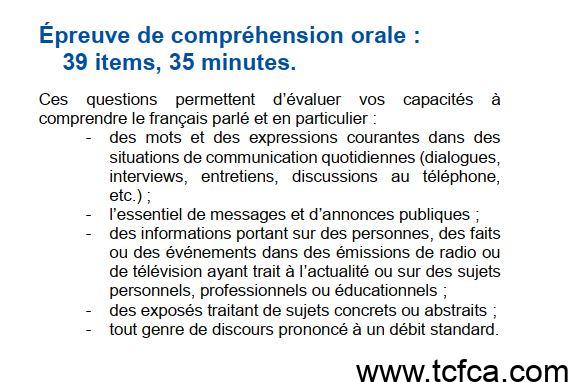
- Ces questions permettent d’évaluer vos capacités à comprendre le français parlé et en particulier :
-
-
- des mots et des expressions courantes dans des situations de communication quotidiennes (dialogues, interviews, entretiens, discussions au téléphone, etc.)
- l’essentiel de messages et d’annonces publiques
- des informations portant sur des personnes, des faits ou des événements dans des émissions de radio ou de télévision ayant trait à l’actualité ou sur des sujets personnels, professionnels ou éducationnels
- des exposés traitant de sujets concrets ou abstraits
- tout genre de discours prononcé à un débit standard.
-
TCF Canada: Compréhension Écrite:
- L’épreuve de compréhension écrite est composée de 39 items, c’est-à-dire de 39 questions à choix multiples, avec pour chaque question une seule bonne réponse parmi les quatre réponses proposées.
- Le temps est limité à 60 minutes
- Dans cette partie du TCF Canada, vous allez montrer votre compréhension du français écrit a partir de documents que vous pouvez rencontrer dans la vie quotidienne ou dans le monde professionnel.
Consignes générales:
- Lisez bien chaque question. Choisissez la bonne réponse et cochez une case sur la feuille de réponses.
- Gérez bien votre temps.Cette partie dure 60 minutes.
- N’oubliez pas ! Si vous vous êtes trompé et avez, par exemple,coché la case B cochez une nouvelle case et entourez cette case
- Si vous hésitez trop longtemps, passez à la question suivante

- Ces questions testent vos capacités à comprendre :
-
-
- des noms familiers, des mots et des phrases très simples utilisés dans des situations de communication (messages et lettres amicales ou administratives) ;
- des informations contenues dans des documents courants (petites annonces, prospectus, menus et horaires, etc.) ;
- des informations portant sur des personnes, des faits ou des événements (lettres personnelles) ;
- des textes en langue courante relatifs à la vie quotidienne ou au travail ;
- des articles et des comptes rendus dans lesquels les auteurs prennent position sur des sujets concrets ou abstraits ;
- des textes factuels ou littéraires longs et complexes, des articles spécialisés ;
- des textes abstraits ou complexes extraits d’ouvrages, d’articles spécialisés, d’œuvres littéraires.
-
TCF Canada: Expression Écrite:
Vous êtes évalué sur vos capacités à :
- communiquer un message de façon claire
- donner les informations demandées
- décrire, raconter, expliquer
- justifier un choix, une position, une décision, etc.
- enchaîner des idées et faire preuve de cohérence dans votre discours
- comparer deux points de vue
- exprimer votre avis et l’argumenter
- utiliser un vocabulaire et des structures adaptés à la tâche demandée
- être capable de faire une synthèse et de reformuler
Expression Écrite Tâche 1 :
- rédaction d’un message pour décrire, raconter et/ou expliquer, adressé à un ou plusieurs destinataires, dont le statut a été précisé dans la consigne. minimum 60 mots/maximum 120 mots

Expression Écrite Tâche 2 :
- Rédaction d’un article, d’un courrier, d’une note, etc. à l’intention de plusieurs destinataires pour faire un compte rendu d’expérience ou un récit. Comptes rendus et récits seront accompagnés de commentaires, d’opinions ou d’arguments, en fonction d’un objectif (ex : revendiquer, se réconcilier, etc.). minimum 120 mots/maximum 150 mots

Expression Écrite Tâche 3 :
- rédaction d’un texte (pour un journal, un site Internet, un collègue, un supérieur hiérarchique, etc.) qui compare deux points de vue portant sur un fait de société (1e partie), exprimés dans deux documents courts et simples de 90 mots environ chacun. Le candidat prend position sur le thème traité dans les deux documents (2e partie).
- Nombre de mots attendu : minimum 120 mots/maximum 180 mots. Soit entre 40 et 60 mots pour la 1e partie de la tâche et entre 80 et 120 mots pour la 2e partie de la tâche.


TCF Canada: Expression Orale:
Vous êtes évalué sur vos capacités à :
- parler de vous, de votre environnement, familial et professionnel ;
- poser des questions adaptées à la situation de communication proposée ;
- donner votre opinion et expliquer les avantages et inconvénients d’un projet, exprimer votre accord et votre désaccord ;
- présenter une argumentation claire et structurée dans un style approprié au contexte
- présenter de façon détaillée et structurée des sujets
complexes, les développer et conclure.
Expression Orale Tâche 1:
- Entretien dirigé sans préparation.
- Durée de l’échange : 2 minutes
- Objectif de la tâche : le candidat fait preuve de sa capacité à échanger avec une personne qu’il ne connaît pas (l’examinateur).

Expression Orale Tâche 2 :
- Exercice en interaction avec préparation.
- Durée : 5 minutes 30
-
-
- Préparation : 2 minutes
- Durée de l’échange : 3 minutes 30
-
-
- Objectif de la tâche : le candidat fait preuve de sa capacité à obtenir des informations dans une situation de la vie quotidienne courante.
- Les statuts de l’interlocuteur et du candidat sont précisés dans la consigne.
- Le candidat est autorisé à prendre de courtes notes pendant le temps de préparation de la tâche.

Expression Orale Tâche 3 :
- Expression d’un point de vue sans préparation.
- Durée de l’échange : 4 minutes 30
- Objectif de la tâche : le candidat fait preuve de sa capacité à parler de manière spontanée, continue et convaincante en répondant à une question choisie par l’examinateur.
- Dans cette épreuve du TCF canada, vous êtes évalué(e) sur vos capacités à :
-
- parler de vous, de votre environnement, familial et professionnel
- poser des questions adaptées à la situation de communication proposée
- donner votre opinion et expliquer les avantages et inconvénients d’un projet, exprimer votre accord et votre désaccord
- présenter une argumentation claire et structurée dans un style approprié au contexte
- présenter de façon détaillée et structurée des sujets complexes, les développer et conclure.
-

TCF Canada: Les resultats
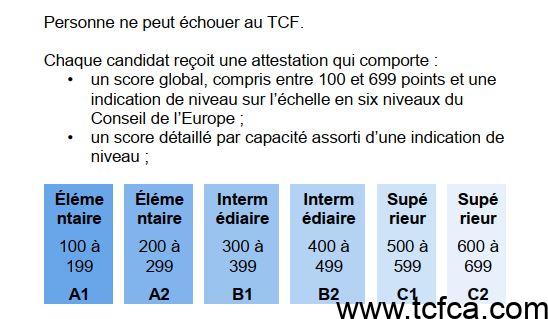
Chaque candidat reçoit une attestation qui comporte :
- un score global, compris entre 100 et 699 points et une indication de niveau sur l’échelle en six niveaux du Conseil de l’Europe
- un score détaillé par capacité assorti d’une indication de niveau
Tableaux des équivalences pour les résultats TCF Canada

Se Préparer au TCF Canada En Ligne
Pour plus d’informations: https://www.ciep.fr/tcf_canada
Test de Connaissance de Français, сокращенно TCF, — тест, по итогам прохождения которого присваивается уровень владения французским языком согласно европейской шкале CEFR. Пройти его может любой человек от 16 лет независимо от того, какой язык у него родной.
В отличие от дипломов DELF-DALF, у TCF существует несколько вариантов экзамена с разным содержанием, между которыми кандидат выбирает в зависимости от своей цели. Тем, кто собирается эмигрировать в Канаду, нужно сдавать TCF Canada. Его принимают во всех провинциях Канады, в том числе в Квебеке. Наравне с TCF Canada можно сдать слегка отличающийся TEF Canada, созданный конкурирующей организацией. Все, что я буду писать дальше, в основном, касается и TEF Canada.
TCF Canada, либо TEF Canada обязательно сдаются для получения канадского гражданства, даже если на гражданство подает француз. Самое забавное, что из-за особенностей экзамена многим французам не удается получить уровень C2 по всем компетенциям.
Даты и стоимость TCF Canada отличаются в разных странах, узнать их и найти ближайший к вам центр сдачи можно на сайте France Éducation International. Полученный диплом действителен 2 года. Результаты сообщают в течение 15 дней после сдачи. Пересдать экзамен можно не раньше, чем через 30 дней после последней попытки. Центры сдачи и стоимость TEF Canada указаны на другом сайте.
Существует также TCF Québec и похожий на него TEFAQ, но зачтут их только для получения вида на жительства в Квебеке. Они проще и содержат в 2 раза меньше частей, только аудирование и говорение. TCF Québec/TEFAQ, в отличие от TCF/TEF Canada, не подходят для получения канадского гражданства.
TCF Canada состоит из 4 частей:
- Аудирование (compréhension orale) общей длительностью 35 минут на 39 вопросов.
- Понимание письменной речи (compréhension écrite) общей длительностью 60 минут на 39 вопросов. В первых 2 частях надо выбрать 1 правильный ответ из 4.
- Письмо (expression écrite) длительностью 60 минут на 3 задания.
- Говорение (expression orale) длительностью 12 минут на 3 задания, в числе которых 2 минуты – подготовка ко 2-му заданию.
Как видно, лексико-грамматического теста в составе экзамена нет. Первые 3 части TCF Canada сдаются на компьютере в аккредитованном центре. Последняя часть на говорение представляет собой беседу с экзаменатором, которая записывается на диктофон.
По каждой из 4 компетенций выставляется своя оценка в баллах (максимально 699 за каждую из частей понимания и по 20 за письмо и говорение). Каждому из уровней европейской шкалы уровней CEFR соответствует определенное количество баллов. Кроме того, по результатам экзамена целиком кандидату также присуждается определенный уровень. Канадцы переводят эти баллы в свои уровни NCLC (еще не запутались?), и для эмиграции требуют минимально:
- 458 баллов из 699 за понимание устной речи (B2-C1)
- 453 балла из 699 за понимание письменной речи (B2)
- 10 баллов из 20 за письмо (B2)
- 10 баллов из 20 за говорение (B2)
 Согласно таблице уровней NCLC это 7 уровень и выше. Если кандидат получает более высокий результат, это дает дополнительные баллы его эмиграционному досье. Подробнее узнать об особенностях подачи документов на эмиграцию можно на сайте правительства Канады.
О материалах для подготовки к экзамену я писала в отдельной статье. C 2011 года я занимаюсь индивидуальной подготовкой к сдаче TCF Canada и TEF Canada, это одно из моих приоритетных направлений работы.
© Соколова Надежда,
преподаватель французского языка
Подробно о TEF Canada: что это такое, на что влияет при иммиграции, сколько действует, где сдавать тестирование, таблица перевода в CLB, какие результаты позволят иммигрировать.
В Канаде 2 государственных языка: английский и французский. В большинстве случаев для успешной иммиграции вы должны доказать, что владеете языком на определенном уровне.
Заказать подбор программы
Заполните анкету, а мы бесплатно оценим ваши шансы и подберем подходящие программы для иммиграции в Канаду.
Заполнить анкету
TEF: что это и зачем нужно
TEF Canada (Test d’évaluation de français) – это тест по французскому, по результатам которого канадская иммиграционная служба определяет ваш уровень владения языком. Результаты тестирования конвертируются в CLB.
Для английского потребуется сдать тест IELTS.
Уровень знаний языка влияет на:
- возможность участия в программах иммиграции. Так, чтобы попасть под популярную Federal Skilled Worker, необходимо получить за каждый показатель (аудирование, чтение, письмо, разговор) не менее 7 CLB. У других программ иммиграции другие требования, но, думаем, смысл понятен;
- количество баллов в Express Entry. Чем больше баллов, тем выше шансы на получение приглашения стать резидентом Канады.
Чтобы узнать, подходите ли вы для Express Entry, воспользуйтесь этим калькулятором. Если да, то можете оценить свои шансы на иммиграцию в калькуляторе баллов.
Таким образом, хорошее знание французского языка (или английского) – это один из важнейших факторов для успешного переезда. Немного ниже объясним почему.
Срок действия TEF Canada составляет 2 года. Если за это время у вас не получилось перебраться в Канаду, то придется повторно пройти тестирование. Очень важно следить за актуальностью этого документа!
Структура TEF Canada
Данное тестирование состоит из 4 частей:
-
Аудирование (Compréhension orale).
Эта часть экзамена длится 40 минут и состоит из 60 вопросов. На старте идут простые, но каждый последующий становится сложнее и сложнее. Некоторые из них будут воспроизводить несколько раз, что немного упрощает задачу.
В качестве заданий обычно используют телефонные разговоры, сообщения с радио, диалоги людей и т.п.
-
Чтение (Compréhension écrite).
Эта часть экзамена длится 60 минут и включает в себя 50 вопросов. Вопросы также начинаются с простых, заканчиваются сложными.
На каждый вопрос будут даны варианты ответов. Вам потребуется выбрать правильный. Не рекомендуем долго думать над вопросом, который не дается сходу. Лучше ответить на более простые, а к оставшимся вернуться в конце.
-
Письмо (Expression écrite).
На письмо также выделен час. Эта часть экзамена разделена на 2 этапа:
- сочинение. Пример: будет предоставлен какой-то текст. Его необходимо изучить и на основе полученной информации написать свое мнение не менее, чем на 200 слов;
- эссе. Будет предоставлено начало случайного текста, который необходимо дописать (не менее 80 слов).
Анализируя требования каждого задания, можно сделать вывод, что на сочинение необходимо выделить примерно 40-45 минут, а на эссе 15-20.
-
Разговор (Expression orale).
Эта часть длится 15 минут. Здесь также будет 2 этапа:
- первый. Будет дана тема, для которой за 2-3 минуты потребуется придумать как можно больше вопросов. Чем больше, тем лучше;
- второй. Также дается тема и несколько минут на подготовку. Тут задание более сложное. Например, продать какой-то товар экзаменатору. Придумать как можно больше аргументов, почему он ему нужен. Тот же будет сопротивляться и отказываться. Вы же должны реагировать на это и стараться переубедить.
Где сдавать и сколько стоит
Тут все очень просто. Требуется перейти на официальный сайт, в выпадающем списке стран выбрать Россию (или ту, в которой вы находитесь). После этого появится список всех городов, где есть аккредитованные агентства для прохождения TEF. А также адреса конкретных мест.
Под наименованием каждого заведения указаны экзамены, которые они принимают. Вам нужны только те, у которых есть TEF Canada.
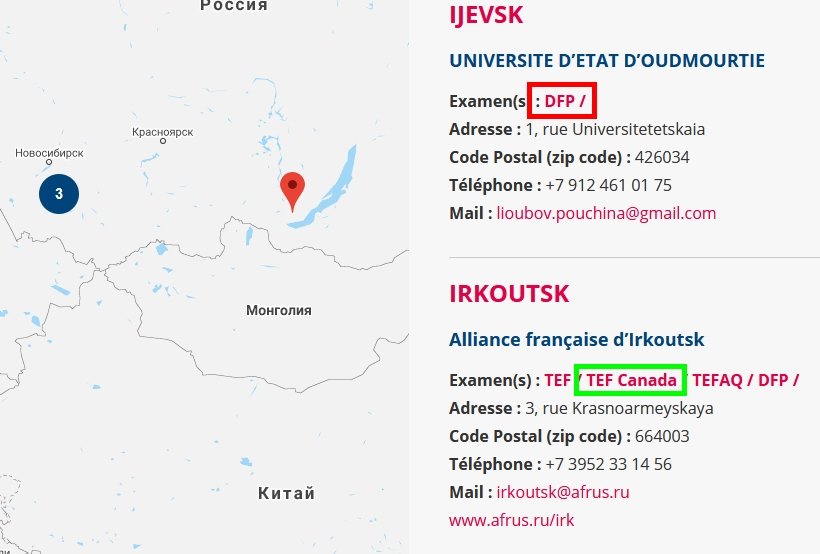
Стоимость прохождения тестирования указана на официальных сайтах. Например, цена на cref.ru равна 17 200 рублей.
Таблица соответствия TEF Canada и CLB
Результаты всех тестов переводятся в единую для Канады систему CLB. Это позволяет оценивать уровень знания английского или французского кандидатов на иммиграцию.
| Уровень CLB | Аудирование | Чтение | Письмо | Разговор |
|---|---|---|---|---|
| 10 | 316-360 | 263-300 | 393-450 | 393-450 |
| 9 | 298-315 | 248-262 | 371-392 | 371-392 |
| 8 | 280-297 | 233-247 | 349-370 | 349-370 |
| 7 | 249-279 | 207-232 | 310-348 | 310-348 |
| 6 | 217-248 | 181-206 | 271-309 | 271-309 |
| 5 | 181-216 | 151-180 | 226-270 | 226-270 |
| 4 | 145-180 | 121-150 | 181-225 | 181-225 |
Например, чтобы попасть под программу FSW необходимо сдать экзамен на следующие минимальные результаты:
- аудирование: 249-279;
- чтение: 207-232;
- письмо: 310-348;
- разговор: 310-348.
Если хотя бы один из результатов будет ниже CLB 7, то рассчитывать на участие в этой программе не стоит. Потребуется улучшить знания, и пересдать тест.
Материалы по теме
Всем привет! Я уже много лет занимаюсь подготовкой людей к языковым экзаменам и для иммиграции в том числе.
Один из самых частых запросов – это сдача экзамена для иммиграции в Канаду. Я подготовила ответы на самые частые вопросы, которые задают нам студенты. Сразу скажу – я не проходила процедуру иммиграции сама, мы только готовим к языковым экзаменам.
Итак, для того, чтобы иммигрировать в Канаду вы можете сдать экзамен на знание двух языков – английского и французского, так как они оба являются официальными языками.
АНГЛИЙСКИЙ
В Канаде есть своя собственная система оценки языковых знаний – Canadian Language Benchmarks, сокращенно CLB. Существует всего 3 ступени, которые в свою очередь делятся на 12 возможных уровней с начального (basic) до продвинутого (advanced).
Для разных программ иммиграции требуется разный уровень языка. Например, для Federal Skilled Worker Program(это как раз программа, по которой чаще всего подаются наши соотечественники), требуется CLB7 – это уровень upper-intermediate. Вы можете выбрать из двух экзаменов– CELPIP (Canadian English Language Proficiency Index Program)и IELTS (International English Language Testing System). Если вы подходите под другую программу, то вам нужен уровень ниже, например, на некоторые программы достаточно уровня CLB5, то есть хорошего уровня intermediate. Почитать программы можно здесь.
Конечно, легче сдать IELTS, потому что его можно сдать из любого места (кроме России и Беларуси (приостановлено в марте 2022 г.). Экзамен CELPIP можно сдать всего в 12 странах (по состоянию на 20 октября 2022) Полный список и регистрация на экзамен – здесь.
Если вы все-таки выберете опцию с IELTS, то Вам необходимо сдавать экзамен IELTS General. В IELTS также есть опция – Academic. Он не подойдет для иммиграции. Для того, чтобы зарегистрироваться на экзамен IELTS вам необходимо в поиске ввести ielts и город, в котором вы проживаете/ планируете сдавать. Если вы живете в РФ, то легче всего сдать в Казахстане, так как там есть даже вариант для тех, кто планирует оплачивать карточками РФ.
ФРАНЦУЗСКИЙ
Для французского языка есть система, которая называется Niveaux de compétence linguistique canadien (NCLC), который также делится на 3 ступени, и в свою очередь на 12 возможных уровней.
Схема тут абсолютно такая же – вам необходимо подтвердить уровень В2. Для этого нужно сдать экзамен TEF Canada или TCF Canada. Данные экзамены также нельзя сдать в РФ, сейчас информации о том, когда это снова станет возможно.
Удачи с иммиграцией!
Канал подготовки к IELTS. Бот, который ответит на вопрос – нужен ли вам IELTS вообще.