
Creativity
Natalie Cenci
October 26, 1975 Ikebana International. Kasumi Teshigahara. Photo by Denver Post via Getty Images.
What is ikebana?
In ikebana, the Japanese art of flower arranging, blossoms, branches, leaves, and stems find new life as materials for artmaking. In contrast to the western habits of casually placing flowers in a vase, ikebana aims to bring out the inner qualities of flowers and other live materials and express emotion.
What does ikebana look like?
Ikebana arrangements are not unlike sculpture. Considerations of color, line, form, and function guide the construction of a work. The resulting forms are varied and unexpected, and can range widely in terms of size and composition, from a piece made from a single flower to one that incorporates several different flowers, branches, and other natural objects.
In Japanese culture, most native flowers, plants, and trees are embedded with symbolic meaning and are associated with certain seasons, so in traditional ikebana, both symbolism and seasonality have always been prioritized in developing arrangements. Some of the most common elements used are bamboo grass year round; pine and Japanese plum branches around the new year; peach branches for Girls Days in March; narcissus and Japanese iris in the spring; cow lily in summer; and chrysanthemum in autumn. Modern ikebana practices call for the same sensitivity to seasons, as well as to the environment in which an arrangement is being made.
Sometimes, practitioners of ikebana, or ikebanaists, trim flowers and branches into unrecognizable shapes, or they may even paint the leaves of an element. Plant limbs may be arranged to sprout into space in various directions, but in the end, the whole work must be balanced and contained. At times, arrangements are mounted in a vase, though this is not always the case.
In ikebana, it is not enough to have beautiful materials if the materials are not artfully employed to create something even more beautiful. Given a skilled maker, one carefully placed flower can be just as powerful as an elaborate arrangement.
Who practices ikebana?
Hirozumi Sumiyoshi, Rikka, ca. 1700. Image via Wikimedia Commons.
Coloured diagram #15 ofshōkaworks by the 40th headmaster Ikenobō Senjō, from the Sōka Hyakki, 1820. Image via Wikimedia Commons.
Ikebana can be practiced by both amateurs and professionals, both of whom are able to achieve elegant results. However, like many other art forms, mastering the basics is fundamental to any practice, and only then can a person begin to experiment.
Guided by precision, a core value of Japanese culture, beginners are taught basic technical skills—like how to properly cut branches and flowers, how to measure angles in space for the correct placement of branches and stems, and how to preserve live materials—along with the etiquette of maintaining a clean work station.
Beginners are also taught how to sensitize their eyes to the materials, to be able to bring out their inner qualities, and understand how this changes with each arrangement. Beginner arrangements done in the Nageire and Moribana styles often make use of two tall branches and a small bundle of flowers. These pieces follow the three-stem system of shin, soe, and hikae—elements that have traditionally represented heaven, man, and Earth, respectively. Now, on a practical level, they refer to the main stems that are employed. All other stems are called jushi, meaning supporting or subordinate stem.
How is a basic ikebana arrangement made?
Photo by Annie Dalbéra, via Wikimedia Commons.
Photo by Annie Dalbéra, via Wikimedia Commons.
To prepare a basic Moribana arrangement, for example, the ikabanaist adds water to a shallow container, then places a kenzan—a small, pin-covered object that keeps flowers in place—within it. Then, the maker selects two branches, one for shin and one for soe, and a flower, for hikae. Next, each stem is measured and cut to precise lengths (which are specified in the Moribana beginner’s manual) and fixed, one at a time, on the kenzan, at different angles. To complete the arrangement, supplementary jushi stems are added to hide the kenzan and fill out the arrangement. These principles can be repeated over and over, shifting the placement and angles to achieve different shapes and effects.
The beginnings of ikebana
Photo by Carlos Donderis, via Flickr.
The roots of ikebana in Japan are believed to trace back to either the ceremonial practices of the native Shinto religion, or to a tradition of making floral offerings in Buddhism, which was imported from China in the 6th century.
The first known written text on ikebana, called Sendensho, was penned in the 15th century. In it, readers find a thorough set of instructions on how to create arrangements that are appropriate to certain seasons and occasions; its directives make clear that the practice of ikebana embodies the evolved appreciation and sensitivity to nature that Japanese culture is known for more broadly.
Around the same time, ikebana started to become a secular activity. The design of the Japanese home during this period reflects this transition: new homes were almost always built with a special recess called the tokonoma, which would contain a scroll, a precious art object, and a flower arrangement.
Amidst the muted colors and flat planes of the traditional Japanese home, the tokonoma stood out as the singular place for color and decoration, and deep consideration was given to the objects placed there. In keeping with the Japanese culture’s reverence for impermanence, tokonoma displays were rotated regularly, with the changing seasons and during festive occasions. Arranging flowers in this context paved the way for ikebana and its recognition as a distinct art form.
The traditional schools of ikebana
Photo by Carlos Donderis, via Flickr.
Photo by Carlos Donderis, via Flickr.
In the 15th century, with the sudden ubiquity of the tokonoma and teachings of the Sendensho, ikebana practices began to flourish. First came the rise of the Ikenobo School, whose name refers to a long line of priests in Kyoto who followed the Buddhist tradition of presenting floral offerings in the temple. During this time, Ikenobo Senkei gained fame for his skillful floral compositions; today, he is considered the first master of ikebana.
The secular style that Senkei practiced became known as Rikka, which means “standing flowers.” This type of ikebana is made with seven core elements (or sometimes nine), which are a mix of tree branches and two or three flowers—pine, chrysanthemum, irises, and boxwood are commonly used. These elements are combined, traditionally in an ornate Chinese vase, to create bursting, triangular shapes, with tall elements at the center and shorter ones shooting outwards. To be able to make the main elements stand upright without support requires a high level of technical skill. Rikka compositions are considered the most grand, but also the most rigid (even by today’s standards). They were originally intended for temples and later found in royal palaces and the stately homes of the rich.
At the same time, a more modest approach to flower arrangement was also gaining popularity as an extension of Zen Buddhism and the Wabi-Sabi and Tea Ceremony aesthetics that grew from its core tenets. Japan’s most famous tea master, Sen no Rikyū, introduced an appreciation for imperfect, modest aesthetics in his tea ceremonies, which included the use of flowers. Rather than constructing over-the-top Rikka-style arrangements, Rikyū preferred minimalist, single-stem arrangements, like one morning glory placed in a simple vase made by a local artisan. These ceremonies led to the formation of the second major style ikebana, which came to be known as Nageire, meaning “thrown in.”
In its early form, Nageire was free of the rules and formality that governed the Rikka style. As the antithesis to Rikka, flowers in Nageire arrangements were not designed to stand upright on their own and were instead placed in tall vases that supported the stems of the flowers.
Rikka and Nageire represent two opposing viewpoints. Rikka, though technically a secular style, concerns itself with the the cosmos, harking back to its Buddhist origins. In contrast, Nageire’s more organic approach focuses more directly on connections with nature.
Modern schools of ikebana
Installation view of Nendo, Kaleidoscopic Ivy, 2017 in collaboration wtih hnm, syk + onndo. Photo by Akihiro Yoshida. Courtesy of Nendo.
Due to over 200 years of political isolation in Japan, there were no further innovations in ikebana until 1868, when the country reopened to foreign exchange. People were quick to embrace Western customs, and in the world of ikebana, this catalyzed a series of radical changes.
In 1912, the first modern school of ikebana, the Ohara School, was established. Its founder, Unshin Ohara, helped the art form evolve by introducing the Moribana style, and through it, implementing two major changes: the incorporation of Western flowers, and the use of a shallow, circular container to make flowers stand upright, with the help of the kenzan.
The flexibility and variation that the Moribana style allows for has made it a favorite and a staple in almost every ikebana school today. At the core of Moribana is a three-stem system, whereby three flowers are almost always fixed to create a triangle. Compositions that do not follow this triangle system are known as freestyle. Freestyle is also used to describe more creative and original approaches to ikebana, where the maker uses their knowledge of form, color, and line from previous practice to develop new arrangements that don’t necessarily adhere to traditions.
Changes continued with the creation of the Sogetsu School in 1927. Its founder, Sofu Teshigahara (whose father was also an ikebana master), is credited with elevating ikebana from a technical practice to an art at the level of sculpture, which is how it is has been viewed ever since.
Teshigahara’s approach called for greater freedom and the use of other live materials. For him, the forgotten parts of nature—like dirt, rocks, and moss—were just as ripe with expressive potential as flowers. He heartily believed that excellent ikebana is not divorced from the life and times of its creator, and that a flower is an irreplaceable, expressive tool that reveals the soul. With these innovations, the Rikka style began to fade. At present, Ikenobo, Ohara, and Sogetsu are the most popular styles, with around 400 of these schools operating today.
Ikebana today
Camille Henrot
The Sorrows Of Young Werther, Johann Wolfgang von Goethe, 2014
KÖNIG GALERIE
In the mid-20th century, the internationalization of ikebana was spurred by the efforts of Ellen Gordon Allen, an American who studied ikebana while living in Japan. She saw ikebana as a means of uniting people from around the world. Beginning in 1956, Allen worked with the major ikebana schools to found a nonprofit organization called Ikebana International, which would propel a diplomatic mission: “friends through flowers.”
In the decades since, chapters for all the major schools have sprouted up on a global scale. In recent years, the practice has inspired contemporary artists like Camille Henrot and a wide swath of floral artists, who use the tenets of ikebana to develop new, original creations.
Anyone who practices ikebana today knows well that building relationships is at the core of the practice—relationships between materials, between students, and between teachers and their pupils.
In Japan today, the word kado, meaning “way of flowers,” is the preferred term for ikebana, as it’s believed to more accurately capture the spirit of the art as a lifelong path of learning. The impermanence built into this art, beginning with its dependence on nature’s seasons, lends itself to never-ending exploration and experimentation for ikebanaists.
Teshigahara was firm in his conviction that a successful lifelong ikebana practice requires curiosity, not complacency. “We must strive to develop into artists with breadth and depth instead of remaining comfortable in our artistic niche,” he once said. “Our creations should vary. If we do not venture out we will never become outstanding artists.”
Задание 19 на подготовку к ЕГЭ по английскому. В тексте имеются пропуски слов. Для каждого пропуска даны несколько вариантов. Определите, какой вариант верный.
ЗаданиеОтвет
Egg art is one of the earliest forms of art. There is something fascinating about the shape of the egg, and the idea of making this into / out of / over / up for art.
Many early civilizations regarded the egg as a symbol of fertility and the circle of life, partly because it is a(n) ocular / optical / visible / visual shorthand for new life and un-hatched potential. There is also an interesting contrast between the soft interior and the protective tough exterior, awaking / conjuring / evoking / originating ideas of protection and hidden secrets.
Eggs have particular resonance in the Christian faith where they have become associated with the resurrection of Jesus Christ. Eggs also take on an important role in the Jewish Passover holiday where they have become a symbol of sacrifi ce and loss. In some Asian cultures the egg is seen as a symbol of luck and wealth. So many cultures adorn the egg as part of their prayers / rites / services / worships.
Modern man has turned egg decoration into egg art.
An artist who ‘does eggs’ must above / before / beyond / over all know how to empty an eggshell. It’s necessary to disinfect it to make sure you are working with a surface that is free from diseases which are born / carried / moved / transported by birds. Goose, duck and chicken eggs (no eggs are taken from the wild!) are usually ‘blown’ — a hole is made in each end and the contents are blown out.
After cleaning the egg, a craftsman must know how to make the naturally smooth and greasy surface of an eggshell easier to work with if you want to paint it or cover it in mosaic or decorate it with things such as ribbons, fabric or carve ornaments with a high-pace / speed / tempo / velocity paragraver (quite similar to a dentist’s drilling tool).
Egg art is one of the earliest forms of art. There is something fascinating about the shape of the egg, and the idea of making this into art.
Many early civilizations regarded the egg as a symbol of fertility and the circle of life, partly because it is a visual shorthand for new life and un-hatched potential. There is also an interesting contrast between the soft interior and the protective tough exterior, evoking ideas of protection and hidden secrets.
Eggs have particular resonance in the Christian faith where they have become associated with the resurrection of Jesus Christ. Eggs also take on an important role in the Jewish Passover holiday where they have become a symbol of sacrifi ce and loss. In some Asian cultures the egg is seen as a symbol of luck and wealth. So many cultures adorn the egg as part of their rites.
Modern man has turned egg decoration into egg art.
An artist who ‘does eggs’ must above all know how to empty an eggshell. It’s necessary to disinfect it to make sure you are working with a surface that is free from diseases which are carried by birds. Goose, duck and chicken eggs (no eggs are taken from the wild!) are usually ‘blown’ — a hole is made in each end and the contents are blown out.
After cleaning the egg, a craftsman must know how to make the naturally smooth and greasy surface of an eggshell easier to work with if you want to paint it or cover it in mosaic or decorate it with things such as ribbons, fabric or carve ornaments with a high-speed paragraver (quite similar to a dentist’s drilling tool).
Post Views:
27,627
Ikebana is the Japanese art of arranging flowers. A tradition born during the ancient period and thriving since then, ikebana is also known as kadō (way of flowers.) The tradition started as floral offerings on altars. Later, the tokonoma (alcove) of a traditional Japanese home was adorned with beautifully arranged flowers.
Along with chadō for tea and the tea ceremony and kōdō for incense appreciation, ikebana is one of the three classical Japanese arts of refinement. Reaching its first peak in the 16th century due to the influence of the Buddhist tea masters. It has grown over the years, embodying Japanese tradition and culture.
History of Ikebana
Early practices
‘Ikebana’ comes from the Japanese words ‘ikeru’ (to arrange or have a life) and ‘hana’ (flower.) Other possible translations include ‘arranging flowers’ and ‘giving life to flowers.’ The early Japanese aristocracy established the practice of viewing and appreciating plants and flowers through the four seasons. In the Heian period (794-1185), Waka poetry anthologies like the Man’yōshū and Kokin Wakashū had several poems regarding the topic of flowers.
When Buddhism was introduced in Japan, it became a common practice to offer flowers at Buddhist altars. In India, lotus flowers were commonly used at Buddhist altars. But in Japan, other native flowers were used, and they varied according to the season. In China, Buddhist priests themselves were the first instructors of flower arrangement, but in Japan, only the simplest or crudest elements were used during the early stages. For a long period of time, flower arrangement was done without any specific meaning or significance attached to it. Flowers were merely placed in vases without any meaningful structure or system and offered at temples and ancestral shrines.

The first system of flower arrangement to be used was known as shin-no-hana, which means ‘central flower arrangement.’ In shin-no-hana, an enormous branch of pine or Sugi (Japanese cedar or Japanese redwood) would be in the middle, while three or five flowers depending on the season would be placed around it. The stems and branches would be placed in vases in simple, upright positions, rather than attempting to make artificial curves. Religious pictures from the 14th century indicate that the first attempts at flower arrangement were done in such a way that it appeared as natural as possible. It was an attempt to represent natural scenery. Distant scenery was indicated by the large tree in the middle, while tiny flowering plants in the front represent the foreground. The middle distance was represented by plum or cherry blossoms. In this type of arrangement, the lines were known as centre and sub-centre.
Tatebana to Ikebana

During the Kamakura (1185-1333) and Nanboku-chō periods (1336–1392), among the many types of Buddhist offerings, Mitsu-gusoku (traditional arrangement of three articles) became extremely popular. Many Buddhist scriptures took their names after flowers, like the Hokke-Kyo (Lotus Sutra) and the Kegon-Kyo (Flower Garland Sutra.)

When the shoin-zukuri architectural style (a style of Japanese residential architecture) was developed during the Muromachi period (1336–1573), scroll pictures (kakemono) and containers were displayed as art objects on two-levelled shelves (called chigaidana) and the oshiita alcove (a precursor to the tokonoma.) Flower arrangements in vases also accompanied these art objects. The flower arrangements began to influence the style of interior decorations, leading to more exquisite and simpler decorations as time passed. This style of adorning the interior was known as zashiki kazari.
The set of three ceremonial objects arranged at a Buddhist altar is known as mitsugusoku. The objects consisted of a censer, candles lit in holders and flowers placed in a vase. The earliest style in which flowers were arranged is called tatehana or tatebana, meaning ‘standing flowers.’ The arrangement was made of the shin (the longest branch) and shitakusa (under grass.) Historical research shows that tatebana developed from not one, but a combination of religious beliefs, including Shinto and Buddhism. The Shinto Yorishiro belief (in which an object is believed to be capable of attracting spirits called kami) played a central role in the origin, development and practice of modern ikebana. Buddhism and Shinto together formed the basis for ikebana- the original, purely Japanese derivation of arranging flowers.
Developments

The art of flower arrangement grew slowly, and towards the end of the 15th century, many schools came into existence. Ashikaga Yoshimasa (1436-1490), the eighth shōgun, was a patron of the arts. He was the greatest promoter of the tea ceremony and ikebana. Later on, Yoshimasa abdicated his position and dedicated his time to the arts. He was the one responsible for developing the concepts that would become the rules governing ikebana. One of the most important rules of ikebana put forward by Yoshimasa was that flowers offered on ceremonial occasions and placed before the gods shouldn’t be mere loose offerings- these flowers and the arrangements must represent time and thoughts. It wasn’t just about sticking a few flowers in a vase- it was also about the person who arranges them.
Contemporaries of Yoshimasa were also great contributors to the development of ikebana. One of them was Sōami, a celebrated painter and friend of Yoshimasa, who came up with the idea that ikebana must represent the three elements of heaven, earth and humans. The principles of arrangements used today are rooted in this concept. Ikebana achieved its greatest development at Yoshimasa’s Silver Pavilion in Kyoto, along with the art of tea ceremony and incense ceremony.
Rikka and Nageirebana
The Kanō school’s artists, like Sesshū Tōyō (1420–1506), Sesson, Kanō Masanobu, Kanō Motonobu (1476–1559), and Shugetsu from the 16th century, were all nature lovers. Their thoughts took ikebana a step further- it became more than a form of temple or room decoration. Greater importance was given to the natural beauty of the arrangement of flowers. Ikebana in this form was known as rikka.

Rikka wasn’t the only development in Ikebana at the time. Another form of flower arrangement known as the nageirebana took root during the same time rikka developed. Nageirebana is associated with the story of a samurai. According to legend, it was a hot summer’s day and the samurai was bored. He started randomly throwing a few plant materials into a tall, deep vase in a corner of the room, thus creating a form of flower arrangement. The nageirebana is more spontaneous and fresh than the rikka. It does not follow the strict rules or principles of classical ikebana, like the triangular structure or colour harmony. Thus, it is less formal than rikka.

For centuries, popularity wavered between these two forms. During the Higashiyama period, nageirebana was favoured, but rikka was still preferred by many. It was in the Momoyama period (1568 to 1600) that nageirebana gained more popularity, as the tea ceremony attained its peak. The tea ceremony was a strong influence on ikebana since any practitioner of tea was also knowledgeable about ikebana.
Although it did enjoy a certain level of popularity, nageirebana was always associated closely with rikka. It was only in the 16th century that it finally broke off and gained its independence and popularity. Its style and line of beauty became more noticeable and distinct. The rikka and nageribana, despite having developed in the same period, reflect the styles of the period in which they were more popular. The rikka portrayed the Higashiyama period’s style and taste, while nageirebana was a reflection of the Momoyama period. Rikka lost some of its popularity in the Momoyama period, but it was revived during the early Edo period. In the Higashiyama period, rikka was only seen as a form of room decoration on ceremonial occasions but was now regarded as fine art. The upper class saw it as an accomplishment and pastime. Rikka attained its peak during the Genroku era (1688 to 1704.)
Popularity of ikebana
Ikebana was considered a dignified accomplishment. Each one of Japan’s most celebrated generals practised ikebana, claiming that it soothed their minds and made decision-making on the battlefield much clearer. So ikebana became an art form that has a meditative quality. Arranging the flowers and materials into a design was supposed to be done in silence. This allows whoever is arranging it to observe and meditate on the loveliness of nature and attain inner peace. Seasoned designers identified not just the importance of silence, but also the significance of space. Contrary to popular belief, space isn’t something to be filled, rather, it is something created and preserved by arranging. Other principles of ikebana include minimalism, simplicity, shape and line, humanity, form, balance and aesthetics.
Ikebana and its principles were explored and written about from the Ken’ei (1206–1207) to the Genroku (1668–1704) eras. All the works basically dwelt on Sōami’s concept of the three elements. The first of these works to be published was the Sendenshō, now considered the oldest and most valuable work on the subject of ikebana. The second and another important text, published in 1661, is the Kawari Kaden Hisho. This was an instructive text, elaborating the principles and rules of ikebana in detail, complete with illustrations. Additionally, the text also illustrates how ikebana is enjoyed, which had by then spread from monks to warriors and then further onto the townspeople. There are also texts dedicated exclusively to rikka- the Kokon Rikka-shu (the oldest, published in 1672), the Kokon Rikka-taizen (the most famous work, published in 1683) and the Rikka Imayō Sugata (published in 1688).
During the Ken’ei era, rikka was simple and natural, but during its peak in the Genroku era, the lines attained complicated patterns. It followed the trends of artistic development and expression. This was because, during the Genroku period, fine arts were highly developed. Fabrics were printed with patterns and decorations. Thus, rikka was an embodiment of these developments. In the late 17th century, a famous artist named Korin heavily influenced ikebana with his exquisite designs. Thus, the combination of a pattern with lines following the natural growth of plants created the most graceful and pleasing effects in ikebana.
Ikebana: A combination of different principles

The art of flower arrangement arrived in Japan from China along with Buddhism. Hence, ikebana embodies Chinese and Buddhist philosophy. Ikebana’s roots are interlaced with the Buddhist desire to preserve life, thus playing a heavy role in forming the rules of not just flower arrangement, but also the shapes of the vases.
The shape of the vases helps to prolong the life of the flowers. It is more than just a mere vessel holding the flowers. While arranging the flowers, the surface of the water is always exposed and so is the surface of the earth from which the flowers spring. This creates the impression of the flowers growing in a natural environment. While gifting someone flower arrangements, the flowers used are always in the bud stage, so that the person who receives them may have the pleasure of seeing them bloom.
Spirituality
One of the central aspects of ikebana is its spirituality. Practitioners of ikebana believe that silence is apt while arranging the flowers, while some may feel this is unnecessary. But it is generally agreed that flower arrangement is a time to take in the aspects of nature which may be otherwise overlooked. Ikebana leads a person to become more tolerant and patient with differences in life and nature. It relaxes the mind, body and soul, teaching a person to recognize beauty in all art forms.
Ikebana, on the surface, is arranging flowers to create beauty. On a deeper level, it is a disciplined art form that brings nature and humanity together. It is not the arrangement of different flowers to create a multi-coloured bunch of blossoms. Ikebana equally emphasizes the other parts of a plant too- the leaves and the stem. The shape, line and form are emphasized. Even the materials selected and the method of arrangement indicate good and evil fortune. Another aspect of ikebana is minimalism. Only a minimal number of flowers are used in some arrangements, along with leaves and stalks.
Conveying different ideas through arrangements
The Japanese believe that there is no occasion that can’t be suggested by the manner of ikebana. According to Japanese philosophy, flowers have their own form of language, known as hanakotoba. Plants are given specific coded meanings, depending on the presence of thorns, the colour of the flower, the combination of flowers in a garland and the types of flowers themselves. For example, if someone is leaving home, then it can be announced through the particular arrangement of flowers. To bless or pray for someone’s long and happy life, auspicious materials are used, like willow branches. The same is used when parting with someone or to signify their safe return from a journey. Here, the branches are arranged to form a complete circle.
Red flowers are used during funerals. Hence, red flowers are considered unlucky, in addition to the fact that red symbolizes the flames of a fire. Arranging an odd number of flowers is lucky, while even numbers are the opposite. Hence, they are undesirable and never used while arranging flowers. In flower arrangement, symmetry and equal balance are avoided, keeping in mind that these two features are rarely ever found in nature. The artist’s intention is portrayed through colour combinations, shapes and lines. Without using words, emotion is implied through the arrangement.
When attending a house-warming, white flowers are used to suggest water quenching fire. This is because traditional Japanese homes are made almost exclusively of fire and are susceptible to fire. While celebrating an inheritance, all types of evergreen plants or chrysanthemums could be used. If not, any flower that lives long is an option to indicate that wealth or material possessions last for a long time. To express one’s condolences to someone who has lost a loved one, white flowers are arranged with dead leaves and branches.
Since ikebana combines the principles of Shinto religion, certain plants are used to attract good spirits. For example, evergreen plants like kadomatsu are used in traditional arrangements during New Year. These are then placed in front of homes to welcome the spirits of their ancestors or harvest.
Seasonal variations

The flower arrangements are also an expression of the different seasons. Flowers are grouped differently depending on the time of the year. For example, if it’s March, then to show the prevalence of strong winds, branches are arranged into unusual curves. If it’s summer, then low and broad containers are used to hold the flowers, so that the water is visually predominant. This creates a cooling and refreshing effect.
Cultural significance in anthropology
Ikebana, or the Japanese art of flower arrangement, is an amalgamation of spirituality, philosophy, creativity and beauty. Rather than focus on the external beauty, it aims to project the inner qualities of the materials used and express certain emotions. Any occasion or season can be conveyed through the materials used and the method of arrangement. So ikebana prioritizes both seasonality and symbolism. Practising ikebana sensitizes one’s eyes to the materials and natural beauty that may otherwise go unnoticed in the hustle and bustle of daily life. Hence, ikebana isn’t just the art of flower arrangement, it is also the art of life.

Definition
Ikebana is the art of flower arranging that originates in ancient Japan. It is practiced as an art where flowers and other natural elements are placed in such a way as to embody harmony, peace, and beauty. Ikebana, also known as kado in Japanese, is considered to be the top 3 major forms of cultural arts along with Tea ceremony and calligraphy.
During the Heian period, the priests who took care of altar arrangements were called ikebono and they are the first known masters who developed the best way of arranging flowers. Ikebana has simple rules influenced by simplicity and minimalism in Buddhism. There are usually 3 types of main flowers: primary flower in the middle, the secondary flower right next to it and an ornamental flower down below. There are also 2 main types of vases: the wide and low vase called moribana and the tall thin vase called nageire.
Ikebana, Japanese Culture and Zen Philosophy
Ikebana was born in Buddhist temples and has a close relationship to the philosophy of Zen. The ten connections between zen and ikebana are explained below
- Zen is about harmony, balance and minimalism, ikebana is also about harmony, balance and minimalism
- Zen is about being natural and preserving the nature of things, ikebana makes the flowers how they look in nature; different from the popular flower bouquets in the West. Zen is also about being connected with nature as we develop a sense of closeness to flowers thus mother nature.
- Zen is about mindfulness, and realizing the passing of times. Zen is understanding and enjoying the transience of life. ikebana uses seasonal flowers to help us appreciate the changes of times and seasons.
- Zen is about seeing beauty in a routine, ikebana helps us create art forms from simple flowers.
- Zen helps us appreciate ma (the beauty of empty space and emptiness) and ikebana helps us realize and enjoy ma or the unfilled spaces in a bowl.
- Zen is about no discrimination, with the help of ikebana anyone, regardless of any social class, can create art with any flowers.
- Zen is about selfless mind, ikebana helps us forget the flow of time while arranging the flowers.
- Zen is about getting rid of negative and materialistic thoughts, the world of flowers moves us away from harmful thoughts
- Zen and shinto are about being close to the divine spirit, the flowers have symbolic meanings related to the earth and heavens
- Zen is about a peaceful and graceful mind, the art form we create represents our true nature which is naturally peaceful.
Simple Rules of Ikebana
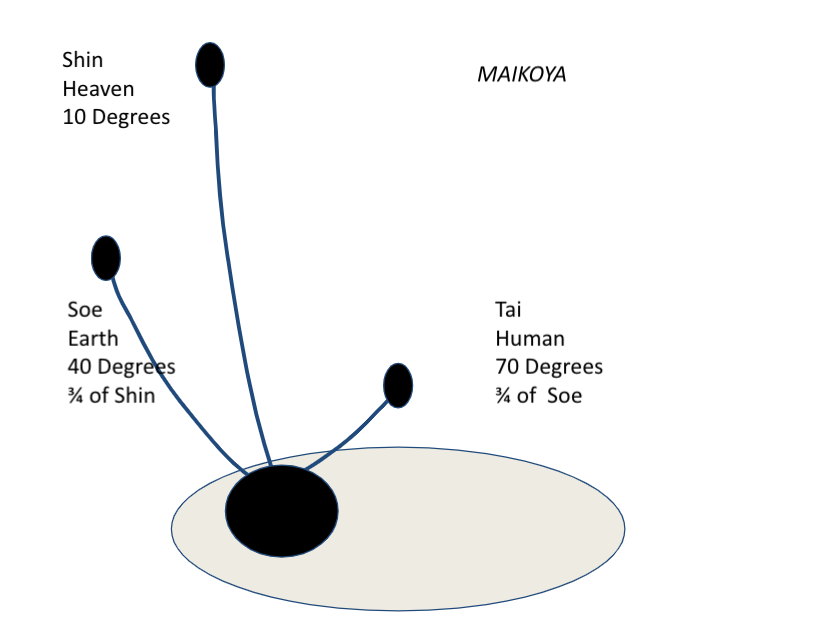
Ikebana Principles
The most simple rule of ikebana is the rule of three also known as the most basic moribana style.
-
- In the middle there is the longest stem, shin. This stem represents heaven. The stem is 1.5 taller than any other flowers or branches. The stem is set leaning 10 degrees left side from the base.
- Left side of the shin there is soe which represents earth. This part is tilted 40 degrees to the left side of the base and has the 3 quarters length of the longest stem.
- On the right side there is the shortest stem called tai. This stem is tilted 70 degrees to the right side and has the length 3 quarters of the second longest stem.
Japanese Symbolism in Ikebana
Ikebana has many rules and principles similar to other culture based crafts influenced by the zen philosophy. First timers are surprised to find out that each flower also has a meaning in Japan such as pines represent longevity, chrysanthemums represent the imperial family, lotus flowers imply purity of mind and body and many seasonal flowers like peonies and wisteria represent grace and beauty. Some people also think the middle branch in ikebana refers to Buddha but this depends on the affiliation of the practitioner.
Ikebana Vocabulary
Iki: A Japanese aesthetic element that translates to ‘refined uniqueness’.
Moribana: A popular style of flower arrangement that translates to ‘piled up’. The flowers and other elements are placed in low, shallow containers.
Nageire: Another popular style of flower arrangement that translates to ‘thrown in’. The natural items are organized in tall vases.
Rikka: A traditional style of flower arrangements that translates to ‘standing flowers’. This style uses seven branches to represent natural scenes.
Shoka: A type of flower arrangement that embodies the spiritual world.
Shin: A branch that represents heaven and is an important element in shoka flower arrangements.
Soe: A branch that represents man and is an important element in shoka flower arrangements.
Tai: A branch that represents earth and is an important element in shoka flower arrangements.
Ikebana Nippon, JNTO
Ikebana Nippon, JNTO
Ikebana Elements
Ikebana is vastly different from other types of flower arrangements in Western countries. Flower arrangement in the West consists of arranging flowers and other plant elements symmetrically in a vessel. Ikebana is fundamentally different due to its higher pursuit to develop a closeness with nature during the creation process. Here are the design elements Ikebana takes into consideration:
• Minimalism: Buddhist ideals of minimalism are at the core of ikebana. The natural elements put into the arrangements are like sculptures and should each have a purpose. For example, leaves should be chosen by how they complement one another and with the style of the finished display as a whole.
• Shape and Line: This element also has ties to Buddhism as all shapes and lines should be placed in a natural-looking position. For example, upright arrangements often made with branches that offer stiff, straight lines. This embodies a tree’s strength and rigidity. A slanting style of arrangement is made with softer elements by incorporating flowers and grasses that grow slanting down. This also gives a sense of movement and grace.
• Structure: Many traditional Japanese flower arrangements are based on a scalene triangle. The points of the triangle are usually made with twigs or branches. A popular style called shoka takes this one step further, as this style’s arrangements represent the spiritual world with its use of structure. The longest branch or flower in the arrangement is called shin, and this represents heaven. The medium branch or flowers, soe, represents man, and the shortest branch or flowers, tai, represents earth.
• Form: The final design of the flowers and other plant elements should be ‘found’ during the arrangement, rather than being planned and forced. It is said that you should find what is ‘already there’ in the flowers, branches, and leaves you have chosen. A typical ikebana arrangement emphasizes asymmetry and imperfection through the use of free space, uneven numbers, and a minimal number of blooms.
• Aesthetics: The overall feel of the arrangement should embody traditional Japanese values. A way to describe it is iki or ‘refined uniqueness’. A style that explains this is rikka or the ‘standing flowers’ style. This style uses seven branches to make or represent the beauty of natural landscapes such as hills, waterfalls, and valleys in their arrangements.
• Humanity and silence: Ikebana is said to also be an embodiment of the arrangement’s creator. It reflects the creator’s mood and personal journey with nature. A style I think embodies this is one with a moribana arrangement which utilizes the shallow bowl it is arranged in as a reflective pool. Finally, while taking part in ikebana you shouldn’t speak. This process should be a meditative activity where you are only focused on the natural elements taking shape in front of you.
Fun Facts about Ikebana
- Just like Karate the ikebana schools also have the “dan” or the ranking system. Even though you don’t get a black belt, you can get a high ranking “kyu” if you practice ikebana for a very long time.
- There are thousands of ikebana schools in Japan alone, with the most well known being the Ikenobo School, which started in the Choho-ji temple in Kyoto. It has since spread chapters all over the world and recently has grown to incorporate over 60,000 teachers in many different countries. Ikebana is still very popular in its home country as it is practiced by roughly 15 million people annually, many of whom are young women.
- While many women practice ikebana, it is also a cultural activity that was historically practiced by men as well. In fact, samurai warriors would need to be taught flower arranging, as well as other important cultural activities, before being recognized as a true warrior. Currently, there are more leading male Ikebana masters than females.
- Modern styles and techniques are changing how ikebana arrangements are put together. One such master who has embraced new styles is Techigahara Sofu who used plaster, plastic, and even steel in his flower arrangements. He founded the Sogetsu School so his ideals of experimentation are practiced by new students as well.
- In addition to the Ikenobo School, two other well-known schools are the Sogetsu School and the Ohara School. These two schools are more modern, each being around for roughly a century. The Sogetsu School and Ohara School were founded by ikebana masters who wanted to incorporate more popular Western elements.
- If you do attend an ikebana arrangement class, some of the classes you would need to take are using scissors to trim different plants correctly, bending branches so they don’t break or look unnatural, selecting flowers to symbolize traditional elements, identifying the appropriate vase or bowl for your arrangement and learning how to keep your natural elements as fresh as possible.
- There are ikebana arrangement displays where you can see experts showcase their abilities and techniques. Many of these exhibitions are about ‘friendship through flowers’ rather than competition and are known in Japan as well as other countries. There are also annual arranging competitions in Japan where masters compete. In these competitions, the masters have the same equipment, flowers, and plants but should use their personal taste and experience in making different arrangements.
- Ikebana is available for students through after school classes and clubs for those wanting to learn. Ikebana is also regularly shown through ‘how-to’ videos and on Japanese TV shows. One such show is Seikei Bijin or Artificial Beauty, a drama TV series which has an ikebana master as a male character and love interest.
- While not ikebana, a related cultural activity from Japan is called kodo. This is the traditional art of fragrance and using incense. This practice is generally learned if a Japanese woman wishes to be considered to be refined, alongside ikebana and the traditional Tea ceremony. This has another tie to ikebana as some of the flowers used in the arrangements are also popular incense scents.
- Another Japanese cultural activity that has ties to flowers is bonsai growing. This is the art of growing small trees in particular shapes in order to showcase their beauty and natural grace. Many aesthetics found in the ikebana flower arrangements are also important in bonsai growing.
- A good online resource if you wish to continue on your own ikebana journey is found at. This website has a step by step tutorial to help with the skills and techniques you need to make your own flower arrangement. Because there are also ikebana teachers around the world, you may find a qualified instructor near you if you search online.
History of Heika Style Ikebana
The word Ikebana itself means ‘alive arranged flowers’ or ‘giving life to flowers’ in English. This cultural activity has origins in Buddhist temples as flowers were used for offerings as far back as the seventh century. Adding leaves and other natural elements into flower arrangements is referenced as an idea from another Japanese religion, Shinto. Shintoism believed all-natural elements as beautiful and spiritual, not just flowers. Ikebana became an art style in its own right during the fifteenth century as Buddhist monks began teaching others the rules of their flower arranging in order for others to create arrangements themselves.
As a result, Ikebana schools were formed, each having their own distinctive flair and style. The flower arrangements became a symbol of fine art in the homes of the aristocratic. It was during this time that styles like the nageire were associated with other exclusive cultural pursuits like the tea ceremony and haiku poetry. In modern times, other arts and design styles and techniques have influenced ikebana, but the fundamental principals have remained the same. The most important of these is that ikebana is still seen as a spiritual pursuit in helping merge the indoors and outdoors.
Start by looking at ikebanahq.org. Finally, there are many Youtube videos and web pages to assist you if you want to practice this art at home.
Page updated: July 13, 2021
Imagine that you are doing a project «The art of tackling problems» together with your friend. You have found some illustrations and want to share the news. Leave a voice message to your friend. In 2.5 minutes be ready to tell the friend about the photos:
• give a brief description of the photos, justifying the choice of the photos for the project;
• say in what way the pictures are different, justifying the choice of the photos for the project;
• mention the advantages and disadvantages (1–2) of problem solving in school and at work;
• express your opinion on the subject of the project – whether you perform better in an educational environment or a professional one.
You will speak for not more than 3 minutes (2–3 sentences for every item of the plan, 12–15 sentences total). You have to talk continuously.

Спрятать пояснение
Пояснение.
Hey, Kate. You know that? I’ve just found two pictures suitable for our project “The art of tackling problems”. Let me tell you a bit more about them.
They are relevant to our project because in both pictures there are people taking up the challenge. In the first photo there is a class of children presented with a school problem. They are not really focused on it. In the second photo, there are two people trying to solve an engineering problem. They seem to be progressing steadily.
There are a few differences to illustrate our project better. Obviously, the first picture features a group of kids, while the second one features two adults. Moreover, the adults are much more concentrated on the problem than the children are.
In my opinion, completing schoolwork and working for an employer have their advantages and disadvantages. For instance, completing their school homework helps schoolchildren be well-educated, but they can feel in vain as no clear reward is given for doing it. Working in an office, for example, is much more profitable; however, it usually doesn’t lead to personal development.
I believe that I would perform better in a professional environment as there would be more proficient people that could work with me, as well as a much clearer goal ahead.
So, shall we use these photos in our project? Call me when you’re ready to discuss if we can use them. Bye-bye.
Высказывание должно быть логично; содержать вступительную и заключительную фразы, соответствующие теме. Средства логической связи должны быть использованы верно. Необходимо избегать необоснованных пауз в речи, верно расставлять ударения, правильно использовать интонацию, не нарушать нормы произношения слов.
Спрятать критерии
Критерии проверки:
| Критерии оценивания выполнения задания | Баллы |
|---|---|
| Решение коммуникативной задачи (содержание)* | |
|
Коммуникативная задача выполнена полностью — содержание полно, точно и развёрнуто отражает все аспекты, указанные в задании (12–15 фраз) |
4 |
|
Коммуникативная задача выполнена в основном: 1 аспект не раскрыт (остальные раскрыты полно), ИЛИ 1–2 аспекта раскрыты неполно/неточно (12–15 фраз) |
3 |
|
Коммуникативная задача выполнена не полностью: 1 аспект не раскрыт и 1 раскрыт неполно/неточно, ИЛИ 3 аспекта раскрыты неполно/неточно (10–11 фраз) |
2 |
|
Коммуникативная задача выполнена частично: 1 аспект содержания не раскрыт и 2 раскрыты неполно/неточно, ИЛИ 2 аспекта не раскрыты (остальные раскрыты полно) ИЛИ все аспекты раскрыты неполно/неточно (8–9 фраз) |
1 |
|
Коммуникативная задача выполнена менее чем на 50%: 3 и более аспекта содержания не раскрыты, ИЛИ 2 аспекта не раскрыты и 1 и более раскрыты неполно/неточно, ИЛИ 1 аспект не раскрыт и остальные раскрыты неполно/неточно, ИЛИ объём высказывания — 7 и менее фраз |
0 |
| Организация высказывания | |
|
Высказывание логично; имеет завершённый характер (имеются вступительная с обращением к другу и заключительная фразы); средства логической связи используются правильно |
3 |
|
Высказывание в основном логично и имеет достаточно завершённый характер, НО отсутствует вступительная фраза с обращением к другу, ИЛИ заключительная фраза, c средства логической связи используются недостаточно |
2 |
|
Высказывание не вполне логично и не имеет завершенного характера, И/ИЛИ отсутствуют вступительная и заключительная фразы, И/ИЛИ средства логической связи используются недостаточно |
1 |
|
Высказывание нелогично И/ИЛИ не имеет завершенного характера, вступительная и заключительная фразы отсутствуют, средства логической связи практически не используются |
0 |
| Языковое оформление высказывания | |
|
Используемый словарный запас, грамматические структуры, фонетическое оформление высказывания соответствуют поставленной задаче (допускается не более 3 негрубых лексико-грамматических ошибок И/ИЛИ не более 3 негрубых фонетических ошибок) |
3 |
|
Используемый словарный запас, грамматические структуры, фонетическое оформление высказывания в основном соответствуют поставленной задаче (допускается не более 4–5 лексико-грамматических (из них не более 2 грубых) И/ИЛИ не более 4–5 фонетических ошибок (из них не более 2 грубых)) |
2 |
|
Языковое оформление частично соответствует поставленной задаче (допускается не более 6–7 лексико-грамматических (из них не более 3 грубых) И/ИЛИ не более 6–7 фонетических ошибок (из них не более 3 грубых)) |
1 |
|
Понимание высказывания затруднено из-за многочисленных ошибок (8 и более лексико-грамматических ошибок ИЛИ 4 и более грубых лексико-грамматических ошибок И/ИЛИ 8 и более фонетических ошибок ИЛИ 4 и более грубых фонетических ошибок) ИЛИ ответ носит характер набора слов |
0 |
| Максимальное количество баллов | 10 |
*Примечание.
1. При получении экзаменуемым 0 баллов по критерию «Решение коммуникативной задачи» всё задание оценивается в 0 баллов.
2. Правильное использование средств логической связи предполагает обязательные логические связки-переходы между всеми частями высказывания.
3. Под грубыми ошибками понимаются ошибки элементарного уровня, а также ошибки, ведущие к сбою коммуникации.
Свежий взгляд на традиционное искусство икебаны.
Суть икебаны — в торжественном и благоговейном единении с природой. Практиковать это древнее искусство значит находить вдохновение в смене времен года, отдавать предпочтение скромным сочетаниям цветов и ветвей, искать баланс в простоте и полностью присутствовать в моменте. Икебана — прекрасное лекарство от суеты, хаоса и излишеств, главных недугов нашего времени.
Аманда Лу и Иванка Мацуба, совладелицы Studio Mondine, делятся новым способом рассказывать истории при помощи цветов. Аманда и Иванка с почтением относятся к исконному японскому наследию, но при этом практикуют собственный подход к икебане.
В книге вы найдете подробные пошаговые инструкции по составлению невероятных сезонных букетов и композиций. Параллельно вы многое узнаете о характерных особенностях и философии икебаны. Благодаря Studio Mondine искусство, которому уже сотни лет, стало глотком свежего воздуха и вдохновения. Пришло время и вам…
A single stem never dies – goes the message from the Japanese floral philosophy of Ikebana. This isn’t a new concept. Far from it. In fact, Japanese Shinto priests – Japan’s indigenous religion – offered evergreen branches to the spirits for centuries to try to capture natural beauty. Then when buddhism came along in the sixth Century, Buddhist monks evolved these Shinto offerings into beautiful arrangements: the art of ikebana was born.
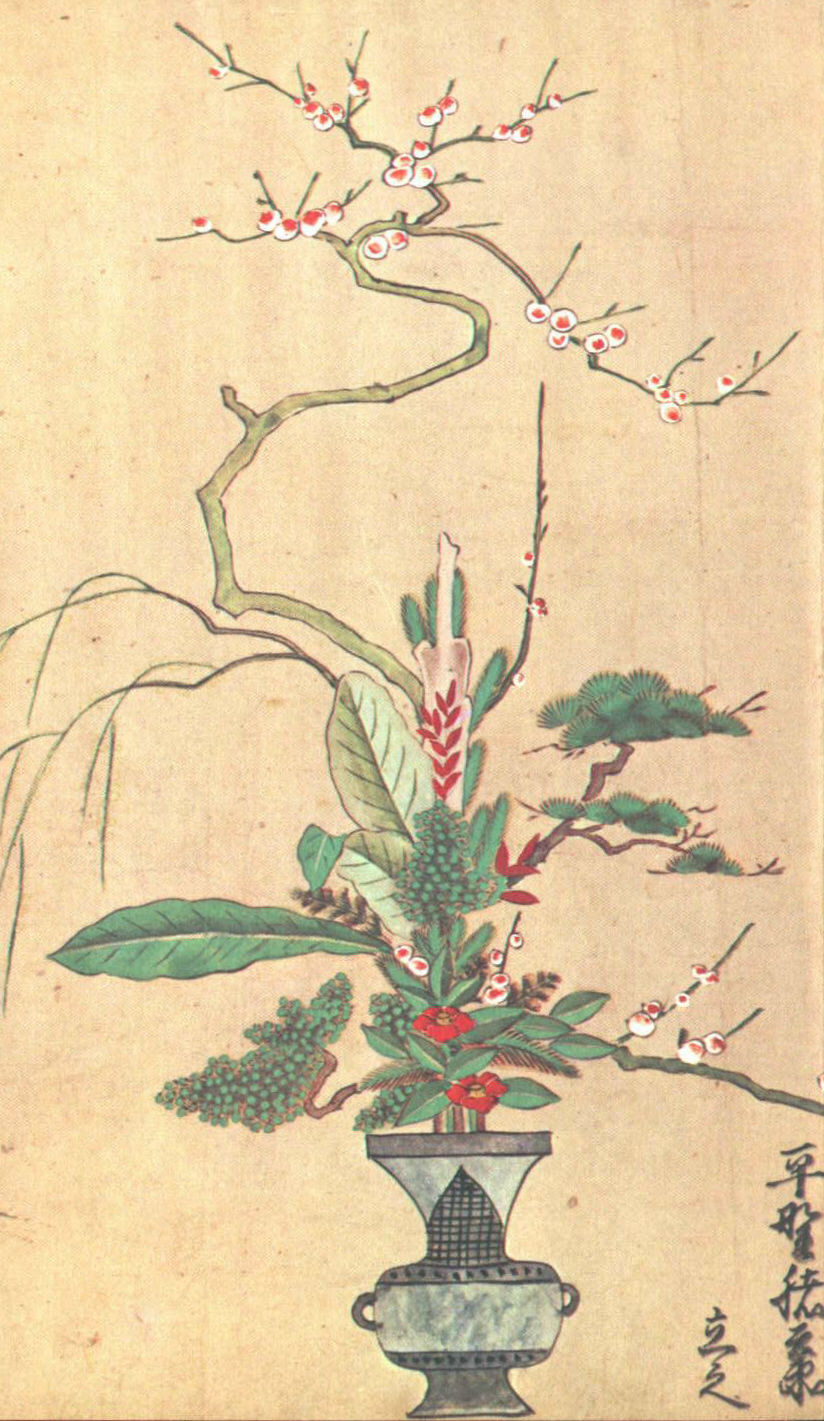
Hirozumi Sumiyoshi, Rikka, ca. 1700. Image via Wikimedia Commons
Ikebana (“living flowers”) is the Japanese art of flower arrangement. It is also known as Kadō (“way of flowers”). The tradition dates back to the 7th century when floral offerings were made at altars. Later, they were placed in the tokonoma (alcove) of a home. In contrast to the western habits of casually placing flowers in a vase, ikebana aims to bring out the inner qualities of flowers and other live materials within certain rules of construction and ultimately – express emotion.
Its materials are living branches, leaves, grasses, and blossoms. Its heart is the beauty resulting from colour combinations, natural shapes, graceful lines, and the meaning latent in the total form of the arrangement. It is a disciplined art form in which the arrangement is a living thing where nature and humanity are brought together. It is steeped in the philosophy of developing closeness with nature.
“Happiness is to hold flowers in both hands.”
– Japanese proverb
Ikebana is a way of arranging flowers according to ancient principles. Branches and flowers are placed at specific angles to represent ten (heaven), chi (earth), and jin (man). The way they’re placed represents the strength, delicacy, and ephemerality of living flowers. Funnily enough, the word ikebana comes from ‘ikuru’ – to live and ‘hana’ – flowers: literally ‘living flowers’.
If you’ve ever dabbled in floristry or arranged some flowers in vase, it’s easy to see why. The act of looking at a flower, admiring its shape, form, and colour. Then deciding to put it just so in a vase. It’s an art that restores our sense of inner harmony. A sort of lovely mix of therapy and meditation. Anyone can ikebana. It’s about trusting your intuition and creating something according to how you feel right at that moment. There’s no right or wrong. It’s your self expression!

“The whole universe is contained in a single flower.”
– Toshiro Kawase, Japan’s leading modern Ikebana Maste
Many of the tools needed for ikebana will seem familiar: sharp scissors to trim stems, containers of different shapes – from cylindrical vases to shallow dishes, and something called a kenzan that is a sort of heavy lead pincushion to fix stems to. If you want to give it a go for the first time, we suggest going for a nice tall cylindrical vase! And if you don’t have a pair of secateurs, using a sharp knife (not serrated) will do the trick. Because of their simplicity, the best place to put an ikebana arrangement is a clear space that’s not too cluttered.
Happy arranging!
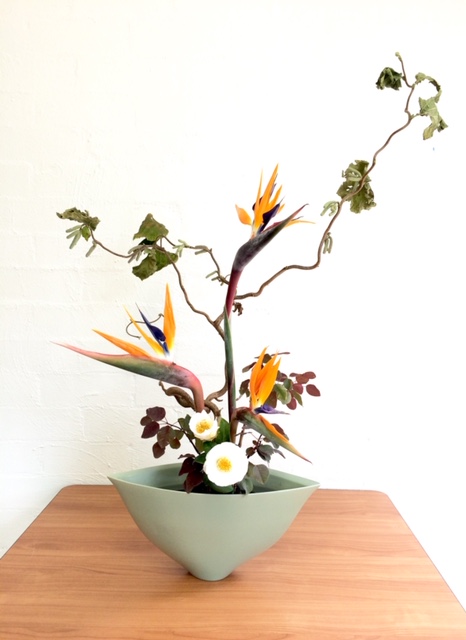
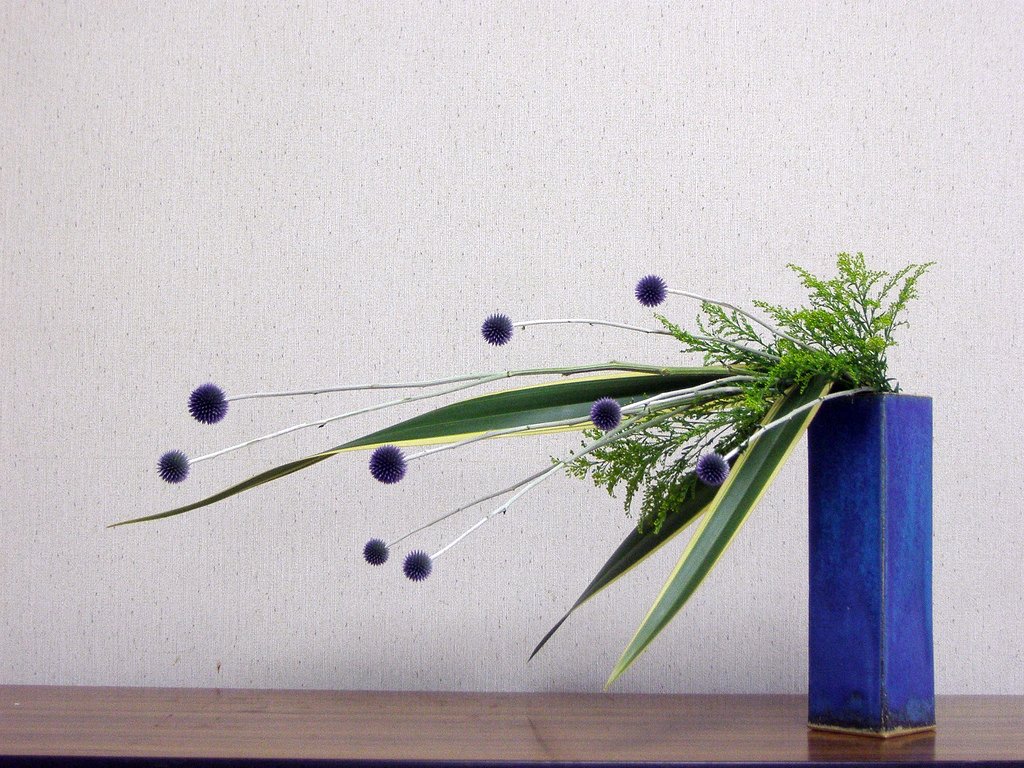
Flickr: ikebana by Tel Qel
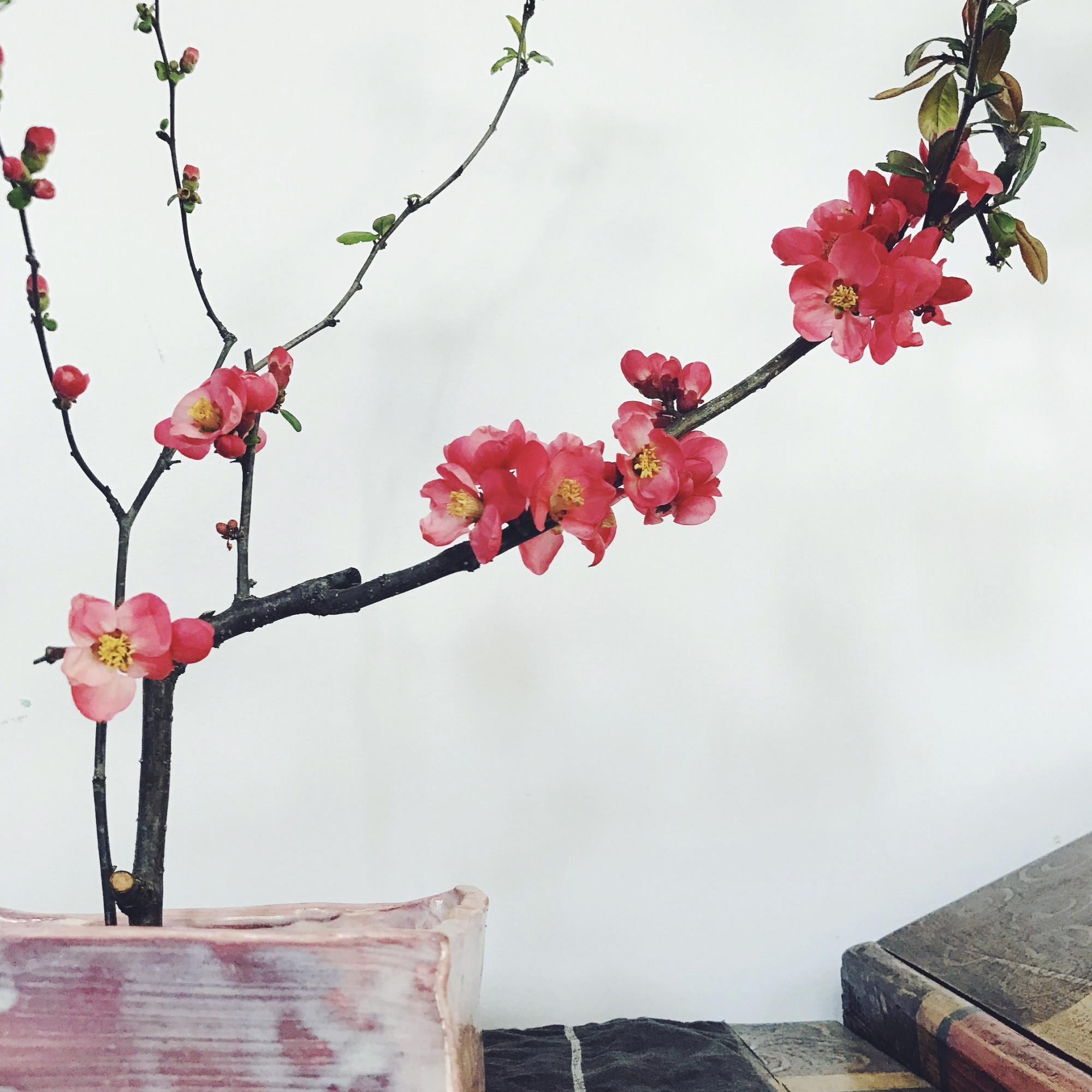
Source: Flickr, Ueha nochi
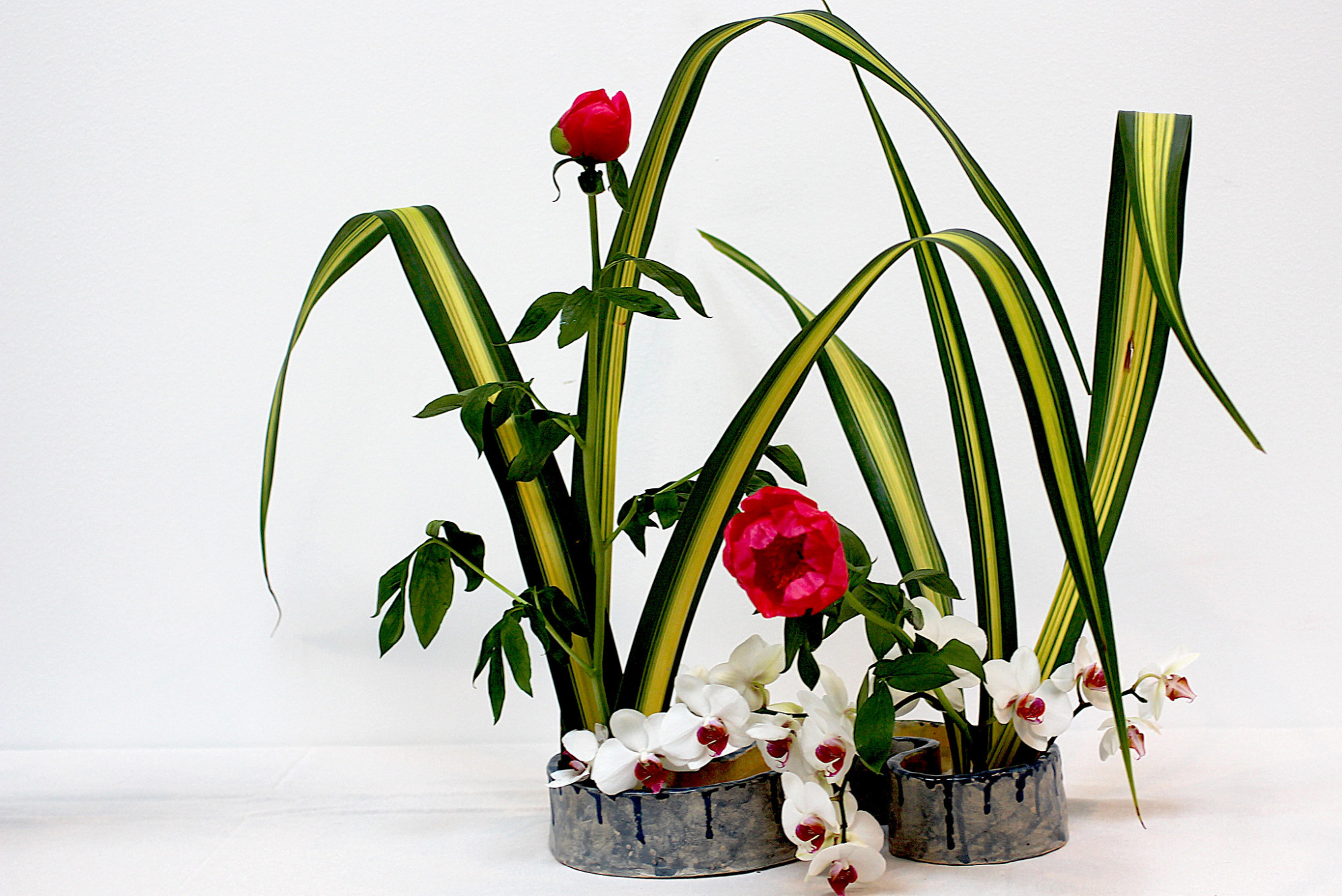
Source: Flickr, ikebana manuel m. v.