
Is the fabric known as silk 7000 years old? Did people wear it from as long ago as 5000 B.C. — before civilization began at Sumer and before Egyptians built the Great Pyramid?
If silkworm cultivation or sericulture is as much as seven millennia old — as the Silk Road Foundation says it may be — the chances are poor that we will ever know exactly who invented it. What we can learn is what the descendants of the people who discovered silk wrote about it and what their legends say about the origins of processing silk.
Although there are other stories and variations, the basic legend credits an early Chinese empress. She is said to have:
1. Cultivated the silk-producing caterpillar (Bombyx mori).
2. Fed the silkworm the mulberry leaf that was discovered to be the best food — at least for those interested in producing the best silk.
3. Invented the loom to weave the fiber.
Raising Silk
On its own, the silkworm larva produces a single, several hundred-yard-strand of silk, which it breaks as it emerges as a moth from its cocoon, leaving residue all over the trees. In preference to gathering the tangled silk caught in the trees, the Chinese learned to raise the silkworms on a fattening diet of the leaves of carefully cultivated mulberry trees. They also learned to watch the development of the cocoons so they could kill the chrysalis by plunging it in boiling water just before its time. This method ensures the full length of silk strands. The boiling water also softens the sticky protein holding together the silk [Grotenhuis]. (The process of pulling out the strand of silk from the water and cocoon in known as reeling.) The thread is then woven into beautiful clothing.
Who Was the Lady Hsi-ling?
The main source for this article is Dieter Kuhn, Professor, and Chair of Chinese Studies, University of Würzburg. He wrote «Tracing a Chinese Legend: In Search of the Identity of the ‘First Sericulturalist’» for T’oung Pao, an international journal of sinology. In this article, Kuhn looks at what the Chinese sources say about the legend of the invention of silk and describes the presentation of silk manufacture’s invention across the dynasties. He makes note of the contribution of the lady of Hsi-ling in particular. She was the principal wife of Huangdi, who is better known as the Yellow Emperor.
The Yellow Emperor (Huangdi or Huang-ti, where Huang is the same word we translate as Yellow when used in connection with the great Chinese Yellow River, and ti is the name of an important god that is used in the names of kings, conventionally translated «emperor») is a legendary Neolithic era ruler and ancestor of the Chinese people, with almost godlike proportions. Huangdi is said to have lived in the third millennium B.C. for 100-118 years, during which he is credited with giving numerous gifts to the Chinese people, including the magnetic compass, and sometimes including silk. The principal wife of the Yellow Emperor, the lady of Hsi-ling (also known as Xi Ling-Shi, Lei-Tsu, or Xilingshi), is, like her husband, credited with discovering silk. The lady of Hsi-ling is also credited with figuring out how to reel silk and inventing what people needed to make clothing from the silk — the loom, according to the Shih-Chi ‘Record of the Historian.’
Ultimately, the confusion seems to remain, but the upper hand is given the empress. The Yellow Emperor, who was honored as the First Sericulturalist during the Northern Chi Period (c. A.D. 550 — c. 580), may be the male figure depicted in later art as a patron saint of sericulture. The lady Hsi-ling is more often called the First Sericulturalist. Although she had been worshiped and held a position in the Chinese pantheon since the Northern Chou Dynasty (557-581), her official position as the personification of the First Sericulturalist with a divine seat and altar only came in 1742.
Silk Clothing Altered the Chinese Division of Labor
One could speculate, as Kuhn does, that the job of making fabric was women’s work and that therefore the associations were made with the empress, rather than her husband, even if he had been the first sericulturalist. The Yellow Emperor may have invented the methods of producing silk, while the lady Hsi-ling was responsible for the discovery of silk itself. This legendary discovery, reminiscent of the story of the discovery of actual tea in China, involves falling into an anachronistic cup of tea.
Chinese scholarship from the seventh century A.D. says that before the Yellow Emperor, clothing was made of bird (feathers can protect against water and down is, of course, an insulating material) and animal skin, but the supply of animals didn’t keep up with demand. The Yellow Emperor decreed that clothing should be made of silk and hemp. In this version of the legend, it is Huangdi (actually, one of his officials named Po Yu), not the lady of Hsi-ling who invented all fabrics, including silk, and also, according to legend from the Han Dynasty, the loom. Again, if looking for a rationale for the contradiction based on the division of labor and gender roles: hunting would not have been a domestic pursuit, but the province of the men, so when clothing changed from skins to cloth, it made sense that it would have changed the storied gender of the maker.
Evidence of 5 Millennia of Silk
Not quite the full seven, but five millennia puts it more in line with important major developments elsewhere, so it is more easily believed.
Archaeological evidence reveals that silk existed in China as far back as around 2750 B.C., which puts it, coincidentally according to Kuhn, close to the dates of the Yellow Emperor and his wife. Shang Dynasty oracle bones show evidence of silk production.
Silk was also in the Indus Valley from the third millennium B.C., according to New Evidence for Silk in the Indus Valley, which says copper-alloy ornaments and steatite beads have yielded silk fibers upon microscopic examination. As an aside, the article says this raises the question of whether China really had exclusive control of silk.
A Silken Economy
The importance of silk to China probably can’t be exaggerated: the exceptionally long and strong filament clothed a vast Chinese population, helped support the bureaucracy by being used as a precursor to paper (2nd century B.C.) [Hoernle] and to pay taxes [Grotenhuis], and led to commerce with the rest of the world. Sumptuary laws regulated the wearing of fancy silks and embroidered, patterned silks became status symbols from the Han to the Northern and Southern Dynasties (2nd century B.C. to 6th century A.D.).
How the Secret of Silk Leaked Out
The Chinese guarded its secret carefully and successfully for centuries, according to tradition. It was only in the 5th century A.D. that silk eggs and mulberry seeds were, according to legend, smuggled out in an elaborate headdress by a Chinese princess when she went to her groom, the king of Khotan, in Central Asia. A century later they were smuggled by monks into the Byzantine Empire, according to the Byzantine historian Procopius.
Silk Worship
Patron saints of sericulture were honored with life-size statues and rites; in the Han period, the silkworm goddess was personified, and in Han and Sung periods, the empress performed a silk ceremony. The empress helped with the gathering of the mulberry leaves necessary for the best silk, and the sacrifices of pig and sheep that were made to the «First Sericulturalist» who may or may not have been the lady of Hsi-ling. By the 3rd century, there was a silkworm palace which the empress supervised.
Legends of the Discovery of Silk
There is a fanciful legend about the discovery of silk, a love story about a betrayed and murdered magic horse, and his lover, a woman transformed into a silkworm; the threads becoming feelings. Liu recounts a version, recorded by Ts’ui Pao in his 4th century A.D. Ku Ching Chu (Antiquarian Researches), where the horse is betrayed by the father and his daughter who promised to marry the horse. After the horse was ambushed, killed, and skinned, the hide wrapped up the girl and flew away with her. It was found in a tree and brought home, where some time later the girl had been transformed into a moth. There is also a fairly pedestrian story of how silk was actually discovered — the cocoon, thought to be fruit, wouldn’t soften when boiled, so the would-be diners got their aggression out by beating it with sticks until the filament emerged.
Sericulture References:
«The Silkworm and Chinese Culture,» by Gaines K. C. Liu; Osiris, Vol. 10, (1952), pp. 129-194
«Tracing a Chinese Legend: In Search of the Identity of the ‘First Sericulturalist,’» by Dieter Kuhn; T’oung Pao Second Series, Vol. 70, Livr. 4/5 (1984), pp. 213-245.
«Spices and Silk: Aspects of World Trade in the First Seven Centuries of the Christian Era,» by Michael Loewe; The Journal of the Royal Asiatic Society of Great Britain and Ireland No. 2 (1971), pp. 166-179.
«Stories of Silk and Paper,» by Elizabeth Ten Grotenhuis; World Literature Today; Vol. 80, No. 4 (Jul. — Aug. 2006), pp. 10-12.
«Silks and Religions in Eurasia, C. A.D. 600-1200,» by Liu Xinru; Journal of World History Vol. 6, No. 1 (Spring, 1995), pp. 25-48.
«Who Was the Inventor of Rag-Paper?» by A. F. Rudolf Hoernle; The Journal of the Royal Asiatic Society of Great Britain and Ireland (Oct. 1903), pp. 663-684.

The production of silk originated in Neolithic period China within the Yangshao culture (4th millennium BC). Though it would later reach other places in the world, the art of silk production remained confined to China until the Silk Road opened at 114 BC, though China maintained its virtual monopoly over silk production for another thousand years. The use of silk within China was not confined to clothing alone, and silk was used for a number of applications, such as writing. Within clothing, the color of silk worn also held social importance, and formed an important guide of social class during the Tang dynasty.
Silk cultivation spread to Japan around 300 AD, and, by 552 AD, the Byzantine Empire managed to obtain silkworm eggs and were able to begin silkworm cultivation; the Arabs also began to manufacture silk at the same time. As a result of the spread of sericulture, Chinese silk exports became less important, although they still maintained dominance over the luxury silk market. The Crusades brought silk production to Western Europe, in particular to many Italian states, which saw an economic boom exporting silk to the rest of Europe. Developments in manufacturing technique also began to take place during the Middle Ages (5th to 15th centuries) in Europe, with devices such as the spinning wheel first appearing at this time. During the 16th century, France joined Italy in developing a successful silk trade, though the efforts of most other nations to develop a silk industry of their own were unsuccessful.
The Industrial Revolution changed much of Europe’s silk industry. Due to innovations in the spinning of cotton, cotton became much cheaper to manufacture, leading to cotton production becoming the main focus for many manufacturers, and causing the more costly production of silk to shrink. New weaving technologies, however, increased the efficiency of producing silk cloth; among these was the Jacquard loom, developed for the production of highly detailed silks with embroidery-like designs. An epidemic of several silkworm diseases at this time caused production to fall, especially in France, where the industry never fully recovered.
In the 20th century, Japan and China regained their earlier dominant role in silk production, and China is now once again the world’s largest producer of silk. The rise of new imitation silk fabrics, such as nylon and polyester, has reduced the prevalence of silk throughout the world, being a cheaper and easier to care for alternative. Silk is now once again thought of as a luxury good, with a greatly reduced importance compared to its historical heyday.
Early history[edit]

The cocoon of the domesticated silk moth; unlike wild silk moths, its cocoon is entirely white
First appearance of silk[edit]
The earliest evidence of silk was found at the sites of Yangshao culture in Xia County, Shanxi, where a silk cocoon was found cut in half by a sharp knife, dating back to between 4000 and 3000 BC. The species was identified as Bombyx mori, the domesticated silkworm. Fragments of a primitive loom can also be seen from the sites of Hemudu culture culture in Yuyao, Zhejiang, dated to about 4000 BC.
The earliest extant example of a woven silk fabric is from 3630 BC, used as wrapping for the body of a child. The fabric comes from a Yangshao site in Qingtaicun at Rongyang, Henan.[1] Scraps of silk were found in a Liangzhu culture site at Qianshanyang in Huzhou, Zhejiang, dating back to 2700 BC.[2][3] Other fragments have been recovered from royal tombs in the Shang dynasty (c. 1600–1046 BC).[4]
During the later epoch, the knowledge of silk production was spread outside of China, with the Koreans, the Japanese and, later, the Indian people gaining knowledge of sericulture and silk fabric production. Allusions to the fabric in the Old Testament show that it was known in Western Asia in biblical times.[5] Scholars believe that starting in the 2nd century BC, the Chinese established a commercial network aimed at exporting silk to the West.[5] Silk was used, for example, by the Persian court and its king, Darius III, when Alexander the Great conquered the empire.[5]
Even though silk spread rapidly across Eurasia, with the possible exception of Japan, its production remained exclusively Chinese for three millennia. The earliest examples of silk production outside China are from silk threads discovered from the Chanhudaro site in the Indus Valley Civilisation, which are dated to 2450–2000 BC.[6][7] The analysis of the silk fibres shows presence of reeling and sericulture, and predates another example of silk found in Nevasa in peninsular India, dated to 1500 BC.
The Siberian Ice Maiden, discovered in the Pazyryk burials, was found clad in a long crimson-and-white striped woolen skirt, with white felt stockings. Her yellow blouse was originally thought to be made of wild tussah silk, but closer examination of the fibres revealed the material not to be Chinese in origin, and was instead woven from a wild silk of a different origin, potentially India.[8]

Detail of silk ritual garment from a 4th-century BC, Zhou Dynasty, China
Myths and legends[edit]

A lacquerware painting from the Jingmen Tomb (Chinese: 荊門楚墓; Pinyin: Jīngmén chǔ mù) of the State of Chu (704–223 BC), depicting men wearing traditional silk dress and riding in a two horsed chariot
Many myths and legends exist as to the exact origin of silk production; the writings of both Confucius and Chinese tradition recount that, in about 3000 BC, a silk worm’s cocoon fell into the teacup of the Empress Leizu.[9] Wishing to extract it from her drink, the 14-year-old girl began to unroll the thread of the cocoon; seeing the long fibers that constituted the cocoon, the Empress decided to weave some of it, and so kept some of the cocoons to do so. Having observed the life of the silkworm on the recommendation of her husband, the Yellow Emperor, she began to instruct her entourage in the art of raising silkworms — sericulture. From this point, the girl became the goddess of silk in Chinese mythology.
Knowledge of silk production eventually left China via the heir of a princess who was promised to a prince of Khotan, likely around the early 1st century AD.[10] The princess, refusing to go without the fabric that she loved, decided to break the imperial ban on silkworm exportation.
Though silk was exported to foreign countries in great amounts, sericulture remained a secret that the Chinese carefully guarded; consequently, other cultures developed their own accounts and legends as to the source of the fabric. In classical antiquity, most Romans, great admirers of the cloth, were convinced that the Chinese took the fabric from tree leaves.[11] This belief was affirmed by Seneca the Elder in his work Phaedra, and by Virgil in his work Georgics. Pliny the Elder notably accurately determined where silk came from; speaking of the Bombyx or silk moth, he wrote in his Natural History that, «They weave webs, like spiders, that become a luxurious clothing material for women, called silk.»[12]
Silk usage in Ancient and Medieval China[edit]


In China, silkworm farming was originally restricted to women, and many women were employed in the silk-making industry. Even though some saw the development of a luxury product as useless, silk provoked such a craze among the high society that the rules in the Li Ji were used to limit its use to the members of the imperial family.[4]
For approximately a millennium, the right to wear silk was reserved for the emperor and the highest dignitaries. Silk was, at the time, a sign of great wealth, due to its shimmering appearance, created by the silk fiber’s prismatic structure, which refracted light from every angle. After some time, silk gradually extended to other classes of Chinese society, though this was mainly the uppermost noble classes. Silk began to be used for decorative means and also in less luxurious ways; musical instruments, fishing, and bow-making all utilized silk. Peasants, however, did not have the right to wear silk until the Qing dynasty (1644–1911).[4]
Paper was one of the greatest discoveries of ancient China. Beginning in the 3rd century BC, paper was made in all sizes with various materials.[13] Silk was no exception, and silk workers had been making paper since the 2nd century BC. Silk, bamboo, linen, wheat and rice straw were all used, and paper made with silk became the first type of luxury paper. Researchers have found an early example of writing done on silk paper in the tomb of a marchioness, who died around 168[vague], in Mawangdui, Changsha, Hunan. The material was more expensive, but also more practical than bamboo slips. Treatises on many subjects, including meteorology, medicine, astrology, divinity, and even maps written on silk[14] have been discovered.

During the Han dynasty, silk became progressively more valuable in its own right, and was used in a greater capacity than as simply a material; lengths of silk cloth were used to pay government officials and to compensate citizens who were particularly worthy. In the same manner that one would sometimes estimate the price of products according to a certain weight of gold, a length of silk cloth became a monetary standard in China, in addition to bronze coins. Many neighbouring countries began to grow envious of the wealth that sericulture provided China, and beginning in the 2nd century BC, the Xiongnu people regularly pillaged the provinces of the Han Chinese for around 250 years. Silk was a common offering by the emperor to these tribes in exchange for peace.
Silk is described in a chapter of the Fan Shengzhi shu from the Western Han period (206 BC–9 AD), and a surviving calendar for silk production in an Eastern Han (25–220 AD) document. The two other known works on silk from the Han period are lost.[1]
The military payrolls tell us that soldiers were paid in bundles of plain silk textiles, which circulated as currency in Han times. Soldiers may well have traded their silk with the nomads who came to the gates of the Great Wall to sell horses and furs.[15]
For more than a millennium, silk remained the principal diplomatic gift of the emperor of China to neighbouring countries or vassal states.[4] The use of silk became so important that the character for silk (糸) soon constituted one of the principal radicals of Chinese script.
As a material for clothing and accessories, the use of silk was regulated by a very precise code in China. For example, the Tang Dynasty and Song Dynasty used colour symbolism to denote the various ranks of bureaucrats, according to their function in society, with certain colours of silk restricted to the upper classes only. Under the Ming Dynasty, silk began to be used in a series of accessories: handkerchiefs, wallets, belts, or even as an embroidered piece of fabric displaying dozens of animals, real or mythical. These fashion accessories remained associated with a particular position: there was specific headgear for warriors, for judges, for nobles, and others for religious use. The women of high Chinese society also followed these codified practices, and used silk in their garments alongside the addition of countless decorative motifs.[4] A 17th century work, Jin Ping Mei, gives a description of one such motif:
Golden lotus having a quilted backgammon pattern, double-folded, adorned with savage geese pecking at a landscape of flowers and roses; the dress’ right figure had a floral border with buttons in the form of bees or chrysanthemums.[4]
- Chinese silk making process
-

The silkworms and mulberry leaves are placed on trays.
-

Twig frames for the silkworms are prepared.
-

The cocoons are weighed.
-

The cocoons are soaked and the silk is wound on spools.
-

The silk is woven using a loom.

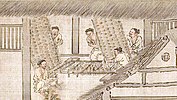

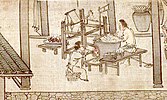
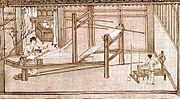
Silk moths and production techniques used in China[edit]

Polychrome embroidery in silk, 17th century, Antwerp

Silk was made using various breeds of lepidopterans, both wild and domestic. While wild silks were produced in many countries, the Chinese are considered to have been the first to produce silk fabric on a large scale, having the most efficient species of silk moth for silk production, the Bombyx mandarina, and its domesticated descendant, Bombyx mori. Chinese sources claim the existence in 1090 of a machine to unwind silkworm cocoons; the cocoons were placed in a large basin of hot water, the silk would leave the cauldron by tiny guiding rings, and would be wound onto a large spool, using a backward and forward motion.[13] However, little information exists about the spinning techniques previously used in China. The spinning wheel, in all likelihood moved by hand, was known to exist by the beginning of the Christian era.[clarification needed] The first accepted image of a spinning wheel appears in 1210, with an image of a silk spinning machine powered by a water wheel that dates to 1313.
More information is known about the looms used. The ‘Nung Sang Chi Yao, or Fundamentals of Agriculture and Sericulture (compiled around 1210) is rich with pictures and descriptions, many pertaining to silk.[16] It repeatedly claims the Chinese looms to be far superior to all others, and speaks of two types of loom that leave the worker’s arms free: the drawloom, which is of Eurasian origin, and the pedal loom, which is attributed to East Asian origins. There are many diagrams of these that originate in the 12th and 13th centuries. When examined closely, many similarities between Eurasian machines can be drawn. Following the Jin Dynasty (266–420), the existence of silk damasks was well recorded, and beginning in the 2nd century BC, four-shafted looms and other innovations allowed the creation of silk brocades.
The Silk Road and trade (2nd–8th century)[edit]

The main silk roads between 500 BC and 500 AD

Numerous archaeological discoveries show that silk had become a luxury material appreciated in foreign countries well before the opening of the Silk Road by the Chinese. For example, silk has been found in the Valley of the Kings in Egypt, in the tomb of a mummy dating to 1070 BC.
Both the Greeks and the Romans — the latter later than the former — spoke of the Seres, «people of silk», a term used for the inhabitants of the far-off kingdom of China. According to certain historians, the first Roman contact with silk was that of the legions of the governor of Syria, Crassus. At the Battle of Carrhae, near the Euphrates, the legions were said to be so surprised by the brilliance of the banners of Parthia that they fled.
The Silk Road toward the west was opened by the Chinese in the 2nd century AD. The main road left from Xi’an, going either to the north or south of the Taklamakan desert, one of the most arid in the world, before crossing the Pamir Mountains. The caravans that travelled this route to exchange silk with other merchants were generally sizeable, constituting 100 to 500 people, as well as camels and yaks carrying around 140 kilograms (310 lb) of merchandise. The route linked to Antioch and the coasts of the Mediterranean, about one year’s travel from Xi’an. In the south, a second route went by Yemen, Burma, and India before rejoining the northern route.[17][18]
Not long after the conquest of Egypt in 30 BC, regular commerce began between the Romans and Asia, marked by the Roman appetite for silk cloth coming from the Far East, which was then resold to the Romans by the Parthians. The Roman Senate tried in vain to prohibit the wearing of silk, for economic reasons as well as moral ones. The import of Chinese silk resulted in vast amounts of gold leaving Rome, to such an extent that silk clothing was perceived as a sign of decadence and immorality.
I can see clothes of silk, if materials that do not hide the body, nor even one’s decency, can be called clothes. … Wretched flocks of maids labor so that the adulteress may be visible through her thin dress, so that her husband has no more acquaintance than any outsider or foreigner with his wife’s body.
China traded silk, teas, and porcelain, while India traded spices, ivory, textiles, precious stones, and pepper, and the Roman Empire exported gold, silver, fine glassware, wine, carpets, and jewels. Although the term «the Silk Road» implies a continuous journey, very few who traveled the route traversed it from end to end; for the most part, goods were transported by a series of agents on varying routes, and were traded in the bustling markets of the oasis towns.[20] The main traders during Antiquity were the Indian and Bactrian traders, followed by Sogdian traders from the 5th to the 8th century AD, and then followed by Arab and Persian traders.
In the late Middle Ages, transcontinental trade over the land routes of the Silk Road declined as sea trade increased.[21] The Silk Road was a significant factor in the development of the civilizations of China, India, Ancient Egypt, Persia, Arabia, and Ancient Rome. Though silk was certainly the major trade item from China, many other goods were traded, and various technologies, religions and philosophies, as well as the bubonic plague (the «Black Death»), also traveled along the silk routes. Some of the other goods traded included luxuries such as silk, satin, hemp and other fine fabrics, musk, other perfumes, spices, medicines, jewels, glassware, and even rhubarb, as well as slaves.[20]
Global spread of sericulture (4th–16th century)[edit]


Chinese Embassy, carrying silk and a string of silkworm cocoons, 7th century CE, Afrasiyab, Sogdia.[22]
Although silk was well known in Europe and most of Asia, China was able to keep a near-monopoly on silk production for several centuries, defended by an imperial decree and condemning to death anyone attempting to export silkworms or their eggs.[citation needed] According to the Nihongi, sericulture reached Japan for the first time around 300 AD, following a number of Koreans, having been sent from Japan to China, recruiting four young Chinese girls to teach the art of plain and figured weaving in Japan.[23] Techniques of sericulture were subsequently introduced to Japan on a larger scale by frequent diplomatic exchanges between the 8th and 9th centuries.
Starting in the 4th century BC, silk began to reach the Hellenistic world by merchants who would exchange it for gold, ivory, horses or precious stones. Up to the frontiers of the Roman Empire, silk became a monetary standard for estimating the value of different products. Hellenistic Greece appreciated the high quality of the Chinese goods and made efforts to plant mulberry trees and breed silkworms in the Mediterranean basin, while Sassanid Persia controlled the trade of silk destined for Europe and Byzantium. The Greek word for «silken» was σηρικός, from Seres (Σῆρες), the name of the people from whom silk was first obtained, according to Strabo.[24] The Greek word gave rise to the Latin ‘sericum’, and ultimately the Old English ‘sioloc’, which later developed into the Middle English ‘silk’.

The monks sent by Justinian give the silkworms to the emperor.
According to a story by Procopius,[25] it was not until 552 AD that the Byzantine emperor Justinian obtained the first silkworm eggs. He had sent two Nestorian monks to Central Asia, and they were able to smuggle silkworm eggs to him hidden in rods of bamboo. While under the monks’ care, the eggs hatched, though they did not cocoon before arrival. The church manufacture in the Byzantine Empire was thus able to make fabrics for the emperor, with the intention of developing a large silk industry in the Eastern Roman Empire, using techniques learned from the Sassanids. These gynecia had a legal monopoly on the fabric, but the empire continued to import silk from other major urban centers on the Mediterranean.[26] The silk produced by the Byzantines was well known for its high quality, owing to the meticulous attention paid to the execution of its weaving and decoration, with weaving techniques taken from Egypt used to produce the fabric. The first diagrams of semple looms appeared in the 5th century.[27]
The Arabs, with their widening conquests, spread sericulture across the shores of the Mediterranean, leading to the development of sericulture in North Africa, Andalusia, Sicily[28] and Southern Italy’s Calabria, which was under the Byzantine dominion. According to André Guillou,[29] mulberry trees for the production of raw silk were introduced to southern Italy by the Byzantines at the end of the 9th century. Around 1050, the theme of Calabria had cultivated 24,000, mulberry trees for their foliage, with growth still ongoing. The interactions among Byzantine and Muslim silk-weaving centers of all levels of quality, with imitations made in Andalusia and Lucca, among other cities, have made the identification and date of rare surviving examples difficult to pinpoint.[30]
Catanzaro, in the region of Calabria, was the first center to introduce silk production to Italy between the 9th and the 11th century. During the following centuries, the silk of Catanzaro supplied almost all of Europe and was sold in a large market fair in the port of Reggio Calabria to Spanish, Venetian, Genoese, Florentine and Dutch merchants. Catanzaro became the lace capital of Europe, with a large silkworm breeding facility that produced all the laces and linens used in the Vatican. The city was famous for its fine fabrication of silks, velvets, damasks, and brocades.[31][32] While the cultivation of mulberry was moving first steps in Northern Italy, silk made in Calabria reached a peak of 50% of the whole Italian/European production. As the cultivation of mulberry was difficult in Northern and Continental Europe, merchants and operators used to purchase raw materials in Calabria in order to finish the products, before reselling them for a higher price. Genoese silk artisans also used fine Calabrian and Sicilian silk for the production of velvets.[33]
While the Chinese lost their monopoly on silk production, they were able to re-establish themselves as major silk suppliers during the Tang dynasty, and to industrialize their production on a large scale during the Song dynasty.[34] China continued to export high-quality fabric to Europe and the Near East along the Silk Road; however, following the beginning of the first Crusades, techniques of silk production began to spread across Western Europe.
In 1147, while Byzantine emperor Manuel I Komnenos was focusing all his efforts on the Second Crusade, the Norman king Roger II of Sicily attacked Corinth and Thebes, two important centers of Byzantine silk production. They took the crops and silk production infrastructure, and deported all the workers to Palermo and Calabria,[35] thereby causing the Norman silk industry to flourish.[36] The sack of Constantinople by the Fourth Crusade in 1204 brought decline to the city and its silk industry, and many artisans left the city in the early 13th century.[28] Italy developed a large domestic silk industry after 2,000 skilled weavers came from Constantinople. Many also chose to settle in Avignon to furnish the popes of Avignon.
The sudden boom of the silk industry in the Italian state of Lucca, starting in the 11th and 12th centuries, was due to much Sicilian, Jewish, and Greek settlement, alongside many other immigrants from neighboring cities in southern Italy.[37] With the loss of many Italian trading posts in the Orient, the import of Chinese styles drastically declined. In order to satisfy the demands of the rich and powerful bourgeoisie for luxury fabrics, the cities of Lucca, Genoa, Venice and Florence increase the momentum of their silk production, and were soon exporting silk to all of Europe, with 84 workshops and at least 7,000 craftsmen in Florence in 1472 alone.
In 1519, Emperor Charles V formally recognized the growth of the industry of Catanzaro by allowing the city to establish a consulate of the silk craft, charged with regulating and check in the various stages of a production that flourished throughout the 16th century. At the moment of the creation of its guild, the city declared that it had over 500 looms. By 1660, when the town had about 16,000 inhabitants, its silk industry kept 1,000 looms, and at least 5,000 people, in employment. The silk textiles of Catanzaro were not only sold at the Kingdom of Naples’s markets, they were also exported to Venice, France, Spain and England.[38]
Use of silk in the Medieval period (5th–15th century)[edit]
Importance as a luxury good[edit]

The high Middle Ages (1000–1250 AD) saw continued use of established techniques for silk manufacture without change in either materials or tools used. Small changes began to appear between the 10th and 12th centuries, followed by larger and more radical innovations in the 13th century, resulting in the invention of new fabrics; other, more mundane fabrics made of hemp and cotton also developed. Silk remained a rare and expensive material,[39] but improved technology saw Byzantine magnaneries in Greece and Syria (6th to 8th centuries), silk production centres in Calabria and those of the Arabs in Sicily and Spain (8th to 10th centuries) able to supply the luxury material in much greater abundance.[39]
Improved silk production technology[edit]
The 13th century saw an improve in the already-changing technology of silk production; as with the Industrial Revolution of late-18th century England, advances in silk production also possibly accompanied more general advances in the technology of modern society as a whole.[40] At the beginning of the 13th century, a primitive form of milling silk yarns was in use; Jean de Garlande’s 1221 dictionary and Étienne Boileau’s 1261 Livre des métiers (Tradesman’s Handbook) both illustrate many types of machinery which can only have been doubling machines. This machinery was further perfected in Bologna between 1270 and 1280.
From the start of the 14th century, many documents allude to the use of complex weaving machinery.[41] Depictions of fabric production techniques from this time period can be found in several places; the earliest surviving depiction of a European spinning wheel is a panel of stained glass in the Cathedral of Chartres,[42] alongside bobbins and warping machines appearing both together in the stained glass at Chartres and in a fresco in the Cologne Kunkelhaus (c. 1300). It is possible that the toothed warping machine was created by the silk industry, as it allowed the for a longer length of warp to hold more uniformity throughout the length of the cloth.[41]
Towards the end of the 14th century, no doubt on account of the devastation caused mid-century by the Black Death, trends began to shift towards less expensive production techniques. Many techniques that earlier in the century would have been completely forbidden by the guilds for low-quality production were now commonplace (such as using low-quality wool, carding, etc.). In the silk industry, the use of water-powered mills grew.
In the second half of the 15th century, drawloom technology was first brought to France by an Italian weaver from Calabria, known as Jean le Calabrais,[43] who was invited to Lyon by Louis XI.[44] He introduced a new kind of machine, which had the ability to work the yarns faster and more precisely. Further improvements to the loom were made throughout the century.[45]
The silk industry in France[edit]

Though highly regarded for its quality, Italian silk cloth was very expensive, both due to the costs of the raw materials and the production process. The craftsmen in Italy proved unable to keep up with the needs of French fashions, which continuously demanded lighter and less expensive materials.[46] These materials, used for clothing, began to be produced locally instead; however, Italian silk remained for a long time amongst the most prized, mostly for furnishings and the brilliant nature of the dyestuffs used.
Following the example of the wealthy Italian city-states of the era, such as Venice, Florence, and Lucca (which had become the center of the luxury-textile industry), Lyon obtained a similar function in the French market. In 1466, King Louis XI decided to develop a national silk industry in Lyon, and employed a large number of Italian workers, mainly from Calabria. The fame of the master weavers of Catanzaro spread throughout France, and they were invited to Lyon in order to teach the techniques of weaving. The drawloom that appeared in those years in France was called loom by Jean Le Calabrais.[47]
In the face of protests by the people of Lyon, Louis XI conceded to move silk production to Tours, but the industry in Tours stayed relatively marginal. His main objective was to reduce France’s trade deficit with the Italian states, which caused France to lose 400,000 to 500,000 golden écus a year.[48] It was under Francis I in around 1535 that a royal charter was granted to two merchants, Étienne Turquet and Barthélemy Naris, to develop a silk trade in Lyon. In 1540, the king granted a monopoly on silk production to the city of Lyon. Starting in the 16th century, Lyon became the capital of the European silk trade, notably producing many reputable fashions.[49] Gaining confidence, the silks produced in the city began to abandon their original Oriental styles in favor of their own distinctive style, which emphasized landscapes. Thousand of workers, the canuts, devoted themselves to the flourishing industry. In the middle of the 17th century, over 14,000 looms were used in Lyon, and the silk industry fed a third of the city’s population.[49]
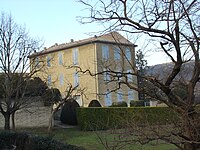
In the 18th and 19th centuries, Provence experienced a boom in sericulture that would last until World War I, with much of the silk shipped north to Lyon. Viens and La Bastide-des-Jourdans are two of the communes of Luberon that profited the most from its now-extinct mulberry plantations.[50] However, silk centers still operate today.[51] Working at home under the domestic system, silk spinning and silk treatment employed many people and increased the income of the working class.
Silk industries in other countries[edit]
England under Henry IV (1367–1413) also looked to develop a silk industry, but no opportunity arose until the revocation of the Edict of Nantes the 1680s, when hundreds of thousands of French Huguenots, many of whom were skilled weavers and experts in sericulture, began immigrating to England to escape religious persecution. Some areas, including Spitalfields, saw many high-quality silk workshops spring up, their products distinct from continental silk largely by the colors used.[52] Nonetheless, the British climate prevented England’s domestic silk trade from becoming globally dominant.
Many envisioned starting a silk industry in the British colonies in America, starting in 1619 under the reign of King James I of England; however the silk industry in the colonies never became very large. Likewise, silk was introduced to numerous other countries, including Mexico, where it was brought by Cortez in 1522. Only rarely did these new silk industries grow to any significant size.[53]
Silk in the modern day (1760–present)[edit]

Mme Tatischeva is shown wearing a paduasoy silk dress.
The Industrial Revolution[edit]
The start of the Industrial Revolution was marked by a massive boom in the textile industry in general, with remarkable technological innovations made, led by the cotton industry of Great Britain. In its early years, there were often disparities in technological innovation between different stages of fabric manufacture, which encouraged complementary innovations. For example, spinning progressed much more rapidly than weaving.
The silk industry, however, did not gain any benefit from innovations in spinning, as silk did not require spinning in order to be woven. Furthermore, the production of silver, and gold silk brocades was a very delicate and precise process, with each color needing its own dedicated shuttle. In the 17th and 18th centuries, progress began to be made in the simplification and standardization of silk manufacture, with many advances following one after another. Bouchon and Falcon’s punched card loom appeared in 1775, later improved on by Jacques de Vaucanson. Later, Joseph-Marie Jacquard improved on the designs of Falcon and Vaucanson, introducing the revolutionary Jacquard loom, which allowed a string of punched cards to be processed mechanically in the correct sequence.[54] The punched cards of the Jacquard loom were a direct precursor to the modern computer, in that they gave a (limited) form of programmability. Punched cards themselves were carried over to computers and were ubiquitous until their obsolescence in the 1970s. From 1801, embroidery-style designs became highly mechanized, due to the effectiveness of the Jacquard loom in imitating embroidered fabrics. The mechanism behind the Jacquard looms even allowed complex designs to be mass-produced.
The Jacquard loom was immediately denounced by workers, who accused it of causing unemployment, but it soon became vital to the industry. The loom was declared as public property in 1806, and Jacquard was rewarded with a pension and a royalty on each machine. In 1834, there were a total of 2,885 Jacquard looms in Lyon alone.[49] The Canut revolt in 1831 foreshadowed many of the larger worker uprisings of the Industrial Revolution. The canuts occupied the city of Lyon, refusing to relinquish it until a bloody repression by the army, led by Marshal Soult. A second revolt, similar to the first, took place in 1834.
Decline in the European silk industry[edit]
The first silkworm diseases began to appear in 1845, creating an epidemic. Among them were pébrine, caused by the microsporidia Nosema bombycis; grasserie, caused by a virus; flacherie, caused by eating infected mulberry leaves; and white muscardine disease, caused by the fungus Beauveria bassiana. The epidemic grew to a massive scale, and spread to infect the mulberry trees after having affected the silkworms. The chemist Jean-Baptiste Dumas, French minister of agriculture, was charged with stopping the epidemic. In face of sericulturers’ call for help, he asked Louis Pasteur to study the disease, starting in 1865.[55] For many years, Pasteur thought that pébrine was not a contagious disease; however, in 1870 he changed his view, and measures were enacted that caused the disease to decline.
Nevertheless, the increase in the price of silkworm cocoons and the reduction in the importance of silk in the garments of the bourgeoisie in the 19th century caused the decline of the silk industry in Europe. The opening of the Suez Canal in 1869 and the silk shortage in France reduced the price of importing Asian silk, particularly from China and Japan.[56]
Starting from the Long Depression (1873–1896), Lyonnais silk production had become totally industrialized, and handlooms were rapidly disappearing. The 19th century saw the textile industry’s progress caused by advances in chemistry. The synthesis of aniline was used to make mauveine (aniline purple) dye, and the synthesis of quinine was used to make indigo dye. In 1884, Count Hilaire de Chardonnet invented viscose, intended as an artificial silk, and in 1891 opened a factory dedicated to the production of viscose, which cost much less and in part replaced natural silk.
-

-

An illustration of spinning, winding, doubling, and throwing machines used in silk textile production in England, 1858.
-

Silk, cotton and gilt-metal-strip-wrapped cotton panel, machine-woven in Scotland c. 1887. The tulip motif is inspired by Turkish textiles.


Silk in modern times[edit]
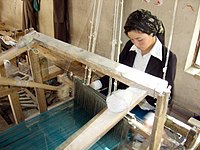
A woman weaving with silk threads in Hotan, China.
Following the crisis in Europe, the modernization of sericulture in Japan made it the world’s foremost silk producer. By the early 20th century, rapidly industrializing Japan was producing as much as 60 percent of the world’s raw silk, most exports shipping through the port of Yokohama.[57] Italy managed to rebound from the crisis, but France was unable. Urbanization in Europe saw many French and Italian agricultural workers leave silk growing for more lucrative factory work. Raw silk was imported from Japan to fill the void.[9] Asian countries, formerly exporters of raw materials (cocoons and raw silk), progressively began to export more and more finished garments.
During the Second World War, silk supplies from Japan were cut off, so western countries were forced to find substitutes. Synthetic fibers such as nylon were used in products such as parachutes and stockings, replacing silk. Even after the war, silk was not able to regain many of the markets lost, though it remained an expensive luxury product.[9] Postwar Japan, through improvements in technology and a protectionist market policy, became the world’s foremost exporter of raw silk, a position it held until the 1970s.[9] The continued rise in the importance of synthetic fibers and loosening of the protectionist economy contributed to the decline of Japan’s silk industry, and by 1975 it was no longer a net exporter of silk.[58]
With its recent economic reforms, the People’s Republic of China has become the world’s largest silk producer. In 1996 it produced 58,000 tonnes out of a world production of 81,000, followed by India at 13,000 tonnes. Japanese production is now marginal, at only 2,500 tonnes. Between 1995 and 1997, Chinese silk production went down 40% in an effort to raise prices, reminiscent of earlier shortages.[59]
In December 2006 the General Assembly of the United Nations proclaimed 2009 to be the International Year of Natural Fibres, so as to raise the profile of silk and other natural fibres.
Notes[edit]
- ^ a b Vainker, Shelagh (2004). Chinese Silk: A Cultural History. Rutgers University Press. pp. 20, 17. ISBN 978-0813534466.
- ^ Tang, Chi and Miao, Liangyun, «Zhongguo Sichoushi» («History of Silks in China») Archived 2007-11-23 at the Wayback Machine. Encyclopedia of China, 1st ed.
- ^ «Textile Exhibition: Introduction». Asian art. Retrieved 2007-08-02.
- ^ a b c d e f (in French) Charles Meyer, Des mûriers dans le jardin du mandarin, Historia, n°648, December 2000.
- ^ a b c (in French) «Soie’» (§2. Historique), Encyclopédie Encarta
- ^ Meadow, Richard. «New Evidence for Early Silk in the Indus Civilization». Archaeometry.
- ^ Good, I. L.; Kenoyer, J. M.; Meadow, R. H. (2009). «New Evidence for Early Silk in the Indus Civilization*» (PDF). Archaeometry. 51 (3): 457–466. doi:10.1111/j.1475-4754.2008.00454.x. ISSN 1475-4754.
- ^ Bahn, Paul G. (2000). The Atlas of World Geology. New York: Checkmark Books. pp. 128. ISBN 978-0-8160-4051-3.
- ^ a b c d «The History of Silk». The Silk Association of Great Britain. Archived from the original on 2007-09-29. Retrieved 2007-10-23.
- ^ Hill (2009), «Appendix A: Introduction of Silk Cultivation to Khotan in the 1st Century AD.», pp. 466-467.
- ^ Jean-Noël Robert. «Les relations entre le monde romain et la Chine : la tentation du Far East» (in French). clio.fr. Archived from the original on May 22, 2007. Retrieved May 6, 2007.
- ^ Pliny the Elder, Naturalis Historia 11.xxvi.76
- ^ a b (in French) Histoire des techniques p.455
- ^ Plous, Estelle. «A History of Silk Maps». TravelLady Magazine. Archived from the original on 2007-09-28. Retrieved 2007-05-20.
- ^ Liu (2010), p. 12.
- ^ Joseph Needham, Francesca Bray, Hsing-Tsung Huang, Christian Daniels, Nicholas K. Menzies, Science and Civilisation in China, Cambridge University Press, 1984 p. 72 ISBN 0-521-25076-5
- ^ (in French) «Histoire de la Route de la soie», Encyclopædia Universalis
- ^ (in French) Charles Meyer, «Les routes de la soie: 22 siècles d’aventure», Historia, n°648 December 2000.
- ^ Seneca the Younger, Declamations Vol. I.
- ^ a b Wood, Francis (2002). The Silk Road: Two Thousand Years in the Heart of Asia. Berkeley, CA: University of California Press. pp. 9, 13–23. ISBN 978-0-520-24340-8.
- ^ Hogan, C. Michael. «The Megalithic Portal and Megalith Map: Silk Road, North China [Northern Silk Road, North Silk Road] Ancient Trackway». www.megalithic.co.uk. Retrieved 2008-07-05.
- ^ Whitfield, Susan (2004). The Silk Road: Trade, Travel, War and Faith. British Library. Serindia Publications, Inc. p. 110. ISBN 978-1-932476-13-2.
- ^ Cook (1999), 144.
- ^ Strabo 11.11.1, 15.1.34. The earliest example of the adjective ‘σηρικός’ was recorded in the 2nd century AD, found in Lucian (De saltatione 63), Cassius Dio (43.24), and Pausanias (6.26.6).
- ^ «Internet History Sourcebooks Project».
- ^ (in French) Catherine Jolivet-Lévy and Jean-Pierre Sodini (2006), «Byzance», in Encyclopædia Universalis
- ^ (in French) Histoire des Techniques p.435
- ^ a b (in French) Anne Kraatz, Marie Risselin-Steenebrugen, Michèle Pirazzoli-t’Serstevens and Madeleine Paul-David (2006), «Tissus d’art», in Encyclopædia Universalis
- ^ Guillou, André; Delogu, Paolo (1983). «Il Mezzogiorno dai Bizantini a Federico II». Storia d’Italia (in Italian). Vol. III. UTET.
- ^ Jacoby, David (2004). «Silk Economics and Cross-Cultural Artistic Interaction: Byzantium, the Muslim World, and the Christian West». Dumbarton Oaks Papers. 58: 197–240. doi:10.2307/3591386. JSTOR 3591386.
- ^ «The Ancient and Noble Art of Silk». 14 May 2015.
- ^ «Catanzaro | Italy».
- ^ Malanima, Paolo (2004). «Le sete della Calabria». In Fusco, Ida Maria (ed.). La seta. E oltre… (in Italian). Edizioni Scientifiche Italiane. pp. 55–68. ISBN 8849509499.
- ^ Heleanor B. Feltham: Justinian and the International Silk Trade, p. 34
- ^ Muthesius, Anna, «Silk in the Medieval World». In Jenkins (2003), p. 331.
- ^ (in French) Georges Ostrogorsky, Histoire de l’état byzantin, Payot, 1956, reedited in 1977, ISBN 2-228-07061-0
- ^ (in French) Histoire des techniques p.551
- ^ Sakellariou, Eleni (2012). Southern Italy in the Late Middle Ages: Demographic, Institutional Change in the Kingdom of Naples, c.1440-c.1530. Brill. ISBN 978-900-422-4063.
- ^ a b Xinru Liu, Silk and Religion: An Exploration of Material Life and the Thought of People AD 600-1200, Oxford University Press US, 1998.
- ^ (in French) Histoire des Techniques p. 553
- ^ a b (in French) Histoire des Techniques p.557
- ^ Ronan (1994), 68,
- ^ (in French) Histoire des Techniques p.639
- ^ Rubino, Angela (2006). La seta a Catanzaro e Lione. Echi lontani e attività presente [Silk in Catanzaro and Lyon. Distant echoes and present activity] (in Italian). Calabria Letteraria. ISBN 8875741271.
- ^ http://media.handweaving.net/DigitalArchive/books/wp_Chapter_01.pdf[bare URL PDF]
- ^ (in French) Autour du Fil, l’encyclopédie des arts textiles
- ^ Rossi, Cesare; Russo, Flavio (2016). Ancient Engineers’ Inventions: Precursors of the Present.
- ^ (in French) Georges Duby (ed), Histoire de la France: Dynasties et révolutions, de 1348 à 1852 (vol. 2), Larousse, 1999 p. 53 ISBN 2-03-505047-2
- ^ a b c (in French) Gérard Chauvy, «La dure condition des forçats du luxe», Historia, n°648, December 2000
- ^ (in French) Guide Gallimard — Parc naturel LUBERON
- ^ Waters, Sarah. «The Silk Industry in Lyon, France.» Museum of the City. Accessed 6 October 2017. http://www.museumofthecity.org/project/the-silk-industry-in-lyon-france/ Archived 2017-10-23 at the Wayback Machine
- ^ Thirsk (1997), 120.
- ^ Peter N. Stearns, William Leonard Langer The Encyclopedia of World History, Houghton Mifflin Books, 2001 p. 403 ISBN 0-395-65237-5
- ^ (in French) Histoire des techniques p.718
- ^ «Louis Pasteur,» Microsoft Encarta Online Encyclopedia 2007. Archived 2009-11-01.
- ^ A. J. H. Latham and Heita Kawakatsu, Japanese Industrialization and the Asian Economy p. 199
- ^ Reilly, Benjamin (2009). Disaster and Human History: Case Studies in Nature, Society, and Catastrophe. Jefferson N.C.: McFarland & Company Inc. p. 95. ISBN 978-0-7864-3655-2.
- ^ «The Cocoon Strikes Back: Innovative Products Could Revive a Dying Industry». Japan Information Network. 2000. Retrieved October 23, 2007.
- ^ Anthony H. Gaddum, «Silk», Business and Industry Review, (2006). In Encyclopædia Britannica
References[edit]
Main sources:
- Bertrand Gille. Histoire des techniques, Gallimard, coll. La Pléiade, 1978 (ISBN 978-2-07-010881-7)(in French)
- The Encyclopédie of Diderot and d’Alembert (in French)
- Catherine Jolivet-Lévy et Jean-Pierre Sodini, «Byzance», in Encyclopædia Universalis, 2006. (in French)
- «La Soie, 4000 ans de luxe et de volupté», Historia, n°648, décembre 2000. (in French)
- Ron Cherry, «Sericulture», Entomological Society of America [1]
- Cook, Robert. Handbook of Textile Fibres Vol. 1: Natural Fibres. Cambridge: Woodhead, 1999.
- «Silk», Encyclopædia Britannica
- «Soie», Encyclopédie Encarta (in French)
- Hill, John E. (2009) Through the Jade Gate to Rome: A Study of the Silk Routes during the Later Han Dynasty, 1st to 2nd Centuries CE. John E. Hill. BookSurge, Charleston, South Carolina. ISBN 978-1-4392-2134-1.
- Anne Kraatz, Marie Risselin-Steenebrugen, Michèle Pirazzoli-t’Serstevens et Madeleine Paul-David, «Tissus d’art», in Encyclopædia Universalis, 2006. (in French)
- Liu, Xinru (2010). The Silk Road in World History. Oxford University Press. ISBN 978-0-19-516174-8; ISBN 978-0-19-533810-2 (pbk).
- Sakellariou, Eleni, Southern Italy in the Late Middle Ages: Demographic, Institutional and Economic Change in the Kingdom of Naples, c.1440-c.1530, Brill, 2012. ISBN 978-900-422-4063
- Toshiharu Furusawa, «The history of Sericulture in Japan – The old and innovative technique for Industry-«, Center for Bioresource Field Science, Kyoto Institute of Technology (pdf)
- «Métiers agricoles — Magnaniers», Institut supérieur de l’agroalimentaire [2]
- Ronan, Colin. The Shorter Science and Civilization in China. Cambridge: Cambridge University, 1994. (in French)
- Thirsk, Joan (1997) Alternative Agriculture: A History from the Black Death to the Present Day. Oxford: Oxford University, 1997.
Further reading[edit]
- Watt, James C.Y.; Wardwell, Anne E. (1997). When silk was gold: Central Asian and Chinese textiles. New York: The Metropolitan Museum of Art. ISBN 978-0870998256.
External links[edit]
- China National Silk Museum, Hangzhou, China (中国丝绸博物馆) https://web.archive.org/web/20171203224557/http://en.chinasilkmuseum.com/
- «Sericulture in Asia: Yesterday, today, tomorrow», Asia and Pacific Network
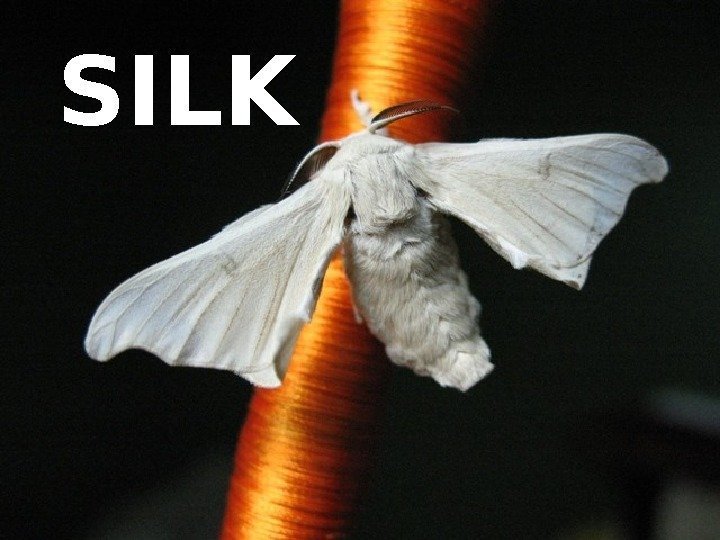 SILK
SILK
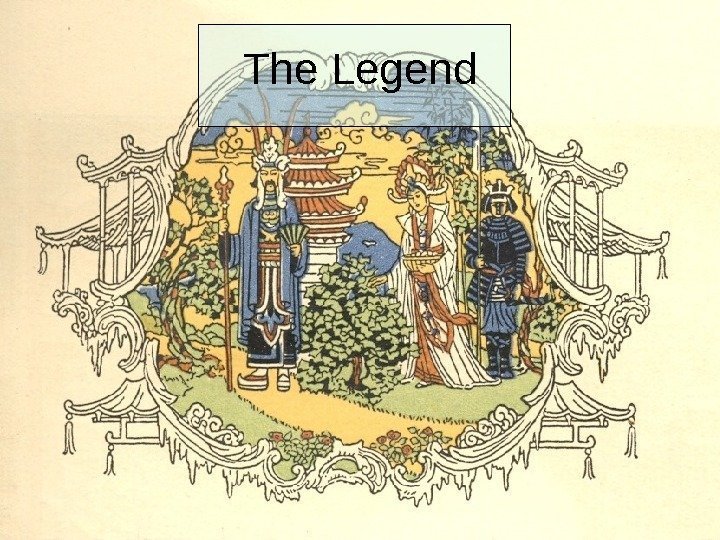 The Legend
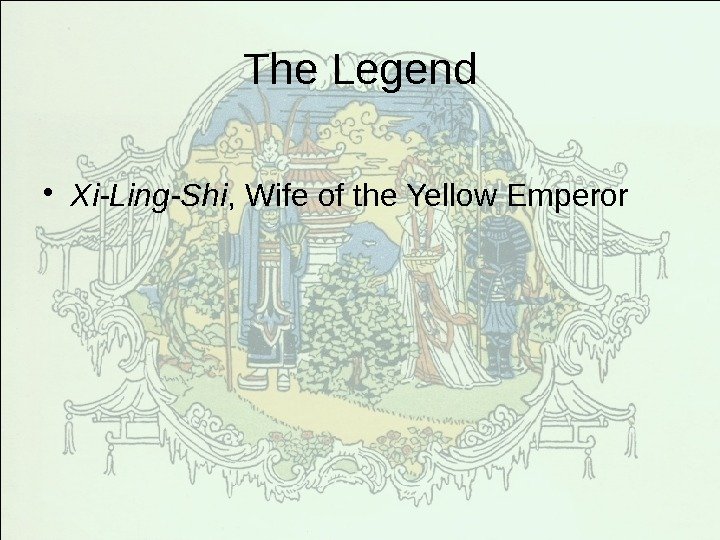 The Legend • Xi-Ling-Shi , Wife of the Yellow Emperor
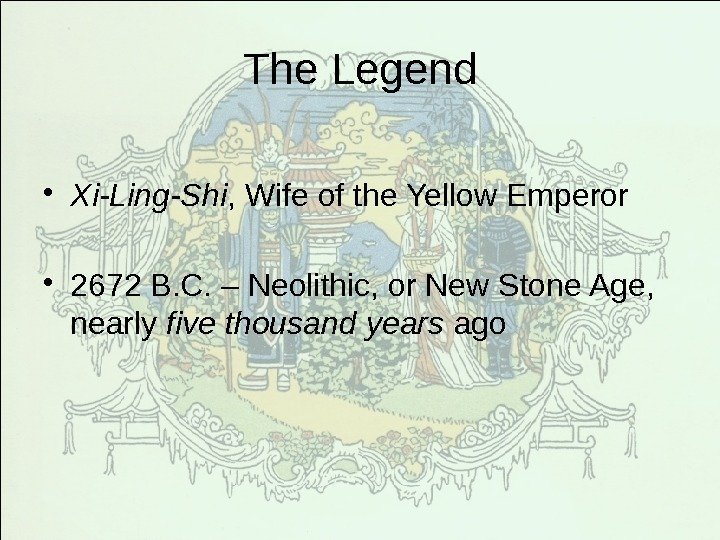 The Legend • Xi-Ling-Shi , Wife of the Yellow Emperor • 2672 B. C. – Neolithic, or New Stone Age, nearly five thousand years ago
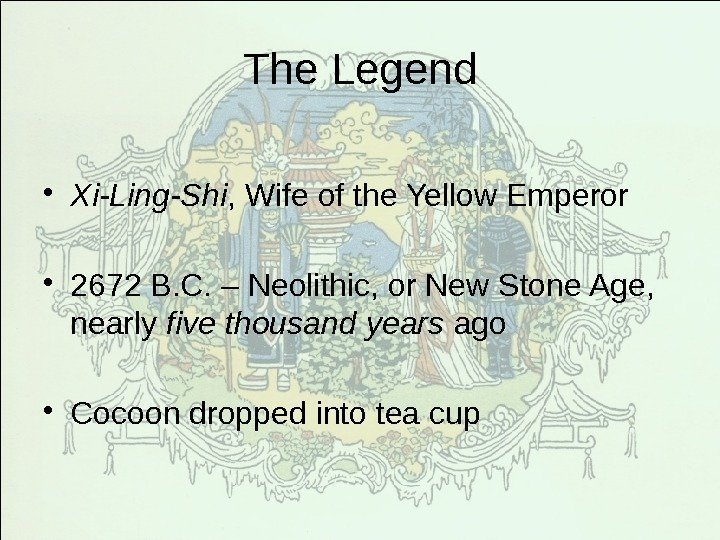 The Legend • Xi-Ling-Shi , Wife of the Yellow Emperor • 2672 B. C. – Neolithic, or New Stone Age, nearly five thousand years ago • Cocoon dropped into tea cup
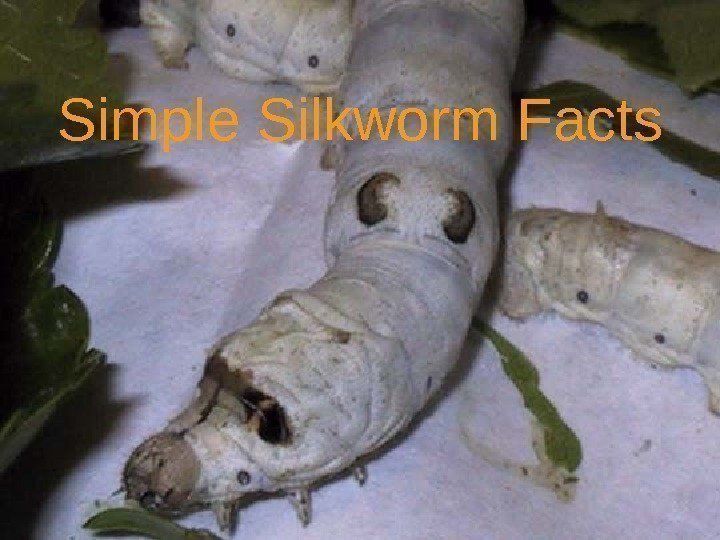 Simple Silkworm Facts
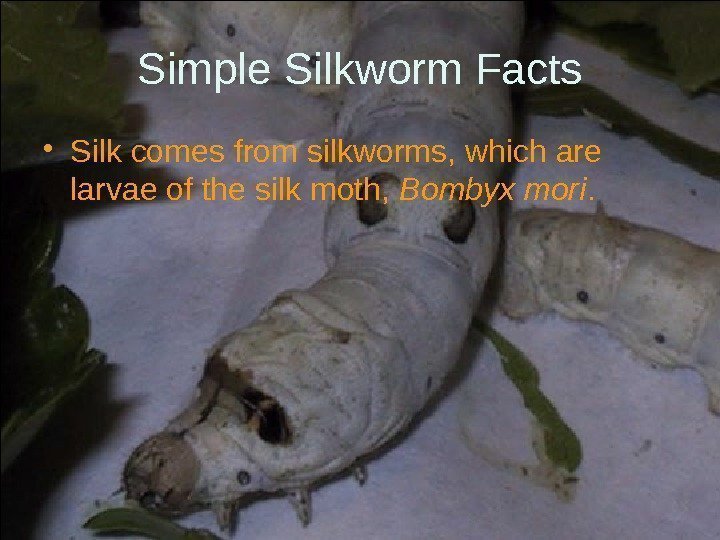 Simple Silkworm Facts • Silk comes from silkworms, which are larvae of the silk moth, Bombyx mori.
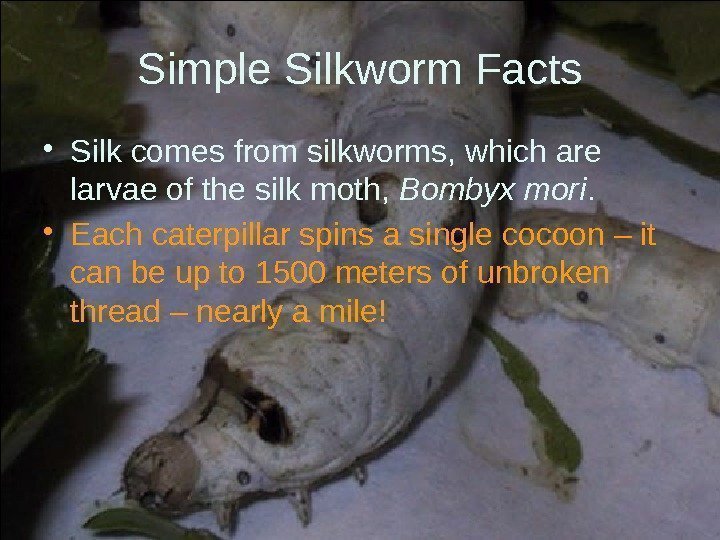 Simple Silkworm Facts • Silk comes from silkworms, which are larvae of the silk moth, Bombyx mori. • Each caterpillar spins a single cocoon – it can be up to 1500 meters of unbroken thread – nearly a mile!
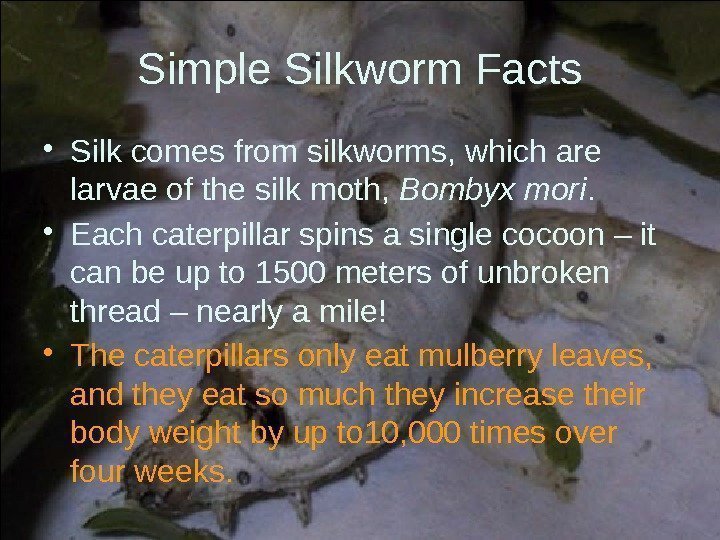 Simple Silkworm Facts • Silk comes from silkworms, which are larvae of the silk moth, Bombyx mori. • Each caterpillar spins a single cocoon – it can be up to 1500 meters of unbroken thread – nearly a mile! • The caterpillars only eat mulberry leaves, and they eat so much they increase their body weight by up to 10, 000 times over four weeks.
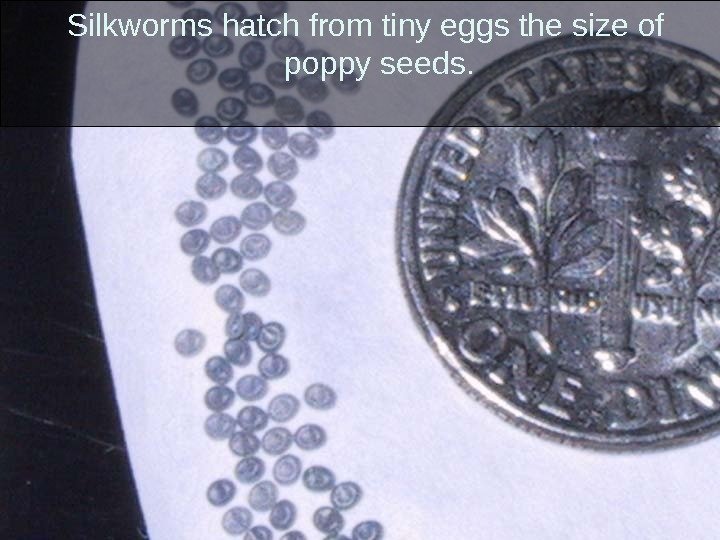 Silkworms hatch from tiny eggs the size of poppy seeds.
 This little guy is only a few hours old.
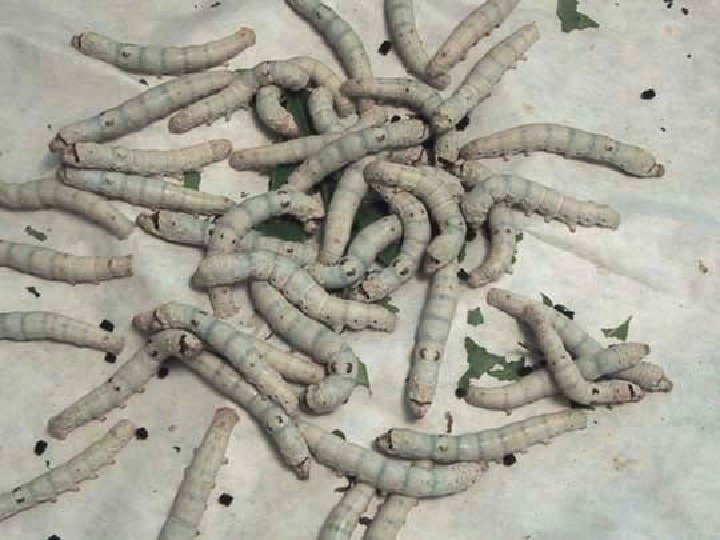
 They eat a LOT of leaves.
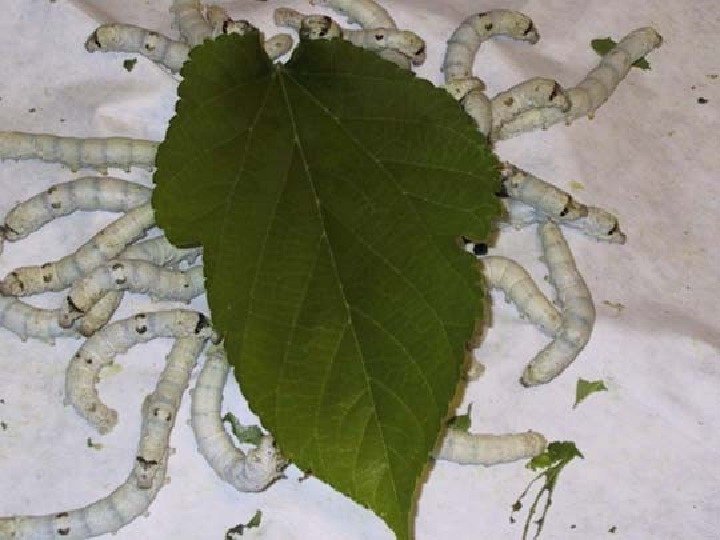
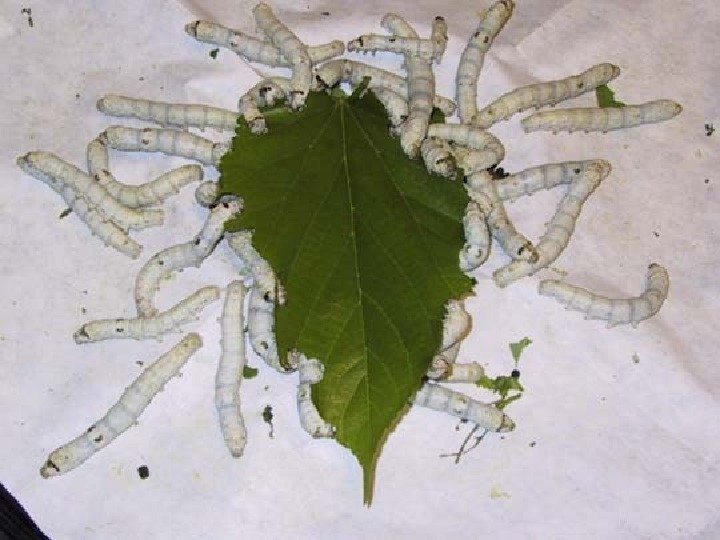
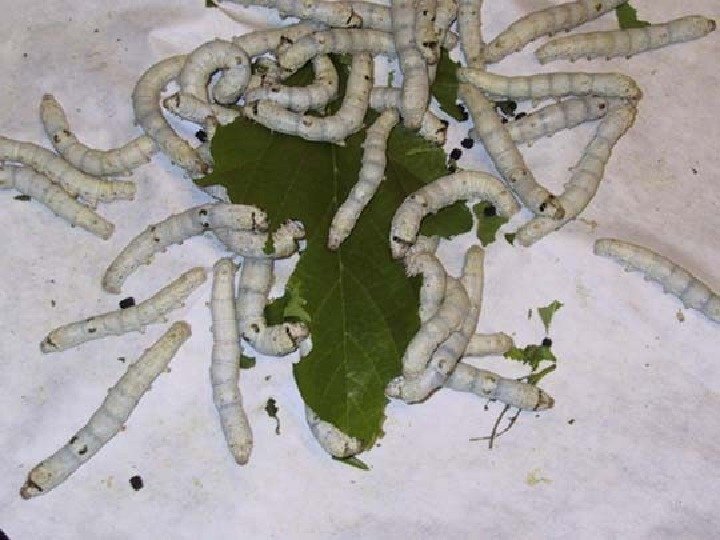
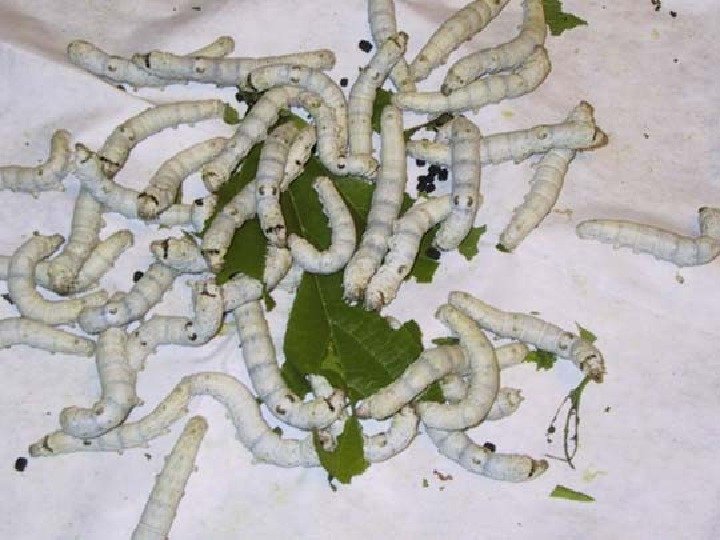
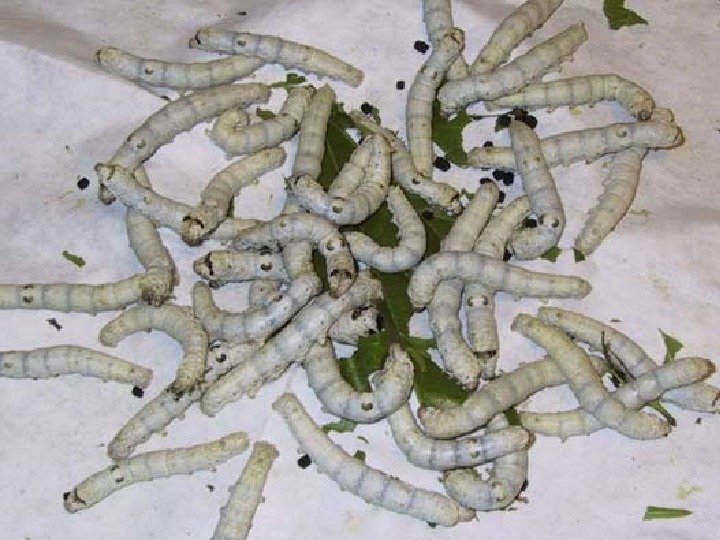 They eat a LOT of leaves.
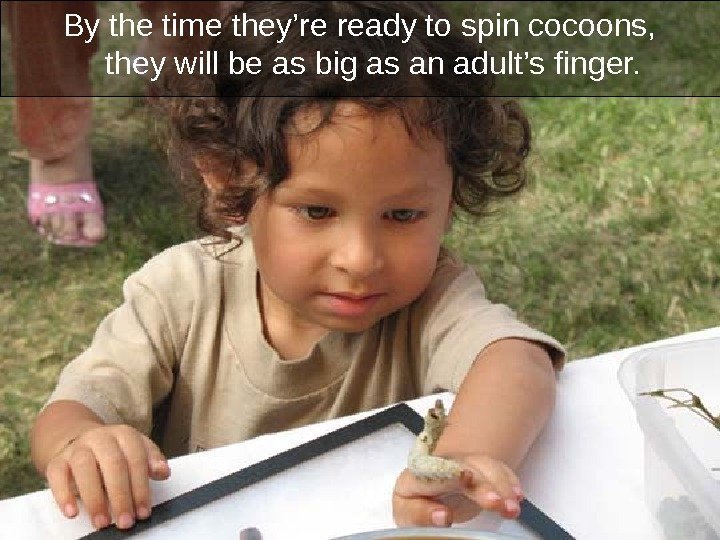 By the time they’re ready to spin cocoons, they will be as big as an adult’s finger.
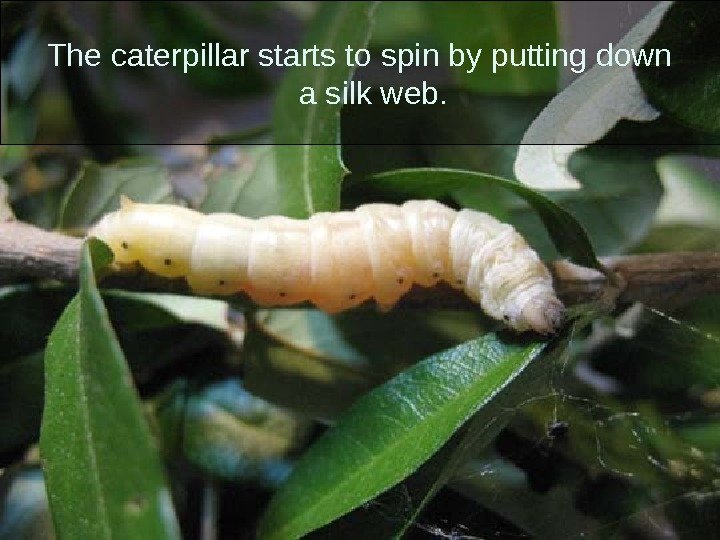 The caterpillar starts to spin by putting down a silk web.
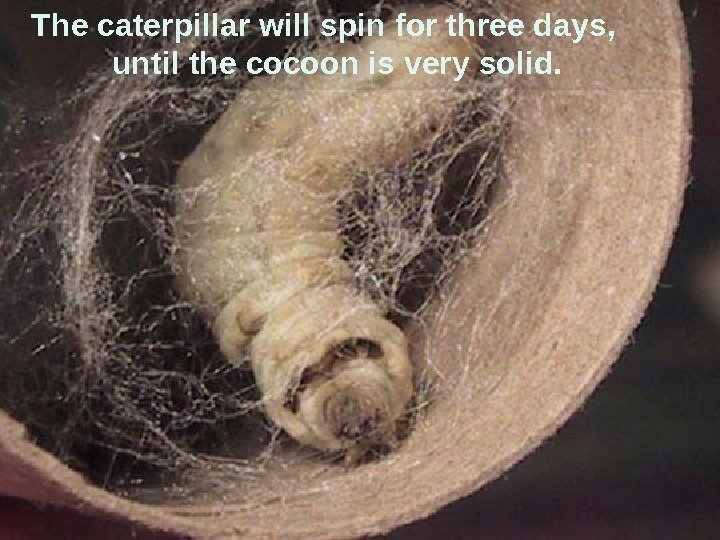 The caterpillar will spin for three days, until the cocoon is very solid.
 The caterpillar will spin for three days, until the cocoon is very solid.
 The caterpillar will spin for three days, until the cocoon is very solid.
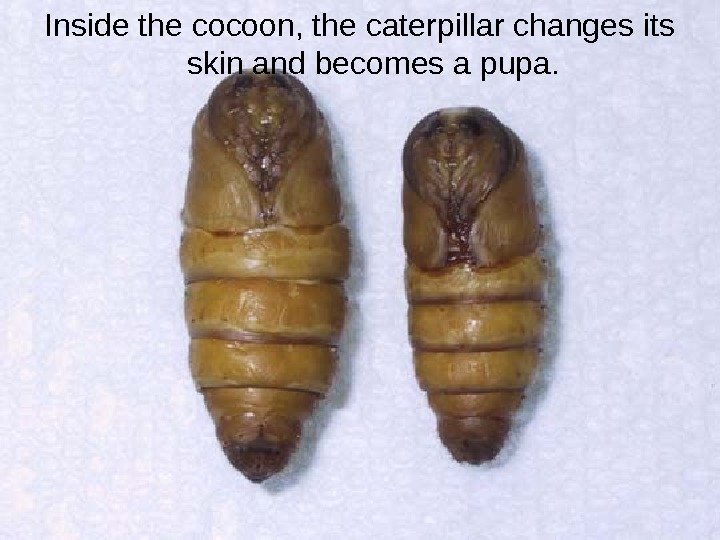 Inside the cocoon, the caterpillar changes its skin and becomes a pupa.
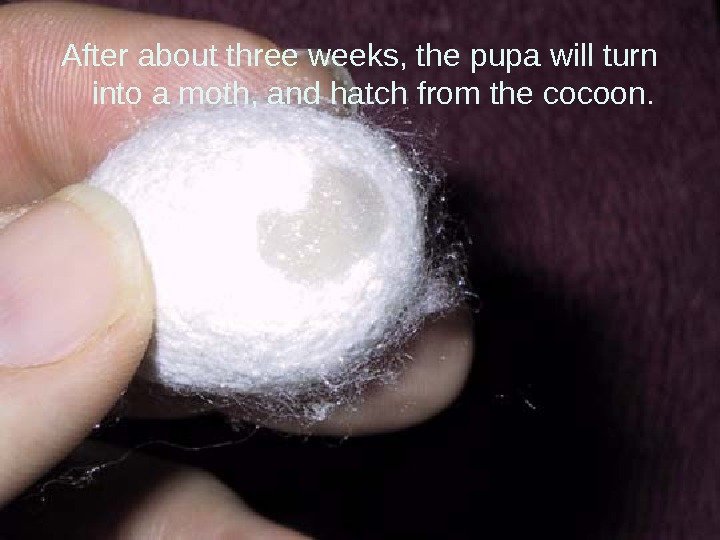 After about three weeks, the pupa will turn into a moth, and hatch from the cocoon.
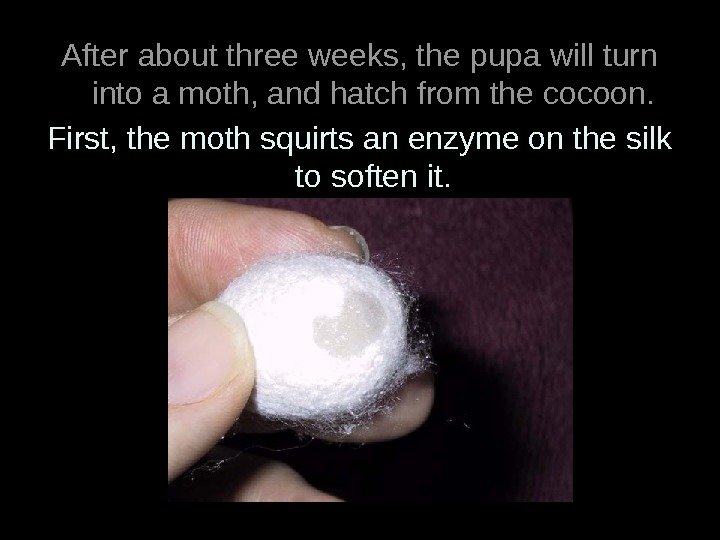 After about three weeks, the pupa will turn into a moth, and hatch from the cocoon. First, the moth squirts an enzyme on the silk to soften it.
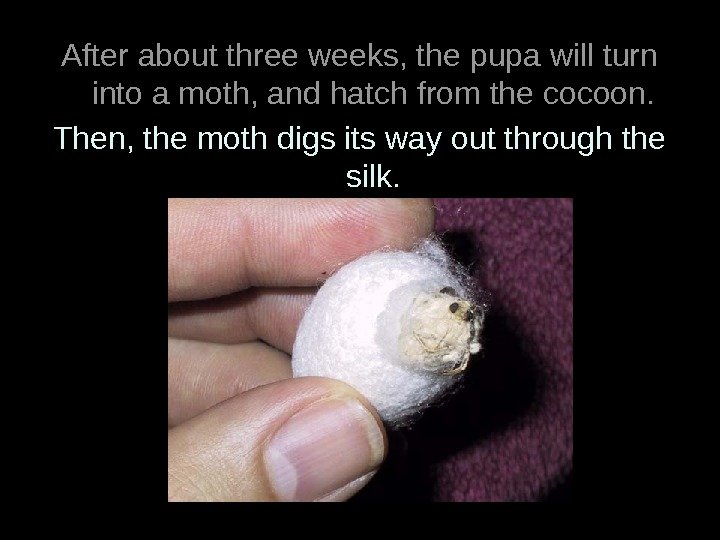 After about three weeks, the pupa will turn into a moth, and hatch from the cocoon. Then, the moth digs its way out through the silk.

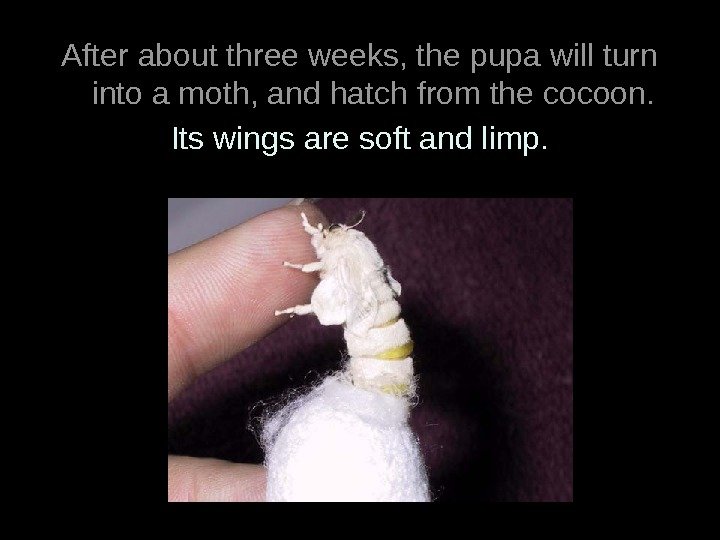 After about three weeks, the pupa will turn into a moth, and hatch from the cocoon. Its wings are soft and limp.
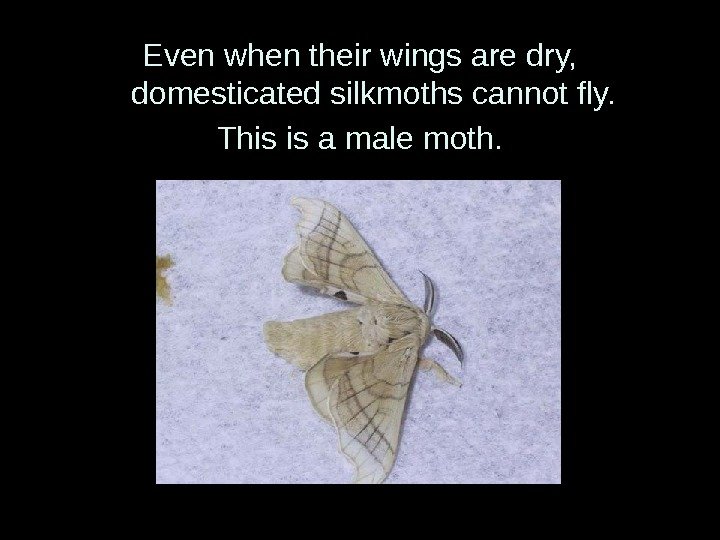 Even when their wings are dry, domesticated silkmoths cannot fly. This is a male moth.
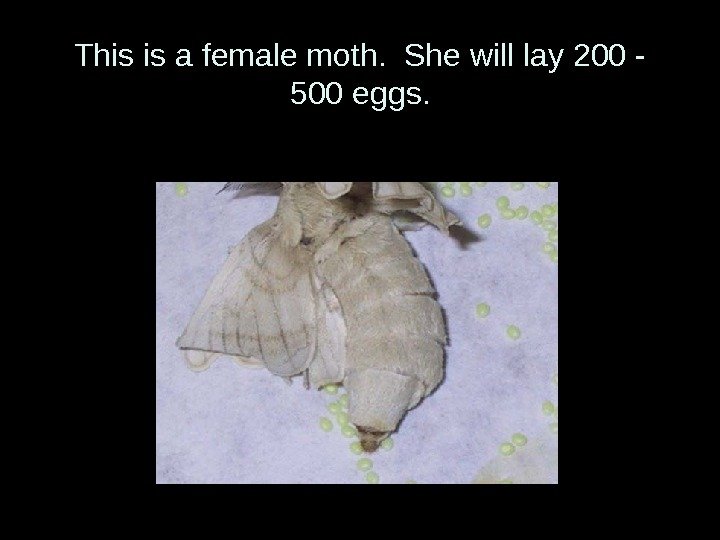 This is a female moth. She will lay 200 — 500 eggs.
 The moths have no mouths, and they cannot eat or drink. They live usually four or five days.
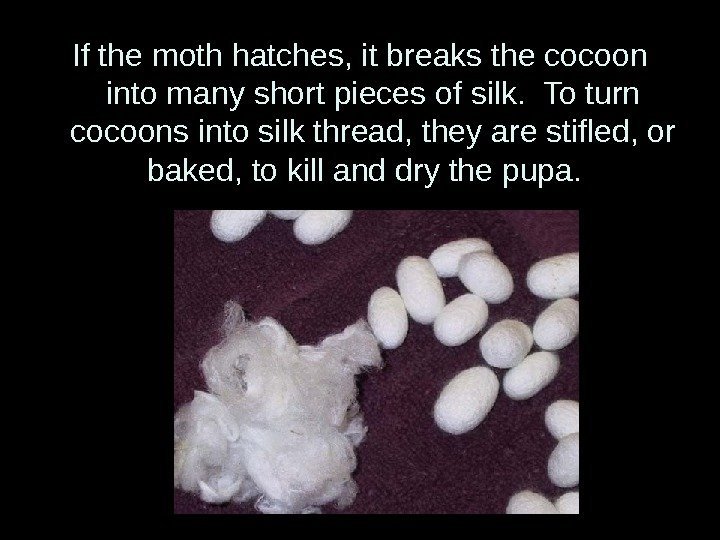 If the moth hatches, it breaks the cocoon into many short pieces of silk. To turn cocoons into silk thread, they are stifled, or baked, to kill and dry the pupa.
 Silk Reeling
 Silk Reeling • Each silk cocoon is a single thread – but it is as fine as a spider web.
 Silk Reeling • Each silk cocoon is a single thread – but it is as fine as a spider web. • The threads from several cocoons are wound together – this is called reeling.
 Silk Reeling • Each silk cocoon is a single thread – but it is as fine as a spider web. • The threads from several cocoons are wound together – this is called reeling. • A set of pulleys, called a croissure, helps to strengthen the thread.
 Silk Reeling • Each silk cocoon is a single thread – but it is as fine as a spider web. • The threads from several cocoons are wound together – this is called reeling. • A set of pulleys, called a croissure, helps to strengthen the thread. • Twenty cocoons makes a strand as fine as a hair.
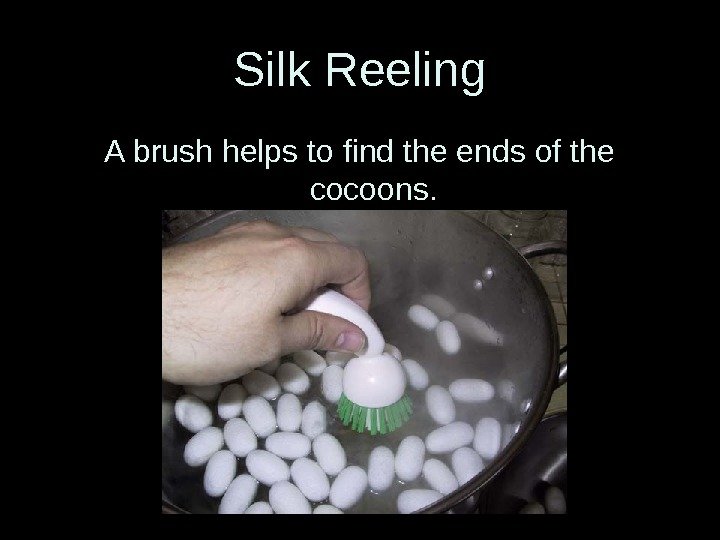 Silk Reeling A brush helps to find the ends of the cocoons.
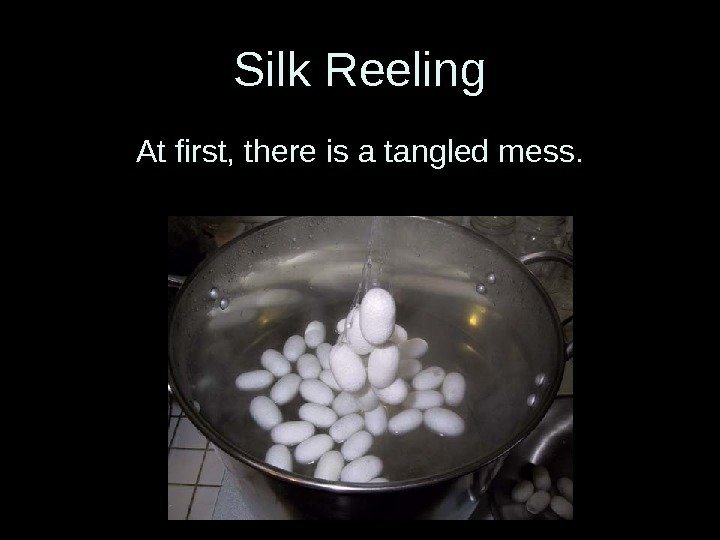 Silk Reeling At first, there is a tangled mess.
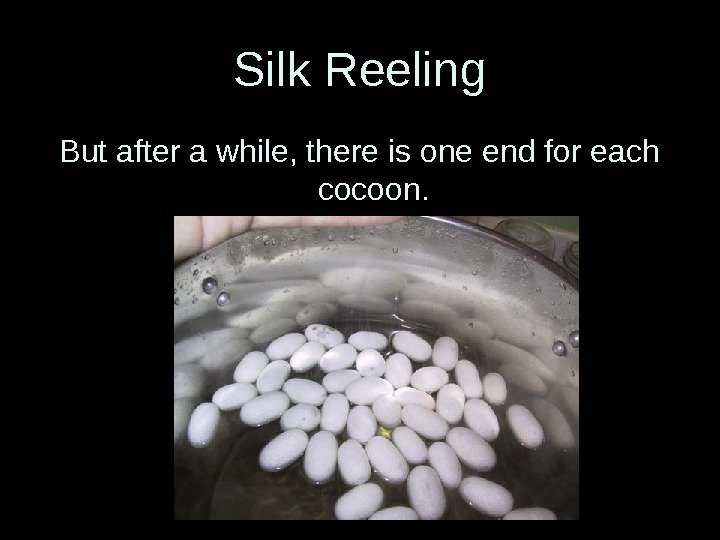 Silk Reeling But after a while, there is one end for each cocoon.
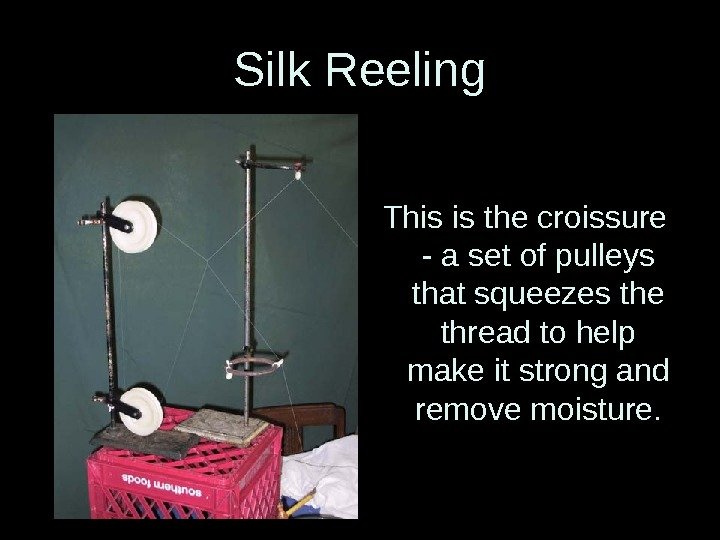 Silk Reeling This is the croissure — a set of pulleys that squeezes the thread to help make it strong and remove moisture.
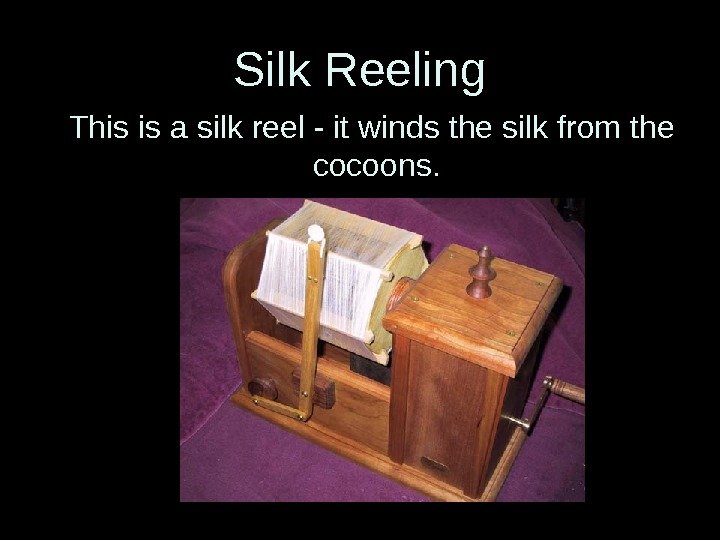 Silk Reeling This is a silk reel — it winds the silk from the cocoons.
 Dyeing
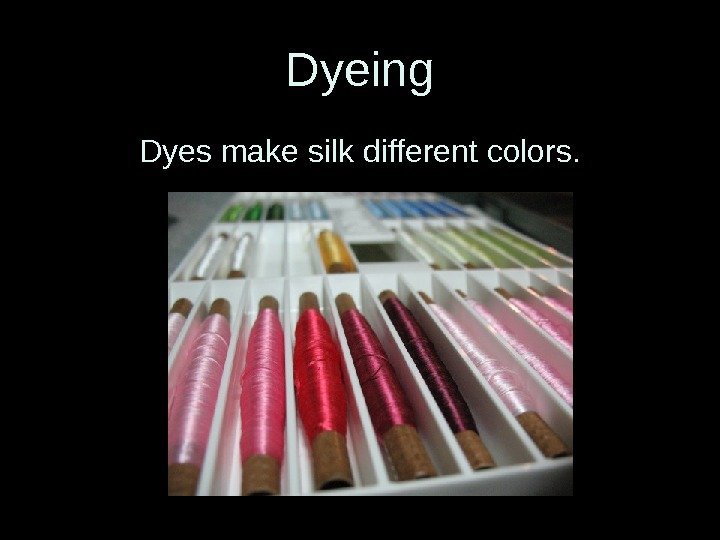 Dyeing Dyes make silk different colors.
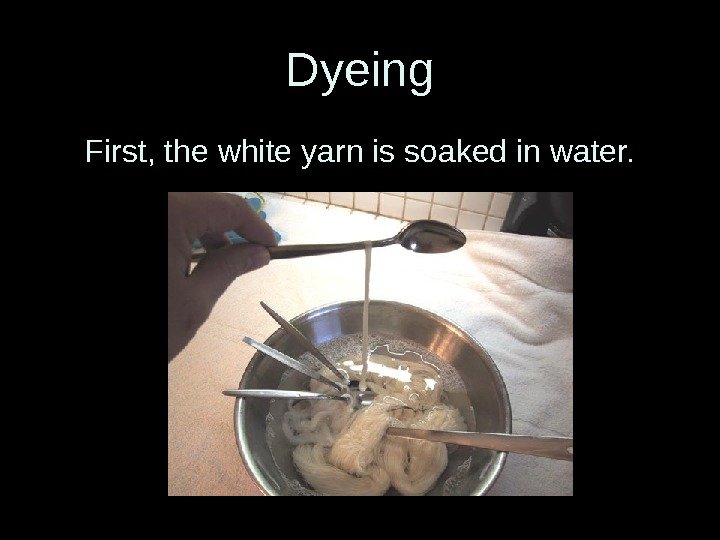 Dyeing First, the white yarn is soaked in water.
 Dyeing The dye liquid looks like kool-aid.
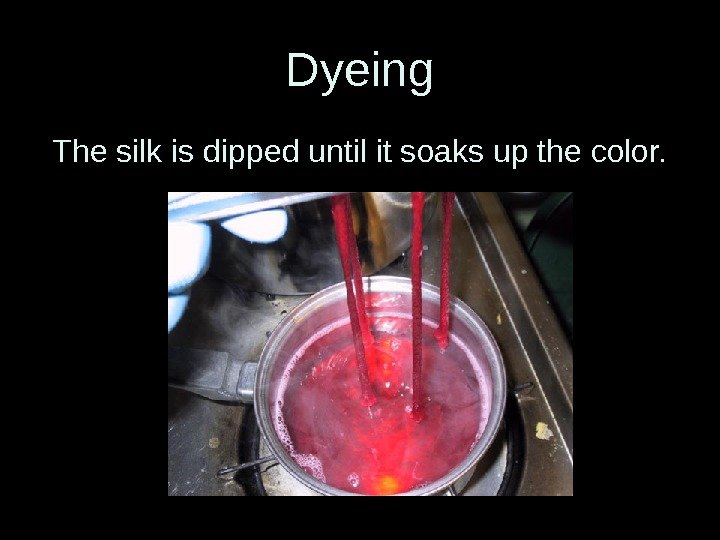 Dyeing The silk is dipped until it soaks up the color.
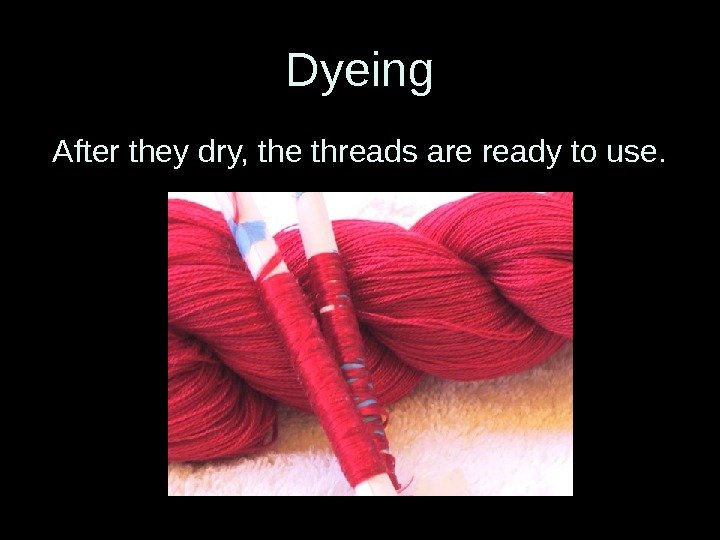 Dyeing After they dry, the threads are ready to use.
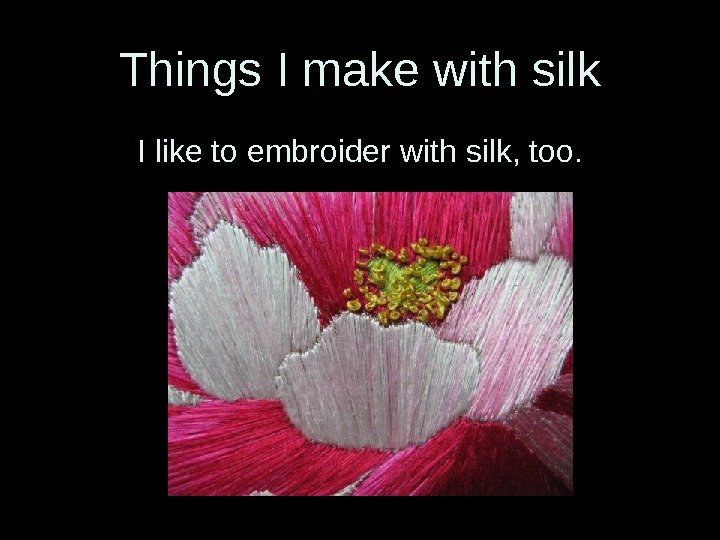 Things I make with silk I like to embroider with silk, too.
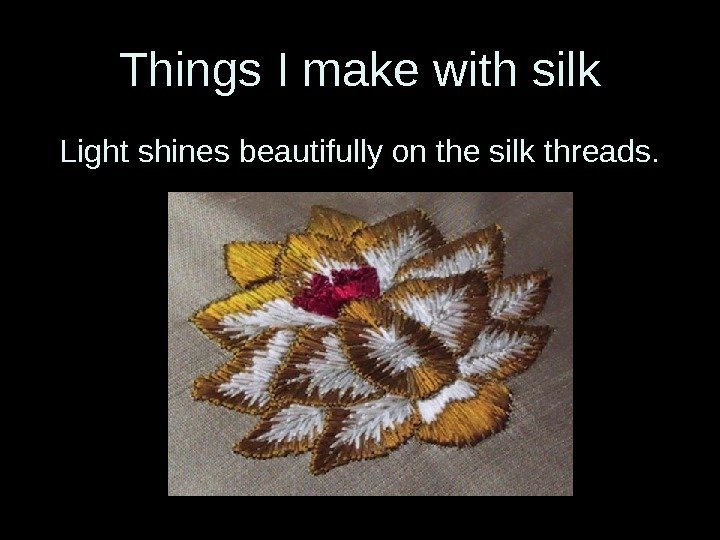 Things I make with silk Light shines beautifully on the silk threads.
 Some Silk Facts
 Some Silk Facts • Silk can hold up to 30% of its weight in water before it feels damp.
 Some Silk Facts • Silk can hold up to 30% of its weight in water before it feels damp. • Silk is an excellent electrical insulator.
 Some Silk Facts • Silk can hold up to 30% of its weight in water before it feels damp. • Silk is an excellent electrical insulator. • Silk is stronger per weight than steel wire.
 Some Silk Facts • Silk can hold up to 30% of its weight in water before it feels damp. • Silk is an excellent electrical insulator. • Silk is stronger per weight than steel wire. • Silk can be made into a wide range of fabrics — everything from bridal veils to bullet-proof vests.
 Some Silk Facts • Silk can hold up to 30% of its weight in water before it feels damp. • Silk is an excellent electrical insulator. • Silk is stronger per weight than steel wire. • Silk can be made into a wide range of fabrics — everything from bridal veils to bullet-proof vests. • Silk can be used for sutures — threads to stitch closed wounds and incisions.
 Some Silk Facts • Silk can hold up to 30% of its weight in water before it feels damp. • Silk is an excellent electrical insulator. • Silk is stronger per weight than steel wire. • Silk can be made into a wide range of fabrics — everything from bridal veils to bullet-proof vests. • Silk can be used for sutures — threads to stitch closed wounds and incisions.
Задание № 14402
1. Silk spreading
2. Immortal tradition
3. Miraculous process
4. Unexpected discovery
5. Tireless creatures
6. Modern technology
7. Stolen secret
8. Variety of purposes
THE MIRACLE OF SILK
A. The world itself is beautiful. The story of silk starts in China over 4 000 years ago. One legend says a silkworm’s cocoon fell into the teacup of Empress His LingShih. When a cocoon was in her cup and then opened into a single, unbroken thread of silk fiber. This was an important discovery. The Chinese learned they could use the cocoons to make cloth that was both beautiful to look at and soft to touch.
B. Making silk was a protected secret in China for 2 500 years kept by — the royal families. In other countries, silk was very rare and valuable. Often it was worth more than gold. Legend tells us that the secret finally got out when a princess left China to get married in India. In her hair she hid some silkworm caterpillars and mulberry seeds for their food.
C. By the year 1 A.D., silk was sold as far west as Roma, and all along the Silk Road, which connected China with places in the Middle East and the Mediterranean. Eventually, around the year 300, silk also travelled from China to Japan. Silk helped to adjust trade between many countries along its way.
D. Nowadays people around the world still make many beautiful things from silk. But silk isn’t only beautiful. It looks delicate, but it’s actually very strong. For example, it has been used to make bicycle tires. And some doctors even use silk threads in hospital operations. Silk is also lightweight and warm. This makes it great for clothes like winter jackets, pants and boots.
E. All of this from a little insect — silkworm. That is the miracle of silk. Silk comes from silkworms, which aren’t really worms. They are caterpillars. To become a moth, a silkworm first produces a long fiber from its mouth. It uses this to make a cocoon. We then weave threads from the cocoons to make cloth. The process of weaving silk is very slow and the machines must be watched all the time. It takes around two and a half hours to make one meter of silk material.
F. For example, in the Vietnamese town of Vong Nguyet, silk making has been an important business for 1,200 years. Many of the village people keep silkworms in their living rooms. Each basket contains hundreds of silkworm caterpillars. Taking care of these caterpillars is hard work. The caterpillars have to eat every two hours during the day and every three hours throughout the night. They eat only mulberry leaves.
G. The silk farmers cannot allow the caterpillar to become an adult moth. If it did, it would eat its way out, and the silk would be broken. The cocoons must be brought to the spinning house before the cycle is complete. Despite the invention of cheaper materials, natural silk is still loved for its beauty and comfort. This amazing product of man and moth continues to be extremely popular around the world.
[topic]
[topic]
Показать ответ
Комментарий:
A — 4 »One legend says a silkworm’s cocoon fell into the teacup of Empress His LingShih. »
B — 7 » Making silk was a protected secret in China for 2 500 years kept by — the royal families.»
C — 1 »By the year 1 A.D., silk was sold as far west as Roma, and all along the Silk Road, which connected China with places in the Middle East and the Mediterranean. Eventually, around the year 300, silk also travelled from China to Japan».
D — 8 »For example, it has been used to make bicycle tires. And some doctors even use silk threads in hospital operations. »
E — 3 »All of this from a little insect — silkworm. That is the miracle of silk. »
F — 5 »Taking care of these caterpillars is hard work.»
G — 2 »This amazing product of man and moth continues to be extremely popular around the world.»
Ответ: 4718352
Нашли ошибку в задании? Выделите фрагмент и нажмите Ctrl + Enter.
Задание 35 на подготовку к ЕГЭ по английскому. В тексте имеются пропуски слов. Для каждого пропуска даны несколько вариантов. Определите, какой вариант верный.
ЗаданиеОтвет
The Phoenix Legend
This magical, mythical bird has long been a part of legends, dating FROM / BACK / AWAY / THROUGH to ancient civilizations. In today’s culture, the phoenix’s legend is still going HEALTHY / STRONG / ALIVE / FINE, with a major city in the United States named after the resurrecting beast and popular books and movies, including the phenomenally successful ‘Harry Potter’ series encompassing the bird into characters and plots.
Since the story has come BACK / ROUND / FORWARD / DOWN to us through the oral tradition, there is no single version of it. It varies from teller to teller — each adding something of their own and changing tiny aspects of it. AS A RESULT / THEREFORE / NONETHELESS / REGARDLESS, the main facts of the legend of the Phoenix remain intact, even though the myth has been adulterated.
According to the legend, the Phoenix is a supernatural creature that has an incredibly long LIFESPAN / LIFESPIN / LIFESCAN / LIFESPAM, stretching to at least a thousand years. It cannot fall sick or get injured at any point in its lifetime. However, some believe that it does get affected by disease or drought, which leads it to prematurely enter the next phase of its life.
Once that time is over, the bird builds its own funeral pyre. The traditional story goes that the phoenix ignites himself, burns to ash, and then rises again from the ashes to live another thousand years. This triumph over adversity has caused the bird to become the PENDANT / ANTHEM / MASCOT / AMULET or symbol of many groups and organizations. Once the bird is born from ashes, the cycle begins anew.
Another version of the story is that before the fire consumes the bird, it lays an egg, which hatches a new phoenix. This phoenix will live to be a thousand years old before having an ANCESTOR / OFFSPRING / PREDECESSOR / OFFCUT in the same method. There is no way of ascertaining which version of the story is true, but all of them express the same theme: the triumph over adversity.
The Phoenix Legend
This magical, mythical bird has long been a part of legends, dating BACK to ancient civilizations. In today’s culture, the phoenix’s legend is still going STRONG, with a major city in the United States named after the resurrecting beast and popular books and movies, including the phenomenally successful ‘Harry Potter’ series encompassing the bird into characters and plots.
Since the story has come DOWN to us through the oral tradition, there is no single version of it. It varies from teller to teller — each adding something of their own and changing tiny aspects of it. NONETHELESS, the main facts of the legend of the Phoenix remain intact, even though the myth has been adulterated.
According to the legend, the Phoenix is a supernatural creature that has an incredibly long LIFESPAN, stretching to at least a thousand years. It cannot fall sick or get injured at any point in its lifetime. However, some believe that it does get affected by disease or drought, which leads it to prematurely enter the next phase of its life.
Once that time is over, the bird builds its own funeral pyre. The traditional story goes that the phoenix ignites himself, burns to ash, and then rises again from the ashes to live another thousand years. This triumph over adversity has caused the bird to become the MASCOT or symbol of many groups and organizations. Once the bird is born from ashes, the cycle begins anew.
Another version of the story is that before the fire consumes the bird, it lays an egg, which hatches a new phoenix. This phoenix will live to be a thousand years old before having an OFFSPRING in the same method. There is no way of ascertaining which version of the story is true, but all of them express the same theme: the triumph over adversity.
UNIT 3. SCIENCE AND TECHNOLOGY
LESSON 31
1. Listen to the dialogue and write down the verb forms in the Passive Voice.
A: Your back should be seen by a specialist.
B: Yes, my back is giving me a lot of problems.
A: You should be given a list of exercises.
B: Yes, I want to be treated by a good physical therapist.
A: An anti-inflammatory medicine should be prescribed for you.
B: Yes, my pain has to be reduced or I can’t work very effectively.

2. Change the following sentences from the Passive Voice into the Active Voice.
1. It is now 6 a.m. and at most of the hospitals in the country patients are being wakened to take their temperature. 2. Why wasn’t the car either locked or put into the garage? 3. The house where the stolen picture was found is being guarded by the police. 4. It is said that too little money is being spent by the government on roads. 5. Your money could be put to good use instead of being put in the bank. 6. For a long time the earth was believed to be flat. 7. The pages have been cut from this book. That’s why I can’t learn this lesson. 8. This newspaper hasn’t been read. 9. The stones were thrown by the student who was afterwards led away by the police. 10. The football player was being escorted from the field by a large crowd of his fans. 11. The fire was finally got under control. 12. The plan hadn’t been well thought by the leader.

Exam Skill Builder
3. Read the text and choose the correct answer.
No one can be certain who really 1. ___ silk but according to the legend it was a Chinese princess. One day, this princess watched in amazement as the caterpillars on her father’s mulberry tree created beautiful silk thread.
Before long, she realized that this thread could be used to 2. ___ cloth. Then, in about 1725 BC, the Chinese emperor’s wife began to sponsor the cultivation of silk worms and the manufacture of the cloth. The process was kept secret, and the Chinese guarded the secret 3. ___ for over 3,000 years. They exported the cloth to many countries and attracted the envy of their trading rivals. But then the secret got 4. ___ . Another Chinese princess married an Indian prince who 5. ___ her to tell him where the silk her clothes were made from was produced, and how. He then got some silk worms and the Indian silk industry was born. At about the same time, two monks smuggled seeds of the mulberry tree and silkworm eggs out of China by hiding them in their 6. ___ sticks. They took the secret to Japan, where the Japanese silk industry boomed — and Japan is still the main producer and manufacturer of silk today. Why is silk so popular? It keeps people warm in winter while keeping them 7. ___ in summer. It is soft against the skin. Although modern materials are now available, silk remains the most luxurious of all.

|
A |
B |
C |
D |
|
|
1 |
investigated |
invented |
discovered |
founded |
|
2 |
grow |
make |
develop |
do |
|
3 |
deeply |
enormously |
carefully |
tightly |
|
4 |
away |
through |
out |
over |
|
5 |
made |
had |
persuaded |
suggested |
|
6 |
walking |
wandering |
climbing |
hiking |
|
7 |
chilled |
fresh |
cool |
cold |
4. After-task reflection. Answer the following questions
1. What strategy did you use to choose the correct item for tasks 1, 2, 3 and 6?
2. What kind of verbs are the verbs «get away», «get through», «get out», «get over»? Even if you don’t know the meaning of the whole verb, what helps you in guessing? Do prepositions in these verbs help you to guess the meaning of the whole verb? What could prepositions «away», «through», «out» and «over» add to the meaning of the whole verb?
3. What kind of grammar rule could help you to choose the correct item for task 5?
4. What are the antonyms for the words «chilled», «fresh», «cool» and «cold»? Did knowing the antonyms help you to choose the correct item?
Exam Skill Builder
5. Study the diagrams and say which sentences refer to Diagram A, which — to diagram B, and which compare the two diagrams.
1. The most popular kind of energy worldwide was oil.
2. Wind power as the energy source was used most widely by Germans.
3. Solar energy consumption in Germany was by sixteen per cent more popular in comparison with the data worldwide.
4. Renewable energy sources comprised only thirteen per cent of worldwide energy consumption, while almost 90 per cent of energy in the world was generated by fossil fuels.
5. 14% of hydropower was generated in Germany in 2013 in comparison to 7% worldwide.
6. Solar energy consumption was very low in the world in 2013, while in Germany it took the third position in popularity.
A. Global energy consumption 2013

B. Energy Consumption in Germany in 2013

6. Study the diagram of the US energy consumption in 2010 and write 5-6 sentences about the most important information. Use exercise 5 and the model to help you.
Model:
A quarter of US energy intake (=consumption) in 2010 was comprised by natural gas.
More than 50 percent of renewable energy for the needs of the US people was generated by biomass in 2010.
In 2010, oil was still the most popular energy type that was consumed by Americans.
Figure 1. Renewable energy consumptionin the nation’s energy supply, 2010

Відвідайте наш новий сайт — Матеріали для Нової української школи — планування, розробки уроків, дидактичні та методичні матеріали, підручники та зошити

The history of the world’s most luxurious fabric, from ancient China to the present day
Silk is a fine, smooth material produced from the cocoons — soft protective shells — that are made by mulberry silkworms (insect larvae). Legend has it that it was Lei Tzu, wife of the Yellow Emperor, ruler of China in about 3000 BC, who discovered silkworms. One account of the story goes that as she was taking a walk in her husband’s gardens, she discovered that silkworms were responsible for the destruction of several mulberry trees. She collected a number of cocoons and sat down to have a rest. It just so happened that while she was sipping some tea, one of the cocoons that she had collected landed in the hot tea and started to unravel into a fine thread. Lei Tzu found that she could wind this thread around her fingers. Subsequently, she persuaded her husband to allow her to rear silkworms on a grove of mulberry trees. She also devised a special reel to draw the fibres from the cocoon into a single thread so that they would be strong enough to be woven into fabric. While it is unknown just how much of this is true, it is certainly known that silk cultivation has existed in China for several millennia.
Originally, silkworm farming was solely restricted to women, and it was they who were responsible for the growing, harvesting and weaving. Silk quickly grew into a symbol of status, and originally, only royalty were entitled to have clothes made of silk. The rules were gradually relaxed over the years until finally during the Qing Dynasty (1644—1911 AD), even peasants, the lowest caste, were also entitled to wear silk. Sometime during the Han Dynasty (206 BC-220 AD), silk was so prized that it was also used as a unit of currency. Government officials were paid their salary in silk, and farmers paid their taxes in grain and silk. Silk was also used as diplomatic gifts by the emperor. Fishing lines, bowstrings, musical instruments and paper were all made using silk. The earliest indication of silk paper being used was discovered in the tomb of a noble who is estimated to have died around 168 AD.
Demand for this exotic fabric eventually created the lucrative trade route now known as the Silk Road, taking silk westward and bringing gold, silver and wool to the East. It was named the Silk Road after its most precious commodity, which was considered to be worth more than gold.
The Silk Road stretched over 6,000 kilometres from Eastern China to the Mediterranean Sea, following the Great Wall of China, climbing the Pamir mountain range, crossing modern-day Afghanistan and going on to the Middle East, with a major trading market in Damascus. From there, the merchandise was shipped across the Mediterranean Sea. Few merchants travelled the entire route; goods were handled mostly by a series of middlemen.
With the mulberry silkworm being native to China, the country was the world’s sole producer of silk for many hundreds of years. The secret of silk-making eventually reached the rest of the world via the Byzantine Empire, which ruled over the Mediterranean region of southern Europe, North Africa and the Middle East during the period 330—1453 AD. According to another legend, monks working for the Byzantine emperor Justinian smuggle silkworm eggs to Constantinople (Istanbul in modern-day Turkey) in 550 AD, concealed inside hollow bamboo walking canes. The Byzantines were as secretive as the Chinese, however, and for many centuries the weaving and trading of silk fabric was a strict imperial monopoly.
Then in the seventh century, the Arabs conquered Persia, capturing their magnificent silks in the process.
Silk production thus spread through Africa, Sicily and Spain as the Arabs swept, through these lands. Andalusia in southern Spain was Europe’s main silk-producing centre in the tenth century. By the thirteenth century, however, Italy had become Europe’s leader in silk production and export. Venetian merchants traded extensively in silk and encouraged silk growers to settle in Italy. Even now, silk processed in the province of Como in northern Italy enjoys an esteemed reputation.
The nineteenth century and industrialisation saw the downfall of the European silk industry. Cheaper Japanese silk, trade in which was greatly facilitated by the opening of the Suez Canal, was one of the many factors driving the trend. Then in the twentieth century, new manmade fibres, such as nylon, started to be used in what had traditionally been silk products, such as stockings and parachutes. The two world wars, which interrupted the supply of raw material from Japan, also stifled the European silk industry. After the Second World War, Japan’s silk production was restored, with improved production and quality of raw silk. Japan was to remain the world’s biggest producer of raw silk, and practically the only major exporter of raw silk, until the 1970s. However, in more recent decades, China has gradually recaptured its position as the world’s biggest producer and exporter of raw silk and silk yarn. Today, around 125,000 metric tons of silk are produced in the world, and almost two thirds of that production takes place in China.
Questions 1-9
Complete the notes below.
Choose ONE WORD ONLY from the passage for each answer.
Write your answers in boxes 1-9 on your answer sheet.
Early silk production in China
• Around 3000 BC, according to legend:
— silkworm cocoon fell into emperor’s wife’s 1
Answer: tea Locate
— emperor’s wife invented a 2 to pull out silk fibres
Answer: reel Locate
• Only 3 were allowed to produce silk
Answer: women Locate
• Only 4 were allowed to wear silk
Answer: royalty Locate
• Silk used as a form of 5
Answer: currency Locate
— e.g. farmers’ taxes consisted partly of silk
• Silk used for many purposes
— e.g. evidence found of 6 made from silk around 168 AD
Answer: paper Locate
Silk reaches rest of world
• Merchants use Silk Road to take silk westward and bring back 7 and precious metals
Answer: wool Locate
• 550 AD: 8 hide silkworm eggs in canes and take them to Constantinople
Answer: monks Locate
• Silk production spreads across Middle East and Europe
• 20th century: 9 and other manmade fibres cause decline in silk production
Answer: nylon Locate
Questions 10-13
Do the following statements agree with the information in Reading Passage?
In boxes 10-13 on your answer sheet, write
TRUE if the statement agrees with the information
FALSE if the statement contradicts the information
NOT GIVEN if there is no information on this
10 Gold was the most valuable material transported along the Silk Road.
Answer: FALSE Locate
11 Most tradesmen only went along certain sections of the Silk Road.
Answer: TRUE Locate
12 The Byzantines spread the practice of silk production across the West.
Answer: FALSE Locate
13 Silk yarn makes up the majority of silk currently exported from China.
Answer: NOT GIVEN Locate
Read the following passage and choose the best answers.
THE MIRACLE OF SILK
Silk. The word itself is beautiful. The story of silk starts in China over 4,000 years ago. One Legend says a silkworm cocoon fell into a woman’s teacup. It then opened into a single unbroken thread. This was an important Discovery. The Chinese learned they could use the cocoon to make cloth that was both beautiful to look at and soft to touch.
Making silk was a protected secret in China for many years. In other countries, silk was very rare and valuable. Often it was worth more than gold. Legend tells us that the secret finally got out when a princess left China to go to India in her hair, she secretly carried many silkworms.
By the year 1 A.D., silk was sold as far west as Rome, and all along the Silk Road, which connected China with places in the Middle East and the Mediterranean. Eventually, around the year 300, silk also traveled from China to Japan. Centuries later, in 1522, the Spanish brought silkworms to Mexico.
Nowadays people around the world still make many beautiful things from silk. But silk isn’t only beautiful. It looks delicate but it’s actually very strong. For example, it has been used to make bicycle tires. And some doctors even use silk threads in hospital operations. Silk is also lightweight and warm. This makes it great for clothes like winter jackets, pants and boots.
All of this from a little insect — the silkworm. That is the miracle of silk.
CÓ THỂ BẠN QUAN TÂM
Is the fabric known as silk 7000 years old? Did people wear it from as long ago as 5000 B.C. — before civilization began at Sumer and before Egyptians built the Great Pyramid?
If silkworm cultivation or sericulture is as much as seven millennia old — as the Silk Road Foundation says it may be — the chances are poor that we will ever know exactly who invented it. What we can learn is what the descendants of the people who discovered silk wrote about it and what their legends say about the origins of processing silk.
Although there are other stories and variations, the basic legend credits an early Chinese empress. She is said to have:
1. Cultivated the silk-producing caterpillar (Bombyx mori).
2. Fed the silkworm the mulberry leaf that was discovered to be the best food — at least for those interested in producing the best silk.
3. Invented the loom to weave the fiber.
Raising Silk
On its own, the silkworm larva produces a single, several hundred-yard-strand of silk, which it breaks as it emerges as a moth from its cocoon, leaving residue all over the trees. In preference to gathering the tangled silk caught in the trees, the Chinese learned to raise the silkworms on a fattening diet of the leaves of carefully cultivated mulberry trees. They also learned to watch the development of the cocoons so they could kill the chrysalis by plunging it in boiling water just before its time. This method ensures the full length of silk strands. The boiling water also softens the sticky protein holding together the silk [Grotenhuis]. (The process of pulling out the strand of silk from the water and cocoon in known as reeling.) The thread is then woven into beautiful clothing.
Who Was the Lady Hsi-ling?
The main source for this article is Dieter Kuhn, Professor, and Chair of Chinese Studies, University of Würzburg. He wrote «Tracing a Chinese Legend: In Search of the Identity of the ‘First Sericulturalist'» for T’oung Pao, an international journal of sinology. In this article, Kuhn looks at what the Chinese sources say about the legend of the invention of silk and describes the presentation of silk manufacture’s invention across the dynasties. He makes note of the contribution of the lady of Hsi-ling in particular. She was the principal wife of Huangdi, who is better known as the Yellow Emperor.
The Yellow Emperor (Huangdi or Huang-ti, where Huang is the same word we translate as Yellow when used in connection with the great Chinese Yellow River, and ti is the name of an important god that is used in the names of kings, conventionally translated «emperor») is a legendary Neolithic era ruler and ancestor of the Chinese people, with almost godlike proportions. Huangdi is said to have lived in the third millennium B.C. for 100-118 years, during which he is credited with giving numerous gifts to the Chinese people, including the magnetic compass, and sometimes including silk. The principal wife of the Yellow Emperor, the lady of Hsi-ling (also known as Xi Ling-Shi, Lei-Tsu, or Xilingshi), is, like her husband, credited with discovering silk. The lady of Hsi-ling is also credited with figuring out how to reel silk and inventing what people needed to make clothing from the silk — the loom, according to the Shih-Chi ‘Record of the Historian.’
Ultimately, the confusion seems to remain, but the upper hand is given the empress. The Yellow Emperor, who was honored as the First Sericulturalist during the Northern Chi Period (c. A.D. 550 — c. 580), may be the male figure depicted in later art as a patron saint of sericulture. The lady Hsi-ling is more often called the First Sericulturalist. Although she had been worshiped and held a position in the Chinese pantheon since the Northern Chou Dynasty (557-581), her official position as the personification of the First Sericulturalist with a divine seat and altar only came in 1742.
Silk Clothing Altered the Chinese Division of Labor
One could speculate, as Kuhn does, that the job of making fabric was women’s work and that therefore the associations were made with the empress, rather than her husband, even if he had been the first sericulturalist. The Yellow Emperor may have invented the methods of producing silk, while the lady Hsi-ling was responsible for the discovery of silk itself. This legendary discovery, reminiscent of the story of the discovery of actual tea in China, involves falling into an anachronistic cup of tea.
Chinese scholarship from the seventh century A.D. says that before the Yellow Emperor, clothing was made of bird (feathers can protect against water and down is, of course, an insulating material) and animal skin, but the supply of animals didn’t keep up with demand. The Yellow Emperor decreed that clothing should be made of silk and hemp. In this version of the legend, it is Huangdi (actually, one of his officials named Po Yu), not the lady of Hsi-ling who invented all fabrics, including silk, and also, according to legend from the Han Dynasty, the loom. Again, if looking for a rationale for the contradiction based on the division of labor and gender roles: hunting would not have been a domestic pursuit, but the province of the men, so when clothing changed from skins to cloth, it made sense that it would have changed the storied gender of the maker.
Evidence of 5 Millennia of Silk
Not quite the full seven, but five millennia puts it more in line with important major developments elsewhere, so it is more easily believed.
Archaeological evidence reveals that silk existed in China as far back as around 2750 B.C., which puts it, coincidentally according to Kuhn, close to the dates of the Yellow Emperor and his wife. Shang Dynasty oracle bones show evidence of silk production.
Silk was also in the Indus Valley from the third millennium B.C., according to New Evidence for Silk in the Indus Valley, which says copper-alloy ornaments and steatite beads have yielded silk fibers upon microscopic examination. As an aside, the article says this raises the question of whether China really had exclusive control of silk.
A Silken Economy
The importance of silk to China probably can’t be exaggerated: the exceptionally long and strong filament clothed a vast Chinese population, helped support the bureaucracy by being used as a precursor to paper (2nd century B.C.) [Hoernle] and to pay taxes [Grotenhuis], and led to commerce with the rest of the world. Sumptuary laws regulated the wearing of fancy silks and embroidered, patterned silks became status symbols from the Han to the Northern and Southern Dynasties (2nd century B.C. to 6th century A.D.).
How the Secret of Silk Leaked Out
The Chinese guarded its secret carefully and successfully for centuries, according to tradition. It was only in the 5th century A.D. that silk eggs and mulberry seeds were, according to legend, smuggled out in an elaborate headdress by a Chinese princess when she went to her groom, the king of Khotan, in Central Asia. A century later they were smuggled by monks into the Byzantine Empire, according to the Byzantine historian Procopius.
Silk Worship
Patron saints of sericulture were honored with life-size statues and rites; in the Han period, the silkworm goddess was personified, and in Han and Sung periods, the empress performed a silk ceremony. The empress helped with the gathering of the mulberry leaves necessary for the best silk, and the sacrifices of pig and sheep that were made to the «First Sericulturalist» who may or may not have been the lady of Hsi-ling. By the 3rd century, there was a silkworm palace which the empress supervised.
Legends of the Discovery of Silk
There is a fanciful legend about the discovery of silk, a love story about a betrayed and murdered magic horse, and his lover, a woman transformed into a silkworm; the threads becoming feelings. Liu recounts a version, recorded by Ts’ui Pao in his 4th century A.D. Ku Ching Chu (Antiquarian Researches), where the horse is betrayed by the father and his daughter who promised to marry the horse. After the horse was ambushed, killed, and skinned, the hide wrapped up the girl and flew away with her. It was found in a tree and brought home, where some time later the girl had been transformed into a moth. There is also a fairly pedestrian story of how silk was actually discovered — the cocoon, thought to be fruit, wouldn’t soften when boiled, so the would-be diners got their aggression out by beating it with sticks until the filament emerged.
Sericulture References:
«The Silkworm and Chinese Culture,» by Gaines K. C. Liu; Osiris, Vol. 10, (1952), pp. 129-194
«Tracing a Chinese Legend: In Search of the Identity of the ‘First Sericulturalist,'» by Dieter Kuhn; T’oung Pao Second Series, Vol. 70, Livr. 4/5 (1984), pp. 213-245.
«Spices and Silk: Aspects of World Trade in the First Seven Centuries of the Christian Era,» by Michael Loewe; The Journal of the Royal Asiatic Society of Great Britain and Ireland No. 2 (1971), pp. 166-179.
«Stories of Silk and Paper,» by Elizabeth Ten Grotenhuis; World Literature Today; Vol. 80, No. 4 (Jul. — Aug. 2006), pp. 10-12.
«Silks and Religions in Eurasia, C. A.D. 600-1200,» by Liu Xinru; Journal of World History Vol. 6, No. 1 (Spring, 1995), pp. 25-48.
«Who Was the Inventor of Rag-Paper?» by A. F. Rudolf Hoernle; The Journal of the Royal Asiatic Society of Great Britain and Ireland (Oct. 1903), pp. 663-684.