
1) Вставьте слово, которое грамматически будет соответствовать содержанию текста.
Live green!
The Oriental Development Company is an enterprise in Japan. It specializes in green inventions. One of their newest inventions is connected with ___ (RECYCLE) paper.
2) Вставьте слово, которое грамматически будет соответствовать содержанию текста.
The machine can recycle waste paper. It ___ (INTRODUCE) to the public several months ago.
3) Вставьте слово, которое грамматически будет соответствовать содержанию текста.
A big advantage is that this machine ___ (NOT PRODUCE) any harmful emissions.
4) Вставьте слово, которое грамматически будет соответствовать содержанию текста.
Where’s our teacher?
One school had a very strict head teacher. Once he ___ (WALK) around the school when he heard a terrible noise coming from one of the classrooms.
5) Вставьте слово, которое грамматически будет соответствовать содержанию текста.
Opening the door, the teacher ___ (SEE) a noisy young man in the centre of the classroom.
6) Вставьте слово, которое грамматически будет соответствовать содержанию текста.
He was ___ (TALL) than the others and he was making the most noise. The head teacher ordered him to leave the classroom immediately.
7) Вставьте слово, которое грамматически будет соответствовать содержанию текста.
“Any more questions?” he asked the students. “Yes, sir,” the ___ (CHILD) replied. “Can we have our teacher back?”
 Вставьте слово, которое грамматически и лексически будет соответствовать содержанию текста.
Murmansk
The city of Murmansk was founded in 1916. At present Murmansk is the largest city situated above the Polar circle but its ___ (POPULATE) is still quite small.
9) Вставьте слово, которое грамматически и лексически будет соответствовать содержанию текста.
Murmansk has severe climatic conditions. Summers are short and cold there. The polar night lasts from December 2 to January 11. Still, many ___ (TOUR) come to visit Murmansk.
10) Вставьте слово, которое грамматически и лексически будет соответствовать содержанию текста.
The city can boast of several major ___ (ATTRACT).
11) Вставьте слово, которое грамматически и лексически будет соответствовать содержанию текста.
Among them you will find Lenin nuclear icebreaker, which is the first of its kind in the world. Now it is an ___ (EXCITE) museum which demonstrates the history of the exploration of the Arctic. There are some other really important museums in Murmansk – the Museum of Regional Studies, the Navy Museum of the Northern Fleet and so on.
12) Вставьте слово, которое грамматически и лексически будет соответствовать содержанию текста.
If you are lucky to see the Northern lights, you will be ___ (REAL) impressed.
13) Вставьте слово, которое грамматически и лексически будет соответствовать содержанию текста.
It’s ___ (POSSIBLE) to forget this splendid view.
14) Запишите в поле ответа цифру 1, 2, 3 или 4, соответствующую выбранному Вами варианту ответа.
Ordinary
“Ordinary” was the worst word she could find for anything. She and I would argue fiercely because I wanted to be ordinary as desperately as my mother wanted to be ___.
1) uncommon
2) unusual
3) odd
4) peculiar
15) Запишите в поле ответа цифру 1, 2, 3 или 4, соответствующую выбранному Вами варианту ответа.
“I can’t ___ that hair-do”, she said when I went to the hairdresser with my friend and came back with a pageboy haircut straight out of Seventeen magazine, “It’s so terribly ordinary”. Not ugly, not unsuitable. But ordinary.
1) stand
2) approve
3) agree
4) vote
16) Запишите в поле ответа цифру 1, 2, 3 или 4, соответствующую выбранному Вами варианту ответа.
Her ___ of ordinariness came out most strongly in her clothes.
1) worry
2) trouble
3) panic
4) fear
17) Запишите в поле ответа цифру 1, 2, 3 или 4, соответствующую выбранному Вами варианту ответа.
“Couldn’t you please ___ something else?” I asked her when she was dressing for Parents’ Day in tight-fitting pants and a bright pink sweater, with a Mexican cape.
1) dress
2) put
3) wear
4) clothe
18) Запишите в поле ответа цифру 1, 2, 3 или 4, соответствующую выбранному Вами варианту ответа.
“What’s wrong with my outfit?” What wasn’t wrong with it! “It’s just that I wish it would be something more plain,” I said sheepishly, “something that people won’t ___ at.”
1) watch
2) stare
3) glance
4) peep
19) Запишите в поле ответа цифру 1, 2, 3 или 4, соответствующую выбранному Вами варианту ответа.
She looked at me angrily and drew herself ___ to her full height of five feet ten inches.
1) up
2) on
3) over
4) at
20) Запишите в поле ответа цифру 1, 2, 3 или 4, соответствующую выбранному Вами варианту ответа.
“Are you ___ of your own mother? Because if you are, Isadora, I feel sorry for you. I really do.”
1) sorry
2) shamed
3) ashamed
4) angry
Recommended textbook solutions
The Language of Composition: Reading, Writing, Rhetoric
2nd Edition•ISBN: 9780312676506Lawrence Scanlon, Renee H. Shea, Robin Dissin Aufses
661 solutions
Literature and Composition: Reading, Writing,Thinking
1st Edition•ISBN: 9780312388065Carol Jago, Lawrence Scanlon, Renee H. Shea, Robin Dissin Aufses
1,697 solutions
Technical Writing for Success
3rd Edition•ISBN: 9780538450485 (3 more)Darlene Smith-Worthington, Sue Jefferson
468 solutions

Edge Reading, Writing and Language: Level C
ISBN: 9781285439594David W. Moore, Deborah Short, Michael W. Smith
304 solutions
| Former type | Public |
|---|---|
| Industry | International trade |
| Founded | 1908 |
| Defunct | 1945 |
| Headquarters | Tokyo, The Empire of Japan |
Oriental Development Company (Shinjitai: 東洋拓殖株式会社, Hangul: 동양척식주식회사, Hanja: 東洋拓殖株式會社), established by the Empire of Japan in 1908 is a national enterprise which was built as one of colonial exploitation policies[1] towards the Korean Empire and other countries in East Asia. The headquarter of the company was naturally headquartered in Tokyo.[2]
Contents
- 1 Foundation
- 2 History
- 2.1 Migration Business
- 2.2 Land Investment
- 2.3 Other Investments
- 3 Aftermath
- 4 See also
- 5 Footnotes
Foundation
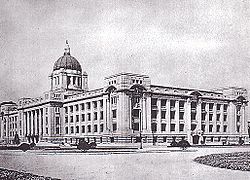

Japanese General-Government building, Seoul
In 1905, the Empire of Japan made a treaty with the Korean Empire called Eulsa Treaty. As a result, the Korean Empire became a protectorate of the Empire of Japan.[3] This treaty deprived Korea of its diplomatic sovereignty.[4][5][6]
Not only that, this treaty also allowed the Empire of Japan to build the Japanese Government-General Building in Seoul, and dispatched a resident-general there.
This treaty gave rise to the foundation of Japan-Korea Treaty of 1907, and soon, the National Diet of Japan passed the bill about the establishment of Oriental Development Company on March 1908. After the law was passed, the Imperial Japan forced the government of Korea to sign up the treaty. Even though it used to be managed by both the Korean Empire and the Empire of Japan, when the headquarter was moved to Tokyo in 1917, it became owned by only the Empire of Japan.
In 1927, a Korean independent movement activist, Na Seok-ju threw bombs inside the Oriental Development Company building in Seoul and killed a few managers.[7] However, soon, Oriental Development Company started to build another branches on other foreign areas such as Taiwan, Manchuria, Sakhalin, South Pacific Mandate. Eventually, they had built nine branches and hired over 800 people in 1938.
History
Migration Business
Due to the decreasing number of farmable lands in Japan, the Imperial Japan decided to establish migration policies which would help people to move to the Korean Peninsula to farm. This gave rises to a number of Japanese farmers coming to Korea. By 1917, Oriental Development Company accepted 1,000 families annually, and by 1926, they had god 260 families per year too. Therefore, Oriental Development Company accepted about 9,000 families in total by 1926.
The land in the possession of the company that had been given away to Japanese colonists up to the spring of 1924, amounts to more than 8,000 landmass and normal immigrants reach to the number of 246,767, thus put together, forming one-seventh of the whole arable land attained by Japanese migrants.[8]
After great deal of migration policies and supports, the practice of ‘subleasing’ came to float. The Japanese people who moved to Joseon were allowed to permit to initiate tenant farming, and then subleased such right for normal Joseon peole who have lived originally.[9]
Land Investment
See also: Cadastral Survey by the Imperial Japan

Oriental Development Company building, Seoul
After the Cadastral Survey had been done by the Imperial Japan, Oriental Development Company has bought one third farmable lands in the Korean Peninsula by late 1920s.[10] Soon, they forced tenants who are farming on their lands to pay over 50% of their production for farm rents, whereas the possession of Japanese migrants have sky-rocketed by 300~400 % per year across the Korean peninsula.[11]
The large amounts of landmass were started to be in grip of Japanese migrants to gain additional taxes and tenure for farmers by the authorities. The seizure of landlord class formed a sense of guild, then farmers indigneous to the region could not but lose the independent class as a farming household.
According to the research by Arthur C. Bunce, Land tenure was most popular type for farmers to go on farming since there had not been another measure to live on. 75% of Korean farmers are tenants operationg farms whose harvests would fall upon landlord.[12]
The situation of residents in Hwanghae provice(currently belonging to North Korea) is descripted in Dong-A Ilbo.
Owing to bad harvest, caused by the flood, drought, and attacks by insects, poor and wretched tenants have pleaded over a month that they must have been exempt from paying the rents, or that the rents must have been reduced, for the year. (abridged) Regardless of how old they are, most of residents came to the local office of the Oriental company and pleaded the cancellation of the tax. The local agents of the company threatened, however, that the farmers shall lose their tenant rights in case they do not pay the rents.[13]
Other Investments
After the occurrence of Mukden Incident in 1931, the Imperial Japan started to plan on transforming the Korean Peninsula into a supply base. Soon, Oriental Development Company also participated in these plans by investing on electricity and railroads to exploit mines in the Korean Peninsula.
Aftermath
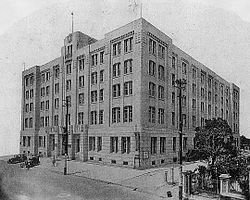
Oriental Development Company building, Tokyo.
After Korea was liberated by the Allies, the United States Army Military Government in Korea decided to confiscate all the properties from Oriental Development Company in 1945.[14] Soon, this became Shinhan Gongsa, which were located in 6 major cities of South Korea.[15] It later owned and controlled the landmass of Oriental company with those of Japanese landholders.
After the First Republic of Korea (South Korea) was established, the lands belonged to Oriental Development Company were distributed to farmers in 1949 by the Land Reform.[16]
Currently in South Korea, the Oriental Development Company still exists in Busan[17] and Mokpo.[18] Two buildings are both operated by modern history museum to record several incidents during Japanese colonial rule. The counterpart in Seoul is now occupied by Korea Exchange Bank.
See also
- Eulsa Treaty
- Japan-Korea Treaty of 1907
- Korea under Japanese rule
- List of territories occupied by Imperial Japan
Footnotes
- ^ F.A.MOKENZIE, p.195 «Korea’s Fight for Freedom» Yonsei University
- ^ (English) Hong I sup, p.220 part.18–1 March First Movement, «Korea’s Self Identity»
- ^ The history of Korea, pp.461~462, by Homer Hulbert
- ^ «Deoksu Jungmyeongjeon». 2008-06-23. http://joongangdaily.joins.com/article/view.asp?aid=2891414. Retrieved 2009-05-04.
- ^ Uk Heo, Terence Roehrig (2010). South Korea Since 1980. Cambridge University Press. pp. 9. http://books.google.com/books?id=Jegq3veJU2wC&pg=PA100&dq=%22Eulsa+Treaty%22&hl=en&ei=A5Z0TPypNsWXcfmXtZ8G&sa=X&oi=book_result&ct=result&resnum=9&ved=0CE4Q6AEwCA#v=onepage&q=%22Eulsa%20Treaty%22&f=false.
- ^ «Independence leader Kim Koo». 2008-04-28. http://www.ivynews.kr/news/news_main.html?number=41&code=feature. Retrieved 2009-05-04.
- ^ Movement of Activist- Na Seok Ju Independence Hall of Korea, Retrieved on 2011-06-09
- ^ On colonial Poplicy Dong-A Ilbo 1924-12-13
- ^ (English)Footnotes, The survey of government owned land in Changwon county under Japanese colonial rule Lee Young Ho
- ^ Yoo Young Ik, «Syngman Rhee and Ahn Ch’ang-ho : A Profile of Patriotism in Conflict_Robert Hyung-chan Kim», Yonsei University pp.601
- ^ (English)Korean Land and Korean People Dong-A Ilbo 1924-01-28
- ^ Far Eastern Survey- JSTOR.org Arthur C. Bunce, The Future of Korea: Part 2, pp.85
- ^ (English)The Inhumanity of the oridental dvelopment company 1924-11-11 Dong-A Ilbo
- ^ (English)An Evaluation of the U.S. Occupational Policy toward Korean Peninsula 1945-1948 Shin Bok Ryong
- ^ (English)The Agricultural Management of the New Korea Corporation ( Sinhan Gonsa ) in North Kyongsang province between 1946~1948 Song Kyung Hee pp.53, 54
- ^ (English)‹Peasant Movement and Land Reform during the U.S. Army Military Government in Korea› Abstract — Bang Young Hyuk
- ^ Busan Modern History Museum Info Destination Guide — Retrieved on 2011-06-09
- ^ Mokpo: An Outdoor Museum of Colonial Korea 2008-08-10, Robert Koehler Retrieved on 2011-06-09
The Oriental Development Company (Kyūjitai/Hanja: 東洋拓殖株式會社, Hangul: 동양척식주식회사), established by the Empire of Japan in 1908, was a national enterprise built as a result of Japanese colonial exploitation policy[1] toward the Korean Empire and other countries in East Asia. The company was headquartered first in Seoul, and later in Tokyo.[2]
 |
|
| Type | Private |
|---|---|
| Industry | International trade |
| Founded | 1908 |
| Founder | Empire of Japan |
| Defunct | 1945 |
| Headquarters |
Keijō and Tokyo , Empire of Japan |
| Owner | Governor-General of Japanese Korea (40%) |
FoundationEdit
In 1905, the Empire of Japan made a treaty with the Korean Empire called the Japan–Korea Treaty of 1905. As a result, the Korean Empire became a protectorate of the Empire of Japan.[3] This treaty deprived Korea of its national sovereignty.[4][5][6]
The treaty also allowed the Empire of Japan to build the Japanese Government-General Building in Seoul and appoint a resident-general.
The treaty of 1905 led to the foundation of the Japan-Korea Treaty of 1907. In March 1908, the National Diet of Japan passed the bill establishing the Oriental Development Company that the government of Korea was forced to sign. It was initially managed by both the Korean Empire and the Empire of Japan. When the headquarters were moved to Tokyo in 1917, it became wholly owned by the Empire of Japan.
In 1927 Na Seok-ju, a Korean independence movement activist, bombed the building in Seoul, which resulted in the death of some of the managers.[7] Despite this incident, the company started to create branches in other Japanese-controlled areas overseas, such as Taiwan, Manchuria, Sakhalin, and the South Seas Mandate. In 1938 there were nine branches with over 800 employees.
HistoryEdit
MigrationEdit
Due to a decrease in arable land in Japan, Imperial Japan decided to establish migration policies that would help people move to the Korean Peninsula to farm. It has been estimated that the Korean branch of the company accepted 85,000 Japanese people in 1904, and about 500,000 had migrated there by 1908.[8]
Company land had been given to Japanese colonists up to the spring of 1924, amounting to more than 8,000 landmass[clarification needed] and normal immigrants reached 246,767, thus put together, forming one-seventh of the whole arable land attained by Japanese migrants.[9]
Along with other government support for migration, the practice of «subleasing» was adopted. Japanese people who moved to Joseon were allowed to initiate tenant farming subleasing to Joseon people who lived there originally.[10]
Land investmentEdit
Oriental Development Company building, Seoul
After Imperial Japan carried out a Cadastral Survey, by the late 1920s the company had bought one third of the arable land in the Korean Peninsula.[11] They forced tenants to pay over 50% of their production as rent, while the holdings of Japanese migrants rose by 300% to 400% per year across the Korean Peninsula.[12]
The large amounts of land held by Japanese migrants accrued taxes for the authorities, while Korean farmers lost their independence.
According to Arthur C. Bunce, land tenure was the most common approach for farmers, since there was not other employment. 75% of Korean farmers became tenants.[13]
Life in Hwanghae province (in modern North Korea) was described thus:
Owing to a bad harvest, caused by the flood, drought, and attacks by insects, poor and wretched tenants have been pleading for over a month that they must have exemption from paying their rents, or that the rents must be reduced, for the year. . . regardless of how old they are, most of residents came to the local office of the Oriental Company and pleaded for the cancellation of taxes. The local agents of the company threatened, however, that the farmers would lose their tenancy rights if they did not pay their rents.[14]
Other investmentsEdit
After the Mukden Incident in 1931, Imperial Japan started to transform the Korean Peninsula into a supply base. Soon, the company invested in electricity and railroad to exploit mines.
AftermathEdit
Oriental Development Company building, Tokyo.
After Korea was liberated by the Allies, the United States Army Military Government in Korea confiscated all company property.[15] Soon, this became Shinhan Gongsa, operating in six major cities of South Korea.[16] It later owned and controlled the land of Oriental Development Company.
After the First Republic of Korea was established, the lands that belonged to Oriental Development Company were distributed to farmers by the 1949 Land Reform.[17]
Oriental Development Company buildings still exist in Busan[18] and Mokpo.[19] Two buildings have been converted into museums to document incidents when Korea was under Japanese rule. The building in Seoul is now occupied by the Korea Exchange Bank.
See alsoEdit
- Japan-Korea Treaty of 1905
- Japan-Korea Treaty of 1907
- Korea under Japanese rule
- List of territories occupied by Imperial Japan
ReferencesEdit
- ^ McKenzie, Frederick Arthur (August 2008). Korea’s Fight for Freedom. BiblioBazaar. p. 195. ISBN 978-0-554-24623-9.
- ^ Hong I sup, p. 220 part. 18–1 March First Movement, «Korea’s Self Identity».
- ^ Hulbert, Homer. The History of Korea. pp. 461–462.
- ^
«Deoksu Jungmyeongjeon». 23 June 2008. Retrieved 4 May 2009. - ^ Uk Heo, Terence Roehrig (2010). South Korea Since 1980. Cambridge University Press. p. 9. ISBN 9780802091956.
- ^ [dead link]«Independence Leader Kim Koo». 28 April 2008. Retrieved 5 May 2009.
- ^ «Movement of Activist – Na Seok Ju». Independence Hall of Korea. Retrieved 9 June 2011.
- ^ Thomas F. Millard, Japanese Immigration into Korea
- ^ Dong-A Ilbo (13 December 1924). «On Colonial Policy».
- ^ Lee Young Ho. «Footnotes, The survey of government owned land in Changwon county under Japanese colonial rule»[permanent dead link].
- ^ Yoo Young Ik, Syngman Rhee and Ahn Ch’ang-ho. A Profile of Patriotism in Conflict – Robert Hyung-chan Kim. Yonsei University. p. 601.
- ^ Dong-A Ilbo (28 January 1924). «Korean Land and Korean People».
- ^ Far Eastern Survey- JSTOR.org. Arthur C. Bunce, The Future of Korea: Part 2, p. 85.
- ^ Dong-A Ilbo (11 November 1924). «The Inhumanity of the Oriental Development Company».
- ^ Shin Bok Ryong. «An Evaluation of the U.S. Occupational Policy toward Korean Peninsula 1945–1948».
- ^ Song Kyung Hee. «The Agricultural Management of the New Korea Corporation (Sinhan Gonsa) in North Kyongsang province between 1946~1948» (PDF format). pp. 53–54.
- ^ Bang Young Hyuk, «Peasant Movement and Land Reform during the U.S. Army Military Government in Korea». Abstract.
- ^ [dead link] «Busan Modern History Museum Info». Destination Guide. Retrieved 9 June 2011.
- ^ Koehler, Robert (10 August 2008) «Mokpo: An Outdoor Museum of Colonial Korea» Archived 21 November 2011 at the Wayback Machine. Retrieved 9 June 2011.
Английский язык (Вариант 7)
- 1
- 2
Раздел 2. Чтение
Прочитайте текст и выполните задания 12-18. В каждом задании выберите цифру 1, 2, 3 или 4, впишите её в соответствующее поле внизу страницы.
Russky Dom
The Science Museum in Vancouver has had many different names over the years. Its present form however dates back to the 1986 World Fair (Expo 86). That year the theme for the World Fair was “Transport” and a special, modernistic exhibition space and dome was built as the centre piece. Called a geodesic dome; its style was influenced by the great American architect — Richard Buckminster Fuller. After the Fair closed, the people of Vancouver (private individuals, businesses, government offices) began a massive fund raising project to save the Dome and make it home to the city’s science museum. Two years later, $19 million dollars had been raised and the first stages of construction completed. In the first 12 weeks alone 310,000 visitors came to visit what was then called “Science World”.
Since that time the museum’s name changed a few times. The aluminium company, Alcan Inc, acted as sponsor so that one of the buildings would be named after them. Then Telus, the Canadian telecommunications giant donated $9 million dollars and the venue became “The Telus World of Science”: However, the new name proved almost universally unpopular among the people of Vancouver.
But during the 2010 Vancouver Winter Olympics, the museum was once again transformed and for a short while became — the Russky Dom! This involved two weeks of spectacular events in February 2010. Every day the people of Vancouver and international visitors to the Winter Games were treated to Russian folk songs, dancers and music sessions. Russian athletes came in to meet the public and sign autographs. There were quizzes and comedy shows and an opportunity for the world to get a taste of what they might expect when the Winter Games come to Sochi in 2014. The centre piece was a huge electronic clock counting down the days, hours, minutes and seconds until the start of the Sochi games.
Today the museum is still very much in business attracting huge numbers of visitors. A $35 million dollar development program was recently announced. There are thousands of brilliant exhibits that teach children and adults all about the world. Many are “hands-on” so that people can perform simple experiments themselves. There is a fabulous and entertaining educational program. You can even go to the link for a taster!
If you plan to visit the museum there are a few exhibits you simply must not miss — “Our World” in particular. It is about sustainable electricity. There are kinetic wheels, wind tunnels and solar panels. You are even given the chance to generate electricity using your own hands. The largest and brightest gallery in the museum is called “Eureka”. Here you can explore and learn about water, air, light, sound and motion.
You can go in to “Contraption Corner”, check out an “inventor box” and construct one of several whirling, buzzing and spinning gadgets. You also get to try and find solutions to practical (and in some cases not so practical) problems — such as how to lift a hippopotamus!
But the wrangle over the name continues. Some people insist it is called “Telus World of Science” and others say it is called “Science World”. But there are more than a few citizens of Vancouver who still remember a great party in February 2010. For them — the name Russky Dom is the one they prefer to use!

12. The “Science World” originally was
1) transport exhibition.
2) a part of the World Fair.
3) a geodesic sight.
4) Richard Buckminster Fuller’s home.
13 The Museum changed its name due to the
1) development of telecommunications.
2) will of people of Vancouver.
3) popularity of local companies.
4) wish of the main sponsor.
14 Which of the following is NOT TRUE about the Russky Dom?
1) Russian musicians performed there.
2) Athletes met the public there.
3) The clock there showed the time remaining till the Sochi Olympiad.
4) It was decided there to set the next 2014 Olympics in Sochi.
15 “Hands-on” in paragraph 4 refers to
1) experiments.
2) visitors.
3) exhibits.
4) educational programs.
16 The text particularly recommends to
1) generate electricity with one’s hands.
2) visit electricity exhibits.
3) enjoy a walk in a “Eureka” gallery.
4) pay attention to solar panels.
17 In the “Contraption Corner” one can
1) try oneself as an inventor.
2) solve any practical problem.
3) see all familiar gadgets.
4) try to lift a hippo.
18 Which of the following officially won the name competition?
1) Telus World of Science.
2) Russky Dom.
3) Science World.
4) None.
Заметили ошибку в тексте?
Выделите её и нажмите Ctrl + Enter
В данном задании дается связный текст с семью пропусками. В данной части экзамена это самое сложное задание. Для каждого пропуска предлагаются четыре варианта ответа, из которых только один является правильным. За каждый правильно выбранный ответ дается 1 Балл. За все задание можно получить максимально 7 Баллов.
ЦЕЛЬ ЗАДАНИЯ: Проверить умение использовать лексику в коммуникативном контексте с учетом специфики:
Форм одного слова и слов, близких по написанию и звучанию;
Ф Значений одного слова и его синонимов, антонимов, омонимов;
Ф Норм лексической сочетаемости, принятых в английском языке, и т. д.
СОВЕТЫ ПО ЭФФЕКТИВНОМУ ВЫПОЛНЕНИЮ ЗАДАНИЯ
Заранее ознакомиться с форматом задания и с требованиями по заполнению бланков для данного задания.
Во время первого прочтения
Просмотреть текст с пропусками, постараться понять его содержание.
Во время второго прочтения
1. Читать текст до пропуска. При работе с каждым фрагментом текста с пропуском использовать следующую логику:
♦ читать внимательно весь фрагмент, но особое внимание уделить предложению с пропущенным словом;
♦ внимательно изучить все предложенные варианты ответа, выбрать наиболее подходящий с учетом значения и норм лексической сочетаемости пропущенного слова. ОСОБОЕ ВНИМАНИЕ уделить Синонимам (у них могут Быть разные оттенки значения, они могут иметь Различия в управлении и сочетаемости с другими словами), а также Созвучным словам или словам Со сходным написанием (у них могут быть разные значения).
♦ прочитать предложение с пропуском еще раз, убедиться, что выбранное слово является наиболее корректным для заполнения пропуска. ОБОСНОВАТЬ СВОЙ ВЫБОР, определив, почему другие варианты неверны в данном случае. Если задание выполняется Не на экзамене, проверить правильность сделанного выбора По словарю.
2. Обвести/ записать окончательный вариант ответа в тексте задания.
ТРЕНИРОВОЧНОЕ ЗАДАНИЕ № 1
Прочитайте текст с пропусками, обозначенными номерами А22—А28. Эти номера соответствуют заданиям А22-А28, в которых представлены возможные варианты ответов. Обведите Номер Выбранного Вами Варианта Ответа.
A New Family Member
Tracey and her sister had always wanted their own horse. And although neither of them had much spare money, they were about to ∣A22∣Their dream. The tricky part was not getting a horse but actually finding somewhere to keep one. But eventually Mrs Richards aGreed to let the girls ∣A23∣A small field at the far end of the farm. This was going to ∣A24∣Them J500 a year but it would work out at just over J20 per month each which was OK. The horse himself was coming from the Horse Rescue Charity. They would need to make a small donation every year to cover the cost of an animal welfare inspector who would visit twice a year. The ∣A25∣ Expenses after this would be for food and vet bills. But the two girls were
∣A26∣That they could manage and were committed to going ahead. And it was a big commitment. They were getting an eighteen month old skewbald colt named Domino. Horses often live over twenty years and the sisters were taking him on A27∣Life. Actually they had plans to get another horse as a friend for Domino. But first of all Domino would need to settle down. He had been badly treated by his previous owners and was still a bit nervous and difficult to ∣A28∣.
|
A22 I |
1) realise |
2) consider |
3) have |
4) believe |
|
A23∣ |
1) borrow |
2) pay |
3) rent |
4) lend |
|
A24 I |
1) charge |
2) fee |
3) pay |
4) cost |
|
A25 I |
1) longest |
2) biggest |
3) hugest |
4) tallest |
|
A26∣ |
1) assured |
2) comfortable |
3) thoughtful |
4) confident |
|
A27∣ |
1) for |
2) during |
3) at |
4) to |
|
A28∣ |
1) deal |
2) agree |
3) handle |
4) cope |
ТРЕНИРОВОЧНОЕ ЗАДАНИЕ № 2
Прочитайте текст с пропусками, обозначенными номерами А22-А28. Эти номера соответствуют заданиям А22-А28, в которых представлены возможные варианты ответов. Обведите Номер Выбранного Вами Варианта Ответа.
Unlucky Travellers
Susan sat down, switched on her computer and was just about to read Her overnight emails when the door flew open. “Valerie! What are you doing here? You are A22∣ to be on holiday in Italy!”
Susan was astonished. She and Val worked together as receptionists at the hospital. Because she had expected to be on her own and working twice as hard, she was quite pleased to see Val. On the other hand she knew that Val was really looking ∣A23∣To her holiday. What could possibly have gone wrong? Val walked in but she didn’t say a ∣A24∣ word. It was clear that she was upset and tired. “What is it? What’s happened?” Susan continued. “Is everything OK?” Valerie was silent for some moments but eventually A25__________________________ . “You clearly haven’t
 Heard the news. Our travel company went bankrupt on Friday. We didn’t know and so went to the airport on Saturday morning. Actually we have spent the whole weekend at the airport hoping still to get a flight. In the end we gave ∣A26 and came home”. “Oh you poor thing,” Susan gushed. “Let me make you a cup of tea but then you should go home. You still have two weeks holiday to A27[ Is certainly nice enough at the moment.
To Italy still. We had travel insurance and it seems we will get all our money ∣A28[ We’ll try again in the autumn with a different travel company.”
|
A22 I |
1) proposed |
2) suggested |
3) wanted |
4) supposed |
|
A23∣ |
1) for |
2) around |
3) forward |
4) after |
|
A24∣ |
1)separate |
2) single |
3) one |
4) certain |
|
A25∣ |
1) asked |
2) said |
3) ) spoke |
4) told |
|
A26 I |
1) up |
2) on |
3) to |
4) at |
|
A27∣ |
1) make |
2) take |
3) manage |
4) do |
|
A28∣ |
1) back |
2) still |
3) agreed |
4) together |
ТРЕНИРОВОЧНОЕ ЗАДАНИЕ № 3
Прочитайте текст с пропусками, обозначенными номерами А22-А28. Эти номера соответствуют заданиям А22-А28, в которых представлены возможные варианты ответов. Обведите Номер Выбранного Вами Варианта Ответа.
The Tower of London
‘Her Majesty’s Royal Palace and Fortress’, ‘The Tower’ and ‘The White Tower’ are all names for the building most commonly known as The Tower of London. Construction began in 1078 but work ∣A22∣, on and off, over a period of two hundred years or more.
The Tower was essentially a fortress whose functions eventually extended to that of royal palace, prison, armoury, zoo, Royal Mint and observatory. Since 1303 it has also been used ∣A23∣Storing the Crown Jewels of the United Kingdom. Today, however, The Tower is cared for by an independent charity and receives no funding from the governmEnt or the crown.
The Tower is probably best known for the famous prisoners who were ∣A24∣, and sometimes executed, there. In 1483 the 13-year-old King Edward 5ffi and his 10-year-old brother Richard were murdered there; apparently on the orders of their uncle, the Duke of Gloucester. ∣A25∣The most famous victim of The Tower was Anne Boleyn, the unfortunate second wife of Henry 8th. But Guy Fawkes, Thomas Moore, Sir Walter Raleigh and even the future Queen Elizabeth 1st were all imprisoned behind those fearsome walls.
Most people know the A26∣Legend that if the ravens ever leave The Tower — then the British Monarchy will be doomed. Possibly less people know however that the Tower was also one of the ∣A27∣Zoos. Lions, tigers and large ∣A28∣Of rare and exotic species lived
|
In the Tower gardens over 800 years ago. |
|||||
|
∣A22∣ |
1) lengthened |
2) continued |
3) prolonged |
4) increased |
|
|
A23∣ |
1) as |
2) with |
3) for |
‘∖ |
4) to |
|
A24∣ |
1) captured |
2) maintained |
3) found |
4) held |
|
|
A25 I |
1) Thus |
2) Consequently |
3) Probably |
4) Although |
|
|
A26∣ |
1) ancient |
2) prehistoric |
3) antique |
4) aged |
|
|
A27 I |
1) newest |
2) youngest |
3) earliest |
4) soonest |
|
|
A28 I |
1) figures |
2) groups |
3) herds |
4) numbers |
ТРЕНИРОВОЧНОЕ ЗАДАНИЕ № 4
Прочитайте текст с пропусками, обозначенными номерами А22-А28. Эти номера соответствуют заданиям А22-А28, в которых представлены возможные варианты ответов. Обведите Номер Выбранного Вами Варианта Ответа.
Schools for gifted and talented: view of American scholars
Gifted programs often provoke controversy because there is no standard definition of what a gifted student is. There are six ∣A22 of ability often evaluated in order to determine
∣A23∣A child is gifted: general intellectual ability, specific academic aptitude, creative thinking, leadership ability, visual and performing arts, and psychomotor ability. They are ∣A24∣ by combinations of standardized tests, plus peer and teacher evaluations.
On the one hand schools for gifted and talented may ∣A25∣The emotional stress of isolation and peer rejection often experienced by gifted students in a traditional school. On the other hand — social development of a child may be impeded as a result of isolation from the general population.
We can’t deny the fact that gifted programs offer personalized instruction and enriched curriculum suited to the needs of students gifted in this or that area. Such programs allow students to learn at a highly ∣A26 rate according to their ability. School administrators in such schools hire gifted teaching staff and select teachers who can be a source of instructional innovation.

 Such schools normally have smaller classes and in general these schools for the gifted are few. Access ∣A27∣ them may be physically difficult because of their location. Besides, they may be not available for families with limited income asthey may be expensive. If such schools are publicly funded, they may be opposed as elitist and money that might go to traditional schools.
|
A22 I |
1) districts |
2) regions |
3) parts |
4) areas |
|
A23j |
1) whether |
2) wherever |
3) whenever |
4) whereas |
|
A24 I |
1) calculated |
2) quantified |
3) determined |
4) measured |
|
A25∣ |
1) treat |
2) relieve |
3) simplify |
4) improve |
|
A26∣ |
1) hasty |
2) prompt |
3) accelerated |
4) hurried |
|
A27∣ |
1) to |
2) for |
3) at |
4) in |
|
A28∣ |
1) blamed |
2) charged |
3) accused |
4) claimed |
ТРЕНИРОВОЧНОЕ ЗАДАНИЕ № 5
Прочитайте текст с пропусками, обозначенными номерами А22-А28. Эти номера соответствуют заданиям А22-А28, в которых представлены возможные варианты ответов. Обведите Номер Выбранного Вами Варианта Ответа.
From High School to University Students
Some students find transition from secondary school to tertiary education painful. Well- known life is left ∣A22∣ with familiar home and community environment, parents, siblings, friends. Anticipation of unpredictable academic responsibilities and fear of failure, together with fear of disappointing one’s parents and friends ∣A23∣To the stress. They are both ∣A24∣ and afraid of new social responsibilities like dealing with roommates, instructors, male and female student friends. There is fear of not being accepted; fear of loneliness; anxiety and guilt about breaking with the past. They are on the edge of redefining themselves as adults, finding a satisfactory career, abandoning old friends and finding new.
What can be done to ∣A25∣ this stress? Firstly, it’s important to become ∣A26∣ with the university’s scholastic and non-scholastic programs: check the university’s website and request informational brochures. You can also visit the campus and introduce yourself at the Departmental office; talk to students majoring in the Department. If the university can provide the names of roommates, become acquainted in person or by ∣A27∣Prior to classes. Most Universities have orientation programs — first year student assemble on campus for a week before the start of classes. Orientation can be led by Departmental deans, instructors, and majors, introducing new students to academic procedures and standards, enrolling students in their first term classes, assigning ∣A28∣. each new student an upperclassman as mentor to help them adjust to their first year at the university.
|
I A22∣ |
1) back |
2) behind |
3) apart |
4) aside |
|
I A23∣ |
1) multiply |
2) raise |
3) rise |
4) add |
|
I A24∣ |
1) eager |
2) liking |
3) wanting |
4) keen |
|
I A25 I |
1) shorten |
2) eliminate |
3) refuse |
4) release |
|
I A26∣ |
1) aware |
2) conscious |
3) acquainted |
4) sensitive |
|
I A27 I |
1) correspondence |
2) communication |
3) interaction |
4) post |
|
I A28∣ |
1) to |
2) for |
3) at |
4) — |
ТРЕНИРОВОЧНОЕ ЗАДАНИЕ № 6
Прочитайте текст с пропусками, обозначенными номерами А22-А28. Эти номера соответствуют заданиям А22-А28, в которых представлены возможные варианты ответов. Обведите номер выбранного вами варианта ответа.
Education in the UK: Pages of History
Prior to 1944 the British secondary education system was rather haphazard. Schools were created by local governments, private charities, and religious foundations. Schools varied greatly by region. ∣A2¾ Was not available to all, and secondary schools were mainly for the upper and middle classes.
 In 1944, secondary education was A23∣ as a right for all children, and universal, free education was introduced. From 1944 to 1976 state-funded secondary education of three types of schools (the Tripartite System): Grammar School, Secondary
Technical School and Secondary Modern School. The basic assumption of the Tripartite System was that all should be entitled to an education appropriate to their nEeds and abilities. It also assumed that students with different abilities should have a different ∣A25∣. Pupils were assigned to one of the three types of school according to their performance in an examination taken at age eleven, the Eleven Plus examination.
Grammar Schools were intended to A26∣A highly academic curriculum. There was a strong focus on intellectual subjects, such as literature, classics and complex mathematics, aimed A27 developing students’ ability to deal with abstract concepts. Secondary Technical Schools were designed to train children with ability in mechanical and scientific subjects. The focus of the schools was on providing scientists, engineers and technicians. Secondary Modern Schools would train pupils in practical skills, equipping them for less skilled jobs and home management.
Due to the expense of building facilities for three types of schools, very few Technical Schools were built, and education in the UK retained its class character: the upper class children attended Grammar School which received the lion’s share of funding, lower class children attended Modern Schools which were largely neglected. Only children who |А28|_ to Grammar Schools had a real chance of getting into a university.
|
I A22 |
1) Access |
2) Attendance |
3) Entrance |
4) Reception |
|
I A23 |
1) recognized |
2) recalled |
3) found |
4) realised |
|
I A24 |
1) inserted |
2) included |
3) contained |
4) consisted |
|
I A25 |
1) agenda |
2) curriculum |
3) courses |
4) plan |
|
I A26 |
1) instruct |
2)learn |
3) teach |
4) study |
|
I A27 |
1) on |
2) at |
3) to |
4) for |
|
I A28 |
1) attended |
2) admitted |
3) went |
4) graduated |
ТРЕНИРОВОЧНОЕ ЗАДАНИЕ № 7
Прочитайте текст с пропусками, обозначенными номерами А22-А28. Эти номера соответствуют заданиям А22-А28, в которых представлены возможные варианты ответов. Обведите Номер Выбранного Вами Варианта Ответа.
Globalisation
Globalisation is good and bad and inevitable. It is good or at least useful economically because it lowers ∣A22∣To trade and increases the flow of goods, labour and services. It has both ∣A23∣In and encouraged legal migration, and tourism. It has shared the best of the world’s musical culture, sport, TV and films, fashion and dance. It has made the world both familiar and strange. In any main Street from Moscow to Los Angeles or London to Sydney — one can eat Chinese, Indian, Italian or Thai cuisine and it seems perfectly normal. Globalisation has reduced (many argue) the ∣A24∣Of global conflict and it has aided the development of world health policies and humanitarian aid. The charity concert “Live Aid” was watched by 400 million viewers in 60 countries.
But Globalisation is also dark. The process began through “discovery” and colonization. It demanded integration ∣A25∣The expense of local independence, colour and “difference”. It grew out of monstrous transnational corporations that became so powerful that neither trade unions nor governments had the power to hinder. It came with the opportunity to produce goods on an unprecedented scale at previously unimagined prices. Globalization ∣A26∣ to the independent manufacturers of the world — “grow with us, or die”.
And Globalization is inevitable. Elements of the late 20th century phenomenon can be seen throughout history in the rise and fall of every empire: where dress, cuisine, culture and even language were ∣A27∣ across continents. Many believe that it is now US culture that has displaced traditional diversity, local uniqueness and identity. Personally I am unable to argue for or against globalisation. It is truly ∣A28∣And utterly terrible and completely inevitable.
|
I A22∣ |
1) obstructions |
2) blockades |
3) difficulties |
4) barriers |
|
I A23∣ |
1) caused |
2) affected |
3)founded |
4) resulted |
|
I |
||||
|
I A24 I |
1) opportunity |
2) occasion |
3) likelihood |
4) reason |
|
I A25 I |
1) at |
2) for |
3) on |
4) by |
|
I A26 I |
1)spoke |
2) told |
3) said |
4) talked |
|
I A27∣ |
1) exposed |
2) imposed |
3) imported |
4) obliged |
|
I A28∣ |
1) well |
2) good |
3) nice |
4) superior |
ТРЕНИРОВОЧНОЕ ЗАДАНИЕ № 8
Прочитайте текст с пропусками, обозначенными номерами А22-А28. Эти номера соответствуют заданиям А22-А28, в которых представлены возможные варианты ответов. Обведите Номер Выбранного Вами Варианта Ответа.
Quarrelling Neighbours
England and France are neighbours and have a famous 1000 year old, love-hate ∣A22∣. An early milestone was 1066, when William of Normandy conquered England. As any English football fan will ∣A23∣You “It’s their fault, they started it!” and ever since there has been conflict; both “teams” selecting their own highlights! The English generally choose the Battle of Agincourt (1415) and of course the ∣A24∣ of Napoleon (conveniently forgetting that several other nations were actually involved). A more recent low occurred wHen Churchill ordered the sinking of the French Fleet after France surrendered to Germany. ∣A25∣ many claim the UK’s role in the liberation of France rather made up for this!
English-French rivalry continues to the present time — in sport, language and culture. In any big sporting tournament (especially football or rugby) the French become “Frogs” — a nickname derived ∣A26∣The (inexplicable to English taste) French inclusion of frogs, snails and other unmentionables in their cuisine.
In the last decades the French have even battled against the invasion of the English language — “Le weekend”, “Le sandwich” and so forth. But it seems that the English language is a ∣A27∣Opponent. The rivalry recently flared up again most recently when London narrowly beat Paris in the bid to A28∣ the 2012 Olympics. But in fairness, since William “kicked-off” in 1066 there have been plenty of French victories as well, and in reality the nations are the best of friends as much as “best” enemies and their rivalry is often quite witty and entertaining.
|
A22j |
1) relationship |
2) rapport |
3) acquaintance |
4) connection |
|
A23 I |
1) talk |
2) speak |
3) say |
4) tell |
|
A24 I |
1) loss ; |
2) defeat |
3) failure |
4) collapse |
|
A25 I |
1) Thus |
2) Although |
3) Therefore |
4) Nevertheless |
|
A26∣ |
1) of |
2) for |
3) from |
4) off |
|
A27∣ |
1) tough |
2) solid |
3) heavy |
4) hard |
|
A28∣ |
1) accommodate |
2) host |
3) settle |
4) contain |
ТРЕНИРОВОЧНОЕ ЗАДАНИЕ № 9
Прочитайте текст с пропусками, обозначенными номерами А22—А28. Эти номера соответствуют заданиям А22-А28, в которых представлены возможные варианты ответов. Обведите номер выбранного вами варианта ответа.
A Night at the Museum
Friday 6th March 2010, was special for Laura, and me — our sleep over at the American Museum of Natural History (AMNH). I am guessing you’ve seen the movie? A22∣ in 2006 and called “A Night at the Museum” with Ben Stiller starring. It’s a kicking comedy about a night guard who ∣A23∣An ancient curse that makes the animals on display come to life every night and trash the place. ___
I am not sure if the night Laura and I spent at the museum was ∣A24∣By the film, but it was way cool. Fact, fact, fact! AMNH is one of the largest Museums in the world. There are 25 buildings and 46 ∣A25∣Exhibition halls set in fab grounds near Central Park, New York. There is a famous library, research labs and a totally awesome 32 million specimens. The night costs $129 per person. Grandma paid for us as early birthday presents.
It began at 5.45pm and ∣A26∣All the way to 9.00am on the 7th. It was real creepy as the doors swung closed and locked and the lights dimmed away. We switched on torches — and so our first mission began: Looking for fossil facts. I can ∣A27∣Describe to you walking through those dark halls, our torches cutting beams through the inky black. There was a way scary moment when a huge buffalo head lit up and made me jump like a wuss.
After some bites and coolin’ we settled down to sleep — directly ‘neath a 94 foot blue whale and next to a mighty fine Brown Bear. Luckily no animals came to ∣A28∣And we slept like babies. Wicked!
|
A22 |
1) Made |
2) Done |
3) Issued |
4) Screened |
|
A23 |
1)learns |
2) opens |
3) discovers |
4) investigates |
|
A24 |
1) aroused |
2) encouraged |
3) pushed |
4) inspired |
|
A25 |
1) constant |
2) permanent |
3) stable |
4) steady |
|
A26 |
1) ended |
2) lasted |
3) went |
4) carried |
|
A27 |
1) hardly |
2) obviously |
3) fairly |
4) apparently |
|
A28 |
1) alive |
2) reality |
3) real |
4) life |
ТРЕНИРОВОЧНОЕ ЗАДАНИЕ № 10
Прочитайте текст с пропусками, обозначенными номерами А22-А28. Эти номера соответствуют заданиям А22-А28, в которых представлены возможные варианты ответов. Обведите Номер Выбранного Вами Варианта Ответа.______________________________________________________________
Blue Whale Watching
For years I have had the same dream about a blue whale. I see the sea darken as the gigantic mammal comes to the surface. Then I see the monster ∣A22∣At me through the clear green water.
But finally I am about to see my dream come true. Several months of planning had brought me to the warm waters off the southern tip of Sri Lanka. Less than an hour after leaving the harbour we A23∣At the location whales had been seen the day before.
 Blue Whales are the largest creatures that have ever lived. Compared to the big“Blue” — elephants, hippos and the biggest great white sharks are tiny. My fellOw tOurists ∣A24∣The deck — all of us breathless with anticipation. Each of us A25 first to see the darkening of the sea.

 |
I heard a shout behind me and suddenly the boat engines roared noisily as the my life’s ∣A28∣, to the realization of beautiful sight I have ever seen.
|
A22 I |
1) watch |
2) stare |
3) see |
4) observe |
|
A23∣ |
1) arrived |
2) reached |
3) entered |
4) achieved |
|
A24 I |
1) among |
2) between |
3) besides |
4) along |
|
A25 I |
1) persuaded |
2) convinced |
3) determined |
4) assured |
|
A26∣ |
1) directed |
2) set |
3) pulled |
4) parked |
|
A27 I |
1) after |
2) to |
3) forward |
4) off |
|
A28∣ |
1) trip |
2)journey |
3) travel |
4) destination |
ТРЕНИРОВОЧНОЕ ЗАДАНИЕ № 11
Прочитайте текст с пропусками, обозначенными номерами А22-А28. Эти номера соответствуют заданиям А22-А28, в которых представлены возможные варианты ответов. Обведите номер выбранного вами варианта ответа.
The Best Breakfast in the World?
The “Greasy Spoon” cafe on Arundel Road offers the best full English breakfast on the planet. Of course people ∣A22∣ about what “full English” should consist of but I think there is a small clue in the word “full”. This is a breakfast that knows no modesty. This is not a breakfast for those on a diet. It is the breakfast of Kings; it should be enjoyed ∣A23∣ leisure and last for the day.
That the “full English” (FE) contains both bacon and eggs is A24_____________ dispute. After this
There are different schools of thought. Sausage, mushrooms, beans, black pudding, fried tomatoes and toast are often ∣A25[ in different line ups and combinations competing for the best, all time classic FE. These are ∣A26∣ in different portions and styles and a decent breakfast is the almost guaranteed outcome. But an FE on Arundel Road beats all contenders for the best FE in the world because it includes ALL of these ingredients in ∣A27∣Quantities! They also serve hot toast on traditional toast racks with real butter. But best of all, each customer is served their own pot of traditional English tea (with tea cosy) which may be drunk with milk or cream. And all of this is offered for just J5 per person — and with a newspaper included! The Greasy Spoon is popular with working people and students alike. It opens early during the week for the lorry drivers and on Sunday mornings ∣A28∣ families come in and spend half the day there.
|
I A22 I |
1) discuss |
2) debate |
3) quarrel |
4) argue |
|
I A23 I |
1) for |
2) at |
3) on |
4) in |
|
I A24 I |
1) beyond |
2) behind |
3) besides |
4) below |
|
J |
||||
|
I A25 I |
1) contained |
2) included |
3) held |
4) enclosed |
|
I A26∣ |
1) suggested |
2) advised |
3) offered |
4) intended |
|
∣A27∣ |
1) generous |
2) rich |
3) luxurious |
4) multiple |
|
I A28∣ |
1) full |
2) complete |
3) total |
4) whole |
ТРЕНИРОВОЧНОЕ ЗАДАНИЕ № 12
Прочитайте текст с пропусками, обозначенными номерами А22-А28. Эти номера соответствуют заданиям А22-А28, в которых представлены возможные варианты ответов. Обведите номер выбранного вами варианта ответа.
A night at the Museum
Anna and Ira are best friends. They are both Russian but ∣A22⅛ the Southbank International School as their parents both work in London. They are fifteen now and are studying hard for their International Baccalaureate.
Every Saturday they love to visit museums and galleries in London and so now they have visited A23∣All of them. But, above all, their absolute favourite is The Natural History Museum in South Kensington.
They filled in an online A24∣Form and became “members”. This means they get free magazines called “Evolve” and “Second Nature”, get fast track entry to special exhibitions and they get invited to previews, workshops, talks and special A25____________________________________________________ . They even get to use the
Special member’s room where there are free refreshments, magazines and internet access. It ∣A26∣Them J56 For the year but they felt it was really good value for money.
Last weekend they took part in “Dino snores” — an event A27∣By the film “A Night at the Museum”. They were given a talk about bugs by TV nature presenter Nick Baker, explored the Dinosaur gallery in the dark on a torch-lit tour, watched films and played games, and then slept in sleeping bags under the shadow of the huge Diplodocus in the Museum’s iconic Central Hall. It was a night they’ll never forget. Although Ira and Anna are both interested in Dinosaurs — they are more interested in present day wildlife and most interested of all in ≡— Russian wildlife. When they go back to Moscow both want to study and eventually
Become wildlife research scientists.
|
A22 |
1) attend |
2) visit |
3) go |
4) enroll |
|
A23 |
1) about |
2) almost |
3) already |
4) approximately |
|
A24 |
1) application |
2) admission |
3) entrance |
4) request |
|
A25 |
1) dealings |
2) actions |
3) procedures |
4) events |
|
A26 |
1) cost |
2) charged |
3) priced |
4) spent |
|
A27 |
1) inspired |
2) motivated |
3) stimulated |
4) encouraged |
|
A28 |
1) struggling |
2) preserving |
3) securing |
4) supporting |
ТРЕНИРОВОЧНОЕ ЗАДАНИЕ № 13
Прочитайте текст с пропусками, обозначенными номерами А22-А28. Эти номера соответствуют заданиям А22—А28, в которых представлены возможные варианты ответов. Обведите номер выбранного вами варианта ответа.
Day schools VS Boarding schools
The majority of modern public schools in the UK and state schools in the USA — schools that offer free education— are со-educational day schools. Children that attend these schools remain in family settings with family support and nurture that helps to reduce the stress of ∣A22∣Any school for a child. They are able to retain contacts with friends and neighbours.
Being less expensive, these schools offer a wider ∣A23∣Of courses and activities. On the other hand, these schools have larger classes and lower academic standards as compared to more selective schools.
Pupils there have a greater ∣A24∣ of encountering bad social trends: drug culture, gangs, anti-intellectualism. Of course, much depends on the regional location and the administrative policy of each school.
Boarding or recreational schools have smaller classes with more individualized iNstruCtion; can often (though not always) boast higher academic standards that are focused ∣A25 making students more independent thinkers; encourage them to make many decisions on their own. Graduates of such schools may have an advantage when applying at more popular universities.
Students of such schools ∣A26∣Lifetime friendships and the so-called ‘old school tie’ — the system of after school, lifelong support and lobbying former schoolmates — can be truly applied in this case.
But there is the ∣A27[ Side of the medal: missed opportunities for parents to educate their children on values; disruption of family: homesick kids, parents missing their children; narrower and less-diverse ∣A28∣Contacts; expensive tuition.
|
A22 |
1) entering |
2) starting |
3) going |
4) getting |
|
A23 |
1) group |
2) collection |
3) mixture |
4) selection |
|
A24 |
1) ability |
2) opportunity |
3) chance |
4) prospect |
|
A25 |
1) on |
2) at |
3) for |
4) to |
|
A26 |
1) assemble |
2) build |
3) construct |
4) design |
|
A27 |
1) another |
2) other |
3) different |
4) optional |
|
A28 |
1) social |
2) sociable |
3) society |
4) civil |
ТРЕНИРОВОЧНОЕ ЗАДАНИЕ № 14
Прочитайте текст с пропусками, обозначенными номерами А22-А28. Эти номера соответствуют заданиям А22-А28, в которых представлены возможные варианты ответов. Обведите Номер Выбранного Вами Варианта Ответа.
Times are Changing
I grew up in tiny village in East Anglia — population 210 people. Everybody knew each other and seemed to know everyone else’s business. What strikes me now — looking back ∣A22∣ 40 years ago — is that the village contained several social groups and there were clear distinctions and unspoken (and certainly unwritten) rules of engagement.
We had two ∣A23∣Class families living in the village: The Brandings, who lived in the manor house, and the very honourable Archer family. The Brandings were well ∣A24∣But certainly not rich. They were extremely posh and so were the Archers who — on the contrary — were fabulously wealthy. But socially — the Brandings and Archers were ∣A25∣. They could socialise with the vicar and my family (because my Dad was an RAF Officer) but their contact with the other villagers was ∣A26∣To friendly but polite greetings. Then we had 8 or 10 middle class families; teachers, a scientist, a factory director and so on. In so small a village we knew each other well and socialised a lot.
The ∣A27∣ comprised of the true working class. They worked in shops, or on the farms. We had also had quite a few elderly couples who in their young days had been “in service”. We didn’t socialise but relations were friendly and we greeted on first name terms.
It’s all changed now of course. Our village is a small town — far too large to be anything like the community of my youth. I may be wrong, but it seems like society has contracted into featureless ∣A28∣And that nowadays people often don’t even know their neighbours’ names.
|
A22 I |
1) above |
2) over |
3) beyond |
4) behind |
|
A23∣ |
1) upper |
2) aristocratic |
3) high |
4) noble |
|
A24∣ |
1) allied |
2) associated |
3) linked |
4) connected |
|
A25 I |
1) commoners |
2) equivalents |
3) equals |
4) parallels |
|
A26∣ |
1) restricted |
2) framed |
3) enclosed |
4) narrowed |
|
A27∣ |
1) remnants |
2) reminders |
3) remain |
4) remainder |
|
A28∣ |
1) likelihood |
2) sameness |
3) neutrality |
4) equality |
ТРЕНИРОВОЧНОЕ ЗАДАНИЕ № 15
Прочитайте текст с пропусками, обозначенными номерами А22-А28. Эти номера соответствуют заданиям А22-А28, в которых представлены возможные варианты ответов. Обведите номер выбранного вами варианта ответа.
Education in the UK: Modern schools
The 1976 Education Act abolished the Tripartite System in favour of a system of free Comprehensive Schools that were ∣A22∣ to provide Grammar School education for all. In the UK today, schools reflect elements of both the Tripartite and the Comprehensive models.
The UK system of state schools is complex and ∣A23∣ the following types: Primary Schools (ages 4-11), Secondary Schools (ages 11-16), Sixth Form Colleges (non-compulsory, ages 16-18), Special Schools for children with physical, emotional and behavioral learning needs, City Technology Colleges (CTCs) and City Colleges for the Technology of the Arts (CCTAs) (ages 11-18). These schools provide a broad secondary education with special emphasis on science and technology and offer a ≡— _ range of vocational qualifications.
Grammar Schools remain and continue to select almost all of their pupils ∣A25∣ reference to high academic ability. Independent Schools are private schools that obtain most of their finances from ∣A26 paid by parents and income from investments. Some of them are
Selective but many are not. Some of the larger independent schools are ∣A27∣ as Public Schools. Most Independent Schools are Church Schools.
Most state schools (primary and secondary) are со-educational day schools, but some secondary schools accept boarders. Independent Schools include day and boarding schools and are mostly single-sex, although an increasing number of junior and some senior schools are coeducational. There has been a sharp increase in the number of children ∣A28∣Independent Schools, owing to the increasing dissatisfaction with academic standards at State Comprehensive Schools.
|
I A22 I |
1) intended |
2) aimed |
3) offered |
4) proposed |
|
I A23 I |
1) fits |
2) includes |
3) engages |
4) composes |
|
I A24 I |
1) high |
2) intensive |
3) extensive |
4) wide |
|
I A25 I |
1) by |
2) at |
3) for |
4) about |
|
I A26 I |
1) costs |
2) bills |
3) fees |
4) taxes |
|
I A27∣ |
1) famous |
2) known |
3) notorious |
4) familiar |
|
I A28∣ |
1) accepting |
2) entering |
3) going |
4) attending |
ТРЕНИРОВОЧНОЕ ЗАДАНИЕ № 16
Прочитайте текст с пропусками, обозначенными номерами А22-А28. Эти номера соответствуют заданиям А22—А28, в которых представлены возможные варианты ответов. Обведите Номер Выбранного Вами Варианта Ответа.
Mining in Australia
Australia is the “mainland” of the world’s smallest continent. It is mostly very flat and much of it is inhospitable desert. ∣A22∣Of the population lives in the South East and South West where there is a ∣A23∣Climate. But the weather played only a relatively minor part in establishing population centres. Many argue that the real story was about mining.
The early colonies in South Australia had a terrible struggle economically. But after significant silver, lead and copper ∣A24j were discovered in Southern Australia, the local
Populations began to grow. In 1841 silver and lead were discovered at Glen Osmond — now a suburb of Adelaide: Then came the discovery of copper at Kapunda in 1845.
But the big story was gold! The first “strike” was at Ophir, New South Wales in 1851. ∣A25∣Weeks more gold was found in the colony of Victoria. The Australian gold rushes had a major impact ∣A26∣, Victoria and Australia as a whole. They coloured every aspect of Australian society and elements of it are still clearly visible today. Victoria became the richest colony and Melbourne Australia’s largest city.
The population of Australia changed dramatically ∣A27∣Of the discovery of gold. In 1851 the population was just 437,655. 10 years later it was 1,151,947. The rapid growth came from “new chums” — recent immigrants from the UK and British Commonwealth. As a lot of Australians will be quick to tell you, much of the new wealth was “stolen” back to England. But enough wealth remained to fund substantial development in industry and infrastructure and to ∣A28∣The foundations for building modern Australia.
|
A22 I |
1) Most |
2) Many |
3) Mainly |
4) Main |
|
I A23 I |
1) temperature |
2) temperate |
3) tempered |
4) temporal |
|
L⅛24J |
1) riches |
2) stores |
3) deposits |
4) treasures |
|
A25 I |
1) Throughout |
2) During |
3) While |
4) Within |
|
[A2βJ |
1) at |
2) on |
3) for |
4) in |
|
I A27∣ |
1) because |
2) due |
3) as |
4)thanks |
ТРЕНИРОВОЧНОЕ ЗАДАНИЕ № 17
Прочитайте текст с пропусками, обозначенными номерами А22-А28. Эти номера соответствуют заданиям А22—А28, в которых представлены возможные варианты ответов. Обведите Номер Выбранного Вами Варианта Ответа.
The storybook wolf
 Josii Luis Rodriguez of Spain is the overall winner of The Wildlife Photographer of the — a wolf jumping over a gate! He visualized his photo many years ago, when Iberian wolves first returned to Bvila in the Castilla у Leyn region of northern Spain, and cattle
Ranchers ∣A23∣ war on them. His idea was a picture that would symbolize the ancient conflict ∣A24∣ humans and wolves, while showing the beauty and strength of this fabled
Animal. But it took a long time to find the ideal ∣A25∣, let alone a wolf that would jump a gate. His chance came when he found a landowner who was happy to have both the wolves and Josfi Luis on his property, and also had the ideal setting: a copse and an ancient, disused cattle corral.
 Josfi Luis started by placing meat in the corral. Once he knew a male wolf was visiting regularly, jumping the gate, he began to introduce the bits of equipment needed to up a camera trap. At first, the wolf didn’t like the flash triggered by the trip beam, but after a few weeks he ∣A27 no notice of the light or the clicks of the hidden digital camera. Now that the wolf was happy and the camera ∣A28∣ was right, it was time to take the final picture with a medium-format camera. When the first transparencies arrived back from the lab, Josfi Luis was overjoyed to find he finally had the picture he had dreamt of.
|
A22 |
1) tournament |
2) competition |
3) test |
4) race |
|
A23 |
1) pronounced |
2) revealed |
3) broadcasted |
4) declared |
|
A24 |
1) between |
2) among |
3) within |
4) amongst |
|
A2δ |
1) situation |
2) sight |
3) location |
4) destination |
|
A26 |
1) put |
2) place |
3) set |
4) build |
|
A27 |
1)took |
2) received |
3) gave |
4) paid |
|
A28 |
1) posture |
2) positioning |
3) posing |
4) pose |
ТРЕНИРОВОЧНОЕ ЗАДАНИЕ № 18
Прочитайте текст с пропусками, обозначенными номерами А22-А28. Эти номера соответствуют заданиям А22-А28, в которых представлены возможные варианты ответов. Обведите Номер Выбранного Вами Варианта Ответа.
Christmas
As a small child I loved almost everything about Christmas. The excitement of Christmas Eve was almost unbearable. We’d go from house to house singing Christmas carols and be given hot mince pies and other ∣A22∣.
Before bed our parents would read us stories and eventualLy puT us to bed with warnings that Santa Claus would not come if we stayed awake. Before ∣A23∣Into bed we would leave out a mince pie for Santa and something for his reindeers as a “thank you”: For me Santa was the great hero and I never ∣A24∣That he would come down our chimney to deliver my presents.
I loved, as I mentioned before, “almost everything”. Immediately after ChristMas I was told by my parents that I had to write “thank you letters”. As a six your old, writing ∣A25∣One letter was a task, but several made a mountain — pressing down on my small world. “Why” I argued to my Mum “should I write to grandparents, aunts and uncles? Santa brought me all my presents”. ___
And my mother would lie to her son. ∣A26Lies of how Santa helped Granddad choose my toy car and with the help of elves and reindeer delivered it for Granddad — but that still I should thank Granddad for the small part he played in it. The following year her lies were even more devious as she tried to ∣A27∣Me convinced. As I eventually solved this annual mystery, I of course lost all A28∣For not writing the “Thank you letters” as the realisation dawned that Granddad had managed everything by himself.
|
I A22 I |
1) surprises |
2) treats |
3) presents |
4) souvenirs |
|
|
I A23 I |
1) getting |
2) going |
3) putting |
4) lying |
|
|
I A24 I |
1) hesitated |
2) suspected |
3) mistrusted |
4) doubted |
|
|
I A25∣ |
1) only |
2) yet |
3) even |
4) still |
|
|
I A26 I |
1) Vague |
2) Elaborate |
3) Complete |
4) Formless |
|
|
• |
A27 I |
1) hold |
2) stay |
3) keep |
4) remain |
|
A28∣ |
1) reasons |
2) defenses |
3) motives |
4) excuses |
ТРЕНИРОВОЧНОЕ ЗАДАНИЕ № 19
Прочитайте текст с пропусками, обозначенными номерами А22-А28. Эти номера соответствуют заданиям А22—А28, в которых представлены возможные варианты ответов. Обведите Номер Выбранного Вами Варианта Ответа.
The Magnificent Six
This is a real life story. When I was about eight, I [A22∣An organization called the “Cub Scouts”. We met once a week and learned basic first aid and were trained ∣A23∣ various techniques related to camping and the outdoor life. For each skill learned, there would be a test — which if passed would result in earning a badge. These badges were cArefulLy sewn on our uniforms; green caps with yellow piping, green shirts with a type of scarf ∣A24j a
Neckerchief and short trousers. Our leader was called Akela — after the wolf pack____________ leader in
Rudyard Kipling’s “The Jungle Book” and we were formed in units of six boys — called a “Six” and led by a “Sixer”.
I can ∣A25∣ remember our Six. We were nicknamed “the dwarves” after the fairy tale “Snow White and the Seven Dwarves”. This was nothing to do with our height (and we were of course six rather than seven) but rather it was to do with our ∣A26∣. We were “Sneezy” (real name Richard), “Bashful” (OLiver), “Grumpy” (Jim), “Doc” (Henry), “Sleepy” (Rupert) and I was “Happy”. Only “Dopey” was ∣A27∣From the original seven! And really that was what we were like. Richard always seemed to have a cold, Oliver was shy, Jim always in a bad mood and so forth. But we all, without fail, had enormous fun — especially on our annual camping ∣A28∣ to the Lake District. Every day was filled with adventure and discovery and the reality was — we werd all truly happy.
|
I A22∣ |
1) entered |
2) enrolled |
3)joined |
4) registered |
|
I A23∣ |
1) in |
2) on |
3) at |
4) for |
|
I A24 I |
1) pronounced |
2) named |
3) entitled |
4) called |
|
I A25 I |
1) always |
2) forever |
3) ever |
4) still |
|
I A26∣ |
1) characters |
2) features |
3) dispositions |
4) persons |
|
I A27 I |
1) away |
2) missing |
3) gone |
4) absent |
|
I A28∣ |
1) excursion |
2) trip |
3) travel |
4)journey |
ТРЕНИРОВОЧНОЕ ЗАДАНИЕ № 20
Прочитайте текст с пропусками, обозначенными номерами А22-А28. Эти номера соответствуют заданиям А22-А28, в которых представлены возможные варианты ответов. Обведите Номер Выбранного Вами Варианта Ответа.
David Bowie
British Singer David Bowie was always famous for changing his appearance and his musical styles throughout his career. At the beginning, in the late 1960’s — he was compared ∣A22∣ fifties singers like Tommy Steele and Anthony Newley. Then he grew his hair and became “Major Tom” — a weird, futuristic space traveller — for his number one album called “Space Oddity”: His appearance made more remarkable for having one eye blue and one brown (the result of a childhood A23∣).
As the years passed he continued to change his appearance — often with fabulous and dramatic costumes that A24∣Each new stage character. After the “space phase” he created the character “Ziggy Stardust”. At this stage Bowie was the most important artist in the early 70’s glam rock era: His costumes sparkling in silvers, reds and golds and his bright orange hair feathered out like a flaming ∣A25∣. Then he became “Aladdin Sane” with a bizarre lightening flash motif painted on his face. Soon after this his hair was again short but wavy, he wore ∣A26Size suits and became an “American” soul singer before transforming again into
Yet another character — a central European “Thin White Duke”.
Probably of all British pop stars — he has become the one most A27[ with change and transformation. Even now after 40 years in the business, he continues to ∣A28∣Strange and original music for his countless fans worldwide. Some believe his 1972 hit song “Changes” predicted all this. It is a song about change and time and the inevitable conflict between one generation and the next.
|
A22 |
1) to |
2) for |
3) on |
4) at |
|
A23 |
1) incident |
2) event |
3) thing |
4) accident |
|
A24 |
1) described |
2) named |
3) defined |
4) recognized |
|
A25 |
1) lamp |
2) torch |
3)lantern |
4) light |
|
A26 |
1) above |
2) over |
3) extreme |
4) upper |
|
A27 |
1) related |
2) fixed |
3) combined |
4) associated |
|
A28 |
1) shape |
2) form |
3) make |
4) do |
Ключи
Первое задание (В4-В10).
Образование грамматических форм
|
Тренировочное задание № 1 |
Тренировочное задание № 2 |
Тренировочное задание № 3 |
|
|
В4 |
Stood |
Islocated |
Took |
|
В5 |
Sheep |
Larger |
Eldest / oldest |
|
BG |
Strongest |
Cooking |
Mostimpressiυe |
|
В7 |
Was swimming |
Doesn’t/does not need |
Standing |
|
В8 |
Those |
Cutting |
Found |
|
В9 |
Hasrealized |
Nearer |
Women |
|
BlO |
One |
Best |
Impersonating |
|
Тренировочное задание № 4 |
Тренировочное задание № 5 |
Тренировочное задание № 6 |
|
|
B4 |
Broke |
Others |
Took |
|
B5 |
Wasmurdered |
Begins |
Hadto |
|
B6 |
Their |
Walking |
Waswearing |
|
B7 |
Wasrecording |
Me |
Her |
|
B8 |
Wereplayed |
Biggest |
Started |
|
B9 |
Lasting |
Closer |
Advertising |
|
BlO |
Bigger |
Trapped |
Was |
|
Тренировочное задание № 7 |
Тренировочное задание № 8 |
Тренировочное задание № 9 |
|
|
B4 |
Hasbeeneducating |
Its |
Societies |
|
B5 |
Our |
Arelooking |
Worse |
|
B6 |
Receives |
Ar elocated |
Fastest |
|
B7 |
Toknow |
Including |
My |
|
B8 |
Willhave∕have |
Offers |
Won, tget/Willnotget |
|
Тренировочное задание № 7 |
Тренировочное задание № 8 |
Тренировочное задание № 9 |
|
|
B9 |
Tnorecheerful |
Оиг |
Hascoτne/сате |
|
BlO |
Arenot/aren’ Hncluded |
Getting |
Has joined |
|
Тренировочное задание № 10 |
Тренировочное задание № 11 |
Тренировочное задание № 12 |
|
|
B4 |
Diaries |
First |
Beexperienced |
|
B5 |
Most |
Wasacknowledged |
Windest |
|
B6 |
Believed |
Fell |
Less |
|
B7 |
Their |
Bears |
Discussing |
|
B8 |
Biggest |
Sailed |
Willbe |
|
B9 |
Falls |
His |
Knows |
|
BlO |
Arepresented |
Didn’t Zdidnotrealized |
Appearing |
|
Тренировочное задание № 13 |
Тренировочное задание № 14 |
Тренировочное задание № 15 |
|
|
B4 |
Friend’s |
Including |
Involves |
|
B5 |
Was covered |
Hascontinued |
These |
|
B6 |
Fell |
Isknown |
Arelearning |
|
B7 |
Used |
Wereworn |
Me |
|
B8 |
Caught |
Women |
Eating |
|
B9 |
Us |
Enemies |
Wasorganised |
|
BlO |
WascryingZhadbeencrying |
Greater |
Is |
|
Тренировочное задание № 16 |
Тренировочное задание № 17 |
Тренировочное задание № 18 |
|
|
B4 |
Mostfamous |
Made |
Working |
|
B5 |
Our |
Him |
Their |
|
B6 |
Stepped |
First |
Their |
|
B7 |
Heroes |
Wastrying |
Divided |
|
B8 |
Beheld |
Hadseen |
Hasdeveloped |
|
B9 |
Doesn’t / doesnotdeserve |
Ran |
Followed |
|
BlO |
Voting |
Mostfamous |
Greater |
|
Тренировочное задание № 19 |
Тренировочное задание № 20 |
|
|
B4 |
Wascalled |
Living |
|
B5 |
Leading |
Iscalled |
|
B6 |
Fittest |
Hidden |
|
B7 |
Lives |
Nightclubs |
|
B8 |
Better |
Togo |
|
B9 |
Became |
Couldnot/couldn’t |
|
BlO |
Third |
Hasn’t/hasnottroubled |
Второе задание (В11-В16).
Словообразование
|
Тренировочное задание № 1 |
Тренировочное задание № 2 |
Тренировочное задание № 3 |
|
|
Bll |
Unpopular |
Environmental |
Fruitless |
|
В12 |
Commercial |
Preservation |
Adventurous |
|
В13 |
Mainly |
Development |
Significant |
|
В14 |
Addition |
Responsible |
Generally |
|
В15 |
Anxious |
Politicians |
Managerial |
|
В16 |
Reality |
Economic |
Reality |
|
Тренировочное задание № 4 |
Тренировочное задание № 5 |
Тренировочное задание № 6 |
|
|
Bll |
Unpopular |
Environmental |
Tricky |
|
B12 |
Commercial |
Imagination |
Impossible |
|
B13 |
Daily |
Responsible |
Unpredictable |
|
B14 |
Addition |
Establishment |
Resourceful |
|
B15 |
Anxious |
Visitors |
Expensive |
|
B16 |
Difference |
Lives |
Disagree |
|
Тренировочное задание № 7 |
Тренировочное задание № 8 |
Тренировочное задание № 9 |
|
|
Bll |
Necessarily |
Educators |
Feelings |
|
B12 |
Activity |
Independently |
Hardship |
|
B13 |
Highly |
Inappropriate |
Formation |
|
B14 |
Routinely |
Necessity |
Unattractive |
|
B15 |
Independence |
Membership |
Personality |
|
B16 |
Academic |
Easily |
Impression |
|
Тренировочное задание № 10 |
Тренировочное задание № 11 |
Тренировочное задание № 12 |
|
|
Bll |
French |
Artist |
Believable |
|
B12 |
Psychological |
Notable |
Connection |
|
B13 |
Discouraged |
Smoky |
Indicators |
|
B14 |
Ambitious |
Violent |
Remarkably |
|
B15 |
European |
Sadly |
Investigations |
|
B16 |
Tension |
Surroundings |
Distinctive |
|
Тренировочное задание № 13 |
Тренировочное задание № 14 |
Тренировочное задание № 15 |
|
|
Bll |
Greatness |
Originally |
Scientist |
|
B12 |
Adventurous |
Honestly |
Achievements |
|
B13 |
Important |
Visitors |
Scientific |
|
B14 |
Generally |
Certainly |
Additional |
|
B15 |
Industrial |
Occasionally |
Equipment |
|
B16 |
Reality |
Disagree |
Subscriptions / subscription |
|
Тренировочное задание № 16 |
Тренировочное задание № 17 |
Тренировочное задание № 18 |
|
|
Bll |
Impossible |
Certainly |
Dramatically |
|
B12 |
Indistinguishable |
Invisible |
Additional |
|
B13 |
Buildings |
Kingdom |
Dangerous |
|
B14 |
Realistically |
Wonderful |
Passionate |
|
B15 |
Cultural |
Expensive |
Government |
|
B16 |
Impressive |
Disagree |
Helpful |
|
Тренировочное задание № 19 |
Тренировочное задание № 20 |
|
|
Bll |
Residential |
Physicist |
|
B12 |
Permission |
Achievements |
|
B13 |
Responsibility |
Unreasonable |
|
B14 |
Accountability |
Enthusiastic |
|
B15 |
Healthy |
Indignation |
|
B16 |
Relaxation / relaxing |
National |
Третье (A22-A28).
Лексическое задание на множественный выбор
|
А22 |
А23 |
А24 |
А25 |
А26 |
А27 |
А28 |
|
|
Тренировочное задание № 1 |
1 |
3 |
4 |
2 |
4 |
1 |
3 |
|
Тренировочное задание № 2 |
4 |
3 |
2 |
3 |
1 |
2 |
1 |
|
Тренировочное задание № 3 |
2 |
3 |
4 |
3 |
1 |
3 |
4 |
|
Тренировочное задание № 4 |
4 |
1 |
4 |
2 |
3 |
1 |
3 |
|
Тренировочное задание № 5 |
2 |
4 |
1 |
2 |
3 |
1 |
4 |
|
Тренировочное задание № 6 |
1 |
1 |
4 |
2 |
3 |
2 |
3 |
|
Тренировочное задание № 7 |
4 |
4 |
3 |
1 |
3 |
2 |
2 |
|
Тренировочное задание № 8 |
1 |
4 |
2 |
4 |
3 |
1 |
2 |
|
Тренировочное задание № 9 |
1 |
3 |
4 |
2 |
2 |
1 |
4 |
|
Тренировочное задание № 10 |
2 |
1 |
4 |
3 |
1 |
4 |
2 |
|
А22 |
А23 |
А24 |
А25 |
А26 |
А27 |
А28 |
|
|
Тренировочное задание № 11 |
4 |
2 |
1 |
2 |
3 |
1 |
4 |
|
Тренировочное задание № 12 |
1 |
2 |
1 |
4 |
1 |
1 |
2 |
|
Тренировочное задание № 13 |
2 |
4 |
3 |
1 |
2 |
2 |
1 |
|
Тренировочное задание № 14 |
K 2 |
1 |
4 |
3 |
1 |
4 |
2 |
|
Тренировочное задание № 15 |
1 |
2 |
4 |
1 |
3 |
2 |
4 |
|
Тренировочное задание № 16 |
1 |
2 |
3 |
4 |
2 |
1 |
3 |
|
Тренировочное задание № 17 |
2 |
4 |
1 |
3 |
3 |
1 |
2 |
|
Тренировочное задание № 18 |
2 |
1 |
4 |
3 |
2 |
3 |
4 |
|
Тренировочное задание № 19 |
3 |
1 |
4 |
4 |
1 |
2 |
2 |
|
Тренировочное задание № 20 |
1 |
4 |
3 |
2 |
2 |
4 |
3 |
Справочное издание
Соловова Елена Николаевна
John Parsons
ЕГЭ
АНГЛИЙСКИЙ ЯЗЫК
[1] Общеевропейские компетенции владения языком: Изучение, преподавание, оценка. МГЛУ, 2003.
[2] Поскольку весь возможный спектр уровней владения иностранным языком представлен в документе Совета Европы лишь шестью уровнями, очевидно, что внутри каждого из них можно выделять определенные подуровни. Обозначение базового уровня ЕГЭ как А2+ означает, что из описания уровня А2 для подготовки заданий базового уровня разработчики ориентируются на дескрипторы, лежащие ближе к уровню Bl, а не к Al.
From Wikidata
Jump to navigation
Jump to search
Japanese colonial exploitation national company
- Tōyō Takushoku Kabushiki Kaisha
- The Oriental Delelopment Company, Limited
edit
| Language | Label | Description | Also known as |
|---|---|---|---|
| English |
Oriental Development Company |
Japanese colonial exploitation national company |
|
Statements
Oriental Development Company
Identifiers
Sitelinks
Wikipedia(7 entries)
edit
Wikibooks(0 entries)
edit
Wikiquote(0 entries)
edit
Wikisource(0 entries)
edit
Wikiversity(0 entries)
edit
Wikivoyage(0 entries)
edit
Wiktionary(0 entries)
edit
Multilingual sites(1 entry)
edit