
1. The heart of the system
2. An exclusion out of the system
3. An unexpected discovery
4. The creation of a satellite
5. Too small for the system
6. A musical work
7. A true ninth planet
8. New items in the system
A. The Planets, Op. 32, is a seven-movement orchestral suite by the English composer Gustav Holst, written between 1914 and 1916. Each movement of the suite is named after a planet of the Solar System and its corresponding astrological character as defined by Holst. From its premiere to the present day, the suite has been enduringly popular, influential, widely performed and frequently recorded.
B. Ever since the discovery of Pluto in 1930, kids grew up learning about the nine planets of our solar system. That all changed starting in the late. 1990s, when astronomers began to argue about whether Pluto was a planet. In a highly controversial decision, the International Astronomical Union ultimately decided in 2006 to call Pluto a ‘dwarf planet’, reducing the list of “real planets” in our solar system to eight.
C. Astronomers are now hunting for another planet in our solar system, after evidence of its existence was unveiled on January 20, 2016. The so-called “Planet Nine,” as scientists are calling it, is about 10 times the mass of Earth and 5,000 times the mass of Pluto. It is in the far outer solar system, orbiting about 20 times farther from the sun than distant Neptune does.
D. The sun, the star at the center of our solar system, controls everything within its mighty gravity field, commanding planets to orbit or pulling comets straight into it. It holds 99.8 percent of the solar system’s mass, and measures roughly 109 times the diameter of the Earth. The visible part of the sun reaches a temperature of roughly 5,500 degrees C, while temperatures in the core exceed 15 million degrees C, driven by nuclear reactions.
E. Our moon is a cold round rock possessing caches of frozen water. It orbits the Earth about once every 27 days at a distance of 238,855 miles (384,400 km). The moon’s gravitation pull creates the tides in Earth’s bodies of water. The leading theory suggests that a body smashed into Earth approximately 4.5 billion years ago, and the debris from both Earth and the impactor accumulated to form our natural satellite.
F. Dwarf planets belong to a newer classification in the solar system. The International Astronomical Union (the IAU) defines a dwarf planet as “an object in orbit around the Sun that is large enough (or massive) to have its own gravity pull itself into a round or nearly round shape. Generally, a dwarf planet is smaller than Mercury. Dwarf planets may also orbit in a zone that has many other objects in it.
G. Pluto, the dwarf planet, has gone through some changes. Clyde Tombaugh discovered Pluto in 1930, based on predictions from Percival Lowell and other astronomers. Pluto is only 1,400 miles (2,300 kilometers) wide and is about 3.6 billion miles from Earth. It has four moons, the latest of which was announced in July 2011.Pluto used to be classified as a full-fledged planet until the IAU downgraded it a dwarf planet in 2006 because its small size.
This article is about the orchestral suite by Gustav Holst. For the planets in the solar system, see Solar System. For other uses, see Planet (disambiguation).
| The Planets | |
|---|---|

Holst’s copy of the first edition |
|
| Opus | 32 |
| Based on | Astrology |
| Composed | 1914–17 |
| Movements | Seven |
| Scoring | Orchestra and female chorus |
| Date | 29 September 1918 |
| Location | Queen’s Hall, London |
| Conductor | Adrian Boult |
The Planets, Op. 32, is a seven-movement orchestral suite by the English composer Gustav Holst, written between 1914 and 1917. In the last movement the orchestra is joined by a wordless female chorus. Each movement of the suite is named after a planet of the Solar System and its supposed astrological character.
The premiere of The Planets was at the Queen’s Hall, London on 29 September 1918, conducted by Holst’s friend Adrian Boult before an invited audience of about 250 people. Three concerts at which movements from the suite were played were given in 1919 and early 1920. The first complete performance at a public concert was given at the Queen’s Hall on 15 November 1920 by the London Symphony Orchestra conducted by Albert Coates.
The innovative nature of Holst’s music caused some initial hostility among a minority of critics, but the suite quickly became and has remained popular, influential and widely performed. The composer conducted two recordings of the work, and it has been recorded at least 80 times subsequently by conductors, choirs and orchestras from the UK and internationally.
Background and composition[edit]

The Planets was composed over nearly three years, between 1914 and 1917.[1] The work had its origins in March and April 1913, when Gustav Holst and his friend and benefactor Balfour Gardiner holidayed in Spain with the composer Arnold Bax and his brother, the author Clifford Bax. A discussion about astrology piqued Holst’s interest in the subject. Clifford Bax later commented that Holst became «a remarkably skilled interpreter of horoscopes».[2] Shortly after the holiday Holst wrote to a friend: «I only study things that suggest music to me. That’s why I worried at Sanskrit.[n 1] Then recently the character of each planet suggested lots to me, and I have been studying astrology fairly closely».[4] He told Clifford Bax in 1926 that The Planets:
… whether it’s good or bad, grew in my mind slowly—like a baby in a woman’s womb … For two years I had the intention of composing that cycle, and during those two years it seemed of itself more and more definitely to be taking form.[5]
Imogen Holst, the composer’s daughter, wrote that her father had difficulty with large-scale orchestral structures such as symphonies, and the idea of a suite with a separate character for each movement was an inspiration to him.[6] Holst’s biographer Michael Short and the musicologist Richard Greene both think it likely that another inspiration for the composer to write a suite for large orchestra was the example of Schoenberg’s Five Pieces for Orchestra.[7][n 2] That suite had been performed in London in 1912 and again in 1914; Holst was at one of the performances,[6] and he is known to have owned a copy of the score.[8]
Holst described The Planets as «a series of mood pictures», acting as «foils to one another», with «very little contrast in any one of them».[9] Short writes that some of the characteristics the composer attributed to the planets may have been suggested by Alan Leo’s booklet What is a Horoscope?, which he was reading at the time.[10] Holst took the title of two movements – «Mercury, the Winged Messenger» and «Neptune, the Mystic» – from Leo’s books.[11] But although astrology was Holst’s starting point, he arranged the planets to suit his own plan:
… ignoring some important astrological factors such as the influence of the sun and the moon, and attributing certain non-astrological qualities to each planet. Nor is the order of movements the same as that of the planets’ orbits round the sun; his only criterion being that of maximum musical effectiveness.[10]
In an early sketch for the suite Holst listed Mercury as «no. 1», which Greene suggests raises the possibility that the composer’s first idea was simply to depict the planets in the obvious order, from nearest the sun to the farthest. «However, opening with the more disturbing character of Mars allows a more dramatic and compelling working out of the musical material».[12]
Holst had a heavy workload as head of music at St Paul’s Girls’ School, Hammersmith and director of music at Morley College,[13] and had limited time for composing. Imogen Holst wrote, «Weekends and holidays were the only times when he could really get on with his own work, which is why it took him over two years to finish The Planets«. She added that Holst’s chronic neuritis in his right arm was troubling him considerably and he would have found it impossible to complete the 198 pages of the large full score without the help of two colleagues at St Paul’s, Vally Lasker and Nora Day, whom he called his «scribes».[14]
The first movement to be written was Mars in mid-1914, followed by Venus and Jupiter in the latter part of the year, Saturn and Uranus in mid-1915, Neptune later in 1915 and Mercury in early 1916. Holst completed the orchestration during 1917.[1]
First performances[edit]
Just before the Armistice, Gustav Holst burst into my office: «Adrian, the YMCA are sending me to Salonika quite soon and Balfour Gardiner, bless his heart, has given me a parting present consisting of the Queen’s Hall, full of the Queen’s Hall Orchestra for the whole of a Sunday morning. So we’re going to do The Planets, and you’ve got to conduct.»
Adrian Boult[15]
The premiere of The Planets, conducted at Holst’s request by Adrian Boult, was held at short notice on 29 September 1918, during the last weeks of the First World War, in the Queen’s Hall with the financial support of Gardiner. It was hastily rehearsed; the musicians of the Queen’s Hall Orchestra first saw the complicated music only two hours before the performance, and the choir for Neptune was recruited from Holst’s students at Morley College and St Paul’s Girls’ School.[16] It was a comparatively intimate affair, attended by around 250 invited associates, but Holst regarded it as the public premiere, inscribing Boult’s copy of the score, «This copy is the property of Adrian Boult who first caused the Planets to shine in public and thereby earned the gratitude of Gustav Holst.»[15]

Adrian Boult, who «who first caused the Planets to shine in public»
At a Royal Philharmonic Society concert at the Queen’s Hall on 27 February 1919 conducted by Boult, five of the seven movements were played in the order Mars, Mercury, Saturn, Uranus, and Jupiter.[17] It was Boult’s decision not to play all seven movements at this concert. Although Holst would have liked the suite to be played complete, Boult’s view was that when the public were being presented with a completely new language of this kind, «half an hour of it was as much as they could take in».[18] Imogen Holst recalled that her father «hated incomplete performances of The Planets, though on several occasions he had to agree to conduct three or four movements at Queen’s Hall concerts. He particularly disliked having to finish with Jupiter, to make a ‘happy ending’, for, as he himself said, ‘in the real world the end is not happy at all’».[19]
At a Queen’s Hall concert on 22 November 1919, Holst conducted Venus, Mercury and Jupiter.[n 3] There was another incomplete public performance, in Birmingham, on 10 October 1920, with five movements (Mars, Venus, Mercury, Saturn and Jupiter), conducted by the composer.[21]
The first complete performance of the suite at a public concert was on 15 November 1920; the London Symphony Orchestra was conducted by Albert Coates.[n 4] The first complete performance conducted by the composer was on 13 October 1923, with the Queen’s Hall Orchestra.[23]
Instrumentation[edit]
The work is scored for a large orchestra. Holst’s fellow composer Ralph Vaughan Williams wrote in 1920, «Holst uses a very large orchestra in the Planets not to make his score look impressive, but because he needs the extra tone colour and knows how to use it».[24] The score calls for the following instrumentation. The movements vary in the combinations of instruments used.
- Woodwinds: four flutes (third doubling first piccolo and fourth doubling second piccolo and «bass flute in G», actually an alto flute),[25] three oboes (third doubling bass oboe), one cor anglais, three clarinets in B♭ and A, one bass clarinet in B♭, three bassoons, one contrabassoon
- Brass: six horns in F, four trumpets in C, two trombones, one bass trombone, one tenor tuba in B♭ (often played on a euphonium), one tuba
- Percussion: six timpani (two players); triangle, side drum, tambourine, cymbals, bass drum, gong, tubular bells, glockenspiel (three players); celesta, xylophone (two players)
- Keyboards: organ
- Strings: two harps, violins i, ii, violas, cellos, double basses
In Neptune, two three-part women’s choruses (each comprising two soprano sections and one alto section) located in an adjoining room which is to be screened from the audience are added.
- Source: Published score.[26]
Structure[edit]
1. Mars, the Bringer of War[edit]
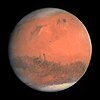
The planet

Its astrological symbol
Mars is marked allegro and is in a relentless 5
4 ostinato for most of its duration. It opens quietly, the first two bars played by percussion, harp and col legno strings.[27] The music builds to a quadruple-forte, dissonant climax.[28] Although Mars is often thought to portray the horrors of mechanised warfare, it was completed before the First World War started. The composer Colin Matthews writes that for Holst, Mars would have been «an experiment in rhythm and clashing keys», and its violence in performance «may have surprised him as much as it galvanised its first audiences».[29] Short comments, «harmonic dissonances abound, often resulting from clashes between moving chords and static pedal-points», which he compares to a similar effect at the end of Stravinsky’s The Firebird, and adds that although battle music had been written before, notably by Richard Strauss in Ein Heldenleben, «it had never expressed such violence and sheer terror».[30]
2. Venus, the Bringer of Peace[edit]
The second movement begins adagio in 4
4.[31] According to Imogen Holst, Venus «has to try and bring the right answer to Mars».[32] The movement opens with a solo horn theme answered quietly by the flutes and oboes. A second theme is given to solo violin. The music proceeds tranquilly with oscillating chords from flutes and harps, with decoration from the celesta.[32] Between the opening adagio and the central largo there is a flowing andante section in 3
4 with a violin melody (solo then tutti) accompanied by gentle syncopation in the woodwind. The oboe solo in the central largo is one of the last romantic melodies Holst allowed himself before turning to a more austere manner in later works.[32] Leo called the planet «the most fortunate star under which to be born»;[33] Short calls Holst’s Venus «one of the most sublime evocations of peace in music».[34]
3. Mercury, the Winged Messenger[edit]


Mercury is in 6
8 and is marked vivace throughout.[35] The composer R. O. Morris thought it the nearest of the movements to «the domain of programme music pure and simple … it is essentially pictorial in idea. Mercury is a mere activity whose character is not defined».[36] This movement, the last of the seven to be written, contains Holst’s first experiments with bitonality.[37] He juxtaposes melodic fragments in B♭ major and E major, in a fast-moving scherzo. Solo violin, high-pitched harp, flute and glockenspiel are prominently featured. It is the shortest of the seven movements, typically taking between 3½ and 4 minutes in performance.[38]
4. Jupiter, the Bringer of Jollity[edit]


In this movement Holst portrays Jupiter’s supposedly characteristic «abundance of life and vitality» with music that is buoyant and exuberant.[10] Nobility and generosity are allegedly characteristics of those born under Jupiter, and in the slower middle section Holst provides a broad tune embodying those traits.[10] It has been compromised by its later use as the melody for a solemn patriotic hymn, «I Vow to Thee, My Country»,[13][n 5] but the music writer Lewis Foreman comments that the composer did not think of it in those terms, as shown by his own recordings of the movement.[39] The opening section of the movement is marked allegro giocoso, in 2
4 time.[40] The second theme, at the same tempo, is in 3
4 time, as is the broad melody of the middle section, marked andante maestoso, which Holst marks to be taken at half the speed of the opening section.[41] The opening section returns and after a reappearance of the maestoso tune – its expected final cadence unresolved, as in its first appearance – the movement ends with a triple forte quaver chord for the full orchestra.[42]
5. Saturn, the Bringer of Old Age[edit]


Saturn was Holst’s favourite movement of the suite.[29] Matthews describes it as «a slow processional which rises to a frightening climax before fading away as if into the outer reaches of space».[29] The movement opens as a quiet adagio in 4
4 and the basic pace remains slow throughout, with short bursts of animato in the first part and a switch to andante in 3
2 in the later section.[43] Apart from the timpani no percussion is used in this movement except for tubular bells at climactic points.[44] At the beginning, flutes, bassoons and harps play a theme suggesting a ticking clock.[44] A solemn melody is introduced by the trombones (Holst’s own main instrument) and taken up by the full orchestra.[45] A development of the ticking theme leads to a clangorous triple forte climax, after which the music dies away and ends quietly.[46]
6. Uranus, the Magician[edit]
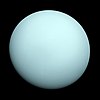

Matthews describes the character of the movement as that of «a clumsy dance, which gradually gets more and more out of hand (not unlike Dukas’s Sorcerer’s Apprentice) until, with what seems like a magic wand, all is abruptly swept away into the far distance».[29][n 6] The movement, which begins with a what Short calls «a tremendous four-note brass motif»,[47] is marked allegro in 6
4. The music proceeds in «a series of merry pranks» with occasional interjections in 9
4, building to a quadruple forte climax with a prominent organ glissando,[48] after which the music suddenly drops to a pianissimo lento before alternating quick and slow sections bring the movement to its pianissimo conclusion.[49]
7. Neptune, the Mystic[edit]

Opening bars: piccolo (top), 2 flutes, bass flute, oboes


The music of the last movement is quiet throughout, in a swaying, irregular metre, opening with flutes joined by piccolo and oboes, with harps and celesta prominent later. Holst makes much use of dissonance in this movement. Before the premiere his colleague Geoffrey Toye said that a bar where the brass play chords of E minor and G♯ minor together was «going to sound frightful». Holst agreed, and said it had made him shudder when he wrote it down but, «What are you to do when they come like that?»[50] As the movement develops, the orchestra is joined by an offstage female chorus singing a soft wordless line: this was unusual in orchestral works at the time, although Debussy had used the same device in his Nocturnes (1900).[51] The orchestra falls silent and the unaccompanied voices bring the work to a pianissimo conclusion in an uncertain tonality, as a door between the singers and the auditorium is gradually closed.[n 7]
Reception[edit]

Holst’s inscription on Boult’s copy of the score
Imogen Holst wrote of the 1918 premiere under Boult:
Even those listeners who had studied the score for months were taken aback by the unexpected clamour of Mars. During Jupiter the charwomen working in the corridors put down their scrubbing-brushes and began to dance. In Saturn the isolated listeners in the dark, half-empty hall felt themselves growing older at every bar. But it was the end of Neptune that was unforgettable, with its hidden chorus of women’s voices growing fainter and fainter in the distance, until the imagination knew no difference between sound and silence.[54]
When the music was first introduced to the general public in February 1919, critical opinion was divided. Greene prints a summary of reviews of the first four public performances of the suite (or movements from it) in February and November 1919 and October and November 1920. Positive reviews are recorded in 28 of the 37 papers, magazines and journals cited.[55] A small minority of reviewers were particularly hostile, among them those of The Globe («Noisy and pretentious)»;[56] The Sunday Times («Pompous, noisy and unalluring»),[57] and The Times («a great disappointment … elaborately contrived and painful to hear»).[n 8] The critic in The Saturday Review wrote that Holst evidently regarded the planets «as objectionable nuisances that he would oust from our orbit if he could».[59]
The Times rapidly changed its mind; in July 1919 it called Holst the most intriguing of his compeers and commented, «The Planets still leaves us gasping»;[60] after hearing Holst conduct three of the movements in November 1919 the paper’s critic declared the piece «the first music by an Englishman we have heard for some time which is neither conventional nor negligible»,[57] and by the time of Holst’s death in 1934 the paper’s assessment of the piece was «Holst’s greatest work»:
Each of the seven numbers shows one aspect of life regarded with a detached and unflinching scrutiny. In this suite Holst, with the directness which was characteristic of his personal intercourse and character, and which comes out in spite of all his mysticism in the technique of his music, sets forth with every elaboration his fundamentally simple view of what life brings. The work is original in conception, in its philosophical implications, in its scoring, and in its harmonic and rhythmic idiom.[61]
The Sunday Times, too, quickly changed its line. In 1920 its new music critic, Ernest Newman, said that Holst could do «easily, without a fuss» what some other composers could only do «with an effort and a smirk», and that in The Planets he showed «one of the subtlest and most original minds of our time. It begins working at a musical problem where most other minds would leave off».[62] Newman compared Holst’s harmonic innovations to those of Stravinsky, to the latter’s disadvantage, and expressed none of the reservations that qualified his admiration of Schoenberg’s Five Pieces for Orchestra.[57]
Recordings[edit]
There have been at least 80 commercial recordings of The Planets.[63] Holst conducted the London Symphony Orchestra in the first two recorded performances: the first was an acoustic recording made in sessions between September 1922 and November 1923;[64] the second was made in 1926 using the new electrical recording process.[65] Holst’s tempi are in general faster than those of most of his successors on record. This may have been due to the need to fit the music on 78 rpm discs, although later 78 versions are slower. Holst’s later recording is quicker than the acoustic version, possibly because the electrical process required wider grooves, reducing the available playing time.[66] Other, slower, recordings from the 78 era include those conducted by Leopold Stokowski (1943)[67] and Sir Adrian Boult (1945).[68] Recordings from the LP age are also typically longer than the composer’s, but from the digital era a 2010 recording by the London Philharmonic Orchestra conducted by Vladimir Jurowski is quicker than Holst’s acoustic version and comes close to matching his 1926 speeds, and in two movements (Venus and Uranus) surpasses them.[69] There were no commercial recordings of the work in the 1930s; timings are given below of a recording representing each subsequent decade up to the 2010s:
- Source: Naxos Music Library.[70]
Additions, adaptations and influences[edit]

Pluto

Its astrological symbol
There have been many adaptations of the suite, and several attempts to add an eighth planet – Pluto – in the time between its discovery in 1930 and its downgrading to «dwarf planet» in 2006. The most prominent of these was Matthews’s 2000 composition, «Pluto, the Renewer», commissioned by the Hallé Orchestra. Dedicated posthumously to Imogen Holst, it was first performed in Manchester on 11 May 2000, with Kent Nagano conducting. Matthews changed the ending of Neptune slightly so that the movement would segue into Pluto.[71] Matthews’s Pluto has been recorded, coupled with Holst’s suite, on at least four occasions.[n 9] Others who have produced versions of Pluto for The Planets include Leonard Bernstein and Jun Nagao.[73]
The suite has been adapted for numerous instruments and instrumental combinations, including organ, synthesiser, brass band, and jazz orchestra.[74] Holst used the melody of the central section of «Jupiter» for a setting («Thaxted») of the hymn «I Vow to Thee, My Country» in 1921.[n 5]
The Planets has been taken as an influence by various rock bands, and for film scores such as those for the Star Wars series. There have been numerous references to the suite in popular culture, from films to television and computer games.[78]
Notes, references and sources[edit]
Notes[edit]
- ^ Holst’s earlier interest in Sanskrit texts, particularly the Rig Veda hymns, had led him to study the language and to compose several works based on Sanskrit texts.[3]
- ^ Short and the musicologist David Lambourn both comment that Holst’s original title for his suite was «Seven Pieces for Large Orchestra».[8]
- ^ This was the first public performance of Venus.[20]
- ^ This was the first time Neptune was heard in a public performance.[22]
- ^ a b In 1986 Imogen Holst wrote that for more than half a century «the main problem in Jupiter has been the difficulty of avoiding unwanted associations with the hymn».[75] Holst’s closest friend, Ralph Vaughan Williams,[76] was, inadvertently, partly to blame for the use of the tune as a solemn hymn. He had suggested that Cecil Spring-Rice’s verse should be set to music, and Holst was asked to undertake the job. Being overworked and exhausted at the time, Holst, spotting that the words fitted the maestoso tune from Jupiter, repurposed that rather than write a new one.[77]
- ^ Short writes that despite reminiscences of the Pan motif in Ravel’s Daphnis et Chloé and of Berlioz’s Symphonie fantastique and the «Infernal Dance» in Stravinsky’s The Firebird the main influence on the movement is clearly The Sorcerer’s Apprentice, which was first performed in London in 1899 and was «doubtless well known to Holst».[47]
- ^ The choir sings alternating C minor and E major chords, and the musician David Owen Norris has commented that as the door shuts it is pure chance whether the last chord heard is C minor (looking back at the key of Mars) or E.[52] In a 2014 article William Weir suggests that the closing bars of Neptune are an early precursor of the electronic fade-out that became ubiquitous in recordings of popular music in the 1950s to the 1980s.[53]
- ^ The anonymous critic was equally dismissive of Ravel’s Rapsodie espagnole given at the same concert.[58]
- ^ The Hallé, conducted by Mark Elder (2001); Royal Scottish National Orchestra conducted by David Lloyd-Jones (2002); Royal Philharmonic Orchestra conducted by Owain Arwel Hughes (2004); and Berlin Philharmonic conducted by Sir Simon Rattle (2006).[72]
References[edit]
- ^ a b Greene, p. 27
- ^ Short, p. 113
- ^ Matthews, Colin. «Holst, Gustav(us Theodore von)», Grove Music Online, Oxford University Press, 2001. Retrieved 18 June 2021 (subscription required) Archived 13 March 2020 at the Wayback Machine
- ^ Quoted in Holst (1981), p. 48
- ^ Bax, pp. 60–61
- ^ a b Holst (1986), p. 32
- ^ Short, p. 119; and Greene, p. 18
- ^ a b Lambourn, David. «Henry Wood and Schoenberg», The Musical Times , August 1987, pp. 422–427 (subscription required) Archived 20 June 2021 at the Wayback Machine
- ^ Short, p. 121
- ^ a b c d Short, p. 122
- ^ Leo, p. 58; and Head, Raymond. «Holst – Astrology and Modernism in ‘The Planets’», Tempo , December 1993, pp. 15–22 (subscription required)
- ^ Greene, p. 19
- ^ a b Warrack, John. «Holst, Gustav Theodore» Archived 20 June 2021 at the Wayback Machine, Oxford Dictionary of National Biography, Oxford University Press, 2011. Retrieved 18 June 2021 (subscription or UK public library membership required)
- ^ Holst (1981), p. 50
- ^ a b Boult (1973) p. 35
- ^ Holst (1986), p. 159
- ^ «London Concerts», The Musical Times, April 1919, p. 179 (subscription required) Archived 22 January 2019 at the Wayback Machine
- ^ Kennedy, p. 68
- ^ Holst (1974), p. 125
- ^ «London Concerts», The Musical Times, January 1920, p. 32 (subscription required) Archived 7 March 2016 at the Wayback Machine
- ^ «Music in the Provinces» Archived 22 January 2019 at the Wayback Machine, The Musical Times, 1 November 1920, p. 769; and «Municipal Music in Birmingham», The Manchester Guardian, 11 October 1920, p. 6
- ^ «London Concerts»‘The Musical Times, December 1920, p. 821 (subscription required) Archived 22 January 2019 at the Wayback Machine
- ^ «Winter Concerts: Plan for Season», The Times, 17 September 1923, p. 10; and «Music», The Observer, 14 October 1923, p. 10
- ^ Vaughan Williams, Ralph. «Gustav Holst (Continued)», Music & Letters , October 1920, p. 314 (subscription required)
- ^ «Combined part of 3rd and 4th flute» (PDF). Archived from the original (PDF) on 25 December 2017. Retrieved 6 December 2013.
- ^ Holst (1921), unnumbered introductory page
- ^ Holst (1921), pp. 1–2
- ^ Holst (1921), p. 29
- ^ a b c d Matthews, Colin (2011). Notes to Chandos CD CHSA5086 OCLC 887360432
- ^ Short, pp. 123–124
- ^ Holst (1921), p. 32
- ^ a b c Holst (1986), p. 34
- ^ Greene, p. 47
- ^ Short, p. 126
- ^ Holst (1921), pp. 44–72
- ^ Quoted in Greene, p. 52
- ^ Holst (1986), pp. 34–35
- ^ Notes to Cala CD CACD0526 OCLC 46880671; Notes to Avid CD AMSC 582 OCLC 45217594; and Notes to LPO CD LPO-0047 OCLC 871404142
- ^ Foreman, Lewis (2001). Notes to Hyperion CD 55350-B OCLC 276175700
- ^ Holst (1921), p. 78
- ^ Holst (1921), p. 91
- ^ Holst (1921), p. 112
- ^ Holst (1921), pp. 113 and 122
- ^ a b Holst (1921), p. 113
- ^ Holst (1921), pp. 113–115
- ^ Holst (1921), p. 131
- ^ a b Short, pp. 130–131
- ^ Holst (1921), p. 159
- ^ Holst (1921), pp. 160–161
- ^ Boult (1979), p. 32
- ^ Short, p. 131
- ^ Norris, David Owen. «The Planets», Building a Library, BBC Radio 3 podcast, retrieved 9 July 2021. Event occurs at 46m 15s
- ^ Weir William. «A Little Bit Softer Now, a Little Bit Softer Now …», Slate, 14 September 2014. Retrieved 20 June 2021
- ^ Holst (2008), pp. 52–53
- ^ Greene, pp. 34–35
- ^ «Royal Philharmonic Society», The Globe, 1 March 1919, p. 13
- ^ a b c Greene, p. 32
- ^ «Royal Philharmonic Society», The Times, 28 February 1919, p. 14
- ^ «Some eminent pianists compared», The Saturday Review, 8 March 1919, p. 224
- ^ «The Prince of Wales at the R.C.M.», The Times, 5 July 1919, p. 15
- ^ «Mr Gustav Holst», The Times, 26 May 1934, p. 7
- ^ Newman, Ernest. «The Week’s Music», The Sunday Times, 21 November 1920, p. 7
- ^ «The Planets» Archived 20 June 2021 at the Wayback Machine, WorldCat. Retrieved 19 June 2021
- ^ Short, pp. 204 and 215
- ^ Holst (1986), p. 143
- ^ Short, p. 247
- ^ Notes to Cala CD CACD0526 OCLC 46880671
- ^ Notes to Avid CD AMSC 582 OCLC 45217594
- ^ Notes to LPO CD LPO-0047 OCLC 871404142
- ^ «The Planets», Naxos Music Library. Retrieved 18 June 2021 (subscription required) «Archived copy». Archived from the original on 20 June 2021. Retrieved 20 June 2021.
{{cite web}}: CS1 maint: archived copy as title (link) CS1 maint: bot: original URL status unknown (link) - ^ Scott Rohan, Michael, Review, Gramophone, August 2001, p. 50
- ^ Respectively, OCLC 52986761, OCLC 58975552, OCLC 1022851419 and OCLC 760128838
- ^ Scott Rohan, Michael, Review, Gramophone, August 2001, p. 50; Hambrick, Jennifer. «The Missing Planet: Watch Leonard Bernstein Improvise ‘Pluto, the Unpredictable’«. WOSU Public Media. WOSU Radio. Archived from the original on 12 January 2019. Retrieved 12 January 2019.; and «Earth, The, from «The Planets» by Trouvère». Wind Repertory Project. Retrieved 6 July 2019.
- ^ Holst: Music for Two Pianos, Naxos catalogue no. 8.554369, About This Recording Archived 4 July 2009 at the Wayback Machine; Peter Sykes. » Holst: The Planets Archived 29 September 2011 at the Wayback Machine.» HB Direct, Released 1996; «Peter Sykes». Peter Sykes. Archived from the original on 2 November 2013. Retrieved 6 December 2013.; Isao Tomita. » Tomita’s Planets Archived 19 August 2010 at the Wayback Machine.» HB Direct, Released 1976; Stephen Roberts Archived 14 June 2009 at the Wayback Machine at 4barsrest.com;«DownBeat Reviews». downbeat.com. Archived from the original on 24 September 2020. Retrieved 17 March 2021.
- ^ Holst (1986), p. 144
- ^ Vaughan Williams, p. 200
- ^ Short, p. 197; and Holst (1986), p. 137
- ^ «King Crimson – Mars». Paste Magazine. Archived from the original on 10 April 2017. Retrieved 10 April 2017.;«Archived copy». Archived from the original on 25 August 2012. Retrieved 27 July 2017.
{{cite web}}: CS1 maint: archived copy as title (link); Shobe, Michael and Kim Nowack. «The Classical Music Influences Inside John Williams’ ‘Star Wars’ Score,» Archived 3 July 2017 at the Wayback Machine WQXR (Dec 17, 2015)
Sources[edit]
- Bax, Clifford (1936). Ideas and People. London: Lovat Dickson. OCLC 9302579.
- Boult, Adrian (1973). My Own Trumpet. London: Hamish Hamilton. ISBN 978-0-24-102445-4.
- Boult, Adrian (1979). Music and Friends. London: Hamish Hamilton. ISBN 978-0-24-110178-0.
- Greene, Richard (1995). Holst: The Planets. Cambridge: Cambridge University Press. ISBN 978-0-52-145000-3.
- Holst, Gustav (1921). The Planets: Suite for Large Orchestra. London: Boosey & Hawkes. OCLC 873691404.
- Holst, Imogen (1974). A Thematic Catalogue of Gustav Holst’s Music. London: Faber & Faber. ISBN 978-0-57-110004-0.
- Holst, Imogen (1981). Holst. London: Faber & Faber. ISBN 978-0-57-118032-5.
- Holst, Imogen (1986). The Music of Gustav Holst. Oxford and New York: Oxford University Press. ISBN 978-0-19-315458-2.
- Holst, Imogen (2008) [1969]. Gustav Holst: A Biography (second ed.). London: Faber & Faber. ISBN 978-0-571-24199-6.
- Kennedy, Michael (1987). Adrian Boult. London: Hamish Hamilton. ISBN 978-0-33-348752-5.
- Leo, Alan (1905). What is a Horoscope and How is it Cast? (second ed.). London: Modern Astrology. OCLC 561872689.
- Short, Michael (1990). Gustav Holst: The Man and his Music. Oxford and New York: Oxford University Press. ISBN 978-0-19-314154-4.
- Vaughan Williams, Ursula (1964). RVW: A Biography of Ralph Vaughan Williams. Oxford: Oxford University Press. ISBN 978-0-19-315411-7.
External links[edit]
- Links to public domain scores of The Planets:
- The Planets: Scores at the International Music Score Library Project
- The Planets: Suite for Large Orchestra (Score in the Public Domain)
Gustav Holst: The Planets Suite Essay, Research Paper
Gustav Holst: The Planets Suite
Music derived from astrology is surprisingly rare. The ancient Greek philosophers, whatever their intellectual attitudes towards astrology may have been, were certainly not ignorant of astrological teachings and ideas. It was they, after all who put forward the idea of the “Music of the Spheres”, the idea that these vast objects twirling around and whirling through space, must have hummed a tone as they went along their courses, much as a ball spun on a string will whistle. They knew of seven planets: Sun, Moon, Mercury, Venus, Mars, Jupiter, and Saturn. Not surprisingly, western music evolved with seven-tone scales. Music and astrology come together again in this suite devoted to the seven planets, though Uranus and Neptune have displaced the Sun and Moon. Gustav Holst (1874-1934) was apparently fascinated by various esoteric pursuits, such as astrology and Hindu philosophy, suggesting in particular a yearning to get to grips with matters of a spiritual nature. How far he got in this pursuit is unclear, but what is quite beyond doubt is the fact that The Planets is a deeply spiritual work, reaching a level of spirit expression that is rarely experienced in other works. Even without this added strength, the whole work is a sonic spectacle and has so many wonderfully exotic harmonies. Coloration, dramatic contrast and inventiveness make this the work of a genius. It was first performed in the autumn of 1918.
Bodine 2
Gustav Holst (1874-1934) was a contemporary composer, who is best known for his composition, “The Planets”. He was born in Cheltenham, Gloucestershire, in western England. He was an organist and choirmaster at the local Gloucestershire church, but he had neuritis in his right hand, which kept him from playing the organ. Since his neuritis kept him from playing the organ, Holst then turned to the trombone. From 1895 to 1898, he studied composition at the Royal College of Music. He eventually became an orchestral trombonist, after teaching composition at Stanford University for some time. In 1905, Holst was chosen as the Director of Music at the St. Paul’s Girl’s School in Hammersmith, just west of London, which he did for almost of the rest of his life. One of Holst’s contemporaries and good friends was the noted composer Ralph Vaughan Williams. They often wrote letters, exchanging critiques and ideas. Holst had a wife, Isobel, and a daughter, Imogen.
Holst’s most famous work, The Planets, is a seven-movement orchestral suite. Each movement represents a different planet in our solar system. Since The Planets is a work based on astrology, the Earth is ignored in the movements. It should also be noted that this piece was also written before Pluto was discovered, thus it only contains seven movements.
The first movement, Mars, the Bringer of War emphasizes bass and low brass using an unusual 5/4 rhythm. The greatest moment in war-torn Mars comes shortly before the end as the orchestra rises to a massive climax, supported by organ and gong. It is a moment of sheer terror, transformed into a still darker terror, as the same two-note motif is repeated in a lower register but still highly dissonant. This is the first ’spiritual’
Bodine 3
moment of the work, in my opinion: the wrath of God at the warring, sinful nature of Man and the consequences of this, as I see it. Holst brings the full horror of mechanized warfare to the listener face to face in this bleakest of all tone poems. Its face is unrepentant, unrelenting, and merciless and it offers us no hope of redemption. Thousands of pairs of jackbooted feet parade across the landscape, hurrying to their graves. Tanks pound cities into rubble. Bullets fly and bombs fall. Airplanes swoop low overhead. How surprising it is then, to learn that Holst completed this piece long before the opening of the First World War, before the invention of the tank, before any plane had ever been fitted out to carry bombs, before the slaughter in the trenches, and before the invention of poison gas.
The second movement, Venus, the Bringer of Peace is, as its title suggests, a softer and more melodious movement. Venus is peaceful with beautiful and unusual harmonies, but here I find little of a ’spiritual’ nature to comment upon. The very picture of beauty and refinement in taste, this is the Venus of ancient Rome: a sprite of gardens and flowers, feminine yet tame and without guile or wiles. This provides the counterpoint to the unshackled violence of Mars.
The third movement, Mercury, the Winged Messenger contains a swift and roaming melody. Fleet-footed Mercury flits about through this piece sounding not unlike a cosmic butterfly. He belongs very much in the Garden of Venus that precedes him in the performance.
The fourth movement, Jupiter, the Bringer of Jollity emphasizes a moving but unhurried bright melody. Jupiter is a tour-de-force of orchestration and melody, and it is
Bodine 4
quite an inspiration for the listener. The spirit of this music is very much in keeping with the astrological significance of Jupiter as the planet of benevolence and generosity. This is not the adulterous Jupiter of mythology, though flirtation is not out of the question. We hear him chasing but not catching the ladies. He invites all to dance, then seems not to favor any one of them any more than the others – one of those men who loves all women because they are women and for no other reason. The music emerges from its cavorting, twirling and gamboling out onto a central plateau of graceful dance music, and then sinks back into the carefree patterns of before. A very famous poem, near and dear to British hearts, was later set to this music and the two have been inseparable ever since. It was played at the Royal Wedding of Charles and Diana:
And there’s another Country
I’ve heard of long ago,
Most Dear to them that Love her,
most Great to them that Know.
We may not count her Armies.
We may not see her King.
Her Fortress is a faithful Heart;
her Pride is Suffering.
And Soul by Soul and silently,
her shining Bounds increase
And her ways are ways of Gentleness
and all her paths are Peace!
We may not count her Armies.
We may not see her King.
Her Fortress is a faithful Heart;
her Pride is Suffering.
And Soul by Soul and silently,
her shining Bounds increase
And her ways are ways of Gentleness
and all her paths are Peace!
Bodine 5
The fifth movement, Saturn, the Bringer of Old Age has a slow, calm, and quiet melody, restful in its lethargy. Saturn represents old age and our mortality very effectively. The opening is made to plod along tragically slowly, as if there is nothing left but to wait for death to come. The music builds to a stern climax that breaks off suddenly to the skeletal discordant bell-tolls as death arrives. This fades leaving us temporarily in an eerie stopover world. Suddenly the mood is transformed as the listener is now taken to an ethereal and magical ‘heaven’. Holst is clearly making a spiritual statement in Saturn about the process of death and the certainty of a ‘heaven’ (he may have thought more of a cosmical union perhaps). Within the magical heaven, very deep bass tones from the organ are giving a solid floor to the sound, and we become aware (when listening spiritually) of the presence of some great ‘being’, whose universe we’ve now entered. Just a few bars from the end, the deep organ pedal is raised by a perfect fifth – a tremendously spiritual moment which for the listener is like a brief vision of God. Serene and deliberate are the words best describing the tone of this piece. We can hear Saturn coming in from a long ways off, with a steady yet plodding gait and with a steady yet plodding gait he comes, as surely as the frost and winter follow upon the summer, as surely as the evening follows the afternoon, as inevitable as death and taxes. Yet, when he arrives, we find him not nearly so dreadful as his heavy steps led us to believe. The deliberation is still there, the uncompromising observance of structures and the law, yet what he creates for us is not without its beauty, crystalline like the snowflakes, serene in the stoic acceptance of his own mortality and finitude, content with the meaning he finds there.
Bodine 6
The sixth movement, Uranus, the Magician portrays musically a misty, distant heavenly body. Uranus is said to be a sonic spectacle and a sense of mischief abounds. This is not the god Uranus of mythology we meet here, but Uranus as the ruler of Aquarius. This magician is bumbling and accident prone, but also a born performer who cannot resist just one more try, one more kick at the cat, before the men in white suits come to take him away – but this veil of eccentricity cloaks deep wisdom and a knowledge of the infinite. On the last try, he gets it right and we hear the opening of the doorway into eternity.
Finally, we come to Neptune, the Mystic; a truly extraordinary movement. We are transported unimaginable distances from the earth, into awe-inspiring nether regions of the universe, detached from all things familiar in worlds of unending mystery. This is profoundly spiritual music, yet I’m not sure what it succeeds in saying. It is perhaps a vision of infinite nothingness, of vast distances, of space. Above all, the warm, assured presence of God (if perhaps also powerful and fear-provoking), which we left in Saturn, has disappeared. Neptune is cold, and as the female choir fades away, it is a lonely place. Much like Uranus, Neptune, the Mystic portrays musically a misty, distant heavenly body that includes a choral section, singing wordless melodies. This is the eternity that Uranus has revealed to us. The chasm opens and we step out into the void. We have a sense of a floating cascade through empty space, through Neptune’s watery depths. Celestial harmonies surround us and we hear choirs of angels receding into the distance.
In conclusion, I would like to state why I chose this work of Holst’s for my final Contemporary Music History paper. The Planets was one of the first orchestral works
Bodine 7
that I was exposed to as a child. My grandmother bought me a classical CD after I decided to take up the Trumpet in private study, which contained The Planets on it. I can’t even begin to describe how taken I was by this piece. It inspired me to start studying music theory and composition, so I could begin to understand how Gustav Holst made this spectacular work. Since then, I have played the suite twice as an orchestral musician. This is a piece that will always be special in my heart, and I know that if I wasn’t exposed to it at such an early age, you might not have seen me in this class, or even at the college, studying music, the real love of my life.
1. Gustav Holst. By Imogen Holst. Oxford University Press (1938, rev. 1969).
2. Gustav Holst, The Man and His Music. By Michael Short. Oxford University Press (1990).
3. A Scrapbook for the Holst Birthplace Museum. Compiled by Imogen Holst.
4. Greene, Richard. Holst, The Planets. Cambridge [England]; New York: Cambridge University Press, 1995.
5. Holst, Imogen. The music of Gustav Holst. London, Oxford U.P., 1968.
6. www.aquarianage.org/lore/holst.html
7. www.best.com/~nebulosa/holst.html
8. www.meteo.physik.uni-muenchen.de/~paul/musem.html#HOLST
This article is about the orchestral suite by Gustav Holst. For the celestial body, see Planet. For the planets in our solar system, see Solar System. For other uses, see Planet (disambiguation).

Gustav Holst
The Planets, Op. 32, is a seven-movement orchestral suite by the English composer Gustav Holst, written between 1914 and 1916. Each movement of the suite is named after a planet of the Solar System and its corresponding astrological character as defined by Holst. With the exception of Earth, which is not observed in astrological practice, all the planets are represented.
From its premiere to the present day, the suite has been enduringly popular, influential, widely performed and the subject of numerous recordings. However, it had a protracted birth. There were four performances between September 1918 and October 1920, but they were all either private (the first performance, in London) or incomplete (two others in London and one in Birmingham). The premiere was at the Queen’s Hall on 29 September 1918, conducted by Holst’s friend Adrian Boult to an invited audience of about 250 people. The first complete public performance was given in London on 15 November 1920, with the London Symphony Orchestra conducted by Albert Coates.
Background
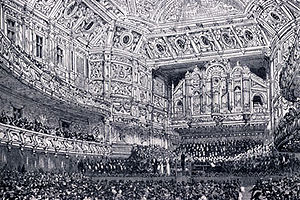
The concept of the work is astrological[1] rather than astronomical (which is why Earth is not included): each movement is intended to convey ideas and emotions associated with the influence of the planets on the psyche, not the Roman deities. The idea of the work was suggested to Holst by Clifford Bax, who introduced him to astrology when the two were part of a small group of English artists holidaying in Majorca in the spring of 1913; Holst became quite a devotee of the subject, and liked to cast his friends’ horoscopes for fun.[1][2] Holst also used Alan Leo’s[1] book What is a Horoscope? as a springboard for his own ideas, as well as for the subtitles (i.e., «The Bringer of…») for the movements.
The Planets as a work in progress was originally scored for a piano duet, except for «Neptune», which was scored for a single organ, as Holst believed that the sound of the piano was too percussive for a world as mysterious and distant as Neptune. Holst then scored the suite for a large orchestra, and it was in this incarnation that it became enormously popular. Holst’s use of orchestration was very imaginative and colourful, showing the influence of Arnold Schoenberg[1] and other continental composers of the day rather than his English predecessors. The influence of the late Russian romantics such as Nikolai Rimsky-Korsakov and Alexander Glazunov is also notable, as it is in Igor Stravinsky’s great early ballets. Its novel sonorities helped make the work an immediate success with audiences at home and abroad. Although The Planets remains Holst’s most popular work, the composer himself did not count it among his best creations and later in life complained that its popularity had completely surpassed his other works. He was, however, partial to his own favourite movement, «Saturn».[3]
Premieres
Just before the Armistice, Gustav Holst burst into my office: «Adrian, the YMCA are sending me to Salonika quite soon and Balfour Gardiner, bless his heart, has given me a parting present consisting of the Queen’s Hall, full of the Queen’s Hall Orchestra for the whole of a Sunday morning. So we’re going to do The Planets, and you’ve got to conduct.»
“
”
Adrian Boult [4]
The orchestral premiere of The Planets suite, conducted at Holst’s request by Adrian Boult, was held at short notice on 29 September 1918, during the last weeks of World War I, in the Queen’s Hall with the financial support of Holst’s friend and fellow composer Henry Balfour Gardiner. It was hastily rehearsed; the musicians of the Queen’s Hall Orchestra first saw the complicated music only two hours before the performance, and the choir for «Neptune» was recruited from pupils from St Paul’s Girls’ School (where Holst taught). It was a comparatively intimate affair, attended by around 250 invited associates,[2][5][6] but Holst regarded it as the public premiere, inscribing Boult’s copy of the score, «This copy is the property of Adrian Boult who first caused the Planets to shine in public and thereby earned the gratitude of Gustav Holst.»[4]
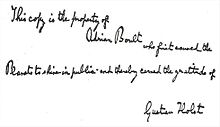
Holst’s inscription on Boult’s score
A public concert was given in London under the auspices of the Royal Philharmonic Society on 27 February 1919, conducted by Boult. Five of the seven movements were played in the order Mars, Mercury, Saturn, Uranus, and Jupiter.[7][8]It was Boult’s decision not to play all seven movements at this concert. He felt that when the public were being given a totally new language like that, «half an hour of it was as much as they could take in». See Kennedy, p. 68. The anonymous critic in Hazell’s Annual called it «an extraordinarily complex and clever suite». [9]At a Queen’s Hall symphony concert on 22 November of that year, Holst conducted Venus, Mercury and Jupiter (this was the first public performance of Venus).[10][8] There was another incomplete public performance, in Birmingham, on 10 October 1920, with five movements (Mars, Venus, Mercury, Saturn and Jupiter). It is not clear whether this performance was conducted by Appleby Matthews[11] or the composer.[12] The composer conducted a complete performance for the first time on 13 October 1923, with the Queen’s Hall Orchestra at a Promenade Concert. His daughter recalled, » He hated incomplete performances of The Planets, though on several occasions he had to agree to conduct three or four movements at Queen’s Hall concerts. He particularly disliked having to finish with Jupiter, to make a ‘happy ending’, for, as he himself said, ‘in the real work the end is not happy at all’».[13]
The first complete performance of the suite at a public concert did not occur until 15 November 1920; the London Symphony Orchestra (LSO) was conducted by Albert Coates. This was the first time the movement «Neptune» had been heard in a public performance, all the other movements having been given earlier public airings.[14]
Holst conducted the LSO himself, in two recorded performances of The Planets: the first was an acoustic recording made in sessions between 1922 and 1924 (now available on Pavilion Records’ Pearl label); the second was made in 1926, and utilised the then-new electrical recording process (in 2003, this was released on compact disc by IMP and later on Naxos outside the United States).[15] Because of the time constraints of the 78rpm format, the tempi are often much faster than is usually the case today.[16]
Instrumentation
The work is scored for an extremely large orchestra:
- Woodwind: 4 flutes (3rd doubling 1st piccolo; 4th doubling 2nd piccolo and a «bass flute in G», actually an alto flute), 3 oboes (3rd doubling bass oboe), an English horn, 3 clarinets in B-flat, a bass clarinet in B-flat, 3 bassoons and a contrabassoon
- Brass: 6 horns in F, 4 trumpets in C, 3 trombones (2 tenor and 1 bass), a «tenor tuba» (euphonium in B-flat) and a bass tuba
- Keyboards: a celesta, and an organ
- Percussion: 6 timpani (2 players, 3 drums each except in «Uranus» having 4 drums for 1st and 2 drums for 2nd), a bass drum, a snare drum, cymbals, a triangle, a tam-tam, a tambourine, a glockenspiel, a xylophone, and tubular bells
- Strings: 2 harps, 1st and 2nd violins, violas, violoncellos, and double basses
- Voices: («Neptune» only), 2 three-part women’s choruses (SSA) located in an adjoining room which is to be screened from the audience
Structure
The suite has seven movements, each named after a planet and its corresponding astrological character (see Planets in astrology):
- Mars, the Bringer of War
- Venus, the Bringer of Peace
- Mercury, the Winged Messenger
- Jupiter, the Bringer of Jollity
- Saturn, the Bringer of Old Age
- Uranus, the Magician
- Neptune, the Mystic
Holst’s original title (clearly seen on the handwritten full score) was «Seven Pieces for Large Orchestra». The composer’s name was given as Gustav von Holst — by the time he wrote «Mercury» in 1916 he had dropped the ‘von’, for he signed the score of that movement separately as Gustav Holst. The movements were called only by the second part of each title (I «The Bringer of War», II «The Bringer of Peace» and so on). The present titles were added in time for the first (incomplete) public performance in September 1919, though they were never added to the original score..[17] It is perhaps instructive to realise Holst attended an early performance of Schoenberg’s «Five Orchestral Pieces» in 1914 (the year he wrote «Mars», «Venus» and «Jupiter») and owned a score of it.[18][19]
A typical performance of all seven movements lasts for about fifty minutes. Some commentators have suggested that the ordering is structural, with the anomaly of Mars, Venus, Mercury, instead of the reverse, being a device to make the first four movements match the form of a symphony.[citation needed] An alternative explanation may be the ruling of astrological signs of the zodiac by the planets: if the signs are listed along with their ruling planets in the traditional order starting with Aries, ignoring duplication, Pluto (then undiscovered) and the luminaries (the Sun and Moon), the order of the movements corresponds. Another possibility, this time from an astronomical perspective, is that the first three movements, representing the inner terrestrial planets, are ordered by decreasing distance from the Sun; the remaining movements, representing the gas giants, are ordered by increasing distance from the Sun. Critic David Hurwitz offers an alternative explanation for the piece’s structure: that «Jupiter» is the centrepoint of the suite and that the movements on either side are in mirror images. Thus «Mars» involves motion and «Neptune» is static; «Venus» is sublime while «Uranus» is vulgar, and «Mercury» is light and scherzando while «Saturn» is heavy and plodding. This hypothesis is lent credence by the fact that the two outer movements, «Mars» and «Neptune», are both written in rather unusual quintuple metre.
A more prosaic explanation may simply be that Holst wrote the movements in the order they stand, with one exception, and that the only structural change was to place «Mercury» third. «Mars», «Venus» and «Jupiter» were from 1914, «Saturn», «Uranus» and «Neptune» from 1915 and «Mercury» from 1916. It has been speculated that «Mars» was a response to the outbreak of World War I, but Holst denied this, saying that «Mars» was completed before war was expected, and in August 1914 he was half-way through «Venus». Nevertheless, «Mars» is seen as prescient of mechanical warfare, something that was not a reality until after the entire suite was complete. Contrary to what is also sometimes said, Holst was not a pacifist but wanted to enlist as his friend Vaughan Williams did, but he was rejected as unfit: he suffered neuritis in his right arm—something that caused him to seek help from several amanuenses in scoring The Planets. This is clear from the number of different hands apparent in the full score.[17]
«Neptune» was one of the first pieces of orchestral music to have a fade-out ending, although several composers (including Joseph Haydn in the finale of his Farewell Symphony) had achieved a similar effect by different means. Holst stipulates that the women’s choruses are «to be placed in an adjoining room, the door of which is to be left open until the last bar of the piece, when it is to be slowly and silently closed», and that the final bar (scored for choruses alone) is «to be repeated until the sound is lost in the distance».[20] Although commonplace today, the effect bewitched audiences in the era before widespread recorded sound—after the initial 1918 run-through, Holst’s daughter Imogen (in addition to watching the charwomen dancing in the aisles during «Jupiter») remarked that the ending was «unforgettable, with its hidden chorus of women’s voices growing fainter and fainter… until the imagination knew no difference between sound and silence».[2]
Pluto
Pluto was discovered in 1930, four years before Holst’s death, and was hailed by astronomers as the ninth planet. Holst, however, expressed no interest in writing a movement for the new planet. He had become disillusioned by the popularity of the suite, believing that it took too much attention away from his other works.[21]
In 2000, the Hallé Orchestra commissioned the English composer Colin Matthews, an authority on Holst, to write a new eighth movement, which he called «Pluto, the Renewer». Dedicated to the late Imogen Holst, Gustav Holst’s daughter, it was first performed in Manchester on 11 May 2000, with Kent Nagano conducting the Hallé Orchestra. Matthews also changed the ending of «Neptune» slightly so that movement would lead directly into «Pluto».[22]
Six years later, in August 2006, the International Astronomical Union promulgated for the very first time a definition of the term «planet», which resulted in Pluto’s status being demoted from planet to dwarf planet.[23] Consequently, Holst’s original work is once again a complete representation of all of the extraterrestrial planets in the Solar System.
Recordings
Main article: The Planets discography
Adaptations of The Planets
Non-orchestral arrangements
- Organ – Morgan Fisher used the main theme from «Jupiter» for the intro of the song «Nova Solis» in 1972.
- Drum and bugle corps – Several drum and bugle corps have performed The Planets, most notably in 1995 when The Cavaliers won the Drum Corps International world championship.
- Piano duet (four hands) – An engraved copy of Holst’s own piano duet arrangement was found by John York.[24]
- Two pianos (duo) – Holst also created a version for two pianos. When he was composing the duo, he had two friends play the four-hands version to aid in the transcription.[25] The two-piano arrangement was published in 1949. Holst’s original manuscripts for it are now in the holdings of the Royal College of Music («Mars», «Venus», «Saturn», «Uranus», «Neptune»), Royal Academy of Music («Mercury») and British Library («Jupiter», «Saturn», «Uranus»).[26]
- Organ – Peter Sykes transcribed The Planets for organ.[27]
- Moog – Isao Tomita adapted The Planets for a Moog and other synthesizers and electronic devices.[28]
- Brass band – Stephen Roberts, associate conductor of the English Symphony Orchestra, transcribed the entire suite for brass band.[29]
- Marching band – The movements «Mars», «Venus», and «Jupiter» have all been arranged for marching band by Jay Bocook.[30] Paul Murtha also arranged the chorale section of «Jupiter» for marching band.[31]
- Percussion ensemble – James Ancona arranged Mercury for a percussion ensemble. It consisted of 2 glockenspiels, 2 xylophones, 2 vibraphones, 2 marimbas, 5 timpani, a small suspended cymbal, and 2 triangles.[32]
- Rock bands – An arrangement of «Mars» by progressive-rock trio Emerson, Lake & Powell appeared on their eponymous album (1985) and was played in their 1985–86 live shows.
King Crimson, Greg Lake’s first successful band performed a rock arrangement of «Mars» live in 1969. This arrangement was issued on their second LP, In the Wake of Poseidon, although for copyright reasons it was renamed «The Devil’s Triangle» and Robert Fripp claimed authorship, with Holst receiving no composer credit.
A third progressive-rock band, Manfred Mann’s Earth Band, performed an arrangement of «Jupiter» with lyrics which they entitled «Joybringer».
Black Metal/Viking Metal band Bathory arranged a section of «Jupiter» as the melody of the song «Hammerheart», from the album Twilight of the Gods. The rock group Sands recorded an abridged version of «Mars» that would dominate the latter half of their 1967 single «Listen to the Sky». Dave Edmunds’ band Love Sculpture included the Mars movement on their 1970 album «Forms and Feelings,» though this was only included in the U.S. version of the album due to Holst’s family preventing worldwide release of the track. Progressive rock band Yes quoted a few sections of «Jupiter» in the song «The Prophet» from their 1970 album «Time and a Word». Death metal band Nile (band)’s track «Ramses Bringer Of War» makes sonic and titular reference to «Mars». - The War of the Worlds TV series used a variation on «Mars», written by Billy Thorpe, as its Season 1 opening titles music.[33]
- The BBC Concert Orchestra adapted «Jupiter» as the interval act for the 1998 Eurovision Song Contest, which took place in Birmingham’s National Indoor Arena. As the theme of the interval act for that year was a celebration of the multi-cultural and multi-ethnicity that is the United Kingdom, the piece was arranged and altered to allow it to be performed in various styles by, amongst others, a Welsh Choir, Irish Harpist, Yorkshire Brass Band, Punjabi Bhangra, Scottish Bagpipers and featured guest performances form Leslie Garrett and Vanessa Mae. It was orchestrated and conducted by Martin Koch.
- Japanese singer Ayaka Hirahara released a pop version of «Jupiter» in December 2003. It went to #2 on the Oricon charts and sold nearly a million copies, making it the third-best-selling single in the Japanese popular music market for 2004. It remained on the charts for over three years.[34]
Hymns
Main article: Thaxted (tune)
Holst himself adapted the melody of the central section of Jupiter in 1921 to fit the metre of a poem beginning «I vow to thee, my country». As a hymn tune it has the title Thaxted, after the town in Essex where Holst lived for many years, and it has also been used for other hymns, such as «O God beyond all praising».[35]
«I Vow to Thee, My Country» was written between 1908 and 1918 by Sir Cecil Spring-Rice and became known as a response to the human cost of World War I. The hymn was first performed in 1925 and quickly became a patriotic anthem. Although Holst had no such patriotic intentions when he originally composed the music, these adaptations have encouraged others[who?] to draw upon the score in similar ways throughout the 20th Century.[citation needed]
Notes
- ^ a b c d «HOLST Suite: The Planets» (compares compositions & history), Len Mullenger, Olton Recorded Music Society, January 2000, webpage: MusicWebUK-Holst: in 1913 Holst went on holiday to Majorca with Balfour Gardiner, Arnold Bax, and his brother Clifford Bax, and who spent the entire holiday discussing astrology.
- ^ a b c «The Great Composers and Their Music», Vol. 50, Marshall Cavendish Ltd., London, 1985. I.H. as quoted on p1218
- ^ Boult, Sir Adrian (1967), Liner note to EMI CD 5 66934 2
- ^ a b Boult p. 35
- ^ «The Definitive CDs» (CD 94), of Holst: The Planets (with Elgar: Enigma Variations), Norman Lebrecht, La Scena Musicale, 1 September 2004, webpage: Scena-Notes-100-CDs.
- ^ «‘Sir Adrian Boult’ on divine-art.com«. http://www.divine-art.com/AS/boult.htm.
- ^ «London Concerts», The Musical Times, April 1919, p. 179 (subscription required).
- ^ a b Holst, Imogen, A Thematic Catalogue of Gustav Holst’s Music. Faber, 1974
- ^ Foreman, Lewis, Music in England 1885-1920, Thames Publishing, 1994
- ^ «London Concerts», The Musical Times, January 1920, p. 32 (subscription required)
- ^ Greene (1995), p. 89
- ^ «Music in the Provinces», The Musical Times, 1 November 1920, p. 769; and «Municipal Music in Birmingham», The Manchester Guardian, 11 October 1920, p. 6
- ^ Holst, Imogen, A Thematic Catalogue of Gustav Holst’s Music. Faber, 1974, at page 125
- ^ «London Concerts»‘ The Musical Times, December 1920, p. 821 (subscription required)
- ^ HOLST: Planets (The) (Holst) / VAUGHAN WILLIAMS: Symphony No. 4 (Vaughan Williams) (1926, 1937) at Naxos.com
- ^ Sanders, Alan, «Gustav Holst Records The Planets», Gramophone, September 1976, p. 34
- ^ a b «Collected Facsimile Edition» vol. 3, Faber 1979. Introduction by Imogen Holst
- ^ ibid.
- ^ Full score, Bodleian Library MS. Mus.b.18/1-7
- ^ «The Planets» (full orchestral score): Goodwin & Tabb, Ltd., London, 1921
- ^ Kemp, Linsay (1996) Liner notes to Decca CD 452-303-2
- ^ Scott Rohan, Michael, Review, Gramophone, August 2001, p. 50
- ^ Perlman, David. «Pluto demoted — from 9th planet to just a dwarf», San Francisco Chronicle, August 25, 2006 (from SFGate website)
- ^ Notes from Amazon, webpage: amazon.ca/Planets-World-Premiere.
- ^ Notes to The Planets, Arranged for Two Pianos By The Composer, J. Curwen & Sons, London.
- ^ Holst: Music for Two Pianos, Naxos catalogue no. 8.554369, About This Recording
- ^ Peter Sykes. » Holst: The Planets.» HB Direct, Released 1996.
- ^ Isao Tomita. » Tomita’s Planets.» HB Direct, Released 1976
- ^ Stephen Roberts at 4barsrest.com
- ^ http://www.southernmusic.com/marching_band/1998/md.htm
- ^ http://www.southernmusic.com/marching_band/2002/grade2.htm
- ^ Tapspace :: Solo & Ensemble :: Mercury (from «The Planets»)
- ^ War Of The Worlds (1988) — Season 1 Opening Credits — YouTube
- ^ 平原綾香 (Hirahara Ayaka) at last.fm (English)
- ^ «O God Beyond All Praising». Oremus. http://www.oremus.org/hymnal/o/o153.html. Retrieved 2009-03-01.
References
- Boult, Adrian (1973). My Own Trumpet. London: Hamish Hamilton. ISBN 0241024455.
- Greene, Richard (1995). Holst: The Planets. Cambridge: Cambridge University Press. ISBN 0-521-45633-9.
- Kennedy, Michael (1987). Adrian Boult. London: Hamish Hamilton. ISBN 0333487524.
Further reading
- Head, Raymond. Astrology and Modernism in «The Planets», Tempo (Boosey & Hawkes, London, now Cambridge University Press) No 187 December 1993.
- Short, Michael. Gustav Holst: The Man and his Music. Oxford: Oxford University Press, 1990. ISBN 0-19-314154-X
- Reid, James. An Astronomer’s Guide to Holst’s The Planets. Sky and Telescope Magazine, January 2011 issue.
External links
- Links to public domain scores of The Planets:
- The Planets: Suite for Large Orchestra (Score in the Public Domain)
- The Planets: Free scores at the International Music Score Library Project.
- Thaxted sheet music (PDF)
- Online Recordings:
- The Planets Suite Op. 32 Live recording by Peabody Concert Orchestra (2002)
- Free MIDI recordings of «The Planets» (containing some errors, however)
- IMDB entry for the 1983 Ken Russell documentary «The Planets»
Audio clips
- Jupiter performed by the Royal Scottish National Orchestra with Alexander Gibson in the Henry Wood Hall in Glasgow in July 1979
- Jupiter arranged by Stephen Roberts and performed by the Black Dyke Band
The Planets: The overview
The Planets, Op. 32 was composed by Gustav Holst, the English composer, born in 1874 in the UK. The Planets is best known for his orchestral composition. Even though he composed other pieces such as Sita, an opera, Beni Mora, and Cloud Messenger, nothing elevated him to the level of artistic greatness as The Planets did.


A few years along, in 1913, Gustav traveled to Spain. There, he acquainted himself with Clifford Bax, an astrologer, who profoundly influenced the composer’s interest in Astrology. Holst’s composition of The Planets was influenced by a number of performances in England by eminent composers. These included those of Schoenberg and Stravinsky. The impression of Holst’s work is evident as he initially named The Planets as Seven Orchestral Pieces, based on Schoenberg’s “Five Orchestral Pieces Op. 18”. Similarly, it is noticeable that Stravinsky’s uncanny orchestral performance influenced Mars, the starting movement of The Planets.
The first performance of The Planets happened privately in 1918 while the first official performance was conducted in 1920, under Albert Coates in Queen’s Hall.
The following elaborates on the individual movements of The Planets.
MARS
Identified as the bringer of war, violent rhythmic beats, a triad theme and an accompaniment of trumpets symbolize Mars. Courage or great heroics are non-existent in its music, which demonstrates the inhumanity of conflict, where Mars is unfeeling of life or death.
Mars uses these instruments: two piccolos, two flutes, two oboes, an English horn, a bass oboe, three clarinets in B flat, a B flat bass clarinet, three bassoons, a double bassoon, six F horns, two tenor trombones, four C trumpets, a bass trombone, a tenor tuba in B flat, a bass tuba, six timpani (two players), a side drum, cymbals, a bass drum, a gong, harps, an organ, violins, violas, cellos, and double basses.
VENUS
Symbolized as peace, Venus begins with the ascending note of a horn followed by tunes of flutes and oboes. The music is characteristically high and also includes the harp and celesta in its ranks. To further create a peaceful feeling, the solo violin’s soft and touching melody touches a cord and makes the movement a beautiful study in contradiction to the previous one.
Venus uses these instruments: four flutes, three oboes, an English horn, three clarinets in B flat, a B flat bass clarinet, three bassoons, a double bassoon, six F horns, a glockenspiel, a celesta, harps, violins, violas, cellos, and double basses.
MERCURY
Also known as the Messenger in Roman Mythology, Mercury is a rather short movement of The Planets. The piece is a celebration of rhythms playing in conjunction (B flat and E) and opposing each other. This is a marked signature of Holst’s work.
Mercury uses these instruments: two piccolos, two flutes, two oboes, an English horn, bass oboe, two clarinets in A, a clarinet in B flat, a B flat bass clarinet, three bassoons, a double bassoon, four F horns, two C trumpets, timpani, a glockenspiel, a celesta, two harps, violins, violas, cellos, and double basses.
JUPITER
This piece is full of merrymaking and fun. As the personification of celebration, Jupiter has a multitude of musical rhythms and categories. The music also reminds keen listeners of English folk music’s influence on Gustav Holst’s work. This speaks to us about a crowd of happy people, jollying about and in high spirits.
Jupiter uses these instruments: two piccolos, two flutes, three oboes, an English horn, three clarinets in B flat, a B flat bass clarinet, three bassoons, a double bassoon, six F horns, two tenor trombones, four C trumpets, a bass trombone in B flat, a bass tuba, six timpani (two players), a triangle, a tambourine, cymbals, a bass drum, a glockenspiel, two harps, violins, violas, cellos, and double basses.
SATURN
This planet is associated with old age and as a result, the music is stark of a different pattern than the other movements. A tremendous vacuum is felt in the opening sequences, thanks to the tone of the opening music and the bass in the background. These inspire a sense of loss and depression followed by a trombone music in B-minor, which reconcile the mood to one of resignation and faith.
Saturn uses these instruments: three flutes, bass G flute, two oboes, an English horn, a bass oboe, three clarinets in B flat, a B flat bass clarinet, three bassoons, a double bassoon, six F horns, two tenor trombones, four C trumpets, a bass trombone, a tuba, six timpani (two players), bells, harps, an organ pedal, violins, violas, cellos, and double basses.
URANUS
The music of Uranus, the magician, is characterized by a flamboyant and energetic tune to keep in sync with the magician’s tricks and astonishing acts. The encore is typical of an eerie climax to the magician’s performance, and the music gives the impression that he vanishes in a sudden burst of fire.
Uranus uses these instruments: two piccolos, two flutes, two oboes, an English horn, a bass oboe, three clarinets in B flat, a B flat bass clarinet, three bassoons, a double bassoon, six F horns, two tenor trombones, four C trumpets, a bass trombone, a tenor tuba in B flat, a bass tuba, six timpani (two players), a xylophone, two harps, an organ, violins, violas, cellos, and double basses.
NEPTUNE
Neptune is a typical mystic in terms of its non-corporeal identity. This is projected further through the accompanied music, which speaks of disembodiment. In the absence of any theme, the fragmentation of tunes into almost imperceptible levels is followed by a chorus in high G that ultimately diminishes into nothingness.
Neptune uses these instruments and voices: a piccolo, two flutes, a bass flute, two oboes, an English horn, a bass oboe, three clarinets in A, a B flat bass clarinet, three bassoons, a double bassoon, four F horns, four C trumpets, three trombones, three timpani (one player), a celesta, harps, an organ pedal, female chorus (total of six parts), violins, violas, cellos, and double basses.
For those of you who don’t know what celesta and glockenspiel are, please take a look at these pictures below:

Celesta

Glockenspiel
If you would like to learn more about Gustav Holst who composed The Planets, Op. 32, please visit our «About Gustav Holst» page.
Reference Links:
- About Gustav Holst on gustavholst.info
- About Gustav Holst on Music Sales Classical
- About Gustav Holst who composed The Planets on Classic FM
- About the musical instrument, Glockenspiel on Wikipedia
- About the musical instrument, celesta on Wikipedia
- About The Planets by Gustav Holst on imslp.org
Related piano sheet music:
Thanks for your patience. Our site is undergoing an important update at this time. We’ll be back shortly.
Sincerely,
The Britannica Team
The Planets, Op. 32, is a seven-movement orchestral suite by the English composer Gustav Holst, written between 1914 and 1916. Each movement of the suite is named after a planet of the Solar System and its corresponding astrological character as defined by Holst.
From its premiere to the present day, the suite has been enduringly popular, influential, widely performed and frequently recorded. The work was not heard in a complete public performance, however, until some years after it was completed.
The suite has seven movements, each named after a planet and its corresponding astrological character (see Planets in astrology):
Mars, the Bringer of War (1914)
Venus, the Bringer of Peace (1914)
Mercury, the Winged Messenger (1916)
Jupiter, the Bringer of Jollity (1914)
Saturn, the Bringer of Old Age (1915)
Uranus, the Magician (1915)
Neptune, the Mystic (1915).
More Info:
en.m.wikipedia.org
<div class=»text-center» style=»margin: 0 25px 5px»>
<img src=»https://cdn.quizzclub.com/social/was-it-interesting.png» alt=»Was it interesting?»>
</div>
«The Planets», Op. 32, is a seven-movement orchestral suite by the English composer Gustav Holst, written between 1914 and 1916. Each movement of the suite is named after a planet of the Solar System and its corresponding astrological character as defined by Holst. With the exception of Earth, which is not observed in astrological practice, all the planets are represented.
The idea of the work was suggested to Holst by Clifford Bax, who introduced him to astrology when the two were part of a small group of English artists holidaying in Majorca in the spring of 1913; Holst became quite a devotee of the subject, and liked to cast his friends’ horoscopes for fun.
The suite has seven movements, each named after a planet and its corresponding astrological character:
1. Mars, the Bringer of War (00:00 — 07:21)
2. Venus, the Bringer of Peace (07:22 — 15:59);
3. Mercury, the Winged Messenger (16:00 — 19:51);
4. Jupiter, the Bringer of Jollity (19:52 — 27:49);
5. Saturn, the Bringer of Old Age (27:50 — 36:31);
6. Uranus, the Magician (36:32 — 42:14)
7. Neptune, the Mystic (42:15 — 49:01).
Holst’s original title (clearly seen on the handwritten full score) was «Seven Pieces for Large Orchestra». he orchestral premiere of The Planets suite, conducted at Holst’s request by Adrian Boult, was held at short notice on 29 September 1918, during the last weeks of World War I, in the Queen’s Hall with the financial support of Holst’s friend and fellow composer Henry Balfour Gardiner. It was hastily rehearsed; the musicians of the Queen’s Hall Orchestra first saw the complicated music only two hours before the performance, and the choir for «Neptune» was recruited from pupils from St Paul’s Girls’ School (where Holst taught). It was a comparatively intimate affair, attended by around 250 invited associates, but Holst regarded it as the public premiere, inscribing Boult’s copy of the score, «This copy is the property of Adrian Boult who first caused the Planets to shine in public and thereby earned the gratitude of Gustav Holst.»
Conductor: Andrè Previn & Royal Philharmonic Orchestra
Overview
The Planets, Op. 32, is a seven-movement orchestral suite by the English composer Gustav Holst, written between 1914 and 1916.
Introduction
The Planets, Op. 32, is a seven-movement orchestral suite by the English composer Gustav Holst, written between 1914 and 1916. Each movement of the suite is named after a planet of the Solar System and its corresponding astrological character as defined by Holst.
From its premiere to the present day, the suite has been enduringly popular, influential, widely performed and frequently recorded. The work was not heard in a complete public performance, however, until some years after it was completed. Although there were four performances between September 1918 and October 1920, they were all either private (the first performance, in London) or incomplete (two others in London and one in Birmingham). The premiere was at the Queen’s Hall on 29 September 1918, conducted by Holst’s friend Adrian Boult before an invited audience of about 250 people. The first complete public performance was finally given in London by Albert Coates conducting the London Symphony Orchestra on 15 November 1920.
Background
The concept of the work is astrological rather than astronomical (which is why Earth is not included): each movement is intended to convey ideas and emotions associated with the influence of the planets on the psyche, not the Roman deities. The idea of the work was suggested to Holst by Clifford Bax, who introduced him to astrology when the two were part of a small group of English artists holidaying in Majorca in the spring of 1913; Holst became quite a devotee of the subject, and would cast his friends’ horoscopes for fun. Holst also used Alan Leo’s book What is a Horoscope? as a springboard for his own ideas, as well as for the subtitles (e.g., «The Bringer of…») for the movements.
When composing The Planets Holst initially scored the work for piano duet, except for «Neptune», which was scored for a single organ, as Holst believed that the sound of the piano was too percussive for a world as mysterious and distant as Neptune. Holst then scored the suite for a large orchestra, in which form it became enormously popular. Holst’s use of orchestration was very imaginative and colourful, showing the influence of such contemporary composers as Igor Stravinsky and Arnold Schoenberg, as well as such late Russian romantics as Nikolai Rimsky-Korsakov and Alexander Glazunov. Its novel sonorities helped make the work an immediate success with audiences at home and abroad. Although The Planets remains Holst’s most popular work, the composer himself did not count it among his best creations and later in life complained that its popularity had completely surpassed his other works. He was, however, partial to his own favourite movement, «Saturn».
Premieres
Just before the Armistice, Gustav Holst burst into my office: «Adrian, the YMCA are sending me to Salonika quite soon and Balfour Gardiner, bless his heart, has given me a parting present consisting of the Queen’s Hall, full of the Queen’s Hall Orchestra for the whole of a Sunday morning. So we’re going to do The Planets, and you’ve got to conduct.»
The orchestral premiere of The Planets suite, conducted at Holst’s request by Adrian Boult, was held at short notice on 29 September 1918, during the last weeks of World War I, in the Queen’s Hall with the financial support of Holst’s friend and fellow composer H. Balfour Gardiner. It was hastily rehearsed; the musicians of the Queen’s Hall Orchestra first saw the complicated music only two hours before the performance, and the choir for «Neptune» was recruited from pupils from St Paul’s Girls’ School (where Holst taught). It was a comparatively intimate affair, attended by around 250 invited associates, but Holst regarded it as the public premiere, inscribing Boult’s copy of the score, «This copy is the property of Adrian Boult who first caused the Planets to shine in public and thereby earned the gratitude of Gustav Holst.»
A public concert was given in London under the auspices of the Royal Philharmonic Society on 27 February 1919, conducted by Boult. Five of the seven movements were played in the order Mars, Mercury, Saturn, Uranus, and Jupiter. It was Boult’s decision not to play all seven movements at this concert. He felt that when the public were being given a totally new language like that, «half an hour of it was as much as they could take in». The anonymous critic in Hazell’s Annual called it «an extraordinarily complex and clever suite». At a Queen’s Hall symphony concert on 22 November of that year, Holst conducted Venus, Mercury and Jupiter (this was the first public performance of Venus). There was another incomplete public performance, in Birmingham, on 10 October 1920, with five movements (Mars, Venus, Mercury, Saturn and Jupiter). It is not clear whether this performance was conducted by Appleby Matthews or the composer.
His daughter Imogen recalled, «He hated incomplete performances of The Planets, though on several occasions he had to agree to conduct three or four movements at Queen’s Hall concerts. He particularly disliked having to finish with Jupiter, to make a ‘happy ending’, for, as he himself said, ‘in the real world the end is not happy at all'».
The first complete performance of the suite at a public concert did not occur until 15 November 1920; the London Symphony Orchestra (LSO) was conducted by Albert Coates. This was the first time the movement «Neptune» had been heard in a public performance, all the other movements having been given earlier public airings.
The composer conducted a complete performance for the first time on 13 October 1923, with the Queen’s Hall Orchestra at a Promenade Concert. Holst conducted the LSO in two recorded performances of The Planets: the first was an acoustic recording made in sessions between 1922 and 1924 (now available on Pavilion Records’ Pearl label); the second was made in 1926, and utilised the then-new electrical recording process (in 2003, this was released on compact disc by IMP and later on Naxos outside the United States). Because of the time constraints of the 78rpm format, the tempi are often much faster than is usually the case today.
Instrumentation
The work is scored for a large orchestra consisting of four flutes (third doubling first piccolo and fourth doubling second piccolo and «bass flute in G», actually an alto flute), three oboes (third doubling bass oboe), one English horn, three clarinets in B-flat and A, one bass clarinet in B-flat, three bassoons, one contrabassoon; six horns in F, four trumpets in C, two trombones, one bass trombone, one tenor tuba in B-flat (actually a euphonium scored for treble clef), one bass tuba; a percussion section with six timpani (requiring two players), bass drum, snare drum, cymbals, triangle, tam-tam, tambourine, glockenspiel, xylophone, tubular bells; celesta, pipe organ; 2 harps and strings. In «Neptune», two three-part women’s choruses (S S A) located in an adjoining room which is to be screened from the audience are added.
Structure
The suite has seven movements, each named after a planet and its corresponding astrological character:
- Mars, the Bringer of War (1914)
- Venus, the Bringer of Peace (1914)
- Mercury, the Winged Messenger (1916)
- Jupiter, the Bringer of Jollity (1914)
- Saturn, the Bringer of Old Age (1915)
- Uranus, the Magician (1915)
- Neptune, the Mystic (1915)
Holst’s original title, as seen on the handwritten full score, was «Seven Pieces for Large Orchestra».[21] Holst almost certainly attended an early performance of Schoenberg’s Five Pieces for Orchestra in 1914 (the year he wrote «Mars», «Venus» and «Jupiter»), and owned a score of it, the only Schoenberg score he ever owned. Each movement of Holst’s work was originally called only by the second part of each title (I «The Bringer of War», II «The Bringer of Peace» and so on); the present titles were added in time for the first (incomplete) public performance in September 1918, though they were never added to the original score.
A typical performance of all seven movements is about fifty minutes long, though Holst’s own electric recording from 1926 is just over forty-two and a half minutes.
One explanation for the suite’s structure, presented by Holst scholar Raymond Head, is the ruling of astrological signs of the zodiac by the planets: if the signs are listed along with their ruling planets in the traditional order starting with Aries, ignoring duplication and the luminaries (the Sun and Moon), the order of the movements corresponds. Critic David Hurwitz offers an alternative explanation for the piece’s structure: that «Jupiter» is the centrepoint of the suite and that the movements on either side are in mirror images. Thus «Mars» involves motion and «Neptune» is static; «Venus» is sublime while «Uranus» is vulgar, and «Mercury» is light and scherzando while «Saturn» is heavy and plodding. This hypothesis is lent credence by the fact that the two outer movements, «Mars» and «Neptune», are both written in rather unusual quintuple meter.
Holst suffered neuritis in his right arm, which caused him to seek help from several amanuenses in scoring The Planets. This is clear from the number of different hands apparent in the full score.[23][need quotation to verify]
«Neptune» was one of the first pieces of orchestral music to have a fade-out ending, although several composers (including Joseph Haydn in the finale of his Farewell Symphony) had achieved a similar effect by different means. Holst stipulates that the women’s choruses are «to be placed in an adjoining room, the door of which is to be left open until the last bar of the piece, when it is to be slowly and silently closed», and that the final bar (scored for choruses alone) is «to be repeated until the sound is lost in the distance». Although commonplace today, the effect bewitched audiences in the era before widespread recorded sound—after the initial 1918 run-through, Holst’s daughter Imogen (in addition to watching the charwomen dancing in the aisles during «Jupiter») remarked that the ending was «unforgettable, with its hidden chorus of women’s voices growing fainter and fainter… until the imagination knew no difference between sound and silence».
See also: Musica universalis
Additions by other composers
Several attempts have been made, for a variety of reasons, to append further music to Holst’s suite, though by far the most common presentation of the music in the concert hall and on record remains Holst’s original seven-movement version.
Pluto
Pluto was discovered in 1930, four years before Holst’s death, and was hailed by astronomers as the ninth planet. Holst, however, expressed no interest in writing a movement for the new planet. He had become disillusioned by the popularity of the suite, believing that it took too much attention away from his other works.
In the March 1972 final broadcast of his Young People’s Concerts series, conductor Leonard Bernstein led the New York Philharmonic through a fairly straight interpretation of the suite, though Bernstein discarded the Saturn movement because he thought the theme of old age was irrelevant to a concert for children. The broadcast concluded with an improvised performance he called «Pluto, the Unpredictable». The 26 March 1972 performance may be viewed on the Kultur DVD set.
In 2000, the Hallé Orchestra commissioned the English composer Colin Matthews, an authority on Holst, to write a new eighth movement, which he called «Pluto, the Renewer». Dedicated to the late Imogen Holst, Gustav Holst’s daughter, it was first performed in Manchester on 11 May 2000, with Kent Nagano conducting the Hallé Orchestra. Matthews also changed the ending of «Neptune» slightly so that movement would lead directly into «Pluto».
On 24 August 2006, the International Astronomical Union (IAU) defined what it means to be a «planet» within the Solar System. This definition excluded Pluto as a planet and added it as a member of the new category «dwarf planet», along with Eris and Ceres.
Following the IAU decision, Kenyon D. Wilson composed a trombone quintet piece entitled «Songs of Distant Earth». The title comes from Arthur C. Clarke’s novel of the same name. The composition contains five movements, each named after one of the five known dwarf planets, Eris, Pluto, Haumea, Makemake, and Ceres.
Asteroids
In 2006, the Berlin Philharmonic, with Sir Simon Rattle and EMI Classics, commissioned four composers (Kaija Saariaho, Matthias Pintscher, Mark-Anthony Turnage, and Brett Dean) and recorded an additional, four-movement suite based on asteroids in the Solar System. The four movements were:
- Asteroid 4179: Toutatis (Saariaho)
- Towards Osiris (Pintscher)
- Ceres (Turnage)
- Komarov’s Fall (Dean)

- Entertainment & Pop Culture
- Geography & Travel
- Health & Medicine
- Lifestyles & Social Issues
- Literature
- Philosophy & Religion
- Politics, Law & Government
- Science
- Sports & Recreation
- Technology
- Visual Arts
- World History
- On This Day in History
- Quizzes
- Podcasts
- Dictionary
- Biographies
- Summaries
- Top Questions
- Week In Review
- Infographics
- Demystified
- Lists
- #WTFact
- Companions
- Image Galleries
- Spotlight
- The Forum
- One Good Fact
- Entertainment & Pop Culture
- Geography & Travel
- Health & Medicine
- Lifestyles & Social Issues
- Literature
- Philosophy & Religion
- Politics, Law & Government
- Science
- Sports & Recreation
- Technology
- Visual Arts
- World History
- Britannica Explains
In these videos, Britannica explains a variety of topics and answers frequently asked questions. - Britannica Classics
Check out these retro videos from Encyclopedia Britannica’s archives. - #WTFact Videos
In #WTFact Britannica shares some of the most bizarre facts we can find. - This Time in History
In these videos, find out what happened this month (or any month!) in history. - Demystified Videos
In Demystified, Britannica has all the answers to your burning questions.
- Student Portal
Britannica is the ultimate student resource for key school subjects like history, government, literature, and more. - COVID-19 Portal
While this global health crisis continues to evolve, it can be useful to look to past pandemics to better understand how to respond today. - 100 Women
Britannica celebrates the centennial of the Nineteenth Amendment, highlighting suffragists and history-making politicians. - Britannica Beyond
We’ve created a new place where questions are at the center of learning. Go ahead. Ask. We won’t mind. - Saving Earth
Britannica Presents Earth’s To-Do List for the 21st Century. Learn about the major environmental problems facing our planet and what can be done about them! - SpaceNext50
Britannica presents SpaceNext50, From the race to the Moon to space stewardship, we explore a wide range of subjects that feed our curiosity about space!
The Planets: The overview
The Planets, Op. 32 was composed by Gustav Holst, the English composer, born in 1874 in the UK. The Planets is best known for his orchestral composition. Even though he composed other pieces such as Sita, an opera, Beni Mora, and Cloud Messenger, nothing elevated him to the level of artistic greatness as The Planets did.
A few years along, in 1913, Gustav traveled to Spain. There, he acquainted himself with Clifford Bax, an astrologer, who profoundly influenced the composer’s interest in Astrology. Holst’s composition of The Planets was influenced by a number of performances in England by eminent composers. These included those of Schoenberg and Stravinsky. The impression of Holst’s work is evident as he initially named The Planets as Seven Orchestral Pieces, based on Schoenberg’s “Five Orchestral Pieces Op. 18”. Similarly, it is noticeable that Stravinsky’s uncanny orchestral performance influenced Mars, the starting movement of The Planets.
The first performance of The Planets happened privately in 1918 while the first official performance was conducted in 1920, under Albert Coates in Queen’s Hall.
The following elaborates on the individual movements of The Planets.
MARS
Identified as the bringer of war, violent rhythmic beats, a triad theme and an accompaniment of trumpets symbolize Mars. Courage or great heroics are non-existent in its music, which demonstrates the inhumanity of conflict, where Mars is unfeeling of life or death.
Mars uses these instruments: two piccolos, two flutes, two oboes, an English horn, a bass oboe, three clarinets in B flat, a B flat bass clarinet, three bassoons, a double bassoon, six F horns, two tenor trombones, four C trumpets, a bass trombone, a tenor tuba in B flat, a bass tuba, six timpani (two players), a side drum, cymbals, a bass drum, a gong, harps, an organ, violins, violas, cellos, and double basses.
VENUS
Symbolized as peace, Venus begins with the ascending note of a horn followed by tunes of flutes and oboes. The music is characteristically high and also includes the harp and celesta in its ranks. To further create a peaceful feeling, the solo violin’s soft and touching melody touches a cord and makes the movement a beautiful study in contradiction to the previous one.
Venus uses these instruments: four flutes, three oboes, an English horn, three clarinets in B flat, a B flat bass clarinet, three bassoons, a double bassoon, six F horns, a glockenspiel, a celesta, harps, violins, violas, cellos, and double basses.
MERCURY
Also known as the Messenger in Roman Mythology, Mercury is a rather short movement of The Planets. The piece is a celebration of rhythms playing in conjunction (B flat and E) and opposing each other. This is a marked signature of Holst’s work.
Mercury uses these instruments: two piccolos, two flutes, two oboes, an English horn, bass oboe, two clarinets in A, a clarinet in B flat, a B flat bass clarinet, three bassoons, a double bassoon, four F horns, two C trumpets, timpani, a glockenspiel, a celesta, two harps, violins, violas, cellos, and double basses.
JUPITER
This piece is full of merrymaking and fun. As the personification of celebration, Jupiter has a multitude of musical rhythms and categories. The music also reminds keen listeners of English folk music’s influence on Gustav Holst’s work. This speaks to us about a crowd of happy people, jollying about and in high spirits.
Jupiter uses these instruments: two piccolos, two flutes, three oboes, an English horn, three clarinets in B flat, a B flat bass clarinet, three bassoons, a double bassoon, six F horns, two tenor trombones, four C trumpets, a bass trombone in B flat, a bass tuba, six timpani (two players), a triangle, a tambourine, cymbals, a bass drum, a glockenspiel, two harps, violins, violas, cellos, and double basses.
SATURN
This planet is associated with old age and as a result, the music is stark of a different pattern than the other movements. A tremendous vacuum is felt in the opening sequences, thanks to the tone of the opening music and the bass in the background. These inspire a sense of loss and depression followed by a trombone music in B-minor, which reconcile the mood to one of resignation and faith.
Saturn uses these instruments: three flutes, bass G flute, two oboes, an English horn, a bass oboe, three clarinets in B flat, a B flat bass clarinet, three bassoons, a double bassoon, six F horns, two tenor trombones, four C trumpets, a bass trombone, a tuba, six timpani (two players), bells, harps, an organ pedal, violins, violas, cellos, and double basses.
URANUS
The music of Uranus, the magician, is characterized by a flamboyant and energetic tune to keep in sync with the magician’s tricks and astonishing acts. The encore is typical of an eerie climax to the magician’s performance, and the music gives the impression that he vanishes in a sudden burst of fire.
Uranus uses these instruments: two piccolos, two flutes, two oboes, an English horn, a bass oboe, three clarinets in B flat, a B flat bass clarinet, three bassoons, a double bassoon, six F horns, two tenor trombones, four C trumpets, a bass trombone, a tenor tuba in B flat, a bass tuba, six timpani (two players), a xylophone, two harps, an organ, violins, violas, cellos, and double basses.
NEPTUNE
Neptune is a typical mystic in terms of its non-corporeal identity. This is projected further through the accompanied music, which speaks of disembodiment. In the absence of any theme, the fragmentation of tunes into almost imperceptible levels is followed by a chorus in high G that ultimately diminishes into nothingness.
Neptune uses these instruments and voices: a piccolo, two flutes, a bass flute, two oboes, an English horn, a bass oboe, three clarinets in A, a B flat bass clarinet, three bassoons, a double bassoon, four F horns, four C trumpets, three trombones, three timpani (one player), a celesta, harps, an organ pedal, female chorus (total of six parts), violins, violas, cellos, and double basses.
For those of you who don’t know what celesta and glockenspiel are, please take a look at these pictures below:
Celesta
Glockenspiel
If you would like to learn more about Gustav Holst who composed The Planets, Op. 32, please visit our «About Gustav Holst» page.
Reference Links:
- About Gustav Holst on gustavholst.info
- About Gustav Holst on Music Sales Classical
- About Gustav Holst who composed The Planets on Classic FM
- About the musical instrument, Glockenspiel on Wikipedia
- About the musical instrument, celesta on Wikipedia
- About The Planets by Gustav Holst on imslp.org
Related piano sheet music:
- Jupiter from The Planets: Pick your level — Piano sheet music
- Music from The Planets by Holst: Piano solo sheet music at multi-levels
- Music from orchestral pieces: Piano solo sheet music at multi-levels
- Classical music: Piano sheet music at multi-levels
- Gustav Holst’s pieces: Piano sheet music at multi-levels