Поможем в ✍️ написании учебной работы
London is the capital of Great Britain. It is an ancient city. It grew up around the first point where the Roman invaders found the Thames narrow enough to build a bridge. They found a small Celtic settlement then known as Londinium and by 300 A. D. they had turned it into a port and important trading centre.
Over 8 million people live in London. The city dominates British life. It is the home of the nation’s commerce and finance, the main centre of itslegal system and the press. It has the largest university and the greatest possibilities for entertainment and for sport in the country. London is one of the most famous capital cities of the world and every year it attracts crowds of visitors from home and abroad. They come to explore its historic buildings, to see its museums and galleries, its streets and parks.
London is a city of great contrasts. Itswestern part is the reachest part of the city with its cosy mansions, beautiful avenues, shops, restaurants and hotels. The East London is the district inhabited by the working people. Industry is chiefly found in that part of the city, grey with soot and smoke.
The heart of London is the City, its commercial and business centre. Here is situated the Tower of London that comes first among the historic buildings of the city. St. Paul’s Cathedral, the greatest of English churches, is situated not far from the Tower. Not far away, in Westminster, where most of the Government buildings are situated, is Westminster Abbey,. Many English sovereigns, outstanding statesmen, painters and poets are buried here. Walking around London one can also see and admire Westminster Palace, Trafalgar Square, Whitehall, the British Museum and many other places in the city.
London is an ancient city with a rich history and cultural achievements. Such sights as the Tower, the Houses of Parliament, Westminster, Trafalgar Square, Picadilly Circus are well-known in the world. Besides these you are sure to have heard about the British Museum, the Tate Gallery and the National Gallery, in which the richest collections of art are exhibited. Large areas of London were destroyed by the Great Fire and equally devastating effect had the Second World War. New buildings continue to change the face of London, but it remains the centre of fasion, culture and artistic achievements.
Vocabulary
invader – завоеватель, захватчик
narrow – узкий
trading centre – торговый центр
possibility – возможность
entertainment – развлечение
to attract – привлекать
cosy – уютный
mansion – особняк
to inhabit – населять
soot – сажа, копоть
church – церковь
sovereign – монарх
to bury – хоронить
to admire – восхищаться, восторгаться
achievement – достижение
to exhibit – демонстрировать, выставлять
to destroy – уничтожать
devastating – разрушительный
TEXT 8
UK POLITICAL SYSTEM
The United Kingdom of Great Britain and Northern Ireland is a constitutional monarchy. It means that the government of the United Kingdom is by a hereditary sovereign, an elected House of Commons and a partly hereditary House of Lords.
The sovereign has the title of King (or Queen). The Sovereign has very few functions that really matter, such as the function of the arbiter of last resort in some matters. These matters can be dissolution of Parliament and invitations to form a government when there is no clear majority.
The supreme legislative power is vested in the Parliament, which sits for 5 years unless sooner dissolved. The Parliament has two chambers: the House of Lords with about 830 hereditary peers, 26 spiritual peers, about 270 life peers and peeresses, and the House of Commons. The House of Сommons has 650 popularly elected members. The House of Commons is the real governing body of the United Kingdom. In order to become a law, a new bill proposed by the Cabinet must be approved by both houses of the Parliament. The Lords cannot veto a bill, but they can delay it for a maximum of one year. Financial bills cannot be delayed by the House of Lords.
The executive power of the Crown is exercised by the Cabinet, headed by the Prime Minister. Prime Minister, normally the head of the party commanding a majority in the House of Commons, is appointed by the Sovereign. Prime Minister appoints the rest of the Cabinet. All ministers must be members of one or the other houses of the Parliament. They are individually and collectively responsible to the Crown and the Parliament. The Cabinet proposes bills and arranges business of the Parliament.
Government in Britain since 1945 has alternated between only two political parties, the Conservatives (the Tory) and the Labour Party. No other party has been in office at all since 1945 and there have been no coalitions. The third long-established party, the Liberals, enjoyed the moments of success, but no member of the Liberal Party has held government office since 1945.
Vocabulary
a constitutional monarchy конституционная монархия
the government of управление (чем-либо)
a hereditary sovereign наследственный монарх
elected House if Commons выборная палата общин
partly hereditary House of Lords частично наследственная палата лордов
the title of King (or Queen) титул короля (королевы)
the arbiter of last resort арбитр последней инстанции
dissolution of Parliament роспуск парламента
to form a government сформировать правительство
clear majority чёткое большинство
the supreme legislative power высшая законодательная власть
to be vested in принадлежать
to dissolve something распустить (парламент)
a chamber палата
a hereditary peer наследственный пэр
a spiritual peer епископ – член парламента
a life peer or peeress пожизненный пэр или пэресса
a popularly elected member член парламента, избранный всенародным
голосованием
the real governing body орган, обладающий реальной властью
to propose a bill внести законопроект
to be approved by быть одобренным (кем-либо)
to veto a bill наложить вето на законопроект
to delay a bill for отложить рассмотрение законопроекта на
the executive power of the Crown исполнительная власть монарха
to be exercised by осуществляться (чем-либо)
to be headed by возглавляться (кем-либо)
Prime Minister премьер-министр
to command a majority обладать большинством
to appoint назначить
to be individually and collectively responsible to нести индивидуальную и коллективную
ответственность перед (кем-либо)
the Conservatives (the Tory) консерваторы (тори)
the Labour Party лейбористская партия
to be in office быть у власти
a long-established party давно существующая партия
the Liberals либералы
to hold government office быть у власти (о правительстве)
TEXT 9
The Tower of London is one of the most famous and most interesting places in the city. The Tower was once a palace, a fortress, a prison and even a Zoo. Today it is known as a historical museum.
Despite being called “The Tower of London”, the place consists of 20 towers. The White Tower is the oldest of them. It was built at the time of William the Conqueror. The Tower of London used to be a place where many famous people lived their last days before execution. Anne Boleyn was beheaded there and future Queen Elizabeth was kept in the prison but later she was released and became Queen.
The guardians of the Tower still tell tourists many thrilling stories about things happened there when the place was a prison. Even a more interesting story is considered to be the one about the start of the Zoo. It is said that King Henry III was given an elephant, a polar bear and several leopards as gifts and he had no place to keep them in except for the Tower of London.
Nowadays the Tower of London is a place of great interest for millions of people. Tourists come there to visit the museum of Royal Armouries, the Fusilier museum and a new Jewel Tower where Crown Jewels are exhibited. Tourists can also speak with the guardians who wear special uniform which was assigned to them during the reign of Queen Elizabeth I.
Перевод:
Лондонский Тауэр – одно из наиболее знаменитых и интересных мест в городе. Тауэр когда-то был дворцом, крепостью, тюрьмой и даже зоопарком. Сегодня он известен как исторический музей.
Несмотря на свое название, Тауэр состоит из 20 башен. Белая Башня – самая старая из них. Она была построена во времена Вильгельма Завоевателя. Лондонский Тауэр ранее был местом, где многие известные люди проживали свои последние дни перед казнью. Анна Болейн была обезглавлена там, а будущая королева Елизавета была заточена в тюрьме, а затем ее выпустили, и она стала королевой.
Стражники Тауэра по сей день рассказывают туристам захватывающие истории о событиях, происходивших в то время, когда место было отведено для тюрьмы. Еще более интересной считается история возникновения зоопарка. Говорят, что король Генрих III получил в качестве подарков слона, белого медведя и нескольких леопардов. Королю негде было держать животных, кроме как в Тауэре.
На сегодняшний день Лондонский Тауэр представляет большой интерес для миллионов людей. Туристы приходят туда, чтобы посетить музей Королевского Оружия, Исторический музей и новую Башню Драгоценностей, где выставлены королевские драгоценности. Туристы также могут пообщаться со стражей, которая носит специальную форму, назначенную во времена правления королевы Елизаветы I.
Полезные фразы и слова:
Fortress – крепость
Conqueror – завоеватель
Execution – казнь
To behead – обезглавить, отрубить голову
To release – отпустить, выпустить
Except for – кроме
Of great interest – представлять большой интерес
To assign – назначить, определить
Готовишься к ОГЭ или ЕГЭ?
- Тренажер ОГЭ
и - тренажер ЕГЭ
будут тебе в помощь! Удачи!
Тауэрский мост — одна из уникальных и удивительных достопримечательностей Англии. Это великое сооружение для перехода расположено в центральной части Лондона, столица которого — Великобритания, и объединяет оба берега реки Темзы. Рядом находится Тауэр — самая знаменитая и страшная темница в мире. Именно в честь этой темницы мост имеет название Тауэрский, так как был построен в качестве переправы из этой темницы.
Над проектом по строительству моста работал один из выдающихся архитекторов Англии Джон Хорас. Он принял участие в конкурсе среди большинства известных архитекторов и стал победителем. Хорас предложил построить разводной мост над рекой Темзой, чтобы разгрузить движение на других площадках. Власти Англии долго думали и спустя 8 лет согласились и одобрили предложенный проект. Начались подготовительные работы, которые длились два года. В 1886 году началось строительство, которое продолжалось долгих восемь лет. Мост был официально открыт в 1894 году. На его строительство потребовалось около 1 миллиона фунтов, десятки тысяч тонн металла, природного камня и гранита. 350 человек трудились чтобы возвести это выдающееся сооружение, 10 человек погибли во время строительных работ.
Мост представлен в виде красивых башен, которые прекрасно передают всю прелесть готического стиля. Башни соединены огромной платформой, и возвышаются словно огромные замки. Платформа служит для передвижения людей с одного конца на другой. Также имеются галереи и коридоры, которые обеспечивают людям безопасное перемещение. Существует четкий график в какое время разводятся стороны этого чудо-творения. Раньше они разводились как только было замечено подплывающее к судно. Часовой подавал сигнал, и разводящиеся стороны расходились. Сигнал звучал для людей, которые в спешке начинали покидать проезжую часть. После того как судно проплывало, разводные пролеты снова сходились.
Сейчас график изменился, если раньше мост разводили по 30 раз в день, то сейчас 3-5 раз. Туристы желающие полюбоваться на это событие, могут подняться на верхнюю платформу по лифтам которые установлены в башнях, или использовать винтовые лестницы идущие от дорожной части.
Перевод
The Tower Bridge is one of the unique and amazing sights of England. This great structure for the crossing is located in the central part of London, the capital is Great Britain, and unites both banks of the River Thames. Nearby is the Tower — the most famous and terrible prison in the world. It is in honor of this dungeon the bridge has the name of Tower, because it was built as a ferry from this dungeon.
The project for the construction of the bridge was worked by one of the most outstanding architects of England, John Horace. He took part in the competition among the most famous architects and became the winner. Horace suggested building a drawbridge over the River Thames to relieve traffic on other sites. The authorities of England thought for a long time and after 8 years agreed and approved the proposed draft. Preparatory work began, which lasted two years. In 1886 construction began, which lasted for long eight years. The bridge was officially opened in 1894. Its construction required about 1 million pounds, tens of thousands of tons of metal, natural stone and granite. 350 people worked to erect this outstanding structure, 10 people were killed during construction work.
The bridge is presented in the form of beautiful towers, which perfectly convey all the charm of the Gothic style. The towers are connected by a huge platform, and towering like huge castles. The platform serves to move people from one end to the other. Also there are galleries and corridors that provide people with a safe movement. There is a clear timetable at what time the parties divorce this wonder-creation. Previously, they were divorced as soon as it was seen the ship. The sentry signaled, and the divorced sides parted. The signal sounded for people who were in a hurry to leave the roadway. After the ship floated, the swing flights again converged.
Now the schedule has changed, if before the bridge was bred 30 times a day, now it is 3-5 times. Tourists wishing to admire this event can climb the upper platform by the elevators that are installed in the towers, or use the spiral staircases coming from the roadway.
London is the capital of Great Britain or the United Kingdom of Great Britain and Northern Ireland. It is an old city, its history counts more than two thousand years. London is both the capital oi the country and a huge port. London is situated upon both banks of the Thames, about forty miles from the mouth and is divided into two parts by the river: north and south. There are 17 bridges that cross the river. The population of London is more than 9 million people.
The history of London goes back to Roman times. Due to favourable geographical position, soon after the Roman conquest, a small town became an important trade centre. Actually, London can be divided into several parts: the City or Downtown of London, Westminster, the West End and the East End. The City is the oldest part of London with narrow streets and pavements. There are many offices, companies and banks in this part of London. The City of London is the financial centre of the United Kingdom. Only a few thousand people live there, but in the day-time it is full of people: as about half a million people come to work there. The biggest Banks and offices are concentrated in the City. The West End is the centre of London. It is full of richest hotels, largest supermarkets, best cinemas and concerthalls. There are a lot of beautiful houses and gardens. Only well-to-do people can live there.
Another important district of London is Westminster, where most of Government buildings are situated. Westminster Palace is the seat of the British Parliament. Westminster Palace was founded in 1050. It is situated in the centre of London. Many great Englishmen were buried in the Abbey: Newton, Darwin and others.
The Towers of the Houses of Parliament stand high above the city. On the highest tower there is the largest clock in the country which is known to the whole world as Big Ben. One can hear Big Ben strike every quarter of an hour. The clock «Big Ben» came into service in 1859. Big Ben is the biggest clock bell in Britain. The official London residence of the Queen is Buckingham Palace. It was built in the 18th century.
There are many nice squares in London. Trafalgar Square is one of them and it is in the centre of the West End. One can see a statue of Lord Nelson in the middle of this square. There are many museums, libraries and galleries in London. The Tate Gallery is one of the well-known galleries in London. Henry Tate was a sugar manufacturer. He was fond of paintings and collected many pictures. The British Museum is a very interesting place in London. It was founded in 1753. The library of this museum has lots of books.
The East End of London is the industrial area and the place where the working people live. There are many factories, workshops and docks there. The East End, lying eastwards from the City is very large and crowded. There are many cars and buses in London. There is the Tube (an underground) in London too. The underground, constructed in London, was the first underground in the World.
Текст о Лондоне. Перевод топика на русский
Лондон является столицей Великобритании или Объединенного Королевства Великобритании и Северной Ирландии, Он является старым городом, его история насчитывает более двух тысяч лет. Лондон является и столицей страны и огромным портом. Лондон расположен на обоих берегах реки Темзы, приблизительно в сорока милях от устья и разделен рекой на две части: северную и южную. Реку пересекают семнадцать мостов. Население Лондона превышает 9 миллионов человек.
История Лондона восходит к римским временам. Из-за благоприятного географического положения, вскоре после завоевания римлянами, маленький город стал важным торговым центром. Фактически Лондон может быть разделен на несколько частей: Сити, или деловой центр Лондона, Вестминстер, Вест-Энд и Ист-Энд. Сити, с узкими улицами и тротуарами, является самой старой частью Лондона. В этой части Лондона находится много офисов, компаний и банков. Лондонский Сити является финансовым центром Великобритании. Там проживает только несколько тысяч людей, но днем здесь полно людей: так как приблизительно полмиллиона людей приезжает сюда на работу. Самые крупные банки и офисы находятся в Сити. Вест-Энд является центром Лондона. Он полон самыми богатыми гостиницами, самыми большими супермаркетами, лучшими кинотеатрами и концертными залами. Здесь расположено много красивых зданий и садов. Только зажиточные люди могут жить там.
Другой важный район Лондона — Вестминстер, где расположено большинство правительственных зданий. Вестминстерский дворец — место заседания Британского парламента. Вестминстерский дворец был основан в 1050 году. Он расположен в центре Лондона. Многие великие англичане были похоронены в этом Аббатстве: Ньютон, Дарвин и другие. Башни зданий парламента возвышаются над городом. На самой высокой башне имеются самые большие часы в стране, которые известны всему миру как Биг Бен (Большой Бен). Бой часов Биг Бен можно слышать каждые четверть часа. Часы Биг Бен начали свою службу в 1859 году. Биг Бен является самыми большими часами с колоколом в Англии. Официальная лондонская резиденция королевы находится в Букингемском дворце. Он был построен в 18-м столетии.
В Лондоне расположено много прекрасных площадей. Трафальгарская площадь — одна из них, она расположена в центре Вэст-Энда. В центре этой площади можно увидеть статую лорда Нельсона. В Лондоне есть много музеев, библиотек и галерей. Тейтская галерея — одна из хорошо известных галерей Лондона. Генри Тейт был производителем сахара. Он очень любил картины и собрал много картин. Британский музей является очень интересным местом в Лондоне. Он был основан в 1753 году. Библиотека этого музея имеет большое количество книг.
Лондонский Ист-Энд является индустриальной областью и местом, где живут рабочие. Там много фабрик, цехов и доков. Ист-Энд находится в восточном направлении от Сити, очень большой и перенаселенный. В Лондоне много автомобилей и автобусов. В Лондоне есть метрополитен, который называется «труба». Метрополитен, построенный в Лондоне, был первым метрополитеном в мире.
Questions (вопросы к рассказу о Лондоне):
1. Is London a young city?
2. Where is London situated?
3. How many bridges cross the river Thames?
4. What was that favourable feature which made London to be an important trade centre soon after the Roman conquest?
5. What is the oldest part of London?
6. What is situated in the West End?
7. Can poor people afford to live in the West End?
8. Where are most of Government buildings situated?
9. Where is the largest clock in the country located?
10. How often does Big Ben strike?
11. When did the clock «Big Ben» come into service?
12. What is the official London residence of the Queen?
13. What square is in the centre of the West End situated?
14. When was the British Museum founded?
15. How is the area where most working people live called? » 6. How is London underground called?
Vocabulary (слова с переводом к теме «Лондон»):
- to count — насчитывать
- huge — большой, гигантский, громадный, огромный
- bank — берег (реки)
- mouth — устье
- due to — благодаря; вследствие; в результате
- favourable — благоприятный
- conquest — завоевание (процесс покорения народов, земель и т. д.)
- trade — торговля
- downtown — деловой район, деловая часть города, бизнес-центр
- narrow — узкий, тесный
- pavement — мостовая, тротуар
- well-to-do people — преуспевающие, обеспеченные люди
- district — район; округ; область
- to be buried — быть похороненным, захороненным
- to strike — ударять, бить (о часах)
- quarter — четверть, пятнадцать минут
- eastwards — на восток, в восточном направлении
- crowded — переполненный, перенаселенный
- the Tube — «труба» (Лондонское метро)
Источник текста
- Тимощук В.А. Кубарьков Г.Л. «Новые темы современного английского языка». — Донецк, 2010. — 416 с.
Певницкий Дмитрий. Гимназия №4, Чебоксары, Чувашская Республика, Россия
Сочинение на английском языке с переводом. Номинация Великобритания и её жители.
All know about the crows of Tower. People say if crows leave the Tower, monarchy will disappear.
The legend tells about one astronomer: John Flamsted,who lived in Charle`s II court. Once he saw a flock of crows in the Tower. John wanted to exterminate them, but somebody prevented him from doing this. This very case could lead to British Colapse. In order to solve this problem Charles II ordered to leave six crows and destroy the others.
Nowadays six crows still live in the Tower. There are three males(Bran, Sadrik, Gvillum) and three females(Hugin, Munin and Branven). These crows live like realkings. They eat raw meat, special biscuits,eggs and rabbits. Englishmen consider these crows to be an important part of British Empire.
Все знают о воронах Тауэра. Считается, что если вороны покинут башню, то монархия распадётся.
Легенда повествует об астрономе Джоне Фламстеде, который жил при дворе Чарльза II. Однажды он увидел стаю воронов в Тауэре и решил избавиться от всех птиц. Но кто-то остановил его, предупредив, что это приведет к распаду монархии. Проблему разрешил сам Чарльз II, приказав оставить только шесть воронов, а остальных истребить.
Сегодня шесть воронов до сих пор обитают в башне. Среди них три самца (Брэн, Сэдрик, Гвиллум) и три самки (Хьюджин, Мунин, Бранвин). Эти вороны живут как настоящие короли. Они питаются сырым мясом, особыми бисквитами, яйцами и кроликами. Англичане считают ворон неотъемлемой частью Британской Империи.
Tower Bridge
This bridge was built in 1894 and it is still in daily use even though the traffic in and out of the London wharves has increased to an extraordinary extent during the course of the 20th century.
Even today Tower Bridge regulates a large part of the impressive traffic of the Port of London. Due to a special mechanism, the main traffic-way consisting of two parts fixed to two hinges at the ends can be lifted up. In this way, the entrance and departure of extremely large vessels is possible, and it allows them to reach the Pool of London.
Nowadays the pedestrian path is closed. This footpath crossing which used to be allowed was by the upper bridge which connected the top of each tower, situated at a height of 142 feet above the waters of the famous Thames.
Tower Bridge commands wide and magnificent views of both the city and the river. After Tower Bridge, the wharves of London extend until Tilbury. The gigantic port of this city, which has one of the heaviest movements of ocean-going traffic in the entire world, occupies practically the whole bank of the Thames from Teddington. It is virtually impossible to get a complete idea of its colossal extention. In fact it is one wharf after another, apparently continuing endlessly.
There is one way to form a closer idea of the grandiosity of this port: to view it from Tower Bridge on a clear day.
Тауэрский мост
Этот мост построен в 1894 году, и он до сих пор в обиходе, хотя входящий и исходящий трафик к лондонской пристани возрос до чрезвычайной степени в ходе двадцатого столетия.
Даже сегодня Тауэрский мост регулирует большую часть впечатляющего движения к лондонскому порту. Благодаря специальному механизму основные дорожно-транспортные пути, состоящие из двух частей крепятся к 2 петлям на концах и могут быть подняты вверх. Таким образом, въезд и выезд очень больших судов возможен, и позволяет им достичь Пулла в Лондоне.
В настоящее время пешеходной путь закрыт. Этот пешеходный переход, который ранее был разрешен, соединял верхние части каждой башни, и был расположен на высоте 142 метров над водами знаменитой Темзы.
С Тауэрского моста открывается широкий и великолепный вид как на город, так и реку. После Тауэрского моста верфи Лондона простираются аж до Тилбери. Гигантский порт этого города, который имеет одно из самых напряженных движений океанских судов во всем мире, занимает почти всю Темзу от Теддингтона. Практически невозможно получить полное представление о его колоссальном расширении. На самом деле это один за другим причалы, которые продолжаются до бесконечности.
Существует один способ формирования представления о грандиозности этого порта: увидеть его из Тауэрского моста в ясный день.

(Image credit: <a href=»http://www.shutterstock.com/gallery-538102p1.html»>Marek Stefunko</a> | <a href=»http://www.shutterstock.com/»>Shutterstock</a>)
The Tower of London is a 900-year-old castle and fortress in central London that is notable for housing the crown jewels and for holding many famous and infamous prisoners.
Throughout its history, the tower has served many purposes: it housed the royal mint (until the early 19th century), a menagerie (which left in 1835), a records office, an armory and barracks for troops. Until the 17th century, it was also used as a royal residence.
First fortifications
William the Conqueror created the first fortifications after the conquest of London in A.D. 1066. The Norman invader lacked support among the people of the city and he feared its inhabitants could throw him out.
William of Poitiers, an 11th century writer who described William the Conqueror and his conquests, wrote that “certain strongholds were made in the city against the fickleness of the vast and fierce population.” These would come to include what is now called the “White Tower,” the innermost building in the castle, which gained its named after the exterior was whitewashed in the 13th century by King Henry III.
Tower historian Geoffrey Parnell writes in his book «The Tower of London Past & Present (opens in new tab)» (Sutton Publishing, 1998) that the tower was expanded for about 250 years after William the Conqueror’s time. Today, the complex’s series of buildings and fortifications sprawls over 12 acres (5 hectares).
Famous prisoners and torture
Throughout its history the tower was used to imprison a wide range of prisoners, from deposed monarchs to more common criminals. Prisoners included Lady Jane Grey, who was queen for about a week in the 16th century before she was deposed by Mary I.
Also imprisoned there were two princes, Edward and Richard, ages 12 and 9, who were the sons of Edward IV (died 1483). They appear never to have left the tower alive and some thought they were killed by Richard III, their uncle who took the throne for himself.
Two of Henry VIII’s wives, Anne Boleyn and Katherine Howard, were both imprisoned and later executed. Henry VIII, who turned England into a Protestant country, also had a number of dissenting clergyman committed to the tower and later killed, including his former counselor Thomas More.
Another notable prisoner was Guy Fawkes, who in 1605 attempted to blow up the House of Lords and the monarch by detonating gunpowder in the cellars below. He was imprisoned in the tower and tortured.
“The king authorised the use of torture on Fawkes, with ‘gentler methods’ to be used first and, if he did not co-operate, more brutal ones later,” writes historian Stephen Porter in his book «The Tower of London: The Biography (opens in new tab)» (Amberley Publishing, 2012). He notes that Venetian ambassador Nicolo Molin wrote that “for two successive days he underwent the most excruciating torture without saying anything except that the conspirators were twelve in number, whose names he would not mention.” Fawkes was executed not long afterward.
The history of torture at the Tower of London is a popular subject; however, Porter notes that many of the prisoners, particularly those of noble birth, were treated well. In some cases, they were even allowed to have servants at the tower and leave the castle at times.
One of the best descriptions of torture comes from John Gerard, a Jesuit who was imprisoned in 1594 during a time of religious upheaval. He later escaped and survived to tell a tale of being tortured in what appears to be the basement of the White Tower.
“Then they put my wrists into iron gauntlets and ordered me to climb two or three wicker steps. My arms were then lifted up and an iron bar was passed through the rings of one gauntlet, then through the staple and rings of the second gauntlet. This done, they fastened the bar with a pin to prevent it slipping and then, removing the wicker steps, they left me hanging by my hands and arms fastened above my head.” (Source: Tower of London website)
In the late 18th and 19th centuries, the tower was used less commonly for prisoners. The last prisoner of note to spend time in the tower was Rudolf Hess, Hitler’s deputy, who fled to Scotland in 1941 and was sent to the tower briefly until he was transferred.
Crown jewels and other treasures
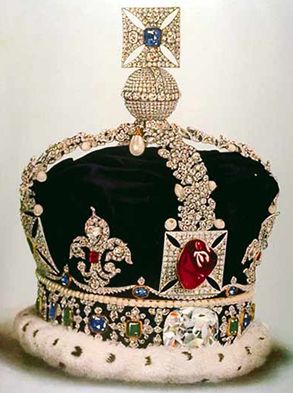
Today, the crown jewels are one of the most popular attractions at the Tower of London. The jewels include the crowns worn by the monarch at coronation and at the opening of Parliament.
Porter notes that the use of the tower as a repository for royal treasure began in earnest in 1303, when a number of treasures were stolen from the Abbey of St. Peter at Westminster. The remaining treasures were brought to the tower, which was the most heavily fortified spot in London, for safekeeping. A new jewel house was built against the south side of the White Tower in 1508.
Much of the royal regalia were destroyed in the mid-17th century when England became a republic for a brief time. “The oldest piece of the Regalia [surviving today] is the 12th century gold Anointing Spoon, used to anoint the Sovereign with holy oil,” writes a team of researchers on the official Tower of London website. “Apart from the three steel coronation swords (the Swords of Temporal Justice, of Spiritual Justice and of Mercy), this is the only piece that survived the destruction of the pre-Civil War Regalia in 1649-50.”
The tower also contains an impressive collection of armor, which is a treasure unto itself. Shown in an exhibit called the “Line of Kings,” a show at the tower that first started more than 300 years ago, it features such items as a life-size wooden horse carved about 1690 and a set of armor, gilded with gold, created for Charles I around 1612.
Beefeaters
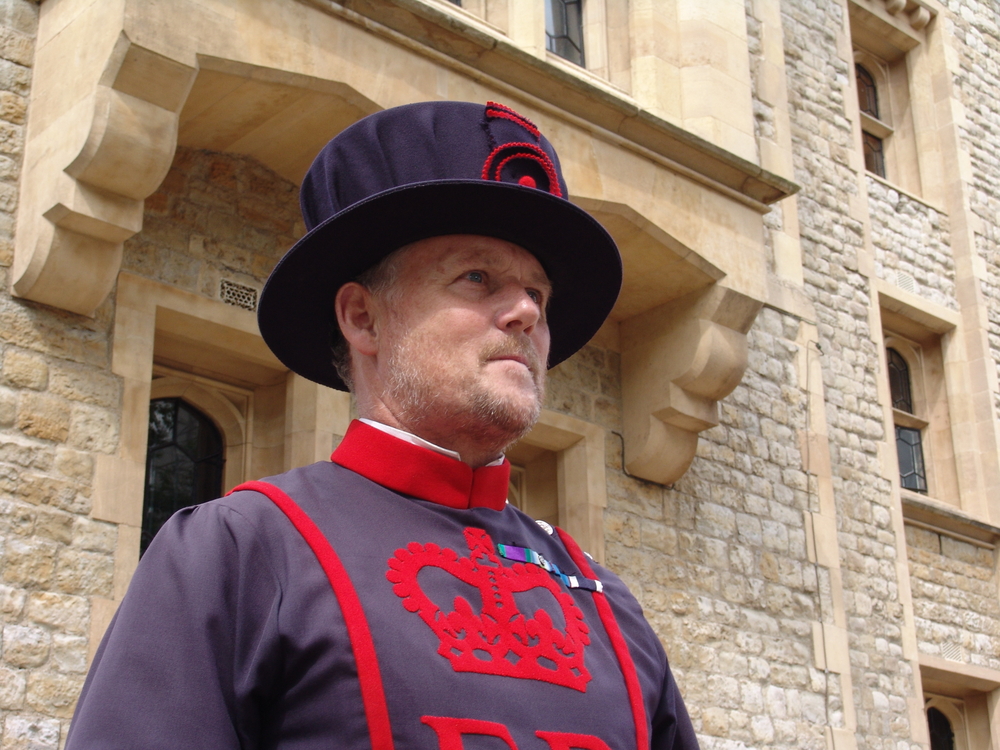
The bearded Yeoman Warders, also called “Beefeaters,” guard the tower today.
First mentioned about 500 years ago the Warders “or ‘Waiters,’ as they were often referred to, formed and acted likely a friendly society, sharing, by way of dividends, the rewards of their official and unofficial duties,” writes Parnell. There was money to be made by renting out parts of the ground and by showing visitors around.
“The post of Yeoman Warder was handed down through the family or sold. This time-honored practice was dealt a fatal blow in 1826, when the Duke of Wellington, as Constable of the Tower, ordered that in the future the post was to be occupied by worthy non-commissioned officers of the Household Cavalry, Foot Guards and Infantry of the Line, solely on their regiment’s recommendation,” writes Parnell, noting that the Warders lost the last of their money-making privileges, the right to sell postcards, in 1923.
Ravens
A flock of ravens resides at the tower, cared for by the Yeoman Warder Ravenmaster. According to the Tower of London website, legend says that the tower — and the monarchy — will fall if the six ravens ever leave the fortress.
Charles II is said to have been the first monarch to insist that the ravens be protected. He did so despite the protests of royal astronomer John Flamsteed, who complained that the ravens kept leaving droppings on his telescope. According to legend, this led Charles to move the Royal Observatory to Greenwich.
The tower as a fortress
While the tower was first built as a fortress, its usefulness as a bastion faded as gunpowder-based siege engines (such as cannons) became widely adopted in Europe.
Porter notes that new gun platforms were erected on it in the 1680s, and Parnell writes that as late as the 1860s, when the United Kingdom feared invasion by France, heavy guns were positioned near the Tower to help defend London. However, as time went on, the tower’s military importance mainly lay in the fact that it was a central location where arms and ammunition could be kept and troops could be marshaled on their way to join armies in Europe.
Porter writes that a grand storehouse, started in 1688 and completed when William and Mary were on the British throne (1689-1702), was built to house weapons and ammunition. “The new Grand Storehouse was 345 feet (105 meters) long and 56 feet (17 meters) wide, of two stories and an attic story,” he writes. “Above the centrally placed main entrance was a large pediment, carved by John Young, with the royal arms flanked by horses, cannon, drums and other military equipment.” This pediment survives to present day.
The tower as an attraction
The history of the tower as an attraction goes back at least as early as the 17th century when the “Line of Kings” exhibition was first set up. The tower had other attractions that drew non-military visitors to it. For instance, the royal menagerie, in essence an early zoo, had a wide range of animals until it was closed in 1835, including lions, an ostrich and even a polar bear.
These animals were given as gifts to various monarchs. Porter writes that James I (1566-1625) was particularly fond of his lions. He once saw a lioness giving birth and “was so fearful that the cubs might die that he sent a description of a nipple to be attached to a glass bottle, so that they may be fed.”
Porter notes that in 1753, when the book «An Historical Description of the Tower of London and its Curiosities» was published, it included biographies of the tower’s lions and provided information on other creatures present, including a golden eagle, an ostrich, a horned owl, bears, tigers, a racoon, a leopard and even a baboon. This menagerie would be removed from the tower and incorporated into an off-site zoo in 1835, but by then there were other things to attract tourists.
The tower’s history as a prison for some of England’s most famous individuals attracted visitors, providing the Yeoman Warders a chance to show tourists around (and for a time, make some extra money while doing so). In the 19th century, the tower’s medieval history so intrigued England that the tower was “restored” in such a way that its medieval aspects were magnified.
Parnell writes that this had some unfortunate consequences as parts of the tower not seen as being “medieval” enough, such as the records office, were torn down.
Today, the Tower of London is one of the most famous castles in the world and is now a World Heritage Site attracting more than 2 million visitors a year. The main threat to the site today is not rebels, foreign armies or falling bombs (bomb damage happened during World War II) but rather the exhaust of cars. It’s a problem that threatens to turn the White Tower into a yellow color, something which none of the previous threats could ever do.
— Owen Jarus
Owen Jarus is a regular contributor to Live Science who writes about archaeology and humans’ past. He has also written for The Independent (UK), The Canadian Press (CP) and The Associated Press (AP), among others. Owen has a bachelor of arts degree from the University of Toronto and a journalism degree from Ryerson University.
Задания 32 – 38 относятся к заданиям повышенного уровня сложности.
В этом задании вам будет предложено ознакомиться со связным текстом с семью пропусками. Для каждого пропуска нужно подобрать один единственно правильный вариант ответа из четырех представленных.
За каждый правильный ответ вы получаете 1 балл. Максимальный балл за выполненное задание – 7 баллов.
Цель задания:
проверить ваши навыки и умения употреблять английские слова в конкретном коммуникативном контексте с учетом их лексического значения и специфики английского языка.
Что нужно знать:
— различные значения одного и того же слова, а так же его синонимы, антонимы, омонимы
— фразовые глаголы, идиоматические выражения
— нормы лексической сочетаемости в английском языке
Как выполнять задание:
Во время первого прочтения
Просмотрите текст с пропусками от начала до конца и постарайтесь понять его содержание.
Во время второго прочтения
Внимательно прочитайте фрагмент текста до пропуска. Особое внимание уделите предложению с пропущенным словом. Из предложенных вариантов ответа выберите наиболее подходящий, учитывая его лексическое значение и сочетаемость с последующим словом. Затем еще раз прочитайте предложение с пропуском, чтобы убедиться, что выбранное вами слово является наиболее корректным. Попытайтесь мысленно обосновать свой выбор, ответив на вопрос, почему другие варианты будут ошибочными.
Ответы к заданиям 32 – 38 запишите в виде одной цифры в поле ответа в тексте работы, а затем не забудьте перенести их в бланк ответов № 1.
Важные советы:
- Заранее ознакомьтесь с форматом заданий ЕГЭ по английскому языку из раздела «Грамматика и лексика», формой экзаменационных бланков и правилами их заполнения. Это поможет вам сэкономить время на экзамене, так как во всех вариантах ЕГЭ установки к заданиям формулируются одинаково.
- В процессе подготовки к экзаменам должное внимание уделяйте синонимичным группам слов, оттенкам их значений, сочетаемости с другими словами, способам управления.
- Увеличивайте свой словарный запас, изучая антонимы и омонимы (созвучные слова или слова со сходным написанием, но разным значением).
- Проверяйте значения всех предлагаемых для ответов вариантов по словарю; составляйте свои «жизненные» примеры для более эффективного запоминания слов.
Sample Text
Прочитайте текст с пропусками, обозначенными номерами 32 – 38. Эти номера соответствуют заданиям 32 – 38, в которых представлены возможные варианты ответов. Запишите в поле ответа цифру 1, 2, 3 или 4, соответствующую выбранному вами варианту ответа.
The Tower of London
“Her Majesty’s Royal Palace and Fortress”, “The Tower” and “The White Tower” are all names for the building most commonly known as The Tower of London. Construction began in 1078 but work 32 __________ , on and off, over a period of two hundred years or more.
The Tower was essentially a fortress whose functions eventually extended to that of royal palace, prison, armoury, zoo, Royal Mint and observatory. Since 1303 it has also been used 33 _________ storing the Crown Jewels of the United Kingdom. Today, however, The Tower is cared for by an independent charity and receives no funding from the government or the crown.
The Tower is probably best known for the famous prisoners who were 34 _________, and sometimes executed, there. In 1483 the 13-year-old King Edward 5th and his 10-year-old brother Richard were murdered there; apparently on the orders of their uncle Duke of Gloucester.
35 ________ the most famous victim of The Tower was Anne Boleyn, the unfortunate second wife of Henry 8th. But Guy Fawkes, Thomas Moore, Sir Walter Raleigh and even the future Queen Elizabeth 1st were all imprisoned behind those fearsome walls.
Most people know the 36 ________ legend that if the ravens ever leave The Tower – then the British Monarchy will be doomed. Possibly less people know however that the Tower was also one of the 37 ________ zoos. Lions, tigers and large 38 _________ of rare and exotic species lived in the Tower gardens over 800 years ago.
32 1) lengthened 2) continued 3) prolonged 4) increased
Ответ:
33 1) as 2) with 3) for 4) to
Ответ:
34 1) captured 2) maintained 3) found 4) held
Ответ:
35 1) Thus 2) Consequently 3) Probably 4) Although
Ответ:
36 1) ancient 2) prehistoric 3) antique 4) aged
Ответ:
37 1) newest 2) youngest 3) earliest 4) soonest
Ответ:
38 1) figures 2) groups 3) herds 4) numbers
Ответ:
Vocabulary
to lengthen – удлинять(ся)
to continue – продолжать(ся), тянуть(ся), простираться
to prolong – продлевать, продолжить (линию)
to increase – расти, возрастать, увеличиваться, повышаться
to be used as + Noun – использовать в качестве чего-то
to be used for + doing smth – использовать для выполнения какого-либо действия
to be used to + Verb (infinitive) — использовать для выполнения какого-либо действия
to capture – поймать, взять в плен
to maintain – поддерживать, сохранять, содержать
to find (found, found) – находить, обнаруживать, оказаться
to hold (held, held) – содержать, удерживать
thus – так, таким образом (The dog played in the mud and thus will need a bath tonight.)
consequently – следовательно, поэтому (Consequently the negotiations were suspended.)
probably – вероятно, возможно (That was probably one of the worst movies I’ve ever seen.)
although – хотя, несмотря на (Although I get good grades, I really don’t like school.)
ancient – древний, старый, античный
prehistoric – доисторический
antique – древний, старинный, античный, старомодный
aged – пожилой, старый, в возрасте
new (= fresh = recent = modern) – новый, свежий, недавний, современный
young (= junior = late = inexperienced) – молодой, младший, недавний, неопытный
early (= first = previous = elementary) – ранний, первый, предыдущий, начальный
soon – скоро
figure – рисунок, цифра, фигура, чертеж
group – группа, ансамбль, фракция, отдел
herd – стадо, табун, пастух, толпа
number – номер, число, количество, группа, выпуск (газеты, журнала)
Ответы к данному заданию смотрите здесь.