
Задание №9145.
Аудирование. ЕГЭ по английскому
Вы услышите диалог. Определите, какие из приведённых утверждений А—G соответствуют содержанию текста (1 — True), какие не соответствуют (2 — False) и о чём в тексте не сказано, то есть на основании текста нельзя дать ни положительного, ни отрицательного ответа (3 — Not stated). Прослушайте запись дважды.
A. The young man thinks he can choose a present himself.
B. The man is choosing a present for his mother’s birthday.
C. The man doesn’t want to spend too much on the present.
D. The man doesn’t think a gift certificate is a good idea.
E. The shop assistant thinks a present would be better than an experience.
F. The young man’s girlfriend has a profile in social networks.
G. The young man often buys flowers to his girlfriend.
| Утверждение | A | B | C | D | E | F | G |
| Соответствие диалогу |
Решение:
Утверждение A (The young man thinks he can choose a present himself. — Молодой человек думает, что сам может выбрать подарок) не соответствует содержанию диалога — False: «I am looking for a present for my girlfriend and I’m totally at a loss. I need your professional help.»
Утверждение B (The man is choosing a present for his mother’s birthday. — Мужчина выбирает подарок маме на день рождения) не соответствует содержанию диалога — False: «I am looking for a present for my girlfriend.»
Утверждение C (The man doesn’t want to spend too much on the present. — Мужчина не хочет слишком много тратить на подарок) соответствует содержанию диалога — True: «Well, I was thinking of a reasonable sum of money. I wouldn’t like to buy something too expensive and thus embarrass Julia.»
Утверждение D (The man doesn’t think a gift certificate is a good idea. — Мужчина не считает подарочный сертификат хорошей идеей) соответствует содержанию диалога — True: «She’s passionate about fashion but I am helpless there. Even if I give her gift certificate I can’t be sure it’s for shop she likes.»
Утверждение E (The shop assistant thinks a present would be better than an experience. — Продавец считает, что подарок лучше, чем впечатления) не соответствует содержанию диалога — False: «Well, if you can afford that give experiences, not things.»
Утверждение F (The young man’s girlfriend has a profile in social networks. — У девушки молодого человека есть профиль в социальных сетях.) не отражено в диалоге — Not stated.
Утверждение G (The young man often buys flowers to his girlfriend. — Молодой человек часто покупает цветы своей девушке) не отражено в диалоге — Not stated.
Показать ответ
Источник: ФИПИ. Открытый банк тестовых заданий
Сообщить об ошибке
Тест с похожими заданиями
1) Вы услышите 6 высказываний. Установите соответствие между высказываниями каждого говорящего A—F и утверждениями, данными в списке 1—7. Используйте каждое утверждение, обозначенное соответствующей цифрой, только один раз. В задании есть одно лишнее утверждение. Прослушайте запись дважды.
1. Extreme tourism has always been in people’s adventurous nature.
2. Extreme tourism satisfies people’s need for risk.
3. Extreme tourism is a thing everybody should try.
4. Extreme tourism is a way to get people’s attention.
5. Extreme tourism is an unnecessary risk for people.
6. Extreme tourism helps people explore the world.
7. Extreme tourism for our family is a way of getting knowledge.
| Говорящий | A | B | C | D | E | F |
| Утверждение |
2) Вы услышите диалог. Определите, какие из приведённых утверждений А—G соответствуют содержанию текста (1 — True), какие не соответствуют (2 — False) и о чём в тексте не сказано, то есть на основании текста нельзя дать ни положительного, ни отрицательного ответа (3 — Not stated). Прослушайте запись дважды.
A. The young man thinks he can choose a present himself.
B. The man is choosing a present for his mother’s birthday.
C. The man doesn’t want to spend too much on the present.
D. The man doesn’t think a gift certificate is a good idea.
E. The shop assistant thinks a present would be better than an experience.
F. The young man’s girlfriend has a profile in social networks.
G. The young man often buys flowers to his girlfriend.
| Утверждение | A | B | C | D | E | F | G |
| Соответствие диалогу |
3) Вы услышите интервью. Запишите в поле ответа цифру 1, 2 или 3, соответствующую выбранному Вами варианту ответа. Прослушайте запись дважды.
The first question of the presenter is about
1) the effectiveness of horse therapy.
2) Diane Smith’s experience with horse therapy.
3) the reason horses are used in therapy.
4) Вы услышите интервью. Запишите в поле ответа цифру 1, 2 или 3, соответствующую выбранному Вами варианту ответа. Прослушайте запись дважды.
According to Diane, hippotherapy is used for
1) teaching languages.
2) treating neurological problems.
3) treating blindness.
5) Вы услышите интервью. Запишите в поле ответа цифру 1, 2 или 3, соответствующую выбранному Вами варианту ответа. Прослушайте запись дважды.
According to Diane, hippotherapy is more effective than traditional therapy for
1) children.
2) anybody.
3) depressed people.
6) Вы услышите интервью. Запишите в поле ответа цифру 1, 2 или 3, соответствующую выбранному Вами варианту ответа. Прослушайте запись дважды.
Horse riding helps to improve speech by improving one’s
1) breathing.
2) balance.
3) motor skills.
7) Вы услышите интервью. Запишите в поле ответа цифру 1, 2 или 3, соответствующую выбранному Вами варианту ответа. Прослушайте запись дважды.
Why is, according to Diane, horse therapy more than just a horse riding?
1) It’s used on a regular basis.
2) The therapist organizes it in a special way.
3) It’s aimed at improving complex skills.
Вы услышите интервью. Запишите в поле ответа цифру 1, 2 или 3, соответствующую выбранному Вами варианту ответа. Прослушайте запись дважды.
What does the therapist do during the first session of horse therapy?
1) Chooses the program of treatment.
2) Trains the horse.
3) Selects the right saddle for the patient.
9) Вы услышите интервью. Запишите в поле ответа цифру 1, 2 или 3, соответствующую выбранному Вами варианту ответа. Прослушайте запись дважды.
Which of the following groups is NOT mentioned by Diane as potential clients for hippotherapy?
1) Disabled children.
2) Depressed adults.
3) Professional riders.
Тренировочная работа №1 статград пробный ЕГЭ 2022 по английскому языку 11 класс задания и ответы для варианта АЯ2110101. Официальная дата проведения работы: 6.12.2021 (6 декабря 2021 год).
Задания письменной части
Задания устной части
Ответы, аудио и скрипты
Тренировочный вариант статград АЯ2110101 ЕГЭ 2022 по английскому языку 11 класс:
Устная часть:
Сложные задания и ответы с варианта:
3)According to Patricia, North American college graduates prefer 1) to live in major cities. 2) to work in big corporations. 3) to live away from parents.
4)Patricia mentions a tradition in North America. Judging by her words, she 1) considers it to be old-fashioned. 2) wants it to continue in the future. 3) believes that it creates problems.
5)Patricia lives in 1) the USA. 2) Canada. 3) the UK.
6)Patricia paid for the house 1) 65 thousand dollars. 2) 150 thousand dollars. 3) 300 thousand dollars.
7)When the presenter exclaims “But you are forgetting the state it is in!”, he means that 1) the house is in a very bad condition. 2) the location of the house is horrible. 3) the house still needs to be paid for.
8)Patricia earns her living by being 1) a youtuber. 2) an electrician. 3) an artist.
9)What is the presenter’s general attitude towards Patricia’s project? 1) highly enthusiastic 2) somewhat skeptical 3) completely indifferent
12)What is the main idea in the first paragraph? 1) Development of human physiology needs to be researched. 2) The fact that a human can outrun a horse isn’t that surprising. 3) Running machines can help train for long-distance running. 4) There is a special marathon for people vs horses held in Wales.
13)The word “far-fetched” in the first paragraph is closest in meaning to 1) easy. 2) stupid. 3) hard. 4) usual.
14)According to the 2nd paragraph, 1) in pre-historic societies families were started by good runners. 2) sharing was an important tradition in all pre-historic societies. 3) prehistoric humans were better runners than people are today. 4) prehistoric humans could easily outrun four-legged animals.
15)Learning to throw sharp weapons at animals did NOT enable people 1) to run faster. 2) to be safer. 3) to run slower. 4) to run less.
16)Halsey and Bryce found out that the effect hot weather had on the ability of humans and horses to run was 1) equally little for both humans and horses. 2) equally strong for both humans and horses. 3) more negative for horses than for humans. 4) more negative for humans than for horses.
17)Which of the following does NOT help humans to be great long-distance runners? 1) A straight big toe. 2) A narrow waste. 3) Ability to sweat. 4) Ability to pant.
18)What makes the best long-distance runner? 1) Most efficient leg bones structure. 2) Advanced body-cooling system. 3) Ability to run gracefully. 4) Efficient use of energy.
19)How much do we know about Henry VIII that is true? The thing that anyone would mention is probably the fact that he was the King of England who broke away from the Catholic Church and started the Church of England.
20)Another well-known fact is that he had six . All of this is true.
21)But there is also a misconception that the famous song Greensleeves by him for his future wife Anne Boleyn.
22)Although Henry VIII was a skilled lute-player and wrote a number of songs, Greensleeves is based on an Italian style of composition that reached England a lot, during the reign of his daughter Elizabeth I.
23)When Peter came home from work he immediately felt that something was wrong. He was sure that somebody in his house in his absence.
24)He could see that in the careless way his scarf from the hook of a coat rack and the fact that the light in the bathroom was on.
25)But more than anything else, all of his pets – two little dogs, three cats and an old parrot – desperately wanted to tell him something. All of them were barking and meowing and screeching and stop.
26)At her 82 years of age, Grandma Thelma could certainly be considered old. But it was not her age that defined her
27)Grandma Thelma was a . Had always been.
28)She still remembered her first time on the river, Dad teaching her how to paddle. She was five back then, but other children, Thelma wasn’t interested in just splashing around and jumping in the water.
29)Thelma wanted to swim. And she did! By age ten, she could swim almost as fast and as well as her dad.
30)Even though she never became a sportswoman, swimming accompanied Thelma all her life.
31)In many ways, it made her life more . It was one of the first things she taught her children. Now, being old, Thelma was happy that she managed to pass on her skill and love for swimming to her grandchildren as well.
40.1)Imagine that you are doing a project on what social networks are used by teenagers in Zetland for communication. You have found some data on the subject – the results of the opinion polls (see the table below). Comment on the data in the table and give your opinion on the subject of the project.
Другие тренировочные варианты ЕГЭ по английскому языку 11 класс:
Вариант АЯ2010101 тренировочной работы №1 статград по английскому языку 11 класс ответы и задания 4 декабря 2020
СТАТГРАД работы по английскому языку задания и ответы
Метки: английский язык 11 классЕГЭ 2022заданияответыстатградтренировочная работа
Все варианты ЕГЭ 2018 по английскому языку с ответами ЕГЭ 100БАЛЛОВ. Единый государственный экзамен по АНГЛИЙСКОМУ ЯЗЫКУ. Критерии оценивания задания с развёрнутым ответом. Все варианты и ответы на задания. Ниже прикрепляем ссылки для скачивания.
Вариант 1: скачать
Вариант 2: скачать
Вариант 3: скачать
Вариант 4: скачать
Вариант 7: скачать
Вариант 8: скачать
Вариант 9: скачать
Вариант 10: скачать
Вариант 12: скачать
Вариант 13: скачать
Вариант 14: скачать
Вариант 15: скачать
Вариант 16: скачать
Вариант 17: скачать
Вариант 18: скачать
Вариант 19: скачать
Поделиться с друзьями:
Данные задания на слоовообразование в английском языке составлены по материалам пособия «Сборник тестов для подготовки к ЕГЭ по английскому языку» (М. Вербицкая, Малколм Манн и др.) и входят в цикл «Английский язык. Подготовка к ЕГЭ. СЛОВООБРАЗОВАНИЕ». Задания на словообразование рекомендуется выполнять после изучения теоретического материала, ссылки на который даны перед упражнениями.
Словообразование. Задания в формате ЕГЭ
Содержание:
- Задания на суффиксы существительного
- Задания на суффиксы и префиксы прилагательного
- Задания на суффиксы и префиксы глагола
* * *
Суффиксы существительного
Задание 1. Измените слова так, чтобы они грамматически и лексически соответствовали содержанию предложения.
ПРИМЕЧАНИЕ.
Слово «лексически» означает, что к слову нужно добавить суффикс или префикс.
Слово «грамматически» означает, что к преобразованному слову, возможно, нужно добавить окончание.
ПРИМЕР. Animal __________ will enjoy the performance. love
Animal lovers will enjoy the performance. — Любители животных получат удовольствие от представления.
Здесь требуется поставить существительное — lover во мн. число, исходя из контекста.
- This __________ is passed through the generations. able
- Stress is the ___________ with which syllables are pronounced. strong
- His ______________led him to discovering a lot of information. curious
- This book contains _________of the centuries. wise
- This film takes me back to my ____________. child
- The ___________of this corridor was surprising. long
- It will be disastrous for the ___________. human
- I appreciate our ___________. friend
- I will die of ____________if I live that long. bored
- The __________of her feelings was unexpected for me. warm
- The____________is given to particularly bright students. scholar
- He was famous for his ___________ . serious
- The ___________of this song is incredible. popular
- We were surprised at the _________in her speech. differ
- It is easy to learn how to do this _________. active
- The airplane started to lose __________. high
Задание 2. Form nouns from the words in bold.
- The Hercules was famous for his _________ . strong
- The ____________of the swimming pool was about 5 meters. wide
- I was surprised by the ______________ of the tablecloth. white
- The _________of the Tower and the __________ of the walls made it a perfect prison. high, thick
- The ___________was delayed by fog for an hour. fly
- Giving alive ___________is quite different from performing on a film. perform
- Our ___________to predict the weather depends on the information we have. able
- Another major ____________is the shape of the ball. different
- The __________of the baseball is very great in America. popular
- Much of his ________ Chekhov lived in severe poverty. child
- The ______of London since then has been incredible. grow
- We moved to our new ______________last spring. resident
- Many encyclopedias state with __________that the Nile is the longest river in the world. confident
- Her acting is closer to __________. real
- The story of the dodo`s ___________is one example of man`s effect on the environment. disappear
- He had ____________in finding a job. difficult
- Each _____________is worth considering. possible
Задание 3. Form nouns from the words in bold.
- The ______________ of this building took 20 years from start to finish. construct
- Famous __________were held in the Tower. prison
- Many _____________come to London each year. visit
- Before the ____________of the hot air balloon, no human had ever successfully flown into the air. invent
- The first successful __________was in 1783. fly
- The ___________of the balloon depends on the wind. direct
- The _____________and response of the audience can affect how the actor feels and performs. behave
- They want to have the opportunity to do some real _____. act
- London is an ideal place nightlife ____________. entertain
- Special _____________is used to collect weather data. equip
- He never seemed to be interested in ____________. educate
- An _______________called Clarence went on an expedition to Canada with his family. explore
- He is famous for his finding the __________to the problem. solve
- His success was an remarkable_______. achieve
- The ____________of its place is unknown. locate
- What is your ______________of the performance? impress
Задание 4. Form nouns from the words in bold.
- ________will find these products on sale in the supermarkets. shop
- In New York he became a ____________at drama school. study
- The ship left for New York with a crew of seven professional _________. sail
- To the crew’s__________ they discovered that nobody was on the island. astonish
- Each flag has its additional _____________. mean
- Another ___________started at once. argue
- Brighton is an ideal place for____________ . relax
- There are eleven ___________in each team in cricket. play
- They tried to persuade the ______________to introduce new laws. govern
- The road __________must be improved. safe
- Finding a good job is uneasy without proper ____________. qualify
- Many people consider the ____________of moving away. possible
- It is necessary to fill the _______________form. apply
- The rate of _________________is very high. employ
- You have a great _____________. imagine
- To our great ___________, it started to rain. disappoint
- The better your education is, the less_____________you will have in finding a job. difficult
Суффиксы и префиксы прилагательного
Задание 5. Form adjectives from the words in bold.
- Huge ___________dinosaurs used to walk on the Earth. power
- There are a lot of ______________courses to improve your skills. train
- This private boat carried a cargo of _______________products. commerce
- The dodo lived on an island where he had no ___________enemies. nature
- There are hundreds of ______________hotels in sunny Brighton. comfort
- Enjoy delicious dishes in ____________ restaurants. fashion
- Taking part in this attraction can be a bit ______. risk
- The story describes the ______________action of people. hero
- _________plays are staged on Broadway. vary
- The road was in ________________condition. excellence
- The _____________method is always in great use. help
- My father doesn’t buy _____________newspapers. expense
- Who is _______________for making changes in our society? response
- The Russians are considered to be very _____________. hospitality
- The ______________equipment needs to be checked. electricity
- I was impressed by French ______________cuisine. delicacy
- She is not self- ________________. confidence
- The job will give him more _______________freedom. artist
- Paul’s Cathedral is an _________________building. impress
- In the old days the only ___________means of transport was the horse. person
- The trip was very ______________. benefit
- Is your answer _______________ from mine? differ
Задание 6. Form adjectives from the words in bold. Mind the prefix UN-
- Two _____________brothers Montgolfier were responsible for designing the first air balloon. France
- The design of the balloon was based on ____________________law. science
- Some ________________flyers have had an accident. fortunate
- The first ________________flight was in 1783. success
- You can go on a _______________ride on a horse back. enjoy
- He had an ____________________idea. imagine
- More ______________visitors can try «The Vampire Ride». adventure
- Riding fast high above the park can be a ______________experience . scare
- Nature is so ___________________that’s why we cannot forecast more than for a few days. predict
- _______ people or things existed in the past are considered to be a part of history. history
- ____________baseball began in the USA in 1865. profession
- In the USA baseball is considered as a __________sport. nation
- It will be an ________________experience for me. forget
- He started his own business and became ________________. wealth
- The bridge was very ________________. use
- It has become the place of _______________importance. globe
- At first sight it seems _________________. believe
- The situation is becoming more __________________. understand
- She is a very _________________woman. effect
- Everyone fell _____________in the room. silence
- It was the most _________________journey I have ever had. please
- It is ___________to drive without seatbelt. legal
Задания в формате ЕГЭ. Суффиксы и префиксы глагола
Задание 7. Form verbs from the words in bold.
- He _______________ and lay on the bed. dress
- He could enter the house because the door was ___________. lock
- The usual practice at the History lesson is to ___________texts. tell
- The exercise must be ________________. write
- Teachers sometimes _____________students. understand
- When the child ______________ she was unable to cope with him. behave
- The parents ____________ the child to go out late at night. allow
- When the days begin to ____________then the cold begins to _____________. long/ strong
- They’re trying to _____________our name. black
- The snow ____________the mountain tops. white
- He was ____________by his family to learn music at a young age. courage
- The town is ______________by fortified walls. circle
- The route was built to ______________trucks to get around a waterfall. able
- No argument can __________a war. just
- If you ____________ a substance, you make it pure by removing any dirty substances from it. pure
- You have ______________him as an ambitious person. character
- His mother rarely___________ him or any of her children. critic
- I’m sure Rose will _____________many of us. live
Задание 8. Form verbs from the words in bold.
- The symptoms of her illness have____________. appear
- The student__________the teacher and did the wrong exercise. hear
- Last week the government ______________ the citizens about the political situation in the country. inform
- His own mind was ___________and ______________by foreign travel. large/rich
- Martin ___________all the people in the area. He died at the age of 101. live
- The elderly are usually _______________with the young. satisfy
- Nowadays the risk of serious illness has________. less
- Do you mean to____________ me? threat
- Unfortunately, the cooperation between two countries was _______________. organize
- The line was ___________, though not dead. connect
- I am very ________________ with you. appoint
- The students _______________ the teacher. obey
- What does the emblem _______________? symbol
- If someone_________a word, they spell it wrongly. spell
- Don’t let this ______________ you. courage
- He recognized her voice and his face ____________. soft
- The men tried to __________ each other in their generosity. do
Готовитесь к ЕГЭ по английскому языку? Читайте далее
ОТВЕТЫ
Для получения доступа, пожалуйста, оформите подписку «ОТВЕТЫ»
 |
||
|
Установите соответствие тем A — G текстам 1-6. Занесите свои ответы в таблицу. Используйте каждую букву только один раз. В задании одна тема лишняя. TEST 03(part 1) |
A. UNUSUAL VIEWS 3
B. EARLY INVENTORS 6
C. SENSIBLE DECISIONS 4
D. POPULAR ARTISTS
E. COMMON MISTAKES 5
F. FUTURE DEVELOPMENTS 2
G. SCIENTIFIC VALUE 1
1. Photography has many uses. Most of us use photographs to save special moments for the future, but scientists can also learn a lot from them. In the nineteenth century, for example, people argued about whether all four of a horse’s legs left the ground at the same time when it ran. A man call Eadweard Muybridge took high-speed photographs of a horse and proved that all four legs were indeed off the ground at the same moment.
О разных применениях фотографирования. SCIENTIFIC VALUE
2. The ordinary camera that uses film seems to be a thing of the past. These days, more and more people are using digital cameras to capture those unforgettable moments. In ten years’ time, we’ll all be taking pictures that we then put on our computers to print out or to send around the world by e-mail. The cameras will get better and cheaper, and the world of photography will never be the same again!
О том, как развивается фотографирование. FUTURE DEVELOPMENTS
3. Is your album full of boring snapshots? Taking good photographs is a lot easier than you might think. The secret is to find new ways of looking at an ordinary scene. If you’re taking a picture of a building, what happens if you look up? Or perhaps the back of the building is more interesting than the front. Photography is about surprises and discovering new points of view.
Фотографирование даёт возможность посмотреть на вещи поновому. UNUSUAL VIEWS
4. Before buying a camera, it’s important to decide what you’re going to use it for. Do you want to take quick photos of your friends and family? In that case, you should go for a cheap camera that you can keep in your bag or pocket, always ready. Do you want to take artistic pictures? If so, you will probably want to spend a bit more on a more expensive professional camera. A little thought now can help you choose wisely.
Перед покупкой фотоаппарата важно определиться с целями. SENSIBLE DECISIONS
5. Many people hope to simply pick up a camera, point it and produce great pictures. Photography is a lot easier than it used to be, but it’s still easy to get it wrong. Remember that you should have the sun behind you. Too many people take photographs facing the sun and then are surprised when there’s too much light! Another thing to avoid is taking pictures of something far away in the dark. Your flash won’t help at a distance.
Чтобы делать хорошие снимки, надо помнить о правилах фотографирования. COMMON MISTAKES
6. When the Englishman William Henry Fox Talbot first pointed his camera at a window in his home, Lacock Abbey, in 1835, he helped to start a revolution. This was the moment he created the first photograph on paper. His ideas, together with those of other pioneers, including the Frenchmen Daguerre and Niepce, changed things forever. Today’s world of full-colour images had its beginnings in their experiments.
Люди, которые открыли фотографию для всего мира. EARLY INVENTORS
| № текста | 1 | 2 | 3 | 4 | 5 | 6 |
| тема | G | F | A | C | E | B |
ВСЕ ТЕСТЫ
TEST 23
Раздел 1. Аудирование
1. Вы услышите 6 высказываний. Установите соответствие между высказываниями каждого говорящего A—F и утверждениями, данными в списке 1—7. Используйте каждое утверждение, обозначенное соответствующей цифрой, только один раз. В задании есть одно лишнее утверждение. Вы услышите запись дважды. Занесите свои ответы в таблицу.
1. There are more minuses than pluses about changing schools.
2. Your experience of changing schools will depend on your personality.
3. Your marks can become worse if you change schools.
4. There are a lot of advantages about changing schools.
5. You can prepare better for your exams if you change schools.
6. Changing schools can be a chance to improve your life.
7. When changing schools, it’s hard to leave your past behind.

2. Вы услышите диалог. Определите, какие из приведённых утверждений А—G соответствуют содержанию текста (1 – True), какие не соответствуют (2 – False) и о чём в тексте не сказано, то есть на основании текста нельзя дать ни положительного, ни отрицательного ответа (3 – Not stated). Занесите номер выбранного Вами варианта ответа в таблицу. Вы услышите запись дважды.
A. The young man thinks he can choose a present himself.
B. The man is choosing a present for his mother’s birthday.
C. The man doesn’t want to spend too much on the present.
D. The man doesn’t think a gift certificate is a good idea.
E. The shop assistant thinks a present would be better than an experience.
F. The young man’s girlfriend has a profile in In-m.
G. The young man often buys flowers to his girlfriend.

***
Вы услышите интервью. В заданиях 3—9 запишите в поле ответа цифру 1, 2 или 3, соответствующую выбранному Вами варианту ответа. Вы услышите запись дважды.
3. The presenter introduces Bob Thomas as…
1) an outdoor lover.
2) a businessman.
3) a fisherman.
Ответ:
4. Bob’s company was founded by…
1) himself.
2) him and his brother.
3) his father.
Ответ:
5. Bob started working on fishing gear…
1) ten years ago.
2) when he was a very young child.
3) when he needed summer money.
Ответ:
6. Bob liked it that his father…
1) spent a lot of time with his children.
2) taught him to fish and hunt.
3) had a successful company.
Ответ:
7. Bob remembers that their family trips to Florida…
1) were very uncomfortable.
2) cost a lot of money.
3) taught him a lot.
Ответ:
8. Bob believes that as a father he…
1) needs to try hard to be like his own dad.
2) shouldn’t follow his father’s example.
3) needs to spend more time with his family.
Ответ:
9. Bob’s «words of wisdom» refer to…
1) his business.
2) nature.
3) family affairs.
Ответ:
По окончании выполнения заданий 1—9 не забудьте перенести ответы в БЛАНК ОТВЕТОВ №1! Запишите ответ справа от номера соответствующего задания, начиная с первой клеточки. При переносе ответов на задания 1 и 2 цифры записываются без пробелов, запятых и других дополнительных символов. Каждую цифру пишите в отдельной клеточке в соответствии с приведёнными в бланке образцами.
***
Прочитайте приведённый ниже текст. Образуйте от слов, напечатанных заглавными буквами в конце строк, обозначенных номерами 25—29, однокоренные слова так, чтобы они грамматически и лексически соответствовали содержанию текста. Заполните пропуски полученными словами. Каждый пропуск соответствует отдельному заданию из группы 25—29.
Edinburgh
25. Edinburgh is one of the most written-about cities on earth. Built on ancient volcanoes and first established because of its secure and ……………………… position, the capital of Scotland has become a crossroads.
26. ……………………… everyone who comes to Scotland today spends some time in this city.
27. Edinburgh is the second most popular tourist destination in Great Britain and it’s not hard to see why. Its midsummer ……………………… festival is one of the biggest in the world.
28. Edinburgh is a delight to explore on foot: most of its ……………………… are contained within a compact central area.
29. With streets steeped in history and a thriving ……………………… scene, Edinburgh offers the perfect balance between traditional and contemporary things.
CULTURE
***
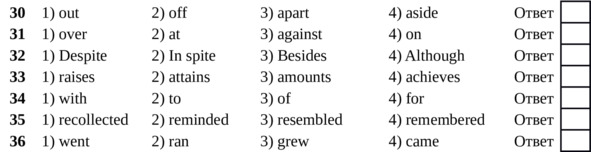
Прочитайте текст с пропусками, обозначенными номерами 30—36. Эти номера соответствуют заданиям 30—36, в которых представлены возможные варианты ответов. Запишите в поле ответа цифру 1, 2, 3 или 4, соответствующую выбранному Вами варианту ответа.
The Archipelago
In the remote southern seas there is a cluster of islands. Each island is inhabited by a different race of people. Although physically they look alike, you can tell them 30 … by their styles of dress and their distinctive dialects. Each island has its own unique form of architecture. The only similarity between them is that each race builds in a manner that is 31 … odds with the environment. On rocky hillsides there are wooden huts and in wooded valleys you can see towns of brick. Arid uplands are irrigated and planted with leafy gardens, whereas, on fertile plains, the parks are paved with stone. 32 … their differences, the islanders coexist peacefully. There is rivalry over certain fishing waters but it rarely 33 … to more than a few heated exchanges.
At the centre of the archipelago, perhaps in the most favoured spot of all, lies an island that has been deserted for many generations. It looks very different from the rest: darker, taller, silent. There is no obvious reason 34 … its abandonment as it has good soil and plenty of freshwater.
Long ago, it was inhabited by farmers and fishermen much like everywhere else in the archipelago, but everything changed when they started building the first wall. As soon as it was finished a second circle of battlements began to rise from the centre, slightly narrower than the one before, so that from faraway the island 35 … an enormous wedding cake.
Nobody can explain why the wall was started but there are many theories as to why it was never finished. Some say that so many had perished during its construction, that no one dared halt the work and thereby admit that it had all been in vain. Others claim that the builders simply 36 … out of materials. But one thing is certain, the predicted threat never arrived and the people at the centre of the archipelago had, quite simply, bricked themselves in.

По окончании выполнения заданий 19—36 не забудьте перенести свои ответы в БЛАНК ОТВЕТОВ №1! Запишите ответ справа от номера соответствующего задания, начиная с первой клеточки. При переносе ответов на задания 19—29 буквы записываются без пробелов, запятых и других дополнительных символов. Каждую букву или цифру пишите в отдельной клеточке в соответствии с приведёнными в бланке образцами.
!Проверьте, чтобы каждый ответ был записан рядом с номером соответствующего задания.
Раздел 4. Письменная речь
Для ответов на задания 37 и 38 используйте бланк ответов №2. Черновые пометки можно делать прямо на листе с заданиями или использовать отдельный черновик. При выполнении заданий 37 и 38 особое внимание обратите на то, что Ваши ответы будут оцениваться только по записям, сделанным в БЛАНКЕ ОТВЕТОВ №2. Никакие записи черновика не будут учитываться экспертом. Обратите внимание также на необходимость соблюдения указанного объёма текста. Тексты недостаточного объёма, а также часть текста, превышающая требуемый объём, не оцениваются. Укажите номер задания 37 в БЛАНКЕ ОТВЕТОВ №2 и напишите текст своего ответного электронного письма зарубежному другу по переписке.
37. You have received an email message from your English-speaking pen-friend Mary:
From: Mary @mail.uk
To: Russian_friend@oge.ru
…I hope everything is fine at school. What’s your regular school day this year like? What is your favourite school subject, and why? What afterschool clubs do you plan to join this year, if any at all?
Write an email to Mary.
– answer his questions;
– ask 3 questions about her new pet.
Write 100—140 words.
Remember the rules of email writing.
***
Выберите только ОДНО из двух предложенных заданий (38.1 или 38.2), укажите его номер в БЛАНКЕ ОТВЕТОВ №2 и выполните согласно данному плану. В ответе на задание 38 числительные пишите цифрами.
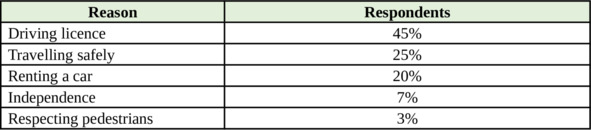
38.1 Imagine that you are doing a project on why teens have to learn traffic laws in Zetland. You have found some data on the subject – the results of various polls (see the table below).
Comment on the data in the table and give your opinion on the subject of the project.

Use the following plan:
– make an opening statement on the subject of the project;
– select and report 2—3 facts;
– make 1—2 comparisons where relevant and give your comments;
– outline a problem that can arise with learning traffic laws and suggest a way of solving it;
– conclude by giving and explaining your opinion on the importance of learning traffic laws.
Problems of Populaion Growth
***
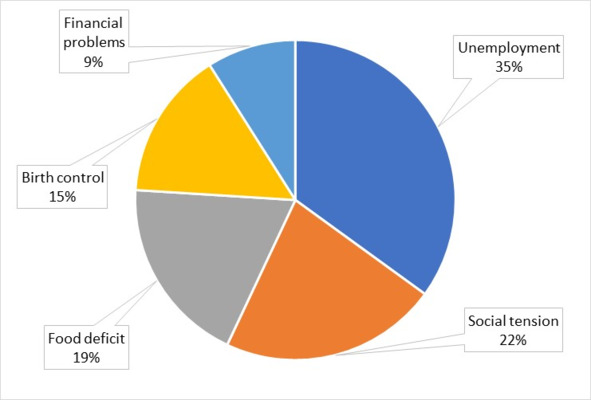
38.2 Imagine that you are doing a project on what, according to teens, population growth in Zetland can lead to. You have found some data on the subject – the results оf the opinion polls (see the pie chart below).
Comment on the data in the pie chart and give your opinion on the subject of the project.
Problems of Population Growth in Zetland

Use the following plan:
– make an opening statement on the subject of the project;
– select and report 2—3 facts;
– make 1—2 comparisons where relevant and give your comments;
– outline a problem that one can face with overpopulation and suggest a way of solving it;
– conclude by giving and explaining your opinion on the importance of population growth control.
!Проверьте, чтобы каждый ответ был записан рядом с номером соответствующего задания.
Test 22. Устная часть
Task 1
Imagine that you are preparing a project with your friend. You have found some interesting material for the presentation and you want to read this text to your friend. You have 1.5 minutes to read the text silently, then be ready to read it out aloud. You will not have more than 1.5 minutes to read it.
Scientists say that in the future people will live longer. With healthier lifestyles and better I medical care the average person will live tolOO. But that’s tomorrow. And today, we continue to stuff ourselves with fast food. What is tasty is not always healthy. Doctors say that chips and pizzas are fattening, cola spoils our teeth and coffee shortens our lives. If we eat too much, it will lead to heart disease and other serious illnesses. But the world today is getting fatter and fatter. Lack of exercise is another serious problem. We spend hours in front of our computers and TV-sets. Few of us do morning exercises. We walk less, because we prefer to use cars or public transport. It’s common knowledge that smoking and drinking can shorten our lives dramatically. Yet many young people smoke and drink. We all know that the healthier we are, the better we feel. The better we feel, the longer we live. So why not take care of ourselves?
Task 2

You are considering buying a skateboard and you’d like to get more information. In 1.5 minutes you are to ask four direct questions to find out the following:
1) if there are extra wheels in the kit
2) a free delivery service
3) country producer
4) availability of other colors of the skateboard
You have 20 seconds to ask each question.
Task 3
You are going to give an interview. You have to answer five questions.
Give full answers to the questions (2—3 sentences).
Remember that you have 40 seconds to answer each question.
Typescript for Task 3
Interviewer: Hello everybody! It’s the Club «TV World». Our guest today is a teenager from Russia and we are going to discuss modern TV. We’d like to know our guest’s point of view on this issue. Please answer five questions. So, let’s get started.
Electronic assistant: How often do you watch TV?
Student: _______________________
Electronic assistant: How can TV be harmful to your health?
Student: _______________________
Electronic assistant: What are your favourite TV programs?
Student: _______________________
Electronic assistant: Why do you think many people prefer watching TV at home to going to the cinema?
Student: _______________________
Electronic assistant: In what way can programmes in English improve students’ knowledge of English?
Student: _______________________
Interviewer: Thank you very much for your interview.
Task 4
Imagine that you and your friend are doing a project «National Songs». You have found some illustrations and want to share the news. Leave a voice message to your friend. In 2.5 minutes be ready to:
– explain the choice of the illustrations for the project by briefly describing them and noting the differences;
– mention the advantages (1—2) of the two types of;
– mention the disadvantages (1—2) of the two types of learning and performing national songs;
– express your opinion on the subject of the project – whether you know and perform national songs and why.

You will speak for not more than 3 minutes (12—15 sentences). You have to talk continuously.
TEST 23
Раздел 1. Аудирование
1. Вы услышите 6 высказываний. Установите соответствие между высказываниями каждого говорящего A—F и утверждениями, данными в списке 1—7. Используйте каждое утверждение, обозначенное соответствующей цифрой, только один раз. В задании есть одно лишнее утверждение. Вы услышите запись дважды. Занесите свои ответы в таблицу.
1. There are more minuses than pluses about changing schools.
2. Your experience of changing schools will depend on your personality.
3. Your marks can become worse if you change schools.
4. There are a lot of advantages about changing schools.
5. You can prepare better for your exams if you change schools.
6. Changing schools can be a chance to improve your life.
7. When changing schools, it’s hard to leave your past behind.

2. Вы услышите диалог. Определите, какие из приведённых утверждений А—G соответствуют содержанию текста (1 – True), какие не соответствуют (2 – False) и о чём в тексте не сказано, то есть на основании текста нельзя дать ни положительного, ни отрицательного ответа (3 – Not stated). Занесите номер выбранного Вами варианта ответа в таблицу. Вы услышите запись дважды.
A. The young man thinks he can choose a present himself.
B. The man is choosing a present for his mother’s birthday.
C. The man doesn’t want to spend too much on the present.
D. The man doesn’t think a gift certificate is a good idea.
E. The shop assistant thinks a present would be better than an experience.
F. The young man’s girlfriend has a profile in In-m.
G. The young man often buys flowers to his girlfriend.

***
Вы услышите интервью. В заданиях 3—9 запишите в поле ответа цифру 1, 2 или 3, соответствующую выбранному Вами варианту ответа. Вы услышите запись дважды.
3. The presenter introduces Bob Thomas as…
1) an outdoor lover.
2) a businessman.
4. Bob’s company was founded by…
1) himself.
2) him and his brother.
5. Bob started working on fishing gear…
1) ten years ago.
2) when he was a very young child.
3) when he needed summer money.
6. Bob liked it that his father…
1) spent a lot of time with his children.
2) taught him to fish and hunt.
3) had a successful company.
7. Bob remembers that their family trips to Florida…
1) were very uncomfortable.
2) cost a lot of money.
8. Bob believes that as a father he…
1) needs to try hard to be like his own dad.
2) shouldn’t follow his father’s example.
3) needs to spend more time with his family.
Ответ:
9. Bob’s «words of wisdom» refer to…
1) his business.
2) nature.
По окончании выполнения заданий 1—9 не забудьте перенести ответы в БЛАНК ОТВЕТОВ №1! Запишите ответ справа от номера соответствующего задания, начиная с первой клеточки. При переносе ответов на задания 1 и 2 цифры записываются без пробелов, запятых и других дополнительных символов. Каждую цифру пишите в отдельной клеточке в соответствии с приведёнными в бланке образцами.
Раздел 3. Грамматика и лексика
Прочитайте приведённые ниже тексты. Преобразуйте, если необходимо, слова, напечатанные заглавными буквами в конце строк, обозначенных номерами 19—24, так, чтобы они грамматически соответствовали содержанию текстов. Заполните пропуски полученными словами. Каждый пропуск соответствует отдельному заданию из группы 19—24.
Choosing a Career
19. Jane had always wanted to be a nurse and help ……………… in need. Her father, however, thought that nursing was not a suitable profession for her.
PERSON
20. When she left school, she ……………… a job as a doctor’s receptionist.
OFFER
21. Jane ……………… to take the job, so she decided to talk to her friend Ann about what she should do.
NOT WANT
22. When Jane came to Ann’s house, Ann met her in the garden. «Hello, Jane! You look so unhappy! What ……………… (you) about?»
THINK
23. While Jane ……………… her problem, Ann’s mother shouted to the girls to come over.
EXPLAIN
24. She said that Ann’s father ……………… an accident and he was in hospital.
HAVE
***
Прочитайте приведённый ниже текст. Образуйте от слов, напечатанных заглавными буквами в конце строк, обозначенных номерами 25—29, однокоренные слова так, чтобы они грамматически и лексически соответствовали содержанию текста. Заполните пропуски полученными словами. Каждый пропуск соответствует отдельному заданию из группы 25—29.
Edinburgh
25. Edinburgh is one of the most written-about cities on earth. Built on ancient volcanoes and first established because of its secure and ……………………… position, the capital of Scotland has become a crossroads.
DEFENCE
26. ……………………… everyone who comes to Scotland today spends some time in this city.
PRACTICAL
27. Edinburgh is the second most popular tourist destination in Great Britain and it’s not hard to see why. Its midsummer ……………………… festival is one of the biggest in the world.
NATION
28. Edinburgh is a delight to explore on foot: most of its ……………………… are contained within a compact central area.
ATTRACT
29. With streets steeped in history and a thriving ……………………… scene, Edinburgh offers the perfect balance between traditional and contemporary things.
CULTURE
***
Прочитайте текст с пропусками, обозначенными номерами 30—36. Эти номера соответствуют заданиям 30—36, в которых представлены возможные варианты ответов. Запишите в поле ответа цифру 1, 2, 3 или 4, соответствующую выбранному Вами варианту ответа.
The Archipelago
In the remote southern seas there is a cluster of islands. Each island is inhabited by a different race of people. Although physically they look alike, you can tell them 30 … by their styles of dress and their distinctive dialects. Each island has its own unique form of architecture. The only similarity between them is that each race builds in a manner that is 31 … odds with the environment. On rocky hillsides there are wooden huts and in wooded valleys you can see towns of brick. Arid uplands are irrigated and planted with leafy gardens, whereas, on fertile plains, the parks are paved with stone. 32 … their differences, the islanders coexist peacefully. There is rivalry over certain fishing waters but it rarely 33 … to more than a few heated exchanges.
At the centre of the archipelago, perhaps in the most favoured spot of all, lies an island that has been deserted for many generations. It looks very different from the rest: darker, taller, silent. There is no obvious reason 34 … its abandonment as it has good soil and plenty of freshwater.
Long ago, it was inhabited by farmers and fishermen much like everywhere else in the archipelago, but everything changed when they started building the first wall. As soon as it was finished a second circle of battlements began to rise from the centre, slightly narrower than the one before, so that from faraway the island 35 … an enormous wedding cake.
Nobody can explain why the wall was started but there are many theories as to why it was never finished. Some say that so many had perished during its construction, that no one dared halt the work and thereby admit that it had all been in vain. Others claim that the builders simply 36 … out of materials. But one thing is certain, the predicted threat never arrived and the people at the centre of the archipelago had, quite simply, bricked themselves in.
По окончании выполнения заданий 19—36 не забудьте перенести свои ответы в БЛАНК ОТВЕТОВ №1! Запишите ответ справа от номера соответствующего задания, начиная с первой клеточки. При переносе ответов на задания 19—29 буквы записываются без пробелов, запятых и других дополнительных символов. Каждую букву или цифру пишите в отдельной клеточке в соответствии с приведёнными в бланке образцами.
!Проверьте, чтобы каждый ответ был записан рядом с номером соответствующего задания.
Раздел 4. Письменная речь
Для ответов на задания 37 и 38 используйте бланк ответов №2. Черновые пометки можно делать прямо на листе с заданиями или использовать отдельный черновик. При выполнении заданий 37 и 38 особое внимание обратите на то, что Ваши ответы будут оцениваться только по записям, сделанным в БЛАНКЕ ОТВЕТОВ №2. Никакие записи черновика не будут учитываться экспертом. Обратите внимание также на необходимость соблюдения указанного объёма текста. Тексты недостаточного объёма, а также часть текста, превышающая требуемый объём, не оцениваются. Укажите номер задания 37 в БЛАНКЕ ОТВЕТОВ №2 и напишите текст своего ответного электронного письма зарубежному другу по переписке.
37. You have received an email message from your English-speaking pen-friend Mary:
From: Mary @mail.uk
To: [email protected]
Subject: School
…I hope everything is fine at school. What’s your regular school day this year like? What is your favourite school subject, and why? What afterschool clubs do you plan to join this year, if any at all?
I’ve got a new pet…
Write an email to Mary.
In your message:
– answer his questions;
– ask 3 questions about her new pet.
Write 100—140 words.
Remember the rules of email writing.
***
Выберите только ОДНО из двух предложенных заданий (38.1 или 38.2), укажите его номер в БЛАНКЕ ОТВЕТОВ №2 и выполните согласно данному плану. В ответе на задание 38 числительные пишите цифрами.
38.1 Imagine that you are doing a project on why teens have to learn traffic laws in Zetland. You have found some data on the subject – the results of various polls (see the table below).
Comment on the data in the table and give your opinion on the subject of the project.
Write 200—250 words.
Use the following plan:
– make an opening statement on the subject of the project;
– select and report 2—3 facts;
– make 1—2 comparisons where relevant and give your comments;
– outline a problem that can arise with learning traffic laws and suggest a way of solving it;
– conclude by giving and explaining your opinion on the importance of learning traffic laws.
Problems of Populaion Growth
***
38.2 Imagine that you are doing a project on what, according to teens, population growth in Zetland can lead to. You have found some data on the subject – the results оf the opinion polls (see the pie chart below).
Comment on the data in the pie chart and give your opinion on the subject of the project.
Problems of Population Growth in Zetland
Write 200—250 words.
Use the following plan:
– make an opening statement on the subject of the project;
– select and report 2—3 facts;
– make 1—2 comparisons where relevant and give your comments;
– outline a problem that one can face with overpopulation and suggest a way of solving it;
– conclude by giving and explaining your opinion on the importance of population growth control.
!Проверьте, чтобы каждый ответ был записан рядом с номером соответствующего задания.
Test 22. Устная часть
Task 1
Imagine that you are preparing a project with your friend. You have found some interesting material for the presentation and you want to read this text to your friend. You have 1.5 minutes to read the text silently, then be ready to read it out aloud. You will not have more than 1.5 minutes to read it.
Scientists say that in the future people will live longer. With healthier lifestyles and better I medical care the average person will live tolOO. But that’s tomorrow. And today, we continue to stuff ourselves with fast food. What is tasty is not always healthy. Doctors say that chips and pizzas are fattening, cola spoils our teeth and coffee shortens our lives. If we eat too much, it will lead to heart disease and other serious illnesses. But the world today is getting fatter and fatter. Lack of exercise is another serious problem. We spend hours in front of our computers and TV-sets. Few of us do morning exercises. We walk less, because we prefer to use cars or public transport. It’s common knowledge that smoking and drinking can shorten our lives dramatically. Yet many young people smoke and drink. We all know that the healthier we are, the better we feel. The better we feel, the longer we live. So why not take care of ourselves?
Task 2
Study the advertisement.
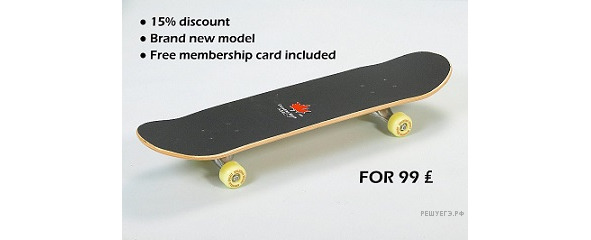
You are considering buying a skateboard and you’d like to get more information. In 1.5 minutes you are to ask four direct questions to find out the following:
1) if there are extra wheels in the kit
2) a free delivery service
3) country producer
4) availability of other colors of the skateboard
You have 20 seconds to ask each question.
Task 3
You are going to give an interview. You have to answer five questions.
Give full answers to the questions (2—3 sentences).
Remember that you have 40 seconds to answer each question.
Typescript for Task 3
Interviewer: Hello everybody! It’s the Club «TV World». Our guest today is a teenager from Russia and we are going to discuss modern TV. We’d like to know our guest’s point of view on this issue. Please answer five questions. So, let’s get started.
Electronic assistant: How often do you watch TV?
Student: _______________________
Electronic assistant: How can TV be harmful to your health?
Student: _______________________
Electronic assistant: What are your favourite TV programs?
Student: _______________________
Electronic assistant: Why do you think many people prefer watching TV at home to going to the cinema?
Student: _______________________
Electronic assistant: In what way can programmes in English improve students’ knowledge of English?
Student: _______________________
Interviewer: Thank you very much for your interview.
Task 4
Imagine that you and your friend are doing a project «National Songs». You have found some illustrations and want to share the news. Leave a voice message to your friend. In 2.5 minutes be ready to:
– explain the choice of the illustrations for the project by briefly describing them and noting the differences;
– mention the advantages (1—2) of the two types of;
– mention the disadvantages (1—2) of the two types of learning and performing national songs;
– express your opinion on the subject of the project – whether you know and perform national songs and why.
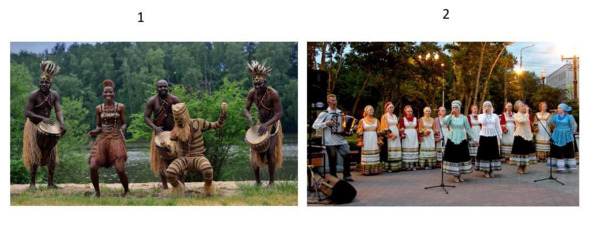
You will speak for not more than 3 minutes (12—15 sentences). You have to talk continuously.
TEST 23
Раздел 1. Аудирование
1. Вы услышите 6 высказываний. Установите соответствие между высказываниями каждого говорящего A—F и утверждениями, данными в списке 1—7. Используйте каждое утверждение, обозначенное соответствующей цифрой, только один раз. В задании есть одно лишнее утверждение. Вы услышите запись дважды. Занесите свои ответы в таблицу.
1. There are more minuses than pluses about changing schools.
2. Your experience of changing schools will depend on your personality.
3. Your marks can become worse if you change schools.
4. There are a lot of advantages about changing schools.
5. You can prepare better for your exams if you change schools.
6. Changing schools can be a chance to improve your life.
7. When changing schools, it’s hard to leave your past behind.

2. Вы услышите диалог. Определите, какие из приведённых утверждений А—G соответствуют содержанию текста (1 – True), какие не соответствуют (2 – False) и о чём в тексте не сказано, то есть на основании текста нельзя дать ни положительного, ни отрицательного ответа (3 – Not stated). Занесите номер выбранного Вами варианта ответа в таблицу. Вы услышите запись дважды.
A. The young man thinks he can choose a present himself.
B. The man is choosing a present for his mother’s birthday.
C. The man doesn’t want to spend too much on the present.
D. The man doesn’t think a gift certificate is a good idea.
E. The shop assistant thinks a present would be better than an experience.
F. The young man’s girlfriend has a profile in In-m.
G. The young man often buys flowers to his girlfriend.

***
Вы услышите интервью. В заданиях 3—9 запишите в поле ответа цифру 1, 2 или 3, соответствующую выбранному Вами варианту ответа. Вы услышите запись дважды.
3. The presenter introduces Bob Thomas as…
1) an outdoor lover.
2) a businessman.
3) a fisherman.
Ответ:
4. Bob’s company was founded by…
1) himself.
2) him and his brother.
3) his father.
Ответ:
5. Bob started working on fishing gear…
1) ten years ago.
2) when he was a very young child.
3) when he needed summer money.
Ответ:
6. Bob liked it that his father…
1) spent a lot of time with his children.
2) taught him to fish and hunt.
3) had a successful company.
Ответ:
7. Bob remembers that their family trips to Florida…
1) were very uncomfortable.
2) cost a lot of money.
3) taught him a lot.
Ответ:
8. Bob believes that as a father he…
1) needs to try hard to be like his own dad.
2) shouldn’t follow his father’s example.
3) needs to spend more time with his family.
Ответ:
9. Bob’s «words of wisdom» refer to…
1) his business.
2) nature.
3) family affairs.
Ответ:
По окончании выполнения заданий 1—9 не забудьте перенести ответы в БЛАНК ОТВЕТОВ №1! Запишите ответ справа от номера соответствующего задания, начиная с первой клеточки. При переносе ответов на задания 1 и 2 цифры записываются без пробелов, запятых и других дополнительных символов. Каждую цифру пишите в отдельной клеточке в соответствии с приведёнными в бланке образцами.
Раздел 2. Чтение
10. Установите соответствие между текстами A—G и заголовками 1—8. Занесите свои ответы в таблицу. Используйте каждую цифру только один раз. В задании один заголовок лишний.
1. Future Rescuers
2. Origin of the Superstition
3. Risky Sport
4. Oldest Creatures
5. Discredited Myth
6. Distress Call
7. Visible Obstacle
8. Significant Difference
A. «When men first flew in space, they were amazed to discover that the only men-made object visible from orbit was the Great Wall of China.» This is a nice idea, but it’s not true. The Great Wall is mostly grey stone in a grey landscape and, in fact, is very difficult to see even from an aeroplane flying at a mere 15 kilometres above. What can be seen when orbiting the earth are the fires of African desert people and the lights of fishing boats off Japan.
В. The term «Mayday’ is an internationally recognized radio signal which is only used when a ship is in great danger and needs help immediately. The signal is transmitted on a wavelength of 2.182 kHz, which is permanently monitored by rescue services on the shore. The use of this expression has a very straightforward explanation. It came from the French phrase «m’aidez’, which means «help me’.
С. In 1700, Henri Misson, a Frenchman visiting Britain, asked villagers why they had horseshoes nailed above their doors. They said it was to keep witches away. Horseshoes are made of iron and the strength of the iron was thought to protect from evil. Still today they are thought to bring good luck and many brides carry silver ones at their weddings. The position of the horseshoe is very important. It must point upwards like a cup so that the luck cannot fall out.
D. Women generally live about six years longer than men. Evidence suggests that boys are the weaker sex at birth, which means that more die in infancy. Also, women do not have as much heart disease as men. In terms of lifestyle, men smoke more than women and thus more die of smoking-related diseases. Also, they generally have more dangerous occupations, such as building work.
E. Scientists say that rats can help look for earthquake survivors buried in the ruined buildings. Dogs are already used to search for people, but rats can be even more useful. Like dogs they’ve got a great sense of smell, but scientists still need to train rats to sniff out people and to carry special radio transmitters to let them know when the survivor is found. Rats may also be trained to find bombs or explosives.
F. Dinosaurs roared for about 150 million years before they disappeared. We humans have only been around for about 2 million years. But cockroaches are 350 million years old and still going strong! Cockroaches can survive in extreme conditions. They can be frozen, then thawed, and walk away as if nothing had happened. They can go for incredibly long time without eating anything. And that is the secret of their success!
G. Founded in 1980, BASE jumping grew out of skydiving. But BASE jumping is much more dangerous than skydiving that is why it is banned in many countries. Legal jumps now happen on specific days and from approved structures. However, like other extreme sports, it’s the risk of disaster that makes BASE jumping so exciting.

***
11. Прочитайте текст и заполните пропуски A—F частями предложений, обозначенными цифрами 1—7. Одна из частей в списке 1—7 лишняя. Занесите цифры, обозначающие соответствующие части предложений, в таблицу.
Clothing
Clothing is a distinctly human artefact. Even more than the use of tools, it distinguishes humans from the other creatures on this planet. The basic purpose of clothing was originally practical. By putting on a skin, humans were able to move into regions ___ (A). An example of this use of clothing can be seen among the Eskimos, and other people who live with extreme cold. However, clothing was not only used for protection, but has also been a means of displaying one’s status. Thus, clothing also developed in countries ___ (B).
Clothing tells us many things about the wearer. It can be used to indicate ___ (C). The most extreme example of this type of clothing is a uniform.
A dress code is very important in business. It is a rare businessman ___ (D).
Most politicians also try to be neat and well-dressed.
The significance of what we wear is becoming more important ___ (E). There have been cases on holiday islands where the locals have been outraged by foreign visitors – especially female visitors – who wear far less than the minimum that the locals consider decent. Actually, the signals given by clothing as worn by men and women have decreased ___ (F). For example, today most women are very comfortable wearing jeans. Yet the sight of a man in a dress would raise eyebrows in most western cultures.
Clothing is very important in our society. So it is highly unlikely that there will be no use for clothing in the future, unless humanity evolves into a completely new species.
1. where there is no real practical need for it
2. because more people started to follow fashion
3. who does not feel the need to wear a suit and tie
4. where they otherwise would have been unable to cope with the climate
5. because many women now wear what were once «men’s’ clothes
6. as the cultures of the world mix
7. whether a person is a member of a particular group or organisation

***
Прочитайте текст и выполните задания 12—18. В каждом задании запишите в поле ответа цифру 1, 2, 3 или 4, соответствующую выбранному Вами варианту ответа.
The Open Window
«My aunt will be down presently, Mr. Nuttel,» said a very self-possessed young lady of fifteen; «in the meantime you must try and put up with me.»
Framton Nuttel endeavoured to say the correct something which should duly flatter the niece of the moment without unduly discounting the aunt that was to come. Privately he doubted more than ever whether these formal visits on a succession of total strangers would do much towards helping the nerve cure which he was supposed to be undergoing.
«I know how it will be,» his sister had said when he was preparing to migrate to this rural retreat; «you will bury yourself down there and not speak to a living soul, and your nerves will be worse than ever from moping. I shall just give you letters of introduction to all the people I know there. Some of them, as far as I can remember, were quite nice.»
Framton wondered whether Mrs. Sappleton, the lady to whom he was presenting one of the letters of introduction came into the nice division.
«Do you know many of the people round here?» asked the niece, when she judged that they had had sufficient silent communion.
«Hardly a soul,» said Framton. «My sister was staying here, at the rectory, you know, some four years ago, and she gave me letters of introduction to some of the people here.»
He made the last statement in a tone of distinct regret.
«Then you know practically nothing about my aunt?» pursued the self-possessed young lady.
«Only her name and address,» admitted the caller. He was wondering whether Mrs. Sappleton was in the married or widowed state. An indefinable something about the room seemed to suggest masculine habitation.
«Her great tragedy happened just three years ago; that would be since your sister’s time. You may wonder why we keep that window wide open on an October afternoon,» said the niece, indicating a large French window that opened on to a lawn.
«It is quite warm for the time of the year,» said Framton; «but has that window got anything to do with the tragedy?»
«Out through that window, three years ago to a day, her husband and her two young brothers went off for their day’s shooting. They never came back. In crossing the moor to their favourite snipe-shooting ground they were all three engulfed in a treacherous piece of bog. It had been that dreadful wet summer, you know, and places that were safe in other years gave way suddenly without warning. Their bodies were never recovered. That was the dreadful part of it.»
Here the child’s voice lost its self-possessed note and became falteringly human. «Poor aunt always thinks that they will come back someday, they and the little brown spaniel that was lost with them, and walk in at that window just as they used to do. That is why the window is kept open every evening till it is quite dusk. Poor dear aunt, she has often told me how they went out, her husband with his white waterproof coat over his arm, and Ronnie, her youngest brother, singing «Bertie, why do you bound?» as he always did to tease her, because she said it got on her nerves. Do you know, sometimes on still, quiet evenings like this, I almost get a creepy feeling that they will all walk in through that window’
13.05.20
Do you
believe in climate change?
This may
seem like an odd question for a climate scientist to ask, but it is one I am
constantly asked
now. The typical discussion starts: «I know that the
climate is changing, but hasn’t it always changed
through natural cycles?»
Then they will often give an example, such as the medieval warm period
to prove
their point.
Those
asking the question include a wide range of people I meet in the pub, friends,
politicians and,
increasingly, even some of those active in sustainable
development and the renewable energy
businesses. What I find interesting is
that I have known many of these people for a long time and
they never asked me
this before.
Recent
studies show that public acceptance of the scientific evidence for man-made
climate change
has decreased. However, the change is not that great. The
difference I find in talking to people is
that they feel better able to express
their doubts.
This is
very hard for scientists to understand. The scientific evidence that humanity
is having an
effect on the climate is overwhelming and increasing every year.
Yet public perception of this is
confused. People modify their beliefs about
uncomfortable truth, they may have become bored of
constantly hearing about
climate change; or external factors such as the financial crisis may have
played a role.
Around
three years ago, I raised the issue of the way that science can be misused. In
some cases
scare stories in the media were over-hyping climate change, and I
think we are paying the price
for this now with a reaction the other way. I was
concerned then that science is not always
presented objectively by the media.
What I don’t think any of us appreciated at the time was the
depth of
disconnect between the scientific process and the public.
Which
brings me to the question, should you believe in climate change? The first
point to make is
that it’s not something you should believe or not believe in –
this is a matter of science and
therefore of evidence – and there’s a lot of it
out there. On an issue this important, I think people
should look at that
evidence and make their own mind up. We are often very influenced by our
own
personal experience. After a couple of cold winters in the UK, the common
question was:
«Has climate change stopped?» despite that fact that many
other regions of the world were
experiencing record warm temperatures. And 2010
was one of the warmest years on record. For
real evidence of climate change, we
have to look at the bigger picture.
You can see
research by the Met Office that shows the evidence of man-made warming is even
stronger than it was when the last report was published. A whole range of
different datasets
and independent analyses show the world is warming. There is
a broad consensus that over the
last half-century, warming has been rapid, and
man-made greenhouse gas emissions are very likely
to be the cause.
Ultimately,
as the planet continues to warm, the issue of whether you believe in climate
change will
become more and more irrelevant. We will all experience the impacts
of climate change in some
way, so the evidence will be there in plain sight.
The more
appropriate questions for today are how will our climate change and how can we
prepare
for those changes? That’s why it’s important that climate scientists
continue their work, and
continue sharing their evidence and research so people
can stay up to date – and make up their
own minds.
1. Paragraph 1 says that people …
1) think that the climate is not changing.
2) doubt that climate change is man-made.
3) believe that in medieval times climate was
harsh.
4) tend to ask strange questions about climate
change.
2. According
to recent studies of public attitude to climate change, more and more people …
1) refuse to accept the scientific proof of warming.
2)know that there is no clear evidence of
climate change.
3) think that scientists are wrong about
climate warming.
4) have stopped trusting climate science.
3. What is
meant by “uncomfortable truth” in paragraph 4?
1)Scientific reports on climate.
2) Evidence of man-made climate change.
3) World financial crisis.
4)People’s personal beliefs.
4. What
does “this” in paragraph 5 refer to?
1) Scientific evidence of climate change.
2) Negative public attitude to climate change.
3)The way the climate change used to be
presented.
4) The historical impact of climate change.
5. The
author gives the example of cold winters in the UK to point out that …
1)the weather in Britain has always been
unpredictable.
2) the Met Office doesn’t make public the
evidence it collected.
3) there is evidence that the climate change
has stopped finally.
4)people draw conclusions based on their own
experience rather than scientific evidence.
6. How does
the author feel about the evidence of climate change?
1) It’s not enough yet.
2)It’s not very convincing.
3)It soon would become conclusive.
4) It’s irrelevant so far.
7. The
author wants climate scientists to continue their work because …
1) they have not shared their findings with
the public.
2) people need to know how to get ready for
changes.
3)society demands more research in this field.
4)people don’t want to make up their own
minds.
20.03.20
Home task
record 4 audiofiles
remember all the rules
speak with correct intonation
Deadline: Saturday 18.00

19.03.2020
Home task for March 20
deadline: TODAY 18.00
audiofiles sent later will not be checked
Human evolution is a lengthy process of change by which people originated from their apelike
ancestors. The traits that we today recognize as human evolved over a period of approximately
six million years. One of the earliest human traits was the ability to walk on two legs. This ability
evolved some four million years ago. A large and complex brain, the ability to use tools and the
capacity for language have developed more recently. Some studies lead us to believe that humans
have some relationship to another group of primate species, the apes. Scientists say that humans
and the great apes of Africa — chimpanzees and gorillas — share a common ancestor who lived
between 8 and 6 million years ago. However, researchers do not all agree about how these
species are related to the modern human. Genetic research into this relationship has produced
some controversial results and more discoveries, perhaps sensational ones, are to be expected.
17/03/20
13.05.20
Do you
believe in climate change?
This may
seem like an odd question for a climate scientist to ask, but it is one I am
constantly asked
now. The typical discussion starts: «I know that the
climate is changing, but hasn’t it always changed
through natural cycles?»
Then they will often give an example, such as the medieval warm period
to prove
their point.
Those
asking the question include a wide range of people I meet in the pub, friends,
politicians and,
increasingly, even some of those active in sustainable
development and the renewable energy
businesses. What I find interesting is
that I have known many of these people for a long time and
they never asked me
this before.
Recent
studies show that public acceptance of the scientific evidence for man-made
climate change
has decreased. However, the change is not that great. The
difference I find in talking to people is
that they feel better able to express
their doubts.
This is
very hard for scientists to understand. The scientific evidence that humanity
is having an
effect on the climate is overwhelming and increasing every year.
Yet public perception of this is
confused. People modify their beliefs about
uncomfortable truth, they may have become bored of
constantly hearing about
climate change; or external factors such as the financial crisis may have
played a role.
Around
three years ago, I raised the issue of the way that science can be misused. In
some cases
scare stories in the media were over-hyping climate change, and I
think we are paying the price
for this now with a reaction the other way. I was
concerned then that science is not always
presented objectively by the media.
What I don’t think any of us appreciated at the time was the
depth of
disconnect between the scientific process and the public.
Which
brings me to the question, should you believe in climate change? The first
point to make is
that it’s not something you should believe or not believe in –
this is a matter of science and
therefore of evidence – and there’s a lot of it
out there. On an issue this important, I think people
should look at that
evidence and make their own mind up. We are often very influenced by our
own
personal experience. After a couple of cold winters in the UK, the common
question was:
«Has climate change stopped?» despite that fact that many
other regions of the world were
experiencing record warm temperatures. And 2010
was one of the warmest years on record. For
real evidence of climate change, we
have to look at the bigger picture.
You can see
research by the Met Office that shows the evidence of man-made warming is even
stronger than it was when the last report was published. A whole range of
different datasets
and independent analyses show the world is warming. There is
a broad consensus that over the
last half-century, warming has been rapid, and
man-made greenhouse gas emissions are very likely
to be the cause.
Ultimately,
as the planet continues to warm, the issue of whether you believe in climate
change will
become more and more irrelevant. We will all experience the impacts
of climate change in some
way, so the evidence will be there in plain sight.
The more
appropriate questions for today are how will our climate change and how can we
prepare
for those changes? That’s why it’s important that climate scientists
continue their work, and
continue sharing their evidence and research so people
can stay up to date – and make up their
own minds.
1. Paragraph 1 says that people …
1) think that the climate is not changing.
2) doubt that climate change is man-made.
3) believe that in medieval times climate was
harsh.
4) tend to ask strange questions about climate
change.
2. According
to recent studies of public attitude to climate change, more and more people …
1) refuse to accept the scientific proof of warming.
2)know that there is no clear evidence of
climate change.
3) think that scientists are wrong about
climate warming.
4) have stopped trusting climate science.
3. What is
meant by “uncomfortable truth” in paragraph 4?
1)Scientific reports on climate.
2) Evidence of man-made climate change.
3) World financial crisis.
4)People’s personal beliefs.
4. What
does “this” in paragraph 5 refer to?
1) Scientific evidence of climate change.
2) Negative public attitude to climate change.
3)The way the climate change used to be
presented.
4) The historical impact of climate change.
5. The
author gives the example of cold winters in the UK to point out that …
1)the weather in Britain has always been
unpredictable.
2) the Met Office doesn’t make public the
evidence it collected.
3) there is evidence that the climate change
has stopped finally.
4)people draw conclusions based on their own
experience rather than scientific evidence.
6. How does
the author feel about the evidence of climate change?
1) It’s not enough yet.
2)It’s not very convincing.
3)It soon would become conclusive.
4) It’s irrelevant so far.
7. The
author wants climate scientists to continue their work because …
1) they have not shared their findings with
the public.
2) people need to know how to get ready for
changes.
3)society demands more research in this field.
4)people don’t want to make up their own
minds.
20.03.20
Home task
record 4 audiofiles
remember all the rules
speak with correct intonation
Deadline: Saturday 18.00


19.03.2020
Home task for March 20
deadline: TODAY 18.00
audiofiles sent later will not be checked
Human evolution is a lengthy process of change by which people originated from their apelike
ancestors. The traits that we today recognize as human evolved over a period of approximately
six million years. One of the earliest human traits was the ability to walk on two legs. This ability
evolved some four million years ago. A large and complex brain, the ability to use tools and the
capacity for language have developed more recently. Some studies lead us to believe that humans
have some relationship to another group of primate species, the apes. Scientists say that humans
and the great apes of Africa — chimpanzees and gorillas — share a common ancestor who lived
between 8 and 6 million years ago. However, researchers do not all agree about how these
species are related to the modern human. Genetic research into this relationship has produced
some controversial results and more discoveries, perhaps sensational ones, are to be expected.
17/03/20
home task
deadline: March 18, 10 am
record your reading
Islands that appear and disappear are certainly part of the world’s legends. But in 1963, with the aid of cameras and scientific observers, some of those legends were given a solid basis of fact. For example, on November 13, 1963, a kind of miracle occured. An island was born.
On that day a fishing boat sailed into waters that were boiling and rolling and foul with a strong smell. The world still had a hard time believing the miracle that was to occur. It was the first time that scientists were to witness the unexpected birth of an underwater island.
First the engineer, then the captain, and at last the cook were aware of awful smell and the peculiar roll of the sea. But it was the cook who first noticed the smoke. He thought there was a ship in trouble somewhere on the seas.
10.03.20
Listen to the interview
|
|||||||||
|
|
Which of the following is TRUE about the writers’ conference? |
|||||||||
|
|
Which of the following is NOT listed as a stage in Julia’s writing process? |
|||||||||
|
|
What is, according to Julia, the advantage of face-to-face events? |
|||||||||
|
|
How do people feel, according to Julia, leaving face-to-face events for writers? |
|||||||||
|
|
In what way is the authors’ advice for young writers different from that of editors? |
|||||||||
|
|
What illusion do people have about writing a book, according to Julia? |
|||||||||
|
|
Which of the following is TRUE about the writers’ conference? |
|||||||||
|
|
Which of the following is NOT listed as a stage in Julia’s writing process? |
|||||||||
|
|
What is, according to Julia, the advantage of face-to-face events? |
|||||||||
|
|
How do people feel, according to Julia, leaving face-to-face events for writers? |
|||||||||
|
|
In what way is the authors’ advice for young writers different from that of editors? |
|||||||||
|
|
What illusion do people have about writing a book, according to Julia? |
|||||||||
|
|
|
4.03.20
18/02/20
18/12/19
26.11.19
Написание эссе
Эссе должно строго соответствовать плану:
вступление — перефразируйте выбранное
высказывание;
ваше мнение по теме и 2-3 аргумента в его
защиту;
противоположное мнение и 1-2 аргумента в
его защиту;
объяснение, почему вы не согласны с
противоположным мнением;
заключение, в котором вы перефразируете
свою позицию из пункта 2.
Каждая часть текста должна начинаться с
нового абзаца, в итоге в сочинении должно быть 5 абзацев.
Проблемой при написании сочинения может стать не
только плохое знание иностранного языка, но и наоборот — слишком хорошее.
Выпускник может написать сочинение в более свободной форме и отойти от шаблона,
комиссия же такой порыв не оценит. Поэтому необходимо писать сочинение строго
по плану и в соответствии с критериями.
Рассмотрим, какие ошибки
допускали выпускники прошлых лет и как их избежать.
Объём
Текст ответа должен содержать не менее 200 и не более
250 слов, допускается отклонение в 10%. По правилам, если объём сочинения менее
180 слов, за всю работу ставится 0, если больше 275 — проверяют часть сочинения
до 250-го слова.
Как избежать ошибок:
Пишите эссе дома на нелинованном листе бумаги. После
10-20 сочинений вы поймёте, какую часть листа занимает нужный объём текста. Это
поможет сориентироваться на экзамене.
Правильно считайте слова. За одно слово
считают:
краткие формы: can’t, didn’t, isn’t, I’m;
предлоги, артикли, частицы;
числительные, выраженные цифрами: 25, 2006, 1000000;
числительные с процентами 25%;
сложные слова: well‑being, good‑looking, twenty‑five;
сокращения: UN, e‑mail.
Пишите по теме
Если проверяющий посчитает, что сочинение не
соответствует выбранной теме, он сразу поставит 0 баллов. Поэтому чем проще –
тем лучше. Ничего не выдумывайте, не пускайтесь в пространные размышления.
Приводите прямые мнения и аргументы чётко по теме.
Эксперты ФИПИ приводят такой пример из вариантов прошлых
лет. Было дано высказывание: “One should read about historical sites before
sightseeing — Следует читать об исторических местах перед их посещением”.
Выпускники совершали следующие ошибки в сочинениях:
Не знали значение слов: принимали слово sites за
веб‑сайты.
Были невнимательны: вместо sites видели cities и
писали о городах.
Упускали смысл высказывания: забывали про слово read,
то есть игнорировали чтение о достопримечательностях, и писали только про их
посещение.
Ещё одна тема из ЕГЭ 2018 года вызвала трудности: “An
early choice of a career path is the key to success — Ранний выбор карьеры —
ключ к успеху”.
Многие выпускники не вчитывались в высказывание и
строили сочинение вокруг словосочетаний “early choice” и “career path”. В
результате писали о своём выборе профессии и о том, когда стоит её выбирать.
Смысл же высказывания заключался в том, что ранний выбор профессии обеспечивает
дальнейший успех в жизни. Соответственно аргументы «за» должны были быть о том,
почему ранний выбор профессии способствует успеху, а «против» — почему он может
привести к неудаче.
Как избежать ошибок:
Несколько раз перечитайте оба высказывания. Выберите
то, в котором вам понятны все слова и значение предложения в целом.
Перед тем как писать сочинение, ответьте на вопросы: в
чём смысл высказывания? С чем вы должны согласиться или не согласиться?
Визуализируйте ответ с помощью майнд‑карты. Обозначьте
тему, от неё спустите 2 стрелки — одну с вашим мнением, вторую — с
противоположным. От своего мнения спустите 2-3 стрелки и в нескольких словах
обозначьте аргументы в его защиту, от противоположного мнения спустите 1-2
стрелки и под ними кратко запишите аргументы в его поддержку.
Перефразируйте тему во вступлении
Во вступлении к заданию №40 выпускники чаще всего совершали
следующие ошибки:
Дословно повторяли тему из задания. Например, к высказыванию “Friendship is the greatest gift of life” писали выступление, которое полностью дублирует фразу: “Some people believe that friendship is the greatest
gift of life. Others don’t think so”.
Высказывали своё мнение по теме. Например, к теме “Science is the first thing to be financed in the
modern world” писали такое вступление: “Modern science helps human progress, that is why it
should be financed before other spheres”.
Не обозначали дискуссионный характер темы.
Использовали риторические вопросы.
Как избежать ошибок:
Во вступлении не должно быть вашего мнения. Первый
абзац — максимально нейтральный.
Тема должна быть перефразирована, то есть выражена
синонимами и близкими по смыслу фразами. Начать можно с помощью фраз‑клише:
Nowadays people are getting more and more concerned
about… — В настоящее время люди все больше и больше обеспокоены насчёт …
It is generally
accepted that… — Общепринято, что…
A common opinion
is that… — Согласно общему мнению…
Для обозначения дискуссионности темы можно
использовать фразы‑клише:
There are two
points of view on… — Существует несколько точек зрения на….
Some people are
convinced that…and others believe that… — Некоторые убеждены что …., другие верят, что…
Не используйте риторические вопросы. Например: Who is
right? Which is true?
Аргументы должны соответствовать мнению
В одном из сочинений за мнением: “I think that it is better to read some historical
information before visiting historic places” шли такие аргументы: “Firstly, you can find a lot of information in the
Internet. Secondly, it may help you in your future life”. Они не
соотносятся с высказыванием, так как прямо не отвечают на вопрос: почему
всё-таки стоит читать информацию перед посещением исторических мест?
Как избежать ошибок:
Сформулируйте своё мнение по теме высказывания, чётко
определитесь: вы за или против.
Для выражения своего мнения используйте фразы‑клише:
My personal view
is that… — Моё мнение таково, что…
In my opinion/judgment/view… — По‑моему
мнению/суждению/На мой взгляд…
I completely agree/disagree with this statement… — Я
совершенно согласна/не согласна с этим утверждением…
I don’t support the idea of… — Я не подерживаю мнение
о том, что…
Объясните, почему вы правы в 2-3 аргументах, которые
следуют из вашего мнения.
Для перечисления аргументов используйте связки:
Firstly/ first and
foremost/ first of all…
Another (positive/
negative) aspect of …
Finally/ Lastly
Представьте, как вам могут возразить в ответ на ваше
мнение. Сформулируйте полностью противоположное мнение.
Начните выражать чужое мнение с фраз‑клише:
However… — Хотя…;
On the other hand
— С другой стороны…
There is another
side to the question of… – Существует и другая сторона вопроса…
Придумайте аргументы в защиту мнения оппонента.
Опровергните контраргументы
В четвёртом абзаце необходимо объяснить, почему вы не
согласны с мнением оппонента. Сделать это необходимо, опровергнув
контраргументы из третьего абзаца.
Например, во втором абзаце вы поддерживаете мнение
«One should read historical sites before sightseeing” и в качестве
противоположного в третьем абзаце приводите «I think that it is better to
visit historical places than to read information» с контраргументом
«The guide will tell you everything during the excursion». В
четвёртом абзаце вы должны опровергнуть контраргумент противоположной стороны
из предыдущего абзаца, а не придумывать ещё один в доказательство своей
правоты.
В примере вам нужно ответить на предложение: «The guide will tell you everything during the
excursion». Например, подойдёт ответ: «If you read about sights in advance you will
save money because excursion may be expensive».
Как избежать ошибок:
Ответьте только на контраргументы из третьего абзаца.
Если вы привели два контраргумента, необходимо опровергнуть оба.
Используйте фразы‑клише:
I strongly disagee
with…
I am afraid I
cannot agree with the opinion that…
Despite my respect
for the opinion that…, I cannot share it because…
Подтвердите своё мнение в заключении
В заключении выпускники чаще всего совершали следующие
ошибки:
Отход от темы. Под конец сочинения забывали про тему
высказывания и в заключении писали про что‑то совершенно другое. Например, ученик закончил сочинение по теме “One should read about historical sites before
sightseeing” следующими словами: “To sum up, I would like to say that sightseeing is
wonderful. And we should cherish the memories about those nice places we have visited”.
Заключение
не соответствует основной теме, так как в нём говорится о посещении
достопримечательностей, хотя рассуждать нужно было о том, стоит или нет читать
о них.
Не обозначали своё мнение. В заключении по предыдущей
теме ученик оставляет проблему неразрешённой: “In conclusion, I want to say,
that it is a debatable issue. Everybody
must decide themselves if they need to find some historical information before
sightseeing”.
Как избежать ошибок:
Держите тему сочинения постоянно перед глазами.
Перефразируйте ваше мнение, о котором вы писали во
втором абзаце.
Используйте фразы‑клише для выражения мнения в
заключении:
On this basis, I can conclude that… — Исходя из этого,
я могу сделать вывод, что…
In conclusion, I would like to stress that… — В заключении
я хотел бы подчеркнуть, что…
All in all, I
believe that… — В конце концов, я верю, что…
To sum up… — Подводя итоги…
Выучите значения вводных слов и союзов
Для построения грамотного и связного высказывания
необходимо правильно использовать вводные слова и союзы. Чаще всего выпускники
путают значения этих частей речи и бессмысленно добавляют их в текст в
хаотичном порядке.
Как избежать ошибок:
Выучите назубок значения вводных слов и союзов, чтобы
не путать их значения. Запомните значения самых распространённых из них:
in addition — к тому же,
moreover — более того,
furthermore — кроме того,
however — тем не менее,
thereby — в связи с этим,
therefore — следовательно,
though — хоть, однако,
although — хотя.
Не используйте более одного вводного слова за раз. Не пытайтесь написать сразу всё, что знаете, например, как здесь: “To my mind, personally, I think that it is better
to visit historical places at first. To begin with, firstly, it will be a
surprise and you will better remember it”. Вы же не пишете в
сочинении по русскому языку так: «Лично, по моему мнению, лучше сначала
посетить историческое место».
Соблюдайте нейтральный стиль
Текст сочинения должен быть выдержан в нейтральном
стиле. То есть нельзя использовать:
риторические вопросы;
разговорную лексику:
Примеры разговорной и нейтральной лексики
Примеры разговорной и нейтральной лексики
разговорные конструкции типа let’s;
краткие формы глаголов: I’m, he’s, don’t, didn’t, haven’t. Исключение:
needn’t.
За что точно поставят 0 баллов
Объём сочинения менее 180 слов.
Плагиат — более 30% или 10 слов подряд из сочинения
совпадают с чужим текстом.
Отход от темы.
Несоблюдение критериев.
Подробно критерии представлены
на сайте ФИПИ в демоверсии письменной части ЕГЭ по английскому языку.
Вводные фразы и слова для эссе
1.
Some
people claim that …, while others argue that …
In this essay I
will try to look upon this issue.
In this essay I
will try to express my opinion on this issue.
In this essay I
would like to express my point of view on this issue.
From my point
of view, …
To
my mind, …
Personally, I think that …
I am certain
that … (Обратите внимание! Мы не сокращаем: пишем I am…)
As
far as I am concerned, …
Firstly, …
To start with, …
To begin with, …
First of all, …
Moreover, …
Furthermore, …
Besides, …
In addition, …
Others believe that …
Some people argue that …
However, some people think that …
3.
Others
believe that …
Some people argue that …
However, some people think that …
4.
I
cannot agree with this opinion because …
I am afraid I cannot agree with this idea
because …
As for …,
Speaking about …,
As far as … is concerned,
To
sum up, …
To
conclude, …
14.11.19
Личное письмо
Правила написания
Секреты успеха
Нюансы
смотри здесь:
https://4ege.ru/angliyskiy/57612-uchimsya-pisat-lichnoe-pismo-po-kriteriyam-ege-2019.html
15.10.19
Раздел «Говорение»
Чтение текста вслух
Количество заданий в разделе «Говорение» ЕГЭ по английскому в 11 классе (ЕГЭ) четыре. Но первое задание — чтение текста вслух.

Каковы требования к выполнению задания?
Вам предлагается отрывок из текста научно-популярного текста. На подготовку отводится 1.5 минуты. На выполнение задания отводится 1.5 минуты (ЕГЭ). Максимальное количество баллов – 1 балл .
Что проверяется в ходе выполнения задания?
Проверяется фонетическая сторона речи – произношение звуков английского языка, интонационное оформление предложений, а также техника чтения (знание правил чтения гласных и согласных букв, а также различных буквосочетаний).
Как оценивается выполнение задания?
Вы получаете 1 балл (ЕГЭ) , если ваша речь легко воспринимается на слух, вы соблюдаете фразовое ударение и интонационное оформление предложений, если вы соблюдаете нормативное произношение слов. При выполнении задания вы можете допустить не более пяти фонетических ошибок, включая не более двух ошибок, искажающих смысл.
Учащийся получает 0 баллов, если возникают трудности при восприятии речи на слух из-за запинок, лишних пауз, неправильного интонирования предложений, а также ошибок в произношении отдельных слов. 0 баллов также выставляется, если допущено более пяти фонетических ошибок, искажающих смысл.
Какие типичные ошибки допускают учащиеся при чтении текста?
Традиционно эксперты указывают на следующие ошибки:
- — Неправильное членение простых и сложных предложений на смысловые группы.
- — Неправильное интонационное оформление смысловых групп, входящих в предложение (несоблюдение восходящего и нисходящего тона).
- — Неправильное интонационное оформление смысловых групп с перечислением (не соблюдается восходящий тон).
- — Неправильная постановка ударения в многосложных словах.
- — Несоблюдение долготы гласных, когда долгие гласные заменяются краткими: eat /iːt/ — it/ɪt/, court /kɔː(r)t/ — cot/kɒt/.
- — Неправильное чтение слов с непроизносимыми согласными: climb /klaɪm/, beret /ˈbereɪ/, bristle /ˈbrɪs(ə)l/.
- — Неправильное произнесение глухих или звонких согласных на конце слова, что приводит к изменению значения слова: nod – not, bed – bet.
- — Неправильная артикуляция некоторых звуков английских языков и замена их другими звуками: / θ/-/ ð/, / ŋ/.
Каковы требования к выполнению задания?
Вам предлагается отрывок из текста научно-популярного текста. На подготовку отводится 1.5 минуты. На выполнение задания отводится 2.0 минуты (ОГЭ) и 1.5 минуты (ЕГЭ). Максимальное количество баллов – 2 балла(ОГЭ) и 1 балл (ЕГЭ).
Что проверяется в ходе выполнения задания?
Проверяется фонетическая сторона речи – произношение звуков английского языка, интонационное оформление предложений, а также техника чтения (знание правил чтения гласных и согласных букв, а также различных буквосочетаний).
Как оценивается выполнение задания?
Вы получаете 1 балл (ЕГЭ) и 2 балла (ОГЭ), если ваша речь легко воспринимается на слух, вы соблюдаете фразовое ударение и интонационное оформление предложений, если вы соблюдаете нормативное произношение слов. При выполнении задания вы можете допустить не более пяти фонетических ошибок, включая не более двух ошибок, искажающих смысл.
Учащийся получает 0 баллов, если возникают трудности при восприятии речи на слух из-за запинок, лишних пауз, неправильного интонирования предложений, а также ошибок в произношении отдельных слов. 0 баллов также выставляется, если допущено более пяти фонетических ошибок, искажающих смысл.
Какие типичные ошибки допускают учащиеся при чтении текста?

Традиционно эксперты указывают на следующие ошибки:
- — Неправильное членение простых и сложных предложений на смысловые группы.
- — Неправильное интонационное оформление смысловых групп, входящих в предложение (несоблюдение восходящего и нисходящего тона).
- — Неправильное интонационное оформление смысловых групп с перечислением (не соблюдается восходящий тон).
- — Неправильная постановка ударения в многосложных словах.
- — Несоблюдение долготы гласных, когда долгие гласные заменяются краткими: eat /iːt/ — it/ɪt/, court /kɔː(r)t/ — cot/kɒt/.
- — Неправильное чтение слов с непроизносимыми согласными: climb /klaɪm/, beret /ˈbereɪ/, bristle /ˈbrɪs(ə)l/.
- — Неправильное произнесение глухих или звонких согласных на конце слова, что приводит к изменению значения слова: nod – not, bed – bet.
- — Неправильная артикуляция некоторых звуков английских языков и замена их другими звуками: / θ/-/ ð/, / ŋ/.
Как готовиться к выполнению Задания №1 раздела «Говорение»?
Для повторения правил чтения английских букв и буквосочетаний можно воспользоваться следующими ресурсами:
- Правила чтения гласных букв и буквосочетаний —
- http://www.englishhints.com/english-vowels.html
- Правила чтения согласных букв и буквосочетаний —
- http://www.pronunciationtips.com/consonants.htm
- http://www.pronunciationtips.com/voiced.htm
- http://www.pronunciationtips.com/endings1.htm
Образец текста (ЕГЭ)


На что следует обратить внимание при подготовке данного отрывка? Конечно же, на произношение географического названия – Isle of Wight / aɪl/./waɪt/,
а также следующих слов – island /ˈaɪlənd / dinosaur /ˈdaɪnəˌsɔː(r)/ contemporary /kənˈtemp(ə)r(ə)ri/ scene /siːn/.
Обратите внимание на знаки препинания в предложениях — они указывают, что необходимо сделать небольшую паузу. Также, делайте паузы в конце каждой части сложносочиненного или сложноподчиненного предложения.
СЛОЖНЫЕ ДЛЯ ЧТЕНИЯ СЛОВА
В английском можно выделить две группы слов, которые называют сложными. К первой относятся слова, произношение которых сильно отличается от написания. Вторую группу составляют сложные английские слова, образованные сложением нескольких полнозначных простых слов.
Слова со сложным произношением
February, phenomenon, aluminium, weird, conscientious, bizarre, occurrence,ventriloquy, necessary, embarrass, maneuver, separate, definitely,circumstance, cemetery, emphasize, embarrass, psychology, pursue, necessary, science, government, language, recommend, allege, concede, committee, occasion, pronunciation, reference, acknowledge, cemetery, recede, inoculate, calendar, conscience, secretary, parliament, succeed, library, neighbor, secede, accommodate, supersede, harass, argument, embarrass, persuade, existence, privilege, proceed, therefore, exceed, precede, foreign, professor, Wednesday, surprise, suspicious,
Слова, для которых существует несколько вариантов произношения (например, британский и американский)
draft (draught), inquiry (enquiry), fulfill (fulfil), program (programme), gray (grey), enroll (enrol), tire (tyre), inclose (enclose).
Слова, произношение которых схоже с произношением других слов
bow – лук для стрельбы и beau – парень, by – предлог и buy – покупать.
|
Wednesday February August cheque tuition fee withdraw architecture geography research review specialist knowledge thistle clothes illegitimate invulnerability prejudice hierarchical entrepreneurial appointment employer confidence guided tour government achievable performance opportunity persuade harass exaggerate success accommodation embarrass millennium |
[ˈwenzdɪ] [ˈfebrʊərɪ] [ɔːˈgʌst] [ʧek] [tjuːˈɪʃn fiː] [wɪðˈdrɔː] [ˈɑːkɪtekʧə] [ʤɪˈɔgrəfɪ] [rɪˈsɜːʧ] [rɪˈvjuː] [ˈspeʃəlɪstˈnɔlɪʤ] [θɪsl] [kləʊðz] [ɪlɪˈʤɪtɪmɪt] [ɪnvʌlnərəˈbɪlɪtɪ] [ˈpreʤʊdɪs] [haɪəˈrɑːkɪkl] [ɒntrəprəˈnɜːrɪəl] [əˈpɔɪntmənt] [ɪmˈplɔɪə] [ˈkɔnfɪdəns] [ˈgaɪdɪdtʊə] [ˈgʌvnmənt] [əˈʧiːvəbl] [pəˈfɔːməns] [ɔpəˈtjuːnɪtɪ] [pəˈsweɪd] [ˈhærəs] [ɪgˈzæʤəreɪt] [səkˈses] [əkɔməˈdeɪʃn] [ɪmˈbærəs] [mɪˈlenɪəm] |
среда февраль август чек плата за обучение снимать, выводить (деньги) архитектура география исследование обзор, рецензия профессиональные знания чертополох одежда противозаконный неуязвимость предубеждение иерархический предпринимательский встреча, прием работодатель уверенность экскурсия правительство достижимый выступление возможность убедить беспокоить преувеличивать успех жилье, размещение смущать тысячелетие |
Сложные составные слова
Многие английские слова образуются путем сложения нескольких простых. Часто их перевод совпадает со значением каждого из простых слов, составленных в одно сочетание. Иногда перевод отличается от дословного, но очень к нему близок. Поэтому составные слова легче для запоминания, чем просто многосложные.
Наиболее востребованные в речи составные сложные английские слова с переводом и транскрипцией представлены в таблице. Обратите внимание, что они могут писаться как слитно, так и раздельно или через дефис.
|
wheelchair vineyard mother-in-law editor-in-chief dragonfly quicksand breakwater hanger-on telltale wheeler-dealer passer-by / passerby attorneygeneral haircut whitewashing onlooker ticketinspector breakthrough |
[ˈwiːlʧeər] [ˈvɪnjəd] [ˈmʌðəɪn-lɔː] [ˈedɪtəɪnʧif] [ˈdrægənflaɪ] [ˈkwɪksænd] [ˈbreɪkwɔːtə] [ˈhæŋəon] [ˈtelteɪl] [ˈwiːlə ˈdiːlə] [ˈpɑːsəˈbaɪ] [əˈtɜːnɪˈʤenərəl] [ˈhɛəkʌt] [ˈbreɪkθruː] [ˈɔnlʊkə] [ˈtɪkɪtɪnˈspektə] [ˈbreɪkθruː] |
инвалидная коляска виноградник свекровь главный редактор стрекоза зыбучий песок волнорез навязчивый поклонник болтун, сплетник пройдоха, махинатор прохожий генеральный прокурор стрижка побелка зритель, наблюдатель контролер |
Топ 20 самых сложных английских слов с переводом
Список самых трудных английских слов. Причем трудность заключается не только в произношении, но и в правильном написании. И так, поехали:
|
Слово на английском |
Транскрипция |
Перевод на русский |
| Aluminium | [æljʊˈmɪnjəm] | алюминий |
| Anaesthetist | [əˈniːsθətɪst] | анестезиолог |
| Anonymous | [əˈnɔnɪməs] | анонимный |
| Ethnicity | [eθˈnɪsɪtɪ] | этническая или расовая принадлежность |
| Facilitate | [fəˈsɪlɪteɪt] | облегчать |
| February | [ˈfebrʊərɪ] | февраль |
| Hereditary | [hɪˈredɪtərɪ] | наследственный |
| Hospitable | [ˈhɔspɪtəbl] | гостеприимный |
| Onomatopoeia | [ɔnəʊmətəʊˈpriːə] | ономатопея, звукоподражание |
| Particularly | [pəˈtɪkjʊləlɪ] | в особенности |
| Phenomenon | [fɪˈnɔmɪnən] | феномен |
| Philosophical | [fɪləˈsɔfɪkəl] | философский |
| Prejudice | [ˈpreʤʊdɪs] | предубеждение |
| Prioritising | [praɪ’ɔrɪtaɪz] | определение приоритетов |
| Pronunciation | [prənʌnsɪˈeɪʃn] | произношение |
| Provocatively | [prəˈvɒkətɪvlɪ] | вызывающе |
| Regularly | [ˈregjʊləlɪ] | правильно, регулярно |
| Remuneration | [rɪmjuːnəˈreɪʃn] | вознаграждение |
| Statistics | [stəˈtɪstɪks] | статистика, статистические данные |
| Thesaurus | [θiːˈsɔːrəs] | словарь, справочник, сокровищница |
Таблица составлена на основе исследований Британских ученых среди Британцев.
Топ-13 ловушек для оратора по версии iloveenglish.ru:
1. Thunderstorm — гроза
2. Invulnerability — неуязвимость
3. Entrepreneurial — антрепренёрский
4. Inconspicuousness — незаметный
5. Maneuverability — маневренность
6. Circumstances — обстоятельства
7. Penitentiary – исправительный дом
8. Depressurization — разгерметизация
9. Interchangeability — взаимозаменяемость
10. Оutmanoeuvre — перехитрить
11. Deteriorate — ухудшать
12. Unequivocally — недвусмысленно
13. Thesaurus — словарь синонимов и антонимов
В качестве бонуса за терпение и старание самое длинное слово в английском языке — «supercalifragilisticexpialidocious»! Современное его значение — «суперархиэкстраультрамегаграндиозно». В следующий раз, когда захотите выразить радость на английском, используйте простенькое «supercalifragilisticexpialidocious», не стесняйтесь!
Числительные в английском языке
Фразы и примерная структура эссе на английском языке
|
|
|
| Many people think … but others do not agree. | Многие люди думают, (что) … , но другие не согласны. |
| Let us consider what the advantages and disadvantages of … are. | Рассмотрим, каковы преимущества и недостатки … . |
| Let’s consider some pros and cons of it. | Давайте рассмотрим некоторые плюсы и минусы (этого). |
| Let us start by considering the facts. | Начнем с рассмотрения фактов. |
| Let us start by considering pros and cons of it. | Начнем с рассмотрения плюсов и минусов (этого). |
| It is generally agreed today that … | Сегодня общепризнано, что … . |
|
|
|
| To begin with, … . | Начнем с того, что … . |
| You can … . | Вы можете (Можно) … . |
| Firstly, … / Secondly, … / Finally, … . | Во-первых, … / Во-вторых, …/ Наконец, … . |
| One argument in support of … . | Один из аргументов в поддержку … . |
| The first thing that needs to be said is … . | Первое, что нужно сказать, это то, что … . (Прежде всего, следует сказать, что … .) |
| First and foremost … . | В первую очередь … . |
| It is true that … / clear that … / noticeable that … . | Это правда, что … / Ясно, что … / Примечательно, что … |
| One should note here that … . | Здесь следует отметить, что … . |
| Another good thing about … is that … . | Еще один положительный момент … заключается в (том, что) … . |
| The second reason for … . | Вторая причина … . |
| It is often said that … . | Часто говорят, что … . |
| It is undeniable that… | Нельзя отрицать, что … . |
| It is a well-known fact that … . | Хорошо известно, что … . |
| For the great majority of people … . | Для подавляющего большинства людей … . |
| We live in a world in which … . | Мы живем в мире, в котором … . |
| A number of key issues arise from the statement. For instance, … . | Это утверждение затрагивает ряд ключевых вопросов. Например, … . |
| One of the most striking features of this problem is … . | Один из самых поразительных аспектов этой проблемы … . |
| First of all, let us try to understand … . | Прежде всего, давайте попытаемся понять … . |
| The public in general tend to believe that … . | Общественность в целом склонна полагать, что … . |
| What is more, … . | Более того, … . |
| Besides, … because it is … . | Кроме того, … потому что … . |
| Doubtless, … . | Несомненно, … . |
| One cannot deny that … . | Нельзя отрицать, что … . |
| It is (very) clear from these observations that … . | Из этих наблюдений (абсолютно) ясно, что … . |
| On the other hand, we can observe that … . | С другой стороны, мы можем наблюдать, что … . |
| The other side of the coin is, however, that … . | Однако, с другой стороны, … . |
| Another way of looking at this question is to … . | Чтобы взглянуть на эту проблему с другой стороны, надо … . |
| One should, nevertheless, consider the problem from another angle. | Тем не менее, следует взглянуть на эту проблему с другой стороны. |
| One should, however, not forget that … . | Тем не менее, не следует забывать, что … . |
| If on the one hand it can be said that … the same is not true for … . | И если с одной стороны, можно сказать, что … , то же самое нельзя сказать о … . |
| On the other hand, … . | С другой стороны, … . |
| Although … . | Хотя … . |
| Besides, … . | Кроме того, … . |
| Moreover, … . | Более того, … . |
| Furthermore, one should not forget that … . | Кроме того, не следует забывать, что … . |
| In addition to … . | Кроме (того, что) … . |
| Nevertheless, one should accept that … . | Тем не менее, следует признать, что … . |
| However, we also agree that … . | Однако, мы также согласны с тем, что … . |
|
|
|
| Experts… | Эксперты … |
| … believe that … . | … считают, что … . |
| … say that … . | … говорят, что … . |
| … suggest that … . | … предполагают, что … . |
| … are convinced that … . | … убеждены, что … . |
| … point out that … . | … отмечают, что … . |
| … emphasize that … . | … подчеркивают, что … . |
| According to some experts… | По мнению некоторых экспертов, … . |
| Perhaps we should also point out the fact that … . | Возможно, нам также следует отметить тот факт, что … . |
| It would be unfair not to mention that fact that … . | Было бы несправедливо не упомянуть тот факт, что … . |
| One must admit that … . | Надо признать, что … . |
| We cannot ignore the fact that … . | Мы не можем игнорировать тот факт, что … . |
| One cannot possibly accept the fact that … . | Трудно смириться с тем фактом, что … . |
| From these facts, one may conclude that … . | Из этих фактов, можно сделать вывод (о том), что … . |
| Which seems to confirm the idea that … . | Что, по-видимому, подтверждает мысль (о том), что … . |
| Thus, … / Therefore,… | Таким образом, … / Поэтому … . |
| The most common argument against this is that … . | Наиболее распространенным аргументом против этого является то, что … . |
|
|
|
| In conclusion, I can say that although … , … . | В заключение я могу сказать, что, хотя … , … . |
| To draw the conclusion, one can say that … . | Подводя итог, можно сказать, что … . |
| So it’s up to everybody to decide whether … or not. | Так что каждый должен решить для себя … ли … , или нет. |
| The arguments we have presented … suggest that … / prove that … / would indicate that … . | Представленные нами аргументы … предполагают, что … / доказывают, что … / указывают на то, что … . |
| From these arguments one must … / could… / might … conclude that … . | Исходя из этих аргументов, надо … / можно … / можно было бы … прийти к заключению о том, что … . |
Распространенные вводные фразы на английском языке
| Вводные фразы | Introductory Phrases |
| Более того, … | Moreover, … |
| Больше всего … | Most of all, … |
| Важно отметить, что … | It is important to note that … |
| Важно помнить, что … | It is important to remember that … |
| Важным является то, что … | An important point is that … |
| В данный момент, … | Аt the moment, … |
| В заключение, … | In conclusion,… |
| В конце концов, … | After all, … |
| В любом случае, … | In any case, … / Anyway, … / Either way, … |
| Вообще-то, … | Actually, … |
| Во-первых, … | Firstly, … |
| В общем, … | All in all, … |
| Вместо того, чтобы … | Instead of … |
| В первую очередь, … | In the first place, … |
| Время от времени, … | From time to time, … |
| В результате … | Аs a result of … |
| Действительно, … | Indeed, … |
| Для того, чтобы … | In order to … |
| Должен признать, … | I must admit, … |
| Другими словами, … | In other words, … |
| Имеет смысл … | It makes sense (to) … |
| Кажется, (что) … | It seems that … |
| Короче, … / Короче говоря, … | In short, … / In a nutshell, … |
| Кроме того, … | Besides, … |
| К счастью … | Luckily, … / Fortunately, … |
| К сожалению, … | Unfortunately, … |
| К тому же, … | In addition, … |
| Между прочим, … / Кстати, … | By the way, … |
| Мне следовало бы … | I should … / I had better … |
| Может показаться, что … | It may seem that … |
| Наконец, … | Finally, … |
| На самом деле, … | In fact, … / Actually, … |
| Насколько я знаю … | As far as I know, … |
| Насколько я могу судить, …. | as far as I can judge, … |
| Не важно, что … | It doesn’t matter that … |
| Не удивительно, что … | It is not surprising that… / It is no great surprise that … |
| Но кроме этого … | But other than that, … |
| Однако, … / Тем не менее, … | However, … |
| Одним словом, … | In a word, … |
| Оказалось, что … | It turned out that … |
| Откровенно говоря, … / Честно говоря, … | Frankly speaking, … / To tell the truth, … |
| По моему мнению, … | In my opinion, …. |
| По правде говоря, … | To tell the truth, … |
| По сути дела, … | As a matter of fact, … |
| Прежде всего, … | First of all, … / Above all, … |
| Само собой понятно, что … | It is self-evident that … |
| Само собой разумеется, что… | It goes without saying that … |
| Следует отметить, что … | It should be noted that … |
| Сначала … | Аt first, … / First, … |
| Советую вам … | I advise you (to) … |
| С одной стороны, … , с другой стороны, … | On the one hand, … , on the other hand, … |
| Также … | Also, … |
| Так же как и … | As well as … |
| Тем временем, … | Meanwhile, … / Meantime, … |
| Тем не менее, … / Всё-таки, … / Однако, … | Nevertheless, … |
| Хорошо известно, что … | It is well known that … |
| Что касается … | As for … / Concerning … |
| Это может означать, что … | It can mean, that … |
| Я бы предпочел … | I would rather … |
| Я бы хотел … | I would like to … |
| Я думаю, … / Я полагаю, … / Я считаю, … | I think, … / I believe, … / I guess, … |
Расшифровка записи
Now we are ready to start.
Tom: Hi, Kate. Kate, earth to Kate! You’re obviously so deep in thoughts. Are you lost in your dreams? What are you thinking about?
Kate: Oh, hi Tom! Sorry, I didn’t see you. Actually I was thinking about a present for my friend’s birthday.
Tom: This shouldn’t be much of the problem for you. You are always so creative for the presents.
Kate: Thanks for the compliment, but the point is, I don’t know this person very well, so choosing a present for her is tricky.
Tom: How can it be that this is your friend and you don’t know this person very well? How can be possible?
Kate: I know it sounds strange, but this is my pen friend actually.
Tom: That explains it. How did you find her?
Kate: Well, she is from Peru and we have just started communicating. I found her profile on facebook. I got a message saying that she has her birthday in two weeks; I thought it’d be nice to give her something on such a special occasion.
Tom: Ok, I see. What about giving her CD? This shouldn’t be so hard to ship to Peru, and music is universal, you know.
Kate: A great idea! But I don’t know what she has or hasn’t in her music collection, do i?
Tom: Oh, that’s pretty easy. You can give her a disc of our local music, she can’t have that. That’s for sure.
Kate: Super! You’re a star!
Tom: Just keep in mind what styles she generally prefers. Do you have any information on that?
Kate: I saw it in her profile. If I remember correctly, she likes calm, romantic music. Does that mean that she is a quite person?
Tom: Not necessarily. She might be just the opposite. Very talkative and easygoing.
Kate: You know, I believe, persons character is reflected in what music he or she likes.
Tom: I think so too. But the connections can be very unexpected and inexplicable for my mind.
Kate: All right. Now I need to go to a music shop and choose something.
Tom: Shall I help you? I’m absolutely free and I know all the local music really well. I can help you choose.
Kate: Really? That would be great! You could also help me choose something for myself, I think my collection needs new items.
Tom: Good idea. Let’s go then.