
1) Вставьте слово, которое грамматически будет соответствовать содержанию текста.
Questions and answers
Johnny was in the 4th grade when he had to take his first school exam. When Johnny came home that day, the mother asked him, “How was ___ (YOU) exam? Were all the questions difficult?”
2) Вставьте слово, которое грамматически будет соответствовать содержанию текста.
Johnny answered, ___ (SMILE) shyly, “No mom, the questions were simple.
3) Вставьте слово, которое грамматически будет соответствовать содержанию текста.
It was the answers which ___ (GIVE) me all the trouble!”
4) Вставьте слово, которое грамматически будет соответствовать содержанию текста.
The compass in the sea
Many people think that to navigate in the sea sailors need the compass. Sailors in ancient times charted their course by the stars, and ___ (NOT USE) the compass.
5) Вставьте слово, которое грамматически будет соответствовать содержанию текста.
We know very little about its invention. All we know is that the compass ___ (MENTION) for the first time in the 12th century manuscript.
6) Вставьте слово, которое грамматически будет соответствовать содержанию текста.
___ (THAT) early compasses consisted of an iron needle attached to a piece of wood or cork that floated in a bowl of water.
7) Вставьте слово, которое грамматически будет соответствовать содержанию текста.
It wasn’t until the 19th century that a really dependable compass was invented. But the compass is no longer used on ships, it’s been replaced by a much ___ (GOOD) device called the gyrocompass.
 Вставьте слово, которое грамматически и лексически будет соответствовать содержанию текста.
Great Yarmouth
Great Yarmouth is not well-known to many people. It’s a typical small English town with a ___ (POPULATE) of 70,000 people.
9) Вставьте слово, которое грамматически и лексически будет соответствовать содержанию текста.
It’s located in a coastal area in Norfolk and has a rich history of ___ (FISH) industry.
10) Вставьте слово, которое грамматически и лексически будет соответствовать содержанию текста.
The locals are ___ (REAL) hospitable people. Most of them own small guest houses or B&Bs as well as souvenir shops.
11) Вставьте слово, которое грамматически и лексически будет соответствовать содержанию текста.
The town also has a market (usually on Wednesdays and Fridays) selling ___ (VARY) goods from household products to clothing. There’s also a large number of chip stalls within the market place.
12) Вставьте слово, которое грамматически и лексически будет соответствовать содержанию текста.
During winter months most places are closed or are open at limited times so ___ (EMPLOY) also goes up as most seasonal jobs come to an end in winter.
13) Вставьте слово, которое грамматически и лексически будет соответствовать содержанию текста.
Over the last few years the local authorities have done a lot to ___ (MODERN) the town to fight this problem.
14) Запишите в поле ответа цифру 1, 2, 3 или 4, соответствующую выбранному Вами варианту ответа.
Mary
Mary wanted something to do, anything to do. Her reason was twofold: one, she wanted with good conscience to escape Glenda’s chore list; and two, she wanted to ___ her mind busy and off last night and Max’s good-night kiss.
1) hold
2) put
3) fix
4) keep
15) Запишите в поле ответа цифру 1, 2, 3 или 4, соответствующую выбранному Вами варианту ответа.
She looked at the framed photo of her and Glenda on her desk. It made her smile; they didn’t even ___ alike though they were twins.
1) look
2) glance
3) see
4) watch
16) Запишите в поле ответа цифру 1, 2, 3 или 4, соответствующую выбранному Вами варианту ответа.
Leaving of musing, she shoved the paperwork on her desk aside and crossed her ankles comfortably on the space she’d cleared. Then she popped a cold can of Pepsi, and ___ her situation.
1) reflected
2) considered
3) thought
4) assumed
17) Запишите в поле ответа цифру 1, 2, 3 или 4, соответствующую выбранному Вами варианту ответа.
The following day there was no ___ for Mary to escape Glenda’s chore list; not if she still wanted Glenda to agree to throw a surprise birthday party for Max.
1) path
2) route
3) way
4) road
18) Запишите в поле ответа цифру 1, 2, 3 или 4, соответствующую выбранному Вами варианту ответа.
After ___ a phone call to Uncle Robert to ask him to check around and see what he could hear about a hockey fan named Perry, she reluctantly started in on the list of chores Glenda had handed her at breakfast.
1) making
2) giving
3) taking
4) doing
19) Запишите в поле ответа цифру 1, 2, 3 или 4, соответствующую выбранному Вами варианту ответа.
It was a foggy windblown day outside just made for warm sweaters and socks, the comfort clothes she adored. Living in St. Louis, one could ___ the weather to change at any moment.
1) await
2) expect
3) imagine
4) believe
20) Запишите в поле ответа цифру 1, 2, 3 или 4, соответствующую выбранному Вами варианту ответа.
Mary almost didn’t hear the knock at the door when it came so close after the thunder. She saw a good-looking stranger who said, “I’m looking ___ Glenda.” Looking down at a piece of paper in his hand he read, “Her name is Glenda Johnson. Look, maybe I have the wrong address. This is some sort of bed and breakfast, isn’t it?”. He looked confused.
1) after
2) in
3) for
4) up
1) Вставьте слово, которое грамматически будет соответствовать содержанию текста.
Questions and answers
Johnny was in the 4th grade when he had to take his first school exam. When Johnny came home that day, the mother asked him, “How was ___ (YOU) exam? Were all the questions difficult?”
2) Вставьте слово, которое грамматически будет соответствовать содержанию текста.
Johnny answered, ___ (SMILE) shyly, “No mom, the questions were simple.
3) Вставьте слово, которое грамматически будет соответствовать содержанию текста.
It was the answers which ___ (GIVE) me all the trouble!”
4) Вставьте слово, которое грамматически будет соответствовать содержанию текста.
The compass in the sea
Many people think that to navigate in the sea sailors need the compass. Sailors in ancient times charted their course by the stars, and ___ (NOT USE) the compass.
5) Вставьте слово, которое грамматически будет соответствовать содержанию текста.
We know very little about its invention. All we know is that the compass ___ (MENTION) for the first time in the 12th century manuscript.
6) Вставьте слово, которое грамматически будет соответствовать содержанию текста.
___ (THAT) early compasses consisted of an iron needle attached to a piece of wood or cork that floated in a bowl of water.
7) Вставьте слово, которое грамматически будет соответствовать содержанию текста.
It wasn’t until the 19th century that a really dependable compass was invented. But the compass is no longer used on ships, it’s been replaced by a much ___ (GOOD) device called the gyrocompass.
Вставьте слово, которое грамматически и лексически будет соответствовать содержанию текста.
Great Yarmouth
Great Yarmouth is not well-known to many people. It’s a typical small English town with a ___ (POPULATE) of 70,000 people.
9) Вставьте слово, которое грамматически и лексически будет соответствовать содержанию текста.
It’s located in a coastal area in Norfolk and has a rich history of ___ (FISH) industry.
10) Вставьте слово, которое грамматически и лексически будет соответствовать содержанию текста.
The locals are ___ (REAL) hospitable people. Most of them own small guest houses or B&Bs as well as souvenir shops.
11) Вставьте слово, которое грамматически и лексически будет соответствовать содержанию текста.
The town also has a market (usually on Wednesdays and Fridays) selling ___ (VARY) goods from household products to clothing. There’s also a large number of chip stalls within the market place.
12) Вставьте слово, которое грамматически и лексически будет соответствовать содержанию текста.
During winter months most places are closed or are open at limited times so ___ (EMPLOY) also goes up as most seasonal jobs come to an end in winter.
13) Вставьте слово, которое грамматически и лексически будет соответствовать содержанию текста.
Over the last few years the local authorities have done a lot to ___ (MODERN) the town to fight this problem.
14) Запишите в поле ответа цифру 1, 2, 3 или 4, соответствующую выбранному Вами варианту ответа.
Mary
Mary wanted something to do, anything to do. Her reason was twofold: one, she wanted with good conscience to escape Glenda’s chore list; and two, she wanted to ___ her mind busy and off last night and Max’s good-night kiss.
1) hold
2) put
3) fix
4) keep
15) Запишите в поле ответа цифру 1, 2, 3 или 4, соответствующую выбранному Вами варианту ответа.
She looked at the framed photo of her and Glenda on her desk. It made her smile; they didn’t even ___ alike though they were twins.
1) look
2) glance
3) see
4) watch
16) Запишите в поле ответа цифру 1, 2, 3 или 4, соответствующую выбранному Вами варианту ответа.
Leaving of musing, she shoved the paperwork on her desk aside and crossed her ankles comfortably on the space she’d cleared. Then she popped a cold can of Pepsi, and ___ her situation.
1) reflected
2) considered
3) thought
4) assumed
17) Запишите в поле ответа цифру 1, 2, 3 или 4, соответствующую выбранному Вами варианту ответа.
The following day there was no ___ for Mary to escape Glenda’s chore list; not if she still wanted Glenda to agree to throw a surprise birthday party for Max.
1) path
2) route
3) way
4) road
18) Запишите в поле ответа цифру 1, 2, 3 или 4, соответствующую выбранному Вами варианту ответа.
After ___ a phone call to Uncle Robert to ask him to check around and see what he could hear about a hockey fan named Perry, she reluctantly started in on the list of chores Glenda had handed her at breakfast.
1) making
2) giving
3) taking
4) doing
19) Запишите в поле ответа цифру 1, 2, 3 или 4, соответствующую выбранному Вами варианту ответа.
It was a foggy windblown day outside just made for warm sweaters and socks, the comfort clothes she adored. Living in St. Louis, one could ___ the weather to change at any moment.
1) await
2) expect
3) imagine
4) believe
20) Запишите в поле ответа цифру 1, 2, 3 или 4, соответствующую выбранному Вами варианту ответа.
Mary almost didn’t hear the knock at the door when it came so close after the thunder. She saw a good-looking stranger who said, “I’m looking ___ Glenda.” Looking down at a piece of paper in his hand he read, “Her name is Glenda Johnson. Look, maybe I have the wrong address. This is some sort of bed and breakfast, isn’t it?”. He looked confused.
1) after
2) in
3) for
4) up
Great Yarmouth, often called Yarmouth, is a seaside resort town in Norfolk, England; it straddles the River Yare and is located 20 miles (30 km) east of Norwich.[2] A population of 38,693 in the 2011 Census made it Norfolk’s third most populous.[1] Its fishing industry, mainly for herring, shrank after the mid-20th century and has all but ended.[3] North Sea oil from the 1960s supplied an oil-rig industry that services offshore natural gas rigs; more recently, offshore wind power and other renewable energy industries have ensued. Yarmouth has been a resort since 1760 and a gateway from the Norfolk Broads to the North Sea. Holiday-making rose when a railway opened in 1844, bringing easier, cheaper access and some new settlement. Wellington Pier opened in 1854 and Britannia Pier in 1858. Through the 20th century, Yarmouth boomed as a resort, with a promenade, pubs, trams, fish-and-chip shops, theatres, the Pleasure Beach, the Sea Life Centre, the Hippodrome Circus, the Time and Tide Museum and a Victorian seaside Winter Garden in cast iron and glass.
Geography and demography[edit]
The town itself is on a 3.1-mile (5.0 km) spit of land between the North Sea and River Yare.[4] It features historic rows of houses in narrow streets and a main tourist sector on the seafront. It is linked to Gorleston, Cobholm and Southtown by Haven Bridge and to the A47 and A149 by Breydon Bridge. The urban area covers 8.3 sq mi (21 km2) and according to the Office for National Statistics in 2002 had a population of 47,288. It is the main town in the Borough of Great Yarmouth.[5]
The ONS identifies a Great Yarmouth urban area with a population of 68,317, including the sub-areas of Caister-on-Sea (8,756) and Great Yarmouth (58,032). The wider Great Yarmouth borough had a population of around 92,500, which increased to 97,277 at the 2011 census.[6] Ethnically, Great Yarmouth was 92.8 per cent White British, with the next biggest ethnic demographic being Other White at 3.5 per cent – Eastern Europeans in the main.[7]
History[edit]

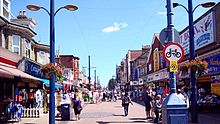
Regent Road before the 2016 fire
Great Yarmouth (Gernemwa, Yernemuth) lies near the site of the Roman fort camp of Gariannonum at the mouth of the River Yare. Its situation having attracted fishermen from the Cinque Ports, a permanent settlement was made, and the town numbered 70 burgesses before the Norman Conquest. Henry I placed it under the rule of a reeve.
In 1101 the Church of St Nicholas was founded by Herbert de Losinga, the first Bishop of Norwich, and consecrated in 1119. This was to be the first of several priories founded in what was a wealthy trading centre of considerable importance. In 1208, King John granted a charter to Great Yarmouth. The charter gave his burgesses of Yarmouth general liberties according to the customs of Oxford, a gild merchant and weekly hustings, amplified by several later charters asserting the rights of the borough against Little Yarmouth and Gorleston. The town is bound to send to the sheriffs of Norwich every year one hundred herrings, baked in twenty four pasties, which the sheriffs are to deliver to the lord of the manor of East Carlton who is then to convey them to the King.[8]
A hospital was founded in Great Yarmouth in the reign of Edward I by Thomas Fastolfe, father of Thomas Fastolf, Bishop of St David’s. In 1551, a grammar school founded and the great hall of the old hospital was appropriated for its use. The school was closed from 1757 to 1860, but re-established by charity trustees and settled in new buildings in 1872.

In 1552 Edward VI granted a charter of admiralty jurisdiction, later confirmed and extended by James I. Elizabeth I came to Great Yarmouth in July 1578.[9] In 1668 Charles II incorporated Little Yarmouth into the borough by a charter with one brief exception remaining in force until 1703, when Queen Anne replaced the two bailiffs by a mayor. In 1673, during the Third Anglo-Dutch War, the Zealand Expedition was assembled in the town. In 1702 the Fishermen’s Hospital was founded.[10] In the early 18th century, Yarmouth, as a thriving herring port, was vividly and admiringly described several times in Daniel Defoe’s travel journals, in part as follows:[11]
Yarmouth is an antient town, much older than Norwich; and at present, tho’ not standing on so much ground, yet better built; much more compleat; for number of inhabitants, not much inferior; and for wealth, trade, and advantage of its situation, infinitely superior to Norwich.
It is plac’d on a peninsula between the River Yare and the sea; the two last lying parallel to one another, and the town in the middle: The river lies on the west-side of the town, and being grown very large and deep, by a conflux of all the rivers on this side the county, forms the haven; and the town facing to the west also, and open to the river, makes the finest key in England, if not in Europe, not inferior even to that of Marseilles itself.
The ships ride here so close, and as it were, keeping up one another, with their head-fasts on shore, that for half a mile [800 m] together, they go cross the stream with their bolsprits over the land, their bowes, or heads, touching the very wharf; so that one may walk from ship to ship as on a floating bridge, all along by the shore-side: The key reaching from the drawbridge almost to the south-gate, is so spacious and wide, that in some places ’tis near one hundred yards from the houses to the wharf. In this pleasant and agreeable range of houses are some very magnificent buildings, and among the rest, the custom-house and town-hall, and some merchants houses, which look like little palaces, rather than the dwelling-houses of private men.
The greatest defect of this beautiful town, seems to be, that tho’ it is very rich and encreasing in wealth and trade, and consequently in people, there is not room to enlarge the town by building; which would be certainly done much more than it is, but that the river on the land-side prescribes them, except at the north end without the gate….

In 1797, during the French Revolutionary Wars, the town was the main supply base for the North Sea Fleet. The fleet collected at the roadstead, from whence it sailed to the decisive Battle of Camperdown against the Dutch fleet.[12]
Again in 1807, during the Napoleonic Wars, the collected fleet sailed from the roadstead to the Battle of Copenhagen.[13]
From 1808 to 1814 the Admiralty in London could communicate with its ships in Yarmouth by a shutter telegraph chain. Ships were routinely anchored offshore during the Napoleonic Wars and the town served as a supply base for the Royal Navy. Part of an Ordnance Yard survives from this period on Southtown Road, probably designed by James Wyatt: a pair of roadside lodges (which originally housed senior officers) frame the entrance to the site, which contains a sizeable armoury of 1806, a small barracks block and other ancillary buildings. Originally the depot extended down to a wharf on the River Yare and was flanked by a pair of storehouses, but these and other buildings were destroyed in The Blitz.[14] A grander survival is the former Royal Naval Hospital designed by William Pilkington, begun in 1806 and opened in 1811. Consisting of four colonnaded blocks around a courtyard, it served as a naval psychiatric hospital, then as a barracks.[15] The barrack-master was Captain George Manby, during his time in post he invented the Manby mortar. The premises was transferred to the NHS in 1958. After its closure in 1993, the buildings were turned into private residences.[16]
The town was the site of a bridge disaster and drowning tragedy on 2 May 1845, when the Yarmouth suspension bridge crowded with children collapsed under the weight killing 79. They had gathered to watch a clown in a barrel being pulled by geese down the river. As he passed under the bridge the weight shifted, causing the chains on the south side to snap, tipping over the bridge deck.[17]
Great Yarmouth had an electric tramway system from 1902 to 1933. From the 1880s until the First World War, the town was a regular destinations for Bass Excursions, when 15 trains would take 8000–9000 employees of Bass’s Burton brewery on an annual trip to the seaside.
During World War I Great Yarmouth suffered the first aerial bombardment in the UK, by Zeppelin L3 on 19 January 1915. That same year on 15 August, Ernest Martin Jehan became the first and only man to sink a steel submarine with a sail-rigged Q-ship, off the coast of Great Yarmouth. It was bombarded by the German Navy on 24 April 1916.
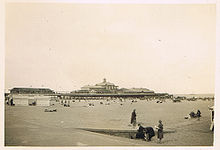
The town suffered Luftwaffe bombing during World War II as the last significant place Germans could drop bombs before returning home, but much is left of the old town, including the original 2,000-metre (1.2 mi) protective medieval wall, of which two-thirds has survived. Of the 18 towers, 11 are left. On the South Quay is a 17th-century Merchant’s House, as well as Tudor, Georgian and Victorian buildings. Behind South Quay is a maze of alleys and lanes known as «The Rows». Originally there were 145. Despite war damage, several have remained.
The southern section of the 2 mi (3.2 km) A47 Great Yarmouth Western Bypass opened in May 1985, with the northern section opened in March 1986. The bypass was re-numbered as part of the A12, until it returned to being part of the A47 in February 2017.
The town was badly affected by the North Sea flood of 1953. More recent flooding has also been a problem, with four floods in 2006, the worst being in September. Torrential rain caused drains to block and an Anglian Water pumping station to break down, which caused flash flooding in which 90 properties were flooded up to 5 ft (1.5 m).[18]
Sights[edit]

Panorama of Hall Quay seen from Southtown. This shows the Town Hall and Star Hotel. Historic South Quay continues to the right of the image.
The Tollhouse with dungeons, dating from the late 13th century, is one of Britain’s oldest former gaols and oldest civic buildings.[19][20][21] It backs onto the central library. Major sections of the medieval town walls survive around the parish cemetery and in parts of the old town.
Great Yarmouth Minster (the Minster Church of St Nicholas, founded in the 12th century as an act of penance) stands in Church Plain, just off the market place. It is the third largest parish church in England after Beverley Minster in the East Riding of Yorkshire and Christchurch Priory in Dorset. Neighbouring Church Plain has the 17th-century timber-framed house where Anna Sewell (1820–1878), author of Black Beauty, was born.
The market place, one of England’s largest, has functioned since the 13th century. It is also home to the town’s shopping sector and the famous Yarmouth chip stalls. The smaller area south of the market is used as a performance area for community events and for access to the town’s shopping centre, Market Gates.
Great Yarmouth railway station is the terminus of the Wherry Lines from Norwich. Before the Beeching Axe, the town had a number of stations and a direct link to London down the east coast. The only remaining signs of these is a coach park, where Beach Station once was, and the A12 relief road, which follows the route of the railway down into the embankment from Breydon Bridge.

Yarmouth has two piers: Britannia Pier (Grade II listed)[22]) and Wellington Pier. The theatre building on the latter was demolished in 2005 and reopened in 2008 as a family entertainment centre, including a ten-pin bowling alley overlooking the beach. Britannia Pier holds the Britannia Theatre, which during the summer has featured acts such as Jim Davidson, Jethro, Basil Brush, Cannon and Ball, Chubby Brown, the Chuckle Brothers, and The Searchers. It is one of the few end-of-the pier theatres surviving in England.
The Scroby Sands Wind Farm of 30 generators is within sight of the seafront, with its giant wind generators. Also visible are grey seals during their breeding season. The country’s only full-time circus, Hippodrome Circus, is just off the seafront.
The Grade II listed Winter Gardens building sits next to the Wellington Pier. The cast iron, framed glass structure was shipped by barge from Torquay in 1903, ostensibly without the loss of a single pane of glass. Over the years, it has been used as ballroom, roller skating rink and beer garden. In the 1990s it was converted into a nightclub by Jim Davidson and has since been used as a family leisure venue. It is currently closed. In the meantime it has been named by the Victorian Society as a heritage building at risk of disrepair.[23]
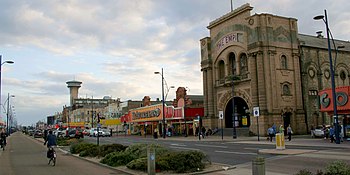
Marine Parade in August 2013, with the derelict Empire Building in the foreground and the Great Yarmouth Tower in the background
Great Yarmouth’s seafront, known as «The Golden Mile» attracts millions of visitors each year to its sandy beaches, indoor and outdoor attractions and amusement arcades. Great Yarmouth’s Marine Parade has twelve Amusement Arcades within 2 square miles (5.2 km2), including: Atlantis, The Flamingo, Circus Circus, The Golden Nugget, The Mint, Leisureland, The Majestic, The Silver Slipper, The Showboat, Magic City, Quicksilver and The Gold Rush, opened in 2007. In addition to the two piers, tourist attractions on Marine Parade include Joyland, Pirates Cove Adventure Golf, Castaway Island Adventure Golf, the Marina Centre, the Sea Life Centre, Merrivale Model Village and the Pleasure Beach and Gardens.
In August 2019, the Venetian Waterways and gardens reopened. The waterways, running parallel to the main beach, were a feature constructed as a work-creation scheme in 1926–1928, consisting of canals and formal gardens, with rowing boats, pedalos and gondolas. These had been allowed to silt up, decay and become abandoned. With a grant from the Heritage Lottery Fund of £1.7m and the labour of volunteers, the flowerbeds have been restored with 20,000 plants, and the 1920s cafe has been restored. That and the boat hire are being run by a social enterprise.[24]
The South Denes area is home to the Grade I listed Norfolk Naval Pillar, known locally as the Britannia Monument or Nelson’s Monument. This tribute to Nelson was completed in 1819, 24 years before the completion of Nelson’s Column in London. The monument, designed by William Wilkins, shows Britannia standing atop a globe holding an olive branch in her right hand and a trident in her left. There is a popular assumption in the town that the statue of Britannia was supposed to face out to sea but now faces inland due to a mistake during construction, although it is thought she is meant to face Nelson’s birthplace at Burnham Thorpe. The monument was originally planned to mark Nelson’s victory at the Battle of the Nile, but fund-raising was not completed until after his death and it was instead dedicated to England’s greatest naval hero. It is currently surrounded by an industrial estate but there are plans to improve the area. The Norfolk Nelson Museum on South Quay housed the Ben Burgess collection of Nelson memorabilia and was the only dedicated Nelson museum in England. Its several galleries looked at Nelson’s life and personality, and at what life was like for men who sailed under him. It closed in 2019.

Charles Dickens used Yarmouth as a key location in his novel David Copperfield, and described the town as «the finest place in the universe».[25] The author stayed at the Royal Hotel on the Marine Parade while writing the novel.
The Time and Tide Museum in Blackfriars Road, managed by Norfolk Museums Service, was nominated in the UK Museums Awards in 2005. It was built as part of a regeneration of the south of the town in 2003. Its location in an old herring smokery harks back to the town’s status as a major fishing port. Sections of the historic town wall stand opposite the museum, next to the Great Yarmouth Potteries, part of which is housed in another former smoke house. The town wall is among the most complete medieval town walls in the country, with 11 of the 18 original turrets still standing. Other museums in the town include the National Trust’s Elizabethan House, the Great Yarmouth Row Houses, managed by English Heritage, and the privately owned Blitz and Pieces, based on the Home Front during World War II.
The Maritime Heritage East partnership, based at the award-winning Time and Tide Museum aims to raise the profile of maritime heritage and museum collections.
Wildlife[edit]
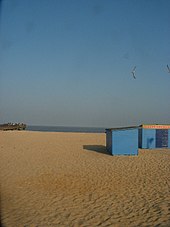
Central Beach close to the Jetty
The Yarmouth area provides habitats for a number of rare and unusual species. The area between the piers is home to one of the largest roosts of Mediterranean gulls in the UK. Breydon Water, just behind the town, is a major wader and waterfowl site, with winter roosts of over 100,000 birds. Grey seal and common seal are frequently seen offshore, as are seabirds such as gannet, little auk, common scoter, razorbill and guillemot.
This and the surrounding Halvergate Marshes are environmentally protected. Most of the area is now managed by conservation organisations, principally the RSPB. The North Denes area of the beach is an SSSI due to its dune plants, and supports numbers of skylarks and meadow pipits, along with one of the largest little tern colonies in the UK each summer, and a small colony of grayling butterflies. Other butterflies found include small copper and common blue.
The nearby cemetery is a renowned temporary roost for spring and autumn migrants. Common redstart and pied flycatcher are often seen during their migration[citation needed]. It has also recorded the first sightings of a number of rare insects blown in from the continent.
Sport and leisure[edit]
The main local football club is Great Yarmouth Town, known as the Bloaters, which plays in the Eastern Counties League. Its ground is at Wellesley Recreation Ground, named after Sir Arthur Wellesley, later to become the Duke of Wellington. There is strong East Anglian rivalry with Gorleston. Local football clubs are served by the Great Yarmouth and District League.
Yarmouth has a horse racecourse that features a chute allowing races of one mile (1.6 km) on the straight.
Speedway racing was staged before and after the Second World War. The meetings were held at the greyhound stadium in Caister Road. The post-war team was known as the Yarmouth Bloaters, after the smoked fish. Banger and Stock car racing are also staged there.
The main Marina leisure centre, built in 1981, has a large swimming pool and conference facilities; it holds live entertainment, such as summer pantomime variety shows produced by local entertainers Hanton & Dean. The centre is run by the Great Yarmouth Sport and Leisure Trust. The Trust was set up in April 2006 to run the building as a charitable non-profit-making organisation.
At the beginning of the 2008 summer season, a world’s first Segway Grand Prix was opened at the Pleasure Beach gardens.
The English Pool Association (EPA),[26] the governing body for 8-Ball Pool in England, holds its National Finals Competitions (including Inter-County and Inter-League, singles and team competitions, and England trials) over several weekends through the year at the Vauxhall Holiday Park[27] on the outskirts of Great Yarmouth.
Transport[edit]
Rail[edit]
The Wherry Lines link Norwich with Great Yarmouth railway station. The hourly Abellio Greater Anglia service is via Acle, or less frequently via Reedham.[28] It is the sole remaining station of three.
Before the Beeching cuts there were four railway lines entering the town: from the north down the coast from Melton Constable to a terminus at Beach station, from the south-west from London Liverpool Street via Beccles, and from the south from Lowestoft Central via Hopton and Gorleston. The last two both terminating at South Town station.[29] The remaining Vauxhall station is now simply referred to as «Great Yarmouth». A former 17 stations within the borough limits are now down to one.
Bus[edit]
The bus station in Great Yarmouth is the hub for local routes beneath Market Gates Shopping Centre. The Excel X1 route operated by First Norfolk & Suffolk provides a long-distance link between Peterborough and Lowestoft, also serving Norwich and King’s Lynn. Other local bus services link the suburban areas of Martham, Hemsby, Gorleston, Bradwell and Belton/ These are mostly operated by First Norfolk & Suffolk. Services to towns further afield such as Beccles, Southwold, Acle and Diss are mostly operated by Konectbus.
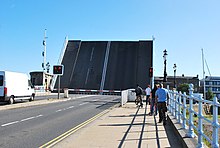
Haven Bridge; one of the two main links to the town pictured in its upright position allowing boats to pass beneath.
Port and River[edit]
The River Yare cuts off Great Yarmouth from other areas of the borough such as Gorleston and Southtown and so the town’s two bridges have become major transport links. Originally Haven Bridge was the only link over the river, but in the late 1980s Breydon Bridge was built to take the A12 over Breydon Water, replacing the old railway bridge of Breydon Viaduct.[30] Both are lifting bridges, which can be raised to allow river traffic to pass through. This can result in traffic tailbacks, and the phrase «the bridge was up» has become synonymous in the town with being late for appointments.
A ferry running between the southern tip of Great Yarmouth and Gorleston provided a much shorter link between the factories on South Denes and the mostly residential areas of Gorleston, but increased running costs and the decline of industrial activity led to its closure in the early 1990s.[31]
Since 2006, the restored pleasure steamer the Southern Belle has offered regular river excursions from the town’s Haven Bridge. Built in 1925 for the Earl of Mount Edgcumbe, she is today owned by the Great Yarmouth and Gorleston Steam Packet Company Limited.[32]
Construction work on the Great Yarmouth Outer Harbour, a deep-water harbour on the North Sea, began in June 2007 and was completed by 2009. Originally there was to be a roll-on/roll-off ferry link with IJmuiden, which failed to materialise. An initiative by Seamax Ferries to connect Great Yarmouth and Ijmuiden by ferry was due to start in 2008.[33] Nor did installation of two large cranes in 2009, since removed, save plans for a container terminal, which have also been scrapped.[34]

Lifeboat station[edit]
There has been a lifeboat at Great Yarmouth since at least 1802. Early boats were privately operated until the RNLI took over in 1857.[35] It has a lifeboat station at Riverside Road, Gorleston (52°34′32″N 1°43′55″E / 52.575419°N 1.732039°E) from where the Trent-class lifeboat Samarbeta and B class (inshore) lifeboat Seahorse IV run.[36]
Roadstead[edit]
The anchorage off Yarmouth known as Yarmouth Roads was seen as one of East Coast’s best in the early 1800s. There fleets gathered and set sail during the Napoleonic wars.[37] Nowadays the roadstead is more likely to be referred to as an anchorage.[38]
Road[edit]
The town is served by the A47 and the terminating A143. Until 2017, the A12 from London terminated in Yarmouth — the route from Lowestoft was renumbered as the A47 by Highways England, as part of a wider road-improvement scheme; thereafter the A12 has terminated in Lowestoft instead of at Vauxhall roundabout. The relief road was built along the path of the old railway to carry the A12 onwards to Lowestoft and London. Roundabouts, junctions and bridges often become gridlocked at rush hour.
Proposed third river crossing[edit]
Plans have been advanced for a third river crossing in Great Yarmouth to link northern Gorleston with the South Denes and the Outer Harbour, avoiding the congested town centre. A public consultation took place in mid-2009 over four possible proposals, but by late 2010 the plans were stalled by lack of funding and closure of the container terminal.[39] In 2016, additional funding of just over £1 million was pledged[40] and a potential crossing proposal outlined for the crossing to link the A12 at Harfrey’s Roundabout to South Denes. If final approval is given, construction could begin in 2021. Public consultation dates have also been set by Norfolk County Council.[41][42]
Air[edit]
The North Denes Heliport north of the town is operated by CHC Helicopter. In 2011 the heliport’s closure was announced, with operations moving to Norwich International Airport, but this has never occurred.[43]
First Responder group[edit]
An East of England Ambulance Service First Responder group has been set up for the Great Yarmouth area. Made up of a group of volunteers within the community in which they live or work, they are trained to attend emergency 999 calls by the NHS Ambulance Service.[44]
Enterprise zone[edit]
Great Yarmouth and Lowestoft Enterprise Zone was launched in April 2012. Its sites include Beacon Park and South Denes in Great Yarmouth.[45]
Notable people[edit]
Those born, raised and/or living in Yarmouth, who have a Wikipedia page:
Earlier times[edit]
- Sir John Fastolf (c. 1378–1459) prototype for Shakespeare’s Falstaff, lived mainly at Caister-on-Sea, but his family had long lived at Great Yarmouth.[46]
- Joan Larke (c. 1490 – after 1529), mistress of Cardinal Thomas Wolsey and mother of his two illegitimate children
16th c.[edit]
- Sir John Clere (c. 1511–1557) politician and naval commander[47]
- William Harborne (c. 1542–1617) diplomat, merchant and Ambassador to the Ottoman Empire[48]
- Edward Owner (1576–1650) politician who sat in the House of Commons at times between 1621 and 1648[49]
- Sir John Potts, 1st Baronet (c. 1592–1673) politician who sat in the House of Commons from 1640 to 1648 and in 1660.[50]
17th c.[edit]
- William Bridge (c. 1600–1670), prominent English independent minister[51]
- Thomas Goodwin (1600–1680) Puritan theologian and preacher, chaplain to Oliver Cromwell[52]
- Joseph Ames (1619–1695) naval commander under the Commonwealth of England[53]
- Rebecca Nurse (1621–1692), sister of Mary Eastey and a victim of the Salem witch trials, was born in Great Yarmouth.[54]
- Mary Eastey (1634–92), victim of the Salem witch trials, was born in Great Yarmouth.
- John Clipperton (1676–1722) of Clipperton Island, privateer who fought against the Spanish
- Sir William Gooch, 1st Baronet (1681–1751) Governor of Virginia from 1727 to 1749[55]
- Joseph Ames (1689–1759) bibliographer and antiquary[56][57]
18th c.[edit]
- Henry Swinden (1716–1772), antiquary, schoolmaster and land surveyor[58]
- James Sayers (1748–1823), caricaturist[59]
- John Ives FRS (1751–1776), antiquary and officer of arms at the College of Arms in London[60]
- Dr Thomas Girdlestone (1758−1822), English physician and writer[61]
- Captain George William Manby FRS (1765−1854), barrack-master and inventor of marine life-saving equipment and the fire extinguisher[62]
- Mary Dawson Turner (1774–1850), artist and illustrator [63]
- Dawson Turner FRS (1775–1858), banker, botanist and antiquary[64]
- Captain John Black (1778–1802) son of a clergyman, ship’s officer and privateer
- William Fisher (1780–1852) officer of the Royal Navy and a novelist[65]
- Robert Miles Sloman (1783–1867), British-German shipbuilder[66]
- Robert Gooch MD (1784–1830), physician[67]
- William Hovell (1786−1875), explorer of Australia[68]
- James Beeching (1788−1858), local shipbuilder, whose firm survived into the 20th century[69]
- Sarah Martin (1791–1843), prison visitor and philanthropist[70]
- Sir George James Turner (1798–1867), barrister, politician and judge, Lord Justice of Appeal in Chancery[71]
- Henry Stebbing FRS (1799–1883), cleric, man of letters, poet, preacher and historian[72]
19th c.[edit]
- Robert McCormick (1800–1890) Royal Navy ship’s surgeon, explorer and naturalist.[73]
- Samuel Laman Blanchard (1804–1845) author and journalist[74]
- Charles John Palmer (1805–1888) lawyer and historian of Great Yarmouth[75]
- John Cantiloe Joy and William Joy (1805–1859 and 1803–1865) marine artists and members of the Norwich School of painters
- James Allen Ransome (1806–1875) agricultural engineer and writer on agriculture[76]
- Sir Edmund Lacon (1807–1888) Conservative politician who sat in the House of Commons between 1852 and 1885
- Sir George Edward Paget FRS (1809–1892) physician and academic[77]
- John Bell (1811–1895) sculptor[78]
- Sir James Paget (1814−1899), Victorian surgeon, after whom the James Paget University Hospital was named[79]
- Anna Sewell (1820−1878), author of Black Beauty, was born and spent the early part of her life in Great Yarmouth.[80]
- James Haylett (1825–1907) noted lifeboatman[81]
- Emma Maria Pearson (1828–1893) writer, one of the first British women nurses in the Red Cross
- Willoughby Smith (1828–1891) electrical engineer, discovered the photoconductivity of the element selenium[82][83]
- Colonel Sir Robert William Edis KBE CB (1839–1927) architect[84]
- Charles Burton Barber (1845–1894) painter, notably of children and pets[85]
- Sir G. A. H. Branson PC (1871–1951), barrister and High Court judge, grandfather of Richard Branson.
- General Sir Thomas Astley Cubitt KCB, CMG, DSO (1871–1939) Army officer and Governor of Bermuda
- Oliver Fellows Tomkins (1873-1901) missionary, eaten by cannibals in Papua
- Reginald Edwards (1881–1925), cricketer
- Captain Cuthbert Orde (1888–1968) war artist, who portrayed many RAF fighter pilots[86]
- Bandsman Jack Blake (John Blake) (1890–1960) boxer, who became British middleweight champion in 1916[87]
- Joseph Henry Woodger (1894–1981) theoretical biologist and philosopher of biology[88]
20th c.[edit]
- William Lygon, 8th Earl Beauchamp JP DL (1903–1979) politician, MP 1929–1938[citation needed]
- Naomi Lewis (1911–2009) poet, essayist, critic and children’s story teller[89]
- Jack Cardiff (1914−2009), Oscar-winning cinematographer[90]
- Peter Cadbury (1918–2006) founder of Westward Television[91]
- Peter Shore (1924–2001), Labour MP and cabinet minister[92]
- Bob Grigg (1924–2002) aerospace engineer, chief designer of British Aerospace 146[93]
- Gerald Hawkins (1928–2003) astronomer and author working on archaeoastronomy[94]
- Sir Kenneth MacMillan (1929–1992), choreographer with the Royal Ballet, Covent Garden[citation needed]
- Richard Larn OBE (born 1931) RN Chief Petty Officer, businessman and maritime historian[95]
- John McDonnell (born 1951, in Liverpool), Labour Party politician and MP, attended Great Yarmouth Grammar School, having moved to Great Yarmouth at a young age.[96][97][98]
- Tony Wright (born 1954) Labour Party politician and MP for Great Yarmouth 1997–2010[99]
- Peter Rodulfo (born 1958) artist, sculptor and leading member of North Sea Magical Realists
- Keith Chapman (born 1959) children’s television writer and producer
- Dale Vince OBE (born 1961) sustainable energy industrialist and New Age traveller[100]
- Jason Statham (born 1967) actor, lived in Great Yarmouth in childhood and attended the local grammar school.[101]
- Matthew Macfadyen (born 1974) actor born in Great Yarmouth[102]
- Travis Kerschen (born 1982) independent film actor[103]
Twin towns[edit]
Great Yarmouth has been twinned with Rambouillet, France since 1956.[104]
See also[edit]
- Lydia Eva, the last surviving steam drifter of the Great Yarmouth herring fishing fleet
- «Yarmouth Town», a traditional sea shanty set in the town
References[edit]
- ^ a b «Great Yarmouth (Norfolk, East of England, United Kingdom) – Population Statistics, Charts, Map, Location, Weather and Web Information». www.citypopulation.de.
- ^ Ordnance Survey (2005). OS Explorer Map OL40 — The Broads. ISBN 0-319-23769-9.
- ^ «Town’s last fishing boat fights tide and time». The Daily Telegraph. 14 January 2008. Archived from the original on 12 January 2022.
- ^ Encyclopedia of the World’s Coastal Landforms. Springer Science & Business Media. 2010. p. 454. ISBN 978-1-402-08638-0.
- ^ Office for National Statistics & Norfolk County Council (2001). Census population and household counts for unparished urban areas and all parishes. Retrieved 2 December 2005.
- ^ «Great Yarmouth Authority population 2011». Retrieved 25 August 2015.
- ^ Services, Good Stuff IT. «Great Yarmouth – UK Census Data 2011». UK Census Data. Retrieved 4 October 2018.
- ^ Nuttall, P Austin (1840). A classical and archæological dictionary of the manners, customs, laws, institutions, arts, etc. of the celebrated nations of antiquity, and of the middle ages. London. p. 555.
- ^ HMC 9th Report: Great Yarmouth (London, 1883), p. 316.
- ^ «Fisherman’s Hospital». greatyarmouthculturalheritage.co.uk. Great Yarmouth Cultural Heritage. Retrieved 17 February 2019.
- ^ Daniel Defoe, A tour thro’ the whole island of Great Britain, divided into circuits or journies (1724), Letter 1, Pt 3. Defoe’s several descriptions may be accessed on the Vision of Britain website.
- ^ Finch-Crisp, William (1877). Chronological Retrospect of the History of Great Yarmouth and Neighbourhood from A.D. 46 to 1884. Great Yarmouth: William Finch-Crisp.
- ^ Finch-Crisp, William (1877). Chronological Retrospect of the History of Great Yarmouth and Neighbourhood from A.D. 46 to 1884. Great Yarmouth: William Finch-Crisp.
- ^ «Norfolk Heritage Explorer».
- ^ Chambers, John (1829). A general history of the county of Norfolk. Norwich. p. 276.
- ^ «A Brief History of the Royal Naval Hospital, Great Yarmouth».
- ^ «The Fall of Yarmouth Road». AngliaCampus. Retrieved 11 October 2009.
- ^ «England; Norfolk; Homes under water in flash floods». BBC News. 25 September 2006. Retrieved 29 January 2010.
- ^ John Greaves Nall (1866). Great Yarmouth and Lowestoft: A Handbook for Visitors and Residents. Longmans, Green, Reader & Dyer. p. 257.
- ^ Clive Tully (1990). The Visitor’s Guide to East Anglia. MPC. p. 69. ISBN 978-0-86190-356-6.
- ^ John Steane (30 October 2014). The Archaeology of Medieval England and Wales. Routledge. p. 25. ISBN 978-1-317-59994-4.
- ^ «Great Yarmouth Britannia Pier – National Piers Society». Archived from the original on 5 October 2013. Retrieved 4 October 2013.
- ^ «Victorian Society reveals top 10 buildings ‘crying out’ to be saved». BBC News. BBC.
- ^ Addley, Esther (17 August 2019). «New life flows into Great Yarmouth as waterways reopen». The Guardian. Retrieved 17 August 2019.
- ^ Biddle, Sophie. «Everyone aboard at Great Yarmouth’s Big Day Out». Great Yarmouth Mercury.
- ^ «English Pool Association – Home Page». Epa.org.uk. Retrieved 26 March 2013.
- ^ «Norfolk Caravan Camping Lodge Holidays and Short Breaks – Vauxhall Holiday Park in Great Yarmouth». Vauxhall-holiday-park.co.uk. Retrieved 26 March 2013.
- ^ National Express East Anglia Timetables. Retrieved 20 November 2010.
- ^ New Adlestrop Railway Atlas Retrieved 20 November 2010.
- ^ Building the Breydon Bridge, June 1985 Our Great Yarmouth, Retrieved 20 November 2010.
- ^ Great Yarmouth Ferry Crossings Our Great Yarmouth; Retrieved 20 November 2010.
- ^ The Southern Belle Archived 21 November 2009 at the Wayback Machine. Retrieved 29 October 2009.
- ^ Seamax Ferries homepage Archived 15 December 2017 at the Wayback Machine. Retrieved 15 December 2017.
- ^ Stephen Pullinger (10 November 2010). «Great Yarmouth outer harbour’s £7m cranes to go». Eastern Daily Press. Retrieved 20 November 2010.
- ^ RNLI history of Great Yarmouth & Gorleston lifeboat station Archived 8 January 2009 at the Wayback Machine
- ^ «Great Yarmouth and Gorleston Fleet». RNLI. Archived from the original on 26 August 2007. Retrieved 29 January 2010.
- ^ «Parliamentary Papers». 4. H.M. Stationery Office. 1826: 116, 224.
- ^ «Anchorage of Great Yarmouth». MarineTraffic.com. Retrieved 9 March 2017.
- ^ «Cash concerns over third crossing» Archived 18 July 2011 at the Wayback Machine East Coast Live; Retrieved 20 November 2010.
- ^ «Funding boost of £1m for third river crossing in Great Yarmouth» Great Yarmouth Mercury; Retrieved 11 January 2017.
- ^ «Public’s Views Sought on Great Yarmouth Third River Crossing» Great Yarmouth Mercury; Retrieved 11 January 2017.
- ^ «Public Consultation on Third River Crossing» Archived 13 January 2017 at the Wayback Machine Norfolk County Council; Retrieved 11 January 2017.
- ^ ««Town’s heliport to close next year»] East Coast Live; Retrieved 20 November 2010″. Archived from the original on 1 August 2012.
- ^ «Great Yarmouth First Responders». Great Yarmouth First Responders. Archived from the original on 23 December 2010. Retrieved 22 June 2010.
- ^ Dickson, Annabelle (12 January 2012). «Great Yarmouth and Lowestoft enterprise zone interest from around the world». EDP24. Eastern Daily Press. Retrieved 13 March 2015.
- ^ «Fastolf, John» . Dictionary of National Biography. Vol. 18. 1889.
- ^ The History of Parliament Trust, CLERE, Sir John (? 1511–1557), of London, Norwich and Ormesby, Norfolk. Retrieved December 2017.
- ^ «Harborne, William» . Dictionary of National Biography. Vol. 24. 1890.
- ^ The History of Parliament Trust, OWNER, Edward (1575–1650), of Great Yarmouth, Norfolk. Retrieved December 2017.
- ^ The History of Parliament Trust, POTTS, Sir John, 1st Bt. (c. 1592–1673), of Mannington, Norfolk. Retrieved December 2017.
- ^ A Puritan’s Mind website, The works of William Bridge & Biography. Retrieved December 2017.
- ^ «Goodwin, Thomas» . Encyclopædia Britannica. Vol. 12 (11th ed.). 1911.
- ^ «Ames, Joseph (1619-1695)» . Dictionary of National Biography. Vol. 01. 1885.
- ^ Salem Witch Trials in History and Literature, University of Virginia, 2001. Retrieved December 2017.
- ^ Dictionary of Virginia Biography, Sir William Gooch (1681–1751). Retrieved December 2017.
- ^ «Ames, Joseph» . Encyclopædia Britannica. Vol. 01 (11th ed.). 1911.
- ^ «Ames, Joseph (1689-1759)» . Dictionary of National Biography. Vol. 01. 1885.
- ^ «Swinden, Henry» . Dictionary of National Biography. Vol. 55. 1898.
- ^ «Sayer, James» . Encyclopædia Britannica. Vol. 24 (11th ed.). 1911.
- ^ «Ives, John» . Dictionary of National Biography. Vol. 29. 1892.
- ^ «Girdlestone, Thomas» . Dictionary of National Biography. Vol. 21. 1890.
- ^ «Manby, George William» . New International Encyclopedia. 1905.
- ^ «Mary Dawson Turner». www.npg.org.uk. Retrieved 21 March 2021.
- ^ «Turner, Dawson» . Dictionary of National Biography. Vol. 57. 1899.
- ^ Laughton, John Knox (1889). «Fisher, William (1780–1852)» . In Stephen, Leslie (ed.). Dictionary of National Biography. Vol. 19. London: Smith, Elder & Co. p. 75.
- ^ Hurd, Archibald; Wilcox, E. H. (1914). German Sea-power: Its Rise, Progress, and Economic Basis. Scribner’s sons. p. 295. Retrieved 18 February 2020.
- ^ «Gooch, Robert» . Dictionary of National Biography. Vol. 22. 1890.
- ^ Dictionary of Australian Biography, HOVELL, WILLIAM HILTON (1786-1875) Retrieved December 2017.
- ^ «Beeching, James» . Dictionary of National Biography. Vol. 04. 1885.
- ^ «Martin, Sarah» . Dictionary of National Biography. Vol. 36. 1893.
- ^ «Turner, George James» . Dictionary of National Biography. Vol. 57. 1899.
- ^ «Stebbing, Henry (1799-1883)» . Dictionary of National Biography. Vol. 54. 1898.
- ^ «McCormick, Robert» . Dictionary of National Biography. Vol. 35. 1893.
- ^ «Blanchard, Samuel Laman» . Encyclopædia Britannica. Vol. 04 (11th ed.). 1911.
- ^ «Palmer, Charles John» . Dictionary of National Biography. Vol. 43. 1895.
- ^ «Ransome, Robert» . Dictionary of National Biography. Vol. 47. 1896.
- ^ «Paget, George Edward» . Dictionary of National Biography. Vol. 43. 1895.
- ^ «Bell, John (1811-1895)» . Dictionary of National Biography (1st supplement). 1901.
- ^ «Paget, Sir James» . Encyclopædia Britannica. Vol. 20 (11th ed.). 1911.
- ^ Sewell, Anna (1897). «Sewell, Mary» . Dictionary of National Biography. Vol. 51.
- ^ Caister Lifeboat website. Retrieved December 2017.
- ^ Atlantic-Cable.com website, The Electrical Engineer, July 24, 1891, page 85 retrieved December 2017.
- ^ «Smith, Willoughby» . Dictionary of National Biography. Vol. 53. 1898.
- ^ Archiseek website, Edis, Sir Robert William (1839–1927) Retrieved December 2017.
- ^ ArtCyclopedia website, Charles Burton Barber, «English Painter, 1845–1894/93». Retrieved December 2017.
- ^ Inventory of Orde’s art held by the RAF Museum. Retrieved December 2017.
- ^ Great Yarmouth Mercury, 2 September 2010. Retrieved December 2017.
- ^ Biographical note at Bookrags.com website. Retrieved December 2017.
- ^ The Guardian, Obituary, 14 July 2009, Obituary, Naomi Lewis. Retrieved December 2017.
- ^ «Jack Cardiff». The Daily Telegraph. 24 April 2009. Archived from the original on 4 May 2009. Retrieved 25 September 2019.
- ^ The Daily Telegraph, 18 Apr 2006, Obituary, Peter Cadbury. Retrieved December 2017.
- ^ HANSARD 1803–2005, Mr Peter Shore. Retrieved December 2017.
- ^ Flight International, May 1981. Retrieved December 2017.
- ^ The Guardian, 24 July 2003, Obituary, Gerald Hawkins. Astronomer who claimed Stonehenge was a computer. Retrieved December 2017.
- ^ Website of Shipwrecks UK Ltd, founded by Richard Larn and Alan Jones. Retrieved December 2017.
- ^ Hunt, Alex (14 September 2015). «A profile of John McDonnell – new shadow chancellor». BBC News. Retrieved 15 October 2020.
- ^ «John McDonnell» (PDF). BBK. Retrieved 15 October 2020.
- ^ Dickson, Annabelle (18 December 2016). «Shadow chancellor shares memories of growing up in Great Yarmouth». Great Yarmouth Mercury. Retrieved 15 October 2020.
- ^ TheyWorkForYou.com – Anthony D Wright MP. Retrieved December 2017.
- ^ The Guardian, 12 March 2015, Woman wins right…. Retrieved December 2017.
- ^ History-biography (20 June 2018). «Jason Statham». History and Biography. Retrieved 28 January 2020.
- ^ IMDb Database. Retrieved December 2017.
- ^ IMDb Database. Retrieved December 2017.
- ^ [1].
Further reading[edit]
- Chisholm, Hugh, ed. (1911). «Yarmouth (Norfolk)» . Encyclopædia Britannica. Vol. 28 (11th ed.). Cambridge University Press.
- Ferry, Kathryn (2009) «‘The maker of modern Yarmouth’: J. W. Cockrill», in: Kathryn Ferry, ed., Powerhouses of Provincial Architecture, 1837–1914. London: Victorian Society; pp. 45–58
External links[edit]
- Official website of Great Yarmouth Borough Council
Great Yarmouth is in the county of Norfolk, in the United Kingdom.
Understand[edit]

Great Yarmouth is a long established English seaside town (since the 1700s) at the mouth of the River Yare, about 120 miles (172 km) to the north east of London. Around 5 million people visit Great Yarmouth every year, making it Britain’s third most popular seaside resort. It is about 20 miles (32 km) from Norwich, the nearest city, and close to the Norfolk Broads — a popular network of inland lakes and rivers.
Formerly the home of one of the most lucrative fishing industry and famous for herrings, Great Yarmouth is a bustling and very popular seaside resort. Undoubtedly, one of the most popular attractions is Great Yarmouth Pleasure Beach, a free-entry theme park, which boasts 28 rides (including the ‘Scenic Railway roller coaster’, built in 1932) and draws annually 1.5 million visitors. The two piers, Britannia Pier and Wellington Pier, both contain family-orientated entertainment including a Bowling alley (Wellington) and a theatre (Britannia). As well as the usual thrills and spills one would expect on a classic British seafront, Great Yarmouth also has a quieter side, with a fascinating heritage quarter to explore. Not many people know that Great Yarmouth has the most complete city walls after York, with heritage walks to help you discover this medieval attraction along with several museums and houses dating back many centuries. If ghost walks are more your cup of tea, Eerie Tales and Yarmouth Yarns is the tour for you, (+44 1493 846346).
Great Yarmouth is also a centre for the North Sea oil and gas industry and increasingly for offshore wind power. The new outer harbour is a huge development taking place which will see cruise liners and larger ships coming to the town. The Maritime Festival in September each year celebrates Great Yarmouth’s maritime heritage.
Yarmouth has seen significant regeneration spending to improve and modernise the popular seafront area and to ensure it is linked to the town centre. Regent Road has a stunning ceiling of light which is illuminated in the evenings and is now a lovely pedestrianed link street leading from town centre to the seafront area.
Illuminations along Marine Parade are also worth an evening stroll, some have been designed by children from local primary schools. Fireworks celebrations run for 6 weeks every Wednesday evening for the six weeks of the school summer holidays when a carnival atmosphere can been enjoyed.
Get in[edit]
By car[edit]
The A47 is a direct route from Norwich or King’s Lynn. The road South towards Lowestoft and Ipswich has now been renumbered, was A12, now A47
1 Great Yarmouth Station, Acle New Rd, Great Yarmouth, NR30 1SD. Has a regular service to Norwich via Acle, Blofield and Brundall on The Wherry Line and occasionally trains run to London Liverpool Street. At Norwich you’ll find local interconnecting services from Lowestoft, Sheringham and Cromer via Wroxham and intercity services to London Liverpool Street. There are also services from the Midlands, the North of England and Scotland, via Peterborough, Cambridge and Ely. A cross country service from Liverpool, through Manchester, Nottingham and Peterborough also arrives in Norwich where connecting trains to Great Yarmouth are available. 
 (updated Apr 2017)
By plane[edit]
- Norwich International airport, with connecting flights from Amsterdam, is about 45 minutes’ drive away.
By bicycle[edit]
Regional Cycle Route 30 runs northwards from to town to Sea Palling, Cromer and beyond. National Cycle Route 517 runs southwards from the town to Beccles where it connects with National Cycle route 1 and Regional Cycle Route 31.
[edit]
Get around[edit]
Great Yarmouth has lots of car parking, all clearly signed. It is a common misconception that parking is difficult to find, but this is not actually the case, with many car parks to be found up and down Marine Parade on the sea front and in the town centre, catering for nearly 2000 cars. Prices start from £1.00 per hour in summer. If you do try to park on a side street to avoid paying, make sure you watch out for residents parking areas where a pass is required.
A refurbished and improved Marine Parade includes extra wide pavements and a special slow lane for bicycles and the landau. A widened road with clearly marked crossing areas for pedestrians and several new roundabouts mean that it is now much easier to cruise up and down when finding somewhere to park.
Regular bus and train services are also available.
See[edit]


Yarmouth offers the traditional seaside attractions — crazy golf, amusement arcades, funfairs, etc. There is also a racecourse, greyhound and stock car racing. The beach itself is clean and good for families.
A few miles north of the town, are quieter seaside villages like Winterton, Sea Palling and Waxham. 20 miles (32 km) or so to the south is Southwold, an upmarket resort.
- 1 Elizabethan House Museum, 4 South Quay, NR30 2QH, ☏ +44 1493 855746, elizabethanhouse@nationaltrust.org.uk. (updated Apr 2017)
- 2 Merrivale Model Village, Marine Parade, NR30 3JG, ☏ +44 1493 842097, peter@merrivalemodelvillage.co.uk. Adults £7.99, senior £6.99, child £6.49, under 3 free. (updated Apr 2017)
- 3 Nelson Museum, 26 South Quay, NR30 2RG, ☏ +44 1493 850698, enquiries@nelson-museum.co.uk. 1 Feb-19 Nov: M-Th 10AM-4PM, F 1PM-4PM, Su 1-4PM. Tells story of seafarer Lord Horatio Nelson (born in Norfolk).

 (updated Apr 2017)
 - 4 Row Houses & Greyfriars Cloisters, South Quay, NR30 2RG, ☏ +44 1493 857900. Adults £4.30, children £2.60, concessions £3.90.
- 5 Somerleyton Hall (Stately home), Lovingland, NR32 5QQ (10 miles S of town.), ☏ +44 8712 224244 (premium), clare@somerleyton.co.uk. Hall & gardens Tu, Th & Su. Also gardens only W. (updated Apr 2017)
- 6 Time and Tide Museum, Blackfriars Road, NR30 3BX, ☏ +44 1493 743930, yarmouth.museums@norfolk.gov.uk. 1 Mar-31 Oct: daily 10AM-4:30PM; 1 Nov-31 Mar M-F 10AM-4PM, Sa Su noon-4PM. Great Yarmouth’s heritage and history. Housed in a converted Victorian herring curing works. (updated Apr 2017)
- 7 Berney Marshes is an RSPB wildlife reserve west bank of the confluence of the Yare and Waveney. It’s open 24 hours, free, donations welcome. There’s no road access so either walk from Berney Arms station (half a mile) or visit on a boat trip. The windmill is a seven-storey tower, initially used to grind clinker for cement, then switched to pumping for drainage. In 2021 it’s derelict and closed.
Do[edit]

Great Yarmouth’s Holiday Mile
The Greater Yarmouth area has a variety of interesting and entertaining attractions to enjoy, whether you’re on holiday, day-tripping or live in or around Norfolk. Indoor and outdoor activities are available — so, even if it’s raining (though East Anglia does enjoy the least rainfall of anywhere in the UK) there’s still plenty to keep the visitor occupied.
The borough of Greater Yarmouth has up to 17 miles (25 km) of sandy beach to enjoy. Deck chairs and wind breaks can be hired on the beach in summer. Dog walkers are welcome at North Beach.
Marine Parade hosts a large range of activities, from Joyland to the more sedate Model Village, from the aforementioned Pleasure Beach to Yesterday’s World, with something for all age groups.
Yarmouth Hollywood Cinema is well worth a visit. It’s the cheapest cinema around and although it only has 5 screens (3 of which are smallish) and isn’t exactly the most modern experience; it has character that is often lacking from ‘multiplex’ cinema chains
- 1 Joyland (Children’s Fun Park), Marine Parade, NR30 2EH, ☏ +44 1493 844094, park@joyland.org.uk. Daily Mid-Mar to end Sep, Oct weekends, Oct half-term holidays. (updated Apr 2017)
- 2 Pirates Cove (Adventure golf), Marine Parade, NR30 2ER, ☏ +44 1493 331785. £7.50 adults, £6.50 children. (updated Apr 2017)
- 3 Pleasure Beach, South Beach Parade, NR30 3EH, ☏ +44 1493 844585, info@pleasure-beach.co.uk. 9 acres. Rides, roller-coaster, fun-fare, etc. Dogs allowed on a lead and under control. (updated Apr 2017)
- 4 RetroSkate (Roller-skating), Marine Parade, NR30 2ER, ☏ +44 1493 854349, info@retroskate.net. (updated Apr 2017)
- 5 Sealife, Marine Parade, NR30 3AH, ☏ +44 1493 330631. Daily from 10AM. Fun for all ages. Although not cheap, you have all day to explore the large assortment of aquariums including a shark tank with a tunnel passing underneath it. (updated Apr 2017)
- 6 TopGun Indoor Paintball, Trafalgar Works, Fenner Rd, NR30 3PS, ☏ +44 1493 844839. (updated Apr 2017)
- 7 The Hippodrome, St. Georges Road Great Yarmouth Norfolk NR30 2EU, ☏ +44 1493 844172, hippodromecircus@gmail.com. Dubbed one of the 7 wonders of the British Seaside, The Hippodrome hosts spectacular circus shows of international quality within a building of great beauty and heritage. Not to be missed! (updated May 2020)
- 8 Wellington Pier, Marine Parade, NR30 3JF, ☏ +44 1493 845947, info@wellington-pier.co.uk. Amusements, bowling, casino, gift shops, ice cream parlour. (updated Apr 2017)

Part of the town wall and its South East Tower
- 9 Town wall, from Rampart Road to Mariners Road. 24×7. For a more cultured diversion, take a 1-hour self-guided walking tour along supposedly the best preserved medieval town wall after York’s, with 11 surviving towers along a 1.3-mile route passing through residential, ecclesiastical, commercial and industrial areas from the North West Tower by the river at the end of Rampart Road to the Blackfriars Tower on Mariners Road. The most impressive section with the five-storey South East Tower is along Blackfriars Road between the latter and St Spyridon church. Free. (updated Aug 2020)
- 10 Cycling, around Great Yarmouth. 24×7. The Great Yarmouth Cycle Map has several routes of between 7 and 16 miles to neighbouring villages covering various subjects. 4 miles from the town hall is Burgh Castle, a 3rd-century Roman fort with a good view. Lowestoft is 10 miles away along the coast and an off-road trail, passing quaint Gorleston, atmospheric St Margarets ruined church and Ness Point, the easternmost point of Britain. Bring a bike (free with a train ticket but spaces are limited) or rent one. (updated Aug 2020)
Buy[edit]
Many places of genuine interest on Regent Road (including Docwra Rock Shop — see below).
Great Yarmouth puts the fun back into shopping, whether in the high street chain stores, some of the quirky local shops or the more traditional seaside shops. Market days are Wednesdays and Saturdays all year and on Fridays as well during the summer months.
For general shopping, Yarmouth is served by Asda next to the train station; Tesco between town centre and the industrial estate and Sainsbury’s near Market Gates.
- 1 Asda (Superstore/supermarket), Acle New Road, Runham Vauxhall, NR30 1SF, ☏ +44 1493 330272. M 7:30AM-midnight, Tu-F 24 hr, Sa midnight-10PM, Su 10AM-4PM. Petrol station, pharmacy, ATMs. (updated Apr 2017)
- 2 Co-Op (Foodstore), 26 Beresford Road, New Town, NR304AB, ☏ +44 1493 842104. Daily 7AM-10PM. (updated Apr 2017)
- 3 Docwra Rock Shop (Candy store), 13 Regent Rd, NR30 2AF, ☏ +44 1493 844676. The largest rock (the sugary type you can eat) factory in the world. They also make and sell many other types of confectionery, including many types of fudge, chocolate-coated strawberries and even diabetic products. (updated Apr 2017)
- 4 Sainsbury’s (Superstore/supermarket), St. Nicholas Road, NR30 1NN, ☏ +44 1493 330313. M-Sa 08AM-9PM, Su 10AM-4PM. Cafe (different hours), ATMs. (updated Apr 2017)
Eat[edit]
Yarmouth has a long history of chip stalls on the market place near town centre and Market Gates. Several have been there for many many decades offering a delicacy not available anywhere else.
- 1 Anna Sewell House, 26 Whitehorse Plain, NR30 1NE, ☏ +44 1493 856859. (updated Apr 2017)
- 2 Bombay Nite (Indian Restaurant), 25a King St, NR30 2NZ, ☏ +44 1493 331383. Free delivery locally on orders over £15. (updated Apr 2017)
- 3 The Courtyard, Row 75, Howard St South, NR30 2PU, ☏ +44 1493 330622. Tu-Sa noon-2PM & 7-9PM. (updated Apr 2017)
- 4 The Dining Room (Bistro), 68 Marine Parade, NR30 2DQ, ☏ +44 1493 842740. M-F 9AM-4PM, Sa Su 9AM-5PM. (updated Apr 2017)
- 5 Harry Ramsden’s (Fish Restaurant), 11-12 Marine Parade, NR30 3AH, ☏ +44 1493 330444. Daily 11:30AM-10PM. (updated Apr 2017)
- 6 The Imperial Hotel (Restaurant & hotel), North Drive, NR30 1EQ, reservations@imperialhotel.co.uk. Has a good French-influenced restaurant. (updated Apr 2017)
- 7 Sara’s Tearooms, The Pleasure Beach Gardens, South Beach Parade, NR30 3EH, ☏ +44 1493 845546, sara@thetearooms.co.uk. (updated Apr 2017)
- 8 The Troll Cart (a JD Weatherspoons pub), 7-9 Regent Rd, NR30 2AF (situated at the west end of Regent Road near Market Gates), ☏ +44 1493 332932. Daily 8AM-midnight. One of the best places to eat in Yarmouth. When they bother to stock the ingredients on the menu (around 50% of the time) it is the best and cheapest place to get a good meal. The Troll Cart stocks a good range of spirits, ales and beer from around the world. Meat free and wheat free options are stated on their menu. (updated Apr 2017)
- 9 The Copper Kitchen, 27 — 30 Camperdown (With your back to the Sea Life Center looking down Camperdown, tree lined avenue.), ☏ +44 1493 843490, enquiries@andoverhouse.co.uk. 6-9PM. Restaurant serving modern food, a good spot for a romantic break. £20. (updated Apr 2018)
Drink[edit]
When the sun goes down, Great Yarmouth becomes a wonderland of colour as you find your way to a night out on the town to enjoy our theatres, nightclubs, cinemas and casinos.
The Britannia Pier theatre has a varied programme of performance to enjoy.
For fine dining try the Anna Sewell restaurant or Café Cru at The Imperial Hotel. Alternatively, Pub on the Prom is a great place to start with a wide menu and a great atmosphere.
Popular clubs in Yarmouth include Caesars, Roseys, Kings Wine Bar, Arena, Fantasia, Peggotys, the Gari/Tabu/Gaping-Hole-In-The-Ground (after several incarnations this one has turned in to a fun place to be on a Saturday night), The Long Bar, Angels Strip Club and the Ocean Rooms.
- 1 The Barking Smack (Bar), 16 Marine Parade, NR30 3AH, ☏ +44 1493 859752, barkingsmack@hotmail.com. (updated Apr 2017)
- 2 The Dock Tavern, Dock Tavern Lane, Gorleston-on-Sea, NR31 6PY, ☏ +44 1493 442255. Free Wi-Fi. (updated Apr 2017)
- 3 The Kings Arms (Pub), 229 Northgate St, NR30 1BG, ☏ +44 1493 843736, info@thekingsarmsgreatyarmouth.co.uk. Bar: M Tu noon-10PM, W 11AM-11PM, Th noon-11PM, F Sa noon-midnight, Su noon-10PM. Food: M-F noon-2:30PM & 5-9PM, Sa noon-10PM, Su noon-5PM. Also food. (updated Apr 2017)
- 4 The Marine Pub, 15 Marine Parade, NR30 3AH, ☏ +44 1493 844244. (updated Apr 2017)
- 5 Mocha (Coffee lounge), 34 Regent St, ☏ +44 7940 009292 (mobile). M-Sa 9AM-3PM. Mocha is a coffee lounge and café by day offering cooked to order breakfasts and lunches. (updated Apr 2017)
- 6 Munchies Cafe, 2 North Drive, NR30 4ET, ☏ +44 7808 032075 (mobile), info@munchiesgreatyarmouth.co.uk. Also food, deck chair hire. (updated Apr 2017)
Sleep[edit]
There’s such a range of holiday accommodation in Great Yarmouth you’ll be spoilt for choice.
- 1 Andover House Hotel, 27-30 Camperdown, NR30 3JB (Tree Lined Avenue Camperdown, opposite the Sea Life Centre), ☏ +44 1493 843490, bookings@andoverhouse.co.uk. Check-in: 2PM, check-out: 10AM (weekdays), 11AM (weekends). This hotel in Great Yarmouth has 3 AA stars, and a fine dining restaurant with 2* AA rosettes. Exclusively for adults (over 13 years). 27 plush rooms ranging from single to superior with a king size bed, renovated with a bar and outdoor terrace. £69-109. (updated Apr 2018)
- 2 Caravan Holidays Hopton, Warren Road, NR31 9BW (Hopton Holiday Village is signposted on the A12 between Great Yarmouth and Lowestoft, follow the signs to Hopton.), ☏ 0845004829 (non-geographic number), enquiries@caravanholidayhopton.co.uk. Check-in: 2PM, check-out: 11AM. 2- and 3-bedroom privately owned static caravans for hire, all offering linen and towels in the price on Hopton Holiday Village. from £50/night.. (updated Nov 2016)
- 3 Hotel Victoria, Kings Road, NR30 3JW, ☏ +44 1493 843872, booking@hotelvictoria.org.uk.
- 4 Marine House (Hotel & B&B), 81 Marine Parade, NR30 2DJ, ☏ +44 1493 855051. Very friendly guest house, with a very reasonably priced bar room. Situated on the sea front close to Britannia pier. Also the best breakfast offered in the town. £20 per person per night.
- 5 Marine Lodge Hotel, 19-20 Euston Rd, NR30 1EB, ☏ +44 1493 331120, res@marinelodge.co.uk. Swimming pool. Bar. Dining room. (updated Apr 2017)
- 6 [formerly dead link] Sunnyside B&B, 10 Wellesley Rd, NR30 2AR, ☏ +44 1493 844013, info@bedandbreakfastgreatyarmouth.org. £40-54. (updated Apr 2017)
- 7 The Swiss Cottage, 31 North Drive, NR30 4EW, ☏ +44 1493 855742, info@swiss-cottage.info. AA 4*. (updated Apr 2017)
- St Annes Hotel, 7 Norfolk Square, NR30 1EE, ☏ +44 1493843795, holgatehouse@btinternet.com. Check-in: 4PM, check-out: 10:30AM. In a quiet location of Great Yarmouth, though only 200 yards from the seafront and a 5-min walk into town. Double, twin & family rooms available. (updated Mar 2019)
Stay healthy[edit]
- 1 Nearest Accident & Emergency: James Paget University Hospital, Lowestoft Road, Gorleston, NR31 6LA (5 miles S of town centre.). 24/7. (updated Apr 2017)
- 2 East Norfolk Medical Practice (GP or Primary Healthcare), 147 Lawn Avenue, NR30 1QP, ☏ +44 1493 745050. M 8:30AM-6:30PM, Tu W 8:30AM-19:30PM, Th F 8:30AM-6:30PM. (updated Apr 2017)
- 3 John G. Plummer (Dentist), Greyfriars Chambers, 8 Queen Street, NR30 2QP, ☏ +44 1493 842559, yarmouth@plummers.co.uk. M-F 8:30AM-5PM. (updated Apr 2017)
- 4 Well (Pharmacy), 57-58 King Street, NR30 2PW, ☏ +44 1493 843445. M-F 9AM-18:30PM, Sa 9AM-1PM. (updated Apr 2017)
Go next[edit]
- Lowestoft — a quiet coastal town in neighbouring Suffolk.
- Norwich — a two-cathedral city, Norwich is the capital city of Norfolk.
Routes through Great Yarmouth
 |
||
|
Установите соответствие тем A—G текстам 1-6. Занесите свои ответы в таблицу. Используйте каждую букву только один раз. В задании одна тема лишняя. TEST 04(part 1) |
A. EXPENSIVE NEWSPAPERS
B. SERIOUS PROBLEM 6
C. DIFFERENT TOPICS 1
D. WAYS OF READING 4
E. INSTANT INFORMATION 5
F. EASIER READING 2
G. FAMOUS AUTHOR 3
1. There are two main types of newspaper: ‘broadsheets’ and ‘tabloids’. Broadsheets are often larger than tabloids, and are ‘serious’ newspapers. They present the news in detail, and do not have many stories about the private lives of famous people. Tabloids, on the other hand, are much more interested in news and scandals involving stars than they are in serious news. They often have very big headlines, particularly on the front page, and have lots more photographs.
Два типа газет. DIFFERENT TOPICS
2. There is an organisation in the UK called the Plain English Campaign. Their aim is to try to get official documents, such as government leaflets, written in a style of English that is easy to understand. They say that a lot of written English, particularly when it’s talking about legal issues, is confusing, even to British people. They have had a lot of success, and many government departments now make sure that the documents they produce are checked to make sure they’re understandable.
Организация, которая упрощает сложный стиль официальных документов. EASIER READING
3. The Tolstoy family have contributed much to Russian society and culture for many hundreds of years. One of the most famous Tolstoys, Count Lev Nikolaevich, better known to the world as Leo Tolstoy, was born in 1828. He was a writer, politician and philosopher, and is now considered to be one of the greatest novelists of the 19th century. Many of his books, including War and Peace and Anna Karenina, are still extremely popular today. Leo Tolstoy died in 1910.
Толстой великий писатель 19го века, который является популярным и по сей день. FAMOUS AUTHOR
4. If you’re reading a newspaper and you want to find out what’s on TV at 8 o’clock tonight, you don’t read every word on the TV page. You ignore all the programmes on earlier in the day, and just look at the information about programmes on at 8 pm. With a news report, however, you may read the whole thing through quickly to get a general idea of what it’s about. If it looks interesting, you might decide to read it in more detail.
Различные способы чтения новостей. WAYS OF READING
5. When we want to find a company’s telephone number, we look in a telephone directory. The Internet, however, doesn’t have a directory of websites, so how can we find the website of a business we’re interested in? The answer is to use a ‘search engine’. One of the most popular search engines at the moment is Google. Let’s say you want to find a company called Haymarket. You do a quick search on Google, and all the websites which have the word Haymarket in them appear in a list.
Принцип поиска информации в интернете. INSTANT INFORMATION
6. Many people suffer from some form of dyslexia. This means that their reading or writing ability is not as good as you would expect from their level of intelligence. There are actually many different types of dyslexia. If you have ‘scotopic sensitivity syndrome’, for example, you find it difficult to read black print on white paper. Other colours, however, are much easier to read.
Различные виды дислексии. SERIOUS PROBLEM
| № текста | 1 | 2 | 3 | 4 | 5 | 6 |
| тема | C | F | G | D | E | B |
ВСЕ ТЕСТЫ


От 25 апреля, 2022 СТАТГРАД
Тренировочная работа №2 статград ЕГЭ 2022 по английскому языку 11 класс задания и ответы для варианта АЯ2110201. Официальная дата проведения работы: 21 апреля 2022 год.
Скачать задания письменной части
Скачать задания устной части
Все ответы (решения) и задания (с аудио)
Задания письменной части варианта статград:
Задания устной части:
Задания и ответы с вариантов статграда:
1)“Trees Can Talk” by Robin Black is
- 1) a book of Native American folk stories.
- 2) a bestselling psychological thriller.
- 3) a scientific book written by a biologist.
2)The word “mindset” in “That mindset – comparing trees to people – is exactly the problem” is closest in its meaning to
- 1) “way of thinking”.
- 2) “word combination”.
- 3) “scientific experiment”.
3)According to Robin, scientists
- 1) always knew that trees could communicate.
- 2) have just proven that trees can communicate.
- 3) are suspecting that trees might communicate.
4)According to Robin, when a tree is already attacked by insects, it produces chemicals, which
- 1) defend it from the insects.
- 2) tell other trees of the attack.
- 3) serve as medicine for it.
5)The presenter spells the word “mast” because
- 1) he is not sure he heard it correctly.
- 2) he wants to write it down correctly.
- 3) he thinks he needs to correct the guest.
6)Pecan trees produce nuts
- 1) regularly every season.
- 2) with no visible regularity.
- 3) depending on the weather.
7)We can see from the interview, that the presenter
- 1) himself is not a very clever person and asks stupid questions.
- 2) is a specialist in biology and makes the interview too technical.
- 3) makes sure the listeners understand what the guest is saying.
8)Which of the following is NOT true?
- 1) Mass paper production requires complicated machinery.
- 2) Cooking and blending can be part of the paper-making process.
- 3) Originally, people used trees as the material for making paper.
- 4) Today, some people make paper the old-fashioned way for fun.
9)Which of the following can be considered paper in the strict sense of the word?
- 1) paper made of wood
- 2) paper made of tree bark
- 3) parchment paper
- 4) amate paper
10)The original purpose of paper was
- 1) writing.
- 2) packaging.
- 3) recycling.
- 4) hygiene.
11)Toilet paper was invented in
- 1) China.
- 2) Mexico.
- 3) Europe.
- 4) the Islamic world.
12)Which of the following is NOT one of the negative environmental consequences of paper making?
- 1) chemical air pollution
- 2) chemical water pollution
- 3) destruction of forests
- 4) unrecyclable final product
13)Which of the following is NOT an advantage of handmade papermaking?
- 1) It is good for the environment.
- 2) It allows you to be creative.
- 3) All sheets of paper are alike.
- 4) Material is easy to find.
14)In the last paragraph, by saying “This type of material can go a long way” the author means that
- 1) one can make a lot of paper out of a small quantity of material.
- 2) it takes a long time to make hand-made paper out of this material.
- 3) the paper made from this material is thick and will last a long time.
- 4) this kind of material can be recycled over and over again.
15)Mark Twain is one of the most well-known American writers. He was the __________________ great literary voice in America. He recorded the history and culture of America in his writing and brought to life all sorts of characters based on people he knew and met.
16)Born in 1835 as Samuel Clemens, Twain lived through the Civil War and joined the Confederate Army. His various careers __________________ riverboat pilot, prospector, and newspaper agent.
17)Mark Twain achieved fame by writing humorous fiction, and his work is still enjoyed by __________________ and grownups today.
18)His most famous works include The Adventures of Tom Sawyer and Adventures of Huckleberry Finn. Both of them are modeled on his childhood in Missouri. He also wrote The prince and the Pauper where the way people treat the poor and disadvantaged
19)Why did a ten-week-old piglet wonder the streets of New York City? New York City animal control officers __________________ understand that either.
20)One Friday afternoon they found a tiny piglet. They thought she __________________ from a market. They took her to a shelter. She was quite sick. She was treated for wounds and a respiratory infection.
21)The shelter staff named her Priscilla. Now she is a lot __________________ . Priscilla was adopted by a family in Michigan. She loves her new home.
22)After school little Peter often went to the public library where his mum worked. He loved the quiet rooms with __________________ shelves of books.
23)He loved looking at people sitting __________________ in armchairs and reading. He thought he knew the library well. But today he made a turn and was suddenly lost.
24)The further he went, the taller the bookshelves were and the narrower the aisles between them. He tried turning back but couldn’t find the right __________________ .
25)But he was also curious. Walking on his tiptoes, Peter came up to the corner and looked under the shelf. He saw something little moving on the __________________ floor.
26)You have received an email message from your English-speaking pen-friend Gloria: From: Gloria@mail.uk To: Russian_friend@ege.ru Subject: Moving … Next week we are moving to California! My dad found a good job there. This will be the fourth time in my life that we pack and go to a new place! How many times have you moved in your lifetime, if any? What would be the house or apartment of your dreams? Where would you like to live when you grow up? By the way, in our new place we will have a vegetable garden!
27)Imagine that you are doing a project on what kinds of fruit teenagers in Zetland eat regularly. You have found some data on the subject – the results of the opinion polls (see the table below). Comment on the data in the table and give your opinion on the subject of the project.
Другие тренировочные варианты статград ЕГЭ по английскому языку 11 класс:
СТАТГРАД работы по английскому языку задания и ответы
Вариант АЯ2110101 пробный ЕГЭ 2022 статград по английскому языку 11 класс с ответами
Метки: английский язык 11 классЕГЭ 2022заданияответыстатградтренировочная работа