
Текст TSOI (A Russian Rock Star) с переводом.
TSOI (A Russian Rock Star)
ЦОЙ (российская рок-звезда)
| Victor Tsoi was born in Leningrad in 1962. His mother was Russian and his father was Korean. Little did they know that their son would grow up to be one of the pioneers of Russian rock music. | Виктор Цой родился в Ленинграде в 1962 году. Его мать была русской, а его отец – корейцем. Вряд ли они знали, что их сын станет одним из пионеров российской рок-музыки. | |
| He started writing rock songs when he was 17, and by the time he was 20 he had formed a band called “Kino”. They made their first recording in Tsoi’s flat and the demo tape was passed around the city and then the country. | Он начал писать песни, когда ему было 17 лет, а к 20 годам он создал группу под названием “Кино”. Они сделали первую запись в квартире Цоя, и демо-запись потом пошла по городу и по стране. | |
| Kino quickly attracted a large cult following. When their first album “45” was released in 1982, the political nature of their lyrics both excited a lot of Russian youth and angered the authorities. The band was the runaway winner of the Leningrand Rock Club Concert, mostly due to the popularity of their anti-war songs. | Группа “Кино” быстро привлекла много поклонников. Когда в 1982 году был выпущен их первый альбом “45”, политическая сущность их стихов взволновала много русской молодежи, а также рассердило власти. Эта группа легко стала победителем Концерта Ленинградского рок-клуба благодаря, главным образом, популярности своих антивоенных песен. | |
| 1985 proved to be a very important year for Tsoi and for Kino. Tsoi got married and had a son, Alexander. Social reforms allowed rock bands to be written about and appear on TV, which up until then had not been allowed. Kino then quickly became the most popular rock band in Russia. | 1985 год оказался очень важным для Цоя и для группы “Кино”. Цой женился, и у него появился сын Александр. Социальные реформы разрешили писать о рок-группах и появляться им на ТВ, что до того момента не разрешалось. Группа “Кино” стала самой популярной рок-группой в России. | |
| Sadly, Victor Tsoi died in a tragic car accident in 1990. | К сожалению, Виктор Цой погиб в трагической автокатастрофе в 1990-м году. | |
| Amazingly, a tape of his vocals for the next album survived the crash and the band made the album after his death. This album was called the ‘Black Album’ and it was the band’s last. | Удивительно, но пленка с его записями для следующего альбома сохранилась в катастрофе, и группа выпустила этот альбом после его смерти. Этот альбом был назван “Черный альбом” и стал последний для группы. | |
| Their music is still popular today and Victor Tsoi remains a cultural hero. | Их музыка все еще популярна сегодня, а Виктор Цой остается культурным героем. |
Источник: Spotlight, 11 класс
Светило науки — 265 ответов — 10205 раз оказано помощи
Viktor Tsoi, a singer, a poet, an actor, a musician has lived a short life, but became a symbol, an icon, and a voice of his generation. He was born in 1962 in Leningrad, his father was an engineer, and his mother was a PT teacher. He’s been attending art school, and in 1978 entered Leningrad Art College, but in 1979 was expelled, found a job at the factory and started attending a night school. In 1980 Tsoi has started to participate in small home concerts in Moscow, and in 1981 made his stage debut as a bass player in “Trium”, a cafe in Leningrad. In this year Victor Tsoi, Alexey Rybin and Oleg Valinsky have created a band, later renamed into “Kino”. In 1982 “Kino” has played the first concert at Leningrad Rock Club and released the first album, produced by Boris Grebenshchikov. Thus began the impetuous rise of the group and Victor Tsoi to recognition and fame. Viktor Tsoi died in 1990 in a car crush, and has left a heritage of paintings, songs, poems, cinema roles and millions of loyal fans. His poetry is highly valued and appreciated to this day.
|
Viktor Tsoi |
|
|---|---|
| Виктор Цой | |
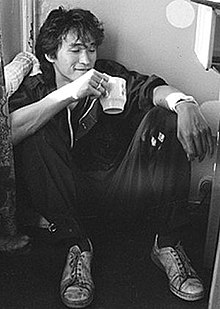
Tsoi in 1986 |
|
| Born |
Viktor Robertovich Tsoi 21 June 1962 Leningrad, Russian SFSR, Soviet Union |
| Died | 15 August 1990 (aged 28)
Zentene, Latvian SSR, Soviet Union |
| Cause of death | Car crash |
| Resting place | Bogoslovskoye Cemetery, Saint Petersburg |
| Occupations |
|
| Years active | 1978–1990 |
| Spouse |
Marianna Tsoi (m. 1985) |
| Children | 1 |
| Musical career | |
| Genres |
|
| Instrument(s) |
|
| Labels |
|
| Signature | |
 |
Viktor Robertovich Tsoi (Russian: Виктор Робертович Цой; Russian pronunciation: [ˈvʲikt̪ər ˈrobʲɪrt̪əvʲɪtɕ ˈtsoi̯]; 21 June 1962 – 15 August 1990) was a Soviet singer and songwriter who co-founded Kino, one of the most popular and musically influential bands in the history of Russian music.
Born and raised in Leningrad (now known as Saint Petersburg), Tsoi started writing songs as a teenager. Throughout his career, Tsoi contributed a plethora of musical and artistic works, including ten albums. After Kino appeared and performed in the 1987 Soviet film Assa, the band’s popularity surged, triggering a period referred to as «Kinomania», and leading to Tsoi’s leading role in the 1988 Kazakh new wave art film The Needle. In 1990, after their high-profile concert at the Luzhniki Stadium, Tsoi briefly relocated to Latvia with bandmate Yuri Kasparyan to work on the band’s next album. Two months after the concert, Tsoi died in a car collision.[8][9]
He is regarded as one of the most important pioneers of rock music in Russia and is credited with popularizing the genre throughout the Soviet Union. He retains a devoted following throughout the former Soviet Union, where he is known as one of the most influential and popular people in the history of Russian music.
Viktor Tsoi became popular by combining his music and lyrics with philosophy.[10]
Early life[edit]
Viktor Robertovich Tsoi was born on 21 June 1962, in a maternity hospital on Kuznetsovskaya Street in Leningrad. He was the only child of Valentina Vasilyevna Tsoi (née Guseva), a Russian schoolteacher, and Robert Maximovich Tsoi, a Soviet Korean engineer from Kzyl-Orda, Kazakhstan, where his Korean parents had been exiled after Stalin’s 1937 deportation of Koreans in the Soviet Union.[11][12] The family’s Korean ancestry can be traced back to Songjin, Hamgyong, Korea (present-day Kimchaek, North Korea), where Viktor’s great-grandfather Choi Yong-nam was born in 1893.[13]
Tsoi grew up in the vicinity of the Moskovsky Victory Park. The family lived in the notable «general’s house» at the corner of Moskovsky Avenue and Basseynaya Street (the building is now an architectural monument).[14] For some time Tsoi studied at a nearby school in Frunze Street, where his mother worked.[15]
From 1974 until 1977, Tsoi attended a secondary art school, where he was a member of the band Palata No. 6 (Russian: Палата № 6, English: «Ward No. 6»).[16] From 1977, he attended the Serov Art School, until he was expelled in 1979 for poor performance.[citation needed] Afterwards, he attended SGPTU-61, a secondary city vocational school, where he studied to become a wood carver.[17] In his youth, he was a fan of Mikhail Boyarsky and Vladimir Vysotsky, and later Bruce Lee, after whom he started modelling his image.[18][19] He was fond of martial arts and often sparred «in Chinese» with bandmate Yuri Kasparyan.
Career[edit]
Tsoi began writing songs at the age of 17. In the 1970s and the 1980s, rock music was an underground movement limited mostly to Leningrad; Moscow pop stars, endorsed by the Soviet state, ruled the charts and received the most exposure from the media. However, rock music was not popular with the government, and rock bands received little to no funding and were given little exposure by the media. The Leningrad Rock Club was one of the few public places where rock bands were allowed to perform.
In the late 1970s and early 1980s, Tsoi was a close friend of Alexei Rybin. Rybin, a member of the hard rock band Piligrimy (Russian: Пилигримы, lit. ‘Pilgrims’), and Tsoi, who played bass guitar in the group Palata # 6 (Russian: Палата № 6, lit. ‘Chamber # 6’), met at the house of Andrei «Svin» Panov, in whose apartment people and musicians often gathered, and also where his own punk band Avtomaticheskie udovletvoriteli rehearsed. By this time, Tsoi had begun to perform the songs he wrote at parties.
Tsoi and Rybin, as members of Автоматические удовлетворители (Avtomaticheskie udovletvoriteli), went to Moscow and performed punk-rock metal at Artemy Troitsky’s underground concerts. During a similar performance in Leningrad on the occasion of Andrei Tropillo’s anniversary, Tsoi and Rybin first met Boris Grebenshchikov. Later, after a solo concert by Grebenshchikov, they met up and Tsoi played two of his songs to him.[20] Grebenshchikov, who had already been a relatively established musician in the Leningrad underground scene, was very impressed by Tsoi’s talent and helped him start up his own band.
Beginnings of Kino[edit]
At the Leningrad Rock Club, Tsoi played as a solo artist supported by members of the band Aquarium. Tsoi’s lyrics and music impressed the crowd. In the summer of 1981, Tsoi, Rybin, and Oleg Valinsky formed the band Garin i giperboloydy (Russian: Гарин и Гиперболоиды, lit. ‘Garin and the hyperboloids’). The name was a homage to the classic Russian novel The Hyperboloid of Engineer Garin by Aleksey Tolstoy. In autumn of the same year, the band was admitted to membership of the Leningrad Rock Club. Not long after, Valinsky was conscripted into the army, leaving only Tsoi and Rybin, who renamed the band to Kino. Kino began recording its debut album in the spring of 1982.
First albums[edit]
Kino began recording its debut album, 45, in the spring of 1982 at Andrei Tropillo’s studio. Members of Aquarium also took part in the recording, with Boris Grebenshchikov directing the album. By the summer, the album was completely finished. Its duration was 45 minutes, after which the album was named 45. The album got some distribution and Kino performed in many apartment concerts in Moscow and Leningrad.
On 19 February 1983, a joint concert with Kino and Aquarium took place. After the concert, Yuri Kasparyan was invited to join the band as a guitarist. In the spring, Rybin left Kino due to disagreements with Tsoi. Tsoi and Kasparyan spent the summer on joint rehearsals. As a result, Kino recorded the album 46, which was initially thought of as a demo for Nachalnik Kamchatki (Russian: Начальник Камчатки, lit. ‘Chief of Kamchatka’). 46 was widely distributed and was considered to be a full-fledged album. In the fall of 1983, Tsoi went to a psychiatric hospital in Pryazhka, where he spent a month and a half. As a result, Tsoi was not conscripted into the army.[21] After being discharged from the psychiatric hospital, he wrote the song «Trankvilizator» (Russian: Транквилизатор, lit. ‘Tranquilizer’).[22]
«Peremen!/»My zhdyom peremen» («Changes!»/»We are waiting for changes»), first performed by Tsoi in the summer of 1986, quickly became an important political song, an embodiment of the spirit of the Perestroika. It remains a powerful political song, prominently used during 2020–2021 Belarusian protests.
Rise to fame[edit]
1987 was a breakthrough year for Kino. The release of their 6th album Gruppa Krovi (Russian: Группа крови, lit. ‘Blood Type’) triggered what was then called «Kinomania». The open political climate under glasnost allowed Tsoi to make Gruppa Krovi, his most political album, yet it also allowed him to record a sound of music that no one before him had been able to play. Most of the tracks on the album were directed at the youth of the Soviet Union, telling them to take control and make changes within the nation; some of the songs addressed the social problems crippling the nation. The sound and lyrics of the album made Tsoi a hero among Soviet youth and Kino the most popular rock band ever. In the diverse Soviet republics, fans translated his originally Russian lyrics into their native languages as well.
Over the next few years, Tsoi appeared in several successful movies and also travelled to the United States to promote his films at film festivals. Several more albums were released, their themes were once again mostly political, further fueling the band’s popularity. Even though Tsoi was a huge star, he still lived a relatively ordinary life. He kept his old job in the boiler room of an apartment building, called Kamchatka, which is currently a museum/club dedicated to the singer. The fact that he worked at a boiler plant surprised many people. Tsoi said that he enjoyed the work and he also needed the money to support the band, as they still received no government support and their albums were copied and passed around the nation via magnitizdat free of charge. This made Tsoi even more popular among the people because it showed that he was down to earth and they could relate to him. He also went on tour in 1988–1989 to Italy, France, and Denmark. Kino’s finest hour came in 1990 with a concert at Moscow’s Luzhniki Stadium; 62,000 fans filled the stands to celebrate the triumph of the USSR’s most successful rock group. It also was one of the four times the Luzhniki Olympic Fire was ever lit.
Film appearances[edit]
In 1987, the band Kino, along with other Russian rock bands, appeared as themselves in Assa (Russian: Асса), a film by Sergei Solovyov. However, the film as a whole has nothing to do with rock music, and Kino simply appears as a cameo in the end.
In 1988, Viktor Tsoi starred as the protagonist in The Needle (Russian: Игла, romanized: Igla), directed by Rashid Nugmanov and written by Aleksandr Baranov and Bakhyt Kilibayev. The plot is centered around the character Moro, who returns to Almaty, Kazakhstan, to collect money owed to him. While waiting out an unexpected delay, he visits his former girlfriend Dina and discovers she has become a morphine addict. He decides to help her quit and fight the local drug mafia responsible for her condition. But Moro finds a deadly opponent in «the doctor,» the mafia kingpin who is exploiting Dina.[23] Tsoi was nominated for an award for his role in the film.[21]
The film’s soundtrack, including original music by Tsoi’s band Kino, contributes to the overall feeling of the movie, in addition to the film’s use of post-modern twists and surreal scenes.
The movie was officially released in February 1989 in the Soviet Union.
Death[edit]

Tsoi’s fans mourning in Leningrad
On 15 August 1990, in Latvia, Tsoi was driving on the Sloka – Talsi highway, near Tukums and Riga. At 12:28 p.m., Tsoi died in a car collision. The investigation concluded that Tsoi had fallen asleep while driving, possibly due to fatigue;[24][25] he had not consumed alcohol for at least 48 hours before his death.[26] At the time he fell asleep Tsoi was driving at a speed of at least 130 km/h, causing his dark blue Moskvitch-2141[27] to turn into the oncoming lane and collide with an Ikarus 250 bus.[28] Tsoi was pronounced dead at the scene. The bus driver was not injured. Tsoi’s car was completely destroyed to the point that one of its tires was never found.
The death of Viktor Tsoi was a shock to many fans, some even having committed suicide.[29] On 17 August, Komsomolskaya Pravda, one of the main Soviet newspapers, had the following to say about Tsoi and his meaning to the youth of the nation:
Tsoi means more to the young people of our nation than any politician, celebrity or writer. This is because Tsoi never lied and never sold out. He was and remains himself. It’s impossible not to believe him… Tsoi is the only rocker who has no difference between his image and his real life, he lived the way he sang… Tsoi is the last hero of rock.
On 19 August, he was buried in a closed casket at the Bogoslovskoe Cemetery in Leningrad. Thousands of people came to the funeral.[30]
Kasparyan left for Leningrad prior to the collision, with a tape containing the only recording of Tsoi’s vocals for the band’s next album. The remaining members of Kino finished and released the Black Album in December. It later became the band’s most popular creation.[citation needed]
Personal life[edit]
Viktor lived with his wife, Marianna Tsoi, and his son Alexander (born 1985). Tsoi lived a poor life, with Marianna saying that they could not even afford a proper wedding dress. The apartment building boiler room he worked at was nicknamed «Kamchatka», and is now the site of a museum and rock club dedicated to Tsoi.[31] He previously also worked in Kyiv, Ukraine, however after the authorities found out he was working illegally, he was sent to Moscow.
During the filming of Assa, Tsoi met Natalia Razlogova, the director’s assistant. Tsoi later fell in love with Razlogova and separated from Marianna. However, they did not divorce, for the sake of their son.[32]
Legacy[edit]

Russian stamp devoted to Viktor Tsoi, 1999

Portraits of Viktor Tsoi are displayed today in many places around Russia, from graffiti on the fences of Saint Petersburg to an entire wall dedicated to Viktor Tsoi in a bylane of the famous Arbat Street in Moscow, where fans still gather to remember their hero. Other Tsoi Walls can also be found in Minsk, Belarus and in some regions of Kazakhstan. In 2000 some of the nation’s top rock bands came together and released their interpretations of Kino’s best songs as a tribute to Viktor Tsoi on what would have been his 38th birthday.[citation needed]
In 2012, on what would have been Tsoi’s 50th birthday, the remaining members of Kino gathered to record the song «Ataman» (Russian: «Атаман»), with his vocals that were recovered from his car crash but never used because of its poor quality. The drummer Georgiy Guryanov died shortly after, making «Ataman» the last song recorded by Kino and its members.[citation needed]
On 15 August 2020, the 30th anniversary of Tsoi’s death was marked. In memory of Tsoi, the Palace Bridge in St. Petersburg was lifted to his songs. Fans across the country commemorated his death, especially in his home city of St. Petersburg where a number of events and concerts were organised, as well as at the Tsoi Wall in Moscow. The day before, a 4-meter-tall monument dedicated to Tsoi was erected in St. Petersburg in his memory.[33][34]
The South Korean rock band YB covered the song «Gruppa krovi» (Russian: «Группа крови», lit. ‘Blood Type’; Korean: 혈액형) on their 1999 album Korean Rock Remade (Korean: 한국 ROCK 다시 부르기).[35]
Viktor An, a South Korean-born Russian short track speed skater, chose his Russian name «Viktor» in honour of Tsoi.[36]
Popular culture[edit]
- Joanna Stingray commemorated him in her song, «Tsoi Song».[37]
- On 21 June 2012, Google commemorated Tsoi’s 50th birthday with a Google Doodle reminiscent of the Tsoi Wall.[38]
- In 2015, Tsoi’s song «Kukushka» (Russian: «Кукушка», lit. ‘Cuckoo’) was covered by Russian singer Polina Gagarina for the movie Battle for Sevastopol.
- In the 2018 film Leto, Tsoi was played by Teo Yoo.[39]
- In 2018, a monument to Tsoi was erected in Almaty, Kazakhstan.[40]
- In the 2019 videogame, Metro Exodus, multiple songs by Kino such as “We Want Changes”, “Watch Yourself”, “A Song Without Words” and “Shut The Door Behind Me», can be heard on the radio during segments set on a train as it travels across Russia, its crew in search of a hospitable place to live after a nuclear war. “Shut The Door Behind Me” can also be heard in the beginning of the level ‘Taiga’ as the player and a crew member scout out a valley.[citation needed]
- In the 2020 videogame, Cyberpunk 2077, graffiti reading «цой жив» (Tsoi lives) can be found in various locations.[41]
Family[edit]
| External images |
|---|
 Valentina Vasiliyevna — Viktor’s mother Valentina Vasiliyevna — Viktor’s mother |
| Robert Maximovich — Viktor’s father |
| Alexander — Viktor’s son |
- Maxim Maximovich Tsoi (Korean name: Choi Seung Jun, Hangul: 최승준) — Viktor’s grandfather on his father’s side; a Korean from Kazakhstan.[42]
- Robert Maximovich Tsoi (born 5 May 1938, Korean name: Choi Dong Yeol, Hangul: 최동열) — Viktor’s father; an engineer.
- Valentina Vasiliyevna Tsoi (née Guseva) (8 January 1937 – 28 November 2009) — Viktor’s mother; a physical education teacher.
- Marianna Igorevna Tsoi (born Kovalyova, Rodovanskaya after her first marriage) (5 March 1959 – 27 June 2005) — Viktor’s wife; Viktor and Marianna met in 1982, married in 1984, and separated in 1987, after which Viktor moved in with his new girlfriend Natalia Razlogova.[32] Marianna became the owner of the rights to Viktor’s songs after his death. She survived him by 15 years, dying of cancer in 2005.[43][44]
- Alexander Viktorovich Tsoi (performed as Molchanov) (born 5 August,[45] 1985) — Viktor’s son; a graphic designer and musician. In June 2012, on his first ever interview, he said that he owns a club in St. Petersburg, writes and performs music, and works as a graphic designer, creating album covers for other musicians.[46] He was a guitarist in the band Para bellvm.
- Natalia Emilyevna Razlogova (born 20 October 1956) — Viktor’s girlfriend; a film critic, translator, and sister of the famous film critic Kirill Razlogov. After Tsoi’s death, she married journalist Yevgeny Dodolev and left for the US, where she and Dodolev had two children.
References[edit]
- ^ Григорий Шарапа. «Виктор Цой: Биография». www.soyuz.ru (in Russian). Archived from the original on 24 June 2021. Retrieved 1 June 2022.
- ^ a b c d Бехтер Леонид Трофимович. «Статья Звезда по имени Виктор Цой». solncesvet.ru (in Russian). Archived from the original on 6 August 2022. Retrieved 1 June 2022.
- ^ «Виктор Цой о своем творчестве — НАШЕ Радио». www.nashe.ru (in Russian). Retrieved 2 October 2022.
- ^ a b «Новая волна русского рока: история в лицах». www.soulsound.ru (in Russian). Archived from the original on 17 May 2021. Retrieved 1 June 2022.
- ^ «P-PCC: Пост-панк кино клуб». www.abbreviationfinder.org (in Russian). Archived from the original on 6 August 2022. Retrieved 1 June 2022.
- ^ a b c Иван Михайлов (8 February 2021). «Смысл песни Цоя «Звезда по имени Солнце»». potokmedia.ru (in Russian). Archived from the original on 6 August 2022. Retrieved 12 March 2022.
- ^ «В.Цой играет на пианино». YouTube (in Russian). Retrieved 28 September 2022.
- ^ «Cabaret Band Silver Wedding /Bellorussia/». Cabaret Band Silver Wedding /Bellorussia/ — Riga This Week. Retrieved 8 June 2019.
- ^ «Retour en URSS : gloire du Soviet Rock et de Viktor Tsoï». Dispatchbox.net. 14 July 2013. Retrieved 8 June 2019.
- ^ «Цой Виктор Робертович — биография композитора и исполнителя, личная жизнь, фото».
- ^ OKS LU (1 December 2012). «Родители Виктора Цоя в пер. ЛЮБОВЬ СКВОЗЬ ГОДЫ 2008 г». YouTube. Archived from the original on 12 December 2021. Retrieved 8 June 2019.
- ^ «Группа крови — дальневосточная». dv.land.
- ^ Zhitinsky, p. 41
- ^ «Дом со шпилем или «Генеральский дом»«. Petersburglike.ru. 23 August 2015. Retrieved 8 June 2019.
- ^ «Здесь жил Цой». Rosbalt.ru. 21 June 2012.
- ^ Zhitinsky, p. 50
- ^ Zhitinsky, p. 64
- ^ «Виктор Цой (Victor Tsoy). Биография. Фотографии». Lichnosti.net. Retrieved 8 June 2019.
- ^ Петербургский курьер (1999). Он не был ангелом, как не был и демоном Archived 18 January 2009 at the Wayback Machine
- ^ Viktor Tsoi’s biography at the website lichnosti.net
- ^ a b «Виктор Цой в 25 фактах о нем – Rock Cult». Rock Cult (in Russian). Retrieved 9 March 2016.
- ^ Tsoi, Marianna (1991). «Точка отсчета». Виктор Цой. Стихи. Документы. Воспоминания. Звезды рок-н-ролла. St. Petersburg: Novyi Heicon. Сост. Марианна Цой, Александр Житинский. ISBN 5-85-395-018-5.
- ^ Written by Forrest Ciesol for IMDB
- ^ Схема аварии на сайте РИА Новости. RIA Novosti. 15 August 2007: «В 12 час. 28 мин на 35 км трассы из-за поворота со скоростью 60–70 километров в час выехал автобус Икарус, который Цой не заметил.»
- ^ Гибель Цоя: как произошла авария на трассе Слока-Талси. ИНФОграфика – РИА Новости [Tsoi’s Death: How Did the Accident on Sloka-Talsi Road Happen]. Rian.ru (in Russian). 15 August 2007. Retrieved 27 August 2013.
- ^ Soldatenkov, N. КИНО без Цоя?. kinoman.net
- ^ Комментарий отца Виктора — Роберта Максимовича, в передаче «Битва экстрасенсов».
- ^ Belyaev, Andrei (23 August 1995) «В этот момент из-за поворота выскочил «Икарус-250″». Sovetskaya Molodezh, Latvia
- ^ «Гибель Цоя: как произошла авария на трассе Слока-Талси. ИНФОграфика». Ria.ru. 15 August 2007. Retrieved 8 June 2019.
- ^ «The Soviet Union’s LARGEST funerals (PHOTOS)». 16 July 2021.
- ^ Fedorova, Anastasiia (15 August 2017). «Remembering Viktor Tsoi: why the rebellious rock poet is still a hero for our time». The Calvert Journal.
- ^ a b «Биография Виктора Цоя». РИА Новости. 15 August 2015.
- ^ «Памятник Виктору Цою установили в Петербурге». peterburg2.ru. 14 August 2020.
- ^ «Последний герой: как чтят память Виктора Цоя». gazeta.ru. 15 August 2020.
- ^ «윤도현 밴드 — 한국 rock 다시 부르기 (1999)». Init_Music. 13 October 2011. Retrieved 21 January 2021.
- ^ Zeigler, Mark (10 February 2014). «Viktor Ahn: For Russia, with love». Utsandiego.com.
- ^ Joanna Stingray — Tsoi Song, archived from the original on 12 December 2021, retrieved 2 November 2019
- ^ «Viktor Tsoi’s 50th Birthday». Google.com. 21 June 2012. Retrieved 26 March 2015.
- ^ Barber, Nicholas (10 May 2018). «Leto premieres despite its director’s house arrest». Bbc.com.
- ^ «В Алматы появился памятник Виктору Цою». kapital.kz. 22 June 2018.
- ^ 5 Soviet and Russian culture allusions in Cyberpunk 2077, retrieved 8 April 2021
- ^ «Фамилия Цой». Vitya-tsoy.narod.ru. Retrieved 8 June 2019.
- ^ «Умерла Марьяна Цой». Kp.ru. 28 June 2005. Retrieved 8 June 2019.
- ^ «She died a widow of Viktor Tsoi. What will happen to the monument of rock legends?». BestTopNews.Com. 28 June 2005.
- ^ «Александр Цой (I) (Александр Цой) — Биография и интересные факты — КиноКопилка». Kinokopilka.pro. Retrieved 8 June 2019.
- ^ ««Интервью»:Сын Виктора Цоя дал первое телевизионное интервью». m24.ru. Retrieved 23 August 2020.
Cited sources[edit]
- Zhitinsky, A. N. (2012). Tsoi Forever. St. Petersburg: Amphora. ISBN 978-5-699-37227-0.
Further reading[edit]
- (in Russian) «Виктор Цой, Звезда по Имени Солнце: Стихи, Песни, Воспоминания», Eksmo, 2001.
- Tsoi, Marianna; Aleksandr Zhitinsky (1991). Viktor Tsoi: stikhi, dokumenty, vospominaniya (in Russian). St. Peterburg: Novy Gelikon. ISBN 5-85395-018-5.
External links[edit]
 Media related to Viktor Tsoi at Wikimedia Commons
 Media related to Viktor Tsoi at Wikimedia Commons
- Viktor Tsoi at IMDb
- Viktor Tsoi’s 50th Birthday Google Doodle
Viktor Tsoi, a singer, a poet, an actor, a musician has lived a short life, but became a symbol, an icon, and a voice of his generation. He was born in 1962 in Leningrad, his father was an engineer, and his mother was a PT teacher. He’s been attending art school, and in 1978 entered Leningrad Art College, but in 1979 was expelled, found a job at the factory and started attending a night school. In 1980 Tsoi has started to participate in small home concerts in Moscow, and in 1981 made his stage debut as a bass player in “Trium”, a cafe in Leningrad. In this year Victor Tsoi, Alexey Rybin and Oleg Valinsky have created a band, later renamed into “Kino”. In 1982 “Kino” has played the first concert at Leningrad Rock Club and released the first album, produced by Boris Grebenshchikov. Thus began the impetuous rise of the group and Victor Tsoi to recognition and fame. Viktor Tsoi died in 1990 in a car crush, and has left a heritage of paintings, songs, poems, cinema roles and millions of loyal fans. His poetry is highly valued and appreciated to this day.
Биография виктора цоя на английском языке с переводом
Сочинение на английском языке о Викторе Цое. Биография Виктора Цоя, этапы его становления, история создания его группы, реализация Виктора Цоя в музыке и кино. Последний альбом и трагическая смерть. Память о Викторе Цое у поклонников и русского народа.
| Рубрика | Иностранные языки и языкознание |
| Предмет | Английский язык |
| Вид | Сочинение |
| Язык | Английский |
| Прислал(а) | Evgeniy |
| Дата добавления | 07.11.2008 |
| Размер файла | 4,5 K |
Отправить свою хорошую работу в базу знаний просто. Используйте форму, расположенную ниже
Студенты, аспиранты, молодые ученые, использующие базу знаний в своей учебе и работе, будут вам очень благодарны.
Подобные документы
Евангелизационная проповедь Виктора Гамма, общее коммуникативное намерение автора. Экстралингвистический, языковой, композиционный, богословский анализ текста; функционально-стилевые и эмоционально-экспрессивные элементы; религиозная толерантность.
Практическая работа [19,2 K], добавлен 14.03.2011
Развитие видовременных форм сопоставляемых языков. Грамматическая категория вида. Семный состав глаголов русского языка. Значение совершенного и несовершенного вида в английском языке. Выражение сопутствующих значений аффиксов в английском языке.
Курсовая работа [95,4 K], добавлен 27.07.2017
Теории словосочетания в лингвистике, его принципы и схемы классификации. Типы ядерных (группы слов, образующих грамматически организованную структуру) и безъядерных словосочетаний (основанных на отсутствии ядра внутри группы) в английском языке.
Курсовая работа [31,9 K], добавлен 29.11.2010
Понятие семантического поля. Понятийное поле «жилище» в русском языке. Сравнение русского и английского языков. Трудности, возникающие при переводе с одного языка на другой. Формирование лексико-семантической группы слова «жилище» в английском языке.
Курсовая работа [34,3 K], добавлен 07.03.2014
Процесс заимствования испанской лексики английским языком, его этапы. Способы проникновения испанской лексики в английский язык. Классификация заимствованной лексики, особенности ее функционирования в английском языке. Семантические группы заимствований.
Курсовая работа [66,0 K], добавлен 14.05.2015
Особенности функции порядка слов в английском языке. Типы порядка слов в английском языке. Основные случаи использования типов инверсии в английском языке. Анализ инверсии в произведении Алдоса Хаксли «Жёлтый Кром» (Aldous Huxley «Crome Yellow»).
Курсовая работа [41,3 K], добавлен 06.11.2011
Грамматическая структура, функции и место пословиц и поговорок в языке. Отражение в них морально-нравственных народных ценностей русского народа. Их соотношение с английскими аналогами. Источники происхождения и семантические группы английских пословиц.
How to become successfull
| Рубрика | Иностранные языки и языкознание |
| Предмет | Английский язык |
| Вид | Сочинение |
| Язык | Английский |
| Прислал(а) | Evgeniy |
| Дата добавления | 07.11.2008 |
| Размер файла | 4,5 K |
Студенты, аспиранты, молодые ученые, использующие базу знаний в своей учебе и работе, будут вам очень благодарны.
Понятийное поле жилище в русском языке.
Otherreferats. allbest. ru
31.07.2019 7:35:40
2019-07-31 07:35:40
Источники:
Https://otherreferats. allbest. ru/languages/00003550.html
Биография Менделеева на английском макс? Английский язык » /> » /> .keyword { color: red; } Биография виктора цоя на английском языке с переводом
Биография Менделеева на английском макс
Биография Менделеева на английском макс?

Ответ : Dmitry Ivanovich Mendeleev was born on January the 27th, 1834 in the village of Verkhnie Aremzyani, near Tobolsk in Siberia, to Ivan Pavlovich Mendeleev and Maria Dmitrievna Mendeleeva (Kornilieva).
His grandfather was Pavel Maximovich Sokolov, a priest of the Russian Orthodox Church of Tver.
Mendeleev was raised as an Orthodox Christian, his mother encouraging him to «patiently search divine and scientific truth.
«Mendeleev is thought to be the youngest of 17 siblings ; (the exact number differs among sources.
) His father was a teacher of fine arts, politics and philosophy.
Unfortunately for the family’s financial well — being, his father became blind and lost his teaching position.
His mother was forced to work and she restarted her family’s abandoned glass factory.
At the age of 13, after the passing of his father and the destruction of his mother’s factory by fire, Mendeleev attended the Gymnasium in Tobolsk.
In one of the variants of the dedication to the mother one of his first major work «Studies of water solutions by specific gravity», Dmitry Ivanovich will say : «.
You raised your last child, the seventeenth of those born by You, to his feet, nursed his labour after the death of the father, leading the factory business, you taught to love nature with its truth, science.
, the homeland with all its inseparable riches, gifts.
, most of all labour with all its sorrows and joys.
You made me learn to work and see it as the only support for everything, you with these suggestions trustfully gave me to science, consciously feeling, that this will be Your last case.
When you died, you inspired me with love, hard work, and perseverance.
By accepting from You.
So much, though with small, perhaps the last, your memory I will honour.
Дмитрий Иванович Менделеев родился 27 января 1834 года в селе Верхние Аремзяны, близ Тобольска в Сибири, у Ивана Павловича Менделеева и Марии Дмитриевны Менделеевой (Корнилиевой).
Его дедом был Павел Максимович Соколов, священник Русской Православной Церкви в Твери.
Менделеев был воспитан как православный христианин, мать поощряла его » терпеливо искать Божественную и научную истину.
«Считается, что Менделеев — самый младший из 17 братьев и сестер (точное число источников различается.
) Его отец был преподавателем изящных искусств, политики и философии.
К несчастью для финансового благополучия семьи, его отец ослеп и потерял место учителя.
Его мать была вынуждена работать, и она возобновила заброшенный стекольный завод своей семьи.
В возрасте 13 лет, после смерти отца и уничтожения огнем фабрики матери, Менделеев поступил в гимназию в Тобольске.
В одном из вариантов посвящения матери первого своего крупного труда «Исследования водных растворов по удельному весу» Дмитрий Иванович скажет : « .
Вашего последыша, семнадцатого из рождённых Вами, Вы подняли на ноги, вскормили своим трудом после смерти батюшки, ведя заводское дело.
Вы научили меня любить природу с её правдою, науку с её истиной.
, родину со всеми её богатствами, дарами.
, но больше всего труд, со всеми его горестями и радостями.
Вы заставили научиться труду и видеть в нём одном всему опору, Вы с этими внушениями доверчиво отдали меня в науку, сознательно чувствуя, что это будет последнее Ваше дело.
His father was a teacher of fine arts, politics and philosophy.
Anglijskij-azyk. my-dict. ru
26.10.2017 4:04:21
2017-10-26 04:04:21
Источники:
Https://anglijskij-azyk. my-dict. ru/q/7470242_biografia-mendeleeva-na-anglijskom-maks/
Виктор Цой биография и личная жизнь кратко – дети, самое важное из творчества, причина смерти » /> » /> .keyword { color: red; } Биография виктора цоя на английском языке с переводом
Биография Виктора Цоя
Биография Виктора Цоя
Виктор Робертович Цой (1962–1990 гг.) — советский музыкант, киноактёр, художник, автор песен. Основатель и лидер рок-группы «Кино», ставший кумиром поколения “перестройки”. Творчество этого музыканта оставило глубокий след в советской, а затем российской культуре. Биография Виктора Цоя была полна ярких моментов, но трагически прервалась, когда певец был в самом расцвете лет.

Детство и юность
Виктор Цой родился 21 июня 1962 года в Ленинграде в интернациональной семье: отец, Роберт Максимович Цой, был корейцем, а мать, Валентина Васильевна, — русской.
С ранних лет маленький Витя с большим удовольствием рисовал, и родители отправили его учиться в художественную школу, где он делал успехи. А вот в средней школе успехи Вити были не столь впечатляющими. Интерес он проявлял лишь к английскому языку, хотя в школе изучал немецкий.
В пятом классе Цой неожиданно стал интересоваться музыкой. Родители купили ему гитару, и вскоре будущий музыкант собрал с товарищами свою первую группу «Палата №6».
После окончания девятого класса Цой поступил в Ленинградское художественное училище им. Серова, чтобы получить профессию художника-оформителя. Однако самым важным для него были занятия музыкой, которые отнимали все время, и на втором курсе Цоя отчислили за неуспеваемость.
Первое время Виктор работал на заводе, затем обучался тонкостям резьбе по дереву. Однако вскоре он понял, что хочет связать свою дальнейшую судьбу только с музыкой.
Творческий путь
В 1981 году Цой вместе с Алексеем Рыбиным и Олегом Валинским создал группу «Гарин и Гиперболоиды», которая стремительно стала набирать популярность. Однако после ухода Валинского в армию группа была переименована в «Кино», и уже 1982 году начинающие музыканты выпустили свой дебютный альбом «45».
Новое название группы оказалось счастливым, и на музыкантов обрушилась всесоюзная слава. Самыми популярными в тот период композициями стали «Алюминиевые огурцы», «Троллейбус», «Электричка».
В 1983 году свет увидел второй альбом группы под названием «46». На волне успеха «Кино» пришлось на некоторое время прекратить свою деятельность. Виктор Цой был призван в ряды Советской армии, но ему удалось избежать срочной службы. Если кратко, Цой совершил ложную попытку суицида, в результате чего попал в психиатрическую лечебницу. Выйдя из больницы, он вновь вернулся к творчеству.
Музыка приносила Цою удовольствие и самовыражение, но не финансовую независимость. Чтобы сводить концы с концами, известный певец работал кочегаром в котельной «Камчатка». Так появилось название третьего альбома — «Начальник Камчатки». Следом за ним последовало еще два альбома: «Звезда по имени Солнце» и «Группа крови», которые в рекордные сроки стали невероятно популярными.
Виктор Цой показал себя и талантливым актером, снявшись в картинах «Игла», «Асса», и даже получил титул «Лучшего актера года» по версии журнала «Советский экран» в 1989 году.
Личная жизнь
В официальном браке Виктор Цой состоял один раз. Его супругой стала Марианна Родованская, которая подарила музыканту сына Александра. Чтобы быть рядом с любимым мужем, Марианна даже бросила работу и стала администратором группы «Кино».
На съемках «Ассы» Цой познакомился с ассистентом режиссера Натальей Разлоговой, ради которой бросил семью. Однако музыкант не успел оформить развод с Марианной и жениться на своей новой избраннице. Общих детей с Натальей у Цоя нет.
Автокатастрофа
Виктор Цой ушел из жизни 15 августа 1990 года. Причиной смерти стала автомобильная авария. Музыкант разбился в ДТП, возвращаясь домой с отдыха в Прибалтике. По факту, его автомобиль на большой скорости врезался в пассажирский автобус. Согласно официальной версии виной всему стало переутомление певца, который заснул за рулем.
Гибель лидера группы «Кино» стала настоящим потрясением для многих его поклонников. Многие фанаты, не сумев справиться с болью утраты, покончили жизнь самоубийством.
19 августа 1990 года в Санкт-Петербурге состоялись похороны Виктора Цоя. Проститься с кумиром пришли тысячи людей. И по сегодняшний день на могиле певца всегда лежат живые цветы и горят свечи.
Виктор Цой, биография которого оказалась столь трагической, оказал большое влияние на развитие отечественной рок-музыки. Его творчество оказалось вне времени.
Так появилось название третьего альбома Начальник Камчатки.
Obrazovaka. ru
03.01.2020 0:33:01
2020-01-03 00:33:01
Источники:
Https://obrazovaka. ru/alpha/t/coj-viktor-tsoy-viktor