
You will not find this small Belorussian village on any of the most detailed geographic map today. It was destroyed by German fascists in spring in 1943.
 |
|
This is the only photo of the woman who was among these 149 burned people, her name is Vanda Yaskevich. |
The massacre occurred on March 22, 1943. Brutal fascists rushed into the village and encircled it. The inhabitants of the village did not know anything about the fact that in the morning a fascist motor convoy was attacked by fire on a motorway just 6 km away from Khatyn. As a result a German officer was killed. The inhabitants of Khatyn were innocent, however their death sentence had already been pronounced. All of them — young and old, women and kids were driven from their houses out into the shed. The fascists roused the sick from their beds with rifle butts. They had mercy neither for the old nor for women with infants in their arms. The family of Joseph and Anna Baranovsky with their 9 children was among them. So were Alex and Alexandra Novitsky with their 7 children. Similarly, there were 7 kids in the family of Kazimir and Elena Iotko, the youngest boy was only 1 year old. Vera Yaskevich was also driven into the shed with her 7-week-old son Tolik. Little Lena Yaskevich first tried to hide in the farmstead, but then decided to take safe shelter in the wood. Fascists’ bullets were not able to catch up with the running girl, therefore one of the fascists rushed to her and having overtaken killed the girl before the very eyes of her father who was distraught with grief. Among the perished there were also two people from other villages who by chance found themselves in Khatyn at the time. These were Anton Kunkevich from the village of Yurkovichi and Kristina Slonskaja from the village of Kameno.
None of the adults managed to escape. Only three kids — Volodia Yaskevich, his sister Sonia and another boy Sasha Zhelobkovich by name — were able to hide from the fascists. When all people were finally in the shed, the door was locked and the Nazis covered the shed with straw, spilt benzine over and set fire to it. In a moment the wooden shed was ablaze. The children were crying and suffocating in the smoke. The adults were trying to rescue them. The doors of the shed could not bear the force and the pressure of the dozens of people and so they crashed down. Horror-stricken people in their burning clothes took to heels. But the fascists with their machine guns dispassionately killed those who tried to escape from the flames of fire. 149 people, including 75 children under age were burned alive. The youngest baby was only 7 weeks old. The village was then looted and burned to the ground.
The girls from two different families Maria Fedorovich and Yulia Klimovich were saved by miracle. They managed to leave the shed and crawl to the nearby wood. Half dead or half alive, all burned they were found by the inhabitants of the village of Khvorosteny of the Kameno village council. Unfortunately, this village was later also burned to the ground and the tow girls were killed.
In the village of Khatyn only two children survived. They are a 7-year-old Viktor Zhelobkovich and a 12-year-old Anton Baranovsky. A young woman Anna Zhelobkovich by name was also in the shed. Together with some other horror-stricken people in their burning clothes she tried to leave the shed, which was ablaze. She was firmly holding her son Vitia’s hand. A moment later she was fatally wounded and as she was falling down on the ground she covered the son with her body. The child was wounded in his arm. He lay on the ground under his mother’s corpse till the Nazis finally left the village. Anton Baranovsky was also wounded in his leg by an explosive bullet. And so the fascists mistook him for a dead boy.
Inhabitants of neighbouring villages picked up all those injured and severely burnt children and brought them to an orphanage in a small town of Pleshinitsy where they were raised after the war.
The only adult witness to the Khatyn massacre, a 56-year-old village smith Joseph Kaminsky, also wounded and burnt, recovered consciousness late at night when the fascists were already gone. He had to suffer a hard blow, though. He found his injured son among the corpses of the fellow — villagers. The boy was fatally wounded in the abdomen and totally burnt. He died later in the arms of his father.
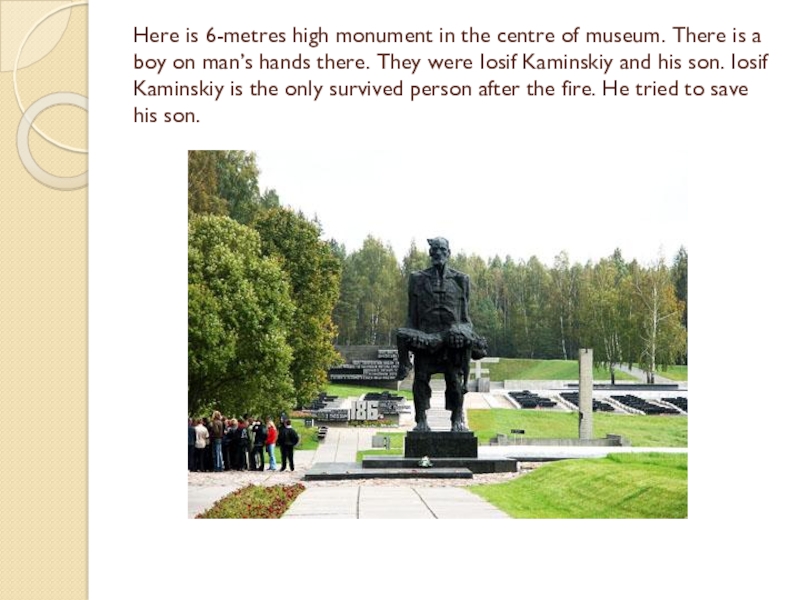
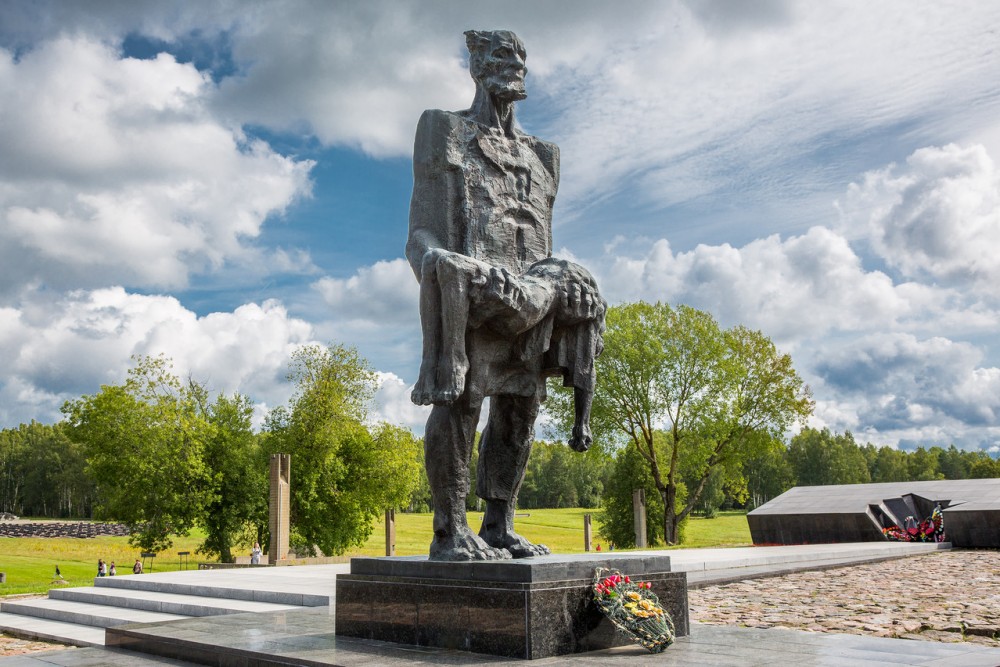
And so the only sculpture of the Khatyn memorial complex «The Unconquered Man» was based on this tragic story in the life of Joseph Kaminsky.
The tragedy of Khatyn is not just an occasional episode of this war. It is one of the thousand facts, which testify to the existence of the targeted genocide policy regarding the population of Belarus. And the Nazis were pursuing this policy during all those years of German occupation. Hundreds of similar disasters occurred within the three years (1941 — 1944) of the occupation of the Belorussian land.
Only six people are recognized as witnesses to the tragedy of Khatyn. They are 5 children and an only adult.
Yaskevich Vladimir Antonovich, born in 1930 in the village of Khatyn.
Stayed at the children’s home of Pleshinitsy. Studied at the vocational school No. 9. Worked as a turner at the Minsk automobile plant. Served in the army, then came back to the Minsk automobile plant in 1952. He began his career as a turner and progressed to a shop foreman. He retired in 1993. He lived in the village of Kozyry in Logoisk region. Died in 2008.
 |
|
(from left to right) V. A. Yaskevich, V. A. Zhelobkovich, S. A. Fiokhina (Yaskevich) at the memorial complex «Khaytn» in 1985 |
Yaskevich (Fiokhina) Sofia Antonovna, born in 1934 in the village of Khatyn.
Stayed at the children’s home of Pleshinitsy. Studied at the vocational school of communication No. 15 in Brest. Worked as a typist at a post office in Minsk. She is now in pension and lives in Minsk. She has two sons and a granddaughter.
Zhelobkovich Viktor Andreevich, born in 1934 in the village of Khatyn.
Stayed at the children’s home of Pleshinitsy. Studied at a vocational school. Worked as a moulder at the machine tools plant. Served in the army, then came back to the plant. Studied at and graduated from the Polytechnical University at evening classes specializing in mechanical engineering. He worked at the design office of precise engineering. Now he lives in Minsk and has a daughter and a granddaughter.
Zhelobkovich Alexander Petrovich, born in 1930 in the village of Khatyn.
Stayed at the children’s home of Pleshinitsy. Studied at a military school, then at the Military Academy. Served in the armed forces. Then was a reserve lieutenant colonel. Died in 1994.
Baranovsky Anton Iosifovich, born in 1930 in the village of Khatyn.
Stayed at the children’s home of Pleshinitsy. Then lived in Minsk and died tragically in 1969.
Kaminsky Iosif Iosifovich, born in 1887.
He lived in the village of Kozyry after the war. He often used to come to Khatyn when he was alive. Died in 1973 and was buried in Logoisk.
Approved by the executive committee of the regional council of the working delegates on May 26, 1969
Statement
May 26, 1969, a town of Logoisk
The members of the committee: SKORY P. P. — committee’s chairman, deputy chairman of the executive committee of the regional council of the working delegates, SELIVANOVA M. E. — public prosecutor, SHEVEL A. A. — chairman of the department of propaganda of the regional committee of the Communist Party of Belarus, EGOROVA M. F. — an architect of the place, SAVRIZKY B. I. — regional inspector of the state statistics.
All these people together with those who survived the massacre of Khatyn were involved in obtaining more accurate information about the date of the disaster and the number of people burnt there.
They established the following facts:
- The village of Khatyn was burned by German fascist invaders on March 22, 1943 at 14. 00. 26 houses together with the farmsteads were burned. All the inhabitants were driven to a shed which was poured with benzine and set on fire. Those who tried to escape were killed.
- 149 (one hundred and forty — nine) peaceful Soviet citizens were burned alive:
-
- Zhelobkovich Andrei Ivanovich (born in 1897)
- Zhelobkovich Anna Vikentievna (born in 1905)
- Zhelobkovich Stepan (born in 1928)
- Zhelobkovich Anna (born in 1929)
- Zhelobkovich Sophia (born in 1933)
-
- Zhelobkovich Petr Antonovich (born in 1898)
- Zhelobkovich Stefanida Alekseevna (born in 1903)
- Zhelobkovich Olga (born in 1928)
- Zhelobkovich Stanislav (born in 1929)
- Zhelobkovich Raissa (born in 1932)
- Zhelobkovich Lidia (born in 1934)
-
- Zhelobkovich Roman Stepanovich (born in 1881)
- Zhelobkovich Stefanida Ivanovna (born in 1892)
- Zhelobkovich Viktor (born in 1933)
- Zhelobkovich Galina (born in 1935)
-
- Baranovsky Joseph Ivanovich (born in 1899)
- Baranovskaia Anna Vikentievna (born in 1906)
- Baranovsky Nikolai (born in 1928)
- Baranovsky Stanislav (born in 1929)
- Baranovsky Valdimir (born in 1931)
- Baranovsky Gennady (born in 1932)
- Baranovskaia Leonida (born in 1932)
- Baranovskaia Maria (born in 1933)
- Baranovskaia Sophia (born in 1934)
- Baranovskaia Elena (born in 1936)
-
- Novitsky Alexander Romanovich (born in 1896)
- Novitskaia Alexandra (born in 1901)
- Novitsky Leonid (born in 1928)
- Novitsky Evgeny (born in 1930)
- Novitskaia Maria (born in 1932)
- Novitskaia Anna (born in 1934)
- Novitsky Konstantin (born in 1938)
- Novitsky Anton (born in 1939)
- Novitsky Mikhail (born in 1941)
-
- Baranovskaia Sophia(born in 1895)
- Baranovskaia Vanda (born in 1918)
- Baranovskaia Anna (born in 1926)
- Baranovsky Nikolai (born in 1937)
- One of the houses house was burned to ground without any people inside.
-
- Zhydovich Savvely Kazimirovich (born in 1905)
- Zhydovich Elena Antonovna (born in 1908)
- Zhydovich Stepan (born in 1931)
- Zhydovich Kazimir (born in 1933)
- Zhydovich Adam (born in 1934)
- Zhydovich Nikolai (born in 1935)
- Zhydovich Viacheslav (born in 1936)
- Zhydovich Mikhail (born in 1938)
- Zhydovich Maria Antonovna (born in 1883)
-
- Kaminsky Ivan Iosifovich (born in 1892)
- Kaminskaia Olga Antonovna (born in 1896)
- Kaminsky Viacheslav (born in 1924)
- Kaminskaia Maria (born in 1928)
- Kaminsky Stanislav (born in 1932)
- Kaminskaia Anna (born in 1933)
- Kaminskaia Yuzefa (born in 1938)
-
- Kaminskaia Adelia (born in 1890)
- Kaminskaia Yadviga (born in 1922)
- Kaminsky Adam (born in 1928)
- Kaminsky Mikhail (born in 1930)
- Kaminskaia Vilia (born in 1932)
- Kunkevich Anton (born in 1912)
-
- Zhelobkovich Ivan Ivanovich (born in 1904)
- Zhelobkovich Sofia Antonovna (born in 1907)
- Zhelobkovich Vladimir (born in 1922)
- Zhelobkovich Lena (born in 1933)
- Zhelobkovich Leonid (born in 1939)
- Zhelobkovich Mikhail (born in 1941)
- Zhelobkovich Maria (born in 1885)
- Yaskevich Ivan Antonovich (born in 1904)
- Yaskevich Yulia Ivanovna (born in 1913)
- Yaskevich Sofia (born in 1933)
- Yaskevich Elena (born in 1935)
- Yaskevich Anna (born in 1939)
- Yaskevich Mikhail (born in 1941)
-
- Iotka Kazimir Feliksovich (born in 1896)
- Iotka Elena Stepanovna (born in 1898)
- Iotka Maria (born in 1925)
- Iotka Albert (born in 1928)
- Iotka Stanislav (born in 1931)
- Iotka Dominik (born in 1936)
- Iotka Regina (born in 1937)
- Iotka Stepan (born in 1939)
- Iotka Yuzefa (born in 1941)
-
- Zhelobkovich Efrosinia Ivanovna (born in 1883)
- Zhelobkivich Josef (born in 1904)
- Zhelobkovich Olga (born in 1909)
-
- Iotka Ivan Alexandrovich (born in 1904)
- Iotka Anastasia Stepanovna (born in 1908)
- Iotka Kazimir (born in 1935)
- Iotka Yuzefa (born in 1939)
-
- Rudak Maria Ivanovna (born in 1898)
- Miranovich Stefanida Klimentievna (born in 1875)
-
- Drazhynskaia Yuzefa Antonovna (born in 1911)
- Drazhynskaia Valentina (born in 1933)
- Drazhynskaia Mikhalina (born in 1938)
- Dovgel Anton Antonovich (born in 1888)
- Dovgel Boris (born in 1933)
-
- Miranovich Josef Iosifovich (born in 1898)
- Miranovich Fekla Nikolaevna (born in 1901)
- Miranovich Nina (born in 1925)
- Miranovich Fedor (born in 1934)
- Miranovich Petr (born in 1937)
- Miranovich Vasily (born in 1940)
- Miranovich Elena (born in 1941)
-
- Karaban Konstantin Ustinovich (born in 1897)
- Karaban Maria (born in 1900)
- Karaban Leokadia (born in 1928)
- Karaban Nadezhda (born in 1933)
- Karaban Konstantin (born in 1939)
-
- Fedarovich Anna Sidorovna (born in 1892)
-
- Karaban Petr Vasilievich (born in 1914)
- Karaban Elena Gavrilovna (born in 1925)
-
- Karaban Yulia Ambrosievna (born in 1878)
- Karaban Josef (born in 1918)
- Karaban Maria (born in 1923)
- Karaban Anna (born in 1923)
- Karaban Viktor (born in 1925)
- Karaban Vladimir (born in 1941)
-
- Yaskevich Anton Antonovich (born in 1896)
- Yaskevich Elena Sidorovna (born in 1895)
- Yaskevich Viktor (born in 1922)
- Yaskevich Vanda (born in 1923)
- Yaskevich Vera (born in 1924)
- Yaskevich Nadezhda (born in 1934)
- Yaskevich Vladislav (born in 1936)
- Yaskevich Tolik (7 weeks)
-
- Rudak Stefanida Antonovna (born in 1898)
- Rudak Zinaida (born in 1925)
- Rudak Aleksandr (born in 1932)
- Rudak Regina (born in 1934)
- Rudak Anton (born in 1938)
-
- Rudak Josef Iosifovich (born in 1874)
- Rudak Praskovia Ivanovna (born in 1877)
- Rudak Mikhial Iosifovich (born in 1905)
- Rudak Khristina (born in 1912)
- Rudak Sofia (born in 1938)
- Rudak Khristina (born in 1940)
-
- Fedarovich Josef Sidorovich (born in 1889)
- Fedarovich Petrunelia Ambrosievna (born in 1894)
- Fedarovich Maria (born in 1922)
- Fedarovich Anton (born in 1925)
- Fedarovich Josef Iosifovich (born in 1913)
- Fedarovich Yulia Antonovna (born in 1913)
- Fedarovich Ekaterina (born in 1938)
- Fedarovich Ania (born in 1940)
-
- Klimovich Anton Maksimovich (born in 1890)
- Klimovich Yulia (born in 1922)
- Klimovich Anton (born in 1926)
- Slonskaia Khristina Maksimovna (born in 1895)
- Sokolovsky Petr Leonovich (born in 1933)
Chairman of the committee is P. Skory
Members of the committee:
M. Selivanov
A. Shevel
M. Egorova
B. Savrizky
Babka1337 Новичок2. Трагедыя Хатыні 22 сакавіка 1943 у вёску ўвайшоў 118-ты батальён ахоўнай паліцыі (Schutzpolizei), які быў перакінуты ў Беларусь у ліпені 1943 [2], і атачыў яе. Батальён быў сфарміраваны ў чэрвені 1942 гады ў раёне Кіева галоўным чынам з былых вайскоўцаў Чырвонай Арміі, якія трапілі ў Кіеўскі кацёл. [3]. Аперацыя праводзілася пад кіраўніцтвам спецыяльнага злучэння СС Дзірлевангер (ім. «SS-Sonderregiment Dirlewanger»). [4]. Пасля вайны за ўдзел у гэтай карнай аперацыі быў асуджаны былы старэйшы лейтэнант Чырвонай Арміі, а на момант аперацыі начальнік штаба 118-га ахоўнага батальёна Рыгор Васюра;камандзір узвода гэтага ж батальёна былы кадравы лейтэнант Чырвонай Арміі Васіль Мялешка быў асуджаны да расстрэлу.Прысуд прыведзены ў выкананне ў 1975 годзе. Апошняе, што чулі спальваныя беларусы, быў рускі мат. [5] Нямецкім «шэфам» 118-га карнага батальёна быў эсэсаўскі маёр Эрых Кернер, камандаваў батальёнам здраднік ра быў прызнаны вінаватым у злачынствах і прыгавораны да вышэйшай меры пакарання — расстыві ».
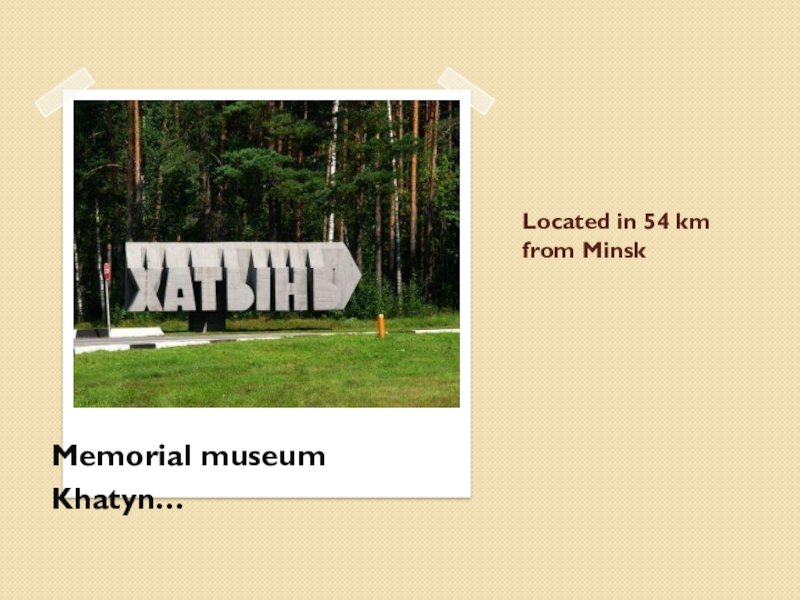
Слайд 1Located in 54 km from Minsk
Memorial museum
Khatyn…
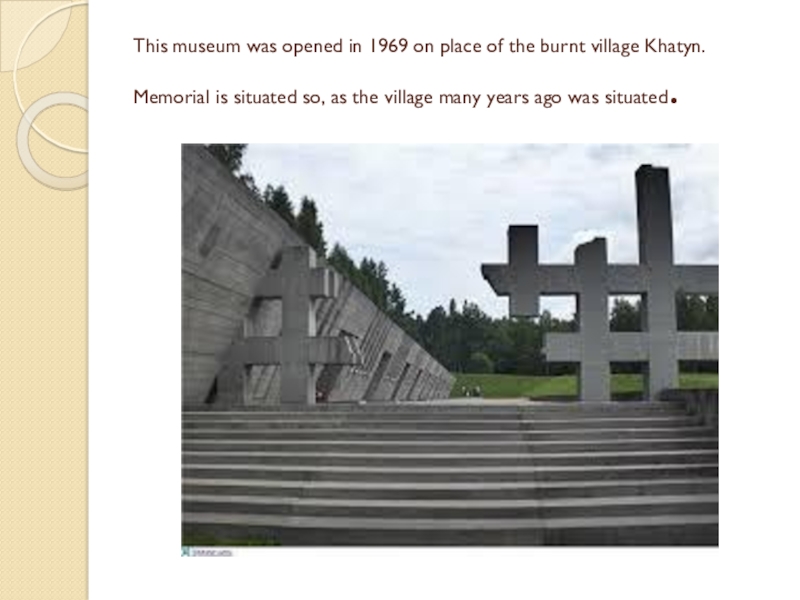
Слайд 2This museum was opened in 1969 on place of the burnt
village Khatyn. Memorial is situated so, as the village many years ago was situated.
Слайд 3Here is 6-metres high monument in the centre of museum. There
is a boy on man’s hands there. They were Iosif Kaminskiy and his son. Iosif Kaminskiy is the only survived person after the fire. He tried to save his son.
Слайд 4Khatyn was an usual Belorussian village. There were 26 houses in
the village. There are monuments with chimney with bells there now. They strike every 30 minutes.
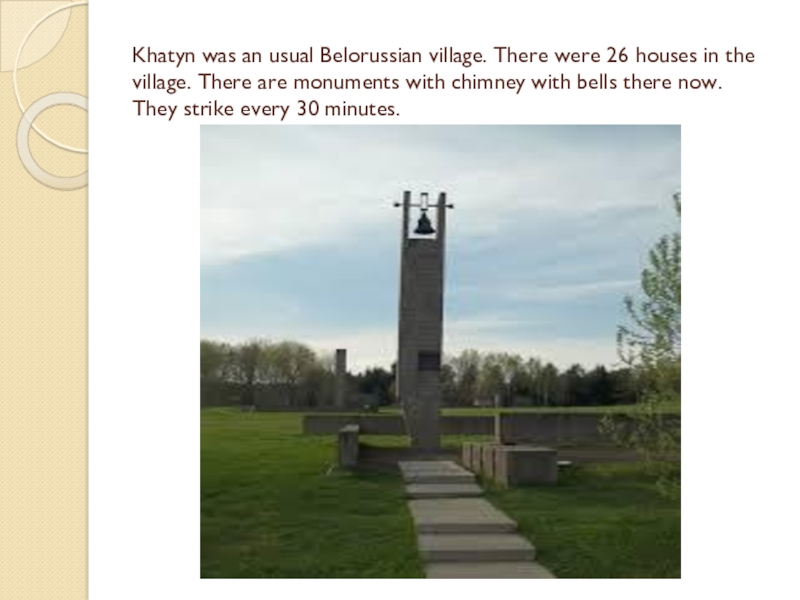
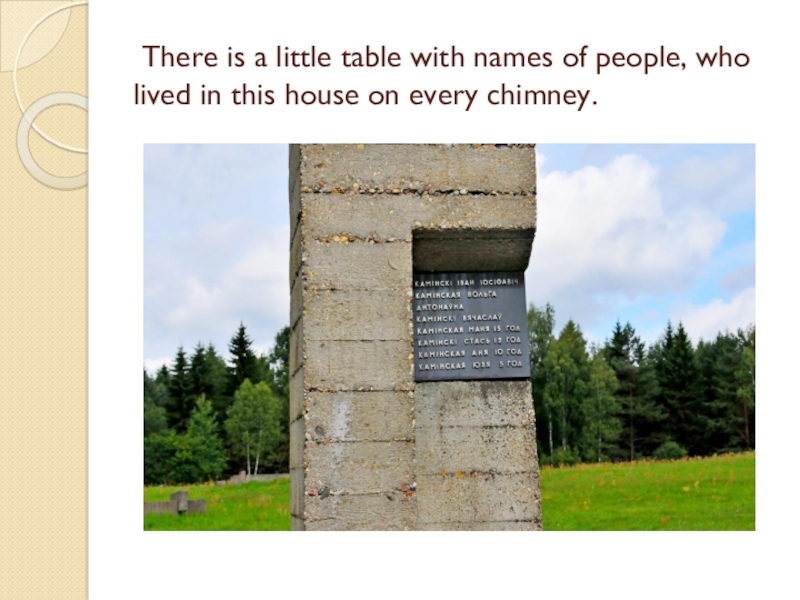
Слайд 5 There is a little table with names of people, who lived
in this house on every chimney.
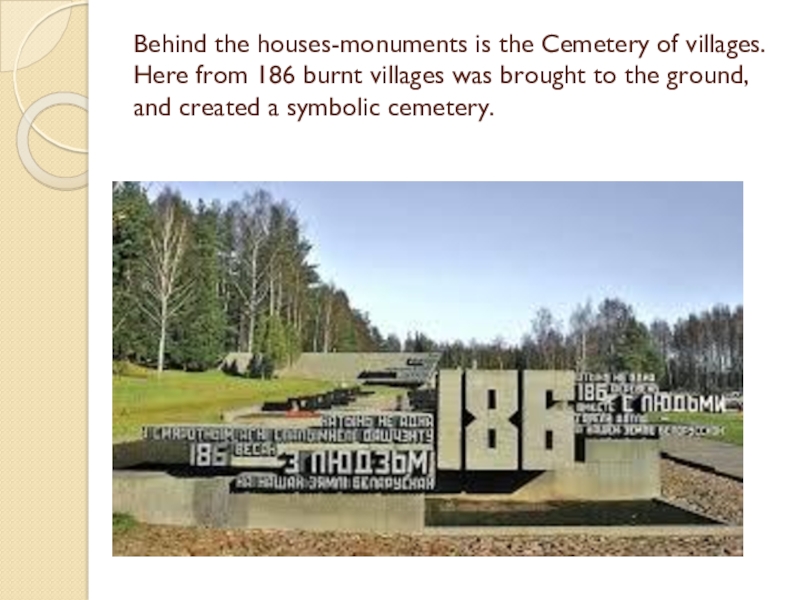
Слайд 6Behind the houses-monuments is the Cemetery of villages. Here from 186
burnt villages was brought to the ground, and created a symbolic cemetery.
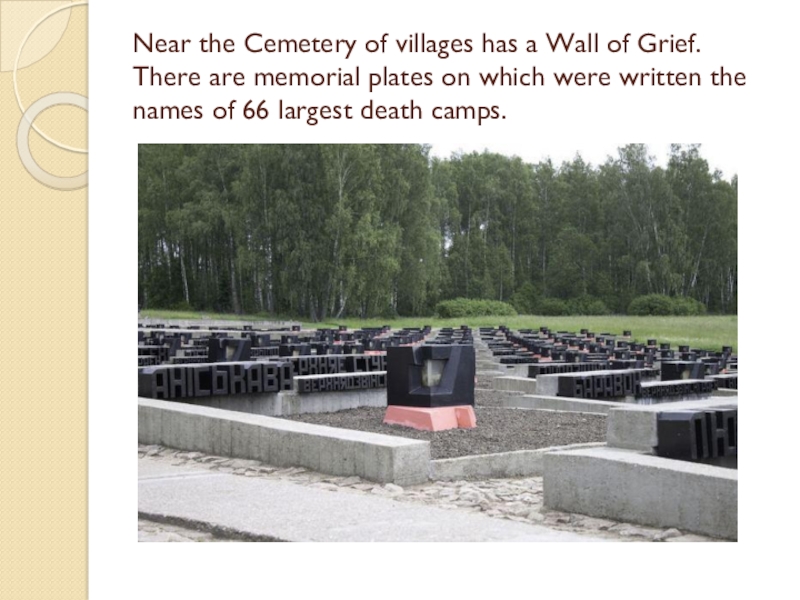
Слайд 7Near the Cemetery of villages has a Wall of Grief. There
are memorial plates on which were written the names of 66 largest death camps.
Слайд 8Completing the memorial area of Memory. In its centre grow 4
birch. Three of them symbolize life.
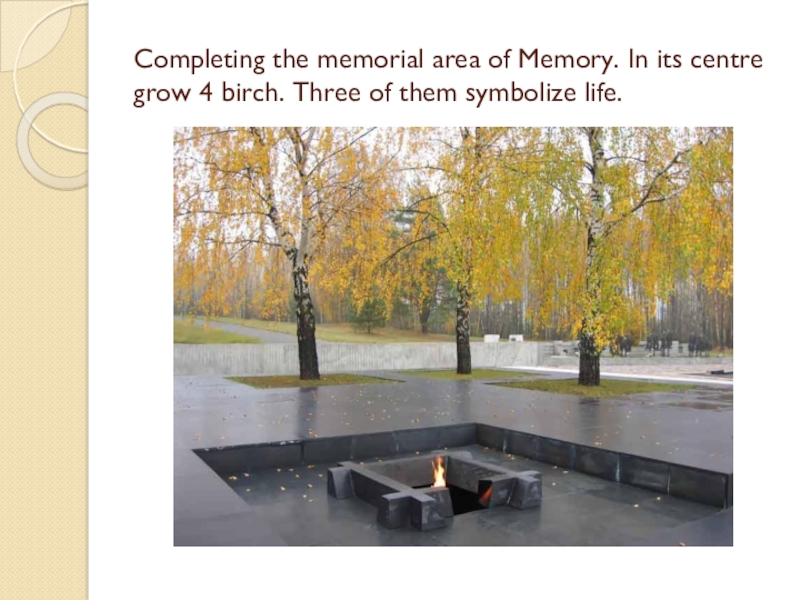
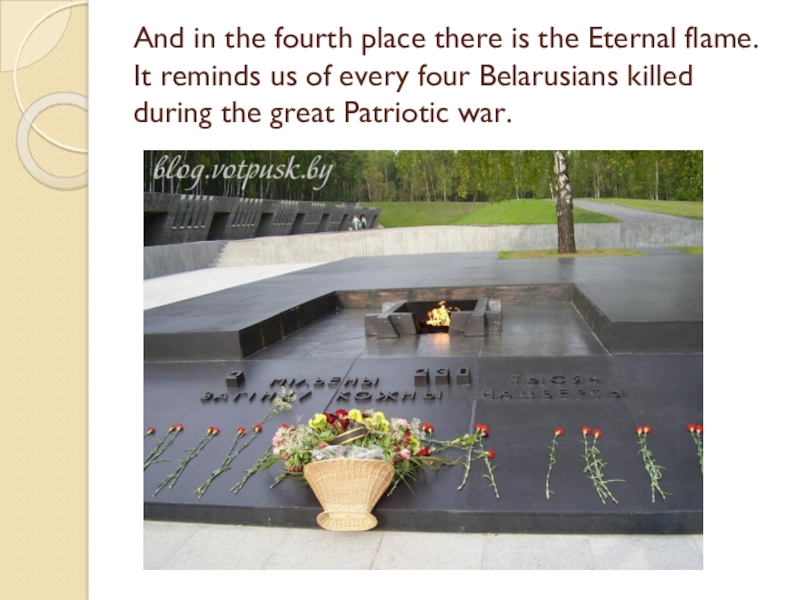
Слайд 9And in the fourth place there is the Eternal flame. It
reminds us of every four Belarusians killed during the great Patriotic war.
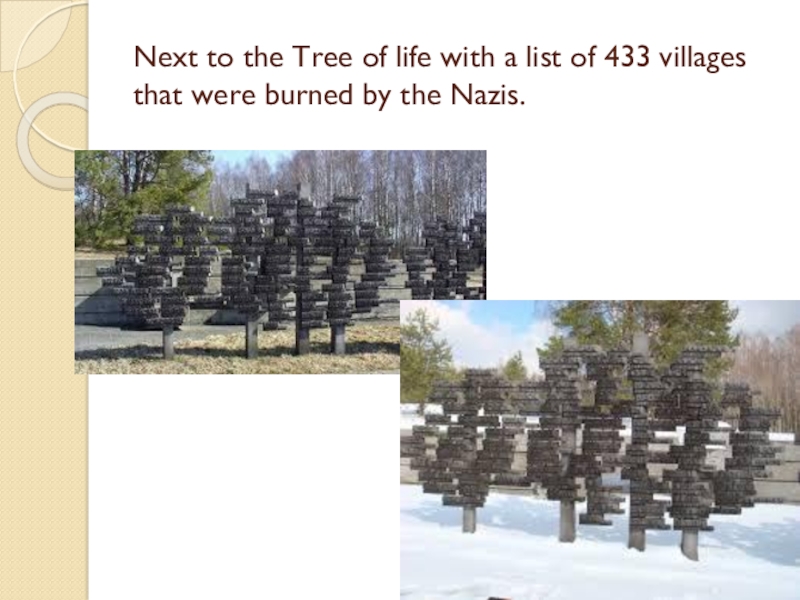
Слайд 10Next to the Tree of life with a list of 433
villages that were burned by the Nazis.
The village of Khatyn is the largest monument to the heroes of the Great Patriotic War, a real embodiment of all the pain of the war experienced. The article will tell about the tragic events associated with the village, as well as the ways to get to the village.
History of the Khatyn village
The village of Khatyn is known for its tragic fate throughout the world. True, her life ended on March 22, 1943. As one might think, the residents did not leave their homes in search of a better place, but died right in their homes.
Today, on the site of the village, there is a memorial complex Khatyn in honor of the memory of every Belarusian who died during the Great Patriotic War.
It all began during the war, when the German fascist invaders decided to take revenge on the villagers for the deaths of several soldiers and an officer of the German army. Then they came up with a plan according to which all the villagers were gathered in one shed. As soon as they entered, the barn doors closed and German soldiers threw matches, which set off flames that killed the entire village alive. The harsh soldiers of the German army called it an act of collective punishment, when civilians were killed alive in the fire by whole families. It was not only the perpetrators who died, but the neighboring families with children from six months.
The village consisted of 26 houses, in which 149 inhabitants lived. They all burned down, but the most tragic thing was the realization that there were about 70 children in the population. True, some managed to escape: two boys hid in the forest before the arson, two girls got out of the fire, two survived thanks to the desperate love of a mother who covered her child with herself, and the indiscretion of a soldier who mistook the boy for a corpse.
Of the adults, only Joseph Kaminsky survived. He almost died, but fate gave him a second chance after the enemy retreated. True, his life was no longer the same, because his only son died in the fire.
On such a note, the history of the great village, which is now known to everyone who is not indifferent, ended. In honor of the feat of the people, a memorial complex «Khatyn» was built on the site of the village.
Memorials in Khatyn
The memorial complex is a reminder to Belarusians about the events of the Second World War and the heroes who gave their lives for our freedom. The bronze six-meter sculpture «The Unconquered Man» personifies the image of Kaminsky carrying his dying son from the ashes, as well as the symbol of the entire people who have lost their loved ones and friends in a bloody battle. This is the center of the Khatyn memorial complex.
Do not forget that there were many villages like Khatyn. Some of them fought to the last, and some were burned and not rebuilt even after the victory. Their names are carved on the wall of sorrow, the cemetery of the fallen villages of Belarus.
The memorial complex is a monument to the burned down and revived villages. Two Trees of Life with their names raise their branches to the sky — this is also part of the memorial.
Tourists staying on the territory of the complex feel the atmosphere of the pain experienced by the people of that time. And on one of the stones of the memorial there is an inscription: «Good people, remember …»
Location of Khatyn village
The village is located 54 km north-east of Minsk. The driver needs to head for the Logoisk district of the Minsk region, and then the road will lead you to the memorial.
If it were not for the events of those times, then this original Belarusian village would have stood on the territory of the Minsk region, and would have had more than those 26 households.
How to get to the Khatyn memorial complex?
Those wishing to experience the events of those times can only get to the memorial by car. Unfortunately, you can only get to Minsk by public transport.
The memorial is located 54 km from Minsk, 5 km from the Minsk-Vitebsk highway. Turning to it shows a special sign made of gray concrete blocks.
Attractions near Khatyn
The memorial complex «Khatyn» is the most significant landmark of Belarus during the Second World War. If you are planning a trip to Khatyn, it is best for the whole day.
Among the interesting sights of Minsk and the Minsk region are also:
• Victory Square in Minsk. Today, the square is a place of tribute to the memory of the heroes who died during the Second World War. Many newlyweds observe the tradition of raising flowers to the Victory Monument to the Eternal Flame.
• Nesvizh Palace. Nesvizh castle and park with decorative lakes and shady alleys are the most beautiful palace and park ensemble of Belarus, attracting many tourists. In 2011, restoration work was carried out here, so today visitors can admire the castle in its original form.
• The National Library in Minsk is the country’s sociopolitical center. It contains 9 million copies of publications and books. The unique library is located on an area of 10 floors, and Internet access is open for visitors. Tourists are offered excursions here with a visit to the Museum of Books and access to the observation deck of the library.
• Theaters and museums. In addition to excursion education, Minsk offers visits to entertainment venues — musical and theatrical events. You can visit the renowned National Academic Bolshoi Opera and Ballet Theater or attend the International Arts Festival.
Tourists are offered to get acquainted with the rich and original culture of our country.
Photo: wikiway.com, bonchance.by
From Wikipedia, the free encyclopedia
This article is about the massacre of Belarusian civilians in 1943. For the massacre of Polish officers in 1940, see Katyn massacre.
| Khatyn massacre | |
|---|---|
| Part of the Eastern Front of World War II | |

The sculpture Unbowed Man by Sergei Selikhanov at the Khatyn Memorial site depicts Yuzif Kaminsky, the only adult to survive the massacre, holding his dead son Adam. |
|
| Location | Khatyn village [Wikidata], Lahoysk District, Minsk Region, Byelorussian Soviet Socialist Republic, Soviet Union |
| Coordinates | 54°20′06″N 27°56′42″E / 54.33500°N 27.94500°ECoordinates: 54°20′06″N 27°56′42″E / 54.33500°N 27.94500°E |
| Date | 22 March 1943 |
| Weapons | Burning alive, shooting |
| Deaths | 149 |
| Injured | 2 |
| Perpetrators | Schutzmannschaft Battalion 118 of the Ukrainian Auxiliary Police Dirlewanger Brigade |
| Motive | Retaliation for Soviet partisan attack |
| Convicted | Vasyl Meleshko Hryhoriy Vasiura |
| Website | khatyn.by/en/the-tragedy-of-khatyn |
Khatyn (Belarusian: Хаты́нь, romanized: Chatyń, pronounced [xaˈtɨnʲ]; Russian: Хаты́нь, pronounced [xɐˈtɨnʲ]) was a village of 26 houses and 157 inhabitants in Belarus, in Lahoysk Raion, Minsk Region, 50 km away from Minsk. On 22 March 1943, almost the entire population of the village was massacred by the Schutzmannschaft Battalion 118 in retaliation for an attack on German troops by Soviet partisans.
The battalion was composed of primarily Ukrainian nationalist Nazi collaborators and assisted by the Dirlewanger Waffen-SS special battalion.[1][2][3]
Background[edit]
The massacre was not an unusual incident in Belarus during World War II. At least 5,295 Belarusian settlements were burned and destroyed by the Nazis, and often all their inhabitants were killed (some amounting to as many as 1,500 victims) as a punishment for collaboration with partisans. In the Vitebsk region, 243 villages were burned down twice, 83 villages three times, and 22 villages were burned down four or more times. In the Minsk region, 92 villages were burned down twice, 40 villages three times, nine villages four times, and six villages five or more times.[4] Altogether, over 2,000,000 people were killed in Belarus during the three years of Nazi occupation, almost a quarter of the region’s population.[5][6]
On 22 March 1943, a German convoy was attacked by Soviet partisans near Koziri village, 6 km away from Khatyn, resulting in the deaths of four police officers of Schutzmannschaft Battalion 118. Among the dead was Hauptmann Hans Woellke, the battalion’s commanding officer.[7]
Massacre[edit]
Troops from the Dirlewanger Brigade, a unit mostly composed of criminals recruited for Nazi security warfare tasks, entered the village and drove the inhabitants from their houses and into a shed, which was then covered with straw and set on fire.[8] The trapped people managed to break down the front doors, but in trying to escape, were killed by machine gun fire. Around 149 people, including 75 children under 16 years of age, were killed due to burning, shooting or smoke inhalation. The village was then looted and burned to the ground.[9]
Survivors[edit]

Bell tower at the Khatyn Memorial
Eight inhabitants of the village survived, of whom six witnessed the massacre – five children and an adult.
- Twelve-year-old Anton Iosifovich Baranovsky (1930–1969) was left for dead with wounds in both legs.[10] His injuries were treated by partisans. Five months after the opening of the Memorial, Baranovsky died in unclear circumstances.
- The only adult survivor of the massacre, 56-year-old village smith Yuzif Kaminsky (1887–1973), recovered consciousness with wounds and burns after the killers had left. He supposedly found his burned son, who later died in his arms. This incident was later commemorated with a statue at the Khatyn Memorial.[10]
- Another 12-year-old boy, Alexander Petrovich Zhelobkovich (1930–1994), escaped from the village before the soldiers were able to fully surround it. His mother woke him up and put him on a horse, on which he escaped to a nearby village. After the war, he served in the armed forces and became a reserve lieutenant colonel.[10]
- Vladimir Antonovich Yaskevich (1930–2008) hid in a potato pit 200 meters from his family house. Two soldiers noticed the boy, but spared him. Vladimir noted that they spoke German between themselves, not Ukrainian.[11]
- Sofia Antonovna Yaskevich (later Fiokhina) (1934–2020), Vladimir’s sister, hid in the cellar from the early morning of the massacre. As an adult she worked as a typist, and was last reported living in Minsk.[12]
- Viktor Andreevich Zhelobkovich (1934–2020), a seven-year-old boy, survived the fire in the shed under the corpse of his mother.[12] As an adult, he worked at the design office of precise engineering, and was also reported to be living in Minsk.[12]
Two other Khatyn women survived because they were away from the village that day.
- Tatyana Vasilyevna Karaban (1910 – c. 2000s) was visiting relatives in a neighboring village, Seredniaya.[13]
- Sofya Klimovich, a relative of Karaban, was also visiting a nearby village. After the war she worked at the Memorial for several years.[13]
Post-war trials[edit]
In 1946, the officer who ordered the massacre, Bruno Pavel, was prosecuted at the Riga Trial and executed. Ivan Melnichenko, the leader of the Dirlewanger unit which committed the massacre, was fatally shot by NKVD agents on 26 February 1946 while resisting arrest. Multiple collaborators who participated in the massacre were tried in the 1960s and 1970s. Some of them were executed.[14]
The commander of one of the platoons of 118th Schutzmannschaft Battalion, former Soviet junior lieutenant Vasyl Meleshko, was tried in a Soviet court and executed in 1975.
The chief of staff of 118th Schutzmannschaft Battalion, former Red Army senior lieutenant Hryhoriy Vasiura, was tried in Minsk in 1986 and found guilty of all his crimes. He was sentenced to death by the verdict of the military tribunal of the Belorussian Military District. Vasiura was executed in 1987.
The case and the trial of the main executioner of Khatyn was not given much publicity in the media; the leaders of the Soviet republics worried about the inviolability of unity between the Belarusian and Ukrainian peoples.
Khatyn Memorial[edit]

«Cemetery of villages» with 185 tombs. Each tomb symbolizes a particular village in Belarus which was burned together with its population.
Khatyn became a symbol of mass killings of the civilian population during the fighting between partisans, German troops, and collaborators. In 1969, it was named the national war memorial of the Byelorussian SSR.[15] Among the best-recognized symbols of the memorial complex is a monument with three birch trees, with an eternal flame instead of a fourth tree, a tribute to the one in every four Belarusians who died in the war.[5] There is also a statue of Yuzif Kaminsky carrying his dying son, and a wall with niches to represent the victims of all the concentration camps, with large niches representing those with more than 20,000 victims. Bells ring every 30 seconds to commemorate the rate at which Belarusian lives were lost throughout the duration of the Second World War.
Part of the memorial is a Cemetery of villages with 185 tombs. Each tomb symbolizes a particular village in Belarus that was torched along with its population.
Among the foreign leaders who have visited the Khatyn Memorial during their time in office are Richard Nixon of the US, Fidel Castro of Cuba, Rajiv Gandhi of India, Yasser Arafat of the PLO, and Jiang Zemin of China.[16]
According to Norman Davies, the Khatyn massacre was deliberately exploited by the Soviet authorities to cover up the Katyn massacre, and this was a major reason for erecting the memorial – it was done in order to cause confusion with Katyn among foreign visitors.[17]
In 2004, the Memorial was renovated. According to 2011 data, the Memorial was in the top ten of the most attended tourist sites in Belarus – that year it was visited by 182,000 people.[18]
-

Panorama of the central part of the Khatyn Memorial
-

Another view of the Cemetery of Villages.
-
Village names on memorial.
-
Children’s toys placed by the site of the barn where an estimated 149 people were burned to death.



See also[edit]
- Come and See, 1985 film about the massacre
- German occupation of Byelorussia during World War II
- Koriukivka massacre
- Ležáky and Lidice
- List of massacres in Belarus
- Michniów
- Oradour-sur-Glane massacre
- Vladimir Katriuk
References[edit]
- ^ Zur Geschichte der Ordnungspolizei 1936–1942, Teil II, Georg Tessin, Dies Satbe und Truppeneinheiten der Ordnungspolizei, Koblenz 1957, s. 172–173
- ^ Leonid D. Grenkevich; David M. Glantz (1999). The Soviet Partisan Movement, 1941–1944: A Critical Historiographical Analysis. London: Routledge. pp. 133–134. ISBN 0-7146-4874-4.
- ^ Per A. Rudling, «Terror and Local Collaboration in Occupied Belorussia: The Case of Schutzmannschaft Battalion 118. Part One: Background», Historical Yearbook of the Nicolae Iorga History Institute (Bucharest) 8 (2011), pp. 202–203
- ^ «The tragedy of Khatyn – Genocide policy / Punitive Operations». Site Memorial Complex Khatyn. 2005. Archived from the original on 2012-02-04. Retrieved 2014-07-01.
- ^ a b Vitali Silitski (May 2005). «Belarus: A Partisan Reality Show» (PDF). Transitions Online: 5. Archived from the original (PDF) on 2006-10-13. Retrieved 2006-08-26.
- ^ «The tragedy of Khatyn — Genocide policy». SMC Khatyn. 2005. Archived from the original on 2015-03-10.
- ^ «The tragedy of Khatyn – Partisan attack». SMC Khatyn. 2005. Archived from the original on 2018-10-11.
- ^ ««Khatyn» – The tragedy of Khatyn». 2018-05-26. Archived from the original on 2018-05-26. Retrieved 2021-03-22.
- ^ ««Khatyn» – The tragedy of Khatyn». 2018-07-21. Archived from the original on 2018-07-21. Retrieved 2021-03-22.
- ^ a b c ««Khatyn» – The tragedy of Khatyn | Witnesses to the tragedy». 2020-02-04. Archived from the original on 2020-02-04. Retrieved 2021-03-22.
- ^ «Правда о том, кто убивал Хатынь: палачи и подручные | UArgument». 2018-02-10. Archived from the original on 2018-02-10. Retrieved 2021-03-22.
- ^ a b c «The tragedy of Khatyn — Witnesses». SMC Khatyn. 2005. Archived from the original on 2020-02-04.
- ^ a b Mikhail Shimansky (2013). «Непокоренная Хатынь [Undefeated Khatyn]». .sb.by (in Belarusian). РЭСПУБЛІКА. Retrieved 2014-07-01.
- ^ «Special punitive team SS Dirlewanger. The fate of the punishers from the Dirlewanger team (33 photos)». kerchtt.ru. Retrieved 2022-10-05.
- ^ https://m.eng.belta.by/video/getRecord/697/
- ^ «Хатынь – интернациональный символ антивоенных акций (Khatyn: international symbol of anti-war actions)». khatyn.by (in Russian). ГМК «Хатынь». 2005. Retrieved 2006-08-26.
- ^ Davies, Norman (1996). Europe: A History. Oxford University Press. p. 1005. ISBN 0-19-820171-0.
- ^ «Исторические «нестыковки» преследуют Хатынь даже спустя 70 лет после трагедии». interfax.by (in Russian). Retrieved 2021-03-22.
External links[edit]

Wikimedia Commons has media related to Khatyn’.
- Khatyn Museum
- Remembering the Khatyn Massacre by Meilan Solly, Smithsonian (magazine) March 22, 2021
- Catalog of Pins and Medals Commemorating the Khatyn Massacre and Memorial Site
- The Khatyn Massacre in Belorussia: A Historical Controversy Revisited by Per Anders Rudling, from Holocaust and Genocide Studies, Volume 26, Issue 1, Spring 2012, Pages 29–58; Source abstract
More background info: First of all: this site must not be confused with the similar looking name Katyn (see Katyn museum), the site where the Soviets massacred the Polish army’s officer elite near Smolensk in Russia.
Khatyn, spelled Хатынь in Cyrillic (the initial letter is pronounced like the <ch> in Loch Ness) is a State Memorial Complex in Belarus that commemorates a village of that name that was burned down by the Nazis in 1943 – it also stands symbolically for all the other villages destroyed in a similar manner during Nazi Germany’s occupation of the country. In fact, such crimes against civilians including the torching of whole villages was far from exceptional but sadly rather common during that grim time.
At the Khatyn site a total of 619 names of burned-down villages are noted, 433 of these were rebuilt after the war, but the remaining 186 were permanently erased off the face of the Earth.
In the case of Khatyn, this fate struck on 22 March 1943, when, apparently in random retaliation for the killing of a German officer in battles with partisans, an SS battalion drove to the village and encircled it. They rounded up all the inhabitants (nearly 150), locked them in a wooden barn that they then torched. Anybody trying to escape the blaze was mowed down with machine-gun fire. Afterwards, the Nazis looted the village and set fire to every single one of the village’s 26 houses, thus burning it to the ground in its entirety.
Of the villagers only a couple of kids survived by hiding or escaping to the forest. A single adult villager also survived, the 56-year-old blacksmith Joseph Kaminsky. Wounded and burnt he regained consciousness late at night after the Nazis had left. Amongst the victims he found his young son, badly burnt but just about alive – though he soon died in his father’s arms (at least so the official legend goes). The main memorial sculpture at the memorial site today depicts Kaminsky carrying his dead son. About half of the victims were in fact children under the age of 16.
After the war, initially only a modest memorial stone was placed at the site of the disappeared village of Khatyn. But in 1965 plans were made for a larger memorial complex, and this was opened in 1969 to coincide with the 25th anniversary of the liberation of Belarus from Nazi occupation by the Red Army. The complex was completely renovated in 2004.
The design of the memorial complex is full of symbolism – some of which is explained below – and now stands as one of the most significant memorials in Belarus. And it is “popular”. When I visited in August 2016, there were hundreds of other visitors (mostly Belarusians)! Whether that is always so I cannot say, but I found it remarkable to see such a place so full of visitors, when at Maly Trostenets the three of us had the whole site to ourselves.
What there is to see: From the (remarkably large) car park you approach the centre of the memorial complex along a double paved path, the two halves of which are separated by a long thin flowerbed with red blooms.
The main component you then come to is the 20 feet (6 m) tall statue of Joseph Kaminsky, the sole adult survivor of the massacre, carrying his dead son in his arms (see above).
To the right of this a short white-marble-paved path leads to a black marble sculpture that is vaguely reminiscent of a broken roof. This symbolizes the shed or barn that villagers were burned to death in. My guide told me that you’re not supposed to take the path and walk up to the symbolic barn because that was the last path taken by the dead.
Opposite this, to the left of the Kaminsky statue is another large stone monument that stands atop the shallow mound of the mass grave for the killed villagers.
A short stretch further along the main paved path an unpaved path branches off to the left and right which would have been the village’s main street. Along this and dotted around the whole area are symbolic foundations of the village’s houses, all with a stylized chimney and open symbolic doors (standing for the hospitality of the hosts who are no longer there to welcome you inside in person). The names of the respective inhabitants are noted on small plaques on each of the house memorials. In addition, the ages of those under 16 are given.
Each “chimney” has a bell at the top. These bells ring once every 30 seconds – to indicate the rate at which Soviets were killed in the Great Patriotic War (WWII): two every minute! This is probably the most sombre aspect of the whole memorial. Rather subtle but quite effective once you understand the symbolism.
In addition, you also see little concrete roofs dotted around – these stand symbolically for the village’s wells.
The next large section of the memorial complex is the field of village tombs. Mostly stretching out to the right every one of these symbolic tombs has the name of the 185 destroyed Belarusian villages other than Khatyn written on it in black marble. A large “186” sits in the middle of a boxy concrete memorial to the left. (That’s the figure including Khatyn, of course.)
A bit further on you come to a row of “symbolic trees of life” sculptures. Their “leafs” are little signs that spell out the names of 433 villages that were also burned down by the Nazis like Khatyn but which since the war have been rebuilt.
Furthermore there is the usual eternal flame (no Soviet war memorial is complete without one), but here it is not only still burning (at many more neglected Soviet memorials it has long since stopped) but it also comes with an additional symbolic twist. It sits in one quarter of a black-marble square and the other three quarters each have a birch tree growing out of them in the middle. This is to symbolize the fact that about 1 in 4 out of the whole population of Belarus lost their lives in the war.
On the northern edge of the memorial complex stands another huge concrete structure with an outer wall angled forward as if in the middle of collapsing. Up some steps you then come to a row of niches alternating with symbolic windows with bars, all made of grey concrete. The niches, or alcoves, are so low that as an adult you have to bow down to look inside – probably to kind of enforce this gesture of respect.
Inside the alcoves are sculptures each stating the names of the many forced-labour camps or massacre sites in the territory of Belarus, together with the (estimated) number of victims for each one of them. Flowers, wreaths and soft toys are left in many of these niches as memento mori.
At various other points at the memorial complex, artificial flowers have been laid down as well, or stuck into gaps in the concrete.
Back at the car park there is also said to be a photo exhibition inside a house next to the administrative building, but for some reason my guide did not take us there before we got back in the car to head on. I learned about the exhibition’s existence only when I got home. So I cannot comment on it.
All in all, Khatyn is certainly a very moving memorial complex. It helps having all the symbolism explained to you, as my guide did in quite some detail, otherwise much of it would be rather lost on you. So I do recommend visiting the Khatyn memorial with a guide.
Location: Some 40 miles (65 km) by road from the centre of Minsk, to the north-east in the Lahoysk (Logoisk) region of Belarus.
Access and costs: remote, requiring a vehicle (or bike) to get to; nominally accessible for free, but investing in a guided tour is recommended.
Details: The location is deep in a forest far out of Minsk, so to get there you either have to have your own private means of transport or go on a guided tour that includes transport.
I opted for the latter. I invested in the combined Khatyn and Glory Mound tour my guide offered for the price of ca. 130 USD (and he threw in a stopover at Maly Trostenets for free at the beginning of the tour). This may seem steep, but as it includes transport by private vehicle from Minsk and back and you get so much more out of all the symbolism of Khatyn with a guide, I’d say it’s money well invested.
If you are doing it independently and have your own means of transport, then leave Minsk by the M3 motorway heading north-east. After passing the main exit to Lahoysk, keep going for another 9 miles (14 km) and you come to a well-signposted turn off for Khatyn (Хатынь). After another 3 miles (5 km) of road winding through the forest you get to the car park. There are plenty of spaces.
The memorial complex as such is freely accessible at all times.
Admission to the photo exhibition is 2 BYR (concession 1 BYR), opening times: daily except Mondays from 10:30 a.m. to 4 p.m.
Time required: The combined private tour from Minsk to Khatyn and the Mound of Glory takes about four hours altogether, with almost two hours spent at Khatyn alone.
Combinations with other dark destinations: The way I visited Khatyn it came with its combination built into the tour, namely with the Mound of Glory – in addition I also had a stop at the memorial complex at the former death camp of Maly Trostenets worked into the tour, which was also a very worthwhile addition. And since the tour was from Minsk, the sites of that city combine well with it too. In particular the Great Patriotic War Museum is a must. It has a section about the torching of villages such as Khatyn in its main exhibition with some graphic illustrations.
Combinations with non-dark destinations: For a country as flat as Belarus, the lands around Khatyn are actually quite hilly and even vaguely scenic. You even get a couple of skiing resorts here! In the summer it’s quite an odd sight to see a couple of ski jumps poking out above the treetops!
For more tourist attractions for international visitors, however, you have to head back to Minsk.
Khatyn (Belarusian: Хаты́нь, romanized: Chatyń, pronounced [xaˈtɨnʲ]; Russian: Хаты́нь, pronounced [xɐˈtɨnʲ]) was a village of 26 houses and 157 inhabitants in Belarus, in Lahoysk Raion, Minsk Region, 50 km away from Minsk. On 22 March 1943, almost the entire population of the village was massacred by the Schutzmannschaft Battalion 118 in retaliation for an attack on German troops by Soviet partisans.
The battalion was composed of primarily Ukrainian nationalist Nazi collaborators and assisted by the Dirlewanger Waffen-SS special battalion.