
Общие данные о TELC:
Европейская Языковые сертификаты или Тэлч — языковые тесты, международные стандартизированные тесты из десяти различных языках. Он находится в ведении TELC GmbH, которая является дочерней компанией Немецкой Ассоциацией Образования для взрослых (DVV). telc — языковые тесты могут быть пройдены на английском, немецком, турецком, испанском, французском, итальянском, португальском, русском, чешском, и арабском языках.
Уровень:
CIC I: Intermediate: средний(3)
CIC A: Advanced: высокий(4)
уровень по европейскому стандарту: B1-B2
Даты экзаменов:
Даты варьируются в зависимости от экзаменационного центра.
Стоимость экзаменов:
Стоимость варьируется в зависимости от экзаменационного центра.
Предварительная запись:
за 8 недель до экзамена
Структура экзамена:
Дополнительная информация:
Что означает telc?
Telc означает „The European Language Certificates“ (Европейские языковые сертификаты).
Языковые экзамены telc основаны на Общеевропейских компетенциях владения иностранным языком (GER). Таким образом, языковые сертификаты telc соответствуют требованиям большинства немецких университетов для подтверждения знания немецкого языка.

Штудиенколлег Дюссельдорфа — это экзаменационный центр telc, где можно сдать экзамены telc по немецкому языку уровней B1, B2, C1 Hochschule и другие экзамены. Чтобы помочь нашим студентам в подготовке к экзамену telc, штудиенколлег Дюссельдорфа предлагает подготовительные курсы к экзамену telc.
Из чего состоит экзамен telc?
Экзамен состоит из письменной и устной части. Более подробную информацию о процедуре экзамена вы можете найти на официальном сайте telc здесь.
Письменная часть
▶ Понимание прочитаного
▶ Аудирование
▶ Письмо
Устная часть
▶ Устный экзамен
Как можно подготовиться к экзамену telc?
Штудиенколлег Дюссельдорфа предлагает вам курсы подготовки к экзамену telc: немецкий уровней B2 и C1 Hochschule. У нас Вы можете подготовиться к успешной сдачи экзамена.
Где я могу сдать экзамен telc?
Поскольку штудиенколлег Дюссельдорфа является экзаменационным центром telc, вы можете сдать экзамен telc на уровни B1, B2, C1 Hochschule и другие непосредственно в нашем штудиенколлеге.
Можно ли пересдать экзамен telc?
Экзамены telc можно пересдавать сколь угодно раз. Вам не нужно повторять весь экзамен, если вы не сдали одну часть экзамена.
The European Language Certificates (TELC; also known as TELC language tests) are international standardised tests of ten languages.
telc gGmbH is a non-profit language test, examination and certificate provider based in Frankfurt am Main. A subsidiary of the German Adult Education Association (DVV), it is the primary[clarification needed] examination provider around the world for standardized TELC language tests. telc gGmbH offers more than 70 different TELC certificates, including general language and vocational examinations and tests for students. All telc language tests correspond to the Common European Framework of Reference for Languages (CEFR), which was published in 2001 by the Council of Europe, to cover the skills of listening, reading, speaking and writing.
TELC language tests can be taken in English, German, Turkish, Spanish, French, Italian, Portuguese, Russian, Polish, and Arabic at 3,000 test centers in 20 countries, including community colleges and private language schools.
telc gGmbH is a full member of the Association of Language Testers in Europe (ALTE).
History[edit]
The European Language Certificates – today TELC language tests, formerly VHS Certificate – arose in 1968 when a team of language experts to Robert Nowacek first developed as a standardized language test for the German Adult Education Association (DVV) – the VHS Certificate in English. Over the years, tests followed in other European languages. 1995 the Examination Centre of DVV became a member of the Association of Language Testers in Europe (ALTE). The main objective of this association of Language Testers from over 20 European countries is the quality assurance of language exams. In 1998 the examination Centre of DVV became WBT (Weiterbildungs-Testsysteme gGmbH), eight years later it was renamed telc gGmbH (with the stylized ‘telc’ standing for TELC).
German test for Immigrants / German test for Austria[edit]
On behalf of the Federal Ministry of the Interior, telc gGmbH in cooperation with Goethe-Institute developed the German test for immigrants (DTZ) from 2006 to 2009. The test is taken to complete the Integrationskurs and the result, if successful, entails a settlement permit in Germany. Also, naturalization may be requested with proof of the successful completion of the German test for immigrants. After the development, telc gGmbH received the commission by the Federal Office for Migration and Refugees to carry out and further develop the DTZ.
In 2011, telc gGmbH developed the German Test for Austria on behalf of the Austrian Integration Fund (ÖIF), which was founded by the Austrian Federal Ministry of the Interior (BMI). It is a version of the German test for immigrants A2-B1revised for Austria. Since 1 July 2011, the proof of German language skills at level B1 of the Common European Framework of Reference is required also in Austria for obtaining citizenship.
Recognition[edit]
In Germany telc gGmbH partners with the federal government for the language examination at the end of the Integrationskurs for immigrants. Individuals who wish to apply for German citizenship can document the necessary language skills with a TELC certificate. When it comes to residence permits, all German-speaking countries recognize TELC certificates. In the context of subsequent immigration of a spouse to Germany, the Ministry of Foreign Affairs recognises the exam «Start German 1 / TELC German A1» as a requirement for a visa concerning the subsequent immigration of a spouse. In Poland, TELC certificates are recognised as proof of language proficiency for a career in the civil service. In Hungary, the government-accredited TELC examinations are a requirement for higher education qualifications. In Switzerland, depending on the canton, the required language skills for naturalization or acquisition into the Public Service can be proven with TELC certificates.
Also, the Turkish Higher Education Council (YÖK) officially recognize the German TELC language tests. The recognition by the supreme state control committee of Turkish universities is valid for all German exams by telc gGmbH on the competency levels B2, B2 +, and C1 of the Common European Framework of Europe. In the course of this recognition, the tests were incorporated into the official equivalence table (İngilizce Dil Esdegerligi tablosu) of the University Council. Thus TELC language tests can be used and recognized by all Turkish universities and institutions of higher education and employed for the recruitment of lecturers, for students who wish to study a master’s degree and doctoral candidates who must demonstrate their language skills.
Universities in Spain recognise TELC certificates as proof of foreign language skills. The certificate TELC Deutsch C1 Hochschule is officially recognised and accepted by the members of the German Rectors’ and Cultural Ministers’ Conference as proof of language skills for admission to German universities. Also, many universities in Austria and Switzerland accept TELC Certificates. Germany, in particular, makes use of the TELC language certificates for physicians and nursing staff in the context of professional recognition. TELC English C1 certificates are used in Germany for proof of language skills for primary school teachers. The TELC entrance examination provides access to university studies for qualified candidates.
Exam Implementation[edit]
TELC language tests can be taken worldwide at more than 3,000 testing centres, including adult education centres and private language schools. Exam dates can be set independently by each examination centre as well as the examination prices can vary from the test centre to test centre. Test results are available after four to six weeks. TELC certificates are valid for an unlimited period.
TELC characteristics[edit]
TELC language tests incorporate the following features:[1]
- TELC examinations test the ability to listen, read, write and speak in ten languages.
- TELC examinations are geared to the Common European Framework of Reference for Languages: Learning, teaching and assessment.
- In Germany the telc gGmbH is the exclusive partner of the federal government for the language test taken at the end of the Integrationskurs for migrants.
- In Germany TELC certificates are recognized as the official proof of German language competence in order to receive citizenship.
- In Poland the TELC certificate is recognized as the proof of language competence for civil service applicants.
- In Hungary students must prove language competence at B2 level in order to obtain their university degree. TELC language tests are state-approved in Hungary.
- In Switzerland TELC certificates are accepted as pre-requisites to obtain Swiss citizenship.
TELC structure[edit]
All candidates must complete four modules (reading, writing, listening and speaking) to obtain a score.
Written Examination[edit]
Reading Comprehension[edit]
The Reading Comprehension covers three types of tasks: reading for gist, reading for detail, and selective reading.
Language elements[edit]
The Language Elements part covers two tasks. In the first task, the candidates are required to accomplish a multiple-choice test choosing from three different alternatives. In the second task, the candidates are required to complete a text with ten words choosing from 15 words. The Language Elements tests grammatical accuracy and vocabulary as well.
Listening[edit]
The listening task comprises three types of tasks: Listening for gist, listening for detail, and selective listening.
Writing[edit]
The writing task consists of only one part. The candidate can choose from two situations and has to write a formal letter (letter of application, letter of complaint or letter of inquiry).
Oral Examination[edit]
Each oral examination for TELC English (B2) normally takes place with two candidates. For each examination, there are two examiners. In exceptional cases, e.g. when there is an odd number of candidates at the examination centre, the candidates may be tested in three. The examination is intended to have the character of a conversation, not an interrogation. The main task of the examiners is to supervise the conversation. They are instructed to say as little as possible. For the purpose of the examination, it is more important for the candidate to have an active conversation with his/her partner. The candidate should respond to what his/her partner says without trying to dominate the conversation. Both candidates are expected to involve themselves in the conversation so as to produce an interesting dialogue on a variety of topics. It will have a positive effect on the candidate’s mark if he/she tries to help his/her partner, should he/she at any time have problems trying to express what he/she would like to say. The oral examination lasts about 15 minutes with two candidates, 25 minutes with three candidates. Before the examination starts, the candidate has twenty minutes to prepare for the examination with the help of candidate sheets giving details of the tasks the candidate will have to complete. During this preparation time, the candidate is not allowed to communicate with his/her partner.
Presentation[edit]
In this part of the examination, the candidates should present something briefly to their partner. They can choose from two topics. The presentation should not be longer than 90 seconds. It
should only be interrupted if something is really not understood. After the presentation, the candidate has to answer the questions his/her partner asks. The same procedure applies to all candidates: presentation, questions and answers.
Discussion[edit]
In this part of the examination, the candidates will have a discussion on a controversial
topic. First, the candidates should say something about the text they have read during the preparation. The candidates have to present the arguments or points they think are interesting.
In the discussion which follows, they will be expected to give their own opinion on the topic
concerned. They have to make sure they have a discussion in which they express their points of view, they have to exchange arguments and respond to what their partner says.
Task[edit]
In this part of the examination, the candidates will be given a task to carry out. The candidates will be given only the situation and will have to think of the details themselves. The candidates should think about all the points they wish to make, express their opinions, make suggestions and respond to what their partner says.
Duration[edit]
| Sub-Test | Duration |
|---|---|
| Reading Comprehension and Language Elements | 90 minutes |
| Writing | 30 minutes |
| Listening | 25–30 minutes |
| Speaking | 15–20 minutes |
Points[edit]
| Sub-Test | Maximum Number of Points |
|---|---|
| WRITTEN EXAMINATION | 225 |
| Reading Comprehension | 75 |
| Part 1 | 25 |
| Part 2 | 25 |
| Part 3 | 25 |
| Language Elements | 30 |
| Part 1 | 15 |
| Part 2 | 15 |
| Listening Comprehension | 75 |
| Part 1 | 25 |
| Part 2 | 25 |
| Part 3 | 25 |
| Writing | 45 |
| ORAL EXAMINATION | 75 |
| Presentation | 25 |
| Discussion | 25 |
| Task | 25 |
| TOTAL POINTS | 300 |
Languages[edit]
| Language | CEFR levels | |||||
|---|---|---|---|---|---|---|
| A1 | A2 | B1 | B2 | C1 | C2 | |
| Arabic | — | — | B1 | — | — | — |
| English | A1 | A2 | B1 | B2 | C1 | C2 |
| French | A1 | A2 | B1 | B2 | — | — |
| German | A1 | A2 | B1 | B2 | C1 | C2 |
| Italian | A1 | A2 | B1 | B2 | — | — |
| Polish | — | — | B1 | B2 | — | — |
| Portuguese | — | — | B1 | — | — | — |
| Russian | A1 | A2 | B1 | B2 | — | — |
| Spanish | A1 | A2 | B1 | B2 | — | — |
| Turkish | A1 | A2 | B1 | B2 | C1 | — |
Arabic[edit]
For Arabic, telc gGmbH offers exams at B1 CEFR level for learners with basic skills who can already communicate fairly well in everyday situations.
English[edit]
For English, telc gGmbH offers exams at all CEFR levels. In addition, at A2, A2-B1, B1 and B2 CEFR levels candidates can take a ‘School’ exam which is specially designed for pupils aged about 12 to 16. At A2-B2, B1, B1-B2, B2 and B2-C1 CEFR levels candidates can take ‘Business’ exams which are designed especially for learners who wish to prove their language competence in various everyday business situations. At B1 CEFR level, candidates can take a ‘Hotel and restaurant’ exam which is designed for learners who wish to prove their language competence in the hotel and restaurant fields. At B2 CEFR level candidates can take a ‘Technical’ exam which is designed for advanced learners in technical professions.
French[edit]
For French, telc gGmbH offers four levels (A1, A2, B1 and B2). In addition, at A2 CEFR level candidates can choose from TELC Français A2 (for learners after completing an average of 250 – 300 teaching units) or TELC Français A2 Ecole which is designed for school pupils aged about 12 to 16 (in classes 7 to 10). At B1 level TELC Français B1 there are two options for learners with basic skills who can already communicate fairly well in everyday situations or TELC Français B1 Ecole which is designed for school pupils aged about 14 to 17 (in classes 9 to 11).
German[edit]
For German, telc gGmbH tests for German can be taken at six different CEFR levels (A1, A2, B1, B2, C1 and C2). In Hungary, the TELC certificate in the German language is accredited.
Italian[edit]
For Italian, telc gGmbH offers CEFR language exams at four levels (A1, A2, B1, and B2).
Portuguese[edit]
For Portuguese, telc gGmbH offers language exam at B1 level.
Russian[edit]
For Russian, TELC language tests can be taken at four different levels (A1, A2, B1 and B2).
Polish[edit]
![[icon]](https://upload.wikimedia.org/wikipedia/commons/thumb/1/1c/Wiki_letter_w_cropped.svg/20px-Wiki_letter_w_cropped.svg.png) |
This section is empty. You can help by adding to it. (September 2022) |
Spanish[edit]
For Spanish, telc gGmbH offers exams at four CEFR levels (A1, A2, B1 and B2). At A2 level candidates can choose from TELC Español A2 (for learners after completing an average of 250 – 300 teaching units) or TELC Español A2 Escuela which is designed for school pupils aged about 12 to 16 (in classes 7 to 10). At B1 level there are two options i.e. TELC Español B1 (for learners with basic skills who can already communicate fairly well in everyday situations) or TELC Español B1 Escuela which is designed for school pupils aged about 14 to 17 (in classes 9 to 11). At B2 level candidates can take TELC Español B2 (for advanced learners who can clearly and explicitly express themselves) or TELC Español B2 Escuela which is designed for advanced school pupils aged about 17 to 19 (in classes 12 to 13).
Turkish[edit]
For Turkish, telc gGmbH offers exams at five different levels (A1, A2, B1, B2 and C1). In addition, at A2 CEFR level candidates can choose from TELC Türkçe A2 which is designed for learners after completing an average of 250 – 300 teaching units or TELC Türkçe A2 Okul which is designed for school pupils who can communicate simply in everyday situations. At B1 level candidates can choose from TELC Türkçe B1 (for learners with basic skills who can already communicate fairly well in everyday situations) or from TELC Türkçe B1 Okul which is designed for school pupils aged about 12 to 15 (classes 7 to 10). At B2 level there are two options i.e. TELC Türkçe B2 (for advanced learners who can clearly and explicitly express themselves) or TELC Türkçe B2 Okul which is designed for more advanced school pupils aged about 15 to 19 (in classes 10 to 13).
TELC centres[edit]
Hungary[edit]
On 13 October 2018, the Budapest-based Tudományos Ismeretterjesztő Társulat announced the cessation of their partnership with TELC. The last exam would be held in February 2019.[2]
However, it was also announced that the TELC will continue its operation in Hungary.[3]
telc Book Map Error[edit]
In 2017, the Federal Office for Migration and Refugees withdrew approval for a German textbook published by telc gGmbH for showing Crimea as part of Russia.[4] In the series «Einfach gut! Deutsch für die Integration» by telc gGmbH, a map with the «Russian» Crimea was printed in textbooks for levels B 1.1 and B1.2. telc gGmbH commented that the company regretted «the reprint of the faulty map» with the note that it did not mean to make «a political statement».
See also[edit]
- Common European Framework of Reference for Languages
- Language assessment
- List of language proficiency tests
References[edit]
- ^ «Who we are». telc.net. 22 January 2012. Retrieved 22 January 2012.
- ^ «Megszűnik az egyik legnépszerűbb nyelvvizsga, februárban lehet utoljára próbálkozni». 13 October 2018.
- ^ «Jó hír a nyelvtanulóknak: áprilistól újra lehet majd TELC-nyelvvizsgát tenni». 28 November 2018.
- ^ «Falsche Krim-Karte im Lehrbuch wird ersetzt». 16 April 2017.
External links[edit]
- Official TELC website
The European Language Certificates (TELC; also known as TELC language tests) are international standardised tests of ten languages.
telc gGmbH is a non-profit language test, examination and certificate provider based in Frankfurt am Main. A subsidiary of the German Adult Education Association (DVV), it is the primary[clarification needed] examination provider around the world for standardized TELC language tests. telc gGmbH offers more than 70 different TELC certificates, including general language and vocational examinations and tests for students. All telc language tests correspond to the Common European Framework of Reference for Languages (CEFR), which was published in 2001 by the Council of Europe, to cover the skills of listening, reading, speaking and writing.
TELC language tests can be taken in English, German, Turkish, Spanish, French, Italian, Portuguese, Russian, Polish, and Arabic at 3,000 test centers in 20 countries, including community colleges and private language schools.
telc gGmbH is a full member of the Association of Language Testers in Europe (ALTE).
History[edit]
The European Language Certificates – today TELC language tests, formerly VHS Certificate – arose in 1968 when a team of language experts to Robert Nowacek first developed as a standardized language test for the German Adult Education Association (DVV) – the VHS Certificate in English. Over the years, tests followed in other European languages. 1995 the Examination Centre of DVV became a member of the Association of Language Testers in Europe (ALTE). The main objective of this association of Language Testers from over 20 European countries is the quality assurance of language exams. In 1998 the examination Centre of DVV became WBT (Weiterbildungs-Testsysteme gGmbH), eight years later it was renamed telc gGmbH (with the stylized ‘telc’ standing for TELC).
German test for Immigrants / German test for Austria[edit]
On behalf of the Federal Ministry of the Interior, telc gGmbH in cooperation with Goethe-Institute developed the German test for immigrants (DTZ) from 2006 to 2009. The test is taken to complete the Integrationskurs and the result, if successful, entails a settlement permit in Germany. Also, naturalization may be requested with proof of the successful completion of the German test for immigrants. After the development, telc gGmbH received the commission by the Federal Office for Migration and Refugees to carry out and further develop the DTZ.
In 2011, telc gGmbH developed the German Test for Austria on behalf of the Austrian Integration Fund (ÖIF), which was founded by the Austrian Federal Ministry of the Interior (BMI). It is a version of the German test for immigrants A2-B1revised for Austria. Since 1 July 2011, the proof of German language skills at level B1 of the Common European Framework of Reference is required also in Austria for obtaining citizenship.
Recognition[edit]
In Germany telc gGmbH partners with the federal government for the language examination at the end of the Integrationskurs for immigrants. Individuals who wish to apply for German citizenship can document the necessary language skills with a TELC certificate. When it comes to residence permits, all German-speaking countries recognize TELC certificates. In the context of subsequent immigration of a spouse to Germany, the Ministry of Foreign Affairs recognises the exam «Start German 1 / TELC German A1» as a requirement for a visa concerning the subsequent immigration of a spouse. In Poland, TELC certificates are recognised as proof of language proficiency for a career in the civil service. In Hungary, the government-accredited TELC examinations are a requirement for higher education qualifications. In Switzerland, depending on the canton, the required language skills for naturalization or acquisition into the Public Service can be proven with TELC certificates.
Also, the Turkish Higher Education Council (YÖK) officially recognize the German TELC language tests. The recognition by the supreme state control committee of Turkish universities is valid for all German exams by telc gGmbH on the competency levels B2, B2 +, and C1 of the Common European Framework of Europe. In the course of this recognition, the tests were incorporated into the official equivalence table (İngilizce Dil Esdegerligi tablosu) of the University Council. Thus TELC language tests can be used and recognized by all Turkish universities and institutions of higher education and employed for the recruitment of lecturers, for students who wish to study a master’s degree and doctoral candidates who must demonstrate their language skills.
Universities in Spain recognise TELC certificates as proof of foreign language skills. The certificate TELC Deutsch C1 Hochschule is officially recognised and accepted by the members of the German Rectors’ and Cultural Ministers’ Conference as proof of language skills for admission to German universities. Also, many universities in Austria and Switzerland accept TELC Certificates. Germany, in particular, makes use of the TELC language certificates for physicians and nursing staff in the context of professional recognition. TELC English C1 certificates are used in Germany for proof of language skills for primary school teachers. The TELC entrance examination provides access to university studies for qualified candidates.
Exam Implementation[edit]
TELC language tests can be taken worldwide at more than 3,000 testing centres, including adult education centres and private language schools. Exam dates can be set independently by each examination centre as well as the examination prices can vary from the test centre to test centre. Test results are available after four to six weeks. TELC certificates are valid for an unlimited period.
TELC characteristics[edit]
TELC language tests incorporate the following features:[1]
- TELC examinations test the ability to listen, read, write and speak in ten languages.
- TELC examinations are geared to the Common European Framework of Reference for Languages: Learning, teaching and assessment.
- In Germany the telc gGmbH is the exclusive partner of the federal government for the language test taken at the end of the Integrationskurs for migrants.
- In Germany TELC certificates are recognized as the official proof of German language competence in order to receive citizenship.
- In Poland the TELC certificate is recognized as the proof of language competence for civil service applicants.
- In Hungary students must prove language competence at B2 level in order to obtain their university degree. TELC language tests are state-approved in Hungary.
- In Switzerland TELC certificates are accepted as pre-requisites to obtain Swiss citizenship.
TELC structure[edit]
All candidates must complete four modules (reading, writing, listening and speaking) to obtain a score.
Written Examination[edit]
Reading Comprehension[edit]
The Reading Comprehension covers three types of tasks: reading for gist, reading for detail, and selective reading.
Language elements[edit]
The Language Elements part covers two tasks. In the first task, the candidates are required to accomplish a multiple-choice test choosing from three different alternatives. In the second task, the candidates are required to complete a text with ten words choosing from 15 words. The Language Elements tests grammatical accuracy and vocabulary as well.
Listening[edit]
The listening task comprises three types of tasks: Listening for gist, listening for detail, and selective listening.
Writing[edit]
The writing task consists of only one part. The candidate can choose from two situations and has to write a formal letter (letter of application, letter of complaint or letter of inquiry).
Oral Examination[edit]
Each oral examination for TELC English (B2) normally takes place with two candidates. For each examination, there are two examiners. In exceptional cases, e.g. when there is an odd number of candidates at the examination centre, the candidates may be tested in three. The examination is intended to have the character of a conversation, not an interrogation. The main task of the examiners is to supervise the conversation. They are instructed to say as little as possible. For the purpose of the examination, it is more important for the candidate to have an active conversation with his/her partner. The candidate should respond to what his/her partner says without trying to dominate the conversation. Both candidates are expected to involve themselves in the conversation so as to produce an interesting dialogue on a variety of topics. It will have a positive effect on the candidate’s mark if he/she tries to help his/her partner, should he/she at any time have problems trying to express what he/she would like to say. The oral examination lasts about 15 minutes with two candidates, 25 minutes with three candidates. Before the examination starts, the candidate has twenty minutes to prepare for the examination with the help of candidate sheets giving details of the tasks the candidate will have to complete. During this preparation time, the candidate is not allowed to communicate with his/her partner.
Presentation[edit]
In this part of the examination, the candidates should present something briefly to their partner. They can choose from two topics. The presentation should not be longer than 90 seconds. It
should only be interrupted if something is really not understood. After the presentation, the candidate has to answer the questions his/her partner asks. The same procedure applies to all candidates: presentation, questions and answers.
Discussion[edit]
In this part of the examination, the candidates will have a discussion on a controversial
topic. First, the candidates should say something about the text they have read during the preparation. The candidates have to present the arguments or points they think are interesting.
In the discussion which follows, they will be expected to give their own opinion on the topic
concerned. They have to make sure they have a discussion in which they express their points of view, they have to exchange arguments and respond to what their partner says.
Task[edit]
In this part of the examination, the candidates will be given a task to carry out. The candidates will be given only the situation and will have to think of the details themselves. The candidates should think about all the points they wish to make, express their opinions, make suggestions and respond to what their partner says.
Duration[edit]
| Sub-Test | Duration |
|---|---|
| Reading Comprehension and Language Elements | 90 minutes |
| Writing | 30 minutes |
| Listening | 25–30 minutes |
| Speaking | 15–20 minutes |
Points[edit]
| Sub-Test | Maximum Number of Points |
|---|---|
| WRITTEN EXAMINATION | 225 |
| Reading Comprehension | 75 |
| Part 1 | 25 |
| Part 2 | 25 |
| Part 3 | 25 |
| Language Elements | 30 |
| Part 1 | 15 |
| Part 2 | 15 |
| Listening Comprehension | 75 |
| Part 1 | 25 |
| Part 2 | 25 |
| Part 3 | 25 |
| Writing | 45 |
| ORAL EXAMINATION | 75 |
| Presentation | 25 |
| Discussion | 25 |
| Task | 25 |
| TOTAL POINTS | 300 |
Languages[edit]
| Language | CEFR levels | |||||
|---|---|---|---|---|---|---|
| A1 | A2 | B1 | B2 | C1 | C2 | |
| Arabic | — | — | B1 | — | — | — |
| English | A1 | A2 | B1 | B2 | C1 | C2 |
| French | A1 | A2 | B1 | B2 | — | — |
| German | A1 | A2 | B1 | B2 | C1 | C2 |
| Italian | A1 | A2 | B1 | B2 | — | — |
| Polish | — | — | B1 | B2 | — | — |
| Portuguese | — | — | B1 | — | — | — |
| Russian | A1 | A2 | B1 | B2 | — | — |
| Spanish | A1 | A2 | B1 | B2 | — | — |
| Turkish | A1 | A2 | B1 | B2 | C1 | — |
Arabic[edit]
For Arabic, telc gGmbH offers exams at B1 CEFR level for learners with basic skills who can already communicate fairly well in everyday situations.
English[edit]
For English, telc gGmbH offers exams at all CEFR levels. In addition, at A2, A2-B1, B1 and B2 CEFR levels candidates can take a ‘School’ exam which is specially designed for pupils aged about 12 to 16. At A2-B2, B1, B1-B2, B2 and B2-C1 CEFR levels candidates can take ‘Business’ exams which are designed especially for learners who wish to prove their language competence in various everyday business situations. At B1 CEFR level, candidates can take a ‘Hotel and restaurant’ exam which is designed for learners who wish to prove their language competence in the hotel and restaurant fields. At B2 CEFR level candidates can take a ‘Technical’ exam which is designed for advanced learners in technical professions.
French[edit]
For French, telc gGmbH offers four levels (A1, A2, B1 and B2). In addition, at A2 CEFR level candidates can choose from TELC Français A2 (for learners after completing an average of 250 – 300 teaching units) or TELC Français A2 Ecole which is designed for school pupils aged about 12 to 16 (in classes 7 to 10). At B1 level TELC Français B1 there are two options for learners with basic skills who can already communicate fairly well in everyday situations or TELC Français B1 Ecole which is designed for school pupils aged about 14 to 17 (in classes 9 to 11).
German[edit]
For German, telc gGmbH tests for German can be taken at six different CEFR levels (A1, A2, B1, B2, C1 and C2). In Hungary, the TELC certificate in the German language is accredited.
Italian[edit]
For Italian, telc gGmbH offers CEFR language exams at four levels (A1, A2, B1, and B2).
Portuguese[edit]
For Portuguese, telc gGmbH offers language exam at B1 level.
Russian[edit]
For Russian, TELC language tests can be taken at four different levels (A1, A2, B1 and B2).
Polish[edit]
|
This section is empty. You can help by adding to it. (September 2022) |
Spanish[edit]
For Spanish, telc gGmbH offers exams at four CEFR levels (A1, A2, B1 and B2). At A2 level candidates can choose from TELC Español A2 (for learners after completing an average of 250 – 300 teaching units) or TELC Español A2 Escuela which is designed for school pupils aged about 12 to 16 (in classes 7 to 10). At B1 level there are two options i.e. TELC Español B1 (for learners with basic skills who can already communicate fairly well in everyday situations) or TELC Español B1 Escuela which is designed for school pupils aged about 14 to 17 (in classes 9 to 11). At B2 level candidates can take TELC Español B2 (for advanced learners who can clearly and explicitly express themselves) or TELC Español B2 Escuela which is designed for advanced school pupils aged about 17 to 19 (in classes 12 to 13).
Turkish[edit]
For Turkish, telc gGmbH offers exams at five different levels (A1, A2, B1, B2 and C1). In addition, at A2 CEFR level candidates can choose from TELC Türkçe A2 which is designed for learners after completing an average of 250 – 300 teaching units or TELC Türkçe A2 Okul which is designed for school pupils who can communicate simply in everyday situations. At B1 level candidates can choose from TELC Türkçe B1 (for learners with basic skills who can already communicate fairly well in everyday situations) or from TELC Türkçe B1 Okul which is designed for school pupils aged about 12 to 15 (classes 7 to 10). At B2 level there are two options i.e. TELC Türkçe B2 (for advanced learners who can clearly and explicitly express themselves) or TELC Türkçe B2 Okul which is designed for more advanced school pupils aged about 15 to 19 (in classes 10 to 13).
TELC centres[edit]
Hungary[edit]
On 13 October 2018, the Budapest-based Tudományos Ismeretterjesztő Társulat announced the cessation of their partnership with TELC. The last exam would be held in February 2019.[2]
However, it was also announced that the TELC will continue its operation in Hungary.[3]
telc Book Map Error[edit]
In 2017, the Federal Office for Migration and Refugees withdrew approval for a German textbook published by telc gGmbH for showing Crimea as part of Russia.[4] In the series «Einfach gut! Deutsch für die Integration» by telc gGmbH, a map with the «Russian» Crimea was printed in textbooks for levels B 1.1 and B1.2. telc gGmbH commented that the company regretted «the reprint of the faulty map» with the note that it did not mean to make «a political statement».
See also[edit]
- Common European Framework of Reference for Languages
- Language assessment
- List of language proficiency tests
References[edit]
- ^ «Who we are». telc.net. 22 January 2012. Retrieved 22 January 2012.
- ^ «Megszűnik az egyik legnépszerűbb nyelvvizsga, februárban lehet utoljára próbálkozni». 13 October 2018.
- ^ «Jó hír a nyelvtanulóknak: áprilistól újra lehet majd TELC-nyelvvizsgát tenni». 28 November 2018.
- ^ «Falsche Krim-Karte im Lehrbuch wird ersetzt». 16 April 2017.
External links[edit]
- Official TELC website
The European Language Certificates (TELC; also known as TELC language tests) are international standardised tests of ten languages.
telc gGmbH is a non-profit language test, examination and certificate provider based in Frankfurt am Main. A subsidiary of the German Adult Education Association (DVV), it is the primary[clarification needed] examination provider around the world for standardized TELC language tests. telc gGmbH offers more than 70 different TELC certificates, including general language and vocational examinations and tests for students. All telc language tests correspond to the Common European Framework of Reference for Languages (CEFR), which was published in 2001 by the Council of Europe, to cover the skills of listening, reading, speaking and writing.
TELC language tests can be taken in English, German, Turkish, Spanish, French, Italian, Portuguese, Russian, Polish, and Arabic at 3,000 test centers in 20 countries, including community colleges and private language schools.
telc gGmbH is a full member of the Association of Language Testers in Europe (ALTE).
History[edit]
The European Language Certificates – today TELC language tests, formerly VHS Certificate – arose in 1968 when a team of language experts to Robert Nowacek first developed as a standardized language test for the German Adult Education Association (DVV) – the VHS Certificate in English. Over the years, tests followed in other European languages. 1995 the Examination Centre of DVV became a member of the Association of Language Testers in Europe (ALTE). The main objective of this association of Language Testers from over 20 European countries is the quality assurance of language exams. In 1998 the examination Centre of DVV became WBT (Weiterbildungs-Testsysteme gGmbH), eight years later it was renamed telc gGmbH (with the stylized ‘telc’ standing for TELC).
German test for Immigrants / German test for Austria[edit]
On behalf of the Federal Ministry of the Interior, telc gGmbH in cooperation with Goethe-Institute developed the German test for immigrants (DTZ) from 2006 to 2009. The test is taken to complete the Integrationskurs and the result, if successful, entails a settlement permit in Germany. Also, naturalization may be requested with proof of the successful completion of the German test for immigrants. After the development, telc gGmbH received the commission by the Federal Office for Migration and Refugees to carry out and further develop the DTZ.
In 2011, telc gGmbH developed the German Test for Austria on behalf of the Austrian Integration Fund (ÖIF), which was founded by the Austrian Federal Ministry of the Interior (BMI). It is a version of the German test for immigrants A2-B1revised for Austria. Since 1 July 2011, the proof of German language skills at level B1 of the Common European Framework of Reference is required also in Austria for obtaining citizenship.
Recognition[edit]
In Germany telc gGmbH partners with the federal government for the language examination at the end of the Integrationskurs for immigrants. Individuals who wish to apply for German citizenship can document the necessary language skills with a TELC certificate. When it comes to residence permits, all German-speaking countries recognize TELC certificates. In the context of subsequent immigration of a spouse to Germany, the Ministry of Foreign Affairs recognises the exam «Start German 1 / TELC German A1» as a requirement for a visa concerning the subsequent immigration of a spouse. In Poland, TELC certificates are recognised as proof of language proficiency for a career in the civil service. In Hungary, the government-accredited TELC examinations are a requirement for higher education qualifications. In Switzerland, depending on the canton, the required language skills for naturalization or acquisition into the Public Service can be proven with TELC certificates.
Also, the Turkish Higher Education Council (YÖK) officially recognize the German TELC language tests. The recognition by the supreme state control committee of Turkish universities is valid for all German exams by telc gGmbH on the competency levels B2, B2 +, and C1 of the Common European Framework of Europe. In the course of this recognition, the tests were incorporated into the official equivalence table (İngilizce Dil Esdegerligi tablosu) of the University Council. Thus TELC language tests can be used and recognized by all Turkish universities and institutions of higher education and employed for the recruitment of lecturers, for students who wish to study a master’s degree and doctoral candidates who must demonstrate their language skills.
Universities in Spain recognise TELC certificates as proof of foreign language skills. The certificate TELC Deutsch C1 Hochschule is officially recognised and accepted by the members of the German Rectors’ and Cultural Ministers’ Conference as proof of language skills for admission to German universities. Also, many universities in Austria and Switzerland accept TELC Certificates. Germany, in particular, makes use of the TELC language certificates for physicians and nursing staff in the context of professional recognition. TELC English C1 certificates are used in Germany for proof of language skills for primary school teachers. The TELC entrance examination provides access to university studies for qualified candidates.
Exam Implementation[edit]
TELC language tests can be taken worldwide at more than 3,000 testing centres, including adult education centres and private language schools. Exam dates can be set independently by each examination centre as well as the examination prices can vary from the test centre to test centre. Test results are available after four to six weeks. TELC certificates are valid for an unlimited period.
TELC characteristics[edit]
TELC language tests incorporate the following features:[1]
- TELC examinations test the ability to listen, read, write and speak in ten languages.
- TELC examinations are geared to the Common European Framework of Reference for Languages: Learning, teaching and assessment.
- In Germany the telc gGmbH is the exclusive partner of the federal government for the language test taken at the end of the Integrationskurs for migrants.
- In Germany TELC certificates are recognized as the official proof of German language competence in order to receive citizenship.
- In Poland the TELC certificate is recognized as the proof of language competence for civil service applicants.
- In Hungary students must prove language competence at B2 level in order to obtain their university degree. TELC language tests are state-approved in Hungary.
- In Switzerland TELC certificates are accepted as pre-requisites to obtain Swiss citizenship.
TELC structure[edit]
All candidates must complete four modules (reading, writing, listening and speaking) to obtain a score.
Written Examination[edit]
Reading Comprehension[edit]
The Reading Comprehension covers three types of tasks: reading for gist, reading for detail, and selective reading.
Language elements[edit]
The Language Elements part covers two tasks. In the first task, the candidates are required to accomplish a multiple-choice test choosing from three different alternatives. In the second task, the candidates are required to complete a text with ten words choosing from 15 words. The Language Elements tests grammatical accuracy and vocabulary as well.
Listening[edit]
The listening task comprises three types of tasks: Listening for gist, listening for detail, and selective listening.
Writing[edit]
The writing task consists of only one part. The candidate can choose from two situations and has to write a formal letter (letter of application, letter of complaint or letter of inquiry).
Oral Examination[edit]
Each oral examination for TELC English (B2) normally takes place with two candidates. For each examination, there are two examiners. In exceptional cases, e.g. when there is an odd number of candidates at the examination centre, the candidates may be tested in three. The examination is intended to have the character of a conversation, not an interrogation. The main task of the examiners is to supervise the conversation. They are instructed to say as little as possible. For the purpose of the examination, it is more important for the candidate to have an active conversation with his/her partner. The candidate should respond to what his/her partner says without trying to dominate the conversation. Both candidates are expected to involve themselves in the conversation so as to produce an interesting dialogue on a variety of topics. It will have a positive effect on the candidate’s mark if he/she tries to help his/her partner, should he/she at any time have problems trying to express what he/she would like to say. The oral examination lasts about 15 minutes with two candidates, 25 minutes with three candidates. Before the examination starts, the candidate has twenty minutes to prepare for the examination with the help of candidate sheets giving details of the tasks the candidate will have to complete. During this preparation time, the candidate is not allowed to communicate with his/her partner.
Presentation[edit]
In this part of the examination, the candidates should present something briefly to their partner. They can choose from two topics. The presentation should not be longer than 90 seconds. It
should only be interrupted if something is really not understood. After the presentation, the candidate has to answer the questions his/her partner asks. The same procedure applies to all candidates: presentation, questions and answers.
Discussion[edit]
In this part of the examination, the candidates will have a discussion on a controversial
topic. First, the candidates should say something about the text they have read during the preparation. The candidates have to present the arguments or points they think are interesting.
In the discussion which follows, they will be expected to give their own opinion on the topic
concerned. They have to make sure they have a discussion in which they express their points of view, they have to exchange arguments and respond to what their partner says.
Task[edit]
In this part of the examination, the candidates will be given a task to carry out. The candidates will be given only the situation and will have to think of the details themselves. The candidates should think about all the points they wish to make, express their opinions, make suggestions and respond to what their partner says.
Duration[edit]
| Sub-Test | Duration |
|---|---|
| Reading Comprehension and Language Elements | 90 minutes |
| Writing | 30 minutes |
| Listening | 25–30 minutes |
| Speaking | 15–20 minutes |
Points[edit]
| Sub-Test | Maximum Number of Points |
|---|---|
| WRITTEN EXAMINATION | 225 |
| Reading Comprehension | 75 |
| Part 1 | 25 |
| Part 2 | 25 |
| Part 3 | 25 |
| Language Elements | 30 |
| Part 1 | 15 |
| Part 2 | 15 |
| Listening Comprehension | 75 |
| Part 1 | 25 |
| Part 2 | 25 |
| Part 3 | 25 |
| Writing | 45 |
| ORAL EXAMINATION | 75 |
| Presentation | 25 |
| Discussion | 25 |
| Task | 25 |
| TOTAL POINTS | 300 |
Languages[edit]
| Language | CEFR levels | |||||
|---|---|---|---|---|---|---|
| A1 | A2 | B1 | B2 | C1 | C2 | |
| Arabic | — | — | B1 | — | — | — |
| English | A1 | A2 | B1 | B2 | C1 | C2 |
| French | A1 | A2 | B1 | B2 | — | — |
| German | A1 | A2 | B1 | B2 | C1 | C2 |
| Italian | A1 | A2 | B1 | B2 | — | — |
| Polish | — | — | B1 | B2 | — | — |
| Portuguese | — | — | B1 | — | — | — |
| Russian | A1 | A2 | B1 | B2 | — | — |
| Spanish | A1 | A2 | B1 | B2 | — | — |
| Turkish | A1 | A2 | B1 | B2 | C1 | — |
Arabic[edit]
For Arabic, telc gGmbH offers exams at B1 CEFR level for learners with basic skills who can already communicate fairly well in everyday situations.
English[edit]
For English, telc gGmbH offers exams at all CEFR levels. In addition, at A2, A2-B1, B1 and B2 CEFR levels candidates can take a ‘School’ exam which is specially designed for pupils aged about 12 to 16. At A2-B2, B1, B1-B2, B2 and B2-C1 CEFR levels candidates can take ‘Business’ exams which are designed especially for learners who wish to prove their language competence in various everyday business situations. At B1 CEFR level, candidates can take a ‘Hotel and restaurant’ exam which is designed for learners who wish to prove their language competence in the hotel and restaurant fields. At B2 CEFR level candidates can take a ‘Technical’ exam which is designed for advanced learners in technical professions.
French[edit]
For French, telc gGmbH offers four levels (A1, A2, B1 and B2). In addition, at A2 CEFR level candidates can choose from TELC Français A2 (for learners after completing an average of 250 – 300 teaching units) or TELC Français A2 Ecole which is designed for school pupils aged about 12 to 16 (in classes 7 to 10). At B1 level TELC Français B1 there are two options for learners with basic skills who can already communicate fairly well in everyday situations or TELC Français B1 Ecole which is designed for school pupils aged about 14 to 17 (in classes 9 to 11).
German[edit]
For German, telc gGmbH tests for German can be taken at six different CEFR levels (A1, A2, B1, B2, C1 and C2). In Hungary, the TELC certificate in the German language is accredited.
Italian[edit]
For Italian, telc gGmbH offers CEFR language exams at four levels (A1, A2, B1, and B2).
Portuguese[edit]
For Portuguese, telc gGmbH offers language exam at B1 level.
Russian[edit]
For Russian, TELC language tests can be taken at four different levels (A1, A2, B1 and B2).
Polish[edit]
|
This section is empty. You can help by adding to it. (September 2022) |
Spanish[edit]
For Spanish, telc gGmbH offers exams at four CEFR levels (A1, A2, B1 and B2). At A2 level candidates can choose from TELC Español A2 (for learners after completing an average of 250 – 300 teaching units) or TELC Español A2 Escuela which is designed for school pupils aged about 12 to 16 (in classes 7 to 10). At B1 level there are two options i.e. TELC Español B1 (for learners with basic skills who can already communicate fairly well in everyday situations) or TELC Español B1 Escuela which is designed for school pupils aged about 14 to 17 (in classes 9 to 11). At B2 level candidates can take TELC Español B2 (for advanced learners who can clearly and explicitly express themselves) or TELC Español B2 Escuela which is designed for advanced school pupils aged about 17 to 19 (in classes 12 to 13).
Turkish[edit]
For Turkish, telc gGmbH offers exams at five different levels (A1, A2, B1, B2 and C1). In addition, at A2 CEFR level candidates can choose from TELC Türkçe A2 which is designed for learners after completing an average of 250 – 300 teaching units or TELC Türkçe A2 Okul which is designed for school pupils who can communicate simply in everyday situations. At B1 level candidates can choose from TELC Türkçe B1 (for learners with basic skills who can already communicate fairly well in everyday situations) or from TELC Türkçe B1 Okul which is designed for school pupils aged about 12 to 15 (classes 7 to 10). At B2 level there are two options i.e. TELC Türkçe B2 (for advanced learners who can clearly and explicitly express themselves) or TELC Türkçe B2 Okul which is designed for more advanced school pupils aged about 15 to 19 (in classes 10 to 13).
TELC centres[edit]
Hungary[edit]
On 13 October 2018, the Budapest-based Tudományos Ismeretterjesztő Társulat announced the cessation of their partnership with TELC. The last exam would be held in February 2019.[2]
However, it was also announced that the TELC will continue its operation in Hungary.[3]
telc Book Map Error[edit]
In 2017, the Federal Office for Migration and Refugees withdrew approval for a German textbook published by telc gGmbH for showing Crimea as part of Russia.[4] In the series «Einfach gut! Deutsch für die Integration» by telc gGmbH, a map with the «Russian» Crimea was printed in textbooks for levels B 1.1 and B1.2. telc gGmbH commented that the company regretted «the reprint of the faulty map» with the note that it did not mean to make «a political statement».
See also[edit]
- Common European Framework of Reference for Languages
- Language assessment
- List of language proficiency tests
References[edit]
- ^ «Who we are». telc.net. 22 January 2012. Retrieved 22 January 2012.
- ^ «Megszűnik az egyik legnépszerűbb nyelvvizsga, februárban lehet utoljára próbálkozni». 13 October 2018.
- ^ «Jó hír a nyelvtanulóknak: áprilistól újra lehet majd TELC-nyelvvizsgát tenni». 28 November 2018.
- ^ «Falsche Krim-Karte im Lehrbuch wird ersetzt». 16 April 2017.
External links[edit]
- Official TELC website
The European Language Certificates (TELC) предлагают более 90 различных экзаменов на десяти языках. Имея более чем 15-летний опыт работы, школа и экзаменационный центр JT Communications подготовил более ….. студентов к сдаче экзамена Telc по немецкому и приняла экзамен у более …. человек.
Языковые сертификаты TELC подтверждают ваше владение языком в аудировании, чтении, разговорной речи и письме. Сертификат необходим для профессионального обучения, обучения в колледже и работы.
JT Communications — официальный экзаменационный центр Telc
JT Communications является официальным аккредитованным центром по подготовке и организации экзаменов TELC по немецкому языку.

Гибкие даты экзаменов

Срок зачисления 30 дней

Проведение экзамена Telc для одного человека
Вы можете сдать экзамен Telc в любое время. Экзамены проходят как в группах, так и для одного человека.
Престиж экзамена Telc
Европейские языковые сертификаты TELC (The European Language Certificates) имеют международное признание в университетах, компаниях и учреждениях и особенно большим авторитетом пользуются на европейском уровне. В Германии TELC является государственным партнером. Университеты и компании, которые в настоящее время предлагают работу в области здравоохранения, инженерии или гостиничного бизнеса, нуждаются в сертификации TELC от кандидатов.
Как зарегистрироваться на экзамен
1
Заполните форму регистрации

2
Оплатите экзамен*

3
Получите письмо-приглашение

4
Предъявите паспорт и фото в день экзамена
Реквизиты для оплаты
Business Mission GmbH (J.T.Sprachschule)
Volksbank Hannover
DE03 2519 0001 0779 576900
VOHADE2HXXX
Цены на экзамены Telc по немецкому
| Telc Deutsch A1 | 200€ | Регистрация |
| Telc Deutsch A2 | 200€ | Регистрация |
| Telc Deutsch B1 | 250€ | Регистрация |
| Telc Deutsch B1+Beruf | 250€ | Регистрация |
| Telc Deutsch B1-B2 Pflege | 250€ | Регистрация |
| Telc Deutsch B2+ Beruf | 250€ | Регистрация |
| Telc Deutsch B2 | 250€ | Регистрация |
| Telc Deutsch B2-C1 Medizin | 300€ | Регистрация |
| Telc Deutsch C1 | 280€ | Регистрация |
| Telc Deutsch C1- Hochschule | 280€ | Регистрация |
| Telc Deutsh C2 | 300€ | Регистрация |
Экзамены других языков (telc английский, испанский, русский и т.д) также возможны по запросу.
Условия
- Необходимое число участников для сдачи экзамена — от 1 человека.
- Дата экзамена — по договоренности.
- Регистрация и оплата проводится не позднее, чем 4 недели до даты проведения экзамена. Регистрация считается действительной после оплаты.
- За 2 недели до даты экзамена Вы получите письменное приглашение по электронной почте.
- В день экзамена необходимо предъявить паспорт с фотографией.
- При отсутствии кандидата в день проведения теста, или отмены регистрации, стоимость экзамена не подлежит возврату.
- Результаты становятся известны через 4 недели.
- Вы получите оповещение о готовности результатов и сможете забрать Сертификат в рабочие часы школы.
FAQ
Как я могу подготовиться к экзамену?
Вы можете подготовиться, посещая языковые курсы или обучаясь самостоятельно.
Подготовительные курсы Telc
Могу ли я использовать словарь во время экзамена telc?
Использование словаря, мобильных телефонов, других личных вещей запрещено правилами экзамена.
Когда я могу сдать экзамен?
Экзаменационный центр JT Communications проводит экзамены TELC по запросу. Учтите, что регистрацию и оплату экзамена необходимо произвести за 30 дней до даты экзамена.
Где я могу сдать экзамен?
Экзаменационный центр JT Communications проводит экзамены по адресу Loccumer Str. 55, Hannover.
Сколько стоит экзамен?
Стоимость экзамена варьируется от уровня. Смотрите таблицу с ценами.
Можно ли повторить экзамен?
Да, экзамены можно повторять так часто, как вы хотите. В таком случае, Вам придется повторить весь экзамен (как письменную, так и устную часть).

Экзамен TELC B2 имеет 5 частей, которые поделены на 2 раздела:
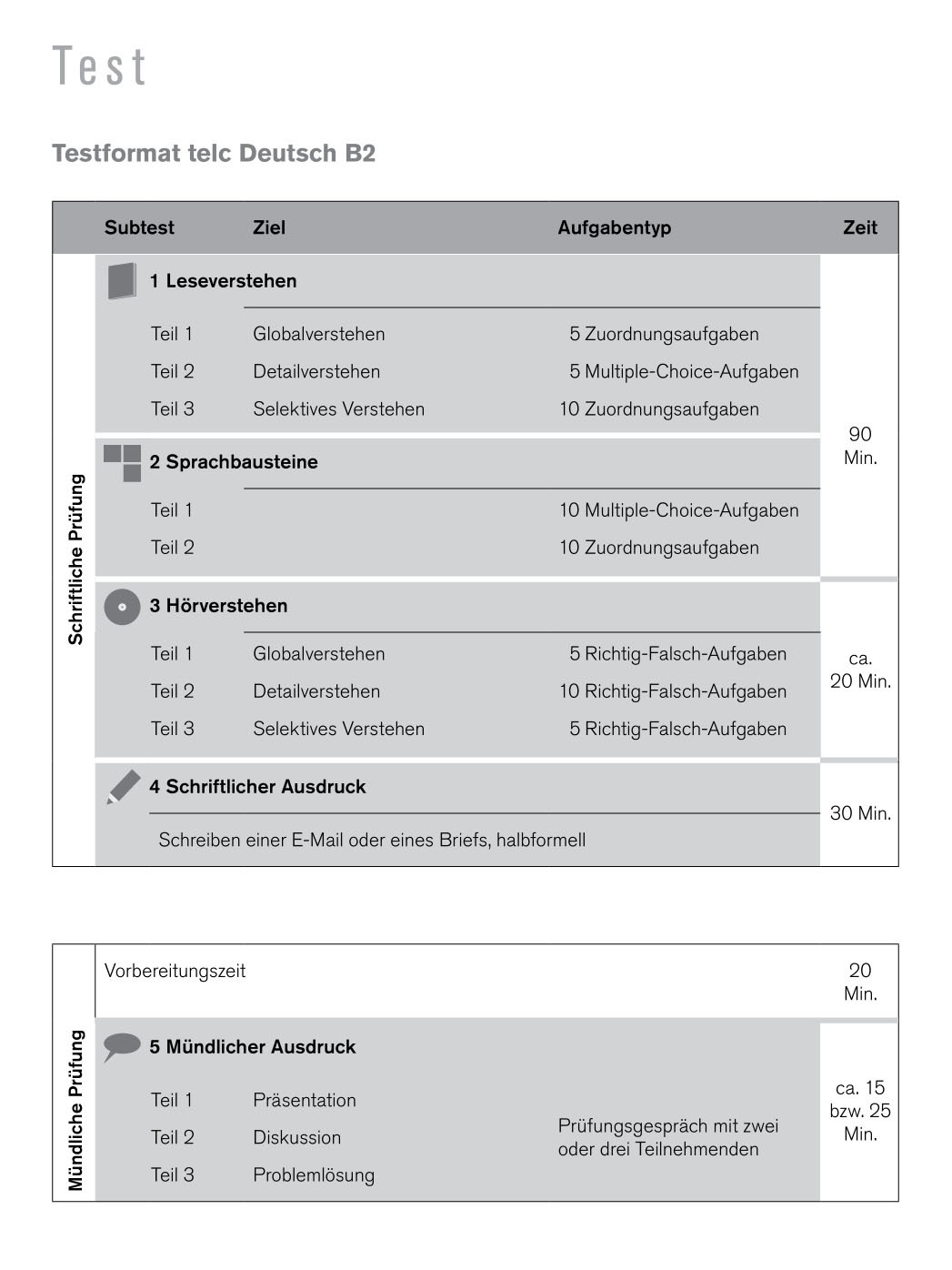
1 раздел: письменная часть (Schriftliche Prüfung)
Она длится примерно 140 минут. Время строго учитывается! Поэтому не забывайте использовать таймер во время подготовки к экзамену. Даже сами создатели экзамена говорят, что сложность экзамена — это уложиться в определенный срок выполнения заданий и успеть перенести все ответы в экзаменационный бланк, так как только эти ответы будут учитываться при проверке.
Итак, из каких же частей состоит письменная часть экзамена TELC B2?
1. Teil Leseverstehen
Вместе со следующей частью (Teil Sprachbausteine) длится 90 минут. Создатели теста рекомендуют тратить на часть Lesen 55 минут. За это время вам необходимо выполнить 3 задания.
Leseverstehen Teil 1 — Globalverstehen
Рекомендовано выполнить это задание за 15 минут.
Вам дается 5 текстов (по 150-170 слов) и 10 заголовков на выбор. К каждому тексту требуется подобрать заголовок. Если вы подберете верный заголовок, то получите 5 баллов. Суммарное количество баллов за все правильные ответы — 25.
Сначала прочитайте заголовки и выделите ключевые слова. Так вы заранее, еще до прочтения текстов, поймете, о чем может идти речь. Некоторые заголовки могут быть похожими. В таком случае выделите, чем они отличаются друг от друга. Во время прочтения текстов вам нужно понять общий смысл, поэтому не переживайте, если какие-то слова будут незнакомыми. Ваша задача — понять главную мысль и подобрать правильный заголовок.
Leseverstehen Teil 2 — Detailverstehen
Рекомендовано выполнить это задание за 20 минут.
Вы получаете текст объемом 500-600 слов и 5 вопросов с 3 вариантами ответов (a, b, c). Только один вариант ответа верный. Если вы выберите правильный ответ, то получите 5 баллов. Суммарное количество баллов за все правильные ответы — 25.
Не отвечайте на вопросы, опираясь на собственные знания по теме. В статье может содержаться дополнительная информация или мнение автора, поэтому самое главное — отвечать на вопросы только после того, как прочитаете текст полностью. Все задания расположены в такой же последовательности, в какой подается информация. Вы можете сэкономить время и читать текст, параллельно отвечая на вопросы.
Leseverstehen Teil 3 — Selektives Verstehen
Рекомендовано выполнить это задание за 20 минут.
В этом задании вам предлагается 12 текстов (общий объем 960-1200 слов) и 10 предложений, которые коротко описывают ситуацию. Каждому предложению необходимо подобрать подходящий текст. Внимание! Всегда есть 1 предложение, которому не подходит никакой из текстов. В этой ситуации поставьте X в поле ответа. За правильный ответ вы получите 2,5 балла. Суммарное количество баллов за все правильные ответы — 25.
Прочитайте сначала предложения и выделите основные слова. Только затем приступайте к прочтению текстов. После того, как прочтете каждый текст, сразу же определитесь, подходит ли он под какую-то из ситуаций. Чтобы облегчить самопроверку, выделяйте в каждом тексте ключевые слова, подходящие под один из пунктов.
2. Teil Sprachbausteine
Вместе с предыдущей частью (Teil Leseverstehen) длится 90 минут. Создатели теста рекомендуют тратить на часть Sprachbausteine 35 минут времени. За это время вам нужно выполнить 2 задания.
Часть Sprachbausteine существует только в экзамене TELC, в экзамене Goethe Zertifikat B2 такой части не существует. В заданиях Sprachbausteine проверяется соответствуют ваши знания грамматики и лексики уровню В2. При подготовке к экзамену мы рекомендуем уделить особое внимание тренировке этой части.
Sprachbausteine Teil 1 — Ein Lückentext und 10 Multiple-Choice-Aufgaben
Рекомендовано выполнить это задание за 15 минут.
Вы получаете текст длиной 250 слов с 10 пропусками (письмо, электронное письмо или факс). Для каждого пропуска вам дается 3 варианта (a,b, c), из которых требуется выбрать 1 правильный. Пропуски должны определить ваши знания в склонении артиклей, существительных и прилагательных, спряжении глаголов, предлогах, союзах, частицах, местоименных наречиях и тд. Если вы правильно заполните пропуск, то получите 1,5 балла. Суммарное количество баллов за все верные ответы — 15.
Повторите грамматику и прорешайте как можно больше подобных заданий! Тогда на экзамене вы будете чувствовать себя гораздо увереннее. Если подобное задание остается для вас очень сложным и не поддается тренировке, возможно, следует вернуться к повторению или углубиться в грамматический материал уровня В2 и ненадолго отложить сдачу экзамена.
Sprachbausteine Teil 2 — Ein Lückentext und 10 Zuordnungsaufgaben
Рекомендовано выполнить это задание за 20 минут.
Вы получаете газетную статью длиной 300-350 слов, в которой пропущено 10 слов. Под текстом находятся 15 слов и выражений, из которых вам надо выбрать подходящие для заполнения пропусков. В этой части проверяются ваши знания словарного запаса. Если вы выберете подходящее пропущенное, то получите 1,5 балла. Суммарное количество баллов за все правильные ответы — 15.
Не оставляйте пропуск без ответа, даже если вы не знаете, какое слово здесь подойдет. Возможно, ваш ответ будет правильным и вы не потеряете балл.
3. Teil Hörverstehen
Часть Hören длится около 20 минут и за это время вам нужно выполнить 3 задания. В каждом задании нужно отметить: richtig (+) или falsch (-). Внимание! Вы слушаете каждое аудио только 1 раз!
Как проходит часть Hörverstehen:
Экзаменатор включает единую аудиодорожку для всей части Hören. Аудиодорожка уже содержит паузы после каждой части (45 секунд). Они предназначены для того, чтобы прочитать заданий и перенести ответы в экзаменационный бланк. Создатели экзамена рекомендуют сразу же проставлять ответы в экзаменационный бланк, чтобы не тратить время на перенос. В конце раздается сигнал, обозначающий завершение Hörverstehen.
В одном из заданий используется диалектная речь, чаще всего баварский диалект. Главные слова для выбора правильного ответа вы сможете понять и не зная диалекта, но общее понимание речи может быть затруднено. Поэтому создатели экзамена настоятельно рекомендуют познакомиться при подготовке к экзамену с баварским, австрийским и швейцарским диалектами.
Hörverstehen Teil 1 – Globalverstehen
Длится примерно 5 минут.
Вы слушаете 5 радиосообщений по актуальным тем (политика, наука, культура, спорт и т.д.). Вам дается 5 выражений, которые вы должны оценить: richtig (+) или falsch (-). На прочтение задания перед прослушиванием аудио вам дается 30 секунд. За каждый правильный ответ вы получите 5 баллов. Суммарное количество баллов за все правильные ответы — 25.
Выделите ключевые слова в каждом выражении. Сконцентрируйтесь на глобальном понимании каждого сообщения.
Hörverstehen Teil 2 – Detailverstehen
Длится примерно 7 минут.
Вы слушаете радиоинтервью с 2 или более участниками. Радиоинтервью касается повседневных актуальных тем и в нем принимают участие спортсмены, водители автобусов, продавцы и т.д. Вам дается 10 выражений, которые вы должны оценить согласно аудио: richtig (+) или falsch (-). На прочтение задания перед прослушиванием аудио вам дается 60 секунд. В случае правильного выбора вы получите 2,5 балла. Суммарное количество баллов, которое можно получить за все корректные ответы — 25.
В аудио могут встречаться отрывки, к которым нет выражения в задании. Ваша задача – сконцентрироваться по максимуму на каждом пункте задания.
Hörverstehen Teil 3 – Selektives Verstehen
Длится примерно 6 минут.
Вы слушаете 5 сообщений по громкой связи (на радио, вокзале, в аэропорту или на автоответчике). Вам предлагается 5 выражений, которые вы должны оценить согласно аудио: richtig (+) или falsch (-). На прочтение задания перед прослушиванием аудио вам дается 30 секунд. Если вы выберите правильный ответ, то получите 5 баллов. Суммарное количество баллов за все верные ответы — 25.
В выражениях могут встретиться 2 имени или числа. Обязательно подчеркните их и при прослушивании обратите на них внимание. Ваша задача – сконцентрироваться по максимуму на каждом выражении.
4. Teil Schreiben
Длительность 30 минут.
В течении 30 минут вам нужно написать текст длиной 150-200 слов, выбрав одно из заданий (запрос информации или написание жалобы). У вас не будет времени писать текст вначале на черновик, а затем переписывать его на чистовик. Поэтому создатели экзамена рекомендуют писать текст сразу же в экзаменационном бланке. Не переживайте по поводу исправлений, они допустимы. Самое главное, чтобы экзаменатор понял, как и что вы исправили. Для написания текста вам дается 4 пункта, из которых вам следует выбрать 3 из предложенных или выбрать 2 из предложенных и придумать 1 свой.
Внимание! Текст должен быть оформлен согласно правилам написания писем! Недостаточно просто выполнить задание. Вам нужно обязательно написать: получателя, место и дату, тему письма, обращение, введение, а в конце подходящее завершение, передачу приветов (Grußformel) и подпись.
Вы можете вначале набросать короткий план на черновике или собрать главные идеи для письма. Обязательно потренируйтесь выполнять эти задания при подготовке к экзамену и, самое главное, укладывайтесь в 30 минут. По окончанию 30 минут все экзаменационные бланки собираются. Дополнительное время экзаменаторы не дают.
Вот, что говорят создатели экзамена о письменной части:
Ihre Texte werden aufgrund der Definitionen des europäischen Referenzrahmens für die Stufe B2 nach folgenden Kriterien beurteilt:
1. Behandlung des Schreibanlasses,
2. Kommunikative Gestaltung,
3. Formale Richtigkeit.
Обязательно ознакомьтесь с образцами написания писем и правильными вариантами оформления. Максимальное количество баллов за часть Schreiben – 45 баллов.
Выделите время на экзамене, чтобы проверить свое письмо! Обратите внимание, выполнили ли вы задание, безошибочно ли использовали грамматику и лексику и поделили ли текст на смысловые части.
2 раздел: устная часть (Mündlliche Prüfung)
Устная часть длится примерно 15 минут.
На подготовку к части Sprechen вам дается 20 минут. За это время нужно подготовиться к выполнению 3 устных заданий: набросать свои идеи, аргументы, определиться с точкой зрения и составить план решения проблемы.
Для того, чтобы сдать разговорную часть экзамена, вам нужно использовать в речи словарный запас и грамматику уровня В2 (Nebensätze, Passiv, Könjunktiv и др.).
В начале проведения Mündlliche Prüfung экзаменатор предложит участникам познакомиться. Вам необходимо обменяться со своим партнером несколькими репликами: как зовут, откуда вы, как давно живете в Германии и т.д. Знакомство не оценивается экзаменаторами, но они могут уже составить первое впечатление о вашей устной речи.
Mündliche Aufgabe 1 — Präsentation
Длительность 5 минут (по 2,5 минуты на собеседника).
В первом задании вам нужно представить собеседнику книгу, фильм, путешествие или что-то еще, что вам нравится. После вашей презентации ваш партнер должен задать пару дополнительных вопросов.
Подготовьтесь к этому заданию заранее! Еще до экзамена вы можете подготовить презентацию и в готовом виде использовать на экзамене. Обычно список тем на выбор всегда одинаковый. Обязательно потренируйтесь укладываться в нужное время!
Mündliche Aufgabe 2 – Diskussion
Длительность 5 минут (по 2,5 минуты на собеседника).
Вам дается текст длиной 25-30 строк на одну из острых актуальных тем. Вам и вашему собеседнику нужно обсудить этот текст и его основную проблему: поговорить о содержимом статьи и вашем впечатлении, затем обменяться собственным опытом, мнением и аргументами. В конце беседы вы должны прийти к общему решению проблемы или компромиссу.
Используйте в своей речи вводные фразы для выражения своего мнения, рассказа о своем опыте и перечислении аргументов.
Mündliche Aufgabe 3 — Problemlösung
Длительность 5 минут (по 2,5 минуты на собеседника).
В этом задании вам описывают ситуацию (например, организовать мероприятие, вечеринку или вылазку или подготовить путешествие) и предлагают ее обсудить вместе с собеседником. Во время подготовки вы можете составить примерный план обсуждения.
Если ничего не приходит в голову, то можно пользовать схемой из 6 вопросов, которые помогут быстро сконцентрироваться: Was? Wer? Wann? Wo? Essen/Trinken? Kosten?
Вот, что говорят создатели экзамена об оценке устной части:
Die Prüfer/innen bewerten Ihre Leistung in Anlehnung an den Gemeinsamen europäischen Referenzrahmen danach, inwieweit sie folgenden Kriterien entsprechen:
1. Ausdrucksfähigkeit,
2. Aufgabenbewältigung,
3. Formale Richtigkeit,
4. Aussprache und Intonation.
Кстати, в отличие от письменной части, где за грамматические ошибки снижают большое количество баллов, в устной части можно делать ошибки. Самое главное, чтобы они не мешали пониманию вашей речи. Максимальное количество баллов за часть Sprechen – 75 баллов.
Оценивание экзамена и критерии оценки

На экзамене отдельно оценивается письменная часть экзамена (Lesen, Sprachbausteine, Hören, Schreiben) и устная часть экзамена (Sprechen).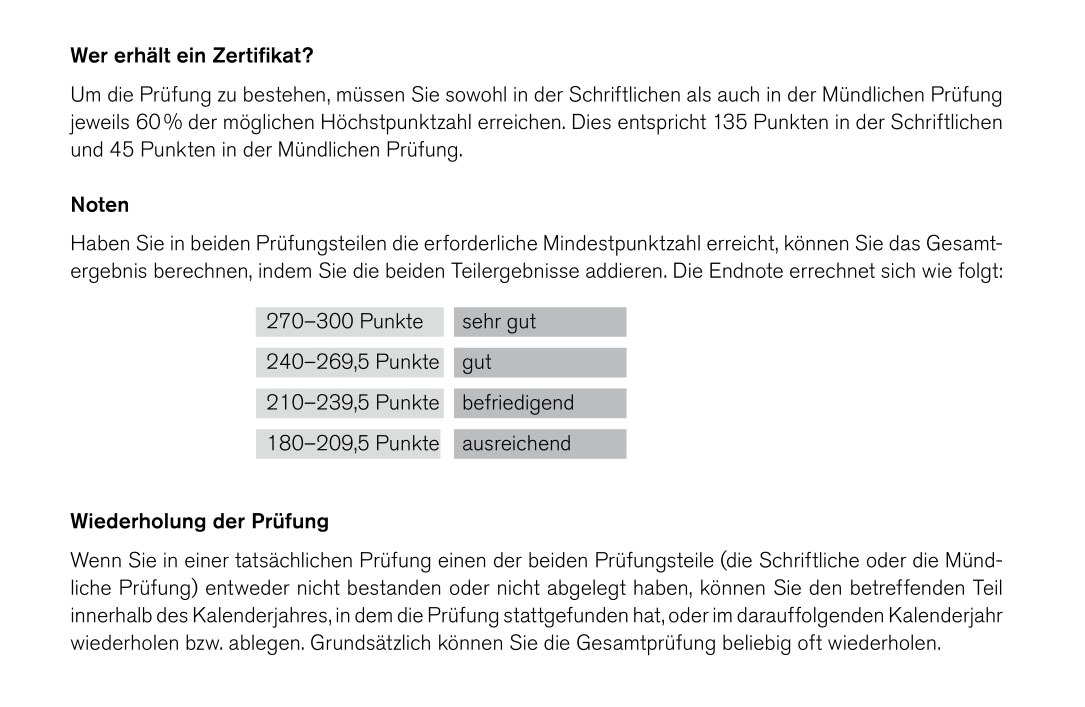
Для того, чтобы сдать экзамен нужно набрать суммарно 180 баллов за весь экзамен, но не менее 60% в каждой части (не менее 135 баллов за письменную часть и 45 за устную часть). Если по какой-то части вы не набрали необходимое количество баллов, то эту часть можно пересдать в течении календарного года.
Хотите подготовиться к экзамену TELC B2? Наши преподаватели готовы вам помочь! Записывайтесь на индивидуальные занятия немецким в нашей школе.
Мы подготовили для вас еще больше полезных материалов о лексике и грамматике немецкого языка! Подписывайтесь на рассылку, чтобы получать новые статьи в числе первых! А так же записывайтесь на пробный урок — наши преподаватели помогут вам заговорить на немецком и подготовиться к нужным экзаменам!