
Представлено сочинение на английском языке Блокада Ленинграда/ Leningrad Blockade с переводом на русский язык.
| Leningrad Blockade | Блокада Ленинграда |
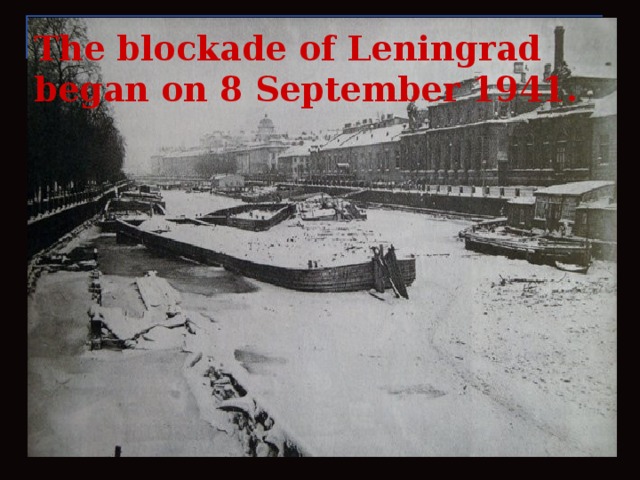
| The blockade of Leningrad is a terrible page in the history of our country which took place during the Great Patriotic War. The city was besieged from September 8, 1941 to January 27, 1944 which makes it 872 days. | Блокада Ленинграда — это страшная страница истории нашей страны, которая произошла в годы Великой Отечественной войны. Блокада города длилась с 8 сентября 1941 года по 27 января 1944 года, долгие 872 дня. |
| The war was developing rapidly and at the beginning of September the city was siege all around and surrounded by fascist invaders. The only way that connected Leningrad with the rest of the country was a route through Lake Ladoga which was shot through by the Germans from the ground and from air and water. | Война развивалась стремительно, и уже в начале сентября город оказался в полном кольце, окруженный фашистскими захватчиками. Единственная ветка, соединявшая Ленинград со страной был маршрут через Ладожское озеро, который простреливался немцами, как с земли, так и с воздуха и воды. |
| After the city was besieged, the Germans started to fire on the city massively, especially trying to destroy food warehouses and they quickly managed to do this by bombing the Badayev warehouses on the very first day of the blockade. The city was overcrowded with refugees from the Baltic republics and surrounding areas so it simply could not feed everyone. The portions of bread and other foods began to get smaller fast and reached their lowest levels at the end of November when workers and their dependents received only 125 grams of bread a day. Massive hunger began and as a result of it deaths and even cannibalism. | После окружения, немцы начали массированно обстреливать город, особенно стремились уничтожить продовольственные склады, и это им быстро удалось сделать, разбомбив Бадаевские склады в первый же день блокады. Город, переполненный беженцами из прибалтийских республик и близлежащих областей, просто не мог прокормить всех желающих. Нормы отпуска хлеба и других продуктов начали стремительно уменьшаться и достигли минимальных значений в конце ноября, когда служащие и иждивенцы получали всего по 125 граммов хлеба в день. Начался массовый голод и как следствие — голодные смерти и даже людоедство. |
| Besides hunger and bombing, another enemy fell upon the Leningraders — freeze. The winter of 1941-1942 was the coldest one out of all the years of city weather observation. Lots of people froze to death and even more than 7 thousand wooden houses were used as firewood. | Кроме голода и бомбёжек на ленинградцев обрушился ещё один враг — морозы. Зима 1941—1942 годов была самой морозной за все годы наблюдения в городе. Люди массово замерзали, было даже пущено на дрова более 7 тысяч деревянных домов. |
| During the years of that blockade up to 1.5 million people died and most of them were buried at the Piskarevskoye Memorial Cemetery. | За годы блокады погибло до 1,5 миллиона человек, большинство из них похоронено на Пискарёвском мемориальном кладбище. |
| However, despite all the horrible conditions, the residents of Leningrad were able to withstand and soon in 1942 the city was fully supplied with food, a tram started working and much more stuff was done. The factories continued to work very well, tanks and other weapons were manufactured. The city withstood and on January 27, 1944 the blockade was over. Very soon after that the first train came to the besieged city. | Несмотря на страшные условия, ленинградцы смогли выстоять, и уже в 1942 году наладилось полное снабжение города продовольствием, был пущен трамвай и сделано многое другое. Стабильно продолжали работать заводы, выпускались танки и другое вооружение. Город выстоял, и 27 января 1944 года блокада была снята. А вскоре, в осаждённый город, уже был пущен первый железнодорожный состав. |
Обновлено: 11.03.2023
на английском языке с переводом на русский язык
Great Patriotic War
Великая Отечественная война
The 20 th century was full of cruel and tragic military conflicts, but the World War II and the Great Patriotic War, its main part, are the most global and memorable among them. The fight between Nazi Germany with its allies (Italy and Japan) and the anti-Hitler coalition countries, including the Soviet Union, the United Kingdom, the USA, France, and others, lasted from 1939 to 1945. The Great Patriotic War began on the USSR territory on 22 June 1941 and finished on 9 May 1945, with the conquest of Berlin and the collapse of the key Nazi forces. The occupied by the Nazis countries of Europe, Asia, North Africa, the Pacific and Atlantic islands were saved.
XX век был полон жестоких и трагических военных конфликтов, но Вторая мировая война и Великая Отечественная война, её главная часть, – самые глобальные и памятные среди них. Борьба между нацистской Германией с союзниками (Италией и Японией) и странами антигитлеровской коалиции, включающей Советский Союз, Великобританию, США, Францию и др., длилась с 1939 по 1945 гг. Великая Отечественная война началась на территории СССР 22 июня 1941 г. и закончилась 9 мая 1945 г., с завоеванием Берлина и падением ключевых нацистских сил. Оккупированные нацистами страны Европы, Азии, Северной Африки, острова Тихого и Атлантического океанов были спасены.
However, this war has become not only a victory but also a disaster: according to different estimates, from 50 to 85 million people dead. For the Russians, as well as for other nations of the former USSR, the Great Patriotic War is the turning point of history. Almost every family has a member who sacrificed his life or health for the motherland. Fierce battles of the Great Patriotic War (the Battle of Moscow, the Battle of Stalingrad, the Battle of Kursk, the Siege of Leningrad, the Operation Bagration that liberated Belarus, etc.) changed the destiny of the world. Besides, millions of men, women and even children labored for the army in the rear, despite the hardest conditions and famine.
Due to courage and patriotism of our ancestors, now we can live in peace and freedom, out of Nazi slavery. It is important not to forget about their heroic feat.
Благодаря отваге и патриотизму наших предков, сейчас мы можем жить в мире и свободе, вне нацистского рабства. Важно не забывать об их героическом подвиге.
This was undoubtedly the most tragic period in the history of the city, a period full of suffering and heroism. For everyone who lives in St. Petersburg the Blokada (the Siege) of Leningrad is an important part of the city’s heritage and a painful memory for the population’s older generations.
Less than two and a half months after the Soviet Union was attacked by Nazi Germany, German troops were already approaching Leningrad. The Red Army was outflanked and on September 8 1941 the Germans had fully encircled Leningrad and the siege began. The siege lasted for a total of 900 days, from September 8 1941 until January 27 1944. The city’s almost 3 million civilians (including about 400,000 children) refused to surrender and endured rapidly increasing hardships in the encircled city. Food and fuel stocks were limited to a mere 1-2 month supply, public transport was not operational and by the winter of 1941-42 there was no heating, no water supply, almost no electricity and very little food. In January 1942 in the depths of an unusually cold winter, the city’s food rations reached an all time low of only 125 grams (about 1/4 of a pound) of bread per person per day. In just two months, January and February of 1942, 200,000 people died in Leningrad of cold and starvation. Despite these tragic losses and the inhuman conditions the city’s war industries still continued to work and the city did not surrender. Several hundred thousand people were evacuated from the city across Lake Ladoga via the famous «Road of Life» («Doroga Zhizni») — the only route that connected the besieged city with the mainland. During the warm season people were ferried to the mainland, and in winter — carried by trucks that drove across the frozen lake under constant enemy bombardment.
Meanwhile, the city lived on. The treasures of the Hermitage and the suburban palaces of Petrodvorets and Pushkin were hidden in the basements of the Hermitage and St Isaac’s Cathedral. Many of the city’s students continued their studies and even passed their finals exams. Dmitry Shostakovich wrote his Seventh «Leningrad» Symphony and it was performed in the besieged city.
In January 1943 the Siege was broken and a year later, on January 27 1944 it was fully lifted. At least 641,000 people had died in Leningrad during the Siege (some estimates put this figure closer to 800,000). Most of them were buried in mass graves in different cemeteries, with the majority in the Piskariovskoye Memorial Cemetery, resting place to over 500,000 people and a timeless reminder of the heroic deeds of the city.
Siege of Leningrad — a military blockade of the German, Finnish [2] and Spanish (Blue Division) troops during the Great Patriotic War Leningrad (now St. Petersburg). Lasted from September 8, 1941 to January 27, 1944 (the siege ring was broken on Jan. 18, 1943) — 872 days.
By the beginning of the blockade in the city had only inadequate in terms of food supplies and fuel. The only means of communication with the besieged Leningrad remained Ladoga Lake, located within reach of the artillery of the besiegers. The capacity of this transport artery was irrelevant to the needs of the city. Begins in hunger, aggravated by problems with heating and transport, has led to hundreds of thousands of deaths among residents.
скачай переводчик диктор-dikter, напишите текс в ворде, выделите его, и нажмите на переводчика, затем выберите язык -англ. и переведите, потом скопируйте, вот и все))) )
а это перевод того кто написал текст выше, кстати, с диктора
Блокада Ленинграда — военная блокада немецкого, финского [2] и испанском языках (Голубая дивизия) войсками во время Великой Отечественной войны Ленинград (ныне Санкт-Петербург) . Продолжалось с 8 сентября 1941 по 27 января 1944 (кольцо осады была разбита по 18 января 1943) — 872 дней. К началу блокады в городе были только недостаточны в плане поставок продовольствия и топлива. Единственным средством связи с осажденного Ленинграда оставалось Ладожское озеро, расположенное в пределах досягаемости артиллерии осаждающих. Мощность этой транспортной артерии не имеет отношения к потребностям города. Начинается голод, усугубляются проблемы с отоплением и транспорт, привело к сотням тысяч смертей среди жителей

Веб-квест по английскому языку,созданная на платформе Jimdo.
веб-квеста по английскому языку
Название проекта —The Leningrad Blockade
Ф.И.О. разработчика – Левченко Римма Евгеньевна
Участники проекта: 8 кл, 9кл.
Год разработки проекта: 2019 г.
— создание условий для обогащения детей знаниями о ВОВ
— воспитание патриотизма, чувства гордости за свою Родину
7. Задачи проекта:
сформировать знания о блокадном Ленинграде.
пробудить в детях чувство сострадания и гордости за стойкость своего народа в период блокады Ленинграда и на протяжении всей Великой Отечественной войны
формировать исследовательские навыки, умения самостоятельно добывать новую информацию.
Освоить метод работы в группе.
Форма организации детей: групповая, индивидуальная, внешкольная.
После завершения проекта учащиеся смогут:
Метапредметные результаты.
К ним можно отнести:
-способность регулировать собственную деятельность, направленную на изучение темы, осознание её важности и возможности самостоятельно найти пути и способы решения проблемы;
-способность осуществлять информационный поиск, оценивать степень значимости источника;
-умение структурировать найденную информацию;
-проводить анализ найденной информации, делать выводы на основе совокупности отдельных фактов;
-осознание правил и норм взаимодействия со взрослыми и сверстниками;
-навыки использования средств ИКТ для сопровождения интеллектуальной деятельности, развития универсальных учебных действий.
Предметные результаты.
К ним можно отнести:
-усвоение первоначальных сведений;
-использование базового понятийного аппарата на уровне, доступном для понимания средних школьников,
-умение описывать и характеризовать факты и события в изучаемой области .
Время работы : долгосрочный проект
Режим работы: внеурочный режим, очно встречались с детьми, дистанционно.
Учебно-методическое и техническое оснащение: Интернет ресурсы, аудио ресурсы, тест

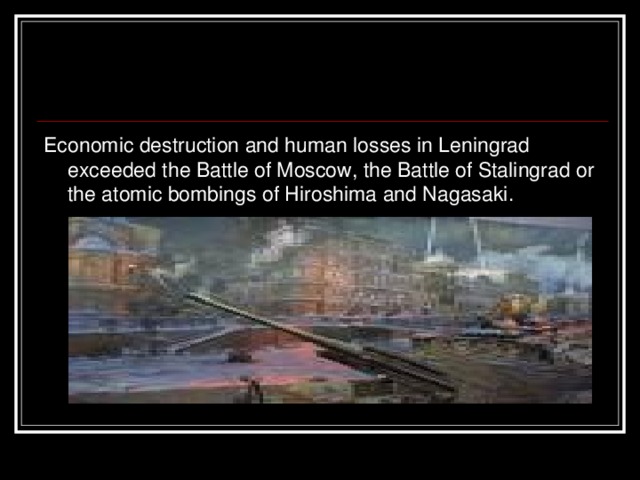
Economic destruction and human losses in Leningrad exceeded the Battle of Moscow, the Battle of Stalingrad or the atomic bombings of Hiroshima and Nagasaki.
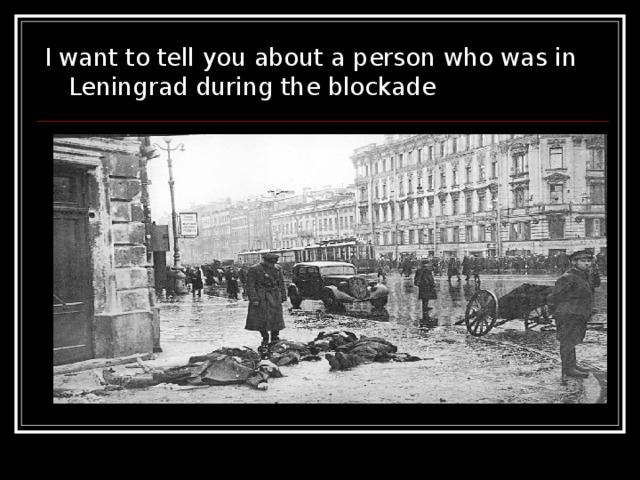
I want to tell you about a person who was in Leningrad during the blockade
Her mother died in Leningrad
Two uncles were killed by fascists
Her grandfather didn’t return from work
Her father was a cavalry-man and he was killed nearby Smolensk
Every five minutes shells fell onto the houses and streets. Children helped to put out fire.
It was hard to go on foot: children went barefoot and their feet were rubbed. Soon they came to Leningrad children’s home and there they were fed.
Полную информацию смотрите в файле.
Содержимое разработки
The Blockade of Leningrad
The blockade of Leningrad began on 8 September 1941.
Economic destruction and human losses in Leningrad exceeded the Battle of Moscow, the Battle of Stalingrad or the atomic bombings of Hiroshima and Nagasaki.
I want to tell you about a person who was in Leningrad during the blockade
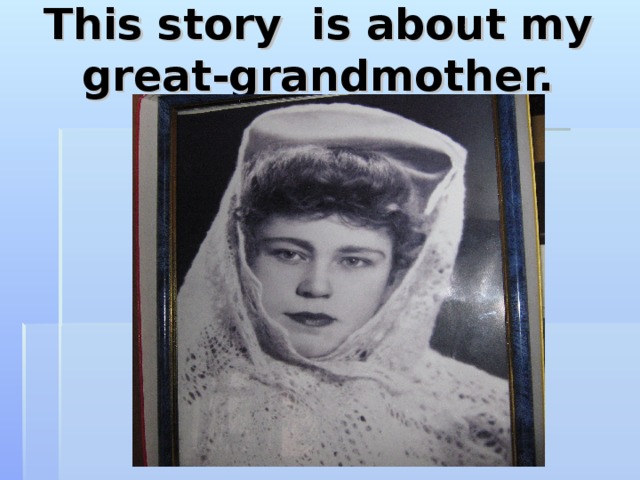
This story is about my great-grandmother.
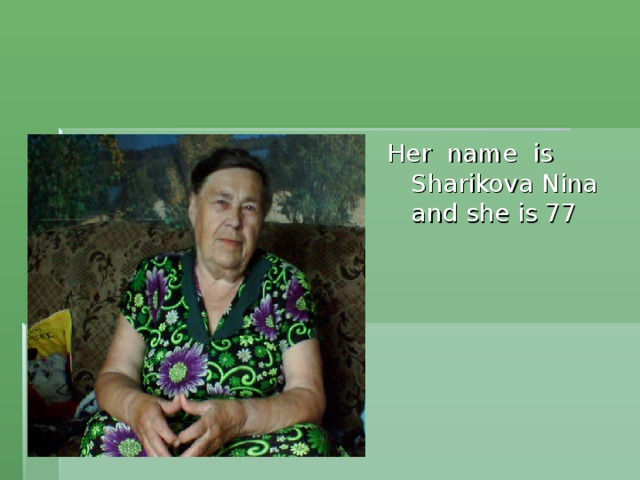
Her name is Sharikova Nina and she is 77
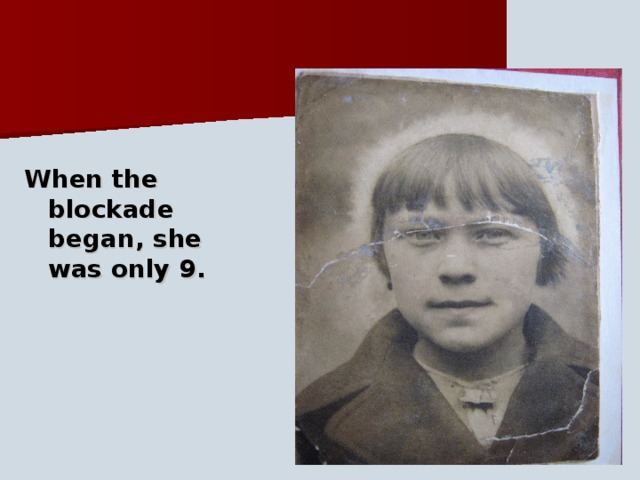
When the blockade began, she was only 9.
Her mother died in Leningrad Two uncles were killed by fascists Her grandfather didn’t return from work
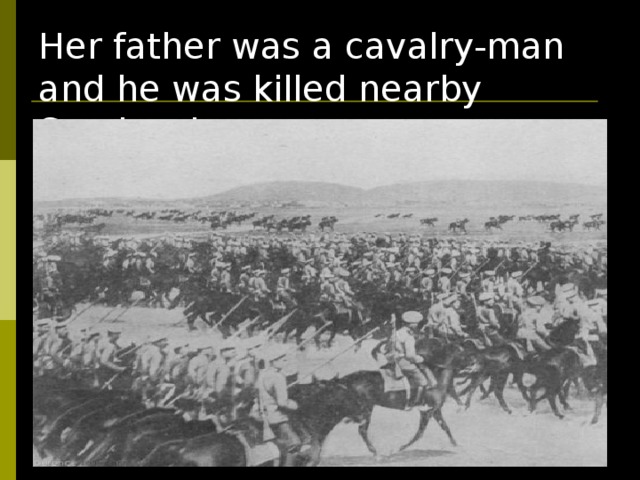
Her father was a cavalry-man and he was killed nearby Smolensk
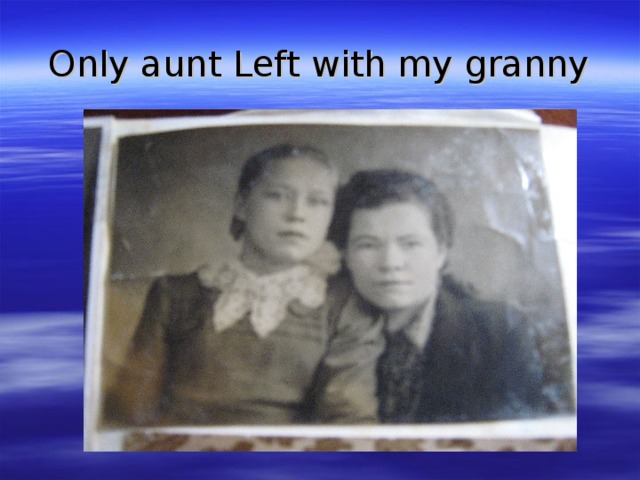
Only aunt Left with my granny
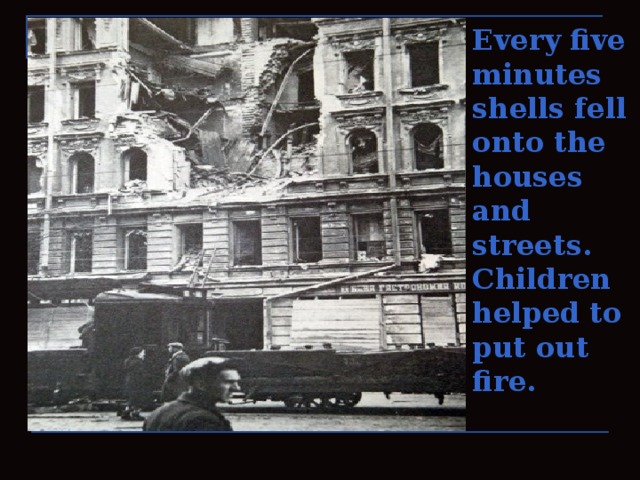
Every five minutes shells fell onto the houses and streets. Children helped to put out fire.

People ate cats, dogs, medicines. There were cases of cannibalism.
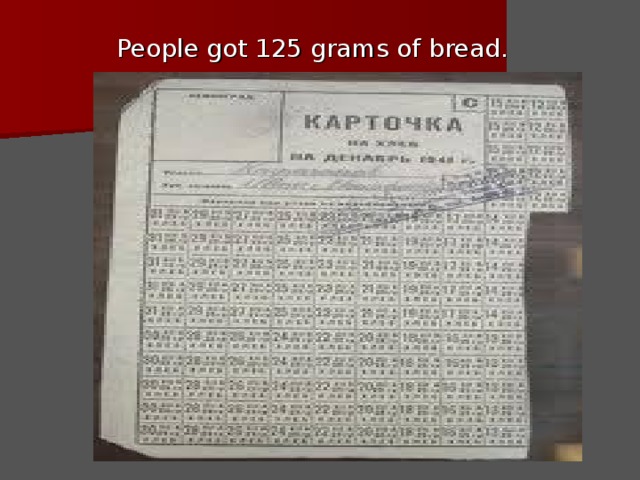
People got 125 grams of bread.
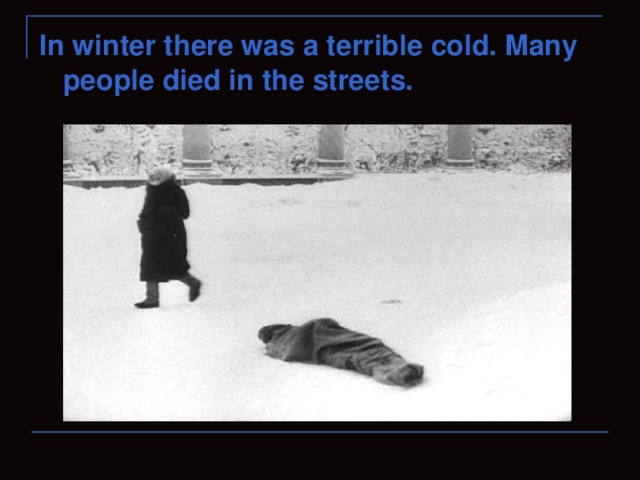
In winter there was a terrible cold. Many people died in the streets.
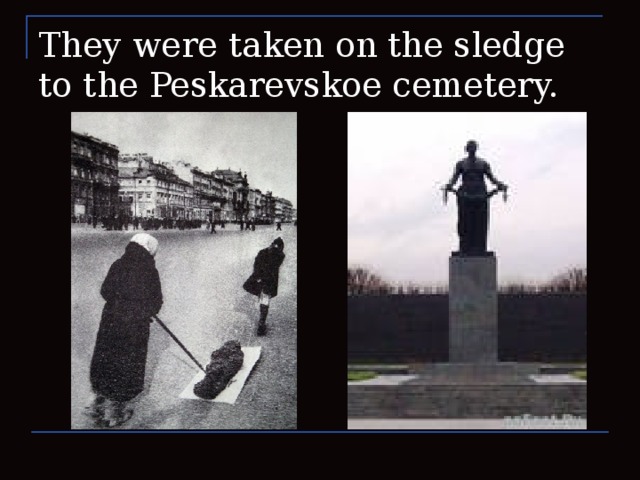
They were taken on the sledge to the Peskarevskoe cemetery.
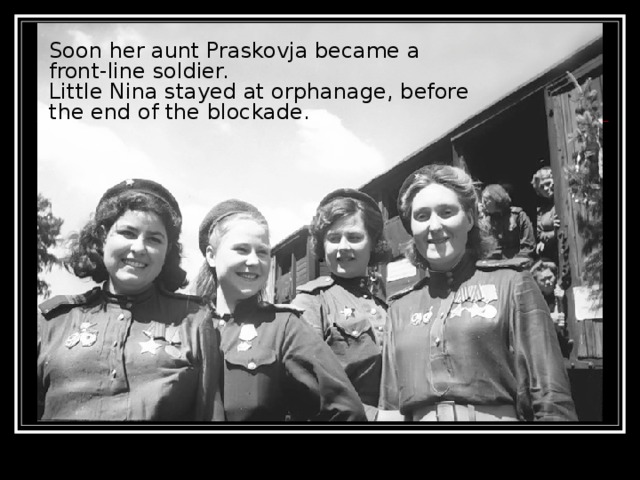
Soon her aunt Praskovja became a front-line soldier. Little Nina stayed at orphanage, before the end of the blockade.
In the orphanage
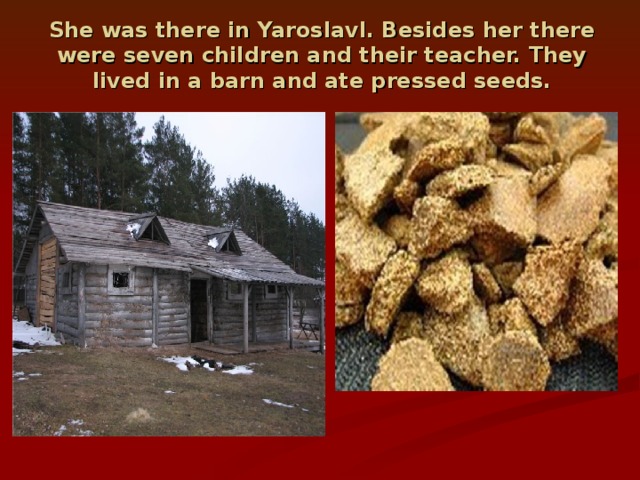
She was there in Yaroslavl. Besides her there were seven children and their teacher. They lived in a barn and ate pressed seeds.
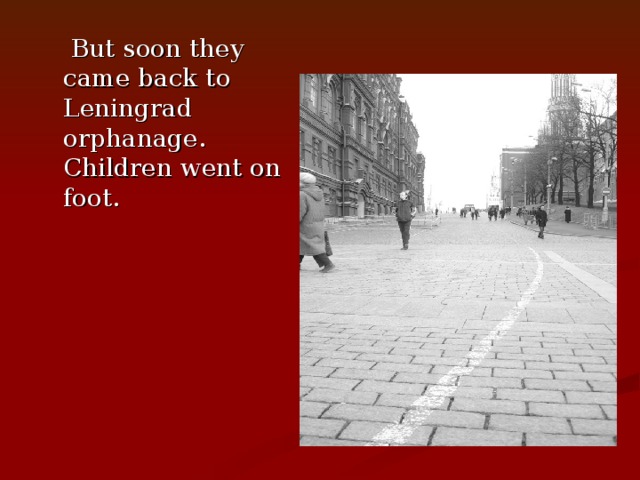
But soon they came back to Leningrad orphanage. Children went on foot.
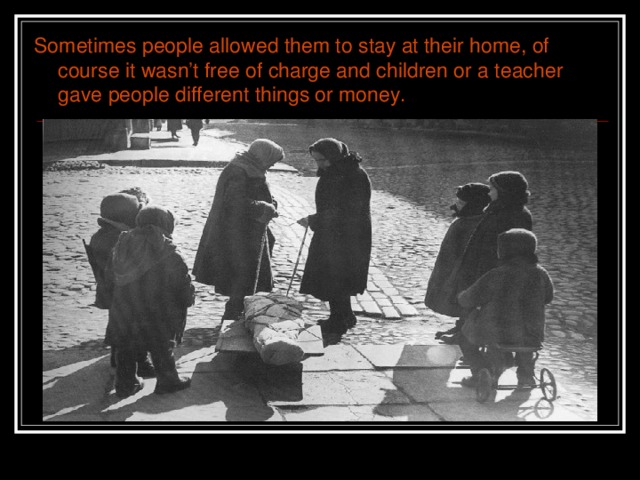
Sometimes people allowed them to stay at their home, of course it wasn’t free of charge and children or a teacher gave people different things or money.
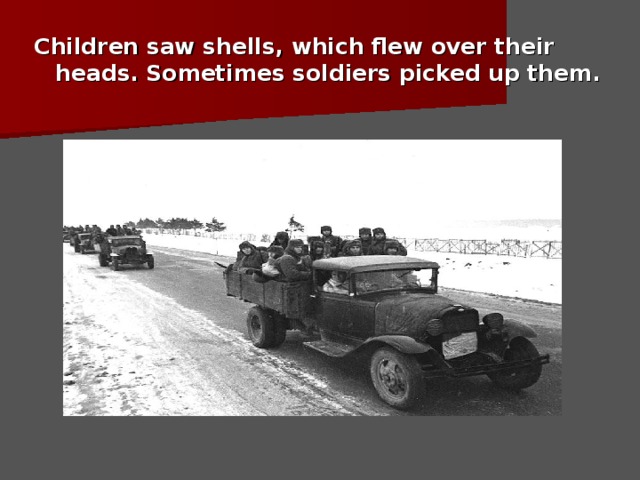
Children saw shells, which flew over their heads. Sometimes soldiers picked up them.
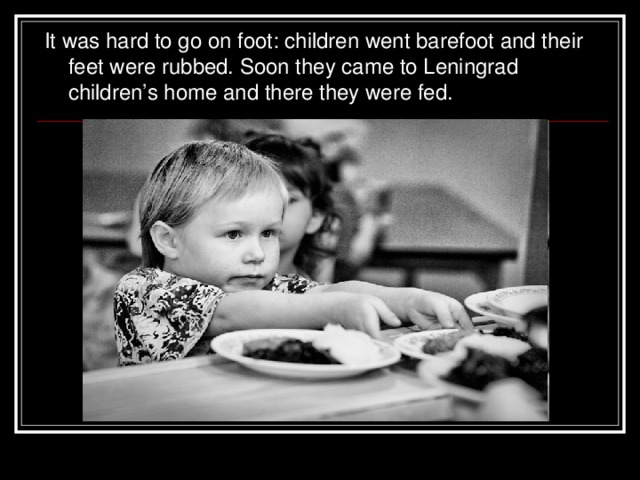
It was hard to go on foot: children went barefoot and their feet were rubbed. Soon they came to Leningrad children’s home and there they were fed.
On 27 January 1944 – the blockade of Leningrad ended.
Produced by
Rogozhina Christina

-75%
Читайте также:
- Сочинение нравственный выбор по тексту куприна
- Мой любимый фантастический фильм сочинение
- Почему бы не издать полное собрание трудов шкловского сочинение проблема
- Сочинение один день из жизни синьора
- Сочинение по сериалу острые козырьки
Is worth its weight in gold, I grant it.
But we’ve got strength and guts instead,
We’ll let ourselves feel tired after”
— Nikolai Tikhonov 1942
77 years ago, on September 8th, 1941, the siege of Leningrad began. This was and still is one of the most horrible and yet heroic episodes in human history in which more than one million people died. In this feature, we look back on those events and show you some rare historic photographs of that time.
The first terrible winter
The siege of Leningrad began on September 4th 1941 when the German army began to shell the city now known as St. Petersburg. Four days later the last land connection to the outside world was severed when German troops took Lake Ladoga (to the east of the city).
On September 12th, provisions were calculated as being grain and flour for 35 days, meat for 33 days, fats for 45 days, and sugar for 60 days. Rations were introduced. By November 20th the rations were just 250 grams of bread for blue-collar workers and 125 grams for children under 12, white-collar workers and the unemployed.
Citizens supplemented their diet by boiling up wallpaper and leather into soups and by making bread from sawdust and cardboard. By December death from hunger was rampant and people simply fainted and died in the streets and were dragged away by those strong enough to help or simply left where they lay.
Then came the first winter, which was one of the most ferocious in memory. Fuel supplies began to run out and those who were not defeated by hunger succumbed to the cold. In January 1942 it is estimated that 4,000 people a day died in the city and by spring the death toll was already in the hundreds of thousands.
Building hope with the road of life
In a miraculous feat of heroism, the defenders of the city managed to open up a ‘road of life’ across the frozen Lake Ladoga in early 1942 and fuel, food, medicine and ammunition arrived to aid the stricken city.
In May all those who were able, came out to clean the streets and attempt to bring back some humanity to the desolate city. Trams began to run and in the basement of the enormous Kirov factory in the south west of the city, literary recitals were organised.
On August 9th (the day Hitler had predicted the city would fall) a group of starving musicians from the Leningrad symphony orchestra lifted their instruments to play a concert. Written by Dmitri Shostakovich, the 7th Leningrad symphony was then broadcast around the city on loudspeakers and by radio to the rest of Russia, as a rallying patriotic cry to the nation from the people of Leningrad.
Destruction, preservation and reconstruction
Outside St. Petersburg many of the city’s imperial masterpieces such as the amber room of the palace at Tsarskoe selo and the palace at Pavlovsk were destroyed during the fighting or vandalised by German troops, only to be painstakingly restored in the years following the war.
In an incredible act of foresight many sculptural masterpieces and artworks, such as the fountains at Peterhof, were sent to Siberia for safe-keeping or buried in steel boxes deep underground. Local landmarks such as the Soviet battleship Avrora, which fired the first shots of the revolution was famously sunk and Peter the Great’s Log Cabin, was camouflaged so as not to become a bombing targets. Much of the Hermitage’s priceless art collection was hidden safely away and many rooms of the grand winter palace became part of a makeshift hospital.
After three years of isolation the red army finally broke through the blockade on January 18th 1943, although it was another year before the Germans were forced to fully retreat. It is thought that almost a million people died during the blockade — most of them from starvation.
Though many of the city’s priceless artworks were saved, much of the city was in ruins due to bombings. Undeterred by the hardships and horrors that they had suffered, the proud heroic survivors of the city eventually went on to rebuild their magnificent city.
Heroes of Leningrad
There are uncountable numbers of famous and unknown heroic stories from the blockade. 15,000 children alone were decorated for their bravery in putting out firebombs and fighting on the front lines. From around 30,000 doctors and 100,000 nurses in pre-war Leningrad more than half died during the siege.
Of the 700,000 people left in the city in 1944, 300,000 of them were soldiers who had arrived from across Russia to help defend the city. Many citizens were awarded the defender of the city medal or survivor of the siege medal and the order of Lenin. Here is just a tiny pick of some of the many names and stories.
Tatiana Savicheva
Tanya Savicheva was a young Russian diarist who lived through the siege. Aged just 11 when the siege started Tanya joined her family in helping the war effort by digging trenches and putting out firebombs. After having burnt her own diary to heat their home, on December 28th 1941 Tanya was given her missing-presumed-dead sister’s diary. In it she began to record her family’s toil. Everyday her mother would walk seven kilometres to work in an ammunitions plant, then donate blood before returning home.
Every month of the diary holds a death, first was her second sister, then grandmother in January 1942, a brother 2 months later, followed by her uncles and then in May 1942 her mother. As an orphan Tanya was evacuated from the city in August 1942 to a village but died of illness in July 1944. Her heartbreaking diaries can be seen at the Rumyantsev museum.
Olga Berggolts
Born in St. Petersburg, Berggolts began her career as a journalist before beginning to put her thoughts into poetry. Like many fellow poets such as Anna Akhmatova, Berggolts was also a victim of the purge and was imprisoned and cruelly beaten for 7 months in 1939 because of her works.
On her release she went to work for the Leningrad radio station and remained their throughout the siege. She became famous and loved for her inspirational poetry and speeches which she read over the radio to the hungry citizens of the city. Following the war she was decorated for her courage and morale during the siege and received the order of Lenin.
Boris Babochkin
Before moving to Moscow in 1940 Boris Babochkin was one of the most prominent actors working in Leningrad. Throughout the siege he made several visits to the city to lift the spirits of the city’s defenders through performances and delivered numerous copies of the popular war film Chapaev in which he played the star role.
After the war Babochkin played the role of a corrupt bureaucrat in the play Shadows and was denounced by the Soviet minister of Culture. Following this character assassination he remained practically unemployed for years, finding only roles in highly propagandist films.
Nikolai Ivanovich Vavilov
Nikolai Vavilov was a celebrated Soviet botanist and geneticist. Over the years he organised various different expeditions to collect seeds for cultivation and created the worlds largest seed bank in Leningrad to house them.
During the terrible starvation of the siege, Vavilov diligently protected his seed bank so that future survivors would be able to grow food. One of his assistants even died of starvation in the seed bank surrounded by 200,000 types of plant seed, most of them edible. He received the order of Lenin in 1945 and a song ‘When the war came’ was dedicated to him.
As you enter St. Petersburg on the way from the airport you’ll be reminded by a huge sign that this is a gorod geroi (hero city). Across the city and its outskirts there are many museums and monuments devoted to the Blockade.

- Entertainment & Pop Culture
- Geography & Travel
- Health & Medicine
- Lifestyles & Social Issues
- Literature
- Philosophy & Religion
- Politics, Law & Government
- Science
- Sports & Recreation
- Technology
- Visual Arts
- World History
- On This Day in History
- Quizzes
- Podcasts
- Dictionary
- Biographies
- Summaries
- Top Questions
- Week In Review
- Infographics
- Demystified
- Lists
- #WTFact
- Companions
- Image Galleries
- Spotlight
- The Forum
- One Good Fact
- Entertainment & Pop Culture
- Geography & Travel
- Health & Medicine
- Lifestyles & Social Issues
- Literature
- Philosophy & Religion
- Politics, Law & Government
- Science
- Sports & Recreation
- Technology
- Visual Arts
- World History
- Britannica Explains
In these videos, Britannica explains a variety of topics and answers frequently asked questions. - Britannica Classics
Check out these retro videos from Encyclopedia Britannica’s archives. - #WTFact Videos
In #WTFact Britannica shares some of the most bizarre facts we can find. - This Time in History
In these videos, find out what happened this month (or any month!) in history. - Demystified Videos
In Demystified, Britannica has all the answers to your burning questions.
- Student Portal
Britannica is the ultimate student resource for key school subjects like history, government, literature, and more. - COVID-19 Portal
While this global health crisis continues to evolve, it can be useful to look to past pandemics to better understand how to respond today. - 100 Women
Britannica celebrates the centennial of the Nineteenth Amendment, highlighting suffragists and history-making politicians. - Britannica Beyond
We’ve created a new place where questions are at the center of learning. Go ahead. Ask. We won’t mind. - Saving Earth
Britannica Presents Earth’s To-Do List for the 21st Century. Learn about the major environmental problems facing our planet and what can be done about them! - SpaceNext50
Britannica presents SpaceNext50, From the race to the Moon to space stewardship, we explore a wide range of subjects that feed our curiosity about space!
Слайд 1
The Seige of Leningrad . Выполнили: Сырцова Софья (11-а) Беднова Виолетта (10-а) ГБОУ школа № 331 Невского района Санкт-Петербурга
Слайд 2
The Siege of Leningrad (September 8, 1941 – January 27, 1944)
Слайд 3
Encirclement of Leningrad According to the plan “Barbarossa” in the summer of 1941 Hitler was planning to conquer the USSR in two months. The key city in the northern direction was Leningrad. 150 km from the city of Leningrad by the town of Luga the Nazis were stopped by the Soviet troops because Russian resistance was fierce. Initially, the city was to be taken immediately but the Germans relied on the expectation that the besieged city would surrender. Hitler decided to raze Leningrad to the ground with the help of aviation. According to the plan “ Barbarossa ” in the summer of 1941 Hitler was planning to conquer the USSR in two months. The key city in the northern direction was Leningrad. 150 km from the city of Leningrad by the town of Luga the Nazis were stopped by the Soviet troops because Russian resistance was fierce. Initially, the city was to be taken immediately but the Germans relied on the expectation that the besieged city would surrender. Hitler decided to raze Leningrad to the ground with the help of aviation.
Слайд 4
Encirclement of Leningrad The last rail connection to Leningrad was severed on 30 August, when the Germans reached the Neva River. On 8 September, the road to the besieged city was severed when the Germans reached Lake Ladoga at Shlisselburg , leaving just a corridor of land between Lake Ladoga and Leningrad which remained unoccupied by axis forces. Bombing on 8 September caused 178 fires. On 21 September, German High Command considered the options of how to destroy Leningrad. Simply occupying the city was ruled out «because it would make us responsible for food supply». The resolution was to lay the city under siege and bombardment, starving its population. On 7 October, Hitler sent a further directive signed by Alfred Jodl reminding Army Group North not to accept capitulation.
Слайд 5
900 blockade days There was no food supplies, energy, water. People died from cold, bombardments and starvation . Civilians in the city suffered from extreme starvation, especially in the winter of 1941–1942. For example, from November 1941 to February 1942 the only food available to the citizen was 125 grams of bread, of which 50–60% consisted of sawdust and other inedible admixtures, and distributed through ration cards. In conditions of extreme temperatures and city transport being out of service, even a distance of a few kilometers to a food distributing kiosk created an insurmountable obstacle for many citizens. In January–February 1942, about 700–1,000 citizens died every day, most of them from hunger.
Слайд 6
Operation Iskra The encirclement was broken in the wake of Operation Iskra . After fierce battles the Red Army units overcame the powerful German fortifications to the south of Lake Ladoga, and on 18 January 1943 the Volkhov Front’s 372nd Rifle Division met troops of the 123rd Rifle Brigade of the Leningrad Front, opening a 10–12 km (6.2–7.5 mi) wide land corridor, which could provide some relief to the besieged population of Leningrad.
Слайд 7
Although the Red Army managed to open a narrow land corridor to the city on 18 January 1943, the siege was finally lifted on 27 January 1944, 872 days after it began. It was one of the longest and most destructive sieges in history. The total number of human losses during the 29 months of the siege of Leningrad is estimated as 1.5 million, both civilian and military.
Слайд 8
Notable people who survived.
Слайд 9
Anna Akhmatova During World War II, Akhmatova witnessed the 900 day Siege of Leningrad. In 1940, Akhmatova started her Poem without a Hero , finishing a first draft in Tashkent, but working on «The Poem» for twenty years and considering it to be the major work of her life, dedicating it to «the memory of its first audience – my friends and fellow citizens who perished in Leningrad during the siege». On returning to Leningrad in May 1944, she writes of how disturbed she was to find «a terrible ghost that pretended to be my city». Anna Akhmatova was a Russian modernist poet, one of the most acclaimed writers in the Russian canon.
Слайд 10
Olga Berggoltz Olga Berggolts spent all the 872 days of the blockade in Leningrad. She worked at the radio, encouraging hungry and depressed citizens of the city by her speeches and poems. Berggolts wrote many times about heroic and glorious events in the history of Russia, such as Faithfulness and They Were Living in Leningrad . Olga Fyodorovna Bergholz was a Soviet poet. She is most famous for her work on the Leningrad radio during the city’s blockade, when she became the symbol of city’s strength and determination.
Слайд 11
Dmitry Shostakovich After the outbreak of war between the Soviet Union and Germany in 1941, Shostakovich initially remained in Leningrad. He tried to enlist for the military but was turned away because of his poor eyesight. To compensate, Shostakovich became a volunteer for the Leningrad Conservatory’s firefighter brigade and delivered a radio broadcast to the Soviet people . Dmitri Dmitriyevich Shostakovich was a Russian composer and pianist, and a prominent figure of 20th-century music. The greatest and most famous wartime contribution was the Seventh Symphony. Whether or not Shostakovich really conceived the idea of the symphony with the siege of Leningrad in mind, it was officially claimed as a representation of the people of Leningrad’s brave resistance to the German invaders and an authentic piece of patriotic art at a time when morale needed boosting.
Слайд 12
Joseph Brodsky Brodsky was born into a Jewish family in Leningrad. His father, Aleksandr Brodsky, was a professional photographer in the Soviet Navy and his mother, Maria Volpert Brodsky, was a professional interpreter whose work often helped to support the family. They lived in communal apartments, in poverty, marginalized by their Jewish status. In early childhood Brodsky survived the Siege of Leningrad where he and his parents nearly died of starvation; one aunt did die of hunger. He later suffered from various health problems caused by the siege. Joseph Brodsky was a Russian and American poet and essayist.
Слайд 13
Boris and Arkady Strugatskiy Arkady Natanovich Strugatsky was born August 25, 1925 in Batumi; The family later moved to Leningrad. In January 1942, Arkady and his father left the besieged city, but Arkady was the only survivor in his train car; his father died upon reaching Vologda. Arkady was later drafted into the Soviet army; Prior to that, he was able to take the mother and brother of Leningrad. Born April 14, 1933, Boris Natanovich Strugatsky remained in Leningrad with his mother during the siege of the city during World War II.
Слайд 14
“Nobody is forgotten, nothing is forgotten” These words are carved into the wall of the Piskaryov Memorial Cemetery where nearly half a million victims of the 900-day siege lie.
«Siege of Petrograd» redirects here. Not to be confused with Battle of Petrograd.
| Siege of Leningrad | ||||||||
|---|---|---|---|---|---|---|---|---|
| Part of the Eastern Front of World War II | ||||||||
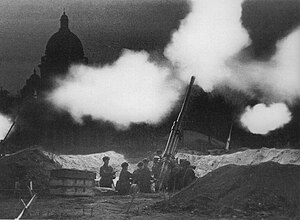 Soviet antiaircraft battery in Leningrad near Saint Isaac’s Cathedral, 1941 |
||||||||
|
||||||||
| Belligerents | ||||||||
 Germany Germany Finland[1][2] Finland[1][2]Naval support:  Italy[3] Italy[3] |
 Soviet Union Soviet Union |
|||||||
| Commanders and leaders | ||||||||
|
|
|||||||
| Strength | ||||||||
| Initial: 725,000 | Initial: 930,000 | |||||||
| Casualties and losses | ||||||||
|
Army Group North: 1941: 85,371 total casualties[4] 1942: 267,327 total casualties[5] 1943: 205,937 total casualties[6] 1944: 21,350 total casualties[7] Total: 579,985 casualties |
Russian estimate of killed, captured or missing:[9] |
|||||||
|
Soviet civilians: 642,000 during the siege, 400,000 at evacuations[8] |
The siege of Leningrad (Russian: Блокада Ленинграда, romanized: Blokada Leningrada; German: Leningrader Blockade; Finnish: Leningradin piiritys) was a prolonged military blockade undertaken by the Axis powers against the Soviet city of Leningrad (present-day Saint Petersburg) on the Eastern Front of World War II. Germany’s Army Group North advanced from the south, while the German-allied Finnish army invaded from the north and completed the ring around the city.
The siege began on 8 September 1941, when the Wehrmacht severed the last road to the city. Although Soviet forces managed to open a narrow land corridor to the city on 18 January 1943, the Red Army did not lift the siege until 27 January 1944, 872 days after it began. The blockade became one of the longest and most destructive sieges in history, and it was possibly the costliest siege in history due to the number of casualties which were suffered throughout its duration. While not classed as a war crime at the time,[10]
in the 21st century, some historians have classified it as a genocide due to the systematic starvation and intentional destruction of the city’s civilian population.[11][12][13][14][15]
BackgroundEdit
German soldiers in front of burning houses and a church, near Leningrad in 1941
Leningrad’s capture was one of three strategic goals in the German Operation Barbarossa and the main target of Army Group North. The strategy was motivated by Leningrad’s political status as the former capital of Russia and the symbolic capital of the Russian Revolution and Bolshevism hated by the NSDAP and the state apparatus, the city’s military importance as a main base of the Soviet Baltic Fleet, and its industrial strength, housing numerous arms factories.[16] By 1939, the city was responsible for 11% of all Soviet industrial output.[17]
It has been said that Adolf Hitler was so confident of capturing Leningrad that he had invitations printed to the victory celebrations to be held in the city’s Hotel Astoria.[18]
Although various theories have been put forward about Germany’s plans for Leningrad, including making it the capital of the new Ingermanland province of the Reich in Generalplan Ost, it is clear Hitler intended to utterly destroy the city and its population. According to a directive sent to Army Group North on 29 September:
After the defeat of Soviet Russia there can be no interest in the continued existence of this large urban center. […] Following the city’s encirclement, requests for surrender negotiations shall be denied, since the problem of relocating and feeding the population cannot and should not be solved by us. In this war for our very existence, we can have no interest in maintaining even a part of this very large urban population.[19]
Hitler’s ultimate plan was to raze Leningrad and give areas north of the River Neva to the Finns.[20][21]
PreparationsEdit
German plansEdit
Army Group North under Field Marshal Wilhelm Ritter von Leeb advanced to Leningrad, its primary objective. By early August, Army Group North was seriously over-extended, having advanced on a widening front and dispersed its forces on several axes of advance. Leeb estimated he needed 35 divisions for all of his tasks, while he only had 26.[22] The attack resumed on 10 August but immediately encountered strong opposition around Luga. Elsewhere, Leeb’s forces were able to take Kingisepp and Narva on 17 August. The army group reached Chudovo on 20 August, severing the rail link between Leningrad and Moscow. Tallinn fell on 28 August.[23]
Finnish military forces were north of Leningrad, while German forces occupied territories to the south.[24] Both German and Finnish forces had the goal of encircling Leningrad and maintaining the blockade perimeter, thus cutting off all communication with the city and preventing the defenders from receiving any supplies – although Finnish participation in the blockade mainly consisted of a recapture of lands lost in the Winter War. The Germans planned on lack of food being their chief weapon against the citizens; German scientists had calculated the city would reach starvation after only a few weeks.[1][2][25][26]
Leningrad fortified regionEdit
On Friday, 27 June 1941, the Council of Deputies of the Leningrad administration organised «First response groups» of civilians. In the next days, Leningrad’s civilian population was informed of the danger and over a million citizens were mobilised for the construction of fortifications. Several lines of defences were built along the city’s perimeter to repel hostile forces approaching from north and south by means of civilian resistance.[2]
In the south, the fortified line ran from the mouth of the Luga River to Chudovo, Gatchina, Uritsk, Pulkovo and then through the Neva River. Another line of defence passed through Peterhof to Gatchina, Pulkovo, Kolpino and Koltushy. In the north the defensive line against the Finns, the Karelian Fortified Region, had been maintained in Leningrad’s northern suburbs since the 1930s, and was now returned to service. A total of 306 km (190 mi) of timber barricades, 635 km (395 mi) of wire entanglements, 700 km (430 mi) of anti-tank ditches, 5,000 earth-and-timber emplacements and reinforced concrete weapon emplacements and 25,000 km (16,000 mi)[27] of open trenches were constructed or excavated by civilians. Even the guns from the cruiser Aurora were removed from the ship to be used to defend Leningrad.[28]
EstablishmentEdit
The 4th Panzer Group from East Prussia took Pskov following a swift advance and reached Novgorod by 16 August. After the capture of Novgorod, General Hoepner’s 4th Panzer Group continued its progress towards Leningrad.[29] However, the 18th Army – despite some 350,000 men lagging behind – forced its way to Ostrov and Pskov after the Soviet troops of the Northwestern Front retreated towards Leningrad. On 10 July, both Ostrov and Pskov were captured and the 18th Army reached Narva and Kingisepp, from where advance toward Leningrad continued from the Luga River line. This had the effect of creating siege positions from the Gulf of Finland to Lake Ladoga, with the eventual aim of isolating Leningrad from all directions. The Finnish Army was then expected to advance along the eastern shore of Lake Ladoga.[30]
The last rail connection to Leningrad was cut on 30 August, when the German forces reached the River Neva. In early September, Leeb was confident Leningrad was about to fall. Having received reports on the evacuation of civilians and industrial goods, Leeb and the OKH believed the Red Army was preparing to abandon the city. Consequently, on 5 September, he received new orders, including the destruction of the Red Army forces around the city. By 15 September, Panzer Group 4 was to be transferred to Army Group Centre so it could participate in a renewed offensive towards Moscow. The expected surrender did not materialise although the renewed German offensive cut off the city by 8 September.[31] Lacking sufficient strength for major operations, Leeb had to accept the army group might not be able to take the city, although hard fighting continued along his front throughout October and November.[32]
Orders of battleEdit
GermanyEdit
Map of Army Group North’s advance into the USSR in 1941. Coral up to 9 July, pink up to 1 September and green up to 5 December.
- Army Group North (Feldmarschall Wilhelm Ritter von Leeb)[33]
- 18th Army (Georg von Küchler)
- XXXXII Corps (2 infantry divisions)
- XXVI Corps (3 infantry divisions)
- 16th Army (Ernst Busch)
- XXVIII Corps (Mauritz von Wiktorin) (2 infantry, 1 armoured divisions)
- I Corps (2 infantry divisions)
- X Corps (3 infantry divisions)
- II Corps (3 infantry divisions)
- (L Corps – Under 9th Army) (2 infantry divisions)
- 4th Panzer Group (Erich Hoepner)
- XXXVIII Corps (Friedrich-Wilhelm von Chappuis) (1 infantry division)
- XXXXI Motorized Corps (Georg-Hans Reinhardt) (1 infantry, 1 motorised, 1 armoured divisions)
- LVI Motorized Corps (Erich von Manstein) (1 infantry, 1 motorised, 1 armoured, 1 panzergrenadier divisions)
- 18th Army (Georg von Küchler)
FinlandEdit
- Finnish Defence Forces HQ (Finnish Marshal Mannerheim)[34]
- I Corps (2 infantry divisions)
- II Corps (2 infantry divisions)
- IV Corps (3 infantry divisions)
ItalyEdit
- XII Squadriglia MAS (Mezzi d’Assalto) (Italian for «12th Assault Vessel Squadron») (C.C. Giuseppe Bianchini) Regia Marina
SpainEdit
- Blue Division, officially designated as 250. Infanterie-Division by the German Army and as the División Española de Voluntarios by the Spanish Army; General Esteban Infantes took command of this unit of Spanish volunteers at the Eastern Front during World War II.[35]
Soviet UnionEdit
- Northern Front (Lieutenant General Popov)[36]
- 7th Army (2 rifle, 1 militia divisions, 1 naval infantry brigade, 3 motorised rifle and 1 armoured regiments)
- 8th Army
- 10th Rifle Corps (2 rifle divisions)
- 11th Rifle Corps (3 rifle divisions)
- Separate Units (3 rifle divisions)
- 14th Army
- 42nd Rifle Corps (2 rifle divisions)
- Separate Units (2 rifle divisions, 1 Fortified area, 1 motorised rifle regiment)
- 23rd Army
- 19th Rifle Corps (3 rifle divisions)
- Separate Units (2 rifle, 1 motorised divisions, 2 Fortified areas, 1 rifle regiment)
- Luga Operation Group
- 41st Rifle Corps (3 rifle divisions)
- Separate Units (1 armoured brigade, 1 rifle regiment)
- Kingisepp Operation Group
- Separate Units (2 rifle, 2 militia, 1 armoured divisions, 1 Fortified area)
- Separate Units (3 rifle divisions, 4 guard militia divisions, 3 Fortified areas, 1 rifle brigade)
The 14th Army of the Soviet Red Army defended Murmansk and the 7th Army defended Ladoga Karelia; thus they did not participate in the initial stages of the siege. The 8th Army was initially part of the Northwestern Front and retreated through the Baltics. It was transferred to the Northern Front on 14 July when the Soviets evacuated Tallinn.
On 23 August, the Northern Front was divided into the Leningrad Front and the Karelian Front, as it became impossible for front headquarters to control everything between Murmansk and Leningrad.
Zhukov states, «Ten volunteer opolcheniye divisions were formed in Leningrad in the first three months of the war, as well as 16 separate artillery and machine-gun opolcheniye battalions.»[37]
Severing lines of communicationEdit
On 6 August, Hitler repeated his order: «Leningrad first, Donetsk Basin second, Moscow third.»[38] Arctic convoys using the Northern Sea Route delivered American Lend-Lease and British food and war materiel supplies to the Murmansk railhead (although the rail link to Leningrad was cut off by Finnish armies just north of the city), as well as several other locations in Lapland.[citation needed]
Encirclement of LeningradEdit
Map showing the Axis encirclement of Leningrad
Finnish intelligence had broken some of the Soviet military codes and read their low-level communications. This was particularly helpful for Hitler, who constantly requested intelligence information about Leningrad.[39] Finland’s role in Operation Barbarossa was laid out in Hitler’s Directive 21, «The mass of the Finnish army will have the task, in accordance with the advance made by the northern wing of the German armies, of tying up maximum Russian (sic – Soviet) strength by attacking to the west, or on both sides, of Lake Ladoga».[40] The last rail connection to Leningrad was severed on 30 August, when the Germans reached the Neva River. On 8 September, the road to the besieged city was severed when the Germans reached Lake Ladoga at Shlisselburg, leaving just a corridor of land between Lake Ladoga and Leningrad which remained unoccupied by Axis forces. Bombing on 8 September caused 178 fires.[41]
On 21 September, German High Command considered how to destroy Leningrad. Occupying the city was ruled out «because it would make us responsible for food supply».[42] The resolution was to lay the city under siege and bombardment, starving its population. «Early next year, we [will] enter the city (if the Finns do it first we do not object), lead those still alive into inner Russia or into captivity, wipe Leningrad from the face of the earth through demolitions, and hand the area north of the Neva to the Finns.»[43] On 7 October, Hitler sent a further directive signed by Alfred Jodl reminding Army Group North not to accept capitulation.[44]
Finnish participationEdit
By August 1941, the Finns advanced to within 20 km (12 mi) of the northern suburbs of Leningrad at the 1939 Finnish-Soviet border, threatening the city from the north; they were also advancing through East Karelia, east of Lake Ladoga, and threatening the city from the east. The Finnish forces crossed the pre-Winter War border on the Karelian Isthmus by eliminating Soviet salients at Beloostrov and Kirjasalo, thus straightening the frontline so that it ran along the old border near the shores of Gulf of Finland and Lake Ladoga, and those positions closest to Leningrad still lying on the pre-Winter War border.
According to Soviet claims, the Finnish advance was stopped in September through resistance by the Karelian Fortified Region;[45] however, Finnish troops had already earlier in August 1941 received orders to halt the advance after reaching their goals, some of which lay beyond the pre-Winter War border. After reaching their respective goals, the Finns halted their advance and started moving troops to East Karelia.[46][47]
For the next three years, the Finns did little to contribute to the battle for Leningrad, maintaining their lines.[48] Their headquarters rejected German pleas for aerial attacks against Leningrad[49] and did not advance farther south from the Svir River in occupied East Karelia (160 kilometres northeast of Leningrad), which they had reached on 7 September. In the southeast, the Germans captured Tikhvin on 8 November, but failed to complete their encirclement of Leningrad by advancing further north to join with the Finns at the Svir River. On 9 December, a counter-attack of the Volkhov Front forced the Wehrmacht to retreat from their Tikhvin positions in the Volkhov River line.[2]
On 6 September 1941, Germany’s Chief of Staff Alfred Jodl visited Helsinki. His main goal was to persuade Mannerheim to continue the offensive. In 1941, President Ryti declared to the Finnish Parliament that the aim of the war was to restore the territories lost during the Winter War and gain more territories in the east to create a «Greater Finland».[50][51][52] After the war, Ryti stated: «On August 24, 1941 I visited the headquarters of Marshal Mannerheim. The Germans aimed us at crossing the old border and continuing the offensive to Leningrad. I said that the capture of Leningrad was not our goal and that we should not take part in it. Mannerheim and Minister of Defense Walden agreed with me and refused the offers of the Germans. The result was a paradoxical situation: the Germans could not approach Leningrad from the north…» There was little or no systematic shelling or bombing from the Finnish positions.[24]
The proximity of the Finnish border – 33–35 km (21–22 mi) from downtown Leningrad – and the threat of a Finnish attack complicated the defence of the city. At one point, the defending Front Commander, Popov, could not release reserves opposing the Finnish forces to be deployed against the Wehrmacht because they were needed to bolster the 23rd Army’s defences on the Karelian Isthmus.[53] Mannerheim terminated the offensive on 31 August 1941, when the army had reached the 1939 border. Popov felt relieved, and redeployed two divisions to the German sector on 5 September.[54]
Subsequently, the Finnish forces reduced the salients of Beloostrov and Kirjasalo,[55] which had threatened their positions at the sea coast and south of the River Vuoksi.[55] Lieutenant General Paavo Talvela and Colonel Järvinen, the commander of the Finnish Coastal Brigade responsible for Ladoga, proposed to the German headquarters the blocking of Soviet convoys on Lake Ladoga. The idea was proposed to the Germans on their own behalf going past both Finnish Navy HQ and General HQ. Germans responded positively to the proposition and informed the slightly surprised Finns—who apart from Talvela and Järvinen had very little knowledge of the proposition—that transport of the equipment for the Ladoga operation was already arranged. The German command formed the ‘international’ naval detachment (which also included the Italian XII Squadriglia MAS) under Finnish command and the Einsatzstab Fähre Ost under German command. These naval units operated against the supply route in the summer and autumn of 1942, the only period the units were able to operate as freezing waters then forced the lightly equipped units to be moved away, and changes in front lines made it impractical to reestablish these units later in the war.[24][39][56][57]
Defensive operationsEdit
Two Soviet soldiers, one armed with a DP machine gun, in the trenches of the Leningrad Front on 1 September 1941
The Leningrad Front (initially the Leningrad Military District) was commanded by Marshal Kliment Voroshilov. It included the 23rd Army in the northern sector between the Gulf of Finland and Lake Ladoga, and the 48th Army in the western sector between the Gulf of Finland and the Slutsk–Mga position. The Leningrad Fortified Region, the Leningrad garrison, the Baltic Fleet forces, and Koporye, Pulkovo, and Slutsk–Kolpino operational groups were also present.[citation needed]
Defence of civilian evacueesEdit
According to Zhukov, «Before the war Leningrad had a population of 3,103,000 and 3,385,000 counting the suburbs. As many as 1,743,129, including 414,148 children were evacuated» between 29 June 1941 and 31 March 1943. They were moved to the Volga area, the Urals, Siberia and Kazakhstan.[58]
By September 1941, the link with the Volkhov Front (commanded by Kirill Meretskov) was severed and the defensive sectors were held by four armies: 23rd Army in the northern sector, 42nd Army on the western sector, 55th Army on the southern sector, and the 67th Army on the eastern sector. The 8th Army of the Volkhov Front had the responsibility of maintaining the logistic route to the city in coordination with the Ladoga Flotilla. Air cover for the city was provided by the Leningrad military district PVO Corps and Baltic Fleet naval aviation units.[59][60]
The defensive operation to protect the 1,400,000 civilian evacuees was part of the Leningrad counter-siege operations under the command of Andrei Zhdanov, Kliment Voroshilov, and Aleksei Kuznetsov. Additional military operations were carried out in coordination with Baltic Fleet naval forces under the general command of Admiral Vladimir Tributs. The Ladoga Flotilla under the command of V. Baranovsky, S.V. Zemlyanichenko, P.A. Traynin, and B.V. Khoroshikhin also played a major military role in helping with evacuation of the civilians.[61]
BombardmentEdit
Nurses helping wounded people during a German bombardment on 10 September 1941
The first success of the Leningrad air defence took place on the night of 23 June. The Ju-88A bomber from the 1st air corps KGr.806 was damaged by the AA guns fire of the 15th battery of the 192nd anti-aircraft artillery regiment, and made an emergency landing. All crew members, including commander, Lieutenant Hans Turmeyer, were captured on the ground. The commander of the 15th battery, lieutenant, Alexey Pimchenkov was awarded the Order of the Red Banner.[62]
By Monday, 8 September, German forces had largely surrounded the city, cutting off all supply routes to Leningrad and its suburbs. Unable to press home their offensive, and facing defences of the city organised by Marshal Zhukov, the Axis armies laid siege to the city for «900 days and nights».[63]
The air attack of Friday, 19 September, was particularly brutal. It was the heaviest air raid Leningrad would suffer during the war, as 276 German bombers hit the city killing 1,000 civilians. Many of those killed were recuperating from battle wounds in hospitals that were hit by German bombs. Six air raids occurred that day. Five hospitals were damaged in the bombing, as well as the city’s largest shopping bazaar. Hundreds of people had run from the street into the store to take shelter from the air raid.[64]
Artillery bombardment of Leningrad began in August, increasing in intensity during 1942 with the arrival of new equipment. It was stepped up further during 1943, when several times as many shells and bombs were used as in the year before. Against this, the Soviet Baltic Fleet Navy aviation made over 100,000 air missions to support their military operations during the siege.[65] German shelling and bombing killed 5,723 and wounded 20,507 civilians in Leningrad during the siege.[66]
Supplying the defendersEdit
Supplies being unloaded from a barge on Lake Ladoga to a narrow-gauge train in 1942
To sustain the defence of the city, it was vitally important for the Red Army to establish a route for bringing a constant flow of supplies into Leningrad. This route, which became known as the Road of Life (Russian: Дорога жизни), was effected over the southern part of Lake Ladoga and the corridor of land which remained unoccupied by Axis forces between Lake Ladoga and Leningrad. Transport across Lake Ladoga was achieved by means of watercraft during the warmer months and land vehicles driven over thick ice in winter (hence the route becoming known as «The Ice Road»). The security of the supply route was ensured by the Ladoga Flotilla, the Leningrad PVO Corps, and route security troops. Vital food supplies were thus transported to the village of Osinovets, from where they were transferred and transported over 45 km (28 mi) via a small suburban railway to Leningrad.[67] The route had to be used also to evacuate civilians, since no evacuation plans had been executed in the chaos of the first winter of the war, and the city was completely isolated until 20 November, when the ice road over Lake Ladoga became operational. Vehicles risked becoming stuck in the snow or sinking through broken ice caused by constant German bombardments, but the road brought necessary military and food supplies in and took civilians and wounded soldiers out, allowing the city to continue resisting the enemy.[68][69][70]
Effect on the cityEdit
The two-and-a-half-year siege caused the greatest destruction and the largest loss of life ever known in a modern city.[24][71] On Hitler’s direct orders the Wehrmacht looted and then destroyed most of the imperial palaces, such as the Catherine Palace, Peterhof Palace, Ropsha, Strelna, Gatchina, and other historic landmarks located outside the city’s defensive perimeter, with many art collections transported to Germany.[72] A number of factories, schools, hospitals and other civil infrastructure were destroyed by air raids and long range artillery bombardment.[73]
The diary of Tanya Savicheva, a girl of 11, her notes about starvation and deaths of her sister, then grandmother, then brother, then uncle, then another uncle, then mother. The last three notes say «Savichevs died», «Everyone died» and «Only Tanya is left.» She died of progressive dystrophy shortly after the siege. Her diary was used by the prosecution at the Nuremberg trials.[74]
The 872 days of the siege caused extreme famine in the Leningrad region through disruption of utilities, water, energy and food supplies. This resulted in the deaths of up to 1,500,000[75] soldiers and civilians and the evacuation of 1,400,000 more (mainly women and children), many of whom died during evacuation due to starvation and bombardment.[1][2] Piskaryovskoye Memorial Cemetery in Leningrad holds half a million civilian victims of the siege alone. Economic destruction and human losses in Leningrad on both sides exceeded those of the Battle of Stalingrad, the Battle of Moscow, or the bombing of Tokyo. The siege of Leningrad ranks as the most lethal siege in world history, and some historians speak of the siege operations in terms of genocide, as a «racially motivated starvation policy» that became an integral part of the unprecedented German war of extermination against populations of the Soviet Union generally.[76][77]
Three men burying victims of Leningrad’s siege in 1942
Two teen girls assemble PPD-40 submachine guns during the siege of Leningrad in 1943
Civilians in the city suffered from extreme starvation, especially in the winter of 1941–42. From November 1941 to February 1942 the only food available to the citizen was 125 grams of bread per day, of which 50–60% consisted of sawdust and other inedible admixtures. In conditions of extreme temperatures (down to −30 °C (−22 °F)), and with city transport out of service, even a distance of a few kilometres to a food distribution kiosk created an insurmountable obstacle for many citizens. Deaths peaked in January–February 1942 at 100,000 per month, mostly from starvation.[78] People often died on the streets, and citizens soon became accustomed to the sight of death.[79]
CannibalismEdit
While reports of cannibalism appeared in the winter of 1941–42, NKVD records on the subject were not published until 2004. Most evidence for cannibalism that surfaced before this time was anecdotal. Anna Reid points out that «for most people at the time, cannibalism was a matter of second-hand horror stories rather than direct personal experience».[80] Indicative of Leningraders’ fears at the time, police would often threaten uncooperative suspects with imprisonment in a cell with cannibals.[81] Dimitri Lazarev, a diarist during the worst moments in the Leningrad siege, recalls his daughter and niece reciting a terrifying nursery rhyme adapted from a pre-war song:
A dystrophic walked along
With a dull look
In a basket he carried a corpse’s arse.
I’m having human flesh for lunch,
This piece will do!
Ugh, hungry sorrow!
And for supper, clearly
I’ll need a little baby.
I’ll take the neighbours’,
Steal him out of his cradle.[82]
NKVD files report the first use of human meat as food on 13 December 1941.[83] The report outlines thirteen cases, which range from a mother smothering her eighteen-month-old to feed her three older children to a plumber killing his wife to feed his sons and nieces.[83]
By December 1942 the NKVD had arrested 2,105 cannibals – dividing them into two legal categories: corpse-eating (trupoyedstvo) and person-eating (lyudoyedstvo). The latter were usually shot while the former were sent to prison. The Soviet Criminal Code had no provision for cannibalism, so all convictions were carried out under Code Article 59–3, «special category banditry».[84] Instances of person-eating were significantly lower than that of corpse-eating; of the 300 people arrested in April 1942 for cannibalism, only 44 were murderers.[85] 64% of cannibals were female, 44% were unemployed, 90% were illiterate or with only basic education, 15% were rooted inhabitants, and only 2% had any criminal records. More cases occurred in the outlying districts than in the city itself. Cannibals were often unsupported women with dependent children and no previous convictions, which allowed for a certain level of clemency in legal proceedings.[86]
Given the scope of mass starvation, cannibalism was relatively rare.[87] Far more common was murder for ration cards. In the first six months of 1942, Leningrad witnessed 1,216 such murders. At the same time, Leningrad was experiencing its highest mortality rate, as high as 100,000 people per month. Lisa Kirschenbaum notes that rates «of cannibalism provided an opportunity for emphasizing that the majority of Leningraders managed to maintain their cultural norms in the most unimaginable circumstances.»[87]
Soviet relief of the siegeEdit
On 9 August 1942, the Symphony No. 7 «Leningrad» by Dmitri Shostakovich was performed by the Leningrad Radio Orchestra. The concert was broadcast on loudspeakers placed throughout the city and also aimed towards the enemy lines. The same day had been previously designated by Hitler to celebrate the fall of the city with a lavish banquet at Leningrad’s Astoria Hotel,[18] and was a few days before the Sinyavino Offensive.[citation needed]
Sinyavino OffensiveEdit
The Sinyavino Offensive was a Soviet attempt to break the blockade of the city in early autumn 1942. The 2nd Shock and the 8th armies were to link up with the forces of the Leningrad Front. At the same time the German side was preparing an offensive to capture the city, Operation Nordlicht (Northern Light), using the troops made available by the capture of Sevastopol.[88] Neither side was aware of the other’s intentions until the battle started.[citation needed]
The offensive began on 27 August 1942 with some small-scale attacks by the Leningrad front, pre-empting «Nordlicht» by a few weeks. The successful start of the operation forced the Germans to redirect troops from the planned «Nordlicht» to counterattack the Soviet armies.[citation needed] The counteroffensive saw the first deployment of the Tiger tank, though with limited success. After parts of the 2nd Shock Army were encircled and destroyed, the Soviet offensive was halted. However, the German forces also had to abandon their offensive.[citation needed]
Operation IskraEdit
The encirclement was broken in the wake of Operation Iskra (Spark), a full-scale offensive conducted by the Leningrad and Volkhov Fronts. This offensive started in the morning of 12 January 1943. After fierce battles the Red Army units overcame the powerful German fortifications to the south of Lake Ladoga, and on 18 January 1943, the Volkhov Front’s 372nd Rifle Division met troops of the 123rd Rifle Brigade of the Leningrad Front, opening a 10–12 km (6.2–7.5 mi)[verification needed] wide land corridor, which could provide some relief to the besieged population of Leningrad.[citation needed]
The Spanish Blue Division faced a major Soviet attempt to break the siege of Leningrad in February 1943, when the 55th Army of the Soviet forces, reinvigorated after the victory at Stalingrad, attacked the Spanish positions at the Battle of Krasny Bor, near the main Moscow-Leningrad road. Despite very heavy casualties, the Spaniards were able to hold their ground against a Soviet force seven times larger and supported by tanks. The Soviet assault was contained by the Blue Division.[89][90]
Lifting the siegeEdit
The siege continued until 27 January 1944, when the Soviet Leningrad–Novgorod Offensive expelled German forces from the southern outskirts of the city. This was a combined effort by the Leningrad and Volkhov Fronts, along with the 1st and 2nd Baltic Fronts. The Baltic Fleet provided 30% of aviation power for the final strike against the Wehrmacht.[65] In the summer of 1944, the Finnish Defence Forces were pushed back to the other side of the Bay of Vyborg and the Vuoksi River.[91]
The siege was also known as the Leningrad Blockade and the 900-Day Siege.
TimelineEdit
The timeline is based on various sources such as work done by David Glantz.[92]
1941Edit
A victim of starvation in besieged Leningrad suffering from muscle atrophy in 1941
- April: Hitler intends to occupy and then destroy Leningrad, according to plan Barbarossa and Generalplan Ost.
- 22 June: The Axis powers’ invasion of Soviet Union begins with Operation Barbarossa.
- 23 June: Leningrad commander M. Popov, sends his second in command to reconnoitre defensive positions south of Leningrad.
- 29 June: Construction of the Luga defence fortifications (Russian: Лужский оборонительный рубеж) begins together with evacuation of children and women.
- June–July: Over 300,000 civilian refugees from Pskov and Novgorod escaping from the advancing Germans come to Leningrad for shelter. The armies of the North-Western Front join the front lines at Leningrad. Total military strength with reserves and volunteers reaches 2 million men involved on all sides of the emerging battle.
- 19–23 July: First attack on Leningrad by Army Group North is stopped 100 km (62 mi) south of the city.
- 27 July: Hitler visits Army Group North, angry at the delay. He orders Wilhelm Ritter von Leeb to take Leningrad by December.
- 31 July: Finns attack the Soviet 23rd Army at the Karelian Isthmus, eventually reaching northern pre-Winter War Finnish-Soviet border.
- 20 August – 8 September: Artillery bombardments of Leningrad hit industries, schools, hospitals and civilian houses.
- 21 August: Hitler’s Directive No.34 orders «Encirclement of Leningrad in conjunction with the Finns.»
- 20–27 August: Evacuation of civilians is blocked by attacks on railways and other exits from Leningrad.
- 31 August: Finnish forces go on the defensive and straighten their front line.[47] This involves crossing the 1939 pre-Winter War border and occupation of municipalities of Kirjasalo and Beloostrov.[47]
- 6 September: German High Command’s Alfred Jodl fails to persuade Finns to continue offensive against Leningrad.
- 2–9 September: Finns capture the Beloostrov and Kirjasalo salients and conduct defensive preparations.
- 8 September: Land encirclement of Leningrad is completed when the German forces reach the shores of Lake Ladoga.
- 10 September: Joseph Stalin appoints General Zhukov to replace Marshal Voroshilov as Leningrad Front and Baltic Fleet commander.
- 12 September: The largest food depot in Leningrad, the Badajevski General Store, is destroyed by a German bomb.
- 15 September: Wilhelm Ritter von Leeb has to remove the 4th Panzer Group from the front lines and transfer it to Army Group Center for the Moscow offensive.
- 19 September: German troops are stopped 10 km (6.2 mi) from Leningrad. Citizens join the fighting at the defence line
- 22 September: Hitler directs that «Saint Petersburg must be erased from the face of the Earth».
- 22 September: Hitler declares, «….we have no interest in saving lives of the civilian population.»
- 8 November: Hitler states in a speech at Munich: «Leningrad must die of starvation.»
- 10 November: Soviet counter-attack begins, and lasts until 30 December.
- December: Winston Churchill wrote in his diary «Leningrad is encircled, but not taken.»
- 6 December: The United Kingdom declared war on Finland. This was followed by declaration of war from Canada, Australia, India and New Zealand.
- 30 December: Soviet counter-attack, which began at 10 November, forced Germans to retreat from Tikhvin back to the Volkhov River, preventing them from joining Finnish forces stationed at the Svir River on the eastern shore of Lake Ladoga.
1942Edit
Soviet civilians leaving destroyed houses after a German bombardment during the Siege, 10 December 1942
- 7 January: Soviet Lyuban Offensive Operation is launched; it lasts 16 weeks and is unsuccessful, resulting in the loss of the 2nd Shock Army.
- January: Soviets launch battle for the Nevsky Pyatachok bridgehead in an attempt to break the siege. This battle lasts until May 1943, but is only partially successful. Very heavy casualties are experienced by both sides.
- 4–30 April: Luftwaffe Operation Eis Stoß (ice impact) fails to sink Baltic Fleet ships iced in at Leningrad.
- June–September: New German railway-mounted artillery bombards Leningrad with 800 kg (1,800 lb) shells.
- August: The Spanish Blue Division (División Azul) transferred to Leningrad.
- 9 August 1942: The Symphony No. 7 «Leningrad» by Dmitri Shostakovich was performed in the city.[93]
- 14 August – 27 October: Naval Detachment K clashes with Leningrad supply route on Lake Ladoga.
- 19 August: Soviets begin an eight-week-long Sinyavino Offensive, which fails to lift the siege, but thwarts German offensive plans (Operation Nordlicht).
1943Edit
- January–December: Increased artillery bombardments of Leningrad.
- 12–30 January: Operation Iskra penetrates the siege by opening a land corridor along the coast of Lake Ladoga into the city. The blockade is broken.
- 10 February – 1 April: The unsuccessful Operation Polyarnaya Zvezda attempts to lift the siege.
1944Edit
- 14 January – 1 March: Several Soviet offensive operations begin, aimed at ending the siege.
- 27 January: Siege of Leningrad ends. German forces pushed 60–100 km (37–62 mi) away from the city.
- January: Before retreating, the German armies loot and destroy the historical Palaces of the Tsars, such as the Catherine Palace, the Peterhof Palace, the Gatchina Palace and the Strelna Palace. Many other historic landmarks and homes in the suburbs of St. Petersburg are looted and then destroyed, and a large number of valuable art collections are moved to Germany.
During the siege some 3,200 residential buildings, 9,000 wooden houses were burned, and 840 factories and plants were destroyed in Leningrad and suburbs.[94]
Later evaluationEdit
American evaluationEdit
Historian Michael Walzer summarized that «The Siege of Leningrad killed more civilians than bombing of Hamburg, Dresden, Hiroshima and Nagasaki combined.»[95]
The US Military Academy evaluated that Russian casualties during the siege were bigger than combined American and British casualties during the entire war.[96][97][95]
GenocideEdit
Some 21st century historians, including Timo Vihavainen and Nikita Lomagin, have classified the siege of Leningrad as genocide due to the systematic starvation and intentional destruction of the city’s civilian population.[11][12][13][14][15]
Controversial issuesEdit
Controversy over Finnish participationEdit
Almost all Finnish historians regard the siege as a German operation and do not consider that the Finns effectively participated in the siege. Russian historian Nikolai Baryshnikov argues that active Finnish participation did occur, but other historians have been mostly silent about it, most likely due to the friendly nature of post-war Soviet–Finnish relations.[98]
The main issues which count in favour of the former view are: (a) the Finns mostly stayed at the pre-Winter War border at the Karelian Isthmus (with small exceptions to straighten the frontline), despite German wishes and requests, and (b) they did not bombard the city from planes or with artillery and did not allow the Germans to bring their own land forces to Finnish lines. Baryshnikov explains that the Finnish military in the region was strategically dependent on the Germans, and lacked the required means and will to press the attack against Leningrad any further.[99]
Soviet deportation of civilians with enemy nations ethnic origin – Germans and FinnsEdit
Deportations of Finns and Germans from the Leningrad area to inhospitable areas of the Soviet Union began in March 1942 using the Road of Life; many of their descendants still remain in those areas today.[100] The situation in blockaded Leningrad was worse than that in the eastern areas to which most Leningrad residents were evacuated. These inhospitable areas of the Soviet Union hosted millions of evacuees, and many factories, universities, and theatres were also relocated there.[101]
CommemorationEdit
Leningrad Siege and Defence MuseumEdit
Even during the siege itself, war artifacts were collected and shown to the public by city authorities, such as the German aeroplane that was shot down and fell to the ground in Tauricheskiy Garden (Таврический сад). Such objects were displayed as a sign of the people’s courage, and gathered in a specially allocated building of the former 19th century Solyanoi Town [ru]. The exhibition was soon turned into a full-scale State Memorial Museum of the Defence and Siege of Leningrad [ru] (Государственный мемориальный музей обороны и блокады Ленинграда).
Several years after World War II, from the late 1940s to the early 1950s, Stalin’s supposed jealousy of Leningrad city leaders caused their destruction in the course of politically motivated show trials forming the post-WWII Leningrad Affair (the pre-war purge followed the 1934 assassination of the popular city ruler Sergey Kirov). Another generation of state and Communist Party functionaries of the city was wiped out, supposedly for publicly overestimating the importance of the city as an independent fighting unit and their own roles in defeating the enemy. Their brainchild, the Leningrad Defence Museum, was also destroyed, as were many valuable exhibits.[102]
With the museum’s revival during the wave of glasnost of the late 1980s new shocking facts were published, showing heroism of the wartime city along with hardships and even cruelties of the period. The exhibition opened in its originally allocated building, but has not yet regained its original size and area, most of its former premises having been occupied by military and other governmental offices. Plans for a new modern building of the museum have been suspended due to the financial crisis, although under the present Defence Secretary, Sergey Shoigu, promises have been made to expand the museum at its original location.[103]
Monuments: The Green Belt of Glory and memorial cemeteriesEdit
Commemoration of the siege got a second wind during the 1960s. Local artists dedicated their achievements to the Victory and memory of the war they saw. A leading local poet and war participant Mikhail Dudin suggested erecting a ring of monuments on the places of heaviest siege-time fighting and linking them into a belt of gardens around the city showing where the advancing enemy armies were stopped forever. That was the beginning of the Green Belt of Glory (Зелёный пояс Славы).[104]
On 29 October 1966, a monument entitled Broken Ring [ru] (of the Siege, Разорванное кольцо) was erected at the 40th kilometer of the Road of Life, on the shore of Lake Ladoga near the village of Kokkorevo. Designed and created by Konstantin Simun, the monument pays tribute not only to the lives saved via the frozen Ladoga, but also the many lives broken by the blockade.[citation needed]
Monument to the Heroic Defenders of Leningrad in Ploschad’ Pobedy (Victory Square), southern entrance to the city, 1981
The Monument to the Heroic Defenders of Leningrad on Victory Square [ru] (Монумент героическим защитникам Ленинграда) was erected on 9 May 1975 in Victory Square, Saint Petersburg.[105]
The monument is a huge bronze ring with a gap in it, pointing towards the site that the Soviets eventually broke through the encircling German forces. In the centre a Russian mother cradles her dying soldier son. The monument has an inscription saying «900 days 900 nights». An exhibit underneath the monument contains artifacts from this period, such as journals.[106][107]
Memorial cemeteriesEdit
During the siege, numerous deaths of civilians and soldiers led to considerable expansion of burial places later memorialised, of which the best known is Piskaryovskoye Memorial Cemetery.[108]
Military parade on Palace SquareEdit
Every year, on 27 January, as part of the celebrations of the lifting of the siege, a military parade of the troops of the Western Military District and the Saint Petersburg Garrison on Palace Square takes place. Close to 3,000 soldiers and cadets take part in the parade, which includes historical reenactors in Red Army uniforms, wartime tanks such as the T-34 and color guards carrying wartime flags such as the Banner of Victory and the standards of the different military fronts. Musical support is provided by the Massed Military Bands of the St. Petersburg Garrison under the direction of the Senior Director of Music of the Military Band of the Western Military District.[109][110]
See alsoEdit
- Consequences of Nazism
- Effect of the siege of Leningrad on the city
- List of famines
- List of genocides by death toll
- Ribbon of Leningrad Victory
- World War II casualties
ReferencesEdit
NotesEdit
- ^ a b c Brinkley & Haskew 2004, p. 210
- ^ a b c d e Wykes 1972, pp. 9–21
- ^ Baryshnikov 2003; Juutilainen 2005, p. 670; Ekman, P-O: Tysk-italiensk gästspel på Ladoga 1942, Tidskrift i Sjöväsendet 1973 Jan.–Feb. Archived 4 March 2016 at the Wayback Machine, pp. 5–46.
- ^ «Heeresarzt 10-Day Casualty Reports per Army/Army Group, 1941». Archived from the original on 25 October 2012. Retrieved 28 March 2012.
{{cite web}}: CS1 maint: unfit URL (link) - ^ «Heeresarzt 10-Day Casualty Reports per Army/Army Group, 1942». Archived from the original on 28 December 2015. Retrieved 24 March 2015.
{{cite web}}: CS1 maint: unfit URL (link) - ^ «Heeresarzt 10-Day Casualty Reports per Army/Army Group, 1943». Archived from the original on 25 May 2013. Retrieved 25 May 2013.
{{cite web}}: CS1 maint: unfit URL (link) - ^ «Heeresarzt 10-Day Casualty Reports per Army/Army Group, 1944». Archived from the original on 29 October 2012. Retrieved 3 May 2012.
{{cite web}}: CS1 maint: unfit URL (link) - ^ a b c Glantz 2001, pp. 179
- ^ Krivosheev, G. F. (1997). Soviet Casualties and Combat Losses in the Twentieth Century. ISBN 9781853672804. Archived from the original on 18 January 2023. Retrieved 3 October 2020.
- ^ «Siege Warfare and the Starvation of Civilians as a Weapon of War and War Crime». justsecurity.org. 4 February 2016. Archived from the original on 18 January 2023. Retrieved 3 August 2022.
- ^ a b Bidlack, Richard; Lomagin, Nikita (2012). The Leningrad Blockade, 1941–1944: A New Documentary History from the Soviet Archives. Translated by Schwartz, Marian. Yale University Press. pp. 1, 36. ISBN 9780300110296. JSTOR j.ctt5vm646.
Next to the Holocaust, the Leningrad siege was the greatest act of genocide in Europe during the Second World War, as Germany, and to a lesser extent Finland, tried to bombard and starve Leningrad into submission. […] The number of civilians who died from hunger, cold, and enemy bombardment within the blockaded territory or during and immediately following evacuation from it is reasonably estimated to be around 900,000.
- ^ a b Ganzenmüller 2005 page 334
- ^ a b Hund, Wulf Dietmar; Koller, Christian; Zimmermann, Moshe (2011). Racisms Made in Germany. Münster: LIT Verlag. p. 25. ISBN 978-3-643-90125-5. Archived from the original on 18 January 2023. Retrieved 23 June 2020.
- ^ a b Vihavainen, Timo; Schrey-Vasara, Gabriele (2011). «Opfer, Täter, Betrachter: Finnland und die Leningrader Blockade». Osteuropa. 61 (8/9): 48–63. JSTOR 44936431.
- ^ a b Siegl, Elfie (2011). «Die doppelte Tragödie: Anna Reid über die Leningrader Blockade». Osteuropa. 61 (8/9): 358–363. JSTOR 44936455.
- ^ Glantz 2001, pp. 13–14.
- ^ Saint Petersburg-The Soviet Period Archived 8 October 2014 at the Wayback Machine,» Saint Petersburg.» Encyclopædia Britannica. Encyclopædia Britannica. Encyclopædia Britannica, 2011. Web. 19 July 2011.
- ^ a b Vulliamy, ed. (25 November 2001). «Orchestral manoeuvres (part 1)». The Guardian. Archived from the original on 12 April 2020. Retrieved 13 December 2012.
- ^ Reid 2011, pp. 134–135, 6. No Sentimentality
- ^ In a conversation held on 27 November 1941, with the Finnish Foreign Minister Rolf Witting, Hitler stated that Leningrad was to be razed to the ground and then given to the Finns, with the River Neva forming the new post-war border between the German Reich and Finland. However, there was a command of Mannerheim in Finland for the country not to participate in the siege of Leningrad.
- ^ Hannikainen, Olli; Vehviläinen (2002). Finland in the Second World War: between Germany and Russia. Palgrave Macmillan. p. 104. ISBN 978-0-333-80149-9.
- ^ Klink 1998, pp. 631–634.
- ^ Klink 1998, pp. 635–637.
- ^ a b c d Baryshnikov 2003[page needed]
- ^ Higgins 1966[page needed]
- ^ Willmott, Cross & Messenger 2004
- ^ Bidlack, Richard (2013). The Leningrad Blockade. New Haven: Yale University press. p. 41. ISBN 978-0300198164.
- ^ Ermengem, Kristiaan Van. «Aurora, St. Petersburg». A View on Cities. Archived from the original on 7 February 2020. Retrieved 2 March 2020.
- ^ Carruthers, Bob (2011). Panzers at War 1939–1942. Warwickshire: Coda books. ISBN 978-1781591307.
- ^ Хомяков, И (2006). История 24-й танковой дивизии ркка (in Russian). Санкт-Петербург: BODlib. pp. 232 с. Archived from the original on 17 May 2010. Retrieved 27 January 2008.
- ^ Klink 1998, pp. 637–642.
- ^ Klink 1998, pp. 646–649.
- ^ Glantz 2001, p. 367
- ^ National Defence College 1994, pp. 2:194, 256
- ^ Carlos Caballero Jurado; Ramiro Bujeiro (2009). Blue Division Soldier 1941–45: Spanish Volunteer on the Eastern Front. Osprey Publishing. p. 34. ISBN 978-1-84603-412-1.
- ^ Glantz 2001, p. 351
- ^ Zhukov 1974, pp. 421, 438
- ^ Higgins 1966, pp. 151
- ^ a b Juutilainen & Leskinen 2005, pp. 187–9
- ^ Führer Directive 21. Operation Barbarossa
- ^ «St Petersburg – Leningrad in the Second World War Archived 16 July 2011 at the Wayback Machine» 9 May 2000. Exhibition. The Russian Embassy. London
- ^ Reid 2011, p. 132, 6. No Sentimentality
- ^ Reid 2011, p. 133, 6. No Sentimentality
- ^ ««Nuremberg Trial Proceedings Vol. 8″, from The Avalon Project at Yale Law School». Archived from the original on 15 April 2008.
- ^ Карта обстановки на фронте 23 Армии к исходу 11 September 1941 (in Russian). Архив Министерства обороны РФ. фонд 217 опись 1221 дело 33. 1941. Archived from the original on 7 March 2012.
- ^ Raunio, Ari; Kilin, Juri (2007). Jatkosodan hyökkäystaisteluja 1941. Keuruu: Otavan kirjapaino Oy. pp. 153–159. ISBN 978-951-593-069-9.
- ^ a b c National Defence College 1994, p. 2:261
- ^ Glantz 2001, pp. 166
- ^ National Defence College 1994, p. 2:260
- ^ Vehviläinen & McAlister 2002
- ^ Пыхалов, И. (2005). Великая Оболганная война (in Russian). ISBN 5-699-10913-7. Archived from the original on 29 August 2007. Retrieved 25 September 2007.
Со сслылкой на Барышников В. Н. «Вступление Финляндии во Вторую мировую войну. 1940–1941 гг.» СПб, 2003, с. 28
- ^ «И вновь продолжается бой…» Андрей Сомов. Центр Политических и Социальных Исследований Республики Карелия. (in Russian). Politika-Karelia. 28 January 2003. Archived from the original on 17 November 2007. Retrieved 25 September 2007.
- ^ Glantz 2001, pp. 33–34
- ^ Platonov 1964[page needed]
- ^ a b National Defence College 1994, pp. 2:262–267
- ^ YLE: Kenraali Talvelan sota Archived 29 October 2013 at the Wayback Machine (in Finnish)
- ^ Ekman, P-O: Tysk-italiensk gästspel på Ladoga 1942, Tidskrift i Sjöväsendet 1973 Jan.–Feb., pp. 5–46.
- ^ Zhukov 1974, p. 439
- ^ Greenwood, John (11 June 2014). Greenwood, John; Hardesty, Von; Higham, Robin (eds.). Russian Aviation and Air Power in the Twentieth Century. p. 117. doi:10.4324/9781315037868. ISBN 9781315037868.
- ^ Glantz, David M. (2004). The battle for Leningrad 1941–1944 : 900 days of terror. Cassell. pp. 14. ISBN 0-304-36672-2. OCLC 224098878.
- ^ Achkasov Bronislavovich Pavlovich», V. I. Nikolaĭ (1981). Soviet naval operations in the Great Patriotic War 1941–1945. Naval Institute Press. p. 324.
- ^ «Пимченков Алексей Титович – Муниципальное образование Литейный округ (№79)». liteiny79.spb.ru. Archived from the original on 2 March 2020. Retrieved 2 March 2020.
- ^ Zhukov 1974, pp. 399, 415, 425
- ^ http://www.bartcop.com/arc4109.htm Archived 4 February 2015 at the Wayback Machine[bare URL]
- ^ a b Гречанюк, Дмитриев & Корниенко 1990
- ^ Glantz 2001, p. 130
- ^ Reid 2011, p. 201, 10. The Ice Road
- ^ правды», Андрей МОИСЕЕНКО | Сайт «Комсомольской (23 June 2006). «Тайна «Дороги жизни»«. KP.RU – сайт «Комсомольской правды» (in Russian). Archived from the original on 15 July 2022. Retrieved 8 April 2019.
- ^ «Д-2 «Народоволец»«. 22 May 2008. Archived from the original on 22 May 2008. Retrieved 8 April 2019.
- ^ Salisbury 1969, pp. 407–412
- ^ Spencer C. Tucker (23 December 2009). A Global Chronology of Conflict: From the Ancient World to the Modern Middle East: From the Ancient World to the Modern Middle East. ABC-CLIO. p. 1929. ISBN 978-1-85109-672-5.
- ^ Nicholas, Lynn H. (1995). The Rape of Europa: the Fate of Europe’s Treasures in the Third Reich and the Second World War. Vintage Books
- ^ «Saint Petersburg encyclopaedia». encspb.ru. Archived from the original on 27 February 2021. Retrieved 2 March 2020.
- ^ «Memorial plaque in memory of Tanya Savicheva». www.visit-petersburg.ru. Archived from the original on 23 October 2020. Retrieved 12 December 2020.
- ^ Salisbury 1969, p. 590f
- ^ Ganzenmüller 2005, pp. 17, 20
- ^ Barber & Dzeniskevich 2005
- ^ Reid 2011, p. 284, 15. Corpse-eating and person-eating
- ^ Anderson, M. T. (7 February 2017). Symphony for the city of the dead: Dmitri Shostakovich and the siege of Leningrad. p. 284. ISBN 978-0-7636-9100-4. OCLC 975000281.
- ^ Reid 2011, p. 286, 15. Corpse-eating and person-eating
- ^ Salisbury 1969, p. 481
- ^ Reid 2011, p. 354, 19. The Gentle Joy of Living and Breathing
- ^ a b Reid 2011, p. 287, 15. Corpse-eating and person-eating
- ^ Reid 2011, p. 291, 15. Corpse-eating and person-eating
- ^ Reid 2011, p. 288, 15. Corpse-eating and person-eating
- ^ Reid 2011, p. 292, 15. Corpse-eating and person-eating
- ^ a b Kirschenbaum, Lisa A. (2006). «7. Speaking the Unspoken?». The Legacy of the Siege of Leningrad, 1941–1995: Myth, Memories, and Monuments. Cambridge, England, United Kingdom: Cambridge University Press. pp. 231–263. doi:10.1017/CBO9780511511882.010. ISBN 9781139460651. Archived from the original on 18 January 2023. Retrieved 25 October 2015 – via Google Books.
- ^ E. Manstein. Lost Victories. Ch 10
- ^ Carlos Caballero Jurado; Ramiro Bujeiro (2009). Blue Division Soldier 1941–45: Spanish Volunteer on the Eastern Front. Osprey Publishing. p. 34. ISBN 978-1-84603-412-1.
- ^ Gavrilov, B.I., Tragedy and Feat of the 2nd Shock Army, defunct site paper
- ^ David T. Zabecki (2015). World War II in Europe: An Encyclopedia. Taylor & Francis. p. 1556. ISBN 9781135812492. Archived from the original on 18 January 2023. Retrieved 23 June 2018.
- ^ Timeline references:
- Baryshnikov 2003[page needed]
- Zhukov 1974, pp. 399, 415, 425
- Juutilainen & Leskinen 2005, pp. 187–9
- National Defence College 1994, p. 2:260
- National Defence College 1994, pp. 2:262–267
- Cartier 1977[page needed]
- Glantz, David M. (2011). Operation Barbarossa : Hitler’s invasion of Russia, 1941. History Press. p. 37. ISBN 978-0-7524-6070-3. OCLC 813666134.
- Glantz 2001, p. 31
- Glantz 2001, p. 42
- Higgins 1966, pp. 156
- The World War II. Desk Reference. Eisenhower Center director Douglas Brinkley. Editor Mickael E. Haskey. Grand Central Press, 2004. Page 8.
- «Approaching Leningrad from the North. Finland in WWII (На северных подступах к Ленинграду)» (in Russian). Archived from the original on 20 December 2008. Retrieved 26 January 2008.
- Glantz 2001, p. 64
- Glantz 2001, p. 114
- Glantz 2001, p. 71
- Hitler, Adolf (22 September 1941). «Directive No. 1601» (in Russian). Archived from the original on 13 August 2009. Retrieved 28 December 2007.
- Churchill, Winston (2000) [1950]. The Grand Alliance. The Second World War. Vol. 3 (The Folio Society ed.). London: Cassel & Co.
- pp. 98–105, Finland in the Second World War, Bergharhn Books, 2006
- Bernstein, AI; Бернштейн, АИ (1983). «Notes of aviation engineer (Аэростаты над Ленинградом. Записки инженера – воздухоплавателя. Химия и Жизнь №5)» (in Russian). pp. с. 8–16. Archived from the original on 4 May 2008.
- Vulliamy, Ed (25 November 2001). «Orchestral maneouvres (part two)». The Observer. ISSN 0029-7712. Archived from the original on 29 January 2020. Retrieved 2 March 2020.
- Glantz 2001, pp. 167–173
- Ekman, P-O: Tysk-italiensk gästspel på Ladoga 1942, Tidskrift i Sjöväsendet 1973 Jan.–Feb., pp. 5–46.
- «A Brief History of the Amber Room». Smithsonian Magazine. Archived from the original on 4 March 2020. Retrieved 2 March 2020.
- «Saint Petersburg encyclopaedia». encspb.ru. Archived from the original on 4 March 2021. Retrieved 23 June 2020.
- ^ Brown, Kellie D. (2020). The sound of hope: Music as solace, resistance and salvation during the holocaust and world war II. McFarland. p. 215. ISBN 978-1-4766-7056-0.
- ^ Сведения городской комиссии по установлению и расследованию злодеяний немецко-фашистских захватчиков и их сообщников о числе погибшего в Ленинграде населения ЦГА СПб, Ф.8357. Оп.6. Д. 1108 Л. 46–47.
- ^ a b
Walzer, Michael (1977). Just and Unjust Wars. pp. 160. ISBN 978-0465037070.More civilians died in the siege of Leningrad than in the modernist infernos of Hamburg, Dresden, Tokyo, Hiroshima, and Nagasaki, taken together.
- ^ Atlas of the Second World War. West Point, USA, 1995
- ^ «The Siege of Leningrad, 1941–1944». Archived from the original on 26 December 2016. Retrieved 10 June 2018 – via EyeWitnessToHistory.com.
- ^ Baryshnikov 2003, p. 3
- ^ Baryshnikov 2003, p. 82
- ^ Klaas 2010
- ^ Куманев, Г.А. «ВОЙНА И ЭВАКУАЦИЯ В СССР. 1941–1942» (in Russian). Archived from the original on 6 December 2010. Retrieved 8 November 2015.
- ^ «Museum of the Defense and Siege of Leningrad, St. Petersburg Russia». saint-petersburg.com. Archived from the original on 2 March 2020. Retrieved 2 March 2020.
- ^ «A meeting with Acting Governor of St Petersburg Alexander Beglov». President of Russia. Archived from the original on 2 March 2020. Retrieved 2 March 2020.
- ^ «Saint Petersburg encyclopaedia». www.encspb.ru. Archived from the original on 28 January 2022. Retrieved 22 July 2021.
- ^ «Monument to the Heroic Defenders of Leningrad, St. Petersburg, Russia». 13 September 2012. Archived from the original on 28 September 2015. Retrieved 26 September 2015.
- ^ «The Monument to the Heroic Defenders of Leningrad». saint-petersburg.com. Archived from the original on 2 March 2020. Retrieved 2 March 2020.
- ^ «History». spbmuseum.ru. Archived from the original on 27 February 2020. Retrieved 2 March 2020.
- ^ «Пискарёвское мемориальное кладбище». museum.ru. Archived from the original on 16 November 2006. Retrieved 2 March 2020.
- ^ «Military Parade Marking 75th Anniversary of Leningrad Siege Held on Palace Square» Archived 28 January 2019 at the Wayback Machine (27 January 2019). TASS News Agency. Retrieved 3 March 2019.
- ^ «Military Parade Marks 75th Anniversary Of End Of Siege Of Leningrad» Archived 28 January 2019 at the Wayback Machine (27 January 2019). Radio Free Europe/Radio Liberty (RFERL.org). Retrieved 3 March 2019.
BibliographyEdit
- Barber, John; Dzeniskevich, Andrei (2005), Life and Death in Besieged Leningrad, 1941–44, Palgrave Macmillan, New York, ISBN 1-4039-0142-2
- Baryshnikov, N. I. (2003), Блокада Ленинграда и Финляндия 1941–44 (Finland and the Siege of Leningrad), Институт Йохана Бекмана
- Brinkley, Douglas; Haskew, Michael E. (2004), The World War II. Desk Reference, Grand Central Press
- Glantz, David (2001). The Siege of Leningrad 1941–44: 900 Days of Terror. Zenith Press, Osceola, WI. ISBN 0-7603-0941-8.
- Goure, Leon (1981), The Siege of Leningrad, Stanford University Press, Palo Alto, CA, ISBN 0-8047-0115-6
- Granin, Daniil Alexandrovich (2007), Leningrad Under Siege, Pen and Sword Books Ltd, ISBN 978-1-84415-458-6, archived from the original on 15 December 2007
- Higgins, Trumbull (1966), Hitler and Russia, The Macmillan Company
- Kirschenbaum, Lisa (2006), The Legacy of the Siege of Leningrad, 1941–1995: Myth, Memories, and Monuments, Cambridge University Press, New York, ISBN 0-521-86326-0
- Klaas, Eva (2010), Küüditatu kirjutas oma mälestused raamatuks (in Estonian: A Deportee Published His Memories in Book) (in Estonian), Virumaa Teataja, archived from the original on 20 July 2010, retrieved 19 July 2010
- Boog, Horst; Förster, Jürgen; Hoffmann, Joachim; Klink, Ernst; Müller, Rolf-Dieter; Ueberschär, Gerd R., eds. (1998). «The Army and the Navy». Germany and the Second World War: Attack on the Soviet Union. Vol. IV. Oxford and New York: Clarendon Press. ISBN 978-0-19-822886-8.
- Lubbeck, William; Hurt, David B. (2010), At Leningrad’s Gates: The Story of a Soldier with Army Group North, Casemate, ISBN 978-1-935149-37-8
- Platonov, S. P., ed. (1964), Bitva za Leningrad, Voenizdat Ministerstva oborony SSSR, Moscow
- Reid, Anna (2011). Leningrad: Tragedy of a City under Siege, 1941-44. London, England, United Kingdom: Bloomsbury Publishing. ISBN 9781408824702. Archived from the original on 18 January 2023. Retrieved 27 January 2022 – via Google Books.
- Salisbury, Harrison Evans (1969), The 900 Days: The Siege of Leningrad, Da Capo Press, ISBN 0-306-81298-3
- Simmons, Cynthia; Perlina, Nina (2005), Writing the Siege of Leningrad. Women’s diaries, Memories, and Documentary Prose, University of Pittsburgh Press, ISBN 978-0-8229-5869-7
- Vehviläinen, Olli; McAlister, Gerard (2002), Finland in the Second World War: Between Germany and Russia, Palgrave
- Willmott, H. P.; Cross, Robin; Messenger, Charles (2004), The Siege of Leningrad in World War II, Dorling Kindersley, ISBN 978-0-7566-2968-7
- Wykes, Alan (1972), The Siege of Leningrad, Ballantines Illustrated History of WWII
- Zhukov, Georgy (1974). Marshal of Victory, Volume I. Pen and Sword Books Ltd. ISBN 9781781592915.
Further readingEdit
- Backlund, L. S. (1983), Nazi Germany and Finland, University of Pennsylvania. University Microfilms International A. Bell & Howell Information Company, Ann Arbor, Michigan
- Barskova, P. (2017). Besieged Leningrad: Aesthetic Responses to Urban Disaster Archived 23 November 2022 at the Wayback Machine. DeKalb: Northern Illinois University Press.
- Barskova, Polina. «The Spectacle of the Besieged City: Repurposing Cultural Memory in Leningrad, 1941–1944.» Slavic Review (2010): 327–355. online Archived 3 November 2020 at the Wayback Machine
- Clapperton, James. «The siege of Leningrad as sacred narrative: conversations with survivors.» Oral History (2007): 49–60. online Archived 6 November 2020 at the Wayback Machine, primary sources
- Jones, Michael. Leningrad: State of siege (Basic Books, 2008).
- Kay, Alex J. (2006), Exploitation, Resettlement, Mass Murder. Political and Economic Planning for German Occupation Policy in the Soviet Union, 1940–1941, Berghahn Books, New York, Oxford
- Yarov, Sergey. Leningrad 1941-42: Morality in a City under Siege (Polity Press, 2017) online review
In Russian, German, and FinnishEdit
- Baryshnikov, N. I.; Baryshnikov, V. N. (1997), Terijoen hallitus, TPH
- Baryshnikov, N. I.; Baryshnikov, V. N.; Fedorov, V. G. (1989), Finlandia vo vtoroi mirivoi voine (Finland in the Second World War), Lenizdat, Leningrad
- Baryshnikov, N. I.; Manninen, Ohto (1997), Sodan aattona, TPH
- Baryshnikov, V. N. (1997), Neuvostoliiton Suomen suhteiden kehitys sotaa edeltaneella kaudella, TPH
- Cartier, Raymond (1977), Der Zweite Weltkrieg (The Second World War), R. Piper & CO. Verlag, München, Zürich
- Ganzenmüller, Jörg (2005), Das belagerte Leningrad 1941–1944, Ferdinand Schöningh Verlag, Paderborn, ISBN 3-506-72889-X
- Гречанюк, Н. М.; Дмитриев, В. И.; Корниенко, А. И. (1990), Дважды, Краснознаменный Балтийский Флот (Baltic Fleet), Воениздат
- Jokipii, Mauno (1987), Jatkosodan synty (Birth of the Continuation War), ISBN 951-1-08799-1
- Juutilainen, Antti; Leskinen, Jari (2005), Jatkosodan pikkujättiläinen, Helsinki
- National Defence College (1994), Jatkosodan historia 1–6, Porvoo, ISBN 951-0-15332-X
- Seppinen, Ilkka (1983), Suomen ulkomaankaupan ehdot 1939–1940 (Conditions of Finnish foreign trade 1939–1940), ISBN 951-9254-48-X
- Симонов, Константин (1979), Записи бесед с Г. К. Жуковым 1965–1966, Hrono, archived from the original on 27 February 2009, retrieved 30 December 2007
External linksEdit
- Media related to Siege of Leningrad at Wikimedia Commons
- Documentary footage: Блокада / Siege of Leningrad (2006) on YouTube
- «In the vortex of congealed time», by Oleg Yuriev. An overview of the literature of the Siege of Leningrad.
- Russian State Memorial Museum of Defence and Siege of Leningrad (in Russian)
- The Museum of the Siege of Leningrad at Google Cultural Institute
Паспорт
веб-квеста по английскому языку
-
Название проекта —The Leningrad Blockade
-
Ф.И.О. разработчика – Левченко Римма Евгеньевна
-
Название образовательного учреждения – МБОУ Гатчинская СОШ № 11»
-
Участники проекта: 8 кл, 9кл.
-
Год разработки проекта: 2019 г.
-
Цели проекта:
— создание условий для обогащения детей знаниями о ВОВ
— воспитание патриотизма, чувства гордости за свою Родину
7. Задачи проекта:
сформировать знания о блокадном Ленинграде.
пробудить в детях чувство сострадания и гордости за стойкость своего народа в период блокады Ленинграда и на протяжении всей Великой Отечественной войны
формировать исследовательские навыки, умения самостоятельно добывать новую информацию.
Освоить метод работы в группе.
-
Форма организации детей: групповая, индивидуальная, внешкольная.
-
После завершения проекта учащиеся смогут:
-использовать программные средства обработки изображений, создания презентаций, публикаций для представления результатов поисковой и исследовательской деятельности;
-выражать своё мнение по проблеме;
-аргументировать свою точку зрения;
-составлять планы письменных и устных сообщений;
-привести примеры, иллюстрирующие изучаемую проблему;
-анализировать, сопоставлять факты и делать выводы;
-обрабатывать полученную информацию;
-употреблять в речи изученную лексику по учебным темам;
-сотрудничать с другими учащимися и родителями, продуктивно работать в команде для решения поставленной проблемы;
-находить нужные информационные ресурсы;
-применять творчески свои идеи. -
Личностные результаты.
Учащиеся смогут:
-приобрести опыт коллективных взаимоотношений: сотрудничества и взаимопомощи;
-в процессе работы учиться вести «диалог культур» ;
-повысить интерес к предмету, который даёт возможность обсуждать волнующие их темы, близкие возрасту и реальной жизниМетапредметные результаты.
К ним можно отнести:
-способность регулировать собственную деятельность, направленную на изучение темы, осознание её важности и возможности самостоятельно найти пути и способы решения проблемы;
-способность осуществлять информационный поиск, оценивать степень значимости источника;
-умение структурировать найденную информацию;
-проводить анализ найденной информации, делать выводы на основе совокупности отдельных фактов;
-осознание правил и норм взаимодействия со взрослыми и сверстниками;
-навыки использования средств ИКТ для сопровождения интеллектуальной деятельности, развития универсальных учебных действий.Предметные результаты.
К ним можно отнести:
-усвоение первоначальных сведений;
-использование базового понятийного аппарата на уровне, доступном для понимания средних школьников,
-умение описывать и характеризовать факты и события в изучаемой области . -
Время работы : долгосрочный проект
-
Режим работы: внеурочный режим, очно встречались с детьми, дистанционно.
-
Учебно-методическое и техническое оснащение: Интернет ресурсы, аудио ресурсы, тест