
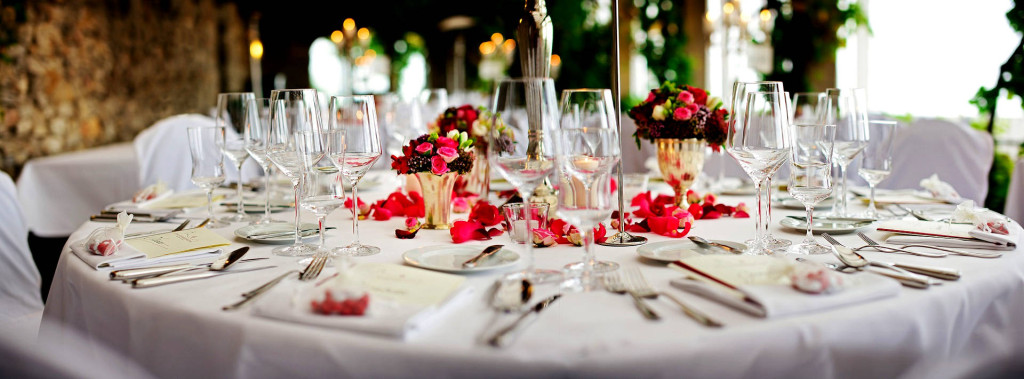
Топик по английскому Манеры за столом (Table Manners) рассказывает о том, как правильно вести себя во время еды. В данном тексте на английском языке будет рассказано Вам о том, что нельзя класть локти на стол, громко чавкать и опаздывать в гости. Манеры за столом (Table Manners) это топик на английском, который будет полезен для всех, кто путешествует и ведет активную социальную жизнь.
Текст топика «Table Manners»
Table manners vary from country to country. But knowing how to behave during meals is very important in any community. We have certain rules that tell us what to do, how to eat and what utencils to use.
There are some things that you should and shouldn’t do wherever you are.
Never speak with your mouth full, beacuse it is inapproprite to show people what you have in your mouth. So chew with your mouth closed, do not make noises when you eat and don’t make a mess on your plate.
Get rid of your bad habbit of putting your elbows on the table. It is not polite to make bad comments about food, the cook can be seriously offended. When you want something that is standing far from you, ask the other guests to pass it.
Take as much food as you want, but eat as much as you take. It is better to ask for another portion than to leave your plate full.
Eating and drinking too fast is also unacceptable even if you are very hungry. Don’t leave your spoon in the cup when drinking tea or coffee. Put vegetables and pasta onto the fork with the help of your knife. If your food is too hot, just be patient and wait a little, don’t blow on it.
In most European countries you should use a fork and a knife . But there are some exceptions. For example don’t be afraid to use your hand if you are eating chicken or taking a slice of bread.
In Asian countries it is normal to use your fingers or chopsticks.
If you are invited for dinner, be on time and don’t forget to thank the host.
These are the basic rules of ettiquett. If you want to look good during meals you should know and follow them.
Перевод топика «Манеры за столом»
Манеры за столом различаются от страны к стране. Но знание как вести себя за столом очень важно в любом обществе. У нас есть определенные правила, которые говорят нам что делать, как есть и какие приборы использовать.
Вот некоторые вещи, которые нужно и не нужно делать.
Никогда не говори с набитым ртом, потому что неприемлемо показывать людям, что у тебя во рту. Так что жуй с закрытым ртом, не издавай звуки во время еды и не создавай беспорядок в своей тарелке.
Избавься от ужасной привычки класть локти на стол. Невежливо плохо комментировать еду, это может серьезно обидеть повара. Когда ты хочешь что-то, стоящее далеко от тебя, попроси другого гостя передать это.
Берите столько еды, сколько хотите, но съедайте столько, сколько взяли. Лучше попросить новую порцию, чем оставить полную тарелку.
Есть слишком быстро неприемлемо даже если вы очень голодны. Не оставляйте ложку в чашке, когда пьете кофе или чай.Овощи и макароны кладутся на вилку с помощью ножа.
Если ваша еда слишком горячая, будьте терпеливы и подождите немного, не дуйте на нее.
В большинстве европейских стран нужно использовать вилку и нож. Но есть некоторые исключения, например, не бойся использовать руки, когда ешь курицу или берешь кусок хлеба. В азиатских странах является нормой использовать пальцы или палочки для еды.
Если вы приглашены на обед, приходите вовремя и не забывайте поблагодарить хозяина.
Вот базовые правила этикета. Если вы хотите хорошо выглядеть во время еды, вы должны их знать и следовать им.
Good table manners avoid ugliness. All rules of table manners are made to avoid it. To let anyone see what you have in your mouth is offensive. So is to make a noise. To make a mess in the plate is disgusting. So there are some rules how to behave yourself at the table:
Do not attract undue attention to yourself in public.
When eating take as much as you want, but eat as much as you take.
Never stretch over the table for something you want, ask. your neighbour to pass it.
Take a slice of bread from the bread-plate by hand, don’t harpoon your bread with a fork.
Never read while eating (at least in company).
When a dish is placed before you do not eye it suspiciously as though it were the first time you had seen it, and do not give the impression that you are about to sniff it.
Chicken requires special handling. First cut as much as you can, and when you can’t use knife or fork any longer, use your fingers.
The customary way to refuse a dish is by saying, «No, thank you» (or to accept, «Yes, please»). Don’t say «I don’t eat that stuff, don’t make faces or noises to show that you don’t like it.
In between courses don’t make bread-balls to while the time away and do not play with the silver.
Do not leave spoon in your cup when drinking tea or coffee.
Do not empty your glass too quickly — it will be promptly refilled.
Don’t put liquid into your mouth if it is already full.
Don’t eat off the knife.
Vegetables, potatoes, macaroni are placed on your fork with the help of your knife.
If your food is too hot don’t blow on it as though you were trying to start a campfire on a damp night.
Try to make as little noise as possible when eating.
And, finally, don’t forget to say «thank you» for every favour or kindness.
Манеры за столом
Хорошие манеры за столом позволяют избежать уродства. Все правила поведения за столом направлены на избежание этого. Показывать кому-то что у тебя во рту является оскорбительным. Точно также и шуметь. Беспорядок в своей тарелке отвратителен.Есть целый ряд правил как вести себя за столом:
Не привлекать излишнего внимания к себе в общественных местах.
Во время еды брать столько, сколько хотите, но съедать всё, что вы возьмёте.
Никогда не тянитесь через весь стол за тем, что вы хотите, попросите вашего соседа подать это.
Берите кусок хлеба из хлебницы рукой, а не вилкой.
Никогда не читайте во время еды (по крайней мере в компании).
Когда блюдо перед вами, не осматривайте его с подозрением, как если бы вы в первый раз видели его и не создавайте впечатление, что вы собираетесь понюхать его.
Курица требует специальной обработки. Сначала отрежте столько, сколько возможно, и, если вы не можете использовать нож или вилку больше, используйте пальцы.
Общепринятый способ отказываться от блюда, сказав: «Нет, спасибо» (или принять, «Да, пожалуйста»). Не говори «Я не ем это», не делайте гримасы или звуки, чтобы показать, что вам оно не нравится.
В перерывах между блюдами не делайте хлебные мячики чтобы скоротать время и не играйте с серебром.
Не оставляйте ложку в чашке, когда пьете чай или кофе.
Не опустошайте стакан слишком быстро — она будет незамедлительно наполнен.
Не набирайте жидкости в рот, если он уже переполнен.
Не ешьте с ножа.
Овощи, картофель, макароны ложите на вилку с помощью ножа.
Если пища слишком горячая, не дуйте на неё, как будто вы пытаетесь разжечь костер в сырую ночь.
Постарайтесь не шуметь во время еды.
И, наконец, не забудьте сказать «спасибо» за каждую услугу или доброту хозяев.
продолжить с темой «Еда»
вернуться к списку тем топиков
Курсы английского языка по уровням
Beginner

Экспресс-курс
«I LOVE ENGLISH»
Elementary
Космический квест
«БЫСТРЫЙ СТАРТ»
Intermediate
Обычная жизнь
КЕВИНА БРАУНА
В разработке
Advanced
Продвинутый курс
«ПРОРЫВ»
Практичные советы по изучению английского языка
Сочинение на тему “Правила поведения за столом” на английском языке с переводом на русский язык |
|
Table Manners |
Правила поведения за столом |
|
Even children know how important to amend table manners. The rules of table manners help people to avoid the ugliness. Of course, some rules of table manners vary from country to country because every country has its own culture. However there are some common rules of table manners. |
Даже дети знают, как важно следовать правилам поведения за столом. Правила поведения за столом помогают людям избежать некрасивого поведения. Конечно, некоторые правила поведения за столом варьируются от страны к стране, потому что у каждой страны есть своя культура. Однако есть некоторые общие правила поведения за столом. |
|
First of all, do not speak while eating even somebody asks you a question. If you speak while chewing, some parts of food can drop out of your mouth. One more rule is to bite off a small piece. Do not bite off big pieces. If you eat bread, you should break off a piece of bread. Do not bite off it. |
Прежде всего, не разговаривайте во время еды, даже если кто-то задает вам вопрос. Если вы разговаривайте во время жевания, некоторые части еды могут выпасть из вашего рта. Еще одно правило – откусывать маленькие кусочки. Не откусывайте большие куски. Если вы кушаете хлеб, отломите от него кусочек, не откусывайте. |
|
If you want to eat something that is far from you, ask other people to pass it. You should not stretch over the table. Do not eat off the knife. It is not only an ugly action but also a dangerous one because you can cut your mouth. It is also important to make as little noise as possible. So do not speak loudly. |
Если вы хотите съесть что-то, что далеко от вас, попросите других передать это вам. Вы не должны тянуться через весь стол. Не ешьте с ножа. Это не только некрасиво выглядит, но и опасно, потому что вы можете порезаться. Также важно издавать как можно меньше шума. Поэтому не разговаривайте громко. |
|
There are particular rules concerning particular food. For example, you should cut meat into thin slices. Besides, you should cut a new slice only after you eat a previous one. It is necessary to keep food hot and nice. If you eat chicken, cut as much as you can and, when it will be impossible to cut it, use your fingers. It is very important to amend table manners. |
Существуют особые правила, касающиеся конкретных продуктов питания. Например, вы должны разрезать мясо на тонкие ломтики. Кроме того, вы должны отрезать новый кусочек только после того, как съедите предыдущий. Это необходимо, чтобы поддерживать пищу горячей и красивой на вид. Если вы кушаете курицу, отрежьте от кости столько, сколько сможете, и, когда отрезать дальше невозможно, кушайте оставшееся мясо руками. Очень важно следовать правилам поведения за столом. |

[16.09.2010]
olga
Посмотрели: 104993
Рейтинг: 54
Коментариев: 3

54


Table Manners
Good table manners avoid ugliness. All rules of table manners are made to avoid it. To let anyone see what you have in your mouth is offensive. So is to make a noise. To make a mess in the plate is disgusting. So there are some rules how to behave yourself at the table:
Do not attract undue attention to yourself in public.
When eating take as much as you want, but eat as much as you take.
Never stretch over the table for something you want, ask. your neighbour to pass it.
Take a slice of bread from the bread-plate by hand, don’t harpoon your bread with a fork.
Never read while eating (at least in company).
When a dish is placed before you do not eye it suspiciously as though it were the first time you had seen it, and do not give the impression that you are about to sniff it.
Chicken requires special handling. First cut as much as you can, and when you can’t use knife or fork any longer, use your fingers.
The customary way to refuse a dish is by saying, «No, thank you» (or to accept, «Yes, please»). Don’t say «I don’t eat that stuff, don’t make faces or noises to show that you don’t like it.
In between courses don’t make bread-balls to while the time away and do not play with the silver.
Do not leave spoon in your cup when drinking tea or coffee.
Do not empty your glass too quickly — it will be promptly refilled.
Don’t put liquid into your mouth if it is already full.
Don’t eat off the knife.
Vegetables, potatoes, macaroni are placed on your fork with the help of your knife.
If your food is too hot don’t blow on it as though you were trying to start a campfire on a damp night.
Try to make as little noise as possible when eating.
And, finally, don’t forget to say «thank you» for every favour or kindness.
Манеры за столом
Хорошие манеры за столом позволяют избежать уродства. Все правила поведения за столом направлены на избежание этого. Показывать кому-то что у тебя во рту является оскорбительным. Точно также и шуметь. Беспорядок в своей тарелке отвратителен.Есть целый ряд правил как вести себя за столом:
Не привлекать излишнего внимания к себе в общественных местах.
Во время еды брать столько, сколько хотите, но съедать всё, что вы возьмёте.
Никогда не тянитесь через весь стол за тем, что вы хотите, попросите вашего соседа подать это.
Берите кусок хлеба из хлебницы рукой, а не вилкой.
Никогда не читайте во время еды (по крайней мере в компании).
Когда блюдо перед вами, не осматривайте его с подозрением, как если бы вы в первый раз видели его и не создавайте впечатление, что вы собираетесь понюхать его.
Курица требует специальной обработки. Сначала отрежте столько, сколько возможно, и, если вы не можете использовать нож или вилку больше, используйте пальцы.
Общепринятый способ отказываться от блюда, сказав: «Нет, спасибо» (или принять, «Да, пожалуйста»). Не говори «Я не ем это», не делайте гримасы или звуки, чтобы показать, что вам оно не нравится.
В перерывах между блюдами не делайте хлебные мячики чтобы скоротать время и не играйте с серебром.
Не оставляйте ложку в чашке, когда пьете чай или кофе.
Не опустошайте стакан слишком быстро — она будет незамедлительно наполнен.
Не набирайте жидкости в рот, если он уже переполнен.
Не ешьте с ножа.
Овощи, картофель, макароны ложите на вилку с помощью ножа.
Если пища слишком горячая, не дуйте на неё, как будто вы пытаетесь разжечь костер в сырую ночь.
Постарайтесь не шуметь во время еды.
И, наконец, не забудьте сказать «спасибо» за каждую услугу или доброту хозяев.
Правила поведения за столом (перевод)
Хорошие манеры за столом исключают вульгарность. Все правила поведения за столом созданы, чтобы избежать этого. Показывать кому-нибудь содержимое вашего рта — оскорбительно. То же самое касается и шума. Неаккуратно есть также некрасиво. Поэтому и существуют правила поведения за столом.
Не привлекайте к себе чрезмерного внимания собравшихся.
Когда едите, берите сколько хотите, но съедайте все, что берете.
Никогда не тянитесь через весь стол за чем-нибудь, попросите соседа передать это.
Берите кусочек хлеба с хлебницы рукой, не накалывайте его вилкой.
Никогда не читайте во время приема пищи (по крайней мере, в компании).
Когда перед вами поставлено блюдо, не пожирайте его глазами, как будто вы в первый раз его увидели, и не создавайте впечатления, будто вы готовы проглотить его.
Цыпленок требует специального способа обращения. Вначале порежьте его, а когда уже невозможно пользоваться ножом или вилкой, прибегните к пальцам.
Вежливый способ отказаться от блюда — сказать: «Нет, спасибо» (или согласиться: «Да, пожалуйста»). Не говорите «Я такое не ем», не гримасничайте и не поднимайте шум, показывая, что вы не хотите этого.
В перерывах между едой не катайте хлебные шарики, чтобы скоротать время, и не играйте с серебром.
Не оставляйте ложку в чашке, когда пьете чай или кофе.
Не опустошайте стакан очень быстро — он будет незамедлительно наполнен.
Не пейте, если ваш рот набит едой.
Не ешьте с ножа.
Фрукты, картофель, макароны накладываются на тарелку с помощью ножа.
Если еда горячая, не дуйте на нее так, как будто вы собираетесь развести костер глубокой ночью.
Попытайтесь создавать как можно меньше шума во время еды.
И, в конце концов, не забывайте благодарить за каждую услугу и помощь.
Table Manners
Good table manners avoid ugliness. All rules of table manners are made to avoid it. To let anyone see what you have in your mouth is offensive. So is to make a noise. To make a mess in the plate is disgusting. So there are some rules how to behave yourself at the table:
Do not attract undue attention to yourself in public.
When eating take as much as you want, but eat as much as you take.
Never stretch over the table for something you want, ask. your neighbour to pass it.
Take a slice of bread from the bread-plate by hand, don’t harpoon your bread with a fork.
Never read while eating (at least in company).
When a dish is placed before you do not eye it suspiciously as though it were the first time you had seen it, and do not give the impression that you are about to sniff it.
Chicken requires special handling. First cut as much as you can, and when you can’t use knife or fork any longer, use your fingers.
The customary way to refuse a dish is by saying, «No, thank you» (or to accept, «Yes, please»). Don’t say «I don’t eat that stuff, don’t make faces or noises to show that you don’t like it.
In between courses don’t make bread-balls to while the time away and do not play with the silver.
Do not leave s in your cup when drinking tea or
coffee.
Do not empty your glass too quickly — it will be promptly refilled.
Don’t put liquid into your mouth if it is already full.
Don’t eat off the knife.
Vegetables, potatoes, macaroni are placed on your fork with’ the help of your knife.
If your food is too hot don’t blow on it as though you were trying to start a campfire on a damp night.
Try to make as little noise as possible when eating.
And, finally, don’t forget to say «thank you» for every favour or kindness.
Установите соответствие между текстами A–G и заголовками 1–8. Запишите свои ответы в таблицу. Используйте каждую цифру только один раз. В задании один заголовок лишний.
1. A good source of information
2. From elitist knowledge to democratic usage
3. The revival of letter writing
4. A beautiful tradition lost
5. Making it quick and efficient
6. The victory of technology
7. Beauty is forever
8. As long as you can write on it!
A. There is something pleasant about receiving a handwritten letter from a friend. It is also very enjoyable to write a letter — choosing the paper and envelope, writing with a favourite pen, and the satisfying closure of licking the envelope and putting on a stamp. Unfortunately, since the widespread use of email, not many people write and send letters any more. The history of letter writing, however, is very interesting.
B. Before the invention of the postal service, letters were delivered on foot by couriers. The ancient Greeks used athletic runners for that. Later, horses were used because they were faster and could be changed at various stations. The Romans developed this system into a postal service. The Latin word ‘positus’ meant carriers, and that is where the English word ‘post’ comes from.
C. The material of letter writing has changed over time. Originally, people wrote on clay tablets. Later the Egyptians started using papyrus, a plant that grows in the river. The English word ‘paper’ comes from this plant. In the West, paper was produced from animal skins. In medieval times, the Saxons used the bark of the beech tree, called bok. This is where the English word ‘book’ comes from.
D. Literacy has had a big effect on letter writing: if you can’t read you can’t write letters! Before the 15t century letter writing was restricted to governments, the church, and the aristocracy. After the invention of the printing press that made books cheaper, literacy was greatly increased. Ordinary people started writing letters and it became the most popular and the only way of long distance communication until the invention of the telegraph in 1837.
E. Much of what we know of the lives of people long dead comes from personal letters. Certainly books have provided historical information about the Ancient Greek and Roman civilizations, but much of what we know of daily life from these periods comes from letters. Modern biographers get most of their information about the famous people they are writing about from their correspondence.
F. In the 18th and 19th centuries, letter writing was considered an art and essential part of life. People wrote not only to keep in touch but also as a method of literary expression, as a work of art, and conformed to conventions of etiquette and form. Literary figures wrote letters knowing that they would be read in the future by historians, and one day might be published. There were even novels consisting of a series of letters, known as the epistolary novel.
G. Even after the telephone became a common fixture in homes, people continued to write letters. What killed the letter was the widespread use of email, and the development of texting and chatting on social media. This type of communication holds many advantages. You don’t need to worry about the hassle of paper, envelopes, stamps, and going to the mailbox. It is also possible to get an instant reply.
| Текст | A | B | C | D | E | F | G |
| Заголовок |
Interesting Dining Manners in Different Cultures
Around the world, people gather to eat lunch or dinner. Every culture has developed this social ritual in different ways, so today there are certain rules that need to be respected while eating – for example, how to use utensils (knife, fork, spoon) correctly or when to ask to be served. We call them dining or table manners.
These rules differ from one culture to another, so what is considered to be polite in one society can be seen as very rude somewhere else!
Click Here for Step-by-Step Rules, Stories and Exercises to Practice All English Tenses
Interesting Word Origins in the Eng…
Please enable JavaScript
A Brief History of Table Manners in Europe
- Most table manners that Europeans and North Americans practice today originate from the Age of Exploration in the 1500s. It is believed that dinners became more refined when Catherine de’ Medici, who was the Pope’s niece, married the future King of France Henry II.
She was appalled by the fact that French people did not use forks, and had greasy hands from cutting the meat. - Around that time, a few more educated people, like Erasmus of Rotterdam (a Dutch scholar), had already written about the use of utensils and restraining oneself from eating quickly. At that time, knives, spoons and cups were shared among all those sitting at the table, and soups were drunk directly from the bowl.
- Soon after, individual cutlery was introduced, and napkins were adopted to protect the diners’ clothes. Even today, it is a good table manner to put the napkin on the lap.
Hands Up, France
When in France, you might be advised to always rest your wrists or forearms (but not elbows) on the table while you are not using utensils to eat. Keeping your hands under the table where nobody can see them is considered a bad dining manner.
In many other countries in Europe and North America, «hands on the table» is one of the basic dining rules, particularly reiterated to children. Why is that? Some people suggest this tradition started because people were afraid of what other people might be doing under the table, like holding a weapon.

Siesta, Spain
If you find yourself in Spain during the summer, you will notice that many shops are closed in the early afternoon, even on a regular work day. The reason they are closed is siesta, a short nap people take after lunch.
The word siesta, meaning «nap» in Spanish, derives from the Latin word sexta, meaning the sixth hour (counting from the dawn), which explains why siesta is usually taken around noon.
This particular dining ritual can be explained by the very high temperatures during the summer, and the great amount of food a typical midday meal in Spain includes. These two together make people very sleepy, so they made it a nation-wide acceptable habit to take a break from work in the middle of the day and get some rest.
Slurping, East and South Asia
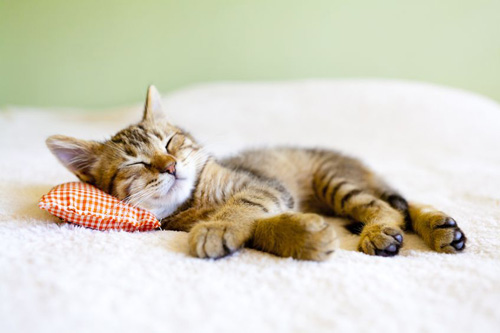
While in most European cultures making any noise while drinking or chewing is considered to be very rude, in places like Japan and China those who slurp their soups have good dining manners.
In other words, slurping your soup or noodles very loudly sends a message to the chef or the host that the food is delicious. The more loudly you slurp it, the more appreciation for the meal you show. If by any chance you forget to do it, the cook could be very offended or hurt thinking that you did not enjoy their meal!

Eating With Hands, Ethiopia
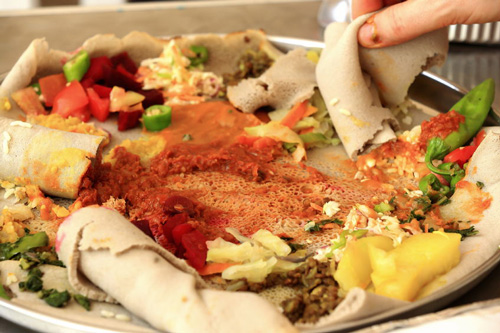
Traditionally, Ethiopian food is eaten with hands, usually from a large communal plate. Several delicious meals are put together in a plate with some injera, a flat Ethiopian bread, and the guests sit around it.
The proper way to eat Ethiopian food is to tear off a piece of the bread, grab some food that is close to you with it, and put it in your mouth. Because you are touching the food with your hands, make sure that you always wash them before and after the meal. The left hand is considered unclean, so it is advisable and polite to only use your right hand to eat.
No Extra Cheese, Italy
Italian cuisine is known for using a great variety of cheese in large quantities. Italian pizzas and pastas are particularly rich in cheese. In an Italian restaurant anywhere in the world, the parmesan cheese might even be freshly grated in front of you on your plate.
However, unless cheese is offered to you, you should not ask for extra cheese for a dish like pizza which already has a lot of cheese. Such an act is considered to be an insult to the cook, so most waiters will simply refuse to bring more cheese.
Another cheese-related rule in Italy applies to seafood – adding cheese to a seafood pasta is unimaginable according to traditional dining manners, so it is best you avoid it.
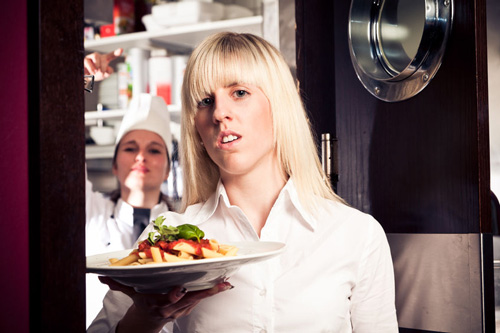
Comprehension Exercises
Vocabulary Questions
- What does «reiterate» mean?
- demand
- repeat
- forgive
- What does «appalled» mean?
- feeling shocked or disgusted
- being concerned
- liking something very much
- What does «refined» mean?
- improved, elegant
- rejected, disliked
- done again
- What does «cutlery» mean?
- the act of cutting bread
- decrease one’s debt
- cutting utensils
- What does «exploration» mean?
- hiding something from someone
- searching and finding out about something
- changing the rules
Collocation Questions
- Many shops in Spain are closed in the __________ afternoon.
- primary
- early
- first part of the
- Italians eat cheese in large __________.
- quantities
- sums
- volumes
- You should always __________ your wrists on the table.
- lay
- relax
- rest
- Ethiopian food is usually served in a large __________ plate.
- communal
- mass
- joint
- Asking for more cheese is an insulting __________.
- gesture
- act
- move
- Start eating by tearing __________ a piece of bread.
- up
- away
- off
- In many cultures, the left hand is considered __________.
- impure
- unclean
- stained
- Catherine de’ Medici was appalled __________ the behavior of the French.
- about
- of
- by
- Taking a siesta is __________ habit all over Spain.
- an acceptable
- a justifiable
- a bearable
- Erasmus thought people should __________ themselves from eating quickly.
- repress
- restrain
- limit
Wh Questions
- Why do people take siestas?
- because the weather is hot
- because the law requires it
- because cooking takes a long time
- Where should you put your napkin during dinner?
- around your neck
- on the table
- on the lap
- What should you never add to seafood in Italy?
- pasta
- cheese
- olive oil
- How does slurping compliment the cook in Japan?
- it means they will get a tip
- it means the food is delicious
- it means they are good-looking
- When did Europeans adopt forks and spoons?
- from the 16th century onwards
- 2,000 years ago
- in the 20th century
Evaluating Statements
- Based on the information in this lesson, which statement is true?
- Siestas always last from 3pm to 5pm.
- Siestas are usually taken around midday.
- Based on the information in this lesson, which statement is false?
- When in France, the best advice is to rest your elbows on the table.
- When in France, the best advice is to rest your wrists on the table.
True or False?
- Based on the information in this lesson, is the following statement true or false?
«During a meal in Ethiopia, always reach across the table to get food.»
- True
- False
- Based on the information in this lesson, is the following statement true or false?
«In Italy, if the waiter offers you cheese, it is okay to take it.»
- True
- False
Answer Key
1. B | 2. A | 3. A | 4. C | 5. B | 6. B | 7. A | 8. C | 9. A | 10. B | 11. C | 12. B | 13. C | 14. A | 15. B | 16. A | 17. C | 18. B | 19. B | 20. A |21. B | 22. A | 23. B | 24. A
Get Updates, Special Offers, and English Resources
Download your FREE GIFT (the first two chapters of
English Short Stories Book and Workbook)
as soon as you join!

By submitting your email, you consent to receiving updates and newsletters from us and to the sharing of your personal data with third parties for the purposes of sending you communications. We will not spam you. You can unsubscribe at any time. For more information, please see our privacy policy.